DSM-5 Round up: February #1

DSM-5 Round up: February #1

Post #225 Shortlink:
http://wp.me/pKrrB-2F7

Update: More recent coverage:

The first in a series of three commentaries by Allen Frances, MD, on the Somatic Symptoms Disorder issue has received over 25,000 page views on Psychology Today, alone. It was also published at Huffington Post and on “Education Update,” and now also at Psychiatric Times.

Mislabeling Medical Illness As Mental Disorder

Allen Frances, MD | February 13, 2013

Fox Health News

A psychiatrist’s take on the DSM-5 Somatic Symptom Disorder diagnosis, Dr Keith Ablow, for Fox News Health:

Does somatic symptom disorder really exist?

Keith Ablow, MD |  for Fox News Health | February 14, 2013

Currents An interactive newsletter of NASW-WA

(Washington State Chapter of the National Association of Social Workers is a membership organization.)

DSM 5 Changes

DSM-5: A Summary of Proposed Changes

Carlton E. Munson, PhD, LCSW-C | February 12, 2013

The Health Care Blog

Mislabeling Medical Illness

Allen Frances, MD | February 12, 2013

Huffington Post Blogger

Bruce E. Levine
Practicing clinical psychologist, writer

DSM-5: Science or Dogma? Even Some Establishment Psychiatrists Embarrassed by Newest Diagnostic Bible

Bruce E. Levine | February 10, 2013

Earlier coverage:

Huffington Post

DSM-5: Science or Dogma? Even Some Establishment Psychiatrists Embarrassed by Newest Diagnostic Bible

Bruce E. Levine | February 10, 2013

Practicing clinical psychologist, writer

+++

DIE WELT/Worldcrunch All news is global

Translated (and possibly abridged) from original article in German

Worldcrunch All news is global

Psychiatrists Not Crazy About The Revised Manual Of Mental Disorders

Fanny Jiménez and Christiane Löll | February 5, 2013

+++

Allen Frances, MD, now blogs at Saving Normal.

Archive posts at DSM 5 in Distress will remain accessible and open for new comments.

Saving Normal
Mental health and what is normal.
by Allen Frances, M.D.

DSM 5 Boycotts and Petitions
Too many, too sectarian

Allen Frances, MD | February 8, 2013

There are already about a dozen different DSM 5 petitions and boycotts out there. This is completely understandable – there is lots in DSM 5 to be angry at or frightened about.

Unfortunately, though, this is not a case of more the merrier. Fragmentation into a number of small protests will greatly reduce their aggregate impact…

+++

David J. Kupfer, MD, chairs the DSM-5 Task Force. On February 8, Dr Kupfer published in defence of the SSD construct on Huffington Post. Part Three in the Allen Frances and Suzy Chapman series of commentaries on the SSD criteria was published earlier, last week, Saving Normal on Psychology Today:

Huffington Post

David J. Kupfer, M.D.
Chair, DSM-5 Task Force

Somatic Symptoms Criteria in DSM-5 Improve Diagnosis, Care

David J. Kupfer, MD | February 8, 2013

While the goal of the upcoming fifth edition of the Diagnostic and Statistical Manual of Mental Disorders (DSM-5) is clear, accurate criteria for diagnosing mental disorders, the motivation behind the book’s revision was the improvement of diagnosis and clinical care. Somatoform disorders are one area where definitive progress was made.

Somatoform disorders are characterized by symptoms suggesting physical illness or injury, but which may not be fully explained by a general medical condition, another mental disorder, or by medication or substance side effects. The symptoms are either very distressing or result in significant disruption of an individual’s ability to function in daily life. People suffering from somatoform disorders are often initially seen in general medical settings as opposed to psychiatric settings…

+++
This new post from Christopher Lane on the DSM-5 ‘Somatic Symptom Disorder’ controversy has been designated a Psychology Today “Essential Read” editor pick:

Side Effects
From quirky to serious, trends in psychology and psychiatry
by Christopher Lane, Ph.D.

DSM-5 Has Gone to Press Containing a Major Scientific Gaffe
The APA declined to correct the error, despite multiple warnings.

Christopher Lane, PhD | February 8, 2013

When DSM-5 is published three months from now, in the middle of May, it will contain at least one major scientific gaffe. The Trustees of the American Psychiatric Association voted to include a definition of Somatic Symptom Disorder (SSD) so broad and over-inclusive that it is certain to include medical patients with an outsized concern about their health, as well as those who are merely vigilant in trying to maintain it…

+++
Lightweight feature in UK Times Magazine, Saturday, February 9, 2013:

The Asperger’s effect

Louise Carpenter | February 9 2013

Once it was a taboo. Now, in Silicon Valley, it’s almost a job qualification. So has the diagnosis lost its stigma, wonders Louise Carpenter…

+++

Article on mental health diagnosis and DSM-5 co-authored by Dr Raj Persaud, Consultant Psychiatrist, and Professor Sir Simon Wessely, Professor of Psychological Medicine, Institute of Psychiatry, King’s College London.


http://www.simonwessely.com/dsm5.html

DSM-5 and the future of psychiatry
Did 2012 prove that psychiatric disease doesn’t exist?

From doctors.net.uk 1.2.2013

+++
At the end of this article is a link to a forthcoming CPD Certified conference at the Wolfson Lecture Theatre, Institute of Psychiatry, June 4-5, 2013:

Conference:

DSM-5 and the Future of Psychiatric Diagnosis: Where is the roadmap taking us?

A two day international conference following the publication of the fifth edition of the Diagnostic and Statistical Manual of Mental Disorders (DSM-5) will take place at the Institute of Psychiatry on the 4th and 5th of June 2013.

Mental health practitioners and researchers around the world anticipate the DSM-5 that is due to published by the American Psychiatric Association within the first few months of 2013.

Discussions about the DSM-5 have stretched well beyond the world of academic psychiatry having become a matter of intense public interest and media coverage.

The aim of this conference is to have a rigorous and comprehensive discussion of the clinical, research, and public health implications of the DSM-5. The perspective is international and speakers will include top scientists, key policy makers, patient representatives, and front-line clinicians.

Speakers include:

Professor David Kupfer, Head of DSM-5 Planning Committee and Professor at the University of Pittsburgh

Professor William Carpenter, DSM-5 Task Force Member and Professor at the University of Maryland

Professor David Clark, Professor of Experimental Psychology, University of Oxford

Dr Clare Gerada, General Practitioner and Chair of the Council of the Royal College of General Practitioners

Professor Catherine Lord, Director of the Center for Autism and the Developing Brain and Professor at the University of Michigan

Professor Vikram Patel, Professor of International Mental Health, London School of Hygiene and Tropical Medicine

Professor Nikolas Rose, Head of the Department of Social Science, Health and Medicine, Kings College London

Sir Michael Rutter, First Professor of child psychiatry in the UK and Professor of Developmental Psychopathology at Kings College London

Professor Norman Sartorius, Former director of the World Health Organization’s Division of Mental Health, and a former president of the World Psychiatric Association

Price: £350 (including lunches and an evening reception)

Dates:

* Tuesday 4th June | 09:45- 17:30 (evening reception to follow)

* Wednesday 5th June | 09:45 – 17:15

Venue: Wolfson Lecture Theatre, Institute of Psychiatry

This event is CPD Certified

American Psychiatric Association launches new pages for DSM-5 – DSM-5 to cost $199

American Psychiatric Association (APA) launches new pages for DSM-5 – DSM-5 to cost $199

Post #220 Shortlink:
http://wp.me/pKrrB-2CD

Unless you’ve had your head stuck in a bucket this last three years, you’ll be aware that the next edition of the American Psychiatric Association’s diagnostic manual is slated for release this May.

APA has spent $25 million on the development of DSM-5.

DSM-5 will be published by American Psychiatric Publishing Inc. and planned for release at the APA’s 166th Annual Meeting in San Francisco (May 18-22).

A hardback copy is going to set you back $199, though paid up members of the American Psychiatric Association are being offered a discount.

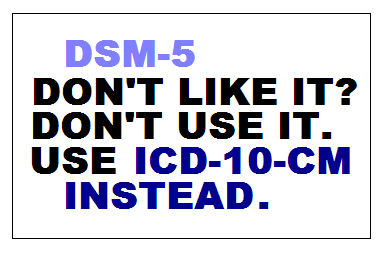
Psychiatrists, psychologists, primary health care physicians, therapists, counselors, social workers and allied health professionals don’t have to use DSM-5.

Instead, when codes are required they can use the codes in Chapter 5 of ICD-9-CM (Mental Disorders) and Chapter 5 of ICD-10-CM (Mental, Behavioral and Neurodevelopmental disorders), when ICD-10-CM is implemented*.

*Effective implementation date for ICD-10-CM (and ICD-10-PCS) is currently October 1, 2014. Until that time the codes in ICD-10-CM are not valid for any purpose or use.

Image Copyright Dx Revision Watch 2013

Don’t like it? Don’t use it. Use ICD codes instead.

Since 2003, ICD-9-CM diagnostic codes have been mandated for third-party billing and reporting by HIPAA for all electronic transactions for billing and reimbursement. The codes in DSM are crosswalked to ICD codes.

So you can use ICD-9-CM codes.

And when ICD-10-CM is implemented, it isn’t going to cost you a cent – it will be freely available on the internet.

The ICD-10-CM draft, currently subject to partial code freeze, and its associated documentation can be accessed here on the CDC site; so you can already have a poke around:

International Classification of Diseases, Tenth Revision, Clinical Modification (ICD-10-CM)

On January 23, Allen Frances, MD, who had oversight of the Task Force that developed DSM-IV had this to say about the $199 manual:

Price Gouging: Why Will DSM-5 Cost $199 a Copy?


APA launches new pages for DSM-5

Last week the APA launched new pages to promote DSM-5.

Report by John Gever for Medpage Today:

Psych Group Posts Glimpses of Final DSM-5

John Gever, Senior Editor, MedPage Today | January 21, 2013

Peeks into the final DSM-5, the controversial new edition of the American Psychiatric Association’s diagnostic manual, are now available from the group prior to the guide’s official May 22 debut…

PR piece by Mark Moran for Psychiatric News, organ of the American Psychiatric Association:

Psychiatric News | January 18, 2013
Volume 48 Number 2 page 1-6
10.1176/appi.pn.2013.1b10
American Psychiatric Association
Professional News

Continuity and Changes Mark New Text of DSM-5

Mark Moran

The DSM-5 Task Force chair discusses conceptual themes driving changes to the new manual. This is the first in a series continuing through May that will summarize the diagnostic and organizational differences between DSM-IV and DSM-5.

DSM-5, approved by the APA Board of Trustees in December, reflects the “state of the clinical science” in psychiatric diagnosis, incorporating important findings from genetic, neurobiological, and treatment research, while also maintaining substantial continuity for maximum clinical utility…

Go here for the DSM-5 Collection.

Psychiatric News Alert, where those not intending to boycott DSM-5 are encouraged to explore and pre-order a copy ($199):

Psychiatric News Alert

Tuesday, January 22, 2013

New DSM-5 Series Includes Supplementary Information; Order Your Manual Now!

The new DSM-5 pages can be found here, with articles, fact sheets and videos:


http://www.psychiatry.org/dsm5

Documents include:

DSM-5 Table of Contents  [Lists disorder sections and the categories that sit under them.]

Changes to DSM-5

Continuity and Changes Mark New Text of DSM-5, Psychiatric News, January 18, 2013

Highlights of Changes from DSM-IV-TR to DSM-5
DSM-5 Provides New Take on Developmental Disorders, Psychiatric News, January 18, 2013

DSM-5 Fact Sheets

From Planning to Publication: Developing DSM-5
The People Behind DSM-5
The Organization of DSM-5

Making a Case for New Disorders
Autism Spectrum Disorder
Specific Learning Disorder
Intellectual Disability
Social Communication Disorder
Attention-Deficit/Hyperactivity Disorder

DSM-5 Video Series

How and why was DSM-5 developed?
What has been the goal for revising DSM-5?

What are the changes to autism spectrum disorder in DSM-5?
What will be the impact of DSM-5 changes to autism spectrum disorder?
What are the changes to learning disorder in DSM-5?
What will be the impact of the revised specific learning disorder diagnosis?

The APA’s DSM-5 Development site can still be found here DSM-5 Development.

Proposals for changes to DSM-IV categories and criteria, as they had stood at the third draft, were frozen on June 15, 2012.

Any revisions made to criteria sets following closure of the third and final comment period are subject to embargo and the DSM-5 Development site has not been updated to reflect changes made to categories and criteria beyond June 15.

The entire third draft of proposals was removed from the DSM-5 Development site on November 15.

You can read APA’s rationale for removing the draft on an updated Permissions, Licensing & Reprints page.

DSM-5 Round up: January #2

DSM-5 Round up: January #2

Post #220 Shortlink:
http://wp.me/pKrrB-2Ce

Round up of recent media coverage of DSM-5 issues from US and UK spanning January 18 to January 28:

Scientific American

The Newest Edition of Psychiatry’s “Bible,” the DSM-5, Is Complete

The APA has finished revising the DSM and will publish the manual’s fifth edition in May 2013. Here’s what to expect

Ferris Jabr | January 28, 2013

For more than 11 years, the American Psychiatric Association (APA) has been laboring to revise the current version of its best-selling guidebook, the Diagnostic and Statistical Manual of Mental Disorders (DSM) (see “Psychiatry’s Bible Gets an Overhaul” in Scientific American MIND). Although the DSM is often called the bible of psychiatry, it is not sacred scripture to all clinicians—many regard it more as a helpful corollary to their own expertise. Still, insurance companies in the U.S. often require an official DSM diagnosis before they help cover the costs of medication or therapy, and researchers find it easier to get funding if they are studying a disorder officially recognized by the manual. This past December the APA announced that it has completed the lengthy revision process and will publish the new edition—the DSM-5—in May 2013, after some last (presumably minor) rounds of editing and proofreading. Below are the APA’s final decisions about some of the most controversial new disorders as well as hotly debated changes to existing ones, including a few surprises not anticipated by close observers of the revision process…

Update: New material above

New York Times | New Old Age Blogs | Medical Issues

Time to Recognize Mild Cognitive Disorder?

Paula Span| January 25, 2013

Dr. Allen Frances, chairman of the task force that developed the previous Diagnostic and Statistical Manual of Mental Disorders, predicts inclusion of Mild Neurocognitive Disorder in the new version will lead to “wild overdiagnosis.”

The Diagnostic and Statistical Manual of Mental Disorders, published and periodically updated by the American Psychiatric Association, is one of those documents few laypeople ever read, but many of us are affected by…

Medscape Medical News Psychiatry

No Impact of DSM-5 Criteria on Alcohol Disorder Prevalence

Deborah Brauser | January 25, 2013

Although criteria used to assess serious alcohol problems will be revised in the upcoming fifth edition of the Diagnostic and Statistical Manual of Mental Disorders (DSM-5), these changes will not likely affect the prevalence of these disorders, new research suggests…

Huffington Post Blogs | Allen Frances, MD

Why Will DSM-5 Cost $199 a Copy?

Allen Frances, MD | January 25, 2013

DSM-5 has just announced its price — an incredible $199 (and the paperback is also no bargain at a hefty $149). Compare this to $25 for a DSM III in 1980; $65 for a DSM IV in 1994; and $84 for a DSM-IV-TR in 2000. The price tag on a copy of DSM is escalating at more than twice the rate of inflation.

What’s going on?

Huffington Post Blogs | Allen Frances, MD

Terrible News: DSM-5 Refuses to Reduce Overdiagnosis of ‘Somatic Symptom Disorder’

Allen Frances, MD | January 18, 2013

Many of you will have read a previous blog prepared by Suzy Chapman and me that contained alarming information about the new DSM-5 diagnosis “somatic symptom disorder” (SSD).

DSM-5 defines SSD so over-inclusively that it will mislabel one in six people with cancer and heart disease, one in four with irritable bowel syndrom and fibromyalgia, and one in 14 who are not even medically ill.

I hoped to be able to influence the DSM-5 work group to correct this in two ways: 1) by suggesting improvements in the wording of the SSD criteria set that would reduce mislabeling, and 2) by letting them know how much opposition they would face from concerned professionals and an outraged public if DSM-5 failed to slam on the brakes while there was still time…

New York Times | New Old Age Blogs | Medical Issues

Grief Over New Depression Diagnosis

Paula Span | January 24, 2013, 6:40 am

The next edition of the Diagnostic and Statistical Manual of Mental Disorders will not only abandon the Roman numerals, but will also leave grief considerations out of diagnoses for depression.
When the American Psychiatric Association unveils a proposed new version of its Diagnostic and Statistical Manual of Mental Disorders, the bible of psychiatric diagnoses, it expects controversy. Illnesses get added or deleted, acquire new definitions or lists of symptoms. Everyone from advocacy groups to insurance companies to litigators — all have an interest in what’s defined as mental illness — pays close attention. Invariably, complaints ensue…

TIME | Alcohol

Revisions to Mental Health Manual May Turn Binge Drinkers into ‘Mild’ Alcoholics

Maia Szalavitz | January 23, 2013

Are you an alcoholic— or just a problem drinker? It may not matter, according to the latest version of the DSM, psychiatry’s diagnostic manual.

And now, in a new study of the different levels of alcohol misuse, scientists say the changes made to the DSM-5 may not even represent a significant improvement in the diagnosis of alcoholism. In fact, the revised definition collapses the medical distinction between problem drinking and alcoholism, potentially leading college binge drinkers to be mislabeled as possible lifelong alcoholics. The changes take effect in May, when the DSM-5 will be released…

EurekAlert! Press Release | January 22, 2013

Will Proposed DSM-5 Changes to Assessment of Alcohol Problems Do Any Better?

Proposed changes to the upcoming fifth edition of the Diagnostic and Statistical Manual of Mental Disorders (DSM-5) will affect the criteria used to assess alcohol problems. One change would collapse the two diagnoses of alcohol abuse (AA) and alcohol dependence (AD) into a single diagnosis called alcohol use disorder (AUD). A second change would remove “legal problems,” and a third would add a criterion of “craving.” A study of the potential consequences of these changes has found they are unlikely to significantly change the prevalence of diagnoses…

Medpage Today

Psych Group Posts Glimpses of Final DSM-5

John Gever, Senior Editor, MedPage Today | January 21, 2013

Peeks into the final DSM-5, the controversial new edition of the American Psychiatric Association’s diagnostic manual, are now available from the group prior to the guide’s official May 22 debut…

British Psychological Society

Professor Peter Kinderman writes on DSM-5 for the BBC News website

January 18, 2013

People diagnosed with a mental illness need help and understanding, not labels and medication. That is the message of an article published on the BBC News Health pages today by Professor Peter Kinderman from the University of Liverpool, a former chair of our Division of Clinical Psychology…

[BBC News Health report below]

BBC News Health

‘Grief and anxiety are not mental illnesses’

Peter Kinderman, Professor of Clinical Psychology | January 18, 2013

The forthcoming edition of an American psychiatric manual will increase the number of people in the general population diagnosed with a mental illness – but what they need is help and understanding, not labels and medication.

Many people experience a profound and long-lasting grieving process following the death of a loved one. Many soldiers returning from conflict suffer from trauma. Many of us are shy and anxious in social situations or unmotivated and pessimistic if we’re unemployed or dislike our jobs…

Psychiatric Times

DSM-5 Field Trials: What Was Learned

James Phillips, MD | January, 8 2013

With DSM-5 now approved by the APA Board of Trustees—and, to the dismay of this reader, all discussion removed from the DSM-5 Web site—how are we to evaluate the results of the field trials for the end product? I suggest beginning with the short piece published in Psychiatric News, “What We Learned from DSM-5 Field Trials.”1 Authors David Kupfer and Helena Kraemer wrote, “We ultimately tested the criteria for 23 disorders. The question we asked was a straightforward one: In the hands of regular clinicians, assessing typically symptomatic patients in no different way than they would during everyday practice, was a particular disorder reliable?”

DSM-5 Round up: January #1

DSM-5 Round up: January #1

Post #218 Shortlink:
http://wp.me/pKrrB-2Bs

American Journal of Psychiatry

Editorials | January 01, 2013

The Initial Field Trials of DSM-5: New Blooms and Old Thorns

Robert Freedman, M.D.; David A. Lewis, M.D.; Robert Michels, M.D.; Daniel S. Pine, M.D.; Susan K. Schultz, M.D.; Carol A. Tamminga, M.D.; Glen O. Gabbard, M.D.; Susan Shur-Fen Gau, M.D., Ph.D.; Daniel C. Javitt, M.D., Ph.D.; Maria A. Oquendo, M.D., Ph.D.; Patrick E. Shrout, Ph.D.; Eduard Vieta, M.D., Ph.D.; Joel Yager, M.D.

Am J Psychiatry 2013;170:1-5. 10.1176/appi.ajp.2012.12091189

View Author and Article Information
Copyright © 2013 by the American Psychiatric Association

Article
Figures
References

“A rose is a rose is a rose” (1). For psychiatric diagnosis, we still interpret this line as Robins and Guze did for their Research Diagnostic Criteria—that reliability is the first test of validity for diagnosis (2). To develop an evidence-based psychiatry, the Robins and Guze strategy (i.e., empirically validated criteria for the recognizable signs and symptoms of illness) was adopted by DSM-III and DSM-IV. The initial reliability results from the DSM-5 Field Trials are now reported in three articles in this issue (3–5). As for all previous DSM editions, the methods used to assess reliability reflect current standards for psychiatric investigation (3). Independent interviews by two different clinicians trained in the diagnoses, each prompted by a computerized checklist, assessment of agreement across different academic centers, and a pre-established statistical plan are now employed for the first time in the DSM Field Trials. As for most new endeavors, the end results are mixed, with both positive and disappointing findings…

Full free text

Washington Post

Antidepressants to treat grief? Psychiatry panelists with ties to drug industry say yes

Peter Whoriskey | December 27, 2012

It was a simple experiment in healing the bereaved: Twenty-two patients who had recently lost a spouse were given a widely used antidepressant.

The drug, marketed as Wellbutrin, improved “major depressive symptoms occurring shortly after the loss of a loved one,” the report in the Journal of Clinical Psychiatry concluded.

When, though, should the bereaved be medicated? For years, the official handbook of psychiatry, issued by the American Psychiatric Association, advised against diagnosing major depression when the distress is “better accounted for by bereavement.” Such grief, experts said, was better left to nature.

But that may be changing…

Medscape Medical News > Psychiatry

APA Answers Criticism of Pharma-Influenced Bias in DSM-5

Deborah Brauser | January 4, 2013

The American Psychiatric Association (APA) has fired back a strong response to a recent article by the Washington Post questioning the possibility of pharmaceutical industry influence on decisions regarding the upcoming fifth edition of the Diagnostic and Statistical Manual of Mental Disorders (DSM-5)…

Ed: Note for watchers of DSM-5′s Timeline. Although the Timeline has the final texts schedule for submission to the publishers by December 2012, in his commentary below, Dr Frances discloses that DSM-5 will go to press at the end of January. The new edition of DSM is slated for release at the APA’s 166th Annual Meeting, May 18-22, 2013, San Francisco.

Psychology Today

DSM5 in Distress
The DSM’s impact on mental health practice and research
by Allen Frances, M.D.

Last Plea to DSM 5: Save Grief From the Drug Companies
Let us respect the dignity of love and loss.

Allen J. Frances, M.D. | January 3, 2013

Psychiatric News
Psychiatric News | January 04, 2013
Volume 48 Number 1 page 7-7
10.1176/appi.pn.2013.1a14
American Psychiatric Association
Professional News

Eating-Disorders Guideline Still Current and Valid, Panel Finds

Mark Moran | January 4, 2013

A review of the 2006 APA practice guideline on eating disorders finds that it is substantially current and is not affected by changes in diagnostic criteria in DSM-5.

Huffington Post

‘Eating Disorders Not Otherwise Specified’: What’s Changing With EDNOS In DSM-5?

Catherine Pearson | January 4, 2013

It took Autumn Whitefield-Madrano more than 20 years to seek treatment for her eating disorder. The writer was 9 when she started having symptoms, primarily binging, and 33 when she finally got help. When she did, the diagnosis surprised her. Whitefield-Madrano had EDNOS, or an “Eating Disorder Not Otherwise Specified…”

Trouble with timelines (1) DSM-5, ICD-10-CM, ICD-11 and ICD-11-CM

Trouble with timelines (1): DSM-5, ICD-10-CM, ICD-11 and ICD-11-CM

Post #198 Shortlink:
http://wp.me/pKrrB-2qr

Update at August 15, 2012: On Page 3, I stated that Steven Hyman, MD, is a DSM-5 Task Force Member and that Dr Hyman chairs the meetings of the  International Advisory Group for the Revision of ICD-10 Mental and Behavioural Disorders. According to the DSM-5 Development site, Dr Hyman is no longer a member of the DSM-5 Task Force, having served from 2007-2012. I cannot confirm whether Dr Hyman continues involvement with the International Advisory Group for the Revision of ICD-10 Mental and Behavioural Disorders though his name remains listed on the WHO site page, or on what date or for what reason Dr Hyman stood down from the DSM-5 Task Force.

+++

While the US health care industry, professional bodies and clinical practices sweat on the announcement of a final rule for ICD-10-CM compliance and speculation continues over the feasibility of leapfrogging from ICD-9-CM to ICD-11, I thought I’d run through the timelines.

+++

DSM-5: ETA: May 18-22, 2013

Originally slated for publication in May 2012.

In December 2009, the American Psychiatric Association shifted release of DSM-5 to May 2013, in response to slipping targets. With no changes to the published Timeline and no intimation of further delays, I’m assuming DSM-5 remains on target.

The final manual is scheduled for submission to American Psychiatric Publishing by December 31, 2012, for official release, next May, during APA’s 2013 Annual Meeting in San Francisco.

Following closure of the third and final public review on June 15, 2012, draft proposals for disorder descriptions and criteria sets as published on the DSM-5 Development website were frozen. The DSM-5 website will not be updated with any further revisions made by the work groups between June 15 and going to print. Final criteria sets and manual content are under strict embargo until publication [1].

+++

ICD-10-CM: ETA: Compliance mandatory by October 1, 2013; Final Rule to be announced on CMS’s proposal to delay compliance date to October 1, 2014

The development process for ICD-10-CM is as old as God’s dog.

WHO published ICD-10 in 1992. Twenty years on, while the rest of the world has long since migrated to ICD-10, the US is still waiting to transition from ICD-9-CM to a US specific clinical modification of ICD-10. The US is still using a modification based on WHO’s long since retired, ICD-9, and a code set that is now over 35 years old.

The Tabular List and preliminary crosswalk between ICD-9-CM and ICD-10-CM were posted on the NCHS website for public comment in December 1997. Field testing took place nearly ten years ago, in the summer of 2003.

The proposed rule for the adoption of ICD-10-CM/PCS was published in August 2008 with a proposed compliance date of October 1, 2011. In January 2009, the Department of Health and Human Services (HHS) published a final rule adopting ICD-10-CM/PCS to replace ICD-9-CM in HIPAA transactions, with an effective compliance date of October 1, 2013.

On February 16, 2012, HHS Secretary Kathleen Sibelius announced intent to postpone the compliance date for adoption of ICD-10-CM/PCS codes sets for a further year, to October 1, 2014 to allow more time for providers, payers and vendors to prepare for transition.

Public comment on the proposed rule closed in June. An imminent decision on a final compliance rule is anticipated but no date by which a decision would be announced has been issued.

Annual updated releases of ICD-10-CM and associated documentation have been posted on the CDC website for public viewing since January 2009.

CMS has issued the 2013 release of ICD-10-CM and General Equivalence Mappings (GEMs) which replace the December 2011 release. Until an implementation date is reached, codes in the 2013 release of ICD-10-CM are not currently valid for any purpose or use but are available for public viewing on the CDC website.

+++
Partial Code freeze for ICD-9-CM and ICD-10-CM

At the September 15, 2010 public ICD-9-CM Coordination and Maintenance Committee Meeting it was announced that the committee had finalized its recommendation to impose a partial code freeze for ICD-9-CM and ICD-10-CM/PCS codes prior to implementation of ICD-10-CM. Partial Code Freeze Announcement [PDF]

October 1, 2011 was the last major update of ICD-10-CM/PCS until October 1, 2014. Between October 1, 2011 and October 1, 2014 proposals for revisions to ICD-10-CM/PCS will be considered only for new diseases/new technology procedures and minor revisions to correct reported errors. Regular (at least annual) updates to ICD-10-CM/PCS will resume on October 1, 2014.

These Partial Code Freeze dates are based on the original compliance date of October 1, 2013. It’s reported that postponement of the requirement for compliance until October 1, 2014 would also push back scheduled ICD-10-CM coding updates.

If the proposed compliance date of October 1, 2014 is instituted, adoption of ICD-10-CM would become mandatory around 18 months after publication of DSM-5. The first regular updates to ICD-10-CM would resume one year post compliance date, that is, from October 1, 2015.

Continued on Page 2

Changes to content on DSM-5 Development site (1)

Changes to content on DSM-5 Development site (1)

Post #189 Shortlink:
http://wp.me/pKrrB-2jn


Content embargo

According to American Psychiatric Association’s recently published, highly restrictive DSM-5 Permissions Policy – following closure of the third and final public review, the content of DSM-5 will be under strict embargo until the manual is published.

DSM-5 is expected to be finalized by December 31 for publication in May 2013.

APA closed its third stakeholder review of draft proposals for DSM-5 categories and criteria on June 15 and issued a Press Release on June 26 – write-up from Deborah Brauser for Medscape Medical News, below.

Between closure of the final review and Wednesday, June 27, the DSM-5 Development site stated that although comments on proposals could no longer be submitted through the website the site would remain viewable with the draft proposals until DSM-5′s publication.

That line of text was deleted from the DSM-5 Development site home page yesterday, Thursday, June 28.

It remains unconfirmed whether it is now APA’s intention to remove the draft as it stood at the third review from the DSM-5 Development site at some point between now and the slated publication date.


Categories and criteria text frozen during final revisions

According to DSM-5 Development home page text, revisions to categories and criteria will continue to be made between now and the end of 2012 in response to stakeholder feedback; continued analysis of DSM-5 Field Trial results; scrutiny by the DSM-5 Scientific Review Committee which will review scientific validating evidence for revisions; an extensive peer review process; review by an Assembly DSM-5 committee and an overall final review by the DSM-5 Task Force.

Disorder categories and criteria texts as they currently stand on the website are now frozen and the site content will not be updated to reflect any further revisions and edits made between June 15 and submission of final texts, later this year, for approval by APA Board of Trustees.

None of the manual’s extensive textual content that will accompany the new categories has been out on public review.

The remainder of the development process is set out on the Home Page under “Next Steps” and in the APA Board Materials Packet – December 10-11, 2011. This document sets out the DSM-5 Development program from December 2011 until May 2013:

Open here: Item 11.A – DSM Task Force Report


From Medscape Medical News > Psychiatry

Last DSM-5 Public Review Period Ends With 2000 Comments

Deborah Brauser | June 26, 2012

June 26, 2012 — The latest and final public comment period for the upcoming Diagnostic and Statistical Manual of Mental Disorders, Fifth Edition (DSM-5) ended on June 15 — but not before logging 2298 responses from around the world, the American Psychiatric Association (APA) reports.

This was the third public comment period that has been opened for online feedback regarding the manual’s proposed criteria changes. To date, there have been a total of 15,000 public comments posted…

Read full report

Ed: Free registration required for access to most parts of Medscape site.


Comment on closure of third and final draft review from 1 Boring Old Man

1 Boring Old Man

missed opportunity…

Wednesday, June 27, 2012


Related material

1] APA News Release June 26, 2012

2] DSM-5 Development Timeline

3] DSM-5 Development Permissions Policy

4] DSM-5 Terms and Conditions of Use

Three professional organization responses to third and final DSM-5 stakeholder review

Three professional organization responses to the third and final DSM-5 stakeholder review

Post #185 Shortlink:
http://wp.me/pKrrB-2hS

According to DSM-5 Task Force Vice-chair, Darrel Regier M.D., the specific diagnostic categories that received most comments during the second public review of draft proposals (May-June 2011) were the sexual and gender identity disorders, followed closely by somatic symptom disorders and anxiety disorders.

The American Psychiatric Association (APA) has yet to report how many comments the DSM-5 Task Force and its 13 Work Groups received during this third and final review period (which closed last Friday), or which categories garnered the most responses, this year.


No publication of field trial data

Following posting of the third draft on May 2, it was anticipated APA would publish full results from the DSM-5 field trials “within a month”. [Source: Deborah Brauser for Medscape Medical News: interview with Darrel Regier, May 8, 2012.]

No report emerged and stakeholders had little choice but submit feedback on this latest iteration without the benefit of scrutiny of reliability data to inform their submissions.

APA has yet to account for its failure to place its field trial results in the public domain while the feedback exercise was in progress, other than releasing some Kappa data at its May 5-9 Annual Conference.

American Psychiatric Association CEO and Medical Director, James H. Scully, Jr., M.D., blogs at Huffington Post. Last week, I asked Dr Scully why the field trial report has been withheld; whether Task Force still intends publishing field trial data and when that report might now be anticipated. 

I’ve received no response from Dr Scully and APA has put out no clarification.


No publication of list of Written Submissions

These three DSM-5 public reviews of draft proposals for changes to DSM-IV categories and criteria have not been managed as formal stakeholder consultation exercises.

APA publishes no aggregations of key areas of concern identified during public comment periods nor publishes Work Group or Task Force responses to key areas of professional or lay public concern on the DSM-5 Development website  – an issue I raised with the Task Force during both the first and second reviews.

Although some published submissions (ACA, British Psychological Society and the DSM-5 Reform Open Letter and Petition Committee) have received responses from the Task Force and which APA has elected to place in the public domain, submissions from the majority of professional bodies and organizations disappear into a black hole.

In the interests of transparency, APA could usefully publish lists of the names of US and international professional bodies, academic institutions, patient advocacy organizations etc. that have submitted comments, in the way that Written Submissions are listed in the annexes to reports and public inquiries.

That way, interested parties might at least approach organizations to request copies of submissions or suggest that these are placed in the public domain.

APA could not legitimately claim it would require permissions before publishing full lists of the names of professional body, academic institution and organization respondents that tendered formal responses – its legal department’s boilerplate Terms and Conditions of Use gives APA carte blanche to make use of and publish uploaded submissions in any way it sees fit.*

*See Terms and Conditions of Use, under “User Submissions” 


The following have released their submissions in response to the third draft:

Submission from The American Mental Health Counselors Association (AMHCA)

The American Mental Health Counselors Association is a nationwide organization representing 6,000 clinical mental health counselors. Their submission includes concerns for the lowering of the “B type” threshold requirement for “Somatic Symptom Disorder” criteria between the second and third drafts.

[In the CSSD field trials, about 15% of the "diagnosed illness" study group (patients with cancer and coronary disease) met the criteria for coding with an additional mental health diagnosis of "SSD" when "one B type" cognition was required; about 10% met the criteria when "two B type" were required. About 26% of the "functional somatic" arm of the study group (patients with irritable bowel and "chronic widespread pain" – a term used synonymously with fibromyalgia) met the criteria for coding with an additional mental health diagnosis of "SSD" when "one B type" cognition was required; about 13% met the criteria when "two B type" were required. AMHCA recommends raising the threshold back to at least two from the three B type criteria, as the criteria for CSSD had stood for the second draft. I consider the category of "SSD" should be rejected in the absence of a substantial body of independent evidence for the reliability, validity and safety of "SSD" as a construct.]

AMHCA Submits Comments on DSM-5 06/19/12

June 18, 2012 – Alexandria, VA – The DSM-5 Task Force of the American Mental Health Counselors Association (AMHCA) has submitted comments for the third period of public comment on the fifth edition of Diagnostic and Statistical Manual of Mental Disorders (DSM-5).

AMHCA’s comments addressed 12 disorder categories and the Cultural Formulation Interview Guide. Per the site requirements, each was sent separately to the particular disorder site.

    Download compilation of comments submitted by AMHCA DSM-5 Task Force

Somatic Symptom Disorders

“Somatic Symptom Disorder

“A major change in this revision is the merger of Complex Somatic Symptom Disorder and Simple Somatic Symptom Disorder into one disorder, Somatic Symptom Disorder. The increased emphasis placed on cognitive distortions (along with the presence of somatic symptoms ) provides greater clarity about the nature of the disorder. However, the notion that a single B.2 criteria could be used as the sole basis for identifying these cognitive aspects seems to open the door to diagnosing individuals who have legitimate “high anxiety” about their symptoms. We recommend considering “two of three” criteria under B be required.”


The British Psychological Society writes:

The British Psychological Society still has concerns over DSM-V

…For all the reasons stated above, the BPS, having reviewed the currently proposed revisions of the new diagnostic criteria in DSM 5, continues to have major concerns. These have, if anything, been increased by the very poor reliabilities achieved in many of the recent field trials (Huffington Post, 2012), especially given the limited time available to attempt to achieve more satisfactory outcomes. Since validity depends, at the very least, on acceptable levels of reliability, the unavoidable conclusion is that many of the most frequently-used categories will be unable to fulfil their purported purposes, i.e. identification of appropriate treatments, signposting to support, providing a basis for research…

Read full submission to third draft here in PDF format.

Response to second draft here.

Christopher Lane comments:

Psychology Today | Side Effects

Arguing Over DSM-5: The British Psychological Society Has Serious Concerns About the Manual

The BPS expresses “serious reservations” about the next DSM.

Christopher Lane, Ph.D. in Side Effects | June 20, 2012

Although the American Psychiatric Association recently closed its window allowing comments on proposed changes to the DSM, the organization has yet to report on the field trials it devised for the next edition of the psychiatric manual, themselves meant to support—indeed, serve as a rationale for—the changes it is proposing in the first place.

While this unhappy outcome points to some of the organization’s chicken-and-egg problems with the manual and the disorders it is seeking to adjust or make official, those wanting to respond to the draft proposals have had to do so in the dark, unaware of the results of the field trials and thus whether the proposals draw from them any actual empirical support…

Read on


Submission from American Counseling Association (ACA)

The American Counseling Association (ACA), represents more than 50,000 counselors – one of the largest groups of DSM-5 users in the US.

ACA provides final comments on the DSM-5

ACA President Don W. Locke has sent the American Psychiatric Association a letter providing final comments for the fifth edition of the Diagnostic and Statistical Manual of Mental Disorders (DSM-5). Based on comments from ACA members and the ACA DSM Task Force, the letter acknowledges useful changes that had been made to previous drafts of the DSM-5: the development of the Cultural Formulation Outline, reversing the pathologizing of normal bereavement, and limiting the expansion of personality disorder types. ACA also calls for addressing the one-dimensional nature of the new Substance Use Disorder category and rejects the proposed dimensional assessments. Click here to view letter.

This is the third letter ACA has sent to the American Psychiatric Association providing feedback for the DSM-5. Click the links below to read the previous letters and a response from APA:

Letter from President Lynn Linde, April 16, 2010

Letter from President Don Locke, November 8, 2011

Response from APA President John Oldham, November 21, 2011


Submission by Coalition for DSM-5 Reform Committee

The Coalition for DSM-5 Reform Open Letter and Petition has garnered support from over 13,700 professionals and concerned stakeholders and the endorsement of nearly 50 organizations, since launching last October.

The DSM-5 Reform Committee continues to call for independent scientific review of draft proposals and submitted the following response during this third and final comment period:

Submission from Coalition for DSM-5 Reform (Society for Humanistic Psychology)Division 32 of the American Psychological Association)

To the DSM-5 Task Force and the American Psychiatric Association

As you know, the Open Letter Committee of the Society for Humanistic Psychology and the Coalition for DSM-5 Reform have been following the development of DSM-5 closely.

We appreciate the opportunity for public commentary on the most recent version of the DSM-5 draft proposals. We intend to submit this brief letter via the dsm5.org feedback portal and to post it for public viewing on our website at
http://dsm5-reform.com/

Since its posting in October 2011, the Open Letter to the DSM-5, which was written in response to the second version of the draft proposals, has garnered support from almost 50 mental health organizations and over 13,500 individual mental health professionals and others.

Our three primary concerns in the letter were as follows: the DSM-5 proposals appear to lower diagnostic thresholds, expanding the purview of mental disorder to include normative reactions to life events; some new proposals (e.g., “Disruptive Mood Dysregulation Disorder” and “Attenuated Psychosis Syndrome”) seem to lack the empirical grounding necessary for inclusion in a scientific taxonomy; newly proposed disorders are particularly likely to be diagnosed in vulnerable populations, such as children and the elderly, for whom the over-prescription of powerful psychiatric drugs is already a growing nationwide problem; and the increased emphasis on medico-biological theories for mental disorder despite the fact that recent research strongly points to multifactorial etiologies.

We appreciate some of the changes made in this third version of the draft proposals, in particular the relegation of Attenuated Psychosis Syndrome and Mixed Anxiety-Depression to the Appendix for further research. We believe these disorders had insufficient empirical backing for inclusion in the manual itself. In addition, given the continuing elusiveness of biomarkers, we are relieved to find that you have proposed a modified definition of mental disorder that does not include the phrase “underlying psychobiological dysfunction.”

Despite these positive changes, we remain concerned about a number of the DSM-5 proposals, as well as the apparent setbacks in the development process.

Our continuing concerns are:

 The proposal to include new disorders with relatively little empirical support and/or research literature that is relatively recent (e.g., Disruptive Mood Dysregulation Disorder)

 The lowering of diagnostic thresholds, which may result in diagnostic expansion and various iatrogenic hazards, such as inappropriate treatment and stigmatization of normative life processes. Examples include the newly proposed Minor Neurocognitive Disorder, as well as proposed changes to Generalized Anxiety Disorder, Attention Deficit/Hyperactivity Disorder, Pedophilia, and the new behavioral addictions.

The perplexing Personality Disorders overhaul, which is an unnecessarily complex and idiosyncratic system that is likely to have little clinical utility in everyday practice.

 The development of novel scales (e.g., severity scales) with little psychometric testing rather than utilizing established standards.

In addition, we are increasingly concerned about several aspects of the development process. These are:

Continuing delays, particularly in the drafting and field testing of the proposals.

 The substandard results of the first set of field trials, which revealed kappas below accepted reliability standards.

 The cancelation of the second set of field trials.

The lack of formal forensic review.

Ad hominem responses to critics.

The hiring of a PR firm to influence the interpretation and dissemination of information about DSM-5, which is not standard scientific practice.

We understand that there have been recent attempts to locate a “middle ground” between the DSM-5 proposals and DSM-5 criticism. We believe that, given the extremity and idiosyncrasy of some of the proposed changes to the manual, this claim of a “middle ground” is more rhetorical and polemic than empirical or measured. A true middle ground, we believe, would draw on medical ethics and scientific standards to revise the proposals in a careful way that prioritizes patient safety, especially protection against unnecessary treatment, above institutional needs.

Therefore, we would like to reiterate our call for an independent scientific review of the manual by professionals whose relationship to the DSM-5 Task Force and/or American Psychiatric Association does not constitute a conflict of interest.

As the deadline for the future manual approaches, we urge the DSM-5 Task Force and all concerned mental health professionals to examine the proposed manual with scientific and expert scrutiny.

It is not only our professional standards, but also – and most importantly – patient care that is at stake. We thank you for your time and serious consideration of our concerns, and we hope that you will continue to engage in dialogue with those calling for reform of DSM-5.

Sincerely,

The DSM-5 Open Letter Committee of the Society for Humanistic Society, Division 32 of the American Psychological Association

American Psychiatric Association (APA) Assembly Notes and Full Treasurer’s Report

American Psychiatric Association (APA) Assembly Notes and Full Treasurer’s Report

Post #174 Shortlink:
http://wp.me/pKrrB-2bX

Update @ June 1, 2012

James H. Scully, Jr., M.D., CEO and Medical Director of the American Psychiatric Association, has published a response to Allen Frances’ Huff Po blog of May 30:

DSM-5 Inaccuracies: Setting the Record Straight

Update @ May 30, 2012

1 Boring Old Man

reform, or accept your fate…

1 Boring Old Man | May, 30 2012

Huffington Post Blogs Allen Frances, MD

DSM-5 Costs $25 Million, Putting APA in a Financial Hole

Allen Frances | May 30, 2012

The American Psychiatric Association just reported a surprisingly large yearly deficit of $350,000. This was caused by reduced publishing profits, poor attendance at its annual meeting, rapidly declining membership, and wasteful spending on DSM-5. APA reserves are now below “the recommended amount for a non-profit (reserves equal to a year’s operating expenses).”

APA has already spent an astounding $25 million on DSM-5. I can’t imagine where all that money went. As I recall it, DSM-IV cost about $5 million, and more than half of this came from outside research grants. Even if the DSM-5 product were made of gold instead of lead, $25 million would be wildly out of proportion. The rampant disorganization of DSM-5 must have caused colossal waste. One obvious example is the $3 million spent on the useless DSM-5 field trial, with its irrelevant question, poorly conceived design, and embarrassing results…

Full commentary

On May 8, in an article for Medscape Medical News, Deborah Brauser reported:

     …Members of the task force said they hope to publish the full results [of the DSM-5 field trials] “within a month.” However, the third and final public comment period for the manual opened last week and ends on June 15. Although the entire period is 6 weeks long, the public may only have 2 weeks to comment after the publication of the field trials’ findings. DSM-5 Field Trials Generate Mixed Results

With less than three weeks to go before the stakeholder and public comment period closes, there is still no sign of a report on the DSM-5 field trials.

If the Task Force does not get a report out soon, stakeholders will be obliged to submit feedback without the benefit of data from the trials to inform their comments. Once again, this third and final stakeholder review smacks of a purely tokenistic exercise.

For the two previous draft reviews, some disorders were accompanied by PDF documents expanding on new and revised disorder descriptions and work group rationales.

For the Somatic Symptom Disorders, no updated “Disorder Descriptions” or “Rationale/Validity” documents have been published that reflect substantial revisions made to proposals and criteria between the second and third drafts. The documents as published for the second review have been taken down from the DSM-5 Development site but have not been revised and reissued.

I have twice contacted APA Media and Communications for clarification of whether the Work Group intends to publish revised documents before the end of the comment period. Evidently APA Media and Communications don’t wish to provide me with a response.


I will update if and when a report on the field trials emerges from the Task Force.

In the meantime, here are two public domain documents that may be of interest to APA watchers:

APA Assembly Notes Spring 2012

or download here:


http://alabamapsych.org/wp-content/uploads/2012/02/apa_assembly_notes_may_2012.pdf

APA Treasurer’s Report May 2012  [.ppt compatible PowerPoint reader required]

or view here:


https://docs.google.com/file/d/0BzWdENl1wkVSYk5aXzRZelFYUjA/edit?pli=1

DSM-5 in New Scientist: Psychiatry’s new diagnostic bible is creating headaches for doctors and patients alike

DSM-5 in New Scientist: “Psychiatry’s new diagnostic bible is creating headaches for doctors and patients alike”

Post #171 Shortlink:
http://wp.me/pKrrB-293

A reminder that this third and final stakeholder review and comment period is scheduled to close on June 15.

On May 17, APA added the following statement to the home page of the DSM-5 Development site.

APA Position Statement on DSM-5 Draft Diagnostic Criteria

The official position of the APA on draft DSM-5 diagnostic criteria is that they are not to be used for clinical or billing purposes under any circumstances. They are published on the http://www.dsm5.org Web site to obtain feedback on these preliminary DSM-5 Task Force proposals from mental health professionals, patients, and the general public. They have not received official reviews or approval by the APA Board of Trustees and will not be available for clinical use or billing purposes until May 2013.

Two articles in this week’s online and print editions of New Scientist.

The first report, by Peter Aldhous, quotes Allen Frances, MD, who had chaired the development of the DSM-IV; APA research director and DSM-5 Task Force Vice Chair, Darrel Regier, and Dr Dayle Jones who is tracking DSM-5 for the American Counseling Association, on DSM-5 field trial kappa results and the relegation of Attenuated psychosis syndrome and Mixed anxiety/depression to the DSM-5 appendix.

This article is behind a paywall or a subscription to the print edition.

New Scientist 19 May 2012

Page 6 print edition

THIS WEEK/MENTAL HEALTH

Psychiatry’s new diagnostic bible is creating headaches for doctors and patients alike

Online title Trials highlight worrying flaws in psychiatry ‘bible’

Peter Aldhous

Diagnosis: uncertain

HOW reliable is reliable enough?

The second article, “OPINION ‘Label jars, not people”, by James Davies, is accessible on the New Scientist website without payment or print edition subscription.

New Scientist 19 May 2012

Page 7 print edition

OPINION | James Davies

James Davies is a senior lecturer in social anthropology and psychotherapy at the University of Roehampton, London

‘Label jars, not people’

“LABEL jars, not people” and “stop medicalising the normal symptoms of life” read placards, as hundreds of protesters – including former patients, academics and doctors – gathered to lobby the American Psychiatric Association’s (APA) annual meeting.

The demonstration aimed to highlight the harm the protesters believe psychiatry is perpetrating in the name of healing. One concern is that while psychiatric medications are more widely prescribed than almost any drugs in history, they often don’t work well and have debilitating side effects. Psychiatry also professes to respect human rights, while regularly treating people against their will. Finally, psychiatry keeps expanding its list of disorders without solid scientific justification…

Read full article

More Kappa data from DSM-5 field trials

More Kappa data from DSM-5 field trials

Post #167 Shortlink:
http://wp.me/pKrrB-27D

Further data from the DSM-5 field trials results have been released in a report by Deborah Brauser for Medscape Medical News.

You can read Ms Brauser’s report from the American Psychiatric Association’s annual conference here, though you may need to register for the site:

Medscape Medical News > Psychiatry

DSM-5 Field Trials Generate Mixed Results

Deborah Brauser | May 8, 2012

…Members of the task force said they hope to publish the full results “within a month.” However, the third and final public comment period for the manual opened last week and ends on June 15. Although the entire period is 6 weeks long, the public may only have 2 weeks to comment after the publication of the field trials’ findings.

“No previous field trial had such a sophisticated design. And it has resulted in more statistically significant data for specific disorders,” said Dr. Regier.

The current DSM-5 field trials, as well as field trials for past manuals, use Kappa score as a statistical measure of criteria reliability. A Kappa score of 1.0 was considered perfect, a score of greater than .8 was considered almost perfect, a score of .6 to .8 was considered good to very good, a score of .4 to .6 was considered moderate, a score of .2 to .4 was considered fair and could be accepted, and a score of less than .2 was considered poor.

 At adult sites, schizophrenia was shown to have a pooled Kappa score of .46. However, that is down from the .76 and .81 Kappa scores found in the DSM-IV and DSM-III, respectively, and it is less than the .79 score found in the International Classification of Diseases, Tenth Revision (ICD-10).

“It’s important to realize in some ways that the Kappa in the current field trial was from a totally different design…,” said Dr. Regier

Full report

This table has some of the results:


Reconstructed from data published by A Frances, DSM 5 in Distress, Psychology Today, 05.06.12


1 Boring Old Man has updated an earlier table here on his blog which incorporates additional data from the Medscape report: 

updated table
1 Boring Old Man | May 9, 2012

There are further, detailed commentaries from 1 boring old man on the DSM-5 field trial results and Kappa values here:

major depressive disorder κ=0.30?…     May 6, 2012

a fork in the road…     May 7, 2012

Village Consumed by Deadly Storm…     May 8, 2012

box scores and kappa…     May 8, 2012

Included in Ms Brauser’s report are data for “Complex somatic disorder”:

The field trials for the new proposed category Complex Somatic Symptom Disorder (CSSD) were held at Mayo. According to one of several tables within Ms Brauser’s report, the following data have been released for “Complex somatic disorder” [sic]:

Extract from DSM-5 Field Trials Generate Mixed Results, Deborah Brauser,  May 8, 2012

Disorder DSM-5 (95% CI) DSM-IV ICD-10 DSM-III
Major neurocognitive disorder .78 (.68 – .87) .66 .91
ASD .69 (.58 – .80) .59 – .85 .77 -.01
PTSD .67 (.59 – .74) .59 .76 .55*
Child ADHD .61 (.51 – .72) .59 .85 .50
Complex somatic disorder .60 (.41 – .78) .45 .42

CI, confidence interval; ASD, autism spectrum disorder; PTSD, posttraumatic stress disorder; ADHD, attention-deficit/hyperactivity disorder

*From the DSM-III-R.

CSSD is a new category for DSM-5 which redefines and replaces some, but not all of the existing DSM-IVSomatoform Disorders categories under a new rubric with a new definition and criteria.

It’s a mashup of the existing categories:

Somatization Disorder
Hypochondriasis
Undifferentiated Somatoform Disorder
Pain Disorder

Following evaluation of the field trials, this new category, Complex Somatic Symptom Disorder is now proposed to drop the “Complex” descriptor, be named Somatic Symptom Disorder and absorb Simple Somatic Symptom Disorder (SSSD) – a separate diagnosis that had been introduced for the second draft, with criteria requiring fewer symptoms than for a diagnosis of CSSD and shorter chronicity.

In order to accommodate SSSD, criteria and Severity Specifiers for CSSD have been modified since the second draft. (More on this in the next post.)

Since CSSS (or SSD, as is now proposed) did not exist as a category in DSM-IV, or in ICD-10 or DSM-III, it’s unclear and unexplained by the table what data for which existing somatoform disorders have been used for Kappa comparison for this new category with data for ICD-10 and DSM-III, and how meaningful comparison between them would be.

You can find out more about how the field trials were conducted on the DSM-5 Development site.


Delay in publication of field trial results and no key documents in support of proposals

Stakeholders may not get to scrutinise a report on the field trials until as late as a couple of weeks before the public comment period closes.

There are no Disorder Descriptions and Rationale/Validity Propositions PDF documents that expand on category descriptions and rationales (at least not for the Somatic Symptom Disorders) and reflect revisions to proposals between the release of the second and third draft.

Yesterday, I contacted APA’s Communications and Media Office to enquire whether the Somatic Symptom Disorders work group intends to publish either a Disorder Descriptions or Rationale/Validity Propositions document, or both, to accompany this latest draft during the life of the stakeholder review period or whether these key documents are being dispensed with for the third draft.

I’ll update if and when APA Media and Communications provides clarification.


Related post:

Make Yourself Heard! says DSM-5′s Kupfer – but are they listening?