APM Workshop: DSM-V for Psychosomatic Medicine: Current Progress and Controversies

APM 2009 Annual Meeting Workshop: DSM-V for Psychosomatic Medicine: Current Progress and Controversies

Post #8 Shortlink: http://wp.me/pKrrB-hc

In November, last year, The Academy of Psychosomatic Medicine, Bethesda, Maryland, held its drug company sponsored 56th Annual Meeting in Las Vegas, Nevada.

Three DSM-V Work Group members, Francis Creed, Lawson Wulsin and Joel Dimsdale (Chair, Somatic Symptom Disorders Work Group) gave presentations around “Medically Unexplained Symptoms” (MUS) and DSM-V, and DSM-V proposals and progress. Slides are available, below, for the first two presentations, with text for the third.

This material represents the most recent information around the deliberations of the DSM-V Work Group that is revising the categories currently under DSM-IV “Somatoform Disorders”.

See this Dx Revision Watch page for previous updates from this Work Group.

The APA anticipates publishing draft proposals for DSM-V diagnostic categories on 20 January. (Since rescheduled for 10 February 2010.)

The Academy of Psychosomatic Medicine

Bethesda, Maryland, US
The Organization for Consultation and Liaison Psychiatry
Publishers of Psychosomatics

2009 ANNUAL MEETING in LAS VEGAS
November 11–14, 2009

56th Annual Meeting

“The Academy of Psychosomatic Medicine recognizes and appreciates the significant financial support provided by the following companies for the 56th Annual Meeting.

“AstraZeneca Pharmaceuticals
Bristol-Myers Squibb and Otsuka Pharmaceutical, Inc.
Eli Lilly and Company
Ortho-McNeil Janssen Scientific Affairs, LLC”

PRESENTERS’ SLIDES

Award Lectures

Hackett Award — Friday, 12:45pm – 1:45pm

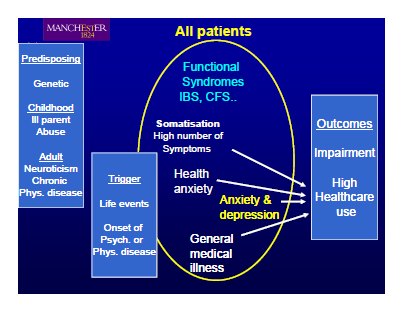
Francis Creed, MD, FRCP: Can We Now Explain Medically Unexplained Symptoms? [1]

      Creed Presentation Slides

       Creed References

[No transcript available]

Workshops

Workshop 15 — Saturday, 1:45 – 2:45pm

DSM-V for Psychosomatic Medicine: Current Progress and Controversies

Lawson Wulsin, MD, FAPM: DSM V for Psychosomatic Medicine: Current Progress and Controversies [2]

     Wulsin Presentation Slides

[No transcript available]

Joel Dimsdale, MD, FAPM: Update on DSM V Somatic Symptoms Workgroup [3]

       Dimsdale text

[Text version of slides]

Update on DSM V Somatic Symptoms Workgroup

Workshop #15, APM Annual Meeting, 11-14-09
DSM-V for Psychosomatic Medicine: Current Progress and Controversies

The Somatic Symptoms Workgroup was charged with reviewing most somatoform disorders, psychological factors affecting medical condition, and factitious disorders. There is considerable confusion regarding the diagnostic terminology and a reluctance to use these diagnostic labels. In addition to relying on expert opinion and the research literature, the Workgroup has also been conducting studies in an effort to learn how physicians actually use these diagnostic labels.

These diagnoses are rarely coded. In a study of >1,000,000 Virginia Anthem Blue Cross policy holders, Levenson [4] found that there were fewer than 600 patients with such disorders. Of these 600 patients, the largest group of patients were diagnosed with Psychological Factors Affecting Medical Condition.

Four focus groups were held in San Diego and Edinburgh. Psychiatrists from very different practice settings attended these groups (child psychiatrists, forensic psychiatrists, psychopharmacologists, consultation psychiatrists, psychotherapists). Nonpsychiatrist attendees included neurologists, pediatricians, and gastroenterologists. Using themes identified from the focus groups, an anonymous internet poll was designed. Using mailing lists from a variety of professional organizations, physicians were invited to respond to an anonymous poll.

Three hundred thirty-two physicians responded to the poll. Two thirds were psychiatrists; two-thirds were from the United States. While in general, physicians reported that somatoform patients were relatively rare in their practices (i.e. 0-2%), some physicians reported high prevalence of these patients. Over 30% of the physicians regarded the diagnostic guidelines for pain disorder and somatoform disorder not otherwise specified as “unclear.” Similar numbers of doctors regarded these particular disorders as “not useful.” Physicians were uniform in their opinion that patients disapproved of such diagnostic labels. Respondents also felt that there was a great deal of overlap between somatization disorder, pain disorder, hypochondriasis, and somatoform disorder not otherwise specified. In addition, they felt that that there was overlap between the somatoform disorders and anxiety and depressive disorders.

The Somatic Symptoms Workgroup has been struck by the fact that “medically unexplained symptoms” (MUS) comprise the crucial intellectual underpinning of the large group of somatoform disorders; yet MUS designations are perilous. They foster mind-body dualism; they confuse “undiagnosed” with “unexplained”; they contribute to doctor-patient antagonism; and they base a diagnosis on a negative, rather than positive criteria.

The Workgroup is proposing a series of changes to these disorders. First off, such disorders would be grouped together under one rubric entitled “Somatic Symptom Disorders”, which would include somatoform disorders, factitious disorders, and psychological factors affecting medical condition. Second, because of their many common features, the group is proposing that hypochondriasis, pain disorder, somatization disorder, and undifferentiated somatoform disorder be grouped together as “Complex Somatic Symptom Disorder”, with optional specifyers to designate when the predominant presentation is, for instance, hypochondriasis, etc. MUS is de-emphasized for this diagnosis, which would require both prominent somatic symptoms causing distress or dysfunction, as well as positive psychological criteria (behavior, cognition, perception).

A draft description of these and other disorders will be published on the APA’s DSM V website in January, 2010.

In addition, a paper describing the thinking of the workgroup and providing a slightly earlier version of the diagnostic guidelines may be found at:

Dimsdale J , Creed F, and on behalf of the DSM-V Workgroup on Somatic Symptom Disorders. The proposed diagnosis of somatic symptom disorders in DSM-V to replace somatoform disorders in DSM-IV—a preliminary report, J Psychosom Res, 66 (2009) 473–476

[Ed: Free full text here: http://www.jpsychores.com/article/S0022-3999(09)00088-9/fulltext ]

The workgroup welcomes comments from colleagues about the proposed changes. Are the proposed changes on the right track? Does this proposal represent, all in all, a step forward? Are there major adverse unintended consequences? Workgroup members include: Arthur Barsky, Francis Creed, Javier Escobar, Nancy Frasure-Smith, Michael Irwin, Frank Keefe, Sing Lee, James Levenson, Michael Sharpe [5], Lawson Wulsin, Joel Dimsdale (chair).

Please send comments to Joel Dimsdale via email jdimsdale@ucsd.edu .

[Ends]

[1] Francis Creed, MD, is a member of the DSM-V Somatic Symptom Disorders Work Group (aka Somatic Distress Disorders Work Group) and was a member of the international CISSD Project, co-ordinated by Dr Richard Sykes, PhD. He is a co-editor of the Journal of Psychosomatic Research.

[2] Lawson R. Wulsin, MD, is a member of the DSM-V Somatic Symptom Disorders Work Group.

[3] Joel E Dimsdale, MD, chairs the DSM-V Somatic Symptom Disorders Work Group, is a member of the DSM-V Task Force and was a member of the CISSD Project.

[4] James L Levinson, MD, is a member of the DSM-V Somatic Symptom Disorders Work Group and was a member of the CISSD Project.

[5] Michael Sharpe, MD, Director, University of Edinburgh Psychological Medicine Research Group, is a member of the Somatic Symptom Disorders Work Group, a co-PI of the UK MRC funded PACE Trial and was a member of the CISSD Project.


Related information:

The current use of the diagnosis “Psychological Factors Affecting Medical Condition” in DSM-IV is set out here

Francis Creed is currently working with EACLPP colleagues, Henningsen and Fink, on a draft white paper for the EACLPP MUS Study Group called: “Patients with medically unexplained symptoms and somatisation – a challenge for European health care systems”. A copy of the MUS Study Group working draft can be downloaded from the EACLPP site.

The January 2010, Editorial “Is there a better term than “Medically unexplained symptoms?” Creed F, Guthrie E, Fink P, Henningsen P, Rief W, Sharpe M, White P. J Psychoso Res: Volume 68, Issue 1, Pages 5-8, discusses the deliberations of the EACLPP study group. The Editorial also includes references to the DSM and ICD revision processes.

Javier Escobar, MD, Director of the University of Medicine and Dentistry of New Jersey (UMDNJ) – Robert Wood Johnson Medical School (RWJMS) Medically Unexplained Physical Symptoms (MUPS) Research Center, which has been supported with over $4M in funding by the US National Institute of Mental Health (NIMH), is a member of the DSM-V Task Force. Dr Escobar serves as a Task Force liaison to the Somatic Symptom Disorders Work Group and is said to work closely with this group.

In a 2008 Special Report by Marin and Escobar: “Unexplained Physical Symptoms What’s a Psychiatrist to Do?” Psychiatric Times. Vol. 25 No. 9, August 1, 2008, the authors write:

“…Perhaps as a corollary of turf issues, general medicine and medical specialties started carving these syndromes with their own tools. The resulting list of ‘medicalized’, specialty-driven labels that continues to expand includes fibromyalgia, chronic fatigue syndome, multiple chemical sensitivity, and many others.

“…These labels fall under the general category of functional somatic syndromes and seem more acceptable to patients because they may be perceived as less stigmatizing than psychiatric ones. However, using DSM criteria, virtually all these functional syndromes would fall into the somatoform disorders category given their phenomenology, unknown physical causes, absence of reliable markers, and the frequent coexistence of somatic and psychiatric symptoms.”

In Table 1, under the heading “Functional Somatic Syndromes (FSS)” Escobar and Marin list:

“Irritable bowel syndrome, Chronic fatigue syndrome, Fibromyalgia, Multiple chemical sensitivity, Nonspecific chest pain, Premenstrual disorder, Non-ulcer dyspepsia, Repetitive strain injury, Tension headache, Temporomandibular joint disorder, Atypical facial pain, Hyperventilation syndrome, Globus syndrome, Sick building syndrome, Chronic pelvic pain, Chronic whiplash syndrome, Chronic Lyme disease, Silicone breast implant effects, Candidiasis hypersensivity, Food allergy, Gulf War syndrome, Mitral valve prolapse, Hypoglycemia, Chronic low back pain, Dizziness, Interstitial cystitis, Tinnitus, Pseudoseizures, Insomnia, Systemic yeast infection, Total allergy syndrome”

Marin and Escobar August 2008 Special Report here on Psychiatric Times site.

APA confirms publication date for draft proposals for DSM-5 diagnostic criteria

APA confirms publication date for draft proposals for DSM-5 diagnostic criteria

Post #7 Shortlink: http://wp.me/pKrrB-dL

American Psychiatric Association President, Alan F. Schatzberg, MD, has confirmed that the APA anticipates publishing draft proposals for DSM-5 criteria on Wednesday, 20 January. (Since rescheduled for 10 February 2010.)

It remains unclear how long the public consultation period will be – the only indication is “two to three months”. At the time of publishing, there is no information on the APA’s website around the consultation process.

Psychiatric News January 1, 2010
Volume 45 Number 1 Page 2
ASSOCIATION NEWS
by Jun Yan 

DSM-5 Postponed Until 2013; Field Trials Scheduled for Summer 

Psychiatrists and the public will be able to view and submit comments on proposed DSM-5 criteria this month and after extensive field trials.

The fifth edition of the Diagnostic and Statistical Manual of Mental Disorders will be released in May 2013, APA announced last month…

and on Page 3 

FROM THE PRESIDENT
by Alan F. Schatzberg, MD

Why is DSM-5 Being Delayed?

The draft guidelines for diagnostic criteria will be posted on the Web on January 20 with a comment period of two to three months. The field trials will commence in July…

Allen Frances; John Grohol on DSM-V revision process

Allen Frances, MD; John Grohol, PsyD, on DSM-V revision process

Post #6 Shortlink: http://wp.me/pKrrB-bS

There’s been no response, so far, on the DSM-V pages of Psychiatric Times to the news that the APA has extended its timeline by 12 months.

On 3 December, Dr Allen Frances, MD, who chaired the DSM-IV Task Force, had published that according to his sources, the APA’s original plan to schedule field trials before the proposed changes could be vetted by the field and with an “impossible publication deadline” of May 2012 was being shelved and that field trials would now follow the posting of options; the publication of DSM-5 was expected to be postponed until May 2013.

Psychiatric Times 

COMMENTARY
Alert to the Research Community—Be Prepared to Weigh in on DSM-V
by Allen Frances, MD
03 December 2009

Dr Frances was the chair of the DSM-IV Task Force and of the department of psychiatry at Duke University School of Medicine, Durham, NC. He is currently professor emeritus at Duke.

This commentary will suggest how the research community can be instrumental in improving DSM-V and helping it avoid unintended consequences. According to several converging, anonymous (but I think quite reliable) sources to which I have had access, the draft options for DSM-V will finally be posted between mid-January and mid-February 2010. There will then be just one additional month until mid-March for collecting comments.* The good news is that the products of a previously closed process will finally be available for wide review and correction. The bad news is that there will be only a very brief period allotted for this absolutely crucial input from the field…

…The research community has a central role and a great responsibility in taking advantage of this precious opportunity to carefully review and identify the problems in the DSM-V drafts and to suggest solutions…

Read full commentary here

The APA board has declined to comment on Dr Frances’ comments.

Catch up with the often acerbic exchanges between Drs Spitzer and Frances, APA board members and others with past and current involvement with DSM revisions on Psychiatric Times DSM-V Resource pages.

*APA has since rescheduled date of publication of draft options to 10 February 2010 

Commentary here on DSM revision controversies from Dr John M Grohol PsyD:

Psych Central
DSM-V: Suggestions for Change
by John M Grohol, PsyD

Dr. John Grohol is the CEO and founder of Psych Central.

Dr Grohol offers 8 suggestions for “Fixing the DSM Revision Process”

An earlier piece by Grohol around DSM-5:

Psych Central
Transparency, Kupfer and the DSM-V
by John M Grohol, PsyD

Christopher Lane on DSM revision and New Scientist article

Christopher Lane commentary on DSM revision and New Scientist article

Post #5 Shortlink: http://wp.me/pKrrB-bG

Update @ 9 January 10

On the Media | The Art of Diagnosis | 26 December 2008

Does very severe PMS constitute a mental disorder? That’s one of many questions facing psychiatrists as they work to revise the Diagnostic and Statistical Manual of Mental Disorders or DSM, the definitive compendium of our psychic maladies. Because the DSM influences not just doctors and patients but medical research, insurance companies, the pharmaceutical industry, advertising and the culture at large, controversy surrounding its new edition abounds. Brooke looks at this powerful book…

Audio and transcript: includes contributions from Christopher Lane, Brooke Gladstone, Dr Darrel Regier (Vice chair, DSM-5 Task Force), Dr Michael First and others.

Christopher Lane, PhD, is the Pearce Miller Research Professor at Northwestern University and author of Shyness: How Normal Behavior Became a Sickness.

On 12 December, Dr Lane published a commentary around the editorial and article published a couple of days before, by New Scientist:

Psychology Today

American Psychiatry Is Facing “Civil War” over Its Diagnostic Manual
What’s the real reason DSM-V has been delayed?

Yesterday, the American Psychiatric Association announced that it is pushing back the publication of DSM-V until 2013. The APA tried to put a good face on this rather embarrassing admission – embarrassing, because several spokespeople for the organization had insisted, quite recently, that they were on-track for publication in 2012 and that nothing would deter them…

Read full article here

On Friday, 18 December, Christopher Lane gave an interview on WNCY Radio, on the Brian Lehrer Show.  You can listen to the interview here:

The Brian Lehrer Show  |  18 December 2009  |  Mental Illness by the Book

http://www.wnyc.org/shows/bl/episodes/2009/12/18/segments/146466

http://www.wnyc.org/stream/ram?file=/bl/bl121809bpod.mp3

http://www.wnyc.org/flashplayer/player.html#/play/%2Fstream%2Fxspf%2F146466

“The Diagnostic and Statistical Manual of Mental Disorders, is commonly known as the “bible” of psychiatry. Christopher Lane, Northwestern University English literature professor and author of Shyness: How Normal Behavior Became a Sickness, discusses the controversy around revising this manual.”

Related information:

Previous commentary from Christopher Lane on the DSM revision process:

Los Angeles Times
Opinion
Wrangling over psychiatry’s bible
by Christopher Lane
16 November 2008

and

Slate
Bitterness, Compulsive Shopping, and Internet Addiction
The diagnostic madness of DSM-V
by Christopher Lane
24 July 2009

DSM-5: Revision controversies in New Scientist 09.12.09

DSM-5: Revision controversies in New Scientist 09.12.09

Post #4 Shortlink: http://wp.me/pKrrB-bv

Just one day before the American Psychiatric Association (APA) announced its intention to shift the publication date for DSM-5 one year on, to May 2103, New Scientist published an editorial and an article by Peter Aldhous [New Scientist’s San Francisco bureau chief] on the controversies around the revision of DSM-IV:

New Scientist

Editorial:
Time’s up for psychiatry’s bible
09 December 2009

“…The final wording of the new manual will have worldwide significance. DSM is considered the bible of psychiatry, and if the APA broadens the diagnostic criteria for conditions such as schizophrenia and depression, millions more people could be placed on powerful drugs, some of which have serious side effects. Similarly, newly defined mental illnesses that deem certain individuals a danger to society could be used to justify locking these people up for life…”

Read full editorial here

Article:
Psychiatry’s civil war
by Peter Aldhous
09 December 2009

“…Two eminent retired psychiatrists are warning that the revision process is fatally flawed.* They say the new manual, to be known as DSM-V, will extend definitions of mental illnesses so broadly that tens of millions of people will be given unnecessary and risky drugs. Leaders of the American Psychiatric Association (APA), which publishes the manual, have shot back, accusing the pair of being motivated by their own financial interests – a charge they deny. The row is set to come to a head next month when the proposed changes will be published online. For a profession that exists to soothe human troubles, it’s incendiary stuff.”

“…Some of the most acrimonious arguments stem from worries about the pharmaceutical industry’s influence over psychiatry. This has led to the spotlight being turned on the financial ties of those in charge of revising the manual, and has made any diagnostic changes that could expand the use of drugs especially controversial.”

Read full article here

*See: Letter to APA Board of Trustees July 7 2009 From Allen Frances and Robert Spitzer 06 July 2009

See also:

Psychiatric Times
News
A Warning Sign on the Road to DSM-V: Beware of Its Unintended Consequences
Allen Frances, MD
26 June 2009

Dr Frances was chair of the DSM-IV Task Force


See: Psychiatric Times DSM-V Resource page for further commentaries by Spitzer, Frances and others and responses from APA board officials

APA announces revised timeline for publication of DSM-5

American Psychiatric Association (APA) announces revised timeline for publication of DSM-5

Post #3 Shortlink: http://wp.me/pKrrB-aS

Update@ 10 February

The APA released draft revisions and proposals for DSM-5 criteria on new webpages on 10 February, here:  DSM-5 Development

In a news release issued on 10 December, the APA has announced that the timeline for the publication of DSM-5 (DSM-V) is being extended from May 2012 to May 2013.

APA President Alan Schatzberg, MD, said:

Extending the timeline will allow more time for public review, field trials and revisions

The extension will also permit the DSM-5 to better link with the U.S. implementation of the ICD-10-CM codes for all Medicare/Medicaid claims reporting, scheduled for October 1, 2013.

David Kupfer, MD, chair of the DSM-5 Task Force, said:

Draft changes to the DSM will be posted on the DSM-5 Web site in January 2010. Comments will be accepted for two months and reviewed by the relevant DSM-5 Work Groups in each diagnostic category. Field trials for testing proposed changes will be conducted in three phases.

The APA news release does not confirm a date for the publication of draft category proposals but this MedPage Today write-up quotes 20 January* and also suggests a consultation period of “two to three months”:

*Since rescheduled for 10 February 2010

MedPage Today
DSM-V Publication Pushed Back to 2013
By John Gever, Senior Editor, MedPage Today
11 December 2009

On 1 January, the APA confirmed the draft publication date in this Psychiatric News article:

Psychiatric News  
Association News DSM-5 Postponed Until 2013; Field Trials Scheduled for Summer
by Jun Yan
Volume 45 Number 1 Page 2
01 January 2010

Proposed changes to the current diagnostic criteria will be posted on APA’s DSM-5 Web site at for public comments starting on January 20. After an open period of two to three months, feedback will be reviewed and incorporated by the appropriate work groups under the direction of the DSM-5 Task Force. The resulting draft criteria will then be tested in the first phase of field trials, which are set to begin this summer…

…Data collected in field trials will be analyzed to inform further revisions to the proposed criteria. The public will then have another window of opportunity to comment on the updated draft of DSM-5 criteria.

At the time of publishing, there is no information on the APA’s DSM-5 webpages around the draft consultation process. No progress reports have been issued by the DSM-5 Work Groups since April 2009.


The WHO is scheduled to publish its ICD-11 Alpha Draft in May, this year, but has yet to issue an ETA for the launch of iCAT, the wiki-like collaborative authoring platform though which the revision of ICD-10 and development of ICD-11 is being undertaken. ICD-11 Revision Steering Group has issued no comment on the APA’s decision to postpone publication of DSM-5 until 2013.

The PDF of the APA’s 10 December News Release is here 

Short link: http://DSM5toMay2013.notlong.com

and here is the full text of the APA News Release:

News Release  American Psychiatric Association

100 Wilson Boulevard, Suite 1825, Arlington, VA, 22209

For Information Contact:
Beth Casteel 703-907-8640
press@psych.org  Release No. 09-65
Jaime Valora 703-907-8562
jvalora@psych.org

For Immediate Release:
December 10, 2009
Release No. 09-65

DSM-5 Publication Date Moved to May 2013

ARLINGTON, Va. (Dec. 10, 2009) – The American Psychiatric Association revised the timeline for publishing the fifth edition of the Diagnostic and Statistical Manual of Mental Disorders, moving the anticipated release date to May 2013.

“Extending the timeline will allow more time for public review, field trials and revisions,” said APA President Alan Schatzberg, M.D.” The APA is committed to developing a manual that is based on the best science available and useful to clinicians and researchers.”

The extension will also permit the DSM-5 to better link with the U.S. implementation of the ICD-10-CM codes for all Medicare/Medicaid claims reporting, scheduled for October 1, 2013.

Although ICD-10 was published by the WHO in 1990, the “Clinical Modification” version (ICD-10-CM) authorized by the U.S. Centers for Medicare and Medicaid Services (CMS) and the Centers for Disease Control (CDC) is not being implemented in the U.S. until 23 years later.

The ICD-10-CM includes disorder names, logical groupings of disorders and code numbers but not explicit diagnostic criteria. The APA has already worked with CMS and CDC to develop a common structure for the currently in-use DSM-IV and the mental disorders section of the ICD-10-CM.

The International Classification of Diseases (ICD) is published by the WHO for all member countries to classify diseases and medical conditions for international health care, public health, and statistical use. The WHO plans to release its next version of the ICD, the ICD-11, in 2014.

APA will continue to work with the WHO to harmonize the DSM-5 with the mental and behavioral disorders section of the ICD-11. Given the timing of the release of both DSM-5 and ICD-11 in relation to the ICD-10-CM, the APA will also work with the CDC and CMS to propose a structure for the U.S. ICD-10 CM that is reflective of the DSM-5 and ICD-11 harmonization efforts. This will be done prior to the time when the ICD-10-CM revisions are “frozen” for CMS and insurance companies to prepare for the October 1, 2013, adoption.

The Timeline

David Kupfer, M.D., chair of the DSM-5 Task Force, which is in charge of the DSM revision process, noted that draft changes to the DSM will be posted on the DSM-5 Web site in January 2010. Comments will be accepted for two months and reviewed by the relevant DSM-5 Work Groups in each diagnostic category. Field trials for testing proposed changes will be conducted in three phases.

The process for developing the DSM-5 began a decade ago, with an initial research planning conference under the joint sponsorship of the APA and the National Institute of Mental Health.

Additional global research planning conferences, under the auspices of the American Psychiatric Institute for Research and Education (APIRE), the World Health Organization, and three institutes of the National Institutes of Health produced a series of monographs, which helped lay the groundwork for the revisions. The APA’s DSM-5 Task Force and Work Group members were identified in 2007; they are tasked with reviewing scientific advances and research to develop draft diagnostic criteria in diagnostic categories of psychiatric disorders. Information about the revision process is available online at http://www.DSM5.org .

The American Psychiatric Association is a national medical specialty society whose physician members specialize in the diagnosis, treatment, prevention and research of mental illnesses, including substance use disorders. Visit the APA at http://www.psych.org and http://www.healthyminds.org .