ME Association submission to the consultation on the revision of the American Diagnostic and Statistical Manual of Mental Disorders

ME Association submission to the consultation on the revision of the American Diagnostic and Statistical Manual of Mental Disorders

Post #92 Shortlink: http://wp.me/pKrrB-1bT

http://www.meassociation.org.uk/?p=6619

June 13, 2011

The ME Association has submitted the following comments to the consultation on the proposed, new American Diagnostic and Statistical Manual of Mental Disorders, otherwise known as the “DSM-5″. Our contribution was officially acknowledged on Sunday (June 12) at 10.52am.

The ME Association is a UK based medical charity that provides information and support for people with ME/CFS (myalgic encephalomyelitis/chronic fatigue syndrome).

The concerns we express below refer to the proposal to create a new and wide-ranging psychiatric category – Complex Somatic Symptom Disorder (CSSD) – in the next edition of the American Diagnostic and Statistical Manual of Mental Disorders (ie DSM V) and the widespread belief that people with ME and CFS may become included in this new medical terminology.

ME is recognised by the World Health Organisation (in section G93:3 of ICD 10) and by the UK Department of Health as a complex neurological disorder – a fact that is now supported by numerous published research studies.

CFS, which includes a wider group of clinical presentations, is indexed to the WHO neurological classification.

It is not therefore appropriate to use the proposed terminology of CSSD – either by intention or mistake – to describe or classify people with ME or CFS as having somatic presentations of mental health disorders in any other system of disease classification or explanation such as the DSM.

This proposal itself has a number of major flaws, including:

• A very limited and partial scientific rationale with too much reliance on subjective judgements.

• An implied acceptance that diagnoses are always correct.

• An assumption that all that is important in psychological medicine is already known and what remains uncertain can be summarised in one new clinical entity.

Psychological Medicine already attracts a lot of negative criticism and this proposal will only make matters worse.

The APA therefore needs to reflect on its full responsibilities when reviewing a subject area as complex and uncertain as this.

We therefore suggest that you drop CSSD and instead refer to ‘chronic distress that may be related to psychological or physical events or a combination’. This is a term that should lead to empathetic, focused management.

ENDS

European ME Alliance (EMEA) submission to DSM-5 draft proposals Submission

European ME Alliance (EMEA) submission to DSM-5 draft proposals Submission – to the American Psychiatric Association on DSM-V Complex Somatic Symptom Disorders category

Post #91 Shortlink: http://wp.me/pKrrB-1bI

June 2011

http://www.euro-me.org/news-Q22011-003.htm

The European ME Alliance consists of 11 European national charities/non profit organisations campaigning for better diagnosis and understanding of myalgic encephalomyelitis (ME or ME/CFS) as defined by WHO-ICD-10-G93.3.

Even though we are not mental health professionals or represent people with mental health disorders we feel it important to comment on the draft proposal of DSM-V and its Complex Somatic Symptom Disorders proposal.

This response should be seen against the backdrop of the devastation caused by the misinformation within the medical profession regarding ME/CFS and the promotion of false perceptions about the disease to the public, healthcare authorities and government.

It is of paramount importance that the American Psychiatric Association are aware of the dangers inherent in establishing incorrect categories of disorders which are based on poor science, vested interests or which do not serve the patients. It is the patients who must surely be the priority in all healthcare provision.

We are especially concerned about the criteria described in the new category of Complex Somatic Symptom Disorder which seems to imply that anyone who has a chronic or incurable illness with somatic symptoms and ‘misattributes’ their symptoms could be given this label.

Who decides when someone misattributes their pain or fatigue?

How are these symptoms measured?

How long and vigorously is a patient allowed to complain about their symptoms before a doctor can decide to investigate further and determine if a headache is a brain tumour or irritable bowel syndrome colon cancer?

In the CSSD Criteria B there are terms used which are subjective and not measurable – such as “health concerns” and “catastrophising”.

Based on our collective experiences with the treatment of an organic illness such as ME/CFS – experiences across Europe – our concern is that there is a great danger of mis- or missed diagnoses when looking at this category and its proposed diagnostic criteria.

The criteria are very vague and allow too much subjectivity.

In fact, ME/CFS could mistakenly be placed in this category if one were to ignore, or be unaware of, the huge volume of biomedical research and evidence which shows it to be an organic illness and if one were to use only the broad CSSD criteria to diagnose.

Such an action would be a major and costly mistake and would not serve the patients or the healthcare communities.

In our experience specialist ME/CFS clinics get as many as 40% of patients referred with a ME/CFS diagnosis who turn out to have other very serious and sometimes fatal illnesses.

The patients we are concerned with suffer from myalgic encephalomyelitis which is a neurological disease. Yet all too often these patients are being treated as if they had a somatoform illness.

Parents of children with ME/CFS are restricted in visiting their severely ill children in hospital or worse still the children are taken away from their families as the healthcare professional believes it is the family that is keeping the child ill by having ‘wrong illness beliefs’.

Severely ill grown ups with this disease are denied normal medical care and threatened with being placed in mental hospitals if they are too ill to care for themselves and ask for help.

This not only sets patient against healthcare professional but also is a waste of resources and of lives.

A broad unspecific category such as the proposed Complex Somatic Symptom Disorder does not help patients who need an honest and clear diagnosis.

Any illness lacking a diagnostic test is in danger of being put into this non specific category which helps no one.

We hope and request that the APA listens to patients and avoids creating a category of mental illness that is meaningless.

Yours Sincerely,

The Chairman, Board and Members of the European ME Alliance

www.euro-me.org

PDF version: http://www.euro-me.org/GB/EMEA%20Letter%20to%20APA%20-%20DSM-V.pdf

Membership of EMEA: http://www.euro-me.org/about.htm

Links:

Proposed criteria are set out on the DSM-5 Development site here: http://tinyurl.com/Somatic-Symptom-Disorders

The CSSD criteria are here: http://tinyurl.com/DSM-5-CSSD

For examples of submissions for 2010, go here: http://wp.me/PKrrB-AQ

Copies of submissions for 2011 are being collated, here: http://wp.me/PKrrB-19a   

If you are a patient organization, professional, patient, carer or advocate and have already submitted and would like a copy of your comment added to my site, please send a copy to me.agenda@virgin.net

IACFS/ ME Statement on DSM-5 Somatic Symptom Disorder

The International Association for Chronic Fatigue Syndrome/ME (IACFS/ME) Statement on DSM-5 Somatic Symptom Disorder

Post #89 Shortlink: http://wp.me/pKrrB-1b6

The closing date for comments in the second DSM-5 public review is June 15.

Register to submit feedback via the DSM-5 Development website here:
http://tinyurl.com/Somatic-Symptom-Disorders

More information on registration and preparing submissions here:
http://tinyurl.com/DSM-5-register-to-comment

Copies of last year’s submissions here: http://tinyurl.com/DSM5submissions

Copies of this year’s submissions here: http://tinyurl.com/DSM5submissions2011

IACFS/ME

Dear Members and Colleagues:

I have submitted the comments below to the DSM-5 Work Group on Somatic Symptom Disorders. We are very concerned about the proposed new diagnosis, Complex Somatic Symptom Disorder, and its potential influence on physicians who see patients with CFS/ME.

Thank you.

Fred

Fred Friedberg, PhD
President
IACFS/ME
www.iacfsme.org

To the DSM-5 Somatic Symptoms Disorders Work Group:

On behalf of the board of directors and the membership of the International Association for Chronic Fatigue Syndrome (IACFS/ME), I would like to express my deep concern about the proposed new category of Complex Somatic Symptom Disorder (CSSD) in DSM-5 scheduled for release in 2013.

The Work Group’s well-reasoned points about DSM-IV somatoform disorders – that they are little used, confusing, and pejorative – do call for a re-evaluation. The question is: What should replace them? The new inclusive CSSD category attempts to offer a simplified and more inclusive diagnosis that may be more user-friendly to physicians and other health practitioners.

Our major concern is that the logic behind the new CSSD category is not informed by empirical data that directly examines the utility of this diagnosis in medical practice.

As stated by your Work Group: “A key issue is whether the guidelines for CSSD describe a valid construct and can be used reliably. …Predictive validity of most of the diagnostic proposals has not yet been investigated.”

Given the absence of scientific validation of the CSSD diagnosis, the potential for unintended consequences is a serious concern. One such consequence is the possibility of over-diagnosis that may selectively affect patients with illnesses that are already not well understood such as CFS/ME. If the treating practitioner is skeptical about the severity or even  existence of CFS/ME, then the new criteria can be used to diagnose CSSD without reference to an underlying illness.

For instance, the CSSD criteria of (2) Disproportionate and persistent concerns about the medical seriousness of one’s symptoms and (3) Excessive time and energy devoted to these symptoms or health concerns, would allow practitioners skeptical of CFS/ME to diagnosis the illness as an Axis I psychiatric disorder. This new psychological diagnosis may then narrow the physician’s focus and reduce the possibility of more effective management of the CFS/ME illness. Furthermore, the CSSD diagnosis may result in additional stigma for already marginalized patients with CFS/ME.

Over-diagnosis with CSSD may also arise from the broad generality of the new criteria and the absence of clear thresholds for patients to meet the criteria. As with somatization/somatoform disorders, when different criteria are used population prevalence varies from less than 1% for somatization disorder to an astonishing 79% for undifferentiated somatoform disorder (cited from Work Group online document). Arguably, the generality of the criteria for both undifferentiated somatoform disorder and CSSD suggests that CSSD may become a much more common (and potentially misapplied) diagnosis than the somatic symptom disorders that it replaces.

Finally, the CSSD diagnosis will not inform the clinician of CFS/ME-specific issues such as adverse reactions to treatment that are more likely in this hypersensitive population. By contrast, the CFS/ME diagnosis is useful for an array of illness related concerns that will assist the clinician in providing care for these medically under-served patients.

Given the above considerations, we ask that the CSSD diagnosis be omitted from DSM-5. Only when the proper validation studies are done that consider vulnerable populations such as CFS/ME can we know if the use of the CSSD diagnosis has clinical value. In its current form, we believe that the new diagnosis will do more harm than good.

Thank you.

Fred Friedberg

Fred Friedberg, PhD
President
IACFS/ME
www.iacfsme.org

IACFS/ME
27 N. Wacker Drive, #416
Chicage, Illinois 60606
US

Coalition4ME/CFS issues Call to Action on DSM-5 proposals

Coalition4ME/CFS issues Call to Action on DSM-5 proposals

Post #88 Shortlink: http://wp.me/pKrrB-1aJ

On June 2, the Coalition4ME/CFS, which comprises eight US 305c registered patient organizations, issued a Call to Action for submissions to the DSM-5 Somatic Symptom Disorders Work Group.

Full Coalition4ME/CFS announcement: http://www.coalition4mecfs.org/News.html

Position paper (PDF): http://www.coalition4mecfs.org/DSM-5_Position_Paper_-_FInal2.pdf

Letter to the DSM-5 Task Force – Letter available for use to the public for submit to the task force: http://www.coalition4mecfs.org/DSM5letter.html

The Coalition4ME/CFS – a coalition of US ME/CFS non-profit organizations – has issued a Call to Action on the impending DSM-5 proposal and provided information to assist organizations and patients in writing their own letter to the American Psychiatric Association. The submission period ends June 15th.

THE COALITION ANNOUNCEMENT

DSM-5 Background:

Why this call to action is important to you:

Among other changes, the DSM-5 proposal includes the establishment of a new category called Complex Somatic Symptom Disorder (CSSD). The criteria for a CSSD diagnosis include somatic symptoms that last more than 6 months and significantly disrupt life combined with the doctor’s assessment that the patient has a disproportionate concern about the medical seriousness of his symptoms. The guidelines also include recommendations of Cognitive Behavior Therapy (CBT) and antidepressants as the appropriate therapies.

CSSD could prove disastrous for the ME/CFS patient and for patients with other diseases like Fibromyalgia, Gulf War Illness and IBS that are misunderstood, misdiagnosed and mistreated by the medical community at large. For doctors who view the ME/CFS patient as ‘just depressed’, it will be a small leap to decide that the patient has “disproportionate and persistent concerns about the medical seriousness of one’s symptoms” and, as a result, inappropriately diagnose CSSD. Once diagnosed with CSSD, the implications for diagnosis, treatment, disability and insurance will be profound.

The background and associated issues with the DSM-5 and CSSD can be found in the attached “Complex Somatic Symptom Disorders Position Paper” developed by the Coalition 4 ME/CFS.

What you can do:

The Coalition 4 ME/CFS has sent a response to the APA on this issue, which you can find here. (Feel free to use this letter as a template for your response). The DSM-5 team also needs to hear from as many of you as possible about your concerns. Feel free to draw from the Coalition 4 ME/CFS letter for your own comments. Remember, this must be done by June 15, 2011.

Here are the steps to follow to provide your input:

1. Register on the DSM-5 web site to make comments. The “Register Now” site is in the upper right hand corner of the DSM-5 home page. You will receive a confirmation email with a temporary password that you will have to click on to complete registration. If you have registered previously, you should still have an account and can log in in the same box.

2. Provide your comments directly on the CSSD page. It is probably easiest to create your comments outside of the interface and then copy them in. Bolding and other formatting appear to be lost when you copy your document in.

Thank you,

Coalition 4 ME/CFS

• Other Resources – Suzy Chapmans is an extensive resource for these issues; see Dx Revision Watch

Check out other organizations letters in the comments below and on this page

The Coalition4ME/CFS consists of the

• CFS/Fibromyalgia Organization of Georgia, Inc.
• CFS Knowledge Center
• CFS Solutions of West Michigan
• PANDORA Inc. – Patient Alliance for Neuroendocrineimmune Disorders Organization for Research & Advocacy, Inc.
• Phoenix Rising
• Rocky Mountain CFS/ME & FM Association (RMCFA)
• Vermont CFIDS Association Inc.
• Wisconsin ME/CFS Association, Inc.

US ME/CFS Non-profit organizations are invited to join the Coalition.

Get on the Coalitions email list here: http://www.coalition4mecfs.org/contact.html

Action for M.E. publish news item on DSM-5

Action for M.E. publish news item on DSM-5

Post #87 Shortlink: http://wp.me/pKrrB-1a1

Yesterday, UK patient organization, Action for M.E., published an item around the DSM-5 proposals on its News pages and confirmed that it does intend submitting comment in the second DSM-5 public review exercise. Last year’s submissions from international organizations, professionals and patient advocates are collated on this page .

To the best of my knowledge, Action for M.E. is the only organization to have confirmed, so far, that it intends to submit comment in this second stakeholder review of draft criteria for the revision of DSM-IV.

The closing date for comments is June 15.

Register to submit feedback via the DSM-5 Development website: http://tinyurl.com/Somatic-Symptom-Disorders

More information on registration and submissions: http://tinyurl.com/DSM-5-register-to-comment

From the News pages of Action for M.E.

USA: complex somatic symptom disorder

01 June 2011

US patient organisations are lobbying against proposals to include a new psychiatric category, Complex Somatic Symptom Disorder (CSSD), in the American Diagnostic and Statistical Manual of Mental Disorders (DSM).

Version four of the manual (DSM-4) is under revision and version five (DSM-5) is due to be published May 2013.

The publication, which is produced by the American Psychiatric Association (APA), contains listings, definitions, and explanations of different psychiatric and psychological disorders.

In a letter last year, the CFIDS Association of America strongly urged the DSM-5 Task Force to abandon the proposed creation of CSSD saying:

The proposed DSM-5 revision correctly does not identify chronic fatigue syndrome (CFS) as a condition within the domain of mental disorders and the DSM. However, past discussions of the Somatic Symptoms Disorder Work Group have included such physiological disorders as chronic fatigue syndrome, irritable bowel syndrome and fibromyalgia as ‘somatic presentations of mental disorders.

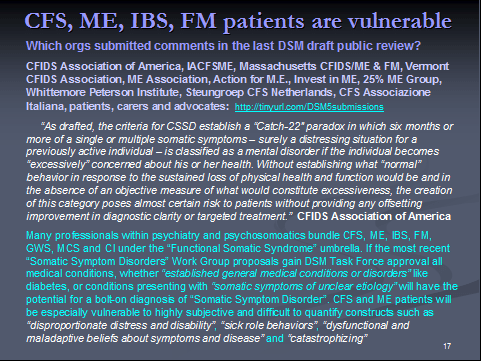
…As drafted, the criteria for CSSD establish a ‘Catch-22’ paradox in which six months or more of a single or multiple somatic symptoms is classified as a mental disorder if the individual becomes ‘excessively’ concerned about his or her health.

The Massachusetts CFIDS/ME & FM Association says:

The way CSSD is defined makes it possible to either mistakenly or intentionally diagnose CFIDS/ME or Fibromyalgia in this psychiatric category. Moreover, the greater concern is whether this change could potentially lead to the reclassification of these illnesses as psychiatric conditions under CSSD.

The APA DSM-5 developmentsite says the draft is open for comment until 15 June.

UK campaigner Suzy Chapman has set up a website, Dx Revision Watch, which has further information.

Action for M.E. commented in response to the first consultation and will make a further representation in response to the second.

[Ends]

Call for Action – Second DSM-5 public comment period closes June 15

Call for Action – Second DSM-5 public comment period closes June 15

Post #83 Shortlink Post: http://wp.me/pKrrB-12d

        Disorders Description    Key Document One: “Somatic Symptom Disorders”

       Rationale Document   Key Document Two: “Justification of Criteria — Somatic Symptoms”
 

MS Word .doc format:  Call for Action Second DSM-5 public review

            PDF format:  Call for Action Second DSM-5 public review

For immediate circulation to US and international ME and CFS patient organizations, clinicians, advocates

22 May 2011

Call for Action – Second DSM-5 public comment period closes June 15

The American Psychiatric Association’s DSM-5 Task Force is accepting public comment on its latest proposals for the revision of diagnostic criteria for psychiatric disorders.

The deadline for stakeholder feedback is June 15.

Is this a US specific issue?

No. International input is also required. The Diagnostic and Statistical Manual of Mental Disorders (the DSM) is the primary diagnostic system in the US for defining mental disorders and used to a varying extent in other countries. The next edition of the manual, slated for publication in 2013, will inform health care providers and policy makers for many years to come. DSM-5 will shape international research, influence literature in the fields of psychiatry and psychosomatics and inform perceptions of patients’ medical needs throughout the world.

What is being proposed?

The DSM-5 “Somatic Symptom Disorders” Work Group has responsibility for the revision of the DSM-IV “Somatoform Disorders” categories.

The Work Group is recommending renaming the “Somatoform Disorders” section to “Somatic Symptom Disorders” and combining existing categories – “Somatoform Disorders”, “Psychological Factors Affecting Medical Condition (PFAMC)” and possibly “Factitious Disorders” into one group.

(“Somatic” means “bodily” or “of the body”.)

The Work Group also proposes repackaging “Somatization Disorder”, “Hypochondriasis”, “Undifferentiated Somatoform Disorder” and “Pain Disorder” under a new category entitled “Complex Somatic Symptom Disorder” (CSSD). There is also a “Simple Somatic Symptom Disorder” (SSSD) and a proposal to rebrand “Conversion Disorder” as “Functional Neurological Disorder”.


Where can I find the full criteria for “CSSD”, “PFAMC” and other proposed categories?

Proposed criteria are set out on the DSM-5 Development site: http://tinyurl.com/Somatic-Symptom-Disorders

The CSSD criteria are here: http://tinyurl.com/DSM-5-CSSD

There are two key PDF documents here, “Disorders Descriptions” and “Rationale”, which expand on the Work Group’s proposals, here, or above:

http://tinyurl.com/SSD-Disorders-Description

http://tinyurl.com/SSD-Justification-of-Criteria

Which patient groups might be hurt by these proposals?

The Chronic Fatigue Syndrome Advisory Committee (CFSAC) provides advice and recommendations to the Secretary of Health and Human Services (HHS). On Day One of the May 10-11 CFSAC meeting, CFSAC Committee discussed the implications of these proposals for CFS and ME patients as part of the agenda item around the proposed coding of CFS for ICD-10-CM. You can watch this section of the meeting (4hrs 27mins in from start of video) here:

http://nih.granicus.com/ViewPublisher.php?view_id=26

If the Work Group’s proposals gain DSM Task Force approval, all medical diseases, whether “established general medical conditions or disorders”, like diabetes or heart disease, or conditions presenting with “somatic symptoms of unclear etiology” will have the potential for a bolt-on diagnosis of a “somatic symptom disorder” – if the practitioner feels the patient meets the new criteria.

As discussed by CFSAC committee members, earlier this month, CFS, ME, Fibromyalgia and IBS patients, already diagnosed or waiting on a diagnosis, may be especially vulnerable to highly subjective criteria and difficult to quantify concepts such as “disproportionate distress and disability”, “catastrophising”, “health-related anxiety” and “[appraising] bodily symptoms as unduly threatening, harmful, or troublesome.”

Other patient groups that are also bundled under the so-called “Functional somatic syndromes” and “medically unexplained” umbrellas, like Chemical Injury (CI), Chemical Sensitivity (CS), chronic Lyme disease and GWS, are highly vulnerable.

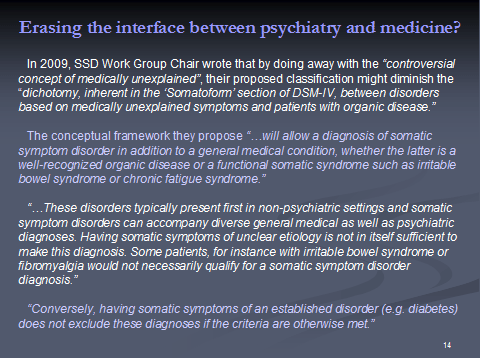
In a 2009 Editorial on the progress of the Work Group, the chair wrote that by doing away with the “controversial concept of medically unexplained”, their proposed classification might diminish “the dichotomy, inherent in the ‘Somatoform’ section of DSM-IV, between disorders based on medically unexplained symptoms and patients with organic disease.” The conceptual framework the Work Group proposes:

“…will allow a diagnosis of somatic symptom disorder in addition to a general medical condition, whether the latter is a well-recognized organic disease or a functional somatic syndrome such as irritable bowel syndrome or chronic fatigue syndrome.”

So under the guise of eliminating “medically unexplained” symptoms as a diagnostic criterion in order to diminish “stigma”, eradicating “terminology [that] enforces a dualism between psychiatric and medical conditions” and language that is “divisive between patients and clinicians”, the APA appears hell bent on colonising the entire medical field by licensing the potential application of a mental health diagnosis to all medical diseases and disorders, if the clinician considers that the patient’s response to their bodily symptoms or their perceived level of disability is “disproportionate” or their coping styles, “maladaptive”.

In its latest proposals, the Work Group writes:

“…Having somatic symptoms of unclear etiology is not in itself sufficient to make this diagnosis. Some patients, for instance with irritable bowel syndrome or fibromyalgia would not necessarily qualify for a somatic symptom disorder diagnosis. Conversely, having somatic symptoms of an established disorder (e.g. diabetes) does not exclude these diagnoses if the criteria are otherwise met.”

“…The symptoms may or may not be associated with a known medical condition. Symptoms may be specific (such as localized pain) or relatively non-specific (e.g. fatigue). The symptoms sometimes represent normal bodily sensations (e.g., orthostatic dizziness), or discomfort that does not generally signify serious disease…”

“…Patients with this diagnosis tend to have very high levels of health-related anxiety. They appraise their bodily symptoms as unduly threatening, harmful, or troublesome and often fear the worst about their health. Even when there is evidence to the contrary, they still fear the medical seriousness of their symptoms. Health concerns may assume a central role in the individual’s life, becoming a feature of his/her identity and dominating interpersonal relationships.”

These proposals could result in misdiagnosis of a mental health disorder or the misapplication of an additional diagnosis of a mental health disorder. There may be considerable implications for these highly subjective criteria for the diagnoses assigned to patients, for the provision of social care, the payment of employment, medical and disability insurance, the types of treatment and testing insurers are prepared to fund and the length of time for which insurers are prepared to pay out.

Dual-diagnosis may bring thousands more patients, potentially, under a mental health banner where they may be subject to inappropriate treatments, psychiatric services, antidepressants, antipsychotics and behavioural therapies such as CBT, for the “modification of dysfunctional and maladaptive beliefs about symptoms and disease, and behavioral techniques to alter illness and sick role behaviors and promote more effective coping [with their somatic symptoms].”

Coding CFS in the “Signs, symptoms and ill-defined conditions” chapter of the forthcoming ICD-10-CM would also render CFS and ME patients more vulnerable to these DSM-5 Work Group recommendations that will provide another dustbin in which to shovel patients with so-called “medically unexplained” bodily symptoms.

Who should submit comment on these proposals?

All stakeholders are permitted to submit comment and the views of patients, carers, families and advocates are important. But evidence-based submissions from the perspective of informed medical professionals – clinicians, psychiatrists, researchers, allied health professionals, lawyers and other professional end users are likely to have more influence.

National and state patient organizations also need to submit comment.

To date, not one patient organization in the US or UK has confirmed to me that they intend to submit feedback, this year. So we need to lean heavily on our patient organizations to review these criteria.

Where can I read last year’s submissions?

Copies of international patient organization submissions for the first DSM-5 public and stakeholder review are collated on this page of my site, together with selected patient and advocate submissions:

DSM-5 Submissions to the 2010 review: http://tinyurl.com/DSM5submissions

How to comment:

Register to submit feedback via the DSM-5 Development website: http://tinyurl.com/Somatic-Symptom-Disorders

More information on registration and preparing submissions here: http://tinyurl.com/DSM-5-register-to-comment

What else can I do?

Use mailing lists, forums, blogs, websites and contacts to get this information out – especially platforms where clinicians, allied health professionals, medical lawyers and patient organization reps participate. Alert state and national ME, CFS, FM and IBS patient organizations to the deadline and lobby for their involvement.

This is the last alert I shall be sending out. Remember, the deadline is June 15.

Thank you.

—————–

Text and formatted versions of this document in Word .doc and PDF format will be available on my website.

Suzy Chapman

https://dxrevisionwatch.wordpress.com