POST AUTHOR CORRECTIONS, 25 October 2010 doi: 10.1097/MLR.0b013e3181ef9d3e Original Article: PDF Only
The Development, Evolution, and Modifications of ICD-10: Challenges to the International Comparability of Morbidity Data
Published Ahead-of-Print
Abstract
Background: The United States is about to make a major nationwide transition from ICD-9-CM coding of hospital discharges to ICD-10-CM, a country-specific modification of the World Health Organization’s ICD-10. As this transition occurs, the WHO is already in the midst of developing ICD-11. Given this context, we undertook this review to discuss: (1) the history of the International Classification of Diseases (a core information “building block” for health systems everywhere) from its introduction to the current era of ICD-11 development; (2) differences across country-specific ICD-10 clinical modifications and the challenges that these differences pose to the international comparability of morbidity data; (3) potential strategic approaches to achieving better international ICD-11 comparability.
Literature Review and Discussion: A literature review and stakeholder consultation was carried out. The various ICD-10 clinical modifications (ICD-10-AM [Australia], ICD-10-CA [Canada], ICD-10-GM [Germany], ICD-10-TM [Thailand], ICD-10-CM [United States]) were compared. These ICD-10 modifications differ in their number of codes, chapters, and subcategories. Specific conditions are present in some but not all of the modifications. ICD-11, with a similar structure to ICD-10, will function in an electronic health records environment and also provide disease descriptive characteristics (eg, causal properties, functional impact, and treatment).
Conclusion: The threat to the comparability of international clinical morbidity is growing with the development of many country-specific ICD-10 versions. One solution to this threat is to develop a meta-database including all country-specific modifications to ensure more efficient use of people and resources, decrease omissions and errors but most importantly provide a platform for future ICD updates.
(C) 2010 Lippincott Williams & Wilkins, Inc.
Ed note: The forthcoming US “Clinical Modification”, ICD-10-CM, is country specific; it does not apply outside the US.
Current proposals for the US Clinical Modification ICD-10-CM, which is scheduled for implementation in October 2013, propose classifying Chronic fatigue syndrome in ICD-10-CM Chapter 18 at R53.82.
The proposed U.S. classification ICD-10-CM separates CFS and Postviral fatigue syndrome into mutually exclusive categories. “Chronic fatigue, unspecified | Chronic fatigue syndrome not otherwise specified” appear in Chapter XVII under R53.82.
“Postviral fatigue syndrome | Benign myalgic encephalomyelitis” appear in Chapter VI under G93.3.
The Chronic Fatigue Syndrome Advisory Committee (CFSAC) had previously recommended CFS to be placed under the same neurological code as ME and PVFS, G93.3.
For the most recent ICD-10-CM proposals see:
CDC site: International Classification of Diseases, Tenth Revision, Clinical Modification (ICD-10-CM) [1]:
Sean M. Falconer, Tania Tudorache, Csongor Nyulas, Natalya F. Noy, Mark A. Musen
Stanford Center for Biomedical Informatics Research, Stanford University, US
1 Introduction
The International Classification of Diseases (ICD) is a public global standard that organizes and classifes information about diseases and related health problems [4]. Health offcials use ICD in all United Nations member countries to compile basic health statistics, to monitor health-related spending, and to inform policy makers. In the United States, use of the ICD is also a requirement for all medical billing. ICD has therefore a major impact on many aspects of health care all over the world.
In 2007, the WHO initiated the 11th revision of ICD. Several ambitious goals were set for this version (details in [2]). One such goal is to allow the ICD to become a multi-purpose classification for a much larger number of usages. Previous versions of ICD were strictly classification hierarchies used for statistical purposes. To meet the new revision goals, ICD-11 will use OWL to create a rich formal representation. Another key diference between ICD-11 and previous versions is that the development process of ICD-11 will use a Web-based open process powered by collaboration and social features. That is, similar to Wikipedia, the WHO hopes that a large number of medical experts will contribute to the content of ICD-11.
Our group has been working closely with the WHO to provide the technical support for these ambitious goals. We have created a customized version of Protégé specifcally designed to support the ICD authoring process. In [2], we discuss in detail the use of Semantic Web technologies for the revision of ICD. Our demo will showcase features of the customized Protégé such as content creation and collaboration. For the remainder of this paper, we present the architecture and highlight features of the user interface…
The iCamp2 meeting, scheduled for April but postponed due to volcanic ash cloud disruption of air traffic, was held between 27 September – 1 October, in Geneva.
iCamp2
27 September – 1 October 2010 Geneva, Switzerland WHO Headquarters
RSG 2010 [Revision Steering Group]
30 September – 1 October 2010 Geneva, Switzerland WHO Headquarters
The revised Agenda for the meeting can be read here in html on the ICD Revision site.
Download here as a Word document from the ICD Revision site or open here iCamp2 Agenda September 2010 on DSM-5 and ICD-11 Watch site.
I will post a link for the minutes, summary or note of this meeting when these are available on the ICD Revision site.
For Immediate Release:
Oct. 5, 2010
Release No. 10-65
APA Announces Start of Field Trials for DSM-5
Sites to Test Proposed Diagnostic Criteria in Real-World Clinical Settings
ARLINGTON, Va. (Oct. 5, 2010) – The American Psychiatric Association today announced the start of field trials to test proposed diagnostic criteria for the fifth edition of the Diagnostic and Statistical Manual of Mental Disorders (DSM). Field trials will help assess the practical use of proposed DSM-5 criteria in real-world clinical settings.
The field trials follow a public comment period in which more than 8,000 written comments on the draft diagnostic criteria were submitted to the DSM-5 website by clinicians, researchers and family and patient advocates. Submitted comments were reviewed by DSM-5 Work Groups and resulted in further refinement of the criteria.
Evaluation measures
For the diagnostic criteria that are being evaluated, the results of the field trials will address:
. Feasibility: are the proposed criteria easy for clinicians to understand and to use?
. Clinical Utility: do the proposed criteria do a good job in describing patients’ psychiatric problems and help clinicians make decisions about treatment plans?
. Reliability: are the same conclusions reached consistently when the criteria are used by different clinicians?
. Validity: how accurately do the diagnostic criteria reflect the mental disorders they are designed to describe?
In addition, the field trials will help assess severity measures and cross-cutting dimensional measures.
Severity measures are questionnaires and other tools intended to help clinicians evaluate how severe the symptoms of an individual are on a rating scale.
Cross-cutting dimensional measures are tools for assessing symptoms that occur across a wide range of diagnoses, such as anxiety or sleep problems. Field trials will help determine whether these proposed tools provide useful information for clinicians and their patients, and whether they capture changes in symptoms over time to evaluate progress in treatment.
Two rigorous study designs
Since the DSM is used in many care settings, two standardized and methodologically rigorous study designs were developed by the DSM-5 Research Group to gather data from a wide range of clinicians and settings.
“It is important that the proposed diagnostic criteria are subjected to rigorous and empirically sound field trials before DSM-5 is published in 2013,” said David Kupfer, M.D., chair of the DSM-5 Task Force.
“The two field trial designs will allow us to better understand how the proposed revisions affect clinicians’ practices and, most importantly, patient care.”
One study design was developed for use in academic or other large clinical settings, and will be employed at 11 sites, chosen from among 65 centers that responded to APA’s call for proposals. Another study design was developed for use by individual practitioners and smaller clinical practices. These field trials will be conducted in diverse care settings by 3,900 mental health professionals: 1,400 psychiatrists selected from a randomly selected sample, as well as an additional 2,500 volunteer clinicians, including psychiatrists, psychologists, social workers, and advanced practice psychiatric-mental health nurses.
Participating clinicians must meet eligibility criteria and complete a web-based training seminar.
Clinicians in the field trials will evaluate new and existing patients at different stages of treatment using the proposed DSM-5 diagnostic criteria and measures.
All patients considered for participation in the field trial will receive information about the trial and must give their consent. None of the patients will have their identities revealed in the results of the studies.
In the field trials conducted in the academic and large medical centers, patient evaluations will begin with an initial baseline assessment by a clinician. A different clinician will conduct a second assessment 4 hours to 2 weeks later, to help determine reliability of the diagnostic criteria. This assessment will be repeated in a follow-up visit (4 to 12 weeks after the second evaluation) to test whether the severity and cross-cutting measures are sensitive to changes in treatment progression.
Academic and Large Medical Centers
The 11 large academic medical settings participating in field trials are:
Pediatric Sites
. Baystate Medical Center, Springfield, Mass.
. Columbia University/New York State Psychiatric Institute, Child Psychiatry Division, in collaboration with colleagues at New York Presbyterian
. Hospital/Weill Cornell Medical Center, New York Presbyterian
. Hospital/Westchester Division, and the North Shore Child and Family Guidance Center, Roslyn Heights, New York
. Centre for Addiction and Mental Health, Toronto
. Dallas Veterans Affairs Medical Center
. DeBakey Veterans Affairs Medical Center and Menninger Clinic, Baylor College of Medicine, Houston
. Mayo Clinic, Rochester, Minn.
. University of California, Los Angeles
. University of Pennsylvania, Philadelphia
. University of Texas Health Science Center, San Antonio
More information on the participating academic large medical centers and the specific disorders being tested in field trials is available on www.dsm5.org .
Disseminating the Field Trial Findings
The DSM-5 Field Trials team will disseminate the results of these initial field trials through presentations at scientific meetings, with professional and consumer groups and in articles published in peer-reviewed scientific journals and DSM-5 source books.
After completion of the first phase of field trials and another period of public comment via the DSM5.org web site, work group members will make any necessary revisions to their draft criteria. This will be followed by a second phase of field trials for further examination of selected criteria, scheduled to take place in 2011 and 2012.
“The process for developing DSM-5 continues to be deliberative, thoughtful and inclusive,” said Darrel Regier, M.D., M.P.H., vice-chair of the DSM-5 Task Force, and APA research director. “Large-scale field trials are the next critical phase in this important process and will give us the information we need to ensure the diagnostic criteria are both useful and accurate in real-world clinical settings.”
The American Psychiatric Association is a national medical specialty society whose physician members specialize in the diagnosis, treatment, prevention and research of mental illnesses, including substance use disorders.
By John Gever, Senior Editor, MedPage Today Published: October 05, 2010
“Testing of new diagnostic criteria proposed for DSM-5, the revision of the psychiatric profession’s manual for patient assessment, is finally underway, more than two months behind schedule…”
(With thanks to Kelly Latta for alerting me to the MedPage Today commentary.)
———-
Current proposals by the DSM-5 Work Group for disorders related to the diagnostic category, Somatoform Disorders, can be found here:
There were considerable concerns, earlier this year, in response to the proposal of the DSM-5 Work Group for “Somatic Symptom Disorders” to combine several existing somatoform disorder categories into one larger category, Complex Somatic Symptom Disorder (CSSD).
Patient organisations, professionals and advocates submitting comments in the DSM-5 draft proposal public review process were invited to provide copies of their submissions for publication on this page:
This table sets out how the current versions of classification systems, DSM-IV and ICD-10, have corresponded for Somatoform Disorders:
Current DSM-IV Codes and Categories for Somatoform Disorders and ICD-10 Equivalents
Source: Mayou R, Kirmayer LJ, Simon G, Kroenke K, Sharpe M: Somatoform disorders: time for a new approach in DSM-V. Am J Psychiat. 2005;162:847-855.
ICD-11 Alpha Draft
According to sources, in July, a print version of the ICD-11 Alpha Draft was expected to be made available around the time that the rescheduled iCamp2 meeting took place in September.
In August, ICD Revision confirmed that a “draft print version will be available in September 2010”.
iCamp2 has now concluded, but it remains unclear whether a print version has been produced. ICD Revision has been asked to clarify the status and availability of an Alpha Draft, whether it is intended for internal use only or is going to be made available for public scrutiny, and if so, when, and in what format(s).
For update on status and availability of ICD-11Alpha Draft see: Post #53
The publication of DSM-5 is currently timelined for May 2013.
Implementation of ICD-10-CM, the US specific “Clinical Modification” of ICD-10, is scheduled for October 2013.
As the Phase 1 field trials are underway, members of the DSM-5 Task Force and Work Group will begin drafting their initial text for DSM-5. During this time, case studies will also be developed, which will be published after DSM-5’s release in a series of case books.
March – April 2011: Revisions to Proposed Criteria. Based on results from the first phase of field trials, the DSM-5 Task Force and Work Group members will make revisions to the proposed DSM-5 diagnostic criteria and dimensional measures. These revised criteria and measures will be tested in a second phase of field trials.
April – May 2011: Review of Revised Criteria. Revised proposed criteria will be subjected to internal review, including a review by the DSM-5 Task Force and Research Group and by other relevant work groups.
May-July 2011: Online Posting of Revised Criteria. Following the internal review, revised draft diagnostic criteria will be posted online for approximately one month to allow the public to provide feedback. This site will be closed for feedback by midnight on June 30, 2011.
ICD is the international de facto standard classification for most epidemiological and many health-care and clinical uses. Originally designed to record causes of death, the usage of ICD has been extended to include morbidity classification, reimbursement, and several other specialty areas such as oncology and primary care. The current 10th edition of ICD was endorsed by the World Health Assembly in 1990 and has been periodically updated over the years. Recently, the World Health Assembly decided to develop a completely new version named the 11th revision.
Methods
In previous revisions of ICD, specialty experts and national representatives of WHO collaborative-classification centers proposed additions and changes to the codes (using lists of codes for creating new drafts). In contrast, the development of ICD-11 aims to create an information infrastructure and workflow processes that utilize knowledge engineering and management techniques that are supported by software.
Instead of just codes, titles, and associated rules and indices, the information infrastructure will enable a more detailed definition of disease and health conditions, as well as the use of reference terminologies and ontologies, review of best scientific evidence, and field trials of draft standards.
In terms of workflow, the information infrastructure should support the collaborative development of new content and proposed changes, rigorous review and approval processes, and the creation of draft classifications for field testing. The ICD revision process was initially the work of Topic Advisory Groups (TAG) that had been set up for various specialty areas. The ICD-11 revision process will eventually be opened up for comments and suggestions from interested parties on the Internet.
Lastly, the final output will be multiple for different use cases such as mortality, morbidity and primary care, which can be mapped with ontology-driven tools
Results
The content model is made up of three different parts:
A) Descriptive Characteristics
ICD Concept Title
Hierarchy, Type and Use
Textual Definition
Terms
Index Terms
Synonyms
Inclusion Terms
Exclusion Terms
C) Formal Characteristics
Body Structure
Morphologic Abnormality
Causal Properties
Mechanisms/ Agents
Risk Factors
Genomic Characteristics
Dysfunction
The web platform named ICAT has been developed by a team of Stanford University to allow a collaborative population of the content model by their different tags.
The ICD-11 content model is still evolving, but the main components have been specified. A detailed guide describes the expected content and usage of each component. It is the document that records the shared understanding of the content model.
The OWL content model realizes the informal description in the guide and formalizes the three-layer conceptualization of the original UML model.
Conclusions
The ICD-11 content model is very much a work in progress. Consensus formulation of several components such as temporal properties, severity properties, and diagnostic criteria is not yet available. From the view point of case mix, the new tools will provide an ICD of better quality for morbidity, thus allowing better mapping between diagnosis systems and, as a result of this, better mapping across case-mix systems based on diagnosis coding.
[Abstract Ends]
Update on status of ICD-11 Alpha Draft in previous post on DSM-5 and ICD-11 site:
ICD Revision iCamp2 meeting, new documents and status of the ICD-11 Alpha Draft
[2] User Manual [Content Model User Guide, 53 pp Word doc] Key ICD-11 document
Identifies the basic properties needed to define any ICD concept (unit, entity or category) through the use of multiple parameters. Open here on DSM-5 and ICD-11 Watch: User Manual 20.09.10
The information in this update relates only to proposals for ICD-11.
This information does not apply to ICD-10-CM, the forthcoming “Clinical Modification” of ICD-10, which is scheduled for implementation in October 2013 and is specific to the US.
Post #45 is intended to clarify any confusion between ICD-10, ICD-11 and the forthcoming US specific “Clinical Modification”, ICD-10-CM.
The iCamp2 meeting, scheduled for April but postponed due to volcanic ash cloud disruption of air traffic, was held between 27 September – 1 October, in Geneva.
iCamp2
27 September – 1 October 2010 Geneva, Switzerland WHO Headquarters
RSG 2010 [Revision Steering Group]
30 September – 1 October 2010 Geneva, Switzerland WHO Headquarters
The revised Agenda for the meeting can be read here in html on the ICD Revision site.
Download here as a Word document from the ICD Revision site or open here iCamp2 Agenda September 2010 on DSM-5 and ICD-11 Watch site.
I will post a link for the minutes, summary or note of this meeting when these are available on the ICD Revision site.
In his iCamp2 Introductory presentation, Dr Bedirhan Üstün says there are just seven months to go before the start of the ICD-11 beta drafting phase and 43 months to the final version. Beta drafting remains scheduled to begin in May 2011, even though targets for the drafting of content are slipping and an Alpha Draft has yet to be published.
The Beta Requirements Document says, “The Beta Phase will be open to [the] general public in May 2011 to enable structured input by interested parties subject to peer-review by relevant Technical Advisory Groups” and that the time until May 2011 “will be used to develop and test the Beta Draft software and procedures and make consultations with end users around key issues and basic questions.”
iCamp2 acknowledged that a considerable amount of work needs to be done in the interim if ICD Revision is going to meet its targets.
No detailed timeline for the development of ICD-11 is available on the WHO’s main website. But in March, an ICD Revision Project Plan document, published on the ICD Revision Google site, had projected an Alpha Draft release date of May 2010, with a Beta Draft ready by May 2012. [Source: Page 7, “Project milestones and budget, and organizational overview”.]
A press launch for the Alpha Draft had been tabled for discussion on the Agenda for the April iCamp2 meeting. In the event, the April meeting was postponed, but ICD Revision has issued no public explanation for why the anticipated Alpha Draft failed to be released in April/May, nor has the Steering Group issued a revised ETA.
From the ICD Revision Project Plan:
The Alpha draft will be produced in a traditional print and electronic format. The Alpha Draft will also include a Volume 2 containing the traditional sections and including a section about the new features of ICD-11 in line with the style guide. An index for print will be available in format of sample pages. A fully searchable electronic index using some of the ontological features will demonstrate the power of the new ICD.
According to sources, in July, a print version of the Alpha Draft was expected to be made available around the time that the rescheduled iCamp2 meeting took place in September. Requests for clarification of the status and accessibility of an alpha draft have been left on ICD Revision Facebook site by several members of the public. When a response was eventually forthcoming, in August, it was confirmed that a “draft print version will be available in September 2010”.
iCamp2 is over now, but it remains unclear whether a print version has been produced, whether it is intended for internal use only or is going to be made available for public scrutiny, and if so, when, and in what format(s). ICD Revision has been asked to clarify.
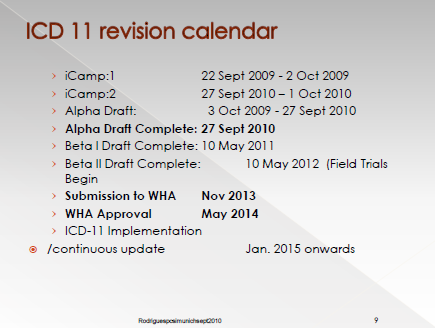
This slide from a DSPIM presentation says the Alpha Draft was scheduled for completion by 27 September:
Source: Slide 9, PDF presentation slides: ICD-11 Revision: where are we now? Ontology driven tools and web platform. JM Rodrigues et al, DSPIM, University of Saint Etienne, WHO Collaborating Centre for International Classifications in French Language, Paris.
The WHO is promoting the development of ICD-11 as a transparent, collaborative and inclusive process
The Revision Steering Group (RSG) has launched a number of public interfaces – the ICD-11 Revision site (meeting agendas, minutes, documents and presentations), a YouTube channel, a blog (not updated since October 2009), a Facebook site, Twitter and an iCAT users Google Group, open to any stakeholders who register for access. The iCAT Web 2.0 drafting platform is also viewable by the public and the production server can be accessed here: http://icat.stanford.edu/.
But little consideration appears to have been given to who should take responsibility for responding to questions from stakeholders or fielding queries left on the ICD Revision Facebook site, which rarely receive a reasonably prompt response, or any response, at all.
WHO Secretariat do not always acknowledge or respond to enquiries. A request for clarifications from a Topic Advisory Group (TAG) Chair, whilst acknowledged, has received no response after three months. The 5th meeting of the International Advisory Group for the Revision of ICD-10 Mental and Behavioural Disorders (currently ICD-10 Chapter V) was held on 28 – 29 September 2009. A year later, a Summary Report is still pending publication and no meeting summaries for TAG Mental Health have been published on the WHO website since the 4th Meeting 1 – 2 December 2008.
The WHO needs to decide whether, in launching public interfaces and using “social networking” for input and feedback from stakeholders it genuinely seeks to provide platforms for meaningful interaction with the public or whether these are tokenistic nods at “transparency”.
Content posted by ICD Revision admin on its Facebook Wall often lacks meaning and substance. What stakeholders really need to know is whether any form of alpha draft is going to be publicly released before the Beta phase – not photos of happy iCampers playing bassoons at musical soirées and iCamp bonding sessions.
I will update if and when any information is released on the status and public availability of an alpha draft, and what format(s) it will be available in.
Proposals
Since 2007, it has been possible for stakeholders in the development of ICD to submit proposals and comments, supported by citations, via the ICD Update and Revision Platform Intranet. It was understood, last September, that for some Topic Advisory Groups (notably Chapters 5 and 6) a proposal form for ICD-11 was being prepared for use by stakeholders.
Information about the availability of proposal forms for the various Topic Advisory Groups, up to what stage in the development process timeline these might be used and which stakeholders might be permitted to make use of any proposal forms already being issued or in preparation would also be welcomed from the Revision Steering Group or TAG managing editors.
Slipping targets
According to the iCamp2 PowerPoint presentation, Frequent Criticisms and this iCamp2 YouTube, targets for the population of content for the Alpha Draft have not been reached.
Less that 80% of Terminology Definitions have been uploaded to the iCAT and less than the 20% target for full Content Model completion for the many thousands of diseases and disorders classified within ICD has been met. [The Content Model identifies the basic properties needed to define any ICD concept (unit, entity or category) through the use of multiple parameters.] Not all parameters of the Content Model are implemented yet. Not all Topic Advisory Groups are at a similar developmental stage; Beta Plans are behind schedule.
The Revision Steering Group identifies barriers to keeping this technically very ambitious project on track: lack of finances; the sheer amount of time required for the drafting of definitions and population of textual content according to the complex ICD-11 Content Model; recruiting external experts for reviewing proposals and generating content; familiarising TAG workgroup members with the functionality of the iCAT, the collaborative authoring platform through which ICD-11 is being drafted, and with informatics; entering data into the iCAT; the paucity of face-to-face meetings for TAG managing editors and workgroup members who are scattered across the globe and undertaking these roles in addition to professional commitments; difficulties facilitating interaction between the various Topic Advisory Groups where diseases overlap with other chapters.
A number of new workgroups have recently been created (Paediatrics, Dentistry, E.N.T, Traditional Medicine and Communicable/Tropical Diseases).
The knowledge representation space is too large to be curated by a small number of experts (e.g. 20,000 ICD Categories, 15 parameters of CM [Content Model], each may have 1-20 entries – on average a relational database matrix with 300,000 entries).
[…]
Scaling up the process from the alpha phase to beta should be carefully planned and modelled. It is estimated that the alpha phase participants will be at the magnitude of 500-1000 persons. In beta phase it is expected to have 10-100 fold increase.
If the Revision Steering Group is already struggling to maintain motivation and interaction between the various Topic Advisory Groups, then management of the project once the beta phase is reached and the process opened up to stakeholders is going to present the Steering Group and TAG workgroup managing editors with considerable challenges.
The original dissemination date for ICD-11 had been 2012, with the timelines for the revision of ICD-10 and DSM-IV running more or less in parallel. The dissemination date for ICD-11 was later extended to 2014 and the publication date of the next edition of the DSM, DSM-5, extended to May 2013.
(John Gever, Senior Editor, MedPage Today, reported on 5 October that Testing of new diagnostic criteria proposed for DSM-5, the revision of the psychiatric profession’s manual for patient assessment, is finally underway, more than two months behind schedule.)
The development of ICD-11 is a hugely complex and technically ambitious undertaking; all three volumes will be electronically published, integrable and intended to be integrable with some other health classification publications; the scope of ICD-11 is far greater than that of the previous edition.
It may be that come May 2011, we might anticipate some scaling back of plans and/or possibly a shift in the release of the Beta Draft from May 2012 to 2013+, in response to the recognition that the WHO may have significantly overestimated its capacity for securing the funding and resources to complete the technical work on this project by 2012, if implementation of the final version is to take place in 2014.
The iCamp YouTube commentaries have an air of brittle optimism about them.
Coming up
In a forthcoming post, in lieu of an Alpha Draft, I shall be reporting on what can currently be seen in the ICD-11 iCAT drafting platform and associated Revision documents in relation to the three ICD-10 categories: “Postviral fatigue syndrome”, “Chronic fatigue syndrome” and “(Benign) myalgic encephalomyelitis” and why I have asked the Chair of the Topic Advisory Group for Neurology for a clarification.
iCamp2 meeting documents and presentations
A number of new and existing ICD revision related documents have been published on the ICD-11 Revision Google site in association with the iCamp2 and RSG September meetings. Not all the documents listed have been uploaded to the ICD Revision site and several links are returning “File not found”.
Field “A Type” specifies: new; unchanged; decision to be made; retired; real retired
[Note: ICD11 Alpha Codes may be temporary sorting codes; “FXC” against “G93.3” does not relate to the F Codes in ICD Chapter 5 (V); note also that Gj92 is an ICD-11 “Sorting label” not an ICD code.]
Signs and Symptoms [4 pp Word doc; Discussion document: Considerations for handling categories and concepts currently found in chapter 18 of ICD-10, “SYMPTOMS, SIGNS AND ABNORMAL CLINICAL AND LABORATORY FINDINGS NOT ELSEWHERE CLASSIFIED”, (R-codes), authors: Aymé, Chalmers, Chute, Jakob.] Or open here: Discussion: Signs and Symptoms (Chapter 18)
“ICD has traditionally grouped diseases by aetiology and by affected organ system. For ICD11 the creation of a new chapter for multisystem disorders has been proposed. The following text sets out the rationale for and the possible scope of a multisystem disorders chapter.”
Contains Literature search reference at 119 to the Maes and Twisk paper, Treatment of myalgic encephalomyelitis/chronic fatigue syndrome (ME/CFS), a multisystem disease, should target the pathophysiological aberrations (inflammatory and oxidative and nitrosative stress pathways), not the psychosocial “barriers” for a new equilibrium. 2010: Ireland. p. 148-9.
Contains Literature search reference at 118 to published response to Maes and Twisk paper by Luyten, P. and B. Van Houdenhove, Treatment of myalgic encephalomyelitis/chronic fatigue syndrome (ME/CFS), a multisystem disease, should target the pathophysiological aberrations (inflammatory and oxidative and nitrosative stress pathways), not the psychosocial “barriers” for a new equilibrium – Response to Maes and Twisk. 2010, ELSEVIER IRELAND LTD, ELSEVIER HOUSE, BROOKVALE PLAZA, EAST PARK SHANNON, CO, CLARE, 00000, IRELAND. p. 147-147.
Presentations [PowerPoint slides require the MS PP 2007 pptx reader unless identified as ppt]
[2] User Manual [Content Model User Guide, 53 pp Word doc] Key ICD-11 document
Identifies the basic properties needed to define any ICD concept (unit, entity or category) through the use of multiple parameters. Open here on DSM-5 and ICD-11 Watch: User Manual 20.09.10



 dx revision watch