Resources and media coverage: American Psychiatric Association “cease and desist” v DSM-5 Watch website

Post #123 Shortlink: http://wp.me/pKrrB-1Bi

Update: Commentary on APA’s threats of legal action in paper by Dr Monica Greco:

Monica Greco (2016) What is the DSM? Diagnostic manual, cultural icon, political battleground: an overview with suggestions for a critical research agenda, Psychology & Sexuality, 7:1, 6-22, DOI: 10.1080/19419899.2015.1024470

Dr. Monica Greco is a Reader in the Department of Sociology at Goldsmiths, University of London and a Fellow of the Humboldt Foundation. She is the author of Illness As a Work of Thought: A Foucauldian Perspective on Psychosomatics (Routledge, 1998) and of articles on psychosomatics, vitalism, medical humanities and the sociology of unexplained symptoms.

Click to access Greco%20-%20What%20is%20the%20DSM%20for%20GRO.pdf


Media coverage: American Psychiatric Association (APA) “cease and desist” v DSM-5 Watch website;

Legal information and resources for bloggers and site owners


Media coverage and blogger commentaries on “APA ‘cease and desist’ use of DSM 5 mark in domain name” issue


Neurobonkers

APA Shut Down DSM-5 Blogger


Knight Science Journal Tracker

Psychiatrists issue legal threat, silencing blogger critical of diagnostic manual.

Paul Raeburn | March 1, 2012

also

National Association of Science Writers


Reporting on Health

William Heisel’s Antidote

Investigating Untold Health Stories

Part One: February 27, 2012

Slap: American Psychiatric Association Pressures Brit DSM5 Blogger Suzy Chapman

Part Two: February 29, 2012

William Heisel: Slap: American Psychiatric Association Targets One DSM5 Critic, Ignores Others


Psychiatry Update (Australia)

DSM 5 blogger bounces back

Kate Aubusson | January 19, 2012


Behaviorism and Mental Health

An alternative perspective on mental disorders

Philip Hickey, Ph.D.

What’s New? APA Threats, Xanax, Etc.

Philip Hickey  | January 23, 2012


From a Polish blogger, January 16, 2012

From a Spanish psychologist, January 9, 2012

From a Spanish blogger, January 7, 2012


Salty Current

APA bullies blogger

SC (Salty Current) | January 18, 2012

“…I think what we may be witnessing with the broad challenges to the DSM-5 is the beginning of the end for this psychiatric model. Its flaws, failures, and cooptation by corporate interests are becoming more widely known, and it’s unraveling. Efforts at evasion and intimidation like these merely dramatize the process.”


retired doc’s thoughts

James Gaulte

Southwest, United States
Trained in and practiced internal medicine and pulmonary disease
Interests: current state of medicine from a technical and philosophical point of view

American Psychiatric Association “Slapps” down web site critical of DSM5

James Gaulte | January 12, 2012

“Dr. Bernard Carroll, former head of psychiatry at Duke, writing on the blog Health Care Renewal, writes about an interesting conflict between the APA and a former editor of DSM. See here

“Dr. Allen Francis who edited DSM4 has been highly critical of the DSM process and particularly of the yet to be released DSM5. He expresses concern that psychiatry is being practiced less by psychiatrists and more by primary care physicians, who are busy and often not very well trained in managing psychiatric problem and at times strongly influenced by marketing.

“His criticism includes the charge that with the publication of DSM5, not yet released, there will be more patients diagnosed with DMS defined mental conditions as new diagnoses are being added and the criteria for others have been broadened. His comments regarding his view of the problems with DSM were appearing on at least one web site.

“Now the APA, who owns DSM and profits from its publication and use, has sent out a cease and desist threat to the website previously known as “dsm5watch”…”

Full commentary


1 Boring Old Man

1 Boring Old Man | January 16, 2012

“But this is about more than just Suzy’s site, it’s about the worst kind of arrogance – the worst kind because the people at the APA and the APPI don’t seem to have a clue how arrogant they really are.”


Nederlog

Good news: “DSM-5-censorship fails”

Maarten Maartensz M.A. Psy, B.A. Phil | January 14, 2012

Is the American Psychiatric Association a terrorist organization?

Maarten Maartensz M.A. Psy, B.A. Phil | January 04, 2012


Psychology Today

DSM5 in Distress
The DSM’s impact on mental health practice and research.
by Allen Frances, M.D. (Chair, DSM-IV Task Force and currently professor emeritus at Duke.)

DSM 5 Censorship Fails
Support From Professionals and Patients Saves Free Speech

Allen Frances, M.D. | January 12, 2012

“Last week I described the plight of Suzy Chapman, a well respected UK patient advocate forced to change the domain name of her website by the heavy handed tactics of the publishing arm of the American Psychiatric Association. The spurious legal excuse was commercial protection of the ‘DSM 5’ trademark; the probable intent was to stifle one of the internet’s best sources of DSM and ICD information. This bullying could not have come at a worse time – just as final decisions are being made on highly controversial DSM 5 proposals and with the third and final draft due for release this spring. This is precisely when a ragged and reckless DSM 5 can most benefit from the widest and most open discussion.”

Read on 


PLoS Blogs

Neuroanthropology

About Neuroanthropology

Neuroanthropology forms part of PLoS Blogs, and is one of eleven founding blogs that joined with PLoS.org, everyONE and Speaking of Medicine to provide a comprehensive network that covers science and medicine…Daniel Lende is Associate Professor in Anthropology at the University of South Florida. He trained in medical, psychological, and biological anthropology and public health at Emory University…

Wednesday Round Up #160

Daniel Lende  | January 11, 2012

“This week I lead off with some controversy over the new edition of the Diagnostic and Statistical Manual, DSM 5, which is due out in 2013. This is not the first time the DSM 5 has come into the public’s eye (it’s been there pretty much since it got announced), but the focus has zoomed in on the machinations of the American Psychiatry Association, the force behind DSM 5, in protecting its DSM 5 brand while also maintaining closed control over the production of the new set of diagnoses.”

Read on here


Mindhacks

Mindhacks | January 07, 2012

The manual that must not be named


Science Isn’t Golden
Matters of the mind and heart
by Paula J. Caplan, Ph.D.

Top Psychiatrists Again Try to Quash Debate
APA shuts down website critical of DSM-5

Paula J. Caplan, Ph.D. in Science Isn’t Golden | January 06, 2012

American Psychiatric Association Shuts Down Critical Website

“As you read the following, think what an outcry there would be if the silencing came from a third-world dictator (or maybe even the U.S. government) and was directed against pro-democracy protestors or protestors against any real harm.”


Thought Broadcast

Two New Ways To Get Sued

Steve Balt, MD | January 06, 2012

“The last week hasn’t been a very uplifting one for psychiatrists who pay attention to the news. For as much as we complain about shrinking reimbursements, the undue influence of Big Pharma, and government meddling in our therapeutic work, we psychiatrists now have two new reasons to be concerned.

“And, maybe, to lawyer up.

“I. APA Threatens Blogger
Most readers who follow this blog will certainly have seen this story already, after first being reported in Allen Frances’ Psychology Today blog. So I know I’m just preaching to the choir here, but frankly, in my opinion, this story cannot receive too much attention.”


Gary Greenberg

About the author

Gary Greenberg Blog

http://www.garygreenbergonline.com/

Pity the poor American Psychiatric Association, Part 1

Pity the poor American Psychiatric Association, Part 2

Gary Greenberg | January 05, 2012

“Why the APA would make themselves into a Goliath is not clear to me. The DSM offers Paranoid Personality Disorder, but this episode makes me wish Frances hadn’t shied away from his proposal for a Self-Defeating Personality Disorder. Because it is not clear to me how they win this one.”


Beyond Meds
Alternatives to psychiatry

APA for DSM5 takes legal action against a website with the URL: http://dsm5watch.wordpress.com/

giannakali | January 04, 2012

“Seems to me the APA is feeling the heat and digging themselves in even deeper.”


I Speak of Dreams

Passions: Effective parenting and education, learning disabilities, non-profit management, horses, and fun!

Yet More Legal Thuggery, This Time from the American Psychiatric Association

I Speak of Dreams | January 05, 2012

“I am not an attorney or in any way educated in the legal system, but this seems to me to be intimidation, pure and simple.”


Behavioral.net

1984 Revisted, II: Big Brother on the Run

“The American Psychiatric Association keeps on undermining its credibility, or more to the point, plays a mean big brother.”

Jack Carney, DSW | January 04, 2012


Hooked: Ethics, Medicine and Pharma blog

Updates and Commentary related to HOOKED: ETHICS, THE MEDICAL PROFESSION, AND THE PHARMACEUTICAL INDUSTRY, by Howard Brody, MD, PhD (Rowman and Littlefield, January, 2007)

From Health Care Renewal: Egregious Behavior of the APA

Howard Brody | January 04, 2012

“Dr. Carroll makes a number of on-target observations in his post. He notes that this action by the APA amounts to what’s called “SLAPP,” which as I discussed in HOOKED means “strategic lawsuit against public participation.” In this case it would be a threatened SLAPP rather than a true SLAPP, as no lawsuit was filed, but the fear of having to go up individually against the deep legal pockets of the APA forced the UK blogger to knuckle under promptly.”


The Carlat Psychiatry Blog
Keeping Psychiatry Honest Since 2007

APA Threatens to Sue “dsm5watch” Website

Dan Carlat | January 04, 2012

“It all seems rather heavy-handed to me. After all, the New York Times appears to have no problem with the anti-Times site called TimesWatch. In a democratic society, healthy dissent and debate is part of the package. It may be annoying, but that doesn’t excuse the bullying tactics that the APA has chosen.”


University Diaries

A professor of English describes university life.
Aim: To change things.

The Stalking Cure

Margaret Soltan | January 04, 2012


Health Care Renewal

Addressing threats to health care’s core values, especially those stemming from concentration and abuse of power. Advocating for accountability, integrity, transparency, honesty and ethics in leadership and governance of health care.

SELF INFLICTED DAMAGE

“It is bad enough that the APA resorts to this legal artifice to stifle public discussion. When they do it through their lawyers and business entities rather than through their medical and scientific officers, they sink to a lower level yet. The parallels with corporate sleaze that we have discussed so often on this blog are obvious. For shame.”

Bernard Carroll | January 04, 2012


1 Boring Old Man

DSM-5™…

1 Boring Old Man | January 03, 2012

“Phrases like “of all the lame-brained…”, “you’ve got to be kidding…”, or “what were they thinking?” came immediately to mind on reading this most recent post from Dr. Allen Frances in Psychology Today. After pondering for a bit, I still can’t find anything sensible about playing the trademark card on DSM-5™.”


Soulful Sepulcher

Allen Frances, MD- ” I am surprised and saddened by APA’s ill-conceived attempt to restrict Suzy Chapman’s free expression on DSM 5″

Stephanie at Soulful Sepulcher | January 03, 2012


APA Use Restraints on Blogger

SEROXAT SUFFERERS – STAND UP AND BE COUNTED
A blog by Bob Fiddaman

Bob Fiddaman | January 04, 2012

“The field of psychiatry is doing itself no favours by using intimidation tactics against people that criticize their opinion, let’s face it, the whole premise of psychiatry is based on opinion, I’ve not yet seen any scientific evidence of the chemical imbalance the field of psychiatry tout when someone is depressed or has a psychiatric disorder.

“Chapman’s blog can be read at her new web address HERE. Her work/opinion continues to spread, much to the annoyance of the APA who have probably shot themselves in the foot with their intimidation tactics.

“Memo to the APA – Intimidate a blogger and you put them on a pedastal, you highlight what it is that they have to say… here endeth your first lesson in psychology.”


DSM5 in Distress
The DSM’s impact on mental health practice and research.
by Allen Frances, M.D (Dr Frances was chair of the DSM-IV Task Force and is currently professor emeritus at Duke.)

Is DSM 5 A Public Trust Or An APA Cash Cow?
Commercialism And Censorship Trump Concern For Quality

Allen Frances, M.D. |  January 03, 2012

“I am surprised and saddened by APA’s ill-conceived attempt to restrict Suzy Chapman’s free expression on DSM 5. It can only be in the service of the equally unworthy goals of censorship and/or commercialism. I simply can’t imagine that anything should ever be kept secret in the preparation of a diagnostic manual and wonder what in Suzy Chapman’s web site could possibly be so frightening to APA.

“Using a trademark to suppress comment is a violation of APA’s public trust to produce the best possible DSM 5. This is another indication that DSM has become too important for public health and for public policy for its revisions to be left under the exclusive control of one professional organization – particularly when that organization’s own financial future is at stake. This basic conflict of interest can be cured only by creating a new institutional framework to supervise the future DSM revisions. Censorship and commercial motivations must not warp the development of a safe and scientifically sound diagnostic manual.”

Read full commentary


Legal information and resources for bloggers and site owners:


1] Wipedia article: Cease and desist
http://en.wikipedia.org/wiki/Cease_and_desist
2] Wipedia article: Strategic lawsuit against public participation (SLAPP)
http://en.wikipedia.org/wiki/Strategic_lawsuit_against_public_participation
3] Electronic Frontier Foundation (EFF)
http://en.wikipedia.org/wiki/Electronic_Frontier_Foundation
http://www.eff.org/
EFF Bloggers’ Rights
https://www.eff.org/bloggers
EFF Legal Guide for Bloggers
https://www.eff.org/issues/bloggers/legal
4] Chilling Effects
http://en.wikipedia.org/wiki/Chilling_Effects_(group)
http://chillingeffects.org/
Chilling Effects FAQ on Trademark Law
http://www.chillingeffects.org/trademark/faq.cgi#QID251
Chilling Effects on Protest, Parody and Criticism Sites
http://www.chillingeffects.org/protest/
5] U.S. Trademark Law, Rules of Practice & Federal Statutes, U.S. Patent & Trademark Office, November 2011: http://www.uspto.gov/trademarks/law/tmlaw.pdf

 

Psychiatric creep – Erasing the interface between psychiatry and medicine

Psychiatric creep – Erasing the interface between psychiatry and medicine

Post #121 Shortlink: http://wp.me/pKrrB-1A5

As reported in an earlier post, the third draft of proposals for changes to DSM-IV categories and criteria is delayed because DSM-5 field trials are running behind schedule.

This third and final draft is now expected to be released for public review and comment, “no later than May 2012”, according to DSM-5 Task Force Vice-chair, Darrel Regier, MD [1].


DSM-5 Somatic Symptom Disorders

One focus of this site has been the proposals of the DSM-5 Somatic Symptom Disorders Work Group

Proposed criteria, as they stood in May, last year, are set out on the DSM-5 Development site here: http://tinyurl.com/Somatic-Symptom-Disorders

There are two key PDF documents which expand on the proposals as currently posted:

         Disorders Description  Key Document One: “Somatic Symptom Disorders”

         Rationale Document  Key Document Two: “Justification of Criteria — Somatic Symptoms”


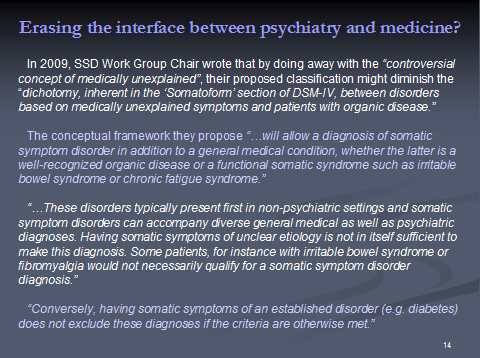
Erasing the interface between psychiatry and medicine 


I first reported on Co-Cure, over two years ago, in May 2009, that the conceptual framework the Somatic Symptom Disorders Work Group was proposing would:

“…allow a diagnosis of somatic symptom disorder in addition to a general medical condition, whether the latter is a well-recognized organic disease or a functional somatic syndrome such as irritable bowel syndrome or chronic fatigue syndrome.” [2]

(“Somatic” means “bodily” or “of the body”.)

The most recent version of the Somatic Symptom Disorders Disorders description proposals document states:

“This group of disorders is characterized predominantly by somatic symptoms or concerns that are associated with significant distress and/or dysfunction…Such symptoms may be initiated, exacerbated or maintained by combinations of biological, psychological and social factors.”

“These disorders typically present first in non-psychiatric settings and somatic symptom disorders can accompany diverse general medical as well as psychiatric diagnoses. Having somatic symptoms of unclear etiology is not in itself sufficient to make this diagnosis. Some patients, for instance with irritable bowel syndrome or fibromyalgia would not necessarily qualify for a somatic symptom disorder diagnosis. Conversely, having somatic symptoms of an established disorder (e.g. diabetes) does not exclude these diagnoses if the criteria are otherwise met.”

“The symptoms may or may not be associated with a known medical condition. Symptoms may be specific (such as localized pain) or relatively non-specific (e.g. fatigue). The symptoms sometimes represent normal bodily sensations (e.g., orthostatic dizziness), or discomfort that does not generally signify serious disease.” [3]


Psychiatric creep

While the media has focused on the implications for introducing new disorder categories into the DSM and lowering diagnostic thresholds for existing criteria, there has been little scrutiny of the proposals of the Somatic Symptom Disorders Work Group.

This Work Group has been quietly redefining DSM’s Somatoform Disorders categories with proposals that will have the potential for a “bolt-on” diagnosis of a “somatic symptom disorder” for all medical diseases, whether “established general medical conditions or disorders”, like diabetes or angina, or conditions presenting with “somatic symptoms of unclear etiology.”

These radical proposals for rebranding the Somatoform Disorders categories as Somatic Symptom Disorders and combining a number of existing, little-used categories (somatization disorder, hypochondriasis, pain disorder, and undifferentiated somatoform disorder) under a proposed portmanteau term, Complex Somatic Symptom Disorder (CSSD), and the more recently proposed, Simple Somatic Symptom Disorder (SSSD), which requires symptom duration of as little as one month, have the potential for bringing many thousands more patients under a mental health banner.

Complex Somatic Symptom Disorder (CSSD) criteria are here: http://tinyurl.com/DSM-5-CSSD 

Simple Somatic Symptom Disorder (SSSD) criteria are here: http://tinyurl.com/DSM-5-SSSD

These proposals have the potential for expanding markets for psychiatric services, antidepressants and behavioural therapies, like CBT, for the “modification of dysfunctional and maladaptive beliefs about symptoms and disease, and behavioral techniques to alter illness and sick role behaviors”  for all patients with somatic symptoms, if the clinician decides that the patient’s response (or in the case of a child, a parent’s response) to bodily symptoms and concerns about their health are “excessive”, or the perception of their level of disability “disproportionate”, or their coping styles “maladaptive.”

Under the guise of “eliminating stigma” and eradicating “terminology [that] enforces a dualism between psychiatric and medical conditions” by “de-emphasizing the concept of ‘medically unexplained'”, the American Psychiatric Association appears hell bent on colonising the entire medical field by licensing the potential application of a mental health diagnosis to all medical diseases and disorders.

Continued on Page 2

Is DSM 5 A Public Trust Or An APA Cash Cow? Commercialism And Censorship Trump Concern For Quality by Allen Frances

Is DSM 5 A Public Trust Or An APA Cash Cow? Commercialism And Censorship Trump Concern For Quality

APA forces domain name change for DSM-5 and ICD-11 Watch site

Post #122 Shortlink: http://wp.me/pKrrB-1Ah

3 January, 2012

On December 22, with just one working day left before offices closed down for the Christmas and New Year holidays, I received two communications from the Licensing and Permissions department of American Psychiatric Publishing, A Division of American Psychiatric Association, informing me that the unauthorized use of the DSM 5 mark in my domain name is improper and in violation of United States Trademark Law.

I was advised that my actions may subject me to contributory infringement liability including increased damages for wilful infringement. I was requested to immediately cease and desist any and all use of the DSM 5 mark, remove the DSM 5 mark from my domain name and provide documentation confirming I had done so, and that any further use would be considered an infringement.

Given the difficulties of liaising from the UK with American Psychiatric Publishing and with my Californian based site hosts, WordPress, over the holiday and mindful of the implied consequences should I delay taking action, I considered I had little option but to change the site’s domain and title.

Since December 23, this site has been operating under the title Dx Revision Watch and the site’s domain name has been changed to

https://dxrevisionwatch.wordpress.com/

As a result of changing the domain name, links on websites, forums and social media platforms for posts published prior to December 23 and for pages cached on Google and other search engines before that date will no longer point to this site and will return a “site deleted” or 404 message.

If you have bookmarked or are linking to this site please update your links.

Today, on Psychology Today, Allen Frances, MD, who had chaired the DSM-IV Task Force, has blogged on the actions American Psychiatric Publishing has taken against this site:

DSM5 in Distress
The DSM’s impact on mental health practice and research.
by Allen Frances, M.D

Is DSM 5 A Public Trust Or An APA Cash Cow?
Commercialism And Censorship Trump Concern For Quality

Allen Frances, M.D. |  January 03, 2012

http://www.psychologytoday.com/blog/dsm5-in-distress/201201/is-dsm-5-public-trust-or-apa-cash-cow

Published on January 3, 2012 by Allen J. Frances, M.D. in DSM5 in Distress

DSM 5 will have a big impact on how millions of lives are led and how scarce mental health resources are spent. Getting the right diagnosis and treatment can be life enhancing, even life saving. Incorrect diagnosis can lead to the prescription of unnecessary and potentially harmful medication and to the diversion of services away from those who really need them and toward those who are better left alone. Preparing DSM 5 should be a public trust of the highest order.

But DSM 5 is also an enormously profitable commercial venture. DSMs are perpetual best sellers (at least one hundred thousand copies sold every year) netting the American Psychiatric Association yearly profits exceeding five million dollars.

From the very start of work on DSM 5, APA took unprecedented steps to protect its commercial interest – but in the process betrayed its obligation to the public trust. Work group members were recruited only on condition that they first sign confidentiality agreements – thereby squelching the free flow of ideas that is absolutely necessary to produce a quality diagnostic manual. ‘Intellectual property’ has been the priority – a safe, scientifically sound DSM 5 has been the victim.

DSM 5 commercialism and heavy handed censorship have recently assumed a new and troubling form. APA is exercising its ‘DSM 5’ trademark to unfairly stifle an extremely valuable source of information. Suzy Chapman, a patient advocate from England, runs a highly respected and authoritative site providing the best available information on the preparation of both DSM and ICD. Her writings can always be relied upon for fairness, accuracy, timeliness, and clarity. The site has gained a grateful following with over 40,000 views in its first two years.

Ms Chapman recently sent me the following email describing her David vs Goliath struggle with the APA and its disturbing implications both for DSM 5 and for internet freedom:

“Until last week, my website published under the domain name http://dsm5watch.wordpress.com/.

On December 22, I was stunned to receive two emails from the Licensing and Permissions department of American Psychiatric Publishing, claiming that the domain name my site operates under was infringing upon the DSM 5 trademark in violation of United States Trademark Law and that my unauthorized actions may subject me to contributory infringement liability including increased damages for willful infringement. I was told to cease and desist immediately all use of the DSM 5 mark and to provide documentation within ten days confirming I had done so.”

“Given my limited resources compared with APA’s deep pockets, I had no choice but to comply and was forced to change my site’s domain name to https://dxrevisionwatch.wordpress.com.

“Hits to the new site have plummeted dramatically and it will take months for traffic to recover – just at the time when crucial DSM 5 decisions are being made.”

“Was APA justified in seeking to exercise its trademark rights in this situation? Or do APA’s actions fly in the face of accepted internet trademark practice, common sense, and good public relations? I am not a lawyer, but I have made a careful study of ‘U.S. Trademark Law, Rules of Practice & Federal Statutes, U.S. Patent & Trademark Office, November 8, 2011’ and of many other available sources. My conclusion is that APA is making excessive and unwarranted claims for its DSM 5 trademark. Courts have found that using a trademark in a domain or subdomain name is ‘fair use’ if the purpose is non commercial, where there is no intent to mislead, where use of the mark is pertinent to the subject of discussion, and where it is clear that the user is not implying endorsement by, or affiliation with, the holder of the mark.”

“The home page of my site clearly defines its purpose – ‘DSM-5 and ICD-11 Watch – Monitoring the development of DSM-5, ICD-11, ICD-10-CM’ and carries this disclaimer,

‘This site has no connection with and is not endorsed by the American Psychiatric Association (APA), American Psychiatric Publishing Inc., World Health Organization (WHO) or any other organization, institution, corporation or company. This site has no affiliations with any commercial or not-for-profit organization…This site does not accept advertising, sponsorship, funding or donations and has no commercial links with any organization, institution, corporation, company or individual.'”

“It puzzles and worries me that APA would seek to suppress my clearly non commercial resource created only to provide information and commentary on the revision process of two internationally used classifications. My only purpose is to inform interested stakeholders and those patient groups whose medical and social care may potentially be impacted by proposals for changes to diagnostic categories and criteria.”

“There is a paradox here. The APA has promoted its commitment to transparency of process, but has rarely demonstrated it. Much has been made of the posting of drafts for public review and soliciting feedback. But to usefully participate in this process, patients, patient groups, and advocacy organizations need to know about proposed changes and when and by what means they can input comment during public review periods. Now, because of APA’s arbitrary actions, it will be harder for them to find the information they need – just when they most need it.”

I am surprised and saddened by APA’s ill-conceived attempt to restrict Suzy Chapman’s free expression on DSM 5. It can only be in the service of the equally unworthy goals of censorship and/or commercialism. I simply can’t imagine that anything should ever be kept secret in the preparation of a diagnostic manual and wonder what in Suzy Chapman’s web site could possibly be so frightening to APA.

Using a trademark to suppress comment is a violation of APA’s public trust to produce the best possible DSM 5. This is another indication that DSM has become too important for public health and for public policy for its revisions to be left under the exclusive control of one professional organization – particularly when that organization’s own financial future is at stake. This basic conflict of interest can be cured only by creating a new institutional framework to supervise the future DSM revisions. Censorship and commercial motivations must not warp the development of a safe and scientifically sound diagnostic manual.

[ENDS]

References:

1] Legal Guide for Bloggers:
https://www.eff.org/issues/bloggers/legal/liability/IP

2] U.S. Trademark Law, Rules of Practice & Federal Statutes, U.S. Patent & Trademark Office, November 8, 2011: http://www.uspto.gov/trademarks/law/tmlaw.pdf

3] Dx Revision Watch: https://dxrevisionwatch.wordpress.com/

4] Dr Allen Frances MD, former chair, DSM-IV Task Force, blogs at “DSM5 in Distress” on “Psychology Today”: http://www.psychologytoday.com/blog/dsm5-in-distress

5] APA’s DSM-5 Development site: http://www.dsm5.org/Pages/Default.aspx

Suzy Chapman

DSM 5 Disorganization, Disarray, and Missed Deadlines Allen Frances, Psychology Today

DSM 5 Disorganization, Disarray, and Missed Deadlines Allen Frances, Psychology Today

Post #120 Shortlink: http://wp.me/pKrrB-1zt

DSM5 in Distress
The DSM’s impact on mental health practice and research.
by Allen Frances, M.D

DSM 5 Disorganization, Disarray, and Missed Deadlines
Beware The Final Mad Rush

Allen Frances, M.D. |  December 29, 2011

Dr Dayle Jones has become one of the world’s leading experts on DSM 5 and on psychiatric diagnosis. As Chair of the American Counseling Association’s DSM 5 Task Force, she closely follows the DSM 5 process and trenchantly critiques the DSM 5 proposals (see her blogs at http://my.counseling.org/category/dayle-jones/).

Dr Jones just sent me the following alarming email: “DSM 5 keeps missing its own deadlines and the DSM 5 publication date is fast approaching. I am afraid there is insufficient time left for thoughtful preparation or adequate public input. Here’s a brief history of DSM 5’s consistent failure to deliver on time…

…Here’s a brief history of DSM 5’s consistent failure to deliver on time.

On the DSM-5 Field Trials in Academic/Large Clinic Settings: These were originally scheduled to begin in 2009, prior even to the draft proposals being reviewed and vetted by outside mental health professionals. But, after much criticism, the DSM-5 Task Force wisely postponed the start date to June 2010. Unfortunately, the Task Force then came up with an impossibly complicated field trial design that was roundly criticized for missing the relevant questions and having a completely unrealistic timetable…

…On the Routine Clinical Practice Field Trial: I have serious concerns whether this will ever get done…Finally, after these many miscues, the field trials ‘officially’ began in September 2011. In November, APA announced it was extending the field trials to March 2012 in order to recruit more participants. There’s a desperate failure motivating this extension- according to the APA flyer, out of “over 5000 clinicians” eligible to participate, only 195 have completed the training, and a mere 70 (1.4%) are enrolling patients.

This field trial is clearly a total bust.

On The Open Periods For Public Comment: APA has repeatedly bragged about the “unprecedented” open comment periods whereby clinicians can post comments about the DSM-5 proposals online during specified time periods. Ironically, the first comment period in February/April 2010 was initiated only after outside pressure insisted that all proposed revisions be reviewed and vetted by the field before field trials could begin. And, interestingly, very few substantive changes have been made in response to public comments since the first drafts were posted- despite the fact that so many DSM 5 proposals have been so heavily criticized. The final public comment period was originally scheduled for September/October 2011, but has been twice postponed because everything is so far behind- first to January/February 2012 and recently to May 2012. Given this late date, new public feedback will almost certainly have no impact whatever on DSM-5 and appears to be no more than a public relations gimmick…”

…In various blogs since, I have warned that the DSM 5 process has suffered from continued disarray- with constantly missed deadlines, reckless proposals, and a poorly written product. I have long predicted that there would be a headlong and heedless rush at the end to meet the new deadline of May 2013 – with the inevitable mistakes, inconsistencies, and poor quality…

…Given all that is undone and poorly done and the ongoing remarkable state of disarray, the May 2013 publication date for DSM 5 has itself become impossibly premature. In any sensible world there would be yet another year’s delay to clean up the current mess. But because projected DSM 5 publishing profits are essential to the meeting the projected APA budget, May 2013 will almost certainly be the one and only deadline DSM 5 will ever meet. It now seems clear that DSM 5 will be born well before its time in an impossibly ragged and possibly unusable state.

Read full article by Allen Frances on Psychology Today

When is the third stakeholder and public review of draft categories and criteria for DSM-5 scheduled?

When is the third stakeholder and public review of draft categories and criteria for DSM-5 scheduled?

Post #119 Shortlink: http://wp.me/pKrrB-1yz

Most likely not according to the schedule posted on the DSM-5 Development website.

The first stakeholder and public review of draft proposals for changes to DSM-IV categories and criteria ran for ten weeks, from February 10 to April 20, 2010. The APA reported receiving over 8,600 comments [1].

The second public review ran for just six weeks, from May 4 to June 15, 2011 (at which point it was extended a further month, to July 15). During this second review period, Task Force Chair, David Kupfer, MD, told Deborah Brauser for Medscape Medical News, that 2,100 individual comments had been submitted [2].


Slip slidin’ away…

According to the current DSM-5 Development Timeline, the final draft is scheduled for release in January–February 2012, although the DSM-5 Development home page states:

“In spring 2012, we will open the site for a third and final round of comments from visitors which will again be systematically reviewed by each of the work groups for consideration of additional changes.”

This article, Patient-Centered Revisions to the DSM-5, co-authored by Emily A. Kuhl, PhD, David J. Kupfer, MD, and Darrel A. Regier, MD, MPH, Virtual Mentor. December 2011, Volume 13, Number 12: 873-879.

states:

“…Given the high utility of patient and public feedback in drafting revisions thus far, a third open commenting period has been scheduled to take place in 2012, following completion of the DSM-5 field trials.”

But completion dates for field trials are slipping targets.

(See: DSM 5 in Distress: Disorganization, Disarray, and Missed Deadlines, Beware The Final Mad Rush, Allen Frances, Psychology Today, December 29, 2011).

In this November 9, 2011 report by Deborah Brauser for Medscape Medical News, DSM-5 Task Force vice-chair, Darrel Regier, MD, predicts a final public feedback period “no later than May 2012.”

APA Answers DSM-5 Critics

“…Although the routine clinical settings field trials were expected to be completed by the end of December, it has been extended to around March 2012. Dr. Regier said that this will probably push back the final public feedback period to no later than May 2012.”

So, April–May? May–June? I will update when a firm release date is published or other information received.

DSM-5 Development Timeline

References

[1] DSM-5 Development website

[2] DSM-5 Task Force Ponders Round 2 of Public Feedback: Deborah Brauser for Medscape Medical News
August 31, 2011 [Registration required to view this Medscape article.]

[3] Current DSM-5 proposals for changes to DSM-IV categories and criteria

[4] DSM-5 Development Timeline

Psychiatric Times Editor invites readership to submit views on DSM-5 for potential publication

Editor of Psychiatric Times invites its readership to submit views on DSM-5 for potential publication

Post #117 Shortlink: http://wp.me/pKrrB-1sx

Although the current DSM-5 Development Timeline has a third draft scheduled for release in January-February, 2012, for a two month period for public comment, this final draft is expected to be delayed until spring, pending completion of the DSM-5 field trials.

In this November 9, 2011 report by Deborah Brouser for Medcape Medical News, DSM-5 Task Force vice-chair, Darrel Regier, MD, says “no later than May 2012.”

 APA Answers DSM-5 Critics

“…Although the routine clinical settings field trials were expected to be completed by the end of December, it has been extended to around March 2012. Dr. Regier said that this will probably push back the final public feedback period to no later than May 2012.”

When the third and final draft has been published, a notice and links will be posted on my sites with instructions on how to register with the DSM-5 Development site for submitting feedback to the Task Force and 13 work groups.

According to Darrel Regier, Vice-Chair of the DSM-5 Task Force, the specific diagnostic categories that received most comments in the second public review of draft proposals, in May-July, 2011, were sexual and gender identity disorders, followed closely by somatic symptom disorders and anxiety disorders.

December 16, 2011

In a brief Editorial entitled The Debate Over DSM-5: We Invite Your Views, James L. Knoll IV, MD, Editor, Psychiatric Times, clarifies Psychiatric Times’s position with regard to the journal’s intent behind posting the many blogs about DSM-5 that appear on its web site.

Dr Knoll encourages and invites readers to submit their viewpoints on DSM-5 “in the spirit of collegial and scientific investigation.”

Dr Knoll writes that manuscripts and letters sent to editor@PsychiatricTimes.com will be reviewed for possible publication either in print or on www.PsychiatricTimes.com.

Read Editorial here

(Free registration is required for access to Pyschiatric Times Editorial.)


Related content:

DSM-5 on Psychiatric Times January 3 – December 16, 2011

December 16, 2011
The Debate Over DSM-5: We Invite Your Views

November 23, 2011
DSM-5: APA Responds to American Counseling Association Concerns

November 21, 2011
DSM-5: Petitions, Predictions, and Prescriptions

November 17, 2011
Counselors Turn Against DSM-5: Can APA Ignore 120,000 Users?

November 11, 2011
DSM-5: Living Document or Dead on Arrival?

November 10, 2011
The User’s Revolt Against DSM-5: Will It Work?

November 8, 2011
APA Responds Lamely to the Petition to Reform DSM-5

November 7, 2011
The Great DSM-5 Personality Bazaar

November 4, 2011
Why Psychiatrists Should Sign The Petition To Reform DSM-5

November 3, 2011
Why Doesn’t DSM-5 Defend Itself? Perhaps Because No Defense Is Possible

November 2, 2011
DSM-5 Will Not Be Credible Without An Independent Scientific Review

November 1, 2011
DSM-5 Against Everyone Else: Research Types Just Don’t Understand The Clinical World

October 31, 2011
What Would A Useful DSM-5 Look Like? And An Update On The Petition Drive

October 26, 2011
Petition Against DSM-5 Gets Off To Racing Start: A Game Changer?

October 24, 2011
Psychologists Petition Against DSM-5: Users Revolt Should Capture APA Attention
Several divisions of the American Psychological Association have just written an open letter highly critical of DSM-5.

October 13, 2011
Should Temper Tantrums Be Made Into A DSM-5 Diagnosis?

October 12, 2011
Do We Need a DSM-V?

September 30, 2011
PTSD, DSM-5, and Forensic Misuse

September 29, 2011
An Alternative To The DSM-5 Personality Proposals

September 21, 2011
Why Psychiatry Is Wonderful—Even If DSM-5 Isn’t

September 14, 2011
DSM-5 Proposals Should Undergo An Independent Cochrane Review Of Scientific Evidence

September 13, 2011
Warning to DSM-5: Mental Health Clinicians Can Use ICD-10-CM

August 23, 2011
The Leaders’ Report on DSM-5

August 10, 2011
DSM-5 Stubbornly Circles The Wagons Against Opposition From The Field
Bob Spitzer was prophetic 4 years ago when he warned that the closed DSM-5 process would lead to a flawed DSM-5 product…

August 5, 2011
Scandalous Off Label Use Of Antipsychotics: Another Warning For DSM-5

July 27, 2011
DSM-5 Will Further Inflate the ADD Bubble: Child Work Group Fails to Learn From Experience

July 25, 2011
The British Psychological Society Condemns DSM-5

June 8, 2011
Who Needs DSM-5? A Strong Warning Comes From Professional Counselors

May 12, 2011
DSM-5 Rejects Coercive Paraphilia: Once Again Confirming That Rape Is Not A Mental Disorder

April 28, 2011
Marijuana Withdrawal Syndrome: Should Cannabis Withdrawal Disorder Be Included in DSM-5?

April 15, 2011
The Constant DSM-5 Missed Deadlines And Their Consequences: the Future is Closing In
Aside from its reckless proposals for dangerous new diagnoses, the most characteristic thing about DSM-5 has been its remarkably poor planning…

April 13, 2011
DSM-5 and the NIMH Research Domain Criteria Project

April 11, 2011
DSM-5 Will Medicalize Everyday Worries Into Generalized Anxiety Disorder

February 25, 2011
DSM-5: When To Change and When Not to Change

February 22, 2011
Temper Tantrums, Mental disorder, and DSM-5: The Case for Caution

January 25, 2011
DSM-5 Promotes A 60% Jump In The Rate Of Alcohol Use Disorders

January 20, 2011
An Independent View of DSM-5

January 19, 2011
DSM-5: A Year End Summary

January 11, 2011
DSM-5 and Practical Consequences

January 10, 2011
Does Research Support “Craving” as a Core Symptom of Substance Use Disorders in DSM-5?

January 3, 2011
DSM-5: Dissent From Within