Index: Recent posts around DSM-5 second public review

Index: Recent posts around DSM-5 second public review

Post #84 Shortlink:  http://wp.me/pKrrB-18z

As a number of posts have been published recently on the DSM-5 public review, I am providing an Index:
 

5 May 2011  Post #73: http://wp.me/pKrrB-12k

American Psychiatric Association (APA) announces second public review of DSM-5 draft criteria and structure

Post announcing launch of second DSM-5 public review period with links to DSM-5 Development site and to media coverage.

6 May 2011  Post #74: http://wp.me/pKrrB-12x

APA News Release 4 May 2011: New Framework Proposed for Manual of Mental Disorders

Copy of APA News Release No. 11-27 announcing the posting on 4 May of revised draft criteria for DSM-5 on the DSM-5 Development website and a second public review period running from May to June 15.

8 May 2011  Post #75: http://wp.me/pKrrB-12P

What are the latest proposals for DSM-5 “Somatic Symptom Disorders” categories and why are they problematic? (Part 1)

Part 1 of this report is a Q & A addressing some of the queries that have been raised with me around the DSM-5 public review process. Includes table comparing “Current DSM-IV Codes and Categories for Somatoform Disorders and ICD-10 Equivalents”. Also includes a screenshot from Chapter 5 (V) Somatoform Disorders (the F codes) F45 – F48.0 (as displaying in the iCAT Alpha Drafting platform in November 2010; this drafting platform has since been replaced by another public Alpha drafting browser launched on 17 May 2011 – see Post #81: ICD-11 Alpha Drafting platform launched 17 May (public version): http://wp.me/pKrrB-16N).

10 May 2011  Post #77: http://wp.me/pKrrB-13z

What are the latest proposals for DSM-5 “Somatic Symptom Disorders” categories and why are they problematic? (Part 2)

In Part 2 of this report, I set out the latest proposals for draft criteria (dated 14 April 2011) from the DSM-5 Somatic Symptom Disorders Work Group, as published on the DSM-5 Development website, on 4 May.

12 May 2011  Post #78: http://wp.me/pKrrB-15q

Registering to submit comment in the second DSM-5 public review of draft criteria

Information on registering for and submitting comment in the second DSM-5 public review.

18 May 2011  Post #80: http://wp.me/pKrrB-15X

What are the latest proposals for DSM-5 “Somatic Symptom Disorders” categories and why are they problematic? (Part 3)

In Part 3 of this report, I posted extracts from “Disorders Description”, the first of the two key PDF documents that accompany the revised proposals, highlighting passages in yellow to indicate why ME and CFS patient representation organizations, professionals and advocates need to register their concerns via this second public review.

22 May 2011   Post #82: http://wp.me/pKrrB-16B

What are the latest proposals for DSM-5 “Somatic Symptom Disorders” categories and why are they problematic? (Part 4)

In Part 4 of this report, I posted the complete text of the key “Rationale” document that accompanies the draft proposals of the Somatic Symptom Disorders Work Group, omitting several pages of references to published and unpublished research papers.

22 May 2011   Post #83: http://wp.me/pKrrB-12d

Call for Action – Second DSM-5 public comment period closes June 15

Sets out why patients, patient organizations, advocates, clinicians, allied health professionals, lawyers and other professional end users need to review the proposals of the Somatic Symptom Disorders Work Group and submit responses. Includes copy of post in Word .doc and PDF formats.

Some of last year’s submissions are collated on this page: http://wp.me/PKrrB-AQ

Call for Action – Second DSM-5 public comment period closes June 15

Call for Action – Second DSM-5 public comment period closes June 15

Post #83 Shortlink Post: http://wp.me/pKrrB-12d

        Disorders Description    Key Document One: “Somatic Symptom Disorders”

       Rationale Document   Key Document Two: “Justification of Criteria — Somatic Symptoms”
 

MS Word .doc format:  Call for Action Second DSM-5 public review

            PDF format:  Call for Action Second DSM-5 public review

For immediate circulation to US and international ME and CFS patient organizations, clinicians, advocates

22 May 2011

Call for Action – Second DSM-5 public comment period closes June 15

The American Psychiatric Association’s DSM-5 Task Force is accepting public comment on its latest proposals for the revision of diagnostic criteria for psychiatric disorders.

The deadline for stakeholder feedback is June 15.

Is this a US specific issue?

No. International input is also required. The Diagnostic and Statistical Manual of Mental Disorders (the DSM) is the primary diagnostic system in the US for defining mental disorders and used to a varying extent in other countries. The next edition of the manual, slated for publication in 2013, will inform health care providers and policy makers for many years to come. DSM-5 will shape international research, influence literature in the fields of psychiatry and psychosomatics and inform perceptions of patients’ medical needs throughout the world.

What is being proposed?

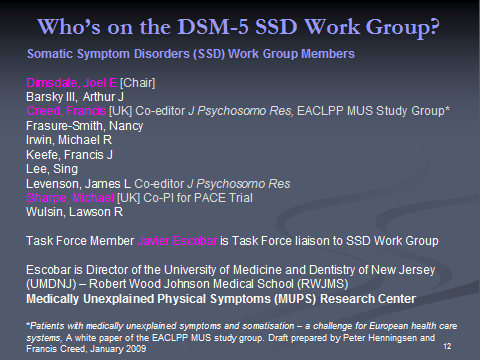
The DSM-5 “Somatic Symptom Disorders” Work Group has responsibility for the revision of the DSM-IV “Somatoform Disorders” categories.

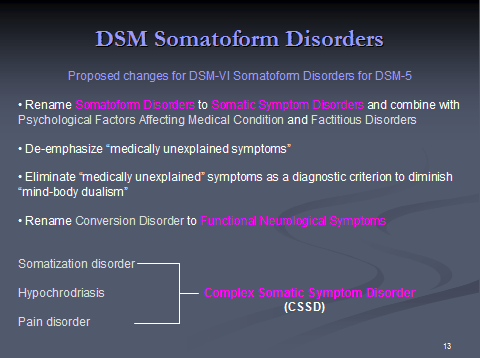
The Work Group is recommending renaming the “Somatoform Disorders” section to “Somatic Symptom Disorders” and combining existing categories – “Somatoform Disorders”, “Psychological Factors Affecting Medical Condition (PFAMC)” and possibly “Factitious Disorders” into one group.

(“Somatic” means “bodily” or “of the body”.)

The Work Group also proposes repackaging “Somatization Disorder”, “Hypochondriasis”, “Undifferentiated Somatoform Disorder” and “Pain Disorder” under a new category entitled “Complex Somatic Symptom Disorder” (CSSD). There is also a “Simple Somatic Symptom Disorder” (SSSD) and a proposal to rebrand “Conversion Disorder” as “Functional Neurological Disorder”.


Where can I find the full criteria for “CSSD”, “PFAMC” and other proposed categories?

Proposed criteria are set out on the DSM-5 Development site: http://tinyurl.com/Somatic-Symptom-Disorders

The CSSD criteria are here: http://tinyurl.com/DSM-5-CSSD

There are two key PDF documents here, “Disorders Descriptions” and “Rationale”, which expand on the Work Group’s proposals, here, or above:

http://tinyurl.com/SSD-Disorders-Description

http://tinyurl.com/SSD-Justification-of-Criteria

Which patient groups might be hurt by these proposals?

The Chronic Fatigue Syndrome Advisory Committee (CFSAC) provides advice and recommendations to the Secretary of Health and Human Services (HHS). On Day One of the May 10-11 CFSAC meeting, CFSAC Committee discussed the implications of these proposals for CFS and ME patients as part of the agenda item around the proposed coding of CFS for ICD-10-CM. You can watch this section of the meeting (4hrs 27mins in from start of video) here:

http://nih.granicus.com/ViewPublisher.php?view_id=26

If the Work Group’s proposals gain DSM Task Force approval, all medical diseases, whether “established general medical conditions or disorders”, like diabetes or heart disease, or conditions presenting with “somatic symptoms of unclear etiology” will have the potential for a bolt-on diagnosis of a “somatic symptom disorder” – if the practitioner feels the patient meets the new criteria.

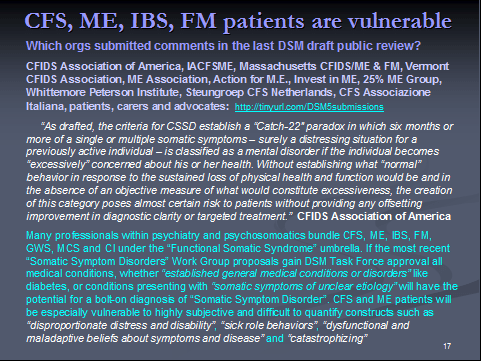
As discussed by CFSAC committee members, earlier this month, CFS, ME, Fibromyalgia and IBS patients, already diagnosed or waiting on a diagnosis, may be especially vulnerable to highly subjective criteria and difficult to quantify concepts such as “disproportionate distress and disability”, “catastrophising”, “health-related anxiety” and “[appraising] bodily symptoms as unduly threatening, harmful, or troublesome.”

Other patient groups that are also bundled under the so-called “Functional somatic syndromes” and “medically unexplained” umbrellas, like Chemical Injury (CI), Chemical Sensitivity (CS), chronic Lyme disease and GWS, are highly vulnerable.

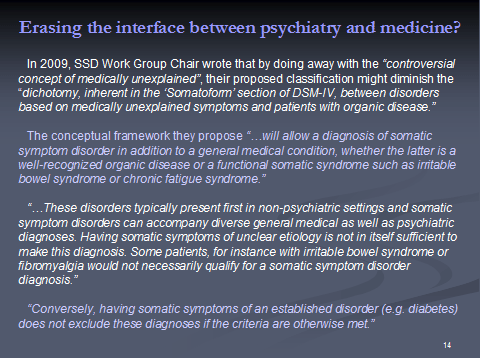
In a 2009 Editorial on the progress of the Work Group, the chair wrote that by doing away with the “controversial concept of medically unexplained”, their proposed classification might diminish “the dichotomy, inherent in the ‘Somatoform’ section of DSM-IV, between disorders based on medically unexplained symptoms and patients with organic disease.” The conceptual framework the Work Group proposes:

“…will allow a diagnosis of somatic symptom disorder in addition to a general medical condition, whether the latter is a well-recognized organic disease or a functional somatic syndrome such as irritable bowel syndrome or chronic fatigue syndrome.”

So under the guise of eliminating “medically unexplained” symptoms as a diagnostic criterion in order to diminish “stigma”, eradicating “terminology [that] enforces a dualism between psychiatric and medical conditions” and language that is “divisive between patients and clinicians”, the APA appears hell bent on colonising the entire medical field by licensing the potential application of a mental health diagnosis to all medical diseases and disorders, if the clinician considers that the patient’s response to their bodily symptoms or their perceived level of disability is “disproportionate” or their coping styles, “maladaptive”.

In its latest proposals, the Work Group writes:

“…Having somatic symptoms of unclear etiology is not in itself sufficient to make this diagnosis. Some patients, for instance with irritable bowel syndrome or fibromyalgia would not necessarily qualify for a somatic symptom disorder diagnosis. Conversely, having somatic symptoms of an established disorder (e.g. diabetes) does not exclude these diagnoses if the criteria are otherwise met.”

“…The symptoms may or may not be associated with a known medical condition. Symptoms may be specific (such as localized pain) or relatively non-specific (e.g. fatigue). The symptoms sometimes represent normal bodily sensations (e.g., orthostatic dizziness), or discomfort that does not generally signify serious disease…”

“…Patients with this diagnosis tend to have very high levels of health-related anxiety. They appraise their bodily symptoms as unduly threatening, harmful, or troublesome and often fear the worst about their health. Even when there is evidence to the contrary, they still fear the medical seriousness of their symptoms. Health concerns may assume a central role in the individual’s life, becoming a feature of his/her identity and dominating interpersonal relationships.”

These proposals could result in misdiagnosis of a mental health disorder or the misapplication of an additional diagnosis of a mental health disorder. There may be considerable implications for these highly subjective criteria for the diagnoses assigned to patients, for the provision of social care, the payment of employment, medical and disability insurance, the types of treatment and testing insurers are prepared to fund and the length of time for which insurers are prepared to pay out.

Dual-diagnosis may bring thousands more patients, potentially, under a mental health banner where they may be subject to inappropriate treatments, psychiatric services, antidepressants, antipsychotics and behavioural therapies such as CBT, for the “modification of dysfunctional and maladaptive beliefs about symptoms and disease, and behavioral techniques to alter illness and sick role behaviors and promote more effective coping [with their somatic symptoms].”

Coding CFS in the “Signs, symptoms and ill-defined conditions” chapter of the forthcoming ICD-10-CM would also render CFS and ME patients more vulnerable to these DSM-5 Work Group recommendations that will provide another dustbin in which to shovel patients with so-called “medically unexplained” bodily symptoms.

Who should submit comment on these proposals?

All stakeholders are permitted to submit comment and the views of patients, carers, families and advocates are important. But evidence-based submissions from the perspective of informed medical professionals – clinicians, psychiatrists, researchers, allied health professionals, lawyers and other professional end users are likely to have more influence.

National and state patient organizations also need to submit comment.

To date, not one patient organization in the US or UK has confirmed to me that they intend to submit feedback, this year. So we need to lean heavily on our patient organizations to review these criteria.

Where can I read last year’s submissions?

Copies of international patient organization submissions for the first DSM-5 public and stakeholder review are collated on this page of my site, together with selected patient and advocate submissions:

DSM-5 Submissions to the 2010 review: http://tinyurl.com/DSM5submissions

How to comment:

Register to submit feedback via the DSM-5 Development website: http://tinyurl.com/Somatic-Symptom-Disorders

More information on registration and preparing submissions here: http://tinyurl.com/DSM-5-register-to-comment

What else can I do?

Use mailing lists, forums, blogs, websites and contacts to get this information out – especially platforms where clinicians, allied health professionals, medical lawyers and patient organization reps participate. Alert state and national ME, CFS, FM and IBS patient organizations to the deadline and lobby for their involvement.

This is the last alert I shall be sending out. Remember, the deadline is June 15.

Thank you.

—————–

Text and formatted versions of this document in Word .doc and PDF format will be available on my website.

Suzy Chapman

https://dxrevisionwatch.wordpress.com

What are the latest proposals for DSM-5 “Somatic Symptom Disorders” categories and why are they problematic? (Part 4)

What are the latest proposals for DSM-5 “Somatic Symptom Disorders” categories and why are they problematic? (Part 4)

Post #82 Shortlink: http://wp.me/pKrrB-16B

Part 1 of this report can be read here in Post #75:

What are the latest proposals for DSM-5 “Somatic Symptom Disorders” categories and why are they problematic? (Part 1)

Part 2 of this report can be read in Post #77:

What are the latest proposals for DSM-5 “Somatic Symptom Disorders” categories and why are they problematic? (Part 2)

Part 3 of this report can be read in Post #80:

What are the latest proposals for DSM-5 “Somatic Symptom Disorders” categories and why are they problematic? (Part 3)

The second public review of draft proposals for DSM-5 criteria closes on 15th June

Information about registering to submit comment can be found in Post #78: http://wp.me/pKrrB-15q

In Part 3 of this report, I set out extracts from the first of two key PDF documents that accompany the latest proposals of the DSM-5 Somatic Symptom Disorders Work Group, highlighting in yellow why ME and CFS patient representation organizations, professionals and advocates need to register their concerns. Stakeholder feedback in this second public review is being accepted until 15 June.

In Part 4, I am posting all the text from the “Rationale” document, omitting several pages of references to research papers. Both key documents can be downloaded here:

For extracts from the “Disorders Description” document see Post #80

     Disorders Description   Key Document One: “Somatic Symptom Disorders”

     Rationale Document     Key Document Two: “Justification of Criteria — Somatic Symptoms”
What are the latest proposals for DSM-5 “Somatic Symptom Disorders” categories and why are they problematic? (Part 3)

What are the latest proposals for DSM-5 “Somatic Symptom Disorders” categories and why are they problematic? (Part 3)

Post #80 Shortlink: http://wp.me/pKrrB-15X

Part 1 of this report can be read here in Post #75:

What are the latest proposals for DSM-5 “Somatic Symptom Disorders” categories and why are they problematic? (Part 1)

Part 2 of this report can be read in Post #77:

What are the latest proposals for DSM-5 “Somatic Symptom Disorders” categories and why are they problematic? (Part 2)

The second public review of draft proposals for DSM-5 criteria is now open and runs from May to 15th June

Information about registering to submit comment can be read here in Post #78: http://wp.me/pKrrB-15q

In the first part of this report, I addressed some of the queries that have been raised around the second public review of proposals for the revision of DSM categories and diagnostic criteria.

In Part 2, I linked to the latest proposals (dated 14 April 2011) from the DSM-5 Somatic Symptom Disorders Work Group, as published on the DSM-5 Development website, on 4 May.

Stakeholder feedback is being accepted now until 15 June.

       Disorders Description   Key Document One: “Somatic Symptom Disorders

       Rationale Document     Key Document Two: “Justification of Criteria — Somatic Symptoms”


Related information:

Submissions by international patient organizations and advocates in February to April 2010 DSM-5 public review can be read here: http://wp.me/PKrrB-AQ

ICD Revision: WHO announces revised Timeline for ICD-11

ICD Revision: WHO announces revised Timeline for ICD-11

Post #79 Shortlink: http://wp.me/pKrrB-16e

The information in this report relates only to ICD-11, the forthcoming revision of ICD-10 that is scheduled for completion and pilot implementation in 2014/15. It does not apply to the forthcoming US specific Clinical Modification of ICD-10, known as ICD-10-CM.

The following has been published on the WHO’s website in the last couple of days. Note that the original timeline had scheduled presentation to the WHA (World Health Assembly) in May 2014, for pilot implementation of ICD-11 in 2014. This most recent timeline for ICD-11 Revision suggests that implementation is being postponed until 2015+.

A WHO news release (if issued) and details on how to access the drafting platform, will be posted as more information becomes available.

http://www.who.int/classifications/icd/revision/timeline/en/

ICD Revision Timelines

May 2011

Open ICD-11 Alpha Browser to the public for viewing

July 2011

Open ICD-11 Alpha Browser to the public for commenting

May 2012

Open ICD-11 Beta to the public

ICD-11 Beta Information
WHO will engage with individuals from an outside community to participate in the ICD revision process.

Individuals will be allowed to:

Make comments
Make proposals to change ICD categories
Participate in field trials
• Assist in translating

May 2015
Present the ICD-11 to the World Health Assembly 

Related information:

Alpha and Beta drafting process:

ICD Revision Process Alpha Evaluation Meeting documents and PowerPoint slide presentations, April 19, 2011: http://wp.me/pKrrB-10i

ICD Revision Process Alpha Evaluation Meeting 11 – 14 April 2011: The Way Forward? April 19: 2011: http://wp.me/pKrrB-ZN


Key documents and references:

1] Key document: ICD Revision Project Plan version 2.1 9 July 2010

2] Key document: Content Model Reference Guide version January 2011

Registering to submit comment in the second DSM-5 public review of draft criteria

Registering to submit comment in the second DSM-5 public review of draft criteria

Post #78 Shortlink: http://wp.me/pKrrB-15q

Second public review of draft proposals for DSM-5 criteria now open and runs from May to 15th June


Under the guise of “eliminating stigma” and eradicating “terminology [that] enforces a dualism between psychiatric and medical conditions” the American Psychiatric Association (APA) appears hell bent on colonising the entire medical field by licensing the application of a mental health diagnosis to all medical diseases and disorders.

If the most recent proposals of the  “Somatic Symptom Disorders” Work Group gain DSM Task Force approval, all medical diseases and disorders, whether “established general medical conditions or disorders” like diabetes or conditions presenting with “somatic symptoms of unclear etiology” will have the potential for a bolt-on diagnosis of “somatic symptom disorder”.

CFS and ME patients, diagnosed or awaiting diagnosis, may be especially vulnerable to highly subjective criteria and difficult to quantify constructs such as “disproportionate distress and disability”, “catastrophising”, “health-related anxiety”, “[appraising] bodily symptoms as unduly threatening, harmful, or troublesome” with “health concerns [that] may assume a central role in the individual’s life, becoming a feature of his/her identity and dominating interpersonal relationships.”

There may be considerable implications for these highly subjective classifications for the diagnoses assigned and the treatments offered to US patients, for the provision of social care and payment of medical and disability insurance.

Who can submit comment?

The APA is inviting all stakeholders to submit comment and feedback on the draft framework for DSM-5 and the latest proposed revisions to diagnostic criteria – patients and families, patient advocates and patient organizations as well as clinicians, researchers, allied health professionals, lawyers and other end users.

It’s important that patients who are able to submit comment do so, but please also encourage patient organizations, informed clinicians, researchers, psychiatrists, psychologists and allied health professionals to submit feedback, too.

Last year, the APA received over 8000 comments from stakeholders across all DSM categories.

Where can I read examples of last year’s submissions?

Copies of last year’s submissions by patient organizations and advocates can be read here: http://tinyurl.com/DSM5submissions

I shall be opening a new page for copies of this year’s patient organization and patient advocate submissions.

How do I register to submit comment?

1. Go to the DSM-5 Development website: http://www.dsm5.org/Pages/Default.aspx

2. Look for the “Participate” box (right hand side of Home Page) and click on “Register Now”. (Log in names and passwords from last year’s public review do appear to have been retained.)

3. Complete the “Register to Make Comments” form: http://www.dsm5.org/Pages/Registration.aspx

Having registered a username, name, email address and country, and entered the “Captcha” code, a confirmation email with a temporary password will be auto generated. The Registration form is also accessible from each of the category Criteria pages, as well as from the Home Page.

You can register in advance, if you wish, then prepare and upload your submission at a later date, but remember the feedback period closes on 15 June.

4. To comment on the proposals of the “Somatic Symptom Disorders” Work Group, Login in and go to this page:

http://www.dsm5.org/proposedrevision/Pages/SomaticSymptomDisorders.aspx

You can submit comment, on that page, for one or more categories, or click on a specific category, for example,

http://www.dsm5.org/ProposedRevision/Pages/proposedrevision.aspx?rid=368

J 00 Complex Somatic Symptom Disorder

Login in and you will be presented with a WYSIWYG editor.

I would strongly recommend composing your comment in a draft email or word processor first and saving a copy, as last year, there were complaints that Captcha characters were hard to read and the uploading procedure glitchy – so please save a copy first. External links and references can be included but there is no facility for including attachments. There appears to be no maximum word or character length specified. I would also suggest that you head your submission with “For the attention of the Somatic Symptom Disorders Work Group” or similar.

What are the latest proposals for the “Somatic Symptom Disorders” categories?

The latest proposals are set out here, where the two key “Disorder Descriptions” and “Rationale” documents can also be downloaded: http://wp.me/pKrrB-13z 

I’ll be posting extracts from the two key documents in the next post.

More Q and As on and around the public review, here: http://wp.me/pKrrB-12P


Related material:

On the subject of the use of the word “somatic” and “somatic symptom” , Angela Kennedy published this note, in June 2009:

I’ve noticed for some time that various people have been using the term ‘somatic’ as if it signified a ‘psychosomatic’ or ‘psychogenic’ condition.

This is incorrect. The OED definition of ‘somatic’ is “of or relating to the body, especially as distinct from the mind” (my italics). The word comes from the Greek ‘soma’ meaning ‘body’.

Even when proponents of ‘psychogenic’ explanations (it’s in your mind, you’re imagining it, misinterpreting it, faking it, caused it by your own beliefs etc. etc. etc.) use the term ‘somatic illness’ they actually do mean an illness of the body. They may then claim this somatic (or bodily illness) is caused by psychological dysfunction, but the word ‘somatic’ does not mean “illness caused by psychological dysfunction”. It merely means illness of a body, or a bodily illness.

It is important that this word is used correctly, especially when people write to the media, government, the medical establishment etc. Otherwise we are in danger of seeing apparent objections published, from advocates, to saying ME/CFS is a bodily illness, purely because someone has used the word ‘somatic’ incorrectly!