Registering to submit comment in the second DSM-5 public review of draft criteria

Registering to submit comment in the second DSM-5 public review of draft criteria

Post #78 Shortlink: http://wp.me/pKrrB-15q

Second public review of draft proposals for DSM-5 criteria now open and runs from May to 15th June
 

Under the guise of “eliminating stigma” and eradicating “terminology [that] enforces a dualism between psychiatric and medical conditions” the American Psychiatric Association (APA) appears hell bent on colonising the entire medical field by licensing the application of a mental health diagnosis to all medical diseases and disorders.

If the most recent proposals of the  “Somatic Symptom Disorders” Work Group gain DSM Task Force approval, all medical diseases and disorders, whether “established general medical conditions or disorders” like diabetes or conditions presenting with “somatic symptoms of unclear etiology” will have the potential for a bolt-on diagnosis of “somatic symptom disorder”.

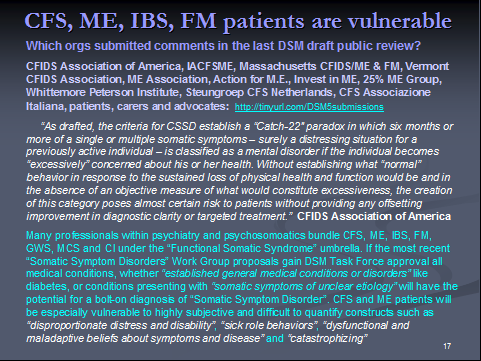
CFS and ME patients, diagnosed or awaiting diagnosis, may be especially vulnerable to highly subjective criteria and difficult to quantify constructs such as “disproportionate distress and disability”, “catastrophising”, “health-related anxiety”, “[appraising] bodily symptoms as unduly threatening, harmful, or troublesome” with “health concerns [that] may assume a central role in the individual’s life, becoming a feature of his/her identity and dominating interpersonal relationships.”

There may be considerable implications for these highly subjective classifications for the diagnoses assigned and the treatments offered to US patients, for the provision of social care and payment of medical and disability insurance.

Who can submit comment?

The APA is inviting all stakeholders to submit comment and feedback on the draft framework for DSM-5 and the latest proposed revisions to diagnostic criteria – patients and families, patient advocates and patient organizations as well as clinicians, researchers, allied health professionals, lawyers and other end users.

It’s important that patients who are able to submit comment do so, but please also encourage patient organizations, informed clinicians, researchers, psychiatrists, psychologists and allied health professionals to submit feedback, too.

Last year, the APA received over 8000 comments from stakeholders across all DSM categories.

Where can I read examples of last year’s submissions?

Copies of last year’s submissions by patient organizations and advocates can be read here: http://tinyurl.com/DSM5submissions

I shall be opening a new page for copies of this year’s patient organization and patient advocate submissions.

How do I register to submit comment?

1. Go to the DSM-5 Development website: http://www.dsm5.org/Pages/Default.aspx

2. Look for the “Participate” box (right hand side of Home Page) and click on “Register Now”. (Log in names and passwords from last year’s public review do appear to have been retained.)

3. Complete the “Register to Make Comments” form: http://www.dsm5.org/Pages/Registration.aspx

Having registered a username, name, email address and country, and entered the “Captcha” code, a confirmation email with a temporary password will be auto generated. The Registration form is also accessible from each of the category Criteria pages, as well as from the Home Page.

You can register in advance, if you wish, then prepare and upload your submission at a later date, but remember the feedback period closes on 15 June.

4. To comment on the proposals of the “Somatic Symptom Disorders” Work Group, Login in and go to this page:

http://www.dsm5.org/proposedrevision/Pages/SomaticSymptomDisorders.aspx

You can submit comment, on that page, for one or more categories, or click on a specific category, for example,

http://www.dsm5.org/ProposedRevision/Pages/proposedrevision.aspx?rid=368

J 00 Complex Somatic Symptom Disorder

Login in and you will be presented with a WYSIWYG editor.

I would strongly recommend composing your comment in a draft email or word processor first and saving a copy, as last year, there were complaints that Captcha characters were hard to read and the uploading procedure glitchy – so please save a copy first. External links and references can be included but there is no facility for including attachments. There appears to be no maximum word or character length specified. I would also suggest that you head your submission with “For the attention of the Somatic Symptom Disorders Work Group” or similar.

What are the latest proposals for the “Somatic Symptom Disorders” categories?

The latest proposals are set out here, where the two key “Disorder Descriptions” and “Rationale” documents can also be downloaded: http://wp.me/pKrrB-13z 

I’ll be posting extracts from the two key documents in the next post.

More Q and As on and around the public review, here: http://wp.me/pKrrB-12P
 

Related material:

On the subject of the use of the word “somatic” and “somatic symptom” , Angela Kennedy published this note, in June 2009:

I’ve noticed for some time that various people have been using the term ‘somatic’ as if it signified a ‘psychosomatic’ or ‘psychogenic’ condition.

This is incorrect. The OED definition of ‘somatic’ is “of or relating to the body, especially as distinct from the mind” (my italics). The word comes from the Greek ‘soma’ meaning ‘body’.

Even when proponents of ‘psychogenic’ explanations (it’s in your mind, you’re imagining it, misinterpreting it, faking it, caused it by your own beliefs etc. etc. etc.) use the term ‘somatic illness’ they actually do mean an illness of the body. They may then claim this somatic (or bodily illness) is caused by psychological dysfunction, but the word ‘somatic’ does not mean “illness caused by psychological dysfunction”. It merely means illness of a body, or a bodily illness.

It is important that this word is used correctly, especially when people write to the media, government, the medical establishment etc. Otherwise we are in danger of seeing apparent objections published, from advocates, to saying ME/CFS is a bodily illness, purely because someone has used the word ‘somatic’ incorrectly!

What are the latest proposals for DSM-5 “Somatic Symptom Disorders” categories and why are they problematic? (Part 2)

What are the latest proposals for DSM-5 “Somatic Symptom Disorders” categories and why are they problematic? (Part 2)

Post #77 Shortlink: http://wp.me/pKrrB-13z

Part 1 of this report can be read here in Post #75:

What are the latest proposals for DSM-5 “Somatic Symptom Disorders” categories and why are they problematic? (Part 1)

In the first part of this report, I addressed some of the queries that have been raised around the second public review of proposals for the revision of DSM categories and diagnostic criteria. Stakeholder feedback is being accepted now until 15 June and I’ll be giving more information on how to submit feedback via the DSM-5 Development website in a forthcoming post.

In this post, I am setting out the latest proposals (dated 14 April 2011) from the DSM-5 Somatic Symptom Disorders Work Group, as published on the DSM-5 Development website, on 4 May. The next post will set out extracts from the two key documents that accompany these revised proposals and why ME and CFS patient representation organizations, patients and advocates need to register their concerns via this second public review.

Criteria proposals and rationales are expanded upon within the two key documents and the devil is in the detail. Patient organizations will need to review both documents, as changes have been made since last year. And if you are able to do so, I recommend that patients, carers and patient advocates read them, too.

At over a dozen pages long, the “Rationale” document (which is titled: “Justification of Criteria — Somatic Symptoms”) looks potentially daunting, but the text is not as long as it appears since five or six pages of references are included at the end. Edits to the documents since the versions published in January, this year, have been highlighted by the Work Group in yellow.

http://www.dsm5.org/ProposedRevision/Pages/SomaticSymptomDisorders.aspx

Somatic Symptom Disorders

Below, I am posting proposal details for categories J 00 thru J 04.

Note that the two key PDF documents, dated 14 April 2011 called: “Disorder Descriptions” (7 pages) and “Rationale” contain full disorder descriptions and rationales for all category proposals in the Somatic Symptom Disorders categories, so you need only download one copy of each PDF.

Open full disorder descriptions here       Disorders Description   Key Document One: “Somatic Symptom Disorders”

Open full rationale document here       Rationale Document   Key Document Two: “Justification of Criteria — Somatic Symptoms”

Related material

Patient organisations, professionals and advocates submitting comments in the DSM-5 draft proposal review process are invited to provide copies of their submissions for this second and current public review for publication on this site.

Read submissions in the last DSM-5 public review, held Feb-April 2010 here:

http://tinyurl.com/DSM5submissions

International patient organisation submissions:

Whittemore Peterson Institute, Steungroep CFS Netherlands, CFS Associazione Italiana, ME Association (endorsing submission by Dr Ellen Goudsmit), Action for M.E., Invest in ME, Mass. CFIDS/ME & FM, The CFIDS Association of America, Vermont CFIDS Association, IACFSME, The 25% ME Group

A number of patient advocate submissions are also published.

APA announces second public review of DSM-5 draft criteria and structure

American Psychiatric Association (APA) announces second public review of DSM-5 draft criteria and structure

Post #73 Shortlink: http://wp.me/pKrrB-12k

Second public stakeholder review and feedback period now 4 May to 15 June

APA News Release No: 11-27 PDF: http://tinyurl.com/APAnewsrelease4may11 

or open PDF on this site here: New Framework Proposed for Manual of Mental Disorders

Online posting of draft disorders and criteria proposed by the 13 DSM-5 Work Groups for new and existing mental disorders had originally been scheduled for May-June, this year. According to a revised Timeline on the APA’s DSM-5 Development site, in March, this second public review exercise had been rescheduled for August-September:

“August-September 2011: Online Posting of Revised Criteria. Following the internal review, revised draft diagnostic criteria will be posted online for approximately one month to allow the public to provide feedback. This site will be closed for feedback by midnight on September 30, 2011.”

But yesterday, 4 May, the APA announced that the second public review period is now open and will run from May to 15 June.

The DSM-5 site was updated yesterday with announcements and revised proposals (dated May 4, 2011) across all categories. The current review period closes on 15th June – just six weeks away.

Note that this is a public and stakeholder review and feedback exercise and is not restricted to professionals or members of the American Psychiatric Association.

There is a Task Force announcement here: http://www.dsm5.org/Pages/Default.aspx

[Extracts]

What Specifically Has Changed on This Site?

“You will notice several changes to this Web site since we first launched in February 2010. Numerous disorders contain updated criteria…

” ...Is There Opportunity to Provide Further Comments?

“At this time, we are asking visitors to review and comment on the proposed DSM-5 organizational structure and criteria changes. Please note that the current commenting period will end on June 15, 2011. It is important to remember that the proposed structure featured here is only a draft. These proposed headings were reviewed by the DSM-5 Task Force in November 2010…

“…The content on this site will stay in its current form until after completion of the DSM-5 Field Trials, scheduled to conclude later this year. Following analysis of field trial results, we will revise the proposed criteria as needed and, after appropriate review and approval, we will post these changes on this Web site. At that time, we will again open the site to a third round of comments from visitors, which will be systematically reviewed by each of the work groups for consideration of additional changes. Thus, the current commenting period is not the final opportunity for you to submit feedback, and subsequent revisions to DSM-5 proposals will be jointly informed by field trial findings as well as public commentary.

“We look forward to receiving your feedback during the coming weeks and appreciate your participation in this important process.”      [Source: http://www.dsm5.org/Pages/Default.aspx]

There are brief notes on the proposed DSM-5 Organizational Structure here:

http://www.dsm5.org/proposedrevision/Pages/proposed-dsm5-organizational-structure.aspx

The “Recent updates” page for “DSM changes” and “Disorder-specific changes” is here:

http://www.dsm5.org/Pages/RecentUpdates.aspx


Registration for submitting feedback

Last year, registration was required in order to submit comment via the DSM-5 Development website. You can register to submit feedback on the DSM-5 Development site home page or on the individual pages for specific category proposals (right hand side under “Participate”).

The revised Timeline can be read here: http://www.dsm5.org/about/Pages/Timeline.aspx

According to the Timeline, a third review and feedback is currently scheduled for January-February 2012, for two months.


Latest revisions for “Somatic Symptom Disorders”

http://www.dsm5.org/ProposedRevision/Pages/SomaticSymptomDisorders.aspx

I will post  information in the next posting specific to the proposals of the DSM-5  Work Group for “Somatic Symptom Disorders”


Media coverage of APA’s 4 May DSM-5 announcement

MedPage Today

CNN Blog

APA postpones release of revised proposals for draft criteria for DSM-5 by three months

APA postpones release of revised proposals for draft criteria for DSM-5 by three months

Post #64 Shortlink: http://wp.me/pKrrB-Yu

Slip slidin’ away…

There will be no public review of revised draft criteria for DSM-5 categories this coming May.

APA Field Trials got off to a late start and the DSM-5 timeline continues to slip.

Online posting of draft disorders and criteria proposed by the DSM-5 Work Groups for new and existing mental disorders had been scheduled for May-July, this year. Revised criteria were expected to be posted online in May, for a period of approximately one month to allow the public to review proposals and submit comment.

But according to a revised Timeline on the American Psychiatric Association’s (APA) DSM-5 Development site, this second public review exercise is now postponed until August-September 2011:

“August-September 2011: Online Posting of Revised Criteria. Following the internal review, revised draft diagnostic criteria will be posted online for approximately one month to allow the public to provide feedback. This site will be closed for feedback by midnight on September 30, 2011.”

There are also references within the DSM-5 Timeline to ICD-10-CM and the forthcoming ICD-10-CM Partial Code Freeze, and to ICD-11.

ICD-11 Beta Draft

According to sources, ICD-11 Revision Steering Group are still working towards having a Beta Draft ready for May 2011.

But from a PowerPoint presentation posted briefly on the ICD-11 Revision website at the end of February, but swiftly removed following enquiries, evidently the WHO has been discussing the pros and cons of postponing the release of its own Beta Draft for public input until the autumn, or until the end of 2011, or possibly even May 2012.

Another ICD Revision document: ICD Revision Project Plan v 2.1, projects a date of May 2012 for release of the Beta Draft. Since there is no definitive and recent ICD-11 timeline on any of the WHO’s ICD Revision sites, and since ICD Revision is keeping schtum, it remains unclear at what point in the timeline a Beta Draft for ICD-11 will be released for public scrutiny and input (as opposed to purely internal use, as the Alpha Draft had been). I will update when more information becomes available.

The original dissemination date for ICD-11 had been 2012, with the timelines for the revision of ICD-10 and DSM-IV running more or less in parallel. But in 2007/8, the release date for ICD-11 was shifted to pilot implementation in 2014 and dissemination in 2015. A “pre-final draft” of ICD-11 is projected for March 2013 with submission for WHA endorsement in May 2014. ICD Revision are balancing “incomplete software, unsatisfactory content and incomplete review process” against reduced opportunity for public input and reduced public confidence, if the timeline for the Beta were to be extended.

In December 2009, the APA announced that the publication date for their DSM-5 was being extended to May 2013.

In January 2010, APA President, Alan F Schatzburg, MD, said:

“…the extension will permit better linking of DSM-5 to the U.S. implementation of the ICD-10-CM codes for all Medicare/Medicaid claims reporting, which are scheduled to go into effect on October 1, 2013. APA will also continue to work with the World Health Organization (WHO) to harmonize DSM-5 with the mental and behavioral disorders section of ICD-11, which WHO plans to release no sooner than 2014.”

With a Partial Code Freeze looming this October for ICD-10-CM, the delays in starting field trials and now a three month postponement of publication of revised criteria for the second public review and comment period isn’t going to inspire confidence in a Task Force that has already come in for significant criticism of its oversight of the revision of DSM-IV.

Revised and expanded DSM-5 Timeline

[Timeline superceded by revised Timeline]

Ed: Footnotes: The “harmonization” of DSM-5 and ICD-11

The APA participates with the WHO in the “International Advisory Group for the Revision of ICD-10 Mental and Behavioural Disorders” (Chapter 5) and a “DSM-ICD Harmonization Coordination Group”.

There is already a degree of correspondence between DSM-IV and Chapter V of ICD-10. For the next editions, the APA and the WHO have committed as far as possible:

“To facilitate the achievement of the highest possible extent of uniformity and harmonization between ICD-11 mental and behavioural disorders and DSM-V disorders and their diagnostic criteria.”

with the objective that

“The WHO and APA should make all attempts to ensure that in their core versions, the category names, glossary descriptions and criteria are identical for ICD and DSM.”

But the WHO acknowledges there may be areas where congruency between the two systems may not be achievable.

As the iCAT (the ICD-11 electronic collaborative drafting platform) stood last November, two new categories were listed in the Linearized Chapter 5, F45 – F48.0 (Somatoform Disorders) codes. It is understood from ICD documentation (DIFF File – Changes from ICD-10 [MS Excel doc. Retrieved 29.09.10; no longer available on 01.10.10]) that child categories F45.40 and F45.41 are new entities for ICD-11 [1].

Note the ICD-11 categories between F45 – F48.0, as they stood in the iCAT drafting platform last November, do not mirror current proposals of the DSM-5 “Somatic Symptom Disorder” Work Group for renaming the “Somatoform Disorders” categories of DSM-IV to “Somatic Symptom Disorders” and combining a number of existing categories under a new rubric, “Complex Somatic Symptom Disorder (CSSD)”, and the more recently proposed “Simple Somatic Symptom Disorder (SSSD)” [2][3].

[1] Screenshot iCAT, ICD-11: Chapter 5: F45 – F48.0: https://dxrevisionwatch.com/wp-content/uploads/2010/05/2icatchapter5f45somatoform.png  

[2] Article: Erasing the interface between psychiatry and medicine (DSM-5), Chapman S, 13 February 2011: http://wp.me/pKrrB-Vn

[3] Article: Revisions to DSM-5 proposals on 14.01.11: New category proposed “Simple Somatic Symptom Disorder, Chapman S, 16 January 2011: http://wp.me/pKrrB-St  

[4] DSM-5 Development website: http://www.dsm5.org/about/Pages/Timeline.aspx

Erasing the interface between psychiatry and medicine (DSM-5)

Erasing the interface between psychiatry and medicine (DSM-5)

Post #61 Shortlink: http://wp.me/pKrrB-Vn

Under the guise of “eliminating stigma” and eradicating “terminology [that] enforces a dualism between psychiatric and medical conditions” the American Psychiatric Association (APA) appears hell bent on colonising the entire medical field by licensing the application of a mental health diagnosis to all medical diseases and disorders.

While a stream of often acerbic commentaries from two former DSM Task Force chairs, Allen Frances and Robert Spitzer, have focused on the implications for introducing new additions into the DSM and broadening the definitions of existing diagnostic criteria, the DSM-5 “Somatic Symptom Disorders” Work Group (Chair, Joel E Dimsdale) has been quietly redefining DSM’s “Somatoform Disorders” categories with proposals that if approved, would legitimise the application of an additional diagnosis of “Somatic Symptom Disorder” to all medical diseases and disorders.

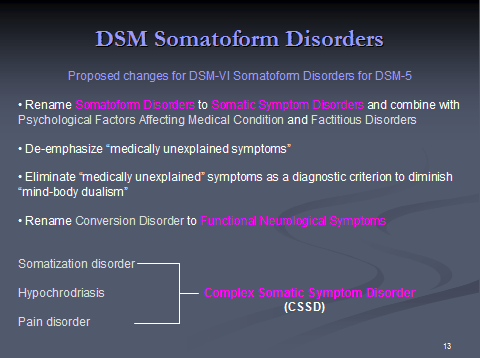
Radical proposals for renaming the “Somatoform Disorders” category “Somatic Symptom Disorders” and combining a number of existing categories under a new rubric, “Complex Somatic Symptom Disorder (CSSD)”, and a more recently proposed “Simple Somatic Symptom Disorder (SSSD)”, have the potential for bringing millions more patients under a mental health banner and expanding markets for psychiatric services, antidepressants, antipsychotics and behavioural therapies such as Cognitive Behavioural Therapy (CBT) for the “modification of dysfunctional and maladaptive beliefs about symptoms and disease, and behavioral techniques to alter illness and sick role behaviors” for all patients with somatic symptoms, irrespective of cause.

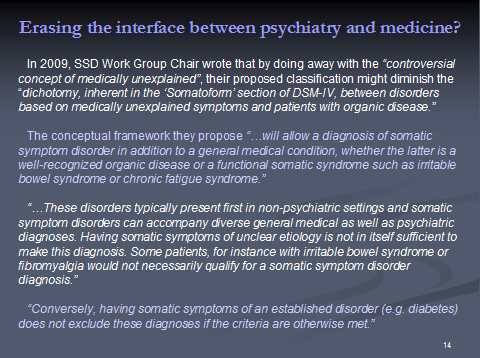
In a June ’09 Editorial, titled “The proposed diagnosis of somatic symptom disorders in DSM-V to replace somatoform disorders in DSM-IV – a preliminary report”, which expanded on a brief DSM-5 Work Group progress report published on the DSM-5 Development website that April, Joel E Dimsdale and fellow DSM-5 Work Group member, Francis Creed, reported that by doing away with the “controversial concept of medically unexplained symptoms”, their proposed classification might diminish the “dichotomy, inherent in the ‘Somatoform’ section of DSM IV, between disorders based on medically unexplained symptoms and patients with organic disease.”

If the most recent “Somatic Symptom Disorders” Work Group proposals gain DSM Task Force approval, all medical diseases and disorders, whether “established general medical conditions or disorders” like diabetes or conditions presenting with “somatic symptoms of unclear etiology” will have the potential for a bolt-on diagnosis of “somatic symptom disorder”.

CFS and ME patients may be especially vulnerable to highly subjective and difficult to quantify constructs such as “disproportionate distress and disability”, “catastrophising”, “health-related anxiety”, “[appraising] bodily symptoms as unduly threatening, harmful, or troublesome” with “health concerns [that] may assume a central role in the individual’s life, becoming a feature of his/her identity and dominating interpersonal relationships.”

There may be considerable implications for these highly subjective criteria for the treatments offered to US patients, the provision of social care packages and the payment of medical and disability insurance.

Criteria are set out very briefly in the PowerPoint slides, but the full criteria and key documents need to be scrutinized. The most recent proposals of the DSM-5 “Somatic Symptoms Disorders” Work Group plus two key Disorder Description and Rationale PDF documents can be read on the APA’s DSM-5 Development site here:

http://www.dsm5.org/ProposedRevisions/Pages/SomatoformDisorders.aspx

Two key Somatic Symptoms Disorders Work Group Draft Proposal documents:

     Revised Justification of Criteria Version 1/31/11

     Revised Disorder Descriptions: Version 1/14/11

The next public review of draft criteria and disorder descriptions has been postponed to August – September, this year, for a period of approximately one month for public review and feedback.

[1] Psychiatric Times Special Report, PSYCHIATRY AND MEDICAL ILLNESS Unexplained Physical Symptoms What’s a Psychiatrist to Do?  Humberto Marin, MD and Javier I. Escobar, MD, 01 August 2008

[Draft criteria superceded by third draft published on May 2, 2012]

Images copyright ME agenda 2011   No unauthorized reproduction.

The next public review of draft criteria and disorder descriptions is scheduled for May/June 2011.

Shortlink for this Post: http://wp.me/pKrrB-Vn

Washington Examiner: Corrupting Psychiatry by Max Borders

Washington Examiner: Corrupting Psychiatry by Max Borders

Post #58 Shortlink: http://wp.me/pKrrB-TU

Interesting commentary from writer Max Borders, last week, on the website of the Washington Examiner around the revision of the American Psychiatric Association’s Diagnostic and Statistical Manual of Mental Disorders (DSM):

Washington Examiner

Corrupting Psychiatry

By Max Borders 01/18/11 10:22 AM

The American Psychiatric Association (APA) has gone crazy — like a fox.

“There was a time when we could be more charitable about the vagaries in the APA’s Bible, the DSM. But not anymore. If you’ve never heard of the DSM, it’s the Diagnostic and Statistical Manual series the APA publishes. Psychiatrists all over the world use the DSM as a guidebook for treating people with some form of mental illness. But the APA may test credulity with its upcoming edition.

“I refer specifically to proposed changes in the DSM-V due out in 2013. It’s no accident these changes reflect new political realities about how psychiatric medicine gets paid for and by whom…”

Read rest of article at the Washington Examiner

Commentary in response to “Corrupting Psychiatry” from Dutch philosopher and psychologist, Maarten Maartensz, on Nederlog here More on the APA’s mockery of medicine and morality and here More on the APA and the DSM-5

Comments on Washington Examiner to article “Corrupting Psychiatry” by Max Borders

By: Skeeter
Jan 21, 2011 9:55 PM

Good article, that says things that need to be said, long and loud.

Both the APA, and the broader psychiatric profession, are currently indulging in a seriously unjustified power grab, and they and their claims are in desperate need of much closer and tougher (and ongoing) external scrutiny then they have been subject to date.

Generally speaking, I would have to agree that the profession is becoming much too closely aligned with and mutually reliant on both state and corporate interests, as opposed to the interests of the patient and the science on which they base their claims to authority.

One small point: I would not invoke British psychiatry as any counterbalance to the excesses of their American colleagues. The Brits have their own serious problems. Not least of which is that they are mired deep in the methodological and ethical swamp of somatoform disorders (aka conversion or psychosomatic disorders, and their related ‘treatments’), and a lot of patients are paying a very heavy price indeed for this obsession by certain influential members of the British psych establishment.

By: Suzy Chapman
Jan 22, 2011 7:28 AM

Erasing the interface between psychiatry and medicine

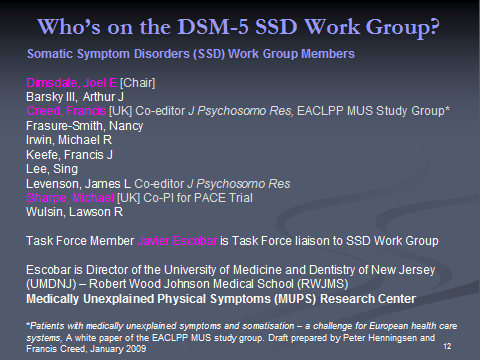
The previous commenter cautions against invoking members of the “British psych establishment”. Two very influential members of the British psychiatry and psychosomatics establishment, Professors Michael Sharpe and Francis Creed, have seats on the DSM-5 “Somatic Symptom Disorders” Work Group.

While many column inches by rightly perturbed journalists and a stream of often acerbic critiques from former DSM Task Force chairs, Allen Frances and Robert Spitzer, have focussed on the implications for introducing new additions into the DSM and broadening the definitions of existing diagnostic criteria, the DSM-5 “Somatic Symptom Disorders” Work Group (Chair, Joel E Dimsdale) has been quietly redefining DSM’s “Somatoform Disorders” categories with proposals that if approved would legitimise the application of an additional diagnosis of “Somatic Symptom Disorder” to all medical diseases and disorders.

Radical proposals for renaming the “Somatoform Disorders” category “Somatic Symptom Disorders” and combining a number of existing categories under a new umbrella, “Complex Somatic Symptom Disorder (CSSD)” and a more recently suggested “Simple Somatic Symptom Disorder (SSSD)”, have the potential for bringing millions more patients under a mental health banner and expanding markets for psychiatric services, antidepressants, antipsychotics and behavioural therapies such as Cognitive Behavioural Therapy (CBT) for all patients with somatic symptoms, irrespective of cause.

Professor Creed is co-editor of The Journal of Psychosomatic Research. In a June ’09 Editorial, titled “The proposed diagnosis of somatic symptom disorders in DSM-V to replace somatoform disorders in DSM-IV – a preliminary report”, which expanded on a brief DSM-5 Work Group progress report published on the DSM-5 Development website that April, Joel E Dimsdale and fellow DSM-5 Work Group member, Francis Creed, reported that by doing away with the “controversial concept of medically unexplained symptoms”, their proposed classification might diminish the “dichotomy, inherent in the ‘Somatoform’ section of DSM IV, between disorders based on medically unexplained symptoms and patients with organic disease.”

If the most recent “Somatic Symptom Disorders” Work Group proposals gain DSM Task Force approval, all medical conditions, whether “established general medical conditions or disorders” like diabetes or conditions presenting with “somatic symptoms of unclear etiology” will have the potential for a bolt-on diagnosis of “somatic symptom disorder”.

Under the guise of “eliminating stigma” and eradicating “terminology [that] enforces a dualism between psychiatric and medical conditions” the American Psychiatric Association (APA) appears hell bent on colonising the entire medical field by licensing the application of a mental health diagnosis to all medical diseases and disorders.

By: KAL
Jan 23, 2011 1:36 PM

Who else might benefit? Disability Insurance. If you can be shown to have a “mental illness” then disability insurance only pays a maximum of two years of payments vs. a lifetime of payments for an organic disease.

Check the APA website for conflicts of interest for members of the working group for Somatic Disorders.

References:

DSM-5 Development website: Somatoform Disorders
http://www.dsm5.org/ProposedRevisions/Pages/SomatoformDisorders.aspx

Proposal: Complex Somatic Symptom Disorder
http://www.dsm5.org/ProposedRevisions/Pages/proposedrevision.aspx?rid=368

Proposal: Simple Somatic Symptom Disorder
http://www.dsm5.org/ProposedRevisions/Pages/proposedrevision.aspx?rid=491

The most recent versions of the two key documents associated with the proposals of the “Somatic Symptom Disorders” Work Group are:

Update @ 7 February 2011

The Justification of Criteria document was revised again by the SSD Work Group on 1/31/11 to incorporate the new proposal for SSSD and other revisions and is replaced by:

DRAFT 1/31/11  Justification of Criteria – Somatic Symptoms

Descriptions document version 1/14/11 Revised Disorder Descriptions: Version 1/14/11

Rationale document version 10/4/10 Previous revised Justification of Criteria: Version 10/4/10