What are the latest proposals for DSM-5 “Somatic Symptom Disorders” categories and why are they problematic? (Part 3)

What are the latest proposals for DSM-5 “Somatic Symptom Disorders” categories and why are they problematic? (Part 3)

Post #80 Shortlink: http://wp.me/pKrrB-15X

Part 1 of this report can be read here in Post #75:

What are the latest proposals for DSM-5 “Somatic Symptom Disorders” categories and why are they problematic? (Part 1)

Part 2 of this report can be read in Post #77:

What are the latest proposals for DSM-5 “Somatic Symptom Disorders” categories and why are they problematic? (Part 2)

The second public review of draft proposals for DSM-5 criteria is now open and runs from May to 15th June

Information about registering to submit comment can be read here in Post #78: http://wp.me/pKrrB-15q

In the first part of this report, I addressed some of the queries that have been raised around the second public review of proposals for the revision of DSM categories and diagnostic criteria.

In Part 2, I linked to the latest proposals (dated 14 April 2011) from the DSM-5 Somatic Symptom Disorders Work Group, as published on the DSM-5 Development website, on 4 May.

Stakeholder feedback is being accepted now until 15 June.

       Disorders Description   Key Document One: “Somatic Symptom Disorders

       Rationale Document     Key Document Two: “Justification of Criteria — Somatic Symptoms”


Related information:

Submissions by international patient organizations and advocates in February to April 2010 DSM-5 public review can be read here: http://wp.me/PKrrB-AQ

Registering to submit comment in the second DSM-5 public review of draft criteria

Registering to submit comment in the second DSM-5 public review of draft criteria

Post #78 Shortlink: http://wp.me/pKrrB-15q

Second public review of draft proposals for DSM-5 criteria now open and runs from May to 15th June


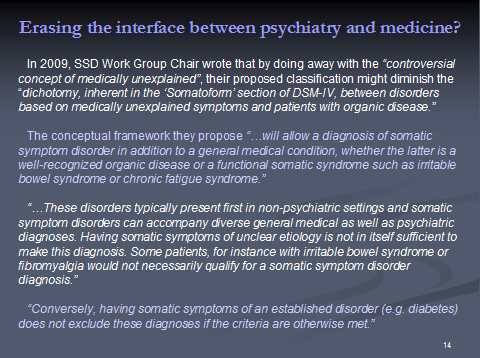
Under the guise of “eliminating stigma” and eradicating “terminology [that] enforces a dualism between psychiatric and medical conditions” the American Psychiatric Association (APA) appears hell bent on colonising the entire medical field by licensing the application of a mental health diagnosis to all medical diseases and disorders.

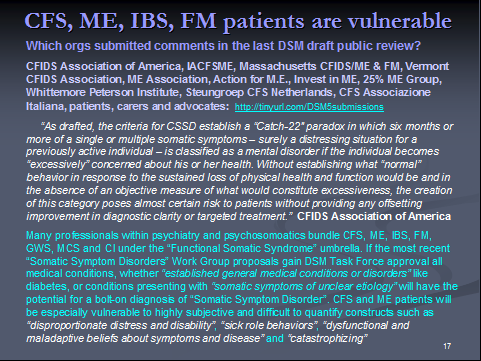
If the most recent proposals of the  “Somatic Symptom Disorders” Work Group gain DSM Task Force approval, all medical diseases and disorders, whether “established general medical conditions or disorders” like diabetes or conditions presenting with “somatic symptoms of unclear etiology” will have the potential for a bolt-on diagnosis of “somatic symptom disorder”.

CFS and ME patients, diagnosed or awaiting diagnosis, may be especially vulnerable to highly subjective criteria and difficult to quantify constructs such as “disproportionate distress and disability”, “catastrophising”, “health-related anxiety”, “[appraising] bodily symptoms as unduly threatening, harmful, or troublesome” with “health concerns [that] may assume a central role in the individual’s life, becoming a feature of his/her identity and dominating interpersonal relationships.”

There may be considerable implications for these highly subjective classifications for the diagnoses assigned and the treatments offered to US patients, for the provision of social care and payment of medical and disability insurance.

Who can submit comment?

The APA is inviting all stakeholders to submit comment and feedback on the draft framework for DSM-5 and the latest proposed revisions to diagnostic criteria – patients and families, patient advocates and patient organizations as well as clinicians, researchers, allied health professionals, lawyers and other end users.

It’s important that patients who are able to submit comment do so, but please also encourage patient organizations, informed clinicians, researchers, psychiatrists, psychologists and allied health professionals to submit feedback, too.

Last year, the APA received over 8000 comments from stakeholders across all DSM categories.

Where can I read examples of last year’s submissions?

Copies of last year’s submissions by patient organizations and advocates can be read here: http://tinyurl.com/DSM5submissions

I shall be opening a new page for copies of this year’s patient organization and patient advocate submissions.

How do I register to submit comment?

1. Go to the DSM-5 Development website: http://www.dsm5.org/Pages/Default.aspx

2. Look for the “Participate” box (right hand side of Home Page) and click on “Register Now”. (Log in names and passwords from last year’s public review do appear to have been retained.)

3. Complete the “Register to Make Comments” form: http://www.dsm5.org/Pages/Registration.aspx

Having registered a username, name, email address and country, and entered the “Captcha” code, a confirmation email with a temporary password will be auto generated. The Registration form is also accessible from each of the category Criteria pages, as well as from the Home Page.

You can register in advance, if you wish, then prepare and upload your submission at a later date, but remember the feedback period closes on 15 June.

4. To comment on the proposals of the “Somatic Symptom Disorders” Work Group, Login in and go to this page:

http://www.dsm5.org/proposedrevision/Pages/SomaticSymptomDisorders.aspx

You can submit comment, on that page, for one or more categories, or click on a specific category, for example,

http://www.dsm5.org/ProposedRevision/Pages/proposedrevision.aspx?rid=368

J 00 Complex Somatic Symptom Disorder

Login in and you will be presented with a WYSIWYG editor.

I would strongly recommend composing your comment in a draft email or word processor first and saving a copy, as last year, there were complaints that Captcha characters were hard to read and the uploading procedure glitchy – so please save a copy first. External links and references can be included but there is no facility for including attachments. There appears to be no maximum word or character length specified. I would also suggest that you head your submission with “For the attention of the Somatic Symptom Disorders Work Group” or similar.

What are the latest proposals for the “Somatic Symptom Disorders” categories?

The latest proposals are set out here, where the two key “Disorder Descriptions” and “Rationale” documents can also be downloaded: http://wp.me/pKrrB-13z 

I’ll be posting extracts from the two key documents in the next post.

More Q and As on and around the public review, here: http://wp.me/pKrrB-12P


Related material:

On the subject of the use of the word “somatic” and “somatic symptom” , Angela Kennedy published this note, in June 2009:

I’ve noticed for some time that various people have been using the term ‘somatic’ as if it signified a ‘psychosomatic’ or ‘psychogenic’ condition.

This is incorrect. The OED definition of ‘somatic’ is “of or relating to the body, especially as distinct from the mind” (my italics). The word comes from the Greek ‘soma’ meaning ‘body’.

Even when proponents of ‘psychogenic’ explanations (it’s in your mind, you’re imagining it, misinterpreting it, faking it, caused it by your own beliefs etc. etc. etc.) use the term ‘somatic illness’ they actually do mean an illness of the body. They may then claim this somatic (or bodily illness) is caused by psychological dysfunction, but the word ‘somatic’ does not mean “illness caused by psychological dysfunction”. It merely means illness of a body, or a bodily illness.

It is important that this word is used correctly, especially when people write to the media, government, the medical establishment etc. Otherwise we are in danger of seeing apparent objections published, from advocates, to saying ME/CFS is a bodily illness, purely because someone has used the word ‘somatic’ incorrectly!

What are the latest proposals for DSM-5 “Somatic Symptom Disorders” categories and why are they problematic? (Part 2)

What are the latest proposals for DSM-5 “Somatic Symptom Disorders” categories and why are they problematic? (Part 2)

Post #77 Shortlink: http://wp.me/pKrrB-13z

Part 1 of this report can be read here in Post #75:

What are the latest proposals for DSM-5 “Somatic Symptom Disorders” categories and why are they problematic? (Part 1)

In the first part of this report, I addressed some of the queries that have been raised around the second public review of proposals for the revision of DSM categories and diagnostic criteria. Stakeholder feedback is being accepted now until 15 June and I’ll be giving more information on how to submit feedback via the DSM-5 Development website in a forthcoming post.

In this post, I am setting out the latest proposals (dated 14 April 2011) from the DSM-5 Somatic Symptom Disorders Work Group, as published on the DSM-5 Development website, on 4 May. The next post will set out extracts from the two key documents that accompany these revised proposals and why ME and CFS patient representation organizations, patients and advocates need to register their concerns via this second public review.

Criteria proposals and rationales are expanded upon within the two key documents and the devil is in the detail. Patient organizations will need to review both documents, as changes have been made since last year. And if you are able to do so, I recommend that patients, carers and patient advocates read them, too.

At over a dozen pages long, the “Rationale” document (which is titled: “Justification of Criteria — Somatic Symptoms”) looks potentially daunting, but the text is not as long as it appears since five or six pages of references are included at the end. Edits to the documents since the versions published in January, this year, have been highlighted by the Work Group in yellow.

http://www.dsm5.org/ProposedRevision/Pages/SomaticSymptomDisorders.aspx

Somatic Symptom Disorders

Below, I am posting proposal details for categories J 00 thru J 04.

Note that the two key PDF documents, dated 14 April 2011 called: “Disorder Descriptions” (7 pages) and “Rationale” contain full disorder descriptions and rationales for all category proposals in the Somatic Symptom Disorders categories, so you need only download one copy of each PDF.

Open full disorder descriptions here       Disorders Description   Key Document One: “Somatic Symptom Disorders”

Open full rationale document here       Rationale Document   Key Document Two: “Justification of Criteria — Somatic Symptoms”

Related material

Patient organisations, professionals and advocates submitting comments in the DSM-5 draft proposal review process are invited to provide copies of their submissions for this second and current public review for publication on this site.

Read submissions in the last DSM-5 public review, held Feb-April 2010 here:

http://tinyurl.com/DSM5submissions

International patient organisation submissions:

Whittemore Peterson Institute, Steungroep CFS Netherlands, CFS Associazione Italiana, ME Association (endorsing submission by Dr Ellen Goudsmit), Action for M.E., Invest in ME, Mass. CFIDS/ME & FM, The CFIDS Association of America, Vermont CFIDS Association, IACFSME, The 25% ME Group

A number of patient advocate submissions are also published.

What are the latest proposals for DSM-5 “Somatic Symptom Disorders” and why are they problematic? (Part 1)

What are the latest proposals for DSM-5 “Somatic Symptom Disorders” categories and why are they problematic? (Part 1)

Post #75 Shortlink: http://wp.me/pKrrB-12P

DSM stands for Diagnostic and Statistical Manual of Mental Disorders. The DSM is published by the American Psychiatric Association (APA) and contains descriptions, symptoms and criteria for diagnosing mental disorders. It does not include information or guidelines on treatments. DSM is the primary diagnostic system in the US for defining mental disorders and is used to a varying extent in other countries.

As a classification system, DSM does not have quite the significance in the UK as Chapter V: Mental and Behavioural Disorders of the WHO’s ICD-10, which is used more often in Europe for classifying mental health disorders. But the next edition of DSM will shape international research, influence literature in the fields of psychiatry and psychosomatics and inform health care providers and policy makers’ perceptions of patients’ needs for many years to come.

The next edition of DSM, which will be known as DSM-5, is scheduled for publication in May 2013.

Diagnostic criteria defined within the DSM determine what is considered a mental disorder and what is not, what medical treatments individuals receive and which treatments medical insurers will authorise funding for. In addition to use in medical settings, DSM is also used by social services agencies, governments, policy makers, courts, prisons, drug regulation agencies, pharmaceutical companies and in research.

The inclusion or not of a disorder within DSM has revenue implications for pharmaceutical companies seeking licences for new drugs or to expand markets and applications for existing products.

Second public review of proposals for DSM-5

On 4 May, the APA published revised proposals for the 13 Work Groups for the revision of DSM-IV categories and diagnostic criteria on the DSM-5 Development website and issued a news release announcing a second stakeholder review and feedback exercise. According to the DSM-5 Timeline, as it stood in March, this second public review was not expected until August-September.

Q: Is this review and comment process open only to APA members and other professionals?

A: No. All stakeholders are invited to submit comment and feedback on the draft framework and the latest proposed revisions to diagnostic criteria: patients and families, patient advocates and patient representation organizations as well as clinicians, researchers, allied health professionals, lawyers and other end users.

Q: How long will this second review period run for?

A: The DSM-5 Development website is open for commenting now until 15 June.

Q: Is registration required in order to submit feedback?

A: Yes. You will need to register to submit comment to the Work Groups. You can register now on the DSM-5 Development site to participate. Once registered, you can prepare and upload your comment via a WYSIWYG editor anytime until 15 June. More information on registering to submit feedback in Post #78.

Q: Which DSM-5 Work Group proposals have potentially the most implications for CFS and ME patients? 

A: The DSM-5 Work Group which has the most relevance for “Chronic fatigue syndrome”, CFS, “ME”, “CFS/ME”, “ME/CFS”, IBS, Fibromyalgia, Chemical Sensitivity (CS), Chemical Injury (CI), Environmental Illness (EI), GWS and chronic Lyme disease patients is the Somatic Symptom Disorders Work Group (SSD Work Group) which has responsibility for the revision of the categories currently classified in DSM-IV under “Somatoform Disorders”.

Q: Where can I find copies of the comments submitted last year by ME and CFS patient organizations during the first public review?

A: Copies of comments submitted, last year, by international patient organizations to the Work Group for “Somatic Symptom Disorders” are collated here together with some of the feedback submitted by patients and patient advocates: http://tinyurl.com/DSM5submissions

Q: How many submissions did the 13 DSM-5 Work Groups and Task Force receive during the first review?

A: The APA reports having received over 8000 comments across all categories.  After the review period had closed, the Task Force did not publish summaries of key areas of concern brought to its attention by stakeholders and neither has the Task Force nor individual Work Groups published responses to areas of major concern.

Q: How many submissions were received in response to the proposals published last year for the “Somatic Symptom Disorders” categories?

A: The APA did not publish a breakdown of the numbers of responses received by each of the 13 Work Groups.


Q: How do the current DSM-IV categories for “Somatoform Disorders” compare with ICD-10?

A: There is a degree of correspondence between the current Somatoform Disorders section in DSM-IV and the equivalent section in ICD-10 Chapter V Mental and behavioural disorders. This simplified table sets out how the two classification systems currently correspond for their respective Somatoform Disorders categories:

Current DSM-IV Codes and Categories for Somatoform Disorders and ICD-10 Equivalents
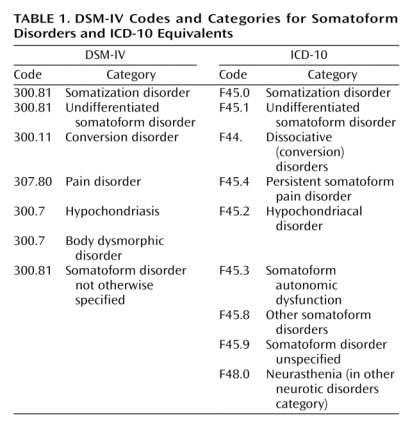
Source: Mayou R, Kirmayer LJ, Simon G, Kroenke K, Sharpe M: Somatoform disorders: time for a new approach in DSM-V. Am J Psychiat. 2005;162:847–855.

Neurasthenia is not categorized in DSM-IV. Neurasthenia is classified in ICD-10 in Chapter V Mental and behavioural disorders, at F48.0, as shown in the table, above.

Chronic fatigue syndrome is not classified in DSM-IV. Chronic fatigue syndrome is indexed in ICD-10 to G93.3, (Chapter VI Diseases of the nervous system – the Neurology chapter), the same code to which PVFS and (Benign) ME are classified.

ICD-10 has “Fatigue syndrome”  [Note: not “postviral”; not “chronic”] coded at F48.0 in Chapter V, which specifically excludes G93.3 Postviral fatigue syndrome.

(Please refer to the “ICD-10 Classification of Mental and Behavioural Disorders Clinical descriptions and diagnostic guidelines” aka “the Blue Book” and to ICD-10 online for full categories, disorder descriptions, inclusions and exclusions for ICD-10 Somatoform Disorders.) [9] [10]


Q: What does “Harmonization” between DSM-IV and the forthcoming ICD-11 mean?

A:  The APA participates with the WHO in an International Advisory Group for the Revision of ICD-10 Mental and Behavioural Disorders and a DSM-ICD Harmonization Coordination Group.

There is already a degree of correspondence between some categories in DSM-IV and their equivalent sections in ICD-10 Chapter V. For their next editions, the APA and the WHO have committed as far as possible:

“To facilitate the achievement of the highest possible extent of uniformity and harmonization between ICD-11 mental and behavioural disorders and DSM-V disorders and their diagnostic criteria.”

with the objective that

“The WHO and APA should make all attempts to ensure that in their core versions, the category names, glossary descriptions and criteria are identical for ICD and DSM.”

The WHO acknowledges there may be areas where congruency between the two systems may not be achievable.

Q: Is ICD Revision intending to harmonize its Somatoform Disorders categories with the current proposals for DSM-5?

A: DSM-5 proposals are a “work in progress”. The proposals of the Somatic Symptom Disorders Work Group for the revision of categories within this section represent a radical restructuring of the current DSM-IV Somatoform Disorders; following fields trials, the Work Group will review and potentially revise their proposals. These proposals may be found to be inoperable in the field or otherwise unacceptable to clinicians participating in field trials. The Task Force may require the Work Group to make substantial modifications to the current proposals. A third public review is scheduled for January-February 2011 prior to the finalization of categories and criteria.

It’s not known how closely the DSM-5 Work Group for “Somatic Symptom Disorders” are collaborating with the ICD Revision working group responsible for overseeing the revision of ICD-10’s Somatoform Disorders categories.

There have been no minutes or summaries of meetings of the International Advisory Group for the Revision of ICD-10 Mental and behavioural disorders, in which the APA participates and which is chaired by DSM-5 Task Force member, Steven E Hyman, MD, published since December 2008 (a point raised recently with the WHO’s Dr Bedhiran Üstün) and the ICD Revision Topic Advisory Group for Mental Health does not issue public reports on its progress.

It is not known whether, to what extent or at what stage in the Alpha/Beta drafting process ICD Revision might seek to achieve congruency between category names, glossary descriptions and criteria for ICD-11 Chapter 5 and those being proposed for the restructured DSM “Somatoform Disorders” section. But the classifications under “Somatoform Disorders” for ICD-11 Chapter 5, according to the iCAT Alpha Drafting platform as it stood in November, last year, did not appear to mirror the proposals of the DSM-5 SSD Work Group:

Chapter 5 (V) Somatoform Disorders (the F codes) F45 – F48.0 (as displaying in the iCAT Alpha Drafting platform in November 2010):
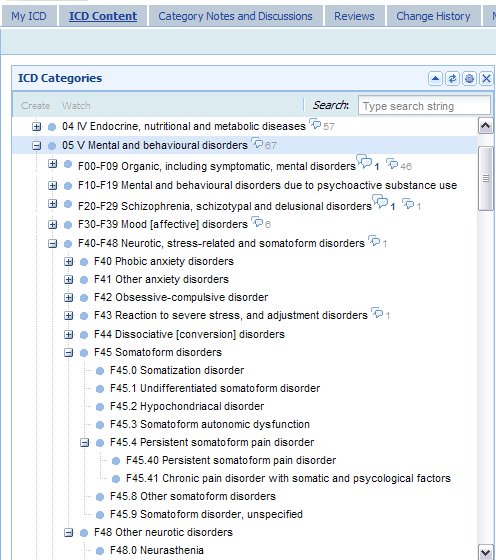
(It is understood from ICD documentation that the child categories F45.40 and  F45.41 are proposed new entities for ICD-11.)

From what is understood of ICD taxonomic and ontological principles, the conceptual framework and radical restructuring of the Somatoform Disorders currently proposed by the SSD Work Group, might prove difficult for ICD-11 to assimilate even if ICD Revision were to consider the proposals, per se, to be valid constructs that could be used reliably.


Q: What proposals are being put forward for the revision of the DSM-IV categories currently known as “Somatoform Disorders”?

A: The SSD Work Group is recommending renaming the “Somatoform Disorders” disorders section of DSM-IV to “Somatic Symptom Disorders”.
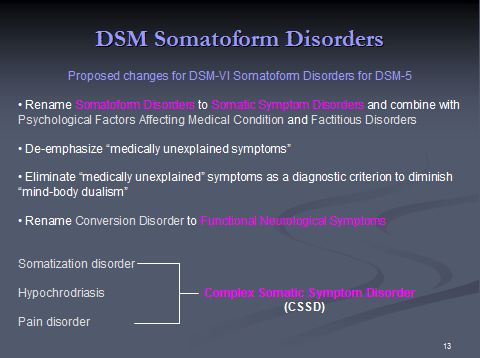
The Work Group proposes combining existing categories – Somatoform Disorders, Psychological Factors Affecting Medical Condition (PFAMC), Factitious Disorder and Factitious Disorder imposed on another (previously known as Factitious Disorder by proxy) into one group entitled “Somatic Symptom Disorders”. Alternatively, Factitious Disorders would be listed under the category “Other Disorders”.

The Work Group’s summary justification is ‘Because the current terminology for somatoform disorders is confusing and because somatoform disorders, psychological factors affecting medical condition, and factitious disorders all involve presentation of physical symptoms and/or concern about medical illness, the work group suggests renaming this group of disorders Somatic Symptom Disorders. In addition, because of the implicit mind-body dualism and the unreliability of assessments of “medically unexplained symptoms,” these symptoms are no longer emphasized as core features of many of these disorders.’

‘…since Somatization Disorder, Hypochondriasis, Undifferentiated Somatoform Disorder, and Pain Disorder share certain common features, namely somatic symptoms and cognitive distortions, the work group is proposing that these disorders be grouped under a common rubric under a new category called “Complex Somatic Symptom Disorder” (CSSD).’

There is a relatively recent additional proposal for a category called “Simple (or abridged) Somatic Symptom Disorder” (SSSD).

These proposals would represent a major change in the diagnostic nomenclature for this section of the DSM.

The Work Group also proposes a category “Illness Anxiety Disorder” (hypochondriasis without somatic symptoms) and recommends the existing Conversion Disorder category be renamed “Functional Neurological Disorder”. (‘Somatic’  means of or relating to the body.)


Q: Have there been changes since the publication of the initial proposals, in February 2010?

A: Since the first public review, the Work Group has modified the criteria for “Complex Somatic Symptom Disorder (CSSD), added a new proposal for a category called “Simple Somatic Symptom Disorder” and made revisions to the text of the two key PDF documents. So you will need to review the most recent criteria and the two key documents that accompany these latest proposals if you are intending to submit comment.

I shall be posting the latest proposals for criteria and the two key “Disorder Description” and “Rationale” documents in the next post (Post #77).


References

1] APA 4 May 2011  News release No. 11-27  or  http://tinyurl.com/APAnewsrelease4may11

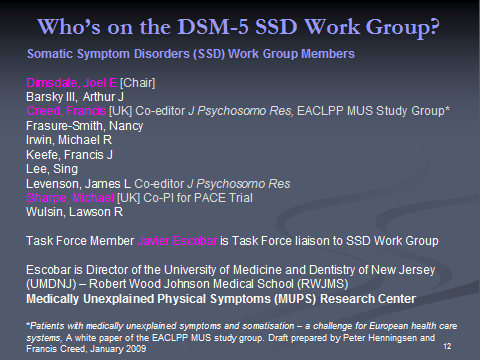
2] “Somatic Symptom Disorders” Work Group Members, Bios and Disclosures

3] Latest proposals for “Somatic Symptom Disorders”

4] Key Somatic Symptom Disorders PDF Document: Disorder Descriptions

5] Key Somatic Symptom Disorders PDF Document: Justification of Criteria

6] Revised DSM-5 Timeline

7] Register on the DSM-5 site to submit stakeholder feedback

8] APA’s FAQ on DSM-5

[9] ICD-10 online (version for 2007) Chapter V: Somatoform Disorders: F45-F48.0 codes”

[10] ICD-10 Classification of Mental and Behavioural Disorders Clinical descriptions and diagnostic guidelines” (aka “the Blue Book”) PDF format

APA News Release 4 May 2011: New Framework Proposed for Manual of Mental Disorders

APA News Release 4 May 2011: New Framework Proposed for Manual of Mental Disorders

Post #74 Shortlink: http://wp.me/pKrrB-12x

http://tinyurl.com/APAnewsrelease4may11

APA News Release 4 May 2011

American Psychiatric Association

News Release

For Information Contact:                                                            Release No. 11-27
Eve Herold 703-907-8640
press@psych.org

Erin Connors 703-907-8562
econnors@psych.org

FOR IMMEDIATE RELEASE

New Framework Proposed for Manual of Mental Disorders
APA Revisions a Key Step in Development of DSM-5

ARLINGTON, Va. (May 4, 2011) The American Psychiatric Association today released the organizational framework proposed for the fifth edition of the Diagnostic and Statistical Manual of Mental Disorders (DSM). This restructuring of the DSMs chapters and categories of disorders signals the latest scientific thinking about how various conditions relate to each other and may influence care. The APA is again inviting comment from the public and mental health and other professionals who use the manual for both diagnostic and research purposes.

The revisions reflect the knowledge we have gained since the last DSM was published in 1994, said David Kupfer, M.D., chair of the DSM-5 Task Force. They should facilitate more comprehensive diagnosis and treatment approaches for patients and encourage research across diagnostic criteria.

The changes re-order the existing manuals 16 chapters based on underlying vulnerabilities as well as symptom characteristics, which currently result in many patients being diagnosed with multiple disorders within and across disorder groups. The chapters are arranged by general categories such as neurodevelopmental, emotional and somatic to reflect the potential commonalities in etiology within larger disorder groups.

The sequence of chapters builds on what we have learned about the brain, behavior and genetics over the past two decades, noted Steven Hyman, M.D., former director of the National Institute of Mental Health and a member of the DSM-5 Task Force.

Public comment is invited through June 15 on the draft framework and the latest proposed revisions to diagnostic criteria, both available on http://www.dsm5.org. During an initial public review and comment period last year an unprecedented occurrence in both the field of psychiatry and in medicine the APA received more than 8,000 written responses from clinicians, researchers and family and patient advocates. All of the responses were considered as part of the manuals reorganization.

Todays release marks another stage in the development of DSM-5. Rigorous scientific scrutiny is shaping this 14-year project, with the involvement of nearly 500 experts from the United States and abroad. Publication is scheduled for 2013.

The manuals new organization combines certain disorders under more comprehensive chapter headings while breaking others out from their previous categories. One example is obsessive-compulsive disorder (OCD), long considered to be an anxiety-driven disorder. Recent studies have shown that OCD and several related disorders involve distinct neurocircuits, and so they are now listed as a separate grouping a move that could advance understanding of their root causes.

There are other notable changes. Disorders previously listed under a single rubric of infancy, childhood and adolescence have been integrated into other chapters, in line with the goal of making DSM more developmentally focused. In addition, research findings linking schizophrenia and schizotypal personality disorder into a schizophrenia spectrum will be reflected in this next edition.

The schizophrenia spectrum designation is supported by studies showing how these disorders tend to aggregate within families, said Darrel Regier, M.D., M.P.H., vice chair of the DSM-5 Task Force and executive director of the American Psychiatric Institute for Research and Education. It will help clinicians to correctly diagnose patients by making clear the common features that fall within the spectrum.

To date, reports on the deliberations and progress of the task force and 13 work groups have been presented at international conferences, through more than 100 papers and via the DSM-5 website. After last years public comment period, the work groups continued to amend and refine some categories of disorders.

The first round of field trials is now testing the new diagnostic criteria in real-world settings, including at nearly a dozen larger academic and clinical centers; almost 3,900 mental health professionals in individual practice and smaller settings also will participate before the trials conclude. Another public comment period on the criteria will then follow.

The DSM-5 framework and diagnostic criteria will be determined by 2012 and submitted to the APAs Board of Trustees for review and approval.

At every stage, said Kupfer, DSM-5 is benefiting from a depth of research and a breadth of expertise and diverse opinions that will immeasurably strengthen the final document.

The American Psychiatric Association is a national medical specialty society whose more than 36,000 physician members specialize in the diagnosis, treatment, prevention and research of mental illnesses, including substance use disorders. Visit the APA at www.psych.org and www.healthyminds.org.


Media coverage, APA’s 4 May DSM-5 announcement

MedPage Today

CNN Blog


Related information:

Post: 05.05.11 American Psychiatric Association (APA) announces second public review of DSM-5 draft criteria and structure

APA postpones release of revised proposals for draft criteria for DSM-5 by three months

APA postpones release of revised proposals for draft criteria for DSM-5 by three months

Post #64 Shortlink: http://wp.me/pKrrB-Yu

Slip slidin’ away…

There will be no public review of revised draft criteria for DSM-5 categories this coming May.

APA Field Trials got off to a late start and the DSM-5 timeline continues to slip.

Online posting of draft disorders and criteria proposed by the DSM-5 Work Groups for new and existing mental disorders had been scheduled for May-July, this year. Revised criteria were expected to be posted online in May, for a period of approximately one month to allow the public to review proposals and submit comment.

But according to a revised Timeline on the American Psychiatric Association’s (APA) DSM-5 Development site, this second public review exercise is now postponed until August-September 2011:

“August-September 2011: Online Posting of Revised Criteria. Following the internal review, revised draft diagnostic criteria will be posted online for approximately one month to allow the public to provide feedback. This site will be closed for feedback by midnight on September 30, 2011.”

There are also references within the DSM-5 Timeline to ICD-10-CM and the forthcoming ICD-10-CM Partial Code Freeze, and to ICD-11.

ICD-11 Beta Draft

According to sources, ICD-11 Revision Steering Group are still working towards having a Beta Draft ready for May 2011.

But from a PowerPoint presentation posted briefly on the ICD-11 Revision website at the end of February, but swiftly removed following enquiries, evidently the WHO has been discussing the pros and cons of postponing the release of its own Beta Draft for public input until the autumn, or until the end of 2011, or possibly even May 2012.

Another ICD Revision document: ICD Revision Project Plan v 2.1, projects a date of May 2012 for release of the Beta Draft. Since there is no definitive and recent ICD-11 timeline on any of the WHO’s ICD Revision sites, and since ICD Revision is keeping schtum, it remains unclear at what point in the timeline a Beta Draft for ICD-11 will be released for public scrutiny and input (as opposed to purely internal use, as the Alpha Draft had been). I will update when more information becomes available.

The original dissemination date for ICD-11 had been 2012, with the timelines for the revision of ICD-10 and DSM-IV running more or less in parallel. But in 2007/8, the release date for ICD-11 was shifted to pilot implementation in 2014 and dissemination in 2015. A “pre-final draft” of ICD-11 is projected for March 2013 with submission for WHA endorsement in May 2014. ICD Revision are balancing “incomplete software, unsatisfactory content and incomplete review process” against reduced opportunity for public input and reduced public confidence, if the timeline for the Beta were to be extended.

In December 2009, the APA announced that the publication date for their DSM-5 was being extended to May 2013.

In January 2010, APA President, Alan F Schatzburg, MD, said:

“…the extension will permit better linking of DSM-5 to the U.S. implementation of the ICD-10-CM codes for all Medicare/Medicaid claims reporting, which are scheduled to go into effect on October 1, 2013. APA will also continue to work with the World Health Organization (WHO) to harmonize DSM-5 with the mental and behavioral disorders section of ICD-11, which WHO plans to release no sooner than 2014.”

With a Partial Code Freeze looming this October for ICD-10-CM, the delays in starting field trials and now a three month postponement of publication of revised criteria for the second public review and comment period isn’t going to inspire confidence in a Task Force that has already come in for significant criticism of its oversight of the revision of DSM-IV.

Revised and expanded DSM-5 Timeline

[Timeline superceded by revised Timeline]

Ed: Footnotes: The “harmonization” of DSM-5 and ICD-11

The APA participates with the WHO in the “International Advisory Group for the Revision of ICD-10 Mental and Behavioural Disorders” (Chapter 5) and a “DSM-ICD Harmonization Coordination Group”.

There is already a degree of correspondence between DSM-IV and Chapter V of ICD-10. For the next editions, the APA and the WHO have committed as far as possible:

“To facilitate the achievement of the highest possible extent of uniformity and harmonization between ICD-11 mental and behavioural disorders and DSM-V disorders and their diagnostic criteria.”

with the objective that

“The WHO and APA should make all attempts to ensure that in their core versions, the category names, glossary descriptions and criteria are identical for ICD and DSM.”

But the WHO acknowledges there may be areas where congruency between the two systems may not be achievable.

As the iCAT (the ICD-11 electronic collaborative drafting platform) stood last November, two new categories were listed in the Linearized Chapter 5, F45 – F48.0 (Somatoform Disorders) codes. It is understood from ICD documentation (DIFF File – Changes from ICD-10 [MS Excel doc. Retrieved 29.09.10; no longer available on 01.10.10]) that child categories F45.40 and F45.41 are new entities for ICD-11 [1].

Note the ICD-11 categories between F45 – F48.0, as they stood in the iCAT drafting platform last November, do not mirror current proposals of the DSM-5 “Somatic Symptom Disorder” Work Group for renaming the “Somatoform Disorders” categories of DSM-IV to “Somatic Symptom Disorders” and combining a number of existing categories under a new rubric, “Complex Somatic Symptom Disorder (CSSD)”, and the more recently proposed “Simple Somatic Symptom Disorder (SSSD)” [2][3].

[1] Screenshot iCAT, ICD-11: Chapter 5: F45 – F48.0: https://dxrevisionwatch.com/wp-content/uploads/2010/05/2icatchapter5f45somatoform.png  

[2] Article: Erasing the interface between psychiatry and medicine (DSM-5), Chapman S, 13 February 2011: http://wp.me/pKrrB-Vn

[3] Article: Revisions to DSM-5 proposals on 14.01.11: New category proposed “Simple Somatic Symptom Disorder, Chapman S, 16 January 2011: http://wp.me/pKrrB-St  

[4] DSM-5 Development website: http://www.dsm5.org/about/Pages/Timeline.aspx