Medical Classification WHO ICD codes by Mary Schweitzer

Medical Classification WHO ICD codes by Mary Schweitzter

Post #105 Shortlink: http://wp.me/pKrrB-1j9

Mary Schweitzer

October 14, 2011

There has of late been speculation that it would be bad for U.S. patients if CFS and M.E. were placed in the same category in the neurology chapter of ICD-10-CM, the “clinical manual” of ICD-10 that will be adopted for use in the United States.

But the fact of the matter is that in ICD-10, CFS already IS coded to G93.3, “PVFS and M.E.” in the index, which is as authoritative as the tabular version. [PVFS stands for Post-Viral Fatigue Syndrome, and is not diagnosed very frequently any more – not at all in the U.S.]. It already IS coded in neurology.

110 nations use ICD-10 as-is, including the UK. Australia has a clinical version that does not alter the codes for M.E. or CFS. But Canada and Germany have clinical versions that place CFS in the tabular version of ICD-10, in G93.3 with M.E. In fact, it was the Canadian clinical version, ICD-10-CA, which led to the highly regarded Canadian Consensus Criteria for ME/CFS in 2003.

NOBODY EXCEPT THE UNITED STATES CODES CFS IN THE “R” CHAPTER. If we coded CFS at R53.82, which was the plan of NCHS, we would have been the ONLY nation in the world to do so.

Furthermore, M.E. is not a known diagnosis in the U.S. (WE know about it, but very few doctors do.) There is no definition for it approved by CDC. We can now point to the new definition that was published in the Journal of Internal Medicine, but that is more likely to enable researchers in the US and Canada to use M.E. if they want to, than to trickle down to U.S. clinicians [1]. Part of the problem is that when M.E. replaced atypical polio as a disease name in British commonwealth nations and Europe, in the U.S. the new name was epidemic neuromyesthenia, which has not (to my knowledge) been diagnosed in decades.

So if CFS gets coded as R53.82 in the U.S.’s ICD-10-CM, yes, M.E. will be less likely to confuse with CFS – but that would only be in the U.S., and in the U.S. we only get diagnosed with that revolting name CFS anyway. At least we could get them scratching their heads and asking, “What is M.E.?” if both diseases were placed together where those of you outside the U.S. already have it.

Given that U.S. doctors do not have a high opinion of CFS, keeping it under “R” in “vague signs and symptoms” would only reinforce their prejudice against it as a “garbage diagnosis” – something you diagnose when you run out of ideas.

Finally, there was an inadvertent error in an earlier Co-Cure message about getting CFS out of the “R” category. The “R” category is not for psychiatric diagnoses.

British psychiatrists use “fatigue syndrome,” which is coded at F48.0 under neuroses at “neurasthenia.”. Then when they write about it, they mix and match terms so it looks as if CFS is the same thing, and therefore it goes in F48.0. That is a serious problem in the UK. [I have to admit to being alarmed recently when a U.S. virologist connected CFS not to the history of atypical polio, which is pretty well established, but to the arcane nineteenth century diagnosis of neurasthenia. Please don’t do that!]

We are not (I hope) in current danger of being coded under neuroses at F48.0, neurasthenia, in the U.S. But the “R” diagnosis is sufficiently vague that it wouldn’t be difficult to use it to claim CFS patients really have CSSD (Complex Somatic Symptom Disorder), the category British psychiatrist and CBT advocate Michael Sharpe is trying to shoehorn into DSM-5, the new version of the American Psychiatric Association’s huge diagnostic tome. So it does leave us vulnerable [2].

To those outside the U.S. I would say, look to ICD-11. That’s what will affect you the most. To those in the U.S. (where we are finally getting around to adopting ICD-10-CM two decades after ICD-10 was written), what WE need is simply to get in step with the rest of the world now.

Mary M. Schweitzer PhD

Related material

[1] New International Consensus Criteria for M.E., Journal of Internal Medicine

Volume 270, Issue 4, pages 327–338, October 2011

Carruthers, B. M., van de Sande, M. I., De Meirleir, K. L., Klimas, N. G., Broderick, G., Mitchell, T., Staines, D., Powles, A. C. P., Speight, N., Vallings, R., Bateman, L., Baumgarten-Austrheim, B., Bell, D. S., Carlo-Stella, N., Chia, J., Darragh, A., Jo, D., Lewis, D., Light, A. R., Marshall-Gradisbik, S., Mena, I., Mikovits, J. A., Miwa, K., Murovska, M., Pall, M. L. and Stevens, S. (2011), Myalgic encephalomyelitis: International Consensus Criteria. Journal of Internal Medicine, 270: 327–338. doi: 10.1111/j.1365-2796.2011.02428.x

Abstract
http://onlinelibrary.wiley.com/doi/10.1111/j.1365-2796.2011.02428.x/abstract

Full text in html
http://onlinelibrary.wiley.com/doi/10.1111/j.1365-2796.2011.02428.x/full

Full text in PDF
http://onlinelibrary.wiley.com/doi/10.1111/j.1365-2796.2011.02428.x/pdf

Or Open PDF here:  International ME Consensus Criteria

[2] DSM-5 Development: Somatic Symptom Disorders

http://www.dsm5.org/proposedrevision/Pages/SomaticSymptomDisorders.aspx

Extracts: ICD-9-CM Coordination and Maintenance Committee Meeting Summary document (CFS coding)

Extracts: ICD-9-CM Coordination and Maintenance Committee Meeting Summary of Diagnosis Presentations September 14, 2011 (CFS Coding)

Post #104 Shortlink: http://wp.me/pKrrB-1iN

You can download an Audio of the September 14 NCHS meeting here: http://www.cms.gov/ICD9ProviderDiagnosticCodes/Downloads/091411_Meeting_Audio.zip

[Note this is a large Zipped file.  The section for discussions on CFS coding starts at 2 hours 27 minutes in from start and ends at 3 hours 02 minutes.]

Summary of Volumes 1 and 2, Diagnosis Presentations
September 14, 2011

http://www.cdc.gov/nchs/icd/icd9cm_maintenance.htm

http://www.cdc.gov/nchs/data/icd9/2011SeptemberSummary.pdf

Donna Pickett, co-chair of the committee, welcomed the members of the audience to the diagnosis portion of the meeting. She reviewed the timeline included at the beginning of the topic packet informing the attendees of the deadline for written comments on topics presented at this meeting. All diagnosis topics presented during the meeting are being considered for October 1, 2013 implementation.

Written comments must be received by NCHS staff by November 18, 2011. Ms. Pickett requested that comments be sent via electronic mail to the following email address nchsicd9CM@cdc.gov since regular mail is often delayed. Contact information for all NCHS staff and the NCHS website are included in the topic packet. Attendees were also reminded that the full topic packet is currently posted on the NCHS website.

[…]

Page 2

Comments and discussion on the topics presented on September 14, 2011 were as follows:

Chronic Fatigue Syndrome

Mary Dimmock representing the Coalition 4 ME/CFS gave a presentation on the Coalition’s understanding of myalgic encephalomyelitis (ME) and chronic fatigue syndrome (CFS) as well as their proposal. They presented additional options for coding of these two diagnoses. NCHS responded that since they were not aware of this additional option, until today’s meeting, the proposal would remain with the two options offered (one from NCHS and one from the requestor).

There were many comments from the audience including the following:

There was general support for NCHS proposed option 2, moving CFS to ICD-10-CM Chapter 6, Diseases of the Nervous System but retaining separate codes for CFS vs. ME. Reasons given for retaining separate codes included agreement that it is important to retain ability to do data extraction on the two conditions separately vs. combining them if desired. In addition, the CFS may not always be able to be identified as postviral.

Though the requestor had asked to have the term “benign” deleted from inclusion term “benign myalgic encephalomyelitis,” NCHS indicated it should remain somewhere at G93.3 to maintain compatibility with WHO ICD-10. Comments on this indicated that it should be added to proposed new code G93.31 with benign as a nonessential modifier.

[Ed: It was suggested at the meeting that the modifier “Benign” might appear in parentheses at the end of  “Myalgic encephalomyelitis”.]

It was recommended to change the excludes2 note, at proposed new code G93.32, to an exludes1 since it is not likely that one would have both chronic fatigue syndrome and a chronic fatigue, NOS from some other condition. There is no need to code chronic fatigue NOS separate from the CFS.

There was a general question asked about how this request can be considered for October 1, 2012 since it is not a new disease. There was also general support that if the change is approved to move CFS from Chapter 18, code R53.82, to a code within Chapter 6 it should occur in time for the October 1, 2013 implementation of ICD-10-CM.

There was general agreement, by those in the audience, that the term “myalgic encephalomyelitis” is not seen in medical records.

One commenter, representing Coalition4 ME/CFS indicated that ME and CFS should not be separated since it goes against the definition of the 2011 ME ICC (an international committee). Her opinion was that treatment is the same for both conditions, literature refers to ME and CFS together, and that the U.S. is behind the international recognition of these two conditions being the same.

[…]

The audience was asked to carefully review the proposals following the meeting and to submit written comments by the November 18, 2011 deadline.

[Extract ends]

Comments on proposals need to be submitted by November 18.

Comments from stakeholders, preferably via email, should be submitted to:

Donna Pickett RHIA, MPH
Medical Classification Administrator
National Center for Health Statistics – CDC
3311Toledo Road Hyattsville, MD 20782
Via email: nchsicd9CM@cdc.gov

Related material:

1] Full NCHS meeting Proposals document:

http://www.cdc.gov/nchs/data/icd9/TopicpacketforSept2011a.pdf

2] Full NCHS meeting Summary document:

http://www.cdc.gov/nchs/data/icd9/2011SeptemberSummary.pdf

3] Post: Coding CFS in ICD-10-CM: CFSAC and the Coalition4ME/CFS initiative

4] Post: Extracts: ICD-9-CM Coordination and Maintenance Committee Meeting September 14, 2011 (Coding of CFS in ICD-10-CM)

Extracts: ICD-9-CM Coordination and Maintenance Committee Meeting September 14, 2011 (Coding of CFS in ICD-10-CM)

Extracts from Diagnosis Agenda: ICD-9-CM Coordination and Maintenance Committee Meeting September 14, 2011 (Coding of CFS in ICD-10-CM)

Post #103 Shortlink: http://wp.me/pKrrB-1iB

You can download an Audio of the September 14 NCHS meeting here:  http://www.cms.gov/ICD9ProviderDiagnosticCodes/Downloads/091411_Meeting_Audio.zip

[Note this is a large Zipped file.  The section for discussions on CFS coding starts at 2 hours 27 minutes in from start and ends at 3 hours 02 minutes.]

Extracts from Diagnosis Agenda

http://www.cdc.gov/nchs/icd/icd9cm_maintenance.htm

http://www.cdc.gov/nchs/data/icd9/TopicpacketforSept2011a.pdf

Page 8

Partial Code Freeze for ICD-9-CM and ICD-10

The ICD-9-CM Coordination and Maintenance Committee will implement a partial freeze of the ICD-9-CM and ICD-10 (ICD-10-CM and ICD-10-PCS) codes prior to the implementation of ICD-10 on October 1, 2013. There was considerable support for this partial freeze. The partial freeze will be implemented as follows:

• The last regular, annual updates to both ICD-9-CM and ICD-10 code sets will be made on October 1, 2011.
• On October 1, 2012, there will be only limited code updates to both the ICD-9-CM and ICD-10 code sets to capture new technologies and diseases as required by section 503(a) of Pub. L. 108-173.
• On October 1, 2013, there will be only limited code updates to ICD-10 code sets to capture new technologies and diagnoses as required by section 503(a) of Pub. L. 108-173. There will be no updates to ICD-9-CM, as it will no longer be used for reporting.
• On October 1, 2014, regular updates to ICD-10 will begin.

The ICD-9-CM Coordination and Maintenance Committee will continue to meet twice a year during the partial freeze. At these meetings, the public will be asked to comment on whether or not requests for new diagnosis or procedure codes should be created based on the criteria of the need to capture a new technology or disease. Any code requests that do not meet the criteria will be evaluated for implementation within ICD-10 on and after October 1, 2014 once the partial freeze has ended.

Codes discussed at the September 15 – 16, 2010 and March 9 – 10, 2011 ICD-9-CM Coordination and Maintenance Committee meeting will be considered for implementation on October 1, 2011, the last regular updates for ICD-9-CM and ICD-10. Code requests discussed at the September 14 – 15, 2011 and additional meetings during the freeze will be evaluated for either the limited updates to capture new technologies and diseases during the freeze period or for implementation to ICD-10 on October 1, 2014. The public will be actively involved in discussing the merits of any such requests during the period of the partial freeze.

Page 10 and 11

ICD-9-CM Coordination and Maintenance Committee Meeting September 14, 2011

10 Chronic Fatigue Syndrome

According to the Coalition 4 ME/CFS, US researchers have estimated that myalgic encephalomyelitis/chronic fatigue syndrome (ME/CFS) strikes 1 to 4 million Americans. It is a devastating illness that is characterized by profound fatigue that is not improved by rest and is worsened by physical or mental activity, along with multi-system symptoms including pain, cognitive impairment, headaches, unrefreshing sleep and tender lymph nodes.

In ICD-9-CM, the code for Chronic Fatigue Syndrome (CFS) (780.71, Chronic Fatigue Syndrome) became effective October 1, 1998. The proposal to create a unique code was presented at the December 1997 ICD-9-CM Coordination and Maintenance meeting and was based on a number of requests that stated that a unique code was needed because it was impossible to collect meaningful data about the frequency of diagnosis as well as the utilization of medical services. Placement of CFS within Chapter 16 in ICD-9-CM at that time reflected that an underlying cause had not yet been determined.

The cause or causes of CFS remain unknown, despite a vigorous search. While a single cause for CFS may yet be identified, another possibility is that CFS represents a common endpoint of disease resulting from multiple causes. Conditions that have been proposed to trigger the development of CFS include infections, traumatic conditions, immune dysfunction, stress, and toxins.

Currently there are several case definitions in use, some separating CFS from myalgic encephalomyelitis (ME), and others merging the two conditions together. The most widely used are the 1994 case definition, the Canadian and the Oxford definitions. A new definition of ME has been recently published to emphasize recent research and clinical experience that strongly point to widespread inflammation and multisystemic neuropathology. While there is no consensus on case definition, there is consensus that this is a serious syndrome and complex syndrome, and it is likely that there are multiple subgroups. Changes in immune, CNS and autonomic nervous system can be identified, but no tests have sufficient sensitivity and specificity to serve as a diagnostic test for CFS.

ICD-10 was approved by the International Conference for the Tenth Revision of the International Classification of Diseases in 1989 and adopted by the 43rd World Health Assembly in 1990. In ICD-10 WHO created code G93.3, Postviral fatigue syndrome and indexed chronic fatigue syndrome to this code. In ICD-10-CM chronic fatigue syndrome NOS (that is not specified as being due to a past viral infection) was added to ICD-10-CM in Chapter 18 at R53.82, Chronic fatigue, unspecified. ICD-10-CM retained code G93.3 to allow the differentiation of cases of fatigue syndrome where the physician has determined the cause as being due to a past viral infection from cases where the physician has not established a post viral link. It should be noted that including chronic fatigue syndrome NOS at code G93.3 would make it difficult to disaggregate cases that are now distinguishable through the use of two separate codes.

The Coalition 4 ME/CFS has submitted a proposal asking that chronic fatigue syndrome be deleted as an inclusion term under code R53.82 and that the term be added as an inclusion term under code G93.3.

The Coalition 4 ME/CFS is also requesting that their proposal be considered for October 1, 2012 so that the change occurs prior to the October 1, 2013 implementation date of ICD-10-CM even though the condition is not a new disease.

Page 11

Ed: Note that Option 1 (Proposal by the Coalition4ME/CFS) does not display the term Benign myalgic encephalomyelitis under G93.3 Postviral fatigue syndrome. This is because no change to the placement of this term is being requested by the Coalition4ME/CFS, that is, no request to Add, Delete or Revise the term is being requested.

[Extract ends]

Ed: Note that discussion of whether class 1 excludes were more appropriate than class 2 excludes took place at the meeting.

ICD: Use of Excludes1 or Excludes2

https://www.cms.gov/ICD10/Downloads/6_I10tab2010.pdf

ICD-10-CM TABULAR LIST of DISEASES and INJURIES

Instructional Notations

[…]

Excludes Notes

The ICD-10-CM has two types of excludes notes. Each note has a different definition for use but they are both similar in that they indicate that codes excluded from each other are independent of each other.

Excludes1

A type 1 Excludes note is a pure excludes. It means “NOT CODED HERE!” An Excludes1 note indicates that the code excluded should never be used at the same time as the code above the Excludes1 note. An Excludes1 is for used for when two conditions cannot occur together, such as a congenital form versus an acquired form of the same condition.

Excludes2

A type 2 excludes note represents “Not included here”. An excludes2 note indicates that the condition excluded is not part of the condition it is excluded from but a patient may have both conditions at the same time. When an Excludes2 note appears under a code it is acceptable to use both the code and the excluded code together.

Related material:

1] Full NCHS meeting Proposals document:

http://www.cdc.gov/nchs/data/icd9/TopicpacketforSept2011a.pdf

2] Post: Coding CFS in ICD-10-CM: CFSAC and the Coalition4ME/CFS initiative

3] Post: Extracts: ICD-9-CM Coordination and Maintenance Committee Meeting September 14, 2011 (Coding of CFS in ICD-10-CM)

Coding CFS in ICD-10-CM: CFSAC and the Coalition4ME/CFS initiative

Coding CFS in ICD-10-CM: CFSAC and the Coalition4ME/CFS initiative

Post #102 Shortlink: http://wp.me/pKrrB-1hd

Coalition4ME/CFS initiative

ICD-10-CM


CFSAC discusses ICD-10-CM coding concerns

The Chronic Fatigue Syndrome Advisory Committee (CFSAC) provides advice and recommendations to the Secretary of Health and Human Services via the Assistant Secretary for Health of the U.S. Department of Health and Human Services (DHHS) on issues related to chronic fatigue syndrome (CFS).

Go here for the current Roster of Voting and Ex Officio committee members.

CFSAC holds twice yearly public meetings and meeting Agendas, Minutes, Meeting Materials, Presentations, Public Testimonies, Meeting Videocasts and CFSAC’s Recommendations to the DHHS are published on the CFSAC website.

The National Center for Health Statistics (NCHS), the Federal agency responsible for use of the WHO’s International Statistical Classification of Diseases and Related Health Problems, 10th revision (ICD-10) in the United States, has developed a clinical modification of the classification for morbidity purposes. The ICD-10 is used to code and classify mortality data from death certificates, having replaced ICD-9 for this purpose as of January 1, 1999.

The WHO has authorized the development of an adaptation of ICD-10 for use in the United States for U.S. government purposes. Although a U.S. specific adaptation, with U.S. committees and technical advisory panels responsible for its development and oversight, all modifications to the ICD-10 must conform to WHO ICD conventions.

ICD-10-CM is planned as the replacement for ICD-9-CM, volumes 1 and 2.

U.S. lags behind

While much of the world has been using the ICD-10 for many years and is looking to move onto ICD-11 (currently  scheduled for implementation in 2015), the U.S. has been slow to make the transition from ICD-9-CM to a “clinical modification” of ICD-10.

ICD-10-CM development has been a long drawn out process and ICD-10-CM isn’t scheduled for implementation until October 1, 2013.

So when U.S. coders, clinicians, medical insurers and reimbursers are adapting to using ICD-10-CM, much of the rest of the world will be gearing up for ICD-11, which is planned to be a significantly different product to ICD-10, in terms of its structure, content, presentation, accessibility and its capacity, as an electronic publication, for continuous update and revision.


CFSAC new Recommendation to HHS

At the last CFSAC meeting (May 10-11, 2011), an hour long slot had been tabled on the agenda for Day One for discussion of concerns around the NCHS’s current proposals for the coding of CFS within ICD-10-CM.

The Committee was also informed of the considerable concerns for the implications for CFS and ME patients of the draft criteria and new categories being proposed by the DSM-5 “Somatic Symptom Disorders” work group.

A new CFSAC Recommendation to HHS was proposed by Committee member, Dr Lenny Jason, seconded by Dr Nancy Klimas, and voted unanimously in favour of by the Committee [1].

This new Recommendation, set out below, restates and expands on the Recommendation that CFSAC had made to HHS, in August 2005.

CFSAC rejects current proposals to code CFS in Chapter 18 of ICD-10-CM under R53.82: Chronic fatigue, unspecified > Chronic fatigue syndrome NOS. CFSAC continues to recommend that CFS should be classified in ICD-10-CM in Chapter 6 under “diseases of the nervous system” at G93.3, in line with ICD-10 and ICD-10-CA (the Canadian Clinical Modification), and in accordance with the Committee’s recommendations of August 2005. CFSAC considers CFS to be a multi-system disease and rejects any proposals to classify CFS as a psychiatric condition in US disease classification systems. (Note: no disease classification system under HHS’ control proposes to move or to include CFS in or among psychiatric conditions.)     Source: CFSAC Recommendations – May 10-11, 2011


What are the current proposals?

For ICD-10-CM, the current proposals for the classification of PVFS and ME are:

that Postviral fatigue syndrome would be classified within Chapter 6 Diseases of the nervous system under the parent class “G93 Other disorders of brain”, coded at G93.3.

(Benign) Myalgic encephalomyelitis would be classified as an Inclusion term under Title category “G93.3 Postviral fatigue syndrome”.

This is in keeping with the international ICD-10, from which ICD-10-CM has been developed. See Footnote [4] for link to page setting out current proposals for ICD-10-CM.

In ICD-10, Chronic fatigue syndrome is indexed to G93.3 in Volume 3 The Alphabetical Index. 

In ICD-10-CA, the Canadian Clinical Modification of ICD-10, Chronic fatigue syndrome is classified in the Tabular List in Chapter 6, under “G93.3 Postviral fatigue syndrome”.

For ICD-11, the proposal is that all three terms should be classified within Chapter 6.

But for ICD-10-CM, instead of coding Chronic fatigue syndrome to G93.3, the proposal is  to retain Chronic fatigue syndrome in the R codes chapter (which is Chapter 16 in ICD-9-CM and will be Chapter 18 in ICD-10-CM), where it would be coded thus:

Chapter 18  (Symptoms and signs and ill defined conditions)

[…]

R53.8 Other malaise and fatigue

R53 Malaise and fatigue

R53.82 Chronic fatigue, unspecified
              Chronic fatigue syndrome (NOS)

Excludes1: postviral fatigue syndrome (G93.3)

(In ICD, NOS stands for “Not Otherwise Specified”.)


What is NCHS’s rationale for retaining CFS as (CFS NOS) in the R code chapter?

According to the background document Dr Wanda Jones presented to the Committee:

As it relates to CFS the use of two codes is consistent with the classification as there would be a code to capture CFS when the physician has determined the cause as being due to a past viral infection (G93.3) or if the physician has not established a link with a past viral infection (R53.82).

If code R53.82 were eliminated it would not be possible to disaggregate cases that are now distinguishable through the use of two codes.

There is a general equivalence map between ICD-9-CM and ICD-10-CM codes, however, if a concept is not carried over from the earlier version to the newer version data will be lost going forward.

Source: Extract: ICD-related questions from CFSAC for May 2011 meeting

 
Dr. Jones clarified for the Committee that if, in the clinician’s judgment, it was considered there is enough evidence to attribute the patient’s illness to a viral illness onset then the clinician could code to G93.3 (Postviral fatigue syndrome). If “however they could not identify where the trajectory developed toward CFS, then it would wind up in the R codes.” [1]
 
It has been further confirmed that testing for a viral illness is not required to assign a code – that coding is based on the clinician’s judgment.
 
And from the NCHS September 14 meeting Proposals document:
In ICD-10-CM chronic fatigue syndrome NOS (that is not specified as being due to a past viral infection) was added to ICD-10-CM in Chapter 18 at R53.82, Chronic fatigue, unspecified. ICD-10-CM retained code G93.3 to allow the differentiation of cases of fatigue syndrome where the physician has determined the cause as being due to a past viral infection from cases where the physician has not established a post viral link. It should be noted that including chronic fatigue syndrome NOS at code G93.3 would make it difficult to disaggregate cases that are now distinguishable through the use of two separate codes.
 

Is this a new proposal?

No. This is a long-standing proposal that had been known about since at least 2007. It has been discussed on forums and raised in mailings on the Co-Cure Listserv list in 2007 and 2008 by U.S. advocates Mary Schweitzer and Jean Harrison, and flagged up by others in the U.S. and elsewhere, in the last couple of years.

The proposed coding of CFS, PVFS and (B) ME in the forthcoming ICD-10-CM had already been discussed at public CFSAC meetings in June 2004, when the NCHS’s, Donna Pickett, had given a presentation and again in September 2004, January 2005 and May 2010.

So the proposed coding of PVFS, (B) ME and CFS for ICD-10-CM is by no means a new issue.

As noted, ICD-10-CM has been under development for many years. A public comment period ran from December 1997 through February 1998. In 2001, the proposal had been that all three terms should be coded to G93.3, in keeping with the placement in the WHO’s ICD-10 [2].

I am advised that at one point, all three terms: PVFS, (B) ME and CFS, were proposed to be coded under G93.3, with a “CFS NOS” retained in the R codes. But that subsequently, the placement of CFS in Chapter 6 under the G93 parent class was deleted, leaving “CFS NOS” orphaned, in Chapter 18.


What is the ICD “R code” chapter for?

There is a four page ICD-11 Discussion Document that is worth a read: Signs and Symptoms [Considerations for handling categories and concepts currently found in chapter 18 of ICD-10, “SYMPTOMS, SIGNS AND ABNORMAL CLINICAL AND
LABORATORY FINDINGS NOT ELSEWHERE CLASSIFIED”, (R-codes), authors: Aymé, Chalmers, Chute, Jakob.] Open here: Discussion: Signs and Symptoms (Chapter 18)

The R codes chapter is the ICD chapter for “Symptoms, signs and abnormal clinical and laboratory findings, not elsewhere classified (R00-R99)”

“This chapter includes symptoms, signs, abnormal results of clinical or other investigative procedures, and ill defined conditions regarding which no diagnosis classifiable elsewhere is recorded.” Source: ICD-10-CM Chapter 18, 2011 release.


Dustbin Diagnosis

At the May CFSAC meeting, Committee member, Steven Krafchick, a medical and disability attorney, raised his considerable concerns for the legal and medical insurance ramifications of coding CFS under the “R codes” at the May CFSAC meeting [1]. 

Coding CFS under R53.82 for “non viral onset” cases will consign patients to a dustbin diagnosis that will continue to confuse and conflate Chronic fatigue syndrome with Chronic fatigue. There are no certainties that clinicians will code new cases using the unfamiliar G93.3 PVFS and ME codes or that existing CFS patients will get “upgraded” to G93.3 ME.

Coding CFS under R53.82 under ill defined conditions will make patients more vulnerable to the proposals of the APA’s DSM-5 “Somatic Symptom Disorders” Work Group.

Coding CFS under R53.82 will render ICD-10-CM out of line with at least four versions of ICD-10, including Canada’s ICD-10-CA, which has all three terms classified in the Tabular List under G93.3, and out of line with proposals for the forthcoming ICD-11, scheduled for implementation in 2015. The U.S. would be the only country with CFS coded in the R codes.


ICD-10-CM CFS CF


Have representations been made to the NCHS Committee?

Although representations around the coding of CFS for ICD-10-CM have been made to CDC over the years, no stakeholder representations at NCHS meetings are recorded.

At the May CFSAC meeting, Dr Jones informed the Committee that the ICD-CM process is a public process and that there is an opportunity to input into the update of ICD-9-CM and development of ICD-10-CM as part of that process, and to engage with the NCHS Committee via regularly scheduled public meetings. Dr Jones confirmed that NCHS has stated that there has been no public presence from the CFS community at these meetings.
 
It was established during the May meeting that the deadline for submitting representations for new inclusions or modifications to existing proposals for ICD-10-CM for tabling for discussion at the next NCHS Coordination and Maintenance Committee meeting would close on July 15, for a meeting scheduled for September 14. It was further noted this would be the last meeting before implementation of the partial code freeze and that this was therefore a time sensitive issue.
 
Committee members discussed the potential for a representative of CFSAC attending the September 14 ICD-9-CM Coordination and Maintenance Committee meeting if it were permissible for CFSAC to give public testimony to another advisory body; Dr Jones stated that she would check the rules. Medical attorney, Steven Krafchick, had been particularly keen to see this suggestion taken forward.


Coalition4ME/CFS initiative

In a Press Release dated September 12, 2011, the Coalition4ME/CFS, which comprises a number of US 501 (c)(3) registered ME and CFS organizations, announced that the Coalition had submitted a representation to NCHS in July.

The Coalition had set out its proposals and a rationale in a 48 page letter dated July 14 and had been successful in getting the issue of the proposed coding of CFS in ICD-10-CM placed on the agenda for the September 14 meeting of the ICD-9-CM Coordination and Maintenance Committee. 

Mary Dimmock and Marly Silverman attended the September meeting and presented the Coalition’s proposal and rationale to the NCHS. The NCHS presented an alternative suggestion to the current proposal for the coding of CFS in ICD-10-CM on which stakeholders may also wish to submit comment.

The Coalition4ME/CFS’s materials can be found here:


http://coalition4mecfs.org/ICDPR.html

There are a quite a number of background documents on the Coalition’s site and you may want to start with the Coalition’s Summary and Overview document.

You’ll also find the Coalition’s Press Release, ICD FAQ, Coalition Proposal, ICD Presentation (PPT), ME-ICC Update, ICD Meeting Update, IACFS Conference info and an ICD Sample Letter (a template for submitting comment to NCHS in support of the Coalition’s proposals).


What is the Coalition4ME/CFS proposing?

The Coalition proposes that for ICD-10-CM, Chronic fatigue syndrome (currently coded as “Chronic fatigue syndrome NOS”) should be deleted from Chapter 18: R53.82 Malaise and fatigue and instead, classified within Chapter 6 Diseases of the nervous system under the parent class G93 Other diseases of brain, under the Title term G93.3 Postviral fatigue syndrome, under which code Benign myalgic encephalomyelitis is proposed to be classified.

 This would bring the US specific ICD-10-CM in line with international ICD-10 (in which CFS is indexed to G93.3) and ICD-10-CA (Canada), where all three terms are classsified within the ICD-10-CA Tabular List under G93.3.

This would reflect the CFSAC Committee’s Recommendation to HHS of May 2011 which had prompted the Coalition’s initiative.

This would bring ICD-10-CM in line with ICD-11, for which it is proposed that all three terms are classified in Chapter 6 Diseases of the nervous system.

I shall be setting out the various proposals in a forthcoming post.


September 14 Coordination and Maintenance Committee meeting

The CDC webpage for the development of ICD-10-CM is here: http://www.cdc.gov/nchs/icd/icd10cm.htm

The 2011 release for the draft ICD-10-CM is available from the page above under this section of the page. Note that although this release of ICD-10-CM is available for public viewing, the codes in ICD-10-CM are not currently valid for any purpose or use. The most recent update to the draft, the “2011 release of ICD-10-CM” replaces the December 2010 release.

The CDC webpage for the ICD-9-CM Coordination and Maintenance Committee remit, meeting schedules and meeting documentation is here: http://www.cdc.gov/nchs/icd/icd9cm_maintenance.htm

The ICD-9-CM Coordination and Maintenance Committee is a Federal Committee; suggestions for new inclusions to ICD-9-CM and modifications to proposals for the forthcoming ICD-10-CM come from both the public and private sectors.  Interested parties and stakeholders are required to submit proposals for modification prior to a scheduled meeting.

These twice yearly meetings are held as public fora to discuss proposed modifications to ICD-9-CM and proposals for ICD-10-CM and a number of proposals and modifications around other diseases and disorders had been tabled for discussion on September 14, in addition to the issue of the coding of CFS in ICD-10-CM.

Meeting presentation

Mary Dimmock (who prepared the proposal) and Marly Silverman (PANDORA founder and Coalition4ME/CFS steering committee member) presented on behalf of the Coalition at the NCHS’s September 14 meeting.

At the meeting, the NCHS had presented an alternative suggestion to the current proposal for the coding of CFS in ICD-10-CM which suggested coding (B) ME and CFS under two separate sub codes (G93.31 and G93.32) under a revised G93.3 parent “G93.3 Postviral and other chronic fatigue syndromes” (a not entirely satisfactory suggestion that I shall set out in full in a forthcoming post). I shall be posting extracts from the two NCHS meeting Proposals and Summary documents where they relate to the issue of the coding of CFS in the next post, and you can download the entire documents from the links below.

 
You can download an Audio of the September 14 NCHS meeting here: http://www.cms.gov/ICD9ProviderDiagnosticCodes/Downloads/091411_Meeting_Audio.zip

[Note this is a large Zipped file.  The section for discussions on CFS coding starts at 2 hours 27 minutes in from start and ends at 3 hours 02 minutes.]

The NCHS Committee’s Summary of the proceedings of this meeting can be downloaded here: Summary September 14, 2011. See Page 2.

The CDC site says, “Note: This document was re-posted, changes are on page 2, bullet 2, bolded.  If you downloaded the previous document you will need to download this updated document.”

The NCHS Committee’s Proposals document is here:  Proposals September 14, 2011. See Pages 10-11.

The CDC site says, “Note: This document was re-posted, if you downloaded the previous document you will need to download this updated document.”


What’s the deadline for comments and where do I send them?

The closing date for submitting comments to NCHS on the proposals is Friday, November 18.

Comments from stakeholders, preferably via email, should be submitted to:

Donna Pickett RHIA, MPH
Medical Classification Administrator
National Center for Health Statistics – CDC
3311Toledo Road Hyattsville, MD 20782
Via email: nchsicd9CM@cdc.gov


Coming up…

In upcoming posts I’ll be setting out the various proposals and the NCHS’s suggestion, for ease of comparison, and a posting by Mary Schweitzer around ICD-10-CM.


Footnotes and related postings:

1] Minutes of May 10-11 2011 CFSAC meeting (Extract: Discussion of concerns re coding of CFS for ICD-10-CM)

2]  A Summary of Chronic Fatigue Syndrome and Its Classification in the International Classification of Diseases CDC, 2001.

3] CFS orphaned in the “R” codes in US specific ICD-10-CM

4] Forthcoming US “Clinical Modification” ICD-10-CM (starts half way down page)

5] I have written to the CDC’s, Donna Pickett, to request that consideration is given to posting stand alone PDFs of the draft Tabular List and Index. (At the moment, these two documents require extraction or opening in situ from a 14 MB Zipped file which contains five PDFs, which include the ICD-10-CM Tabular List and the Alphabetical Index.)

To view or download the Tabular List and Alphabetical Index for the 2011 release of ICD-10-CM:

Go to: http://www.cdc.gov/nchs/icd/icd10cm.htm#10update

Heading: ICD-10-CM Files – 2011 release

Click on: ICD-10-CM PDF Format for which the URL is

ftp://ftp.cdc.gov/pub/Health_Statistics/NCHS/Publications/ICD10CM/2011/

Open or save this directory file:

12/20/2010 08:40AM    14,131,267    icd10_cm_pdf.zip

contains 5 PDF files, which include the Tabular List (7.8 MB) and the Alphabetical Index (4.7 MB) which can be viewed in situ or saved to hard drive.

Next CFSAC meeting, Tuesday 8 and Wednesday 9 November (US)

Next CFSAC meeting, Tuesday 8 and Wednesday 9 November (US)

Post #101 Shortlink: http://wp.me/pKrrB-1gZ

Update @ October 19, 2011

An expanded version of the email I received from Mr Emmett Nixon on October 14 has now been posted on the CFSAC site at http://www.hhs.gov/advcomcfs/notices/n101811.html which includes the following:

“We will provide a video recording of the meeting on the CFSAC webpage, http://www.hhs.gov/advcomcfs, which will be posted within one week of the meeting. This recording will be compliant with Section 508 of the Rehabilitation Act and will include captions.”

**********************************************************************************************

Fall CFSAC meeting

The Federal Notice announcing dates for the Fall Chronic Fatigue Syndrome Advisory Committee (CFSAC) meeting was issued on October 5, 2011 and can be read here Federal Notice. At the time of publishing, an agenda for this meeting has yet to be released. I will update when the agenda has been published.

Custom TinyURL: http://tinyurl.com/November2011CFSAC

The two day meeting will be held on Tuesday, November 8, 2011 and Wednesday, November 9, 2011 at a new venue – the Holiday Inn Capitol, Columbia Room, 550 C Street, SW., Washington, DC.

Since May 2009, the entire meeting proceedings have been streamed as live video with videocasts posted online a few days after the meeting has closed. For the November meeting, CFSAC has stated that only a live audio feed will be provided rather than real-time visuals and auto subtitling and that a high quality video will be provided at a later date.

The Federal Notice can be read below and beneath that, a clarification received on October 14, from Mr Emmett Nixon (HHS/OAHS), CFSAC Support Team.

Meeting of the Chronic Fatigue Syndrome Advisory Committee

A Notice by the Health and Human Services Department on 10/05/2011

Summary

As stipulated by the Federal Advisory Committee Act, the U.S. Department of Health and Human Services is hereby giving notice that the Chronic Fatigue Syndrome Advisory Committee (CFSAC) will hold a meeting. The meeting will be open to the public.

Table of Contents

DATES:
ADDRESSES:
FOR FURTHER INFORMATION CONTACT:
SUPPLEMENTARY INFORMATION:

DATES:

The meeting will be held on Tuesday, November 8, 2011 and Wednesday, November 9, 2011. The meeting will be held from 9 a.m. to 5 p.m. on November 8, 2011, and 9 a.m. to 4:30 p.m. on November 9, 2011.

ADDRESSES:

Holiday Inn Capitol; Columbia Room; 550 C Street, SW., Washington, DC 20024; Hotel (202-479-4000).

FOR FURTHER INFORMATION CONTACT:

Nancy C. Lee, MD; Designated Federal Officer, Chronic Fatigue Syndrome Advisory Committee, Department of Health and Human Services; 200 Independence Avenue, SW., Hubert Humphrey Building, Room 712E; Washington, DC 20201. Please direct all inquiries to cfsac@hhs.gov .

SUPPLEMENTARY INFORMATION:

CFSAC was established on September 5, 2002. The Committee shall advise and make recommendations to the Secretary, through the Assistant Secretary for Health, on a broad range of topics including (1) The current state of knowledge and research and the relevant gaps in knowledge and research about the epidemiology, etiologies, biomarkers and risk factors relating to CFS, and identifying potential opportunities in these areas; (2) impact and implications of current and proposed diagnosis and treatment methods for CFS; (3) development and implementation of programs to inform the public, health care professionals, and the biomedical academic and research communities about CFS advances; and (4) partnering to improve the quality of life of CFS patients.

The agenda for this meeting is being developed. The agenda will be posted on the CFSAC Web site, http://www.hhs.gov/advcomcfs , when it is finalized. The meeting will be recorded and archived for on-demand viewing through the CFSAC Web site. It will be available by audio on both days and the call-in numbers will be posted on the CFSAC Web site.

Public attendance at the meeting is open. Those attending the meeting will need to sign-in prior to entering the meeting room. Individuals who plan to attend and need special assistance, such as sign language interpretation or other reasonable accommodations, should notify the designated contact person at cfsac@hhs.gov in advance.

Members of the public will have the opportunity to provide oral testimony on both days of the meeting; pre-registration for oral testimony is required. Individuals who wish to address the Committee during the public comment session must pre-register by Wednesday, October 26, 2011, via e-mail to cfsac@hhs.gov. Time slots for public comment will be available on a first-come, first-served basis and will be limited to five minutes per speaker; no exceptions will be made. Priority will be given to individuals who have not presented public comment at previous CFSAC meetings. Individuals registering for public comment should submit a copy of their oral testimony in advance to cfsac@hhs.gov, prior to the close of business on Wednesday, October 26, 2011. If you wish to remain anonymous, please notify the CFSAC support team staff upon submission of your materials to cfsac@hhs.gov.

If you do not submit your written testimony by the close of business Wednesday, October 26, 2011, you may bring a copy to the meeting and present it to a CFSAC support team staff member. Your testimony will be included in a notebook available for viewing by the public on a table at the back of the meeting room.

Individuals who do not provide public comment at the meeting, but who wish to have printed material distributed to CFSAC members for review should submit, at a minimum, one copy of the material to the Designated Federal Officer at cfsac@hhs.gov prior to close of business on Wednesday, October 26, 2011. Submitted documents should be limited to five typewritten pages. If you wish to remain anonymous, please notify the CFSAC support team staff upon submitting your materials to cfsac@hhs.gov .

All testimony and printed material submitted for the meeting are part of the official meeting record and will be uploaded to the CFSAC Web site; this material will be made available for public inspection. Testimony and materials submitted should not include any sensitive personal information, such as a person’s social security number; date of birth; driver’s license number, State identification number or foreign country equivalent; passport number; financial account number; or credit or debit card number. Sensitive health information, such as medical records or other personal identifiable health information, or any non-public corporate or trade association information, such as trade secrets or other proprietary information also should be excluded from any materials submitted.

Dated: September 30, 2011.

Nancy C. Lee,

Designated Federal Officer, Chronic Fatigue Syndrome Advisory Committee.

[FR Doc. 2011-25739 Filed 10-4-11; 8:45 am]

On October 14, I received the following clarifications from Mr Emmett Nixon, (HHS/OAHS) CFSAC Support Team, in response to queries first raised with Dr Nancy Lee, on October 11, concerning the arrangements for the recording and streaming of this meeting and the rationale behind the change of venue.

Mr Nixon’s response (October 14, 2011):

“We have heard concerns about changes we have made in the venue and the format of the upcoming 2011 November Chronic Fatigue Syndrome Advisory Committee meeting. Below we provide additional details about the meeting.

“We are working diligently to address major shifts in budget restrictions and protecting the personal safety of the public attending the meeting. We have moved the Fall CFSAC meeting to the Holiday Inn 550 C. St. SW, Columbia Room, Washington, D.C. 20024. This change was made because the HHS Humphrey Building Room 800 cannot accommodate more than 50 persons, and we are required to escort all persons attending the meeting due to security measures in place. The Columbia room at the Holiday inn holds a maximum of 300 people and provides an opportunity for the public to move freely about the hotel, rest in their rooms and use open hotel areas including the hotel cafeteria and restaurant. HHS will continue to provide a quiet area in the rear of the Columbia room to accommodate those needing a place to rest. HHS will not provide any medical services.

“There will be a live audio link to the two day meeting, which allows listeners to hear the entire meeting in real time. Due to budgetary considerations, we are unable to provide a live-video cast as previously arranged. We will provide a video recording of the meeting on the CFSAC webpage http://www.hhs.gov/advcomcfs/ . This recording will provide a higher quality video at substantially lower cost.

“Time slots for public testimony will be available on a first-come, first-served basis and limited to five minutes per speaker. Priority will be given to individuals who have not given public testimony in previous meetings. Three hours have been allotted for public testimony. As before, we will accommodate persons who want to provide their testimony by telephone.

“The CFSAC Support Team”

On October 17, I wrote again to Mr Nixon, CC Dr Nancy Lee and Dr Chris Snell, Chair, CFSAC Committee, requesting that the decision not to provide live video streaming be reviewed, citing the issue of accessability to a public meeting by a patient group with disabilities, sensory processing difficulties and cognitive impairment and that a precedent had been set in May 2009 when video streaming was introduced for these meetings, which are viewed live not just in the US, but internationally.

In raising this issue with CFSAC Support Team, I have presented my concerns as an individual and have no connection with any other initiatives or approaches that might be being made to the Committee in respect of similar concerns over the arrangements for this November meeting.

Related material

Minutes of May 10-11 2011 CFSAC meeting (Discussion of coding of CFS for ICD-10-CM)

Update on ICD-11 development: July 3, 2011

Update on ICD-11 development: July 3, 2011

Post #96 Shortlink: http://wp.me/pKrrB-1eb

The information in this mailing relates only to ICD-11, the forthcoming revision of ICD-10 that is scheduled for pilot implementation in 2015. It does not apply to the forthcoming US specific Clinical Modification of ICD-10, known as “ICD-10-CM”, scheduled for implementation in October 2013, or to Clinical Modifications of ICD-10 already in use.

Caveat (updated 18 September 2011): The screenshots below were a “snapshot” of the ICD-11 Alpha Browser as it had stood on May 17 and 19, 2011. The ICD-11 Alpha Browser is a work in progress and is updated by ICD Revision personnel on a daily basis. Information visible in the Alpha Browser is incomplete, will have changed since May 17, may be in a state of flux and may contain errors and omissions; the codes and temporary “Sorting labels” assigned to ICD parent classes and categories are subject to change as work on the draft progresses and as chapters are reorganized. Note that the screenshots below no longer reflect what can be seen in the draft, as it currently stands in September 2011.

Not all ICD-11 category terms and the data associated with them (which is in the process of being populated according to 13 common ICD-11 Content Model fields, that include Definitions, Inclusions, Exclusions, Causal Mechanisms and other parameters that will be used to describe ICD-11 entities) display in this version of the Alpha Browser platform. A separate, more layered electronic drafting platform is being used by the various ICD Revision Topic Advisory Group (TAG) managers and their workgroup members, accessible only to ICD Revision TAG personnel via a password protected log in. The multi author electronic platform which the Revision TAGs are working on displays Content Model fields that are not currently viewable by the public, though for some ICD categories, Definitions are now displaying in the public version, as the development of some chapters of the ICD-11 Alpha Browser is more advanced than others.

In the next month or two, ICD-11 Revision is planning to release a new drafting platform which will be accessible by the public and for which professionals and the public will be able to register online to submit comment. This new platform was originally scheduled for mid May, then July, but ICD Revision is slipping its targets. When the new platform is released, there will be an official channel of communication but the commenting process will not be like that of the DSM stakeholder review. For an idea of what is being planned for stakeholder involvement during the alpha and beta development stages, see the presentation slides in these two Dx Revision Watch posts from April 19, 2011:

ICD Revision Process Alpha Evaluation Meeting 11 – 14 April 2011: The Way Forward?

Shortlink Post #70: http://wp.me/pKrrB-ZN

ICD Revision Process Alpha Evaluation Meeting documents and PowerPoint slide presentations

Shortlink Post #71: http://wp.me/pKrrB-10i

In the meantime, the version of the Alpha Draft currently visible to the public comes with WHO caveats and should not be relied upon and it does not reflect the screenshots below, as they had stood in May, this year. As soon as the new public platform is released, I will update, at the moment there is insufficient information to reliably determine proposals and I am seeing misreporting and outdated information being discussed on some forums.

For example, in June to November 2010, the iCAT Alpha Draft recorded a change in hierarchy for PVFS because its parent class “G93 Other disorders of brain” is removed, with ICD Title “Gj92 Chronic fatigue syndrome” listed as a child category of parent class, “GN Other disorders of the nervous system” (see this post for screenshots as they stood at that date).

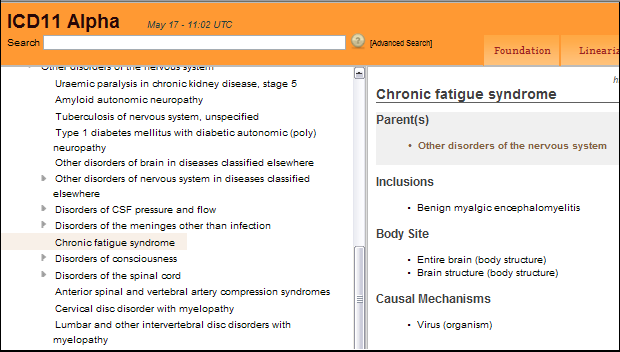
But by May 2011, the “Sorting labels” had been revised and the public version of the alpha draft displayed “06L Other disorders of the nervous system” > “06L00 Chronic fatigue syndrome”. However, the 06L00 code has subsequently been reassigned to parent class “Disorders of autonomic nervous system”, and parent class, “[G93] Other disorders of brain” (an ICD-10 legacy parent class which had previously been proposed to be removed or retired) has since reappeared as a parent class at “06L02”.

“Chronic fatigue syndrome” is currently listed not at, or under “06L00”, or under parent class “06L02” [formerly parent class G93, under which had sat PVFS and (B)ME and a number of other child classes to G93], but is currently assigned the Sorting label “23A113.00” under:

23 Special tabulation lists for mortality and morbidity
  > 23A Tabulation list for mortality
     >> 23A113 Selected cause is Remainder of the nervous system in Condensed and selected Infant and  child mortality lists
         >>> 23A113.00 Chronic fatigue syndrome

(for which no rationale or “Discussion Note” is evident in the public version), together with a long list of other Chapter 6 categories listed under Special tabulation lists for mortality and morbidity.

I would advise against attempting to determine ICD-11 proposals based on the status of the information as it currently displays, the ambiguities, the lack of visible “Discussion Notes” which explain changes (which had been visible in the iCAT platform, last year) and given that input and organization of data on the multi editor platform is subject to daily revision by numerous ICD Revision personnel, is therefore in a state of flux and may contain technical errors and omissions due to software glitches and human error in data entry and operation of a complex electronic platform.

I wrote to WHO’s Sarah Cottler in September 2011 requesting clarifications. No response was received.

Click here for ICD Caveats


Screenshot from ICD11 Alpha  retrieved May 17 – 11.02 UTC    Chapter 6 Diseases of the nervous system: Foundation Tab selected

ICD11 Alpha Chapter 6

    »  http://apps.who.int/classifications/icd11/browse/f/en#/@_@who_3_int_1_icd_2_G93_3_3

Screenshot from ICD11 Alpha  retrieved May 19 – 11.02 UTC    Chapter 6: Linearizations Tab > Morbidity selected

    »  http://apps.who.int/classifications/icd11/browse/l-m/en#/@_@who_3_int_1_icd_2_G93_3_3


Slipping Timeline

In May, I reported that the revision of ICD-10 and development of ICD-11 is running about a year behind targets for the population of content and software development and that the ICD-11 Timeline for Alpha and Beta drafting has been adjusted [1]. In order to meet its revised schedule, the technical work on ICD-11 will need to be completed by 2013, the year the APA’s DSM-5 is slated for publication. 

Drafting platforms

In November 2010, the iCAT platform through which ICD-11 was being drafted was taken out of the public domain. In May, this year, an ICD-11 Alpha browser was released for public viewing [2], with a number of caveats [3].

This most recently published Alpha platform does not include many of the “Content Model” parameters, for example, no draft “Definitions” are included and neither are the  “Discussion Notes” and “Change Histories” that had been viewable in the iCAT, as it stood last June to November. You can see screenshots of the June to November 2010 version of the iCAT in this post [4].

For screenshots from the most recent Alpha Browser for:

Chapter 6: Diseases of the nervous system > 06L Other disorders of the nervous system > 06L00 Chronic fatigue syndrome

see this post [5] or pull up the Alpha Browser pages, here [6].

As you’ll see, ICD-10 Chapter VI (6) is undergoing reorganization and the parent class “G93 Other disorders of brain” under which “Postviral fatigue syndrome”, “Benign myalgic encephalomyelitis” and many other ICD-10 categories had sat is proposed to be removed. A change of hierarchy between “Postviral fatigue syndrome” and “Chronic fatigue sydrome” is recorded in a “Change History” note.

Reorganization of Chapter 6 Diseases of the nervous system

Chapter 6 categories for ICD-11 are currently assigned the codes 06A thru 06L02. It is not known what codes will eventually be assigned to the categories within ICD-11 Chapter 6. As you’ll see from the screenshots, “06L00 Chronic fatigue syndrome” is proposed to be classified under “06L Other disorders of the nervous system”, with “Benign myalgic encephalomyelitis” specified as an Inclusion term to “06L00 Chronic fatigue syndrome”.

Relationships between Inclusion terms are not specified within ICD-10, but they will be specified within ICD-11.

Go here for ICD-11 Chapter 5 “Neurotic, stress-related and somatoform disorders” > Somatoform Disorders and Neurasthenia:

http://apps.who.int/classifications/icd11/browse/f/en#/@_@who_3_int_1_icd_2_F45

http://apps.who.int/classifications/icd11/browse/f/en#/@_@who_3_int_1_icd_2_F48_3_0

Go here for ICD-11 Chapter 18 “Symptoms, signs and abnormal clinical and laboratory findings, not elsewhere classified” > Malaise and fatigue:

http://apps.who.int/classifications/icd11/browse/l-m/en#/@_@who_3_int_1_icd_2_R53


The Revision Steering Group (RSG) and the various ICD Revision Topic Advisory Groups (TAGs) and their external reviewers for content and proposals are using a more layered version of the platform on which they are undertaking the ongoing drafting process; their platform is currently accessible only to WHO, ICD Revision and IT technicians.

The public version of the ICD-11 Alpha Browser, which is being updated daily, is currently open for public viewing only – not for commenting on. But in July, ICD Revision is planning to open up the Alpha Browser for one year for public commenting and consultations.

Extracts from: http://www.who.int/classifications/icd/revision/en/index.html

ICD-11 Timeline

Compiled from the most recent Timelines [1] [7]:

May 2011: Alpha Browser opened up for public viewing [Reached]

July 2011: Alpha Browser opened up for public commenting

+1 year for Commentaries and consultations

May 2012: Beta version opened up to public and Field Trials Version

+2 years for Field trials

2014: Final version for public viewing

May 2015: Presentation of the final version for World Health Assembly (WHA) Approval

Stakeholder participation

The WHO will be engaging with stakeholders who express an interest in participating in the ICD revision process.

Individuals may register to:

Make comments

Make proposals to change ICD categories

Participate in field trials

Assist in translating

The drafting browsers will be open all year round, subject to continuous daily updates and open to all interested stakeholders – Health Care Providers, Information Managers etc. Proposals and feedback will be subject to structured peer review by the Topic Advisory Groups.

For more information on how stakeholder participation is being projected see presentation slides in these reports on my site [8] [9].

Registering for participation

It’s currently unclear which classes of stakeholder might be called upon to participate, and to what extent, during the Alpha drafting stage.

The Stakeholder Registration Form [10] currently appears geared for participation by medical and allied health professionals and administrators. Irrespective of whether the “Yes” or “No” field for the question “Are you a health care professional?” is selected, one is presented with the same options:

Register to become involved

http://www.who.int/classifications/icd/revision/en/index.html

WHO wants to know if you are interested in being involved in the ICD Revision. We will contact you as certain features are opened to the public.

What is your clinical profession?

Medicine

Psychology

Nursing

Counselling

Social Work

Health Information Manager

Coder

Which of the following describes your highest educational attainment? Pre-University; University Degree; Non-doctoral post graduate degree (e.g. Master’s;) Doctoral degree (PhD, post bachelor’s MD, or similar)

Are you interested in participating in:

Making proposals

Peer-reviewing

Field trials

I will check the form again, once the Alpha draft has been opened up for public comment, currently scheduled for July. It is anticipated that an Alpha browser using different software from that currently in use may be released in July. I will update when the browser is opened up for public comment.

The ICD-11 “Content Model”

The WHO’s, Dr Bedhiran Üstün, describes ICD-10 as a “laundry list”. One of the most significant differences between ICD-10 and the forthcoming ICD-11 will be the “Content Model”.

Content Model

http://www.who.int/classifications/icd/revision/contentmodel/en/index.html

The content model is a structured framework that captures the knowledge that underpins the definition of an ICD entity.

Represents ICD entities in a standard way

Allows computerization

Each ICD entity can be seen from different dimensions or “parameters”. E.g. there are currently 13 defined main parameters in the content model to describe a category in ICD (see below).

A parameter is expressed using standard terminologies known as “value sets”

Content Model Parameters

ICD Entity Title

Classification Properties

Textual Definitions

Terms

Body System/Structure Description

Temporal Properties

Severity of Subtypes Properties

Manifestation Properties

Causal Properties

Functioning Properties

Specific Condition Properties

Treatment Properties

Diagnostic Criteria

For more information on the application of the “Content Model” see document [11].

Definitions

There are no definitions inlcuded in any volume of ICD-10 for  “Postviral fatigue syndrome”, “Benign myalgic encephalomyelitis” or “Chronic fatigue syndrome”. WHO has never set out what it understands by these terms nor has it specified what ICD-10 understands the relationships between these three terms to be (see page: https://dxrevisionwatch.wordpress.com/icd-11-me-cfs/) but there will be definitions in ICD-11 and the relationships between Inclusion terms will be specified.

Definitions

http://www.who.int/classifications/icd/revision/def/en/index.html

All ICD entities will have definitions: key descriptions of the meaning of the category in human readable terms – to guide users

Limited definition in Print Version – 100 words

Detailed definitions ONLINE

Definitions will be compatible with:

– the Content Model

– Diagnostic Criteria

– across the whole classification and the versions

Versions of ICD-11 are planned for multiple settings:

Primary Care

Clinical Services

Research

Specialty Adaptations of ICD-11 are being planned for:

Children and Youth

Oncology

Mental Health

Neurology

Musculoskeletal

Dermatology

Dentistry

————————————–

Sources, references and further reading:

ICD-11 Revision on main WHO website

http://www.who.int/classifications/icd/revision/en/

1] ICD-11 Revised Timeline

http://www.who.int/classifications/icd/revision/timeline/en/index.html

2] ICD-11 Alpha Browser Platform

http://apps.who.int/classifications/icd11/browse/f/en

3] ICD-11 Alpha Browser Caveats

http://www.who.int/classifications/icd/revision/caveat/en/index.html

4] Article: iCAT collaborative authoring platform, June to November 2010, screenshots and notes

https://dxrevisionwatch.wordpress.com/2010/06/07/pvfs-me-cfs-and-the-icd-11-alpha-draft-and-icat-collaborative-authoring-platform/

5] Article: ICD-11 Alpha Browser Platform, screenshots and notes for Chapter 6: Diseases of the nervous system > 06L Other disorders of the nervous system > 06L00 Chronic fatigue syndrome

https://dxrevisionwatch.wordpress.com/2011/05/19/icd-11-alpha-drafting-platform-launched-17-may-public-version/

6] ICD-11 Alpha Browser Platform: ICD-11 entity “06L00 Chronic fatigue syndrome”

Foundation:

http://apps.who.int/classifications/icd11/browse/f/en#/@_@who_3_int_1_icd_2_G93_3_3

Linearizations Morbidity:

http://apps.who.int/classifications/icd11/browse/l-m/en#/@_@who_3_int_1_icd_2_G93_3_3

7] ICD-11 Timeline: PowerPoint presentation (in PDF format)

http://unstats.un.org/unsd/class/intercop/expertgroup/2011/AC234-P32.PDF

8] Article: ICD Revision Process Alpha Evaluation Meeting documents and PowerPoint slide presentations

https://dxrevisionwatch.wordpress.com/2011/04/19/icd-revision-process-alpha-evaluation-meeting-presentations/

9] Article: ICD-11 Revision Steering Group struggling to meet targets for release of Beta Draft platform in May

https://dxrevisionwatch.wordpress.com/2011/04/11/icd-11-struggling-to-meet-targets-for-release-of-beta-draft-in-may/

10] Register for participation in ICD-11 Alpha drafting process

http://www.who.int/classifications/icd/revision/en/

Stakeholder Registration form

https://spreadsheets.google.com/spreadsheet/viewform?formkey=dDVabnF1RFpTQkVnVEN2TXhVRm55MGc6MQ

[11] ICD-11 Content Model Reference Guide version January 2011

http://sites.google.com/site/icd11revision/home/documents

https://dxrevisionwatch.com/wp-content/uploads/2011/02/content20model20reference20guide20january2020111.doc