Abstract: WPA Congress 2014: ICD-11 Symposia: Proposals and evidence for the ICD-11 classification of bodily distress disorders

Post #320 Shortlink: http://wp.me/pKrrB-43v

Edited version of the text published on 13.01.15.

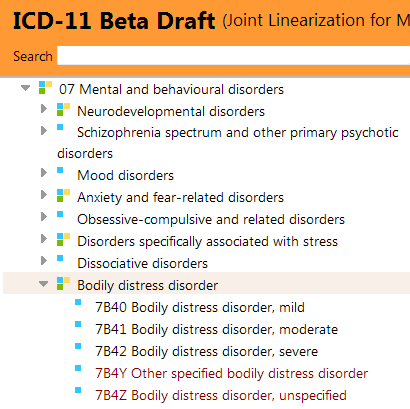
Screenshot: ICD-11 Beta drafting platform, public version, 13.01.15; Chapter 07 Mental and behavioural disorders: Bodily distress disorder. Joint Linerarization for Mortality and Morbidity Statistics (JLMMS) view selected.
+++
BDD130115

“Show availability in main linearizations” view selected. Hover text for categories designated with three coloured key reads: “In Mortality and Morbidity, Primary Care High Resource, Primary Care Low Resource.” Hover text for categories designated with single blue key reads: “In Mortality and Morbidity.”

Two working groups, two sets of recommendations

The Expert Working Group on Somatic Distress and Dissociative Disorders (S3DWG) is one of two working groups advising the Mental Health Topic Advisory Group (TAG) on the potential revision of the ICD-10 Somatoform disorders categories for ICD-11.

The other group tasked with making recommendations on the revision of the Somatoform disorders is the Primary Care Consultation Group (PCCG), led by Prof Sir David Goldberg [1].

The S3DWG’s disorder construct is the construct that has been entered into the ICD-11 Beta drafting platform since 2012 [2].

Perversely, the S3DWG is proposing to call its disorder construct, “Bodily distress disorder” (BDD) – a term already being used outside ICD Revision, interchangeably, with Bodily Distress Syndrome (BDS), which is conceptually different.

To further muddy the waters, the PCCG has proposed calling its construct (which in 2012 had drawn heavily on the Fink et al BDS concept but with some DSM-5 SSD-like psychobehavioural features tacked on), “Bodily stress syndrome” (BSS).

So four very similar terms in play:

Bodily distress disorder (S3DWG, the construct entered into the Beta draft)

Body distress disorders (PCCG primary care disorder group heading*)

Bodily stress syndrome (PCCG disorder category sitting under Body distress disorders*)

Bodily Distress Syndrome (Fink et al, 2010)

*As proposals of the Primary Care Consultation Group had stood in mid 2012 [1].

The co-chair of the Mental Health TAG agrees that the S3DWG’s BDD and Fink et al’s (2010) BDS construct [3] are conceptually different; that there is potential for confusion between the two constructs and he will be discussing the issue of BDD terminology with the working group.

I shall be reporting on some recently proposed revisions to the definition text for BDD and its three Severities in my next post.

ICD-11 Symposia, XVI World Congress of Psychiatry, Madrid 2014

The have been no progress reports from either the S3DWG or the PCCG since emerging proposals for both working groups were published in 2012.

In September, Professor Oye Gureje, who chairs the ICD-11 Expert Working Group on Somatic Distress and Dissociative Disorders, presented on “Proposals and evidence for the ICD-11 classification of Bodily Distress Disorders” as part of series of symposia on the development of the ICD-11 chapter for mental and behavioural disorders, at the World Psychiatric Association XVI World Congress, in Madrid.

In the absence of progress reports, I have requested that WHO/WPA make a transcript, slides or summary of this presentation publicly available.

In the meantime, the Abstracts for these ICD-11 symposia presentations can be found here:

http://www.tilesa.es/wpamadrid2014/abstracts/volume8/files/assets/basic-html/page352.html

also: http://www.tilesa.es/wpamadrid2014/abstracts/volume8/index.html#/352/zoomed

XVI World Congress of Psychiatry. Madrid 2014
Volume 2. Abstracts Regular Symposia

[…]

http://www.tilesa.es/wpamadrid2014/abstracts/volume8/files/assets/basic-html/page354.html

Session: Regular Symposium SPEAKER 3 Code SY469

Title: Proposals and evidence for the ICD-11 classification of bodily distress disorders

Speaker O. Gureje University of Ibadan, Ibadan, Nigeria Abstract Objectives:

The disorder categories currently classified in the group of Somatoform Disorders in ICD-10 have been the subject of controversy relating to their names, utility, reliability and acceptability.

The ongoing development of ICD-11 presents an opportunity to revise these categories so as to enhance their utility and overall acceptability.

Methods: The WHO ICD-11 Working Group on Somatic Distress and Dissociative Disorders has conducted a comprehensive review of the current status of Somatoform Disorders, drawing on literature from across the world and considered within diverse clinical experiences of experts who were consulted for the revision exercise. Proposals for DSM-5 and their suitability for global application were also considered.

Results: Important areas for improving the utility and reliability of disorders grouped under Somatoform Disorders were identified. These areas encompass name, content, structure and clarity of the phenomenology. A simplified category of Bodily Distress Disorder with an improved set of guidelines for making the diagnosis has been proposed to replace current Somatoform Disorders categories.

Bodily Distress Disorder may be described as Mild, Moderate, or Severe based on the extent of focus on bodily symptoms and their interference with personal functioning. Bodily Distress Disorder is currently a subject of tests of its utility and reliability in internet- and clinic-based studies via the extensive network that WHO has developed.

Conclusions: Bodily Distress Disorder holds the promise of addressing the various concerns that have been expressed in regard to the utility and applicability of categories currently classified under Somatoform Disorders. The overarching goal of the new category is to enhance the clinical care of patients presenting with these common and disabling conditions. Bodily Distress Disorder is currently a subject of tests of its utility and reliability in internet- and clinic-based studies, including in primary care settings, via the extensive network that WHO has developed.

References Creed F, Gureje O. Emerging themes in the revision of the classification of somatoform disorders. International Review of Psychiatry 2012; 24:556-567

Further reading:

1 Lam TP, Goldberg DP, Dowell AC, Fortes S, Mbatia JK, Minhas FA, Klinkman MS: Proposed new diagnoses of anxious depression and bodily stress syndrome in ICD-11-PHC: an international focus group study. Family Practice (2013) 30 (1): 76-87. Full free text: http://fampra.oxfordjournals.org/content/30/1/76.long

2 Creed F, Gureje O. Emerging themes in the revision of the classification of somatoform disorders. Int Rev Psychiatry 2012;24:556-67. [Abstract: PMID: 23244611]

3 Fink P, Schröder A. One single diagnosis, bodily distress syndrome, succeeded to capture 10 diagnostic categories of functional somatic syndromes and somatoform disorders. J Psychosom Res. 2010 May; 68(5):415-26.  [Abstract: PMID: 20403500].

Caveats: The ICD-11 Beta drafting platform is not a static document: it is a work in progress, subject to daily edits and revisions, to field test evaluation and to approval by ICD Revision Steering Group and WHO classification experts. Not all new proposals may survive ICD-11 field testing. Chapter numbering, codes and sorting codes currently assigned to ICD categories may change as chapters and parent/child hierarchies are reorganized. The public version of the Beta draft is incomplete; not all “Content Model” parameters display or are populated; the draft may contain errors and category omissions.

References for intention not to retain Neurasthenia for ICD-11

Post #319 Shortlink: http://wp.me/pKrrB-439

When ICD-10 was completed in 1992, Chapter V Mental and behavioural disorders retained the disorder category term, Neurasthenia, coded at F48.0.

This is how Neurasthenia is listed within ICD-10:

F48.0 Neurasthenia (with Fatigue syndrome as inclusion term).


Neurasthenia and ICD-10-CM

The forthcoming U.S. specific ICD-10-CM inherits Neurasthenia in Chapter 5 Mental, Behavioral and Neurodevelopmental disorders (F01–F99). But here, it is coded under F48.8, owing to the different coding arrangement for the F48–F48.9 entities within ICD-10-CM.

This is how Neurasthenia is listed in the ICD-10-CM Tabular List release for FY 2015*

Neurasthenia ICD-10-CM

*Although the FY 2015 ICD-10-CM is now available for public download and viewing, the codes in ICD-10-CM are not currently valid for any purpose or use until implementation date is reached.


Neurasthenia and DSM

There was no discrete category for Neurasthenia within DSM-IV or DSM-IV-TR; nor within DSM-5, which published in May 2013.


Neurasthenia and ICD-11 and ICD-11-PHC

I reported in 2012 that for ICD-11 and ICD-11-PHC, the intention is not to retain Neurasthenia.

Here are the references:

Creed F, Gureje O. Emerging themes in the revision of the classification of somatoform disorders. Int Rev Psychiatry. 2012 Dec;24(6):556-67. http://www.ncbi.nlm.nih.gov/pubmed/23244611 [Full text behind paywall]

On Page 563 of this review paper, the authors state that a major highlight of the proposals of the ICD-11 Expert Working Group on Somatic Distress and Dissociative Disorders (the S3DWG sub working group) for the revision of the ICD-10 Somatoform disorders is that of subsuming all of the ICD-10 categories of F45.0–F45.9 and F48.0 under a single category with the proposed name of “Bodily distress disorder” (BDD).

ICD-10 PHC is a simplified version of the WHO’s ICD-10 chapter for mental and behavioural disorders for use in general practice and primary health care settings. This system has rough but not exact equivalence to selected of the mental disorders in the core ICD-10 classification.

The ICD-10 PHC includes and describes 26 disorders commonly encountered within primary care and and low resource settings, as opposed to circa 450 classified within Chapter V of ICD-10.

For ICD-11 PHC it is also the intention not to retain the category F48 Neurasthenia.

Here are the references for the primary care version:

International Psychiatry, Issue 1 Feb 2011, Royal College of Psychiatrists
http://www.rcpsych.ac.uk/pdf/IPv8n1.pdf

Page1: Box 1 The 26 conditions included in ICD10-PHC

F45 Unexplained somatic complaints*
F48 Neurasthenia*

*Not to be included in ICD11-PHC

Neurasthenia Box 1

See also:

Goldberg DP. Comparison between ICD and DSM diagnostic systems for mental disorders.
In: Sorel E, ed. 21st Century Global Mental Health. Jones & Bartlett Learning, 2012:37-53.
Sample Chapter 2: http://samples.jbpub.com/9781449627874/Chapter2.pdf
Publication date: August, 2012: http://www.jblearning.com/catalog/9781449627874/

See Page 51: Table 2.5 The 28 Disorders Proposed for ICD11-PHC

Note: If you compare the list of proposed disorders for the ICD-11 primary care version, as listed in the February 2011 International Psychiatry article (on Page 2, Box 2 The 28 disorders to be field tested for ICD11-PHC), with Table 2.5, above, you will note that some proposed disorder names, disorder groupings and disorder group headings have been revised since the article in International Psychiatry. Prof Goldberg has clarified that the iteration published in the sample book chapter was the more recent of the two, cf:

February 2011 iteration:

Body distress disorders

16 Bodily distress syndrome (new – was unexplained somatic complaints)
17 Health preoccupation (new)
18 Conversion disorder (was dissociative disorder)


Sample chapter (2012) iteration:

Body distress disorders

15 Bodily stress syndrome
16 Acute stress reaction
17 Dissociative disorder
18 Self-harm

This list of disorder proposals and groupings may have undergone further revision since publication of 21st Century Global Mental Health. But no progress reports have emerged on behalf of the Primary Care Consultation Group (PCCG) setting out more recent proposals for their “Bodily stress syndrome” construct since the Lam et al (July 2012) paper [1].

The disorder term and construct that is entered into the ICD-11 Beta draft and defined with three severities, is the S3DWG group’s conceptually different, but similarly named construct, Bodily distress disorder (BDD).

The ICD-11 S3DWG group is advising ICD Revision in parallel with the PCCG on a potential replacement for the ICD-10 Somatoform disorders.

It is the case, however, that some professional and consumer stakeholders are unaware that are two groups advising on the revision of the Somatoform disorders, that there have been two sets of proposals presented, or how they differ in conceptualization.

Four revised definition texts were submitted to the Proposals List on behalf of Mental Health TAG for “Bodily distress disorder (BDD)” on January 9–11, which will be the subject of a future post.


Further evidence of intention for Neurasthenia and ICD-11

In mid 2012, Neurasthenia was removed from the ICD-11 Beta draft and subsumed (along with the F45.0–F45.9 category terms) by the S3DWG’s new single diagnostic category, “Bodily distress disorder.”

However, a couple of redundant listings for Neurasthenia as an exclusion term remained in the Beta draft as legacy text from ICD-10, under Exclusions to Fatigue (Symptoms and signs chapter) and Generalized anxiety disorder (Mental and behavioural disorders chapter).

The deletion of Neurasthenia as an exclusion term to Fatigue has now been attended to.

The following proposal has been submitted via the Proposals facility on behalf of Mental Health TAG to address the legacy listing that remains under Generalized anxiety disorder and this provides additional and contemporary evidence of intention not to retain Neurasthenia as a disorder term for ICD-11:

Proposals List

Content Enhancement Proposal

Exclusion to Generalized anxiety disorder

neurasthenia

Submitted

Neurasthenia is not recommended for retention as a disorder category in ICD-11. Therefore, this exclusion term is not longer necessary.

–On behalf of Mental Health TAG

Geoffrey Reed 2015-Jan-09 – 10:09 UTC


If the concept is not retained in ICD-11, then the concept would be marked as obsolete rather than deleted. Thank you!

M. Meri Robinson Nicol 2015-Jan-26 – 13:14 UTC


References

1 Lam TP, Goldberg DP, Dowell AC, Fortes S, Mbatia JK, Minhas FA, Klinkman MS: Proposed new diagnoses of anxious depression and bodily stress syndrome in ICD-11-PHC: an international focus group study. Fam Pract Feb 2013 [Epub ahead of print July 2012]. http://www.ncbi.nlm.nih.gov/pubmed/22843638. Full free text: http://fampra.oxfordjournals.org/content/30/1/76.long

ICD-11 Mental Health TAG opposes inclusion of “Functional clinical forms of the nervous system” under neurological conditions

Post #318 Shortlink: http://wp.me/pKrrB-42P

Update: In September, a series of ICD-11 Symposia were held at the World Psychiatric Association XVI World Congress, in Madrid. These included Symposium Code SY469: Proposals and evidence for the ICD-11 classification of dissociative disorders, the abstract for which can be found here (pages 354-355).

Update: For those registered for enhanced access to the public version of the ICD-11 Beta drafting platform, there are some recent proposals on behalf of Mental Health TAG for the Dissociative disorders block, here.


As previously posted:

In my September post, Briefing paper on ICD-11 and PVFS, ME and CFS: Part 2, I reported on a proposal by the ICD-11 Topic Advisory Group (TAG) for Neurology for the inclusion of a disorder group termed, “Functional clinical forms of the nervous system,” under Neurological conditions.

Under this new parent class, it has been proposed to locate a list of “functional disorders” (Functional paralysis or weakness; Functional sensory disorder; Functional movement disorder; Functional gait disorder; Functional cognitive disorder, Functional visual loss etc.).

In ICD-10, these conditions are accommodated under the Chapter V F44 Dissociative [conversion] disorders section.

In DSM-5, they are classified under “Conversion Disorder (Functional Neurological Symptom Disorder),” which is one of several categories that sit under the DSM-5 “Somatic Symptom and Related Disorders” section. They are cross-walked to ICD-10-CM’s F44.4 to F44.7 codes, depending on the symptom type.

The rationale for this proposed new parent class is set out in this recent paper by Stone et al:

Functional disorders in the Neurology section of ICD-11: A landmark opportunity

Jon Stone, FRCP, Mark Hallett, MD, Alan Carson, FRCPsych, Donna Bergen, MD and Raad Shakir, FRCP*

Neurology December 9, 2014 vol. 83 no. 24 2299-2301

doi: 10.1212/WNL.0000000000001063

Full free text

Full free PDF

*Raad Shakir chairs the Topic Advisory Group for Neurology

See also (full paper behind paywall):

Functional neurological disorders: The neurological assessment as treatment. Stone J. Neurophysiol Clin. 2014 Oct;44(4):363-73 Abstract: http://www.ncbi.nlm.nih.gov/pubmed/25306077


Opposition from Mental Health TAG

If you are registered for increased access to the public version of the Beta drafting platform, you can read the response from Mental Health TAG, here.

If you are not registered, see below:

Proposal for Deletion of the Entity

Functional clinical forms of the nervous system

Proposal Status: Submitted

Definition

Definition does not exist for this content

Rationale

This grouping should be deleted.

These are by definition not neurological conditions, as indicated by the phrase included in the definitions provided: ‘in which there is positive evidence of either internal inconsistency or incongruity with other neurological disorders’. If there is no evidence of a neurological mechanism or etiology, the rationale for including these in the classification of neurological disorders is unclear to say the least.

In contrast, these have always been viewed as mental disorders (from the days of Sigmund Freud), and there is no evidence about their etiology or mechanism that is inconsistent with that formulation.

Prior to ICD-10, these conditions were conceptualized as Conversion Disorders. This terms is considered obsolete because it refers to a psychodynamic mechanism that is theoretical and not ideally descriptive. ICD-10 offered a transitional title, calling them Dissociative [conversion] disorders.

For ICD-11, the proposals for Mental and Behavioural Disorders refer to these as Dissociative disorders, dropping the ‘Conversion’ part of the term. Dissociative disorders are defined descriptively, as ‘characterized by disruption or discontinuity in the normal integration of memories of the past, awareness of identity, immediate sensations, and control over bodily movements that are not better explained by another mental and behavioural disorder, are not due to the direct effects of a substance or medication, and are not due to a neurological condition, sleep-wake disorder, or other disorder or disease. This disruption or discontinuity may be complete, but is more commonly partial, and can vary from day to day or even from hour to hour.’ There is not basis for suggesting that this formulation is inconsistent with the phenomena proposed for inclusion here as ‘Functional clinical forms of the nervous system’.

The fact that neurologists may be asked to evaluate these conditions is not an adequate rationale for defining them as neurological disorders, nor are concerns about reimbursement policies that are unwisely based on divisions among specialists’ scope of practice based on ICD chapters.

The Mental Health TAG is aware that there is a vocal group of advocates for this terminology among neurologists. In fact, this terminology was included as alternate terminology in DSM-5. However, in DSM-5, these are still very clearly classified as Mental disorders.

Similarly, these terms can be added as inclusion terms to the equivalent categories in the Mental and behavioural disorders chapter.

In spite of its popularity among at least some neurologists, this terminology is currently viewed in psychiatry as obsolete, and based on a mind-body split (division between ‘organic’ and ‘non-organic’) we are elsewhere attempting to remove from the ICD-11. The implied contrast is between a ‘real’ (medical) disorder and a ‘functional’ (psychiatric) disorder.

A further problem with this terminology is its inconsistency with WHO’s official policy use of terminology related to ‘functioning’ (function, functional), as defined in the ICF.

In some instances of the use of the term ‘functional’ in other parts of proposals for ICD-11, it is not clear that the proposals use the term ‘functional’ in this same sense, or if they mean something close to ‘idiopathic’. However, it is quite clear that what is meant in this group of proposals is ‘without neurological explanation or plausible or demonstrable etiology’.

However, this terminology is in any case problematic. In addition to requesting that this group of categories be deleted from the classification and instead integrated appropriately as inclusion terms in the chapter on Mental and Behavioural Disorders, the Mental Health TAG requests that the Classifications Team examine other uses of the term ‘functional’ in proposals for ICD-11 and consider either appropriate parenting in Mental and behavioural disorders or alternative terminology.

The Mental Health TAG also requests that this issue be revised by the Revision Steering Group (and or Small Executive Group) in order to arrive at an ICD-wide solution as efficiently as possible. The Mental Health TAG requests that this issue not simply be arbitrated by the same TAGs that have made these proposals.

–On behalf of Mental Health TAG

References

There are no references attached for this proposal item

Comments on this proposal

Comment

The Mental Health TAG also requests that this issue be revised by the Revision Steering Group (and or Small Executive Group) in order to arrive at an ICD-wide solution as efficiently as possible. The Mental Health TAG requests that this issue not simply be arbitrated by the same TAGs that have made these proposals.

–On behalf of the Mental Health TAG
Geoffrey Reed 2015-Jan-10 – 23:10


Comment

An alternative could be that this grouping could be retained but with appropriate primary parenting to Dissociative disorders in the Mental and behavioural disorders chapter.

Entities of ‘functional clinical forms’ have already been proposed to be added in the appropriate categories in Dissociative disorders. Most of them are included in Dissociative motor disorder, though several are included in Dissociative disorder of sensation. One is included in dissociative amnesia.

However, the name of these entries – i.e., functional disorders – remains an issue as described above, which should be resolved at the ICD-wide level.

Note that if the solution selected involved retaining these categories, perhaps renamed, but primary parenting them appropriately in Dissociative disorders, it will be more appropriate to move the secondary parented categories to the main Disease of the nervous system chapter rather than listing them in clinical forms.

–On behalf of the Mental Health TAG
Geoffrey Reed 2015-Jan-12 – 09:14 UTC


I will update if further comment is uploaded on behalf of the Mental Health TAG, the Neurology TAG, ICD-11 Revision Steering Group, the WHO classification experts etc.


Note for stakeholders with an interest in the ICD-10 G93.3 categories: There is currently no inclusion within any chapter of the ICD-11 Beta draft for a specific parent class for “Functional somatic syndromes,” or “Functional somatic disorders” or “interface disorders” under which, conceivably, those who consider CFS, ME, IBS, FM et al to be speciality driven manifestations of a similar underlying functional disorder might be keen to see these terms aggregated.

On July 24, 2014, ICD Revision’s Dr Geoffrey Reed stated there has been no proposal and no intention to include ME or other conditions such as fibromyalgia or chronic fatigue syndrome in the classification of mental disorders.

ICD-11 revision process: External assessment now due April 1

Post #317 Shortlink: http://wp.me/pKrrB-42A

This post is the first in a series of updates on the ICD-11 revision process.

Last July, in Call for Expressions of Interest to review the ICD revision process, I reported that the World Health Organization (WHO) Office of the Assistant Director General, Health Systems and Innovation had posted a call for expressions of interest from suitable contractors to conduct an interim assessment of the 11th Revision of the International Classification of Diseases (ICD).

Lead time was four months, with the completed final report targeted for submission to WHO by December 15, latest.

With no sign of a report in the offing, I asked WHO’s Bedirhan Üstün, last week, whether an interim assessment had been delivered in December and did WHO intend to publish a summary report.

Dr Üstün confirmed on January 10 that the external report will now be delivered by April 1 and that it “will certainly be made available.”

So the delivery of this interim assessment has slipped targets by some 15 weeks.

I have no information about the contractors who successfully pitched for the review and no date by which WHO aims to release a copy of the report’s findings (or summary of key findings).

The Call for Expressions of Interest to review the ICD revision process Terms of Reference document can still be downloaded from the WHO website, here:

or open, here, on Dx Revision Watch:

Click link for PDF document  Call for Expressions of Interest to review the ICD revision process

ICD-11 Beta drafting platform

Go here for the public version of the ICD-11 Beta drafting platform.

According to Slide #4 of this WHO presentation on Slideshare, the Joint Linearization for Mortality and Morbidity and Statistics (JLMMS) was expected to be frozen at certain points during the review process.

If you are registered with the public Beta platform for increased access and interaction with the draft, there are dropdowns from the Info tab for Downloads and Frozen Releases, eg:

Linearization Print Versions

Simplified Linearization Outputs

Linearization Index Tabulations

Frozen Releases

You may find the frozen release downloads here


When viewing the ICD-11 Beta drafting platform bear in mind that the platform may still be subject to freeze and more recent proposals will have been made across all chapters.

From the Contributions tab, you can pull up the Proposals pages for specific terms or view the Proposals List. New proposals are added on a daily basis and date back to July 2014.

Proposals can be filtered according to Proposal Status (Saved; Submitted; External Review, Accepted, Implemented, Rejected etc.) or filtered by Proposal Type.

Before scrutinizing or quoting from the public version of the Beta draft, I strongly advise that you first check the Proposals List for more recent revisions since the public Beta drafting platform may not display the most recent proposals.

You may find later proposals for revisions to the text of definitions and other Content Model descriptors; additions or deletions to Inclusions, Exclusions, Synonyms; deletions or additions of entities; revisions to terminology; proposals for complex hierarchical changes etc. Please also read these Caveats.

Caveats: The ICD-11 Beta drafting platform is not a static document: as a work in progress, it is subject to daily edits and revisions, to field test evaluation and to approval by ICD Revision Steering Group and WHO classification experts. Not all new proposals may survive internal/external review or field testing. Chapter numbering, codes and sorting codes currently assigned to ICD categories may change as chapters, entities, content and parent/child hierarchies are reorganized. The public version of the Beta draft is incomplete; not all “Content Model” parameters display or are populated; the draft may contain errors and omissions of categories and Index terms.