ICD-11 Alpha Drafting platform launched 17 May (public version)

ICD-11 Alpha Drafting platform launched 17 May (public version)

Post #81 Shortlink: http://wp.me/pKrrB-16N

This information does not apply to the forthcoming US specific “Clinical Modification” of ICD-10, called ICD-10-CM, scheduled for implementation in October 2013.

Changes to Alpha Draft since May 17, 2011:

May 19 – 11:02 UTC : Code/sorting label assigned to Parent class “Other disorders of the nervous system” changed from 06N to 06L.

Screenshot from ICD11 Alpha  May 17 – 11.02 UTC    Chapter 6 Diseases of the nervous system: Foundation Tab selected

ICD11 Alpha Chapter 6

    »  http://apps.who.int/classifications/icd11/browse/f/en#/@_@who_3_int_1_icd_2_G93_3_3
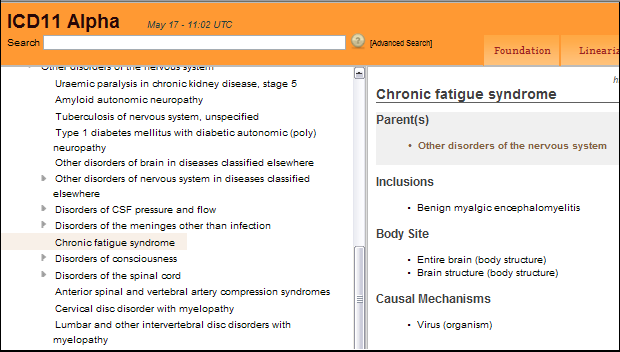
Screenshot from ICD11 Alpha  May 19 – 11.02 UTC    Chapter 6: Linearizations Tab > Morbidity selected

    »  http://apps.who.int/classifications/icd11/browse/l-m/en#/@_@who_3_int_1_icd_2_G93_3_3


Four new pages were published on the WHO’s main website on 17 May – the revised Timeline for ICD-11, the announcement of an Alpha Draft browser, a Registration form and a Caveat. Yesterday, I posted the revised ICD-11 Revision Timeline.

What can be seen for PVFS, (B)ME and CFS in the public Alpha Draft?

For the Alpha browser, go to this page:

http://www.who.int/classifications/icd/revision/en/index.html

Here it states:

The International Classification of Diseases 11th Revision is due by 2015

ICD is the international standard to measure health & health services

• Mortality statistics
• Morbidity statistics
• Health care costs
• Progress towards the Millenium Development Goals
• Research

– Alpha draft is updated daily as the work progresses
– It is intended to show the new features to stakeholders early
– Commenting will be available in July 2011

The link for the alpha browser is:

http://apps.who.int/classifications/icd11/browse/f/en

This is the link to a page for “Caveats”

“Read more on what to expect in the ICD-11 Alpha Draft”

ICD-11 Alpha Draft Caveats

ICD-11 alpha draft is:

• Incomplete
• May contain errors, omissions or imperfections
• The work in different chapters are at different stages
• The alpha drafting work is going on by the WHO, Revision Steering Group and Topic Advisory Groups
• The alpha draft is going to be updated on a daily basis
• The alpha draft is NOT TO BE USED for CODING at this stage
• The alpha draft has not yet been approved by the Topic Advisory Groups, Revision Steering Group or WHO

Click here to access the public Alpha Draft browser

Poke around and open the Parent and Child categories and the Tabs – you cannot edit or break anything.

This new interface is not as detailed or as easy to navigate as the software version of the iCAT collaborative drafting platform that was in the public domain up until November, last year. Less information is visible, for example, some of the paramenter tabs, including “Definitions”. (Compare with what could be seen in this iCAT screenshot from last June.)

This is a public draft and another platform is being used by ICD Revision for ongoing drafting. The public draft will be updated as the work of the various Topic Advisory Groups and working groups progresses. ICD Revision has not reached its targets for the generation of content and population of “Content Model” fields across all chapters and this draft is not as far forward as ICD Revision had projected for a May 2011 release.

Though viewable now, the Alpha drafting browser is not planned to be open for public comment until July, this year. It’s not yet clear which classes of public stakeholder will be able to participate in the drafting process, come July, or to what extent.

If you are interested in the proposed public comment, interaction and input processes for the Alpha and Beta drafting stages, see this DSM-5 and ICD-11 Watch post for meeting presentation slides.

Summary

First a caveat: It had been anticipated that a Beta drafting platform would be released in May, this year. WHO has cited lack of content and underdeveloped software for delaying the launch of a Beta drafting platform.

This public version of an Alpha drafting platform is a “work in progress”; not all disease and disorder categories may have been entered into the draft and proposed textual content is in the process of being authored and reviewed by the various Topic Advisory Groups, ICD Revision Steering Group and external peer reviewers.

From what can be seen, today, 19 May:

06L00 Chronic fatigue syndrome

is proposed to be coded within Chapter 6 Diseases of the nervous system (the Neurology chapter), as an ICD Title category, under the Parent class, 06L Other disorders of the nervous system.

Benign myalgic encephalomyelitis is specified as an Inclusion to 06L00 Chronic fatigue syndrome.

“Causal mechanisms” for 06L00 Chronic fatigue syndrome are cited as “Virus (organism)”.

The relationship between ICD Title category 06L00 Chronic fatigue syndrome and Inclusion term Benign myalgic encephalomyelitis is not yet specified, ie whether for ICD-11, “Benign myalgic encephalomyelitis” is proposed to be specified as a Synonym , Subclass or other relationship to “06L00 Chronic fatigue syndrome”.

Many categories within the draft are waiting for their Inclusion terms to be specified, not just the three terms of interest to us.

For explanation of Inclusions and other “Content Model” parameter terms, see: iCAT Glossary or the key ICD-11 Content Model document.

6 Inclusions

Details: Inclusion terms appear in the tabular list [Ed: ICD Volume 1] of the traditional print version and show users that entities are included in the relevant concept. All of the ICD-10 inclusion terms have been imported and accessible in the iCat. These are either synonyms of the category titles or subclasses which are not represented in the classification hierarchy. Since we have synonyms as a separate entity in our ICD-11 content model, the new synonyms suggested by the users should go into the synonyms section. In the future, iCat will provide a mechanism to identify whether an inclusion is a synonym or a subclass.”


What is the proposed relationship between PVFS and CFS?

Postviral fatigue syndrome is not accounted for in the “Foundations” or “Linearizations > Morbidity” listings.

In ICD-10, Postviral fatigue syndrome is an ICD Title category under G93 Other disorders of brain. I cannot confirm, but it may be that due to the hierarchy  change, “Postviral fatigue syndrome” is proposed to be subsumed under “06L00 Chronic fatigue syndrome” with “06L00 Chronic fatigue syndrome” becoming the ICD Title category, because “G93.3 Postviral fatigue syndrome” has lost its ICD-10 Parent category.

At the moment, there is not sufficient information displaying to determine what the intention is. Last June, I requested a clarification from Dr Raad Shakir, chair of Topic Advisory Group for Neurology, but no clarification has been forthcoming.

In the iCAT initial drafting platform, last November, where “Postviral fatigue syndrome” was referenced within a “Category Note” and specified as an Exclusion to Chapter 5 and Chapter 18,  it was referenced as:

“G93.3 Postviral fatigue syndrome -> Gj92 Chronic fatigue syndrome”

[“Note: Gj92” is a “Sorting label” assigned for the initial Alpha drafting process, not an eventual ICD-11 code.]


“Change history” note from May 2010

In ICD-10, “Postviral fatigue syndrome” is a Title code at G93.3 under Parent category “G93 Other disorders of brain”. “Benign myalgic encephalomyelitis” sits under “G93.3 Postviral fatigue syndrome” (relationship unspecified).

As previously reported, an iCAT “Change history” note, dated 1 May 2010, records a “Change in hierarchy for class: G93.3 Postviral fatigue syndrome because its parent category (G93 Other disorders of brain) is removed.”

This would leaves the existing ICD-10 G93.3 Title category, “Postviral fatigue syndrome” and “Benign myalgic encephalomyelitis” that sits beneath it, and also the G93.3 index entry for Chronic fatigue syndrome with no parent category.

Note that the removal of the parent “G93 Other disorders of brain” affects many other categories also classified under G93 in ICD-10 which have also been assigned new parents under the reorganization of Chapter 6 (VI).

Screenshot of “Change history” Note from May 2010


Exclusions

No Exclusions have been specified yet for “06L00 Chronic fatigue syndrome”.

“Postviral fatigue syndrome” is specified as an Exclusion to the following ICD-11 chapters:

Chapter 5 “05E06 Other neurotic disorders > 05E06.00 Neurasthenia”
Chapter 18 “18GF General symptoms and signs > 18F03 Malaise and fatigue.”

(Chapter 18 is the “R code” chapter of ICD-10; ICD-10-CM proposes to retain CFS under R53 Malaise and fatigue at R53.82 Chronic fatigue, unspecified, as “Chronic fatigue syndrome NOS”, with the Exclusion: Postviral fatigue syndrome G93.3.)

Go here for ICD-11 Chapter 5 “Neurotic, stress-related and somatoform disorders” > Somatoform Disorders:

http://apps.who.int/classifications/icd11/browse/f/en#/@_@who_3_int_1_icd_2_F40-F48

Go here for ICD-11 Chapter 18 “Symptoms, signs and abnormal clinical and laboratory findings, not elsewhere classified”:

http://apps.who.int/classifications/icd11/browse/l-m/en#/@_@who_3_int_1_icd_2_XVIII


Congruency with DSM-5 proposals for revision of DSM-IV “Somatoform Disorders”

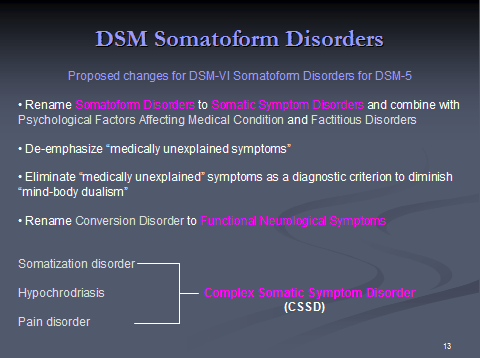
There is no obvious mirroring of the radical proposals currently being put forward by the DSM-5 Somatic Symptom Disorders Work Group to rename “Somatoform Disorders” to “Somatic Symptom Disorders” and combine a number of existing somatoform categories under a new rubric, “Complex Somatic Symptom Disorder”.


Registering for involvement

There is a Registration form here

This form appears to be aimed at recruiting medical health professionals for putting their names down to be contacted at some point to “Make comments; Make proposals to change ICD categories; Participate in field trials; Assist in translating“. It’s not clear whether or at what point in the Alpha/Beta drafting processes involvement might be extended to non professional stakeholders.

Register to become involved

ICD-11 Registration

“WHO wants to know if you are interested in being involved in the ICD Revision. We will contact you as certain features are opened to the public.”

[Fields are: Family name*; First name*; Email address*; Organization or Company*; LinkedIn ID; Are you a health care professional?* Yes/No. Continue…]   *Required fields


Related information

1] ICD11 Alpha browser

2] ICD Revision Process Alpha Evaluation Meeting documents and PowerPoint slide presentations

3] Key document: ICD Revision Project Plan version 2.1 9 July 2010

4] Key document: Content Model Reference Guide version January 2011

What are the latest proposals for DSM-5 “Somatic Symptom Disorders” categories and why are they problematic? (Part 3)

What are the latest proposals for DSM-5 “Somatic Symptom Disorders” categories and why are they problematic? (Part 3)

Post #80 Shortlink: http://wp.me/pKrrB-15X

Part 1 of this report can be read here in Post #75:

What are the latest proposals for DSM-5 “Somatic Symptom Disorders” categories and why are they problematic? (Part 1)

Part 2 of this report can be read in Post #77:

What are the latest proposals for DSM-5 “Somatic Symptom Disorders” categories and why are they problematic? (Part 2)

The second public review of draft proposals for DSM-5 criteria is now open and runs from May to 15th June

Information about registering to submit comment can be read here in Post #78: http://wp.me/pKrrB-15q

In the first part of this report, I addressed some of the queries that have been raised around the second public review of proposals for the revision of DSM categories and diagnostic criteria.

In Part 2, I linked to the latest proposals (dated 14 April 2011) from the DSM-5 Somatic Symptom Disorders Work Group, as published on the DSM-5 Development website, on 4 May.

Stakeholder feedback is being accepted now until 15 June.

       Disorders Description   Key Document One: “Somatic Symptom Disorders

       Rationale Document     Key Document Two: “Justification of Criteria — Somatic Symptoms”


Related information:

Submissions by international patient organizations and advocates in February to April 2010 DSM-5 public review can be read here: http://wp.me/PKrrB-AQ

ICD Revision: WHO announces revised Timeline for ICD-11

ICD Revision: WHO announces revised Timeline for ICD-11

Post #79 Shortlink: http://wp.me/pKrrB-16e

The information in this report relates only to ICD-11, the forthcoming revision of ICD-10 that is scheduled for completion and pilot implementation in 2014/15. It does not apply to the forthcoming US specific Clinical Modification of ICD-10, known as ICD-10-CM.

The following has been published on the WHO’s website in the last couple of days. Note that the original timeline had scheduled presentation to the WHA (World Health Assembly) in May 2014, for pilot implementation of ICD-11 in 2014. This most recent timeline for ICD-11 Revision suggests that implementation is being postponed until 2015+.

A WHO news release (if issued) and details on how to access the drafting platform, will be posted as more information becomes available.

http://www.who.int/classifications/icd/revision/timeline/en/

ICD Revision Timelines

May 2011

Open ICD-11 Alpha Browser to the public for viewing

July 2011

Open ICD-11 Alpha Browser to the public for commenting

May 2012

Open ICD-11 Beta to the public

ICD-11 Beta Information
WHO will engage with individuals from an outside community to participate in the ICD revision process.

Individuals will be allowed to:

Make comments
Make proposals to change ICD categories
Participate in field trials
• Assist in translating

May 2015
Present the ICD-11 to the World Health Assembly 

Related information:

Alpha and Beta drafting process:

ICD Revision Process Alpha Evaluation Meeting documents and PowerPoint slide presentations, April 19, 2011: http://wp.me/pKrrB-10i

ICD Revision Process Alpha Evaluation Meeting 11 – 14 April 2011: The Way Forward? April 19: 2011: http://wp.me/pKrrB-ZN


Key documents and references:

1] Key document: ICD Revision Project Plan version 2.1 9 July 2010

2] Key document: Content Model Reference Guide version January 2011

Registering to submit comment in the second DSM-5 public review of draft criteria

Registering to submit comment in the second DSM-5 public review of draft criteria

Post #78 Shortlink: http://wp.me/pKrrB-15q

Second public review of draft proposals for DSM-5 criteria now open and runs from May to 15th June


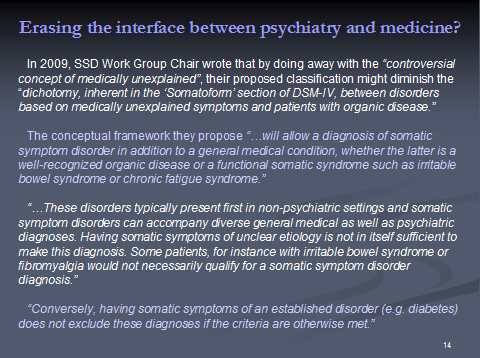
Under the guise of “eliminating stigma” and eradicating “terminology [that] enforces a dualism between psychiatric and medical conditions” the American Psychiatric Association (APA) appears hell bent on colonising the entire medical field by licensing the application of a mental health diagnosis to all medical diseases and disorders.

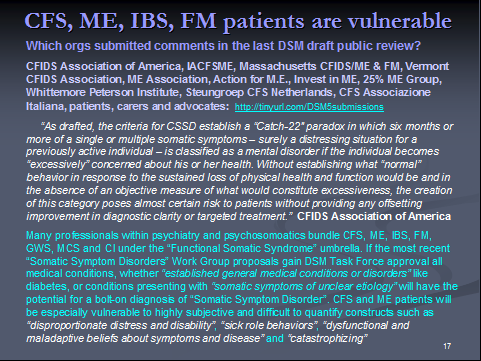
If the most recent proposals of the  “Somatic Symptom Disorders” Work Group gain DSM Task Force approval, all medical diseases and disorders, whether “established general medical conditions or disorders” like diabetes or conditions presenting with “somatic symptoms of unclear etiology” will have the potential for a bolt-on diagnosis of “somatic symptom disorder”.

CFS and ME patients, diagnosed or awaiting diagnosis, may be especially vulnerable to highly subjective criteria and difficult to quantify constructs such as “disproportionate distress and disability”, “catastrophising”, “health-related anxiety”, “[appraising] bodily symptoms as unduly threatening, harmful, or troublesome” with “health concerns [that] may assume a central role in the individual’s life, becoming a feature of his/her identity and dominating interpersonal relationships.”

There may be considerable implications for these highly subjective classifications for the diagnoses assigned and the treatments offered to US patients, for the provision of social care and payment of medical and disability insurance.

Who can submit comment?

The APA is inviting all stakeholders to submit comment and feedback on the draft framework for DSM-5 and the latest proposed revisions to diagnostic criteria – patients and families, patient advocates and patient organizations as well as clinicians, researchers, allied health professionals, lawyers and other end users.

It’s important that patients who are able to submit comment do so, but please also encourage patient organizations, informed clinicians, researchers, psychiatrists, psychologists and allied health professionals to submit feedback, too.

Last year, the APA received over 8000 comments from stakeholders across all DSM categories.

Where can I read examples of last year’s submissions?

Copies of last year’s submissions by patient organizations and advocates can be read here: http://tinyurl.com/DSM5submissions

I shall be opening a new page for copies of this year’s patient organization and patient advocate submissions.

How do I register to submit comment?

1. Go to the DSM-5 Development website: http://www.dsm5.org/Pages/Default.aspx

2. Look for the “Participate” box (right hand side of Home Page) and click on “Register Now”. (Log in names and passwords from last year’s public review do appear to have been retained.)

3. Complete the “Register to Make Comments” form: http://www.dsm5.org/Pages/Registration.aspx

Having registered a username, name, email address and country, and entered the “Captcha” code, a confirmation email with a temporary password will be auto generated. The Registration form is also accessible from each of the category Criteria pages, as well as from the Home Page.

You can register in advance, if you wish, then prepare and upload your submission at a later date, but remember the feedback period closes on 15 June.

4. To comment on the proposals of the “Somatic Symptom Disorders” Work Group, Login in and go to this page:

http://www.dsm5.org/proposedrevision/Pages/SomaticSymptomDisorders.aspx

You can submit comment, on that page, for one or more categories, or click on a specific category, for example,

http://www.dsm5.org/ProposedRevision/Pages/proposedrevision.aspx?rid=368

J 00 Complex Somatic Symptom Disorder

Login in and you will be presented with a WYSIWYG editor.

I would strongly recommend composing your comment in a draft email or word processor first and saving a copy, as last year, there were complaints that Captcha characters were hard to read and the uploading procedure glitchy – so please save a copy first. External links and references can be included but there is no facility for including attachments. There appears to be no maximum word or character length specified. I would also suggest that you head your submission with “For the attention of the Somatic Symptom Disorders Work Group” or similar.

What are the latest proposals for the “Somatic Symptom Disorders” categories?

The latest proposals are set out here, where the two key “Disorder Descriptions” and “Rationale” documents can also be downloaded: http://wp.me/pKrrB-13z 

I’ll be posting extracts from the two key documents in the next post.

More Q and As on and around the public review, here: http://wp.me/pKrrB-12P


Related material:

On the subject of the use of the word “somatic” and “somatic symptom” , Angela Kennedy published this note, in June 2009:

I’ve noticed for some time that various people have been using the term ‘somatic’ as if it signified a ‘psychosomatic’ or ‘psychogenic’ condition.

This is incorrect. The OED definition of ‘somatic’ is “of or relating to the body, especially as distinct from the mind” (my italics). The word comes from the Greek ‘soma’ meaning ‘body’.

Even when proponents of ‘psychogenic’ explanations (it’s in your mind, you’re imagining it, misinterpreting it, faking it, caused it by your own beliefs etc. etc. etc.) use the term ‘somatic illness’ they actually do mean an illness of the body. They may then claim this somatic (or bodily illness) is caused by psychological dysfunction, but the word ‘somatic’ does not mean “illness caused by psychological dysfunction”. It merely means illness of a body, or a bodily illness.

It is important that this word is used correctly, especially when people write to the media, government, the medical establishment etc. Otherwise we are in danger of seeing apparent objections published, from advocates, to saying ME/CFS is a bodily illness, purely because someone has used the word ‘somatic’ incorrectly!

What are the latest proposals for DSM-5 “Somatic Symptom Disorders” categories and why are they problematic? (Part 2)

What are the latest proposals for DSM-5 “Somatic Symptom Disorders” categories and why are they problematic? (Part 2)

Post #77 Shortlink: http://wp.me/pKrrB-13z

Part 1 of this report can be read here in Post #75:

What are the latest proposals for DSM-5 “Somatic Symptom Disorders” categories and why are they problematic? (Part 1)

In the first part of this report, I addressed some of the queries that have been raised around the second public review of proposals for the revision of DSM categories and diagnostic criteria. Stakeholder feedback is being accepted now until 15 June and I’ll be giving more information on how to submit feedback via the DSM-5 Development website in a forthcoming post.

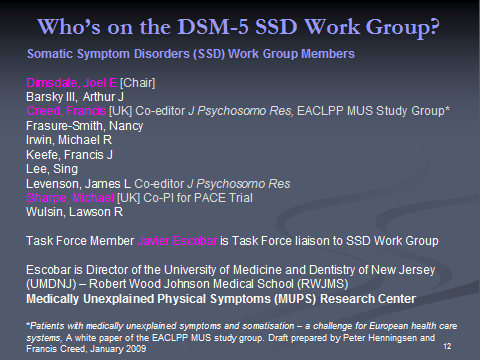
In this post, I am setting out the latest proposals (dated 14 April 2011) from the DSM-5 Somatic Symptom Disorders Work Group, as published on the DSM-5 Development website, on 4 May. The next post will set out extracts from the two key documents that accompany these revised proposals and why ME and CFS patient representation organizations, patients and advocates need to register their concerns via this second public review.

Criteria proposals and rationales are expanded upon within the two key documents and the devil is in the detail. Patient organizations will need to review both documents, as changes have been made since last year. And if you are able to do so, I recommend that patients, carers and patient advocates read them, too.

At over a dozen pages long, the “Rationale” document (which is titled: “Justification of Criteria — Somatic Symptoms”) looks potentially daunting, but the text is not as long as it appears since five or six pages of references are included at the end. Edits to the documents since the versions published in January, this year, have been highlighted by the Work Group in yellow.

http://www.dsm5.org/ProposedRevision/Pages/SomaticSymptomDisorders.aspx

Somatic Symptom Disorders

Below, I am posting proposal details for categories J 00 thru J 04.

Note that the two key PDF documents, dated 14 April 2011 called: “Disorder Descriptions” (7 pages) and “Rationale” contain full disorder descriptions and rationales for all category proposals in the Somatic Symptom Disorders categories, so you need only download one copy of each PDF.

Open full disorder descriptions here       Disorders Description   Key Document One: “Somatic Symptom Disorders”

Open full rationale document here       Rationale Document   Key Document Two: “Justification of Criteria — Somatic Symptoms”

Related material

Patient organisations, professionals and advocates submitting comments in the DSM-5 draft proposal review process are invited to provide copies of their submissions for this second and current public review for publication on this site.

Read submissions in the last DSM-5 public review, held Feb-April 2010 here:

http://tinyurl.com/DSM5submissions

International patient organisation submissions:

Whittemore Peterson Institute, Steungroep CFS Netherlands, CFS Associazione Italiana, ME Association (endorsing submission by Dr Ellen Goudsmit), Action for M.E., Invest in ME, Mass. CFIDS/ME & FM, The CFIDS Association of America, Vermont CFIDS Association, IACFSME, The 25% ME Group

A number of patient advocate submissions are also published.

Live streaming of CFSAC Meeting (US) today, 10-11 May

Live streaming of CFSAC Meeting (US) today, 10-11 May

Post #76 Shortlink: http://wp.me/pKrrB-14n

Chronic Fatigue Syndrome Advisory Committee (CFSAC)
May 10-11, 2011
Room 800, Hubert H. Humphrey Building
200 Independence Ave, S.W.
Washington, D.C. 20201

A reminder that Day One of the two day spring CFSAC meeting will be streaming live today.

A copy of the Meeting Agenda is published in this post:

CFSAC Spring 2011 Meeting Agenda (May 10-11): http://wp.me/pKrrB-126

Public and Written Testimonies can be read and downloaded from this page of the CFSAC website:

http://www.hhs.gov/advcomcfs/meetings/presentations/05102011.html

The meeting proceedings can be watched live at this page (Requires Windows Media Player version 9 or higher or Silverlight Player installed): http://nih.granicus.com/ViewPublisher.php?view_id=26

The archived videocasts have had simultaneous subtitles.

The meeting opens at 9.00am Washington D.C. time (which is around 5 hours time difference with UK).  So streaming should commence  about five minutes before 2.00pm UK time (usually the microphones are switched off until just before the meetings starts, so anticipate video only until the meeting is called to order).

ICD-10-CM proposed coding issue

I am very pleased that the issue of the proposed coding for CFS in the forthcoming ICD-10-CM (a US specific “Clinical Modification” of ICD-10 scheduled for implementation in October 2013 and subject to a partial code freeze, in October 2011) has been placed back on the agenda and that an hour’s time has been tabled for discussion of this important item.

Discussion of ICD-10-CM is tabled to start at 1.15pm Washington D.C. time (6.15pm UK time).

1:15 p.m. Discussion of International Classification of Diseases-Clinical Modification (ICD-CM) concerns     Committee Members

During the Public Testimony sessions, US patient and patient advocate, Mary Schweitzer, Ph.D., will be speaking about the CDC and also references the ICD-10-CM coding issue:

http://www.hhs.gov/advcomcfs/meetings/presentations/publictestimony_201105_schweitzer.pdf

[…]

NCHS, within CDC, is overseeing the development of ICD-10-CM. We need to keep CFS in the same code as in ICD-10 – under neurology, at G93.3. That’s where it is in WHO’s index to ICD-10 – adopted by over one hundred nations. It’s also under G93.3 in the tabular versions of the clinical modifications produced by Canada, Germany, and Australia. It should not be placed in R53.82, under “vague signs and symptoms.” We would be the only nation to have CFS in R53.82. Why?

A one page handout outlining the ICD-10-CM coding issue is being circulated at the meeting and can be read here: CFSAC Handout ICD-10-CM 10 May 2011