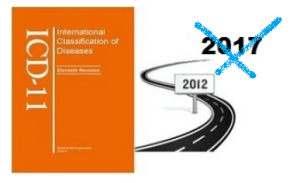
ICD-11 Revision releases External review and Response: shifts projected WHA adoption to 2018

Post #321 Shortlink: http://wp.me/pKrrB-44N

Update: August 6, 2015

ICD Revision has now published a revised Project Plan and Communication Schedule:

ICD Project Plan 2015 to 2018


As previously posted

2017

And so it goes on…

The revision of ICD-10 and development of ICD-11 kicked off in April 2007. The original projected WHA adoption date was 2011/12 [1].

Then a shift to 2015, then to 2017.

WHO has just kicked the can further down the road to May 2018.

In July 2014, the World Health Organization (WHO) Office of the Assistant Director General, Health Systems and Innovation, posted a call for expressions of interest from suitable contractors to conduct an interim assessment of the 11th Revision for International Classification of Diseases (ICD).

External assessment was prompted by concerns raised by WHO Member States, UN Statistical Commission and other stakeholder organizations about the status of the revision and the utility of the ICD-11 product.

The External review of ICD-11 Revision’s progress has now been completed.

Last week, WHO quietly released a report on the status of the ICD revision process, its management and resources, the feasibility of meeting its goals and timelines, and its fitness for purpose.

The reviewers’ assessment and recommendations can be read here: External report

Read WHO’s initial response to the report’s findings and the actions ICD Revision proposes to take here: WHO Response to External Report

WHO says:

WHO welcomes the constructive messages of the Report of the ICD-11 Revision Review. WHO is initiating the second phase of the revision process, acting immediately on the Review’s recommendations.

A revised workplan will be formulated before the end of June and submitted for approval to the RSG-SEG. During 2015 the WHO secretariat will be strengthened in terms of project management, communication of progress and plans, documentation and transparency of decision-making and classification expertise, as recommended by the reviewers.

As I predicted, a further shift in the development timeline from WHA adoption in May 2017 to May 2018 is proposed, along with other measures.

References

1 Exhibit 1 WHO Letter August 2007
Letter Saxena, WHO, to Ritchie, IUPsyS (International Union for Psychological Science), August 2007

2 External Review ICD-11 (Consultancy Interim Assessment of 11th ICD Revision, January – March 2015)

3 WHO Response to External Review of ICD-11 (Initial WHO response to the report of the external review of the ICD-11 revision,Department of Health Statistics and Information Systems, May 12 2015)

ICD-11 Mental Health TAG opposes inclusion of “Functional clinical forms of the nervous system” under neurological conditions

Post #318 Shortlink: http://wp.me/pKrrB-42P

Update: In September, a series of ICD-11 Symposia were held at the World Psychiatric Association XVI World Congress, in Madrid. These included Symposium Code SY469: Proposals and evidence for the ICD-11 classification of dissociative disorders, the abstract for which can be found here (pages 354-355).

Update: For those registered for enhanced access to the public version of the ICD-11 Beta drafting platform, there are some recent proposals on behalf of Mental Health TAG for the Dissociative disorders block, here.


As previously posted:

In my September post, Briefing paper on ICD-11 and PVFS, ME and CFS: Part 2, I reported on a proposal by the ICD-11 Topic Advisory Group (TAG) for Neurology for the inclusion of a disorder group termed, “Functional clinical forms of the nervous system,” under Neurological conditions.

Under this new parent class, it has been proposed to locate a list of “functional disorders” (Functional paralysis or weakness; Functional sensory disorder; Functional movement disorder; Functional gait disorder; Functional cognitive disorder, Functional visual loss etc.).

In ICD-10, these conditions are accommodated under the Chapter V F44 Dissociative [conversion] disorders section.

In DSM-5, they are classified under “Conversion Disorder (Functional Neurological Symptom Disorder),” which is one of several categories that sit under the DSM-5 “Somatic Symptom and Related Disorders” section. They are cross-walked to ICD-10-CM’s F44.4 to F44.7 codes, depending on the symptom type.

The rationale for this proposed new parent class is set out in this recent paper by Stone et al:

Functional disorders in the Neurology section of ICD-11: A landmark opportunity

Jon Stone, FRCP, Mark Hallett, MD, Alan Carson, FRCPsych, Donna Bergen, MD and Raad Shakir, FRCP*

Neurology December 9, 2014 vol. 83 no. 24 2299-2301

doi: 10.1212/WNL.0000000000001063

Full free text

Full free PDF

*Raad Shakir chairs the Topic Advisory Group for Neurology

See also (full paper behind paywall):

Functional neurological disorders: The neurological assessment as treatment. Stone J. Neurophysiol Clin. 2014 Oct;44(4):363-73 Abstract: http://www.ncbi.nlm.nih.gov/pubmed/25306077


Opposition from Mental Health TAG

If you are registered for increased access to the public version of the Beta drafting platform, you can read the response from Mental Health TAG, here.

If you are not registered, see below:

Proposal for Deletion of the Entity

Functional clinical forms of the nervous system

Proposal Status: Submitted

Definition

Definition does not exist for this content

Rationale

This grouping should be deleted.

These are by definition not neurological conditions, as indicated by the phrase included in the definitions provided: ‘in which there is positive evidence of either internal inconsistency or incongruity with other neurological disorders’. If there is no evidence of a neurological mechanism or etiology, the rationale for including these in the classification of neurological disorders is unclear to say the least.

In contrast, these have always been viewed as mental disorders (from the days of Sigmund Freud), and there is no evidence about their etiology or mechanism that is inconsistent with that formulation.

Prior to ICD-10, these conditions were conceptualized as Conversion Disorders. This terms is considered obsolete because it refers to a psychodynamic mechanism that is theoretical and not ideally descriptive. ICD-10 offered a transitional title, calling them Dissociative [conversion] disorders.

For ICD-11, the proposals for Mental and Behavioural Disorders refer to these as Dissociative disorders, dropping the ‘Conversion’ part of the term. Dissociative disorders are defined descriptively, as ‘characterized by disruption or discontinuity in the normal integration of memories of the past, awareness of identity, immediate sensations, and control over bodily movements that are not better explained by another mental and behavioural disorder, are not due to the direct effects of a substance or medication, and are not due to a neurological condition, sleep-wake disorder, or other disorder or disease. This disruption or discontinuity may be complete, but is more commonly partial, and can vary from day to day or even from hour to hour.’ There is not basis for suggesting that this formulation is inconsistent with the phenomena proposed for inclusion here as ‘Functional clinical forms of the nervous system’.

The fact that neurologists may be asked to evaluate these conditions is not an adequate rationale for defining them as neurological disorders, nor are concerns about reimbursement policies that are unwisely based on divisions among specialists’ scope of practice based on ICD chapters.

The Mental Health TAG is aware that there is a vocal group of advocates for this terminology among neurologists. In fact, this terminology was included as alternate terminology in DSM-5. However, in DSM-5, these are still very clearly classified as Mental disorders.

Similarly, these terms can be added as inclusion terms to the equivalent categories in the Mental and behavioural disorders chapter.

In spite of its popularity among at least some neurologists, this terminology is currently viewed in psychiatry as obsolete, and based on a mind-body split (division between ‘organic’ and ‘non-organic’) we are elsewhere attempting to remove from the ICD-11. The implied contrast is between a ‘real’ (medical) disorder and a ‘functional’ (psychiatric) disorder.

A further problem with this terminology is its inconsistency with WHO’s official policy use of terminology related to ‘functioning’ (function, functional), as defined in the ICF.

In some instances of the use of the term ‘functional’ in other parts of proposals for ICD-11, it is not clear that the proposals use the term ‘functional’ in this same sense, or if they mean something close to ‘idiopathic’. However, it is quite clear that what is meant in this group of proposals is ‘without neurological explanation or plausible or demonstrable etiology’.

However, this terminology is in any case problematic. In addition to requesting that this group of categories be deleted from the classification and instead integrated appropriately as inclusion terms in the chapter on Mental and Behavioural Disorders, the Mental Health TAG requests that the Classifications Team examine other uses of the term ‘functional’ in proposals for ICD-11 and consider either appropriate parenting in Mental and behavioural disorders or alternative terminology.

The Mental Health TAG also requests that this issue be revised by the Revision Steering Group (and or Small Executive Group) in order to arrive at an ICD-wide solution as efficiently as possible. The Mental Health TAG requests that this issue not simply be arbitrated by the same TAGs that have made these proposals.

–On behalf of Mental Health TAG

References

There are no references attached for this proposal item

Comments on this proposal

Comment

The Mental Health TAG also requests that this issue be revised by the Revision Steering Group (and or Small Executive Group) in order to arrive at an ICD-wide solution as efficiently as possible. The Mental Health TAG requests that this issue not simply be arbitrated by the same TAGs that have made these proposals.

–On behalf of the Mental Health TAG
Geoffrey Reed 2015-Jan-10 – 23:10


Comment

An alternative could be that this grouping could be retained but with appropriate primary parenting to Dissociative disorders in the Mental and behavioural disorders chapter.

Entities of ‘functional clinical forms’ have already been proposed to be added in the appropriate categories in Dissociative disorders. Most of them are included in Dissociative motor disorder, though several are included in Dissociative disorder of sensation. One is included in dissociative amnesia.

However, the name of these entries – i.e., functional disorders – remains an issue as described above, which should be resolved at the ICD-wide level.

Note that if the solution selected involved retaining these categories, perhaps renamed, but primary parenting them appropriately in Dissociative disorders, it will be more appropriate to move the secondary parented categories to the main Disease of the nervous system chapter rather than listing them in clinical forms.

–On behalf of the Mental Health TAG
Geoffrey Reed 2015-Jan-12 – 09:14 UTC


I will update if further comment is uploaded on behalf of the Mental Health TAG, the Neurology TAG, ICD-11 Revision Steering Group, the WHO classification experts etc.


Note for stakeholders with an interest in the ICD-10 G93.3 categories: There is currently no inclusion within any chapter of the ICD-11 Beta draft for a specific parent class for “Functional somatic syndromes,” or “Functional somatic disorders” or “interface disorders” under which, conceivably, those who consider CFS, ME, IBS, FM et al to be speciality driven manifestations of a similar underlying functional disorder might be keen to see these terms aggregated.

On July 24, 2014, ICD Revision’s Dr Geoffrey Reed stated there has been no proposal and no intention to include ME or other conditions such as fibromyalgia or chronic fatigue syndrome in the classification of mental disorders.

ICD-11 revision process: External assessment now due April 1

Post #317 Shortlink: http://wp.me/pKrrB-42A

This post is the first in a series of updates on the ICD-11 revision process.

Last July, in Call for Expressions of Interest to review the ICD revision process, I reported that the World Health Organization (WHO) Office of the Assistant Director General, Health Systems and Innovation had posted a call for expressions of interest from suitable contractors to conduct an interim assessment of the 11th Revision of the International Classification of Diseases (ICD).

Lead time was four months, with the completed final report targeted for submission to WHO by December 15, latest.

With no sign of a report in the offing, I asked WHO’s Bedirhan Üstün, last week, whether an interim assessment had been delivered in December and did WHO intend to publish a summary report.

Dr Üstün confirmed on January 10 that the external report will now be delivered by April 1 and that it “will certainly be made available.”

So the delivery of this interim assessment has slipped targets by some 15 weeks.

I have no information about the contractors who successfully pitched for the review and no date by which WHO aims to release a copy of the report’s findings (or summary of key findings).

The Call for Expressions of Interest to review the ICD revision process Terms of Reference document can still be downloaded from the WHO website, here:

or open, here, on Dx Revision Watch:

Click link for PDF document  Call for Expressions of Interest to review the ICD revision process

ICD-11 Beta drafting platform

Go here for the public version of the ICD-11 Beta drafting platform.

According to Slide #4 of this WHO presentation on Slideshare, the Joint Linearization for Mortality and Morbidity and Statistics (JLMMS) was expected to be frozen at certain points during the review process.

If you are registered with the public Beta platform for increased access and interaction with the draft, there are dropdowns from the Info tab for Downloads and Frozen Releases, eg:

Linearization Print Versions

Simplified Linearization Outputs

Linearization Index Tabulations

Frozen Releases

You may find the frozen release downloads here


When viewing the ICD-11 Beta drafting platform bear in mind that the platform may still be subject to freeze and more recent proposals will have been made across all chapters.

From the Contributions tab, you can pull up the Proposals pages for specific terms or view the Proposals List. New proposals are added on a daily basis and date back to July 2014.

Proposals can be filtered according to Proposal Status (Saved; Submitted; External Review, Accepted, Implemented, Rejected etc.) or filtered by Proposal Type.

Before scrutinizing or quoting from the public version of the Beta draft, I strongly advise that you first check the Proposals List for more recent revisions since the public Beta drafting platform may not display the most recent proposals.

You may find later proposals for revisions to the text of definitions and other Content Model descriptors; additions or deletions to Inclusions, Exclusions, Synonyms; deletions or additions of entities; revisions to terminology; proposals for complex hierarchical changes etc. Please also read these Caveats.

Caveats: The ICD-11 Beta drafting platform is not a static document: as a work in progress, it is subject to daily edits and revisions, to field test evaluation and to approval by ICD Revision Steering Group and WHO classification experts. Not all new proposals may survive internal/external review or field testing. Chapter numbering, codes and sorting codes currently assigned to ICD categories may change as chapters, entities, content and parent/child hierarchies are reorganized. The public version of the Beta draft is incomplete; not all “Content Model” parameters display or are populated; the draft may contain errors and omissions of categories and Index terms.


Call for Expressions of Interest to review the ICD revision process

Post #312 Shortlink: http://wp.me/pKrrB-3Yw

(If the consulting team that secures the ICD Revision interim assessment contract extends their outreach to include analysis of advocate stakeholder views and experience of interacting with the revision process, I shall be happy to discuss key concerns.)

The World Health Organization (WHO) Office of the Assistant Director General, Health Systems and Innovation, has posted a call for expressions of interest from suitable contractors to conduct an interim assessment of the 11th Revision for International Classification of Disease (ICD).

Deadline for expressions of interest is July 31, 2014. Following the selection process, WHO will inform the contracted party by 15 August 2014.

Lead time is four months

Target date for the completed first draft of the deliverable is by 10 October 2014. Due date for the completed final product submitted to WHO will be 15 December 2014 latest.

“WHO keeps the right to publicize the report and its contents as a whole or in parts.”

+++

Call for Expressions of Interest to review the ICD revision process

+++
Terms of Reference:

Review of

WHO’s Revision Process
for the International Classification of Diseases (ICD)

Request for Expressions of Interest

+++
Table of Contents

(…)

1. INTRODUCTION

WHO Office of the Assistant Director General, Health Systems and Innovation, solicits expressions of interest from a suitable Contractor(s) to conduct an interim assessment of the 11th Revision for International Classification of Disease (ICD) to carry out the following work:

1.1 Objective of the Request

WHO Office of the Assistant Director General, Health Systems and Innovation, solicits expressions of interest from a suitable Contractor(s) to carry out the following work:

1. Conduct an interim assessment of the 11th Revision for International Classification of Disease (ICD) in terms of:

Progress towards the goals of the Revisions
• Process and mechanisms put in place for the ICD revision
Project resources (financial & human) in relation to the proposed outcomes of the revision
• Project Plans and proposed timeline for the completion of ICD 11 for 2017
• Organization for maintenance and updates of ICD beyond 2017

2. Analyze the relevance and effectiveness of the planned features of ICD 11 in meeting the needs of the key stakeholders in WHO Member States including its:

a. Use in Mortality statistics – e.g. Cause of Death statistics, Verbal Autopsy, others…
b. Use in Morbidity statistics – e.g. Discharge summaries, Case-mix groupings, others…
c. Use in Primary Care – in low and intermediate resource settings…
d. Use in Clinical Care – for diagnosis, guidance, quality and safety indicators
e. Use in Scientific Research for epidemiology, genetic studies and other

3. Compile an assessment report summarizing the findings and making recommendations for improvement.

Potential contractors are requested to state the reason why they consider themselves suitable for this work and explain how they will respond to the requirements stated in this request with (a) a proposed draft work plan; (b) timeline; (c) budget with annotation.

1.2 Deadline for Expressions of Interest

Expressions of interest must be submitted on or before July 31, 2014 in order to be considered. The description of the contracting agency and curriculum vitae of the proposed team members, and proposed methods for assessment and timeline should be attached to the expressions of interest (see also 2.3). A point of contact for inquiries should be identified. WHO may contact the parties for further clarification. WHO will inform the contracted party following the selection process by 15 August 2014.

(…)

+++
Full document here:

http://www.who.int/classifications/icd/revision/en/

or open PDF on Dx Revision Watch here:

Click link for PDF document  Call for Expressions of Interest to review the ICD revision process


Annex I to this document (Page 12) contains a Summary of the ICD Revision Process

“This document summarizes the ICD Revision Process, in particular, in terms of the timelines for the finalization date and submission to WHO Governing Bodies. Following various consultations with the WHO Member States and relevant international stakeholders, it was decided decided to postpone the submission to WHA to 2017 May in various consultations with the WHO Member States and relevant international stakeholders taking into account [sic]*: the developmental stage of ICD 2013 Beta, and allowing for reasonable time to complete the remaining tasks: reviews; additional proposals; field trials; translations; and the transition preparations.”

Section 2 (Page 23) sets out ICD Revision Process: Tasks for Beta Phase and Finalization 2013-2017

Annex II contains The Detailed List of Multiple Stakeholders to be contacted

*I guess no-one at WHO reviewed and edited this document before posting it?

12 Point Skinny on ICD-11

Post #305 Shortlink: http://wp.me/pKrrB-3Rm

Update at May 15, 2014: Somatization disorder, listed as a uniquely coded child category under parent, Bodily distress disorder, has been removed from the Beta draft Linearizations since publishing the update on May 9. Instead, the ICD-10 legacy terms, somatoform disorders and Somatization disorder are both now listed under Synonyms to Bodily distress disorder and also listed as Index Terms. The three severity specifiers for BDD, (Mild, Moderate, Severe) remain.

Neurasthenia, listed as a child category under parent, Mental and behavioural disorders, has been removed from the Linearizations and is not listed in the PDF for the print version of the Alphabetical Index.

Update at May 9, 2014: Three uniquely coded severity specifiers (Mild, Moderate, Severe) have now been added back as child categories to Bodily distress disorder but Somatization disorder remains as a uniquely coded child category to BDD.

As no new posts will be added to the site from April, I leave you with my 12 Point Skinny on ICD-11 first published in February.

The version below has been updated to reflect changes since February.

A brief summary of how things stand in the Beta drafting platform at March 31, 2014.

If reposting, please repost unedited, with the publication date and source URL:

12 Point Skinny on ICD-11

Dx Revision Watch’s 12 Point Skinny on ICD-11:

1. The ICD-10 terms, PVFS, BME, and CFS, are not currently displaying in the public version of the Beta drafting platform under any chapters, either as ICD Title terms, or as Inclusion terms to ICD Title terms, or under Synonyms to ICD Title terms.

2. On Feb 12, 2014, @WHO Twitter admin stated: “Fibromyalgia, ME/CFS are not included as Mental & Behavioural Disorders in ICD-10, there is no proposal to do so for ICD-11”. This position was additionally confirmed by Mr Gregory Härtl, Head of Public Relations/Social Media, WHO.

3. Other than this position, WHO/ICD Revision has yet to clarify how it does propose to classify PVFS, BME, and CFS within ICD-11, in terms of intentions for specific chapter locations, parent classes (including any proposals to assign any of these terms to multiple parentage), hierarchies, Definitions text and other “Content Model” descriptive parameters.

4. Since June 2013, multiple requests have been made to WHO/ICD Revision to account for the current absence of these terms from the public version of the Beta draft and to issue a statement clarifying intent. On March 18, 2014, a joint letter was sent to key WHO/ICD Revision personnel [1].

5. Two separate working groups have been appointed by WHO/ICD Revision that are advising on the revision of the Somatoform disorders categories.

6. In 2012, two sets of emerging proposals were published – one for a tentative construct called Bodily distress disorder (BDD), and one for a divergent construct, tentatively called Bodily stress syndrome (BSS).

7. In 2012, the emerging proposals by the ICD-11 Expert Working Group on Somatic Distress and Dissociative Disorders (the Gureje led S3DWG sub working group) for its Bodily distress disorder (BDD) concept had described an SSD-like construct with criteria based on psychobehavioural responses [2].

8. In 2012, the emerging proposals by the PCCG (the Goldberg led ICD-11 Primary Care Consultation Group) presented an alternative Bodily stress syndrome (BSS) construct [3].

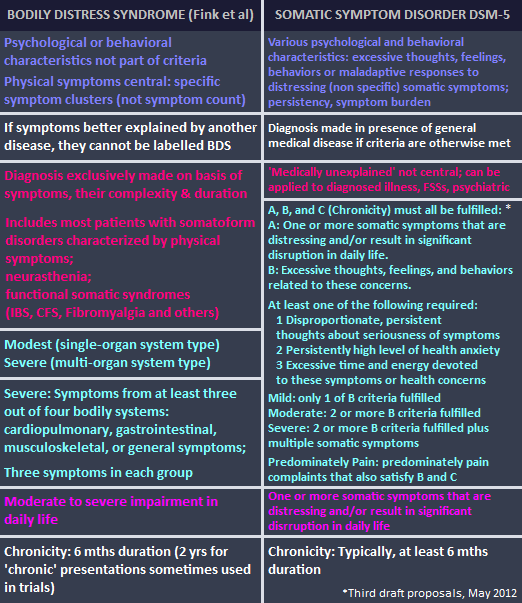
This proposal drew heavily on Fink et al’s Bodily Distress Syndrome (BDS) disorder model, requiring symptom patterns from body systems to meet the criteria. But the PCCG proposed to incorporate some SSD-like psychobehavioural responses, which do not form part of Fink’s BDS criteria – attempting a mash-up between two divergent constructs or disorder models [4].

9. The Definition for Bodily distress disorder (BDD) that is inserted into the Beta drafting platform [5] is based on the disorder description wording in the 2012 Gureje, Creed BDD paper, which had described an SSD-like construct [3].

10. BDD had a child category, Severe bodily distress disorder. This is now removed from the public Beta draft. Instead, ICD-10’s Somatization disorder has been restored to the draft linearizations as the child category to parent, Bodily distress disorder. Additionally, ICD-10’s F48.0 Neurasthenia has been restored to the draft, under parent, Mental and behavioural disorders.

Update at May 9, 2014: Three uniquely coded severity specifiers (Mild, Moderate, Severe) have now been added back as child categories to Bodily distress disorder but Somatization disorder remains as a uniquely coded child category to BDD.

In the ICD-11 Beta, it had previously been proposed that seven ICD-10 Somatoform disorders categories (F45.0 – F45.9) plus F48.0 Neurasthenia would be replaced by this single new disorder construct, Bodily distress disorder (BDD) [2].

But how these two (now apparently proposed to be restored) ICD-10 legacy categories, Somatization disorder and Neurasthenia, are currently envisaged to function within a new disorder framework to replace the Somatoform disorders categories remains unclarified.

Update at May 15, 2014: Somatization disorder, listed as a uniquely coded child category under parent, Bodily distress disorder, has been removed from the Beta draft Linearizations since publishing the update on May 9. Instead, the ICD-10 legacy terms, somatoform disorders and Somatization disorder are both now listed under Synonyms to Bodily distress disorder and also listed as Index Terms. The three severity specifiers for BDD, (Mild, Moderate, Severe) remain.

Neurasthenia, listed as a child category under parent, Mental and behavioural disorders, has now been removed from the Linearizations and is not listed in the PDF for the print version of the Alphabetical Index.

11. Without full disorder descriptions, criteria, inclusions, exclusions, differential diagnoses etc. or field test protocol, there is insufficient information in the public version of the Beta draft to determine the characteristics and criteria for whatever construct is being progressed to field tests; or to determine whether the initial field testing protocol represents the construct favoured by the Revision Steering Group (RSG); or to determine whether the two advisory groups and the RSG have reached consensus over the revision of the Somatoform disorders categories.

12. ICD-11 Beta is a work in progress, updated daily, and not finalized. Proposals for new categories are subject to ongoing revision and refinement, to field test evaluation, may not survive field testing, and are not approved by ICD Revision or WHO.

+++
References for 12 Point Skinny on ICD-11:

1. Joint letter signed by Annette Brooke MP, Chair, All Party Parliamentary Group on M.E., Countess of Mar, Chair, House of Lords-led group Forward ME, Dr Charles Shepherd, Medical Adviser of the ME Association, Sonya Chawdhury, Chief Executive, Action for M.E.
http://www.actionforme.org.uk/Resources/Action%20for%20ME/Documents/get-informed/who-icd-11-letter-17-3-14-sc.pdf

2. Creed F, Gureje O. Emerging themes in the revision of the classification of somatoform disorders. Int Rev Psychiatry. 2012 Dec;24(6):556-67. http://www.ncbi.nlm.nih.gov/pubmed/23244611 [Full text behind paywall]

3. Lam TP, Goldberg DP, Dowell AC, Fortes S, Mbatia JK, Minhas FA, Klinkman MS: Proposed new diagnoses of anxious depression and bodily stress syndrome in ICD-11-PHC: an international focus group study. Fam Pract Feb 2013 [Epub ahead of print July 2012]. http://www.ncbi.nlm.nih.gov/pubmed/22843638. Full free text: http://fampra.oxfordjournals.org/content/30/1/76.long

4. Graphic comparing Fink et al’s BDS criteria with DSM-5’s SSD

5. ICD-11 Beta drafting platform public version: Bodily distress disorder: http://apps.who.int/classifications/icd11/browse/f/en#/http%3a%2f%2fid.who.int%2ficd%2fentity%2f767044268

Caveats: The ICD-11 Beta drafting platform is not a static document: it is a work in progress, subject to daily edits and revisions, to field test evaluation and to approval by Topic Advisory Group Managing Editors, the ICD Revision Steering Group and WHO classification experts.
 

Joint Open letter to WHO/ICD Revision over classification of absent G93.3 terms for ICD-11 Beta draft

Post #301 Shortlink: http://wp.me/pKrrB-3Pp

Today, Sonya Chowdhury, CEO, Action for M.E., has released an Open Letter to Dr Ra’ad Shakir, Chair, ICD-11 Revision Topic Advisory Group for Neurology.

The Open Letter has been copied to Tarun Dua, Managing Editor, Neurology Topic Advisory Group, WHO; Christopher Chute, Chair, ICD Revision Steering Group, WHO; Dr Geoffrey Reed, Senior Project Officer, International Advisory Group for the Revision of ICD-10 Mental and Behavioural Disorders, ICD-11, WHO; Dr Margaret Chan, Director General, WHO; Dr Robert Jakob, MD, Medical Adviser, WHO.

In the interests of transparency, I have acted in an advisory capacity in the preparation of this joint letter in respect of existing ICD-10 coding, proposals for the G93.3 terms for ICD-11, as they had stood in January 2013, and around Beta drafting platform technicalities.

http://www.actionforme.org.uk/get-informed/news/policy-and-campaigns/open-letter-to-who-over-classification

Open letter to WHO over classification

18 March, 2014

Action for M.E.

Chief Executive Sonya Chowdhury has written an open letter to Dr Ra’ad Shakir, Chair of the World Health Organisation neurology topic advisory group, regarding concerns over the classification of M.E./CFS in the WHO ICD-11.

There has been concern within the M.E. community that the three ICD-10 G93.3 terms, PVFS (Postviral Fatigue Syndrome), BME (Benign Myalgic Encephalomyelitis) and CFS (Chronic Fatigue Syndrome) have been missing from the public version of ICD-11 Beta draft since early 2013.

The letter which has been produced collectively, is also signed by Annette Brooke MP, Chair of the All Party Parliamentary Group on M.E., the Countess of Mar, Chair of the House of Lords-led group Forward ME, and Dr Charles Shepherd, Medical Adviser of the ME Association who, like Sonya, is a member of the APPG secretariat.

The PDF of the joint letter can be read here:

Click to access who-icd-11-letter-17-3-14-sc.pdf

Open PDF here:  Click link for PDF document   Joint Open Letter to WHO/ICD 03.18.14

Text

OPEN LETTER

Dr Ra’’ad Shakir
Chair, WHO Neurology Topic Advisory Group
Chief of Neurology
Imperial College NHS Trust
Charing Cross Hospital
London

17th March 2014

Dear Dr Shakir

Re: WHO ICD-11 Beta draft classification

We are writing, collectively, on behalf of the estimated 250,000 people with M.E./CFS. in the UK.

As you may be aware, there has been considerable discussion and concern expressed within the M.E./CFS community regarding the WHO ICD-11 classification.

As both individuals and organisations, we have received a number of questions and concerns from people affected by M.E./CFS and are therefore writing to seek clarification to enable us to respond accordingly.

We are keen to work collaboratively with others to help empower and support people affected by M.E. and as such, would be very happy to discuss this further with you directly or welcome you to a meeting of either the All Party Parliamentary Group on M.E. or Forward M.E. (a House of Lords-led collaboration).

A summary of our current understanding

The three ICD-10 G93.3 terms, PVFS (Postviral fatigue syndrome), BME (Benign myalgic encephalomyelitis) and CFS (Chronic fatigue syndrome) have been missing from the public version of ICD-11 Beta draft since early 2013.

Prior to early 2013, in the public version of the ICD-11 Beta drafting platform, Chronic Fatigue Syndrome had been listed in the Foundation Component as an ICD Title entity under Diseases of the nervous system, with Benign Myalgic encephalomyelitis specified as an Inclusion term and Postviral fatigue syndrome listed under Synonyms to the Chronic Fatigue Syndrome Title entity. Therefore, all three terms were accounted for within the Beta draft; the terms were then removed from the public version of the Beta draft.

Currently, no entry for any of the terms, CFS, BME or PVFS, under any hierarchy, can be found within any chapter of ICD-11 Beta in the Foundation or the Morbidity and Mortality linearization, the top level category list, the PDF print version or the PDF Alphabetical Index.

The replies that WHO Twitter admin gave to members of the public who enquired about this, stated that there was no proposal to include ME, CFS or Fybromyalgia as Mental and behavioural disorders in ICD-11. They did not say (as Parliamentary Under-Secretary of State for Health, Jane Ellison MP stated in response to a question from Annette Brooke MP) “no proposal to reclassify ME/CFS in ICD-11 ”(¹ Hansard, House of Commons, Oral Answers to Questions, Tuesday, February 25, 2014).

A member of the public also asked on Twitter if there is a proposal to reclassify ME, CFS and Fybromyalgia as “Bodily Distress Disorders” in ICD-11, but no reply was forthcoming from WHO Twitter Admin. Also, they did not confirm a proposal to ‘retain’ in Chapter 07, only not to include in Chapter 05.

Points of clarification requested

1. Under which chapters and parent categories are the following three ICD-10 G93.3 entities currently proposed to be classified within ICD-11:

Chronic Fatigue Syndrome;
Benign Myalgic encephalomyelitis;
Postviral fatigue syndrome?

2. What is the current proposed hierarchy or relationship within ICD-11 between these three entities, in terms of Title term, Inclusion term, Synonym, and which of these three terms are proposed to be assigned a Definition and other “Content Model” parameters?

3. What is the reason for these three terms not currently displaying in the public version of the Beta drafting platform?

4. When does ICD-11 Revision intend to restore these three terms to the public version of the Beta drafting platform?

We very much appreciate you taking the time to respond to our request and look forward to hearing from you.

Yours sincerely

Sonya Chowdhury, CEO, Action for M.E.; Secretariat, All Party Parliamentary Group on M.E.
Annette Brook MP; Chair, All Party Parliamentary Group on M.E.
Countess of Mar; Forward M.E., House of Lords
Dr Charles Shepherd, Medical Adviser, ME Association; Secretariat, All Party Parliamentary Group on M.E.

c.c.Tarun Dua, Managing Editor, Neurology Topic Advisory Group, WHO
Christopher Chute, Chair, ICD Revision Steering Group, WHO
Dr Geoffrey Rees [sic], Project Manager, Mental & Behavioural Chapter, ICD-11, WHO
Dr Margaret Chan, Director General, WHO
Dr Robert Jakob, MD, Medical Adviser, WHO

Action for M.E.
PO Box 2778
Bristol BS1 9DJ