On 16 January, I reported that the page for current DSM-5 proposals for the revision of the DSM-IV “Somatoform Disorders” categories and diagnostic criteria had been updated on 14 January, with a new category proposal called “Simple Somatic Symptom Disorder”.
This proposal is in addition to the recommendations of the Somatic Symptom Disorders Work Group, published in February 2010, for grouping a number of existing Somatoform categories under a common rubric “Complex Somatic Symptom Disorder (CSSD)” and does not replace “CSSD”.
To meet criteria for Simple Somatic Symptom Disorder, criteria A, B, and C are necessary.
A. One or more highly distressign [sic] and disabling somatic symptoms
B. One of the following symptoms from CSSD (i.e. Disproportionate and persistent concerns about the medical seriousness of one’s symptoms; high level of health-related anxiety; or excessive time and energy devoted to these symptoms or health concerns)
C. Symptom duration is greater than 1 month
For full proposals for “Simple Somatic Symptom Disorder” open the Tabs on this page:
The Justification of Criteria document was revised again by the SSD Work Group on 1/31/11 to incorporate the proposal for SSSD and other revisions and is replaced by:
I shall be monitoring the DSM-5 Development website and if there are any further revisions to either document before the DSM-5 beta is published I will update this site.
According to the APA’s DSM-5 Development Timeline, the second draft is scheduled to be published by the DSM-5 Task Force in May-June, with a public review period of only around a month. The public review and comment period for the first draft, last year, had been around ten weeks.
The following patient organisations have been alerted to these revisions and sent copies of the key documents:
UK patient organisations:
Heather Walker, Action for M.E.
Neil Riley, Chair, Board of Trustees, ME Association
25% ME Group
Invest in ME
Jane Colby, The Young ME Sufferers Trust
US patient organisations and professionals:
Dr Alan Gurwitt, Massachusetts Chronic Fatigue and Immune Dysfunction Syndrome/Myalgic Encephalopathy and Fibromyalgia Association (Mass. CFIDS/ME & FM)
Dr Kenneth Friedman, IACFS/ME
Jennie Spotila, CFIDS Association of America
Dr Lenny Jason
International patient organisations and professionals:
ESME (European Society for ME)
Dr Eleanor Stein, Canada
For copies of International patient organisation and patient advocate submissions in the APA’s spring 2010 DSM-5 draft proposals review process see:http://wp.me/PKrrB-AQ
The page for current DSM-5 proposals for the “Somatoform Disorders” section of DSM-IV was updated on January 14, 2011 with a new category proposal called “Simple Somatic Symptom Disorder”.
Note this proposal is in addition to the recommendation of the Somatic Symptom Disorders Work Group, in February 2010, for grouping a number of existing disorders under a common rubric “Complex Somatic Symptom Disorder (CSSD)” and it does not replace “CSSD”.
As I have been highlighting for some time now, under these DSM-5 Task Force proposals, all medical conditions, whether “established” general medical conditions or disorders, or conditions presenting with “somatic symptoms of unclear etiology”, have the potential for qualifying for an additional diagnosis of a “somatic symptom disorder”.
There have also been revisions and additions to some of the text of the “Disorder descriptions” document dated “DRAFT January 29, 2010” that was first published by the DSM-5 Task Force when draft proposals for revisions to DSM-IV were posted on the APA’s DSM-5 website on February 10, 2010, for public review and comment.
Note also that the key document: “Justification of Criteria-Somatic Symptoms DRAFT 1/29/10” which is also associated with the proposals of the Somatic Symptom Disorders Work Group has now been revised twice since February 2010.
Update @ 7 February 2011
The Justification of Criteria document was revised for a second time by the SSD Work Group on 1/31/11 to incorporate the new proposal for SSSD and other revisions and is replaced by:
International patient organisation and patient advocate submissions to DSM-5 draft proposals public review process, Feb-April 2010:http://wp.me/PKrrB-AQ
Updated @ 4 January 2011:Added DSM-5: Dissent From Within by Allen Frances, MD, Psychiatric Times
An interesting article in Wired by Gary Greenberg with Allen Frances, MD, who had chaired the DSM-IV Task Force.
“Wired is a full-color monthly American magazine and on-line periodical, published since March 1993, that reports on how technology affects culture, the economy, and politics. Owned by Condé Nast Publications, it is published in San Francisco, California.”
“We made mistakes that had terrible consequences,” [Frances] says. Diagnoses of autism, attention-deficit hyperactivity disorder, and bipolar disorder skyrocketed, and Frances thinks his manual inadvertently facilitated these epidemics—and, in the bargain, fostered an increasing tendency to chalk up life’s difficulties to mental illness and then treat them with psychiatric drugs…
…At stake in the fight between Frances and the APA is more than professional turf, more than careers and reputations, more than the $6.5 million in sales that the DSM averages each year. The book is the basis of psychiatrists’ authority to pronounce upon our mental health, to command health care dollars from insurance companies for treatment and from government agencies for research. It is as important to psychiatrists as the Constitution is to the US government or the Bible is to Christians. Outside the profession, too, the DSM rules, serving as the authoritative text for psychologists, social workers, and other mental health workers; it is invoked by lawyers in arguing over the culpability of criminal defendants and by parents seeking school services for their children. If, as Frances warns, the new volume is an “absolute disaster,” it could cause a seismic shift in the way mental health care is practiced in this country. It could cause the APA to lose its franchise on our psychic suffering, the naming rights to our pain.
Note that at the time of writing, the link for “APA” (Wired article, third paragraph) has been incorrectly given as http://www.apa.org/ which is the site of the American Psychological Association.
The correct link should be http://www.psych.org/ – it is the American Psychiatric Association that is publisher of the Diagnostic and Statistical Manual of Mental Disorders (current edition known as DSM-IV). Go here for the American Psychiatric Association’s DSM-5 Development website.
DSM-5: Dissent From Within
By Allen Frances, MD
03 January 2011
Many people associated with DSM-5 have privately expressed their serious doubts to me, but felt muzzled into public silence by constraining confidentiality agreements and loyalty to the process. Gary Greenberg’s recent DSM-5 piece in Wired offers a set of dispirited quotes from discouraged Work Group members–but again he elicited them only under the promise of strict anonymity. Until now, the only people connected to DSM-5 to express public displeasure were the two who have resigned from it.
John Livesley, a highly respected member of the Personality Disorders (PD) Work Group, has now broken this fortress defensiveness and enforced wall of silence. He has published a brilliantly reasoned critique titled “Confusion and Incoherence in the Classification of Personality Disorder: Commentary on the Preliminary Proposals for DSM-5.”
Year in Review: More Bumps in Road to DSM-V
By John Gever, Senior Editor, MedPage Today
26 December 2010
As part of the Year in Review series, Medpage Today reporters are revisiting major news stories and following up with an analysis of the impact of the original report, as well as subsequent news generated by the initial publication. Here’s what’s happened on the DSM-5 front since we published the first 2010 piece on the topic.
Note the projected period for public comment on the beta draft is much shorter than the public review period for the alpha draft had been – which had been around 10 weeks.
APA research director, Darrel Regier, MD, told MedPage Today’s senior editor, John Gever, that an update of the central DSM-5 website, where current versions of the draft may be seen, is likely to take place in January. The Task Force anticipates that all the revisions going into the field trials will be posted and that the site will reflect the new classification scheme envisioned for the final DSM-5.
Allen Frances, MD and Robert Spitzer, MD write to the APA Board of Trustess re DSM-5 Scientific Review Work Group; Frances on DSM-5 Field Trials and deadlines
On 10 December 2009, the American Psychiatric Association (APA) issued a news release announcing a revised timeline for the publication of the fifth edition of the Diagnostic and Statistical Manual of Mental Disorders (DSM-5). The anticipated release date for DSM-5 was being shifted from May 2012 to May 2013.
Allen Frances, MD, currently professor emeritus at Duke, had chaired the DSM-IV Task Force. Frances maintains the blog DSM5 in Distress at Pyschology Today and also writes for Psychiatric Times where he’s been documenting and commenting on the development of DSM-5 since June 2009. Robert Spitzer had chaired the DSM-III Task Force.
Links to two recent commentaries by Allen Frances on DSM-5 deadlines and a joint letter by Frances and Spitzer to the APA Board of Trustees in response to the APA’s appointment of a DSM-5 Scientific Review Work Group, below:
We are delighted that you have appointed a DSM-5 Scientific Review Work Group and charged it with assessing the quality of evidence supporting the DSM 5 proposals. This is great news, probably the last hope to weed out proposals that could do great harm to the Association, our field, and to our patients. Our relief and hope are tempered only by several problems with the process as you have established it:
CONTINUED SECRECY: Given all of the negative publicity surrounding the DSM-5 confidentiality agreements, we are amazed to see the following statement in the charge to the Scientific Review committee: “Deliberations and reports to the BOT will be confidential. The existence of the committee (work group) will be public.” Why on earth is this case? What is the possible harm of making this esteemed committee’s final report public? While we can appreciate the need for the committee to be able to deliberate candidly and not feel constrained by the possibility that every aspect of their deliberations will be made public, it is essential that the final report containing the committee’s assessment of the scientific merits of the proposals be made public.
COMPOSITION OF WORK GROUP: The announcement makes an ambitious claim, namely, that this review will be equivalent to an independent NIMH peer review. This desirable standard cannot possibly be met by the DSM-5 Scientific Review Work Group as you have constituted it. The people chosen are all well-respected, but all but two of the committee members have been involved with DSM 5 or its oversight. To have credibility, a review committee must be completely unattached to the work that has already been done on DSM 5. Preferably, APA should contract out the review process to experts in evidence based medicine who would be both fully independent and also able to apply the standards of scientific proof used across all medical specialties. At the very least, the membership of the committee needs to be broadened to guarantee both the reality and the appearance of a truly unbiased and independent review process.
CHARGE: Although labeled a “Scientific Review Work Group”, the charge needs to go beyond just being a scientific review and include a thorough risk/ benefit analysis of all suggestions. That such an analysis is planned in suggested by the statement in the charge that “issues of clinical utility, public health, and potential impact on patients should also be considered.” We applaud this plan to conduct a risk/benefit analysis but are concerned that such a review requires broader experience in primary care, public policy, health economics, and forensics that goes beyond the current composition of the Workgroup. At a minimum, close consultation with such experts should be part of the planned review process.
METHOD: It appears the assessments will be limited to evidence already generated by the work groups, with no check to determine if their reviews have been comprehensive and balanced. Since there was no standard operating procedure in the literature review process, the work group reviews are variable in quality and method. A recheck to ensure that all pertinent references have been included is necessary.
TIMING: This scientific review is occurring unbelievably late in the DSM 5 process- it should have been completed more than a year ago, not after the field trials have already begun. There is little purpose to be doing expensive field testing on proposal likely to be eliminated because of limited scientific support. Every step in the DSM 5 process has missed its deadline, sometimes by a year or more. We are concerned that the momentum of the DSM 5 process and limited time left for its review will result in the rushed inclusion of proposals that are both risky and unsupported by evidence.
All these serious concerns notwithstanding, The DSM 5 Scientific Review Work Group has our very best wishes. It is in a key position to do a great service for our field and for our patients and to save APA from further embarrassment.
This is a sad tale of completely unrealistic timetables, poorly executed work effort, consistently missed deadlines, and what will undoubtedly be a rushed and botched DSM 5. It all started at the annual meeting of the American Psychiatric Association in May 2009, when the DSM 5 leadership blithely announced it was ready to begin field testing in the early summer of 2009…
…It was patently obvious from the moment of its announcements that the new DSM 5 field test timetable was also a product of fantasy that would not be met in the real world. First off, it should have been clear that the field trials could not possibly start on time two months after their announcement. Recruiting the sites, training the personnel, gaining human rights approvals, and pilot testing always take at least six months. Predictably, we are already in mid Nov 2010 and it is still not at all clear when the DSM 5 field tests will actually begin to enroll patients at all its sites.
…Field tests also fail to account for the pressures that will lead to systematic, future misuse-especially the drug company marketing of mental disorders that leads to over-diagnosis.
…What do I mean? DSM 5 has made a number of radical suggestions for change, particularly the inclusion of many new diagnoses at the threshold of normality. These have the potential to reclassify as mentally disordered tens of millions of people currently considered normal. The only relevant questions are the overall rates of these disorders in the general population and the risks of false negative over-diagnosis.
…At the end of the DSM 5 field trials, we will have no idea whatever whether its suggestions will create false epidemics of misidentified pseudo-patients.
Implementation of the WHO’s ICD-11 is scheduled for 2014. Earlier this year, I asked ICD Revision to clarify for stakeholders whether any form of Alpha Draft for ICD-11 will be placed in the public domain, when this will be released and in what formats.
In October, ICD Revision stated via its Facebook site, that there will be no publication of an ICD-11 Alpha Draft for public scrutiny and that a public Beta Draft is still targeted for May 2011.
ICD-11 targets also slipping
According to the September iCamp2 meeting PowerPoint presentation, Frequent Criticisms and this iCamp2 YouTube, targets for the population of content for the ICD-11 Alpha Draft had not been reached.
Less that 80% of Terminology Definitions had been uploaded to the iCAT and less than the 20% target for full Content Model completion for the thousands of diseases and disorders classified within ICD had been met at that point. [The Content Model identifies the basic properties needed to define any ICD concept (unit, entity or category) through the use of multiple parameters.] Not all Topic Advisory Groups were at a similar developmental stage and ICD-11 Beta Plans were behind schedule. (See Post #48)
International Advisory Group for the Revision of ICD-10 Mental and Behavioural Disorders
The International Advisory Group for the Revision of the ICD-10 Chapter for Mental and Behavioural Disorders (currently ICD-10 Chapter V but will be Chapter 5 in ICD-11) was constituted by the WHO with the primary task of advising the WHO on all steps leading to the revision of the mental and behavioural disorders classification in ICD-10, in line with the overall ICD revision process.
The Group is chaired by Steven E Hyman, MD, Harvard University, Cambridge, Massachusetts. Steven E Hyman, MD is also a member of the APA’s DSM-5 Task Force.
There is already a degree of correspondence between DSM-IV and Chapter V of ICD-10. For the next editions, the APA and the WHO have committed as far as possible:
To facilitate the achievement of the highest possible extent of uniformity and harmonization between ICD-11 mental and behavioural disorders and DSM-V disorders and their diagnostic criteria.
with the objective that
The WHO and APA should make all attempts to ensure that in their core versions, the category names, glossary descriptions and criteria are identical for ICD and DSM.
The Advisory Group has published no Summary Reports of its meetings since its fourth meeting in December 2008. A fifth meeting of the group was held on 28 – 29 September 2009. Over a year later, no Summary Report has been published for that meeting. It is uncomfirmed whether any meetings of the Advisory Group were held in 2010.
Topic Advisory Group for Neurology
The lead WHO Secretariat for Topic Advisory Group (TAG) for Neurology is Dr Tarun Dua, Management of Mental and Brain Disorders, Department of Mental Health and Substance Abuse, WHO, Geneva.
The TAG for Neurology is chaired by Raad Shakir, MD, Imperial College London. For further information on TAG Neurology see this page.
For Immediate Release:
Oct. 5, 2010
Release No. 10-65
APA Announces Start of Field Trials for DSM-5
Sites to Test Proposed Diagnostic Criteria in Real-World Clinical Settings
ARLINGTON, Va. (Oct. 5, 2010) – The American Psychiatric Association today announced the start of field trials to test proposed diagnostic criteria for the fifth edition of the Diagnostic and Statistical Manual of Mental Disorders (DSM). Field trials will help assess the practical use of proposed DSM-5 criteria in real-world clinical settings.
The field trials follow a public comment period in which more than 8,000 written comments on the draft diagnostic criteria were submitted to the DSM-5 website by clinicians, researchers and family and patient advocates. Submitted comments were reviewed by DSM-5 Work Groups and resulted in further refinement of the criteria.
Evaluation measures
For the diagnostic criteria that are being evaluated, the results of the field trials will address:
. Feasibility: are the proposed criteria easy for clinicians to understand and to use?
. Clinical Utility: do the proposed criteria do a good job in describing patients’ psychiatric problems and help clinicians make decisions about treatment plans?
. Reliability: are the same conclusions reached consistently when the criteria are used by different clinicians?
. Validity: how accurately do the diagnostic criteria reflect the mental disorders they are designed to describe?
In addition, the field trials will help assess severity measures and cross-cutting dimensional measures.
Severity measures are questionnaires and other tools intended to help clinicians evaluate how severe the symptoms of an individual are on a rating scale.
Cross-cutting dimensional measures are tools for assessing symptoms that occur across a wide range of diagnoses, such as anxiety or sleep problems. Field trials will help determine whether these proposed tools provide useful information for clinicians and their patients, and whether they capture changes in symptoms over time to evaluate progress in treatment.
Two rigorous study designs
Since the DSM is used in many care settings, two standardized and methodologically rigorous study designs were developed by the DSM-5 Research Group to gather data from a wide range of clinicians and settings.
“It is important that the proposed diagnostic criteria are subjected to rigorous and empirically sound field trials before DSM-5 is published in 2013,” said David Kupfer, M.D., chair of the DSM-5 Task Force.
“The two field trial designs will allow us to better understand how the proposed revisions affect clinicians’ practices and, most importantly, patient care.”
One study design was developed for use in academic or other large clinical settings, and will be employed at 11 sites, chosen from among 65 centers that responded to APA’s call for proposals. Another study design was developed for use by individual practitioners and smaller clinical practices. These field trials will be conducted in diverse care settings by 3,900 mental health professionals: 1,400 psychiatrists selected from a randomly selected sample, as well as an additional 2,500 volunteer clinicians, including psychiatrists, psychologists, social workers, and advanced practice psychiatric-mental health nurses.
Participating clinicians must meet eligibility criteria and complete a web-based training seminar.
Clinicians in the field trials will evaluate new and existing patients at different stages of treatment using the proposed DSM-5 diagnostic criteria and measures.
All patients considered for participation in the field trial will receive information about the trial and must give their consent. None of the patients will have their identities revealed in the results of the studies.
In the field trials conducted in the academic and large medical centers, patient evaluations will begin with an initial baseline assessment by a clinician. A different clinician will conduct a second assessment 4 hours to 2 weeks later, to help determine reliability of the diagnostic criteria. This assessment will be repeated in a follow-up visit (4 to 12 weeks after the second evaluation) to test whether the severity and cross-cutting measures are sensitive to changes in treatment progression.
Academic and Large Medical Centers
The 11 large academic medical settings participating in field trials are:
Pediatric Sites
. Baystate Medical Center, Springfield, Mass.
. Columbia University/New York State Psychiatric Institute, Child Psychiatry Division, in collaboration with colleagues at New York Presbyterian
. Hospital/Weill Cornell Medical Center, New York Presbyterian
. Hospital/Westchester Division, and the North Shore Child and Family Guidance Center, Roslyn Heights, New York
. Centre for Addiction and Mental Health, Toronto
. Dallas Veterans Affairs Medical Center
. DeBakey Veterans Affairs Medical Center and Menninger Clinic, Baylor College of Medicine, Houston
. Mayo Clinic, Rochester, Minn.
. University of California, Los Angeles
. University of Pennsylvania, Philadelphia
. University of Texas Health Science Center, San Antonio
More information on the participating academic large medical centers and the specific disorders being tested in field trials is available on www.dsm5.org .
Disseminating the Field Trial Findings
The DSM-5 Field Trials team will disseminate the results of these initial field trials through presentations at scientific meetings, with professional and consumer groups and in articles published in peer-reviewed scientific journals and DSM-5 source books.
After completion of the first phase of field trials and another period of public comment via the DSM5.org web site, work group members will make any necessary revisions to their draft criteria. This will be followed by a second phase of field trials for further examination of selected criteria, scheduled to take place in 2011 and 2012.
“The process for developing DSM-5 continues to be deliberative, thoughtful and inclusive,” said Darrel Regier, M.D., M.P.H., vice-chair of the DSM-5 Task Force, and APA research director. “Large-scale field trials are the next critical phase in this important process and will give us the information we need to ensure the diagnostic criteria are both useful and accurate in real-world clinical settings.”
The American Psychiatric Association is a national medical specialty society whose physician members specialize in the diagnosis, treatment, prevention and research of mental illnesses, including substance use disorders.
By John Gever, Senior Editor, MedPage Today Published: October 05, 2010
“Testing of new diagnostic criteria proposed for DSM-5, the revision of the psychiatric profession’s manual for patient assessment, is finally underway, more than two months behind schedule…”
(With thanks to Kelly Latta for alerting me to the MedPage Today commentary.)
———-
Current proposals by the DSM-5 Work Group for disorders related to the diagnostic category, Somatoform Disorders, can be found here:
There were considerable concerns, earlier this year, in response to the proposal of the DSM-5 Work Group for “Somatic Symptom Disorders” to combine several existing somatoform disorder categories into one larger category, Complex Somatic Symptom Disorder (CSSD).
Patient organisations, professionals and advocates submitting comments in the DSM-5 draft proposal public review process were invited to provide copies of their submissions for publication on this page:
This table sets out how the current versions of classification systems, DSM-IV and ICD-10, have corresponded for Somatoform Disorders:
Current DSM-IV Codes and Categories for Somatoform Disorders and ICD-10 Equivalents
Source: Mayou R, Kirmayer LJ, Simon G, Kroenke K, Sharpe M: Somatoform disorders: time for a new approach in DSM-V. Am J Psychiat. 2005;162:847-855.
ICD-11 Alpha Draft
According to sources, in July, a print version of the ICD-11 Alpha Draft was expected to be made available around the time that the rescheduled iCamp2 meeting took place in September.
In August, ICD Revision confirmed that a “draft print version will be available in September 2010”.
iCamp2 has now concluded, but it remains unclear whether a print version has been produced. ICD Revision has been asked to clarify the status and availability of an Alpha Draft, whether it is intended for internal use only or is going to be made available for public scrutiny, and if so, when, and in what format(s).
For update on status and availability of ICD-11Alpha Draft see: Post #53
The publication of DSM-5 is currently timelined for May 2013.
Implementation of ICD-10-CM, the US specific “Clinical Modification” of ICD-10, is scheduled for October 2013.
As the Phase 1 field trials are underway, members of the DSM-5 Task Force and Work Group will begin drafting their initial text for DSM-5. During this time, case studies will also be developed, which will be published after DSM-5’s release in a series of case books.
March – April 2011: Revisions to Proposed Criteria. Based on results from the first phase of field trials, the DSM-5 Task Force and Work Group members will make revisions to the proposed DSM-5 diagnostic criteria and dimensional measures. These revised criteria and measures will be tested in a second phase of field trials.
April – May 2011: Review of Revised Criteria. Revised proposed criteria will be subjected to internal review, including a review by the DSM-5 Task Force and Research Group and by other relevant work groups.
May-July 2011: Online Posting of Revised Criteria. Following the internal review, revised draft diagnostic criteria will be posted online for approximately one month to allow the public to provide feedback. This site will be closed for feedback by midnight on June 30, 2011.
The information in this update relates only to proposals for ICD-11.
This information does not apply to ICD-10-CM, the forthcoming “Clinical Modification” of ICD-10, which is scheduled for implementation in October 2013 and is specific to the US.
Post #45 is intended to clarify any confusion between ICD-10, ICD-11 and the forthcoming US specific “Clinical Modification”, ICD-10-CM.
The iCamp2 meeting, scheduled for April but postponed due to volcanic ash cloud disruption of air traffic, was held between 27 September – 1 October, in Geneva.
iCamp2
27 September – 1 October 2010 Geneva, Switzerland WHO Headquarters
RSG 2010 [Revision Steering Group]
30 September – 1 October 2010 Geneva, Switzerland WHO Headquarters
The revised Agenda for the meeting can be read here in html on the ICD Revision site.
Download here as a Word document from the ICD Revision site or open here iCamp2 Agenda September 2010 on DSM-5 and ICD-11 Watch site.
I will post a link for the minutes, summary or note of this meeting when these are available on the ICD Revision site.
In his iCamp2 Introductory presentation, Dr Bedirhan Üstün says there are just seven months to go before the start of the ICD-11 beta drafting phase and 43 months to the final version. Beta drafting remains scheduled to begin in May 2011, even though targets for the drafting of content are slipping and an Alpha Draft has yet to be published.
The Beta Requirements Document says, “The Beta Phase will be open to [the] general public in May 2011 to enable structured input by interested parties subject to peer-review by relevant Technical Advisory Groups” and that the time until May 2011 “will be used to develop and test the Beta Draft software and procedures and make consultations with end users around key issues and basic questions.”
iCamp2 acknowledged that a considerable amount of work needs to be done in the interim if ICD Revision is going to meet its targets.
No detailed timeline for the development of ICD-11 is available on the WHO’s main website. But in March, an ICD Revision Project Plan document, published on the ICD Revision Google site, had projected an Alpha Draft release date of May 2010, with a Beta Draft ready by May 2012. [Source: Page 7, “Project milestones and budget, and organizational overview”.]
A press launch for the Alpha Draft had been tabled for discussion on the Agenda for the April iCamp2 meeting. In the event, the April meeting was postponed, but ICD Revision has issued no public explanation for why the anticipated Alpha Draft failed to be released in April/May, nor has the Steering Group issued a revised ETA.
From the ICD Revision Project Plan:
The Alpha draft will be produced in a traditional print and electronic format. The Alpha Draft will also include a Volume 2 containing the traditional sections and including a section about the new features of ICD-11 in line with the style guide. An index for print will be available in format of sample pages. A fully searchable electronic index using some of the ontological features will demonstrate the power of the new ICD.
According to sources, in July, a print version of the Alpha Draft was expected to be made available around the time that the rescheduled iCamp2 meeting took place in September. Requests for clarification of the status and accessibility of an alpha draft have been left on ICD Revision Facebook site by several members of the public. When a response was eventually forthcoming, in August, it was confirmed that a “draft print version will be available in September 2010”.
iCamp2 is over now, but it remains unclear whether a print version has been produced, whether it is intended for internal use only or is going to be made available for public scrutiny, and if so, when, and in what format(s). ICD Revision has been asked to clarify.
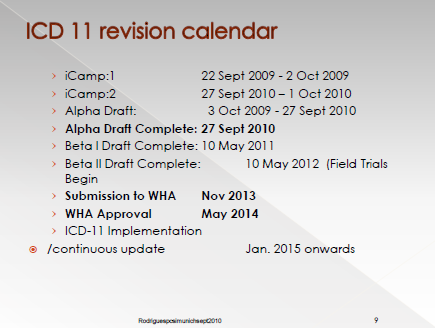
This slide from a DSPIM presentation says the Alpha Draft was scheduled for completion by 27 September:
Source: Slide 9, PDF presentation slides: ICD-11 Revision: where are we now? Ontology driven tools and web platform. JM Rodrigues et al, DSPIM, University of Saint Etienne, WHO Collaborating Centre for International Classifications in French Language, Paris.
The WHO is promoting the development of ICD-11 as a transparent, collaborative and inclusive process
The Revision Steering Group (RSG) has launched a number of public interfaces – the ICD-11 Revision site (meeting agendas, minutes, documents and presentations), a YouTube channel, a blog (not updated since October 2009), a Facebook site, Twitter and an iCAT users Google Group, open to any stakeholders who register for access. The iCAT Web 2.0 drafting platform is also viewable by the public and the production server can be accessed here: http://icat.stanford.edu/.
But little consideration appears to have been given to who should take responsibility for responding to questions from stakeholders or fielding queries left on the ICD Revision Facebook site, which rarely receive a reasonably prompt response, or any response, at all.
WHO Secretariat do not always acknowledge or respond to enquiries. A request for clarifications from a Topic Advisory Group (TAG) Chair, whilst acknowledged, has received no response after three months. The 5th meeting of the International Advisory Group for the Revision of ICD-10 Mental and Behavioural Disorders (currently ICD-10 Chapter V) was held on 28 – 29 September 2009. A year later, a Summary Report is still pending publication and no meeting summaries for TAG Mental Health have been published on the WHO website since the 4th Meeting 1 – 2 December 2008.
The WHO needs to decide whether, in launching public interfaces and using “social networking” for input and feedback from stakeholders it genuinely seeks to provide platforms for meaningful interaction with the public or whether these are tokenistic nods at “transparency”.
Content posted by ICD Revision admin on its Facebook Wall often lacks meaning and substance. What stakeholders really need to know is whether any form of alpha draft is going to be publicly released before the Beta phase – not photos of happy iCampers playing bassoons at musical soirées and iCamp bonding sessions.
I will update if and when any information is released on the status and public availability of an alpha draft, and what format(s) it will be available in.
Proposals
Since 2007, it has been possible for stakeholders in the development of ICD to submit proposals and comments, supported by citations, via the ICD Update and Revision Platform Intranet. It was understood, last September, that for some Topic Advisory Groups (notably Chapters 5 and 6) a proposal form for ICD-11 was being prepared for use by stakeholders.
Information about the availability of proposal forms for the various Topic Advisory Groups, up to what stage in the development process timeline these might be used and which stakeholders might be permitted to make use of any proposal forms already being issued or in preparation would also be welcomed from the Revision Steering Group or TAG managing editors.
Slipping targets
According to the iCamp2 PowerPoint presentation, Frequent Criticisms and this iCamp2 YouTube, targets for the population of content for the Alpha Draft have not been reached.
Less that 80% of Terminology Definitions have been uploaded to the iCAT and less than the 20% target for full Content Model completion for the many thousands of diseases and disorders classified within ICD has been met. [The Content Model identifies the basic properties needed to define any ICD concept (unit, entity or category) through the use of multiple parameters.] Not all parameters of the Content Model are implemented yet. Not all Topic Advisory Groups are at a similar developmental stage; Beta Plans are behind schedule.
The Revision Steering Group identifies barriers to keeping this technically very ambitious project on track: lack of finances; the sheer amount of time required for the drafting of definitions and population of textual content according to the complex ICD-11 Content Model; recruiting external experts for reviewing proposals and generating content; familiarising TAG workgroup members with the functionality of the iCAT, the collaborative authoring platform through which ICD-11 is being drafted, and with informatics; entering data into the iCAT; the paucity of face-to-face meetings for TAG managing editors and workgroup members who are scattered across the globe and undertaking these roles in addition to professional commitments; difficulties facilitating interaction between the various Topic Advisory Groups where diseases overlap with other chapters.
A number of new workgroups have recently been created (Paediatrics, Dentistry, E.N.T, Traditional Medicine and Communicable/Tropical Diseases).
The knowledge representation space is too large to be curated by a small number of experts (e.g. 20,000 ICD Categories, 15 parameters of CM [Content Model], each may have 1-20 entries – on average a relational database matrix with 300,000 entries).
[…]
Scaling up the process from the alpha phase to beta should be carefully planned and modelled. It is estimated that the alpha phase participants will be at the magnitude of 500-1000 persons. In beta phase it is expected to have 10-100 fold increase.
If the Revision Steering Group is already struggling to maintain motivation and interaction between the various Topic Advisory Groups, then management of the project once the beta phase is reached and the process opened up to stakeholders is going to present the Steering Group and TAG workgroup managing editors with considerable challenges.
The original dissemination date for ICD-11 had been 2012, with the timelines for the revision of ICD-10 and DSM-IV running more or less in parallel. The dissemination date for ICD-11 was later extended to 2014 and the publication date of the next edition of the DSM, DSM-5, extended to May 2013.
(John Gever, Senior Editor, MedPage Today, reported on 5 October that Testing of new diagnostic criteria proposed for DSM-5, the revision of the psychiatric profession’s manual for patient assessment, is finally underway, more than two months behind schedule.)
The development of ICD-11 is a hugely complex and technically ambitious undertaking; all three volumes will be electronically published, integrable and intended to be integrable with some other health classification publications; the scope of ICD-11 is far greater than that of the previous edition.
It may be that come May 2011, we might anticipate some scaling back of plans and/or possibly a shift in the release of the Beta Draft from May 2012 to 2013+, in response to the recognition that the WHO may have significantly overestimated its capacity for securing the funding and resources to complete the technical work on this project by 2012, if implementation of the final version is to take place in 2014.
The iCamp YouTube commentaries have an air of brittle optimism about them.
Coming up
In a forthcoming post, in lieu of an Alpha Draft, I shall be reporting on what can currently be seen in the ICD-11 iCAT drafting platform and associated Revision documents in relation to the three ICD-10 categories: “Postviral fatigue syndrome”, “Chronic fatigue syndrome” and “(Benign) myalgic encephalomyelitis” and why I have asked the Chair of the Topic Advisory Group for Neurology for a clarification.
iCamp2 meeting documents and presentations
A number of new and existing ICD revision related documents have been published on the ICD-11 Revision Google site in association with the iCamp2 and RSG September meetings. Not all the documents listed have been uploaded to the ICD Revision site and several links are returning “File not found”.
Field “A Type” specifies: new; unchanged; decision to be made; retired; real retired
[Note: ICD11 Alpha Codes may be temporary sorting codes; “FXC” against “G93.3” does not relate to the F Codes in ICD Chapter 5 (V); note also that Gj92 is an ICD-11 “Sorting label” not an ICD code.]
Signs and Symptoms [4 pp Word doc; Discussion document: Considerations for handling categories and concepts currently found in chapter 18 of ICD-10, “SYMPTOMS, SIGNS AND ABNORMAL CLINICAL AND LABORATORY FINDINGS NOT ELSEWHERE CLASSIFIED”, (R-codes), authors: Aymé, Chalmers, Chute, Jakob.] Or open here: Discussion: Signs and Symptoms (Chapter 18)
“ICD has traditionally grouped diseases by aetiology and by affected organ system. For ICD11 the creation of a new chapter for multisystem disorders has been proposed. The following text sets out the rationale for and the possible scope of a multisystem disorders chapter.”
Contains Literature search reference at 119 to the Maes and Twisk paper, Treatment of myalgic encephalomyelitis/chronic fatigue syndrome (ME/CFS), a multisystem disease, should target the pathophysiological aberrations (inflammatory and oxidative and nitrosative stress pathways), not the psychosocial “barriers” for a new equilibrium. 2010: Ireland. p. 148-9.
Contains Literature search reference at 118 to published response to Maes and Twisk paper by Luyten, P. and B. Van Houdenhove, Treatment of myalgic encephalomyelitis/chronic fatigue syndrome (ME/CFS), a multisystem disease, should target the pathophysiological aberrations (inflammatory and oxidative and nitrosative stress pathways), not the psychosocial “barriers” for a new equilibrium – Response to Maes and Twisk. 2010, ELSEVIER IRELAND LTD, ELSEVIER HOUSE, BROOKVALE PLAZA, EAST PARK SHANNON, CO, CLARE, 00000, IRELAND. p. 147-147.
Presentations [PowerPoint slides require the MS PP 2007 pptx reader unless identified as ppt]
[2] User Manual [Content Model User Guide, 53 pp Word doc] Key ICD-11 document
Identifies the basic properties needed to define any ICD concept (unit, entity or category) through the use of multiple parameters. Open here on DSM-5 and ICD-11 Watch: User Manual 20.09.10
Revised Disorder Descriptions: Version 1/14/11




 dx revision watch