The clock is ticking for CFS: Partial Code Freeze for ICD-9-CM and ICD-10-CM/PCS Finalized

The clock is ticking for CFS: Partial Code Freeze for ICD-9-CM and ICD-10-CM/PCS Finalized (US)

Post #59 Shortlink: http://wp.me/pKrrB-Un

The clock is ticking…

The US was authorized by the WHO to develop its own country specific adaptation of the WHO’s now retired ICD-9, called ICD-9-CM, and has been slow to move on to a “Clinical Modification” of ICD-10.

Rather than skip ICD-10 and move straight onto ICD-11 in 2015, the National Center for Health Statistics (NCHS) has been developing a “clinical modification” of ICD-10 called ICD-10-CM. This development process has been in progress for a number of years.

So ICD-10-CM is US specific and it’s scheduled for implementation in October 2013 [1].

The US does not envisage moving on to ICD-11 (or an adaptation of ICD-11) for many years. So although the majority of countries will be implementing ICD-11 in 2015+, the US will sail on with ICD-10-CM.

Several other countries use a modification of ICD-10. Canada is authorized to use its adaptation of ICD-10, ICD-10-CA. According to one source, Canada may not adopt ICD-11 (or an adaptation of ICD-11) until beyond 2018.

ICD-10-CM

The US clinical modification is proposing to retain CFS in the R codes and to classify it at R53.82 in Chapter 18, rather than code CFS in Chapter 6: Diseases of the nervous system, along with ME and PVFS, at G93.3.

“Symptoms, signs and abnormal clinical and laboratory findings, not elsewhere classified (R00-R99) This chapter includes symptoms, signs, abnormal results of clinical or other investigative procedures, and ill-defined conditions regarding which no diagnosis classifiable elsewhere is recorded.” [2]

For ICD-10-CM, then, PVFS and (B)ME are proposed to be coded thus, in Chapter 6:

Diseases of the nervous system (G00-G99)

Excludes2:

[…]
symptoms, signs and abnormal clinical and laboratory findings, not elsewhere classified (R00-R94)

G93 Other disorders of brain

[…]

G93.3 Postviral fatigue syndrome

Benign myalgic encephalomyelitis
Excludes1: chronic fatigue syndrome NOS (R53.82)

which would bring the classification of PVFS and ME for the US in line with existing ICD-10 codes. (Though note that in ICD-10, Chronic fatigue syndrome is indexed to G93.3 in Volume 3: The Alphabetical Index and does not appear in Volume 1: The Tabular list under the G93 parent category.)

Whereas for ICD-10-CM, CFS is proposed to be coded thus, in Chapter 18:

R53: Malaise and fatigue

[…]

R53.82 Chronic fatigue, unspecified

Chronic fatigue syndrome NOS
Excludes1: postviral fatigue syndrome (G93.3)

Retaining CFS in the R codes and coding CFS in Chapter 18 under R53.82 (which specifically excludes G93.3) means that in ICD-10-CM, the coding of the terms CFS, PVFS and ME will be out of step with four classification systems:

1 The International ICD-10, which is used in the majority of countries.

2 The Canadian Clinical Modification ICD-10-CA.

3 The German Clinical Modification ICD-10-GM.

4 The proposals for Chapter 6 of ICD-11 as they stood in the iCAT ICD Revision Platform at November 2010, where CFS is proposed to be classified in Chapter 6: Diseases of the nervous system, with (B)ME specified as an Inclusion to CFS.

(I am informed that “PVFS” is a term little used by the US medical profession.)


Schism

This issue is proving divisive because some US patients would prefer to see CFS split from ME in ICD-10-CM. 

But retaining CFS in the R codes and placing it under the R53: Malaise and fatigue parent category may have considerable implications for patients who already have a diagnosis of CFS or who may receive a diagnosis of CFS in the future – for the treatments that are provided, the care packages received and for medical and disability insurance.

So I consider it will hurt patients to have CFS coded under the R chapter, rather than in Chapter 6: Diseases of the nervous system and that coding CFS under “ill-defined conditions” will render CFS and ME patients more vulnerable to the current proposals for the revision of the “Somatoform Disorders” section for DSM-5 [4].

If I were a patient who already had a diagnosis of CFS or might be given diagnosis of CFS in the future, I would feel safer if CFS were coded at G93.3, until the science has got it sorted. For there are no guarantees that US medics will diagnose ME and use the new ME code for billing purposes.

But this is not a new issue. 

US patients organizations, advocates and patients have known about these proposals for several years. The issue has been discussed at meetings of the Chronic Fatigue Syndrome Advisory Committee (CFSAC).

CFSAC provides advice and recommendations to the Secretary of Health and Human Services via the Assistant Secretary for Health of the U.S. Department of Health and Human Services on issues related to chronic fatigue syndrome (CFS). Copies of meeting agendas, minutes, recommendations, some presentations and since 2009, videocasts of entire meeting proceedings, can be accessed from the CFSAC pages. Minutes of meetings go back to September 2003 [3].

The codings issue had been discussed by CFSAC in June 2004 and again in September 2005, when a presentation had been given by the CDC’s Donna Pickett. In 2005, the committee had recommend that CFS be classified under G93.3.

“Recommendation 10: We would encourage the classification of CFS as a ‘Nervous System Disease,’ as worded in the ICD-10 G93.3.” CFSAC Committee Recommendations August 2005

The issue was discussed more recently, at the May 2010 CFSAC meeting. During the last ten minutes of that meeting, Dr Lenny Jason discussed his concerns with the committee that the placement of CFS in ICD-10-CM under the Chapter 18 “R” codes could be problematic. 

CFSAC 10.05.10 Agenda

CFSAC 10.05.10 Minutes

Videocast of CFSAC meeting

The Recommendations for that meeting in relation to the coding of CFS in ICD-10-CM had been:

“CFSAC rejects proposals to classify CFS as a psychiatric condition in U.S. disease classification systems. CFS is a multi-system disease and should be retained in its current classification structure, which is within the “Signs and Symptoms” chapter of the International Classification of Diseases 9-Clinical Modification (ICD 9-CM).*

“*DFO Note: The ICD 10-CM is scheduled for implementation on October 1, 2013. In that classification, two mutually exclusive codes exist for chronic fatigue [sic]:

“post-viral fatigue syndrome (in the nervous system chapter), and
chronic fatigue syndrome, unspecified (in the signs and symptoms chapter).

“HHS has no plans at this time to change this classification in the ICD 10-CM.”

Incidently, amongst the Recommendations of the CFSAC committee for the October 2010 meeting was:

3. Adopt the term “ME/CFS” across HHS programs.

I hope further discussion of ICD-10-CM codings can be pushed back up the agenda for the next CFSAC meeting because a number of issues were left hanging.


Code “freezing”

Although ICD-10-CM is not scheduled for implementation until October 2013, it had been proposed that at some point prior that date codes might be “frozen”.

At the ICD-9-CM Coordination & Maintenance Committee Meeting on Sept. 15, 2010, it was announced that the committee had finalized the decision to implement a partial freeze for both ICD-9-CM codes and ICD-10-CM and ICD-10-PCS codes prior to implementation of ICD-10-CM on Oct. 1, 2013.

As of October 1, 2011, only limited updates will be instituted into the code sets so that providers, payers, clearinghouses, and health IT vendors will not have to simultaneously keep pace with code updates while also reconfiguring their existing systems for ICD-10-CM/PCS.


So the clock is ticking and US advocates and patients need to be aware of how little time may be left.

A few days ago, I contacted Donna Pickett, Medical Systems Administrator, Classifications and Public Health Data Standards, National Center for Health Statistics, Centers for Disease Control and Prevention (CDC) to enquire whether the proposed date by which ICD-10-CM codings might be “frozen” had been finalized.

Ms Pickett has provided information regarding the freezing of the ICD-9-CM and ICD-10-CM code sets.

She also confirmed that Clinical criteria and diagnostic guidelines will not be included in ICD-10-CM.

(As I have reported before, for ICD-11, diseases and disorders will be defined through multiple parameters according to a common “Content Model” so there will be definitions, clinical descriptions etc and the potential for considerably more textual content than in ICD-10. See: http://wp.me/pKrrB-KK  for screenshots.)

The notice below is also available in PDF format here

There is an associated meeting Agenda Handout which also includes this information and dates of ICD-9-CM and ICD-10-CM meetings: Agenda. ICD-9-CM Coordination and Maintenance Committee. DHSS

Partial Code Freeze for ICD-9-CM and ICD-10 Finalized

The ICD-9-CM Coordination and Maintenance Committee will implement a partial freeze of the ICD-9-CM and ICD-10 (ICD-10-CM and ICD-10-PCS) codes prior to the implementation of ICD-10 on October 1, 2013. There was considerable support for this partial freeze. The partial freeze will be implemented as follows:

• The last regular, annual updates to both ICD-9-CM and ICD-10 code sets will be made on October 1, 2011.

•On October 1, 2012, there will be only limited code updates to both the ICD-9-CM and ICD-10 code sets to capture new technologies and diseases as required by section 503(a) of Pub. L. 108-173.

• On October 1, 2013, there will be only limited code updates to ICD-10 code sets to capture new technologies and diagnoses as required by section 503(a) of Pub. L. 108-173. There will be no updates to ICD-9-CM, as it will no longer be used for reporting.

• On October 1, 2014, regular updates to ICD-10 will begin.

The ICD-9-CM Coordination and Maintenance Committee will continue to meet twice a year during the partial freeze. At these meetings, the public will be asked to comment on whether or not requests for new diagnosis or procedure codes should be created based on the criteria of the need to capture a new technology or disease. Any code requests that do not meet the criteria will be evaluated for implementation within ICD-10 on and after October 1, 2014 once the partial freeze has ended.

Codes discussed at the September 15 – 16, 2010 and March 9 – 10, 2011 ICD-9-CM Coordination and Maintenance Committee meeting will be considered for implementation on October 1, 2011, the last regular updates for ICD-9-CM and ICD-10. Code requests discussed at the September 14 – 15, 2011 and additional meetings during the freeze will be evaluated for either the limited updates to capture new technologies and diseases during the freeze period or for implementation to ICD-10 on October 1, 2014. The public will be actively involved in discussing the merits of any such requests during the period of the partial freeze.

References:

(For history of ICD in the US to 2001, see archive CDC document: A Summary of Chronic Fatigue Syndrome and Its Classification in the International Classification of Diseases. The March 2001 proposals are since superceded as per 2009, 2010 and 2011 proposals.)

[1] International Classification of Diseases, Tenth Revision, Clinical Modification (ICD-10-CM). Note: The 2011 release of ICD-10-CM is now available. It replaces the December 2010 release:
http://www.cdc.gov/nchs/icd/icd10cm.htm

[2] US “Clinical Modification” ICD-10-CM
This article clarifies any confusion between ICD-10, ICD-11 and the forthcoming US Clinical Modification, ICD-10-CM: http://wp.me/pKrrB-Ka

[3] Chronic Fatigue Syndrome Advisory Committee (CFSAC). The Chronic Fatigue Syndrome Advisory Committee (CFSAC) provides advice and recommendations to the Secretary of Health and Human Services via the Assistant Secretary for Health of the U.S. Minutes of meetings, Recommendations and meeting videocasts:
http://www.hhs.gov/advcomcfs/

[4] The most recent proposals of the DSM-5 “Somatic Symptoms Disorders” Work Group plus two key Disorder Description and Rationale PDF documents can be read on the APA’s DSM-5 Development site:
http://www.dsm5.org/ProposedRevisions/Pages/SomatoformDisorders.aspx

or here on Dx Revision Watch site: http://wp.me/pKrrB-St
No publication of an ICD-11 Alpha Draft for public scrutiny

There will be no publication of an ICD-11 Alpha Draft for public scrutiny

Post #53 Shortlink: http://wp.me/pKrrB-QL

For some time now, I have been trying to establish whether ICD Revision intends to release any form of ICD-11 Alpha Draft for public scrutiny. An Alpha Draft had originally been scheduled for May 2010.

On 6 August, ICD Revision on Facebook had stated:

“The ICD-11 Alpha Drafting process has been ongoing since the first iCamp that was held in Geneva, Switzerland in September 2009. A draft print version will be available in September 2010.”

On 29 September, I asked:

“Clarification would be welcomed on whether an Alpha Draft will be available this month for internal use only or whether it is intended for public viewing, and if for public viewing, in what format(s)?”

which received no response.

On 6 October, I asked, again:

“On 6 August, ICD Revision on Facebook stated that “A draft print version will be available in September 2010”. Other than what can be seen on the iCAT collaborative authoring platform, will ICD Revision please clarify for stakeholders, whether any form of Alpha Draft for ICD-11 is going to be placed in the public domain, when this will now be released, and in what formats?”

On 15 October, ICD Revision on Facebook responded: 

“Indeed a print version is available but as an alpha draft it is not for public consumption. Public draft ( beta draft) was and (is still) targeted for MAY 2011. iCAT authoring platform is not open to public and should be only seen by designated authors. — This is not something opaque. any project of this size and complexity has to pass through stages. In May 2011 more user-friendly software and easy-to-view options will be available…”

At that point, it was in fact the case that both the iCAT authoring platform server and the iCAT demo and training platform had been viewable by the public, although only WHO, ICD Revision Steering Group, ICD Revision IT technicians and Topic Advisory Groups (TAGs) had editing access.

The iCAT production server is at: http://icat.stanford.edu/
The iCAT demo and training platform is at: http://icatdemo.stanford.edu/

In early November, access to viewing the iCAT and the iCAT demo platform was closed to the public. 

Topic Advisory Group (TAG) members now require a password login for both browsing and editing the iCAT or importing data and the public can no longer view the iCAT and the population of ICD Title Categories and Content, at all.

Web Protégé: Supporting the Creation of ICD-11 and iCAMP2 YouTubes

Web Protégé: Supporting the Creation of ICD-11 and iCAMP2 YouTubes

Post #51 Shortlink: http://wp.me/pKrrB-Qv

http://iswc2010.semanticweb.org/pdf/502.pdf

Web Protégé: Supporting the Creation of ICD-11

Sean M. Falconer, Tania Tudorache, Csongor Nyulas, Natalya F. Noy, Mark A. Musen

Stanford Center for Biomedical Informatics Research, Stanford University, US

1 Introduction

The International Classification of Diseases (ICD) is a public global standard that organizes and classifes information about diseases and related health problems [4]. Health offcials use ICD in all United Nations member countries to compile basic health statistics, to monitor health-related spending, and to inform policy makers. In the United States, use of the ICD is also a requirement for all medical billing. ICD has therefore a major impact on many aspects of health care all over the world.

In 2007, the WHO initiated the 11th revision of ICD. Several ambitious goals were set for this version (details in [2]). One such goal is to allow the ICD to become a multi-purpose classification for a much larger number of usages. Previous versions of ICD were strictly classification hierarchies used for statistical purposes. To meet the new revision goals, ICD-11 will use OWL to create a rich formal representation. Another key diference between ICD-11 and previous versions is that the development process of ICD-11 will use a Web-based open process powered by collaboration and social features. That is, similar to Wikipedia, the WHO hopes that a large number of medical experts will contribute to the content of ICD-11.

Our group has been working closely with the WHO to provide the technical support for these ambitious goals. We have created a customized version of Protégé specifcally designed to support the ICD authoring process. In [2], we discuss in detail the use of Semantic Web technologies for the revision of ICD. Our demo will showcase features of the customized Protégé such as content creation and collaboration. For the remainder of this paper, we present the architecture and highlight features of the user interface…

Full document

————–

iCamp2: 27 September – 1 October 2010

http://sites.google.com/site/icd11revision/home/face-to-face-meetings/icamp2-2010   

The iCamp2 meeting, scheduled for April but postponed due to volcanic ash cloud disruption of air traffic, was held between 27 September – 1 October, in Geneva.   

iCamp2
27 September – 1 October 2010 Geneva, Switzerland WHO Headquarters   

RSG 2010 [Revision Steering Group]
30 September – 1 October 2010 Geneva, Switzerland WHO Headquarters   

The revised Agenda for the meeting can be read here in html on the ICD Revision site.   

Download here as a Word document from the ICD Revision site or open here iCamp2 Agenda September 2010 on DSM-5 and ICD-11 Watch site.   

I will post a link for the minutes, summary or note of this meeting when these are available on the ICD Revision site.

There are two ICD-11 iCamp2 on YouTube   

ICD-11 ICAMP2 Day 5 

WHOICD11’s Channel  | 21  October 2010  |  9.53 mins

iCAMP2 Day 2   

WHOICD11’s Channel  | 29 September 2010  |  7:32 mins    


Related information

ICD Revision iCamp2 meeting, new documents and status of the ICD-11 Alpha Draft

ICD-11 revision: where are we now? Ontology-driven tools and the web platform: Meeting abstract

ICD-11 revision: where are we now? Ontology-driven tools and the web platform: Meeting abstract

Post #49 Shortlink: http://wp.me/pKrrB-PW

A PDF of an associated slide presentation by JM Rodrigues et al can be downloaded here:

http://tinyurl.com/ICD-11revision-Rodrigues


This article is part of the supplement:

Patient Classification Systems International: 2010 Case Mix Conference, Munich, Germany. 15-18 September 2010.

http://www.biomedcentral.com/bmchealthservres/10?issue=S2

BMC Health Services Research

Volume 10
Suppl 2

http://www.biomedcentral.com/1472-6963/10/S2/A7

PDF: http://www.biomedcentral.com/content/pdf/1472-6963-10-S2-A7.pdf

Open access

Meeting abstract

ICD-11 revision: where are we now? Ontology-driven tools and the web  platform

J Rodrigues¹²
1 SSPIM, CHU Saint etienne, Saint Etienne, France
2 WHO FIC Collaborative Centre, WHO FIC Collaborative Centre, Paris, France

corresponding author email

from 26th Patient Classification Systems International (PCSI) Working Conference

Munich, Germany. 15-18 September 2010
BMC Health Services Research 2010, 10(Suppl2):
A7doi:10.1186/1472-6963-10-S2-A7

The electronic version of this abstract is the complete one and can be found online at: http://www.biomedcentral.com/1472-6963/10/S2/A7

Published: 6 October 2010

© 2010 Rodrigues; licensee BioMed Central Ltd.

Introduction

ICD is the international de facto standard classification for most epidemiological and many health-care and clinical uses. Originally designed to record causes of death, the usage of ICD has been extended to include morbidity classification, reimbursement, and several other specialty areas such as oncology and primary care. The current 10th edition of ICD was endorsed by the World Health Assembly in 1990 and has been periodically updated over the years. Recently, the World Health Assembly decided to develop a completely new version named the 11th revision.

Methods

In previous revisions of ICD, specialty experts and national representatives of WHO collaborative-classification centers proposed additions and changes to the codes (using lists of codes for creating new drafts). In contrast, the development of ICD-11 aims to create an information infrastructure and workflow processes that utilize knowledge engineering and management techniques that are supported by software.

Instead of just codes, titles, and associated rules and indices, the information infrastructure will enable a more detailed definition of disease and health conditions, as well as the use of reference terminologies and ontologies, review of best scientific evidence, and field trials of draft standards.

In terms of workflow, the information infrastructure should support the collaborative development of new content and proposed changes, rigorous review and approval processes, and the creation of draft classifications for field testing. The ICD revision process was initially the work of Topic Advisory Groups (TAG) that had been set up for various specialty areas. The ICD-11 revision process will eventually be opened up for comments and suggestions from interested parties on the Internet.

Lastly, the final output will be multiple for different use cases such as mortality, morbidity and primary care, which can be mapped with ontology-driven tools

Results

The content model is made up of three different parts:

A) Descriptive Characteristics
ICD Concept Title
Hierarchy, Type and Use
Textual Definition
Terms
Index Terms
Synonyms
Inclusion Terms
Exclusion Terms

B) Clinical Description
Manifestation Properties
Signs & Symptoms
Findings
Temporal Properties
Severity Properties
Functional Properties
Treatment Properties
Diagnostic Rules
Reason For Encounter

C) Formal Characteristics
Body Structure
Morphologic Abnormality
Causal Properties
Mechanisms/ Agents
Risk Factors
Genomic Characteristics
Dysfunction

The web platform named ICAT has been developed by a team of Stanford University to allow a collaborative population of the content model by their different tags.

The ICD-11 content model is still evolving, but the main components have been specified. A detailed guide describes the expected content and usage of each component. It is the document that records the shared understanding  of the content model.

The OWL content model realizes the informal description in the guide and formalizes the three-layer  conceptualization of the original UML model.

Conclusions

The ICD-11 content model is very much a work in progress. Consensus formulation of several components such as temporal properties, severity properties, and diagnostic criteria is not yet available. From the view point of case mix, the new tools will provide an ICD of better quality for morbidity, thus allowing better mapping between diagnosis systems and, as a result of this, better mapping across case-mix systems based on diagnosis coding.

[Abstract Ends]

Update on status of ICD-11 Alpha Draft in previous post on DSM-5 and ICD-11 site:

ICD Revision iCamp2 meeting, new documents and status of the ICD-11 Alpha Draft

2 October 2010

Shortlink Post #48: http://wp.me/pKrrB-O9

Reference material:

PVFS, ME, CFS: the ICD-11 Alpha Draft and iCAT Collaborative Authoring Platform, 7 June 2010, Post # 46: http://wp.me/pKrrB-KK

[1] ICD-11 Revision Project Plan – Draft 2.0 (v March 10):
Describes the ICD revision process as an overall project plan in terms of goals, key streams of work, activities, products, and key participants: ICD Revision Project Plan
http://www.who.int/classifications/icd/ICDRevisionProjectPlan_March2010.pdf

[2] User Manual [Content Model User Guide, 53 pp Word doc]  Key ICD-11 document
Identifies the basic properties needed to define any ICD concept (unit, entity or category) through the use of multiple parameters. Open here on DSM-5 and ICD-11 Watch: User Manual 20.09.10

[3] iCAT production server:
http://sites.google.com/site/icd11revision/home/icat
iCAT production server: http://icat.stanford.edu/

[4] iCAT Glossary
http://apps.who.int/classifications/apps/icd/icatfiles/iCAT_Glossary.html

iCamp2 meeting and status of ICD-11 Alpha Draft

ICD Revision iCamp2 meeting, new documents and status of the ICD-11 Alpha Draft

Post #48 Shortlink: http://wp.me/pKrrB-O9

The information in this update relates only to proposals for ICD-11.   

This information does not apply to ICD-10-CM, the forthcoming “Clinical Modification” of ICD-10, which is scheduled for implementation in October 2013 and is specific to the US.

Post #45 is intended to clarify any confusion between ICD-10, ICD-11 and the forthcoming US specific “Clinical Modification”, ICD-10-CM.

See: US “Clinical Modification” ICD-10-CM

iCamp2: 27 September – 1 October 2010

http://sites.google.com/site/icd11revision/home/face-to-face-meetings/icamp2-2010

The iCamp2 meeting, scheduled for April but postponed due to volcanic ash cloud disruption of air traffic, was held between 27 September – 1 October, in Geneva.

iCamp2
27 September – 1 October 2010 Geneva, Switzerland WHO Headquarters   

RSG 2010 [Revision Steering Group]
30 September – 1 October 2010 Geneva, Switzerland WHO Headquarters  

The revised Agenda for the meeting can be read here in html on the ICD Revision site.

Download here as a Word document from the ICD Revision site or open here iCamp2 Agenda September 2010 on DSM-5 and ICD-11 Watch site.

I will post a link for the minutes, summary or note of this meeting when these are available on the ICD Revision site.

Click here for a list and bios of Meeting Participants

ICD-11 iCamp2 on YouTube 

ICD-11 ICAMP2 Day 5

WHOICD11’s Channel  | 21  October 2010  |  9.53 mins

iCAMP2 Day 2

WHOICD11’s Channel  | 29 September 2010  |  7:32 mins


Status and format of the ICD-11 Alpha Draft

Slipping timeline

In his iCamp2 Introductory presentation, Dr Bedirhan Üstün says there are just seven months to go before the start of the ICD-11 beta drafting phase and 43 months to the final version. Beta drafting remains scheduled to begin in May 2011, even though targets for the drafting of content are slipping and an Alpha Draft has yet to be published.

The Beta Requirements Document says, “The Beta Phase will be open to [the] general public in May 2011 to enable structured input by interested parties subject to peer-review by relevant Technical Advisory Groups” and that the time until May 2011 “will be used to develop and test the Beta Draft software and procedures and make consultations with end users around key issues and basic questions.”

iCamp2 acknowledged that a considerable amount of work needs to be done in the interim if ICD Revision is going to meet its targets.

No detailed timeline for the development of ICD-11 is available on the WHO’s main website. But in March, an ICD Revision Project Plan document, published on the ICD Revision Google site, had projected an Alpha Draft release date of May 2010, with a Beta Draft ready by May 2012. [Source: Page 7, “Project milestones and budget, and organizational overview”.]

A press launch for the Alpha Draft had been tabled for discussion on the Agenda for the April iCamp2 meeting. In the event, the April meeting was postponed, but ICD Revision has issued no public explanation for why the anticipated Alpha Draft failed to be released in April/May, nor has the Steering Group issued a revised ETA.

From the ICD Revision Project Plan:

The Alpha draft will be produced in a traditional print and electronic format. The Alpha Draft will also include a Volume 2 containing the traditional sections and including a section about the new features of ICD-11 in line with the style guide. An index for print will be available in format of sample pages. A fully searchable electronic index using some of the ontological features will demonstrate the power of the new ICD.

According to sources, in July, a print version of the Alpha Draft was expected to be made available around the time that the rescheduled iCamp2 meeting took place in September. Requests for clarification of the status and accessibility of an alpha draft have been left on ICD Revision Facebook site by several members of the public. When a response was eventually forthcoming, in August, it was confirmed that a “draft print version will be available in September 2010”.

iCamp2 is over now, but it remains unclear whether a print version has been produced, whether it is intended for internal use only or is going to be made available for public scrutiny, and if so, when, and in what format(s). ICD Revision has been asked to clarify.

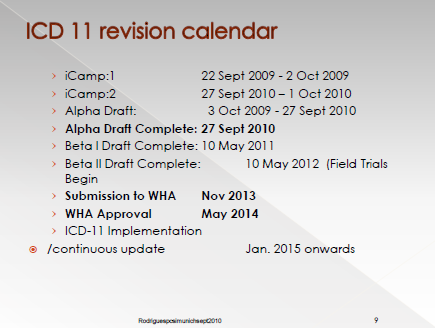
This slide from a DSPIM presentation says the Alpha Draft was scheduled for completion by 27 September:

Source: Slide 9, PDF presentation slides: ICD-11 Revision: where are we now? Ontology driven tools and web platform. JM Rodrigues et al, DSPIM, University of Saint Etienne, WHO Collaborating Centre for International Classifications in French Language, Paris.


The WHO is promoting the development of ICD-11 as a transparent, collaborative and inclusive process

The Revision Steering Group (RSG) has launched a number of public interfaces – the ICD-11 Revision site (meeting agendas, minutes, documents and presentations), a YouTube channel, a blog (not updated since October 2009), a Facebook site, Twitter and an iCAT users Google Group, open to any stakeholders who register for access.  The iCAT Web 2.0 drafting platform is also viewable by the public and the production server can be accessed here: http://icat.stanford.edu/.

But little consideration appears to have been given to who should take responsibility for responding to questions from stakeholders or fielding queries left on the ICD Revision Facebook site, which rarely receive a reasonably prompt response, or any response, at all.

WHO Secretariat do not always acknowledge or respond to enquiries. A request for clarifications from a Topic Advisory Group (TAG) Chair, whilst acknowledged, has received no response after three months. The 5th meeting of the International Advisory Group for the Revision of ICD-10 Mental and Behavioural Disorders (currently ICD-10 Chapter V) was held on 28 – 29 September 2009. A year later, a Summary Report is still pending publication and no meeting summaries for TAG Mental Health have been published on the WHO website since the 4th Meeting 1 – 2 December 2008.

The WHO needs to decide whether, in launching public interfaces and using “social networking” for input and feedback from stakeholders it genuinely seeks to provide platforms for meaningful interaction with the public or whether these are tokenistic nods at “transparency”.

Content posted by ICD Revision admin on its Facebook Wall often lacks meaning and substance. What stakeholders really need to know is whether any form of alpha draft is going to be publicly released before the Beta phase – not photos of happy iCampers playing bassoons at musical soirées and iCamp bonding sessions.

I will update if and when any information is released on the status and public availability of an alpha draft, and what format(s) it will be available in.

Proposals

Since 2007, it has been possible for stakeholders in the development of ICD to submit proposals and comments, supported by citations, via the ICD Update and Revision Platform Intranet. It was understood, last September, that for some Topic Advisory Groups (notably Chapters 5 and 6) a proposal form for ICD-11 was being prepared for use by stakeholders.

Information about the availability of proposal forms for the various Topic Advisory Groups, up to what stage in the development process timeline these might be used and which stakeholders might be permitted to make use of any proposal forms already being issued or in preparation would also be welcomed from the Revision Steering Group or TAG managing editors.

Slipping targets

According to the iCamp2 PowerPoint presentation, Frequent Criticisms and this iCamp2 YouTube, targets for the population of content for the Alpha Draft have not been reached.

Less that 80% of Terminology Definitions have been uploaded to the iCAT and less than the 20% target for full Content Model completion for the many thousands of diseases and disorders classified within ICD has been met. [The Content Model identifies the basic properties needed to define any ICD concept (unit, entity or category) through the use of multiple parameters.] Not all parameters of the Content Model are implemented yet. Not all Topic Advisory Groups are at a similar developmental stage; Beta Plans are behind schedule.

The Revision Steering Group identifies barriers to keeping this technically very ambitious project on track:  lack of finances; the sheer amount of time required for the drafting of definitions and population of textual content according to the complex ICD-11 Content Model; recruiting external experts for reviewing proposals and generating content; familiarising TAG workgroup members with the functionality of the iCAT, the collaborative authoring platform through which ICD-11 is being drafted, and with informatics; entering data into the iCAT; the paucity of face-to-face meetings for TAG managing editors and workgroup members who are scattered across the globe and undertaking these roles in addition to professional commitments; difficulties facilitating interaction between the various Topic Advisory Groups where diseases overlap with other chapters.

A number of new workgroups have recently been created (Paediatrics, Dentistry, E.N.T, Traditional Medicine and Communicable/Tropical Diseases).

Under “Overall Directions” in the Beta Requirements Document, it says:

The knowledge representation space is too large to be curated by a small number of experts (e.g. 20,000 ICD Categories, 15 parameters of CM [Content Model], each may have 1-20 entries – on average a relational database matrix with 300,000 entries).

[…]

Scaling up the process from the alpha phase to beta should be carefully planned and modelled. It is estimated that the alpha phase participants will be at the magnitude of 500-1000 persons. In beta phase it is expected to have 10-100 fold increase.

If the Revision Steering Group is already struggling to maintain motivation and interaction between the various Topic Advisory Groups, then management of the project once the beta phase is reached and the process opened up to stakeholders is going to present the Steering Group and TAG workgroup managing editors with considerable challenges.

The original dissemination date for ICD-11 had been 2012, with the timelines for the revision of ICD-10 and DSM-IV running more or less in parallel. The dissemination date for ICD-11 was later extended to 2014 and the publication date of the next edition of the DSM, DSM-5, extended to May 2013.

(John Gever, Senior Editor, MedPage Today, reported on 5 October that Testing of new diagnostic criteria proposed for DSM-5, the revision of the psychiatric profession’s manual for patient assessment, is finally underway, more than two months behind schedule.)

The development of ICD-11 is a hugely complex and technically ambitious undertaking; all three volumes will be electronically published, integrable and intended to be integrable with some other health classification publications; the scope of ICD-11 is far greater than that of the previous edition.

It may be that come May 2011, we might anticipate some scaling back of plans and/or possibly a shift in the release of the Beta Draft from May 2012 to 2013+, in response to the recognition that the WHO may have significantly overestimated its capacity for securing the funding and resources to complete the technical work on this project by 2012, if implementation of the final version is to take place in 2014.

The iCamp YouTube commentaries have an air of brittle optimism about them.

Coming up

In a forthcoming post, in lieu of an Alpha Draft, I shall be reporting on what can currently be seen in the ICD-11 iCAT drafting platform and associated Revision documents in relation to the three ICD-10 categories: “Postviral fatigue syndrome”, “Chronic fatigue syndrome” and “(Benign) myalgic encephalomyelitis” and why I have asked the Chair of the Topic Advisory Group for Neurology for a clarification.

iCamp2 meeting documents  and presentations

A number of new and existing ICD revision related documents have been published on the ICD-11 Revision Google site in association with the iCamp2 and RSG September meetings. Not all the documents listed have been uploaded to the ICD Revision site and several links are returning “File not found”.

Face-to-Face Meetings‎ > ‎iCamp2: 27 September – 1 October 2010‎
http://sites.google.com/site/icd11revision/home/face-to-face-meetings/icamp2-2010/documents

iCamp2 Agenda  [27 September – 1 October 2010]

Workflow  [PDF]

iCAT Progress Table  [Not currently available]
Alpha Draft Print Sample  [Not currently available]
iCAT Tool Documents  [Not currently available]

• User Manual  [Content Model User Guide, 53 pp Word doc]  Key ICD-11 document
• Issues and Feature Lists  [Not currently available]

Tasks Completed  [Not currently available]
Tasks In Progress/Pending  [iCAT Release Notes on iCAT Google Group platform]

Narrative Workflow Diagram  [Not currently available]

Standard Operating Procedures  [Not currently available]

Beta Requirements Document   [3 pp Word doc]

Workplans:

TAG HIM  [Not currently available]
RSG  [Not currently available]
TAGs  [Not currently available]

3 Component Content Model Description   [File not found]

• Linearization Component  [File not found]
• Foundation Component  [File not found]
• Ontology Component  [1 slide pptx + notes; PowerPoint slides require MS PP 2007 pptx reader]

Evaluation Strategy for Alpha Draft

Questions for Reviewers  [Not currently available]
Quality Assurance  [Not currently available]

Dagger-Asterisk Convention Abolition  [Not currently available]

DIFF File–Changes from ICD-10  [MS Excel doc. Retrieved 29.09.10; Not available on 01.10.10]

Field “A Type” specifies: new; unchanged; decision to be made; retired; real retired

[Note: ICD11 Alpha Codes may be temporary sorting codes; “FXC” against “G93.3” does not relate to the F Codes in ICD Chapter 5 (V); note also that Gj92 is an ICD-11 “Sorting label” not an ICD code.]

Extract Spreadsheet:


Frequent Criticisms   [11 slide pptx; PowerPoint slides require MS PP 2007 pptx reader]

Signs and Symptoms   [4 pp Word doc; Discussion document: Considerations for handling categories and concepts currently found in chapter 18 of ICD-10, “SYMPTOMS, SIGNS AND ABNORMAL CLINICAL AND
LABORATORY FINDINGS NOT ELSEWHERE CLASSIFIED”, (R-codes), authors: Aymé, Chalmers, Chute, Jakob.] Or open here: Discussion: Signs and Symptoms (Chapter 18)

PDF: https://dxrevisionwatch.com/wp-content/uploads/2018/08/icd-revision-signs-and-symptoms-discussion-document.pdf

Multisystem Chapter   [12 pp Word doc; Discussion document: Multisystem Chapter, authors: Aymé, Chalmers, Chute, Jakob.] Or open here: Discussion: Multisystem Chapter

PDF: https://dxrevisionwatch.com/wp-content/uploads/2018/08/icd-revision-multisystem-diseases-discussion-document.pdf

“ICD has traditionally grouped diseases by aetiology and by affected organ system.  For ICD­11 the creation of a new chapter for multisystem disorders has been proposed.  The following text sets out the rationale for and the possible scope of a multisystem disorders chapter.”

Contains Literature search reference at 119 to the Maes and Twisk paper, Treatment of myalgic encephalomyelitis/chronic fatigue syndrome (ME/CFS), a multisystem disease, should target the pathophysiological aberrations (inflammatory and oxidative and nitrosative stress pathways), not the psychosocial “barriers” for a new equilibrium. 2010: Ireland. p. 148-9.

Contains Literature search reference at 118 to published response to Maes and Twisk paper by Luyten, P. and B. Van Houdenhove, Treatment of myalgic encephalomyelitis/chronic fatigue syndrome (ME/CFS), a multisystem disease, should target the pathophysiological aberrations (inflammatory and oxidative and nitrosative stress pathways), not the psychosocial “barriers” for a new equilibrium – Response to Maes and Twisk. 2010, ELSEVIER IRELAND LTD, ELSEVIER HOUSE, BROOKVALE PLAZA, EAST PARK SHANNON, CO, CLARE, 00000, IRELAND. p. 147-147.

Presentations  [PowerPoint slides require the MS PP 2007 pptx reader unless identified as ppt]

Introduction (USTUN)  [14 slides]

Volume 1 (JAKOB)  [26 slides]

Volume 2 (JAKOB)  [11 slides]

Volume 3 (CELIK)  [6 slides + notes]

iCAT (TUDORACHE)  [26 slides PDF; iCAT Progress Update, Stanford Center for Biomedical Informatics Research]

iCAT & TAG Statistics (COTTLER)  [10 slides; New, Retired and Unchanged ICD Concepts (statistics)]

Rare Diseases (RATH)  [19 slides; Rare Diseases TAG feedback on ICD revision]

Dermatology (CHALMERS/WEICHENTHAL)  [ppt; 15 slides]

Ophthalmology (COLENBRANDER/KASHII)  [ppt; 3 slides]

Internal Medicine (SUGANO)  [10 slides]

Paediatrics (LINZER)  [ppt; 4 slides; Newly created TAG]

Musculoskeletal (SUNDBERG)  [ppt; 7 slides]

External Causes and Injuries  (HARRISON)  [ppt; 11 slides]

Maternal, Neonatal and Urogenital  (CHOU)  [ppt; File will not open at 01.10.10]

Socio-Technical Systems (STOREY)  [pptx; 31 slides]


TAG Neoplasms  [ppt; 105 slides]

Functioning TAG  [ppt; 21 slides]

TAG Morbidity  [ppt; 5 slides]

Additional documents  [All PDFs]

Ophthalmology TAG DRAFT
Pre001.2 Dermatology TAG
Rare Diseases Chapter 3 Haematological diseases DRAFT 2
Rare Diseases Chapter 3 Immunological Diseases DRAFT
Rare Diseases Chapter 4 Endocrine Diseases DRAFT
Rare Diseases Chapter 4 Metabolic Diseases DRAFT

Rare Diseases Chapter 4 Nutritional Diseases DRAFT
Rare Diseases Chapter 6 Neurological Diseases DRAFT


References:

PVFS, ME, CFS: the ICD-11 Alpha Draft and iCAT Collaborative Authoring Platform, 7 June 2010, Post # 46: http://wp.me/pKrrB-KK

[1] ICD-11 Revision Project Plan – Draft 2.0 (v March 10):
Describes the ICD revision process as an overall project plan in terms of goals, key streams of work, activities, products, and key participants: ICD Revision Project Plan
http://www.who.int/classifications/icd/ICDRevisionProjectPlan_March2010.pdf

[2] User Manual [Content Model User Guide, 53 pp Word doc]  Key ICD-11 document
Identifies the basic properties needed to define any ICD concept (unit, entity or category) through the use of multiple parameters. Open here on DSM-5 and ICD-11 Watch: User Manual 20.09.10

[3] iCAT production server:
http://sites.google.com/site/icd11revision/home/icat
iCAT production server: http://icat.stanford.edu/

[4] iCAT Glossary
http://apps.who.int/classifications/apps/icd/icatfiles/iCAT_Glossary.html

Update on the ICD-11 Alpha Draft 06.09.10

Update on the ICD-11 Alpha Draft at 06.09.10

Post #47 Shortlink: http://wp.me/pKrrB-MD

The information in this update relates only to proposals for ICD-11.

This information does not apply to ICD-10-CM, the forthcoming “Clinical Modification” of ICD-10, which is scheduled for implementation in October 2013 and is specific to the US.

Post #45 is intended to clarify any confusion between ICD-10, ICD-11 and the forthcoming US specific “Clinical Modification”, ICD-10-CM.

See: US “Clinical Modification” ICD-10-CM 

On 7 June, in Post #46, I published a report that includes 13 screenshots from the iCAT, the wiki-like Web 2.0 collaborative authoring platform through which ICD-11 is being drafted.

To view proposals as they currently appear in the iCAT, see the screenshots and my brief notes here:

PVFS, ME, CFS: the ICD-11 Alpha Draft and iCAT Collaborative Authoring Platform

Note that what currently appears in the iCAT and in my June report may be subject to revision by the ICD Revision Steering Group and Topic Advisory Groups prior to an alpha draft being publicly released or presented at the forthcoming September iCamp2 meeting.


Update on the ICD-11 Alpha Draft

ICD Revision maintains a website at: http://sites.google.com/site/icd11revision/

where the public can access minutes of iCamp and Topic Advisory Group (TAG) meetings, meeting agendas, key documents and presentations.

Text on this website had read:

“ICD-11 alpha draft will be ready by 10 May 2010
ICD-11 beta draft will be ready by 10 May 2011
ICD final draft will be submitted to WHA by 2014”

This text has recently been changed to read:

“ICD-11 alpha draft process began September 2009
ICD-11 beta draft process will begin in 2011
ICD final draft will be submitted to WHA by 2014”

No detailed timeline has been published but there is a “Project milestones and budget, and organizational overview” on page 7 of this document:

ICD-11 Revision Project Plan – Draft 2.0 (v March 10) PDF: ICD Revision Project Plan

or: http://www.who.int/classifications/icd/ICDRevisionProjectPlan_March2010.pdf

which projects a Beta Draft release for May 2012.

Release of ICD-11 Alpha Draft

No ICD-11 Alpha Draft was publicly released in May. But a hard copy “snapshot” of the alpha, as it stood at that point, was presented by the WHO at the 63rd World Health Assembly meeting, between 17 and 25 May.

September iCamp2 meeting

An ICD Revision iCamp2 meeting had been scheduled for April but was postponed. The meeting has been rescheduled for later this month.

iCamp2 is now scheduled for 27 September – 1 October 2010, in Geneva.

The revised Agenda for this meeting is here:

http://sites.google.com/site/icd11revision/home/face-to-face-meetings/icamp2-2010

http://sites.google.com/site/icd11revision/home/face-to-face-meetings/icamp2-2010/icamp-2-agenda

Following iCamp meetings, PowerPoint presentations are sometimes made publicly available on the website.

According to sources, the print version of the alpha draft is now expected to be made available around the time that the iCamp2 meeting takes place, later this month.

ICD Revision maintains a blog, here, which hasn’t been updated since last October and a Facebook presence here

In response to some questions raised several months ago, ICD Revision confirmed, on 6 August, that:

“A draft print version will be available in September 2010.”

On 7 August, I raised the following:

“ICD Revision has clarified that a draft print version will be available in September 2010.

Clarification would also be welcomed on whether this Alpha Draft will be available for internal use only or intended for public viewing, and if for public viewing, in what format(s)?

According to the Revision document ICD Revision Project Plan [1], published on the ICD Revision Google site, in March:

‘The Alpha draft will be produced in a traditional print and electronic format. The Alpha Draft will also include a Volume 2 containing the traditional sections and including a section about the new features of ICD-11 in line with the style guide [2]. An index for print will be available in format of sample pages. A fully searchable electronic index using some of the ontological features will demonstrate the power of the new ICD.’

Since 2007, it has been possible for stakeholders in the development of ICD-11 to submit proposals and comments, supported by citations, via the ICD Update and Revision Platform Intranet. It was understood last year, that for some Topic Advisory Groups a proposal form for ICD-11 was being prepared for use by stakeholders. Information about the availability of proposal forms for the various Topic Advisory Groups, up to what stage in the development process timeline these might be used, and which stakeholders would be permitted to make use of proposal forms would be welcomed.

It remains unclear what will be ready by September, whether it will be available for public scrutiny, and in what format(s), and by what various means stakeholders might submit proposals prior to and following the release of an Alpha Draft.”

This request for clarification has yet to receive a response.


Current proposals for the classification and coding of PVFS, ME and CFS for the ICD-11 Alpha Draft

On my DSM-5 and ICD-11 Watch website, at Post #46, is a report I published on 7 June that includes screenshots from the iCAT, the wiki-like collaborative authoring platform through which ICD-11 is being drafted.

To view what is currently visible in the iCAT, see the screenshots and my brief notes here:

PVFS, ME, CFS: the ICD-11 Alpha Draft and iCAT Collaborative Authoring Platform, 7 June 2010

Caveat

For better understanding, it is important that the brief iCAT Glossary page is read in conjunction with the iCAT screenshots, especially the Glossary entries for ICD-10 Code; ICD Title; Definition; Terms: Synonyms, Inclusions and Exclusions [4].

Read the iCAT Glossary here: http://apps.who.int/classifications/apps/icd/icatfiles/iCAT_Glossary.html

Secondly, it needs to be understood that the alpha draft is a “work in progress”. Not all content will have been compiled yet and entered into the iCAT and there are many blank fields awaiting population for all chapters and for all categories. It also needs to be understood that some text already entered into the various “Details” fields may still be in the process of internal review and subject to revision.

Because Topic Advisory Groups are still in the process of entering content into the iCAT not all listings and content that is intended to be included in the print version of the alpha draft may be visible to us, at this point, in the iCAT drafting platform.

ICD-10 > ICD-11

One of the biggest changes between ICD-10 and ICD-11 is that in ICD-11, Categories will be defined through the use of multiple parameters.

In ICD-10, there is no textual content for the three terms “Postviral fatigue syndrome”, “Benign myalgic encephalomyelitis” and “Chronic fatigue syndrome”. There are no definitions and the relationship between the three terms is not specified.

But in ICD-11, categories will be defined through the use of multiple parameters: Title & Definition, Terms: Synonyms, Inclusions, Exclusions, Clinical Description, Signs and Symptoms, Diagnostic Criteria and so on, according to a common “Content Model” [2] and as evidenced by the screenshots.

So have a look at Post #46 if you have not already done so. Or have a poke around in the iCAT wiki production server. The public has no editing rights so you can’t break anything [3].


Request for clarification to Advisory Group for Neurology

On 28 June, I contacted Dr Raad Shakir who chairs the ICD Revision Topic Advisory Group for Neurology, for clarifications in respect of current proposals for ICD-11 Chapter 6 (VI).

Dr Shakir has been asked if he would disambiguate current proposals for ICD-11 for the classification of, and relationships between the three terms, “Postviral fatigue syndrome”, “Chronic fatigue syndrome” and “Benign myalgic encephalomyelitis”, since this is not explicit from the information as it currently displays in the iCAT, nor from the Discussion Note for “Gj92 Chronic fatigue syndrome”, which has been listed in Chapter 6 (VI) under

Chapter 6 (VI) Disorders of the nervous system

             > GN Other disorders of the nervous system

(“Gj92” is a “Sorting label”. It is understood that a “Sorting label” is a string that can be used to sort the children of a category and is not the ICD code.)

I was advised by Dr Shakir, on 5 July, by email, that my queries have been passed to the Advisory Group for a response. I have yet to receive a clarification.

To: Dr Raad Shakir, West London Neurosciences Centre, Charing Cross
Hospital, Fulham Palace Road, London W6 8RF
raad.shakir@imperial.nhs.uk

Re: Query in relation to Topic Advisory Group for Neurology proposals for ICD-11 Chapter 6 (VI)

28 June 2010

Dear Dr Shakir,

I am writing to you in your capacity as Chair, ICD Revision TAG Neurology, with a request for clarification of current proposals for the restructuring of categories classified in ICD-10 under G93 Others disorders of brain, specifically those at G93.3. That is:

Diseases of the nervous system (G00-G99)

      > Other disorders of the nervous system (G90-99)

             > G93 Other disorders of brain

[…]

G93.3 Postviral fatigue syndrome
Benign myalgic encephalomyelitis

(with Chronic fatigue syndrome indexed to G93.3 in ICD-10: Volume 3: The Alphabetical Index)

In the absence of the release of an ICD-11 Alpha Draft, I rely on information as it currently displays in the ICD Categories listed in the iCAT production server at: http://icat.stanford.edu/

My understanding is that what is being proposed at this point for ICD-11 is that ICD categories coded between G83.9 thru G99.8 in ICD-10 Chapter VI: Diseases of the nervous system, are being reorganised.

That in ICD-11, Chapter 6 (VI) codings beyond G83.9 are represented by new parent classes numbered GA thru to GN thus:

Chapter 6 (VI) Disorders of the nervous system

[…]
G80-G83 Cerebral palsy and other paralytic syndromes
GA Infections of the nervous system
GB Movement disorders and degenerative disorders
GC Dementias
[…]
GN Other disorders of the nervous system

That “GN Other disorders of the nervous system” is parent to five child classes that are assigned the “Sorting labels” Gj90-Gj94.

(It is understood that a “Sorting label” is a string that can be used to sort the children of a category and is not the ICD code.)

At Gj92, sits “Chronic fatigue syndrome”

That “Gj92 Chronic fatigue syndrome” displays no child classes of its own.

The Category Note associated with “Gj92 Chronic fatigue syndrome” records a Change in hierarchy for class: G93.3 Postviral fatigue syndrome because its parent category (G93 Other disorders of brain) is removed.*

[*Ed: Note that the removal of the parent “G93 Other disorders of brain” affects many other categories also classified under G93 in ICD-10, not just G93.3, which have also been assigned “Sorting labels”.]

According to the iCAT ICD Categories “Details for Gj92 Chronic fatigue syndrome”

“Gj92 Chronic fatigue syndrome” displays as a ICD Title term.

“Gj92 Chronic fatigue syndrome” has a Definition field populated.**

[**Ed: Which may be subject to revision and in response to proposals.]

It has an External Definitions field populated which includes definitions imported from other classification systems, the text of which includes “Also known as myalgic encephalomyelitis”.

It has “Benign myalgic encephalomyelitis” specified under Inclusions.

It has no Synonyms, Exclusions or other descriptor fields populated yet.

That at this point and as far as the iCAT version displays, there is no explicit accounting for “Postviral fatigue syndrome”, as an entity, other than that “Postviral fatigue syndrome” is specified under Exclusions to Chapter 5 (V) F48.0 Neurasthenia and to Chapter 18 (XVIII) R53 Malaise and fatigue and is referenced in these chapters as

            postviral fatigue syndrome G93.3 -> Gj92 Chronic fatigue syndrome

It is further understood, from the iCAT Glossary at
http://apps.who.int/classifications/apps/icd/icatfiles/iCAT_Glossary.html

that:

“Inclusion terms appear in the tabular list of the traditional print version and show users that entities are included in the relevant concept. All of the ICD-10 inclusion terms have been imported and accessible in the iCat. These are either synonyms of the category titles or subclasses which are not represented in the classification hierarchy. Since we have synonyms as a separate entity in our ICD-11 content model, the new synonyms suggested by the users should go into the synonyms section. In the future, iCat will provide a mechanism to identify whether an inclusion is a synonym or a subclass.”

I should be most grateful if you could clarify the following for me:

1] In ICD-10 Volume 3: The Alphabetical Index, “Chronic fatigue syndrome” is indexed to G93.3 but does not appear in the Tabular List.

In ICD-11, is it being proposed that “Chronic fatigue syndrome” will be included in the Tabular List in Chapter 6 (VI) Diseases of the nervous system under “(GN) Other disorders of the nervous system”?

2] In ICD-11, is it being proposed that rather than “Postviral fatigue syndrome” being the ICD Category Title term (previously coded at G93.3, but which has now lost its parent class, G93) that “Gj92 Chronic fatigue syndrome” is proposed as a new ICD Category Title term?

If this is the case, what is the current proposed relationship between the terms “Postviral fatigue syndrome” and “Gj92 Chronic fatigue syndrome”?

That is, is it proposed that in the tabular list, “Postviral fatigue syndrome” would still appear as a discrete Category Title term or is it intended that it should be subsumed under “Gj92 Chronic fatigue syndrome” or become a Subclass of, or Synonym to “Chronic fatigue syndrome”, or to have some other relationship?

3] In the iCAT, the term “Benign myalgic encephalomyelitis” (previously coded at G93.3, but which has now lost its parent class G93) is listed as an Inclusion under “Details for Gj92 Chronic fatigue syndrome” but does not appear listed under “GN Other disorders of the nervous system” in the ICD Category List with a Sorting label of its own, nor as a child to “Gj92 Chronic fatigue syndrome”.

What is currently being proposed for ICD-11 for the classification and coding of “Benign myalgic encephalomyelitis”, as an entity, and its relationship to “Chronic fatigue syndrome”?

Since this is not explicit from the information as it currently displays in the iCAT, nor from the Discussion Note to Gj92, I should be pleased if you could disambiguate current proposals for the classification of, and relationships between these three terms for ICD-11.

Sincerely,

etc


I will update when a response has been received and when further information about a print version of the alpha draft becomes available.

Other than making general enquiries around the development of ICD-11 and the operation of the iCAT and this request for clarification of current proposals, I have made no representations to any ICD Topic Advisory Group, nor submitted any proposals through any means nor have I had any discussions with WHO personnel or Topic Advisory Group members in relation to current or future proposals for the three terms of interest to us.

References:

PVFS, ME, CFS: the ICD-11 Alpha Draft and iCAT Collaborative Authoring Platform, 7 June 2010, Post # 46: http://wp.me/pKrrB-KK

[1] ICD-11 Revision Project Plan – Draft 2.0 (v March 10):
Describes the ICD revision process as an overall project plan in terms of goals, key streams of work, activities, products, and key participants: ICD Revision Project Plan
http://www.who.int/classifications/icd/ICDRevisionProjectPlan_March2010.pdf

[2] Content Model Specifications and User Guide (v April 10):
Identifies the basic properties needed to define any ICD concept (unit, entity or category) through the use of multiple parameters: http://tinyurl.com/ICD11ContentModelApril10

[3] iCAT production server and Demo and Training iCAT Platform:
http://sites.google.com/site/icd11revision/home/icat
iCAT production server: http://icat.stanford.edu/

[4] iCAT Glossary
http://apps.who.int/classifications/apps/icd/icatfiles/iCAT_Glossary.html