Update on ICD-11 development: July 3, 2011

Update on ICD-11 development: July 3, 2011

Post #96 Shortlink: http://wp.me/pKrrB-1eb

The information in this mailing relates only to ICD-11, the forthcoming revision of ICD-10 that is scheduled for pilot implementation in 2015. It does not apply to the forthcoming US specific Clinical Modification of ICD-10, known as “ICD-10-CM”, scheduled for implementation in October 2013, or to Clinical Modifications of ICD-10 already in use.

Caveat (updated 18 September 2011): The screenshots below were a “snapshot” of the ICD-11 Alpha Browser as it had stood on May 17 and 19, 2011. The ICD-11 Alpha Browser is a work in progress and is updated by ICD Revision personnel on a daily basis. Information visible in the Alpha Browser is incomplete, will have changed since May 17, may be in a state of flux and may contain errors and omissions; the codes and temporary “Sorting labels” assigned to ICD parent classes and categories are subject to change as work on the draft progresses and as chapters are reorganized. Note that the screenshots below no longer reflect what can be seen in the draft, as it currently stands in September 2011.

Not all ICD-11 category terms and the data associated with them (which is in the process of being populated according to 13 common ICD-11 Content Model fields, that include Definitions, Inclusions, Exclusions, Causal Mechanisms and other parameters that will be used to describe ICD-11 entities) display in this version of the Alpha Browser platform. A separate, more layered electronic drafting platform is being used by the various ICD Revision Topic Advisory Group (TAG) managers and their workgroup members, accessible only to ICD Revision TAG personnel via a password protected log in. The multi author electronic platform which the Revision TAGs are working on displays Content Model fields that are not currently viewable by the public, though for some ICD categories, Definitions are now displaying in the public version, as the development of some chapters of the ICD-11 Alpha Browser is more advanced than others.

In the next month or two, ICD-11 Revision is planning to release a new drafting platform which will be accessible by the public and for which professionals and the public will be able to register online to submit comment. This new platform was originally scheduled for mid May, then July, but ICD Revision is slipping its targets. When the new platform is released, there will be an official channel of communication but the commenting process will not be like that of the DSM stakeholder review. For an idea of what is being planned for stakeholder involvement during the alpha and beta development stages, see the presentation slides in these two Dx Revision Watch posts from April 19, 2011:

ICD Revision Process Alpha Evaluation Meeting 11 – 14 April 2011: The Way Forward?

Shortlink Post #70: http://wp.me/pKrrB-ZN

ICD Revision Process Alpha Evaluation Meeting documents and PowerPoint slide presentations

Shortlink Post #71: http://wp.me/pKrrB-10i

In the meantime, the version of the Alpha Draft currently visible to the public comes with WHO caveats and should not be relied upon and it does not reflect the screenshots below, as they had stood in May, this year. As soon as the new public platform is released, I will update, at the moment there is insufficient information to reliably determine proposals and I am seeing misreporting and outdated information being discussed on some forums.

For example, in June to November 2010, the iCAT Alpha Draft recorded a change in hierarchy for PVFS because its parent class “G93 Other disorders of brain” is removed, with ICD Title “Gj92 Chronic fatigue syndrome” listed as a child category of parent class, “GN Other disorders of the nervous system” (see this post for screenshots as they stood at that date).

But by May 2011, the “Sorting labels” had been revised and the public version of the alpha draft displayed “06L Other disorders of the nervous system” > “06L00 Chronic fatigue syndrome”. However, the 06L00 code has subsequently been reassigned to parent class “Disorders of autonomic nervous system”, and parent class, “[G93] Other disorders of brain” (an ICD-10 legacy parent class which had previously been proposed to be removed or retired) has since reappeared as a parent class at “06L02”.

“Chronic fatigue syndrome” is currently listed not at, or under “06L00”, or under parent class “06L02” [formerly parent class G93, under which had sat PVFS and (B)ME and a number of other child classes to G93], but is currently assigned the Sorting label “23A113.00” under:

23 Special tabulation lists for mortality and morbidity
  > 23A Tabulation list for mortality
     >> 23A113 Selected cause is Remainder of the nervous system in Condensed and selected Infant and  child mortality lists
         >>> 23A113.00 Chronic fatigue syndrome

(for which no rationale or “Discussion Note” is evident in the public version), together with a long list of other Chapter 6 categories listed under Special tabulation lists for mortality and morbidity.

I would advise against attempting to determine ICD-11 proposals based on the status of the information as it currently displays, the ambiguities, the lack of visible “Discussion Notes” which explain changes (which had been visible in the iCAT platform, last year) and given that input and organization of data on the multi editor platform is subject to daily revision by numerous ICD Revision personnel, is therefore in a state of flux and may contain technical errors and omissions due to software glitches and human error in data entry and operation of a complex electronic platform.

I wrote to WHO’s Sarah Cottler in September 2011 requesting clarifications. No response was received.

Click here for ICD Caveats


Screenshot from ICD11 Alpha  retrieved May 17 – 11.02 UTC    Chapter 6 Diseases of the nervous system: Foundation Tab selected

ICD11 Alpha Chapter 6

    »  http://apps.who.int/classifications/icd11/browse/f/en#/@_@who_3_int_1_icd_2_G93_3_3
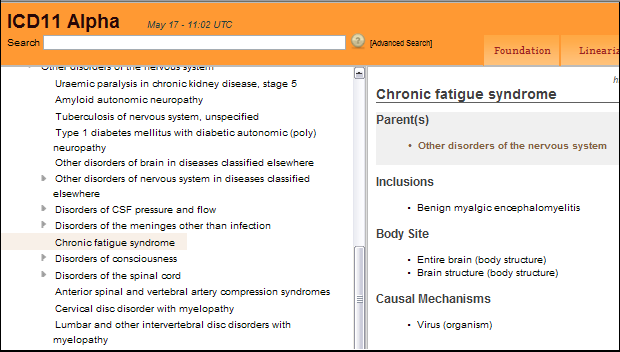
Screenshot from ICD11 Alpha  retrieved May 19 – 11.02 UTC    Chapter 6: Linearizations Tab > Morbidity selected

    »  http://apps.who.int/classifications/icd11/browse/l-m/en#/@_@who_3_int_1_icd_2_G93_3_3


Slipping Timeline

In May, I reported that the revision of ICD-10 and development of ICD-11 is running about a year behind targets for the population of content and software development and that the ICD-11 Timeline for Alpha and Beta drafting has been adjusted [1]. In order to meet its revised schedule, the technical work on ICD-11 will need to be completed by 2013, the year the APA’s DSM-5 is slated for publication. 

Drafting platforms

In November 2010, the iCAT platform through which ICD-11 was being drafted was taken out of the public domain. In May, this year, an ICD-11 Alpha browser was released for public viewing [2], with a number of caveats [3].

This most recently published Alpha platform does not include many of the “Content Model” parameters, for example, no draft “Definitions” are included and neither are the  “Discussion Notes” and “Change Histories” that had been viewable in the iCAT, as it stood last June to November. You can see screenshots of the June to November 2010 version of the iCAT in this post [4].

For screenshots from the most recent Alpha Browser for:

Chapter 6: Diseases of the nervous system > 06L Other disorders of the nervous system > 06L00 Chronic fatigue syndrome

see this post [5] or pull up the Alpha Browser pages, here [6].

As you’ll see, ICD-10 Chapter VI (6) is undergoing reorganization and the parent class “G93 Other disorders of brain” under which “Postviral fatigue syndrome”, “Benign myalgic encephalomyelitis” and many other ICD-10 categories had sat is proposed to be removed. A change of hierarchy between “Postviral fatigue syndrome” and “Chronic fatigue sydrome” is recorded in a “Change History” note.

Reorganization of Chapter 6 Diseases of the nervous system

Chapter 6 categories for ICD-11 are currently assigned the codes 06A thru 06L02. It is not known what codes will eventually be assigned to the categories within ICD-11 Chapter 6. As you’ll see from the screenshots, “06L00 Chronic fatigue syndrome” is proposed to be classified under “06L Other disorders of the nervous system”, with “Benign myalgic encephalomyelitis” specified as an Inclusion term to “06L00 Chronic fatigue syndrome”.

Relationships between Inclusion terms are not specified within ICD-10, but they will be specified within ICD-11.

Go here for ICD-11 Chapter 5 “Neurotic, stress-related and somatoform disorders” > Somatoform Disorders and Neurasthenia:

http://apps.who.int/classifications/icd11/browse/f/en#/@_@who_3_int_1_icd_2_F45

http://apps.who.int/classifications/icd11/browse/f/en#/@_@who_3_int_1_icd_2_F48_3_0

Go here for ICD-11 Chapter 18 “Symptoms, signs and abnormal clinical and laboratory findings, not elsewhere classified” > Malaise and fatigue:

http://apps.who.int/classifications/icd11/browse/l-m/en#/@_@who_3_int_1_icd_2_R53


The Revision Steering Group (RSG) and the various ICD Revision Topic Advisory Groups (TAGs) and their external reviewers for content and proposals are using a more layered version of the platform on which they are undertaking the ongoing drafting process; their platform is currently accessible only to WHO, ICD Revision and IT technicians.

The public version of the ICD-11 Alpha Browser, which is being updated daily, is currently open for public viewing only – not for commenting on. But in July, ICD Revision is planning to open up the Alpha Browser for one year for public commenting and consultations.

Extracts from: http://www.who.int/classifications/icd/revision/en/index.html

ICD-11 Timeline

Compiled from the most recent Timelines [1] [7]:

May 2011: Alpha Browser opened up for public viewing [Reached]

July 2011: Alpha Browser opened up for public commenting

+1 year for Commentaries and consultations

May 2012: Beta version opened up to public and Field Trials Version

+2 years for Field trials

2014: Final version for public viewing

May 2015: Presentation of the final version for World Health Assembly (WHA) Approval

Stakeholder participation

The WHO will be engaging with stakeholders who express an interest in participating in the ICD revision process.

Individuals may register to:

Make comments

Make proposals to change ICD categories

Participate in field trials

Assist in translating

The drafting browsers will be open all year round, subject to continuous daily updates and open to all interested stakeholders – Health Care Providers, Information Managers etc. Proposals and feedback will be subject to structured peer review by the Topic Advisory Groups.

For more information on how stakeholder participation is being projected see presentation slides in these reports on my site [8] [9].

Registering for participation

It’s currently unclear which classes of stakeholder might be called upon to participate, and to what extent, during the Alpha drafting stage.

The Stakeholder Registration Form [10] currently appears geared for participation by medical and allied health professionals and administrators. Irrespective of whether the “Yes” or “No” field for the question “Are you a health care professional?” is selected, one is presented with the same options:

Register to become involved

http://www.who.int/classifications/icd/revision/en/index.html

WHO wants to know if you are interested in being involved in the ICD Revision. We will contact you as certain features are opened to the public.

What is your clinical profession?

Medicine

Psychology

Nursing

Counselling

Social Work

Health Information Manager

Coder

Which of the following describes your highest educational attainment? Pre-University; University Degree; Non-doctoral post graduate degree (e.g. Master’s;) Doctoral degree (PhD, post bachelor’s MD, or similar)

Are you interested in participating in:

Making proposals

Peer-reviewing

Field trials

I will check the form again, once the Alpha draft has been opened up for public comment, currently scheduled for July. It is anticipated that an Alpha browser using different software from that currently in use may be released in July. I will update when the browser is opened up for public comment.

The ICD-11 “Content Model”

The WHO’s, Dr Bedhiran Üstün, describes ICD-10 as a “laundry list”. One of the most significant differences between ICD-10 and the forthcoming ICD-11 will be the “Content Model”.

Content Model

http://www.who.int/classifications/icd/revision/contentmodel/en/index.html

The content model is a structured framework that captures the knowledge that underpins the definition of an ICD entity.

Represents ICD entities in a standard way

Allows computerization

Each ICD entity can be seen from different dimensions or “parameters”. E.g. there are currently 13 defined main parameters in the content model to describe a category in ICD (see below).

A parameter is expressed using standard terminologies known as “value sets”

Content Model Parameters

ICD Entity Title

Classification Properties

Textual Definitions

Terms

Body System/Structure Description

Temporal Properties

Severity of Subtypes Properties

Manifestation Properties

Causal Properties

Functioning Properties

Specific Condition Properties

Treatment Properties

Diagnostic Criteria

For more information on the application of the “Content Model” see document [11].

Definitions

There are no definitions inlcuded in any volume of ICD-10 for  “Postviral fatigue syndrome”, “Benign myalgic encephalomyelitis” or “Chronic fatigue syndrome”. WHO has never set out what it understands by these terms nor has it specified what ICD-10 understands the relationships between these three terms to be (see page: https://dxrevisionwatch.wordpress.com/icd-11-me-cfs/) but there will be definitions in ICD-11 and the relationships between Inclusion terms will be specified.

Definitions

http://www.who.int/classifications/icd/revision/def/en/index.html

All ICD entities will have definitions: key descriptions of the meaning of the category in human readable terms – to guide users

Limited definition in Print Version – 100 words

Detailed definitions ONLINE

Definitions will be compatible with:

– the Content Model

– Diagnostic Criteria

– across the whole classification and the versions

Versions of ICD-11 are planned for multiple settings:

Primary Care

Clinical Services

Research

Specialty Adaptations of ICD-11 are being planned for:

Children and Youth

Oncology

Mental Health

Neurology

Musculoskeletal

Dermatology

Dentistry

————————————–

Sources, references and further reading:

ICD-11 Revision on main WHO website

http://www.who.int/classifications/icd/revision/en/

1] ICD-11 Revised Timeline

http://www.who.int/classifications/icd/revision/timeline/en/index.html

2] ICD-11 Alpha Browser Platform

http://apps.who.int/classifications/icd11/browse/f/en

3] ICD-11 Alpha Browser Caveats

http://www.who.int/classifications/icd/revision/caveat/en/index.html

4] Article: iCAT collaborative authoring platform, June to November 2010, screenshots and notes

https://dxrevisionwatch.wordpress.com/2010/06/07/pvfs-me-cfs-and-the-icd-11-alpha-draft-and-icat-collaborative-authoring-platform/

5] Article: ICD-11 Alpha Browser Platform, screenshots and notes for Chapter 6: Diseases of the nervous system > 06L Other disorders of the nervous system > 06L00 Chronic fatigue syndrome

https://dxrevisionwatch.wordpress.com/2011/05/19/icd-11-alpha-drafting-platform-launched-17-may-public-version/

6] ICD-11 Alpha Browser Platform: ICD-11 entity “06L00 Chronic fatigue syndrome”

Foundation:

http://apps.who.int/classifications/icd11/browse/f/en#/@_@who_3_int_1_icd_2_G93_3_3

Linearizations Morbidity:

http://apps.who.int/classifications/icd11/browse/l-m/en#/@_@who_3_int_1_icd_2_G93_3_3

7] ICD-11 Timeline: PowerPoint presentation (in PDF format)

http://unstats.un.org/unsd/class/intercop/expertgroup/2011/AC234-P32.PDF

8] Article: ICD Revision Process Alpha Evaluation Meeting documents and PowerPoint slide presentations

https://dxrevisionwatch.wordpress.com/2011/04/19/icd-revision-process-alpha-evaluation-meeting-presentations/

9] Article: ICD-11 Revision Steering Group struggling to meet targets for release of Beta Draft platform in May

https://dxrevisionwatch.wordpress.com/2011/04/11/icd-11-struggling-to-meet-targets-for-release-of-beta-draft-in-may/

10] Register for participation in ICD-11 Alpha drafting process

http://www.who.int/classifications/icd/revision/en/

Stakeholder Registration form

https://spreadsheets.google.com/spreadsheet/viewform?formkey=dDVabnF1RFpTQkVnVEN2TXhVRm55MGc6MQ

[11] ICD-11 Content Model Reference Guide version January 2011

http://sites.google.com/site/icd11revision/home/documents

https://dxrevisionwatch.com/wp-content/uploads/2011/02/content20model20reference20guide20january2020111.doc

Minutes: Chronic Fatigue Syndrome Advisory Committee (CFSAC) Spring meeting: May 10 – 11

Minutes: Chronic Fatigue Syndrome Advisory Committee (CFSAC) Spring meeting: May 10 – 11

Post #95 Shortlink: http://wp.me/pKrrB-1dP

“The Chronic Fatigue Syndrome Advisory Committee (CFSAC) provides advice and recommendations to the Secretary of Health and Human Services via the Assistant Secretary for Health of the U.S. Department of Health and Human Services on issues related to chronic fatigue syndrome (CFS). These include:

  • factors affecting access and care for persons with CFS;
  • the science and definition of CFS; and
  • broader public health, clinical, research and educational issues related to CFS.

“Administrative and management support for CFSAC activities is provided by the Office of the Assistant Secretary for Health (OASH). However, staffing will continue to be provided primarily from the Office on Women’s Health, which is part of OASH.”


The twentieth meeting of CFSAC Committee was held in Washington, DC, over two days in May.

Minutes for the proceedings on Day One (May 10) are now published on the CFSAC website. I will update this post when Minutes for Day Two (May 11) and the Recommendations resulting out of this meeting are also published.

Chronic Fatigue Syndrome Advisory Committee (CFSAC)

Meeting May 10-11, 2011

Documents

CFSAC website  

Agenda CFSAC Meeting May 10 – 11  

Presentations and Public Testimonies

Videocasts Day One and Two

Meeting background documents

Recommendations [not yet published]

Minutes Day One (May 10)

Minutes Day Two (May 10) [not yet published]

Open in PDF format: CFSAC Minutes 10 May 2011

43 Pages in PDF format

The Twentieth Meeting of THE CHRONIC FATIGUE SYNDROME ADVISORY COMMITTEE US DEPARTMENT OF HEALTH AND HUMAN SERVICES

Hubert H. Humphrey Building, Room 712E, 200 Independence Avenue, SW

Washington, DC 20101

Tuesday, May 10, 2011 – 9:00 am to 5:00 pm

Discussion of concerns around the long-standing proposals for the coding of Chronic Fatigue Syndrome in the forthcoming US specific “Clinical Modification” of ICD-10, known as “ICD-10-CM”, had been tabled on the agenda at 1.15pm on Day One of  the meeting. 

ICD-10-CM has been under development for many years. A public comment period ran from December 1997 through February 1998.

In 2001, the CDC were recommending that Postviral fatigue syndrome, Benign myalgic encephalomyelitis and Chronic Fatigue Syndrome should all be classified within Chapter 6 Diseases of the nervous system at G93.3, in line with the international ICD-10, from which ICD-10-CM was being adapted for US use.

By 2007, the proposal was (and still stands) that Postviral fatigue syndrome and Benign myalgic encephalomyelitis would be classified in Chapter 6 at G93.3, but that Chronic Fatigue Syndrome would be retained in the R codes (which will be Chapter 18 in ICD-10-CM) and coded under R53 Malaise and fatigue > R53.82 Chronic fatigue, unspecified” > chronic fatigue syndrome NOS, Excludes1: postviral fatigue syndrome (G93.3).

The history of the coding of PVFS, (B)ME and Chronic fatigue syndrome in ICD to 2001 is set out in this CDC document: http://www.co-cure.org/ICD_code.pdf

At the May 10 CFSAC meeting, around 50 minutes was given over to discussion of this agenda item which resulted in a motion proposing a new Recommendation to HHS that was unanimously voted in favour of by the committee.


As I have a particular interest in this issue, I have interspersed this section of the Minutes with notes addressing a number of errors and misunderstandings. My comments are inserted in blue, bold.

As these notes are inserted into official Minutes I give no permission to re-publish as both the formatting and the integrity of an official document will be lost – so permission to link to this post only.

Discussion of International Classification of Diseases-Clinical Modification (ICD-CM)

Page 27:

LUNCH

The Chronic Fatigue Syndrome Advisory Committee recessed for lunch for one hour.

Discussion of International Classification of Diseases-Clinical Modification (ICD-CM) concerns

DISCUSSION OF INTERNATIONAL CLASSIFICATION OF DISEASES – CLINICAL MODIFICATION (ICD-CM) CONCERNS

Dr. Christopher Snell

Brought the meeting to order. Noted they would have a discussion of the ICD-related questions and the proposed reclassification of chronic fatigue syndrome.

Chronic fatigue syndrome is not being “reclassified” as such for ICD-10-CM, but being proposed to be retained in the R codes, as a legacy of ICD-9-CM, rather than follow international ICD-10.

Advised there was a page in the members’ notebooks tabbed after the State of the Knowledge summary which noted key steps in the development of the ICD 10 CM, so a clinical modification of the World Health Organization’s (WHO) ICD 10. It would replace ICD 9.

Stated his understanding of the issues:

o Disconnect between the way the U.S. uses the classification and the rest of the world.

o The way CFS is classified under the ICD system has implications for both reporting of incidents, morbidity and mortality.

o Used by outside agencies to categorize the illness for purposes of inclusion or exclusion.

Opened the floor for discussion.

Dr. Wanda Jones

Clarified that the committee requested that the National Center for Health Statistics have someone to talk to them about the international classification of diseases, about the process, about how the U.S. adapts the WHO index, the ICD for use and about opportunities for dialogue.

Noted that a meeting was set a year ago for May 10 and 11 in Baltimore that engaged resources for the CMS, parts of the federal government focused on health IT and the entire ICD team from the National Center for Health Statistics (NCHS). Noted that as a result no one was available for the CFSAC meeting.

In lieu of their attendance, she developed some questions that the NCHS, ICD team responded to.

PDF of Dr Jones’ background document here: ICD-related questions from CFSAC for May 2011 meeting
http://www.hhs.gov/advcomcfs/meetings/presentations/icd_ques201105mtng.pdf

Tried to clarify the questions so they would have a good understanding of the key processes and the key inflection points differentiating the WHO process from the U.S. ICD-CM, the clinical modification process.

Raised additional questions regarding how alignment from prior versions is maintained and how ICD coding is used in decision-making. Noted also the relationship between the coding and the diagnostic and statistical manual (DSM).

Stated that the information was provided by the NCHS and is meant to generate discussion.

Stated that the ICD-CM process is a public process with regularly scheduled public meetings. Noted that there is an opportunity to comment as part of that process and to engage. Confirmed that the NCHS stated that there has been no public presence from the CFS community at the meetings. Noted that this was the process for people interested in CFS coding to become involved.

Confirmed that there was a lock procedure that is soon to be executed for the ICD 10 CM. Noted it had been in development for a decade and the United States’ move to electronic records means it has to temporarily lock the codes. The electronic health records software would not be ready if they keep changing them.

Noted that information about coding changes would continue to be collected, taken under advisement and the NCHS would continue the process of evaluating. Stated that once it is in public use then that lock will release and there would be an opportunity on a periodic basis for updating.

Dr. Leonard Jason

Stated that the committees are developing ICD 10 CM and it intends to retain CFS in R codes (R53.82) and this means that the symptoms, signs, abnormal results of clinical or other investigative procedures are ill-defined conditions.

Stated that R-codes means it’s an ill-defined condition regarding which no diagnosis is classifiable elsewhere. Explained that if it cannot be diagnosed elsewhere in ICD 10 it goes into a R-code.

The intention in ICD 11 is to put CFS with two other conditions (post viral fatigue syndrome and benign myalgic encephalomyalitus [sic]) under a G-code, being G93.3 or diseases of the nervous system.

For ICD-11, the proposal is to classify all three terms within Chapter 6 Diseases of the nervous system but these categories may not retain the familiar “G93.3” code.

For ICD-11, the parent class “G93 Other disorders of brain” is proposed to be removed (this will affect many categories classified under or indexed to a code that is currently a child to the G93 parent class in ICD-10).

For ICD-11, categories within Chapter 6 Diseases of the nervous system are being reorganised and different codes have been assigned to Chapter 6 categories to those used in ICD-10. “Chronic fatigue syndrome” is proposed to be an ICD Title code and is currently assigned the code “06L00” in the ICD-11 Alpha Draft, under new parent class “06L Other disorders of the nervous system”.

For ICD-11, “Benign myalgic encephalomyelitis” is specified as an Inclusion term to “06L00 Chronic fatigue syndrome”. A change of hierarchy is recorded in the iCAT Alpha drafting platform for “Postviral fatigue syndrome” and “Chronic fatigue syndrome”.

See Dx Revision Watch report: ICD-11 Alpha Drafting platform launched 17 May (public version) for screenshots from the latest version of the ICD-11 Alpha Draft: http://wp.me/pKrrB-16N

Noted that coding CFS under the R-code in the proposed ICD 10 CM would place it out of line with the International ICD 10 used in over 100 countries. Discussed the problems and implications of the U.S. coding of CFS as compared with how other countries are coding it. It would exclude it from the R53 malaise and fatigue codes, which would imply that CFS does not have a viral etiology.

That last sentence does not make sense. Retaining CFS under the R codes would exclude it from the Chapter 6, G93.3 classification.

Proposals for ICD-10-CM have “chronic fatigue syndrome NOS (R53.82)” specified as an Exclusion to “G93.3 Postviral fatigue syndrome > Benign myalgic encephalomyelitis”.

Proposals for ICD-10-CM have “Postviral fatigue syndrome (G93.3)” specified as an Exclusion to the “R53 Malaise and fatigue > R53.82 Chronic fatigue, unspecified” > Chronic fatigue syndrome NOS codes.

Brought forward a motion to be considered:

CFSAC rejects current proposals to code CFS in Chapter 18 of ICD 10 CM under R53.82 chronic fatigue syndrome unspecified, chronic fatigue syndrome NOS (not otherwise specified). CFSAC continues to recommend that CFS should be classified in the ICD 10 CM in Chapter 6 under diseases of the nervous system at G93.3 in line with international ICD 10 in ICD 10 CA which is the Canadian clinical modification and in accordance with the committee’s recommendation which we made in August of 2005. CFSAC considers CFS to be a multi-system disease and rejects any proposals to classify CFS as a psychiatric condition in U.S. disease classification systems.

Previous CFSAC recommendations for ICD-10-CM had read:

May 2010 CFSAC recommendation: CFSAC rejects proposals to classify CFS as a psychiatric condition in U.S. disease classification systems. CFS is a multi-system disease and should be retained in its current classification structure, which is within the “Signs and Symptoms” chapter of the International Classification of Diseases 9-Clinical Modification (ICD 9-CM).

August 2005 CFSAC recommendation: Recommendation 10: We would encourage the classification of CFS as a “Nervous System Disease,” as worded in the ICD-10 G93.3.

Noted that ME and CFS patients could be potentially vulnerable to the current DSM 5 proposals because those proposals are highly subjective and difficult to quantify. Noted that retaining the CFS in the R-codes in the IDC 10 CM differentiates the U.S. from other countries but it renders CFS and ME patients more vulnerable to some of the DSM 5 proposals, notably chronic complex symptom disorder [sic].

Should be “Complex Somatic Symptom Disorder”, not as above.

Dr. Klimas asked for clarification, and Dr. Jason said that in 2013 they would move from DSM 4 to DSM 5. As it stands they would be collapsing somatization disorder, undifferentiated somatoform disorder, hypochondriasis and some presentations of panic disorder into complex somatic symptom disorder. Dr. Klimas clarified that his concern was that the CFS ICD 9 codes would put the non post viral patients into this somatoform cluster. Dr. Jason indicated that this was so.

Should be “pain disorder” not “panic disorder”.

Dr. Klimas seconded the motion.

Mr. Krafchick agreed and stated that the ramifications of the classification would be disastrous for patients, because it would limit disability payments to two years. Dr. Jones clarified that for now the clock was ticking, however once the codes were released, they could be revised, it’s just the implementation of the electronic system which is causing it to be locked at a particular point in time. While CFSAC has shared concerns with NCHS, there is an official process for engaging with them on their discussions regarding the codes. The US was interested in morbidity, in case claims. It is important that providers know how to best categorize things, and provide guidance on which codes to consider based on the science for the disease being evaluated.

Mr. Krafchick stated that the issue was that the criteria for the codes was etiology/trigger based. Dr. Jones clarified that it would still remain in the clinician’s judgment, however if they could not identify where the trajectory developed toward CFS, then it would wind up in the R codes. Dr. Jones clarified also that the NCHS does not view the R category as a somatoform disorder. Mr. Krafchick and Dr. Snell indicated they understood this but it would still represent vulnerability for patients when classifying.

(The justification given by CDC for not mirroring ICD-10 is this: If the clinician feels there is enough evidence to attribute the patient’s illness to a viral illness, they can code at G93.3; if not, they can code at R53.82 Chronic fatigue syndrome NOS. Testing for a viral illness is not required to assign a code, the coding would be based on the clinician’s judgment.)

Dr. Jason restated his recommendation.

Dr. Marshall stated his concern that there was an attendant risk with this, but that they were between a rock and a hard place. He agreed CFS/ME being classified as a somatoform disorder was inappropriate, but at the same time that the recommendation says it’s a complex multi-system disease, it categorizes it within a single nervous system disease silo. This might affect future research funding opportunities with people saying they don’t fund neurological research. He expressed the view that they should advocate for classification in a multi-system disease category rather than putting it in a nervous system disease category for future, though this category did not exist now. It would be a good thing for patients short term, but it could be a long term risk.

Dr. Snell said that given the amount of current funding, this wasn’t a risk. Dr. Marshall said that using reverse translational research as had been advocated during the meeting might increase the role of this categorization, and could be restrictive in funding.

Dr. Jones asked whether the recommendation being put forward was the same as the May 2010 recommendation, and Dr. Jason said that his was dramatically different. Mr. Krafchick underscored how the insurance companies use these ICD codes. If it was classified in something that could be psychiatric it will be psychiatric, so they can deny coverage.

Dr. Levine asked about co-morbid disorders and how these are weighted. Dr. Jones responded that she did not think that there was a weighting. It would get listed like a death certificate, a cause of death and then a secondary, sometimes a third. She stated it was the judgment of the clinician how it was listed.

Dr. Klimas expressed the view that coding was also problematic because clinicians code to get paid. There already exists a bias against coding CFS as CFS because the codes could not be used for billing. She stated that they would make a conscious decision not to code CFS as CFS. She indicated that neurology was a fine place for it to be categorized, and at least this would assist people who may be looking for patient data, as it wouldn’t be ignored.

Dr. Snell asked for a vote of all those in favor regarding Dr. Jason’s motion. The motion passed unanimously.

Dr. Jones noted that she would share this recommendation with the NCHS but repeated that unless someone moved forward to intervene in the official processes in the public record it may not move forward or have an effect.

Dr. Jones noted that the next ICD meeting is September 14 – 15, 2011 with public comments due July 15. Noted this will be put on the CFSAC website.

A link has been placed on the CFSAC site for the CDC page for information on meetings of the ICD-9-CM Coordination and Maintenance Committee  

She noted she would check the rules to see if a member of the CFSAC or the Chair would be able to give public testimony at another advisory committee meeting. Mr. Krafchick said that if it were possible to send someone as a member of the committee, it would make a great deal of sense and be very important. Dr. Jones said they would figure out how this could happen. Ms. Holderman asked whether this notice, and any future notices where they might want to intervene, could be placed on the CDC website. She stated this cross listing would be useful.

Dr. Jones said that from her experience with the fast evolving HIV coding, there was a dialogue so that coding kept up. She expected there would be some connection, however not as comprehensive or active as that disease.

Dr. Mary Schweitzer, a member of the public, stated that the NCHS did come to CFSAC in 2005 and Dr. Reeves at the time was specific and said that CFS needed to be in R53 due to his own method of diagnosis. She suggested that this showed an obvious connection between the CFS side of CDC and NCHS at the time.

[Discussion of this agenda item ends.]

As these are my notes inserted into an extract from official Minutes, no permission to republish. The Shortlink to this post is http://wp.me/pKrrB-1dP. The PDF of the Minutes for Day One (May 10) is here: CFSAC Minutes 10 May 2011

Related material:

[1] Post: CFS orphaned in the “R” codes in US specific ICD-10-CM: http://wp.me/pKrrB-V4

[2] International Classification of Diseases, Tenth Revision, Clinical Modification (ICD-10-CM). Note: The 2011 release of ICD-10-CM is now available and replaces the December 2010 release:
http://www.cdc.gov/nchs/icd/icd10cm.htm

[3] Post: US “Clinical Modification” ICD-10-CM. Article clarifying possible confusion between ICD-10, ICD-11 and the forthcoming US Clinical Modification, ICD-10-CM: http://wp.me/pKrrB-Ka

[4] Chronic Fatigue Syndrome Advisory Committee (CFSAC). The Chronic Fatigue Syndrome Advisory Committee (CFSAC) provides advice and recommendations to the Secretary of Health and Human Services via the Assistant Secretary for Health of the U.S. Minutes of meetings, Recommendations and meeting videocasts:
http://www.hhs.gov/advcomcfs/meetings/index.html

Final Call for Action by UK patient orgs – Second DSM-5 public comment period closes 15 June

Final Call for Action by UK patient orgs – Second DSM-5 public comment period closes 15 June

Post #86 Shortlink: http://wp.me/pKrrB-19G

This communication has been sent to the following organizations:

Action for M.E.; The ME Association; AYME; The Young ME Sufferers Trust; The 25% ME Group; RiME; Invest in ME; BRAME; ME Research UK; Mrs Sue Waddle

A version of this communication will be posted on Co-Cure and selected platforms.

Final Call for Action by UK patient organizations


Second DSM-5 public comment period closes 15 June

29 May 2011

The above organizations were alerted to this second public review period on 5 May, the day after revised criteria were posted on the American Psychiatric Association’s DSM-5 Development website.

To date, not one patient organization in the UK has confirmed to me that they intend to submit feedback, this year. Please take some time to review these proposals and prepare a submission or consider submitting a joint response with another UK patient organization.

The American Psychiatric Association (APA) DSM-5 Task Force is again accepting public comment on the latest proposals for the revision of DSM diagnostic criteria for psychiatric disorders.

The deadline for this second stakeholder feedback period is June 15 – less than three weeks away!

Is this a US specific issue?

No. UK and international input is required from patient organizations.

The DSM-5 “Somatic Symptom Disorders” Work Group has responsibility for the revision of the existing DSM-IV “Somatoform Disorders” categories. Two UK Professors of psychological medicine and research, Professor Michael Sharpe and Professor Francis Creed, are members of the Somatic Symptom Disorders Work Group.

The Diagnostic and Statistical Manual of Mental Disorders is the primary diagnostic system in the US for defining mental disorders and is used to varying extent in other countries. The next edition of the manual is scheduled for publication in 2013 and will inform health care providers and policy makers for many years to come. DSM-5 will shape international research, influence literature in the fields of psychiatry and psychosomatics and inform perceptions of patients’ medical needs throughout the world.

All UK patient organizations need to submit responses in this second review, even if they submitted last year. The latest key documents that expand on the proposals are attached for ease of reference. (Note: These documents have been revised several times since last year’s public review. Yellow highlighting has been applied by the Work Group to indicate edits and revisions between these latest versions and the texts as they had stood, earlier this year.)

What is being proposed?

The DSM-5 “Somatic Symptom Disorders” Work Group is recommending renaming the “Somatoform Disorders” section to “Somatic Symptom Disorders” and combining the existing categories – “Somatoform Disorders”, “Psychological Factors Affecting Medical Condition (PFAMC)” and possibly “Factitious Disorders”, into one group.

(“Somatic” means “bodily” or “of the body”.)

The Work Group also proposes combining “Somatization Disorder”, “Hypochondriasis”, “Undifferentiated Somatoform Disorder” and “Pain Disorder” under a new category entitled “Complex Somatic Symptom Disorder” (CSSD). There is also a “Simple or Abridged Somatic Symptom Disorder” (SSSD) and a proposal to rename “Conversion Disorder” to “Functional Neurological Disorder”.

[Content removed as criteria for draft two superceded by criteria for draft three.]

If the various proposals of the Somatic Symptom Disorders Work Group were approved, there are considerable concerns that patients with a diagnosis of CFS, ME or PVFS, or awaiting diagnosis, would be vulnerable to the application of an additional “bolt-on” mental health diagnosis of a Somatic Symptom Disorder like “CSSD”, “SSSD” or “PFAMD”, or of misdiagnosis with a Somatic Symptom Disorder.

Because the APA and the WHO have a joint commitment to strive for harmonization between category names, glossary descriptions and criteria for DSM-5 and the corresponding categories in Chapter 5 of the forthcoming ICD-11, there could be implications for the revision of the “Somatoform Disorders” section of ICD-10 and therefore implications for UK patients – both adults and children.

Where can I find the full criteria for “CSSD”, “PFAMC” and other proposed categories?

Proposed criteria are set out on the DSM-5 Development site here: http://tinyurl.com/Somatic-Symptom-Disorders

The CSSD criteria are here: http://tinyurl.com/DSM-5-CSSD

There are two key PDF documents, “Disorders Descriptions” and “Rationale”, which expand on the Work Group’s proposals (attached for your convenience)

             Disorders Description   Key Document One: “Somatic Symptom Disorders”

             Rationale Document     Key Document Two: “Justification of Criteria — Somatic Symptoms”


Which patient groups might be hurt by these proposals?

The Chronic Fatigue Syndrome Advisory Committee (CFSAC) provides advice and recommendations to the US Secretary of Health and Human Services (HHS). On Day One of the May 10-11 CFSAC meeting, CFSAC Committee discussed the implications of these proposals for CFS, ME and Fibromyalgia patients as part of the agenda item around concerns for the proposed coding of CFS for the forthcoming ICD-10-CM.

If the Work Group’s proposals gain DSM Task Force approval, all medical diseases, whether “established general medical conditions or disorders”, like diabetes or heart disease, or conditions presenting with “somatic symptoms of unclear etiology” will have the potential for an additional diagnosis of a “somatic symptom disorder” – if the clinician considers that the patient’s response to their bodily symptoms and concerns about their health or the perception of their level of disability is “disproportionate”, or their coping styles, “maladaptive.”

But as discussed by CFSAC Committee members, patients with CFS, ME, Fibromyalgia and IBS (the so-called “Functional somatic syndromes”) may be especially vulnerable to the highly subjective criteria and difficult to measure concepts such as “disproportionate distress and disability”, “catastrophising”, “health-related anxiety” and “[appraising] bodily symptoms as unduly threatening, harmful, or troublesome.”

In a 2009 Editorial on the progress of the Work Group, the Work Group Chair wrote that by doing away with the “controversial concept of medically unexplained”, their proposed classification might diminish “the dichotomy, inherent in the ‘Somatoform’ section of DSM-IV, between disorders based on medically unexplained symptoms and patients with organic disease.” The conceptual framework the Work Group proposes:

“…will allow a diagnosis of somatic symptom disorder in addition to a general medical condition, whether the latter is a well-recognized organic disease or a functional somatic syndrome such as irritable bowel syndrome or chronic fatigue syndrome.”

In its latest proposals, the Work Group writes:

“…Having somatic symptoms of unclear etiology is not in itself sufficient to make this diagnosis. Some patients, for instance with irritable bowel syndrome or fibromyalgia would not necessarily qualify for a somatic symptom disorder diagnosis. Conversely, having somatic symptoms of an established disorder (e.g. diabetes) does not exclude these diagnoses if the criteria are otherwise met.”

“…The symptoms may or may not be associated with a known medical condition. Symptoms may be specific (such as localized pain) or relatively non-specific (e.g. fatigue). The symptoms sometimes represent normal bodily sensations (e.g., orthostatic dizziness), or discomfort that does not generally signify serious disease…”

“…Patients with this diagnosis tend to have very high levels of health-related anxiety. They appraise their bodily symptoms as unduly threatening, harmful, or troublesome and often fear the worst about their health. Even when there is evidence to the contrary, they still fear the medical seriousness of their symptoms. Health concerns may assume a central role in the individual’s life, becoming a feature of his/her identity and dominating interpersonal relationships.”

These proposals could result in misdiagnosis of a mental health disorder or the misapplication of an additional diagnosis of a mental health disorder in patients with CFS and ME. There may be considerable implications for these highly subjective criteria for the diagnoses assigned to patients, the provision of social care, the payment of employment, medical and disability insurance, the types of treatment and testing insurers and health care providers are prepared to fund, and the length of time for which insurers are prepared to pay out.

Dual-diagnosis of a “general medical condition” or a so-called “functional somatic syndrome” plus a “bolt-on” diagnosis of a “Somatic symptom disorder” may bring thousands more patients, potentially, under a mental health banner where they may be subject to inappropriate treatments, psychiatric services, antidepressants and behavioural therapies such as CBT, for the “modification of dysfunctional and maladaptive beliefs about symptoms and disease, and behavioral techniques to alter illness and sick role behaviors and promote more effective coping [with their somatic symptoms].”

Who should submit comment on these proposals?

All stakeholders are permitted to submit comment and the views of patients, carers, families and advocates are important.

But evidence-based submissions from the perspective of informed medical professionals – clinicians, psychiatrists, researchers, allied health professionals, lawyers and other professional end users are likely to have more influence. Patient organizations also need to submit comment.

Where can I read last year’s submissions?

Copies of international patient organization submissions for the first DSM-5 public and stakeholder review are collated on this page of my site, together with selected patient and advocate submissions:

DSM-5 Submissions to the 2010 review: http://wp.me/PKrrB-AQ

How to comment:

Register to submit feedback via the DSM-5 Development website: http://tinyurl.com/Somatic-Symptom-Disorders

More information on registration and preparing submissions here: http://tinyurl.com/DSM-5-register-to-comment

This is the last alert I shall be sending out. I hope all UK patient organisations will take this opportunity to submit their concerns.

Remember, the deadline is June 15.

Thank you.

Suzy Chapman
https://dxrevisionwatch.wordpress.com

ICD-11 Alpha Drafting platform launched 17 May (public version)

ICD-11 Alpha Drafting platform launched 17 May (public version)

Post #81 Shortlink: http://wp.me/pKrrB-16N

This information does not apply to the forthcoming US specific “Clinical Modification” of ICD-10, called ICD-10-CM, scheduled for implementation in October 2013.

Changes to Alpha Draft since May 17, 2011:

May 19 – 11:02 UTC : Code/sorting label assigned to Parent class “Other disorders of the nervous system” changed from 06N to 06L.

Screenshot from ICD11 Alpha  May 17 – 11.02 UTC    Chapter 6 Diseases of the nervous system: Foundation Tab selected

ICD11 Alpha Chapter 6

    »  http://apps.who.int/classifications/icd11/browse/f/en#/@_@who_3_int_1_icd_2_G93_3_3

Screenshot from ICD11 Alpha  May 19 – 11.02 UTC    Chapter 6: Linearizations Tab > Morbidity selected

    »  http://apps.who.int/classifications/icd11/browse/l-m/en#/@_@who_3_int_1_icd_2_G93_3_3


Four new pages were published on the WHO’s main website on 17 May – the revised Timeline for ICD-11, the announcement of an Alpha Draft browser, a Registration form and a Caveat. Yesterday, I posted the revised ICD-11 Revision Timeline.

What can be seen for PVFS, (B)ME and CFS in the public Alpha Draft?

For the Alpha browser, go to this page:

http://www.who.int/classifications/icd/revision/en/index.html

Here it states:

The International Classification of Diseases 11th Revision is due by 2015

ICD is the international standard to measure health & health services

• Mortality statistics
• Morbidity statistics
• Health care costs
• Progress towards the Millenium Development Goals
• Research

– Alpha draft is updated daily as the work progresses
– It is intended to show the new features to stakeholders early
– Commenting will be available in July 2011

The link for the alpha browser is:

http://apps.who.int/classifications/icd11/browse/f/en

This is the link to a page for “Caveats”

“Read more on what to expect in the ICD-11 Alpha Draft”

ICD-11 Alpha Draft Caveats

ICD-11 alpha draft is:

• Incomplete
• May contain errors, omissions or imperfections
• The work in different chapters are at different stages
• The alpha drafting work is going on by the WHO, Revision Steering Group and Topic Advisory Groups
• The alpha draft is going to be updated on a daily basis
• The alpha draft is NOT TO BE USED for CODING at this stage
• The alpha draft has not yet been approved by the Topic Advisory Groups, Revision Steering Group or WHO

Click here to access the public Alpha Draft browser

Poke around and open the Parent and Child categories and the Tabs – you cannot edit or break anything.

This new interface is not as detailed or as easy to navigate as the software version of the iCAT collaborative drafting platform that was in the public domain up until November, last year. Less information is visible, for example, some of the paramenter tabs, including “Definitions”. (Compare with what could be seen in this iCAT screenshot from last June.)

This is a public draft and another platform is being used by ICD Revision for ongoing drafting. The public draft will be updated as the work of the various Topic Advisory Groups and working groups progresses. ICD Revision has not reached its targets for the generation of content and population of “Content Model” fields across all chapters and this draft is not as far forward as ICD Revision had projected for a May 2011 release.

Though viewable now, the Alpha drafting browser is not planned to be open for public comment until July, this year. It’s not yet clear which classes of public stakeholder will be able to participate in the drafting process, come July, or to what extent.

If you are interested in the proposed public comment, interaction and input processes for the Alpha and Beta drafting stages, see this DSM-5 and ICD-11 Watch post for meeting presentation slides.

Summary

First a caveat: It had been anticipated that a Beta drafting platform would be released in May, this year. WHO has cited lack of content and underdeveloped software for delaying the launch of a Beta drafting platform.

This public version of an Alpha drafting platform is a “work in progress”; not all disease and disorder categories may have been entered into the draft and proposed textual content is in the process of being authored and reviewed by the various Topic Advisory Groups, ICD Revision Steering Group and external peer reviewers.

From what can be seen, today, 19 May:

06L00 Chronic fatigue syndrome

is proposed to be coded within Chapter 6 Diseases of the nervous system (the Neurology chapter), as an ICD Title category, under the Parent class, 06L Other disorders of the nervous system.

Benign myalgic encephalomyelitis is specified as an Inclusion to 06L00 Chronic fatigue syndrome.

“Causal mechanisms” for 06L00 Chronic fatigue syndrome are cited as “Virus (organism)”.

The relationship between ICD Title category 06L00 Chronic fatigue syndrome and Inclusion term Benign myalgic encephalomyelitis is not yet specified, ie whether for ICD-11, “Benign myalgic encephalomyelitis” is proposed to be specified as a Synonym , Subclass or other relationship to “06L00 Chronic fatigue syndrome”.

Many categories within the draft are waiting for their Inclusion terms to be specified, not just the three terms of interest to us.

For explanation of Inclusions and other “Content Model” parameter terms, see: iCAT Glossary or the key ICD-11 Content Model document.

6 Inclusions

Details: Inclusion terms appear in the tabular list [Ed: ICD Volume 1] of the traditional print version and show users that entities are included in the relevant concept. All of the ICD-10 inclusion terms have been imported and accessible in the iCat. These are either synonyms of the category titles or subclasses which are not represented in the classification hierarchy. Since we have synonyms as a separate entity in our ICD-11 content model, the new synonyms suggested by the users should go into the synonyms section. In the future, iCat will provide a mechanism to identify whether an inclusion is a synonym or a subclass.”


What is the proposed relationship between PVFS and CFS?

Postviral fatigue syndrome is not accounted for in the “Foundations” or “Linearizations > Morbidity” listings.

In ICD-10, Postviral fatigue syndrome is an ICD Title category under G93 Other disorders of brain. I cannot confirm, but it may be that due to the hierarchy  change, “Postviral fatigue syndrome” is proposed to be subsumed under “06L00 Chronic fatigue syndrome” with “06L00 Chronic fatigue syndrome” becoming the ICD Title category, because “G93.3 Postviral fatigue syndrome” has lost its ICD-10 Parent category.

At the moment, there is not sufficient information displaying to determine what the intention is. Last June, I requested a clarification from Dr Raad Shakir, chair of Topic Advisory Group for Neurology, but no clarification has been forthcoming.

In the iCAT initial drafting platform, last November, where “Postviral fatigue syndrome” was referenced within a “Category Note” and specified as an Exclusion to Chapter 5 and Chapter 18,  it was referenced as:

“G93.3 Postviral fatigue syndrome -> Gj92 Chronic fatigue syndrome”

[“Note: Gj92” is a “Sorting label” assigned for the initial Alpha drafting process, not an eventual ICD-11 code.]


“Change history” note from May 2010

In ICD-10, “Postviral fatigue syndrome” is a Title code at G93.3 under Parent category “G93 Other disorders of brain”. “Benign myalgic encephalomyelitis” sits under “G93.3 Postviral fatigue syndrome” (relationship unspecified).

As previously reported, an iCAT “Change history” note, dated 1 May 2010, records a “Change in hierarchy for class: G93.3 Postviral fatigue syndrome because its parent category (G93 Other disorders of brain) is removed.”

This would leaves the existing ICD-10 G93.3 Title category, “Postviral fatigue syndrome” and “Benign myalgic encephalomyelitis” that sits beneath it, and also the G93.3 index entry for Chronic fatigue syndrome with no parent category.

Note that the removal of the parent “G93 Other disorders of brain” affects many other categories also classified under G93 in ICD-10 which have also been assigned new parents under the reorganization of Chapter 6 (VI).

Screenshot of “Change history” Note from May 2010


Exclusions

No Exclusions have been specified yet for “06L00 Chronic fatigue syndrome”.

“Postviral fatigue syndrome” is specified as an Exclusion to the following ICD-11 chapters:

Chapter 5 “05E06 Other neurotic disorders > 05E06.00 Neurasthenia”
Chapter 18 “18GF General symptoms and signs > 18F03 Malaise and fatigue.”

(Chapter 18 is the “R code” chapter of ICD-10; ICD-10-CM proposes to retain CFS under R53 Malaise and fatigue at R53.82 Chronic fatigue, unspecified, as “Chronic fatigue syndrome NOS”, with the Exclusion: Postviral fatigue syndrome G93.3.)

Go here for ICD-11 Chapter 5 “Neurotic, stress-related and somatoform disorders” > Somatoform Disorders:

http://apps.who.int/classifications/icd11/browse/f/en#/@_@who_3_int_1_icd_2_F40-F48

Go here for ICD-11 Chapter 18 “Symptoms, signs and abnormal clinical and laboratory findings, not elsewhere classified”:

http://apps.who.int/classifications/icd11/browse/l-m/en#/@_@who_3_int_1_icd_2_XVIII


Congruency with DSM-5 proposals for revision of DSM-IV “Somatoform Disorders”

There is no obvious mirroring of the radical proposals currently being put forward by the DSM-5 Somatic Symptom Disorders Work Group to rename “Somatoform Disorders” to “Somatic Symptom Disorders” and combine a number of existing somatoform categories under a new rubric, “Complex Somatic Symptom Disorder”.


Registering for involvement

There is a Registration form here

This form appears to be aimed at recruiting medical health professionals for putting their names down to be contacted at some point to “Make comments; Make proposals to change ICD categories; Participate in field trials; Assist in translating“. It’s not clear whether or at what point in the Alpha/Beta drafting processes involvement might be extended to non professional stakeholders.

Register to become involved

ICD-11 Registration

“WHO wants to know if you are interested in being involved in the ICD Revision. We will contact you as certain features are opened to the public.”

[Fields are: Family name*; First name*; Email address*; Organization or Company*; LinkedIn ID; Are you a health care professional?* Yes/No. Continue…]   *Required fields


Related information

1] ICD11 Alpha browser

2] ICD Revision Process Alpha Evaluation Meeting documents and PowerPoint slide presentations

3] Key document: ICD Revision Project Plan version 2.1 9 July 2010

4] Key document: Content Model Reference Guide version January 2011

ICD Revision: WHO announces revised Timeline for ICD-11

ICD Revision: WHO announces revised Timeline for ICD-11

Post #79 Shortlink: http://wp.me/pKrrB-16e

The information in this report relates only to ICD-11, the forthcoming revision of ICD-10 that is scheduled for completion and pilot implementation in 2014/15. It does not apply to the forthcoming US specific Clinical Modification of ICD-10, known as ICD-10-CM.

The following has been published on the WHO’s website in the last couple of days. Note that the original timeline had scheduled presentation to the WHA (World Health Assembly) in May 2014, for pilot implementation of ICD-11 in 2014. This most recent timeline for ICD-11 Revision suggests that implementation is being postponed until 2015+.

A WHO news release (if issued) and details on how to access the drafting platform, will be posted as more information becomes available.

http://www.who.int/classifications/icd/revision/timeline/en/

ICD Revision Timelines

May 2011

Open ICD-11 Alpha Browser to the public for viewing

July 2011

Open ICD-11 Alpha Browser to the public for commenting

May 2012

Open ICD-11 Beta to the public

ICD-11 Beta Information
WHO will engage with individuals from an outside community to participate in the ICD revision process.

Individuals will be allowed to:

Make comments
Make proposals to change ICD categories
Participate in field trials
• Assist in translating

May 2015
Present the ICD-11 to the World Health Assembly 

Related information:

Alpha and Beta drafting process:

ICD Revision Process Alpha Evaluation Meeting documents and PowerPoint slide presentations, April 19, 2011: http://wp.me/pKrrB-10i

ICD Revision Process Alpha Evaluation Meeting 11 – 14 April 2011: The Way Forward? April 19: 2011: http://wp.me/pKrrB-ZN


Key documents and references:

1] Key document: ICD Revision Project Plan version 2.1 9 July 2010

2] Key document: Content Model Reference Guide version January 2011

Live streaming of CFSAC Meeting (US) today, 10-11 May

Live streaming of CFSAC Meeting (US) today, 10-11 May

Post #76 Shortlink: http://wp.me/pKrrB-14n

Chronic Fatigue Syndrome Advisory Committee (CFSAC)
May 10-11, 2011
Room 800, Hubert H. Humphrey Building
200 Independence Ave, S.W.
Washington, D.C. 20201

A reminder that Day One of the two day spring CFSAC meeting will be streaming live today.

A copy of the Meeting Agenda is published in this post:

CFSAC Spring 2011 Meeting Agenda (May 10-11): http://wp.me/pKrrB-126

Public and Written Testimonies can be read and downloaded from this page of the CFSAC website:

http://www.hhs.gov/advcomcfs/meetings/presentations/05102011.html

The meeting proceedings can be watched live at this page (Requires Windows Media Player version 9 or higher or Silverlight Player installed): http://nih.granicus.com/ViewPublisher.php?view_id=26

The archived videocasts have had simultaneous subtitles.

The meeting opens at 9.00am Washington D.C. time (which is around 5 hours time difference with UK).  So streaming should commence  about five minutes before 2.00pm UK time (usually the microphones are switched off until just before the meetings starts, so anticipate video only until the meeting is called to order).

ICD-10-CM proposed coding issue

I am very pleased that the issue of the proposed coding for CFS in the forthcoming ICD-10-CM (a US specific “Clinical Modification” of ICD-10 scheduled for implementation in October 2013 and subject to a partial code freeze, in October 2011) has been placed back on the agenda and that an hour’s time has been tabled for discussion of this important item.

Discussion of ICD-10-CM is tabled to start at 1.15pm Washington D.C. time (6.15pm UK time).

1:15 p.m. Discussion of International Classification of Diseases-Clinical Modification (ICD-CM) concerns     Committee Members

During the Public Testimony sessions, US patient and patient advocate, Mary Schweitzer, Ph.D., will be speaking about the CDC and also references the ICD-10-CM coding issue:

http://www.hhs.gov/advcomcfs/meetings/presentations/publictestimony_201105_schweitzer.pdf

[…]

NCHS, within CDC, is overseeing the development of ICD-10-CM. We need to keep CFS in the same code as in ICD-10 – under neurology, at G93.3. That’s where it is in WHO’s index to ICD-10 – adopted by over one hundred nations. It’s also under G93.3 in the tabular versions of the clinical modifications produced by Canada, Germany, and Australia. It should not be placed in R53.82, under “vague signs and symptoms.” We would be the only nation to have CFS in R53.82. Why?

A one page handout outlining the ICD-10-CM coding issue is being circulated at the meeting and can be read here: CFSAC Handout ICD-10-CM 10 May 2011