Important notice from DSM-5 Development website (further extension to comment period)

Important notice from DSM-5 Development website (further extension to comment period)

Post #98 Shortlink: http://wp.me/pKrrB-1eW

DSM-5 Development

http://www.dsm5.org/Pages/Default.aspx

Friday, July 15th: We are experiencing some site difficulties and our system is unable to accept comments today. As this is the final day of our open comment period, we encourage you to submit your comments to dsm5@psych.org. We will make sure your comments, if posted by midnight, July 18th, are directed to the appropriate DSM work group(s) for their review. We apologize for the inconvenience and appreciate your contributions to this important diagnostic revision.

Three days left before the second DSM-5 stakeholder review period closes

Three days left before the second DSM-5 stakeholder review period closes

Post #97 Shortlink: http://wp.me/pKrrB-1eA

On June 16, the American Psychiatric Association (APA) announced an extension to its second public stakeholder review of draft proposals for categories and criteria for the next edition of the Diagnostic and Statistical Manual of Mental Disorders, which will be known as “DSM-5”.

The closing date for submissions is now Friday, July 15.

There are just three more days left in which to submit letters of concern in response to potentially damaging proposals being put forward by the Work Group for “Somatic Symptom Disorders” – the DSM-5 committee charged with the revision of existing DSM-IV “Somatoform Disorders” categories. 

Today, patient advocate, Caroline Davis, has sent me a copy of her letter for inclusion on this site. Ms Davis tells me she has made her submission available for other patients to use.

If you haven’t already submitted a comment, please do, however brief. You’ll find  information on making submissions in this post: http://tinyurl.com/DSM-5-register-to-comment.

Proposed criteria and two key documents are posted here: http://wp.me/pKrrB-13z.

For examples of other letters of concern, you’ll find copies of this year’s submissions, including the Coalition4ME/CFS’s resource materials and template letter, collated here: http://wp.me/PKrrB-19a. These include letters of concern from international patient organizations, professional stakeholders, patients, patient advocates and professional bodies.

If you have already submitted but have other points to make, please submit a second response. 

If you know an informed professional please alert them today to the implications for patients with ME, CFS, IBS, FM, CI, CS, Gulf War illness and other illnesses that are bundled under the “Functional Somatic Syndromes” and “Medically Unexplained” umbrellas.

If the Work Group’s current proposals are approved, these illnesses will be sitting ducks for an additional mental health diagnosis of a “Somatic Symptom Disorder”.

If you haven’t yet registered your concerns, please get a letter in before the feedback period closes on July 15!

Submission by patient advocate, Caroline Davis

J 00 Complex Somatic Symptom Disorder

I would like to express my deep concern about the proposed new category of Complex Somatic Symptom Disorder (CSSD) in DSM-5 scheduled for release in 2013.

CSSD proposes to add a mental health diagnosis to any condition where the sufferer has been ill for more than six months, and has developed ‘excessive’ concern about his or her health.

Since most good employers have a sick leave scheme which pays full or most-of-full pay for six months, this timeframe coincides most unhealthily with:

a) The individual’s realisation that their illness might not resolve, and/or might possibly be a disability and

b) A concerted effort to research their condition and seek more tests and treatments in order to get well and

c) The looming possibility of job loss, financial penury and the imminent need to make insurance or disability claims.

A patient in such a situation is likely to fall slap-bang within the CSSD criteria of:

(2) Disproportionate and persistent concerns about the medical seriousness of one’s symptoms and

(3) Excessive time and energy devoted to these symptoms or health concerns

The effect is to automatically deliver a diagnosis for an Axis I psychiatric disorder, simply for finding out what is causing one’s symptoms after such a long time of being ill, and wanting to do the best one can in order to get well and save one’s job and prospects for the future.

There is no empirical data to support the existence of ‘CSSD’. I believe that it is neither clinically safe nor morally right to force through un-researched, untried, untested (and possibly entirely inaccurate) diagnostic criteria for an entirely un-researched, untested (and possibly false) psychiatric condition. As your paper itself says, CSSD is merely ‘a construct’. There is no empirical evidence to support this ‘construct’ but plenty of circumstantial and factual evidence for why this ‘construct’ has been proposed and is being pushed forward with such unseemly speed.

Most patients are sick, but not stupid. We were managers, scientists, teachers, medical people, civil servants and business people in our former lives, and we still have functioning brains. We can see that names on the DSM committee considering CSSD include those in the pay of insurance companies and Governments (including the UK medical establishment). We also know that the implications of DSM-5 will extend to the next version of WHO.

There are those on your committee who wish only to do the bidding of their financial paymasters, and they are doing this by creating diagnoses such as ‘CSSD’ which will allow insurance companies and Government agencies to deny the claims of the genuinely sick and disabled. I urge the rest of the committee members not to allow them to do this, and to remain faithful to the objectives of WHO classifications as an excellent source of unbiased medical knowledge for the guidance of medical practitioners across the world.

Please do not let the DSM – and by implication the WHO classifications – become the vehicle of Governments and insurance companies to get their financial needs met.

I urge the committee to see past the claim that: a ‘diagnosis of CSSD could be applied to any patient with any diagnosis’. In clinical practice, as well as in your own discussions, it is already clear that this ‘diagnosis’ would be applied far more readily to patients already vilified for having conditions for which there is no objective medical test, eg: IBS, ME/CFS, FM, Gulf War Syndrome, interstitial cystitis, long-term pain and others. I urge the committee to examine the level of medical research funding dedicated to these conditions: they will find that funding for biomedical research has been restricted to bare, minimal levels for the past thirty years, which goes a long way toward explaining why there are no differential medical tests for these conditions yet. The solution is more and better biomedical research, not to create a new ‘bucket’ classification to financially manage-away these conditions.

I urge the committee to consider the consequences of moving too fast to approve a classification which is likely to be immediately pejorative to patients. The inclusion of ‘CSSD’ as a possibility for diagnosis will tap into the already hysterical media and ‘biopsychosocial’ research claims and pronouncements about these misunderstood and underestimated conditions.

The consequences – unintended by those whose moral conscience on DSM-5 is clear, and jauntily dismissed by those for whom recognition of these conditions would be financially and politically injurious – are likely to be catastrophic. They include: sceptical medical practitioners who will increasingly believe that it is OK not to test and treat, nor to provide appropriate care, nor to support disability benefit claims; and insurance companies who continue to charge huge premiums and would (with CSSD in place) be free to dismiss valid claims for some of the sickest people they serve.

Not only is this not an appropriate route to management or cure for such patients, but the consequences will quickly spiral into poverty, physical distress and in some cases preventable death.

Even if a patient should subsequently recover, the stigma of a mental health diagnosis is likely to legislate against the possibility of future employment and full reconstruction of a career at pre-illness levels. Thus it would have a direct economic effect on both the individual and the economy.

How much is CSSD really about the management of sickness and disability in patients by doctors and health service professionals, and how much is it the product of financial machinations by insurance companies and Governments seeking to minimise liability for medical care and disability?

While there is such a dearth of properly-conducted research (by non-partisan medical scientists) into the medical validity, applicability and usefulness of CSSD as a diagnosis; and while the likelihood of rushing into including it is likely to have such potentially dire consequences for patients (and, through effects on reputation and liability, also for medical practitioners) I request and appeal for CSSD to be omitted from the DSM-5.

Yours sincerely

Caroline Davis

Patient, advocate


Second DSM-5 public review of draft criteria

The closing date for comments in the second DSM-5 public review has been extended to July 15.

Register to submit feedback via the DSM-5 Development website here: http://tinyurl.com/Somatic-Symptom-Disorders

Once registered, log in with username and password and go to page: http://tinyurl.com/DSM-5-CSSD

Copies of this year’s submissions are being collated here: http://wp.me/PKrrB-19a

Minutes: Chronic Fatigue Syndrome Advisory Committee (CFSAC) Spring meeting: May 10 – 11

Minutes: Chronic Fatigue Syndrome Advisory Committee (CFSAC) Spring meeting: May 10 – 11

Post #95 Shortlink: http://wp.me/pKrrB-1dP

“The Chronic Fatigue Syndrome Advisory Committee (CFSAC) provides advice and recommendations to the Secretary of Health and Human Services via the Assistant Secretary for Health of the U.S. Department of Health and Human Services on issues related to chronic fatigue syndrome (CFS). These include:

  • factors affecting access and care for persons with CFS;
  • the science and definition of CFS; and
  • broader public health, clinical, research and educational issues related to CFS.

“Administrative and management support for CFSAC activities is provided by the Office of the Assistant Secretary for Health (OASH). However, staffing will continue to be provided primarily from the Office on Women’s Health, which is part of OASH.”
 

The twentieth meeting of CFSAC Committee was held in Washington, DC, over two days in May.

Minutes for the proceedings on Day One (May 10) are now published on the CFSAC website. I will update this post when Minutes for Day Two (May 11) and the Recommendations resulting out of this meeting are also published.

Chronic Fatigue Syndrome Advisory Committee (CFSAC)

Meeting May 10-11, 2011

Documents

CFSAC website  

Agenda CFSAC Meeting May 10 – 11  

Presentations and Public Testimonies

Videocasts Day One and Two

Meeting background documents

Recommendations [not yet published]

Minutes Day One (May 10)

Minutes Day Two (May 10) [not yet published]

Open in PDF format: CFSAC Minutes 10 May 2011

43 Pages in PDF format

The Twentieth Meeting of THE CHRONIC FATIGUE SYNDROME ADVISORY COMMITTEE US DEPARTMENT OF HEALTH AND HUMAN SERVICES

Hubert H. Humphrey Building, Room 712E, 200 Independence Avenue, SW

Washington, DC 20101

Tuesday, May 10, 2011 – 9:00 am to 5:00 pm

Discussion of concerns around the long-standing proposals for the coding of Chronic Fatigue Syndrome in the forthcoming US specific “Clinical Modification” of ICD-10, known as “ICD-10-CM”, had been tabled on the agenda at 1.15pm on Day One of  the meeting. 

ICD-10-CM has been under development for many years. A public comment period ran from December 1997 through February 1998.

In 2001, the CDC were recommending that Postviral fatigue syndrome, Benign myalgic encephalomyelitis and Chronic Fatigue Syndrome should all be classified within Chapter 6 Diseases of the nervous system at G93.3, in line with the international ICD-10, from which ICD-10-CM was being adapted for US use.

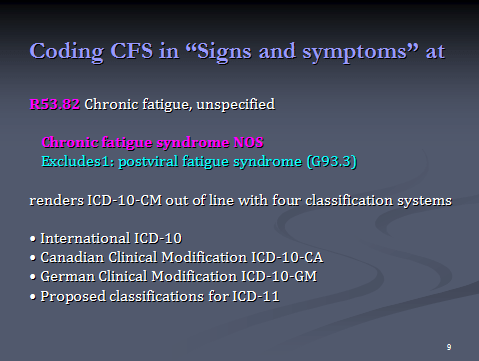
By 2007, the proposal was (and still stands) that Postviral fatigue syndrome and Benign myalgic encephalomyelitis would be classified in Chapter 6 at G93.3, but that Chronic Fatigue Syndrome would be retained in the R codes (which will be Chapter 18 in ICD-10-CM) and coded under R53 Malaise and fatigue > R53.82 Chronic fatigue, unspecified” > chronic fatigue syndrome NOS, Excludes1: postviral fatigue syndrome (G93.3).

The history of the coding of PVFS, (B)ME and Chronic fatigue syndrome in ICD to 2001 is set out in this CDC document: http://www.co-cure.org/ICD_code.pdf

At the May 10 CFSAC meeting, around 50 minutes was given over to discussion of this agenda item which resulted in a motion proposing a new Recommendation to HHS that was unanimously voted in favour of by the committee.


As I have a particular interest in this issue, I have interspersed this section of the Minutes with notes addressing a number of errors and misunderstandings. My comments are inserted in blue, bold.

As these notes are inserted into official Minutes I give no permission to re-publish as both the formatting and the integrity of an official document will be lost – so permission to link to this post only.

Discussion of International Classification of Diseases-Clinical Modification (ICD-CM)

Page 27:

LUNCH

The Chronic Fatigue Syndrome Advisory Committee recessed for lunch for one hour.

Discussion of International Classification of Diseases-Clinical Modification (ICD-CM) concerns

DISCUSSION OF INTERNATIONAL CLASSIFICATION OF DISEASES – CLINICAL MODIFICATION (ICD-CM) CONCERNS

Dr. Christopher Snell

Brought the meeting to order. Noted they would have a discussion of the ICD-related questions and the proposed reclassification of chronic fatigue syndrome.

Chronic fatigue syndrome is not being “reclassified” as such for ICD-10-CM, but being proposed to be retained in the R codes, as a legacy of ICD-9-CM, rather than follow international ICD-10.

Advised there was a page in the members’ notebooks tabbed after the State of the Knowledge summary which noted key steps in the development of the ICD 10 CM, so a clinical modification of the World Health Organization’s (WHO) ICD 10. It would replace ICD 9.

Stated his understanding of the issues:

o Disconnect between the way the U.S. uses the classification and the rest of the world.

o The way CFS is classified under the ICD system has implications for both reporting of incidents, morbidity and mortality.

o Used by outside agencies to categorize the illness for purposes of inclusion or exclusion.

Opened the floor for discussion.

Dr. Wanda Jones

Clarified that the committee requested that the National Center for Health Statistics have someone to talk to them about the international classification of diseases, about the process, about how the U.S. adapts the WHO index, the ICD for use and about opportunities for dialogue.

Noted that a meeting was set a year ago for May 10 and 11 in Baltimore that engaged resources for the CMS, parts of the federal government focused on health IT and the entire ICD team from the National Center for Health Statistics (NCHS). Noted that as a result no one was available for the CFSAC meeting.

In lieu of their attendance, she developed some questions that the NCHS, ICD team responded to.

PDF of Dr Jones’ background document here: ICD-related questions from CFSAC for May 2011 meeting
http://www.hhs.gov/advcomcfs/meetings/presentations/icd_ques201105mtng.pdf

Tried to clarify the questions so they would have a good understanding of the key processes and the key inflection points differentiating the WHO process from the U.S. ICD-CM, the clinical modification process.

Raised additional questions regarding how alignment from prior versions is maintained and how ICD coding is used in decision-making. Noted also the relationship between the coding and the diagnostic and statistical manual (DSM).

Stated that the information was provided by the NCHS and is meant to generate discussion.

Stated that the ICD-CM process is a public process with regularly scheduled public meetings. Noted that there is an opportunity to comment as part of that process and to engage. Confirmed that the NCHS stated that there has been no public presence from the CFS community at the meetings. Noted that this was the process for people interested in CFS coding to become involved.

Confirmed that there was a lock procedure that is soon to be executed for the ICD 10 CM. Noted it had been in development for a decade and the United States’ move to electronic records means it has to temporarily lock the codes. The electronic health records software would not be ready if they keep changing them.

Noted that information about coding changes would continue to be collected, taken under advisement and the NCHS would continue the process of evaluating. Stated that once it is in public use then that lock will release and there would be an opportunity on a periodic basis for updating.

Dr. Leonard Jason

Stated that the committees are developing ICD 10 CM and it intends to retain CFS in R codes (R53.82) and this means that the symptoms, signs, abnormal results of clinical or other investigative procedures are ill-defined conditions.

Stated that R-codes means it’s an ill-defined condition regarding which no diagnosis is classifiable elsewhere. Explained that if it cannot be diagnosed elsewhere in ICD 10 it goes into a R-code.

The intention in ICD 11 is to put CFS with two other conditions (post viral fatigue syndrome and benign myalgic encephalomyalitus [sic]) under a G-code, being G93.3 or diseases of the nervous system.

For ICD-11, the proposal is to classify all three terms within Chapter 6 Diseases of the nervous system but these categories may not retain the familiar “G93.3” code.

For ICD-11, the parent class “G93 Other disorders of brain” is proposed to be removed (this will affect many categories classified under or indexed to a code that is currently a child to the G93 parent class in ICD-10).

For ICD-11, categories within Chapter 6 Diseases of the nervous system are being reorganised and different codes have been assigned to Chapter 6 categories to those used in ICD-10. “Chronic fatigue syndrome” is proposed to be an ICD Title code and is currently assigned the code “06L00” in the ICD-11 Alpha Draft, under new parent class “06L Other disorders of the nervous system”.

For ICD-11, “Benign myalgic encephalomyelitis” is specified as an Inclusion term to “06L00 Chronic fatigue syndrome”. A change of hierarchy is recorded in the iCAT Alpha drafting platform for “Postviral fatigue syndrome” and “Chronic fatigue syndrome”.

See Dx Revision Watch report: ICD-11 Alpha Drafting platform launched 17 May (public version) for screenshots from the latest version of the ICD-11 Alpha Draft: http://wp.me/pKrrB-16N

Noted that coding CFS under the R-code in the proposed ICD 10 CM would place it out of line with the International ICD 10 used in over 100 countries. Discussed the problems and implications of the U.S. coding of CFS as compared with how other countries are coding it. It would exclude it from the R53 malaise and fatigue codes, which would imply that CFS does not have a viral etiology.

That last sentence does not make sense. Retaining CFS under the R codes would exclude it from the Chapter 6, G93.3 classification.

Proposals for ICD-10-CM have “chronic fatigue syndrome NOS (R53.82)” specified as an Exclusion to “G93.3 Postviral fatigue syndrome > Benign myalgic encephalomyelitis”.

Proposals for ICD-10-CM have “Postviral fatigue syndrome (G93.3)” specified as an Exclusion to the “R53 Malaise and fatigue > R53.82 Chronic fatigue, unspecified” > Chronic fatigue syndrome NOS codes.

Brought forward a motion to be considered:

CFSAC rejects current proposals to code CFS in Chapter 18 of ICD 10 CM under R53.82 chronic fatigue syndrome unspecified, chronic fatigue syndrome NOS (not otherwise specified). CFSAC continues to recommend that CFS should be classified in the ICD 10 CM in Chapter 6 under diseases of the nervous system at G93.3 in line with international ICD 10 in ICD 10 CA which is the Canadian clinical modification and in accordance with the committee’s recommendation which we made in August of 2005. CFSAC considers CFS to be a multi-system disease and rejects any proposals to classify CFS as a psychiatric condition in U.S. disease classification systems.

Previous CFSAC recommendations for ICD-10-CM had read:

May 2010 CFSAC recommendation: CFSAC rejects proposals to classify CFS as a psychiatric condition in U.S. disease classification systems. CFS is a multi-system disease and should be retained in its current classification structure, which is within the “Signs and Symptoms” chapter of the International Classification of Diseases 9-Clinical Modification (ICD 9-CM).

August 2005 CFSAC recommendation: Recommendation 10: We would encourage the classification of CFS as a “Nervous System Disease,” as worded in the ICD-10 G93.3.

Noted that ME and CFS patients could be potentially vulnerable to the current DSM 5 proposals because those proposals are highly subjective and difficult to quantify. Noted that retaining the CFS in the R-codes in the IDC 10 CM differentiates the U.S. from other countries but it renders CFS and ME patients more vulnerable to some of the DSM 5 proposals, notably chronic complex symptom disorder [sic].

Should be “Complex Somatic Symptom Disorder”, not as above.

Dr. Klimas asked for clarification, and Dr. Jason said that in 2013 they would move from DSM 4 to DSM 5. As it stands they would be collapsing somatization disorder, undifferentiated somatoform disorder, hypochondriasis and some presentations of panic disorder into complex somatic symptom disorder. Dr. Klimas clarified that his concern was that the CFS ICD 9 codes would put the non post viral patients into this somatoform cluster. Dr. Jason indicated that this was so.

Should be “pain disorder” not “panic disorder”.

Dr. Klimas seconded the motion.

Mr. Krafchick agreed and stated that the ramifications of the classification would be disastrous for patients, because it would limit disability payments to two years. Dr. Jones clarified that for now the clock was ticking, however once the codes were released, they could be revised, it’s just the implementation of the electronic system which is causing it to be locked at a particular point in time. While CFSAC has shared concerns with NCHS, there is an official process for engaging with them on their discussions regarding the codes. The US was interested in morbidity, in case claims. It is important that providers know how to best categorize things, and provide guidance on which codes to consider based on the science for the disease being evaluated.

Mr. Krafchick stated that the issue was that the criteria for the codes was etiology/trigger based. Dr. Jones clarified that it would still remain in the clinician’s judgment, however if they could not identify where the trajectory developed toward CFS, then it would wind up in the R codes. Dr. Jones clarified also that the NCHS does not view the R category as a somatoform disorder. Mr. Krafchick and Dr. Snell indicated they understood this but it would still represent vulnerability for patients when classifying.

(The justification given by CDC for not mirroring ICD-10 is this: If the clinician feels there is enough evidence to attribute the patient’s illness to a viral illness, they can code at G93.3; if not, they can code at R53.82 Chronic fatigue syndrome NOS. Testing for a viral illness is not required to assign a code, the coding would be based on the clinician’s judgment.)

Dr. Jason restated his recommendation.

Dr. Marshall stated his concern that there was an attendant risk with this, but that they were between a rock and a hard place. He agreed CFS/ME being classified as a somatoform disorder was inappropriate, but at the same time that the recommendation says it’s a complex multi-system disease, it categorizes it within a single nervous system disease silo. This might affect future research funding opportunities with people saying they don’t fund neurological research. He expressed the view that they should advocate for classification in a multi-system disease category rather than putting it in a nervous system disease category for future, though this category did not exist now. It would be a good thing for patients short term, but it could be a long term risk.

Dr. Snell said that given the amount of current funding, this wasn’t a risk. Dr. Marshall said that using reverse translational research as had been advocated during the meeting might increase the role of this categorization, and could be restrictive in funding.

Dr. Jones asked whether the recommendation being put forward was the same as the May 2010 recommendation, and Dr. Jason said that his was dramatically different. Mr. Krafchick underscored how the insurance companies use these ICD codes. If it was classified in something that could be psychiatric it will be psychiatric, so they can deny coverage.

Dr. Levine asked about co-morbid disorders and how these are weighted. Dr. Jones responded that she did not think that there was a weighting. It would get listed like a death certificate, a cause of death and then a secondary, sometimes a third. She stated it was the judgment of the clinician how it was listed.

Dr. Klimas expressed the view that coding was also problematic because clinicians code to get paid. There already exists a bias against coding CFS as CFS because the codes could not be used for billing. She stated that they would make a conscious decision not to code CFS as CFS. She indicated that neurology was a fine place for it to be categorized, and at least this would assist people who may be looking for patient data, as it wouldn’t be ignored.

Dr. Snell asked for a vote of all those in favor regarding Dr. Jason’s motion. The motion passed unanimously.

Dr. Jones noted that she would share this recommendation with the NCHS but repeated that unless someone moved forward to intervene in the official processes in the public record it may not move forward or have an effect.

Dr. Jones noted that the next ICD meeting is September 14 – 15, 2011 with public comments due July 15. Noted this will be put on the CFSAC website.

A link has been placed on the CFSAC site for the CDC page for information on meetings of the ICD-9-CM Coordination and Maintenance Committee  

She noted she would check the rules to see if a member of the CFSAC or the Chair would be able to give public testimony at another advisory committee meeting. Mr. Krafchick said that if it were possible to send someone as a member of the committee, it would make a great deal of sense and be very important. Dr. Jones said they would figure out how this could happen. Ms. Holderman asked whether this notice, and any future notices where they might want to intervene, could be placed on the CDC website. She stated this cross listing would be useful.

Dr. Jones said that from her experience with the fast evolving HIV coding, there was a dialogue so that coding kept up. She expected there would be some connection, however not as comprehensive or active as that disease.

Dr. Mary Schweitzer, a member of the public, stated that the NCHS did come to CFSAC in 2005 and Dr. Reeves at the time was specific and said that CFS needed to be in R53 due to his own method of diagnosis. She suggested that this showed an obvious connection between the CFS side of CDC and NCHS at the time.

[Discussion of this agenda item ends.]

As these are my notes inserted into an extract from official Minutes, no permission to republish. The Shortlink to this post is http://wp.me/pKrrB-1dP. The PDF of the Minutes for Day One (May 10) is here: CFSAC Minutes 10 May 2011

Related material:

[1] Post: CFS orphaned in the “R” codes in US specific ICD-10-CM: http://wp.me/pKrrB-V4

[2] International Classification of Diseases, Tenth Revision, Clinical Modification (ICD-10-CM). Note: The 2011 release of ICD-10-CM is now available and replaces the December 2010 release:
http://www.cdc.gov/nchs/icd/icd10cm.htm

[3] Post: US “Clinical Modification” ICD-10-CM. Article clarifying possible confusion between ICD-10, ICD-11 and the forthcoming US Clinical Modification, ICD-10-CM: http://wp.me/pKrrB-Ka

[4] Chronic Fatigue Syndrome Advisory Committee (CFSAC). The Chronic Fatigue Syndrome Advisory Committee (CFSAC) provides advice and recommendations to the Secretary of Health and Human Services via the Assistant Secretary for Health of the U.S. Minutes of meetings, Recommendations and meeting videocasts:
http://www.hhs.gov/advcomcfs/meetings/index.html

DSM-5 Web Site Period for Comments has Been Extended to July 15

DSM-5 Web Site Period for Comments has Been Extended to July 15

Post #93 Shortlink: http://wp.me/pKrrB-1cB

The comment period for the second public review and feedback on proposals for draft criteria for DSM-5 was scheduled to close at midnight, yesterday, June 15.

I noted this morning that it was still possible to upload comments.

This afternoon, the APA has posted a notice on the DSM-5 Development site announcing a four week extension for submission of comments, until Friday, July 15.

APA announcement, today, June 16:

http://www.dsm5.org/Pages/Default.aspx

DSM-5 Web Site Period for Comments has Been Extended to July 15!

We are extending the period for submitting comments and suggestions to the web site regarding the proposed diagnostic criteria revisions, and the newly proposed organizational structure for DSM-5. We are appreciative of the ongoing interest in contributing to this process and are extending the period for submitting comments until July 15th. This extension will also permit reviews and comments for the newly proposed criteria and approach for the assessment of Personality Disorders, which are now being uploaded to the website for release. Our thanks to those who have already provided contributions to this interactive process.

I expect the APA has not received sufficient numbers of responses to comfortably announce in a news release. (Last year they reported having received over 8,000.)

I had asked Dr William Narrow, Task Force member, on June 4, when the DSM-5 website was offline for much of the day, for an extension until at least the end of June.

The extension announced today runs to July 15. Even better!

So those of you who did not submit now have additional 4 weeks in which to submit responses.

I want to see thousands telling the APA why they need to rip up these proposals for the revision of the “Somatoform Disorders” and start again.

Copies of patient organizations, patient and advocates responses, plus the Coalition4ME/CFS’s template letter here: http://wp.me/PKrrB-19a

Thanks to all of you who have already submitted. 

Suzy Chapman

Related material:

Final push: DSM-5 draft criteria

Coalition4ME/CFS issues Call to Action on DSM-5 proposals

Call for Action – Second DSM-5 public comment period

ME Association submission to the consultation on the revision of the American Diagnostic and Statistical Manual of Mental Disorders

ME Association submission to the consultation on the revision of the American Diagnostic and Statistical Manual of Mental Disorders

Post #92 Shortlink: http://wp.me/pKrrB-1bT

http://www.meassociation.org.uk/?p=6619

June 13, 2011

The ME Association has submitted the following comments to the consultation on the proposed, new American Diagnostic and Statistical Manual of Mental Disorders, otherwise known as the “DSM-5″. Our contribution was officially acknowledged on Sunday (June 12) at 10.52am.

The ME Association is a UK based medical charity that provides information and support for people with ME/CFS (myalgic encephalomyelitis/chronic fatigue syndrome).

The concerns we express below refer to the proposal to create a new and wide-ranging psychiatric category – Complex Somatic Symptom Disorder (CSSD) – in the next edition of the American Diagnostic and Statistical Manual of Mental Disorders (ie DSM V) and the widespread belief that people with ME and CFS may become included in this new medical terminology.

ME is recognised by the World Health Organisation (in section G93:3 of ICD 10) and by the UK Department of Health as a complex neurological disorder – a fact that is now supported by numerous published research studies.

CFS, which includes a wider group of clinical presentations, is indexed to the WHO neurological classification.

It is not therefore appropriate to use the proposed terminology of CSSD – either by intention or mistake – to describe or classify people with ME or CFS as having somatic presentations of mental health disorders in any other system of disease classification or explanation such as the DSM.

This proposal itself has a number of major flaws, including:

• A very limited and partial scientific rationale with too much reliance on subjective judgements.

• An implied acceptance that diagnoses are always correct.

• An assumption that all that is important in psychological medicine is already known and what remains uncertain can be summarised in one new clinical entity.

Psychological Medicine already attracts a lot of negative criticism and this proposal will only make matters worse.

The APA therefore needs to reflect on its full responsibilities when reviewing a subject area as complex and uncertain as this.

We therefore suggest that you drop CSSD and instead refer to ‘chronic distress that may be related to psychological or physical events or a combination’. This is a term that should lead to empathetic, focused management.

ENDS

European ME Alliance (EMEA) submission to DSM-5 draft proposals Submission

European ME Alliance (EMEA) submission to DSM-5 draft proposals Submission – to the American Psychiatric Association on DSM-V Complex Somatic Symptom Disorders category

Post #91 Shortlink: http://wp.me/pKrrB-1bI

June 2011

http://www.euro-me.org/news-Q22011-003.htm

The European ME Alliance consists of 11 European national charities/non profit organisations campaigning for better diagnosis and understanding of myalgic encephalomyelitis (ME or ME/CFS) as defined by WHO-ICD-10-G93.3.

Even though we are not mental health professionals or represent people with mental health disorders we feel it important to comment on the draft proposal of DSM-V and its Complex Somatic Symptom Disorders proposal.

This response should be seen against the backdrop of the devastation caused by the misinformation within the medical profession regarding ME/CFS and the promotion of false perceptions about the disease to the public, healthcare authorities and government.

It is of paramount importance that the American Psychiatric Association are aware of the dangers inherent in establishing incorrect categories of disorders which are based on poor science, vested interests or which do not serve the patients. It is the patients who must surely be the priority in all healthcare provision.

We are especially concerned about the criteria described in the new category of Complex Somatic Symptom Disorder which seems to imply that anyone who has a chronic or incurable illness with somatic symptoms and ‘misattributes’ their symptoms could be given this label.

Who decides when someone misattributes their pain or fatigue?

How are these symptoms measured?

How long and vigorously is a patient allowed to complain about their symptoms before a doctor can decide to investigate further and determine if a headache is a brain tumour or irritable bowel syndrome colon cancer?

In the CSSD Criteria B there are terms used which are subjective and not measurable – such as “health concerns” and “catastrophising”.

Based on our collective experiences with the treatment of an organic illness such as ME/CFS – experiences across Europe – our concern is that there is a great danger of mis- or missed diagnoses when looking at this category and its proposed diagnostic criteria.

The criteria are very vague and allow too much subjectivity.

In fact, ME/CFS could mistakenly be placed in this category if one were to ignore, or be unaware of, the huge volume of biomedical research and evidence which shows it to be an organic illness and if one were to use only the broad CSSD criteria to diagnose.

Such an action would be a major and costly mistake and would not serve the patients or the healthcare communities.

In our experience specialist ME/CFS clinics get as many as 40% of patients referred with a ME/CFS diagnosis who turn out to have other very serious and sometimes fatal illnesses.

The patients we are concerned with suffer from myalgic encephalomyelitis which is a neurological disease. Yet all too often these patients are being treated as if they had a somatoform illness.

Parents of children with ME/CFS are restricted in visiting their severely ill children in hospital or worse still the children are taken away from their families as the healthcare professional believes it is the family that is keeping the child ill by having ‘wrong illness beliefs’.

Severely ill grown ups with this disease are denied normal medical care and threatened with being placed in mental hospitals if they are too ill to care for themselves and ask for help.

This not only sets patient against healthcare professional but also is a waste of resources and of lives.

A broad unspecific category such as the proposed Complex Somatic Symptom Disorder does not help patients who need an honest and clear diagnosis.

Any illness lacking a diagnostic test is in danger of being put into this non specific category which helps no one.

We hope and request that the APA listens to patients and avoids creating a category of mental illness that is meaningless.

Yours Sincerely,

The Chairman, Board and Members of the European ME Alliance

www.euro-me.org

PDF version: http://www.euro-me.org/GB/EMEA%20Letter%20to%20APA%20-%20DSM-V.pdf

Membership of EMEA: http://www.euro-me.org/about.htm

Links:

Proposed criteria are set out on the DSM-5 Development site here: http://tinyurl.com/Somatic-Symptom-Disorders

The CSSD criteria are here: http://tinyurl.com/DSM-5-CSSD

For examples of submissions for 2010, go here: http://wp.me/PKrrB-AQ

Copies of submissions for 2011 are being collated, here: http://wp.me/PKrrB-19a   

If you are a patient organization, professional, patient, carer or advocate and have already submitted and would like a copy of your comment added to my site, please send a copy to me.agenda@virgin.net