APA announces second public review of DSM-5 draft criteria and structure

American Psychiatric Association (APA) announces second public review of DSM-5 draft criteria and structure

Post #73 Shortlink: http://wp.me/pKrrB-12k

Second public stakeholder review and feedback period now 4 May to 15 June

APA News Release No: 11-27 PDF: http://tinyurl.com/APAnewsrelease4may11 

or open PDF on this site here: New Framework Proposed for Manual of Mental Disorders

Online posting of draft disorders and criteria proposed by the 13 DSM-5 Work Groups for new and existing mental disorders had originally been scheduled for May-June, this year. According to a revised Timeline on the APA’s DSM-5 Development site, in March, this second public review exercise had been rescheduled for August-September:

“August-September 2011: Online Posting of Revised Criteria. Following the internal review, revised draft diagnostic criteria will be posted online for approximately one month to allow the public to provide feedback. This site will be closed for feedback by midnight on September 30, 2011.”

But yesterday, 4 May, the APA announced that the second public review period is now open and will run from May to 15 June.

The DSM-5 site was updated yesterday with announcements and revised proposals (dated May 4, 2011) across all categories. The current review period closes on 15th June – just six weeks away.

Note that this is a public and stakeholder review and feedback exercise and is not restricted to professionals or members of the American Psychiatric Association.

There is a Task Force announcement here: http://www.dsm5.org/Pages/Default.aspx

[Extracts]

What Specifically Has Changed on This Site?

“You will notice several changes to this Web site since we first launched in February 2010. Numerous disorders contain updated criteria…

” ...Is There Opportunity to Provide Further Comments?

“At this time, we are asking visitors to review and comment on the proposed DSM-5 organizational structure and criteria changes. Please note that the current commenting period will end on June 15, 2011. It is important to remember that the proposed structure featured here is only a draft. These proposed headings were reviewed by the DSM-5 Task Force in November 2010…

“…The content on this site will stay in its current form until after completion of the DSM-5 Field Trials, scheduled to conclude later this year. Following analysis of field trial results, we will revise the proposed criteria as needed and, after appropriate review and approval, we will post these changes on this Web site. At that time, we will again open the site to a third round of comments from visitors, which will be systematically reviewed by each of the work groups for consideration of additional changes. Thus, the current commenting period is not the final opportunity for you to submit feedback, and subsequent revisions to DSM-5 proposals will be jointly informed by field trial findings as well as public commentary.

“We look forward to receiving your feedback during the coming weeks and appreciate your participation in this important process.”      [Source: http://www.dsm5.org/Pages/Default.aspx]

There are brief notes on the proposed DSM-5 Organizational Structure here:

http://www.dsm5.org/proposedrevision/Pages/proposed-dsm5-organizational-structure.aspx

The “Recent updates” page for “DSM changes” and “Disorder-specific changes” is here:

http://www.dsm5.org/Pages/RecentUpdates.aspx


Registration for submitting feedback

Last year, registration was required in order to submit comment via the DSM-5 Development website. You can register to submit feedback on the DSM-5 Development site home page or on the individual pages for specific category proposals (right hand side under “Participate”).

The revised Timeline can be read here: http://www.dsm5.org/about/Pages/Timeline.aspx

According to the Timeline, a third review and feedback is currently scheduled for January-February 2012, for two months.


Latest revisions for “Somatic Symptom Disorders”

http://www.dsm5.org/ProposedRevision/Pages/SomaticSymptomDisorders.aspx

I will post  information in the next posting specific to the proposals of the DSM-5  Work Group for “Somatic Symptom Disorders”
 

Media coverage of APA’s 4 May DSM-5 announcement

MedPage Today

CNN Blog

ICD-11 Training videos, transcripts and Key Revision documentation

New ICD-11 Training videos, video transcripts and Key Revision documentation

Post #65 Shortlink: http://wp.me/pKrrB-YI

The information in this post relates only to the development of ICD-11. It does not relate to the development of the forthcoming US specific “Clinical Modification” of ICD-10, known as “ICD-10-CM”.

A WHO ICD Revision meeting was held in Ankara, Turkey, at the end of February. The ICD Revision Paediatrics Topic Advisory Group (TAG) met to discuss “Diagnostic issues on Children and Youth”.

A number of meeting documents and videos have been posted on the ICD Revision site which are general background documents to the ICD-11 development process and not specific to the work of TAG Paediatrics or the focus of the Ankara meeting.

The two training videos (“ICD-11 Content Model Training” and “iCAT Training”) are now also available on YouTube. The training videos are aimed at those currently involved with the ICD-11 Revision process as WHO staff, IT technicians and the chairs, managing editors, members and external reviewers of the ICD-11 Topic Advisory Groups but will be of general interest to those following the development of ICD-11.

Content Model

One of the main differences between ICD-10 and ICD-11 will be the amount of textual content associated with ICD categories. In ICD-10, there is no textual content, definitions or descriptions for any of the three terms, PVFS, ME, CFS, and the relationship between these terms is not specified within ICD-10.

But the ICD-11 Content Model contains 13 parameters that may be used to describe ICD entities and these parameters are discussed in the training video. So if you are not familiar with the extent of the potential for textual content describing categories within ICD-11, this video sets this out. In the References is the URL for the latest version of the “Content Model Reference Guide” document.

The 13 Parameters through which an ICD-11 category can be described are:

1. ICD Entity Title; 2. Classification Properties; 3. Textual Definition(s); 4. Terms; 5. Body Structure Description; 6. Temporal Properties; 7. Severity Properties; 8. Manifestation Properties; 9. Causal Properties; 10. Functioning Properties; 11. Specific Condition Properties; 12. Treatment Properties; 13. Diagnostic Criteria.

iCAT

The second video describes the operation of the iCAT collaborative drafting platform through which the alpha and beta drafts are being developed. The platform is currently behind a password and accessible only to ICD Revision personnel who have editing rights, but it is understood that after the Beta Drafting stage has been reached, the iCAT should be accessible to stakeholders for limited input.

The iCAT had been in the public domain up until early November for public viewing only and I have some relevant screenshots of the population of content as it stood in the iCAT, at that point, here:

PVFS, ME, CFS: the ICD-11 Alpha Draft and iCAT Collaborative Authoring Platform: http://wp.me/pKrrB-KK

ICD-11 Training videos:

1] Content Model Training Video, YouTube:

Duration: 20: 38 mins

An MS Word document of the Content Model Training Video Script can be downloaded here:

Transcript of Content Model Training Video


2] iCAT Training Video, YouTube:

Duration: 29:12 mins

An MS Word document of the iCAT Training Video Script can be downloaded here:

Transcript of iCAT Training Video

References:

1] Ankara Paediatrics meeting 28 February-1 March 2011
Background documents page and Agenda

2] Key document: Content Model Reference Guide version January 2011

3] Key document: ICD Revision Project Plan version 2.1 9 July 2010

4] iCAT Drafting Platform browser
(Access and editing rights currently restricted to WHO and ICD Revision, TAG members and IT personnel):

Erasing the interface between psychiatry and medicine (DSM-5)

Erasing the interface between psychiatry and medicine (DSM-5)

Post #61 Shortlink: http://wp.me/pKrrB-Vn

Under the guise of “eliminating stigma” and eradicating “terminology [that] enforces a dualism between psychiatric and medical conditions” the American Psychiatric Association (APA) appears hell bent on colonising the entire medical field by licensing the application of a mental health diagnosis to all medical diseases and disorders.

While a stream of often acerbic commentaries from two former DSM Task Force chairs, Allen Frances and Robert Spitzer, have focused on the implications for introducing new additions into the DSM and broadening the definitions of existing diagnostic criteria, the DSM-5 “Somatic Symptom Disorders” Work Group (Chair, Joel E Dimsdale) has been quietly redefining DSM’s “Somatoform Disorders” categories with proposals that if approved, would legitimise the application of an additional diagnosis of “Somatic Symptom Disorder” to all medical diseases and disorders.

Radical proposals for renaming the “Somatoform Disorders” category “Somatic Symptom Disorders” and combining a number of existing categories under a new rubric, “Complex Somatic Symptom Disorder (CSSD)”, and a more recently proposed “Simple Somatic Symptom Disorder (SSSD)”, have the potential for bringing millions more patients under a mental health banner and expanding markets for psychiatric services, antidepressants, antipsychotics and behavioural therapies such as Cognitive Behavioural Therapy (CBT) for the “modification of dysfunctional and maladaptive beliefs about symptoms and disease, and behavioral techniques to alter illness and sick role behaviors” for all patients with somatic symptoms, irrespective of cause.

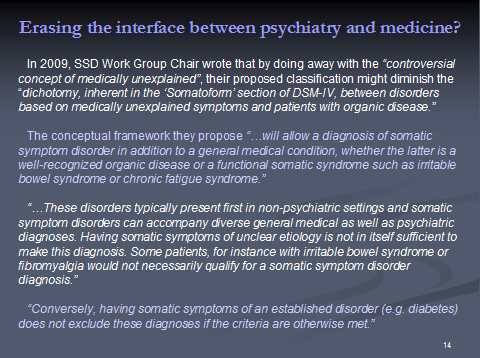
In a June ’09 Editorial, titled “The proposed diagnosis of somatic symptom disorders in DSM-V to replace somatoform disorders in DSM-IV – a preliminary report”, which expanded on a brief DSM-5 Work Group progress report published on the DSM-5 Development website that April, Joel E Dimsdale and fellow DSM-5 Work Group member, Francis Creed, reported that by doing away with the “controversial concept of medically unexplained symptoms”, their proposed classification might diminish the “dichotomy, inherent in the ‘Somatoform’ section of DSM IV, between disorders based on medically unexplained symptoms and patients with organic disease.”

If the most recent “Somatic Symptom Disorders” Work Group proposals gain DSM Task Force approval, all medical diseases and disorders, whether “established general medical conditions or disorders” like diabetes or conditions presenting with “somatic symptoms of unclear etiology” will have the potential for a bolt-on diagnosis of “somatic symptom disorder”.

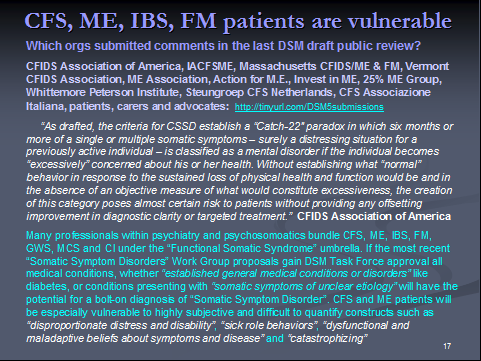
CFS and ME patients may be especially vulnerable to highly subjective and difficult to quantify constructs such as “disproportionate distress and disability”, “catastrophising”, “health-related anxiety”, “[appraising] bodily symptoms as unduly threatening, harmful, or troublesome” with “health concerns [that] may assume a central role in the individual’s life, becoming a feature of his/her identity and dominating interpersonal relationships.”

There may be considerable implications for these highly subjective criteria for the treatments offered to US patients, the provision of social care packages and the payment of medical and disability insurance.

Criteria are set out very briefly in the PowerPoint slides, but the full criteria and key documents need to be scrutinized. The most recent proposals of the DSM-5 “Somatic Symptoms Disorders” Work Group plus two key Disorder Description and Rationale PDF documents can be read on the APA’s DSM-5 Development site here:

http://www.dsm5.org/ProposedRevisions/Pages/SomatoformDisorders.aspx

Two key Somatic Symptoms Disorders Work Group Draft Proposal documents:

     Revised Justification of Criteria Version 1/31/11

     Revised Disorder Descriptions: Version 1/14/11

The next public review of draft criteria and disorder descriptions has been postponed to August – September, this year, for a period of approximately one month for public review and feedback.

[1] Psychiatric Times Special Report, PSYCHIATRY AND MEDICAL ILLNESS Unexplained Physical Symptoms What’s a Psychiatrist to Do?  Humberto Marin, MD and Javier I. Escobar, MD, 01 August 2008

[Draft criteria superceded by third draft published on May 2, 2012]

Images copyright ME agenda 2011   No unauthorized reproduction.

The next public review of draft criteria and disorder descriptions is scheduled for May/June 2011.

Shortlink for this Post: http://wp.me/pKrrB-Vn

Washington Examiner: Corrupting Psychiatry by Max Borders

Washington Examiner: Corrupting Psychiatry by Max Borders

Post #58 Shortlink: http://wp.me/pKrrB-TU

Interesting commentary from writer Max Borders, last week, on the website of the Washington Examiner around the revision of the American Psychiatric Association’s Diagnostic and Statistical Manual of Mental Disorders (DSM):

Washington Examiner

Corrupting Psychiatry

By Max Borders 01/18/11 10:22 AM

The American Psychiatric Association (APA) has gone crazy — like a fox.

“There was a time when we could be more charitable about the vagaries in the APA’s Bible, the DSM. But not anymore. If you’ve never heard of the DSM, it’s the Diagnostic and Statistical Manual series the APA publishes. Psychiatrists all over the world use the DSM as a guidebook for treating people with some form of mental illness. But the APA may test credulity with its upcoming edition.

“I refer specifically to proposed changes in the DSM-V due out in 2013. It’s no accident these changes reflect new political realities about how psychiatric medicine gets paid for and by whom…”

Read rest of article at the Washington Examiner

Commentary in response to “Corrupting Psychiatry” from Dutch philosopher and psychologist, Maarten Maartensz, on Nederlog here More on the APA’s mockery of medicine and morality and here More on the APA and the DSM-5

Comments on Washington Examiner to article “Corrupting Psychiatry” by Max Borders

By: Skeeter
Jan 21, 2011 9:55 PM

Good article, that says things that need to be said, long and loud.

Both the APA, and the broader psychiatric profession, are currently indulging in a seriously unjustified power grab, and they and their claims are in desperate need of much closer and tougher (and ongoing) external scrutiny then they have been subject to date.

Generally speaking, I would have to agree that the profession is becoming much too closely aligned with and mutually reliant on both state and corporate interests, as opposed to the interests of the patient and the science on which they base their claims to authority.

One small point: I would not invoke British psychiatry as any counterbalance to the excesses of their American colleagues. The Brits have their own serious problems. Not least of which is that they are mired deep in the methodological and ethical swamp of somatoform disorders (aka conversion or psychosomatic disorders, and their related ‘treatments’), and a lot of patients are paying a very heavy price indeed for this obsession by certain influential members of the British psych establishment.

By: Suzy Chapman
Jan 22, 2011 7:28 AM

Erasing the interface between psychiatry and medicine

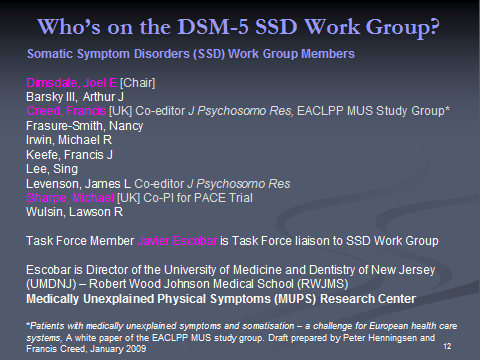
The previous commenter cautions against invoking members of the “British psych establishment”. Two very influential members of the British psychiatry and psychosomatics establishment, Professors Michael Sharpe and Francis Creed, have seats on the DSM-5 “Somatic Symptom Disorders” Work Group.

While many column inches by rightly perturbed journalists and a stream of often acerbic critiques from former DSM Task Force chairs, Allen Frances and Robert Spitzer, have focussed on the implications for introducing new additions into the DSM and broadening the definitions of existing diagnostic criteria, the DSM-5 “Somatic Symptom Disorders” Work Group (Chair, Joel E Dimsdale) has been quietly redefining DSM’s “Somatoform Disorders” categories with proposals that if approved would legitimise the application of an additional diagnosis of “Somatic Symptom Disorder” to all medical diseases and disorders.

Radical proposals for renaming the “Somatoform Disorders” category “Somatic Symptom Disorders” and combining a number of existing categories under a new umbrella, “Complex Somatic Symptom Disorder (CSSD)” and a more recently suggested “Simple Somatic Symptom Disorder (SSSD)”, have the potential for bringing millions more patients under a mental health banner and expanding markets for psychiatric services, antidepressants, antipsychotics and behavioural therapies such as Cognitive Behavioural Therapy (CBT) for all patients with somatic symptoms, irrespective of cause.

Professor Creed is co-editor of The Journal of Psychosomatic Research. In a June ’09 Editorial, titled “The proposed diagnosis of somatic symptom disorders in DSM-V to replace somatoform disorders in DSM-IV – a preliminary report”, which expanded on a brief DSM-5 Work Group progress report published on the DSM-5 Development website that April, Joel E Dimsdale and fellow DSM-5 Work Group member, Francis Creed, reported that by doing away with the “controversial concept of medically unexplained symptoms”, their proposed classification might diminish the “dichotomy, inherent in the ‘Somatoform’ section of DSM IV, between disorders based on medically unexplained symptoms and patients with organic disease.”

If the most recent “Somatic Symptom Disorders” Work Group proposals gain DSM Task Force approval, all medical conditions, whether “established general medical conditions or disorders” like diabetes or conditions presenting with “somatic symptoms of unclear etiology” will have the potential for a bolt-on diagnosis of “somatic symptom disorder”.

Under the guise of “eliminating stigma” and eradicating “terminology [that] enforces a dualism between psychiatric and medical conditions” the American Psychiatric Association (APA) appears hell bent on colonising the entire medical field by licensing the application of a mental health diagnosis to all medical diseases and disorders.

By: KAL
Jan 23, 2011 1:36 PM

Who else might benefit? Disability Insurance. If you can be shown to have a “mental illness” then disability insurance only pays a maximum of two years of payments vs. a lifetime of payments for an organic disease.

Check the APA website for conflicts of interest for members of the working group for Somatic Disorders.

References:

DSM-5 Development website: Somatoform Disorders
http://www.dsm5.org/ProposedRevisions/Pages/SomatoformDisorders.aspx

Proposal: Complex Somatic Symptom Disorder
http://www.dsm5.org/ProposedRevisions/Pages/proposedrevision.aspx?rid=368

Proposal: Simple Somatic Symptom Disorder
http://www.dsm5.org/ProposedRevisions/Pages/proposedrevision.aspx?rid=491

The most recent versions of the two key documents associated with the proposals of the “Somatic Symptom Disorders” Work Group are:

Update @ 7 February 2011

The Justification of Criteria document was revised again by the SSD Work Group on 1/31/11 to incorporate the new proposal for SSSD and other revisions and is replaced by:

DRAFT 1/31/11  Justification of Criteria – Somatic Symptoms

Descriptions document version 1/14/11 Revised Disorder Descriptions: Version 1/14/11

Rationale document version 10/4/10 Previous revised Justification of Criteria: Version 10/4/10

DSM-5: New category proposal “Simple Somatic Symptom Disorder”

DSM-5: New category proposal “Simple Somatic Symptom Disorder”

Post #57 Shortlink: http://wp.me/pKrrB-TA

On 16 January, I reported that the page for current DSM-5 proposals for the revision of the DSM-IV “Somatoform Disorders” categories and diagnostic criteria had been updated on 14 January, with a new category proposal calledSimple Somatic Symptom Disorder”.

This proposal is in addition to the recommendations of the Somatic Symptom Disorders Work Group, published in February 2010, for grouping a number of existing Somatoform categories under a common rubric “Complex Somatic Symptom Disorder (CSSD)” and does not replace “CSSD”.

For full details see previous Post #56: http://wp.me/pKrrB-St 

Simple Somatic Symptom Disorder

Updated January-14-2011

See Tab: Proposed Revision:

http://www.dsm5.org/ProposedRevisions/Pages/proposedrevision.aspx?rid=491

Simple (or abridged) Somatic Symptom Disorder (e.g. pain)

To meet criteria for Simple Somatic Symptom Disorder, criteria A, B, and C are necessary.

A. One or more highly distressign [sic] and disabling somatic symptoms

B. One of the following symptoms from CSSD (i.e. Disproportionate and persistent concerns about the medical seriousness of one’s symptoms; high level of health-related anxiety; or excessive time and energy devoted to these symptoms or health concerns)

C. Symptom duration is greater than 1 month

For full proposals for “Simple Somatic Symptom Disorder” open the Tabs on this page:

http://www.dsm5.org/ProposedRevisions/Pages/proposedrevision.aspx?rid=491


Key links and documents associated with the proposals of the Somatic Symptom Disorders Work Group:

DSM-5 Development website: Somatoform Disorders
http://www.dsm5.org/ProposedRevisions/Pages/SomatoformDisorders.aspx

Proposal: Complex Somatic Symptom Disorder
http://www.dsm5.org/ProposedRevisions/Pages/proposedrevision.aspx?rid=368

Proposal: Simple Somatic Symptom Disorder
http://www.dsm5.org/ProposedRevisions/Pages/proposedrevision.aspx?rid=491

Update @ 7 February 2011

The Justification of Criteria document was revised again by the SSD Work Group on 1/31/11 to incorporate the proposal for SSSD and other revisions and is replaced by:

DRAFT 1/31/11 Justification of Criteria – Somatic Symptoms

        Revised Disorder Descriptions: Version 1/14/11

        Previous revised Justification of Criteria: Version 10/4/10

I shall be monitoring the DSM-5 Development website and if there are any further revisions to either document before the DSM-5 beta is published I will update this site.

According to the APA’s DSM-5 Development Timeline, the second draft is scheduled to be published by the DSM-5 Task Force in May-June, with a public review period of only around a month. The public review and comment period for the first draft, last year, had been around ten weeks.

The following patient organisations have been alerted to these revisions and sent copies of the key documents:

UK patient organisations:

Heather Walker, Action for M.E.
Neil Riley, Chair, Board of Trustees, ME Association
25% ME Group
Invest in ME
Jane Colby, The Young ME Sufferers Trust

US patient organisations and professionals:

Dr Alan Gurwitt, Massachusetts Chronic Fatigue and Immune Dysfunction Syndrome/Myalgic Encephalopathy and Fibromyalgia Association (Mass. CFIDS/ME & FM)
Dr Kenneth Friedman, IACFS/ME
Jennie Spotila, CFIDS Association of America
Dr Lenny Jason

International patient organisations and professionals:

ESME (European Society for ME)
Dr Eleanor Stein, Canada

Revisions to DSM-5 proposals on 14.01.11: New category proposed “Simple Somatic Symptom Disorder”

Revisions to DSM-5 proposals on 14.01.11: New category proposed “Simple Somatic Symptom Disorder”

Post #56 Shortlink: http://wp.me/pKrrB-St 

DSM-5 Dustbin Diagnosis

For copies of International patient organisation and patient advocate submissions in the APA’s spring 2010 DSM-5 draft proposals review process see: http://wp.me/PKrrB-AQ

The page for current DSM-5 proposals for the “Somatoform Disorders” section of DSM-IV was updated on January 14, 2011 with a new category proposal called “Simple Somatic Symptom Disorder”.

Note this proposal is in addition to the recommendation of the Somatic Symptom Disorders Work Group, in February 2010, for grouping a number of existing disorders under a common rubric “Complex Somatic Symptom Disorder (CSSD)”  and it does not replace “CSSD”.

As I have been highlighting for some time now, under these DSM-5 Task Force proposals, all medical conditions, whether “established” general medical conditions or disorders, or conditions presenting with “somatic symptoms of unclear etiology”, have the potential for qualifying for an additional diagnosis of a “somatic symptom disorder”.

There have also been revisions and additions to some of the text of the “Disorder descriptions” document dated “DRAFT January 29, 2010” that was first published by the DSM-5 Task Force when draft proposals for revisions to DSM-IV were posted on the APA’s DSM-5 website on February 10, 2010, for public review and comment.

Note also that the key document: “Justification of Criteria-Somatic Symptoms DRAFT 1/29/10” which is also associated with the proposals of the Somatic Symptom Disorders Work Group has now been revised twice since February 2010.

Update @ 7 February 2011

The Justification of Criteria document was revised for a second time by the SSD Work Group on 1/31/11 to incorporate the new proposal for SSSD and other revisions and is replaced by:

DRAFT 1/31/11  Justification of Criteria – Somatic Symptoms

     Previous revised Justification of Criteria: Version 10/4/10

What are the changes since draft proposals were released in February 2010?

On the APA’s DSM-5 Development web page:

http://www.dsm5.org/ProposedRevisions/Pages/SomatoformDisorders.aspx

under “Somatoform Disorders Not Currently Listed in DSM-IV”

are now listed two proposals:

“Complex Somatic Symptom Disorder”

(which was discussed last year when the DSM-5 draft proposals were first released) and a new proposal:

“Simple Somatic Symptom Disorder”

See:

http://www.dsm5.org/ProposedRevisions/Pages/SomatoformDisorders.aspx  

Somatoform Disorders


Submissions 2010

International patient organisation and patient advocate submissions to DSM-5 draft proposals public review process, Feb-April 2010: http://wp.me/PKrrB-AQ