ICD Revision: TAG Neurology and TAG Mental Health members

ICD Revision: TAG Neurology and TAG Mental Health members

Post #26 Shortlink: http://wp.me/pKrrB-DB

The two ICD Revision Topic Advisory Groups (TAGs) that are the primary focus of this site are:

Topic Advisory Group for Mental Health
Topic Advisory Group for Neurology

ICD Revision has published information on the make up of the new International Advisory Group for the Revision of ICD-10 Mental and Behavioural Disorders (TAGMH) and the Topic Advisory Group for Neurology (TAG Neurology). The professional and scientific organisations that have been asked to appoint representatives to these two groups and the names of their representatives are also published.

Topic Advisory Group for Mental Health

The International Advisory Group for the Revision of ICD-10 Mental and Behavioural Disorders was constituted by the WHO for a period of two years (2007 – 2008) with the primary task of advising the WHO on all steps leading to the revision of the mental and behavioural disorders classification in ICD-10, in line with the overall ICD revision process.

The initial period of operation has now expired and the group has been reconstituted and reappointed for the next two year period. The appointment of the Harmonization Group and other working groups reporting to the Advisory Group has also now expired, and new working groups will be appointed based on the current needs of the revision.

The Advisory Group is co-ordinated by Senior Project Officer, Dr Geoffrey M Reed, PhD, who is seconded to the Department of Mental Health and Substance Abuse, WHO, Geneva, through the IUPsyS (International Union for Psychological Science). The Department of Mental Health and Substance Abuse will also be managing the technical part of the revision of Diseases of the Nervous System (currently Chapter VI), as it is doing for Chapter V.

The group is chaired by Steven E Hyman, MD, Harvard University, Cambridge, Massachusetts, USA, a former Director of the National Institute of Mental Health (NIMH) and a member of the DSM-5 Task Force.

Mental Health Topic Advisory Group

Tasks

The Mental Health TAG reviews categories in ICD-10 relating to mental health and mental illness. The diseases within the scope of the Mental Health TAG are primarily located in Chapter 5 (Mental and Behavioural Disorders). The TAG also formulates definitions and diagnostic criteria for the relevant categories, and suggests changes to the classification structure.

Progress

TAG Mental Health was formed in January, 2007 to work on 11th Revision of the ICD. In 2009, new members were appointed to fill open positions and to meet specific needs prior to the group’s most recent face-to-face meeting in September 2009. The TAG Mental Health will hold its next face-to-face meeting 21-23 June 2010 in Geneva, Switzerland.

Last Updated: 3 February 2010

For membership of TAG Mental Health see this PDF:

Mental Health Topic Advisory Group Feb 10

The first meeting of the reconstituted Advisory Group took place on 28 – 29 September 2009, in Geneva. There have been no other meetings since the December 2008 meeting of the former group.

Summary Reports of meetings held by the International Advisory Group for the Revision of ICD-10 Mental and Behavioural Disorders (currently ICD-10 Chapter V) are published on the WHO main website [PDF format]

1st Meeting: 11 – 12 January 2007, Geneva |
2nd Meeting: 24 – 25 September 2007, Geneva |
3rd Meeting: 11 – 12 March 2008, Geneva |
4th Meeting 1 – 2 December 2008, Geneva |

A Summary Report of the 5th meeting of the group which was held on 28 – 29 September 2009, has yet to be published.

Topic Advisory Group for Neurology

The lead WHO Secretariat for TAG Neurology is Dr Tarun Dua, Management of Mental and Brain Disorders, Department of Mental Health and Substance Abuse, WHO, Geneva. Dr Dua co-ordinated the Atlas Multiple Sclerosis Resources in the World 2008, a collaboration between the World Health Organization and the Multiple Sclerosis International Federation. Dr Dua was a co-author of the World Health Organization publication Neurological Disorders: Public Health Challenges, 2006 or download by Chapters in PDF format

The group is chaired by Dr Raad Shakir, Imperial College London, London, UK

Neurology Topic Advisory Group

Tasks

The Neurology TAG reviews categories in ICD that relate to neurologic diseases. These diseases are found throughout ICD-10, principally within Chapter 6 (Diseases of the nervous system). The TAG also formulates definitions and diagnostic criteria for the relevant categories, and suggests changes to the classification structure.

Progress

The TAG Neurology was formed under consultation by WHO. The TAG met for their first meeting 22-23 June 2009. A managing editor for the alpha drafting of ICD-11 is identified. Discussions regarding changes to the linearization have started. The Neurology TAG will have its second Face-to-Face Meeting 18-19 February 2010 in Geneva, Switzerland.

Last Updated: 2010-04-02

For membership of TAG Neurology see this PDF:

Neurology Topic Advisory Group Feb 10


I am not aware of any meeting summaries, reports or updates published so far by TAG Neurology.

DSM-5 in the media and reminder

DSM-5 in the media and a reminder

Post #15 Shortlink: http://wp.me/pKrrB-xv

Draft proposals for the revision of DSM-IV diagnostic categories are scheduled for publication on 10 February with a comment period expected to be open until 20 April.

Information around proposed revisions and draft criteria for DSM-5 categories currently classified under “Somatoform Disorders” will be published on this DSM-5 and ICD-11 Watch page:

DSM-5 draft and comment process

Psychiatric Times  |  Steven A. King, MD, MS  | 07 February 2010

DSM-V and Pain

Dr King is in the private practice of pain medicine in New York and he is also clinical professor of psychiatry at the New York University School of Medicine. 

The Economist  Print edition  |  04 January 2010

Psychiatric diagnosis

That way, madness lies

A new manual for diagnosing diseases of the psyche is about to be unveiled

ON FEBRUARY 10th the world of psychiatry will be asked, metaphorically, to lie on the couch and answer questions about the state it thinks it is in. For that is the day the American Psychiatric Association (APA) plans to release a draft of the fifth version of its Diagnostic and Statistical Manual of Mental Disorders (DSM-V). Mental illness carrying the stigma that it does, and the brain being as little-understood as it is, revising the DSM is always a controversial undertaking. This time, however, some of the questions asked of the process are likely to be particularly probing…

Read on here

Psychiatric Times  |  03 February 2010

CAUTION! Who Should Be the DSM-V Diagnostician?

By H. Steven Moffic, MD

…Much has been written about DSM-V, especially in Psychiatric Times, including concerns about transparency, diagnostic criteria, timing, and the influence of Pharma. The developmental group is now entering the stage of inviting comments from psychiatrists at large. Up until now, I believe virtually nothing has been discussed about who should use it. If we gradually obtain neuroimaging and/or genetic markers to improve diagnosing, it would seem that the diagnostic process will become even more of a medical one, most suitable for psychiatrists…

Read full article here

Authorstream Slide Presentation  |  Dr. Atiqul Haq Mazumder Post Graduate Student Department of Psychiatry BSMMU, Dhaka

Upcoming Changes in DSM-V: Upcoming Changes in DSM-V A Critical Review

Includes transcript of PowerPoint slide text

ICD on YouTube: ICD-11 ICF ICD ICAMP January 2010

ICD on YouTube: ICD-11 ICF ICD ICAMP Face to Face meeting January 2010

Post #14 Shortlink Post: http://wp.me/pKrrB-x7

IWHOCD11 Channel   [6.59 mins]

ICD-11 ICF ICD ICAMP January 2010.mp4

Related information:

WHO iCAMP ICD-ICF Linkages Meeting, Geneva, 28–29 January 2010: New documents on ICD-11 Revision site


WHO iCAMP ICD-ICF Linkages Meeting: New documents on ICD-11 Revision site

WHO iCAMP ICD-ICF Linkages Meeting, Geneva, 28–29 January 2010: New documents on ICD-11 Revision site

Post #12 Shortlink: http://wp.me/pKrrB-v8

A two day iCAMP Face-to-Face Meeting was held on 28 to 29 January, in Geneva, Switzerland.

ICF = International Classification of Functioning, Disability and Health

Wikipedia article

“International Classification of Functioning, Disability and Health, also known as ICF, is a classification of the health components of functioning and disability. The ICF classification complements WHO’s International Classification of Diseases-10th Revision (ICD), which contains information on diagnosis and health condition, but not on functional status. The ICD and ICF constitute the core classifications in the WHO Family of International Classifications (WHO-FIC).”

List of Participants, Meeting Agenda, Background Documentation, PowerPoint presentations and other documents can be found here on the Face-to-Face Meeting page, ICD-11 Revision Site: ICD-ICF Linkages Meeting

Three documents that may be of interest:

Note: It is not yet known how much textual content might be included in ICD-11: Volume 1, and ICD-11: Volume 3: The Alphabetical Index, for the terms that are the focus for this site. But this is the most recent version of this important document and it needs to be scrutinised.

Style Guide for the Content Model of the ICD-11 Alpha draft

The “Content Model” identifies the basic properties needed to define any ICD concept (unit, entity or category) through the use of multiple parameters.

Most recent version of Content Model Style Guide (at 27.01.10)

Note: Project milestones on Page 5 gives a release date for the ICD-11 Alpha draft as February 2010.  Other current ICD Revision resources give a date of May 2010.

ICD Revision Project Executive Summary

Project milestones and budget, and organizational overview  Page 5

New document: ICD Revision Project Executive Summary (at 25.01.10)

Alpha Drafting Workflow

Sets out lines of responsibility between the various contributors for the alpha drafting phase.
TAG = Topic Advisory Group; RSG = Revision Steering Group.

• TAG members and TAG workgroup members
• Classification Experts. (mainly the experts on the classification with respect to the mortality and morbidity use cases)
• TAG managing Editors
• Reviewers who are asked to review portions of the content in a structured fashion
• TAGs
• RSG
• WHO

Alpha Drafting Workflow (at 06.10.09)

Additional resources and documents are being posted by ICD Revision on a dedicated public access site. Some of these documents are works in progress and subject to internal review and revision. Please refer to the site for the most recent versions. The three documents posted here are as they stood at 28 January 2010.

ICD-11 Revision site  |  Revision and iCAMP meeting resources

ICD-11 Revision site Documents Page  |  Key revision documents

ICD-11 and DSM-V focussed editorials and articles in Advances in Psychiatric Treatment, Jan 10

ICD-11 and DSM-V (DSM-5) focussed editorials and articles in January 2010 edition of Advances in Psychiatric Treatment

Post #11 Shortlink: http://wp.me/pKrrB-up

In the January 2010, Volume 16, Issue 1 edition of Advances in Psychiatric Treatment there are two editorials and an article around ICD-11 and DSM-V (DSM-5) revision classificatory issues.

The Bouch editorial commentary, the Sartorius editorial and the Thornicroft et al article all include brief references to “chronic fatigue syndrome”.

[Subscription or payment required for access to full editorials and articles.]

Adv. Psychiatr. Treat., Jan 2010; 16: 1.

FROM THE EDITOR

Joe Bouch: Classification

[No abstract available]

“….Nevertheless, as diagnosis is intended to be one of the strongest assets of a psychiatrist (Tyrer 2009), clinicians need to think about and be involved in the forthcoming revisions and harmonisation of the two major classifications ICD and DSM. Sartorius (pp. 2-9) gives a behind-the-scenes view of the revision process. There are many vested interests: not just clinicians, but governments and NGOs, lawyers, researchers, public health practitioners, Big Pharma and patient groups. Vast sums are at stake – everything from welfare benefits and compensation claims to research budgets. Concerns include the use of national classifications to facilitate political abuse and of diagnostic labels that are seen as stigmatising or are used to stigmatise. Like Sartorius, Thornicroft (pp. 53-59) singles out chronic fatigue syndrome, bitterly contested in terms of its status as a physical, psychiatric or psychosomatic condition and viewed by healthcare staff as a less deserving category.

“Should the classifications use categories or dimensions? A dimensional approach seems impractical, although dimensions could be used to augment categorical definitions, as with severity of depression…”

Advances in Psychiatric Treatment (2010) 16: 2-9. doi:10.1192/apt.bp.109.007138

Revision of the classification of mental disorders in ICD-11 and DSM-V: work in progress

Editorial: Norman Sartorius

“…In ICD-10 (World Health Organization 1992a), the chapter dealing with mental disorders contains several categories that appear in other chapters as well. Thus, dementia can be found in the chapter of mental disorders, because of its predominantly psychiatric symptoms, and in the chapter of neurological diseases, because it is a brain disease that can be the cause of death. A number of the psychiatric syndromes that occur in the course of other diseases are listed in the chapter of mental disorders as well as in chapters describing other conditions. For example, general paresis is listed in the chapter of mental disorders and in the chapter dealing with syphilis and other contagious diseases. Some of the categories that one would expect to find in a chapter devoted to mental disorders have been placed elsewhere, mainly because of pressures exerted by those who did not want to be labelled by any particular psychiatric diagnosis. Thus, for example, chronic fatigue syndrome, which was listed together with neurasthenia for a long time, is now in the chapter containing infectious diseases which are supposed to be causing it*, and premenstrual dysphoric states are in the chapter dealing with gynaecological disorders…”

*Ed:It’s unclear what Sartorius means, here:

Chronic fatigue syndrome is indexed in Volume 3: The Alphabetical Index to G93.3: Chapter VI: Diseases of the nervous system (G00-G99) > Other disorders of the nervous system (G90-99) > G93 Other disorders of brain > G93.3: Postviral fatigue syndrome; Benign myalgic encephalomyelitis.

Abstract:

Revision of the classification of mental disorders in ICD-11 and DSM-V: work in progress

Norman Sartorius

Norman Sartorius is President of the Association for the Improvement of Mental Health Programmes and holds professorial appointments at the Universities of London, Prague and Zagreb and at several other universities in the USA and China. Dr Sartorius was a member of the WHO’s Topic Advisory Group for ICD-11 and a consultant to the American Psychiatric Research Institute, which supports the work on the DSM-V. He has also served as Director of the Division of Mental Health of the WHO and was the principal investigator of several major international studies on schizophrenia, on depression and on health service delivery. He is a past President of the World Psychiatric Association and of the Association of European Psychiatrists.

Correspondence: Correspondence Professor N. Sartorius, 14, chemin Colladon, 1209 Geneva, Switzerland. Email: sartorius@normansartorius.com

This editorial summarises the work done to prepare ICD-11 and DSM-V (which should be published in 2015 and 2013 respectively). It gives a brief description of the structures that have been put in place by the World Health Organization and by the American Psychiatric Association and lists the issues and challenges that face the two organisations on their road to the revisions of the classifications. These include dilemmas about the ways of presentation of the revisions (e.g. whether dimensions should be added to categories or even replace them), about different versions of the classifications (e.g. the primary care and research versions), about ways to ensure that the best of evidence as well as experience are taken into account in drafting the revision and many other issues that will have to be resolved in the immediate future.

Advances in Psychiatric Treatment (2010) 16: 14-19. doi:10.1192/apt.bp.109.007120

The classification of mental disorder: a simpler system for DSM-V and ICD-11

David Goldberg

Sir David Goldberg is Professor Emeritus and a Fellow of King’s College London. He has devoted his professional life to improving the teaching of psychological skills to doctors of all kinds, and to improving the quality of services for people with severe mental illness. After completing his psychiatric training at the Maudsley Hospital, he went to Manchester, where for 24 years he was Head of the Department of Psychiatry and Behavioural Science. In 1993 he returned to the Maudsley as Professor of Psychiatry and Director of Research and Development.

Correspondence: Correspondence Professor Sir David Goldberg, Institute of Psychiatry, King’s College London, De Crespigny Park, London SE5 8AF, UK. Email: David.Goldberg@iop.kcl.ac.uk

This article proposes a simplification to the chapter structure of current classifications of mental disorder, which cause unnecessary estimates of ‘comorbidity’ and pay major attention to symptom similarity as a criterion for deciding on groupings. A simpler system, taking account of recent developments in aetiology, is proposed. There is at present no simple solution to the problems posed by the structure of our classification, but the advantages as well as the shortcomings of changing our approach to diagnosis are discussed.

Related material in APT:

Advances in Psychiatric Treatment (2010) 16: 53-59. doi:10.1192/apt.bp.107.004481

Discrimination against people with mental illness: what can psychiatrists do?

Graham Thornicroft, Diana Rose and Nisha Mehta

“…Other diagnostic groups also appear to be less popular with healthcare staff. Chronic fatigue syndrome is bitterly contested in terms of its status as a physical, psychiatric or psychosomatic condition and arouses controversy about its causation and treatment. People who have been given or assumed this diagnosis often describe experiences of rejection by both general and mental health staff Davidson 2005)…”

Discrimination against people with mental illness: what can psychiatrists do?

Graham Thornicroft, Diana Rose and Nisha Mehta

Graham Thornicroft is Professor of Community Psychiatry at the Institute of Psychiatry, King’s College London, and a consultant psychiatrist and Director of Research and Development at the South London and Maudsley NHS Foundation Trust. Diana Rose is a senior lecturer and Co-Director of the Service User Research Enterprise, Institute of Psychiatry, which conducts service-user led research in the field of mental health. Professor Thornicroft and Dr Rose are also members of the National Institute for Health Research Biomedical Research Centre at the South London and Maudsley NHS Foundation Trust/ Institute of Psychiatry, and are supported by the NIHR Sapphire Applied Research Programme. Nisha Mehta is a medical student at the School of Medicine, King’s College London, and is undertaking research related to stigma, discrimination and mental health.

Correspondence: Correspondence Professor Graham Thornicroft, Health Service and Population Research Department, Institute of Psychiatry, King’s College London, De Crespigny Park, London SE5 8AF, UK. Email: graham.thornicroft@kcl.ac.uk

This article discusses the evidence that experiences of stigmatisation and discrimination among people with mental illnesses are common and may be severe. Furthermore, there are growing concerns that people with mental illness receive second-class physical healthcare. Beyond this, some aspects of psychiatric practice are reported as being insensitive, disrespectful or even disabling. We consider whether such claims are justified and what psychiatrists can do, directly and indirectly, to reduce stigma and discrimination and improve our practice.

Notes:

1] The APA now plans to publish draft proposals for changes to diagnostic criteria on 10 February. The Alpha Draft for ICD-11 is currently timelined for May 2010.

2] DSM-V Somatic Symptom Disorders Work Group proposals so far can be found at: DSM-5 and ICD-11 Watch at: http://wp.me/PKrrB-hT

3] The Academy of Psychosomatic Medicine November ’09 Annual Meeting slide presentations here:

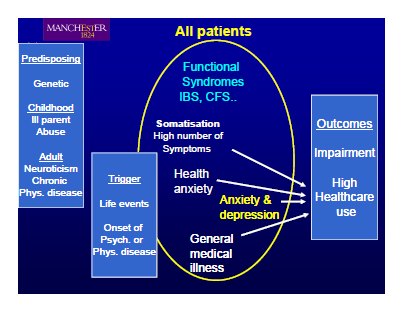
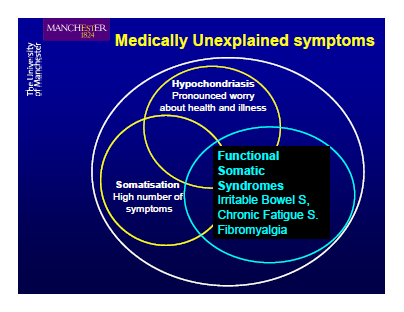
Francis Creed, MD, FRCP: Can We Now Explain Medically Unexplained Symptoms?

PDF Creed Presentation Slides (No transcript)

      Creed Presentation Slides

       Creed References

(A lengthy but important slide presentation by DSM-V Somatic Symptom Disorders Work Group member, Francis Creed. No transcript available but please view the slides – there are many references to “Chronic fatigue syndrome”, chronic fatigue and IBS and to the so called “Functional Somatic Syndromes”.)

Lawson Wulsin, MD, FAPM, DSM V for Psychosomatic Medicine: Current Progress and Controversies

      Wulsin Presentation Slides

[No transcript available]

Joel Dimsdale, MD, FAPM, Update on DSM V Somatic Symptoms Workgroup

       Dimsdale text 

[Text version of slides]

4] For detailed information on the proposed structure of ICD-11, the Content Model and operation of iCAT, the collaborative authoring platform through which the WHO will be revising ICD-10, please scrutinise key documents on the ICD11 Revision Google site:

https://sites.google.com/site/icd11revision/
https://sites.google.com/site/icd11revision/home/documents

Three American Psychiatric Association (APA) DSM related pieces

Three American Psychiatric Association (APA) DSM related pieces

Post #10 Shortlink: http://wp.me/pKrrB-pk

Update @ 24 January

Discussion of the Ethan Watters New York Times Magazine article “The Americanization of Mental Illness” here:

Somatosphere

Monday, January 11, 2010
The globalization of biopsychiatry

A collaborative weblog covering the intersections of medical anthropology, science and technology studies, cultural psychiatry and bioethics.

with extracts from this Kirmayer and Sartorius article:

Psychosomatic Medicine 69:832-840 (2007)
© 2007 American Psychosomatic Society

SOMATIC PRESENTATIONS: CULTURE

Cultural Models and Somatic Syndromes   [Full paper]
Laurence J. Kirmayer, MD and Norman Sartorius, MD, PhD

From the Culture and Mental Health Research Unit, Institute of Community and Family Psychiatry, Sir Mortimer B. Davis-Jewish General Hospital, Montreal, Quebec, Canada.

Update: 22 January
 

New Scientist

23 January 2010

Invasion of the mind-snatchers

Western notions of mental illness are one of the US’s most insideous exports – and they are spreading around the world like a contagion, says Ethan Watters

Ethan Watters is a journalist who writes on social trends for publications that include Wired and The New York Times Magazine. His books include Urban Tribes. This essay is based on his latest book, Crazy Like Us: The globalization of the American psyche (Free Press/Simon and Schuster)

The New Yorker
ANNALS OF MEDICINE

3 January 2010

The Dictionary of Disorder
How one man revolutionized psychiatry

Alix Spiegel

…Robert Spitzer isn’t widely known outside the field of mental health, but he is, without question, one of the most influential psychiatrists of the twentieth century. It was Spitzer who took the Diagnostic and Statistical Manual of Mental Disorders—the official listing of all mental diseases recognized by the American Psychiatric Association (A.P.A.)—and established it as a scientific instrument of enormous power. Because insurance companies now require a DSM diagnosis for reimbursement, the manual is mandatory for any mental-health professional seeking compensation. It’s also used by the court system to help determine insanity, by social-services agencies, schools, prisons, governments, and, occasionally, as a plot device on “The Sopranos.”

Read more: here


New York Times Magazine

The Americanization of Mental Illness

8 January 2010

Ethan Watters

Ethan Watters lives in San Francisco. This essay is adapted from his book “Crazy Like Us: The Globalization of the American Psyche,” which will be published later this month by Free Press.

Dr Sing Lee, referred to in this article is a member of the DSM-5 Work Group for “Somatic Symptom Disorders”.


Psychiatric Times Blogspot

Western Psychiatric Imperialism, or Something Else?

12 January 2010

Ronald Pies responds to the essay in the New York Times Magazine, The Americanization of Mental Illness.