APA announces second public review of DSM-5 draft criteria and structure

American Psychiatric Association (APA) announces second public review of DSM-5 draft criteria and structure

Post #73 Shortlink: http://wp.me/pKrrB-12k

Second public stakeholder review and feedback period now 4 May to 15 June

APA News Release No: 11-27 PDF: http://tinyurl.com/APAnewsrelease4may11 

or open PDF on this site here: New Framework Proposed for Manual of Mental Disorders

Online posting of draft disorders and criteria proposed by the 13 DSM-5 Work Groups for new and existing mental disorders had originally been scheduled for May-June, this year. According to a revised Timeline on the APA’s DSM-5 Development site, in March, this second public review exercise had been rescheduled for August-September:

“August-September 2011: Online Posting of Revised Criteria. Following the internal review, revised draft diagnostic criteria will be posted online for approximately one month to allow the public to provide feedback. This site will be closed for feedback by midnight on September 30, 2011.”

But yesterday, 4 May, the APA announced that the second public review period is now open and will run from May to 15 June.

The DSM-5 site was updated yesterday with announcements and revised proposals (dated May 4, 2011) across all categories. The current review period closes on 15th June – just six weeks away.

Note that this is a public and stakeholder review and feedback exercise and is not restricted to professionals or members of the American Psychiatric Association.

There is a Task Force announcement here: http://www.dsm5.org/Pages/Default.aspx

[Extracts]

What Specifically Has Changed on This Site?

“You will notice several changes to this Web site since we first launched in February 2010. Numerous disorders contain updated criteria…

” ...Is There Opportunity to Provide Further Comments?

“At this time, we are asking visitors to review and comment on the proposed DSM-5 organizational structure and criteria changes. Please note that the current commenting period will end on June 15, 2011. It is important to remember that the proposed structure featured here is only a draft. These proposed headings were reviewed by the DSM-5 Task Force in November 2010…

“…The content on this site will stay in its current form until after completion of the DSM-5 Field Trials, scheduled to conclude later this year. Following analysis of field trial results, we will revise the proposed criteria as needed and, after appropriate review and approval, we will post these changes on this Web site. At that time, we will again open the site to a third round of comments from visitors, which will be systematically reviewed by each of the work groups for consideration of additional changes. Thus, the current commenting period is not the final opportunity for you to submit feedback, and subsequent revisions to DSM-5 proposals will be jointly informed by field trial findings as well as public commentary.

“We look forward to receiving your feedback during the coming weeks and appreciate your participation in this important process.”      [Source: http://www.dsm5.org/Pages/Default.aspx]

There are brief notes on the proposed DSM-5 Organizational Structure here:

http://www.dsm5.org/proposedrevision/Pages/proposed-dsm5-organizational-structure.aspx

The “Recent updates” page for “DSM changes” and “Disorder-specific changes” is here:

http://www.dsm5.org/Pages/RecentUpdates.aspx


Registration for submitting feedback

Last year, registration was required in order to submit comment via the DSM-5 Development website. You can register to submit feedback on the DSM-5 Development site home page or on the individual pages for specific category proposals (right hand side under “Participate”).

The revised Timeline can be read here: http://www.dsm5.org/about/Pages/Timeline.aspx

According to the Timeline, a third review and feedback is currently scheduled for January-February 2012, for two months.


Latest revisions for “Somatic Symptom Disorders”

http://www.dsm5.org/ProposedRevision/Pages/SomaticSymptomDisorders.aspx

I will post  information in the next posting specific to the proposals of the DSM-5  Work Group for “Somatic Symptom Disorders”


Media coverage of APA’s 4 May DSM-5 announcement

MedPage Today

CNN Blog

CFSAC Spring 2011 Meeting Agenda (May 10-11)

CFSAC Spring 2011 Meeting Agenda (May 10-11)

Post #72 Shortlink: http://wp.me/pKrrB-126

The Agenda for the next meeting of the Chronic Fatigue Syndrome Advisory Committee (CFSAC) has been issued and can be read on the CSFSAC website here and below.

Transcripts of some Public and Written Testimonies for the May meeting can be read on this page of the CFSAC website.

“The Chronic Fatigue Syndrome Advisory Committee (CFSAC) provides advice and recommendations to the Secretary of Health and Human Services via the Assistant Secretary for Health of the U.S. Department of Health and Human Services on issues related to chronic fatigue syndrome (CFS). These include:

  • factors affecting access and care for persons with CFS;
  • the science and definition of CFS; and
  • broader public health, clinical, research and educational issues related to CFS.

“Administrative and management support for CFSAC activities is provided by the Office of the Assistant Secretary for Health (OASH). However, staffing will continue to be provided primarily from the Office on Women’s Health, which is part of OASH.

“Dr. Wanda K. Jones, Principal Deputy Assistant Secretary for Health in OASH, will continue in her role as the Designated Federal Officer for CFSAC.”

I am pleased to see that discussion of concerns around the proposed coding of CFS for the forthcoming US specific “Clinical Modification” of ICD-10, which is known as “ICD-10-CM”, has been tabled for further discussion, at 1.15pm on Day One of  the meeting.

CFSAC Spring 2011 Meeting Agenda (May 10-11)

Day One

9:00 a.m.

Call to Order
Opening Remarks

Dr. Christopher Snell
Chair, CFSAC

Roll Call, Housekeeping

Dr. Wanda Jones
Designated Federal Official

9:15 a.m.

Agency Updates and Progress on Recommendations: CDC, HRSA, AHRQ, FDA, CMS

Ex-Officio Members

10:00 a.m.

State of the Knowledge Workshop- Outcomes and Committee Discussion

Dennis Mangan, NIH
Committee Members

11:00 a.m.

Break

11:15 a.m.

Public Comment

Public

12:15 p.m.

Subcommittee Lunch

Subcommittee Members

1:15 p.m.

Discussion of International Classification of Diseases-Clinical Modification (ICD-CM) concerns

Committee Members

2:15 p.m.

Committee Discussion

Committee Members

3:15 p.m.

Break

3:30 p.m.

Public Comment

Public

4:30 p.m.

Committee Discussion and Plans for Day 2

Committee Members

5:00 p.m.

Adjourn


Day Two

9:00 a.m.

Call to Order
Opening Remarks:

Dr. Christopher Snell
Chair, CFSAC

Roll Call, Housekeeping:

Dr. Wanda Jones
Designated Federal Official

9:15 a.m.

Welcome Statement from the Assistant Secretary for Health

Dr. Howard K. Koh

9:30 a.m.

Social Security Administration: Presentation on Disability

John Federline, SSA

10:00 a.m.

ERISA and Insurance Issues for CFS Patients (Tentative)

Department of Labor (TBD)

11:00 a.m.

Break

11:15 a.m.

Committee Discussion

Committee Members

12:00 p.m.

Subcommittee Lunch

Subcommittee Members

1:00 p.m.

Public Comment

Public

2:00 p.m.

Break

2:15 p.m.

Committee Discussion: Finalize Recommendations

Committee Members

4:30 p.m.

Adjourn

Related information

[1] Post: Next meeting of the Chronic Fatigue Syndrome Advisory Committee (CFSAC) (US): http://wp.me/pKrrB-YY

[2] Post: CFS orphaned in the “R” codes in US specific ICD-10-CM: http://wp.me/pKrrB-V4

[3] International Classification of Diseases, Tenth Revision, Clinical Modification (ICD-10-CM). Note: The 2011 release of ICD-10-CM is now available and replaces the December 2010 release:
http://www.cdc.gov/nchs/icd/icd10cm.htm

[4] US “Clinical Modification” ICD-10-CM. This article clarifies any confusion between ICD-10, ICD-11 and the forthcoming US Clinical Modification, ICD-10-CM: http://wp.me/pKrrB-Ka

[5] Chronic Fatigue Syndrome Advisory Committee (CFSAC). The Chronic Fatigue Syndrome Advisory Committee (CFSAC) provides advice and recommendations to the Secretary of Health and Human Services via the Assistant Secretary for Health of the U.S. Minutes of meetings, Recommendations and meeting videocasts:
http://www.hhs.gov/advcomcfs/meetings/index.html

ICD Revision Process Alpha Evaluation Meeting presentations

ICD Revision Process Alpha Evaluation Meeting documents and PowerPoint slide presentations

Post #71 Shortlink: http://wp.me/pKrrB-10i

The information in this mailing relates only to ICD-11, the forthcoming revision of ICD-10 that is scheduled for completion and pilot implementation in 2014/15. It does not apply to the forthcoming US specific Clinical Modification of ICD-10, known as ICD-10-CM.

ICD Revision Process Alpha Evaluation Meeting

An ICD Revision Process Alpha Evaluation Meeting was held, last week, in Geneva. See this post on DSM-5 and ICD-11 Watch site for more information and commentary: http://wp.me/pKrrB-ZN

The Agenda for the meeting can be read here: ICD11 April 2011 Meeting Agenda Word .docx

Following this meeting, it is anticipated that ICD Revision Steering Group may make a public announcement within the next few weeks of how it intends to proceed in light of the fact that the timeline for transition from the Alpha to Beta drafting phases has slipped.

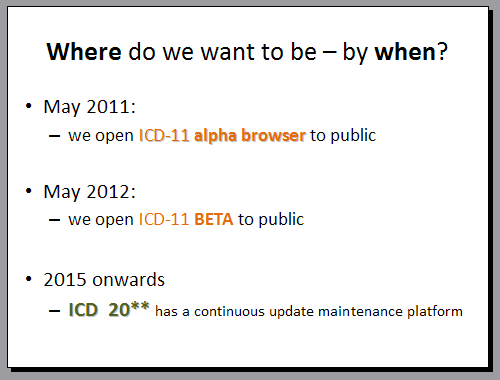
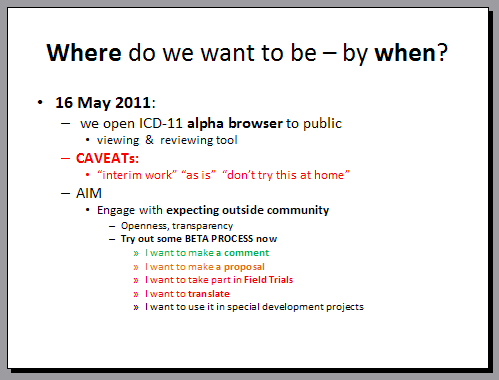
The meeting Agenda and PowerPoint slides suggest that ICD Revision is working towards making a version of the drafting platform publicly available around 16 May, this year, but that this may be a compromise on previous plans and possibly a “hybrid” between the Alpha and Beta drafting phases.

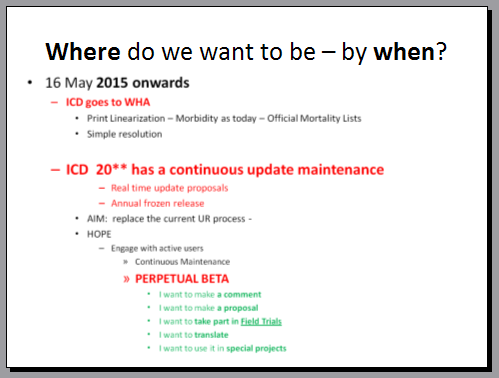
Earlier timelines had approval by World Health Assembly (WHA) slated for May 2014, with pilot implementation of ICD-11 in March 2014. One presentation slide now suggests approval by WHA in 2015.

It’s unconfirmed, but if this is the case, WHO may have already decided to shift WHA endorsement and dissemination of ICD-11 by 12 months, to 2015. This would mean that DSM-5 would have been put to bed and published two years prior to ICD-11 implementation.

From the meeting Agenda:

“Future Phases:

a. iCAT continued alpha development and evaluation ( 2010-11)

b. iCAT beta phase ( 2012-2015)

c. iCAT continuous maintenance phase ( 2015+)”

In November, last year, the iCAT collaborative authoring platform through which ICD-11 is being drafted was taken out of the public domain. A revised version of the software on which the platform runs is currently sitting on a Standford server, behind a password, accessible only to ICD Revision. This, or a similar version, may be made publicly accessible (or accessible to those who register for access) from mid May.

There has been discussion is earlier ICD Revision documents of a hierarchy of stakeholder input – but there is nothing much on this in the meeting presentations, for which ICD Revision has published only slides – not transcripts.

Coming up on DSM-5 and ICD-11 Watch:

ICD-11 proposals for PVFS, ME and Chronic fatigue syndrome

Until some form of Alpha/Beta transition drafting platform is back in the public domain, it won’t be evident how much further forward the population of content for Chapter 6 Diseases of the nervous system has progressed since last November. As more information becomes available, I will update, and I will be posting a summary of how things stood in the iCAT last November, in Post #72.

ICD Revision Process Alpha Evaluation Meeting presentations

There are five presentations published for this meeting: the following three may be of interest to those following the development of ICD-11:

(The 2007 MS PowerPoint viewer is required to view PowerPoint presentations which have been created in .pptx format. A MS .pptx viewer can be downloaded for free from the Microsoft site.)

Open full PowerPoint Presentation:”The Way Forward Questions Options” [.ppt]: TheWayForwardPP

Selected slides from “The Way Forward Questions Options”

Slide 2

Slide 3

Slide 5

Slide 6

Slide 12

Slide 17

Open full PowerPoint Presentation:”The Way Forward Questions Options” [.pptx]: TheWayForwardPP

——————

Open full PowerPoint Presentation: Proposal for the ICD Beta Platform, Stanford team” [.ppt]: iCATBetaStanford[1]

Selected slides from “Proposal for the ICD Beta Platform, Stanford team”

Slide 5

Slide 11

Slide 12

Slide 41

Slide 42

Slide 43

Slide 44

Slide 45

Slide 46

Slide 51

Open full PowerPoint Presentation: Proposal for the ICD Beta Platform, Stanford team” [.ppt]: iCATBetaStanford[1]

——————

Open full Can Celik PowerPoint Presentation: “Public Tooling” [.pptx]: Ppt0000069 CanCelic 

Selected slides from Can Celik’s PowerPoint Presentation: “Public Tooling”

Slide 4

Slide 7

Slide 10

Slide 11

Slide 12

Slide 13

Slide 14

Slide 15

Open full Can Celik PowerPoint Presentation: “Public Tooling” [.pptx]: Ppt0000069 CanCelic 
 

Key documents and references:

1] ICD Revision Process Alpha Evaluation Meeting Agenda and background documents

2] Report, WHO FIC Council conference call, 16 February 2011, PDF format

3] Key document: ICD Revision Project Plan version 2.1 9 July 2010

4] Key document: Content Model Reference Guide version January 2011

5] PVFS, ME, CFS: the ICD-11 Alpha Draft and iCAT Collaborative Authoring Platform (DSM-5 and ICD-11 Watch report with screenshots from the iCAT): http://wp.me/pKrrB-KK

ICD Revision Process Alpha Evaluation Meeting 11-14 April: The Way Forward?

ICD Revision Process Alpha Evaluation Meeting 11 – 14 April 2011: The Way Forward?

Post #70 Shortlink: http://wp.me/pKrrB-ZN

The information in this mailing relates only to ICD-11, the revision of ICD-10 scheduled for completion and pilot implementation in 2014/15. It does not apply to the forthcoming US specific “Clinical Modification” of ICD-10, known as ICD-10-CM.

The Way Forward?

ICD-11 Revision maintains a website on a Google platform where key documents, agendas for iCAMP and workgroup meetings, background documents and presentations can be viewed and downloaded. Minutes or summaries of meetings aren’t usually posted publicly:

ICD-11 Revision: http://sites.google.com/site/icd11revision/home

An ICD Revision Process Alpha Evaluation Meeting was held in Geneva, last week, between 11-14 April, for discussing the status of the revision of ICD-10 and development of ICD-11, for both content and software development, and reviewing the ICD revision “Roadmap” and Timeline.

A copy of the Meeting Agenda can be downloaded from the ICD-11 Revision site here or opened on DSM-5 and ICD-11 Watch site here: ICD11 April 11 Meeting Agenda. There are some interesting comments in the Agenda Appendix on project funding, lack of resources, project management and lines of communication.

There are five PowerPoint presentations available to download from this page.

If you are interested in the ICD Revision process, in general, then I suggest visiting the site and viewing or downloading the following three presentations – these are slides only, with no notes or transcripts.

(The 2007 MS PowerPoint viewer is required to view presentations that have been created in .pptx format. A .pptx viewer can be downloaded free from the Microsoft site.)

.ppt file: The Way Forward

.pptx file: Can Celik’s Presentation: Public Tooling

.pptx file: Stanford’s Presentation: iCAT Beta

These three presentations can also be opened in the next post on DSM-5 and ICD-11 Watch site and selected slides have been posted here:

Post #71: ICD Revision Process Alpha Evaluation Meeting documents and presentations


“Community engagement”

In mid 2009, ICD Revision launched a number of platforms as channels of communication with the public and maintains a YouTube Channel, Facebook site, Twitter and blog. The ICD-11 blog has not been updated since October 2009 and queries left on the Facebook site by members of the public may take several months before a response is provided or may receive no response, at all.

The YouTube videos made to accompany various Geneva meetings can also be accessed on the ICD Revision YouTube page of my site. The two most recent videos give an overview of the iCAT drafting process and the extent of the ICD-11 “Content Model” – the 13 parameters through which ICD-11 categories can be described.


Visibility of iCAT drafting platforms

Following last week’s ICD Revision Process Alpha Evaluation Meeting, it is anticipated that ICD Revision may make a public announcement, within the next few weeks, clarifying how it intends to proceed in light of the fact that the timeline for the Beta drafting phase is slipping.

The meeting Agenda and PowerPoint slides suggest that ICD Revision is working towards making a version of the drafting platform publicly available around 16 May, this year, but that this may represent a compromise on previous plans and may be a “hybrid” between the Alpha and Beta drafting phases.

From the Agenda:

“Future Phases:

a. iCAT continued alpha development and evaluation ( 2010-11)

b. iCAT beta phase ( 2012-2015)

c. iCAT continuous maintenance phase ( 2015+)”

Earlier timelines had projected endorsement by the World Health Assembly (WHA) and pilot implementation of ICD-11 in the spring of 2014. But one presentation slide suggests approval by WHA in 2015.

It’s unconfirmed, but if the “Milestones” timeline has been revised to accommodate a later release of a Beta drafting phase platform and later publication of a Beta Draft, then WHO may have already decided to shift the pilot implementation date for ICD-11 by 12 months, to 2015.

That would mean that by the time ICD-11 is ready for dissemination, the American Psychiatric Association’s DSM-5 would have already been put to bed and out in print two years prior to ICD-11 implementation.

It is intended that for ICD-11, all three volumes will be electronically published and capable of continuous updating in response to scientific developments (unlike ICD-10 where there are annual updates); there will also be electronic translations and print editions. The three volumes of ICD-11 are intended to be integrable with each other and also with some other classification systems. 

The drafting platforms are based on Web 2.0 applications and it is proposed that there will be stakeholder and end user participation in the Beta drafting phase.

The IT work and software development for the various alpha and beta drafting platforms and final product platforms is enormously complex; there is also the potential for far more textual content in ICD-11 than there was in ICD-10 and overall, this revision project represents a huge undertaking by an under-resourced organization.


The ICD-11 Alpha/Beta drafting process

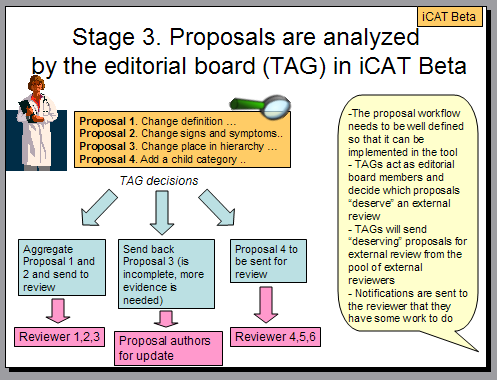
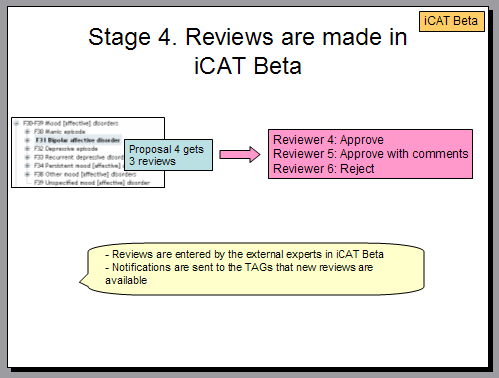
Topic Advisory Group (TAG) Managing Editors overseeing the revision of the various chapters of ICD-10 have responsibility for recruiting external experts, via networking. The function of the external experts is to peer review proposals being made by TAG members or submitted by external professional bodies and institutions and to review or assist with the generation of textual content.

[In late 2009, I approached the WHO’s Dr Robert Jakob to enquire whether and at what stage the names of external peer reviewers would be identified in the drafting platforms, as visible to the public. I also asked whether the reviewing of proposals as they progressed through the Workflow review system would be a transparent process that could be monitored by the public. Neither query produced a response from Dr Jakob.]

So there are many lines of communication to be maintained between WHO classification experts, IT consultants and technicians, Revision Steering Group members, TAG Managing Editors, TAG members and external experts. There is an ICD-11 Collaborative Authoring Workflow chart here: workflow-2.

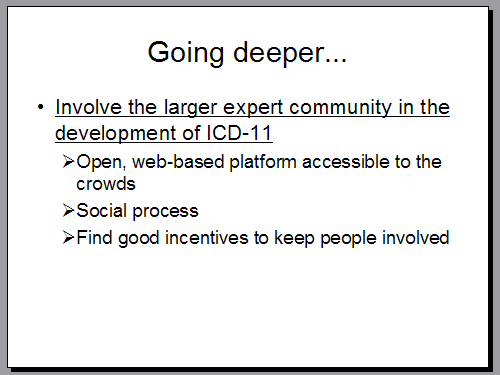
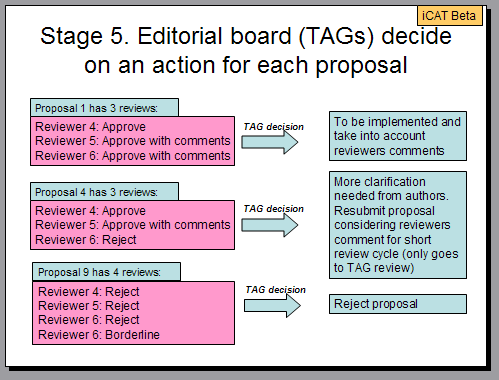
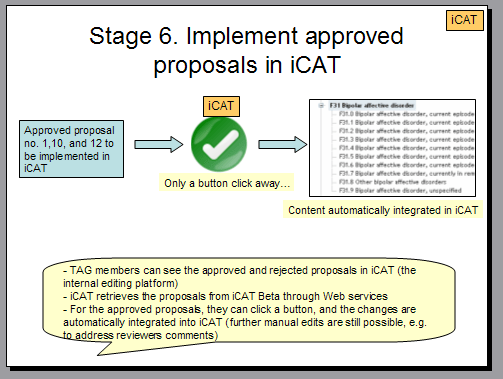
At the Beta drafting stage, the proposal is that TAG Managing Editors will continue to recruit external peer reviewers to assist workgoups with reviewing of categories, proposals and generation of content, but that versions of the Beta drafting platform would be opened up to the public for viewing, and interested stakeholders would be able to register for limited input and interaction.

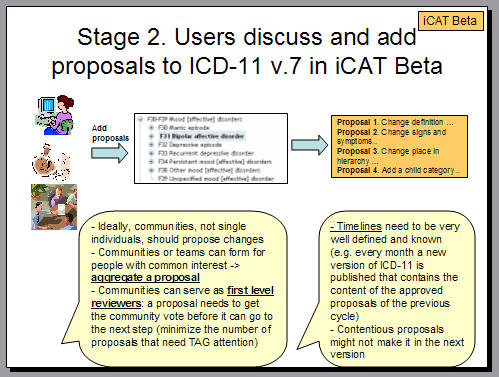
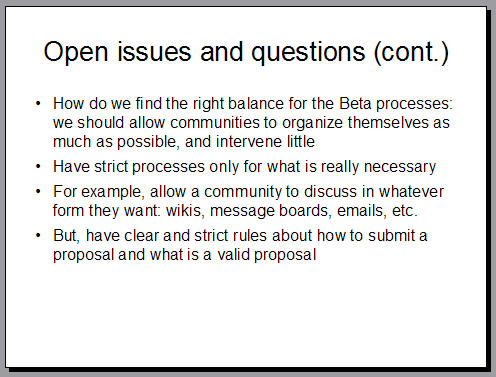
Stakeholders (or preferably, communities of stakeholders) would not have editing rights, per se, but the proposal is that they would comment on proposals, “score” proposals and make evidence-based suggestions which the TAG groups would then consider for approval, which would then be incorporated into the draft or rejected.  There has also been discussion of a “hierarchy” of levels of input according to professional status of stakeholders. How ICD Revision plans to verify the credentials of professionals isn’t clear, nor is it defined what would consitute a stakeholder “community”.

No static Beta Draft for public review and comment

Rather than release a static Beta draft for professional and public scrutiny in a feedback exercise for a pre-determined review period (as DSM-5 has already done and is scheduled to do again in August-September), the proposal appears to be for longer term feedback during an alpha/beta transition drafting phase on dynamic content that would be continuously updated, for example, on a four weekly cycle, to reflect the progress being made by the various Topic Advisory Groups in entering proposals for changes and populatation of textual content, and in response to external input.

So managing editors and members of the Topic Advisory Groups (mostly international clinicians and researchers juggling this work on top of their “day jobs”) are faced with maintaining lines of communication, largely via electronic means, between workgroup chairs, fellow workgroup members, external peer reviewers and WHO classification experts whilst also considering input from professional bodies, and working in the background on the drafting platform, while stakeholders are commenting and feeding suggestions into the process via the public versions of the drafting platforms. 

[Some organizations and professional bodies have been compiling and submitting proposals via an ICD Revision Proposal Form, since late 2009. There is no publicly available list of which institutions and bodies have been invited to submit proposals, which have responded, or where their submissions for changes to ICD-10 can be scrutinised, but copies of these submissions occasionally turn up online, having been published in the organs of these organizations.]

Selected slides from “Proposal for the ICD Beta Platform, Stanford team”:

Slide 11
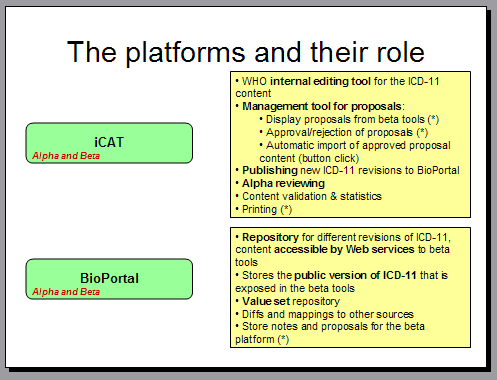
Slide 12

Slide 42

Slide 43

Slide 45

Slide 46
 

“…who will do all this work?”

Presentations and video clips of the WHO’s Dr. Bedirhan Üstün suggest a man buzzed up on information and internet technology: “cloud sourcing”, portals, public commenting and “scoring” of proposals, wikis, blogs,  internal and public “user communities”, drawing in the involvement of “Wikipedians” and other existing “editing communities” (one questions whether Dr Üstün has any experience of how Wikipedia functions and the problems inherent with some Wikipedia admins and editors, particularly in relation to editing of controversial scientific and medical areas), message boards, Facebook integration, “community engagement”…

But as the closing slide of one of last week’s presentations ruefully comments, “And just a small detail: who will do all this work?” [6]

ICD Revision and its IT and informatics advisors seem eager to use these internet applications because they exist, without having given due consideration to whether the WHO can fund, manage and sustain this level of public participation and interaction or whether this is the best way to approach the revision of the ICD.

How does ICD Revision intend to finance and recruit the personnel needed to manage the opening up of the drafting process to multiple platforms for stakeholder participation, given WHO’s limited resources when already, no-one can evidently be spared to even keep the ICD-11 blog updated or to respond to queries that members of the public have posted on ICD Revision’s existing public platforms and where Topic Advisory Group Chairs approached for brief clarifications are not always providing a response nine months down the line?

Who is going to pull this most ambitious project back down to earth?

Insufficient funding allocated and no Project Manager

From the Appendix to the April meeting Agenda:

“TAGs were supposed to be self-financed.  The TAG chair was supposed to have funding to carry out their revision work.”

“As this is a core WHO activity, we should have regular budget funds for this project.  The scale of this project is too big not to have funding for a project manager.”

“Additionally, ALL relevant WHO departments should have designated some financial and some human resources to this project as part of the collaborative effort.”

“…communication between the TAGs is growing, and it is beginning to become overwhelming in addition to clinical responsibilities.”


ICD-11 proposals for PVFS, ME and Chronic fatigue syndrome

Until some form of Alpha/Beta transition drafting platform is back in the public domain, it won’t be evident how much further forward the population of content for Chapter 6 Diseases of the nervous system has progressed since last November. As more information becomes available, I will update, and I will be posting a summary of how things stood in the iCAT last November in Post #72.

The meeting Agenda, selected slides and three of the PowerPoint presentations can be viewed/opened from Post #71, on DSM-5 and ICD-11 Watch site, here:

ICD Revision Process Alpha Evaluation Meeting documents and presentations


Key documents and related posts:

1] ICD Revision Process Alpha Evaluation Meeting Agenda and background documents

2] Report, WHO FIC Council conference call, 16 February 2011, PDF format

3] Key document: ICD Revision Project Plan version 2.1 9 July 2010

4] Key document: Content Model Reference Guide version January 2011

5] PVFS, ME, CFS: the ICD-11 Alpha Draft and iCAT Collaborative Authoring Platform (DSM-5 and ICD-11 Watch report with screenshots from the iCAT): http://wp.me/pKrrB-KK

6] Closing remarks, PowerPoint presentation: “Proposal for the ICD Beta Platform”, Stanford team, 12.04.11, WHO, Geneva.

ICD-11 struggling to meet targets for release of Beta Draft in May

ICD-11 Revision Steering Group struggling to meet targets for release of Beta Draft platform in May

Post #69 Shortlink: http://wp.me/pKrrB-ZB

The information in this mailing relates only to ICD-11, the forthcoming revision of ICD-10 that is scheduled for completion and pilot implementation in 2014/15. It does not apply to the forthcoming US specific Clinical Modification of ICD-10, known as ICD-10-CM, or to other Clinical Modifications of ICD-10, already in use.

Revision of the WHO’s ICD-10, the version of ICD in current use in the UK and over 110 countries worldwide, has been underway since 2007. The implementation date has already been shifted from 2012 to 2014/15.

A Beta Draft platform for ICD-11 had been scheduled for readiness by April, this year, for public release in May.

An ICD Revision Beta Requirements document states, “The Beta Phase will be open to [the] general public in May 2011 to enable structured input by interested parties subject to peer-review by relevant Technical Advisory Groups.”

But ICD Revision is evidently struggling to keep this project on track.

In October, last year, the Revision Steering Group’s “iCamp2” meeting acknowledged that a considerable amount of work needed to be done if ICD Revision if targets for a May 2011 release of a Beta Draft platform were going to be met.

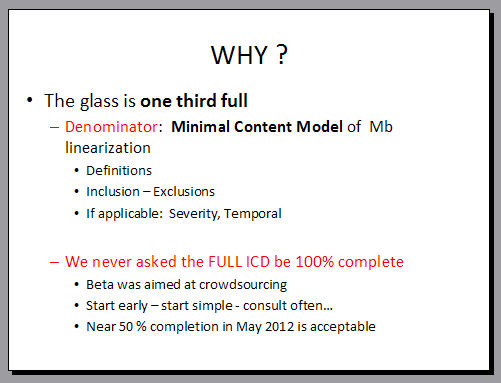
According to an October iCamp2 PowerPoint presentation, Frequent Criticisms, and iCamp2 meeting videos, targets for the population of content for the Alpha Draft had not been reached: less than 80% of the Terminology Definitions had been uploaded to the iCAT and less than the 20% target for full Content Model completion for the thousands of diseases and disorders classified within ICD had been met.

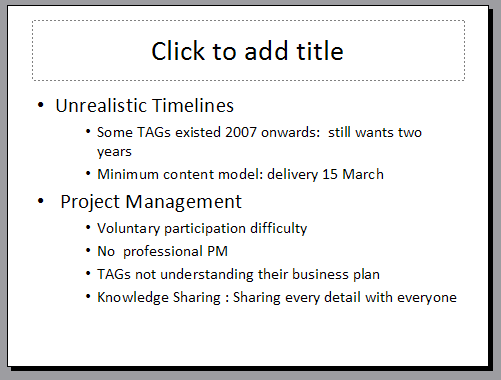
The Revision Steering Group (RSG) identified a number of barriers to keeping this very technically ambitious project on track: lack of funding; the amount of time required for drafting definitions and population of textual content according to the complex ICD-11 “Content Model”; recruitment of external experts for reviewing proposals and generating content; familiarising the various Topic Advisory Group (TAG) members with informatics and the functionality of the iCAT (the collaborative authoring platform through which ICD-11 is being drafted); the paucity of face-to-face meetings for TAG managing editors and workgroup members, (scattered across the globe and undertaking these roles, by electronic means, in addition to their professional commitments), and difficulties facilitating interaction between the various Topic Advisory Groups where diseases overlap with other chapters.

If ICD Revision is already struggling to maintain targets, motivation and interaction between its various Topic Advisory Groups, then management of the project once the Beta drafting phase is reached and the process opened up to [the projected] thousands of stakeholders is going to present ICD-11 RSG and TAG managing editors with considerable challenges. The ICD-11 iCamp YouTube commentaries have an air of brittle optimism about them.

I have already predicted that come May 2011, we might anticipate some scaling back of plans and/or a possible shift in the release date for the Beta drafting platform (and potentially a further shift in the final ICD-11 implementation date) in response to recognition that the WHO may have significantly overestimated its capacity for obtaining funding and resources to fulfil this most ambitious vision by 2014.


Report of a WHO-FIC (WHO Family of International Classifications) Council conference call

http://www.who.int/classifications/network/Council_report_2011_16Feb.pdf

or open  here on Dx Revision Watch site.

This document is the Report of a WHO-FIC Council conference call which took place between 14:00-15:30 Geneva Time, on Wednesday, February 16, 2011. It confirms that ICD Revision is debating whether to go public in May with a Beta drafting platform that falls short of targets for completion or whether to revise its schedule.

From Page 6

ICD-11 Beta Draft and Timeline

“In the context of the review of preparations for the ICD-11 Beta release, there was a set of arguments for and against a postponement of the beta release.

“The status was summarized as in the slide below.

“In discussion the WHO FIC Council Members commented:

• It is essential to have a good product that goes out to the general public.
• Extra time is needed for the cross-cutting TAGs as most substantive review is starting lately.
• On the other hand, having no public input into the process is of concern.

“Wider input is necessary; and public and transparency input was a goal of the revision process. A hybrid model of opening the revision process to public comment and suggestions at the same time not a full scale beta phase with field trials may be a better solution.

“WHO thanked the Council for their valuable input and contribution to the decision-making process. The TAG input is going on and the RSG has to review the topic as well. Given the current stage and pace of work, however, it is unlikely that the ICD-11 will be fulfilling the criteria for a beta version in April – either in terms of content or the software preparations. The financial situation of WHO requires more austere measures rather than a full-scale RSG meeting as planned in 11-15 April. Accordingly a decision will be made and conveyed to all stakeholders.”


I will update if and when ICD Revision issues an information release on its decision about the Beta Drafting platform and clarifies its intentions for the extent of public participation, or when more information becomes available.

In November, the iCAT electronic authoring platform through which the Alpha Draft was being developed was taken out of the public domain. The server for the improved version of the iCAT, which provides the platform for drafting the Beta is sitting behind a password, here: http://icat.stanford.edu/.

Access and editing rights are currently restricted to WHO, Revision Steering Group, the various ICD-11 Topic Advisory Group managing editors and members, reviewers of content and proposals and IT technicians. But it was envisaged that at the Beta stage, the drafting platform would be opened up for public access and to interested stakeholders who register for limited imput.

The Alpha and Beta drafts are “works in progress”. Proposals as they stood in the iCAT collaborative drafting platform in November, last year, are that all three terms, PVFS, (B)ME and Chronic fatigue syndrome should be classified within ICD-11 Chapter 6: Diseases of the nervous system [1].

A meeting was expected to be held in Geneva, this week, and I will post further information as it becomes available on the ICD Revision Google site.


References:

1] PVFS, ME, CFS: the ICD-11 Alpha Draft and iCAT Collaborative Authoring Platform (Report with screenshots from the Alpha drafting stage iCAT)

2] Key document: ICD Revision Project Plan version 2.1 9 July 2010

3] Key document: Content Model Reference Guide version January 2011

Online Version of ICD-10 for 2011?

Online Version of ICD-10 for 2011?

Post #68 Shortlink: http://wp.me/pKrrB-Zr

The information in this mailing relates only to ICD-10, the current version of the WHO’s International Classification of Diseases in use in the UK and over 100 countries worldwide. It does not relate to the forthcoming international revision of ICD-10, which will be ICD-11.

Nor does it relate to the country specific Clinical Modifications of ICD: ICD-9-CM; the forthcoming ICD-10-CM: ICD-10-CA (Canada); ICD-10-GM (Germany); ICD-10-AM (Australia); ICD-10-TM (Thailand).

The ICD-10 Updating process

The International Conference for the Tenth Revision of the ICD held in Geneva in 1989 recommended that “…WHO should endorse the concept of an updating process between revisions and give consideration as to how an effective updating mechanism could be put in place”.

The three volumes of ICD-10 were published between 1992 and 1994 and came into use in WHO Member States from 1995.

Two separate bodies were established to manage the updating process: the Mortality Reference Group (MRG) and the Updating and Revision Committee (URC).

The concept for the MRG was developed in 1997, and it began making decisions regarding the application and interpretation of ICD for mortality in 1998. The MRG also makes recommendations on proposed ICD updates to the URC.

The URC was established in 2000 and receives proposals from the MRG and members through the WHO Collaborating Centres for the Family of International Classifications (WHO FIC). The URC considers the proposals and submits recommendations on proposed updates to the Heads of Collaborating Centres who, in turn, make recommendations to WHO.

Updates to the published volumes of ICD-10 are approved annually at the October meetings of Heads of WHO Collaborating Centres for the Family of International Classifications and are available as annual lists of changes. The lists indicate the source of recommendation and implementation date and they are published in PDF format (from 1996 to 2007) on this page:

http://www.who.int/classifications/icd/icd10updates/en/index.html

According to this “List of Official ICD-10 Updates” page, all major changes that were scheduled for 2009 were postponed to 2010.

This PDF document:

http://www.who.int/classifications/network/Council_report_2011_16Feb.pdf

or here:

https://dxrevisionwatch.com/wp-content/uploads/2011/04/council_report_2011_16feb.pdf

is the Report of a WHO FIC Council conference which took place on 16 February 2011.

On Page 3 of this public domain document it records:

4. Ongoing business

“Posting of Updates for ICD-10: So far, the URC has submitted all relevant files to WHO. Following the WHO review, the updates will be published on WHO web site latest by 31 March 2011.

“Posting of Updates for ICF is scheduled before 31 March 2011.

“Online Version of ICD-10 for 2011: The meeting suggested that it is necessary to have an official reference for the extensive changes to ICD that occurred in 2010.

“The relevant files are available to WHO and such a version will be put online.”

[Note: The update files do not appear to have been uploaded to the ICD site yet.]

The above suggests that WHO envisages publishing an Online Version of ICD-10 for 2011 that would replace the current version for 2007, which can be accessed here:

http://apps.who.int/classifications/apps/icd/icd10online/

Note this would not be the replacement for ICD-10, but an online version of the Tabular List that incorporates the annual updates to ICD-10. ICD-11 is not scheduled for implementation until 2014/15 and is still at the Alpha drafting stage.

There is no evidence to suggest any changes within ICD-10 to the current classifications, codings and indexing for PVFS, (B)ME and Chronic fatigue syndrome and according to the ICD-11 iCAT drafting platform, proposals for ICD-11 are that all three terms should be classified within ICD-11 Chapter 6: Diseases of the nervous system.

However, I do want to alert patients, advocates and those who maintain websites that according to this recent WHO FIC document, there is a possibility that the ICD 10th Revision, Version for 2007 may be replaced, this year, by a version for 2011 that incorporates the annual updates.

I will provide more information if and when an online version for 2011 is published.

References:

1] International Classification of Diseases (ICD)
http://www.who.int/classifications/icd/en/

2] ICD Classifications updating process
http://www.who.int/classifications/icd/updates/en/index.html

3] List of Official ICD-10 Updates
http://www.who.int/classifications/icd/icd10updates/en/index.html

4] International Statistical Classification of Diseases and Related Health Problems 10th Revision Version for 2007 (the current version)
http://apps.who.int/classifications/apps/icd/icd10online/