WHO retires “Benign” from “Benign myalgic encephalomyelitis” for final ICD-10 release

Post #357 Shortlink: https://wp.me/pKrrB-56g

In my report for the December edition of the ME Global Chronicle, I set out how the G93.3 terms:

Postviral fatigue syndrome

Benign myalgic encephalomyelitis

Chronic fatigue syndrome

are classified in the World Health Organization’s international version of ICD-10 and how these terms have been classified for ICD-11.

I have an update on ICD-10 and it’s good news!

In January, the WHO released ICD-10 Version: 2019. With ICD-11 on the horizon, this release will be the final update for the WHO’s international version of ICD-10, apart from corrections and exceptional additions.

In March 2016, a representative from the Canadian Institute for Health Information submitted a request and supporting rationale to the ICD-10 Update and Revision Committee (URC) for removal of the prefix “Benign” from “Benign myalgic encephalomyelitis”.

This request for a change was approved by the URC in September 2016 for implementation in the next release. 

For ICD-10 Version: 2019, the G93.3 Tabular List inclusion term is now Myalgic encephalomyelitis.

(The term, “Benign myalgic encephalomyelitis” has been retained as an Index term.)


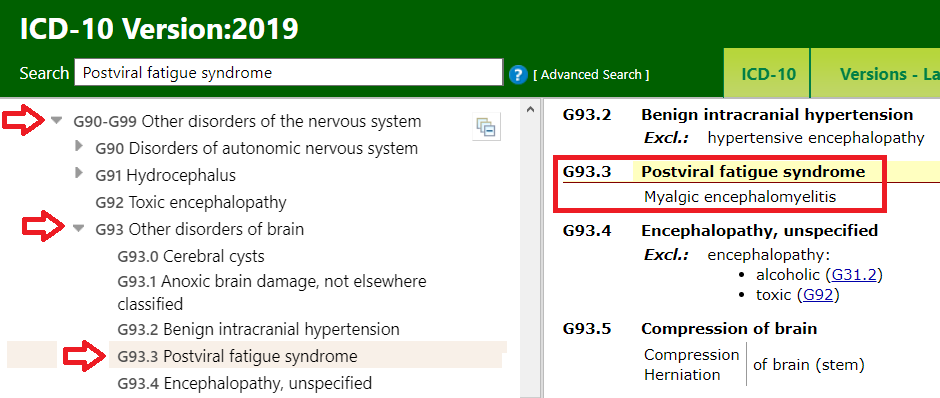
View the revised listing for the G93.3 codes on the ICD-10 Browser, here: https://icd.who.int/browse10/2019/en#/G93.3 or in the screenshot, below.

Note that for ICD-10, Chronic fatigue syndrome is not included in the Tabular List but is included in Volume 3: Index, where it is coded to the G93.3 Postviral fatigue syndrome concept title term.

For ICD-11, the WHO has retained Postviral fatigue syndrome as the concept title term in Chapter 08: Diseases of the nervous system under parent: Other disorders of the nervous system. The new code for ICD-11 is: 8E49.

Benign myalgic encephalomyelitis and Chronic fatigue syndrome are both specified as inclusion terms under Postviral fatigue syndrome in ICD-11’s equivalent to the Tabular List and take the 8E49 code. A number of historical and alternative terms are retained as index terms and all 14 index terms are coded to 8E49.


This is how the G93.3 terms are classified for ICD-10 Version: 2019:

Image 1: ICD-10 Browser Version: 2019, Accessed February 20, 2020: https://icd.who.int/browse10/2019/en#/G93.3
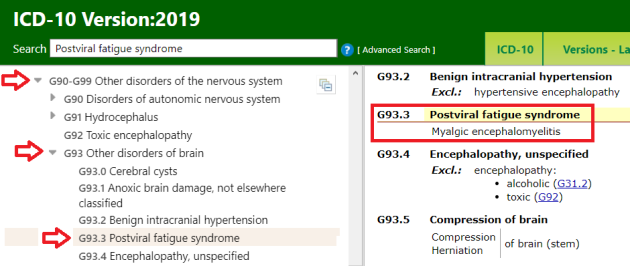
Image location: https://dxrevisionwatch.com/wp-content/uploads/2020/02/meicd1019.png


The WHO expects Member States to be using the most recent release of ICD-10. But countries will implement the ICD-10 Version: 2019 release according to their own schedules. 

NHS England and ICD-10:

NHS England currently uses ICD-10 Version: 2016. I have contacted NHS Digital’s classifications lead to establish whether NHS Digital intends to implement Version: 2019 or may be considering skipping the new release in preference to implementing ICD-11, at some point in the future.

If there is no mechanism for incorporating selected changes in a new release into earlier versions, NHS England might not be able to absorb this change into the version it is using.


Will this change be absorbed automatically for ICD-11?

This revision for the final release of ICD-10 sets a precedent for the national modifications of ICD-10, for example, the U.S. ICD-10-CM and Canadian ICD-10-CA, but also for ICD-11. 

Proposals submitted in March 2017 by Chapman & Dimmock, and by the IACFS/ME for removing “Benign” from “Benign myalgic encephalomyelitis” were rejected by the WHO in early 2019.

In February, I submitted a new proposal for removal of the “Benign” prefix for ICD-11 citing the URC’s 2016 decision and the implementation of that decision for the final release of ICD-10.

You can read a copy of my new proposal and rationale here: http://bit.ly/BenignICD11

I have updated the PDF included in my report in the December edition of the ME Global Chronicle to reflect this change:

Download the PDF of my updated report here:

Update on the classification of PVFS, ME and CFS for ICD-11 Report One | November 2019 | v3 18/02/20


An edited version of this report is scheduled for publication in the March edition of the ME Global Chronicle.
WHO approves exclusions for PVFS, ME and CFS under ICD-11’s Bodily distress disorder

Post #356 Shortlink: https://wp.me/pKrrB-555

An edited version of this report is scheduled for publication in the March edition of the ME Global Chronicle.

For ICD-11, most of the ICD-10 F45 Somatoform disorders categories and F48.0 Neurasthenia have been replaced by a single new category called “Bodily distress disorder” (BDD). 

Although this sounds like it might be very similar to Per Fink’s Bodily distress syndrome (BDS), ICD-11’s BDD is conceptually closely aligned with the DSM-5’s Somatic symptom disorder (SSD).

For ICD-11, Somatic symptom disorder is listed under Synonyms under BDD but is not coded as an inclusion term.

Both the WHO and Prof Fink have clarified that as defined for ICD-11, BDD is a conceptually different disorder construct — ICD-11’s BDD and Fink’s BDS are differently defined and characterised, have very different criteria and are inclusive of different patient sets.

For ICD-11, the BDD diagnosis requires both the presence of one or more chronic, distressing bodily symptoms (which can be “medically unexplained” or caused or exacerbated by a general medical condition) and “excessive attention” or “disproportionate or maladaptive” thoughts, feelings or behavioural responses to these symptoms. BDD can capture a percentage of patients with ME, CFS or other general medical diseases or conditions — if the clinician considers the patient also meets the disorder description for application of an additional mental disorder diagnosis of BDD. 

In contrast, Fink’s BDS disorder construct requires physical “symptom patterns” or “clusters” from one or more body systems; the symptoms must be “medically unexplained” and there is no requirement for emotional or behavioural responses to meet the criteria. If the symptoms can be better explained by a general medical disease, they cannot be labelled “BDS”. But crucially, Fink’s BDS is inclusive of ME, CFS, IBS and FM and subsumes these under a single, unifying diagnosis.

The terms “bodily distress disorder” and “bodily distress syndrome” have been used synonymously since 2007. Not surprisingly, researchers, academics and practitioners are already confusing and conflating ICD-11’s new “Bodily distress disorder” with Fink’s “Bodily distress syndrome”.

Although BDD can potentially be applied to patients with chronic, distressing symptoms associated with any general medical disease or condition, patients with a diagnosis of ME or CFS (or who are waiting for a diagnosis) may be particularly vulnerable to misdiagnosis with BDD or misapplication of an additional BDD mental disorder diagnosis, as a “bolt-on” to their existing diagnosis. 

Exclusions for the 8E49 terms under MG22 Fatigue and a reciprocal exclusion for MG22 Fatigue under 8E49 Postviral fatigue syndrome were secured by April 2019.

However, the need for adding exclusions for PVFS, ME and CFS under ICD-11’s BDD to mitigate the risk of misdiagnosis or misapplication had not been acknowledged or accepted by the WHO.

In my report in the December edition of the ME Global Chronicle, I mentioned that the proposals submitted by Chapman & Dimmock (March 2017) and by Lily Chu MD on behalf of IACFS/ME (March 2017) for exclusions for the three 8E49 terms under 6C20 Bodily distress disorder and for exclusion of 6C20 Bodily distress disorder under the 8E49 Postviral fatigue syndrome concept title had been rejected. 

In December 2019, I submitted a new proposal for exclusions for the three 8E49 terms under 6C20 Bodily distress disorder, supported by a new rationale text. 

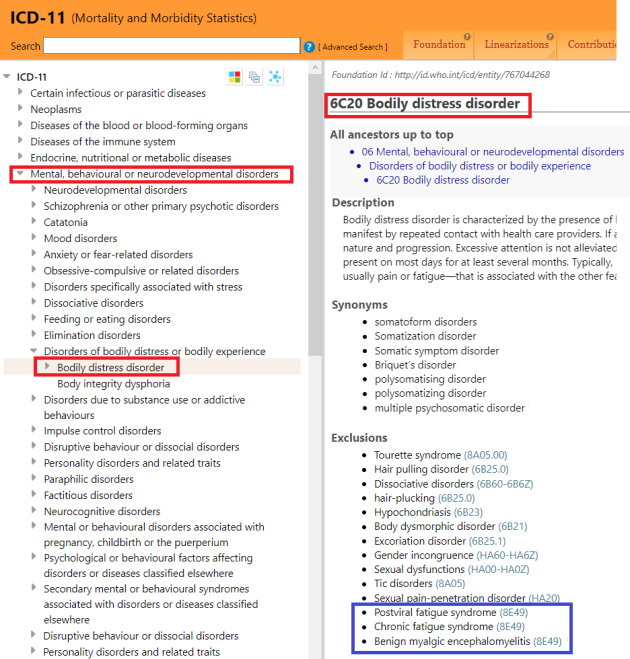
I am very pleased to inform you that in January the WHO approved and implemented my proposal.

You can view the addition of the three exclusions under ICD-11’s Bodily distress disorder here: https://icd.who.int/dev11/l-m/en#/http://id.who.int/icd/entity/767044268

Image 1: ICD-11 for Mortality and Morbidity Statistics (Maintenance Platform), Accessed February 18, 2019:


I have updated the PDF of my report in the December edition to reflect the addition of exclusions.

Download my updated report here: http://bit.ly/ICD11Update 


The WHO Clinical Descriptions and Diagnostic Guidelines (CDDG) for ICD‐11 Mental, Behavioural and Neurodevelopmental Disorders:

For ICD-11, the WHO Department of Mental Health and Substance Abuse has developed the “Clinical Descriptions and Diagnostic Guidelines (CDDG) for ICD‐11 Mental, Behavioural and Neurodevelopmental Disorders” (an equivalent publication to ICD-10’s “Blue Book”).

The CDDG provides expanded clinical descriptions, essential (required) features, boundaries with other disorders and normality, differential diagnoses, additional features, culture-related features and codes for all mental and behavioural disorders commonly encountered in clinical psychiatry. This companion publication is intended for mental health professionals and for general clinical, educational and service use.

The WHO has said it planned to release the CDDG “as soon as possible” after WHA’s adoption of ICD-11. But it remains unclear whether the CDDG has been finalised or if it will be released later this year or next year.

See this post Clinical Descriptions and Diagnostic Guidelines (CDDG) for ICD‐11 Mental, Behavioural and Neurodevelopmental Disorders for more information.

Whilst clinicians have been able to register to review and provide feedback on the drafts, no draft texts for the CDDG have been made available for public stakeholder scrutiny and comment and I have not had access, for example, to the most recent draft for the full clinical descriptions and diagnostic guidelines for ICD-11’s Bodily distress disorder.


Additional resources:

Comparison of SSD, BDD, BDS, BSS in classification systems, Chapman & Dimmock, July 2018

Comparison of Classification and Terminology Systems, Chapman & Dimmock, July 2018

Post: World Health Assembly adopts ICD-11: When will member states start using the new edition? June 17, 2019

Post: Clinical Descriptions and Diagnostic Guidelines (CDDG) for ICD‐11 Mental, Behavioural and Neurodevelopmental Disorders, June 28, 2019