Human Rights denied: Something rotten in the state of Denmark: Update 1

Post #257 Shortlink: http://wp.me/pKrrB-35o
Clarification notice
Reports and updates on Dx Revision Watch site on the Hansen family’s situation are being published as provided by, and in consultation with, Rebecca Hansen, Chairman, ME Foreningen, Danmark (ME Association, Denmark), or edited from reports as provided by Ms Hansen.
Dx Revision Watch site has no connection with any petitions or initiatives, or with any social media platforms or other platforms set up to promote petitions or initiatives, or to otherwise raise awareness of the Hansen family’s situation. The use of any links to content on Dx Revision Watch does not imply endorsement of, or association with any initiatives other than the ME Foreningen, Danmark (ME Association, Denmark) Postcard to Karina Campaign.
All enquiries in relation to petitions or other initiatives, social media platforms, or any other platforms associated with them should be addressed directly to the organizers, sponsors or owners responsible for them.

+++

“…Do ME patients in Denmark not have the right to choose which treatment we want to receive? Do we not have the right to visitors when we are in the hospital?”
+++
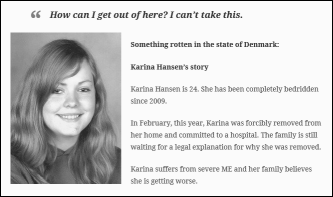
Karina Hansen

Update 1: Human Rights denied

On May 11, on the eve of ME Awareness week, I published an account of the plight of the Hansen family, in Denmark. Karina Hansen is 24. She has been bedridden with severe ME since 2009.

In February, this year, Karina was forcibly removed from her bedroom and committed to Hammel Neurocenter.

Her parents have not seen Karina for over three months.

The Hansen family and their lawyer are still waiting for legal documentation and answers to their questions:

Which authority gave the order to remove Karina from her home against her will and by whom was it authorized?

What legislation was used to detain her as an involuntary patient in a hospital?

Why are the parents being denied visits?

Two updates on the case have been released, this week. These are being published, as provided, and with permission of the Hansen family and their lawyer.

+++
For the first report see:

Something rotten in the state of Denmark: Karina Hansen’s story: http://wp.me/pKrrB-2Xc

For reports in Danish see:

Menneskerettighederne nægtet: Noget råddent i staten Danmark: Karina Hansen: Opdater 1: http://wp.me/pKrrB-36e

The Universal Declaration of Human Rights: https://www.un.org/en/documents/udhr/

Status on Karina’s Case – May 24th, 2013

By Rebecca Hansen
Chairman, ME Foreningen, Danmark (ME Association, Denmark)

The following text has been approved by the family.

Karina is still hospitalized at Hammel Neurocenter. Dr. Jens Gyring gave a verbal message to the family that this could continue for a long time, perhaps a year. We have not seen any evidence that Karina is getting better.

Karina’s parents have a power of attorney that gives them the right to make decisions for Karina, also about her treatment. But this is ignored.

The power of attorney was made in May 2012. Karina’s general practitioner declared her psychologically healthy twice, in May 2012.

The Danish Board of Health claims that Karina’s lawyer is not her lawyer, as they now state that Karina was not competent when she hired her lawyer in May 2012. The lawyer has represented Karina since May 2012 and received access to Karina’s case at that time on the basis that he had authority as her lawyer. Then, The Danish Board of Health informed her lawyer, that it is true that he had authority at the time of the first failed attempt to section Karina (May 3, 2012), but that the power of attorney does not apply to the incident in February 2013, when Karina was forcibly removed and hospitalized.

The psychiatrist, Nils Balle Christensen, writes that Karina is an adult and has the ability to make “here and now decisions” [“her og nu beslutninger”] and that Hammel Neurocenter is doing nothing against her will. But at the same time, Holstebro Kommune believes that Karina needs a guardian and Statsforfatningen Midtjylland has been asked to appoint one for her. This will disempower Karina completely and leave all decisions up to her guardian.

The ME Association, Denmark, contacted the Patient Office on April 19, 2013 to ask for the name of Karina’s patient advisor. We wished to inform the advisor about Karina’s illness and to offer to bring an ME expert to Denmark to examine Karina. The answer from the Patient Office was that “the case is handed over to the Legal Office in Region Midtjylland.”

Karina’s parents and I tried to visit Karina on May 12, 2013, but we were denied access to her. You can read more about our attempt on the ME Association’s Facebook page under Noter.

Nils Balle Christensen writes that there is not a ban on visits, but Karina’s parents are still not allowed to visit her. A verbal message was given to Karina’s parents that  “the laywers” will create a “document” about the “visit restrictions.” Karina’s parents expect to get that in the next 7-14 days.

Karina has her mobile phone at the hospital and we have tried to call it many times, but it always goes directly to voice mail.

+++

A Visit to Karina – a Question of Human Rights

Rebecca Hansen
ME patient
Icerebel62@hotmail.com

On May 12, Karina’s parents and I decided once again try to visit Karina at Hammel Neurocenter. Karina is a severely ill Danish ME patient being held at Hammel Neurocenter since February 12, 2013, during which time her parents have not been allowed to visit or talk to her.

Karina’s lawyer has recently received a very limited access to some of the paperwork in Karina’s case by using the Public Records Act. This revealed that it is actually not permitted in Denmark to prevent relatives from visiting their family members in the hospital and that human rights have priority.

Karina’s parents had been told that they must meet with Nils Balle Christensen (NBC), a psychiatrist from the Research Center for Functional Disorders and Psychosomatics [Aarhus], to talk about the conditions of visitation before they could see their daughter. When Karina’s sister, Janni, visited Karina in April, Janni was given instructions about what she could and could not say to Karina. The parents were not allowed in at all because they were told they first needed to meet with NBC to decide the conditions of visitation.

But now we knew that it is not legal to have this restriction on visits, so we decided to try to see Karina on Sunday May 12 – Mother’s Day and International ME Awareness Day.

Before I tell about the visit, I will tell about the contact NBC has had with Karina and her family.

Nils Balle Christensen became involved with Karina’s case in May 2012 after Karina’s lawyer prevented her removal under a psychiatric law. He was introduced to the family and his job was to help make a treatment plan for Karina. During the summer of 2012, NBC visited the family several times with the purpose of making a treatment plan for Karina. During this time, NBC did not want to cooperate with Karina’s lawyer and NBC did not deliver a written treatment plan. Karina’s parents never received any written instructions for Karina’s care and there was no criticism of the care they were giving Karina.

I was at a meeting with NBC and Karina’s parents in August 2012 where NBC told the mother that she was doing a good job. NBC came with an offer to hospitalize Karina, but not a plan about what would happen when she was hospitalized. They also did not receive an explanation as to why they could not treat Karina at home. Karina’s parents did not dare to agree to an unknown treatment from a doctor who has never before treated (or even seen) a severely ill ME patient. For many reasons, Karina’s parents did not trust NBC and contact with NBC was stopped in the early fall of 2012. Karina’s parents chose to pay for a private doctor and a dietician to help Karina.

Karina’s parents believed that NBC’s involvement with Karina was now over. But the limited access that Karina’s lawyer has now obtained under the Public Records Act reveals that NBC’s involvement was far from over.

The paperwork shows that there was activity in Karina’s case between from the Board of Health to Holstebro county and the Holstebro police, as well as to NBC after his contact with her parents had stopped.

Furthermore, these papers reveal that there was an inquiry to the Ministry for Health and Prevention [Ministeriet for Sundhed og Forebyggelse] about the right to prevent relatives from visiting family members at a hospital. On December 21, 2012, the Minister secretary sent a 5-page answer that explains that human rights have priority (weigh very heavily).

But in NBC’s letter to Karina’s parents on Februay 12, 2013, it says:

“It has been decided that because of Karina’s condition, she may not have visitors the first 14 days. After that, it will be evaluated if she is able to have visits.”

With this new information about human rights in hand, Karina’s parents and I decided on May 12 to see if there was still a ban or restrictions on visitation to Karina at Hammel Neurocenter.

We did not want the staff to feel threatened by us in any way, so we had agreed ahead of time that if we were told we could not visit Karina, we would respect this, but would ask a lot of questions about why this ban/restriction was being made.

At Hammel, Karina’s parents introduced themselves to the staff and asked for permission to see their daughter. The answer was No and we were told that they should have made an appointment with the doctor before coming. I asked if there was a ban on visits and they answered No, not a ban. Then I asked if there were restrictions, but did not receive an answer. Instead, a staff member said that she would call Jens Gyring, the head doctor at the center. They asked us to wait. The staff at Hammel Neurocenter were polite and friendly, but it was obvious that they were not comfortable with us being there.

A few minutes later, the nurse returned and said that Jens Gyring’s answer was that the parents must first have a meeting with NBC before they could see their daughter. We discussed this restriction and Karina’s parents asked for a written explanation as to why they had to have a meeting with NBC before they could see their daughter and what the intent of the meeting would be.

I pointed out that it was not legal to prevent parents from seeing their child and tried to show them the statement from the Ministry of Health and Prevention [Ministeriet for Sundhed og Forebyggelse]. A second staff member broke in to say that this discussion must be taken up with the doctors and not them.

In the meantime, Jens Gyring was contacted again and said that Karina should be asked if she wanted to have a visit. A new nurse joined our discussion and said: “I have just been in with Karina and said you were here and asked if she wanted a visit and she just shook her head.”

Very interesting that suddenly there was no ban, but now it was up to Karina…

To that I said that we would like to have a whole sentence from Karina to make sure she understood the question. We wanted to hear her say that she didn’t want to see her mom and dad. We couldn’t really know if she understood the question or if she really believed they were there after three months. Also, Karina usually wears earplugs, so maybe she did not even hear the question.

Karina’s mom said that she would like to hear the words from Karina’s own mouth. That she would like to see Karina and hear Karina’s answer. And if Karina told her to leave, she would go away immediately.

The staff insisted that Karina has answered.

Remember, the last thing Karina said to her mother was on February 13, when Karina called her mother and said: “How do I get out of here? I can’t take this.” – What has happened in the last three months? Does Karina really not want to see her parents? And if so, why not? What have the doctors told Karina about why her parents are not visiting? We can only guess the answers to these questions.

It was clear that her parents would not be allowed to see Karina and hear for themselves that she didn’t want a visit. But we did get the staff to promise to have NBC send them a written statement about why they had to have a meeting with him before they could see their daughter and what the meeting would be about. They also promised to charge up Karina’s cell phone and give it to her. Then we left the [Hammel] Neurocenter. Her mom had tears in her eyes and said, “I really thought I was going to see her today.”

When her parents got home, they wrote a mail to NBC and once again asked for a written explanation as to why they may not see Karina and what the agenda would be for the meeting that he requires before they can see her.

NBC answered that there is no ban on visits. And since Karina’s parents don’t want to meet with NBC, then they can meet with the head doctor Jens Gyring instead: “where there can be made written agreements about future visits, telephone contact and more.”

Isn’t this still a ban until their conditions are met? How is this any different from a ban on visits until the parents meet with NBC? What right do they have to make this condition?

A few days later, Karina’s parents were told by the doctor Jens Gyring that it would be up to the lawyers to make a written agreement about visitation. This could take two weeks.

In the meantime, we can think about what this situation means for other ME patients and their families in Denmark. A severely ill ME patient is assigned a psychiatrist that has never treated a severely ill ME patient before. The psychiatrist comes from a clinic that has chosen not to work with international ME experts (letter from September 2012 and minutes from our meeting in October 2012).

The psychiatrist does not wish to work with the patient’s lawyer or give any written information about the treatment he will give. When the ME patient and the family decide they do not want the treatment offered by this psychiatrist, then the Danish authorities work together to remove the patient from her home – quite obviously against her will – and isolate her for her family and her lawyer.

The psychiatrists in charge of Karina are also in charge of all ME patients in Denmark – so is this the future for all ME patients and their families in Denmark?

Do ME patients in Denmark not have the right to choose which treatment we want to receive? Do we not have the right to visitors when we are in the hospital?

Yes, something is very rotten in the state of Denmark.

If I have misunderstood something in this story, then I will be happy to hear an explanation from the involved parties.

Rebecca Hansen
ME patient
Icerebel62@hotmail.com

+++
For the first report see:

Something rotten in the state of Denmark: Karina Hansen’s story: http://wp.me/pKrrB-2Xc

For more information on the ME Association of Denmark’s postcard campaign go here on Facebook
For information on Bodily Distress Syndrome see Part Two of Dx Revision Watch Post: ICD-11 Beta draft and BDD, Per Fink and Bodily Distress Syndrome
Human Rights denied: Something rotten in the state of Denmark: Karina Hansen’s story: Update 1: http://wp.me/pKrrB-35o
Menneskerettighederne nægtet: Noget råddent i staten Danmark: Karina Hansen: Opdater 1: http://wp.me/pKrrB-35o
Ontkenning van mensenrechten: Iets verrot in de staat van Denemarken: Het verhaal van Karina Hansen: Update 1: http://wp.me/pKrrB-35o
Menschenrechtsverstoß: Etwas ist faul in Dänemark: Karina Hansens Geschichte: Update 1: http://wp.me/pKrrB-35o
Droits de l’Homme: Il y a quelque chose de pourri au royaume du Danemark: l’histoire de Karina Hansen: Update 1: http://wp.me/pKrrB-35o

DSM-5 released: Media, professional and advocacy reaction: Round up #6

Post #256 Shortlink: http://wp.me/pKrrB-34A

For earlier responses to the release of DSM-5 see Round up Posts #255, #254, #253, #252, #251 and #249

On May 16, CDC published a new report on children’s mental health which I am including in this DSM-5 round up.

Washington Post: CDC says 20 percent of U.S. children have mental health disorders Tony Pugh, May 19, 2013

Up to one in five American youngsters — about 7 million to 12 million, by one estimate — experience a mental health disorder each year, according to a new report billed as the first comprehensive look at the mental health status of children in the country.

CDC article on new Report released May 16, 2013 can be accessed here:

http://www.cdc.gov/features/childrensmentalhealth/

Report in text format here: Children’s Mental Health – New Report

Report in PDF format here: PDF Children’s Mental Health – New Report

+++


Thompson Reuters News & Insight: Lawyers worry new measure of mental retardation could prompt more executions Elizabeth Dilts, May 13, 2013


Lexology, US: “DSM-5 anxiety” may be new disorder for employers trying to navigate ADA Squire Sanders, Ryan A. Sobel, May 22, 2013


Pacific Standard, US: Now That the ‘DSM-5′ Is Out Can We Start Talking About the Effect It Will Have? Michael Dahr, May 23, 2013

The newly revised, hotly contested book of psychiatric diagnoses is finally here. How will it change the way we consider and treat substance use problems?

Michael Dahr is a medical and science writer who has written for Livescience.com, Science & Medicine, Iowa Outdoors, and various medical and research institutions.

The Conversation: DSM-5 won’t increase mental health work claims – here’s why Nick Glozier, May 23, 2013

Professor of Psychological Medicine, BMRI & Discipline of Psychiatry at University of Sydney


Times Higher Education: Psychiatry’s cause for anxiety Matthew Reisz, May 23, 2013

Focus on people, not technology or the DSM, to treat mental illness, Tom Burns tells Matthew Reisz


Telegraph, UK: Why are women still considered more insane than men? Will Nicholl, May, 23, 2013


ABC Australia: The Pulse DSM-5: why all the fuss? Claudine Ryan, May 23, 2013

…Dr Maria Tomasic, president of the Royal Australian and New Zealand College of Psychiatrists, says the DSM-5 is a useful tool designed to be used by medical professionals who understand its limitations. “We are concerned about the use of classification systems such as the DSM-5 by institutions such as courts or government bodies who often do not understand the complexity of diagnosis, and seek to simplify difficult decisions about funding or eligibility…”

[Professor Perminder] Sachdev says “it should not be used as a legal document or to help bench-mark social services and welfare payments, nor is it suitable for use in seven-minute consultations in a GPs office”.


Wood TV, US: Shrinks, critics face off over psychiatric manual Associated Press Medical Writer Lindsey Tanner, May 22, 2013


The Take Away, US: Presenter John Hockenberry

The show is a co-production of WNYC Radio and Public Radio International, in collaboration with New York Times Radio and WGBH Boston.

Listen again The DSM and Mental Health in America, May 22, 2013

Guest: Allen Frances, MD | Produced by: Nikolay Nikolov and Jillian Weinberger

+++

Listen again In Defense of the DSM-5 May 23, 2013

Guest: Jeffrey Lieberman, MD | Produced by: Kristen Meinzer

…the incoming president of the American Psychiatry Association, which revises the DSM, says the criticism is unwarranted. His name is Jeffrey Lieberman, MD, and he’s also chairman of psychiatry at Columbia University.

+++


From Dx Summit platform

Counselors for Social Justice Position Statement on DSM-5 (first published August, 2011)

For earlier responses to the release of DSM-5 see Posts #255, #254, #253, #252, #251 and #249

DSM-5 released: Media, professional and advocacy reaction: Round up #5

Post #255 Shortlink: http://wp.me/pKrrB-346

For earlier responses to the release of DSM-5 see Posts #254, #253, #252, #251 and #249

Division of Clinical Psychology

Earlier this month, the Division of Clinical Psychology (DCP), a division of the British Psychological Society, published a Position Statement on the “Classification of Behaviour and Experience in Relation to Functional Psychiatric Diagnoses, Time for a Paradigm Shift.”

Lucy Johnstone, who helped formulate the DCP’s Position Statement, contributed to a BBC Radio 3 broadcast, last night.

BBC Radio 3

Duration: 45 minutes | One year left to listen | First broadcast: Wednesday 22 May 2013

Night Waves May 22, 2013

Segment starts at 23:45 mins in and runs for 15 mins

Khaled Hosseini, Man Booker International Prize, Disgraced, the Future of Psychiatry, with Rana Mitter

“The British Psychological Society’s division of clinical psychology is calling for a ‘paradigm shift’ in psychiatry away from diagnosis. They claim treating ‘mental distress’ as an illness stigmatises sufferers and leads us to ignore more complicated social dimensions to conditions like depression or schizophrenia. So what is the way forward for psychiatry? Rana is joined by Lucy Johnstone who helped formulate the BPS’s position, consultant psychiatrist Tom Burns, and the historian of psychiatry Matthew Smith.”


Critical Psychiatry Network

The Critical Psychiatry Network (CPN) has issued a statement on DSM-5, dated May 22, 2013. The Statement can be downloaded from this page or the PDF opened, here, on Dx Revision Watch: CPN statement on DSM-5


Social Justice Solutions

“Is a social worker conceived and operated organization born out of the Stony Brook School of Social Welfare’s commitment to active participation in creating a socially just world.”

In DSM-5: A Call to Opposition for Social Workers, Georgianna Dolan-Reilly, LMSW, calls on the organization’s constituency to oppose DSM-5sign the Open Letter developed by the Society for Humanistic Psychology, Division 32 of the American Psychological Association, and criticizes the National Association of Social Workers (NASW) for not issuing its position on DSM-5.


Social Work Helper

Follow Up Interview with Dr Allen Frances: Dishing the Dirt on the DSM 5 Deona Hooper, MSW May 20, 2013

Article links to: Mother Jones: Psychiatry’s New Diagnostic Manual: “Don’t Buy It. Don’t Use It. Don’t Teach It.” By Michael Mechanic, May 14, 2013, which I don’t think has been previously posted.


Science Live Chat: Does ‘Psychiatry’s Bible’ Need to Be Rewritten? (Video)

Talk to experts in a live Google Hangout about the controversy over the DSM-5 Emily Underwood, May 20, 2013

With Frank Farley, William Eaton and Allen Frances

Join us on Thursday, 23 May, at 3 p.m. EDT on this page for a live Google Hangout to chat with experts about the fate of the DSM. Be sure to leave your questions for our guests in the comment box below. [See site for more details]


New Internationalist: Corporates cashing in on mental-health diagnosis Adam McGibbon, May 21, 2013


Pittsburgh Post-Gazette: Critics blast new manual on mental disorders David Templeton, May 21, 2013

Interview with Brent Dean Robbins, who heads the Psychology Department at Point Park University, is a leading critic of DSM-5 and committee member of the recently launched, Global Summit on Diagnostic Alternatives: An Online Platform for Rethinking Mental Health http://dxsummit.org/


AHRP: Two NIMH Directors Debunk DSM & Deplore Psychiatry’s Unscientific Modus Operandi Vera Sharav, May 8, 2013


San Francisco Weekly: Brain Distrust: Shrinks and Scientologists Find Weird Common Ground Over the DSM-5 Joe Eskenazi, May 22, 2013


Counterpunch, US: Taking on Big Pharma A Mental Health Declaration of Independence Bruce E Levine, May 21, 2013


Economist, US: The DSM-5 Attention, everyone CH, May 22, 2013


New York Times: Mind: The Book Stops Here Richard A Friedman, MD, May 20, 2013


Lexology, US: Employers beware: psychiatry’s latest Diagnostic Manual (DSM-5) creates new mental disorders, expands others, Hunton & Williams LLP, May 20, 2013


Education Week, US: Revised Psychiatric Disorders ‘Bible’ Changes Disability Definitions Christina Samuels on May 20, 2013


Human Resource Executive Online, US: New Mental-Health Manual Likely to Impact HR James J McDonald, Jr., May 22, 2013

Making accommodations for employees with mental disabilities has never been easy, and it’s about to get more difficult with the release of the American Psychiatric Association’s new manual of mental disorders.


Fox News, US: The new DSM-5 fails to accurately describe mental illness Dr Keith Ablow, May 22, 2013


Huffington Post: The Role of Biological Tests in Psychiatric Diagnosis Allen Frances, MD, May 22, 2013


Slate, US: You Do Not Have Asperger’s Amy S F Lutz, May 22, 2013

What psychiatry’s new diagnostic manual means for people on the autism spectrum

For earlier responses to the release of DSM-5 see Posts #254, #253, #252, #251 and #249

DSM-5 released: Media, professional and advocacy reaction: Round up #4

Post #254 Shortlink: http://wp.me/pKrrB-33A

For earlier responses to the release of DSM-5 see Posts #253, #252, #251 and #249

The colour of money

If you want to view the WHO’s ICD-10 “Blue Book” or the “Green Book”, the ICD-10 Tabular List Version: 2010 or the forthcoming US ICD-10-CM you can do so for free, online.

If you want to view the “Purple Book” it’s going to set you back $199 in hardcover and $149 in paperback.

American Psychiatric Association has never given free access to the DSM. According to Task Force chair, David J Kupfer, no change is planned to that policy. An online version is in the pipeline but it won’t be free.

“A digital version is promised within a few months through a secure website and also as mobile device applications. Revisions will be more frequent and most likely would be distributed only electronically…” (APA Leaders Defend New Diagnostic Guide John Gever, Medscape Today, May 18, 2013)

The finalized criteria sets and the texts that accompany the disorder sections are nailed down with copyright permissions and restrictions.

What resources are available for free?

On this page of the American Psychiatric Association’s website, you can view the DSM-5 Table of Contents, a document titled Insurance Implications for DSM-5, Psychiatric News articles, disorder descriptions and rationales fact sheets, videos and a document called Highlights of Changes from DSM-IV to DSM-5. New documents are being added to this page every few weeks.

The DSM-5 Development site, from which the third draft was removed, last November, will remain online. Currently undergoing reorganization, APA says the platform will serve as a resource for clinicians, researchers, insurers, and patients.

There is now a tab page Ask Questions or Provide Feedback with a form for submitting questions and feedback. The page states that as frequent questions are received the answers will be continually added to the FAQ pages.

Down the right hand side of the DSM-5 Development Home Page are links for disorder description and rationale documents for some new and existing disorders. (Note that at the time of writing, not all the links are live links, so you may need to hop to this page, in order to open some of the PDFs.)

At the top of the list of links, there is a new document, Important Coding Corrections and an Insurance Implications FAQ.

+++
No position statement issued yet from the American Psychological Association, but a Practice Central Update around DSM-5, ICD-10-CM and the cross-walk has been published: Nine frequently asked questions about DSM-5 and ICD-10-CM Practice Research and Policy staff, May 16.

Quick primer on cross-walk from a coding industry site, here: For Mental Health, how do DSM-5, CPT and ICD-10 Codes Interact?

+++
Medscape Medical News – A Guide to DSM-5

Today, Medscape Medical News has published a 15 section guide highlighting the major additions and revisions in the new DSM-5.

Medscape Medical News from The American Psychiatric Association’s 2013 Annual Meeting

This coverage is not sanctioned by, nor a part of, the American Psychiatric Association.

Medscape Psychiatry: A Guide to DSM-5 Bret S. Stetka, MD, Christoph U. Correll, MD, May 21, 2013


Psychiatric Times > APA Annual Meeting Conference reports

Experts Discuss Changes, Updates in DSM-5

Heidi Anne Duerr, MPH | 22 May 2013

Includes summary of revision of DSM-IV’s Somatoform Disorders to Somatic Symptom and Related Disorders for DSM-5.

“One thing that has not completely changed is the inherent ambiguity in these diagnoses…It will be up to each clinician to determine what “excessive” or “disproportionate” means in terms of pathological response.”

Registration for access to this article may be required.

+++
Other coverage

Jeffrey A Lieberman gets a little hot under the collar over “misguided and misleading ideologues and self-promoters…spreading scientific anarchy” in a guest blog for Scientific American:

Scientific American Guest Blog | Jeffrey A Lieberman, May 20, 2013

DSM-5: Caught between Mental Illness Stigma and Anti-Psychiatry Prejudice

Dr. Lieberman was installed as President-elect of the American Psychiatric Association (APA); he will serve as APA President from May 2013 to May 2014.

+++
Three radio and TV broadcasts


PBS Newshour | ANALYSIS AIR DATE: May 20, 2013 | Presenter Judy Woodruff

What DSM-5, Updated Mental Health ‘Bible,’ Means for Diagnosing Patients

Transcript plus Listen again on mp3

SUMMARY

The American Psychiatric Association released a new edition of the DSM, which doctors use to diagnose and treat mental disorders. Judy Woodruff discusses the changes and implications for both patients and professionals with Dr. Michael First of Columbia University and Dr. Steven Hyman of the Broad Institute.


World News Australia Radio | May 22, 2013, 9:00 am – Source: Kerri Worthington, SBS

Controversy over ‘psychiatry bible’

Transcript plus Listen again on mp3

Quotes from Associate Profressor Tim Carey, also Professors Helen Christensen, executive director of the Black Dog Institute, Perminder Sachder and Gordon Parker

An update to a highly influential mental health manual, the so-called bible of psychiatry, has been unveiled to criticism from both within and without the profession.


ABC Australian Broadcasting Corporation | May 20, 2013 | Reporter: Emma Alberici

Normal behaviour defined as mental illness

Transcript plus 15.58 mins Video available to watch again

Allen Frances, MD, talks to Emma Alberici on DSM-5 and diagnostic inflation.

For earlier responses to the release of DSM-5 see Posts #253, #252, #251 and #249

DSM-5 released: Media, professional and advocacy reaction: Round up #3

Post #253 Shortlink: http://wp.me/pKrrB-332

For earlier responses to release of DSM-5 see Posts #252, #251 and #249

The Conversation

Two visions for understanding illness: DSM and the International Classification of Diseases
James Bradley, Lecturer in History of Medicine/Life Science at University of Melbourne, May 22, 2013

DSM-5 tells us more about psychiatry than psychiatrists
Prof, Sir Simon Wessely, Professor of Psychological Medicine at King’s College London, May 20, 2013

Under new psychiatric guidebook we might all be labelled mad
Allen Frances, Professor Emeritus of Psychiatry at Duke University, May 20, 2013

Explainer: What is the DSM?
Peter Kinderman, Professor of Clinical Psychology at University of Liverpool, May 20, 2013

Mental disorders: debunking some myths of the DSM-5
Perminder Sachdev, Scientia Professor of Neuropsychiatry, Centre for Healthy Brain Ageing (CHeBA), School of Psychiatry at University of New South Wales, April 18, 2013

Five new mental disorders you could have under DSM-5, May 20, 2013
Authors: Christopher Fairburn, Professor of Psychiatry at University of Oxford; Christopher Lane, Professor of English at Northwestern University; David Mataix-Cols, Professor and Honorary Consultant Clinical Psychologist at King’s College London; Jon Grant; Professor of Psychiatry and Behavioral Neuroscience at University of Chicago; Karen M. von Deneen, Associate Professor at Xidian University

+++
The Dana Foundation: Psychiatric Drug Development: Diagnosing a Crisis Steven E Hyman, MD, April 02, 2013

Steven E Hyman, MD, resigned from the DSM-5 Task Force in 2012. Dr Hyman remains listed as Chair of the APA-WHO International Advisory Group for the Revision of ICD-10 Mental and Behavioural Disorders

Update: Commentary by Bernard Carroll at Health Care Renewal, April 6, 2013


Blogs Psych Central: Video NIMH’s Thomas Insel on a New Understanding of the Brain Sandra Kiume, April 2013

Video: 13:04 mins

NIMH’s Thomas Insel on a New Understanding of the Brain By Sandra Kiume

Director of the National Institute for Mental Health Thomas Insel gives a TED Talk on the new domain criteria research direction, and how an important first step is to reframe mental illness as brain disorders.

By doing so, diverse fields like psychology, cognitive science, molecular neuroscience, genetics, psychiatry, and more can work together toward a new understanding of the mind.


NIMH: Mental Disorders as Brain Disorders: Thomas Insel at TEDxCaltech, April 23, 2013

Video 15:05 mins


Psycritic: What If the NIMH Succeeds? What Then? May 11, 2013

A child psychiatrist takes a critical look at psychiatry, the news, culture, etc


Jonathan Turley: From DSM-I to DSM-5 in the Legal System: Mental Illness Issues in the Courtroom Charlton Stanley (Otteray Scribe), guest blogger, May 19


Canada.com: Infighting, boycotts, resignations: Psychiatry faces another crisis of confidence Sharon Kirkey, Postmedia News, May 17

Includes Allen Frances video


Radio New Zealand: New reference manual issued by Psychiatric Assn May 19


Healio Psychiatric Annals: APA President-Elect: ‘Our time is now’ May 19


Los Angeles Times Review of Books: Andrew Scull on The Book of Woe: The DSM and the Unmaking of Psychiatry and Hippocrates Cried : The Decline of American Psychiatry Andrew Scull, May 19

Delusions of Progress: Psychiatry’s Diagnostic Manual

Essay length article that includes reference to the legal threats issued on behalf of American Psychiatric Publishing against Dx Revision Watch site, in December 2011.


Truth Dig: British Psychologists Find Fault With DSM-V Alexander Reed Kelly, May 16

England’s Division of Clinical Psychology, which represents more than 10,000 practitioners, has criticized the latest edition of the field’s leading diagnostic manual for its categorizing of normal behaviors—such as shyness in children and depression after the death of a loved one—as medical problems treatable with drugs…


New York Post: We’re all mad here, New psychiatry manual turns ordinary American life into mental disorders Allen Frances, MD, May 18

Millions of people who went to sleep last night thinking they were normal woke up this morning with a new mental disorder…


Medscape Medical News, Psychiatry: Use DSM-5 ‘Cautiously, If at All,’ DSM-IV Chair Advises Pam Harrison, May 17

“I believe that the American Psychiatric Association (APA)’s financial conflict of interest, generated by DSM publishing profits needed to fill its budget deficit, led to premature publication of an incompletely tested and poorly edited product,” Dr. Frances states.

“The problems associated with the DSM-5 prove that the APA should no longer hold a monopoly on psychiatric diagnosis…. The codes needed for reimbursement are available for free on the Internet.”


Spiked Online, UK: Our brains aren’t moulded by abuse Ken McLaughlin. May 16

So, is mental distress caused by faulty genes or by past experiences of childhood abuse? Maybe it’s neither.


For earlier responses to release of DSM-5 see Posts #252, #251 and #249

DSM-5 released: Media, professional and advocacy reaction: Round up #2

Post #252 Shortlink: http://wp.me/pKrrB-32B

For earlier responses to release of DSM-5 see Posts #251 and #249


Medpage Today, US: APA Leaders Defend New Diagnostic Guide John Gever, Deputy Managing Editor,  May 18

…DSM-5 is now on sale for $199 in hardcover and $149 in paperback. The APA has never made the DSM freely available (it is an important source of revenue) and no change in that policy is planned…A digital version is promised within a few months through a secure website and also as mobile device applications. Revisions will be more frequent and most likely would be distributed only electronically, Kupfer said.


Wall Street Journal, US: Revised Psychiatric Manual Faces Mixed Reviews Shirley Wang, May 18

The widely criticized new version of the U.S. psychiatric diagnostic manual due out faces a potentially diminished role in research, which would mark a shift for what has been considered the bible of American psychiatry for 30 years.

…Dr. Kupfer, the DSM leader, said researchers should look at the DSM as “a guide but not necessarily the only framework they should use to carry out basic science.”

“For the DSM to be considered primarily a guide for clinicians is a “dramatic backtracking from their prior position as putting themselves out there as the best basis for research,” said Geoffrey Reed, senior project officer at the World Health Organization…Most of the research funded by the NIMH and published in psychiatry journals in the past 20-plus years had to use DSM diagnostic criteria; otherwise, scientists had no hope of publishing, said Dr. Reed.


The Guardian, UK: New US manual for diagnosing mental disorders published Ian Sample, science correspondent, May 18

The fifth edition of the Diagnostic and Statistical Manual of Mental Disorders, or DSM-5, has divided medical opinion

[Ed: Note according to a WPA-WHO 2011 Survey, around 11% of practising UK psychiatrists and around 23% of practising psychiatrists surveyed globally reported using DSM-IV more than ICD-10.]

…Though not used in the UK, where doctors turn to the World Health Organisation’s International Statistical Classification of Diseases (ICD), the US manual has global influence. It defines groups of patients, and introduces new names for disorders. Those names can spread, and become the norm elsewhere. More importantly, the categories redefine the populations that are targeted by drugs companies.


The Pharmaletter, US: Europe adopting US strategies to diagnose and treat ADHD Industry article, May 16

…Although Europe trails behind the USA in terms of market revenue, ADHD therapeutics markets are expected to show strong growth, with Spain predicted to witness a compound annual growth rate (CAGR) of 8% over 2012-2018, beating the USA’s CAGR of 6% during the same future period. European markets have not yet neared the saturation point that ADHD therapeutics are facing in the USA, and there is an optimistic view for ambitious growth in this region.


Medpage Today, US: DSM-IV Boss Presses Attack on New Revision John Gever, Deputy Managing Editor, May 17

Includes Complimentary Source PDF: http://annals.org/article.aspx?articleid=1688399

…Ironically, DSM-5 has come under attack from the autism community for rewriting the autism spectrum classification in ways that autism advocates have feared will disqualify many children from receiving autism diagnoses — a controversy that Frances did not address…But he did suggest that the DSM in general has become too important after a very modest beginning in the 1950s.

“The DSM … has since acquired perhaps too much real-world influence as the arbiter of who gets what treatment and whether it will be reimbursed; who is eligible for disability benefits, Veterans Affairs benefits, and school and mental health services; and who qualifies to receive life insurance, adopt a child, fly an airplane, or buy a gun,” Frances observed.


Biomedcentral: Patient advocacy and dsm-5 Dan J Stein and Katharine A Phillips, May 17

BMC Medicine 2013, 11:133 doi:10.1186/1741-7015-11-133

Published: 17 May 2013 Abstract (provisional). Complete article is available as free, provisional PDF here

Abstract (provisional)

The revision of the Diagnostic and Statistical Manual of Mental Disorders (DSM) provides a useful opportunity to revisit debates about the nature of psychiatric classification. An important debate concerns the involvement of mental health consumers in revisions of the classification. One perspective argues that psychiatric classification is a scientific process undertaken by scientific experts and that including consumers in the revision process is merely pandering to political correctness. A contrasting perspective is that psychiatric classification is a process driven by a range of different values and that the involvement of patients and patient advocates would enhance this process. Here we draw on our experiences with input from the public during the deliberations of the Obsessive Compulsive-Spectrum Disorders subworkgroup of DSM-5, to help make the argument that psychiatric classification does require reasoned debate on a range of different facts and values, and that it is appropriate for scientist experts to review their nosological recommendations in the light of rigorous consideration of patient experience and feedback.


Herald Online, PR Newswire: New Social Media Campaign Features Stories Of Individuals Who Rejected Psychiatric Association’s DSM-5

Campaign timed to coincide with rollout of American Psychiatric Association’s DSM-5, Open Paradigm Project

SAN FRANCISCO, May 18, 2013 — /PRNewswire-USNewswire/ — The Open Paradigm Project, in collaboration with MadinAmerica.com, Occupy Psychiatry, and leading organizations in the movement to reform mental health care, announces a social media campaign showcasing video testimonials by individuals negatively impacted by the traditional psychiatric model, which focuses on pathology and illness rather than wellness and recovery. The launch coincides with the American Psychiatric Association’s (APA) rollout of its latest revision of the Diagnostic and Statistical Manual of Mental Disorders (DSM-5), taking place at the APA’s annual meeting in San Francisco this weekend. In light of National Institute of Mental Health (NIMH) director Thomas Insel’s move away from the DSM (“lack of validity… patients deserve better”) and DSM-5 task force chair David Kupfer’s admission of an absence of biological markers of mental illness (“we’re still waiting”), these stories starkly unveil the failure of, and harm done by, the prevailing model of mental health care…


Vox, Gibraltar: Western Psychiatry in Crisis Vox Editor, May 17

DSM 5 and exclusively biological psychiatry must be completely rethought

The following is an extract of the Mental Health Europe article:

Western psychiatry is in crisis. The direction taken by the new Diagnostic and Statistical Manual of Mental Disorders (DSM 5), due to be published later this week, has received ample criticism. Moreover, in disagreement with the American Psychiatric Association, the United States National Institute of Mental Health (NIMH), the world’s largest research institute, has announced they will no longer fund projects based exclusively on DSM categories. Unfortunately, while Mental Health Europe considers the NIMH decision to be the right one, by focusing almost entirely on neuroscience and on so-called disorders of the brain, the NIMH is missing out on the critical importance of user experiences to psychiatric research and to the practice of psychiatry…

…For more information, please contact MHE Information and Communications Manager Silvana Enculescu at silvana.enculescu@mhe-sme.org. MHE Senior Policy Adviser Bob Grove and MHE Policy Officer Yves Brand will be available for interviews.

    Click link for PDF document   More harm than good – DSM 5 and exclusively biological psychiatry must be completely rethought


BBC: Mental health ‘bible’ update due May 18


Psych Central, US: DSM-5 Released: The Big Changes John M Grohol, Psy.D., May 18


Wired Science, US: A Case That Tells the Weird Tale of DSM – and Other Recommended Reading David Dobbs, May 18

For a single post that shows how weirdly and unevenly psychiatric diagnosis actually works (and fails to work) in this country, and what that means for the new DSM, get over to Maia Svalavitz’s clear-eyed account of her own five diagnoses (and the one she never got)…


Independent, UK: Comment: Despite what the DSM implies, medical intervention is not always the answer to mental health issues Frank Furedi, May 18

You don’t need to be a mental health professional to take an interest in the recently published fifth edition of the Diagnostic and Statistical Manual of Mental Disorders

…Recently, the British Psychological Society’s division of clinical psychology has attacked the psychiatric profession for offering a biomedical model for understanding mental distress. But its criticism was not directed at the ethos of medicalisation as such, but only at the tendency to associate mental illness with biological causes. What it offered was an alternative model of medicalisation – one where mental illness was represented as the outcome of social and psychological cause. It seems that medicalization has become so deeply entrenched that even critics of the DSM accept its premise.


OUP Blog (Oxford University Press): Clinician’s guide to DSM-5 Joel Paris, MD, May 18

…The DSM system can be described as flawed but necessary. Clinicians need to communicate to each other, and even a wrong diagnosis allows them to do so.


For earlier responses to release of DSM-5 see Posts #251 and #249