APA postpones release of revised proposals for draft criteria for DSM-5 by three months

APA postpones release of revised proposals for draft criteria for DSM-5 by three months

Post #64 Shortlink: http://wp.me/pKrrB-Yu

Slip slidin’ away…

There will be no public review of revised draft criteria for DSM-5 categories this coming May.

APA Field Trials got off to a late start and the DSM-5 timeline continues to slip.

Online posting of draft disorders and criteria proposed by the DSM-5 Work Groups for new and existing mental disorders had been scheduled for May-July, this year. Revised criteria were expected to be posted online in May, for a period of approximately one month to allow the public to review proposals and submit comment.

But according to a revised Timeline on the American Psychiatric Association’s (APA) DSM-5 Development site, this second public review exercise is now postponed until August-September 2011:

“August-September 2011: Online Posting of Revised Criteria. Following the internal review, revised draft diagnostic criteria will be posted online for approximately one month to allow the public to provide feedback. This site will be closed for feedback by midnight on September 30, 2011.”

There are also references within the DSM-5 Timeline to ICD-10-CM and the forthcoming ICD-10-CM Partial Code Freeze, and to ICD-11.

ICD-11 Beta Draft

According to sources, ICD-11 Revision Steering Group are still working towards having a Beta Draft ready for May 2011.

But from a PowerPoint presentation posted briefly on the ICD-11 Revision website at the end of February, but swiftly removed following enquiries, evidently the WHO has been discussing the pros and cons of postponing the release of its own Beta Draft for public input until the autumn, or until the end of 2011, or possibly even May 2012.

Another ICD Revision document: ICD Revision Project Plan v 2.1, projects a date of May 2012 for release of the Beta Draft. Since there is no definitive and recent ICD-11 timeline on any of the WHO’s ICD Revision sites, and since ICD Revision is keeping schtum, it remains unclear at what point in the timeline a Beta Draft for ICD-11 will be released for public scrutiny and input (as opposed to purely internal use, as the Alpha Draft had been). I will update when more information becomes available.

The original dissemination date for ICD-11 had been 2012, with the timelines for the revision of ICD-10 and DSM-IV running more or less in parallel. But in 2007/8, the release date for ICD-11 was shifted to pilot implementation in 2014 and dissemination in 2015. A “pre-final draft” of ICD-11 is projected for March 2013 with submission for WHA endorsement in May 2014. ICD Revision are balancing “incomplete software, unsatisfactory content and incomplete review process” against reduced opportunity for public input and reduced public confidence, if the timeline for the Beta were to be extended.

In December 2009, the APA announced that the publication date for their DSM-5 was being extended to May 2013.

In January 2010, APA President, Alan F Schatzburg, MD, said:

“…the extension will permit better linking of DSM-5 to the U.S. implementation of the ICD-10-CM codes for all Medicare/Medicaid claims reporting, which are scheduled to go into effect on October 1, 2013. APA will also continue to work with the World Health Organization (WHO) to harmonize DSM-5 with the mental and behavioral disorders section of ICD-11, which WHO plans to release no sooner than 2014.”

With a Partial Code Freeze looming this October for ICD-10-CM, the delays in starting field trials and now a three month postponement of publication of revised criteria for the second public review and comment period isn’t going to inspire confidence in a Task Force that has already come in for significant criticism of its oversight of the revision of DSM-IV.

Revised and expanded DSM-5 Timeline

[Timeline superceded by revised Timeline]

Ed: Footnotes: The “harmonization” of DSM-5 and ICD-11

The APA participates with the WHO in the “International Advisory Group for the Revision of ICD-10 Mental and Behavioural Disorders” (Chapter 5) and a “DSM-ICD Harmonization Coordination Group”.

There is already a degree of correspondence between DSM-IV and Chapter V of ICD-10. For the next editions, the APA and the WHO have committed as far as possible:

“To facilitate the achievement of the highest possible extent of uniformity and harmonization between ICD-11 mental and behavioural disorders and DSM-V disorders and their diagnostic criteria.”

with the objective that

“The WHO and APA should make all attempts to ensure that in their core versions, the category names, glossary descriptions and criteria are identical for ICD and DSM.”

But the WHO acknowledges there may be areas where congruency between the two systems may not be achievable.

As the iCAT (the ICD-11 electronic collaborative drafting platform) stood last November, two new categories were listed in the Linearized Chapter 5, F45 – F48.0 (Somatoform Disorders) codes. It is understood from ICD documentation (DIFF File – Changes from ICD-10 [MS Excel doc. Retrieved 29.09.10; no longer available on 01.10.10]) that child categories F45.40 and F45.41 are new entities for ICD-11 [1].

Note the ICD-11 categories between F45 – F48.0, as they stood in the iCAT drafting platform last November, do not mirror current proposals of the DSM-5 “Somatic Symptom Disorder” Work Group for renaming the “Somatoform Disorders” categories of DSM-IV to “Somatic Symptom Disorders” and combining a number of existing categories under a new rubric, “Complex Somatic Symptom Disorder (CSSD)”, and the more recently proposed “Simple Somatic Symptom Disorder (SSSD)” [2][3].

[1] Screenshot iCAT, ICD-11: Chapter 5: F45 – F48.0: https://dxrevisionwatch.com/wp-content/uploads/2010/05/2icatchapter5f45somatoform.png  

[2] Article: Erasing the interface between psychiatry and medicine (DSM-5), Chapman S, 13 February 2011: http://wp.me/pKrrB-Vn

[3] Article: Revisions to DSM-5 proposals on 14.01.11: New category proposed “Simple Somatic Symptom Disorder, Chapman S, 16 January 2011: http://wp.me/pKrrB-St  

[4] DSM-5 Development website: http://www.dsm5.org/about/Pages/Timeline.aspx

ICD-11 Content Model Reference Guide: version for December 2010

ICD-11 Content Model Reference Guide: version for December 2010

Post #62 Shortlink: http://wp.me/pKrrB-Xj

Update @ 1 March 2011

A more recent version of the Content Model document was uploaded to the ICD Revision site on 22 February.

It can be accessed here on the ICD Revision site:

View Word document

Download Word document

Or opened here on DSM-5 and ICD-11 Watch site: Content Model Reference Guide v January 2011

A revised version of the ICD-11 Content Model Reference Guide was uploaded to the WHO’s ICD Revision Google site in January.  This version of the document, dated 27 January 2011, replaces previous versions on DSM-5 and ICD-11 Watch site and on the ICD Revision Google site.

Content Model Reference Guide December 2010 v.1  27 Jan 2011

A copy of this 57 page document can be viewed on the ICD Revision Google site from this page:

http://sites.google.com/site/icd11revision/home/documents

View Word document

Download Word document

or open here on DSM-5 and ICD-11 Watch site: Content Model Reference Guide December 2010 [v.1]


Introductory pages

ICD-11 alpha

World Health Organization, Geneva

Content Model Reference Guide 11th Revision

December 2010

Table of Contents

Page 2

Introduction 3
What is the “Content Model”? 4
Explanations on the Content Model 5
Technical Specifications for the Content Model 7
ICD -11 Alpha Content Model 9

1. ICD Entity Title 9

2. Classification Properties 11

3. Textual Definition(s) 17

4. Terms 21

5. Body Structure Description 24

6. Temporal Properties 27

7. Severity Properties 31

8. Manifestation Properties 33

9. Causal Properties 35

10. Functioning Properties 38

11. Specific Condition Properties 42

12. Treatment Properties 44

13. Diagnostic Criteria 45

Section B 46

Appendices 48
Appendix 1: Body Systems Value Set 48
Appendix 2: Temporal Properties Value Set 49
Appendix 3: Temporal Properties Value Set and explanations 50
Appendix 4: Basic Aetiology Value Set 56
Appendix 5: Grammar Rules for Titles and Synonyms 57

Page 3

Reference Guide on the Content Model of the ICD 11α

Introduction

This Reference Guide is intended to define and explain the Content Model used in the ICD-11 alpha draft in practical terms. It aims to guide users to understand the purposes and parameters of the Content Model.

The Reference Guide also informs users about the technical specifications of each parameter which the designers of the iCAT (the computer platform that is used to fill in the content model: international Collaborative Authoring Tool) took into account in building the software.

Accordingly, information on each parameter is given in two sections:

(1) Explanations
(2) Technical specifications

The purpose of this Reference Guide is to ensure that the Content Model and its different parameters are properly understood.

This document will be periodically updated in response to user needs and evolution of the content model.

Brief introduction to the ICD – International Classification of Diseases

The International Classification of Diseases (ICD) is the global standard to report and categorize diseases in order to compile health information related to deaths, illness and injury. The ICD content includes diseases and a range of health problems including disorders, syndromes, signs, symptoms, abnormal findings, complaints, social circumstances, and external causes of injury. The ICD is designed to promote international comparability in the collection, processing, classification, and presentation of these statistics.

In ICD there are multiple classification categories which are defined by explicit or implicit parameters such as: codes, titles, definitions and other characteristics. In ICD 11, we aim to formally represent all this classification knowledge in a systematic way. The Content Model serves this purpose.

Page 4

What is the “Content Model”?

The Content Model is a structured framework that defines “a classification unit” in ICD in a standard way in terms of its components that allows computerization.

A “model” is a technical term that refers to a systematic representation of knowledge that underpins any system or structure. Hence, the content model is an organized description of an ICD unit with its different parameters.

In the past, ICD did not explicitly define its “classification units” – in other words diseases were classified without defining “what is a disease?” (There have been efforts to provide some definitions, inclusions, exclusion information, and some coding rules in the instructions and in the index. Some chapters, such as mental health, oncology, or other groups of diseases have been elaborated with diagnostic criteria. All these efforts may be seen as implicit modelling.) In the ICD 11 revision process, deliberate action is being taken to define the ICD categories in a systematic way and represent the classification knowledge to allow processing within computer systems.

To achieve this aim, different ICD categories have been defined by user groups as to what they are. For example, first a disease was defined as follows:

A disease is a set of dysfunction(s) in any of the body systems defined by:

1. Symptomatology: manifestations: known pattern of signs, symptoms and related findings
2. Aetiology: an underlying explanatory mechanism
3. Course and outcome: a distinct pattern of development over time
4. Treatment response: a known pattern of response to interventions
5. Linkage to genetic factors: e.g., genotypes, patterns of gene expression
6. Linkage to interacting environmental factors

Then the key components of this definition have been operationally defined as different parameters which, as a whole, formed the Content Model.

Page 5

Explanations on the Content Model:

A classification unit in ICD is called an “ICD entity”. In other words, any distinct classification rubric is called an Entity. (The term “Entity” is used interchangeably – in the same meaning — with the term “ICD Concept”.

An ICD entity may be:

– A category
– A block
– A chapter

A category (which is the most common reference to an ICD class) may be a disease, disorder or syndrome; sign, symptom or other health problem such as injuries, or a combination of the above. In addition, ICD has also been used to classify “external causes” or “other reasons for encounter” which are different kinds of entities than the diseases. In other words, “Category” refers to the individual classes represented in the ICD-10 printed version.

The Content Model, therefore, allows the various classification categories to be represented more clearly so that users can identify the classification units in a scientific fashion.

The purpose of the content model is to present the knowledge that lies under the definition of an ICD entity. Each ICD entity can be seen from different dimensions. The content model represents each one of these dimensions as a “parameter”. For example, there are currently 13 defined main parameters in the content model to describe a category in ICD.

TABLE 1: The Content Model main parameters

For each category, various parameters are given different values. For example:

Category: Myocardial Infarction

Parameters:                       Value:
Body system                         Cardiovascular system
Body part                              Heart
Signs/symptoms                   Crushing chest pain, etc.
Investigation Findings           ST elevation in ECG

It is not necessary to describe all categories with all parameters. Only parameters that are relevant to the description of the category should be used. In certain instances such as External Causes, only a number of the parameters are valid for the description of these entities.

The full range of different values for a given parameter is predefined using standard terminologies and ontologies. The predefined values constitute a “value set”.

Read full document here: Content Model Reference Guide December 2010 [v.1]


Related documents:

Paper:

http://bmir.stanford.edu/file_asset/index.php/1522/BMIR-2010-1405.pdf

A Content Model for the ICD-11 Revision

Samson W. Tu1, Olivier Bodenreider2, Can Çelik3, Christopher G. Chute4, Sam Heard5, Robert Jakob3, Guoquian Jiang4, Sukil Kim6, Eric Miller7, Mark M. Musen1, Jun Nakaya8, Jon Patrick9, Alan Rector10, Guillermo Reynoso11, Jean Marie Rodrigues12, Harold Solbrig4, Kent A Spackman13, Tania Tudorache1, Stefanie Weber14, Tevfik Bedirhan Üstün3

1Stanford Univ., Stanford, CA, USA; 2National Library of Medicine, Bethesda, MD, USA; 3World Health Organization, Geneva, Switzerland; 4Mayo Clinic College of Medicine, Rochester, MN, USA; 5Ocean Informatics, Chatswood, NSW, Australia; 6Catholic Univ. of Korea, Korea; 7Zepheira, Fredricksburg, VA, USA; 8Tokyo Medical and Dental Univ., Tokyo, Japan; 9Univ. of Sydney, Sydney, NSW, Australia; 10Univ. of Manchester, Manchester, UK; 11Buenos Aires, Argentina;12Université de Saint Etienne, Saint Priest en Jarez, France; 13IHTSDO, USA; 14DIMDI – German Institute of Medical Documentation and Information, Köln, Germany

Abstract

The 11th revision of the International Classification of Diseases and Related Health Problems (ICD) will be developed as a collaborative effort supported by Webbased software. A key to this effort is the content model designed to support detailed description of the clinical characteristics of each category, clear relationships to other terminologies and classifications, especially SNOMED-CT, multi-lingual development, and sufficient content so that the adaptations for alternative uses cases for the ICD – particularly the standard backwards compatible hierarchical form – can be generated automatically. The content model forms the basis of an information infrastructure and of a webbased authoring tool for clinical and classification experts to create and curate the content of the new revision.

CFS orphaned in the “R” codes in ICD-10-CM

CFS orphaned in the “R” codes in US specific ICD-10-CM

Post #60 Shortlink: http://wp.me/pKrrB-V4

Current proposals for ICD-10-CM place CFS in Chapter 18, under R53 Malaise and fatigue at R53.82 Chronic fatigue syndrome NOS (Not otherwise specified).

According to a Note to a Recommendation on the CSFSAC webpages:

*DFO Note: The ICD 10-CM is scheduled for implementation on October 1, 2013. In that classification, two mutually exclusive codes exist for chronic fatigue [sic]:

post-viral fatigue syndrome (in the nervous system chapter), and
chronic fatigue syndrome, unspecified (in the signs and symptoms chapter).

HHS has no plans at this time to change this classification in the ICD 10-CM.

Images Copyright 2011 ME agenda  No unauthorized reproduction


The revision of ICD-10, ICD-11, is scheduled for implementation in 2015.

Once ICD-10-CM has been adopted, the US does not envisage moving on to ICD-11 (or a “Clinical Modification” adaptation of ICD-11) for many years.

Partial Code Freeze

Although ICD-10-CM is not scheduled for implementation until October 2013, it had been proposed that at some point prior that date codes might be “frozen”.

At the ICD-9-CM Coordination & Maintenance Committee Meeting on Sept. 15, 2010, it was announced that the committee had finalized the decision to implement a partial freeze for both ICD-9-CM codes and ICD-10-CM and ICD-10-PCS codes prior to implementation of ICD-10 on Oct. 1, 2013.

       Partial Code Freeze Announcement

As of October 1, 2011, only limited updates will be instituted into the code sets so that providers, payers, clearinghouses, and health IT vendors will not have to simultaneously keep pace with code updates while also reconfiguring their existing systems for ICD-10-CM/PCS.

So the clock is ticking for CFS and US advocates and patients need to be aware of how little time may be left.

References:

[1] International Classification of Diseases, Tenth Revision, Clinical Modification (ICD-10-CM). Note: The 2011 release of ICD-10-CM is now available. It replaces the December 2010 release:
http://www.cdc.gov/nchs/icd/icd10cm.htm

[2] US “Clinical Modification” ICD-10-CM
This article clarifies any confusion between ICD-10, ICD-11 and the forthcoming US Clinical Modification, ICD-10-CM: http://wp.me/pKrrB-Ka

[3] Chronic Fatigue Syndrome Advisory Committee (CFSAC). The Chronic Fatigue Syndrome Advisory Committee (CFSAC) provides advice and recommendations to the Secretary of Health and Human Services via the Assistant Secretary for Health of the U.S. Minutes of meetings, Recommendations and meeting videocasts:
http://www.hhs.gov/advcomcfs/meetings/index.html

No publication of an ICD-11 Alpha Draft for public scrutiny

There will be no publication of an ICD-11 Alpha Draft for public scrutiny

Post #53 Shortlink: http://wp.me/pKrrB-QL

For some time now, I have been trying to establish whether ICD Revision intends to release any form of ICD-11 Alpha Draft for public scrutiny. An Alpha Draft had originally been scheduled for May 2010.

On 6 August, ICD Revision on Facebook had stated:

“The ICD-11 Alpha Drafting process has been ongoing since the first iCamp that was held in Geneva, Switzerland in September 2009. A draft print version will be available in September 2010.”

On 29 September, I asked:

“Clarification would be welcomed on whether an Alpha Draft will be available this month for internal use only or whether it is intended for public viewing, and if for public viewing, in what format(s)?”

which received no response.

On 6 October, I asked, again:

“On 6 August, ICD Revision on Facebook stated that “A draft print version will be available in September 2010”. Other than what can be seen on the iCAT collaborative authoring platform, will ICD Revision please clarify for stakeholders, whether any form of Alpha Draft for ICD-11 is going to be placed in the public domain, when this will now be released, and in what formats?”

On 15 October, ICD Revision on Facebook responded: 

“Indeed a print version is available but as an alpha draft it is not for public consumption. Public draft ( beta draft) was and (is still) targeted for MAY 2011. iCAT authoring platform is not open to public and should be only seen by designated authors. — This is not something opaque. any project of this size and complexity has to pass through stages. In May 2011 more user-friendly software and easy-to-view options will be available…”

At that point, it was in fact the case that both the iCAT authoring platform server and the iCAT demo and training platform had been viewable by the public, although only WHO, ICD Revision Steering Group, ICD Revision IT technicians and Topic Advisory Groups (TAGs) had editing access.

The iCAT production server is at: http://icat.stanford.edu/
The iCAT demo and training platform is at: http://icatdemo.stanford.edu/

In early November, access to viewing the iCAT and the iCAT demo platform was closed to the public. 

Topic Advisory Group (TAG) members now require a password login for both browsing and editing the iCAT or importing data and the public can no longer view the iCAT and the population of ICD Title Categories and Content, at all.

ICD-11 revision: where are we now? Ontology-driven tools and the web platform: Meeting abstract

ICD-11 revision: where are we now? Ontology-driven tools and the web platform: Meeting abstract

Post #49 Shortlink: http://wp.me/pKrrB-PW

A PDF of an associated slide presentation by JM Rodrigues et al can be downloaded here:

http://tinyurl.com/ICD-11revision-Rodrigues


This article is part of the supplement:

Patient Classification Systems International: 2010 Case Mix Conference, Munich, Germany. 15-18 September 2010.

http://www.biomedcentral.com/bmchealthservres/10?issue=S2

BMC Health Services Research

Volume 10
Suppl 2

http://www.biomedcentral.com/1472-6963/10/S2/A7

PDF: http://www.biomedcentral.com/content/pdf/1472-6963-10-S2-A7.pdf

Open access

Meeting abstract

ICD-11 revision: where are we now? Ontology-driven tools and the web  platform

J Rodrigues¹²
1 SSPIM, CHU Saint etienne, Saint Etienne, France
2 WHO FIC Collaborative Centre, WHO FIC Collaborative Centre, Paris, France

corresponding author email

from 26th Patient Classification Systems International (PCSI) Working Conference

Munich, Germany. 15-18 September 2010
BMC Health Services Research 2010, 10(Suppl2):
A7doi:10.1186/1472-6963-10-S2-A7

The electronic version of this abstract is the complete one and can be found online at: http://www.biomedcentral.com/1472-6963/10/S2/A7

Published: 6 October 2010

© 2010 Rodrigues; licensee BioMed Central Ltd.

Introduction

ICD is the international de facto standard classification for most epidemiological and many health-care and clinical uses. Originally designed to record causes of death, the usage of ICD has been extended to include morbidity classification, reimbursement, and several other specialty areas such as oncology and primary care. The current 10th edition of ICD was endorsed by the World Health Assembly in 1990 and has been periodically updated over the years. Recently, the World Health Assembly decided to develop a completely new version named the 11th revision.

Methods

In previous revisions of ICD, specialty experts and national representatives of WHO collaborative-classification centers proposed additions and changes to the codes (using lists of codes for creating new drafts). In contrast, the development of ICD-11 aims to create an information infrastructure and workflow processes that utilize knowledge engineering and management techniques that are supported by software.

Instead of just codes, titles, and associated rules and indices, the information infrastructure will enable a more detailed definition of disease and health conditions, as well as the use of reference terminologies and ontologies, review of best scientific evidence, and field trials of draft standards.

In terms of workflow, the information infrastructure should support the collaborative development of new content and proposed changes, rigorous review and approval processes, and the creation of draft classifications for field testing. The ICD revision process was initially the work of Topic Advisory Groups (TAG) that had been set up for various specialty areas. The ICD-11 revision process will eventually be opened up for comments and suggestions from interested parties on the Internet.

Lastly, the final output will be multiple for different use cases such as mortality, morbidity and primary care, which can be mapped with ontology-driven tools

Results

The content model is made up of three different parts:

A) Descriptive Characteristics
ICD Concept Title
Hierarchy, Type and Use
Textual Definition
Terms
Index Terms
Synonyms
Inclusion Terms
Exclusion Terms

B) Clinical Description
Manifestation Properties
Signs & Symptoms
Findings
Temporal Properties
Severity Properties
Functional Properties
Treatment Properties
Diagnostic Rules
Reason For Encounter

C) Formal Characteristics
Body Structure
Morphologic Abnormality
Causal Properties
Mechanisms/ Agents
Risk Factors
Genomic Characteristics
Dysfunction

The web platform named ICAT has been developed by a team of Stanford University to allow a collaborative population of the content model by their different tags.

The ICD-11 content model is still evolving, but the main components have been specified. A detailed guide describes the expected content and usage of each component. It is the document that records the shared understanding  of the content model.

The OWL content model realizes the informal description in the guide and formalizes the three-layer  conceptualization of the original UML model.

Conclusions

The ICD-11 content model is very much a work in progress. Consensus formulation of several components such as temporal properties, severity properties, and diagnostic criteria is not yet available. From the view point of case mix, the new tools will provide an ICD of better quality for morbidity, thus allowing better mapping between diagnosis systems and, as a result of this, better mapping across case-mix systems based on diagnosis coding.

[Abstract Ends]

Update on status of ICD-11 Alpha Draft in previous post on DSM-5 and ICD-11 site:

ICD Revision iCamp2 meeting, new documents and status of the ICD-11 Alpha Draft

2 October 2010

Shortlink Post #48: http://wp.me/pKrrB-O9

Reference material:

PVFS, ME, CFS: the ICD-11 Alpha Draft and iCAT Collaborative Authoring Platform, 7 June 2010, Post # 46: http://wp.me/pKrrB-KK

[1] ICD-11 Revision Project Plan – Draft 2.0 (v March 10):
Describes the ICD revision process as an overall project plan in terms of goals, key streams of work, activities, products, and key participants: ICD Revision Project Plan
http://www.who.int/classifications/icd/ICDRevisionProjectPlan_March2010.pdf

[2] User Manual [Content Model User Guide, 53 pp Word doc]  Key ICD-11 document
Identifies the basic properties needed to define any ICD concept (unit, entity or category) through the use of multiple parameters. Open here on DSM-5 and ICD-11 Watch: User Manual 20.09.10

[3] iCAT production server:
http://sites.google.com/site/icd11revision/home/icat
iCAT production server: http://icat.stanford.edu/

[4] iCAT Glossary
http://apps.who.int/classifications/apps/icd/icatfiles/iCAT_Glossary.html

Update on the ICD-11 Alpha Draft 06.09.10

Update on the ICD-11 Alpha Draft at 06.09.10

Post #47 Shortlink: http://wp.me/pKrrB-MD

The information in this update relates only to proposals for ICD-11.

This information does not apply to ICD-10-CM, the forthcoming “Clinical Modification” of ICD-10, which is scheduled for implementation in October 2013 and is specific to the US.

Post #45 is intended to clarify any confusion between ICD-10, ICD-11 and the forthcoming US specific “Clinical Modification”, ICD-10-CM.

See: US “Clinical Modification” ICD-10-CM 

On 7 June, in Post #46, I published a report that includes 13 screenshots from the iCAT, the wiki-like Web 2.0 collaborative authoring platform through which ICD-11 is being drafted.

To view proposals as they currently appear in the iCAT, see the screenshots and my brief notes here:

PVFS, ME, CFS: the ICD-11 Alpha Draft and iCAT Collaborative Authoring Platform

Note that what currently appears in the iCAT and in my June report may be subject to revision by the ICD Revision Steering Group and Topic Advisory Groups prior to an alpha draft being publicly released or presented at the forthcoming September iCamp2 meeting.


Update on the ICD-11 Alpha Draft

ICD Revision maintains a website at: http://sites.google.com/site/icd11revision/

where the public can access minutes of iCamp and Topic Advisory Group (TAG) meetings, meeting agendas, key documents and presentations.

Text on this website had read:

“ICD-11 alpha draft will be ready by 10 May 2010
ICD-11 beta draft will be ready by 10 May 2011
ICD final draft will be submitted to WHA by 2014”

This text has recently been changed to read:

“ICD-11 alpha draft process began September 2009
ICD-11 beta draft process will begin in 2011
ICD final draft will be submitted to WHA by 2014”

No detailed timeline has been published but there is a “Project milestones and budget, and organizational overview” on page 7 of this document:

ICD-11 Revision Project Plan – Draft 2.0 (v March 10) PDF: ICD Revision Project Plan

or: http://www.who.int/classifications/icd/ICDRevisionProjectPlan_March2010.pdf

which projects a Beta Draft release for May 2012.

Release of ICD-11 Alpha Draft

No ICD-11 Alpha Draft was publicly released in May. But a hard copy “snapshot” of the alpha, as it stood at that point, was presented by the WHO at the 63rd World Health Assembly meeting, between 17 and 25 May.

September iCamp2 meeting

An ICD Revision iCamp2 meeting had been scheduled for April but was postponed. The meeting has been rescheduled for later this month.

iCamp2 is now scheduled for 27 September – 1 October 2010, in Geneva.

The revised Agenda for this meeting is here:

http://sites.google.com/site/icd11revision/home/face-to-face-meetings/icamp2-2010

http://sites.google.com/site/icd11revision/home/face-to-face-meetings/icamp2-2010/icamp-2-agenda

Following iCamp meetings, PowerPoint presentations are sometimes made publicly available on the website.

According to sources, the print version of the alpha draft is now expected to be made available around the time that the iCamp2 meeting takes place, later this month.

ICD Revision maintains a blog, here, which hasn’t been updated since last October and a Facebook presence here

In response to some questions raised several months ago, ICD Revision confirmed, on 6 August, that:

“A draft print version will be available in September 2010.”

On 7 August, I raised the following:

“ICD Revision has clarified that a draft print version will be available in September 2010.

Clarification would also be welcomed on whether this Alpha Draft will be available for internal use only or intended for public viewing, and if for public viewing, in what format(s)?

According to the Revision document ICD Revision Project Plan [1], published on the ICD Revision Google site, in March:

‘The Alpha draft will be produced in a traditional print and electronic format. The Alpha Draft will also include a Volume 2 containing the traditional sections and including a section about the new features of ICD-11 in line with the style guide [2]. An index for print will be available in format of sample pages. A fully searchable electronic index using some of the ontological features will demonstrate the power of the new ICD.’

Since 2007, it has been possible for stakeholders in the development of ICD-11 to submit proposals and comments, supported by citations, via the ICD Update and Revision Platform Intranet. It was understood last year, that for some Topic Advisory Groups a proposal form for ICD-11 was being prepared for use by stakeholders. Information about the availability of proposal forms for the various Topic Advisory Groups, up to what stage in the development process timeline these might be used, and which stakeholders would be permitted to make use of proposal forms would be welcomed.

It remains unclear what will be ready by September, whether it will be available for public scrutiny, and in what format(s), and by what various means stakeholders might submit proposals prior to and following the release of an Alpha Draft.”

This request for clarification has yet to receive a response.


Current proposals for the classification and coding of PVFS, ME and CFS for the ICD-11 Alpha Draft

On my DSM-5 and ICD-11 Watch website, at Post #46, is a report I published on 7 June that includes screenshots from the iCAT, the wiki-like collaborative authoring platform through which ICD-11 is being drafted.

To view what is currently visible in the iCAT, see the screenshots and my brief notes here:

PVFS, ME, CFS: the ICD-11 Alpha Draft and iCAT Collaborative Authoring Platform, 7 June 2010

Caveat

For better understanding, it is important that the brief iCAT Glossary page is read in conjunction with the iCAT screenshots, especially the Glossary entries for ICD-10 Code; ICD Title; Definition; Terms: Synonyms, Inclusions and Exclusions [4].

Read the iCAT Glossary here: http://apps.who.int/classifications/apps/icd/icatfiles/iCAT_Glossary.html

Secondly, it needs to be understood that the alpha draft is a “work in progress”. Not all content will have been compiled yet and entered into the iCAT and there are many blank fields awaiting population for all chapters and for all categories. It also needs to be understood that some text already entered into the various “Details” fields may still be in the process of internal review and subject to revision.

Because Topic Advisory Groups are still in the process of entering content into the iCAT not all listings and content that is intended to be included in the print version of the alpha draft may be visible to us, at this point, in the iCAT drafting platform.

ICD-10 > ICD-11

One of the biggest changes between ICD-10 and ICD-11 is that in ICD-11, Categories will be defined through the use of multiple parameters.

In ICD-10, there is no textual content for the three terms “Postviral fatigue syndrome”, “Benign myalgic encephalomyelitis” and “Chronic fatigue syndrome”. There are no definitions and the relationship between the three terms is not specified.

But in ICD-11, categories will be defined through the use of multiple parameters: Title & Definition, Terms: Synonyms, Inclusions, Exclusions, Clinical Description, Signs and Symptoms, Diagnostic Criteria and so on, according to a common “Content Model” [2] and as evidenced by the screenshots.

So have a look at Post #46 if you have not already done so. Or have a poke around in the iCAT wiki production server. The public has no editing rights so you can’t break anything [3].


Request for clarification to Advisory Group for Neurology

On 28 June, I contacted Dr Raad Shakir who chairs the ICD Revision Topic Advisory Group for Neurology, for clarifications in respect of current proposals for ICD-11 Chapter 6 (VI).

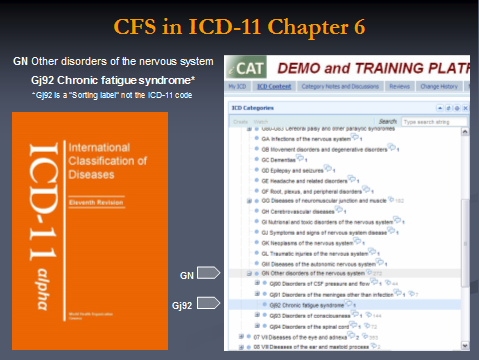
Dr Shakir has been asked if he would disambiguate current proposals for ICD-11 for the classification of, and relationships between the three terms, “Postviral fatigue syndrome”, “Chronic fatigue syndrome” and “Benign myalgic encephalomyelitis”, since this is not explicit from the information as it currently displays in the iCAT, nor from the Discussion Note for “Gj92 Chronic fatigue syndrome”, which has been listed in Chapter 6 (VI) under

Chapter 6 (VI) Disorders of the nervous system

             > GN Other disorders of the nervous system

(“Gj92” is a “Sorting label”. It is understood that a “Sorting label” is a string that can be used to sort the children of a category and is not the ICD code.)

I was advised by Dr Shakir, on 5 July, by email, that my queries have been passed to the Advisory Group for a response. I have yet to receive a clarification.

To: Dr Raad Shakir, West London Neurosciences Centre, Charing Cross
Hospital, Fulham Palace Road, London W6 8RF
raad.shakir@imperial.nhs.uk

Re: Query in relation to Topic Advisory Group for Neurology proposals for ICD-11 Chapter 6 (VI)

28 June 2010

Dear Dr Shakir,

I am writing to you in your capacity as Chair, ICD Revision TAG Neurology, with a request for clarification of current proposals for the restructuring of categories classified in ICD-10 under G93 Others disorders of brain, specifically those at G93.3. That is:

Diseases of the nervous system (G00-G99)

      > Other disorders of the nervous system (G90-99)

             > G93 Other disorders of brain

[…]

G93.3 Postviral fatigue syndrome
Benign myalgic encephalomyelitis

(with Chronic fatigue syndrome indexed to G93.3 in ICD-10: Volume 3: The Alphabetical Index)

In the absence of the release of an ICD-11 Alpha Draft, I rely on information as it currently displays in the ICD Categories listed in the iCAT production server at: http://icat.stanford.edu/

My understanding is that what is being proposed at this point for ICD-11 is that ICD categories coded between G83.9 thru G99.8 in ICD-10 Chapter VI: Diseases of the nervous system, are being reorganised.

That in ICD-11, Chapter 6 (VI) codings beyond G83.9 are represented by new parent classes numbered GA thru to GN thus:

Chapter 6 (VI) Disorders of the nervous system

[…]
G80-G83 Cerebral palsy and other paralytic syndromes
GA Infections of the nervous system
GB Movement disorders and degenerative disorders
GC Dementias
[…]
GN Other disorders of the nervous system

That “GN Other disorders of the nervous system” is parent to five child classes that are assigned the “Sorting labels” Gj90-Gj94.

(It is understood that a “Sorting label” is a string that can be used to sort the children of a category and is not the ICD code.)

At Gj92, sits “Chronic fatigue syndrome”

That “Gj92 Chronic fatigue syndrome” displays no child classes of its own.

The Category Note associated with “Gj92 Chronic fatigue syndrome” records a Change in hierarchy for class: G93.3 Postviral fatigue syndrome because its parent category (G93 Other disorders of brain) is removed.*

[*Ed: Note that the removal of the parent “G93 Other disorders of brain” affects many other categories also classified under G93 in ICD-10, not just G93.3, which have also been assigned “Sorting labels”.]

According to the iCAT ICD Categories “Details for Gj92 Chronic fatigue syndrome”

“Gj92 Chronic fatigue syndrome” displays as a ICD Title term.

“Gj92 Chronic fatigue syndrome” has a Definition field populated.**

[**Ed: Which may be subject to revision and in response to proposals.]

It has an External Definitions field populated which includes definitions imported from other classification systems, the text of which includes “Also known as myalgic encephalomyelitis”.

It has “Benign myalgic encephalomyelitis” specified under Inclusions.

It has no Synonyms, Exclusions or other descriptor fields populated yet.

That at this point and as far as the iCAT version displays, there is no explicit accounting for “Postviral fatigue syndrome”, as an entity, other than that “Postviral fatigue syndrome” is specified under Exclusions to Chapter 5 (V) F48.0 Neurasthenia and to Chapter 18 (XVIII) R53 Malaise and fatigue and is referenced in these chapters as

            postviral fatigue syndrome G93.3 -> Gj92 Chronic fatigue syndrome

It is further understood, from the iCAT Glossary at
http://apps.who.int/classifications/apps/icd/icatfiles/iCAT_Glossary.html

that:

“Inclusion terms appear in the tabular list of the traditional print version and show users that entities are included in the relevant concept. All of the ICD-10 inclusion terms have been imported and accessible in the iCat. These are either synonyms of the category titles or subclasses which are not represented in the classification hierarchy. Since we have synonyms as a separate entity in our ICD-11 content model, the new synonyms suggested by the users should go into the synonyms section. In the future, iCat will provide a mechanism to identify whether an inclusion is a synonym or a subclass.”

I should be most grateful if you could clarify the following for me:

1] In ICD-10 Volume 3: The Alphabetical Index, “Chronic fatigue syndrome” is indexed to G93.3 but does not appear in the Tabular List.

In ICD-11, is it being proposed that “Chronic fatigue syndrome” will be included in the Tabular List in Chapter 6 (VI) Diseases of the nervous system under “(GN) Other disorders of the nervous system”?

2] In ICD-11, is it being proposed that rather than “Postviral fatigue syndrome” being the ICD Category Title term (previously coded at G93.3, but which has now lost its parent class, G93) that “Gj92 Chronic fatigue syndrome” is proposed as a new ICD Category Title term?

If this is the case, what is the current proposed relationship between the terms “Postviral fatigue syndrome” and “Gj92 Chronic fatigue syndrome”?

That is, is it proposed that in the tabular list, “Postviral fatigue syndrome” would still appear as a discrete Category Title term or is it intended that it should be subsumed under “Gj92 Chronic fatigue syndrome” or become a Subclass of, or Synonym to “Chronic fatigue syndrome”, or to have some other relationship?

3] In the iCAT, the term “Benign myalgic encephalomyelitis” (previously coded at G93.3, but which has now lost its parent class G93) is listed as an Inclusion under “Details for Gj92 Chronic fatigue syndrome” but does not appear listed under “GN Other disorders of the nervous system” in the ICD Category List with a Sorting label of its own, nor as a child to “Gj92 Chronic fatigue syndrome”.

What is currently being proposed for ICD-11 for the classification and coding of “Benign myalgic encephalomyelitis”, as an entity, and its relationship to “Chronic fatigue syndrome”?

Since this is not explicit from the information as it currently displays in the iCAT, nor from the Discussion Note to Gj92, I should be pleased if you could disambiguate current proposals for the classification of, and relationships between these three terms for ICD-11.

Sincerely,

etc


I will update when a response has been received and when further information about a print version of the alpha draft becomes available.

Other than making general enquiries around the development of ICD-11 and the operation of the iCAT and this request for clarification of current proposals, I have made no representations to any ICD Topic Advisory Group, nor submitted any proposals through any means nor have I had any discussions with WHO personnel or Topic Advisory Group members in relation to current or future proposals for the three terms of interest to us.

References:

PVFS, ME, CFS: the ICD-11 Alpha Draft and iCAT Collaborative Authoring Platform, 7 June 2010, Post # 46: http://wp.me/pKrrB-KK

[1] ICD-11 Revision Project Plan – Draft 2.0 (v March 10):
Describes the ICD revision process as an overall project plan in terms of goals, key streams of work, activities, products, and key participants: ICD Revision Project Plan
http://www.who.int/classifications/icd/ICDRevisionProjectPlan_March2010.pdf

[2] Content Model Specifications and User Guide (v April 10):
Identifies the basic properties needed to define any ICD concept (unit, entity or category) through the use of multiple parameters: http://tinyurl.com/ICD11ContentModelApril10

[3] iCAT production server and Demo and Training iCAT Platform:
http://sites.google.com/site/icd11revision/home/icat
iCAT production server: http://icat.stanford.edu/

[4] iCAT Glossary
http://apps.who.int/classifications/apps/icd/icatfiles/iCAT_Glossary.html