ICD-11 struggling to meet targets for release of Beta Draft in May

ICD-11 Revision Steering Group struggling to meet targets for release of Beta Draft platform in May

Post #69 Shortlink: http://wp.me/pKrrB-ZB

The information in this mailing relates only to ICD-11, the forthcoming revision of ICD-10 that is scheduled for completion and pilot implementation in 2014/15. It does not apply to the forthcoming US specific Clinical Modification of ICD-10, known as ICD-10-CM, or to other Clinical Modifications of ICD-10, already in use.

Revision of the WHO’s ICD-10, the version of ICD in current use in the UK and over 110 countries worldwide, has been underway since 2007. The implementation date has already been shifted from 2012 to 2014/15.

A Beta Draft platform for ICD-11 had been scheduled for readiness by April, this year, for public release in May.

An ICD Revision Beta Requirements document states, “The Beta Phase will be open to [the] general public in May 2011 to enable structured input by interested parties subject to peer-review by relevant Technical Advisory Groups.”

But ICD Revision is evidently struggling to keep this project on track.

In October, last year, the Revision Steering Group’s “iCamp2” meeting acknowledged that a considerable amount of work needed to be done if ICD Revision if targets for a May 2011 release of a Beta Draft platform were going to be met.

According to an October iCamp2 PowerPoint presentation, Frequent Criticisms, and iCamp2 meeting videos, targets for the population of content for the Alpha Draft had not been reached: less than 80% of the Terminology Definitions had been uploaded to the iCAT and less than the 20% target for full Content Model completion for the thousands of diseases and disorders classified within ICD had been met.

The Revision Steering Group (RSG) identified a number of barriers to keeping this very technically ambitious project on track: lack of funding; the amount of time required for drafting definitions and population of textual content according to the complex ICD-11 “Content Model”; recruitment of external experts for reviewing proposals and generating content; familiarising the various Topic Advisory Group (TAG) members with informatics and the functionality of the iCAT (the collaborative authoring platform through which ICD-11 is being drafted); the paucity of face-to-face meetings for TAG managing editors and workgroup members, (scattered across the globe and undertaking these roles, by electronic means, in addition to their professional commitments), and difficulties facilitating interaction between the various Topic Advisory Groups where diseases overlap with other chapters.

If ICD Revision is already struggling to maintain targets, motivation and interaction between its various Topic Advisory Groups, then management of the project once the Beta drafting phase is reached and the process opened up to [the projected] thousands of stakeholders is going to present ICD-11 RSG and TAG managing editors with considerable challenges. The ICD-11 iCamp YouTube commentaries have an air of brittle optimism about them.

I have already predicted that come May 2011, we might anticipate some scaling back of plans and/or a possible shift in the release date for the Beta drafting platform (and potentially a further shift in the final ICD-11 implementation date) in response to recognition that the WHO may have significantly overestimated its capacity for obtaining funding and resources to fulfil this most ambitious vision by 2014.


Report of a WHO-FIC (WHO Family of International Classifications) Council conference call

http://www.who.int/classifications/network/Council_report_2011_16Feb.pdf

or open  here on Dx Revision Watch site.

This document is the Report of a WHO-FIC Council conference call which took place between 14:00-15:30 Geneva Time, on Wednesday, February 16, 2011. It confirms that ICD Revision is debating whether to go public in May with a Beta drafting platform that falls short of targets for completion or whether to revise its schedule.

From Page 6

ICD-11 Beta Draft and Timeline

“In the context of the review of preparations for the ICD-11 Beta release, there was a set of arguments for and against a postponement of the beta release.

“The status was summarized as in the slide below.

“In discussion the WHO FIC Council Members commented:

• It is essential to have a good product that goes out to the general public.
• Extra time is needed for the cross-cutting TAGs as most substantive review is starting lately.
• On the other hand, having no public input into the process is of concern.

“Wider input is necessary; and public and transparency input was a goal of the revision process. A hybrid model of opening the revision process to public comment and suggestions at the same time not a full scale beta phase with field trials may be a better solution.

“WHO thanked the Council for their valuable input and contribution to the decision-making process. The TAG input is going on and the RSG has to review the topic as well. Given the current stage and pace of work, however, it is unlikely that the ICD-11 will be fulfilling the criteria for a beta version in April – either in terms of content or the software preparations. The financial situation of WHO requires more austere measures rather than a full-scale RSG meeting as planned in 11-15 April. Accordingly a decision will be made and conveyed to all stakeholders.”


I will update if and when ICD Revision issues an information release on its decision about the Beta Drafting platform and clarifies its intentions for the extent of public participation, or when more information becomes available.

In November, the iCAT electronic authoring platform through which the Alpha Draft was being developed was taken out of the public domain. The server for the improved version of the iCAT, which provides the platform for drafting the Beta is sitting behind a password, here: http://icat.stanford.edu/.

Access and editing rights are currently restricted to WHO, Revision Steering Group, the various ICD-11 Topic Advisory Group managing editors and members, reviewers of content and proposals and IT technicians. But it was envisaged that at the Beta stage, the drafting platform would be opened up for public access and to interested stakeholders who register for limited imput.

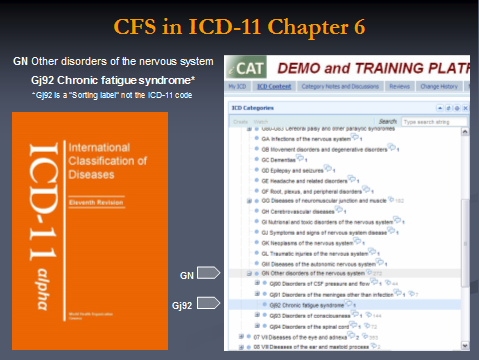
The Alpha and Beta drafts are “works in progress”. Proposals as they stood in the iCAT collaborative drafting platform in November, last year, are that all three terms, PVFS, (B)ME and Chronic fatigue syndrome should be classified within ICD-11 Chapter 6: Diseases of the nervous system [1].

A meeting was expected to be held in Geneva, this week, and I will post further information as it becomes available on the ICD Revision Google site.


References:

1] PVFS, ME, CFS: the ICD-11 Alpha Draft and iCAT Collaborative Authoring Platform (Report with screenshots from the Alpha drafting stage iCAT)

2] Key document: ICD Revision Project Plan version 2.1 9 July 2010

3] Key document: Content Model Reference Guide version January 2011

ICD-11 Training videos, transcripts and Key Revision documentation

New ICD-11 Training videos, video transcripts and Key Revision documentation

Post #65 Shortlink: http://wp.me/pKrrB-YI

The information in this post relates only to the development of ICD-11. It does not relate to the development of the forthcoming US specific “Clinical Modification” of ICD-10, known as “ICD-10-CM”.

A WHO ICD Revision meeting was held in Ankara, Turkey, at the end of February. The ICD Revision Paediatrics Topic Advisory Group (TAG) met to discuss “Diagnostic issues on Children and Youth”.

A number of meeting documents and videos have been posted on the ICD Revision site which are general background documents to the ICD-11 development process and not specific to the work of TAG Paediatrics or the focus of the Ankara meeting.

The two training videos (“ICD-11 Content Model Training” and “iCAT Training”) are now also available on YouTube. The training videos are aimed at those currently involved with the ICD-11 Revision process as WHO staff, IT technicians and the chairs, managing editors, members and external reviewers of the ICD-11 Topic Advisory Groups but will be of general interest to those following the development of ICD-11.

Content Model

One of the main differences between ICD-10 and ICD-11 will be the amount of textual content associated with ICD categories. In ICD-10, there is no textual content, definitions or descriptions for any of the three terms, PVFS, ME, CFS, and the relationship between these terms is not specified within ICD-10.

But the ICD-11 Content Model contains 13 parameters that may be used to describe ICD entities and these parameters are discussed in the training video. So if you are not familiar with the extent of the potential for textual content describing categories within ICD-11, this video sets this out. In the References is the URL for the latest version of the “Content Model Reference Guide” document.

The 13 Parameters through which an ICD-11 category can be described are:

1. ICD Entity Title; 2. Classification Properties; 3. Textual Definition(s); 4. Terms; 5. Body Structure Description; 6. Temporal Properties; 7. Severity Properties; 8. Manifestation Properties; 9. Causal Properties; 10. Functioning Properties; 11. Specific Condition Properties; 12. Treatment Properties; 13. Diagnostic Criteria.

iCAT

The second video describes the operation of the iCAT collaborative drafting platform through which the alpha and beta drafts are being developed. The platform is currently behind a password and accessible only to ICD Revision personnel who have editing rights, but it is understood that after the Beta Drafting stage has been reached, the iCAT should be accessible to stakeholders for limited input.

The iCAT had been in the public domain up until early November for public viewing only and I have some relevant screenshots of the population of content as it stood in the iCAT, at that point, here:

PVFS, ME, CFS: the ICD-11 Alpha Draft and iCAT Collaborative Authoring Platform: http://wp.me/pKrrB-KK

ICD-11 Training videos:

1] Content Model Training Video, YouTube:

Duration: 20: 38 mins

An MS Word document of the Content Model Training Video Script can be downloaded here:

Transcript of Content Model Training Video


2] iCAT Training Video, YouTube:

Duration: 29:12 mins

An MS Word document of the iCAT Training Video Script can be downloaded here:

Transcript of iCAT Training Video

References:

1] Ankara Paediatrics meeting 28 February-1 March 2011
Background documents page and Agenda

2] Key document: Content Model Reference Guide version January 2011

3] Key document: ICD Revision Project Plan version 2.1 9 July 2010

4] iCAT Drafting Platform browser
(Access and editing rights currently restricted to WHO and ICD Revision, TAG members and IT personnel):

APA postpones release of revised proposals for draft criteria for DSM-5 by three months

APA postpones release of revised proposals for draft criteria for DSM-5 by three months

Post #64 Shortlink: http://wp.me/pKrrB-Yu

Slip slidin’ away…

There will be no public review of revised draft criteria for DSM-5 categories this coming May.

APA Field Trials got off to a late start and the DSM-5 timeline continues to slip.

Online posting of draft disorders and criteria proposed by the DSM-5 Work Groups for new and existing mental disorders had been scheduled for May-July, this year. Revised criteria were expected to be posted online in May, for a period of approximately one month to allow the public to review proposals and submit comment.

But according to a revised Timeline on the American Psychiatric Association’s (APA) DSM-5 Development site, this second public review exercise is now postponed until August-September 2011:

“August-September 2011: Online Posting of Revised Criteria. Following the internal review, revised draft diagnostic criteria will be posted online for approximately one month to allow the public to provide feedback. This site will be closed for feedback by midnight on September 30, 2011.”

There are also references within the DSM-5 Timeline to ICD-10-CM and the forthcoming ICD-10-CM Partial Code Freeze, and to ICD-11.

ICD-11 Beta Draft

According to sources, ICD-11 Revision Steering Group are still working towards having a Beta Draft ready for May 2011.

But from a PowerPoint presentation posted briefly on the ICD-11 Revision website at the end of February, but swiftly removed following enquiries, evidently the WHO has been discussing the pros and cons of postponing the release of its own Beta Draft for public input until the autumn, or until the end of 2011, or possibly even May 2012.

Another ICD Revision document: ICD Revision Project Plan v 2.1, projects a date of May 2012 for release of the Beta Draft. Since there is no definitive and recent ICD-11 timeline on any of the WHO’s ICD Revision sites, and since ICD Revision is keeping schtum, it remains unclear at what point in the timeline a Beta Draft for ICD-11 will be released for public scrutiny and input (as opposed to purely internal use, as the Alpha Draft had been). I will update when more information becomes available.

The original dissemination date for ICD-11 had been 2012, with the timelines for the revision of ICD-10 and DSM-IV running more or less in parallel. But in 2007/8, the release date for ICD-11 was shifted to pilot implementation in 2014 and dissemination in 2015. A “pre-final draft” of ICD-11 is projected for March 2013 with submission for WHA endorsement in May 2014. ICD Revision are balancing “incomplete software, unsatisfactory content and incomplete review process” against reduced opportunity for public input and reduced public confidence, if the timeline for the Beta were to be extended.

In December 2009, the APA announced that the publication date for their DSM-5 was being extended to May 2013.

In January 2010, APA President, Alan F Schatzburg, MD, said:

“…the extension will permit better linking of DSM-5 to the U.S. implementation of the ICD-10-CM codes for all Medicare/Medicaid claims reporting, which are scheduled to go into effect on October 1, 2013. APA will also continue to work with the World Health Organization (WHO) to harmonize DSM-5 with the mental and behavioral disorders section of ICD-11, which WHO plans to release no sooner than 2014.”

With a Partial Code Freeze looming this October for ICD-10-CM, the delays in starting field trials and now a three month postponement of publication of revised criteria for the second public review and comment period isn’t going to inspire confidence in a Task Force that has already come in for significant criticism of its oversight of the revision of DSM-IV.

Revised and expanded DSM-5 Timeline

[Timeline superceded by revised Timeline]

Ed: Footnotes: The “harmonization” of DSM-5 and ICD-11

The APA participates with the WHO in the “International Advisory Group for the Revision of ICD-10 Mental and Behavioural Disorders” (Chapter 5) and a “DSM-ICD Harmonization Coordination Group”.

There is already a degree of correspondence between DSM-IV and Chapter V of ICD-10. For the next editions, the APA and the WHO have committed as far as possible:

“To facilitate the achievement of the highest possible extent of uniformity and harmonization between ICD-11 mental and behavioural disorders and DSM-V disorders and their diagnostic criteria.”

with the objective that

“The WHO and APA should make all attempts to ensure that in their core versions, the category names, glossary descriptions and criteria are identical for ICD and DSM.”

But the WHO acknowledges there may be areas where congruency between the two systems may not be achievable.

As the iCAT (the ICD-11 electronic collaborative drafting platform) stood last November, two new categories were listed in the Linearized Chapter 5, F45 – F48.0 (Somatoform Disorders) codes. It is understood from ICD documentation (DIFF File – Changes from ICD-10 [MS Excel doc. Retrieved 29.09.10; no longer available on 01.10.10]) that child categories F45.40 and F45.41 are new entities for ICD-11 [1].

Note the ICD-11 categories between F45 – F48.0, as they stood in the iCAT drafting platform last November, do not mirror current proposals of the DSM-5 “Somatic Symptom Disorder” Work Group for renaming the “Somatoform Disorders” categories of DSM-IV to “Somatic Symptom Disorders” and combining a number of existing categories under a new rubric, “Complex Somatic Symptom Disorder (CSSD)”, and the more recently proposed “Simple Somatic Symptom Disorder (SSSD)” [2][3].

[1] Screenshot iCAT, ICD-11: Chapter 5: F45 – F48.0: https://dxrevisionwatch.com/wp-content/uploads/2010/05/2icatchapter5f45somatoform.png  

[2] Article: Erasing the interface between psychiatry and medicine (DSM-5), Chapman S, 13 February 2011: http://wp.me/pKrrB-Vn

[3] Article: Revisions to DSM-5 proposals on 14.01.11: New category proposed “Simple Somatic Symptom Disorder, Chapman S, 16 January 2011: http://wp.me/pKrrB-St  

[4] DSM-5 Development website: http://www.dsm5.org/about/Pages/Timeline.aspx

ICD-11 Content Model Reference Guide: version for December 2010

ICD-11 Content Model Reference Guide: version for December 2010

Post #62 Shortlink: http://wp.me/pKrrB-Xj

Update @ 1 March 2011

A more recent version of the Content Model document was uploaded to the ICD Revision site on 22 February.

It can be accessed here on the ICD Revision site:

View Word document

Download Word document

Or opened here on DSM-5 and ICD-11 Watch site: Content Model Reference Guide v January 2011

A revised version of the ICD-11 Content Model Reference Guide was uploaded to the WHO’s ICD Revision Google site in January.  This version of the document, dated 27 January 2011, replaces previous versions on DSM-5 and ICD-11 Watch site and on the ICD Revision Google site.

Content Model Reference Guide December 2010 v.1  27 Jan 2011

A copy of this 57 page document can be viewed on the ICD Revision Google site from this page:

http://sites.google.com/site/icd11revision/home/documents

View Word document

Download Word document

or open here on DSM-5 and ICD-11 Watch site: Content Model Reference Guide December 2010 [v.1]


Introductory pages

ICD-11 alpha

World Health Organization, Geneva

Content Model Reference Guide 11th Revision

December 2010

Table of Contents

Page 2

Introduction 3
What is the “Content Model”? 4
Explanations on the Content Model 5
Technical Specifications for the Content Model 7
ICD -11 Alpha Content Model 9

1. ICD Entity Title 9

2. Classification Properties 11

3. Textual Definition(s) 17

4. Terms 21

5. Body Structure Description 24

6. Temporal Properties 27

7. Severity Properties 31

8. Manifestation Properties 33

9. Causal Properties 35

10. Functioning Properties 38

11. Specific Condition Properties 42

12. Treatment Properties 44

13. Diagnostic Criteria 45

Section B 46

Appendices 48
Appendix 1: Body Systems Value Set 48
Appendix 2: Temporal Properties Value Set 49
Appendix 3: Temporal Properties Value Set and explanations 50
Appendix 4: Basic Aetiology Value Set 56
Appendix 5: Grammar Rules for Titles and Synonyms 57

Page 3

Reference Guide on the Content Model of the ICD 11α

Introduction

This Reference Guide is intended to define and explain the Content Model used in the ICD-11 alpha draft in practical terms. It aims to guide users to understand the purposes and parameters of the Content Model.

The Reference Guide also informs users about the technical specifications of each parameter which the designers of the iCAT (the computer platform that is used to fill in the content model: international Collaborative Authoring Tool) took into account in building the software.

Accordingly, information on each parameter is given in two sections:

(1) Explanations
(2) Technical specifications

The purpose of this Reference Guide is to ensure that the Content Model and its different parameters are properly understood.

This document will be periodically updated in response to user needs and evolution of the content model.

Brief introduction to the ICD – International Classification of Diseases

The International Classification of Diseases (ICD) is the global standard to report and categorize diseases in order to compile health information related to deaths, illness and injury. The ICD content includes diseases and a range of health problems including disorders, syndromes, signs, symptoms, abnormal findings, complaints, social circumstances, and external causes of injury. The ICD is designed to promote international comparability in the collection, processing, classification, and presentation of these statistics.

In ICD there are multiple classification categories which are defined by explicit or implicit parameters such as: codes, titles, definitions and other characteristics. In ICD 11, we aim to formally represent all this classification knowledge in a systematic way. The Content Model serves this purpose.

Page 4

What is the “Content Model”?

The Content Model is a structured framework that defines “a classification unit” in ICD in a standard way in terms of its components that allows computerization.

A “model” is a technical term that refers to a systematic representation of knowledge that underpins any system or structure. Hence, the content model is an organized description of an ICD unit with its different parameters.

In the past, ICD did not explicitly define its “classification units” – in other words diseases were classified without defining “what is a disease?” (There have been efforts to provide some definitions, inclusions, exclusion information, and some coding rules in the instructions and in the index. Some chapters, such as mental health, oncology, or other groups of diseases have been elaborated with diagnostic criteria. All these efforts may be seen as implicit modelling.) In the ICD 11 revision process, deliberate action is being taken to define the ICD categories in a systematic way and represent the classification knowledge to allow processing within computer systems.

To achieve this aim, different ICD categories have been defined by user groups as to what they are. For example, first a disease was defined as follows:

A disease is a set of dysfunction(s) in any of the body systems defined by:

1. Symptomatology: manifestations: known pattern of signs, symptoms and related findings
2. Aetiology: an underlying explanatory mechanism
3. Course and outcome: a distinct pattern of development over time
4. Treatment response: a known pattern of response to interventions
5. Linkage to genetic factors: e.g., genotypes, patterns of gene expression
6. Linkage to interacting environmental factors

Then the key components of this definition have been operationally defined as different parameters which, as a whole, formed the Content Model.

Page 5

Explanations on the Content Model:

A classification unit in ICD is called an “ICD entity”. In other words, any distinct classification rubric is called an Entity. (The term “Entity” is used interchangeably – in the same meaning — with the term “ICD Concept”.

An ICD entity may be:

– A category
– A block
– A chapter

A category (which is the most common reference to an ICD class) may be a disease, disorder or syndrome; sign, symptom or other health problem such as injuries, or a combination of the above. In addition, ICD has also been used to classify “external causes” or “other reasons for encounter” which are different kinds of entities than the diseases. In other words, “Category” refers to the individual classes represented in the ICD-10 printed version.

The Content Model, therefore, allows the various classification categories to be represented more clearly so that users can identify the classification units in a scientific fashion.

The purpose of the content model is to present the knowledge that lies under the definition of an ICD entity. Each ICD entity can be seen from different dimensions. The content model represents each one of these dimensions as a “parameter”. For example, there are currently 13 defined main parameters in the content model to describe a category in ICD.

TABLE 1: The Content Model main parameters

For each category, various parameters are given different values. For example:

Category: Myocardial Infarction

Parameters:                       Value:
Body system                         Cardiovascular system
Body part                              Heart
Signs/symptoms                   Crushing chest pain, etc.
Investigation Findings           ST elevation in ECG

It is not necessary to describe all categories with all parameters. Only parameters that are relevant to the description of the category should be used. In certain instances such as External Causes, only a number of the parameters are valid for the description of these entities.

The full range of different values for a given parameter is predefined using standard terminologies and ontologies. The predefined values constitute a “value set”.

Read full document here: Content Model Reference Guide December 2010 [v.1]


Related documents:

Paper:

http://bmir.stanford.edu/file_asset/index.php/1522/BMIR-2010-1405.pdf

A Content Model for the ICD-11 Revision

Samson W. Tu1, Olivier Bodenreider2, Can Çelik3, Christopher G. Chute4, Sam Heard5, Robert Jakob3, Guoquian Jiang4, Sukil Kim6, Eric Miller7, Mark M. Musen1, Jun Nakaya8, Jon Patrick9, Alan Rector10, Guillermo Reynoso11, Jean Marie Rodrigues12, Harold Solbrig4, Kent A Spackman13, Tania Tudorache1, Stefanie Weber14, Tevfik Bedirhan Üstün3

1Stanford Univ., Stanford, CA, USA; 2National Library of Medicine, Bethesda, MD, USA; 3World Health Organization, Geneva, Switzerland; 4Mayo Clinic College of Medicine, Rochester, MN, USA; 5Ocean Informatics, Chatswood, NSW, Australia; 6Catholic Univ. of Korea, Korea; 7Zepheira, Fredricksburg, VA, USA; 8Tokyo Medical and Dental Univ., Tokyo, Japan; 9Univ. of Sydney, Sydney, NSW, Australia; 10Univ. of Manchester, Manchester, UK; 11Buenos Aires, Argentina;12Université de Saint Etienne, Saint Priest en Jarez, France; 13IHTSDO, USA; 14DIMDI – German Institute of Medical Documentation and Information, Köln, Germany

Abstract

The 11th revision of the International Classification of Diseases and Related Health Problems (ICD) will be developed as a collaborative effort supported by Webbased software. A key to this effort is the content model designed to support detailed description of the clinical characteristics of each category, clear relationships to other terminologies and classifications, especially SNOMED-CT, multi-lingual development, and sufficient content so that the adaptations for alternative uses cases for the ICD – particularly the standard backwards compatible hierarchical form – can be generated automatically. The content model forms the basis of an information infrastructure and of a webbased authoring tool for clinical and classification experts to create and curate the content of the new revision.

CFS orphaned in the “R” codes in ICD-10-CM

CFS orphaned in the “R” codes in US specific ICD-10-CM

Post #60 Shortlink: http://wp.me/pKrrB-V4

Current proposals for ICD-10-CM place CFS in Chapter 18, under R53 Malaise and fatigue at R53.82 Chronic fatigue syndrome NOS (Not otherwise specified).

According to a Note to a Recommendation on the CSFSAC webpages:

*DFO Note: The ICD 10-CM is scheduled for implementation on October 1, 2013. In that classification, two mutually exclusive codes exist for chronic fatigue [sic]:

post-viral fatigue syndrome (in the nervous system chapter), and
chronic fatigue syndrome, unspecified (in the signs and symptoms chapter).

HHS has no plans at this time to change this classification in the ICD 10-CM.

Images Copyright 2011 ME agenda  No unauthorized reproduction


The revision of ICD-10, ICD-11, is scheduled for implementation in 2015.

Once ICD-10-CM has been adopted, the US does not envisage moving on to ICD-11 (or a “Clinical Modification” adaptation of ICD-11) for many years.

Partial Code Freeze

Although ICD-10-CM is not scheduled for implementation until October 2013, it had been proposed that at some point prior that date codes might be “frozen”.

At the ICD-9-CM Coordination & Maintenance Committee Meeting on Sept. 15, 2010, it was announced that the committee had finalized the decision to implement a partial freeze for both ICD-9-CM codes and ICD-10-CM and ICD-10-PCS codes prior to implementation of ICD-10 on Oct. 1, 2013.

       Partial Code Freeze Announcement

As of October 1, 2011, only limited updates will be instituted into the code sets so that providers, payers, clearinghouses, and health IT vendors will not have to simultaneously keep pace with code updates while also reconfiguring their existing systems for ICD-10-CM/PCS.

So the clock is ticking for CFS and US advocates and patients need to be aware of how little time may be left.

References:

[1] International Classification of Diseases, Tenth Revision, Clinical Modification (ICD-10-CM). Note: The 2011 release of ICD-10-CM is now available. It replaces the December 2010 release:
http://www.cdc.gov/nchs/icd/icd10cm.htm

[2] US “Clinical Modification” ICD-10-CM
This article clarifies any confusion between ICD-10, ICD-11 and the forthcoming US Clinical Modification, ICD-10-CM: http://wp.me/pKrrB-Ka

[3] Chronic Fatigue Syndrome Advisory Committee (CFSAC). The Chronic Fatigue Syndrome Advisory Committee (CFSAC) provides advice and recommendations to the Secretary of Health and Human Services via the Assistant Secretary for Health of the U.S. Minutes of meetings, Recommendations and meeting videocasts:
http://www.hhs.gov/advcomcfs/meetings/index.html

No publication of an ICD-11 Alpha Draft for public scrutiny

There will be no publication of an ICD-11 Alpha Draft for public scrutiny

Post #53 Shortlink: http://wp.me/pKrrB-QL

For some time now, I have been trying to establish whether ICD Revision intends to release any form of ICD-11 Alpha Draft for public scrutiny. An Alpha Draft had originally been scheduled for May 2010.

On 6 August, ICD Revision on Facebook had stated:

“The ICD-11 Alpha Drafting process has been ongoing since the first iCamp that was held in Geneva, Switzerland in September 2009. A draft print version will be available in September 2010.”

On 29 September, I asked:

“Clarification would be welcomed on whether an Alpha Draft will be available this month for internal use only or whether it is intended for public viewing, and if for public viewing, in what format(s)?”

which received no response.

On 6 October, I asked, again:

“On 6 August, ICD Revision on Facebook stated that “A draft print version will be available in September 2010”. Other than what can be seen on the iCAT collaborative authoring platform, will ICD Revision please clarify for stakeholders, whether any form of Alpha Draft for ICD-11 is going to be placed in the public domain, when this will now be released, and in what formats?”

On 15 October, ICD Revision on Facebook responded: 

“Indeed a print version is available but as an alpha draft it is not for public consumption. Public draft ( beta draft) was and (is still) targeted for MAY 2011. iCAT authoring platform is not open to public and should be only seen by designated authors. — This is not something opaque. any project of this size and complexity has to pass through stages. In May 2011 more user-friendly software and easy-to-view options will be available…”

At that point, it was in fact the case that both the iCAT authoring platform server and the iCAT demo and training platform had been viewable by the public, although only WHO, ICD Revision Steering Group, ICD Revision IT technicians and Topic Advisory Groups (TAGs) had editing access.

The iCAT production server is at: http://icat.stanford.edu/
The iCAT demo and training platform is at: http://icatdemo.stanford.edu/

In early November, access to viewing the iCAT and the iCAT demo platform was closed to the public. 

Topic Advisory Group (TAG) members now require a password login for both browsing and editing the iCAT or importing data and the public can no longer view the iCAT and the population of ICD Title Categories and Content, at all.