What’s new in the ICD-11 Alpha drafting platform? (CFS, PVFS, ME)

What’s new in the ICD-11 Alpha drafting platform? (CFS, PVFS, ME)

Post #157 Shortlink: http://wp.me/pKrrB-22h


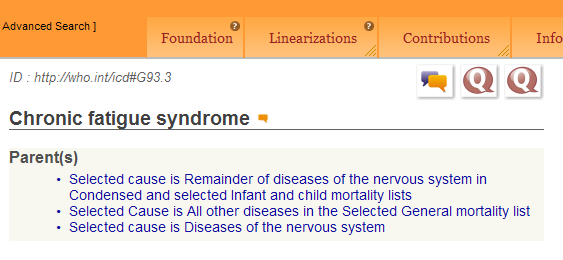
Screenshot: ICD-11 Alpha Browser Foundation view selected, logged in at April 10, 2012:

Chapter 6: Diseases of the nervous system

http://apps.who.int/classifications/icd11/browse/f/en#/http%3a%2f%2fwho.int%2ficd%23G93.3

Apr 09 – 11:02 UTC


ICD-11 Beta drafting platform to launch in May?

As reported in previous posts, according to the timeline, the ICD-11 Beta drafting platform is supposed to be launching this May.

ICD-11 Revision Steering Group has yet to announce whether the Beta platform remains on target for a May release and if so, on what date it will be launched – so I cannot give you a date yet.

Like the Alpha Drafting Browser, the Beta drafting platform will be a work in progress – not a final Beta draft. The final Beta isn’t scheduled until 2014, after the ICD-11 field trials have been undertaken.

When it does launch, the Beta platform is intended to be accessible to professionals and the public for viewing.

Registered or logged in users will have greater access to content and will be able to interact with the platform to read comments, comment on proposals and make suggestions, as part of the ongoing drafting process.  

In the meantime, the publicly viewable version of the Alpha drafting platform (known as the ICD-11 Alpha Browser) can still be accessed here:

http://apps.who.int/classifications/icd11/browse/f/en

The various ICD-11 Revision Topic Advisory Groups are carrying out their draft preparation work on a separate, more complex multi-author drafting platform that is accessible only to WHO and ICD Revision personnel.


Alpha drafting platform

As before, the publicly viewable version of the Alpha Browser should be viewed with the following caveats in mind:

the Alpha draft is a work in progress; it is incomplete; it may contain errors and omissions; it is in a state of flux and updated daily; textual content, codes and “Sorting labels” are subject to change as chapters are reorganized and content populated; the content has not been approved by Topic Advisory Groups, Revision Steering Group or WHO.

It is possible to register, or sign into the platform using existing accounts with several third party account providers such as Google, Yahoo and myOpenID, for increased access and functionality. Once signed in, Comments and Questions can be read and PDFs of the drafts of the top level linearizations can be downloaded from the Linearization tab.

See the Alpha Browser User Guide for information on how the Alpha Browser functions:

http://apps.who.int/classifications/icd11/browse/Help/en


The ICD-11 “Content Model”

ICD-11 will be available in both print and online versions and unlike most chapters of ICD-10, will include descriptive content for ICD terms.

For the online version of ICD-11, all ICD entities will include a definition and a number of additional key descriptive fields – between 7 and 13 pre-defined parameters, populated according to a common “Content Model” (Content Model Reference Guide January 2011).

For example, ICD entity Title, Definition, Synonyms, Narrower Terms, Exclusions, Body Site, Body System, Signs and Symptoms, Causal Mechanisms, and possibly Diagnostic Criteria for some entities.*

*According to the iCAT User Google Group message board, these fields may have been revised since the January 2011 Content Model Reference Guide was published; Content Model parameters in the Beta draft may therefore differ from those currently displaying in the public Alpha drafting platform.

The print version will use a concise version of Definition due to space constraints.

In the Alpha Browser, not all these Content Model parameters display in the Foundation and Linearization views and not all of the parameters that have been listed for individual entities have had their draft text added yet, as some chapters are more advanced for the population of proposed content than others.

So the Alpha draft is still very patchy and many entities have no Definition and little or no other proposed content filled in.

With no “Category Discussion Notes” or “Change history” pop-up windows visible in the public version of the Alpha, the viewer cannot determine the rationales behind the reorganization of terms and hierarchies within the various chapters.


Chapter location and hierarchy for CFS, PVFS and (Benign) ME in ICD-11

I have been reporting since June 2010 that the proposals for ICD-11 Alpha Draft, as far as one could determine, appeared to be:

1] That a change of hierarchy had been recorded in a “Category Discussion Note”, dated May 1, 2010, between ICD-10 Title term “Postviral fatigue syndrome” and “Chronic fatigue syndrome”. (“Category Discussion Notes” and “Change History” pop-ups did display in the earlier iCAT version of the Alpha drafting platform.)

You can view a screenshot from June 2010 of that “Change history” record here:

https://dxrevisionwatch.com/wp-content/uploads/2010/06/change-history-gj92-cfs.png

The Definition field on the “Chronic fatigue syndrome” description panel in the current Alpha Browser is currently blank but in June 2010, the Definition had stood as in this contemporaneous screenshot:

https://dxrevisionwatch.com/wp-content/uploads/2010/05/2icatgj92cfsdef.png

2] That “Chronic fatigue syndrome” had been designated as an ICD-11 Title term within ICD-11 Chapter 6: Diseases of the nervous system, with the capacity for a Definition and up to 10 additional descriptive parameters.

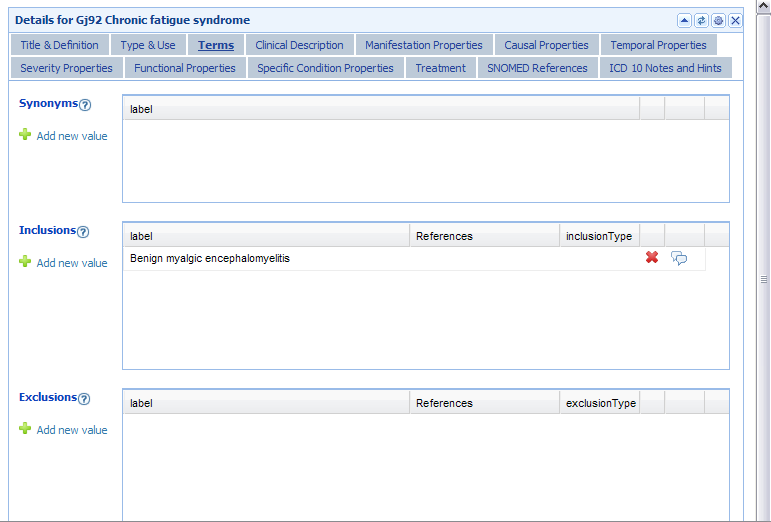
3] That “Benign myalgic encephalomyelitis” had been specified as an Inclusion term to ICD-11 Title term “Chronic fatigue syndrome” but that the relationships between the three terms, PVFS, (B) ME and CFS had yet to be specified, as in this screenshot from June 2010:

https://dxrevisionwatch.com/wp-content/uploads/2010/05/2icatgj92cfsterms.png


What is currently showing in the Chapter 6 Foundation Component?

It isn’t possible to bring up a discrete ICD Title listing for either “Benign myalgic encephalomyelitis” or “Postviral fatigue syndrome” in either the Foundation Component or the Linearization.

In the Foundation view only, for Chapter 6: Diseases of the nervous system, “Chronic fatigue syndrome” is listed as a Title term with the ICD-10 legacy ID “ID:http://who.int/icd#G93.3”;

the Definition field is currently blank;

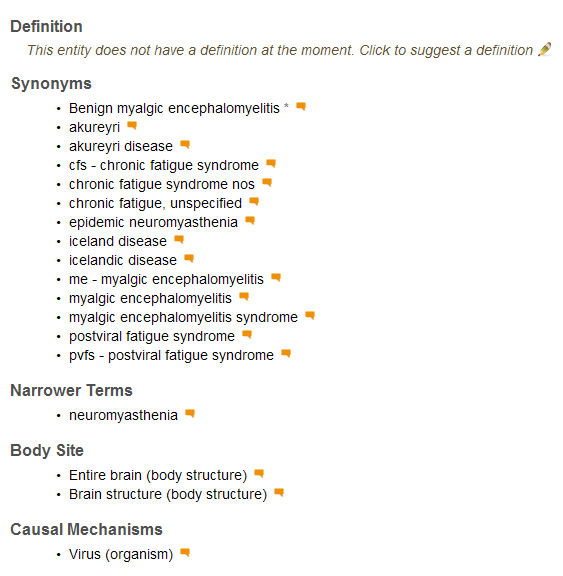
a list of terms has recently been added under “Synonyms”;

one term has recently been added under “Narrower Terms”.

(Note: there is a small asterisk at the end of term “Benign myalgic encephalomyelitis” which is listed at the top of the “Synonyms” list. The asterisk “Hover text” reads “This term is an inclusion term in the linearizations.”)

If you want to view the listing directly on the Browser site (note the “Comment” and “Questions” icons which open up pop-up windows next to terms for reading/commenting won’t display unless you have already registered and logged in) go here:

ICD-11 Alpha Browser Foundation view:

http://apps.who.int/classifications/icd11/browse/f/en#/http%3a%2f%2fwho.int%2ficd%23G93.3

ID:http://who.int/icd#G93.3

Chronic fatigue syndrome

Parent(s)

Selected cause is Remainder of diseases of the nervous system in Condensed and selected Infant and child mortality lists
Selected Cause is All other diseases in the Selected General mortality list
Selected cause is Diseases of the nervous system

Definition

This entity does not have a definition at the moment.

Synonyms

Benign myalgic encephalomyelitis *  [Ed: Hover text over asterisk reads: “This term is an inclusion term in the linearizations.”]
akureyri
akureyri disease
cfs – chronic fatigue syndrome
chronic fatigue syndrome nos   [Ed: from current proposals for ICD-10-CM, Chapter 18, R53.82]
chronic fatigue, unspecified   [Ed: from current proposals for ICD-10-CM, Chapter 18, R53.82]
epidemic neuromyasthenia
iceland disease
icelandic disease
me – myalgic encephalomyelitis
myalgic encephalomyelitis
myalgic encephalomyelitis syndrome
postviral fatigue syndrome
pvfs – postviral fatigue syndrome

Narrower Terms

neuromyasthenia

Body Site

Entire brain (body structure)
Brain structure (body structure)

Causal Mechanisms

Virus (organism)


What’s new in Chapter 5: Mental and behavioural disorders?

As reported in Dx Revision Watch post: http://wp.me/pKrrB-1Vx,  the category “Somatoform Disorders” in Chapter 5, Mental and behavioural disorders is currently renamed to “BODILY DISTRESS DISORDERS”, under which currently sit three new child categories:

5M0 Mild bodily distress disorder
5M1 Moderate bodily distress disorder
5M2 Severe bodily distress disorder.

Chapter 5 Linearization view:

http://apps.who.int/classifications/icd11/browse/l-m/en#/http%3a%2f%2fwho.int%2ficd%23F45

Chapter 5 Foundation view:

http://apps.who.int/classifications/icd11/browse/f/en#/http%3a%2f%2fwho.int%2ficd%23F45

(Click on the little grey arrows to display the child categories):

Child categories to parent “BODILY DISTRESS DISORDERS”:

http://apps.who.int/classifications/icd11/browse/f/en#/http%3a%2f%2fwho.int%2ficd%231905_dd0250d2_e8cd_4c48_a93f_7997cc1c8b07

BODILY DISTRESS DISORDERS

5M0 Mild bodily distress disorder
5M1 Moderate bodily distress disorder
5M2 Severe bodily distress disorder
5M3 Somatization disorder
5M4 Undifferentiated somatoform disorder
5M5 Somatoform autonomic dysfunction
5M6 Persistent somatoform pain disorder
      > 5M6.0 Persistent somatoform pain disorder
      > 5M6.1 Chronic pain disorder with somatic and psycological [sic] factors
5M7 Other somatoform disorders
5M8 Somatoform disorder, unspecified

None of these three new (proposed) categories have had any Definitions or other textual content added to the description panels on the right hand side of the Alpha Browser page since I first reported this change in February.

It is still not possible to determine what disorders ICD-11 intends might be captured by these three new (proposed) terms, should ICD-11 Revision Steering Group and WHO classification experts consider these terms to be valid constructs and approve their progression through to the Beta draft.

Because no “Change Notes” or “Change history” pop-up windows display in this version of the Alpha Drafting browser, it is not possible to determine:

whether ICD-11 is proposing to introduce three new terms – 5M0 Mild bodily distress disorder; 5M1 Moderate bodily distress disorder; 5M2 Severe bodily distress disorder, in addition to retaining existing ICD-10 terms, 5M3 thru 5M8;

how ICD Revision intends to define these (proposed) new terms at 5M0, 5M1, 5M2;

how these three (proposed) new terms would relate to the existing ICD-10 “Somatoform Disorders” categories which remain listed as child categories to “BODILY DISTRESS DISORDERS” (apart from “Hypochondriacal disorder” [ICD-10: F45.2], which is now listed as “5H0.5 Illness Anxiety Disorder” in the ICD-11 Alpha Draft).

(See Page 1 and 2 of my report: “Bodily Distress Disorders” to replace “Somatoform Disorders” for ICD-11?: http://wp.me/pKrrB-1Vx  )


References:

ICD-11 Revision: http://www.who.int/classifications/icd/revision/en/

ICD-11 Alpha Browser User Guide: http://www.who.int/classifications/icd/revision/caveat/en/index.html
Alpha Browser Foundation view: http://apps.who.int/classifications/icd11/browse/f/en#
Alpha Browser Linearization view: http://apps.who.int/classifications/icd11/browse/l-m/en#
“Bodily Distress Disorders” to replace “Somatoform Disorders” for ICD-11?: http://wp.me/pKrrB-1Vx

“Bodily Distress Disorders” to replace “Somatoform Disorders” for ICD-11?

“Bodily Distress Disorders” to replace “Somatoform Disorders” for ICD-11?

Post #145 Shortlink: http://wp.me/pKrrB-1Vx

The information in this report relates only to proposals for the WHO’s forthcoming ICD-11; it does not relate to ICD-10 or to the forthcoming US specific “clinical modification” of ICD-10, known as ICD-10-CM.

Codes assigned to ICD-11 Beta draft categories are subject to change as chapter reorganization progresses. Images and text in this posting may not reflect the most recently assigned codes. This post has been updated to reflect the launch of the Beta drafting platform and revisions to codes assigned during the drafting process as they stand at June 24, 2012.

Part One


This report contains an important update on proposals for ICD-11 Chapter 5: Mental and behavioural disorders.

In a February 16, 2012 report by Tom Sullivan for Health Care Finance News, Christopher Chute, MD, who chairs the ICD Revision Steering Group, warned of a possible delay for completion of ICD-11 from 2015 to 2016.

The ICD-11 Beta drafting platform was launched in May 2012.

The Beta drafting platform is a publicly viewable browser similar to the Alpha drafting platform that had been in the public domain since May, 2011.

You can view the Beta Drafting Browser here:

Foundation Component view:

http://apps.who.int/classifications/icd11/browse/f/en

Morbidity Linearization view:

http://apps.who.int/classifications/icd11/browse/l-m/en

The Morbidity Linearization is the view that includes (what may be temporarily assigned) sorting codes. These codes are likely to change as chapter organization progresses. Click on the small grey arrows next to the chapters and categories to display parent > child > grandchildren hierarchies. Click on individual terms to display descriptive content in the right hand frame of the Beta Browser.

Textual content for ICD-11 is in the process of being drafted and the population of content for some chapters is more advanced than others. Content for some of the “ICD-11 Content Model” parameters may display: ID legacy code from ICD-10 (where applicable); Parent(s); Definition; Synonyms; Inclusions; Narrower Terms; Exclusions; Body Site; Causal Mechanism; Signs and Symptoms.

(For ICD-11, entities will be defined across all chapters through up to 13 “Content Model” parameters – considerably more descriptive content than in ICD-10 and a significant workload for the Topic Advisory Group members and managers who are generating the content for ICD-11.)

The Beta Browser User Guide is here:

http://apps.who.int/classifications/icd11/browse/Help/en

This page of the User Guide sets out differences between Foundation view and Morbidity Linearization view.

The various ICD Revision Topic Advisory Groups (TAGs) are carrying out their work on a separate, more complex, multi-author drafting platform. On their platform, editing histories and “Category and Discussion Notes” are recorded so the progress of proposals and reorganization of ICD entities can be tracked, as the draft evolves.

For the Beta drafting platform, interested stakeholders may register for increased access and interaction with the drafting process by submitting comments and suggestions on draft content and proposals.

For those registered for increased access, it is possible to download PDFs of drafts for the “Print Versions for the ICD-11 Beta Morbidity Linearization” for all 25 chapters of ICD-11. These are obtainable, once registered and logged in, from the Linearization > Print Versions tab.

Caveats

I’m going to reiterate the ICD-11 Alpha Browser Caveats because it’s important to understand that the ICD-11 Beta draft is a work in progress – not a static document – and is subject to change.

The draft is updated on a (usually) daily basis; when you view the Beta Browser, you are viewing a “snapshot” of how the publicly viewable draft stood at the end of the previous day; not all chapters are as advanced as others for reorganization or population of content; the draft is incomplete and may contain errors and omissions.

The codes and “sorting labels” assigned to ICD parent classes, child and grandchildren terms are subject to change as reorganization of the chapters progresses. The Beta draft has not yet been approved by the Topic Advisory Groups, Revision Steering Group or WHO and proposals for, and content in the draft may not progress to the Beta drafting stage; field trials have not yet been completed – so be mindful of the fact that the draft is in a state of flux.

As it currently stands, the Beta draft lacks clarity; not all textual content will have been generated and uploaded for terms imported from ICD-10 and there may be no definitions or other textual content displaying for proposed new terms.

Two chapters that are a focus of this site are Chapter 5: Mental and behavioural disorders and Chapter 6: Disorders of the nervous system (the Neurology chapter). (ICD-11 is dropping the use of Roman numerals.)

I won’t be reporting on specific categories in Chapter 6 in this post but will do a follow up post for Chapter 6 in a forthcoming post; again, there is a lack of clarity for Chapter 6 and requests for specific clarifications, last year, from the chair of Topic Advisory Group Neurology and the lead WHO Secretariat for TAG Neurology have met with no response.

Continued on Page 2: Somatoform Disorders in ICD-10; Somatoform Disorders to Bodily Distress Disorders for ICD-11?

Psychiatric creep – Erasing the interface between psychiatry and medicine

Psychiatric creep – Erasing the interface between psychiatry and medicine

Post #121 Shortlink: http://wp.me/pKrrB-1A5

As reported in an earlier post, the third draft of proposals for changes to DSM-IV categories and criteria is delayed because DSM-5 field trials are running behind schedule.

This third and final draft is now expected to be released for public review and comment, “no later than May 2012”, according to DSM-5 Task Force Vice-chair, Darrel Regier, MD [1].


DSM-5 Somatic Symptom Disorders

One focus of this site has been the proposals of the DSM-5 Somatic Symptom Disorders Work Group

Proposed criteria, as they stood in May, last year, are set out on the DSM-5 Development site here: http://tinyurl.com/Somatic-Symptom-Disorders

There are two key PDF documents which expand on the proposals as currently posted:

         Disorders Description  Key Document One: “Somatic Symptom Disorders”

         Rationale Document  Key Document Two: “Justification of Criteria — Somatic Symptoms”


Erasing the interface between psychiatry and medicine 


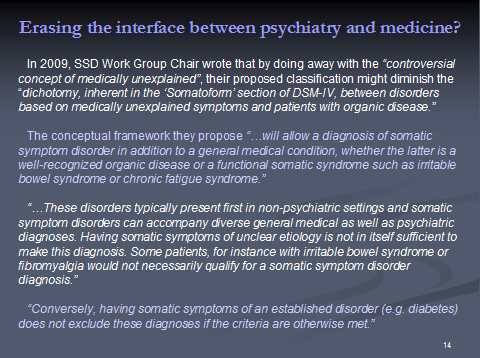
I first reported on Co-Cure, over two years ago, in May 2009, that the conceptual framework the Somatic Symptom Disorders Work Group was proposing would:

“…allow a diagnosis of somatic symptom disorder in addition to a general medical condition, whether the latter is a well-recognized organic disease or a functional somatic syndrome such as irritable bowel syndrome or chronic fatigue syndrome.” [2]

(“Somatic” means “bodily” or “of the body”.)

The most recent version of the Somatic Symptom Disorders Disorders description proposals document states:

“This group of disorders is characterized predominantly by somatic symptoms or concerns that are associated with significant distress and/or dysfunction…Such symptoms may be initiated, exacerbated or maintained by combinations of biological, psychological and social factors.”

“These disorders typically present first in non-psychiatric settings and somatic symptom disorders can accompany diverse general medical as well as psychiatric diagnoses. Having somatic symptoms of unclear etiology is not in itself sufficient to make this diagnosis. Some patients, for instance with irritable bowel syndrome or fibromyalgia would not necessarily qualify for a somatic symptom disorder diagnosis. Conversely, having somatic symptoms of an established disorder (e.g. diabetes) does not exclude these diagnoses if the criteria are otherwise met.”

“The symptoms may or may not be associated with a known medical condition. Symptoms may be specific (such as localized pain) or relatively non-specific (e.g. fatigue). The symptoms sometimes represent normal bodily sensations (e.g., orthostatic dizziness), or discomfort that does not generally signify serious disease.” [3]


Psychiatric creep

While the media has focused on the implications for introducing new disorder categories into the DSM and lowering diagnostic thresholds for existing criteria, there has been little scrutiny of the proposals of the Somatic Symptom Disorders Work Group.

This Work Group has been quietly redefining DSM’s Somatoform Disorders categories with proposals that will have the potential for a “bolt-on” diagnosis of a “somatic symptom disorder” for all medical diseases, whether “established general medical conditions or disorders”, like diabetes or angina, or conditions presenting with “somatic symptoms of unclear etiology.”

These radical proposals for rebranding the Somatoform Disorders categories as Somatic Symptom Disorders and combining a number of existing, little-used categories (somatization disorder, hypochondriasis, pain disorder, and undifferentiated somatoform disorder) under a proposed portmanteau term, Complex Somatic Symptom Disorder (CSSD), and the more recently proposed, Simple Somatic Symptom Disorder (SSSD), which requires symptom duration of as little as one month, have the potential for bringing many thousands more patients under a mental health banner.

Complex Somatic Symptom Disorder (CSSD) criteria are here: http://tinyurl.com/DSM-5-CSSD 

Simple Somatic Symptom Disorder (SSSD) criteria are here: http://tinyurl.com/DSM-5-SSSD

These proposals have the potential for expanding markets for psychiatric services, antidepressants and behavioural therapies, like CBT, for the “modification of dysfunctional and maladaptive beliefs about symptoms and disease, and behavioral techniques to alter illness and sick role behaviors”  for all patients with somatic symptoms, if the clinician decides that the patient’s response (or in the case of a child, a parent’s response) to bodily symptoms and concerns about their health are “excessive”, or the perception of their level of disability “disproportionate”, or their coping styles “maladaptive.”

Under the guise of “eliminating stigma” and eradicating “terminology [that] enforces a dualism between psychiatric and medical conditions” by “de-emphasizing the concept of ‘medically unexplained'”, the American Psychiatric Association appears hell bent on colonising the entire medical field by licensing the potential application of a mental health diagnosis to all medical diseases and disorders.

Continued on Page 2

Coalition for DSM-5 Reform: Petition Update 1

Coalition for DSM-5 Reform: Petition Update 1

Post #112 Shortlink: http://wp.me/pKrrB-1n4

For the most recent updates and media coverage see Coalition for DSM-5 Reform tab page.

All enquiries relating to the Coalition for DSM-5 Reform, the Open Letter and associated iPetition should be addressed to Dr David Elkins and the Coalition for DSM-5 Reform Committee.

Coalition for DSM-5 Reform: Petition Update 1

The Petition was launched on 22 October by three committee members of Division 32:

David N. Elkins, Ph.D.      Email:  David Elkins
President, Society for Humanistic Psychology, Division 32 of the American Psychological Association

Brent Dean Robbins, Ph.D.      Email:  Brent Dean Robbins
Secretary, Division 32, Society for Humanistic Psychology, American Psychological Association

Sarah R. Kamens, M.A.  
Doctoral Candidate in Clinical Psychology, Fordham University, Student Representative, Division 32

The committee has co-opted

Jonathan D. Raskin, Ph.D.     Email:  Jonathan D. Raskin
Fellow, Society for Humanistic Psychology, Division 32, American Psychological Association;
Fellow, Society for Theoretical and Philosophical Psychology, Division 24, American Psychological Association; Member, American Counseling Association

Donna Rockwell, Ph.D.

Frank Farley, Ph.D.

Media enquiries

Media enquiries and enquiries from professional organizations who would like to discuss endorsement of the Coalition’s Open Letter should be addressed to David Elkins and Brent Dean Robbins.


The Open Letter and Petition sponsored by the Society for Humanistic Psychology (Division 32 of the American Psychological Association), in alliance with several other APA Divisions, has attracted nearly 10,000 signatures since launching quietly, on 22 October.

26 mental health professional bodies are now endorsing the Open Letter which is highly critical of many of the draft criteria and categories being proposed for the revision of DSM-IV by the American Psychiatric Association’s  13 DSM-5 Work Groups. See the Coalition for DSM-5 Reform website for a list of organizations endorsing the Petition.

The American Psychiatric Association has scheduled a third and final stakeholder review for early 2012 with the next version of the Diagnostic and Statistical Manual of Mental Disorders slated for publication in May 2013.

Alarmed by the potential dangers they see in many of the current proposals, released in May 2011, the Petition sponsors are inviting mental health professionals and mental health organizations to sign up in support of their Open Letter to the American Psychiatric Association’s DSM-5 Development Task Force.

The Coalition for DSM-5 Reform is calling for the American Psychiatric Association to submit DSM-5 to independent scientific review or drop its most controversial proposals.

You can view the Open Letter and sign the iPetition here.

Of particular concern to the Sponsors are:

(1) The lowering of diagnostic thresholds, which may artificially inflate the prevalence of numerous disorders. By increasing the number of people who qualify for a diagnosis, DSM-5 may lead to the excessive medicalization and stigmatization of normative or transient distress.

(2) The potential consequences of lowered thresholds and new disorder categories on vulnerable populations such as children and the elderly. These populations are already at risk for excessive and inappropriate treatment with medications that have dangerous side effects. We are particularly concerned about the overuse of medications for “Attenuated Psychosis Syndrome,” “Disruptive Mood Dysregulation Disorder,” “Mild Neurocognitive Disorder,” Attention Deficit/Hyperactivity Disorder, and Generalized Anxiety Disorder.

(3) The lack of scientific evidence substantiating many of these new proposals.


The Coalition for DSM-5 Reform has opened a number of platforms

Open Letter and iPetition

Coalition for DSM-5 Reform on Twitter    @dsm5reform

Coalition for DSM-5 Reform on Facebook 

Coalition for DSM-5 Reform website 

This initiative is also being covered on

The Society for Humanistic Psychology Blog

The Society for Humanistic Psychology on Twitter    @HumanisticPsych

The Society for Humanistic Psychology Blog on Facebook 

Media coverage is being collated under the Coalition for DSM-5 Reform tab (far right of navigation tabs)

Developments

On November 4, the Special Projects Manager, Office of Communications & Public Affairs, American Psychiatric Association, sent a letter via email from the DSM-5 Task Force to the Editor of Psychiatric Times. 

Curiously, the letter (incorrectly dated “October 4”) was unsigned by either Task Force Chair, David Kupfer, MD, or Vice-chair, Darrel Regier, MD. And although it was addressed to both Melba J.T. Vasquez, Ph.D., President American Psychological Association, and David N. Elkins, Ph.D., President, Society for Humanistic Psychology and chair of the Open Letter and Petition committee, neither had been sent a copy by the Task Force or by the American Psychiatric Association’s Office of Communications & Public Affairs.

In the absence of clarification, we can only surmise that the Task Force had submitted their letter to the Editor of Psychiatric Times with a view to publication.

The American Psychiatric Association subsequently published a copy of the Task Force’s response to the Open Letter and Petition, here on the DSM-5 Development website (with the date amended).

Or open a PDF version of the Task Force’s letter  here:

             DSM-5 Task Force response to Society for Humanistic Psychology 11.04.11

Text version follows:

American Psychiatric Association

1000 Wilson Boulevard
Suite 1825
Arlington, VA 22209
Telephone 703.907.7300
Fax 703.907.1085
E-mail apa@psych.org
nternet www.psych.org

November 4, 2011

Melba J.T. Vasquez, Ph.D., President
American Psychological Association
750 First Street, N.E.
Washington, DC 20002-4242

David N. Elkins, Ph.D., President
Society for Humanistic Psychology
750 First Street, N.E.
Washington, DC 20002-4242

Dear President Vasquez and President Elkins,

We are appreciative of the thoughtful concerns expressed in the Open Letter about the introduction of new diagnoses, proposals for modifying criteria definitions and thresholds for existing diagnoses. The current draft of the DSM-5 diagnostic criteria, still more than a year away from publication, is continually being refined and reworked by the DSM-5 Task Force and Work Group members. Final decisions about proposed revisions will be made on the basis of field trial data as well as on a full consideration of other issues such as those raised by the signatories to this petition, the 10,000 individuals who responded to the February 2010 and April 2011 postings of draft criteria on DSM5.org, other internal reviews by a Scientific Review Committee, the DSM-5 Task Force, and the APA Board of Trustees.

This level of both internal and external review and field trial exposure has never before been undertaken by any previous DSM or ICD revision proposals.

We wish to clarify several specific issues you raise. Several disorders that were mentioned, such as Parental Alienation Syndrome, were proposed by outside groups but have not been proposed for inclusion by the Task Force. Some of the newer diagnoses, including Disruptive Mood Dysregulation Disorder (DMDD), Attention Deficit Hyperactivity Disorder (ADHD), Attenuated Psychosis Syndrome Disorder (APSD), Complex Somatic Symptom Disorder (CSDD) [sic], Major Depressive Disorder (MDD), Generalized Anxiety Disorder (GAD), and Personality Disorders are all being tested in the 11 large academic field trial centers that have enrolled over 2,000 patients in a rigorous test-retest design to assess the reliability and clinical utility of proposed criteria. Based on the results of these field trials the DSM-5 Task Force and Work Groups will review the criteria for any necessary changes.

The definition of a mental disorder that is contained in DSM-IV is also undergoing thorough review by the Task Force, which has not adopted the proposed revision that was published by Stein et al. in Psychological Medicine. There is certainly no intent on the part of the DSM-5 Task Force to diminish the importance of environmental and cultural exposure factors as etiological contributors to mental disorders – as indicated by an active study group charged with developing a cultural formulation section as well as culture specific expression issues for individual diagnoses.

We should also note that the DSM-5 Task Force and Work Groups include a multi-disciplinary mix of clinical and research experts in which psychologists are prominent members. There is also another field trial taking place in Routine Clinical Practice settings that will include psychiatrists and approximately 500 of each mental health specialty group of psychologists, social workers, psychiatric nurses clinical counsellors, and marriage and family counselors. The full range of disorders will be assessed in this field trial and the findings will contribute to the final decisions about the diagnoses.

We wish to express our appreciation to all of the clinicians and research investigators who have invested such intense interest and energy in assuring that the next revision of DSM will be based on the best available clinical experience and research evidence in an effort to improve patient care and our understanding of mental illnesses. We hear your concerns and are aware of those from others in the mental health field, and take them under serious consideration in our deliberations.

Please continue to visit and review the DSM-5 website for changes to the criteria, the rationale for proposed changes from DSM-IV, and an extensive set of research analyses on www.dsm5.org. We will be opening the website for public comment on the draft criteria and chapter organization one final time in 2012. We invite you all to submit your comments during that time so they can be reviewed thoroughly and systematically by the DSM-5 Task Force and Work Group members.

We would be most appreciative if you would share this information with your members.

Sincerely,

DSM-5 Task Force Members

[Ends]

On November 7, the Coalition for DSM-5 Reform responded to the Task Force:

Open the letter here in PDF format:

            Response to DSM-5 Task Force 11.07.11

Text version follows:

Response to Letter from DSM-5 Task Force and the American Psychiatric Association:

Society of Humanistic Psychology

November 7, 2011

ATTENTION:
David J. Kupfer, M.D., Chair of DSM-5 Task Force
Darrel A. Ragier [sic], M.D., M.P.H., Vice Chair of DSM-5 Task Force
John M. Oldham, M.D., President of the American Psychiatric Association
Dilip V. Jeste, M.D., President-Elect of the American Psychiatric Association
Roger Peele, M.D., Secretary of the American Psychiatric Association

To the DSM-5 Task Force and the American Psychiatric Association:

Thank you for your response to the Open Letter that was composed by the Society for Humanistic Psychology (Division 32 of the American Psychological Association) and endorsed by over 4,600 individuals and 17 organizations, including nine other divisions of the American Psychological Association. In this context, it should be noted that the American Psychological Association itself has not taken a position on this matter other than to encourage its members to participate in the DSM-5 development process. It is our understanding that President Melba Vasquez will be responding to your letter separately on behalf of the American Psychological Association. We are writing on behalf of the Society for Humanistic Psychology Open Letter Committee to express our gratitude that the Task Force has opened a public dialogue about these issues and to let you know that we are happy to share your letter with our membership. We are pleased that the Task Force will consider the issues we described in our Open Letter as well as those raised by others in the mental health field.

However, we remain deeply concerned about the issues we raised and find that your response did not adequately address them. Our main concerns include:

(1) The lowering of diagnostic thresholds, which may artificially inflate the prevalence of numerous disorders. By increasing the number of people who qualify for a diagnosis, DSM-5 may lead to the excessive medicalization and stigmatization of normative or transient distress.

(2) The potential consequences of lowered thresholds and new disorder categories on vulnerable populations such as children and the elderly. These populations are already at risk for excessive and inappropriate treatment with medications that have dangerous side effects. We are particularly concerned about the overuse of medications for “Attenuated Psychosis Syndrome,” “Disruptive Mood Dysregulation Disorder,” “Mild Neurocognitive Disorder,” Attention Deficit/Hyperactivity Disorder, and Generalized Anxiety Disorder.

(3) The lack of scientific evidence substantiating many of these new proposals.

Our rationale for these concerns can be found in our open letter, which is available at http://www.ipetitions.com/petition/dsm5/ for all interested mental health professionals to sign.

Although we appreciate your explanations of the Task Force’s activities, we did not find them sufficient to address our concerns for the following reasons:

A single set of field trials, no matter how large and diverse the sample size, is not an adequate replacement for a body of scientific literature that is built over time through the contributions of multiple and independent researchers. Many of the newly proposed disorder categories lack this important and critically necessary body of scientific support.

Though reliability and utility are important, we are also concerned about validity and potential social consequences. As you know, increasing the number of people who qualify for a psychiatric diagnosis may lead to epidemiological inflation and, as a consequence, the inappropriate medication and stigmatization of individuals with normative conditions. It also leads to ethical and moral concerns about our professions.

Though we are pleased to learn you are not considering the inclusion of several conditions proposed by outside sources (such as Parental Alienation Disorder), it would help to avoid confusion if you removed these conditions from the list of DSM-5 considerations at your website (where they still appear as of 11/7/11):

http://www.dsm5.org/proposedrevision/Pages/Conditions-Proposed-by-Outside-Sources.aspx

We do not assume that the Task Force is intentionally deemphasizing social and psychological explanations. However, the proposed language deemphasizes social and psychological explanations and may lead to the pathologization of sociopolitical deviance. We emphasize again that the Stein et al. definition of mental disorder would result in the scientifically unsubstantiated reduction of all DSM-defined disorders to biological bases.

We are aware that the DSM-5 Task Force and Work Groups include not only psychiatrists but also some psychologists and other mental health professionals. However, these teams represent a highly selective and circumscribed group of academic mental health professionals whose experiences differ from those of mental health professionals working in the field on an everyday basis. The purpose of the open letter is to represent the wide spectrum of voices in our community.

We believe it is important that the Task Force give serious consideration to the public feedback by thousands of mental health professionals and others who have signed the open letter to date. The open letter’s list of individual and organizational signatories continues to grow. As of today, we have over 4,600 individual signatures as well as endorsements from the following organizations: Behavioral Neuroscience and Comparative Psychology (Division 6 of the American Psychological Association), the Division of Developmental Psychology (Division 7 of the American Psychological Association), the Society for Community Research and Action: Division of Community Psychology (Division 27 of the American Psychological Association), Psychotherapy (Division 29 of the American Psychological Association), the Society for the Psychology of Women (Division 35 of the American Psychological Association), the Division of Psychoanalysis (Division 39 of the American Psychological Association), Psychologists in Independent Practice (Division 42 of the American Psychological Association), the Society for Group Psychology and Psychotherapy (Division 49 of the American Psychological Association), the Society for the Psychological Study of Men & Masculinity (Division 51 of the American Psychological Association), the Association for Women in Psychology, the Society for Personality Assessment, the Society for Descriptive Psychology, the UK Council for Psychotherapy (UKCP), the Constructivist Psychology Network (CPN), the Taos Institute, Psychoanalysis for Social Responsibility (Section IX of Division 39 of the American Psychological Association), and the Association for Counselor Education and Supervision (Division of the American Counseling Association). In addition, some are now considering a consumer petition that could tap into the concerns of hundreds of thousands of consumers. We believe you are also aware that the British Psychological Society (nearly 50, 000 members), the American Counseling Association (45,000 members), and two previous chairs of DSM Task Forces have also raised concerns about the current proposals for DSM-5.

Again, we appreciate the Task Force’s assurance that the concerns expressed in our open letter will be taken into consideration. However, we believe these concerns to be of sufficient gravity to warrant more than confidential deliberations among those who invented and supported the problematic proposals. Further, the scientific review of DSM-5 conducted by the American Psychiatric Association was internal, and both the methods and findings of that review remain completely undisclosed to the public.

In view of the above concerns, as well as the unprecedented level of criticism of DSM-5 as currently proposed, we respectfully request an external review of the DSM-5 proposals by scientists and scholars who are not appointed by or affiliated with the American Psychiatric Association. We believe that only such an external review (alongside the implementation of any revisions recommended by the reviewers) will assure the mental health professions that DSM-5 is credible and safe to use.

For the future welfare of our clients/patients, as well as for the credibility of our professions, we hope you will submit the DSM-5 to independent, comprehensive, and scientific review.

Yours sincerely,

David N. Elkins, Ph.D.
President, Society for Humanistic Psychology, Division 32 of the American Psychological Association

Brent Dean Robbins, Ph.D.
Secretary, Division 32, Society for Humanistic Psychology, American Psychological Association

Sarah R. Kamens, M.A.
Doctoral Candidate in Clinical Psychology, Fordham University, Student Representative, Division 32

On November 8, the Coalition for DSM-5 Reform issued a press release:

Scientists and Clinicians Warn about Dangerous Implications of DSM-5

For Immediate Release: November 8, 2011 – It started as a small committee of three persons from the Society for Humanistic Psychology (SHP) who were alarmed about the potential dangers they saw in the proposed DSM-5. Of particular concern were increased risks to vulnerable populations of children and the elderly, possible increases in the number of people who will be diagnosed with a mental disorder, and the lack of scientific basis behind some of the proposals. But what could three people do?

So far, they have generated almost 5000 signatures from mental health professionals from around the world, supporting an Open Letter to the DSM-5 Task Force and the American Psychiatric Association, posted in an online petition

(http://www.ipetitions.com/petition/dsm5/).

Additionally, to date 10 Divisions of the American Psychological Association and 7 other psychology organizations have also endorsed the letter and signed the petition.

The DSM-5 Task Force responded to the Open Letter, but the SHP committee was not satisfied with explanations offered by the Task Force. Thus, the committee has written a response (see below and attached). The letter (goo.gl/gusMy) explains why the response of the task force was not adequate, reiterates the potential dangers of the DSM-5, and requests that the DSM-5 proposals be submitted for independent review by scholars and scientists not selected by, nor affiliated with, the DSM-5 Task Force and the American Psychiatric Association which publishes the manual.

The SHP committee hopes that an independent review will result in revisions to the proposed DSM-5 that will more accurately reflect the scientific literature and help ensure that vulnerable populations are not inappropriately diagnosed with mental disorders and treated with psychiatric drugs that have dangerous side effects.

David N. Elkins, President of the Society of Humanistic Psychology and Chair of the Open Letter Committee stated, “If the proposed DSM-5 is not changed, I am concerned that hundreds of thousands of normal individuals – including children and the elderly – will be diagnosed with a mental disorder and inappropriately treated with powerful psychiatric drugs. I hope the leaders of the DSM-5 Task Force listen to our concerns and insist that changes be made. Mental health professionals, who are the major purchasers and users of the DSM, have a right to know that the manual is credible and safe to use.”

LETTER AND LINK TO BLOG: goo.gl/gusMy

CONTACT INFO:
Email: Brent Dean Robbins
Phone: 716-982-8594

Rather than respond in a letter, Darrel Regier, DSM-5 Task Force Chair, was interviewed by journalist, Deborah Brauser,  for Medscape Medical News:

(Free registration is required in order to view this Medscape article.)

Medscape Medical News > Psychiatry

APA Answers DSM-5 Critics

Deborah Brauser | November 9, 2011


On November 11, Allen Frances, MD, who had chaired the DSM-IV Task Force, published this commentary on Dr Regier’s responses, as part of series of commentaries on DSM-5:

Psychology Today

DSM5 in Distress

The DSM’s impact on mental health practice and research.

DSM 5- ‘Living Document’ or ‘Dead on Arrival: ‘untested ‘scientific hypotheses’ must be dropped

Allen J. Frances, MD | November 11, 2011

News flash From Medscape Medical News—“APA Answers DSM-5 Critics”—a defense of DSM-5 offered by Darrel A. Regier, MD, vice-chair of the DSM-5 Task Force. Wonderful news that the American Psychiatric Association (APA) is attempting to address the fact that DSM-5 alarms many of its potential users—it is long past time for an open dialog.

Unfortunately, however, Dr Regier dodges the concerns that must be addressed if DSM-5 is to become a safe and credible document. Five simple questions were previously posed to APA with a request for straight answers…

Read on here


In his interview for Medscape, Darrell Regier, APA’s director of research and Task Force vice-chair, made some chilling statements. According to Dr Regier:

“Our plan is that these [judgements] will be immediately tested once the DSM is official, and then one will be able to see if revisions can be made…”

“Our workgroups are struggling with this balance…for what might be the most appropriate fix. Some of these fixes are not as well studied as others and we recognize that. But we can’t move forward without some of these put into practice. So we think this is a much more testable set of scientific hypotheses…”

“And that’s what the DSM is — a set of scientific hypotheses that are intended to be tested and disproved if the evidence isn’t found to support them….”

“We’re thinking of having a DSM-5.1, DSM-5.2, etc, in much the same way is done with software updates…”

So come May 2013, the APA plans to publish an unvalidated beta version, as though it were the next release of Firefox, test out its pet theories on vulnerable patients and use children as guinea pigs, then release post publication “patches” to fix a flawed and potentially damaging product.


On November 9, Dr Melba T Vasquez, PhD, President, American Psychological Association responded in a letter to the Task Force:

            Response from Melba T Vasquez to DSM-5 Task Force 11.09.11

Updates and media coverage are also being collated under the Coalition for DSM-5 Reform tab page.

Media coverage: Open Letter and Petition to DSM-5 Task Force by Society for Humanistic Psychology

Round up 1: Media coverage: Open Letter and Petition to DSM-5 Task Force by Society for Humanistic Psychology

Post #108 Shortlink: http://wp.me/pKrrB-1jZ

An Open Letter and Petition sponsored by a coalition of several Divisions of the American Psychological Association has attracted nearly 7000 signatures since its launch on October 22.

The Petition sponsors are inviting mental health professionals and mental health organizations to sign up in support of an Open Letter to the American Psychiatric Association’s DSM-5 Development Task Force.

The Open Letter, which is highly critical of proposals for the revision of DSM-IV by American Psychiatric Association DSM-5 Work Groups, is sponsored by the Society for Humanistic Psychology (Division 32 of the American Psychological Association) in alliance with the following:

Open Letter and Petition Sponsors

Division of Behavioral Neuroscience and Comparative Psychology (Division 6 of APA)
Division of Developmental Psychology (Division 7 of APA)
Society of Counseling Psychology (Division 17 of APA)
Society for Community Research and Action: Division of Community Psychology (Division 27 of APA)
Division of Psychotherapy (Division 29 of APA)
Society for the Psychology of Women (Division 35 of APA)
Division of Psychoanalysis (Division 39 of APA)
Psychoanalysis for Social Responsibility (Section IX of Division 39 of APA)
Psychologists in Independent Practice (Division 42 of APA)
Society for the Psychological Study of Lesbian, Gay, Bisexual, and Transgender Issues (Division 44 of APA)
Society for Group Psychology and Psychotherapy (Division 49 of APA)
Society for the Psychological Study of Men & Masculinity (Division 51 of APA)

Association for Counselor Education and Supervision (Division of the American Counseling Association)
Association for Humanistic Counseling (Division of the American Counseling Association)
The Association for Creativity in Counseling (ACC, Division of the American Counseling Association)
The Association for Women in Psychology,
The Association of Lesbian, Gay, Bisexual, and Transgender Issues in Counseling (ALGBTIC)
Society of Indian Psychologists
National Latina/o Psychological Association
The Society for Personality Assessment,
The Society for Descriptive Psychology,
The UK Council for Psychotherapy (UKCP),
The Constructivist Psychology Network (CPN),
The Taos Institute
Psychoanalysis for Social Responsibility (Section IX of Division 39 of APA)

[See Coalition for DSM-5 Reform website for most recent list of official endorsers.]

For a copy of the coalition’s letter see previous Post #97 or go here iPetitions DSM-5

Media coverage is being collated below as it comes to my attention.


Media coverage

[See Coalition for DSM-5 Reform Tab page on Dx Revision Watch website for most recent media coverage.]

———————

Newsworks

Expanding catalog of mental disorders worries some

Maiken Scott | November 16, 2011

The so-called bible of psychiatry, the Diagnostic and Statistical Manual of Mental Disorders, is getting a make-over. The latest version, DSM 5, will come out in 2013. In the meantime, conflicts over which diagnoses should be added, removed or changed are heating up.

Thousands of mental health professionals who are not happy with the direction of the new DSM are signing an online petition…

Read full article

———————

Irish Medical Times

Pat Kelly is Web Editor and Sub Editor at Irish Medical Times

DSM-V revisions may ‘stigmatise eccentric people’

Pat Kelly | November 15, 2011

Read full article

———————

American Counseling Association

ACA blogs, written by counselors, for counselors

Paul R. Peluso is a counselor and Associate Professor in the Department of Counselor Education at Florida Atlantic University

A Letter to my Colleagues on the DSM-5

Paul Peluso | November 15, 2011

When I read the response to the criticisms offered by Dr. Darrel A. Regier, vice-chair of the DSM-5 task force that the DSM is “a set of scientific hypotheses that are intended to be tested” I became deeply concerned. My first thought was: “When I go to my physician, I don’t want her to have a hypothesized diagnosis that she is going to test on me, I want her to know what is wrong and how to fix it!” And while Dr. Regier’s comment (and a subsequent one that he “hoped” that there would be regular updates to DSM 5, like software) might have been meant to ameliorate the criticism against DSM-5, the reality is that once it is published they will go from being “editable hypotheses” to “diagnostic canon” that insurance companies, government agencies, and courts will all hold clinicians to (to say nothing of the pharmaceutical industry), which will have serious consequences for the entire field. The problem is that the process and its proposed remedy fails to take into consideration the criticisms against it: namely, that it has been based on VERY shaky science (if any at all).

This should concern us all.

Read full commentary

———————

Russell Friedman is Executive Director of The Grief Recovery Institute, and co-author of The Grief Recovery Handbook, When Children Grieve, and Moving On.

Psychology Today

Broken Hearts

Exploring myths and truths about grief, loss, and recovery.
by Russell Friedman

Speaking out on behalf of millions of unsuspecting grievers

From Travesty to Potential Tragedy

Russell Friedman | November 4, 2011

The intent of this blog post is to encourage you to read and sign a petition titled, Open Letter to the DSM-5. We are particularly focused on the proposed change in the bereavement exclusion which is one of the major protests in the petition. You can skip the blog and go directly to the petition: http://www.ipetitions.com/petition/dsm5/

The Dangerous DSM-5 Bereavement Exclusion Train Must Be Derailed BEFORE It Causes Permanent Harm To Unsuspecting Grievers

We are: John W. James and Russell Friedman, co-founders of The Grief Recovery Institute Educational Foundation, and co-creators of The Grief Recovery Method®. We are also co-authors of The Grief Recovery Handbook and When Children Grieve [both published by HarperCollins] and Moving On [M. Evans].

Read full commentary

———————

Labor Related blog

David Foley’s Labor and Employment Law Blog

Furor Over DSM-V

David Foley | November 12, 2011

———————

DSM5 in Distress

The DSM’s impact on mental health practice and research.

DSM 5- ‘Living Document’ or ‘Dead on Arrival: ‘untested ‘scientific hypotheses’ must be dropped

Allen J. Frances, MD | November 11, 2011

News flash From Medscape Medical News—“APA Answers DSM-5 Critics”—a defense of DSM-5 offered by Darrel A. Regier, MD, vice-chair of the DSM-5 Task Force. Wonderful news that the American Psychiatric Association (APA) is attempting to address the fact that DSM-5 alarms many of its potential users—it is long past time for an open dialog.

Unfortunately, however, Dr Regier dodges the concerns that must be addressed if DSM-5 is to become a safe and credible document. Five simple questions were previously posed to APA with a request for straight answers…

Read full commentary

also at

Psychiatric Times

(Registration for Psychiatric Times site required)

DSM-5: Living Document or Dead on Arrival

Allen J. Frances, MD | November 11, 2011

Read full commentary   

———————

DSM5 in Distress

The DSM’s impact on mental health practice and research.

The User’s Revolt Against DSM 5
will it work?

Allen J. Frances, MD | November 10, 2011

When it comes to DSM 5, experience has proven conclusively that the American Psychiatric Association (APA) will not attend to the science, evaluate the risks, or listen to reason. A user’s revolt has become the last and only hope for derailing the worst of the DSM 5 suggestions…

…Will the petition work?

Read full commentary

———————

USA Today

Psychologists challenge proposed new diagnoses in DSM-5

Rita Rubin, Special for USA TODAY | November 10, 2011

———————

Forbes

The New Mental Health Disorders Manual Is Driving Psychologists Nuts

Forbes | November 10, 2011

The new manual of mental disorders coins bizarre new psychological disorders, lowers the threshold for diagnosing old ones, and has some critics pulling their hair out…

———————

Psychology Today

DSM-5 in Distress

APA Responds Lamely to the Petition to Reform DSM 5
How about straight answers to simple questions?

Allen J. Frances, MD | November 8, 2011

———————

Registration is required in order to view Medscape article

Medscape Medical News > Psychiatry

APA Answers DSM-5 Critics

Deborah Brauser | November 9, 2011

———————

Before you take that pill

New Questionable Diagnoses on the Horizon from the DSM-5 Committee

Doug Bremner | November 8, 2011

———————

The Great DSM-5 Personality Bazaar

James Phillips, MD | November 7, 2011

Evaluating the evaluation

There is something quite elegant about the DSM-5 Personality Disorders diagnostic system—an architectonic of divisions, subdivisions, and sub-subdivisions. On the other hand, for all their scholastic erudition, the work group have created a monster—a bloated, pedantic, cumbersome diagnostic instrument that will never be used by anyone working in the hurly-burly of clinical practice. Just imagine doing a routine new-patient evaluation and trying to include the personality disorder assessment, each of the first two criteria with its many-item scale, each item to be scored on a 4- or 5-point rating system. It’s hard to imagine anyone having the patience or motivation to use this instrument.”

Read full article

———————

Registration is required in order to view Medscape article

Medscape Medical News > Psychiatry

Petition Calls for Critical Changes to Upcoming DSM-5

Group Says It Has ‘Serious Reservations’ About Lowering Diagnostic Thresholds

Deborah Brauser | November 4, 2011

November 4, 2011 — Divisions of the American Psychological Association have created an online petition addressing “serious reservations” about the upcoming Diagnostic and Statistical Manual of Mental Disorders, 5th Edition (DSM-5). Launched October 22, the petition has already garnered more than 3000 signatures from mental health professionals, students, and organizations.

———————

Psychology Today

DSM-5 in Distress

The DSM’s impact on mental health practice and research.

Why Psychiatrists Should Sign the Petition to Reform DSM 5 the fight for the future of psychiatry

Allen J. Frances, MD | November 4, 2011

Psychiatrists may be more reluctant than are other mental health clinicians to sign a petition questioning the safety and value of DSM 5. After all, it is the American Psychiatric Association that is sponsoring DSM 5 and there is a natural tendency to want to trust the wisdom of one’s own Association. We also tend to feel the greatest loyalty to our profession when it seems to be under sharp attack from without.

All this is completely understandable to me. I have not felt the least bit comfortable assuming the role fate assigned me as critic of DSM 5 and of the APA. It was a case of responsibility calling and my feeling compelled to answer. If DSM 5 were not proposing some really dangerous changes, I would have stayed comfortably on the sidelines. But I think DSM 5 is too risky to ignore and that all psychiatrists should feel the same call that I did to restrain it before it is too late.

Read full commentary

also on Psychiatric Times (Registration for Psychiatric Times site required)

Why Psychiatrists Should Sign the Petition to Reform DSM 5

Allen J. Frances, MD | November 4, 2011

———————

More from Allen J Frances, MD

DSM5 in Distress

The DSM’s impact on mental health practice and research.

by Allen Frances, M.D.

Why Doesn’t DSM 5 Defend Itself?

Perhaps because no defense is possible

Allen J. Frances, MD | November 3, 2011

———————

Nature.com

Nature News

Mental-health guide accused of overreach

Dispute grows over revisions to diagnostic handbook.

Heidi Ledford | Published online November, 2 2011

Nature 479, 14 (2011) | doi:10.1038/479014a

Corrected online: 3 November 2011

Psychologist David Elkins had modest ambitions for his petition. He and his colleagues were worried that proposed changes to an influential handbook of mental disorders could classify normal behaviours as psychological conditions, potentially leading to inappropriate treatments. So they laid out their concerns in an open letter, co-sponsored by five divisions of the American Psychological Association in Washington DC. “I thought, ‘Well, maybe we’ll get a couple or maybe 30 signatures’,” says Elkins, an emeritus professor at Pepperdine University in Malibu, California.

But the letter, posted online on 22 October (http://www.ipetitions.com/petition/dsm5/), touched a nerve. Within 10 days more than 2,800 people had signed it, many identifying themselves as mental-health professionals…

Read full article

———————

Psychology Today Do the Right Thing

Thomas Plante, Ph.D., ABPP, is Professor of Psychology and Director of the Spirituality and Health Institute at Santa Clara University

All the Fuss with DSM-5: The Ethics of the Psychiatric Bible Is DSM5 sacred scripture?

Thomas G. Plante, Ph.D | November 1, 2011

There has been a great deal of controversy already about DSM5 and it isn’t scheduled to be published until May 2013! So, what’s up with that?

You may have heard of some of the controversy surrounding the new edition of the DSM, the “psychiatric bible,” published periodically by the American Psychiatric Association. It is the “go to” document that defines all mental health disorders and is used for diagnosis, treatment approaches, and perhaps most especially, for insurance coverage and reimbursement for professional psychiatric services. If you are a mental health professional or a patient of a mental health professional, this is an important document…

Read full commentary

———————

A sixth commentary from Allen J Frances 

(Registration for Psychiatric Times site required)

Psychiatric Times

DSM-5 Will Not Be Credible Without An Independent Scientific Review

Allen J Frances, MD | November 2, 2011

After all this controversy and opposition, there is one thing (and one thing only) that will save the credibility of DSM-5 and guarantee its safety – a credible process of external scientific review. APA is conducting its own internal scientific review, but it strikes out badly on all 4 requirements that must be met before a review deserves to be taken seriously as a trustworthy stamp of approval…

Read full text

———————

A fifth commentary from Allen J Frances 

Psychology Today

Blogs

DSM5 in Distress

The DSM’s impact on mental health practice and research.

Dr Frances was Chair of the DSM-IV Task Force and is Professor Emeritus of the Department of Psychiatry at Duke University School of Medicine

DSM 5 Against Everyone Else Its Research Types Just Don’t Understand The Clinical World

Allen J Frances, MD | DSM5 in Distress | November 1, 2011

also at

Psychiatric Times

(Registration for Psychiatric Times site required)

DSM-5 Against Everyone Else: Research Types Just Don’t Understand The Clinical World

Allen J Frances, MD  | November 1, 2011

———————

Psychology Today

Blogs

Side Effects

From quirky to serious, trends in psychology and psychiatry.

by Christopher Lane, Ph.D.

Saving Psychiatry from Itself: The DSM-5 Controversy Heats Up Again

Why an Open Letter to the DSM-5 task force is generating widespread interest

Christopher Lane, PhD | October 31, 2011

Last weekend, without any fanfare or publicity, the Society for Humanistic Psychology, a division of the American Psychological Association, posted an open letter to the DSM-5 task force listing in precise, scholarly detail its many concerns about the edition’s working assumptions, procedures, and recommendations. Three other APA Divisions supported the move, which also was endorsed by the Association for Women in Psychology, the Society for Descriptive Psychology, and the UK Council for Psychotherapy (UKCP).

In the space of just a week, the open letter has caught fire…

Read full commentary

———————

A fourth commentary from Allen J Frances 

Dr Frances was Chair of the DSM-IV Task Force and is Professor Emeritus of the Department of Psychiatry at Duke University School of Medicine

Psychology Today

What Would A Useful DSM 5 Look Like? And An Update On The Petition Drive

Allen J Frances, MD | DSM5 in Distress | October 31, 2011

The petition to reform DSM 5 continues to gain momentum. After just one week, more than 2000 people have expressed their disapproval of the DSM 5 proposals and their desire to see dramatic changes. You can join them at http://www.ipetitions.com/petition/dsm5/.

Read full commentary

———————

The Constructivist Psychology Network | October 30, 2011

CPN Supports DSM-5 Petition 

The Constructivist Psychology Network has signed a petition supporting an open letter by psychologists to the DSM-5 task force. The open letter objects to many of the proposed revisions being considered by the for inclusion in its forthcoming DSM-5.

Read full statement

———————

Psychology Today

Rethinking Depression

How to shed mental health labels and create personal meaning

by Eric Maisel, Ph.D. | October 28, 2011

The DSM-5 Controversy

———————

The UK Council for Psychotherapy (UKCP)

UKCP signs an online petition about DSM-5 | October 26, 2011

UKCP has signed an online petition which expresses serious reservations about the proposed content of the future DSM-5. In the latest issue of The Psychotherapist (issue 49, autumn 2011), Tom Warnecke explains the controversy surrounding the forthcoming fifth edition of the DSM (Diagnostic and Statistical Manual of Mental Disorders)…

Read full text

PDF The Psychotherapist (issue 49, autumn 2011) , Page 24, Mass psychosis or the brave new world of DSM-5: Tom Warnecke

———————

A second blog from Karen Franklin

Forensic Psychologist

Karen Franklin Ph.D. | October 27, 2011

DSM-5 petition takes off like wildfire

Karen Franklin, Ph.D. is a forensic psychologist and adjunct professor at Alliant University in Northern California.

———————

A second commentary  from Allen J Frances 

Psychiatric Times

DSM-5 Blog

Petition Against DSM-5 Gets Off To Racing Start: A Game Changer?

By Allen J Frances, MD | October 26, 2011

Dr Frances was Chair of the DSM-IV Task Force and is Professor Emeritus of the Department of Psychiatry at Duke University School of Medicine

(Registration for Psychiatric Times site required)

also at Psychology Today | October 27, 2011

The Petition Against DSM 5 Gets Off To Fast Start

Could It Be A Game Changer

———————

Counseling Today

Psychologists circulate petition against DSM-5 revisions

CT Daily | October 24, 2011

Heather Rudow

———————

Britsh Psychological Society (BPS)

Psychologists petition against DSM-5 | October 25, 2011

———————

Psychology Today

DSM-5 in Distress

Dr Allen Frances

Psychologists Petition Against DSM-5: Users Revolt Should Capture APA Attention

By Allen J Frances, MD | October 24, 2011

Dr Frances was Chair of the DSM-IV Task Force and is Professor Emeritus of the Department of Psychiatry at Duke University School of Medicine

also (with registered access) same text at Psychiatric Times 

———————

Forensic Psychologist

Karen Franklin, Ph.D. | October 23, 2011

Psychology coalition urges rethinking of DSM-5 expansions

Karen Franklin, Ph.D. is a forensic psychologist and adjunct professor at Alliant University in Northern California.

Dr Franklin also blogs at Psychology Today Witness, A blog about forensic psychology

Open Letter and Petition to DSM-5 Task Force by Society for Humanistic Psychology (Division 32 of the American Psychological Association)

Open Letter and Petition to DSM-5 Task Force by Society for Humanistic Psychology (Division 32 of the American Psychological Association)

Post #107 Shortlink: http://wp.me/pKrrB-1jI

Update @ January 11, 2012: The third and final draft of proposals for changes to DSM-IV categories and criteria is delayed because field trials and evaluations are running behind schedule and extended to March. The final draft is now expected to be released for public review and comment, “no later than May 2012”, according to DSM-5 Task Force Vice-chair, Darrel Regier, MD [1].

Third review of DSM-5 draft proposals on the horizon

This time last year, folk were mailing me saying – I don’t know why you bother continuing to monitor DSM-5 and ICD-11, XMRV is going to render the DSM-5 proposals meaningless.

Well that was then, and this is now. And in a couple of months’ time we’ll be anticipating the third and final public review and feedback on the APA’s draft proposals for changes to categories and criteria for the revision of DSM-IV.

During the first stakeholder feedback exercise, over 8,600 comments rolled in; during the second comment period (which was extended by an additional four weeks), the Task Force and work groups received over 2000 submissions.

According to the current DSM-5 Timeline:

September-November 2011: Work groups will be provided with results from both field trials and will update their draft criteria as needed. Field trial results and revised proposals will be reviewed at the November Task Force meeting.

January-February 2012: Revised draft diagnostic criteria will be posted on http://www.dsm5.org and open to a third public feedback period for two months. Feedback will be shared directly with work group members, and further edits to proposals will be made as needed.” [1]

According to the DSM-5 Development home page:

“…Following analysis of field trial results, we will revise the proposed criteria as needed and, after appropriate review and approval, we will post these changes on this Web site. At that time, we will again open the site to a third round of comments from visitors, which will be systematically reviewed by each of the work groups for consideration of additional changes. Thus, the current commenting period is not the final opportunity for you to submit feedback, and subsequent revisions to DSM-5 proposals will be jointly informed by field trial findings as well as public commentary…” [2]

Assuming the APA’s schedule remains on target, US and international patient organizations and advocates need to start preparing well in advance of the New Year for how best to engage our own medical and allied professionals in this process and encourage their input.

As soon as DSM-5 Draft 3 is posted on the DSM-5 Development site, I shall put out alerts on my websites, via Co-Cure and on other platforms and I shall be contacting UK patient organizations, as I have done for the previous two public review exercises.

But I hope that other advocates and groups, in the US and internationally, will work to take this forward and ensure that as many international patient organizations, ME and CFS clinicians and researchers, like those who collaborated on the new ME International Consensus Criteria, allied health professionals, medical lawyers, social workers and other end uses of the DSM are made aware of the proposals of the “Somatic Symptom Disorders” Work Group and the implications for ME, CFS, FM, IBS, CI, CS and GWS patient groups, and encouraged to submit comments as professional stakeholders.


Open Letter and Petition to DSM-5 Task Force

Today I was alerted to an Open Letter and Petition sponsored by the Society for Humanistic Psychology, Division 32 of the American Psychological Association, in alliance with the Society for Community Research and Action: Division of Community Psychology (Division 27 of APA) and the Society for Group Psychology and Psychotherapy (Division 49 of APA) [3]. (No press release, but I’ll update if one is issued.)

These American Psychological Association Divisions are inviting mental health professionals and mental health organizations to sign up in support of an open letter to the American Psychiatric Association’s DSM-5 Task Force.

Their response to DSM-5 structure and proposals may be of interest to psychiatrists and psychologists affiliated to, or on the boards of our own ME and CFS patient organizations.

The Open Letter to the DSM-5 Task Force can be read here and a copy is appended:

http://www.ipetitions.com/petition/dsm5/

Under the subheading “New Emphasis on Medico-Physiological Theory”, the Open Letter sponsors comment on some aspects of the DSM-5 proposals for the “Somatic Symptom Disorders” categories. The Open Letter also supports concerns set out within the formal response to DSM-5 draft proposals submitted by the British Psychological Society, earlier this year, and more recent concerns published by the American Counseling Association.

A couple of points: both the American Psychological Association, three of whose Divisions are sponsors of this Open Letter, and the American Psychiatric Association use the acronym “APA”. It is the American Psychiatric Association’s DSM-5 Task Force that is developing the DSM-5.

Secondly, although the first release of the DSM-5 draft proposals did have the diagnosis “Factitious Disorder” placed under “Somatic Symptom Disorders (SSDs)”, the most recent (May 2011) DSM-5 draft proposes placing “Factitious Disorder” under the diagnostic chapter “Other Disorders”, not within the SSDs, as the Open Letter, below, states [4], [5].

Suzy Chapman

[1] DSM-5 Development Timeline: http://www.dsm5.org/about/Pages/Timeline.aspx

[2] DSM Development website: http://www.dsm5.org/Pages/Default.aspx

[3] Society for Humanistic Psychology: http://www.apadivisions.org/division-32/index.aspx

[4] DSM-5 Draft Proposals, Somatic Symptom Disorders: http://www.dsm5.org/proposedrevision/Pages/SomaticSymptomDisorders.aspx

[5] DSM-5 Draft Proposals, Other Disorders: http://www.dsm5.org/proposedrevision/Pages/OtherDisorders.aspx


The Open Letter and Petition can be read here: http://www.ipetitions.com/petition/dsm5/

There’s also a copy on the blog of  Society for Humanistic Psychology

Sponsor

Society for Humanistic Psychology, Division 32 of the American Psychological Association, in alliance with Society for Community Research and Action: Division of Community Psychology (Division 27 of APA) and Society for Group Psychology and Psychotherapy (Division 49 of APA). We invite mental health professionals and mental health organizations to sign on in support of this petition to the DSM5 Task Force of the American Psychiatric Association

To the DSM-5 Task Force and the American Psychiatric Association:

As you are aware, the DSM is a central component of the research, education, and practice of most licensed psychologists in the United States. Psychologists are not only consumers and utilizers of the manual, but we are also producers of seminal research on DSM-defined disorder categories and their empirical correlates. Practicing psychologists in both private and public service utilize the DSM to conceptualize, communicate, and support their clinical work.

For these reasons, we believe that the development and revision of DSM diagnoses should include the contribution of psychologists, not only as select individuals on a committee, but as a professional community. We have therefore decided to offer the below response to DSM-5 development. This document was composed in recognition of, and with sensitivity to, the longstanding and congenial relationship between American psychologists and our psychiatrist colleagues.

Overview

Though we admire various efforts of the DSM-5 Task Force, especially efforts to update the manual according to new empirical research, we have substantial reservations about a number of the proposed changes that are presented on www.dsm5.org. As we will detail below, we are concerned about the lowering of diagnostic thresholds for multiple disorder categories, about the introduction of disorders that may lead to inappropriate medical treatment of vulnerable populations, and about specific proposals that appear to lack empirical grounding. In addition, we question proposed changes to the definition(s) of mental disorder that deemphasize sociocultural variation while placing more emphasis on biological theory. In light of the growing empirical evidence that neurobiology does not fully account for the emergence of mental distress, as well as new longitudinal studies revealing long-term hazards of standard neurobiological (psychotropic) treatment, we believe that these changes pose substantial risks to patients/clients, practitioners, and the mental health professions in general.

Given the changes currently taking place in the profession and science of psychiatry, as well as the developing empirical landscape from which psychiatric knowledge is drawn, we believe that it is important to make our opinions known at this particular historical moment. As stated at the conclusion of this letter, we believe that it is time for psychiatry and psychology collaboratively to explore the possibility of developing an alternative approach to the conceptualization of emotional distress. We believe that the risks posed by DSM-5, as outlined below, only highlight the need for a descriptive and empirical approach that is unencumbered by previous deductive and theoretical models.

In more detail, our response to DSM-5 is as follows:

Advances Made by the DSM-5 Task Force

We applaud certain efforts of the DSM-5 Task Force, most notably efforts to resolve the widening gap between the current manual and the growing body of scientific knowledge on psychological distress. In particular, we appreciate the efforts of the Task Force to address limitations to the validity of the current categorical system, including the high rates of comorbidity and Not Otherwise Specified (NOS) diagnoses, as well as the taxonomic failure to establish ‘zones of rarity’ between purported disorder entities (Kendell & Jablensky, 2003). We agree with the APA/DSM-5 Task Force statement that, from a systemic perspective,

The DSM-III categorical diagnoses with operational criteria were a major advance for our field, but they are now holding us back because the system has not kept up with current thinking. Clinicians complain that the current DSM-IV system poorly reflects the clinical realities of their patients. Researchers are skeptical that the existing DSM categories represent a valid basis for scientific investigations, and accumulating evidence supports this skepticism. (Schatzberg, Scully, Kupfer, & Regier, 2009)

As researchers and clinicians, we appreciate the attempt to address these problems. However, we have serious reservations about the proposed means for doing so. Again, we are concerned about the potential consequences of the new manual for patients and consumers; for psychiatrists, psychologists, and other practitioners; and for forensics, health insurance practice, and public policy. Our specific reservations are as follows:

Lowering of Diagnostic Thresholds

The proposal to lower diagnostic thresholds is scientifically premature and holds numerous risks. Diagnostic sensitivity is particularly important given the established limitations and side-effects of popular antipsychotic medications. Increasing the number of people who qualify for a diagnosis may lead to excessive medicalization and stigmatization of transitive, even normative distress. As suggested by the Chair of DSM-IV Task Force Allen Frances (2010), among others, the lowering of diagnostic thresholds poses the epidemiological risk of triggering false-positive epidemics.

We are particularly concerned about:

“Attenuated Psychosis Syndrome,” which describes experiences common in the general population, and which was developed from a “risk” concept with strikingly low predictive validity for conversion to full psychosis.

• The proposed removal of Major Depressive Disorder’s bereavement exclusion, which currently prevents the pathologization of grief, a normal life process.

• The reduction in the number of criteria necessary for the diagnosis of Attention Deficit Disorder, a diagnosis that is already subject to epidemiological inflation.

• The reduction in symptomatic duration and the number of necessary criteria for the diagnosis of Generalized Anxiety Disorder.

Though we also have faith in the perspicacity of clinicians, we believe that expertise in clinical decision-making is not ubiquitous amongst practitioners and, more importantly, cannot prevent epidemiological trends that arise from societal and institutional processes. We believe that the protection of society, including the prevention of false epidemics, should be prioritized above nomenclatural exploration.

Vulnerable Populations

We are also gravely concerned about the introduction of disorder categories that risk misuse in particularly vulnerable populations. For example, Mild Neurocognitive Disorder might be diagnosed in elderly with expected cognitive decline, especially in memory functions. Additionally, children and adolescents will be particularly susceptible to receiving a diagnosis of Disruptive Mood Dysregulation Disorder or Attenuated Psychosis Syndrome. Neither of these newly proposed disorders have a solid basis in the clinical research literature, and both may result in treatment with neuroleptics, which, as growing evidence suggests, have particularly dangerous side-effects (see below)—as well as a history of inappropriate prescriptions to vulnerable populations, such as children and the elderly

Sociocultural Variation

The DSM-5 has proposed to change the Definition of a Mental Disorder such that DSM-IV’s Feature E: “Neither deviant behavior (e.g., political, religious, or sexual) nor conflicts that are primarily between the individual and society are mental disorders unless the deviance or conflict is a symptom of a dysfunction in the individual,” will instead read “[A mental disorder is a behavioral or psychological syndrome or pattern] [t]hat is not primarily a result of social deviance or conflicts with society.” The latter version fails to explicitly state that deviant behavior and primary conflicts between the individual and society are not mental disorders. Instead, the new proposal focuses on whether mental disorder is a “result” of deviance/social conflicts. Taken literally, DSM-5’s version suggests that mental disorder may be the result of these factors so long as they are not “primarily” the cause. In other words, this change will require the clinician to draw on subjective etiological theory to make a judgment about the cause of presenting problems. It will further require the clinician to make a hierarchical decision about the primacy of these causal factors, which will then (partially) determine whether mental disorder is said to be present. Given lack of consensus as to the “primary” causes of mental distress, this proposed change may result in the labeling of sociopolitical deviance as mental disorder.

Revisions to Existing Disorder Groupings

Several new proposals with little empirical basis also warrant hesitation:

• As mentioned above, Attenuated Psychosis Syndrome and Disruptive Mood Dysregulation Disorder (DMDD) have questionable diagnostic validity, and the research on these purported disorders is relatively recent and sparse.

• The proposed overhaul of the Personality Disorders is perplexing. It appears to be a complex and idiosyncratic combined categorical-dimensional system that is only loosely based on extant scientific research. It is particularly concerning that a member of the Personality Disorders Workgroup has publicly described the proposals as “a disappointing and confusing mixture of innovation and preservation of the status quo that is inconsistent, lacks coherence, is impractical, and, in places, is incompatible with empirical facts” (Livesley, 2010), and that, similarly, Chair of DSM-III Task Force Robert Spitzer has stated that, of all of the problematic proposals, “Probably the most problematic is the revision of personality disorders, where they’ve made major changes; and the changes are not all supported by any empirical basis.”

• The Conditions Proposed by Outside Sources that are under consideration for DSM-5 contain several unsubstantiated and questionable disorder categories. For example, “Apathy Syndrome,” “Internet Addiction Disorder,” and “Parental Alienation Syndrome” have virtually no basis in the empirical literature.

New Emphasis on Medico-Physiological Theory

Advances in neuroscience, genetics, and psychophysiology have greatly enhanced our understanding of psychological distress. The neurobiological revolution has been incredibly useful in conceptualizing the conditions with which we work. Yet, even after “the decade of the brain,” not one biological marker (“biomarker”) can reliably substantiate a DSM diagnostic category. In addition, empirical studies of etiology are often inconclusive, at best pointing to a diathesis-stress model with multiple (and multifactorial) determinants and correlates. Despite this fact, proposed changes to certain DSM-5 disorder categories and to the general definition of mental disorder subtly accentuate biological theory. In the absence of compelling evidence, we are concerned that these reconceptualizations of mental disorder as primarily medical phenomena may have scientific, socioeconomic, and forensic consequences. New emphasis on biological theory can be found in the following DSM-5 proposals:

• The first of DSM-5’s proposed revisions to the Definition of a Mental Disorder transforms DSM-IV’s versatile Criterion D: “A manifestation of a behavioral, psychological, or biological dysfunction in the individual” into a newly collapsed Criterion B: [A behavioral or psychological syndrome] “That reflects an underlying psychobiological dysfunction.” The new definition states that all mental disorders represent underlying biological dysfunction. We believe that there is insufficient empirical evidence for this claim.

• The change in Criterion H under “Other Considerations” for the Definition of a Mental Disorder adds a comparison between medical disorders and mental disorders with no discussion of the differences between the two. Specifically, the qualifying phrase “No definition adequately specifies precise boundaries for the concept of ‘mental disorder” was changed to “No definition perfectly specifies precise boundaries for the concept of either ’medical disorder’ or ‘mental/psychiatric disorder’.” This effectively transforms a statement meant to clarify the conceptual limitations of mental disorder into a statement equating medical and mental phenomena.

• We are puzzled by the proposals to “De-emphasize medically unexplained symptoms” in Somatic Symptom Disorders (SSDs) and to reclassify Factitious Disorder as an SSD. The SSD Workgroup explains: “…because of the implicit mind-body dualism and the unreliability of assessments of ‘medically unexplained symptoms,’ these symptoms are no longer emphasized as core features of many of these disorders.” We do not agree that hypothesizing a medical explanation for these symptoms will resolve the philosophical problem of Cartesian dualism inherent in the concept of “mental illness.” Further, merging the medico-physical with the psychological eradicates the conceptual and historical basis for somatoform phenomena, which are by definition somatic symptoms that are not traceable to known medical conditions. Though such a redefinition may appear to lend these symptoms a solid medico-physiological foundation, we believe that the lack of empirical evidence for this foundation may lead to practitioner confusion, as might the stated comparison between these disorders and research on cancer, cardiovascular, and respiratory diseases.

• The proposed reclassification of Attention Deficit/Hyperactivity Disorder (ADHD) from Disorders Usually First Diagnosed in Infancy, Childhood, or Adolescence to the new grouping “Neurodevelopmental Disorders” seems to suggests that that ADHD has a definitive neurological basis. This change, in combination with the proposal to lower the diagnostic threshold for this category as described above, poses high risk of exacerbating the extant over-medicalization and over-diagnosis of this disorder category.

• A recent publication by the Task Force, The Conceptual Evolution of DSM-5 (Regier, Narrow, Kuhl, & Kupfer, 2011), states that the primary goal of DSM-5 is “to produce diagnostic criteria and disorder categories that keep pace with advances in neuroscience.” We believe that the primary goal of DSM-5 should be to keep pace with advances in all types of empirical knowledge (e.g., psychological, social, cultural, etc.).

Taken together, these proposed changes seem to depart from DSM’s 30-year “atheoretical” stance in favor of a pathophysiological model. This move appears to overlook growing disenchantment with strict neurobiological theories of mental disorder (e.g., “chemical imbalance” theories such as the dopamine theory of schizophrenia and the serotonin theory of depression), as well as the general failure of the neo-Kraepelinian model for validating psychiatric illness. Or in the words of the Task Force:

“…epidemiological, neurobiological, cross-cultural, and basic behavioral research conducted since DSM-IV has suggested that demonstrating construct validity for many of these strict diagnostic categories (as envisioned most notably by Robins and Guze) will remain an elusive goal” (Kendler, Kupfer, Narrow, Phillips, & Fawcett, 2009, p. 1).

We thus believe that a move towards biological theory directly contradicts evidence that psychopathology, unlike medical pathology, cannot be reduced to pathognomonic physiological signs or even multiple biomarkers. Further, growing evidence suggests that though psychotropic medications do not necessarily correct putative chemical imbalances, they do pose substantial iatrogenic hazards. For example, the increasingly popular neuroleptic (antipsychotic) medications, though helpful for many people in the short term, pose the long-term risks of obesity, diabetes, movement disorders, cognitive decline, worsening of psychotic symptoms, reduction in brain volume, and shortened lifespan (Ho, Andreasen, Ziebell, Pierson, & Magnotta, 2011; Whitaker, 2002, 2010). Indeed, though neurobiology may not fully explain the etiology of DSM-defined disorders, mounting longitudinal evidence suggests that the brain is dramatically altered over the course of psychiatric treatment.

Conclusions

In sum, we have serious reservations about the proposed content of the future DSM-5, as we believe that the new proposals pose the risk of exacerbating longstanding problems with the current system. Many of our reservations, including some of the problems described above, have already been articulated in the formal response to DSM-5 issued by the British Psychological Society (BPS, 2011) and in the email communication of the American Counseling Association (ACA) to Allen Frances (Frances, 2011b).

In light of the above-listed reservations concerning DSM-5’s proposed changes, we hereby voice agreement with BPS that:

• “…clients and the general public are negatively affected by the continued and continuous medicalization of their natural and normal responses to their experiences; responses which undoubtedly have distressing consequences which demand helping responses, but which do not reflect illnesses so much as normal individual variation.”

• “The putative diagnoses presented in DSM-V are clearly based largely on social norms, with ‘symptoms’ that all rely on subjective judgments, with little confirmatory physical ‘signs’ or evidence of biological causation. The criteria are not value-free, but rather reflect current normative social expectations.”

• “… [taxonomic] systems such as this are based on identifying problems as located within individuals. This misses the relational context of problems and the undeniable social causation of many such problems.”

• There is a need for “a revision of the way mental distress is thought about, starting with recognition of the overwhelming evidence that it is on a spectrum with ‘normal’ experience” and the fact that strongly evidenced causal factors include “psychosocial factors such as poverty, unemployment and trauma.”

• An ideal empirical system for classification would not be based on past theory but rather would “ begin from the bottom up – starting with specific experiences, problems or ‘symptoms’ or ‘complaints’.”

The present DSM-5 development period may provide a unique opportunity to address these dilemmas, especially given the Task Force’s willingness to reconceptualize the general architecture of psychiatric taxonomy. However, we believe that the proposals presented on www.dsm5.org are more likely to exacerbate rather than mitigate these longstanding problems. We share BPS’s hopes for a more inductive, descriptive approach in the future, and we join BPS in offering participation and guidance in the revision process.

References

American Psychiatric Association (2011). DSM-5 Development. Retrieved from http://www.dsm5.org/Pages/Default.aspx

British Psychological Society. (2011) Response to the American Psychiatric Association: DSM-5 development.
Retrieved from http://apps.bps.org.uk/_publicationfiles/consultation-responses/DSM-5%202011%20-%20BPS%20response.pdf

Compton, M. T. (2008). Advances in the early detection and prevention of schizophrenia.
Medscape Psychiatry & Mental Health. Retrieved from http://www.medscape.org/viewarticle/575910

Frances, A. (2010). The first draft of DSM-V. BMJ. Retrieved from http://www.bmj.com/content/340/bmj.c1168.full

Frances, A. (2011a). DSM-5 approves new fad diagnosis for child psychiatry: Antipsychotic use
likely to rise. Psychiatric Times. Retrieved from http://www.psychiatrictimes.com/display/article/10168/1912195

Frances, A. (2011b). Who needs DSM-5? A strong warning comes from professional counselors
[Web log message]. Psychology Today. Retrieved from http://www.psychologytoday.com/blog/dsm5-in-distress/201106/who-needs-dsm-5

Hanssen, M., Bak, M., Bijl, R., Vollebergh, W., & van Os, J. (2005). The incidence and outcome of subclinical psychotic experiences in the general population. British Journal of Clinical Psychology, 44, 181-191.

Ho, B-C., Andreasen, N. C., Ziebell, S., Pierson, R., & Magnotta, V. (2011). Long-term antipsychotic treatment and brain volumes. Archives of General Psychiatry, 68, 128-137.

Johns, L. C., & van Os, J. (2001). The continuity of psychotic experiences in the general population. Clinical Psychology Review, 21, 1125-1141.

Kendell, R., & Jablensky, A. (2003). Distinguishing between the validity and utility of psychiatric diagnoses. The American Journal of Psychiatry, 160, 4-11.

Kendler, K., Kupfer, D., Narrow, W., Phillips, K., & Fawcett, J. (2009, October 21). Guidelines
for making changes to DSM-V. Retrieved August 30, 2011, from
http://www.dsm5.org/ProgressReports/Documents/Guidelines-for-Making-Changes-to-DSM_1.pdf

Livesley, W. J. (2010). Confusion and incoherence in the classification of Personality Disorder: Commentary on the preliminary proposals for DSM-5. Psychological Injury and Law, 3, 304-313.

Moran, M. (2009). DSM-V developers weigh adding psychosis risk. Psychiatric News Online.
Retrieved from http://pn.psychiatryonline.org/content/44/16/5.1.full

Regier, D. A., Narrow, W. E., Kuhl, E. A., & Kupfer, D. J. (2011). The conceptual evolution of DSM-5. Arlington, VA: American Psychiatric Publishing.

Schatzberg, A. F., Scully, J. H., Kupfer, D. J., & Regier, D. A. (2009). Setting the record straight: A response to Frances commentary on DSM-V. Psychiatric Times, 26. Retrieved from http://www.psychiatrictimes.com/dsm/content/article/10168/1425806

Whitaker, R. (2002). Mad in America. Cambridge, MA: Basic Books. Also see http://www.madinamerica.com/madinamerica.com/Schizophrenia.html

Whitaker, R. (2010). Anatomy of an epidemic. New York, NY: Random House.