Next meeting of Chronic Fatigue Syndrome Advisory Committee (CFSAC) (US)

Next meeting of the Chronic Fatigue Syndrome Advisory Committee (CFSAC) (US)

Post #66 Shortlink: http://wp.me/pKrrB-YY

The next meeting of the Chronic Fatigue Syndrome Advisory Committee (CFSAC) takes place on Tuesday and Wednesday, 10 and 11 May 2011. A copy of the Agenda for this meeting will be posted as soon as it becomes available.

“Members of the public will have the opportunity to provide oral testimony at the May 10-11, 2011, meeting if pre- registered.”

Chronic Fatigue Syndrome Advisory Committee (CFSAC)

The Chronic Fatigue Syndrome Advisory Committee (CFSAC) provides advice and recommendations to the Secretary of Health and Human Services via the Assistant Secretary for Health of the U.S. Department of Health and Human Services on issues related to chronic fatigue syndrome (CFS). These include:

factors affecting access and care for persons with CFS;

the science and definition of CFS; and

broader public health, clinical, research and educational issues related to CFS.

Administrative and management support for CFSAC activities is provided by the Office of the Assistant Secretary for Health (OASH). However, staffing will continue to be provided primarily from the Office on Women’s Health, which is part of OASH.

Dr. Wanda K. Jones, Principal Deputy Assistant Secretary for Health in OASH, will continue in her role as the Designated Federal Officer for CFSAC.

CFSAC Notices

http://www.hhs.gov/advcomcfs/notices/index.html

CFSAC Roster

http://www.hhs.gov/advcomcfs/roster/index.html

CFSAC Meetings

Agenda; Minutes; Presentations; Recommendations

http://www.hhs.gov/advcomcfs/meetings/index.html

Recommendations to the Secretary of Health and Human Services

http://www.hhs.gov/advcomcfs/recommendations/index.html


May 10-11, 2011 CFSAC Meeting

PDF: http://edocket.access.gpo.gov/2011/pdf/2011-6702.pdf

Html: http://edocket.access.gpo.gov/2011/2011-6702.htm

[Federal Register: March 22, 2011 (Volume 76, Number 55)]
[Notices]
[Page 15982]
From the Federal Register Online via GPO Access [wais.access.gpo.gov]
[DOCID:fr22mr11-88]

DEPARTMENT OF HEALTH AND HUMAN SERVICES

Meeting of the Chronic Fatigue Syndrome Advisory Committee
———————————————————-

AGENCY: Department of Health and Human Services, Office of the Secretary, Office of the Assistant Secretary for Health.

ACTION: Notice.

SUMMARY: As stipulated by the Federal Advisory Committee Act, the U.S. Department of Health and Human Services is hereby giving notice that the Chronic Fatigue Syndrome Advisory Committee (CFSAC) will hold a meeting. The meeting will be open to the public.

DATES: The meeting will be held on Tuesday and Wednesday, May 10 and 11, 2011. The meeting will be held from 9 a.m. until 5 p.m. on May 10, 2011, and 9 a.m. until 4:30 p.m. on May 11, 2011.

ADDRESSES: Department of Health and Human Services; Room 800, Hubert H. Humphrey Building; 200 Independence Avenue, SW., Washington, DC 20201. For a map and directions to the Hubert H. Humphrey building, please visit http://www.hhs.gov/about/hhhmap.html .

FOR FURTHER INFORMATION CONTACT: Wanda K. Jones, DrPH; Executive Secretary, Chronic Fatigue Syndrome Advisory Committee, Department of Health and Human Services; 200 Independence Avenue, SW., Hubert Humphrey Building, Room 712E; Washington, DC 20201. Please direct all inquiries to cfsac@hhs.gov .

SUPPLEMENTARY INFORMATION: CFSAC was established on September 5, 2002.
The Committee shall advise and make recommendations to the Secretary, through the Assistant Secretary for Health, on a broad range of topics including (1) the current state of knowledge and research and the relevant gaps in knowledge and research about the epidemiology, etiologies, biomarkers and risk factors relating to CFS, and identifying potential opportunities in these areas; (2) impact and implications of current and proposed diagnosis and treatment methods for CFS; (3) development and implementation of programs to inform the public, health care professionals, and the biomedical academic and research communities about CFS advances; and (4) partnering to improve the quality of life of CFS patients.

The agenda for this meeting is being developed. The agenda will be posted on the CFSAC Web site,
http://www.hhs.gov/advcomcfs when it is finalized. The meeting will be broadcast over the Internet as a real-time streaming video. It also will be recorded and archived for on demand viewing through the CFSAC Web site.

[Ed: the real-time streaming also has real-time auto transcription.]

Public attendance at the meeting is limited to space available.

Individuals must provide a government-issued photo ID for entry into the building where the meeting is scheduled to be held. Those attending the meeting will need to sign-in prior to entering the meeting room.

Individuals who plan to attend and need special assistance, such as sign language interpretation or other reasonable accommodations, should notify the designated contact person at cfsac@hhs.gov in advance.

Members of the public will have the opportunity to provide oral testimony at the May 10-11, 2011, meeting if pre- registered.

Individuals who wish to address the Committee during the public comment session must pre-register by Monday, April 18, 2011, via e-mail to cfsac@hhs.gov . Time slots for public comment will be available on a first-come, first- served basis and will be limited to five minutes per speaker; no exceptions will be made. Individuals registering for public comment should submit a copy of their oral testimony in advance to cfsac@hhs.govprior to the close of business on Monday, April 18, 2011.

If you do not submit your written testimony by the close of business Monday, April 18, 2011, you may bring a copy to the meeting and present it to a CFSAC Support Team staff member. Your testimony will be included in a notebook available for viewing by the public on a table at the back of the meeting room.

Members of the public not providing public comment at the meeting who wish to have printed material distributed to CFSAC members for review should submit, at a minimum, one copy of the material to the Executive Secretary, at cfsac@hhs.gov prior to close of business on Monday, April 18, 2011. Submissions are limited to five typewritten pages. If you wish to remain anonymous, please notify the CFSAC support team upon submission of your materials to cfsac@hhs.gov

All testimony and printed material submitted for the meeting are part of the official meeting record and will be uploaded to the CFSAC Web site and made available for public inspection. Testimony and materials submitted should not include any sensitive personal information, such as a person’s social security number; date of birth; driver’s license number, State identification number or foreign country equivalent; passport number; financial account number; or credit or debit card number. Sensitive health information, such as medical records or other individually identifiable health information, or any non-public corporate or trade association information, such as trade secrets or other proprietary information also should be excluded from any materials submitted.

Dated: March 18, 2011.
Wanda K. Jones,
Executive Secretary, Chronic Fatigue Syndrome Advisory Committee.
[FR Doc. 2011-6702 Filed 3-21-11; 8:45 am]
BILLING CODE 4150-42-P

Previous two meetings:

May 10, 2010 Meeting

Agenda

Minutes

Presentations

Recommendations

Videocast    [RealPlayer is required to view]

CFSAC Recommendations – May 10, 2010

http://www.hhs.gov/advcomcfs/recommendations/05102010.html

The Secretary should ask the blood community to defer indefinitely from donating any blood components, any person with a history of chronic fatigue syndrome.

The Secretary should recognize the special challenges of ensuring that CFS is part of any efforts to train or educate health care providers under health reform.

The Secretary should direct CMS, AHRQ, and HRSA to collaborate on developing a demonstration project focused on better value and more efficient and effective care for persons with CFS. This can be a public-private effort, and monitoring outcomes and costs should be part of the overall evaluation.

The Secretary should ask the Designated Federal Officer to explore adding a web-based meeting to conduct CFSAC business.

CFSAC rejects proposals to classify CFS as a psychiatric condition in U.S. disease classification systems. CFS is a multi-system disease and should be retained in its current classification structure, which is within the “Signs and Symptoms” chapter of the International Classification of Diseases 9-Clinical Modification (ICD 9-CM).*

*DFO Note: The ICD 10-CM is scheduled for implementation on October 1, 2013. In that classification, two mutually exclusive codes exist for chronic fatigue [sic]:

post-viral fatigue syndrome (in the nervous system chapter), and
chronic fatigue syndrome, unspecified (in the signs and symptoms chapter).

HHS has no plans at this time to change this classification in the ICD 10-CM.

October 12, 2010 Science Day
October 13-14, 2010

Agenda

Minutes

Presentations

Recommendations

Videocast     [RealPlayer is required to view]

CFSAC Recommendations – October 13-14, 2010

http://www.hhs.gov/advcomcfs/recommendations/1012-142010.html

The specific recommendations articulated by the Committee are:

Develop a national research and clinical network for ME/CFS (myalgic encephalomyelitis/CFS) using regional hubs to link multidisciplinary resources in expert patient care, disability assessment, educational initiatives, research and clinical trials. The network would be a resource for experts for health care policy related to ME/CFS.

Engage the expertise of CFSAC as HHS moves forward to advance policy and agency responses to the health crisis that is ME/CFS.

Adopt the term “ME/CFS” across HHS programs.

Memo from Secretary Sebelius to Christopher Snell, CFSAC Chair, on the October 2010 Meeting

http://www.hhs.gov/advcomcfs/sebelius_memo.pdf

ICD-11 Training videos, transcripts and Key Revision documentation

New ICD-11 Training videos, video transcripts and Key Revision documentation

Post #65 Shortlink: http://wp.me/pKrrB-YI

The information in this post relates only to the development of ICD-11. It does not relate to the development of the forthcoming US specific “Clinical Modification” of ICD-10, known as “ICD-10-CM”.

A WHO ICD Revision meeting was held in Ankara, Turkey, at the end of February. The ICD Revision Paediatrics Topic Advisory Group (TAG) met to discuss “Diagnostic issues on Children and Youth”.

A number of meeting documents and videos have been posted on the ICD Revision site which are general background documents to the ICD-11 development process and not specific to the work of TAG Paediatrics or the focus of the Ankara meeting.

The two training videos (“ICD-11 Content Model Training” and “iCAT Training”) are now also available on YouTube. The training videos are aimed at those currently involved with the ICD-11 Revision process as WHO staff, IT technicians and the chairs, managing editors, members and external reviewers of the ICD-11 Topic Advisory Groups but will be of general interest to those following the development of ICD-11.

Content Model

One of the main differences between ICD-10 and ICD-11 will be the amount of textual content associated with ICD categories. In ICD-10, there is no textual content, definitions or descriptions for any of the three terms, PVFS, ME, CFS, and the relationship between these terms is not specified within ICD-10.

But the ICD-11 Content Model contains 13 parameters that may be used to describe ICD entities and these parameters are discussed in the training video. So if you are not familiar with the extent of the potential for textual content describing categories within ICD-11, this video sets this out. In the References is the URL for the latest version of the “Content Model Reference Guide” document.

The 13 Parameters through which an ICD-11 category can be described are:

1. ICD Entity Title; 2. Classification Properties; 3. Textual Definition(s); 4. Terms; 5. Body Structure Description; 6. Temporal Properties; 7. Severity Properties; 8. Manifestation Properties; 9. Causal Properties; 10. Functioning Properties; 11. Specific Condition Properties; 12. Treatment Properties; 13. Diagnostic Criteria.

iCAT

The second video describes the operation of the iCAT collaborative drafting platform through which the alpha and beta drafts are being developed. The platform is currently behind a password and accessible only to ICD Revision personnel who have editing rights, but it is understood that after the Beta Drafting stage has been reached, the iCAT should be accessible to stakeholders for limited input.

The iCAT had been in the public domain up until early November for public viewing only and I have some relevant screenshots of the population of content as it stood in the iCAT, at that point, here:

PVFS, ME, CFS: the ICD-11 Alpha Draft and iCAT Collaborative Authoring Platform: http://wp.me/pKrrB-KK

ICD-11 Training videos:

1] Content Model Training Video, YouTube:

Duration: 20: 38 mins

An MS Word document of the Content Model Training Video Script can be downloaded here:

Transcript of Content Model Training Video


2] iCAT Training Video, YouTube:

Duration: 29:12 mins

An MS Word document of the iCAT Training Video Script can be downloaded here:

Transcript of iCAT Training Video

References:

1] Ankara Paediatrics meeting 28 February-1 March 2011
Background documents page and Agenda

2] Key document: Content Model Reference Guide version January 2011

3] Key document: ICD Revision Project Plan version 2.1 9 July 2010

4] iCAT Drafting Platform browser
(Access and editing rights currently restricted to WHO and ICD Revision, TAG members and IT personnel):

Ian Swales, MP amends his report on gov policy on CFS and ME (Three Parliamentary errors)

Ian Swales, MP amends his report on government policy on CFS and ME (Three Parliamentary errors)

Post #63 Shortlink: http://wp.me/pKrrB-Y7

On 2 February 2011, Ian Swales (Lib Dem, Redcar) addressed a Parliamentary Adjournment Debate on ME. During that debate, the Health Minister, Paul Burstow, had stated that the World Health Organisation (WHO) uses the composite term CFS/ME for this condition.

This was incorrect. The WHO does not use the composite terms “CFS/ME” or “ME/CFS”.

In a Parliamentary Written Answer to Mr Swales, dated 16 February, the Health Minister corrected his error [1].

Mr Burstow had clarified:

“…During the Westminster Hall debate, on 4 February 2011, I said that the World Health Organisation uses the composite term CFS/ME for this condition*. This was incorrect.

“The World Health Organisation classes benign myalgic encephalomyelitis and post viral fatigue syndrome under the same classification G93.3 ‘diseases of the nervous system’; subheading ‘other disorders of the brain’.

“The report of the CFS/ME Working Group to the Chief Medical Officer, in January in 2002, suggested that the composite term CFS/ME be used as an umbrella term for this condition, or spectrum of disease. This term is also used by the National Institute for Health and Clinical Excellence for their clinical guidelines.

“We do, however, intend to seek further advice on our classification and will update the hon. Member in due course.”

[Note that although Health Minister, Paul Burstow, gave the date of Ian Swales’ Adjournment Debate as “4 February” in his Written Answer of 16 February, the Debate took place on 2 February 2011.]

On 17 February, Mr Swales published a report on his website which went out under the title “Swales wins battle with Government on ME”. This report had claimed:

“Ian Swales MP’s fight for better treatment of myalgic encephalomyelitis (ME) continues as he succeeds in getting the Government to recognise ME and Chronic Fatigue Syndrome (CFS) as different illnesses.”

But Mr Swales had misinterpreted the content of the Written Answer he had received from the Health Minister.


This has caused much confusion amongst ME and CFS patients.

Advocates have raised this misunderstanding with Mr Swales and with his Parliamentary Researcher.

Today, an amended report has been published on Mr Swales’ website under the same URL and date, but with a new title – this time it is called:

“Swales corrects Minister on World Health Organisation definition of ME”

I am appending both versions.

To recap, because this is important, and because there is a further error:

Paul Burstow, Health Minister, incorrectly stated on 2 February, during an Adjournment Debate, that the WHO uses the composite term CFS/ME for this condition. That error was corrected by Mr Burstow in his Written Answer of 17 February.

Ian Swales, MP, then claimed in a website report that he had succeeded in getting the government to recognise ME and Chronic Fatigue Syndrome (CFS) as different illnesses. This was a misinterpretation of Mr Burstow’s own correction and clarification. Mr Swales’ Parliamentary Office has now amended his report.

The Countess of Mar, meanwhile, tabled a Written Question of her own for which a response was provided on 1 March, by Earl Howe [3].

The Countess of Mar had tabled:

“To ask Her Majesty’s Government, further to the statement by the Minister of State for Health, Paul Burstow, on 2 February (Official Report, Commons, col. 327) that the World Health Organisation (WHO) described myalgic encephalomyelitis (ME) as Chronic Fatigue Syndrome/myalgic encephalomyelitis (CFS/ME) and that this was the convention followed by the Department, in light of the fact that the WHO International Classification of Diseases 10 lists ME as a neurological disease with post viral fatigue syndrome (PVFS) under G93.3 and CFS as a mental health condition under F48.0 and that the latter specifically excludes PVFS, whether they will adhere to that classification.”

The response received on 1 March, was:

Earl Howe (Parliamentary Under Secretary of State (Quality), Health; Conservative)

“The department will continue to use the composite term chronic fatigue syndrome/myalgic encephalomyelitis (CFS/ME) for this condition, or spectrum of disease, as suggested by the Chief Medical Officer in his 2002 report. We recognise the condition as neurological in nature.”

But the Countess of Mar’s Written Question also contains an error.

In the International version of ICD-10 (the version used in the UK and over 110 other countries, but not in the US which uses a “Clinical Modification” of ICD-9), CFS is not classified as a mental health condition under F48.0.

Chronic fatigue syndrome is listed in ICD-10 Volume 3: The Alphabetical Index, where it is indexed to G93.3, the same code as Postviral fatigue syndrome.

So in International ICD-10, Postviral fatigue syndrome, Benign myalgic encephalomyelitis and Chronic fatigue syndrome are all three coded or indexed to G93.3 under “G93 Other disorders of brain”, in Chapter VI (6): Diseases of the nervous system.

In International ICD-10, the Mental and behavioural disorders chapter is Chapter V (5). 

http://www.who.int/classifications/apps/icd/icd10online/?gf40.htm+f480

Chapter V (5) Mental and behavioural disorders

Neurotic, stress-related and somatoform disorders are coded between (F40-F48)

Neurasthenia
Fatigue syndrome

are classified under (F40-F48) at F48.0, which specifically Excludes

malaise and fatigue ( R53 )

and

postviral fatigue syndrome ( G93.3 )

So now you know what UK government policy is and that Mr Swales had misled himself.

The forthcoming US specific ICD-10-CM

Perhaps the focus can now return to more pressing issues – like the fact that in the US, a Partial Code Freeze is looming for the forthcoming US specific version of ICD-10, known as “ICD-10-CM”.

Under longstanding proposals, the committees developing ICD-10-CM intend to retain Chronic fatigue syndrome in the R codes, and code it under R53 Malaise and fatigue, at R53.82 Chronic fatigue syndrome (NOS), but propose to code for PVFS and ME in Chapter 6, under G93.3.

The R codes chapter (which will be Chapter 18 in ICD-10-CM) is the chapter for

“Symptoms, signs and abnormal clinical and laboratory findings, not elsewhere classified (R00-R99)”

“This chapter includes symptoms, signs, abnormal results of clinical or other investigative procedures, and ill defined conditions regarding which no diagnosis classifiable elsewhere is recorded.”

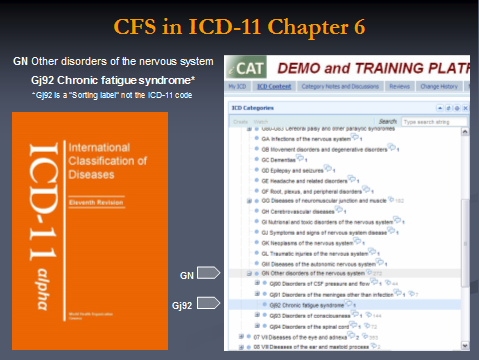
Coding CFS patients under R53.82 will consign them to a dustbin diagnosis: there are no guarantees that clinicians will use the unfamiliar ME code or that insurance companies will reimburse for G93.3. It will make patients more vulnerable to the proposals of the DSM-5 Somatic Symptom Disorders Work Group. It will mean that ICD-10-CM will be out of line with at least four versions of ICD-10, including the Canadian “Clinical Modification”, and also out of line with the forthcoming ICD-11, where all three terms are proposed to be coded in Chapter 6 Diseases of the nervous system.

There are only seven months left before the 1 October Code Freeze and the clock is ticking.


Here is the first version of Mr Swales’ website report, followed by his amended version.

Version One:

http://ianswales.com/en/article/2011/455560/swales-wins-battle-with-government-on-me

Swales wins battle with Government on ME

February 17, 2011 3:45 PM

Ian Swales MP’s fight for better treatment of myalgic encephalomyelitis (ME) continues as he succeeds in getting the Government to recognise ME and Chronic Fatigue Syndrome (CFS) as different illnesses.

During Ian’s recent parliamentary debate on ME he argued that the Government needs to distinguish between Chronic Fatigue Syndrome and ME to provide better treatment for the different illnesses.

However, Health Minister Paul Burstow MP responded by saying that the World Health Organisation classifies Chronic Fatigue Syndrome and ME as the same illness.

Following an outcry from the ME community about this statement, Ian challenged the Minister on his definition of CFS/ME. The Minister admitted that the definition he used in the debate was “incorrect”.

Commenting, Ian Swales MP said:

“I am pleased that the Government has now recognised that ME and Chronic Fatigue Syndrome are two different illnesses.

“After the debate I received a lot of correspondence from the ME community about the Government’s definition of CFS/ME, so after doing some more research on the matter I decided it was right to clarify this point with the Minister. I know they will be reassured by this news.

“I hope that approaching ME as a distinct condition will help lead to better, more effective treatment for sufferers through better analysis of their possible different causes and symptoms.”

[Ends]

Version Two:

http://ianswales.com/en/article/2011/455560/swales-wins-battle-with-government-on-me

Swales corrects Minister on World Health Organisation definition of ME

February 17, 2011 3:45 PM

Ian Swales MP’s fight for better treatment of myalgic encephalomyelitis (ME) continues as he succeeds in getting the Government to acknowledge that the World Health Organisation does not use the composite term CFS/ME for the condition.

During Ian’s recent parliamentary debate on ME he argued that the Government needs to distinguish between Chronic Fatigue Syndrome and ME to provide better treatment for the different illnesses.

However, Health Minister Paul Burstow MP responded by saying that the World Health Organisation “uses the composite term CFS/ME for the condition”.

Following an outcry from the ME community about this statement, Ian challenged the Minister on his definition of CFS/ME. The Minister admitted that his statement was “incorrect”.

Commenting, Ian Swales MP said:

“I am pleased that the Minister has acknowledged the error he made in the debate.

“After the debate I received a lot of correspondence from the ME community about the Government’s definition of CFS/ME, so after doing some more research on the matter I decided it was right to clarify this point with the Minister. I know they will be reassured by this news.

“I will continue my campaign to get more effective treatment for sufferers of ME through better analysis of its causes and symptoms.”

[Ends]

The text of the Adjournment Debate can be read here, on Hansard

 
Myalgic Encephalomyelitis
4.13 pm

References:

[1] Written Answer: Paul Burstow to Ian Swales, 16 February 2011, 16 Feb 2011 : Column 864W:
http://www.publications.parliament.uk/pa/cm201011/cmhansrd/cm110216/text/110216w0004.htm

[2] Amended Ian Swales website report:
http://ianswales.com/en/article/2011/455560/swales-wins-battle-with-government-on-me

[3] Written Answer: Earl Howe to The Countess of Mar, 01 March 2011:
http://www.theyworkforyou.com/wrans/?id=2011-03-01a.297.1

Hansard for above:
http://www.publications.parliament.uk/pa/ld201011/ldhansrd/text/110301w0001.htm#11030162000766

[4] Hansard, House of Lords Debate: Myalgic Encephalomyelitis, 22 January 2004:
http://www.publications.parliament.uk/pa/ld200304/ldhansrd/vo040122/text/40122-12.htm

[5] Current codings in ICD-10 for Postviral fatigue syndrome; [Benign] myalgic encephalomyelitis and Chronic fatigue syndrome:
https://dxrevisionwatch.wordpress.com/icd-11-me-cfs/

ICD-11 Content Model Reference Guide: version for December 2010

ICD-11 Content Model Reference Guide: version for December 2010

Post #62 Shortlink: http://wp.me/pKrrB-Xj

Update @ 1 March 2011

A more recent version of the Content Model document was uploaded to the ICD Revision site on 22 February.

It can be accessed here on the ICD Revision site:

View Word document

Download Word document

Or opened here on DSM-5 and ICD-11 Watch site: Content Model Reference Guide v January 2011

A revised version of the ICD-11 Content Model Reference Guide was uploaded to the WHO’s ICD Revision Google site in January.  This version of the document, dated 27 January 2011, replaces previous versions on DSM-5 and ICD-11 Watch site and on the ICD Revision Google site.

Content Model Reference Guide December 2010 v.1  27 Jan 2011

A copy of this 57 page document can be viewed on the ICD Revision Google site from this page:

http://sites.google.com/site/icd11revision/home/documents

View Word document

Download Word document

or open here on DSM-5 and ICD-11 Watch site: Content Model Reference Guide December 2010 [v.1]


Introductory pages

ICD-11 alpha

World Health Organization, Geneva

Content Model Reference Guide 11th Revision

December 2010

Table of Contents

Page 2

Introduction 3
What is the “Content Model”? 4
Explanations on the Content Model 5
Technical Specifications for the Content Model 7
ICD -11 Alpha Content Model 9

1. ICD Entity Title 9

2. Classification Properties 11

3. Textual Definition(s) 17

4. Terms 21

5. Body Structure Description 24

6. Temporal Properties 27

7. Severity Properties 31

8. Manifestation Properties 33

9. Causal Properties 35

10. Functioning Properties 38

11. Specific Condition Properties 42

12. Treatment Properties 44

13. Diagnostic Criteria 45

Section B 46

Appendices 48
Appendix 1: Body Systems Value Set 48
Appendix 2: Temporal Properties Value Set 49
Appendix 3: Temporal Properties Value Set and explanations 50
Appendix 4: Basic Aetiology Value Set 56
Appendix 5: Grammar Rules for Titles and Synonyms 57

Page 3

Reference Guide on the Content Model of the ICD 11α

Introduction

This Reference Guide is intended to define and explain the Content Model used in the ICD-11 alpha draft in practical terms. It aims to guide users to understand the purposes and parameters of the Content Model.

The Reference Guide also informs users about the technical specifications of each parameter which the designers of the iCAT (the computer platform that is used to fill in the content model: international Collaborative Authoring Tool) took into account in building the software.

Accordingly, information on each parameter is given in two sections:

(1) Explanations
(2) Technical specifications

The purpose of this Reference Guide is to ensure that the Content Model and its different parameters are properly understood.

This document will be periodically updated in response to user needs and evolution of the content model.

Brief introduction to the ICD – International Classification of Diseases

The International Classification of Diseases (ICD) is the global standard to report and categorize diseases in order to compile health information related to deaths, illness and injury. The ICD content includes diseases and a range of health problems including disorders, syndromes, signs, symptoms, abnormal findings, complaints, social circumstances, and external causes of injury. The ICD is designed to promote international comparability in the collection, processing, classification, and presentation of these statistics.

In ICD there are multiple classification categories which are defined by explicit or implicit parameters such as: codes, titles, definitions and other characteristics. In ICD 11, we aim to formally represent all this classification knowledge in a systematic way. The Content Model serves this purpose.

Page 4

What is the “Content Model”?

The Content Model is a structured framework that defines “a classification unit” in ICD in a standard way in terms of its components that allows computerization.

A “model” is a technical term that refers to a systematic representation of knowledge that underpins any system or structure. Hence, the content model is an organized description of an ICD unit with its different parameters.

In the past, ICD did not explicitly define its “classification units” – in other words diseases were classified without defining “what is a disease?” (There have been efforts to provide some definitions, inclusions, exclusion information, and some coding rules in the instructions and in the index. Some chapters, such as mental health, oncology, or other groups of diseases have been elaborated with diagnostic criteria. All these efforts may be seen as implicit modelling.) In the ICD 11 revision process, deliberate action is being taken to define the ICD categories in a systematic way and represent the classification knowledge to allow processing within computer systems.

To achieve this aim, different ICD categories have been defined by user groups as to what they are. For example, first a disease was defined as follows:

A disease is a set of dysfunction(s) in any of the body systems defined by:

1. Symptomatology: manifestations: known pattern of signs, symptoms and related findings
2. Aetiology: an underlying explanatory mechanism
3. Course and outcome: a distinct pattern of development over time
4. Treatment response: a known pattern of response to interventions
5. Linkage to genetic factors: e.g., genotypes, patterns of gene expression
6. Linkage to interacting environmental factors

Then the key components of this definition have been operationally defined as different parameters which, as a whole, formed the Content Model.

Page 5

Explanations on the Content Model:

A classification unit in ICD is called an “ICD entity”. In other words, any distinct classification rubric is called an Entity. (The term “Entity” is used interchangeably – in the same meaning — with the term “ICD Concept”.

An ICD entity may be:

– A category
– A block
– A chapter

A category (which is the most common reference to an ICD class) may be a disease, disorder or syndrome; sign, symptom or other health problem such as injuries, or a combination of the above. In addition, ICD has also been used to classify “external causes” or “other reasons for encounter” which are different kinds of entities than the diseases. In other words, “Category” refers to the individual classes represented in the ICD-10 printed version.

The Content Model, therefore, allows the various classification categories to be represented more clearly so that users can identify the classification units in a scientific fashion.

The purpose of the content model is to present the knowledge that lies under the definition of an ICD entity. Each ICD entity can be seen from different dimensions. The content model represents each one of these dimensions as a “parameter”. For example, there are currently 13 defined main parameters in the content model to describe a category in ICD.

TABLE 1: The Content Model main parameters

For each category, various parameters are given different values. For example:

Category: Myocardial Infarction

Parameters:                       Value:
Body system                         Cardiovascular system
Body part                              Heart
Signs/symptoms                   Crushing chest pain, etc.
Investigation Findings           ST elevation in ECG

It is not necessary to describe all categories with all parameters. Only parameters that are relevant to the description of the category should be used. In certain instances such as External Causes, only a number of the parameters are valid for the description of these entities.

The full range of different values for a given parameter is predefined using standard terminologies and ontologies. The predefined values constitute a “value set”.

Read full document here: Content Model Reference Guide December 2010 [v.1]


Related documents:

Paper:

http://bmir.stanford.edu/file_asset/index.php/1522/BMIR-2010-1405.pdf

A Content Model for the ICD-11 Revision

Samson W. Tu1, Olivier Bodenreider2, Can Çelik3, Christopher G. Chute4, Sam Heard5, Robert Jakob3, Guoquian Jiang4, Sukil Kim6, Eric Miller7, Mark M. Musen1, Jun Nakaya8, Jon Patrick9, Alan Rector10, Guillermo Reynoso11, Jean Marie Rodrigues12, Harold Solbrig4, Kent A Spackman13, Tania Tudorache1, Stefanie Weber14, Tevfik Bedirhan Üstün3

1Stanford Univ., Stanford, CA, USA; 2National Library of Medicine, Bethesda, MD, USA; 3World Health Organization, Geneva, Switzerland; 4Mayo Clinic College of Medicine, Rochester, MN, USA; 5Ocean Informatics, Chatswood, NSW, Australia; 6Catholic Univ. of Korea, Korea; 7Zepheira, Fredricksburg, VA, USA; 8Tokyo Medical and Dental Univ., Tokyo, Japan; 9Univ. of Sydney, Sydney, NSW, Australia; 10Univ. of Manchester, Manchester, UK; 11Buenos Aires, Argentina;12Université de Saint Etienne, Saint Priest en Jarez, France; 13IHTSDO, USA; 14DIMDI – German Institute of Medical Documentation and Information, Köln, Germany

Abstract

The 11th revision of the International Classification of Diseases and Related Health Problems (ICD) will be developed as a collaborative effort supported by Webbased software. A key to this effort is the content model designed to support detailed description of the clinical characteristics of each category, clear relationships to other terminologies and classifications, especially SNOMED-CT, multi-lingual development, and sufficient content so that the adaptations for alternative uses cases for the ICD – particularly the standard backwards compatible hierarchical form – can be generated automatically. The content model forms the basis of an information infrastructure and of a webbased authoring tool for clinical and classification experts to create and curate the content of the new revision.

CFS orphaned in the “R” codes in ICD-10-CM

CFS orphaned in the “R” codes in US specific ICD-10-CM

Post #60 Shortlink: http://wp.me/pKrrB-V4

Current proposals for ICD-10-CM place CFS in Chapter 18, under R53 Malaise and fatigue at R53.82 Chronic fatigue syndrome NOS (Not otherwise specified).

According to a Note to a Recommendation on the CSFSAC webpages:

*DFO Note: The ICD 10-CM is scheduled for implementation on October 1, 2013. In that classification, two mutually exclusive codes exist for chronic fatigue [sic]:

post-viral fatigue syndrome (in the nervous system chapter), and
chronic fatigue syndrome, unspecified (in the signs and symptoms chapter).

HHS has no plans at this time to change this classification in the ICD 10-CM.

Images Copyright 2011 ME agenda  No unauthorized reproduction


The revision of ICD-10, ICD-11, is scheduled for implementation in 2015.

Once ICD-10-CM has been adopted, the US does not envisage moving on to ICD-11 (or a “Clinical Modification” adaptation of ICD-11) for many years.

Partial Code Freeze

Although ICD-10-CM is not scheduled for implementation until October 2013, it had been proposed that at some point prior that date codes might be “frozen”.

At the ICD-9-CM Coordination & Maintenance Committee Meeting on Sept. 15, 2010, it was announced that the committee had finalized the decision to implement a partial freeze for both ICD-9-CM codes and ICD-10-CM and ICD-10-PCS codes prior to implementation of ICD-10 on Oct. 1, 2013.

       Partial Code Freeze Announcement

As of October 1, 2011, only limited updates will be instituted into the code sets so that providers, payers, clearinghouses, and health IT vendors will not have to simultaneously keep pace with code updates while also reconfiguring their existing systems for ICD-10-CM/PCS.

So the clock is ticking for CFS and US advocates and patients need to be aware of how little time may be left.

References:

[1] International Classification of Diseases, Tenth Revision, Clinical Modification (ICD-10-CM). Note: The 2011 release of ICD-10-CM is now available. It replaces the December 2010 release:
http://www.cdc.gov/nchs/icd/icd10cm.htm

[2] US “Clinical Modification” ICD-10-CM
This article clarifies any confusion between ICD-10, ICD-11 and the forthcoming US Clinical Modification, ICD-10-CM: http://wp.me/pKrrB-Ka

[3] Chronic Fatigue Syndrome Advisory Committee (CFSAC). The Chronic Fatigue Syndrome Advisory Committee (CFSAC) provides advice and recommendations to the Secretary of Health and Human Services via the Assistant Secretary for Health of the U.S. Minutes of meetings, Recommendations and meeting videocasts:
http://www.hhs.gov/advcomcfs/meetings/index.html

The clock is ticking for CFS: Partial Code Freeze for ICD-9-CM and ICD-10-CM/PCS Finalized

The clock is ticking for CFS: Partial Code Freeze for ICD-9-CM and ICD-10-CM/PCS Finalized (US)

Post #59 Shortlink: http://wp.me/pKrrB-Un

The clock is ticking…

The US was authorized by the WHO to develop its own country specific adaptation of the WHO’s now retired ICD-9, called ICD-9-CM, and has been slow to move on to a “Clinical Modification” of ICD-10.

Rather than skip ICD-10 and move straight onto ICD-11 in 2015, the National Center for Health Statistics (NCHS) has been developing a “clinical modification” of ICD-10 called ICD-10-CM. This development process has been in progress for a number of years.

So ICD-10-CM is US specific and it’s scheduled for implementation in October 2013 [1].

The US does not envisage moving on to ICD-11 (or an adaptation of ICD-11) for many years. So although the majority of countries will be implementing ICD-11 in 2015+, the US will sail on with ICD-10-CM.

Several other countries use a modification of ICD-10. Canada is authorized to use its adaptation of ICD-10, ICD-10-CA. According to one source, Canada may not adopt ICD-11 (or an adaptation of ICD-11) until beyond 2018.

ICD-10-CM

The US clinical modification is proposing to retain CFS in the R codes and to classify it at R53.82 in Chapter 18, rather than code CFS in Chapter 6: Diseases of the nervous system, along with ME and PVFS, at G93.3.

“Symptoms, signs and abnormal clinical and laboratory findings, not elsewhere classified (R00-R99) This chapter includes symptoms, signs, abnormal results of clinical or other investigative procedures, and ill-defined conditions regarding which no diagnosis classifiable elsewhere is recorded.” [2]

For ICD-10-CM, then, PVFS and (B)ME are proposed to be coded thus, in Chapter 6:

Diseases of the nervous system (G00-G99)

Excludes2:

[…]
symptoms, signs and abnormal clinical and laboratory findings, not elsewhere classified (R00-R94)

G93 Other disorders of brain

[…]

G93.3 Postviral fatigue syndrome

Benign myalgic encephalomyelitis
Excludes1: chronic fatigue syndrome NOS (R53.82)

which would bring the classification of PVFS and ME for the US in line with existing ICD-10 codes. (Though note that in ICD-10, Chronic fatigue syndrome is indexed to G93.3 in Volume 3: The Alphabetical Index and does not appear in Volume 1: The Tabular list under the G93 parent category.)

Whereas for ICD-10-CM, CFS is proposed to be coded thus, in Chapter 18:

R53: Malaise and fatigue

[…]

R53.82 Chronic fatigue, unspecified

Chronic fatigue syndrome NOS
Excludes1: postviral fatigue syndrome (G93.3)

Retaining CFS in the R codes and coding CFS in Chapter 18 under R53.82 (which specifically excludes G93.3) means that in ICD-10-CM, the coding of the terms CFS, PVFS and ME will be out of step with four classification systems:

1 The International ICD-10, which is used in the majority of countries.

2 The Canadian Clinical Modification ICD-10-CA.

3 The German Clinical Modification ICD-10-GM.

4 The proposals for Chapter 6 of ICD-11 as they stood in the iCAT ICD Revision Platform at November 2010, where CFS is proposed to be classified in Chapter 6: Diseases of the nervous system, with (B)ME specified as an Inclusion to CFS.

(I am informed that “PVFS” is a term little used by the US medical profession.)


Schism

This issue is proving divisive because some US patients would prefer to see CFS split from ME in ICD-10-CM. 

But retaining CFS in the R codes and placing it under the R53: Malaise and fatigue parent category may have considerable implications for patients who already have a diagnosis of CFS or who may receive a diagnosis of CFS in the future – for the treatments that are provided, the care packages received and for medical and disability insurance.

So I consider it will hurt patients to have CFS coded under the R chapter, rather than in Chapter 6: Diseases of the nervous system and that coding CFS under “ill-defined conditions” will render CFS and ME patients more vulnerable to the current proposals for the revision of the “Somatoform Disorders” section for DSM-5 [4].

If I were a patient who already had a diagnosis of CFS or might be given diagnosis of CFS in the future, I would feel safer if CFS were coded at G93.3, until the science has got it sorted. For there are no guarantees that US medics will diagnose ME and use the new ME code for billing purposes.

But this is not a new issue. 

US patients organizations, advocates and patients have known about these proposals for several years. The issue has been discussed at meetings of the Chronic Fatigue Syndrome Advisory Committee (CFSAC).

CFSAC provides advice and recommendations to the Secretary of Health and Human Services via the Assistant Secretary for Health of the U.S. Department of Health and Human Services on issues related to chronic fatigue syndrome (CFS). Copies of meeting agendas, minutes, recommendations, some presentations and since 2009, videocasts of entire meeting proceedings, can be accessed from the CFSAC pages. Minutes of meetings go back to September 2003 [3].

The codings issue had been discussed by CFSAC in June 2004 and again in September 2005, when a presentation had been given by the CDC’s Donna Pickett. In 2005, the committee had recommend that CFS be classified under G93.3.

“Recommendation 10: We would encourage the classification of CFS as a ‘Nervous System Disease,’ as worded in the ICD-10 G93.3.” CFSAC Committee Recommendations August 2005

The issue was discussed more recently, at the May 2010 CFSAC meeting. During the last ten minutes of that meeting, Dr Lenny Jason discussed his concerns with the committee that the placement of CFS in ICD-10-CM under the Chapter 18 “R” codes could be problematic. 

CFSAC 10.05.10 Agenda

CFSAC 10.05.10 Minutes

Videocast of CFSAC meeting

The Recommendations for that meeting in relation to the coding of CFS in ICD-10-CM had been:

“CFSAC rejects proposals to classify CFS as a psychiatric condition in U.S. disease classification systems. CFS is a multi-system disease and should be retained in its current classification structure, which is within the “Signs and Symptoms” chapter of the International Classification of Diseases 9-Clinical Modification (ICD 9-CM).*

“*DFO Note: The ICD 10-CM is scheduled for implementation on October 1, 2013. In that classification, two mutually exclusive codes exist for chronic fatigue [sic]:

“post-viral fatigue syndrome (in the nervous system chapter), and
chronic fatigue syndrome, unspecified (in the signs and symptoms chapter).

“HHS has no plans at this time to change this classification in the ICD 10-CM.”

Incidently, amongst the Recommendations of the CFSAC committee for the October 2010 meeting was:

3. Adopt the term “ME/CFS” across HHS programs.

I hope further discussion of ICD-10-CM codings can be pushed back up the agenda for the next CFSAC meeting because a number of issues were left hanging.


Code “freezing”

Although ICD-10-CM is not scheduled for implementation until October 2013, it had been proposed that at some point prior that date codes might be “frozen”.

At the ICD-9-CM Coordination & Maintenance Committee Meeting on Sept. 15, 2010, it was announced that the committee had finalized the decision to implement a partial freeze for both ICD-9-CM codes and ICD-10-CM and ICD-10-PCS codes prior to implementation of ICD-10-CM on Oct. 1, 2013.

As of October 1, 2011, only limited updates will be instituted into the code sets so that providers, payers, clearinghouses, and health IT vendors will not have to simultaneously keep pace with code updates while also reconfiguring their existing systems for ICD-10-CM/PCS.


So the clock is ticking and US advocates and patients need to be aware of how little time may be left.

A few days ago, I contacted Donna Pickett, Medical Systems Administrator, Classifications and Public Health Data Standards, National Center for Health Statistics, Centers for Disease Control and Prevention (CDC) to enquire whether the proposed date by which ICD-10-CM codings might be “frozen” had been finalized.

Ms Pickett has provided information regarding the freezing of the ICD-9-CM and ICD-10-CM code sets.

She also confirmed that Clinical criteria and diagnostic guidelines will not be included in ICD-10-CM.

(As I have reported before, for ICD-11, diseases and disorders will be defined through multiple parameters according to a common “Content Model” so there will be definitions, clinical descriptions etc and the potential for considerably more textual content than in ICD-10. See: http://wp.me/pKrrB-KK  for screenshots.)

The notice below is also available in PDF format here

There is an associated meeting Agenda Handout which also includes this information and dates of ICD-9-CM and ICD-10-CM meetings: Agenda. ICD-9-CM Coordination and Maintenance Committee. DHSS

Partial Code Freeze for ICD-9-CM and ICD-10 Finalized

The ICD-9-CM Coordination and Maintenance Committee will implement a partial freeze of the ICD-9-CM and ICD-10 (ICD-10-CM and ICD-10-PCS) codes prior to the implementation of ICD-10 on October 1, 2013. There was considerable support for this partial freeze. The partial freeze will be implemented as follows:

• The last regular, annual updates to both ICD-9-CM and ICD-10 code sets will be made on October 1, 2011.

•On October 1, 2012, there will be only limited code updates to both the ICD-9-CM and ICD-10 code sets to capture new technologies and diseases as required by section 503(a) of Pub. L. 108-173.

• On October 1, 2013, there will be only limited code updates to ICD-10 code sets to capture new technologies and diagnoses as required by section 503(a) of Pub. L. 108-173. There will be no updates to ICD-9-CM, as it will no longer be used for reporting.

• On October 1, 2014, regular updates to ICD-10 will begin.

The ICD-9-CM Coordination and Maintenance Committee will continue to meet twice a year during the partial freeze. At these meetings, the public will be asked to comment on whether or not requests for new diagnosis or procedure codes should be created based on the criteria of the need to capture a new technology or disease. Any code requests that do not meet the criteria will be evaluated for implementation within ICD-10 on and after October 1, 2014 once the partial freeze has ended.

Codes discussed at the September 15 – 16, 2010 and March 9 – 10, 2011 ICD-9-CM Coordination and Maintenance Committee meeting will be considered for implementation on October 1, 2011, the last regular updates for ICD-9-CM and ICD-10. Code requests discussed at the September 14 – 15, 2011 and additional meetings during the freeze will be evaluated for either the limited updates to capture new technologies and diseases during the freeze period or for implementation to ICD-10 on October 1, 2014. The public will be actively involved in discussing the merits of any such requests during the period of the partial freeze.

References:

(For history of ICD in the US to 2001, see archive CDC document: A Summary of Chronic Fatigue Syndrome and Its Classification in the International Classification of Diseases. The March 2001 proposals are since superceded as per 2009, 2010 and 2011 proposals.)

[1] International Classification of Diseases, Tenth Revision, Clinical Modification (ICD-10-CM). Note: The 2011 release of ICD-10-CM is now available. It replaces the December 2010 release:
http://www.cdc.gov/nchs/icd/icd10cm.htm

[2] US “Clinical Modification” ICD-10-CM
This article clarifies any confusion between ICD-10, ICD-11 and the forthcoming US Clinical Modification, ICD-10-CM: http://wp.me/pKrrB-Ka

[3] Chronic Fatigue Syndrome Advisory Committee (CFSAC). The Chronic Fatigue Syndrome Advisory Committee (CFSAC) provides advice and recommendations to the Secretary of Health and Human Services via the Assistant Secretary for Health of the U.S. Minutes of meetings, Recommendations and meeting videocasts:
http://www.hhs.gov/advcomcfs/

[4] The most recent proposals of the DSM-5 “Somatic Symptoms Disorders” Work Group plus two key Disorder Description and Rationale PDF documents can be read on the APA’s DSM-5 Development site:
http://www.dsm5.org/ProposedRevisions/Pages/SomatoformDisorders.aspx

or here on Dx Revision Watch site: http://wp.me/pKrrB-St