BDS, BDDs, BSS, BDD unscrambled

Post #268 Shortlink: http://wp.me/pKrrB-3fA

BDS, BDDs, BSS, BDD and ICD-11, unscrambled

There are two WHO convened working groups charged with making recommendations for the revision of ICD-10’s Somatoform Disorders: the Primary Care Consultation Group (known as the PCCG) and the Expert Working Group on Somatic Distress and Dissociative Disorders (known as the S3DWG).

The revision of ICD-11 is being promoted as an open and transparent process. But to date, neither working group has published progress reports for stakeholder consumption and neither group has published its emerging proposals in public access journals.

Content populated in the public version of the ICD-11 Beta drafting platform sheds little light on proposals.

Consequently, there is considerable confusion around what is being recommended for the revision of ICD-10’s Somatoform Disorders, whether consensus between the two working groups has been reached, and what proposals will progress to field testing during the next two years.

ICD-11 Revision has been asked to clarify when it intends to define and characterize its current proposals within the Beta drafting platform.

The notes below set out some of what is known about the two working groups’ emerging proposals, how they diverge and how they compare with DSM-5’s Somatic Symptom Disorder and with Fink et al’s Bodily Distress Syndrome.

Caveat: the proposals of the two ICD-11 working groups may have undergone revision and refinement since emerging proposals were published, in July and December, last year; the two groups may or may not have reached consensus over how this proposed new ICD construct should be defined and characterized, its inclusions, exclusions and differential diagnoses, or what name it should be given.

What is Bodily Distress Syndrome (BDS)?

+++

Bodily Distress Syndrome is the name given to a disorder construct developed by Per Fink and colleagues, Aarhus University, that is already in use in Danish research studies and in clinical settings [1].

BDS is described by its authors as “a unifying diagnosis that encompasses a group of closely related conditions such as somatization disorder, fibromyalgia, irritable bowel syndrome and chronic fatigue syndrome.”

Per Fink and colleagues are lobbying for BDS to be integrated into forthcoming classification systems and adopted as a diagnosis by primary care practitioners.

Their proposal is for reclassifying somatoform disorders, pain disorder, neurasthenia and the so-called functional somatic syndromes, including fibromyalgia, irritable bowel syndrome and chronic fatigue syndrome, under a new classification, Bodily Distress Syndrome.

They consider these should be treated and managed as subtypes of the same disorder with CBT, GET, “mindfulness therapy” and in some cases, antidepressants.

The PDF format slide presentation in reference [2] will give an overview of BDS and there is more information and links in an earlier post, in reference [3].

Is Fink et al’s Bodily Distress Syndrome construct the same as DSM-5’s SSD?

+++

No, Bodily Distress Syndrome is a different construct to DSM-5’s Somatic Symptom Disorder.

Psychological or behavioural characteristics, central for the diagnosis of SSD, do not form part of the BDS criteria.

For BDS, physical symptoms are central to the diagnosis, which is based on identification of symptom patterns (not symptom count) from four body systems:

Cardiopulmonary/autonomic arousal; Gastrointestinal arousal; Musculoskeletal tension; General symptoms.

There is a “Modest” BDS (single-organ type) and a “Severe” BDS (multi-organ type).

If the symptoms are better explained by another disease, they cannot be labelled BDS.

The graphic below compares mutli-organ Bodily Distress Syndrome with Somatic Symptom Disorder, as the DSM-5 draft criteria had stood, in May 2012.

Note the defining characteristics of the DSM-5 SSD construct: the SSD definition calls for positive psychobehavioural characteristics (excessive or maladaptive responses or associated health concerns) in response to persistent distressing somatic symptoms; the requirement that the symptoms are “medically unexplained” is not central to the diagnosis and the symptoms may or may not be associated with a well-recognised medical condition.

The SSD diagnosis can be made in the presence of one or more unspecified, somatic symptoms associated with general medical conditions and diagnosed disease, like multiple sclerosis, cancer, diabetes or angina, or in the so-called “functional somatic syndromes” (for example, IBS, CFS or fibromyalgia) or in complaints with unclear etiology.

Compare Fink et al’s BDS with DSM-5’s SSD, in the table, below:

Depending on screen size/resolution, graphic may not display in full. Click on the image and the image file will load. Graphic: Suzy Chapman
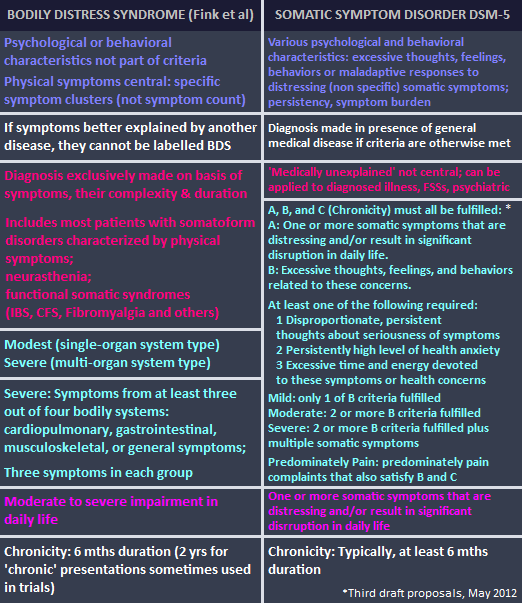
Bodily Distress Syndrome comparison with Somtatic Symptom Disorder

Continued on Page 2

Update on ICD-11 Beta drafting: Bodily Distress Disorder: emerging proposals: Part One

Post #265 Shortlink: http://wp.me/pKrrB-3cr

Update on ICD-11 Beta drafting: Bodily Distress Disorder: emerging proposals: Part One

This report should be read in conjunction with the caveats at the end of the post, on Page 3.

Part One

The technical work associated with the preparation of ICD-11, the field testing and trials evaluation will need to be completed next year if WHO is going to meet its target of presenting ICD-11 for World Health Assembly approval in May 2015, with pilot implementation by 2016.

Three distinct versions of the ICD-11 classification of Mental and Behavioural Disorders are under development: an abridged version for use in primary care, a detailed version for use in specialty settings and a version for use in research.

The ICD-10 Somatoform Disorders are under revision for all three versions and the primary care and speciality versions are being developed simultaneously.

ICD10-PC, the abridged version of ICD, is used in developed and developing countries and in the training of medical officers, nurses and multi-purpose health workers. Globally, more than 90% of patients with mental health problems are managed by practitioners or health workers in general medical or primary care settings – not by psychiatrists.

Over 400 mental disorders are classified in the speciality version of ICD-10 Chapter V. These are condensed to 26 mental disorders for the primary care version – a list can be found on Page 49 of this book chapter, in Table 2.4.

Each disorder in ICD10-PC provides information on patient presentation, clinical descriptions, differential diagnoses, treatments, indications for referrals and information sheets for patients and families.

A revised list of disorders proposed for inclusion in the forthcoming ICD-11-PHC can be viewed on Page 51, in Table 2.5 [1].

For new and revised disorders included in the primary care version there will need to be an equivalent disorder in the core ICD-11 classification.

Existing Somatoform Disorders in the core ICD-10 version can be viewed here: ICD-10 Version: 2010 browser: Somatoform Disorders or from Page 129 in The ICD-10 Classification of Mental and Behavioural Disorders, Clinical descriptions and diagnostic guidelines.

A chart showing the grouping of the detailed core version categories and the 26 corresponding disorders in ICD10-PC can be found here, see Page 8, for F45 Unexplained somatic complaints and F45  Somatoform disorders (ICD-10): Connections between ICD-10 PC and ICD-10 Chapter V.

Where reports of emerging proposals for ICD-11 have been published by ICD revision working group members, the recommendations within them may be subject to refinement or revision following analysis of focus group studies, external review and multicentre field trials to assess the validity and clinical utility of proposals for application in developed and developing countries, in high and low resource settings and across general, speciality and research settings [2].

Not all proposals for new or revised disorders are expected to survive the field trials.

Two working groups are making recommendations for the revision of ICD-10’s Somatoform Disorders:

A WHO Primary Care Consultation Group (known as the PCCG) has been appointed to lead the development of the revision of ICD10-PC, the abridged classification of mental and behavioural disorders for use in primary care settings. The PCCG is charged with developing and field testing the full set of disorders for inclusion in ICD-11-PHC, for which 28 mental disorders are currently proposed.

The PCCG members are SWC Chan, AC Dowell, S Fortes, L Gask, KS Jacob, M Klinkman (Vice Chair), TP Lam, JK Mbatia, FA Minhas, G Reed, and M Rosendal. The PCCG is chaired by Prof, Sir David Goldberg.

A WHO Expert Working Group on Somatic Distress and Dissociative Disorders (known as the S3DWG) was constituted in 2011 to review the scientific evidence for, and clinical utility of the ICD-10 somatoform and dissociative disorders; to review proposals for the DSM-5 somatic symptom disorders and dissociative disorders categories and to consider their suitability or not for global applications; to review proposals and provide draft content for the somatic distress and dissociative disorder categories in line with the overall ICD revision requirements; to propose entities and descriptions for the classification of somatic distress and dissociative disorders for use in diverse global and primary care settings. External reviewers are also consulted on proposals and content.

The full S3DWG membership list is not publicly available but the group is understood to comprise 17 international behavioural health professionals, of which Prof Francis Creed is a member. The S3DWG is Chaired by Prof Oye Gureje.

Responsibilities of ICD-11 working groups are set out on Page 3 (1.1.) of document [3] in the References. Document [3] also includes information on the ICD-11 field trials, from Page 8 (4.).


1. Goldberg DP. Comparison Between ICD and DSM Diagnostic Systems for Mental Disorders. In: Sorel E, (Ed.) 21st Century Global Mental Health. Jones & Bartlett Learning, 2012: 37-53. Free PDF, Sample Chapter Two: http://samples.jbpub.com/9781449627874/Chapter2.pdf
2. PDF WHO ICD Revision Information Note, Field Testing, June 2012
3. Responsibilities of ICD-11 working groups set out on Page 3 of 2012 Annual Report of the International Union of Psychological Science to the American Psychological Association, Revision of World Health Organization’s ICD-10 Mental and Behavioural Disorders, Pierre L.-J. Ritchie, Ph.D., Main Representative to the World Health Organization, International Union of Psychological Science, January, 2013

Continued on Page 2

Proposed new diagnoses of anxious depression and bodily stress syndrome in ICD-11-PHC: an international focus group study

Proposed new diagnoses of anxious depression and bodily stress syndrome in ICD-11-PHC: an international focus group study. [JOURNAL ARTICLE]

Post #196 Shortlink: http://wp.me/pKrrB-2pp

This paper, published on July 28, discusses field testing of two proposed new categories for the forthcoming ICD-11 PHC, “anxious depression” and “bodily stress syndrome (BSS)”.

“Bodily stress syndrome (BSS)” is currently proposed to replace ICD-10 PHC’s “F45 Unexplained somatic complaints” which is the equivalent to ICD-10’s “F45 Somatoform Disorders” section.

For ICD-11 PHC, it is proposed not to include the discrete category “Neurasthenia.”

+++
Full text, subscription required:

Family Practice (2012) doi: 10.1093/fampra/cms037

First published online: July 28, 2012

http://fampra.oxfordjournals.org/content/early/2012/07/20/fampra.cms037.long

http://fampra.oxfordjournals.org/content/early/2012/07/20/fampra.cms037.full.pdf+html

Abstract

http://www.ncbi.nlm.nih.gov/pubmed/22843638

Lam TP, Goldberg DP, Dowell AC, Fortes S, Mbatia JK, Minhas FA, Klinkman MS

Proposed new diagnoses of anxious depression and bodily stress syndrome in ICD-11-PHC: an international focus group study. [JOURNAL ARTICLE]

Fam Pract 2012 Jul 28.

BACKGROUND: The World Health Organization is revising the primary care classification of mental and behavioural disorders for the International Classification of Diseases (ICD-11-Primary Health Care (PHC)) aiming to reduce the disease burden associated with mental disorders among member countries.

OBJECTIVE: To explore the opinions of primary care professionals on proposed new diagnostic entities in draft ICD-11-PHC, namely anxious depression and bodily stress syndrome (BSS).

METHODS: Qualitative study with focus groups of primary health-care workers, using standard interview schedule after draft ICD-11-PHC criteria for each proposed entity was introduced to the participants.

RESULTS: Nine focus groups with 4-15 participants each were held at seven locations: Austria, Brazil, Hong Kong, New Zealand, Pakistan, Tanzania and United Kingdom. There was overwhelming support for the inclusion of anxious depression, which was considered to be very common in primary care settings. However, there were concerns about the 2-week duration of symptoms being too short to make a reliable diagnosis. BSS was considered to be a better term than medically unexplained symptoms but there were disagreements about the diagnostic criteria in the number of symptoms required.

CONCLUSION: Anxious depression is well received by primary care professionals, but BSS requires further modification. International field trials will be held to further test these new diagnoses in draft ICD-11-PHC.

+++

Notes and related posts:

ICD-10 PHC (sometimes written as ICD-10-PHC or ICD10-PHC or ICD-10 PC), is a simplified version of the WHO’s ICD-10 chapter for mental and behavioural disorders for use in general practice and primary health care settings. This system has rough but not exact equivalence to selected of the mental disorders in the core ICD-10 classification.

The ICD-10 PHC includes and describes 26 disorders commonly managed within primary care as opposed to circa 450 classified within Chapter V of ICD-10.

Click here for a chart showing the grouping of categories adapted from the full ICD-10 version for the existing ICD-10 PHC mental health categories

Professor, Sir David Goldberg, M.D., Emeritus Professor, Institute of Psychiatry, King’s College, London, is a member of the DSM-5 Mood Disorders Work Group. Prof Goldberg also chairs the Consultation Group for Classification in Primary Care that is making recommendations for the mental and behavioural disorders for ICD-11 PHC.

Other members of the ICD-11 PHC Consultation Group include Michael Klinkman (GP, United States; Vice Chairman); Sally Chan (nurse, Singapore), Tony Dowell (GP, New Zealand) Sandra Fortes (psychiatrist, Brazil), Linda Gask (psychiatrist, UK), KS Jacob (psychiatrist, India), Tai-Pong Lam (GP, Hong Kong), Joseph Mbatia (psychiatrist, Tanzania), Fareed Minhas (psychiatrist, Pakistan), Marianne Rosendal (GP, Denmark), assisted by WHO Secretariat Geoffrey Reed and Shekhar Saxena.

The majority of patients with mental health problems are diagnosed and managed by general practitioners in primary care – not by psychiatrists and mental health specialists. ICD-10 PHC is used in developed and developing countries in general medical settings and also used in the training of medical officers, nurses and multi purpose health workers.

See also Page 3 of this report:

Changes to ICD-11 Beta drafting platform: Bodily Distress Disorders (1)

Page 3, including Update at July 9: Second list of proposals for ICD-11 PHC

Further information on ICD-10 PHC and proposals for the 28 mental health disorders proposed to be included in ICD-11 PHC can be found in these two documents:

1] Goldberg, D. Guest editorial. A revised mental health classification for use in general medical settings: the ICD11–PHC 1. International Psychiatry, Page 1, February 2011.

http://www.rcpsych.ac.uk/pdf/IPv8n1.pdf

Note: The list of proposed categories in the editorial above has been superseded by the list in Chapter 2 of this book, below. (Source: Prof D Goldberg, who stresses these are draft proposals and subject to revision in the light of field trial results).

2] 21st Century Global Mental Health by Dr Eliot Sorel, Professor, George Washington University, Washington D.C.

Publication date: August, 2012: http://www.jblearning.com/catalog/9781449627874/

Page 51, Sample Chapter 2: http://samples.jbpub.com/9781449627874/Chapter2.pdf