A proposal for the ICD-10 G93.3 legacy terms for ICD-11: Part One

Post #329 Shortlink: http://wp.me/pKrrB-4dV

Our Proposal and Rationale is set out in Part Two:

A proposal for the ICD-10 G93.3 legacy terms for ICD-11: Part Two

A version of ICD-11 in 2018

It’s been a long time coming and it ain’t finished yet…

The World Health Organization (WHO) has been revising ICD-10 since 2007.

After several shifts in the timeline, WHO plans to present a version of the next edition (ICD-11 MMS) at the World Health Assembly (WHA), in May 2018.

WHO won’t be seeking endorsement of the ICD-11 product in May 2018 because it won’t be ready to implement. Endorsement will be sought at some point in the future. In the meantime, a version of ICD-11 is scheduled for release later in 2018, after the May assembly. The release date has yet to be announced.

https://hscic.kahootz.com/connect.ti/t_c_home/view?objectId=297939

“…The World Health Organization (WHO) is currently developing the 11th revision of ICD. Once endorsed by the World Health Assembly (WHA), WHO Nomenclature regulations stipulate that Member States must use the most current revision for mortality and morbidity purposes. For this reason and to allow member countries to adopt the new revision when they are ready, WHO will brief the WHA on ICD-11 in May 2018 but will not seek endorsement at this time.”

Member states will transition from ICD-10 to the new edition at their own pace. It’s going to be several years before countries have evaluated the ICD-11 product for utility and prepared their health systems to make the transition.

At some point, data using codes from the new edition will be accepted alongside data compiled using ICD-10. WHO will continue to support ICD-10 until the majority of member states have adopted and implemented the new edition.

It will take even longer for countries like the U.S. and Canada, who use a country specific adaptation of ICD, to implement as they will need to modify the new edition to suit their countries’ health systems. The earliest Canada can implement is currently projected as 2023 [1]. The U.S.’s CDC estimate it will take at least 6 years after the codes have been ratified to prepare, field test and implement an ICD-11-CM/PCS.


Proposal deadlines

Some important deadlines for proposals for the ICD-11 Beta draft:

The deadline in order for proposals to be considered for a frozen version in March/April 2017 was 30 December 2016.

In order for proposals to be considered for inclusion in the version of ICD-11 that is scheduled for release in 2018, they needed to be submitted by March 30, 2017. So those two deadlines have been reached.

Comments by member states and improvements arising as a part of the Quality Assurance mechanism will be included with deadlines later in 2017.

According to Slide #12 in this November 2016 WHO presentation, the deadline for member state comments is May 31, 2017; the deadline for Field Testing and Quality Assurance is June 30, 2017 [2]. But these dates are unconfirmed and may have been revised since November, last year.

Proposals received after the end of May will be considered in the context of ICD-11 maintenance after 2018, when the new version will be subject to an annual update and maintenance schedule [3]. The first annual update is anticipated in 2019.

The Joint Task Force is considering naming each year’s iteration in the format: ICD 2018; ICD 2019; ICD 2020 and so on. There may never be a need for an ICD-12, since an electronic system is better able to evolve “gracefully” – as Dr Christopher Chute (Joint Task Force; Chair, Revision Steering Group) puts it – in response to advances in scientific knowledge and classificatory changes.


Deadlines for submitting comments

I have asked Dr Jakob and the Joint Task Force to clarify by what date comments on proposals that met the March 30 deadline will need to be submitted by in order to be considered in the context of the earliest release of ICD-11, in 2018.

No clarification has been forthcoming; so if you are a stakeholder considering submitting a comment on existing proposals in the Beta draft or on outstanding proposals queued in the “Proposals Mechanism” which are still going through the review process, then I would advise that you put this in hand over the next couple of weeks. If any deadline is announced, I will update at the top of this report.


Frozen release

On April 4, ICD Revision is scheduled to release a frozen version of ICD-11 MMS for field testing*. If there are any changes in this April 2017 Frozen Release that are relevant to stakeholders in the G93.3 terms, I will post an update at the top of this report.

*ICD-11 Field Trials, Information and Terms of Engagement, March 17, 2017 https://hscic.kahootz.com/gf2.ti/af/762498/122441/PDF/-/ICD11_FT_Information_and_ToE.pdf


Current status of the ICD-10 G93.3 legacy categories

The ICD-10 G93.3 legacy categories: Postviral fatigue syndrome; Benign myalgic encephalomyelitis and Chronic fatigue syndrome were taken out of the public version of the Beta draft in early 2013, with no explanation for their absence.

ICD Revision has maintained a cephalopodic grip on its intentions for these terms.

Advocates and patient organization stakeholders have been attempting to obtain transparency from ICD Revision around the Topic Advisory Group for Neurology’s proposals for these terms for over four years. During this period, stakeholders have been disenfranchised from participation in the revision process.


Questions raised in the English Parliament

15 international stakeholder organizations wrote to the ICD-11 MMS Joint Task Force, in February, in support of my call that the Joint Task Force place the matter of the continued absence of proposals for these terms on the Agenda of their February 20–22 meeting, in Cologne.

There were asked to expedite the release of proposals for public scrutiny and comment before the March 30 deadline.

This initiative was met with a disturbing level of obfuscation on the part of WHO and the Joint Task Force, especially given that ICD Revision has been promoted as an open, transparent process, inclusive of stakeholder participation.

The Countess of Mar, a long standing advocate for patients with ME and CFS, tabled two Written Questions in the House of Lords. The first is here (February 27), which received a response that raised more questions than it answered and a follow up question, here (March 16), which received an equally opaque reply.

But on March 26, the three terms were finally restored to the Beta draft – but with this caveat:

“While the optimal place in the classification is still being identified, the entity has been put back to its original place in ICD.”

Team WHO 2017-Mar-26 – 12:46 UTC

This suggests that we should view the restoration of the terms as a “placeholder” and that the work group may release revised proposals later this year.


What do we know?

WHO has confirmed that there is no intention to classify the ICD-10 G93.3 legacy terms under the Mental or behavioural disorders chapter or under the Symptoms, signs chapter.

“Team WHO” has also approved some long standing proposals for exclusions for two of these terms under Fatigue (but not yet approved an exclusion for Postviral fatigue syndrome and I have asked “Team WHO” for the rationale for this apparent anomaly, since one would anticipate that if the inclusion terms are excluded under Fatigue, the ICD concept title entity would also be excluded). Possibly, TAG Neurology has other plans for the classification of PVFS in ICD-11.

So, nearly 10 years into the revision process, it’s still unclear what the work group might be considering for these terms, when they will reach consensus, or whether alternative proposals might be released on April 4, when a frozen version of ICD-11 is scheduled for release for field testing.


How do the terms currently stand in ICD-10?

This is how the G93.3 legacy terms were represented in ICD-10:
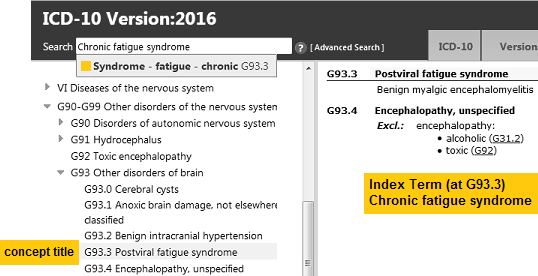
For ICD-10, Postviral fatigue syndrome (PVFS) is the lead (or concept title) term. Benign myalgic encephalomyelitis is the inclusion term under PVFS and takes the G93.3 code. Chronic fatigue syndrome is listed only in the Index, and coded to G93.3.


How do the terms stand in ICD-11 Beta draft, now they have been restored?
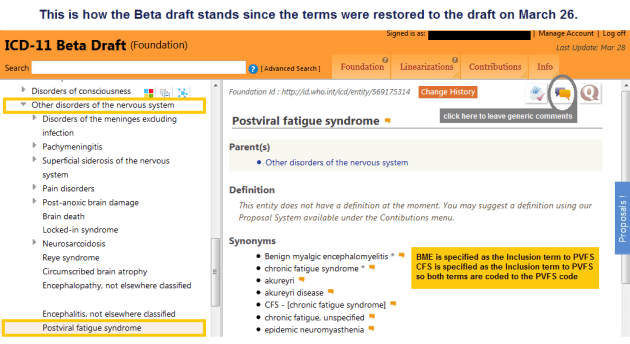
Since March 26, 2017, for ICD-11 Beta draft, all three terms are currently back under the Neurology chapter, under parent: Other disorders of the nervous system. PVFS is the lead (or concept title) term. BME and CFS are both specified as inclusion terms to PVFS, in the ICD-11 equivalent of the Tabular List. The terms listed under synonyms and all other “Content Model” descriptive content appear much as the Beta had stood in 2009.

But given the caveat, it is still unknown what the work group might be considering for these terms or whether or when they might release further proposals.

Note that the recommendations of the various external work groups are advisory only. WHO classification experts and the Joint Task Joint can, and sometimes do, overrule work group decisions.

If the Topic Advisory Group for Neurology, that has responsibility for these terms, were to reach consensus and release an alternative set of proposals before 2018, these will not necessarily obtain the approval of WHO/Joint Task Joint.


Suzy Chapman and Mary Dimmock have submitted a proposal

To address this situation, U.S. advocate, Mary Dimmock, and I have collaborated on the preparation of a formal and fully referenced proposal which we submitted on March 27. Our proposal (in the PDF below) recommends that these terms should be retained in the neurological chapter, using separate codes for ME and CFS, and also makes other recommendations.

PDF: Suzy Chapman, Mary Dimmock Proposal for ICD-11


Our Proposal and Rationale is set out in Part Two:

A proposal for the ICD-10 G93.3 legacy terms for ICD-11: Part Two

For a good overview of ICD-11’s structure and functionality by NHS Digital click here

References:

1 International Statistical Classification of Diseases and Related Health Problems, 11th Revision, Canada, Canadian Institute for Health Information (CIHI). https://www.cihi.ca/en/submit-data-and-view-standards/codes-and-classifications/icd-11

2 Presentation, Dr Robert Jakob, WHO/ICD Revision, November 2016. https://t.co/VvtZXVHZoF

3 ICD Revision Quarterly Newsletter, ICD-11 Update: January 2017. http://www.who.int/entity/classifications/ICD11January2017Newsletter.pdf

Save

Changes to SNOMED CT and Read Codes (CTV3) for CFS, ME and PVFS

Post #327 Shortlink: http://wp.me/pKrrB-4aD

Recent changes to SNOMED CT for CFS, ME and PVFS

  • Correspondence between Forward-ME and UK Health and Social Care Information Centre
  • SNOMED CT retires Mental disorder parent for Chronic fatigue syndrome and ME
  • Projected changes to April 2016 release of Read Codes Clinical Terms Version 3 (CTV3)
  • Read Codes system to be phased out as part of wider SNOMED CT implementation

In addition to ICD-10, a number of terminology and electronic health and medical record systems are used in the UK in primary, secondary, and health and social care clinical settings, which include:

OPCS-4 (classification of Surgical Operations and Procedures)

SNOMED CT (Systematized Nomenclature of Medicine – Clinical Terms, a comprehensive, multilingual clinical terminology system)

Read Codes (a coded thesaurus of clinical terms for recording patient findings and procedures in health and social care IT systems across primary and secondary care, e.g. GP surgeries and reporting of pathology results).

The National Information Board (NIB) has specified that all primary care systems adopt SNOMED CT by the end of December 2016 and that SNOMED CT is to be used as the single terminology in all health care settings in England, with a projected adoption date for the entire health system of April 2020 [3].

You can access a public SNOMED CT browser here: IHTSDO browser

This is an online browser and does not require any software to be downloaded. You will need to accept the license and then select for the UK “Local Extension” of SNOMED CT. Click on the “Search” tab to enter clinical terms.

The SNOMED CT International Edition and “Local Extensions” for a number of other countries, including the US, are also available via the browser. All editions release new updates twice a year, on a staggered schedule. The Release schedule for the UK Extension is April and October.

Read Codes system to be retired

The Read Codes system of clinical terms has been used in the NHS since 1985. As part of the adoption of SNOMED CT in primary care, Clinical Terms Version 3 (CTV3) is being deprecated.

More information on the phasing out of Read Codes, here:

Retirement of Read Version 2 and Clinical Terms Version 3

Click link for PDF document Retirement Schedule

There was no new release for CTV3 issued in October, but the April 2016 release is scheduled for Friday, 18th March 2016. The last release of CTV3 will be published in April 2018.

How have CFS and related terms been listed within SNOMED CT and CTV3?

SNOMED CT

Prior to July 2015, all editions of SNOMED CT had the following listings for CFS, ME and PVFS:

Chronic fatigue syndrome (with ME – Myalgic encephalomyelitis and several other related and historical terms listed under Synonyms) was assigned two parent disorder classes: Mental disorder, and Multisystem disorder.

Postviral fatigue syndrome was listed under Children to Chronic fatigue syndrome.

Read Codes (CTV3)

The twice yearly Read Codes releases (April and October) are available only to license holders but the codes can be viewed through this public resource (caveat: it is unclear how often this NCBO BioPortal ontology resource is updated with new releases for individual ontology systems):

See: BioPortal Xa01F

For CTV3, Xa01F Chronic fatigue syndrome (with ME – Myalgic encephalomyelitis and PVFS – Postviral fatigue syndrome under Synonyms) is listed, hierarchically, under two parent disorder classes: as a Sub Class of both Neurasthenia, under parent: Mental health disorder, and as a Sub Class of Neurological disorder.

See: http://purl.bioontology.org/ontology/RCD/Xa01F

Mental health disorder > Neurotic disorder > Somatoform disorder > Neurasthenia > Chronic fatigue syndrome

and

Neurological disorder > Chronic fatigue syndrome

See also the Visualization tab for a diagrammatic representation of dual parentage:

http://bioportal.bioontology.org/ontologies/RCD?p=classes&conceptid=Xa01F#visualization

Correspondence between Countess of Mar and UK Health and Social Care Information Centre

Forward-ME is an informal group for ME charities and voluntary organizations, chaired by the Countess of Mar, who also serves as Co-chair to the All-Party Parliamentary Group on Myalgic Encephalomyelitis (ME).

Between November 2014 and June 2015, Lady Mar was in correspondence with Mr Leon Liburd, Senior Support Analyst Systems and Service Delivery, and Ms Elaine Wooler, Advanced Clinical Terminology Specialist, UK Health and Social Care Information Centre.

Their correspondence (in reverse date order) was published on the Forward-ME website in June and can be read here:

Click link for PDF document  Correspondence re SNOMED

Changes to SNOMED CT

As a result of these exchanges, Lady Mar was advised that the relationship between the entry for 52702003 Chronic fatigue syndrome and the Mental disorder parent had been retired. In future editions, Chronic fatigue syndrome would be listed under the single parent, 281867008 Multisystem disorder.

Additionally, 51771007 Postviral fatigue syndrome was being removed as a subtype of 52702003 Chronic fatigue syndrome (disorder) – though no rationale for this specific decision appears to be provided within the correspondence.

[So 51771007 Postviral fatigue syndrome would be no longer be listed as a sub class under Children to 52702003 Chronic fatigue syndrome but directly under two parents: 281867008 Multisystem disorder and 123948009 Post-viral disorder.]

These changes were effected in the July 2015 release for the International Edition (Release 20150731).

They were subsequently incorporated into the September 2015 US Extension (Release 20150901), the October 2015 UK Extension (Release 20151001) and the November 2015 Swedish Extension (Release 20151130). It is expected that other country Extensions will also reflect these changes in their forthcoming releases.

Within the correspondence, on 11 November 2014, Mr Leon Liburd had also advised Lady Mar:

“It is also noted that the corresponding representation in the UK’s Clinical Terms Version 3 terminology product Xa01F | Chronic fatigue syndrome is classified as both a Neurological disorder and a Mental health disorder. As such, any conclusions emerging from the SNOMED CT discussions would also be reflected in the CTV3 UK product.”

Clarification re CFS and CTV3

In November, I contacted the UK Health and Social Care Information Centre for clarification of how CFS and its various Synonyms are currently listed within CTV3.

On 20 November, I was advised by Karim Nashar, Terminology Specialist, UK Terminology Centre, Health and Social Care Information Centre, that:

“[Xa01F | Chronic fatigue syndrome was being moved] under a single supertype 281867008 | Multisystem disorder (disorder) as to reflect the SNOMED correction in CTV3″

and that this change should be reflected in the April 2016 CTV3 release.

As noted above, Clinical Terms Version 3 (CTV3) is being deprecated and the last release of CTV3 will be published in April 2018.

The ICD-11 Beta draft and proposed classification of the G93.3 legacy terms

In June, WHO’s Dr Robert Jakob had told me that if TAG Neurology’s proposals and rationales for the G93.3 legacy terms were not ready for public release in September, he projected their release by December, latest (see towards end of Post #324).

No proposals were released in September and none in December. Eight years into the revision process and stakeholders still don’t know how ICD Revision proposes to classify the ICD-10 G93.3 legacy terms for ICD-11.

On 28 December, I called again, via the ICD-11 Beta Comments mechanism, for these terms to be restored to the public version of the Beta drafting platform.


 References

1 UK Terminology Centre (UKTC): http://systems.hscic.gov.uk/data/uktc/

2 SNOMED CT: http://systems.hscic.gov.uk/data/uktc/snomed

3 NIB document ‘Personalised Health and Care 2020: A Framework for Action’:
https://www.gov.uk/government/publications/personalised-health-and-care-2020

4 IHTSDO browser: http://browser.ihtsdotools.org

5 Retirement of Read Version 2 and Clinical Terms Version 3: http://systems.hscic.gov.uk/data/uktc/readcodes

6 NCBO BioPortal Read Codes (CTV3) Xa01F Chronic fatigue syndrome

7 Forward-ME Correspondence re SNOMED

Save

12 Point Skinny on ICD-11

Post #305 Shortlink: http://wp.me/pKrrB-3Rm

Update at May 15, 2014: Somatization disorder, listed as a uniquely coded child category under parent, Bodily distress disorder, has been removed from the Beta draft Linearizations since publishing the update on May 9. Instead, the ICD-10 legacy terms, somatoform disorders and Somatization disorder are both now listed under Synonyms to Bodily distress disorder and also listed as Index Terms. The three severity specifiers for BDD, (Mild, Moderate, Severe) remain.

Neurasthenia, listed as a child category under parent, Mental and behavioural disorders, has been removed from the Linearizations and is not listed in the PDF for the print version of the Alphabetical Index.

Update at May 9, 2014: Three uniquely coded severity specifiers (Mild, Moderate, Severe) have now been added back as child categories to Bodily distress disorder but Somatization disorder remains as a uniquely coded child category to BDD.

As no new posts will be added to the site from April, I leave you with my 12 Point Skinny on ICD-11 first published in February.

The version below has been updated to reflect changes since February.

A brief summary of how things stand in the Beta drafting platform at March 31, 2014.

If reposting, please repost unedited, with the publication date and source URL:

12 Point Skinny on ICD-11

Dx Revision Watch’s 12 Point Skinny on ICD-11:

1. The ICD-10 terms, PVFS, BME, and CFS, are not currently displaying in the public version of the Beta drafting platform under any chapters, either as ICD Title terms, or as Inclusion terms to ICD Title terms, or under Synonyms to ICD Title terms.

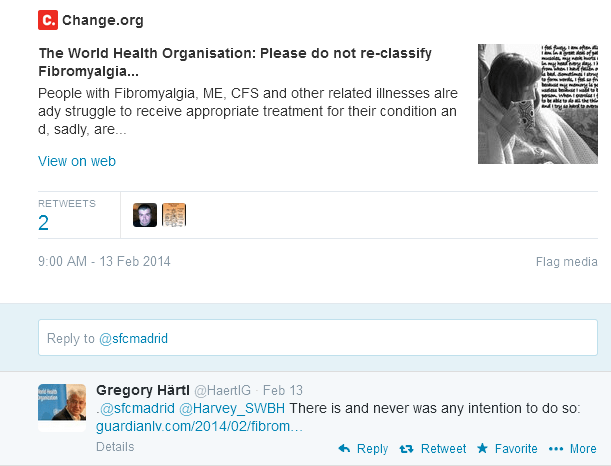
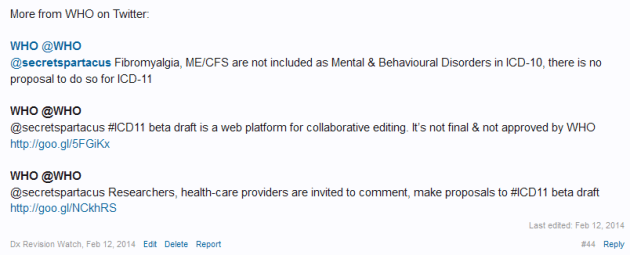
2. On Feb 12, 2014, @WHO Twitter admin stated: “Fibromyalgia, ME/CFS are not included as Mental & Behavioural Disorders in ICD-10, there is no proposal to do so for ICD-11”. This position was additionally confirmed by Mr Gregory Härtl, Head of Public Relations/Social Media, WHO.

3. Other than this position, WHO/ICD Revision has yet to clarify how it does propose to classify PVFS, BME, and CFS within ICD-11, in terms of intentions for specific chapter locations, parent classes (including any proposals to assign any of these terms to multiple parentage), hierarchies, Definitions text and other “Content Model” descriptive parameters.

4. Since June 2013, multiple requests have been made to WHO/ICD Revision to account for the current absence of these terms from the public version of the Beta draft and to issue a statement clarifying intent. On March 18, 2014, a joint letter was sent to key WHO/ICD Revision personnel [1].

5. Two separate working groups have been appointed by WHO/ICD Revision that are advising on the revision of the Somatoform disorders categories.

6. In 2012, two sets of emerging proposals were published – one for a tentative construct called Bodily distress disorder (BDD), and one for a divergent construct, tentatively called Bodily stress syndrome (BSS).

7. In 2012, the emerging proposals by the ICD-11 Expert Working Group on Somatic Distress and Dissociative Disorders (the Gureje led S3DWG sub working group) for its Bodily distress disorder (BDD) concept had described an SSD-like construct with criteria based on psychobehavioural responses [2].

8. In 2012, the emerging proposals by the PCCG (the Goldberg led ICD-11 Primary Care Consultation Group) presented an alternative Bodily stress syndrome (BSS) construct [3].

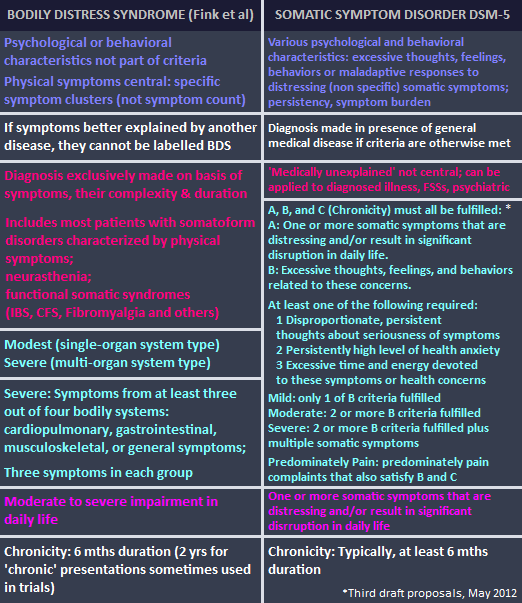
This proposal drew heavily on Fink et al’s Bodily Distress Syndrome (BDS) disorder model, requiring symptom patterns from body systems to meet the criteria. But the PCCG proposed to incorporate some SSD-like psychobehavioural responses, which do not form part of Fink’s BDS criteria – attempting a mash-up between two divergent constructs or disorder models [4].

9. The Definition for Bodily distress disorder (BDD) that is inserted into the Beta drafting platform [5] is based on the disorder description wording in the 2012 Gureje, Creed BDD paper, which had described an SSD-like construct [3].

10. BDD had a child category, Severe bodily distress disorder. This is now removed from the public Beta draft. Instead, ICD-10’s Somatization disorder has been restored to the draft linearizations as the child category to parent, Bodily distress disorder. Additionally, ICD-10’s F48.0 Neurasthenia has been restored to the draft, under parent, Mental and behavioural disorders.

Update at May 9, 2014: Three uniquely coded severity specifiers (Mild, Moderate, Severe) have now been added back as child categories to Bodily distress disorder but Somatization disorder remains as a uniquely coded child category to BDD.

In the ICD-11 Beta, it had previously been proposed that seven ICD-10 Somatoform disorders categories (F45.0 – F45.9) plus F48.0 Neurasthenia would be replaced by this single new disorder construct, Bodily distress disorder (BDD) [2].

But how these two (now apparently proposed to be restored) ICD-10 legacy categories, Somatization disorder and Neurasthenia, are currently envisaged to function within a new disorder framework to replace the Somatoform disorders categories remains unclarified.

Update at May 15, 2014: Somatization disorder, listed as a uniquely coded child category under parent, Bodily distress disorder, has been removed from the Beta draft Linearizations since publishing the update on May 9. Instead, the ICD-10 legacy terms, somatoform disorders and Somatization disorder are both now listed under Synonyms to Bodily distress disorder and also listed as Index Terms. The three severity specifiers for BDD, (Mild, Moderate, Severe) remain.

Neurasthenia, listed as a child category under parent, Mental and behavioural disorders, has now been removed from the Linearizations and is not listed in the PDF for the print version of the Alphabetical Index.

11. Without full disorder descriptions, criteria, inclusions, exclusions, differential diagnoses etc. or field test protocol, there is insufficient information in the public version of the Beta draft to determine the characteristics and criteria for whatever construct is being progressed to field tests; or to determine whether the initial field testing protocol represents the construct favoured by the Revision Steering Group (RSG); or to determine whether the two advisory groups and the RSG have reached consensus over the revision of the Somatoform disorders categories.

12. ICD-11 Beta is a work in progress, updated daily, and not finalized. Proposals for new categories are subject to ongoing revision and refinement, to field test evaluation, may not survive field testing, and are not approved by ICD Revision or WHO.

+++
References for 12 Point Skinny on ICD-11:

1. Joint letter signed by Annette Brooke MP, Chair, All Party Parliamentary Group on M.E., Countess of Mar, Chair, House of Lords-led group Forward ME, Dr Charles Shepherd, Medical Adviser of the ME Association, Sonya Chawdhury, Chief Executive, Action for M.E.
http://www.actionforme.org.uk/Resources/Action%20for%20ME/Documents/get-informed/who-icd-11-letter-17-3-14-sc.pdf

2. Creed F, Gureje O. Emerging themes in the revision of the classification of somatoform disorders. Int Rev Psychiatry. 2012 Dec;24(6):556-67. http://www.ncbi.nlm.nih.gov/pubmed/23244611 [Full text behind paywall]

3. Lam TP, Goldberg DP, Dowell AC, Fortes S, Mbatia JK, Minhas FA, Klinkman MS: Proposed new diagnoses of anxious depression and bodily stress syndrome in ICD-11-PHC: an international focus group study. Fam Pract Feb 2013 [Epub ahead of print July 2012]. http://www.ncbi.nlm.nih.gov/pubmed/22843638. Full free text: http://fampra.oxfordjournals.org/content/30/1/76.long

4. Graphic comparing Fink et al’s BDS criteria with DSM-5’s SSD

5. ICD-11 Beta drafting platform public version: Bodily distress disorder: http://apps.who.int/classifications/icd11/browse/f/en#/http%3a%2f%2fid.who.int%2ficd%2fentity%2f767044268

Caveats: The ICD-11 Beta drafting platform is not a static document: it is a work in progress, subject to daily edits and revisions, to field test evaluation and to approval by Topic Advisory Group Managing Editors, the ICD Revision Steering Group and WHO classification experts.


Joint Open letter to WHO/ICD Revision over classification of absent G93.3 terms for ICD-11 Beta draft

Post #301 Shortlink: http://wp.me/pKrrB-3Pp

Today, Sonya Chowdhury, CEO, Action for M.E., has released an Open Letter to Dr Ra’ad Shakir, Chair, ICD-11 Revision Topic Advisory Group for Neurology.

The Open Letter has been copied to Tarun Dua, Managing Editor, Neurology Topic Advisory Group, WHO; Christopher Chute, Chair, ICD Revision Steering Group, WHO; Dr Geoffrey Reed, Senior Project Officer, International Advisory Group for the Revision of ICD-10 Mental and Behavioural Disorders, ICD-11, WHO; Dr Margaret Chan, Director General, WHO; Dr Robert Jakob, MD, Medical Adviser, WHO.

In the interests of transparency, I have acted in an advisory capacity in the preparation of this joint letter in respect of existing ICD-10 coding, proposals for the G93.3 terms for ICD-11, as they had stood in January 2013, and around Beta drafting platform technicalities.

http://www.actionforme.org.uk/get-informed/news/policy-and-campaigns/open-letter-to-who-over-classification

Open letter to WHO over classification

18 March, 2014

Action for M.E.

Chief Executive Sonya Chowdhury has written an open letter to Dr Ra’ad Shakir, Chair of the World Health Organisation neurology topic advisory group, regarding concerns over the classification of M.E./CFS in the WHO ICD-11.

There has been concern within the M.E. community that the three ICD-10 G93.3 terms, PVFS (Postviral Fatigue Syndrome), BME (Benign Myalgic Encephalomyelitis) and CFS (Chronic Fatigue Syndrome) have been missing from the public version of ICD-11 Beta draft since early 2013.

The letter which has been produced collectively, is also signed by Annette Brooke MP, Chair of the All Party Parliamentary Group on M.E., the Countess of Mar, Chair of the House of Lords-led group Forward ME, and Dr Charles Shepherd, Medical Adviser of the ME Association who, like Sonya, is a member of the APPG secretariat.

The PDF of the joint letter can be read here:

Click to access who-icd-11-letter-17-3-14-sc.pdf

Open PDF here:  Click link for PDF document   Joint Open Letter to WHO/ICD 03.18.14

Text

OPEN LETTER

Dr Ra’’ad Shakir
Chair, WHO Neurology Topic Advisory Group
Chief of Neurology
Imperial College NHS Trust
Charing Cross Hospital
London

17th March 2014

Dear Dr Shakir

Re: WHO ICD-11 Beta draft classification

We are writing, collectively, on behalf of the estimated 250,000 people with M.E./CFS. in the UK.

As you may be aware, there has been considerable discussion and concern expressed within the M.E./CFS community regarding the WHO ICD-11 classification.

As both individuals and organisations, we have received a number of questions and concerns from people affected by M.E./CFS and are therefore writing to seek clarification to enable us to respond accordingly.

We are keen to work collaboratively with others to help empower and support people affected by M.E. and as such, would be very happy to discuss this further with you directly or welcome you to a meeting of either the All Party Parliamentary Group on M.E. or Forward M.E. (a House of Lords-led collaboration).

A summary of our current understanding

The three ICD-10 G93.3 terms, PVFS (Postviral fatigue syndrome), BME (Benign myalgic encephalomyelitis) and CFS (Chronic fatigue syndrome) have been missing from the public version of ICD-11 Beta draft since early 2013.

Prior to early 2013, in the public version of the ICD-11 Beta drafting platform, Chronic Fatigue Syndrome had been listed in the Foundation Component as an ICD Title entity under Diseases of the nervous system, with Benign Myalgic encephalomyelitis specified as an Inclusion term and Postviral fatigue syndrome listed under Synonyms to the Chronic Fatigue Syndrome Title entity. Therefore, all three terms were accounted for within the Beta draft; the terms were then removed from the public version of the Beta draft.

Currently, no entry for any of the terms, CFS, BME or PVFS, under any hierarchy, can be found within any chapter of ICD-11 Beta in the Foundation or the Morbidity and Mortality linearization, the top level category list, the PDF print version or the PDF Alphabetical Index.

The replies that WHO Twitter admin gave to members of the public who enquired about this, stated that there was no proposal to include ME, CFS or Fybromyalgia as Mental and behavioural disorders in ICD-11. They did not say (as Parliamentary Under-Secretary of State for Health, Jane Ellison MP stated in response to a question from Annette Brooke MP) “no proposal to reclassify ME/CFS in ICD-11 ”(¹ Hansard, House of Commons, Oral Answers to Questions, Tuesday, February 25, 2014).

A member of the public also asked on Twitter if there is a proposal to reclassify ME, CFS and Fybromyalgia as “Bodily Distress Disorders” in ICD-11, but no reply was forthcoming from WHO Twitter Admin. Also, they did not confirm a proposal to ‘retain’ in Chapter 07, only not to include in Chapter 05.

Points of clarification requested

1. Under which chapters and parent categories are the following three ICD-10 G93.3 entities currently proposed to be classified within ICD-11:

Chronic Fatigue Syndrome;
Benign Myalgic encephalomyelitis;
Postviral fatigue syndrome?

2. What is the current proposed hierarchy or relationship within ICD-11 between these three entities, in terms of Title term, Inclusion term, Synonym, and which of these three terms are proposed to be assigned a Definition and other “Content Model” parameters?

3. What is the reason for these three terms not currently displaying in the public version of the Beta drafting platform?

4. When does ICD-11 Revision intend to restore these three terms to the public version of the Beta drafting platform?

We very much appreciate you taking the time to respond to our request and look forward to hearing from you.

Yours sincerely

Sonya Chowdhury, CEO, Action for M.E.; Secretariat, All Party Parliamentary Group on M.E.
Annette Brook MP; Chair, All Party Parliamentary Group on M.E.
Countess of Mar; Forward M.E., House of Lords
Dr Charles Shepherd, Medical Adviser, ME Association; Secretariat, All Party Parliamentary Group on M.E.

c.c.Tarun Dua, Managing Editor, Neurology Topic Advisory Group, WHO
Christopher Chute, Chair, ICD Revision Steering Group, WHO
Dr Geoffrey Rees [sic], Project Manager, Mental & Behavioural Chapter, ICD-11, WHO
Dr Margaret Chan, Director General, WHO
Dr Robert Jakob, MD, Medical Adviser, WHO

Action for M.E.
PO Box 2778
Bristol BS1 9DJ

Update to: Oral Response to Oral Question tabled by Annette Brooke MP, House of Commons, February 25, 2014

Post #300 Shortlink: http://wp.me/pKrrB-3Pa

This post is an update to Post #297: Oral Response to Oral Question tabled by Annette Brooke MP, House of Commons, February 25, 2014

On February 26, I submitted a formal query to the office for Ministerial Correspondence and Public Enquiries, Department of Health.

Query Ref: DE00000844965

Re: Answer by The Parliamentary Under-Secretary of State for Health (Jane Ellison) in response to Oral Question, February 25, 2014 House of Commons

11. Annette Brooke (Mid Dorset and North Poole) (LD) ME/CFS

The Parliamentary Under-Secretary of State for Health (Jane Ellison) Oral Response included the statement:

“No discussions have taken place between the Department and the WHO on the reclassification of ME/CFS, but the WHO has publicly stated that there is no proposal to reclassify ME/CFS in ICD-11.”

I should be grateful if you could clarify the source for the WHO public statement which informed Ms Ellison’s response to Annette Brooke.

Suzy Chapman
etc

On March 17, I received a response:

As posted on @dxrevisionwatch via TwitLonger: http://tl.gd/n_1s1115s

Mr Patel includes links for two Twitter responses to members of the public. One from @WHO admin (unsigned) and the second from Mr Gregory Härtl, Head of Public Relations/Social Media at WHO.

Mr Härtl had responded to a posting of a link to a since closed petition. Mr Härtl’s response needs to be read in the context of the tweet to which he had responded, so although it is useful to have confirmation of a second signed source (from WHO PR/Social Media), it cannot be used as a “stand alone” public statement. If reposting please repost in full, unedited, and with this preamble.

Response: Ref: DE00000844965 – Re: February 25, 2014 Oral Questions, House of Commons, Annette Brooke (Mid Dorset and North Poole) (LD)

Received: March 17, 2014

Thank you for your recent emails to Jane Ellison and the Department of Health about the classification of chronic fatigue syndrome/myalgic encephalomyelitis (CFS/ME). I have been asked to reply. Please accept this as a response to both of your emails.

The Department understands that this issue is a complex and emotive issue, and that it is of concern to many people.

The World Health Organization’s (WHO’s) public statement was made on Twitter, where it stated that ‘Fibromyalgia and ME/CFS are not included as Mental & Behavioural Disorders in ICD-10, [and that] there is no proposal to do so for ICD-11’. The message can be viewed at the following link:

In addition, on 14 February, Mr Gregory Hartl, Head of Public Relations/Social Media at WHO, stated that ‘there is and never was any intention to [reclassify Fibromyalgia and ME/CFS as a Mental and Behavioural Disorder]’. The relevant message, and its context, can be seen at:

Finally, you may wish to participate in the development of the eleventh version of WHO’s International Classification of Diseases (ICD). Information about becoming involved in the revision to the ICD is available on the following page:

http://www.who.int/classifications/icd/revision/en/

I hope this reply is helpful.

Yours sincerely,

Rahul Patel
Ministerial Correspondence and Public Enquiries
Department of Health

Gregory Härtl, Head of Public Relations/Social Media at WHO, response to member of public via Twitter:

Gregory_Hartl_WHO_PR

Oral Response to Oral Question tabled by Annette Brooke MP, House of Commons, February 25, 2014

Post #298 Shortlink: http://wp.me/pKrrB-3Nm

Update on February 27, 2014:

To clarify: the replies by WHO Twitter admin of February 12 are still displaying but some viewers may need to adjust the page setting to “All” in order for replies to be visible, as the @WHO Twitter page now defaults to “No Replies” mode.

I stand by my view that responses to members of the public, via Twitter, which may be visible to some but not to others, is not an adequate substitute for the issuing of a formal statement clarifying the reason for the 12 month long absence of these three ICD-10 entities from the Beta drafting platform and ICD Revision’s intentions for their classification, or for restoring these terms to the Beta platform for public scrutiny.

Update on February 26, 2014:

WHO on Twitter appears to have deleted the three tweets to a member of the public. For the record, here is a screenshot from a forum post, dated February 12:

WHOtwitter12_02_14

Update on February 25, 2014:

In her Oral Answer to the Oral Question tabled by Annette Brook MP [House of Commons, February 25, 2014] Jane Ellison, Parliamentary Under-Secretary of State for Health, refers to a WHO public statement.

To the best of my knowledge, WHO has issued no recent public statement around its proposals for the classification of ME and CFS within ICD-11, other than what was stated in an unsigned tweet by an unnamed WHO admin to a member of the public, via WHO’s Twitter account, on February 12.

I have asked Jane Ellison MP, Parliamentary Under-Secretary of State for Health, for the source of the WHO public statement that informed the response given to Annette Brooke MP.

Since I am not a constituent, and Ms Ellison is not obliged to respond to my enquiry, I have also asked the Department of Health for clarification through a formal process for requesting information in relation to government departments and Ministers [Case ref: DE00000844965]. I will update when I have received their response (due within 18 working days of submission).

The tweet by WHO of February 12 does not state, “…there is no proposal to reclassify ME/CFS in ICD-11.”

It states only that there is no proposal to include ME/CFS as Mental and behavioural disorders in ICD-11.

It does not confirm an intention to retain PVFS, ME and CFS within Chapter 07; it does not deny any proposal for coding under dual parent classes within the same chapter or coding to dual parent classes under more than one chapter; nor does it provide any explanation for the year long absence of these three ICD-10 terms from the ICD-11 Beta draft.

It does not set out proposals for hierarchies, that is, which term(s) are proposed to be assigned ICD Title codes and given Definitions and other “Content Model” descriptors, and which are proposed to appear listed only as Inclusion terms or under Synonyms to ICD Title codes. It does not clarify the proposed content of Long or Short “Content Model” Definitions.

As a public statement of clarification it is neither adequate nor acceptable. I continue my quest for the issuing of a full clarification of current proposals for the G93.3 entities and for the restoration of these terms to the Beta draft.

Oral Response to Oral Question from Annette Brooke MP, House of Commons, February 25, 2014

+++

http://www.publications.parliament.uk/pa/cm201314/cmhansrd/cm140225/debtext/140225-0001.htm#14022547000005

Answer to Oral Question

ME/CFS

11.

Annette Brooke (Mid Dorset and North Poole) (LD):

What reports he has received on the possible reclassification of ME/CFS by the World Health Organisation.[902634]

The Parliamentary Under-Secretary of State for Health (Jane Ellison):

The World Health Organisation is currently developing the 11th version of the international classification of diseases, which it aims to publish in 2017. No discussions have taken place between the Department and the WHO on the reclassification of ME/CFS, but the WHO has publicly stated that there is no proposal to reclassify ME/CFS in ICD-11.

Annette Brooke:

I thank the Minister for her answer. Many people will be greatly relieved about that. As chair of the all-party group on myalgic encephalomyelitis, I receive many representations about GPs in this country still not necessarily recognising the condition. Will she look into that, and will she work with her counterparts in the DWP on the benefits side as well?

Jane Ellison:

I am aware that this is a very difficult, complex and emotive area. I have heard before the point that the hon. Lady makes about GPs. I am very happy to take up her points and discuss them with her.

Update on February 25, 2014:

In reply to the posting of a link on February 10, on Action for M.E.’s Facebook page, for Dx Revision Watch post: Update on classification of the ICD-10 G93.3 categories within the ICD-11 Beta draft published on February 8, 2014, Action for M.E. responded:

“Our view is that M.E./CFS is a physical neurological illness and we will challenge any attempt to wrongly classify it as a psychiatric or mental disorder. We have already discussed this issue with other charities with a view to collaborating in opposing any such move by the WHO. Our CEO has also raised the issue with the Chair of the All Party Parliamentary Group on M.E. with a view to encouraging political opposition to such a move.”