Recent changes to ICD-11 Beta drafting platform for “Bodily distress disorder”

Post #307 Shortlink: http://wp.me/pKrrB-3Ts

This post updates on further changes in the public version of the ICD-11 Beta drafting platform to the listing of proposed new ICD category, Bodily distress disorder.

Caveat: The ICD-11 Beta draft is not a static document: it is a work in progress, subject to daily edits and revisions, to field test evaluation and to approval by Topic Advisory Group Managing Editors, the International Advisory Group, the ICD Revision Steering Group and WHO classification experts. “Sorting codes” assigned to categories are subject to frequent change as chapters and categories are reorganized.

The revision of the Somatoform disorders categories has undergone a number of iterations since the release of the initial iCAT drafting platform, in May 2010.

Two working groups

The ICD-11 Expert Working Group on Somatic Distress and Dissociative Disorders (S3DWG) is one of two WHO convened groups charged with making recommendations for the revision of the ICD-10 Somatoform disorders categories.

The second group, the Primary Care Consultation Group (PCCG), leads the development of the revision of the mental and behavioural disorders publication known as “ICD-10 PHC”.

The PCCG is making recommendations for the revision of ICD-10 PHC’s primary care diagnostic category, F45 Unexplained somatic symptoms/medically unexplained symptoms. Disorders included in the abridged primary care version will require an equivalent category within the core ICD-11 classification.

+++

What has the S3DWG work group been proposing?

The S3DWG has proposed Bodily distress disorder as a single diagnostic category to replace all of the ICD-10 Somatoform disorders between F45.0 – F45.9 and F48.0 Neurasthenia [1].

So initially, in the drafting platform, these ICD-10 legacy categories were removed.

As the Beta draft stood in mid 2013, Bodily distress disorder had been assigned three, uniquely coded severity specifiers: Mild BDD, Moderate BDD and Severe BDD. These were then reduced to just two: Bodily distress disorder and Severe bodily distress disorder.

So in January 2014, the Beta drafting platform had stood like this:
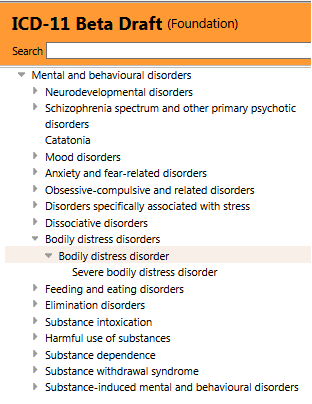
BDD at 02.02.14

Source: ICD-11 Beta drafting platform at January 29, 2014

+++

On February 18, I reported that Severe bodily distress disorder was no longer listed in the Beta drafting platform and had been replaced with the ICD-10 legacy category Somatization disorder.

I also reported that the ICD-10 category, Neurasthenia, previously proposed to be eliminated for both the ICD-11 core and Primary Care versions, had been inserted back into the Beta draft.

It was unclear how these two ICD-10 legacy categories were intended to relate to a single new diagnostic category whose conceptual framework had originally been proposed to replace both of them. The Definition texts displaying for both legacy categories had been imported unedited from ICD-10 and provided no clues to the (evidently revised) proposed framework.

So by February 2014, the draft stood like this:
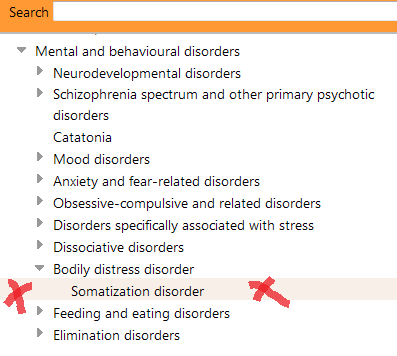
BDD 240214

Source: ICD-11 Beta drafting platform at February 24, 2014

with Neurasthenia back in the draft under parent Mental and behavioural disorders:
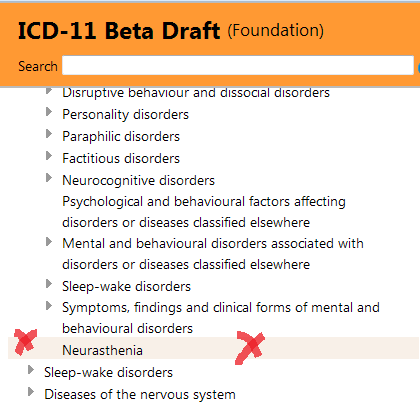
Neurasthenia240214

Source: ICD-11 Beta drafting platform at February 24, 2014

+++
Since these changes, there have been several further modifications to the Beta draft:

Circa May 9, 2014:

Somatization disorder remained listed as a uniquely coded child category under Bodily distress disorder, with a definition comprising unedited text imported from the ICD-10 F45.0 classification.

But three uniquely coded severity specifiers had been added back in:

Bodily distress disorder, mild
Bodily distress disorder, moderate
Bodily distress disorder, severe

So by May 9, the Beta draft Joint Linearization for Mortality and Morbidity Statistics looked like this:
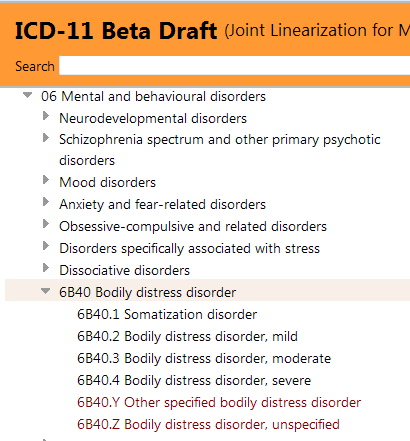
May_9_14_BDD

*Note that the “Sorting codes” assigned to categories change daily as chapters and category hierarchies are reorganized.

+++
Circa May 15, 2014:

Somatization disorder has now been removed from the Beta draft Linearizations as a uniquely coded child category under Bodily distress disorder.

Somatization disorder is now listed with the ICD-10 term somatoform disorders under Synonyms to Bodily distress disorder and both ICD-10 legacy terms are listed as Index Terms.

Update at June 6, 2014: The ICD-10 legacy terms, Somatoform disorders and somatization disorder are no longer listed under Index Terms to Bodily distress disorder in the Beta drafting platform or print version of the draft Alphabetical Index but remain listed under Synonyms. Both terms have been relocated under Index Terms to 6B4Z Bodily distress disorder, unspecified.

The three severity specifiers for BDD, (Mild, Moderate, Severe) remain.

So at May 27, the Beta draft Joint Linearization for Mortality and Morbidity Statistics looks like this:
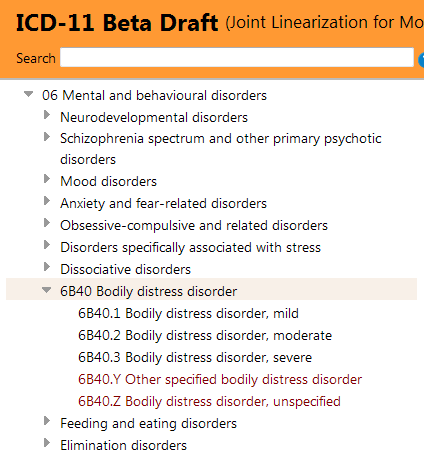
May_15_14_BDD

Neurasthenia has also been removed from the Beta draft Linearizations. Nor is it listed in the PDF of the print version of the draft Alphabetical Index.

This might suggest that the most recent proposal has reverted back to eliminating Neurasthenia from ICD-11, but to retain both Somatization disorder and the term somatoform disorders under Synonyms to BDD, and as Index Terms (as opposed to retaining and coding specifically for Somatization disorder under new ICD parent term, Bodily distress disorder).

[Neurasthenia remains specified as an Exclusion to Generalized anxiety disorder (currently Chapter 06) and to Fatigue (currently Chapter 20) but this may be an oversight.]

You can view the entry for Bodily distress disorder here, in the Foundation Linearization, which also displays a Definition, Synonyms and Exclusions:

http://apps.who.int/classifications/icd11/browse/f/en#/http://id.who.int/icd/entity/767044268

(Click on the small grey arrow to the left of the BDD category term to display the three severity specifiers.)

+++

Current ICD-11 Definition:

A Definition for Bodily distress disorder was inserted around four months ago, but there are no definitions or characterizations inserted yet for any of the three severity specifiers (BDD Mild, Moderate, Severe).

The Definition for Bodily distress disorder remains the same as previously reported:

http://apps.who.int/classifications/icd11/browse/f/en#/http%3a%2f%2fid.who.int%2ficd%2fentity%2f767044268

“Bodily distress disorder is characterized by high levels of preoccupation regarding bodily symptoms, unusually frequent or persistent medical help-seeking, and avoidance of normal activities for fear of damaging the body. These features are sufficiently persistent and distressing to lead to impairment in personal, family, social, educational, occupational or other important areas of functioning. The most common symptoms include pain (including musculoskeletal and chest pains, backache, headaches), fatigue, gastrointestinal symptoms, and respiratory symptoms, although patients may be preoccupied with any bodily symptoms. Bodily distress disorder most commonly involves multiple bodily symptoms, though some cases involve a single very bothersome symptom (usually pain or fatigue).”

The psychological and behavioural features that characterize the disorder, as per this definition, are drawn from disorder conceptualizations in the 2012 Creed, Gureje paper on emerging proposals for Bodily distress disorder.

The paper described a disorder model with good concordance with DSM-5’s Somatic symptom disorder construct and poor concordance with Fink et al’s Bodily Distress Syndrome construct [1,2].

+++

In sum:

At the point of publishing this post, we can say that the public version of the Beta draft displays:

 a single Bodily distress disorder category with three uniquely coded (but as yet uncharacterized) severities replacing all the ICD-10 Somatoform disorders between F45.0 – F45.9 and ICD-10’s Neurasthenia (F48.0);

that the ICD-10 legacy terms, somatoform disorders (F45) and Somatization disorder (F45.0), are listed under Synonyms and under Index Terms to Bodily distress disorder.

Update at June 6, 2014: The ICD-10 legacy terms, Somatoform disorders and somatization disorder are no longer listed under Index Terms to Bodily distress disorder in the Beta drafting platform and print version of the Alphabetical Index but remain listed under Synonyms. Both terms have been relocated under Index Terms to 6B4Z Bodily distress disorder, unspecified.

that ICD-10’s Neurasthenia is no longer displaying in any Linearization and may remain proposed to be eliminated for ICD-11 (but remains anomalously specified in two chapters as an Exclusion term);

that an ICD-11 Definition for Bodily distress disorder has been entered into the draft, the wording for which is based on disorder conceptualizations in the 2012 paper: Creed F, Gureje O. Emerging themes in the revision of the classification of somatoform disorders. Int Rev Psychiatry. 2012 Dec;24(6):556-67.

Apart from scrutinizing the Definition, that is all we can safely determine about the current, proposed construct of Bodily distress disorder, in the context of ICD-11’s deployment of the term, solely from the content of the public version of the Beta drafting platform.

I’ll be writing more about this Definition and the 2012 proposals by both ICD-11 working groups in the next post (Post #308).

These recent changes are a good example of why the public version of the Beta drafting platform needs to be viewed with the WHO’s caveats in mind – the draft is in a state of flux, it is incomplete, it contains errors, omissions and anomalies and is subject to frequent rejiggery.

The entry for BDD may undergo further changes over the coming year or so and following field trials evaluation.

+++

iCAT ICD Collaborative authoring platform:

Note that ICD Revision staff and external editors are developing the draft on a separate, multi-authoring electronic platform called “iCAT ICD Collaborative authoring tool” — a platform considerably more technically sophisticated than the version of the draft that the public sees. In the editors’ version, more Content Model parameters display and there are tabs for change histories, category notes and discussions, and for reviews of proposals. 

So revisions to category chapter locations, hierarchies, internal and external peer review of proposals, drafting and revisions of textual content and rationales for these revisions can be tracked by users of the platform with editing rights or viewing access. The absence of this level of detail in the public version of the draft makes it very difficult for stakeholders to monitor changes and rationales for changes, or to account for missing or no longer displaying category terms.

iCAT ICD Collaborative authoring platform screencast:

This link ICD-11 iCAT screencast will open a 1:55 minute animated screencast intended as a demo for iCAT users but in the public domain. It shows the iCAT platform that the Managing Editors for the various chapters of ICD-11 are developing the draft on. Note the larger number of function tabs along the top of the screen and at 17 secs in, note the larger number of Content Model tabs load under “Details for Test 1” in the category description pane, on the right.

What you see in the Beta draft is a cut down version for public viewing and public interaction that omits many of the functions and much of the detail of the ICD Revision iCAT platform.

To be continued in Post #308.

+++
References:

1. Creed F, Gureje O. Emerging themes in the revision of the classification of somatoform disorders. Int Rev Psychiatry. 2012 Dec;24(6):556-67. [Abstract: PMID: 23244611]

2. Fink P, Schröder A. One single diagnosis, bodily distress syndrome, succeeded to capture 10 diagnostic categories of functional somatic syndromes and somatoform disorders. J Psychosom Res. 2010 May;68(5):415-26. [Abstract: PMID: 20403500].
CMS posts ICD-10-CM Release for 2015; confirms Partial Code Freeze extension; reminder, SSD proposals

Post #306 Shortlink: http://wp.me/pKrrB-3SJ

This report updates on the revised implementation date for ICD-10-CM, the revised Partial Code Freeze timeline, the ICD-10-CM Release for 2015 files, and a reminder of the deadline for objections to the insertion of DSM-5’s Somatic symptom disorder into ICD-10-CM.

[For reminder of deadline for objections to proposed insertion of Somatic symptom disorder into ICD-10-CM, skip to red subheading.]

On April 1, 2014, Bill H.R. 4302, known as the PAM Act (Protecting Access to Medicare Act), was signed into law by President Obama.

As a result of a quietly inserted clause piggybacking on this Bill, implementation of ICD-10-CM was delayed by a further year. Centers for Medicare & Medicaid Services (CMS) has confirmed that the effective implementation date for ICD-10-CM is now October 1, 2015.

Until that time, the codes in ICD-10-CM (the U.S. specific adaptation of the WHO’s ICD-10) are not valid for any purpose or use.

+++

Partial Code Freeze

CMS has announced that the partial code freeze on updates to the ICD-9-CM and ICD-10-CM diagnosis and procedure codes will continue until October 1, 2015.

Between October 1, 2011 and October 1, 2016 revisions to ICD-10-CM/PCS will be for new diseases/new technology procedures, and any minor revisions to correct reported errors in these classifications. Regular (at least annual) updates to ICD-10-CM/PCS will resume on October 1, 2016.

The Partial Code Freeze document has been updated to reflect the revised Timeline and can be accessed here in PDF format Partial Code Freeze for ICD-9-CM and ICD-10

or text, below:

Partial Code Freeze for ICD-9-CM and ICD-10

The ICD-10 Coordination and Maintenance Committee (formerly the ICD-9-CM Coordination and Maintenance Committee) implemented a partial freeze of the ICD-9-CM and ICD-10 (ICD-10-CM and ICD-10-PCS) codes prior to the implementation of ICD-10 which would end one year after the implementation of ICD-10. There was considerable support for this partial freeze. On April 1, 2014, the Protecting Access to Medicare Act of 2014 (PAMA) (Pub. L. No. 113-93) was enacted, which said that the Secretary may not adopt ICD-10 prior to October 1, 2015. Accordingly, the U.S. Department of Health and Human Services expects to release an interim final rule in the near future that will include a new compliance date that would require the use of ICD-10 beginning October 1, 2015. The rule will also require HIPAA covered entities to continue to use ICD-9-CM through September 30, 2015. When published, links will be provided to this interim final rule at http://www.cms.gov/Medicare/Coding/ICD10/Statute_Regulations.html

The partial freeze will be implemented as follows:

• The last regular, annual updates to both ICD-9-CM and ICD-10 code sets were made on October 1, 2011.

• On October 1, 2012, October 1, 2013, and October 1, 2014 there will be only limited code updates to both the ICD-9-CM and ICD-10 code sets to capture new technologies and diseases as required by section 503(a) of Pub. L. 108-173.

• On October 1, 2015, there will be only limited code updates to ICD-10 code sets to capture new technologies and diagnoses as required by section 503(a) of Pub. L. 108-173. There will be no updates to ICD-9-CM, as it will no longer be used for reporting.

• On October 1, 2016 (one year after implementation of ICD-10), regular updates to ICD-10 will begin.

The ICD-10 Coordination and Maintenance Committee will continue to meet twice a year during the partial freeze. At these meetings, the public will be asked to comment on whether or not requests for new diagnosis or procedure codes should be created based on the criteria of the need to capture a new technology or disease. Any code requests that do not meet the criteria will be evaluated for implementation within ICD-10 on and after October 1, 2016 once the partial freeze has ended.

CDC has not yet updated its webpages to reflect the ICD-10-CM implementation delay or the revised Partial Code Freeze timeline.

+++

SSD and ICD-10-CM/PCS Coordination and Maintenance Committee proposals

At the September 2013 and March 2014 Coordination and Maintenance Committee meetings, the American Psychiatric Association (APA) submitted numerous requests for addenda changes for new index entries and tabular inclusion terms for evaluation for implementation on October 1, 2015.

It is unclear whether requests for modifications submitted by APA and other requestors via these September and March meetings will be rolled forward for evaluation for implementation on and after the revised date of October 1, 2016 or whether these proposals will now need to be resubmitted at future C & M Committee meetings. (The next public meeting takes place September 23–24, 2014.)

I have approached NCHS for clarification.

+++
If the proposals from these two meetings do require resubmitting, this would provide another opportunity to comment on the proposal to add the DSM-5’s new disorder term, Somatic symptom disorder, to the ICD-10-CM.

See earlier post: Update on proposal to add DSM-5′s Somatic symptom disorder to ICD-10-CM

+++
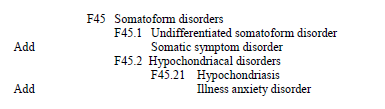
At the public Coordination and Maintenance Committee meeting on September 18–19, 2013, a proposal had been submitted to add Somatic symptom disorder (SSD) as an inclusion term to existing ICD-10-CM code F45.1 Undifferentiated somatoform disorder in the Tabular List Addendum (this also included addition to the Index).

Note: Proposal is not to create a unique code for SSD or to replace any of the existing ICD-10-CM somatoform disorders with SSD, but to add SSD as an inclusion term under an existing ICD-10-CM code, F45.1.

September 18–19, 2013 meeting Agenda, Page 45: PDF Agenda

ICD10CM 4

+++
The proposal to add somatic symptom disorder to the Index (under Disorder), was resubmitted at the public meeting on March 19–20, (reason unclear but a number of proposals for modifications to both the Tabular List and the Index from the September 2013 meeting were also duplicated at the March 2014 meeting).

March 19–20, 2014 meeting Agenda, Page 89: PDF Agenda

March14 ICD-10-CM Cand M SSD to Index

+++
Any decisions made on the considerable number of proposals requested at last year’s September meeting are yet to be posted and possibly won’t be evident until the relevant Addendum is released.

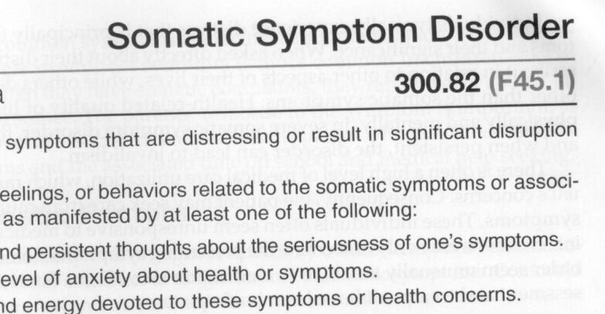
In the DSM-5, Somatic symptom disorder is already cross-walked to ICD-9 code 300.82 (ICD-10-CM F45.1):

+++
DSM-5 (Page 311)

SSDcrosswalk

+++
Given that APA worked with CDC on the cross-walk between the new DSM-5 disorder terms and ICD-9/ICD-10-CM equivalent codes, NCHS’s Director will likely rubber stamp the APA’s proposals for insertion of SSD and a number of other new DSM-5 categories.

Nevertheless, I shall be putting in another objection before the June 20 deadline and I hope all stakeholders with concerns will strongly oppose the incorporation of this controversial new disorder construct into ICD-10-CM.

The deadline for comments on proposals requested at the March meeting is June 20th.

Send comments, by email, to NCHS to nchsicd9CM@cdc.gov

+++
Not a small thing

Between 2010 and 2012, the SSD Work Group attracted considerable opposition across three stakeholder reviews to its radical proposals for a replacement for the somatoform disorders.

In late 2012 and early 2013, we saw a good deal of “outrage” in comments to articles by Allen Frances and myself here and here at Psychology Today and here in the BMJ, in response to the cavalier decision by the Task Force to barrel through with the SSD Work Group’s poorly validated disorder construct.

But I see little evidence of sustained opposition from U.S. professionals and patients over the September and March NCHS/CMS update and revision meeting proposals to insinuate SSD into ICD-10-CM.

At the moment, the proposal is for inserting SSD as an inclusion term under an existing category – not to create a unique code for SSD and not to replace the existing framework with SSD. At the September meeting, CDC’s Donna Pickett said:

“…And just to complete the package, there are other Tabular List proposals that appear on Page 45 and 46 that we would also invite your comments on. And again, with some of the terminology changes that Dr Regier has described the intent here is to make sure that if those terms are being used, that they do have a home somewhere within ICD-10-CM to facilitate people looking these up. So we invite comments…”

Sounds almost cosy. But if NCHS does rubber stamp the addition of Somatic symptom disorder to ICD-10-CM, it could leverage future replacement of the existing Somatoform disorders categories with this new, single diagnostic construct, bringing ICD-10-CM’s framework in line with DSM-5.

There are implications for ICD-11, too.

Once SSD is inserted into ICD-10-CM, the presence of this term within the U.S. modification of ICD-10 may make it easier for ICD-11 Revision Steering Group to justify approving proposals to replace the existing ICD-10 Somatoform disorders categories with a single, new disorder construct that would mirror SSD’s defining characteristics – its positive psychobehavioural features, its simplified criteria, its de-emphasis on “medically unexplained” and facilitate harmonization between ICD-11 and DSM-5 disorder terms.

Christopher Chute, Mayo, chairs the ICD-11 Revision Steering Group. Chute has suggested that following implementation, ICD-10-CM might be brought gradually in line with ICD-11 through a series of annual updates, for smoother transition to ICD-11-CM.

Inserting the SSD term into ICD-10-CM paves the way for disorder construct congruency between DSM-5, ICD-10-CM, ICD-11, and eventually, the ICD-11-CM modification.

Send comments, by email, by June 20, to NCHS at nchsicd9CM@cdc.gov


CMS posts files for ICD-10-CM Release for 2015

On May 15, CMS posted the ICD-10 Procedure Coding System (ICD-10-PCS) files for 2015, download files here:

On May 19, CMS posted the ICD-10-CM and GEMs files for 2015:

These files (some of which are large ZIP files) include:

2015 Code Descriptions in Tabular Order

2015 Code Tables and Index – Updated 5/22/14 (includes Tabular List, and Index in PDF format)

2015 ICD-10-CM Duplicate Code Numbers

2015 Addendum

2015 General Equivalence Mappings (GEMs) – Diagnosis Codes and Guide

2015 Reimbursement Mappings – Diagnosis Codes and Guide

According to the Addendum, “There were no changes to the 2014 ICD-10-CM, therefore there are no 2015 ICD-10-CM Addenda.”

These ICD-10-CM Release for 2015 files are not yet available on the CDC site but when they are posted, they should be accessible from this page: http://www.cdc.gov/nchs/icd/icd10cm.htm


Further reading

Justina Pelletier: The Case Continues Phil Hickey, April 4, 2014
Objection to proposal to insert DSM-5′s Somatic symptom disorder into ICD-10-CM Suzy Chapman, Public submission, ICD-9-CM/PCS Coordination and Maintenance Committee Meeting September 18-19, 2013
Somatic Chapter Drops Centrality Of Unexplained Medical Symptoms Psychiatric News, Mark Moran, March 1, 2013
Somatic Symptoms Criteria in DSM-5 Improve Diagnosis, Care David J Kupfer, MD, Chair, DSM-5 Task Force, defends the SSD construct, Huffington Post, February 8, 2013
The new somatic symptom disorder in DSM-5 risks mislabeling many people as mentally ill Allen Frances, MD, BMJ 2013;346:f1580 BMJ Press Release PDF for full text
Somatic Symptom Disorder could capture millions more under mental health diagnosis Suzy Chapman, May 26, 2012
Mislabeling Medical Illness As Mental Disorder Allen Frances, MD, Psychology Today, DSM 5 in Distress, December 8, 2012
Why Did DSM 5 Botch Somatic Symptom Disorder? Allen Frances, MD, Psychology Today, Saving Normal, February 6, 2013
New Psych Disorder Could Mislabel Sick as Mentally Ill Susan Donaldson James, ABC News, February 27, 2013