Deutschlandfunk Radio: Wissenschaft Im Brennpunkt: Störungswahn? DSM-5 with Allen Frances

Deutschlandfunk Radio: Wissenschaft Im Brennpunkt: Störungswahn? (DSM-5) with Allen Frances, MD

Post #223 Shortlink: http://wp.me/pKrrB-2EH

Flash:
http://www.dradio.de/dlf/sendungen/wib/1990949

Mp3 (12MB):
http://ondemand-mp3.dradio.de/file/dradio/2013/02/03/dlf_20130203_1630_c745d088.mp3

Deutschlandfunk Radio

http://www.dradio.de/dlf/sendungen/wib/1990949/

27:21 mins

WISSENSCHAFT IM BRENNPUNKT (Science In Focus)
03.02.2013

Störungswahn? (Delusional disorder?)

Psychiater streiten um die Zukunft ihres Fachs (Psychiatrists argue about the future of their profession)

Von Martin Hubert with contributions from Allen Frances, MD, and others

In einigen Monaten erscheint das neue amerikanische Handbuch zur Diagnose psychiatrischer Krankheiten, das “DSM-5”. Aber schon heute erzeugt es heftigen Streit. Denn das “DSM-5” wird die Entwicklung der Psychiatrie auf Jahre hinaus wesentlich beeinflussen.

Kritiker meinen, dass es zu viel neue und überflüssige Störungsbilder enthalte. Außerdem definiere es Störungen oft so weich, dass auch Durchschnittsmenschen künftig zum psychiatrischen Fall würden. Die Verteidiger des Handbuchs kontern: Es habe in der Geschichte immer wieder neue Störungen gegeben, auf die die Psychiater zu reagieren hätten. Außerdem seien weiche Kriterien nötig, um Risikopatienten früh erkennen und therapieren zu können. Wann ist ein Patient wirklich gefährdet – und wann leiden die Psychiater selbst unter Störungswahn? Der Streit zeigt, in welche Richtung sich die Psychiatrie insgesamt entwickeln könnte.

Weiterführende Links:

Seiten des Deutschlandradios:

Links ins Netz:

Brief update on DSM-5 ‘Somatic Symptom Disorder’

Brief update on DSM-5 ‘Somatic Symptom Disorder’

Post #221 Shortlink: http://wp.me/pKrrB-2Dd

As previously reported, all draft proposals for categories and criteria for DSM-5 were frozen on the DSM-5 Development website on June 15, 2012, immediately following the closure of the third and final stakeholder review and comment period.

Changes made to the draft after June 15, 2012 are embargoed and final disorder descriptions and criteria sets won’t be evident until DSM-5 is released, in May, this year, unless APA elects to release selected information.

The manual texts that expand on the various disorder sections and the categories that sit within them have not been made public at any stage in the development process. It is understood that for the ‘Somatic Symptom Disorders’ group, for example, the manual text that accompanies these new categories and criteria sets will run to five or six pages.

On November 15, 2012, APA removed the entire third draft from the DSM-5 Development website.

According to this APA Permissions, Licensing & Reprints page, because the most recently posted draft [the third draft that was released on May 2, 2012] has undergone revisions and is no longer current, the criteria texts have been removed from the website in order to avoid confusion or use of outdated categories and definitions. [1]

The page also states that although APA Board of Trustees approved all the proposed diagnoses [in December, 2012] there continue to be minor editorial and content changes as APA moves towards the final stages of the publication process.

Although the DSM-5 Development Timeline has “Final Revisions by the APA Task Force; Final Approval by APA Board of Trustees; Submission to American Psychiatric Publishing, Inc” scheduled for December 2012, according to my sources, the manual texts were now expected to be finalized for the publishers by end of January.


DSM-5 Table of Contents

As also previously reported, APA has created new pages for information and resources for DSM-5, where a number of new articles and documents are available to download. [2][3]

http://www.psychiatry.org/dsm5

Documents include a DSM-5 Table of Contents which lists the disorder sections and the category terms that sit within them.

The DSM-5 Table of Contents reveals that changes to the overall section name for  the ‘Somatic Symptom Disorders’ categories and to the category names that sit within this section have been made since closure of the third and final draft.

For the overall disorder section name, DSM-5 will now be using

‘Somatic Symptom and Related Disorders’

rather than

‘Somatic Symptom Disorders’ as per the first, second and third drafts.

For the third draft, the 6 disorders proposed to sit under this disorder section were:

Somatic Symptom Disorders (SSD)

J 00 Somatic Symptom Disorder
J 01 Illness Anxiety Disorder
J 02 Conversion Disorder (Functional Neurological Symptom Disorder)
J 03 Psychological Factors Affecting Medical Condition
J 04 Factitious Disorder
J 05 Somatic Symptom Disorder Not Elsewhere Classified

7 categories are now listed (on Page 3) of the DSM-5 Table of Contents as follows:

Somatic Symptom and Related Disorders

Somatic Symptom Disorder
Illness Anxiety Disorder
Conversion Disorder (Functional Neurological Symptom Disorder)
Psychological Factors Affecting Other Medical Conditions
Factitious Disorder
Other Specified Somatic Symptom and Related Disorder
Unspecified Somatic Symptom and Related Disorder

Other than these revisions to the SSD disorder section name and category names, there are no other texts disclosed within the DSM-5 Table of Contents. So whatever text is included for the latter two categories, ‘Other Specified Somatic Symptom and Related Disorder’ and ‘Unspecified Somatic Symptom and Related Disorder,’ isn’t known.

Whether any revisions have been made to the disorder descriptions and criteria for the five other disorders since the third draft proposals were posted is also unknown because of the embargo on disclosure of changes to categories and criteria beyond June 15, last year.


SSD Work Group asked to reconsider

In December, Allen Frances, MD, who had chaired the Task Force that had oversight of the development of DSM-IV, asked the SSD Work Group, key APA Board of Trustees members and Task Force Chairs to reconsider the proposals for specifically the ‘Somatic Symptom Disorder’ category. [4]

These representations were made in response to Dr Frances’ own considerable concerns, and those of lay and professional stakeholders, for the looseness of the SSD definition and criteria set, as it had stood at the third draft, and the absence of a body of robust evidence for the validity and safety of ‘SSD’ as a construct, and data on likely prevalence rates.

Dr Frances also proffered suggestions for revisions that he considered would tighten up the criteria and reduce the potential for misapplication.

The response on behalf of the work group was that although Dr Frances’ suggestions were discussed, the work group would not be revising their recommendations. [5]

It is not known whether the concerns raised by Dr Frances in December were discussed beyond the SSD Work Group with the DSM-5 Task Force or with the APA Board of Trustees, who are responsible for approving proposals and therefore accountable for the content of the forthcoming manual.


ICD-11 and DSM-5

In a January 18 article for Psychiatric News, organ of the APA, Mark Moran reports:

“Kupfer [DSM-5 Task Force Chair] said the classification of disorders is largely harmonized with the World Health Organization’s International Classification of Diseases (ICD) so that the DSM criteria sets are more parallel with the proposed ICD-11. In DSM-5 both the current ICD-9-CM and the future standard ICD-10-CM codes (scheduled for 2014) are attached to the relevant disorders in the classification.” [6]

As reported in my Dx Revision Watch post of January 6, at the time of writing, current proposals in the ICD-11 Beta draft have ICD-10’s ‘Somatoform Disorders’ replaced with ‘Bodily Distress Disorders, and Psychological and behavioural factors associated with disorders or diseases classified elsewhere,’ with three, as yet undefined, Severities of ‘Bodily Distress Disorder.’ [7]

It remains to be clarified whether ICD-11’s Beta draft proposals for three Severities of ‘Bodily Distress Disorder’ to replace six ICD-10 ‘Somatoform Disorders’ proposes to mirror Per Fink’s definition and criteria for ‘Bodily Distress Syndrome’ or are more closely aligned with DSM-5‘s ‘Somatic Symptom Disorder,’ in keeping with the APA and WHO’s joint commitment to strive, where possible, for harmonization between the category names, glossary descriptions and criteria across the two systems. [8]

(I shall be addressing this issue in a future post.)

I have previously reported that for ICD-11-PHC, the abridged, Primary Health Care version of ICD-11, the proposal, last year, was for a disorder section called ‘Bodily distress disorders,’ under which would sit ‘Bodily stress [sic] syndrome.’ [9]

According to Professor, Sir David Goldberg, this category is proposed for ICD-11 Primary Health Care version to include “milder somatic symptom disorders” as well as “DSM-5′s Complex somatic symptom disorder” and would replace “medically unexplained somatic symptoms.” These proposals are subject to rejection or modification following ICD-11 Field Trials. [10]

DSM-5 is scheduled for release at the APA’s 166th Annual Meeting (San Francisco, May 18-22).


References and related reports

1] American Psychiatric Publishing Permissions, Licensing & Reprints

2] New DSM-5 webpages

3] DSM-5 Table of Contents

4] Mislabeling Medical Illness As Mental Disorder: The Eleventh DSM-5 Mistake, Psychology Today, DSM5 in Distress, Allen Frances, MD, December 8, 2012

5] Bad News: DSM 5 Refuses to Correct Somatic Symptom Disorder, Psychology Today, DSM5 in Distress, Allen Frances, MD, January 16, 2012

6] Continuity and Changes Mark New Text of DSM-5, Psychiatric News, Volume 48, Number 2, January 18, 2013: pp. 1-6 

7] ICD-11 Beta Draft Public Version: Bodily Distress Disorders
http://apps.who.int/classifications/icd11/browse/l-m/en#/http%3a%2f%2fwho.int%2ficd%23F45

8] Fink P, Schröder A. One single diagnosis, bodily distress syndrome, succeeded to capture ten diagnostic categories of functional somatic syndromes and somatoform disorders. J Psychosom Res 2010;68:415-26
http://www.ncbi.nlm.nih.gov/pubmed/20403500

9] Lam TP, Goldberg DP, Dowell AC, Fortes S, Mbatia JK, Minhas FA, Klinkman MS. Proposed new diagnoses of anxious depression and bodily stress syndrome in ICD-11-PHC: an international focus group study. Fam Pract 2012
http://www.ncbi.nlm.nih.gov/pubmed/22843638

10] Goldberg DP. Comparison Between ICD and DSM Diagnostic Systems for Mental Disorders. In: Sorel E, (Ed.) 21st Century Global Mental Health. Jones & Bartlett Learning, 2012: 37-53 [Free PDF Sample Chapter 2]

11] Somatic Symptom Disorder could capture millions more under mental health diagnosis, Suzy Chapman for Dx Revision Watch, May 26, 2012
American Psychiatric Association launches new pages for DSM-5 – DSM-5 to cost $199

American Psychiatric Association (APA) launches new pages for DSM-5 – DSM-5 to cost $199

Post #220 Shortlink: http://wp.me/pKrrB-2CD

Unless you’ve had your head stuck in a bucket this last three years, you’ll be aware that the next edition of the American Psychiatric Association’s diagnostic manual is slated for release this May.

APA has spent $25 million on the development of DSM-5.

DSM-5 will be published by American Psychiatric Publishing Inc. and planned for release at the APA’s 166th Annual Meeting in San Francisco (May 18-22).

A hardback copy is going to set you back $199, though paid up members of the American Psychiatric Association are being offered a discount.

Psychiatrists, psychologists, primary health care physicians, therapists, counselors, social workers and allied health professionals don’t have to use DSM-5.

Instead, when codes are required they can use the codes in Chapter 5 of ICD-9-CM (Mental Disorders) and Chapter 5 of ICD-10-CM (Mental, Behavioral and Neurodevelopmental disorders), when ICD-10-CM is implemented*.

*Effective implementation date for ICD-10-CM (and ICD-10-PCS) is currently October 1, 2014. Until that time the codes in ICD-10-CM are not valid for any purpose or use.

Image Copyright Dx Revision Watch 2013

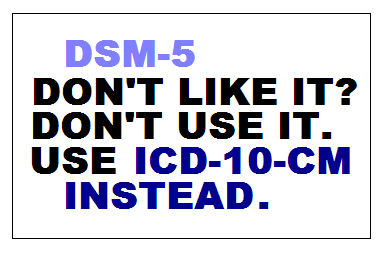
Don’t like it? Don’t use it. Use ICD codes instead.

Since 2003, ICD-9-CM diagnostic codes have been mandated for third-party billing and reporting by HIPAA for all electronic transactions for billing and reimbursement. The codes in DSM are crosswalked to ICD codes.

So you can use ICD-9-CM codes.

And when ICD-10-CM is implemented, it isn’t going to cost you a cent – it will be freely available on the internet.

The ICD-10-CM draft, currently subject to partial code freeze, and its associated documentation can be accessed here on the CDC site; so you can already have a poke around:

International Classification of Diseases, Tenth Revision, Clinical Modification (ICD-10-CM)

On January 23, Allen Frances, MD, who had oversight of the Task Force that developed DSM-IV had this to say about the $199 manual:

Price Gouging: Why Will DSM-5 Cost $199 a Copy?


APA launches new pages for DSM-5

Last week the APA launched new pages to promote DSM-5.

Report by John Gever for Medpage Today:

Psych Group Posts Glimpses of Final DSM-5

John Gever, Senior Editor, MedPage Today | January 21, 2013

Peeks into the final DSM-5, the controversial new edition of the American Psychiatric Association’s diagnostic manual, are now available from the group prior to the guide’s official May 22 debut…

PR piece by Mark Moran for Psychiatric News, organ of the American Psychiatric Association:

Psychiatric News | January 18, 2013
Volume 48 Number 2 page 1-6
10.1176/appi.pn.2013.1b10
American Psychiatric Association
Professional News

Continuity and Changes Mark New Text of DSM-5

Mark Moran

The DSM-5 Task Force chair discusses conceptual themes driving changes to the new manual. This is the first in a series continuing through May that will summarize the diagnostic and organizational differences between DSM-IV and DSM-5.

DSM-5, approved by the APA Board of Trustees in December, reflects the “state of the clinical science” in psychiatric diagnosis, incorporating important findings from genetic, neurobiological, and treatment research, while also maintaining substantial continuity for maximum clinical utility…

Go here for the DSM-5 Collection.

Psychiatric News Alert, where those not intending to boycott DSM-5 are encouraged to explore and pre-order a copy ($199):

Psychiatric News Alert

Tuesday, January 22, 2013

New DSM-5 Series Includes Supplementary Information; Order Your Manual Now!

The new DSM-5 pages can be found here, with articles, fact sheets and videos:

http://www.psychiatry.org/dsm5

Documents include:

DSM-5 Table of Contents  [Lists disorder sections and the categories that sit under them.]

Changes to DSM-5

Continuity and Changes Mark New Text of DSM-5, Psychiatric News, January 18, 2013

Highlights of Changes from DSM-IV-TR to DSM-5
DSM-5 Provides New Take on Developmental Disorders, Psychiatric News, January 18, 2013

DSM-5 Fact Sheets

From Planning to Publication: Developing DSM-5
The People Behind DSM-5
The Organization of DSM-5

Making a Case for New Disorders
Autism Spectrum Disorder
Specific Learning Disorder
Intellectual Disability
Social Communication Disorder
Attention-Deficit/Hyperactivity Disorder

DSM-5 Video Series

How and why was DSM-5 developed?
What has been the goal for revising DSM-5?

What are the changes to autism spectrum disorder in DSM-5?
What will be the impact of DSM-5 changes to autism spectrum disorder?
What are the changes to learning disorder in DSM-5?
What will be the impact of the revised specific learning disorder diagnosis?

The APA’s DSM-5 Development site can still be found here DSM-5 Development.

Proposals for changes to DSM-IV categories and criteria, as they had stood at the third draft, were frozen on June 15, 2012.

Any revisions made to criteria sets following closure of the third and final comment period are subject to embargo and the DSM-5 Development site has not been updated to reflect changes made to categories and criteria beyond June 15.

The entire third draft of proposals was removed from the DSM-5 Development site on November 15.

You can read APA’s rationale for removing the draft on an updated Permissions, Licensing & Reprints page.

DSM-5 rejects call for urgent reconsideration of new “Somatic Symptom Disorder” category

DSM-5 rejects call from lead psychiatrist for DSM-IV Task Force for urgent reconsideration of new “Somatic Symptom Disorder” category 

Post #219 Shortlink: http://wp.me/pKrrB-2C0

Today, Allen Frances, M.D., publishes a follow-up to our December 8 commentary in which we set out the implications for all chronic illness patient populations of misdiagnosis with “Somatic Symptom Disorder (SSD)” or misapplication of an additional diagnosis of “SSD.”

In the second of three commentaries, Dr Frances reports on the outcome of his representations to the DSM-5 Somatic Symptom Disorder Work Group, key APA Board of Trustees office holders and DSM-5’s Task Force chair and vice-chair, for urgent reconsideration of this new “catch-all” mental health disorder.

The texts for DSM-5 are expected to be finalized for the publishers by the end of this month.

Dr Frances’ first commentary on SSD is approaching 20,000 views and has received over 300 comments on Psychology Today, alone. It is also published at Huffington Post and at Education Update and widely circulated on other platforms.

There has been an overwhelming response to our concerns with comments pouring in from patients with diverse chronic illnesses and medical conditions including Ehlers-Danlos Syndrome, Interstitial Cystitis, Behcet’s disease, Endometriosis, Lupus, Hashimotos thyroid disorder, Hughes Syndrome, Pancreatitis and Chronic Lyme disease –patients whose symptoms had been dismissed for years before finally receiving a diagnosis or who are still struggling to obtain a diagnosis, many of whom had been mislabelled with a somatoform disorder.

We’ve also received many emails from patients and international patient organizations.

Please circulate this follow-up commentary. I am particularly keen to reach platforms for patients with common chronic diseases and conditions – cancer, heart disease, diabetes, COPD, MS, RA, chronic pain; also Lyme disease, chemical injury and rare diseases, IBS and Fibromyalgia, ME and CFS.

Allen Frances, M.D., was chair of the DSM-IV Task Force and of the department of psychiatry at Duke University School of Medicine, Durham, NC. He is currently professor emeritus at Duke.

Psychology Today

DSM5 in Distress

The DSM’s impact on mental health practice and research
by Allen Frances, M.D.

Published on January 16, 2013 by Allen J. Frances, M.D., in DSM5 in Distress

Bad News: DSM 5 Refuses To Correct Somatic Symptom Disorder
Medical Illness Will Be Mislabeled Mental Disorder

“Many of you will have read a previous blog prepared by Suzy Chapman and me that contained alarming information about the new DSM 5 diagnosis ‘Somatic Symptom Disorder.’

“SSD is defined so over inclusively by DSM 5 that it will mislabel 1 in 6 people with cancer and heart disease; 1 in 4 with irritable bowel and fibromyalgia; and 1 in 14 who are not even medically ill.

“I hoped to be able to influence the DSM 5 work group to correct this in 2 ways: 1) by suggesting improvements in the wording of the SSD criteria set that would reduce mislabeling; and 2) by letting them know how much opposition they would face from concerned professionals and an outraged public if DSM 5 failed to slam on the brakes while there was still time…”

Read on here:

Bad News: DSM 5 Refuses To Correct Somatic Symptom Disorder
Medical Illness Will Be Mislabeled Mental Disorder


The most recent proposals for new category “J 00 Somatic Symptom Disorder”

IASP and the Classification of Pain in ICD-11  Prof. Dr. Winfried Rief, University of Marburg, Germany

Slide 9

Ed: Note that the requirement for “at least two from the B type criteria” was reduced to “at least one from the B type criteria” for the third iteration of draft proposals. This lowering of the threshold is presumably in order to accommodate the merging of the previously proposed “Simple Somatic Symptom Disorder” category into the “Complex Somatic Symptom Disorder” category, a conflation now proposed to be renamed to “Somatic Symptom Disorder,” also the disorder section name. A revised “Rationale/Validity” PDF document was not issued for the third and final draft. A brief, revised “Rationale” text was published on a Tab Page for the Somatic Symptom Disorder proposal and criteria but is no longer accessible.

Proposals, criteria and rationales, as posted for the third draft in May 2012, were removed from the DSM-5 Development website on November 15, 2012 and placed behind a non public log in. Criteria as they had stood for the third draft can no longer be viewed but are set out on Slide 9 in this presentation, which note, does not include three, optional Severity Specifiers that were included with the third draft criteria.


Related material

Mislabeling Medical Illness As Mental Disorder: The Eleventh DSM-5 Mistake, Psychology Today, DSM5 in Distress, Allen Frances, MD, December 8, 2012

Somatic Symptom Disorder could capture millions more under mental health diagnosis, Suzy Chapman

Submission to Somatic Symptom Disorder Work Group in response to third draft proposals, Suzy Chapman

Additional commentary

Oak Park Behavioral Medicine, Mind Your Body blog

Moving in the Wrong Direction

Dr Tiffany Taft, Ph.D., Northwestern University, December 13, 2012

IBS Impact IBS Impact blog

Proposed DSM-5 Criteria May Unfairly Label Physical Conditions as Psychological Disorders

11th hour call: “Mislabeling Medical Illness As Mental Disorder” by Allen J. Frances, MD.

11th hour call: “Mislabeling Medical Illness As Mental Disorder” by Allen J. Frances, MD.

Post #217 Shortlink: http://wp.me/pKrrB-2AL

Image Copyright Dx Revision Watch 2012On December 8, Allen J. Frances, MD, blogged at Psychology Today on our shared concerns for the new DSM-5 category – Somatic Symptom Disorder. Dr Frances was chair of the DSM-IV Task Force and of the department of psychiatry at Duke University School of Medicine, Durham, NC. He is currently professor emeritus, Duke.

One in six people suffering from cancer, heart and other serious diseases risks being saddled with a psychiatric diagnosis if they are considered to be “excessively” worried about their illness or spending more time on the internet researching their symptoms than the American Psychiatric Association (APA) thinks good for them.

But many illness groups – particularly the so-called “functional somatic syndromes” – stand to be captured by these new criteria and assigned an additional mental health diagnosis, or placed at risk of misdiagnosis.

The DSM-5 manual texts are still being finalized and the Somatic Symptom Disorder Work Group has been asked to reconsider its criteria and tighten them up before the next edition of DSM is sent to the publishers.

Please demonstrate to the APA and the Somatic Symptom Disorder Work Group the level of concern amongst clinicians and allied health professionals, patients, caregivers and advocacy organizations by visiting Dr Frances’ blog post and leaving a comment. You can read the commentary at the link, below.

If you share our concerns that these catch-all criteria will see thousands more patients tagged with a mental health label please forward the link to your colleagues and contacts and post on Twitter, blogs and social media platforms.

Thank you,

Suzy Chapman for Dx Revision Watch

Mislabeling Medical Illness As Mental Disorder: The Eleventh DSM-5 Mistake

Psychology Today, DSM5 in Distress, Allen Frances, MD, December 8, 2012

Additional commentary

Oak Park Behavioral Medicine, Mind Your Body blog

Moving in the Wrong Direction

Dr Tiffany Taft, Ph.D., Northwestern University, December 13, 2012

IBS Impact IBS Impact blog

Proposed DSM-5 Criteria May Unfairly Label Physical Conditions as Psychological Disorders

The most recent proposals for new category “J 00 Somatic Symptom Disorder”

Ed: Proposals, criteria and rationales, as posted for the third stakeholder review and comment period, in May 2012, were removed from the DSM-5 Development website on November 15, 2012 and placed behind a non public log in. Criteria as they had stood for the third draft can no longer be viewed but are set out on Slide 9 in this presentation, which note, does not include the three, optional Severity Specifiers that were included in the third iteration.

Note that the requirement for “at least two from the B type criteria” was reduced to “at least one from the B type criteria” between the second and third set of draft proposals.

IASP and the Classification of Pain in ICD-11  Prof. Dr. Winfried Rief, University of Marburg,

Slide 9

Related material

Somatic Symptom Disorder could capture millions more under mental health diagnosis

Submission to Somatic Symptom Disorder Work Group in response to third draft proposals

Bloomberg: How Many Billions a Year Will the DSM-5 Cost? Allen Frances, MD

Bloomberg: How Many Billions a Year Will the DSM-5 Cost? Allen Frances, MD

Post #216 Shortlink: http://wp.me/pKrrB-2Av

Update: Additional recent articles on DSM-5 development:

Healio Psychiatric Annals > Practice Management > News

DSM-5: a ‘living document’ that may impact practice, patients health

December 21, 2012

Bloomberg

How Many Billions a Year Will the DSM-5 Cost?

Illustration by Pete Gamlen

Allen Frances, MD | December 20, 2012

Further responses to the commentary on DSM-5 Somatic Symptom Disorder by Allen Frances and Suzy Chapman published last week on Psychology Today, Huffington Post and Education Update:

IBS Impact blog

Proposed DSM-5 Criteria May Unfairly Label Physical Conditions as Psychological Disorders

“Recently in the IBS and chronic illness community, several professionals and self-advocates have begun expressing concern about proposed changes in the Diagnostic and Statistical Manual for Mental Disorders, commonly known as the DSM…The DSM is revised periodically and the 5th edition is expected to be released in 2013. While there are many controversial proposed changes, one that has received relatively little attention in the mainstream media is particularly alarming in its potential implications for people with chronic illnesses, especially ones that are still scientifically poorly understood, like irritable bowel syndrome or commonly overlapping conditions like fibromyalgia, chronic fatigue syndrome and interstitial cystitis among others…”

Mind Your Body

Moving in the Wrong Direction

Dr Tiffany Taft, Ph.D., Northwestern University | December 13, 2012

“…Rather than repeating what’s in store in DSM 5, this article provides an excellent summary of the proposed changes. It’s really worth taking the time to read, whether you have diabetes, irritable bowel syndrome, lupus, or fibromyalgia. The bottom line is, regardless of the etiology of your chronic illness you are a candidate for the Somatic Symptom Disorder (SDD) diagnosis. If you’re a parent caregiver, your reactions to your child’s illness may be deemed pathological as well…”

The Reporting on Health Member Blog

DSM 5 – Misdiagnosing or Mislabeling of Medical Diseases

Kate Benson | December 19, 2012

Related material

Somatic Symptom Disorder could capture millions more under mental health diagnosis

Submission to Somatic Symptom Disorder Work Group in response to third draft proposals