Human Rights denied: Something rotten in the state of Denmark: Update 1

Post #257 Shortlink: http://wp.me/pKrrB-35o
Clarification notice
Reports and updates on Dx Revision Watch site on the Hansen family’s situation are being published as provided by, and in consultation with, Rebecca Hansen, Chairman, ME Foreningen, Danmark (ME Association, Denmark), or edited from reports as provided by Ms Hansen.
Dx Revision Watch site has no connection with any petitions or initiatives, or with any social media platforms or other platforms set up to promote petitions or initiatives, or to otherwise raise awareness of the Hansen family’s situation. The use of any links to content on Dx Revision Watch does not imply endorsement of, or association with any initiatives other than the ME Foreningen, Danmark (ME Association, Denmark) Postcard to Karina Campaign.
All enquiries in relation to petitions or other initiatives, social media platforms, or any other platforms associated with them should be addressed directly to the organizers, sponsors or owners responsible for them.

+++

“…Do ME patients in Denmark not have the right to choose which treatment we want to receive? Do we not have the right to visitors when we are in the hospital?”
+++
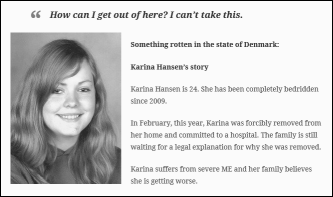
Karina Hansen

Update 1: Human Rights denied

On May 11, on the eve of ME Awareness week, I published an account of the plight of the Hansen family, in Denmark. Karina Hansen is 24. She has been bedridden with severe ME since 2009.

In February, this year, Karina was forcibly removed from her bedroom and committed to Hammel Neurocenter.

Her parents have not seen Karina for over three months.

The Hansen family and their lawyer are still waiting for legal documentation and answers to their questions:

Which authority gave the order to remove Karina from her home against her will and by whom was it authorized?

What legislation was used to detain her as an involuntary patient in a hospital?

Why are the parents being denied visits?

Two updates on the case have been released, this week. These are being published, as provided, and with permission of the Hansen family and their lawyer.

+++
For the first report see:

Something rotten in the state of Denmark: Karina Hansen’s story: http://wp.me/pKrrB-2Xc

For reports in Danish see:

Menneskerettighederne nægtet: Noget råddent i staten Danmark: Karina Hansen: Opdater 1: http://wp.me/pKrrB-36e

The Universal Declaration of Human Rights: https://www.un.org/en/documents/udhr/

Status on Karina’s Case – May 24th, 2013

By Rebecca Hansen
Chairman, ME Foreningen, Danmark (ME Association, Denmark)

The following text has been approved by the family.

Karina is still hospitalized at Hammel Neurocenter. Dr. Jens Gyring gave a verbal message to the family that this could continue for a long time, perhaps a year. We have not seen any evidence that Karina is getting better.

Karina’s parents have a power of attorney that gives them the right to make decisions for Karina, also about her treatment. But this is ignored.

The power of attorney was made in May 2012. Karina’s general practitioner declared her psychologically healthy twice, in May 2012.

The Danish Board of Health claims that Karina’s lawyer is not her lawyer, as they now state that Karina was not competent when she hired her lawyer in May 2012. The lawyer has represented Karina since May 2012 and received access to Karina’s case at that time on the basis that he had authority as her lawyer. Then, The Danish Board of Health informed her lawyer, that it is true that he had authority at the time of the first failed attempt to section Karina (May 3, 2012), but that the power of attorney does not apply to the incident in February 2013, when Karina was forcibly removed and hospitalized.

The psychiatrist, Nils Balle Christensen, writes that Karina is an adult and has the ability to make “here and now decisions” [“her og nu beslutninger”] and that Hammel Neurocenter is doing nothing against her will. But at the same time, Holstebro Kommune believes that Karina needs a guardian and Statsforfatningen Midtjylland has been asked to appoint one for her. This will disempower Karina completely and leave all decisions up to her guardian.

The ME Association, Denmark, contacted the Patient Office on April 19, 2013 to ask for the name of Karina’s patient advisor. We wished to inform the advisor about Karina’s illness and to offer to bring an ME expert to Denmark to examine Karina. The answer from the Patient Office was that “the case is handed over to the Legal Office in Region Midtjylland.”

Karina’s parents and I tried to visit Karina on May 12, 2013, but we were denied access to her. You can read more about our attempt on the ME Association’s Facebook page under Noter.

Nils Balle Christensen writes that there is not a ban on visits, but Karina’s parents are still not allowed to visit her. A verbal message was given to Karina’s parents that  “the laywers” will create a “document” about the “visit restrictions.” Karina’s parents expect to get that in the next 7-14 days.

Karina has her mobile phone at the hospital and we have tried to call it many times, but it always goes directly to voice mail.

+++

A Visit to Karina – a Question of Human Rights

Rebecca Hansen
ME patient
Icerebel62@hotmail.com

On May 12, Karina’s parents and I decided once again try to visit Karina at Hammel Neurocenter. Karina is a severely ill Danish ME patient being held at Hammel Neurocenter since February 12, 2013, during which time her parents have not been allowed to visit or talk to her.

Karina’s lawyer has recently received a very limited access to some of the paperwork in Karina’s case by using the Public Records Act. This revealed that it is actually not permitted in Denmark to prevent relatives from visiting their family members in the hospital and that human rights have priority.

Karina’s parents had been told that they must meet with Nils Balle Christensen (NBC), a psychiatrist from the Research Center for Functional Disorders and Psychosomatics [Aarhus], to talk about the conditions of visitation before they could see their daughter. When Karina’s sister, Janni, visited Karina in April, Janni was given instructions about what she could and could not say to Karina. The parents were not allowed in at all because they were told they first needed to meet with NBC to decide the conditions of visitation.

But now we knew that it is not legal to have this restriction on visits, so we decided to try to see Karina on Sunday May 12 – Mother’s Day and International ME Awareness Day.

Before I tell about the visit, I will tell about the contact NBC has had with Karina and her family.

Nils Balle Christensen became involved with Karina’s case in May 2012 after Karina’s lawyer prevented her removal under a psychiatric law. He was introduced to the family and his job was to help make a treatment plan for Karina. During the summer of 2012, NBC visited the family several times with the purpose of making a treatment plan for Karina. During this time, NBC did not want to cooperate with Karina’s lawyer and NBC did not deliver a written treatment plan. Karina’s parents never received any written instructions for Karina’s care and there was no criticism of the care they were giving Karina.

I was at a meeting with NBC and Karina’s parents in August 2012 where NBC told the mother that she was doing a good job. NBC came with an offer to hospitalize Karina, but not a plan about what would happen when she was hospitalized. They also did not receive an explanation as to why they could not treat Karina at home. Karina’s parents did not dare to agree to an unknown treatment from a doctor who has never before treated (or even seen) a severely ill ME patient. For many reasons, Karina’s parents did not trust NBC and contact with NBC was stopped in the early fall of 2012. Karina’s parents chose to pay for a private doctor and a dietician to help Karina.

Karina’s parents believed that NBC’s involvement with Karina was now over. But the limited access that Karina’s lawyer has now obtained under the Public Records Act reveals that NBC’s involvement was far from over.

The paperwork shows that there was activity in Karina’s case between from the Board of Health to Holstebro county and the Holstebro police, as well as to NBC after his contact with her parents had stopped.

Furthermore, these papers reveal that there was an inquiry to the Ministry for Health and Prevention [Ministeriet for Sundhed og Forebyggelse] about the right to prevent relatives from visiting family members at a hospital. On December 21, 2012, the Minister secretary sent a 5-page answer that explains that human rights have priority (weigh very heavily).

But in NBC’s letter to Karina’s parents on Februay 12, 2013, it says:

“It has been decided that because of Karina’s condition, she may not have visitors the first 14 days. After that, it will be evaluated if she is able to have visits.”

With this new information about human rights in hand, Karina’s parents and I decided on May 12 to see if there was still a ban or restrictions on visitation to Karina at Hammel Neurocenter.

We did not want the staff to feel threatened by us in any way, so we had agreed ahead of time that if we were told we could not visit Karina, we would respect this, but would ask a lot of questions about why this ban/restriction was being made.

At Hammel, Karina’s parents introduced themselves to the staff and asked for permission to see their daughter. The answer was No and we were told that they should have made an appointment with the doctor before coming. I asked if there was a ban on visits and they answered No, not a ban. Then I asked if there were restrictions, but did not receive an answer. Instead, a staff member said that she would call Jens Gyring, the head doctor at the center. They asked us to wait. The staff at Hammel Neurocenter were polite and friendly, but it was obvious that they were not comfortable with us being there.

A few minutes later, the nurse returned and said that Jens Gyring’s answer was that the parents must first have a meeting with NBC before they could see their daughter. We discussed this restriction and Karina’s parents asked for a written explanation as to why they had to have a meeting with NBC before they could see their daughter and what the intent of the meeting would be.

I pointed out that it was not legal to prevent parents from seeing their child and tried to show them the statement from the Ministry of Health and Prevention [Ministeriet for Sundhed og Forebyggelse]. A second staff member broke in to say that this discussion must be taken up with the doctors and not them.

In the meantime, Jens Gyring was contacted again and said that Karina should be asked if she wanted to have a visit. A new nurse joined our discussion and said: “I have just been in with Karina and said you were here and asked if she wanted a visit and she just shook her head.”

Very interesting that suddenly there was no ban, but now it was up to Karina…

To that I said that we would like to have a whole sentence from Karina to make sure she understood the question. We wanted to hear her say that she didn’t want to see her mom and dad. We couldn’t really know if she understood the question or if she really believed they were there after three months. Also, Karina usually wears earplugs, so maybe she did not even hear the question.

Karina’s mom said that she would like to hear the words from Karina’s own mouth. That she would like to see Karina and hear Karina’s answer. And if Karina told her to leave, she would go away immediately.

The staff insisted that Karina has answered.

Remember, the last thing Karina said to her mother was on February 13, when Karina called her mother and said: “How do I get out of here? I can’t take this.” – What has happened in the last three months? Does Karina really not want to see her parents? And if so, why not? What have the doctors told Karina about why her parents are not visiting? We can only guess the answers to these questions.

It was clear that her parents would not be allowed to see Karina and hear for themselves that she didn’t want a visit. But we did get the staff to promise to have NBC send them a written statement about why they had to have a meeting with him before they could see their daughter and what the meeting would be about. They also promised to charge up Karina’s cell phone and give it to her. Then we left the [Hammel] Neurocenter. Her mom had tears in her eyes and said, “I really thought I was going to see her today.”

When her parents got home, they wrote a mail to NBC and once again asked for a written explanation as to why they may not see Karina and what the agenda would be for the meeting that he requires before they can see her.

NBC answered that there is no ban on visits. And since Karina’s parents don’t want to meet with NBC, then they can meet with the head doctor Jens Gyring instead: “where there can be made written agreements about future visits, telephone contact and more.”

Isn’t this still a ban until their conditions are met? How is this any different from a ban on visits until the parents meet with NBC? What right do they have to make this condition?

A few days later, Karina’s parents were told by the doctor Jens Gyring that it would be up to the lawyers to make a written agreement about visitation. This could take two weeks.

In the meantime, we can think about what this situation means for other ME patients and their families in Denmark. A severely ill ME patient is assigned a psychiatrist that has never treated a severely ill ME patient before. The psychiatrist comes from a clinic that has chosen not to work with international ME experts (letter from September 2012 and minutes from our meeting in October 2012).

The psychiatrist does not wish to work with the patient’s lawyer or give any written information about the treatment he will give. When the ME patient and the family decide they do not want the treatment offered by this psychiatrist, then the Danish authorities work together to remove the patient from her home – quite obviously against her will – and isolate her for her family and her lawyer.

The psychiatrists in charge of Karina are also in charge of all ME patients in Denmark – so is this the future for all ME patients and their families in Denmark?

Do ME patients in Denmark not have the right to choose which treatment we want to receive? Do we not have the right to visitors when we are in the hospital?

Yes, something is very rotten in the state of Denmark.

If I have misunderstood something in this story, then I will be happy to hear an explanation from the involved parties.

Rebecca Hansen
ME patient
Icerebel62@hotmail.com

+++
For the first report see:

Something rotten in the state of Denmark: Karina Hansen’s story: http://wp.me/pKrrB-2Xc

For more information on the ME Association of Denmark’s postcard campaign go here on Facebook
For information on Bodily Distress Syndrome see Part Two of Dx Revision Watch Post: ICD-11 Beta draft and BDD, Per Fink and Bodily Distress Syndrome
Human Rights denied: Something rotten in the state of Denmark: Karina Hansen’s story: Update 1: http://wp.me/pKrrB-35o
Menneskerettighederne nægtet: Noget råddent i staten Danmark: Karina Hansen: Opdater 1: http://wp.me/pKrrB-35o
Ontkenning van mensenrechten: Iets verrot in de staat van Denemarken: Het verhaal van Karina Hansen: Update 1: http://wp.me/pKrrB-35o
Menschenrechtsverstoß: Etwas ist faul in Dänemark: Karina Hansens Geschichte: Update 1: http://wp.me/pKrrB-35o
Droits de l’Homme: Il y a quelque chose de pourri au royaume du Danemark: l’histoire de Karina Hansen: Update 1: http://wp.me/pKrrB-35o

Something rotten in the state of Denmark: Karina Hansen’s story

Clarification notice
Reports and updates on Dx Revision Watch site on the Hansen family’s situation are being published as provided by, and in consultation with, Rebecca Hansen, Chairman, ME Foreningen, Danmark (ME Association, Denmark), or edited from reports as provided by Ms Hansen.
Dx Revision Watch site has no connection with any petitions or initiatives, or with any social media platforms or other platforms set up to promote petitions or initiatives, or to otherwise raise awareness of the Hansen family’s situation. The use of any links to content on Dx Revision Watch does not imply endorsement of, or association with any initiatives other than the ME Foreningen, Danmark (ME Association, Denmark) Postcard to Karina Campaign.
All enquiries in relation to petitions or other initiatives, social media platforms, or any other platforms associated with them should be addressed directly to the organizers, sponsors or owners responsible for them.

+++
For update to this post see:

Human Rights denied: Something rotten in the state of Denmark: Karina Hansen’s story: Update 1: http://wp.me/pKrrB-35o

Menneskerettighederne nægtet: Noget råddent i staten Danmark: Karina Hansen: Opdater 1: http://wp.me/pKrrB-36e  (Update reports in English and Danish)
+++

“How can I get out of here? I can’t take this.”

+++
KH5

+++
Something rotten in the state of Denmark:

Karina Hansen’s story

Karina Hansen is 24. She has been completely bedridden since 2009.

In February, this year, Karina was forcibly removed from her home and committed to a hospital. The family is still waiting for a legal explanation for why she was removed.

Karina suffers from severe ME and her family believes she is getting worse.

Karina removed from home

On February 12, 2013, five policemen from Holstebro county, Denmark, arrived at Karina’s house and forcibly removed her from her bedroom.

Two doctors, a locksmith and two social workers were also present.

Karina called for her mother’s help, but her mother was blocked by the police from aiding her. Karina used her mobile phone for the first time in years to call her mother, her father, her cousin and her sister, Janni. Karina is so ill that she can usually only speak in one or two word sentences, but during her removal she managed to call her father and say: Help Dad, in my room, and to her sister: Help, Janni I don’t know where they are taking me.

Karina’s mother could not answer her phone because she was surrounded by policemen.

Karina was driven off to a hospital in an ambulance. Her parents were not told where she was being taken or why they were taking her away. They were given no paperwork.

Later that day, her parents received a phone call. They were told that Karina was at Hammel Neurocenter and that someone would call them every day at 10am to tell them how Karina was doing and that no one would be allowed to visit their daughter for 14 days.

On the morning of February 13, Karina managed to call her mother from her mobile phone. She said: How can I get out of here? I can’t take this. (Hvordan kan jeg komme væk herfra? Jeg kan ikke klare det.) Then the connection was cut.

A few days later, Karina’s parents received a letter from a psychiatrist, Nils Balle Christensen, which said that he would be in charge of Karina’s treatment at Hammel Neurocenter. He also wrote that because “of her condition,” Karina was not allowed visitors for two weeks. That ban on visitors was later extended to three weeks because Dr Christensen was on vacation.

Nils Balle Christensen works at the Aarhus Research Clinic for Functional Disorders and Psychosomatics. He and his boss, Per Fink, believe that ME is a functional disorder. The treatments the clinic recommends are graded exercise therapy (GET), cognitive behavioural therapy (CBT), “mindfulness therapy,” and in some cases, antidepressants. In Denmark, a functional disorder is understood to be a psychosomatic illness.

The psychiatrists at this clinic are considered to have no experience with severely ill ME patients and the Hansen family and ME Foreningen, Danmark fear that if Karina is being treated incorrectly this may lead to a severe and permanent worsening of her condition.

Karina’s parents have not been permitted to see their daughter for three months

The family visited the Neurocenter on April 1 to try to visit Karina, but the parents were not allowed to see her. Karina’s sister, Janni, who is a nurse, was allowed to see Karina for a few minutes. A staff member followed Janni into the room. Janni said that Karina was extremely pale, was unable to talk, and did not show signs that she recognized her sister.

In Janni’s opinion, Karina’s condition is worse now than before she was hospitalized.

Why was Karina forcibly removed?

Karina’s parents and lawyer have yet to receive any official paperwork from any government body or clinician about the reason for her removal. They have received no treatment plan or copies of Karina’s medical reports.

No charges have been made against Karina’s parents. The case has never been heard by a court.

Karina’s parents do not know if or when they will be allowed to see their daughter or if or when she will be allowed to come home. Her parents and her lawyer have obtained power of attorney for Karina, but this is being ignored.

The regional state administrations for Mid-Jutland (Statsforvaltningen Midtjylland) are trying to appoint someone as guardian for Karina.

The only information the family receives comes from Jens Gyring, senior doctor at Hammel Neurocenter. He now calls Karina’s father twice a week and tells him how Karina is.

But the parents are finding it difficult to trust what they are told because they are being given conflicting information. Dr Christensen says Karina is improving every day, but Jens Gyring says there is no change.

Karina’s sister, Janni, thinks her sister is deteriorating.

Jens Grying says he is taking instructions about Karina’s care from Dr Christensen and that the treatment given is a rehabilitation programme.

+++
There are many unanswered questions

Karina’s mother was paid by the county to take care of her daughter and there was never any report of neglect. After Karina was taken away, her mother was fired from her job on the grounds that the caregiver duties were no longer needed.

Which authority gave the order to remove Karina and by whom was it authorized?
What legislation was used to remove and detain her as an involuntary patient in a hospital?
Why are the parents and their lawyer not permitted to see paperwork about the case?
Why have the parents not been allowed to visit?
Are there any charges levelled against the parents?
What is the treatment plan for Karina? The hospital requires that a treatment plan be made on admission.
Why all the secrecy?

+++
Meeting with Liselott Blixt

On April 4, Karina’s parents and two representatives from ME Foreningen, Danmark met with parliament member, Liselott Blixt, who agreed to help to get answers to the many questions in this case.

ME Foreningen, Danmark had been waiting to publish information about Karina’s case until her parents and lawyer had received the official documents. But it is now obvious that these documents will not be released unless pressure is placed on the officials.

+++

ME Foreningen, Danmark campaign

A campaign was launched by ME Foreningen, Danmark for May 12th ME Awareness Week for sending postcards to Karina and also signing a petition in support of the Hansen family’s situation:

http://www.ipetitions.com/petition/postcardtokarina/

For information on where to send your postcard go to ME Foreningen, Danmark on Facebook

If you have a blog or a website, please link to this post or contact ME Foreningen, Danmark for a copy of the account and publish your own blog post. Post a link to this post on Facebook, Twitter, Listservs and forums.

Timeline

Karina Hansen was born in November 1988. She is now 24.

2004/5: Karina contracts mononucleosis, after which she succumbs to countless infections, including sinus infections, as well as severe gastritis. She received many courses of antibiotics. Her activity became very limited because of post exertional malaise. In 2006, Karina had a serious sinus infection and never fully recovered.

2008: Karina receives a diagnosis of Myalgic Encephalomyelitis/ME (ICD-10 G93.3) while at a Danish arthritis hospital, where she was admitted for rehabilitation: exercise and cognitive behavioural therapy (CBT). She was there for 17 days and could never do more than one hour of activity a day.

During the course of her illness, Karina was examined several times by psychiatrists who found no evidence of mental illness. One psychiatrist wrote that her symptoms were most likely caused by the mononucleosis.

Autumn 2009: Karina has an influenza vaccine after which she becomes completely bedridden. In March 2010, Karina’s mother took leave from work to take care of her daughter.

May 2010: Karina’s GP pressured her parents into admitting her to hospital for rehabilitation. By this time, Karina was so ill that she cried from the headaches when they talked to her. There appears to have been an attempt to detain her at the hospital by declaring her mentally unfit. But the medical officer wrote that the “psychiatry law enforcement provisions cannot be used.” She was allowed to go home after three days. Karina’s condition deteriorated after this hospitalization.

May 2010: Karina is seen for the first time by Dr Isager, who confirms the diagnosis of ME. Dr Isager is a Danish doctor who has seen hundreds of ME patients in his long career and has made home visits to many severely ill patients. In 2001, the Danish Ministry of Health wrote that Dr Isager was the Danish doctor with the most experience of ME and had about 250 patients at that time.

March 2011: Karina is seen by another doctor with experience in severe ME. This doctor reconfirmed the ME diagnosis. Karina’s parents worked with her new GP, with Dr Isager, and a nutritionist to try to give Karina the best treatment possible at home. Gut function tests were sent to the USA to try to find a treatment for Karina. There is no hospital in Denmark equipped to take care of severely ill ME patients.

A request was made to have a saline IV started in the home but the county did not cooperate. Karina received a special protein powder and a high iron diet to ensure her nutritional needs were met. Many ME patients do not tolerate iron supplements in pill form.

June 2011: Karina’s mother is hired by the county to be Karina’s caregiver.

May 2012: Sundhedssytrelsen (Danish National Board of Health) contacts two psychiatrists, Per Fink and Jens Nørbæk, about Karina. Karina’s case was presented to them over the phone and Jens Nørbæk stated that Karina must be in an insane-like state: “sindsyglignende tilstand.” These two psychiatrists are considered to have no knowledge of severe ME.

Based on these conversations, the Danish Board of Health put pressure on Karina’s GP to declare Karina psychologically ill and to sign commitment papers. Karina’s GP refused because Karina was not mentally ill. Karina’s GP then resigned as her doctor.

The Danish National Board of Health contacted Per Fink, lead clinician at The Research Clinic for Functional Disorders and Psychosomatics, and asked him to take charge of Karina’s case. The case was then given to another psychiatrist from the clinic, Nils Balle Christensen.

Karina and her parents did not want Dr Christensen as Karina’s doctor. They knew about the research clinic and did not feel the doctors had sufficient knowledge about ME to undertake Karina’s medical care. Karina and her parents said many times they did not want the psychiatric treatment that Dr Christensen was offering. They hired a private doctor to assist Dr Isager in Karina’s care. (Dr Isager is retired.)

February 12, 2013: Karina is forcibly removed from her home and put in the hospital under Dr Christensen’s care. She is now forced to receive the “treatment” she does not want.

May 12, 2013: For three months, Karina’s parents have been denied visits to see their daughter; denied documentation; denied answers to their questions.

+++

The Research Clinic for Functional Disorders and Psychosomatics, Aarhus, Denmark

According to a report by ME Foreningen, Danmark:

The Danish government has put this clinic in charge of taking care of all ME patients in Denmark. The doctors employed here are primarily psychiatrists or psychologists. The centre has spent millions of dollars working to create a new diagnosis, Bodily Distress Syndrome (BDS).

For information on Bodily Distress Syndrome see Part Two of Dx Revision Watch Post:
ICD-11 Beta draft and BDD, Per Fink and Bodily Distress Syndrome

They want to place ME and other illnesses like Fibromyalgia, IBS, chronic pelvic pains and PMS under their new diagnosis. Read about BDS, here, in English:

http://funktionellelidelser.dk/en/for-specialists-researchers/doctors/

Per Fink and his colleagues have been lobbying for their BDS concept to be included in revisions of classification systems.

According to ME Foreningen, Danmark, all treatment at this clinic is on a research basis and all patients receive the same treatment: cognitive behavioural therapy (CBT), graded exercise therapy (GET) and antidepressants. ME Foreningen, Danmark says it has contact with many patients who have ME, Fibromyalgia, IBS, etc but when they are referred to this clinic by their GP, their previous diagnosis is ignored and they are given a psychiatric diagnosis.

ME Foreningen, Danmark states it has many examples of patients who have been pressured by their doctors and case workers to go to this clinic. Patients have reported that their doctors or caseworkers believe this clinic has a proven treatment for ME, Fibromyalgia, IBS etc, so benefits will be denied unless this research treatment is tried. In the 14 years for which the clinic has been open, they only have documentation that they have seen 74 patients with chronic fatigue syndrome. Karina is the first severely ill ME patient that the clinic has had contact with.

+++

Report edited from an account provided by ME Foreningen, Danmark, with permission of the Hansen family.
For more information on the ME Association of Denmark’s postcard campaign go here on Facebook
For information on Bodily Distress Syndrome see Part Two of Dx Revision Watch Post:
ICD-11 Beta draft and BDD, Per Fink and Bodily Distress Syndrome
Something rotten in the state of Denmark: Karina Hansen’s story: http://wp.me/pKrrB-2Xc
Noget råddent i staten Danmark: Karina Hansen: http://wp.me/pKrrB-2Xc
Etwas ist faul in Dänemark: Karina Hansens Geschichte: http://wp.me/pKrrB-2Xc
Il y a quelque chose de pourri au royaume du Danemark: l’histoire de Karina Hansen: http://wp.me/pKrrB-2Xc

Somatic Symptom Disorder paper in Australian & New Zealand Journal of Psychiatry

Somatic Symptom Disorder paper (Frances and Chapman) published in May edition of Australian & New Zealand Journal of Psychiatry

Post #244 Shortlink: http://wp.me/pKrrB-2Wi

ANZJP is a subscription journal.

Commentary by Frances and Chapman discussing the over-inclusive DSM-5 Somatic Symptom Disorder criteria and potential implications for diverse patient groups. The paper concludes by advising clinicians not to use the new SSD diagnosis.

http://anp.sagepub.com/content/current

Commentaries

DSM-5 somatic symptom disorder mislabels medical illness as mental disorder

Aust N Z J Psychiatry May 2013 47: 483-484, doi:10.1177/0004867413484525

Allen Frances¹, Suzy Chapman²

1 Department of Psychiatry, Duke University
2 DxRevisionWatch.com

http://anp.sagepub.com/content/47/5/483.full
http://anp.sagepub.com/content/47/5/483.full.pdf+html

A further commentary on the Somatic Symptom Disorder criteria by Allen Frances, MD, who had chaired the Task Force for DSM-IV, is in press for the June 2013 edition of The Journal of Nervous and Mental Disease.

+++
A second paper, Catatonia from Kahlbaum to DSM-5, by David Healy, is also published in this month’s edition of ANZJP:

May 2013; 47 (5)

Perspectives

Viewpoint

David Healy

Catatonia from Kahlbaum to DSM-5

Aust N Z J Psychiatry May 2013 47: 412-416, doi:10.1177/0004867413486584

+++
Further reading

APA Somatic Symptom Disorder Fact Sheet

Somatic Chapter Drops Centrality Of Unexplained Medical Symptoms Psychiatric News, Mark Moran, March 1, 2013

Somatic Symptoms Criteria in DSM-5 Improve Diagnosis, Care David J Kupfer, MD, Chair, DSM-5 Task Force, defends the SSD construct, Huffington Post, February 8, 2013

The new somatic symptom disorder in DSM-5 risks mislabeling many people as mentally ill Allen Frances, MD, BMJ 2013;346:f1580 BMJ Press Release

Somatic Symptom Disorder could capture millions more under mental health diagnosis Suzy Chapman, May 26, 2012

Mislabeling Medical Illness As Mental Disorder Allen Frances, MD, Psychology Today, DSM 5 in Distress, December 8, 2012

Why Did DSM 5 Botch Somatic Symptom Disorder? Allen Frances, MD, Psychology Today, Saving Normal, February 6, 2013

New Psych Disorder Could Mislabel Sick as Mentally Ill Susan Donaldson James, ABC News, February 27, 2013

Dimsdale JE. Medically unexplained symptoms: a treacherous foundation for somatoform disorders? Psychiatr Clin North Am 2011;34:511-3. [PMID: 21889675]

‘Somatic Symptom Disorders in DSM-5: A step forward or a fall back?’ Eleanor Stein MD FRCP(C)

‘Somatic Symptom Disorders in DSM-5: A step forward or a fall back?’ Eleanor Stein MD FRCP(C) slide presentation

Post #233 Shortlink: http://wp.me/pKrrB-2Jt

Eleanor Stein MD FRCP(C) is a psychiatrist in private practice and a Clinical Assistant Professor in the Department of Psychiatry, University of Calgary, Canada.

In March, Dr Stein gave a presentation on the new Somatic Symptom Disorder category (as it had stood at the third draft) to the Alberta Psychiatric Association and has very kindly made her presentation slides available. These are in PDF format so no PowerPoint viewer is required.

Somatic Symptom Disorders in DSM-5 A step forward or a fall back?

Alberta Psychiatric Association March 23, 2013

 Click link for PDF document   SSD Stein Presentation March 2013

The American Psychiatric Association is not affiliated with nor endorses this presentation.

The next edition of the American Psychiatric Association’s Diagnostic and Statistical Manual of Mental Disorders unwraps next month; finalized criteria sets are embargoed until May 22.

Until then, you will have to make do with the DSM-5 Table of Contents and Highlights of Changes from DSM-IV-TR to DSM-5 and the fact sheets and justifications on this APA webpage.

Erasing the interface between psychiatry and general medicine?

It’s four years, now, since I first started reporting on the deliberations of the Somatic Symptom Disorders Work Group.

The Somatoform Disorders section of DSM-IV has been dismantled and four rarely used disorders replaced for DSM-5 by a single new diagnosis, ‘Somatic Symptom Disorder’ (SSD).

From May, everyone with chronic medical illness or long-term pain becomes a potential candidate for this new mental disorder label.

Out go DSM-IV’s rigorous criteria sets and the requirement for multiple symptoms to be medically unexplained; in comes a far looser definition that doesn’t distinguish between ‘medically unexplained’ somatic symptoms or symptoms in association with diagnosed medical disease.

You can read APA’s rationale for the change here and here and Task Force Chair, David J Kupfer, defending the SSD work group’s decisions here, on Huffington Post.

For DSM-5, the SSD criteria set focuses on the psychological impact of persistent, distressing bodily symptoms on the patient’s thoughts, feelings and behaviours and the degree to which their response is perceived to be ‘disproportionate’ or ‘excessive’ – irrespective of symptom etiology.

Patients with common diseases like cancer, angina, diabetes, CVD, or multiple sclerosis; with long-term pain; with chronic illnesses and conditions like irritable bowel syndrome, fibromyalgia, CFS, interstitial cystitis, chronic Lyme disease, or persistent, somatic symptoms of unclear etiology may qualify for an additional mental disorder diagnosis if the clinician considers the patient also meets the criteria for ‘Somatic Symptom Disorder’ and may benefit from treatment  – psychotropic drugs, CBT or other therapies to modify ‘faulty illness beliefs’ and ‘maladaptive’ coping strategies.

“[The SSD Work Group’s] framework will allow a diagnosis of somatic symptom disorder in addition to a general medical condition*, whether the latter is a well-recognized organic disease or a functional somatic syndrome such as irritable bowel syndrome or chronic fatigue syndrome” [1]

“These disorders typically present first in non-psychiatric settings and somatic symptom disorders can accompany diverse general medical as well as psychiatric diagnoses. Having somatic symptoms of unclear etiology is not in itself sufficient to make this diagnosis. Some patients, for instance with irritable bowel syndrome or fibromyalgia would not necessarily qualify for a somatic symptom disorder diagnosis. Conversely, having somatic symptoms of an established disorder (e.g. diabetes) does not exclude these diagnoses if the criteria are otherwise met.

“The symptoms may or may not be associated with a known medical condition. Symptoms may be specific (such as localized pain) or relatively non-specific (e.g. fatigue). The symptoms sometimes represent normal bodily sensations (e.g., orthostatic dizziness), or discomfort that does not generally signify serious disease.” [2]

*According to page 1 of APA document Highlights of Changes from DSM-IV-TR to DSM-5, under the heading “Terminology,” the document states: ‘The phrase “general medical condition” is replaced in DSM-5 with “another medical condition” where relevant across all disorders.’ Without better context for this change of terminology, it’s not clear what the implications might be or whether this might represent evidence of intent to blur the boundary between psychiatric and general medical conditions, or the colonization of general medicine. (If any readers are aware of earlier references to this change of terminology for DSM-5 and/or APA’s rationale, I should be pleased to receive information, as I can find no reference prior to January 21.)

Psychiatric creep

This new category will potentially result in a ‘bolt-on’ mental disorder diagnosis being applied to all chronic illnesses and medical conditions if the clinician decides the patient’s response to distressing bodily symptoms is ‘excessive’ or their coping strategies are ‘maladaptive,’ or that the patient is ‘catastrophising,’ or displaying ‘fear avoidance’ or is overly preoccupied with their symptoms (or in the case of a parent, a child’s symptoms).

If the practitioner feels the patient is spending too much time on the internet researching data, symptoms and treatments, or that their lives have become dominated by ‘illness worries,’ they may be vulnerable to dual-diagnosis with a mental disorder.

Patients with chronic, multiple bodily symptoms due to rare conditions or multi-system diseases like Behçet’s syndrome or Systemic lupus, which may take several years to diagnose, may be vulnerable to misdiagnosis with a mental disorder and premature case closure.

Families caring for children with chronic illness may be placed at risk of wrongful accusation of ‘over-involvement’ or of being ‘excessively concerned’ with a child’s symptoms or of colluding in the maintenance of ‘sick role behaviour.’

Just one distressing symptom for at least six months duration plus one of the three ‘B type’ criteria is all that is required to tick the box for a diagnosis of a mental health disorder – cancer + SSD; angina + SSD; asthma + SSD; COPD + SSD; diabetes + SSD; IBS + SSD; CFS + SSD…

15% of the ‘diagnosed illness’ study group (cancer and coronary disease) met the criteria for an additional diagnosis of SSD in the DSM-5 field trials.

In the ‘functional somatic’ study group (irritable bowel syndrome or chronic widespread pain), 26% were coded with SSD.

The criteria, as they stood at the third draft, caught 7% of the ‘healthy’ field trial control group.

The Somatic Symptom Disorder construct represents a significant change to the current DSM-IV-TR categories.

There is no substantial body of evidence to support the validity, reliability and safety of the application of SSD in adults or children nor any published data on projected prevalence rates across the entire disease spectrum or on the potential clinical and economic burdens for providers and payers – yet the SSD Work Group, Task Force and APA Board of Trustees have barrelled this through.

In February, SSD Work Group Chair, Joel E Dimsdale, MD, told journalist, Susan Donaldson James, for ABC News:

 “…If it doesn’t work, we’ll fix it in the DSM-5.1 or DSM-6.”

APA says there will be opportunities to reassess and revise DSM-5′s new disorders, post publication, and that it intends to start work on a DSM-5.1 release. Advocates and patient groups are not reassured by APA’s ‘publish first – patch later’ approach: is this science or Windows 7?

This section of DSM-5, seemingly overlooked by clinicians in the field, both within and outside psychiatry and psychosomatics, and by medico-legal and disability specialists demands scrutiny and investigation.

The SSD construct is now influencing emerging proposals and field testing for three severities of a new category for ICD-11, Bodily Distress Disorder, proposed to replace half a dozen existing ICD-10 Somatoform Disorders [3] [4].

As Dr James Brennan wrote in a recent BMJ Rapid Response:

“…All human distress occurs within the context of complicated factors (biological, psychological, emotional, interpersonal, social etc) and it is this context that demands our assessment and understanding, not reducing it all to a subjective judgment by a clinician as to whether a particular emotion is ‘excessive’ or ‘disproportionate’. How much distress ought a cancer patient to have? What democratic authority gives any of us the right to say what is excessive or proportionate about another person’s thoughts, emotions and behaviour? The SSD criteria in this regard are dangerously loose and over-inclusive.”

References

1 Dimsdale J, Creed F. DSM-V Workgroup on Somatic Symptom Disorders: the proposed diagnosis of somatic symptom disorders in DSM-V to replace somatoform disorders in DSM-IV – a preliminary report. J Psychosom Res 2009;66:473-6.
2 DSM-5 Somatic Symptom Disorders Work Group Disorder Descriptions PDF document, published May 4, 2011 for the second stakeholder review.
3 Creed F, Gureje O. Emerging themes in the revision of the classification of somatoform disorders. Int Rev Psychiatry 2012;24:556-67.
4 Goldberg DP. Comparison between ICD and DSM diagnostic systems for mental disorders. In: Sorel E, ed. 21st century global mental health. Jones & Bartlett Learning, 2012:37-53.


Further reading

APA Somatic Symptom Disorder Fact Sheet

Somatic Chapter Drops Centrality Of Unexplained Medical Symptoms Psychiatric News, Mark Moran, March 1, 2013

Somatic Symptoms Criteria in DSM-5 Improve Diagnosis, Care David J Kupfer, MD, Chair, DSM-5 Task Force, defends the SSD construct, Huffington Post, February 8, 2013

The new somatic symptom disorder in DSM-5 risks mislabeling many people as mentally ill Allen Frances, MD, BMJ 2013;346:f1580 BMJ Press Release

Somatic Symptom Disorder could capture millions more under mental health diagnosis Suzy Chapman, May 26, 2012

Mislabeling Medical Illness As Mental Disorder Allen Frances, MD, Psychology Today, DSM 5 in Distress, December 8, 2012

Why Did DSM 5 Botch Somatic Symptom Disorder? Allen Frances, MD, Psychology Today, Saving Normal, February 6, 2013

New Psych Disorder Could Mislabel Sick as Mentally Ill Susan Donaldson James, ABC News, February 27, 2013

Dimsdale JE. Medically unexplained symptoms: a treacherous foundation for somatoform disorders? Psychiatr Clin North Am 2011;34:511-3. [PMID: 21889675]

DSM-5 Round up: April #1

DSM-5 Round up: April #1

Post #231 Shortlink: http://wp.me/pKrrB-2In

New York Post

A disease called ‘childhood’

Do 1 in 5 NYC preteens really suffer a mental woe? A psychiatry expert argues we’re overdiagnosing —and overmedicating — our kids

Allen Frances MD | March 30, 2013

Last week, The Post reported that more than 145,000 city children struggle with mental illness or other emotional problems. That estimate, courtesy of New York’s Health Department, equals an amazing 1 in 5 kids. Could that possibly be true?

+++
BBC Radio 4

http://www.bbc.co.uk/programmes/b01rl1q8

Medicalising Grief

Will the book that classifies mental illness lead to the medicalisation of grief?

Presented by Matthew Hill. Featuring Drs Jerome Wakefield, Lisa Cosgrove, Allen Frances (Chaired the Task Force for DSM-IV), Joanne Cacciatore and Gary Greenberg.

Available to listen again for the next 7 days online.

Counseling Today ACA podcasts help counselors prepare for DSM-5

Heather Rudow | March 27, 2013

Rebecca Daniel-Burke, ACA’s [American Counseling Association]director of professional projects and staff liaison to ACA’s DSM-5 Task Force, hosts the podcast series, which offers counselors a way to prepare for and understand potential changes. Daniel-Burke spoke with K. Dayle Jones for the first, 38-minute podcast, and Jason King for the second, which is 52 minutes long and available for CE credit…

+++

The New York Times invited readers to respond for a dialogue about psychiatric diagnoses and the forthcoming DSM-5. The dialogue was initiated by a letter from Ronald Pies, which concludes “‘Diagnosis’ means knowing the difference between one condition and another. For many patients, learning the name of their disorder may relieve years of anxious uncertainty. So long as diagnosis is carried out carefully and respectfully, it may be eminently humanizing. Indeed, diagnosis remains the gateway to psychiatry’s pre-eminent goal of relieving the patient’s suffering.”

http://www.nytimes.com/2013/03/20/opinion/invitation-to-a-dialogue-psychiatric-diagnoses.html

Ronald Pies

Controversy surrounding the soon-to-be-released fifth edition of the Diagnostic and Statistical Manual of Mental Disorders, or DSM-5 — often called “psychiatry’s bible” — has cast a harsh light on psychiatric diagnosis. For psychiatry’s more radical critics, psychiatric diagnoses are merely “myths” or “socially constructed labels.” But even many who accept the reality of, say, major depression argue that current psychiatric diagnoses often “stigmatize” or “dehumanize” people struggling with ordinary grief, stress or anxiety…

Published responses:

http://www.nytimes.com/2013/03/24/opinion/sunday/sunday-dialogue-defining-mental-illness.html

Letters
Sunday Dialogue: Defining Mental Illness

Response to Letters from Ronald Pies via Psychiatric Times

http://www.psychiatrictimes.com/blog/pies/content/article/10168/2135248

Diagnosis and its Discontents: The DSM Debate Continues

Ronald W. Pies, MD | 29 March 2013

Dr Pies is Editor-in-Chief Emeritus of Psychiatric Times, and a professor in the psychiatry departments of SUNY Upstate Medical University and Tufts University School of Medicine. He is the author of The Judaic Foundations of Cognitive Behavioral Therapy; a collection of short stories, Ziprin’s Ghost; and, most recently, a poetry chapbook, The Heart Broken Open. His most recent book is The Three-Petalled Rose: How the Synthesis of Judaism, Buddhism, and Stoicism Can Create a Healthy, Fulfilled and Flourishing Life (iUniverse: 2013).

“As to diseases, make a habit of two things—to help, or at least to do no harm.”
–Hippocrates, Epidemics, in Hippocrates, trans. W. H. S. Jones (1923), Vol. I, 165 [italics added]

“An agnostic is someone who doesn’t know, and di– is a Greek prefix meaning “two.” So “diagnostic” means someone who doesn’t know twice as much as an agnostic doesn’t know.”
–Walt Kelly, Pogo

A funny thing happened to me on the way to the New York Times “Sunday Dialogue” —I made myself unclear.¹ This is not supposed to happen to careful writers, or to those of us who flatter ourselves with that honorific. So what went wrong?

In brief, I greatly underestimated the public’s strong identification of psychiatric diagnosis with the categorical approach of the recent DSMs. But whereas my letter to the Times was indeed occasioned by DSM-5’s release in May, my argument in defense of psychiatric diagnosis was not a testimonial in favor of any one type of diagnostic scheme—categorical, dimensional, prototypical² or otherwise…

http://www.meactionuk.org.uk/The-Achilles-Heel.htm

Stephen Ralph | March 30, 2013

In recent years I have been considering the reliability of the whole “CFS/ME” diagnostic process.

From personal experience I have encountered numerous doctors who failed to possess the detailed specialist knowledge they needed to make a diagnosis of Behçet’s disease at both GP and specialist level.

From personal experience I have learned that standard blood tests or even CT/MRI scans or indeed other diagnostic tests such as endoscopy can and do fail to detect a complex clinical disease present in a patient.

I have no doubt that there is a diagnostic black hole between the insufficient knowledge of the doctor and pathologies that are not detectable by the basic tests they choose to request which produce negative results they then choose to rely on.

The diagnoses of “CFS/ME” and now Somatic Symptom Disorder have in my view been deployed by liaison psychiatry to exploit that black hole.

Read more of this post

Update on ICD-11 Beta draft: Bodily Distress Disorder

Updates on ICD-11 Beta draft: Bodily Distress Disorder (proposed for ICD-11 Chapter 5: Mental and behavioural disorders); Chronic fatigue syndrome; Postviral fatigue syndrome; Benign myalgic encephalomyelitis (Chapter 6: Diseases of the nervous system)

Post #218 Shortlink: http://wp.me/pKrrB-2Bg

Dr Elena Garralda presentation slides:

http://www.rcpsych.ac.uk/pdf/Garralda%20E.pdf

or open here: Click link for PDF document    Garralda presentation Somatization in Childhood

Slide 1

Somatization in childhood

The child psychiatrist’s concern?

Elena Garralda

CAP Faculty Meeting, RCPsych Manchester, September 2012

Slide 11

New ICD-11 and DSM-V classifications

. Somatoform disorders >>>
– Bodily distress syndrome (ICD-11)
– Complex Somatic symptom disorder (DSM-V)

[Preceded by downward pointing arrow]

“Unexplained” or “functional” medical symptoms (CFS, fibromyalgia, irritable bowel syndrome)

[Preceded by upward pointing arrow]

Physical complaint (s)
with subjective distress/preoccupation ++,
illness beliefs impairment
health help seeking

+++

Notes on ICD-11 Beta drafting platform and DSM-5 draft by Suzy Chapman for Dx Revision Watch:

These notes may be reposted, if reposted in full, source credited, link provided, and date of publication included.

January 6, 2013

1] The publicly viewable version of the ICD-11 Beta drafting platform can be accessed here:
Foundation view: http://apps.who.int/classifications/icd11/browse/f/en
Linearization view: http://apps.who.int/classifications/icd11/browse/l-m/en

2] The various ICD-11 Revision Topic Advisory Groups are developing the Beta draft on a separate, more complex platform accessible only to ICD-11 Revision.

3] The ICD-11 Beta draft is a work in progress and not scheduled for completion until 2015/16. When viewing the public version of the Beta draft please note the ICD-11 Revision Caveats. Note also that not all proposals may be retained following analysis of the field trials for ICD-11 and ICD-11-PCH, the abridged Primary Care version of ICD-11:
http://apps.who.int/classifications/icd11/browse/Help/Get/caveat/en

4] The Bodily Distress Disorders section of the ICD-11 Beta draft Chapter 5 can be found here:
http://apps.who.int/classifications/icd11/browse/f/en#/http%3a%2f%2fwho.int%2ficd%23F45
http://apps.who.int/classifications/icd11/browse/l-m/en#/http%3a%2f%2fwho.int%2ficd%23F45

According to the public version of the ICD-11 Beta drafting platform, the existing ICD-10 Somatoform Disorders are currently proposed to be replaced with Bodily Distress Disorders, and Psychological and behavioural factors associated with disorders or diseases classified elsewhere, not with Bodily distress syndrome as Dr Garralda has in her slide presentation.

The following proposed ICD-11 categories are listed as child categories under parent, Bodily Distress Disorders, and Psychological and behavioural factors associated with disorders or diseases classified elsewhere:

EC5 Mild bodily distress disorder
EC6 Moderate bodily distress disorder
EC7 Severe bodily distress disorder
EC8 Psychological and behavioural factors associated with disorders or diseases classified elsewhere

There are no Definitions nor any other descriptors populated for the proposed, new ICD categories EC5 thru EC7.

EC8 is a legacy category from ICD-10 and has some populated content imported from ICD-10.

+++
These earlier ICD-11 Beta draft Somatoform Disorders categories appear proposed to be eliminated and replaced with the four new categories EC5 thru EC8, listed above:

Somatization disorder [F45.0 in ICD-10]
Undifferentiated somatoform disorder [F45.1 in ICD-10]
Somatoform autonomic dysfunction [F45.3 in ICD-10]
Persistent somatoform pain disorder [F45.4 in ICD-10]
    > Persistent somatoform pain disorder
    > Chronic pain disorder with somatic and psychological factors [Not in ICD-10]
Other somatoform disorders [F45.8 in ICD-10]
Somatoform disorder, unspecified [F45.9 in ICD-10]

5] The existing ICD-10 Chapter V category Neurasthenia [ICD-10: F48.0] is no longer accounted for in the public version of the ICD-11 Beta draft. I have previously reported that for ICD-11-PHC, the Primary Care version of ICD-11, the proposal is to eliminate the term Neurasthenia.

(I cannot confirm whether the currently omission of Neurasthenia from the Beta draft is due to oversight or because ICD-11 Revision’s intention is that Neurasthenia is also eliminated from the main ICD-11 classification.)

+++
6] I have previously reported that for ICD-11-PHC, the abridged, Primary Care version of ICD-11, the proposal, last year, was for a disorder section called Bodily distress disorders, under which would sit Bodily stress syndrome [sic].

This category is proposed for ICD-11 Primary Care version to include “milder somatic symptom disorders” as well as “DSM-5’s Complex somatic symptom disorder” and would replace “medically unexplained somatic symptoms.”

7] Dr Garralda lists Complex Somatic symptom disorder (DSM-V) on Slide 11 of her presentation.

The manual texts for the next edition of DSM are in the process of being finalized for a projected release date of May 2013. The next edition of DSM will be published under the title DSM-5 not DSM-V . The intention is that once published, updates and revisions to DSM-5 will be styled: DSM-5.1, DSM-5.2 etc.

When the third draft of DSM-5 was released in May 2012, the proposal was to merge Complex Somatic Symptom Disorder with Simple Somatic Symptom Disorder and to call this hybrid category Somatic Symptom Disorder.

This would mean that this new disorder has the same name as the overall disorder section it sits under, which replaces DSM-IV’s Somatoform Disorders.

As any subsequent changes to draft criteria sets following closure of the third stakeholder review are embargoed, I cannot confirm whether the SSD Work Group has decided to rename this category to Somatic symptom Disorder or retain the original term, Complex Somatic Symptom Disorder, the term used by Dr Garralda in her presentation.

+++
8] Turning from ICD-11 Beta draft Chapter 5 Mental and behavioural disorders to Chapter 6 Diseases of the nervous system:

As previously reported, Chronic fatigue syndrome is listed under Diseases of the nervous system in the Foundation View. There is no listing for Chronic fatigue syndrome in the Linearization View nor is the term listed in the PDF for Chapter 6, that is available to those who are registered with ICD-11 Beta draft for access to additional content:

http://apps.who.int/classifications/icd11/browse/f/en#http%3a%2f%2fwho.int%2ficd%23G93.3

Documentation from the ICD-11 iCAT Alpha draft dating from May 2010, implies that the intention for ICD-11 is a change of hierarchy for the existing ICD-10 Title term Postviral fatigue syndrome.

In the ICD-11 Beta draft, Chronic fatigue syndrome (which was listed only within the Index volume of ICD-10 and not listed in Volume 2: The Tabular List) appears to be elevated to ICD Title term status, with potentially up to 12 descriptive parameters yet to be completed and populated in accordance with the ICD-11 “Content Model”.

But the current proposed hierarchical relationship between PVFS and CFS for ICD-11 remains unconfirmed.

See image for documentation from the iCAT Alpha drafting platform, from May 2010:

https://dxrevisionwatch.com/wp-content/uploads/2010/06/change-history-gj92-cfs.png

There is no discrete ICD Title term displaying for Postviral fatigue syndrome in either the ICD-11 Beta Foundation View or Linearization View.

Neither is there any discrete ICD Title term displaying for Benign myalgic encephalomyelitis in either the Foundation View or Linearization View.

Benign myalgic encephalomyelitis appears at the top of a list of terms under “Synonyms” in the CFS description. [The hover text over the asterisk at the end of “Benign myalgic encephalomyelitis” reads, “This term is an inclusion term in the linearizations.”]

Postviral fatigue syndrome is also listed under “Synonyms” along with a number of other terms imported from other classification systems.

Included in this list under “Synonyms” are “chronic fatigue syndrome nos” and “chronic fatigue, unspecified,” both of which appear to have been sourced from the as yet to be implemented, US specific, ICD-10-CM.

+++
At some recent, unspecified date, a Definition has been inserted for ICD-11 Title term Chronic fatigue syndrome into the previously empty Definition field. An earlier Definition was removed when the Alpha draft was replaced with the Beta draft but can be seen in this screenshot, here, from June 2010:

https://dxrevisionwatch.com/wp-content/uploads/2010/05/2icatgj92cfsdef.png

The current Definition reads (and be mindful of the ICD-11 Caveats):

“Chronic fatigue syndrome is characterized by extreme chronic fatigue of an indeterminate cause, which is disabling andt [sic] does not improve with rest and that is exacerbated by physical or mental activity.”

There are no Definition fields for Benign myalgic encephalomyelitis or Postviral fatigue syndrome as these terms are listed under “Synonyms” to ICD-11 Title term, Chronic fatigue syndrome.

+++
Since one needs to be mindful of the ICD-11 Caveats and as the Chair of Topic Advisory Group for Neurology has failed to respond to a request for clarification of the intention for these three terms and the proposed ICD relationships between them, I am not prepared to draw any conclusions from what can currently be seen in the Beta drafting platform.

I shall continue to monitor the Beta draft and report on any significant changes.

For definitions of “Synonyms,” “Inclusions,” “Exclusions” and other ICD-11 terminology see the iCAT Glossary:
http://apps.who.int/classifications/apps/icd/icatfiles/iCAT_Glossary.html

+++
Related material:

http://www.rcpsych.ac.uk/pdf/8%20Ash%20IC2012.pdf

Presentation slides: Medically Unexplained Symptoms pages

Dr Graham Ash, Lancashire Care NHS Foundation Trust

Website pages featured in the slide presentation:

Medically Unexplained Symptoms

http://www.rcpsych.ac.uk/expertadvice/improvingphysicalandmh/aboutthissite.aspx

Dx Revision Watch Post, June 26, 2012: ICD-11 Beta drafting platform: Update (2): Neurasthenia, Postviral fatigue syndrome (PVFS), Benign myalgic encephalomyelitis (ME), Chronic fatigue syndrome (CFS), Fibromyalgia (FM), Irritable bowel syndrome (IBS): http://wp.me/pKrrB-2mC