ICD-11 Mental Health TAG opposes inclusion of “Functional clinical forms of the nervous system” under neurological conditions

Post #318 Shortlink: http://wp.me/pKrrB-42P

Update: In September, a series of ICD-11 Symposia were held at the World Psychiatric Association XVI World Congress, in Madrid. These included Symposium Code SY469: Proposals and evidence for the ICD-11 classification of dissociative disorders, the abstract for which can be found here (pages 354-355).

Update: For those registered for enhanced access to the public version of the ICD-11 Beta drafting platform, there are some recent proposals on behalf of Mental Health TAG for the Dissociative disorders block, here.


As previously posted:

In my September post, Briefing paper on ICD-11 and PVFS, ME and CFS: Part 2, I reported on a proposal by the ICD-11 Topic Advisory Group (TAG) for Neurology for the inclusion of a disorder group termed, “Functional clinical forms of the nervous system,” under Neurological conditions.

Under this new parent class, it has been proposed to locate a list of “functional disorders” (Functional paralysis or weakness; Functional sensory disorder; Functional movement disorder; Functional gait disorder; Functional cognitive disorder, Functional visual loss etc.).

In ICD-10, these conditions are accommodated under the Chapter V F44 Dissociative [conversion] disorders section.

In DSM-5, they are classified under “Conversion Disorder (Functional Neurological Symptom Disorder),” which is one of several categories that sit under the DSM-5 “Somatic Symptom and Related Disorders” section. They are cross-walked to ICD-10-CM’s F44.4 to F44.7 codes, depending on the symptom type.

The rationale for this proposed new parent class is set out in this recent paper by Stone et al:

Functional disorders in the Neurology section of ICD-11: A landmark opportunity

Jon Stone, FRCP, Mark Hallett, MD, Alan Carson, FRCPsych, Donna Bergen, MD and Raad Shakir, FRCP*

Neurology December 9, 2014 vol. 83 no. 24 2299-2301

doi: 10.1212/WNL.0000000000001063

Full free text

Full free PDF

*Raad Shakir chairs the Topic Advisory Group for Neurology

See also (full paper behind paywall):

Functional neurological disorders: The neurological assessment as treatment. Stone J. Neurophysiol Clin. 2014 Oct;44(4):363-73 Abstract: http://www.ncbi.nlm.nih.gov/pubmed/25306077


Opposition from Mental Health TAG

If you are registered for increased access to the public version of the Beta drafting platform, you can read the response from Mental Health TAG, here.

If you are not registered, see below:

Proposal for Deletion of the Entity

Functional clinical forms of the nervous system

Proposal Status: Submitted

Definition

Definition does not exist for this content

Rationale

This grouping should be deleted.

These are by definition not neurological conditions, as indicated by the phrase included in the definitions provided: ‘in which there is positive evidence of either internal inconsistency or incongruity with other neurological disorders’. If there is no evidence of a neurological mechanism or etiology, the rationale for including these in the classification of neurological disorders is unclear to say the least.

In contrast, these have always been viewed as mental disorders (from the days of Sigmund Freud), and there is no evidence about their etiology or mechanism that is inconsistent with that formulation.

Prior to ICD-10, these conditions were conceptualized as Conversion Disorders. This terms is considered obsolete because it refers to a psychodynamic mechanism that is theoretical and not ideally descriptive. ICD-10 offered a transitional title, calling them Dissociative [conversion] disorders.

For ICD-11, the proposals for Mental and Behavioural Disorders refer to these as Dissociative disorders, dropping the ‘Conversion’ part of the term. Dissociative disorders are defined descriptively, as ‘characterized by disruption or discontinuity in the normal integration of memories of the past, awareness of identity, immediate sensations, and control over bodily movements that are not better explained by another mental and behavioural disorder, are not due to the direct effects of a substance or medication, and are not due to a neurological condition, sleep-wake disorder, or other disorder or disease. This disruption or discontinuity may be complete, but is more commonly partial, and can vary from day to day or even from hour to hour.’ There is not basis for suggesting that this formulation is inconsistent with the phenomena proposed for inclusion here as ‘Functional clinical forms of the nervous system’.

The fact that neurologists may be asked to evaluate these conditions is not an adequate rationale for defining them as neurological disorders, nor are concerns about reimbursement policies that are unwisely based on divisions among specialists’ scope of practice based on ICD chapters.

The Mental Health TAG is aware that there is a vocal group of advocates for this terminology among neurologists. In fact, this terminology was included as alternate terminology in DSM-5. However, in DSM-5, these are still very clearly classified as Mental disorders.

Similarly, these terms can be added as inclusion terms to the equivalent categories in the Mental and behavioural disorders chapter.

In spite of its popularity among at least some neurologists, this terminology is currently viewed in psychiatry as obsolete, and based on a mind-body split (division between ‘organic’ and ‘non-organic’) we are elsewhere attempting to remove from the ICD-11. The implied contrast is between a ‘real’ (medical) disorder and a ‘functional’ (psychiatric) disorder.

A further problem with this terminology is its inconsistency with WHO’s official policy use of terminology related to ‘functioning’ (function, functional), as defined in the ICF.

In some instances of the use of the term ‘functional’ in other parts of proposals for ICD-11, it is not clear that the proposals use the term ‘functional’ in this same sense, or if they mean something close to ‘idiopathic’. However, it is quite clear that what is meant in this group of proposals is ‘without neurological explanation or plausible or demonstrable etiology’.

However, this terminology is in any case problematic. In addition to requesting that this group of categories be deleted from the classification and instead integrated appropriately as inclusion terms in the chapter on Mental and Behavioural Disorders, the Mental Health TAG requests that the Classifications Team examine other uses of the term ‘functional’ in proposals for ICD-11 and consider either appropriate parenting in Mental and behavioural disorders or alternative terminology.

The Mental Health TAG also requests that this issue be revised by the Revision Steering Group (and or Small Executive Group) in order to arrive at an ICD-wide solution as efficiently as possible. The Mental Health TAG requests that this issue not simply be arbitrated by the same TAGs that have made these proposals.

–On behalf of Mental Health TAG

References

There are no references attached for this proposal item

Comments on this proposal

Comment

The Mental Health TAG also requests that this issue be revised by the Revision Steering Group (and or Small Executive Group) in order to arrive at an ICD-wide solution as efficiently as possible. The Mental Health TAG requests that this issue not simply be arbitrated by the same TAGs that have made these proposals.

–On behalf of the Mental Health TAG
Geoffrey Reed 2015-Jan-10 – 23:10


Comment

An alternative could be that this grouping could be retained but with appropriate primary parenting to Dissociative disorders in the Mental and behavioural disorders chapter.

Entities of ‘functional clinical forms’ have already been proposed to be added in the appropriate categories in Dissociative disorders. Most of them are included in Dissociative motor disorder, though several are included in Dissociative disorder of sensation. One is included in dissociative amnesia.

However, the name of these entries – i.e., functional disorders – remains an issue as described above, which should be resolved at the ICD-wide level.

Note that if the solution selected involved retaining these categories, perhaps renamed, but primary parenting them appropriately in Dissociative disorders, it will be more appropriate to move the secondary parented categories to the main Disease of the nervous system chapter rather than listing them in clinical forms.

–On behalf of the Mental Health TAG
Geoffrey Reed 2015-Jan-12 – 09:14 UTC


I will update if further comment is uploaded on behalf of the Mental Health TAG, the Neurology TAG, ICD-11 Revision Steering Group, the WHO classification experts etc.


Note for stakeholders with an interest in the ICD-10 G93.3 categories: There is currently no inclusion within any chapter of the ICD-11 Beta draft for a specific parent class for “Functional somatic syndromes,” or “Functional somatic disorders” or “interface disorders” under which, conceivably, those who consider CFS, ME, IBS, FM et al to be speciality driven manifestations of a similar underlying functional disorder might be keen to see these terms aggregated.

On July 24, 2014, ICD Revision’s Dr Geoffrey Reed stated there has been no proposal and no intention to include ME or other conditions such as fibromyalgia or chronic fatigue syndrome in the classification of mental disorders.

ICD-11 revision process: External assessment now due April 1

Post #317 Shortlink: http://wp.me/pKrrB-42A

This post is the first in a series of updates on the ICD-11 revision process.

Last July, in Call for Expressions of Interest to review the ICD revision process, I reported that the World Health Organization (WHO) Office of the Assistant Director General, Health Systems and Innovation had posted a call for expressions of interest from suitable contractors to conduct an interim assessment of the 11th Revision of the International Classification of Diseases (ICD).

Lead time was four months, with the completed final report targeted for submission to WHO by December 15, latest.

With no sign of a report in the offing, I asked WHO’s Bedirhan Üstün, last week, whether an interim assessment had been delivered in December and did WHO intend to publish a summary report.

Dr Üstün confirmed on January 10 that the external report will now be delivered by April 1 and that it “will certainly be made available.”

So the delivery of this interim assessment has slipped targets by some 15 weeks.

I have no information about the contractors who successfully pitched for the review and no date by which WHO aims to release a copy of the report’s findings (or summary of key findings).

The Call for Expressions of Interest to review the ICD revision process Terms of Reference document can still be downloaded from the WHO website, here:

or open, here, on Dx Revision Watch:

Click link for PDF document  Call for Expressions of Interest to review the ICD revision process

ICD-11 Beta drafting platform

Go here for the public version of the ICD-11 Beta drafting platform.

According to Slide #4 of this WHO presentation on Slideshare, the Joint Linearization for Mortality and Morbidity and Statistics (JLMMS) was expected to be frozen at certain points during the review process.

If you are registered with the public Beta platform for increased access and interaction with the draft, there are dropdowns from the Info tab for Downloads and Frozen Releases, eg:

Linearization Print Versions

Simplified Linearization Outputs

Linearization Index Tabulations

Frozen Releases

You may find the frozen release downloads here


When viewing the ICD-11 Beta drafting platform bear in mind that the platform may still be subject to freeze and more recent proposals will have been made across all chapters.

From the Contributions tab, you can pull up the Proposals pages for specific terms or view the Proposals List. New proposals are added on a daily basis and date back to July 2014.

Proposals can be filtered according to Proposal Status (Saved; Submitted; External Review, Accepted, Implemented, Rejected etc.) or filtered by Proposal Type.

Before scrutinizing or quoting from the public version of the Beta draft, I strongly advise that you first check the Proposals List for more recent revisions since the public Beta drafting platform may not display the most recent proposals.

You may find later proposals for revisions to the text of definitions and other Content Model descriptors; additions or deletions to Inclusions, Exclusions, Synonyms; deletions or additions of entities; revisions to terminology; proposals for complex hierarchical changes etc. Please also read these Caveats.

Caveats: The ICD-11 Beta drafting platform is not a static document: as a work in progress, it is subject to daily edits and revisions, to field test evaluation and to approval by ICD Revision Steering Group and WHO classification experts. Not all new proposals may survive internal/external review or field testing. Chapter numbering, codes and sorting codes currently assigned to ICD categories may change as chapters, entities, content and parent/child hierarchies are reorganized. The public version of the Beta draft is incomplete; not all “Content Model” parameters display or are populated; the draft may contain errors and omissions of categories and Index terms.


Briefing paper on ICD-11 and PVFS, ME and CFS: Part 2

Post #316 Shortlink: http://wp.me/pKrrB-41q

Update: With regard to a new parent class: Functional clinical forms of the nervous system proposed for inclusion within the ICD-11 Diseases of the nervous system (Neurology) chapter, see Stone et al paper:

Functional disorders in the Neurology section of ICD-11: A landmark opportunity

Jon Stone, FRCP, Mark Hallett, MD, Alan Carson, FRCPsych, Donna Bergen, MD and Raad Shakir, FRCP

Neurology December 9, 2014 vol. 83 no. 24 2299-2301

doi: 10.1212/WNL.0000000000001063

Full free text:

http://www.neurology.org/content/83/24/2299.long

Full free PDF:

http://www.neurology.org/content/83/24/2299.full.pdf+html


As previously posted:

Part two of a three part report on the status of ICD-11 proposals for the classification of the three ICD-10 entities:

G93.3 Postviral fatigue syndrome (coded under parent class G93 in Tabular List)

Benign myalgic encephalomyelitis (inclusion term to G93.3 in Tabular List)

Chronic fatigue syndrome (indexed to G93.3 in Volume 3: Alphabetical Index)


Part 1: Status of the ICD-11 development process published September 29, 2014


Part 2: Status of proposals for the classification of PVFS, BME, and CFS in the public version of the ICD-11 Beta drafting platform

Seven years into the development process and it’s still not known how ICD-11 intends to classify the three G93.3 terms.

Sub working groups were formed under TAG Neurology with responsibility for the restructured disease and disorder blocks proposed for ICD-11’s Diseases of the nervous system chapter.

It hasn’t been established which of the various sub working groups has responsibility for making recommendations for the revision of the G93.3 terms or who the members of the subgroup(s) and its external advisers are.

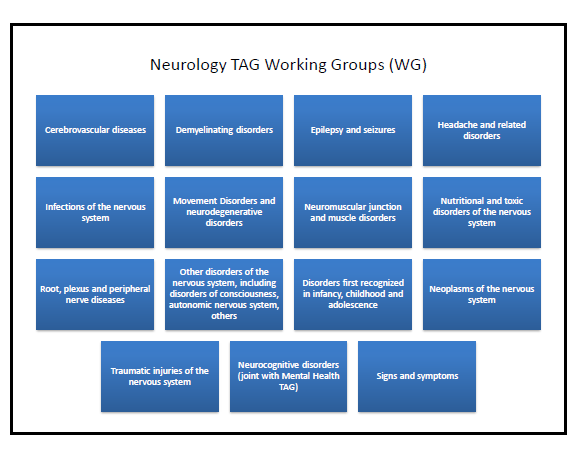
Neurology Topic Advisory Group (TAG) sub working groups:

Neurology TAG sub working groups

Source: Slide #16: Summary of progress, Neurology Advisory Group, Raad Shakir (Chair): http://www.hc2013.bcs.org/presentations/s1d_thu_1530_Shakir_amended.ppt


No journal papers, editorials, presentations or public domain progress reports have been published, to date, on behalf of TAG Neurology that discuss emerging proposals or intentions for the classification of the three G93.3 terms for ICD-11.

The public version of the Beta drafting platform displays no editing change histories or category notes. Until the three terms have been restored to the Beta draft the public is reliant on what information WHO/ICD Revision chooses to disclose, which thus far, has been minimal.

Currently, there is no information within the Beta draft for proposals for these three terms. The continued absence of these terms from the draft (now missing for over 18 months) is hampering professional and public stakeholder scrutiny, discourse and comment.

This is not acceptable for any disease category given that ICD Revision is being promoted by WHO’s, Bedirhan Üstün, as an open and transparent process and inclusive of stakeholders.

This next section summarizes the most significant changes since May 2010 for several iterations of the Neurology chapter, during the Alpha and Beta drafting phases, as displayed in the public version of the draft.


Tracking the progression of the G93.3 terms through the Alpha and Beta drafting stages

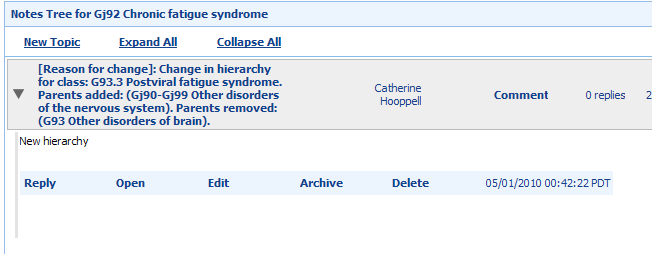
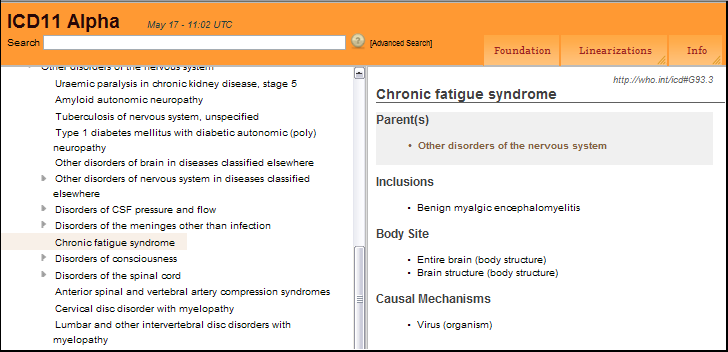
In May 2010: the ICD-10 G93 legacy parent class: Other disorders of brain was retired and a change in hierarchy for class Postviral fatigue syndrome recorded. See Notes Tree screenshot [12].

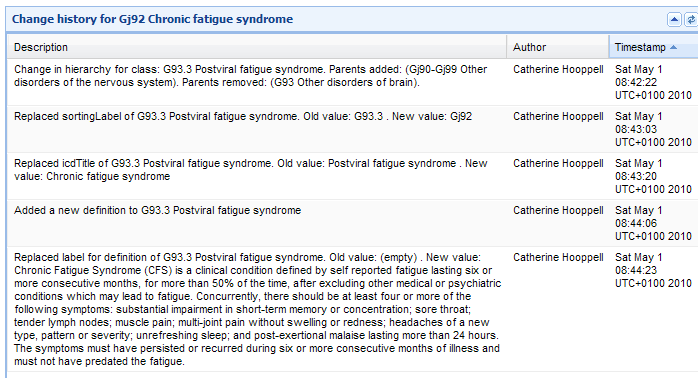
A Definition was inserted for Chronic fatigue syndrome. See Change history screenshot [13].

Chronic fatigue syndrome replaced Postviral fatigue syndrome as the new ICD Title term and now sat directly under parent class: Other disorders of the nervous system.

Benign myalgic encephalomyelitis was specified as an Inclusion term under Synonyms to new ICD Title term: Chronic fatigue syndrome. See Alpha draft screenshot [14].

Postviral fatigue syndrome was at that point unaccounted for in the Alpha draft.

By July 2012: 13 additional terms were now listed under Synonyms, including Postviral fatigue syndrome, and two terms imported from the yet to be implemented, ICD-10-CM (the ICD-10-CM Chapter 18 R53.82 codes: chronic fatigue syndrome nos and chronic fatigue, unspecified).

The Definition field was now blanked.

At this point, ICD Title term: Chronic fatigue syndrome was no longer displaying as a child category directly under parent class: Other disorders of the nervous system.

The listing for Chronic fatigue syndrome now appeared under a new “Selected Cause” subset, which displayed as a sub linearization within the Foundation Component. The purpose of this subset, which aggregated many terms from Neurology and other chapters, was not evident from the Beta draft.

By November 2012: ICD Revision had re-inserted a scrappy, revised Definition for Chronic fatigue syndrome. I have sourced this draft definition to an internal ICD Revision/Stanford Protege document (line 1983):

Chronic fatigue syndrome is characterized by extreme chronic fatigue of an indeterminate cause, which is disabling andt [sic] does not improve with rest and that is exacerbated by physical or mental activity.


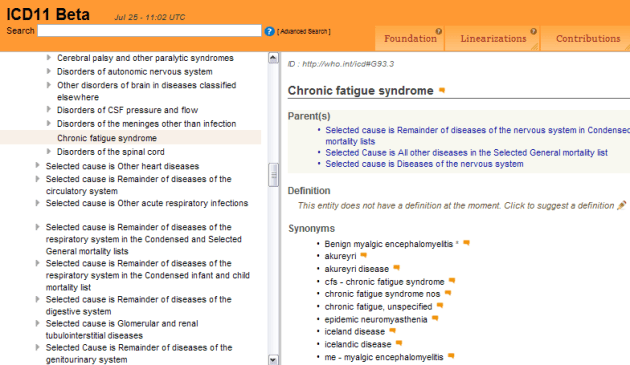
Below is a screenshot from the Beta draft taken in July 2012, before a Definition for Title term, Chronic fatigue syndrome had been re-inserted.

(It isn’t evident in the screenshot, but the asterisk at the end of Benign myalgic encephalomyelitis displayed a hover text denoting its specification as the Inclusion term to ICD Title term, Chronic fatigue syndrome. Also not evident in this cropped screenshot is the listing of Postviral fatigue syndrome under Synonyms.)

July2512

Source: ICD-11 Beta drafting platform, July 25, 2012.

This “Selected Cause” sub linearization was later removed from the public Beta draft and some of the terms that had been listed under it were restored to the Neurology chapter and to other chapters. But ICD Title term, Chronic fatigue syndrome, its Inclusion term and list of Synonyms were not restored to any chapter.

Since February 2013: no listing can be found in any chapter of the public version of the Beta draft, under any linearization, for any of the terms, Postviral fatigue syndrome, Benign myalgic encephalomyelitis or Chronic fatigue syndrome, as uniquely coded ICD Title terms, or as Inclusion terms or Synonyms to Title terms, or in the ICD-11 Beta Index.

Since June 2013: My repeated requests for an explanation for the absence of these three terms from the Beta draft and for ICD Revision’s intentions for these terms were ignored by ICD Revision until July 2014, when a response was forthcoming from ICD Revision’s, Dr Geoffrey Reed.

(It is understood that Annette Brooke MP also received a response, in July, from WHO’s, Dr Robert Jakob, in respect of the joint organizations’ letter of March 18, for which Ms Brooke had been a co-signatory.)


What clarifications have been given?

Feb 12, 2014: An unidentified admin for the @WHO Twitter account replied to a member of the public: “Fibromyalgia, ME/CFS are not included as Mental & Behavioural Disorders in ICD-10, there is no proposal to do so for ICD-11.” A similar affirmation was tweeted by Gregory Hartl, head of public relations/social media, WHO.


July 24, 2014: Geoffrey Reed PhD (Senior Project Manager for revision of Mental and behavioural disorders) replied to Suzy Chapman, by email:

Dr Reed stated inter alia that the placement of ME and related conditions within the broader classification is still unresolved.

That he had no influence or control over this process; his authority being limited to coordinating recommendations related to conditions that should or should not be placed in the chapter on Mental and behavioural disorders.

That there has been no proposal and no intention to include ME or other conditions such as fibromyalgia* or chronic fatigue syndrome in the classification of mental disorders.

That the easiest way to make this absolutely clear will be through the use of exclusion terms. However, he would be unable to ask that exclusion terms are added to relevant Mental and behavioural disorders categories (e.g. Bodily Distress Disorder) until the conditions that are being excluded exist in the classification. That at such time, he would be happy to do that.

That since his purview does not extend to the section on classification of Diseases of the nervous system or other areas outside the Mental and behavioural disorders chapter, he was unable to provide any information related to how these conditions will be classified in other chapters.

That he was unable to comment about the management of correspondence by other TAG groups and signposted me to Dr Robert Jakob [the senior classification expert who had been copied into the joint organizations’ letter to WHO/ICD Revision, in March] whose role relates to the overall coordination of the classification.


*Fibromyalgia remains classified under ICD-11 Beta draft public version chapter “Diseases of the musculoskeletal system and connective tissue” under parent: Certain specified soft tissue disorders, not elsewhere classified.

Irritable bowel syndrome remains classified under ICD-11 Beta draft public version chapter “Diseases of the digestive system” under: Functional gastrointestinal disorders > Irritable bowel syndrome and certain specified functional bowel disorders.


In August, I submitted two FOI requests, one to the Scottish Health Directorate, one to the English Department of Health. The latter was not deemed specific enough in terms of named health agencies for a response to be generated and will require resubmission.

September 24, 2014: FOI request fulfilled by (SCOTLAND) ACT 2002 (FOISA), received from David Cline, Unit Head, Strategic Planning and Clinical Priorities Team, by email: 

The Quality Unit: Health and Social Care Directorates
Planning & Quality Division

[Addresses redacted]

Your ref:  FoI/14/01460

24 September 2014

REQUEST UNDER THE FREEDOM OF INFORMATION (SCOTLAND) ACT 2002 (FOISA)

Thank you for your request dated 27 August 2014 under the Freedom of Information (Scotland) Act 2002 (FOISA)…


Your request

Under the Freedom of Information (Scotland) Act 2002, please provide the following.

Please send me copies of all correspondence, emails, letters, minutes relating to:

Enquiries made by Scottish Health Directorate to World Health Organization (WHO), 20 Av Appia, CH-1211, Geneva, in respect of:

Classification of the three ICD-10 (International Classification of Diseases 10th edition) G93.3 coded disease terms in the forthcoming revision of ICD-10, to be known as ICD-11:

Postviral fatigue syndrome (Post viral fatigue syndrome; PVFS)

Benign myalgic encephalomyelitis (myalgic encephalomyelitis; myalgic encephalitis; ME);

Chronic fatigue syndrome (CFS; CFS/ME, ME/CFS)

During the period:

1] January 1, 2013 – December 31, 2013

2] January 1, 2014 – July 31, 2014

I also request copies of responses received from WHO in reply to enquiries made by Scottish Health Directorate during these periods in respect of the above ICD disease categories.


Response to your  request

Information held covering the time period indicated relates to an email exchange on 11 and 12 March 2014 as part of a request for advice in answering Ministerial correspondence.

On 11 March the World Health Organisation WHO were asked “I would be very grateful for your help in confirming the status of an element within the WHO’s ICD 11 regarding ME/CFS. On 25th February in the UK parliament, the Under-Secretary of State for Health informed the UK parliament that the WHO had publicy stated that there was no proposal  to reclassify ME/CFS in ICD-11…I would be very grateful if you can confirm that this is the case and if possible, provide a web link to the original wording so I can include this within the correspondence I am preparing”.

The WHO responded on 12 March; “The question regarding MS/CFS [sic] and ICD-11 has been asked recently by several different parties. At this point in time, the ICD-11 is still under development, and to handle this classification issue we will need more time and input from the relevant working groups. It would be premature to make any statement on the subject below.

The general information on ICD Revision can be accessed here: http://www.who.int/classifications/icd/revision/. The current state of development of ICD-11 (draft) can be viewed here (and comments can be made, after self registration): http://www.who.int/classifications/icd11 ”.

A further email on 12 March to the WHO asked; “It would be fair to say then …that work will continue on the draft with an expected publication in 2015?”.

WHO responded on 12 March; “Work on the draft will continue until presentation at the World Health Assembly in 2017. Before, reviews and field testing will provide input to a version that is available for commenting, as much as possible and proposals can be submitted online* with the mechanisms provided already.”

*Since the three terms are currently not accounted for within the Beta draft this impedes the submission of comments.


This is the sum total of what has been disclosed by WHO/ICD Revision in respect of current proposals for the classification of the three ICD-10 G93.3 terms, despite the fact that ICD-11 has now been under development for 7 years, and prior to the timeline extension in January 2014, the new edition had been scheduled for WHA approval and dissemination in 2015.


What might the working group potentially be considering? 

  • The terms may have been removed from the draft in order to mitigate controversy over a proposed change of chapter location, change of parent class, reorganization of the hierarchy, or over the wording of Definition(s). (Whether a term is listed as a coded Title term, or is specified as an Inclusion term to a coded term or listed under Synonyms to a coded term, dictates which of the terms is assigned a Definition. If, for example, CFS and [B]ME were both coded as discrete ICD Title terms, both terms will require the assigning of Definitions and other Content Model descriptors.)
  • TAG Neurology may be proposing to retain all three terms under the Neurology chapter, under an existing parent class that is still under reorganization, and has taken the three terms out of the linearizations in the meantime, or is proposing to locate one or more of the terms under a new parent class for which a name and location has yet to be agreed.
  • TAG Neurology may be proposing to locate one or more of these terms under more than one chapter, for example, under the Neurology chapter but dual parented under the Symptoms and signs chapter. Or multi parented and viewable under a multisystem linearization, if the potential for a multisystem linearization remains under discussion.
  • TAG Neurology may be proposing to retire one or more of these three terms (despite earlier assurances by senior WHO classification experts) but I think this unlikely. ICD-11 will be integrable with SNOMED CT, which includes all three terms, albeit with ME and BME listed as synonyms to coded CFS, with PVFS assigned a discrete SNOMED CT code.
  • Given the extension to the timeline, TAG Neurology may be reluctant to make decisions at this point because it has been made aware of the HHS contract with U.S. Institute of Medicine (IOM) to develop “evidence-based clinical diagnostic criteria for ME/CFS” and to “recommend whether new terminology for ME/CFS should be adopted.” Any new resulting criteria or terminology might potentially be used to inform ICD-11 decisions.

Other possibilities might be listing one or more of these terms under parent class, Certain specified disorders of the nervous system or under Symptoms, signs and clinical findings involving the nervous system, which is dual parented under both the Neurology chapter and the Symptoms and signs chapter.

All currently listed parent and child categories within the Neurology chapter can be viewed here:

Click on the small grey arrows next to Beta draft categories to display their parent, child and grandchildren categories, as drop down hierarchies.

Linearization display button1Select this coloured button to display symbols and hover text indicating which linearization(s) a selected term is listed under.

http://apps.who.int/classifications/icd11/browse/f/en#/http://id.who.int/icd/entity/1296093776


There is a new parent class proposed for the ICD-11 Neurology chapter called, Functional clinical forms of the nervous system, which Dr Jon Stone has been working on [15] [17].

Under this new Neurology chapter parent class, it is proposed to relocate or dual locate a list of “functional disorders” (Functional paralysis or weakness; Functional sensory disorder; Functional movement disorder; Functional gait disorder; Functional cognitive disorder etc.) which in ICD-10 are classified under the Chapter V Dissociative [conversion] disorders section.

The rationale for this proposed chapter shift for Conversion disorders/functional disorders is beyond the scope of this briefing paper.

In a 2013 editorial, Prof Raad Shakir (Chair, TAG Neurology) briefly discusses the proposed reorganization of what he calls the “rag bag of diverse and disparate diseases” that is parent class, Other disorders of the nervous system [16].

He writes, “In addition, there will also be a section on Functional disorders of the nervous system, reflecting the growing diagnostic importance of such syndromes.” 

It’s not clear whether this reference, in 2013, to the inclusion of a new section for “Functional disorders of the nervous system” within the Neurology chapter relates to the relocation or dual location of those “functional disorders” currently classified under Dissociative [conversion] disorders within ICD-10 Chapter V, or whether Prof Shakir was referring to potential inclusion within the Neurology chapter of a section for “Functional somatic syndromes.” But I consider the former more likely.

There is currently no inclusion within any chapter for a specific parent class for “Functional somatic syndromes,” or “Functional somatic disorders” or “interface disorders” under which, conceivably, those who consider CFS, ME, IBS and FM to be “speciality driven” manifestations of a similar underlying functional disorder might be keen to see these terms aggregated.

I shall return to the subject of “interface disorders” in Part 3.


There remain 6 important questions to be answered:

• under which chapter(s) are PVFS, BME and CFS proposed to be located?
• under which parent classes?
• what hierarchies are proposed, in terms of coded Title terms, Inclusions, Synonyms?
• which of the terms are to be assigned definitions?
• where will definitions be sourced from?
• when will the terms be restored to the draft to enable scrutiny and comment?


Extract, ICD-11 document Known Concerns and Criticisms:

“It may be true that some advocacy groups may give inputs in line with their vested interests or object to the listings in ICD-11 Beta. When such public controversy occurs, it is better to have it in an open and transparent discussion…”

Having obscured these terms from the Beta drafting platform eighteen months ago, with no explanation, ICD Revision Steering Group and TAG Neurology, which are both accountable to WHO, have disenfranchised professional and advocacy stakeholders from scrutiny of, and participation in what is being touted as an open and transparent process.

For Part 1 of this briefing document: Part 1: Status of the ICD-11 development process

In Part 3, I shall be setting out what is currently known about the status of proposals for the revision of ICD-10’s Somatoform disorders for the core and primary care versions of ICD-11.


Important caveats: The public Beta platform is not a static document, it is a work in progress, subject to daily editing and revision, to field test evaluation and to approval by the RSG and WHO classification experts. Not all new proposals may survive the ICD-11 field tests. Chapter numbering, codes and “sorting codes” currently assigned to ICD categories are not stable and will change as chapters and parent/child hierarchies are reorganized. The public version of the Beta is incomplete; not all “Content Model” parameters display or are populated; the draft may contain errors and omissions.


References for Part 2

12 https://dxrevisionwatch.com/wp-content/uploads/2010/05/2icatnotegj92cfs.png

13 https://dxrevisionwatch.com/wp-content/uploads/2011/02/change-history-gj92-cfs.png

14 https://dxrevisionwatch.com/wp-content/uploads/2011/05/icd11-alpha1-17-05-11.png

15 http://apps.who.int/classifications/icd11/browse/f/en#/http%3a%2f%2fid.who.int%2ficd%2fentity%2f1614846095

16 Shakir R, Rajakulendran, S. The 11th Revision of the International Classification of Diseases (ICD) The Neurological Perspective JAMA Neurol. 2013;70(11):1353-1354. http://archneur.jamanetwork.com/article.aspx?articleid=1733323

17 Functional neurological disorders: The neurological assessment as treatment. Stone J. Neurophysiol Clin. 2014 Oct;44(4):363-73 http://www.ncbi.nlm.nih.gov/pubmed/25306077

Briefing paper on ICD-11 and PVFS, ME and CFS: Part 1

Post #315 Shortlink: http://wp.me/pKrrB-40E


Part one of a three part report on the status of ICD-11 proposals for the classification of the three ICD-10 entities:

G93.3 Postviral fatigue syndrome (coded under parent class G93 in Tabular List)

Benign myalgic encephalomyelitis (inclusion term to G93.3 in Tabular List)

Chronic fatigue syndrome (indexed to G93.3 in Volume 3: Alphabetical Index)


Part 1: Status of the ICD-11 development process

Part 2: Status of proposals for the classification of PVFS, BME, and CFS in the public version of the ICD-11 Beta drafting platform

Part 3: Status of proposals for the revision of ICD-10’s Somatoform disorders for the core and primary care versions of ICD-11


Part 1: Status of the ICD-11 development process

The revision of ICD-10 and development of the structure for ICD-11 began in April 2007.

ICD-11 was originally planned for completion by 2012, but the timeline was extended to 2015 early in the development process.

In January 2014, WHO/ICD Revision extended the timeline by a further two years to allow more time for generation of content, peer review, field testing and evaluation, translations and transition preparations [1].

The current projected date for approval by the World Health Assembly (WHA) is May 2017 with implementation timelined for 2018+.

In July 2014, WHO issued a call for expressions of interest in a contract for an external interim assessment of the revision process. Due date for the assessment report is December 15, 2014. It is not known whether WHO intends to publish a summary of the external assessment report.

Once ICD-11 is ready for dissemination, WHO Member States will transition to the new edition at their own pace. There is no WHO mandated date by which ICD-11 must be implemented, but WHO has said that it won’t support the annual updating of ICD-10 indefinitely. Developing and low resource countries may take many years before migrating to ICD-11.


Print and electronic versions

The scope of the revision project is ambitious and technically very complex. The project is under-resourced and underfunded and there is no overall project manager. Work groups have complained about the burden of work and poor internal communications.

There will be an ICD-11 print edition and a more expansive computerized version planned to be integrable with the international SNOMED CT terminology system.

The electronic version has a Foundation Component which includes all the ICD-11 diagnostic categories arranged in hierarchical “trees.”

From the Foundation Component, subsets (known as “linearizations”) are derived that contain mutually exclusive lists of terms for different purposes, e.g. for mortality, morbidity or primary care.

There are anticipated to be linearizations for mental and behavioural disorders, low resource and high resource primary care settings, rare diseases and occupational health and speciality classifications, including neurology, paediatrics, ophthalmology and dermatology.

The public version of the Beta drafting platform currently displays only the Foundation Component and a Joint Linearization for Mortality and Morbidity Statistics.

The country specific “Clinical Modifications” of ICD-10, including the U.S.’s forthcoming ICD-10-CM, are expected to be incorporated into ICD-11, as linearizations, as is ICPC-2.

The development process is overseen by a Revision Steering Group (RSG) chaired by biomedical informatics expert, Christopher Chute, MD, Mayo Clinic, Rochester, MN [2].


Primary Care version

ICD-10 PHC (sometimes written as ICD-10-PHC or ICD10-PHC or ICD-10 PC), is a simplified version of the WHO’s ICD-10 chapter for mental and behavioural disorders for use in general practice and primary health care settings. This system has rough but not exact equivalence to mental disorders in the core ICD-10 classification.

The ICD-10 PHC describes 25 disorders commonly managed within primary care as opposed to circa 450 classified within Chapter V of ICD-10.

An revised version, known as ICD-11 PHC, is being developed simultaneously with the core version.

The ICD-11 Primary Care Consultation Group, chaired by Prof Sir David Goldberg, is charged with the revision of the 26 mental and behavioural disorders in ICD-10 PHC. The 28 mental disorders proposed for the new primary care edition (ICD-11 PHC) will require an equivalent category within the core ICD-11 version [5].


Work Groups

Over 20 work groups have been assembled since 2007 reporting to the RSG. These are known as Topic Advisory Groups (TAGs). Professional and scientific organisations also have representatives on the TAGs [3].

TAG Managing Editors may also recruit external reviewers for reviewing proposals and textual content. Terms of Reference for TAGs and work groups can be viewed in reference [4].

Reporting to the TAGs are sub working groups charged with making recommendations for specific chapter sections. TAG membership lists are available from the WHO site but the names of sub working group members and external reviewers are not posted.

The Work Groups with most relevance for the ICD-10 G93.3 categories are:

TAG Neurology (Diseases of the nervous system) Chair: Prof Raad Shakir, Managing editor: Tarun Dua, WHO.

TAG Mental Health (Mental and behavioural disorders) Co-Chairs: Geoffrey Reed, PhD, WHO; Steven Hyman, MD, Harvard University.

ICD-11 Expert Working Group on Somatic Distress and Dissociative Disorders (S3DWG) Chair: Prof Oye Gureje. A sub working group to TAG Mental Health. Prof emeritus, Francis Creed, is a member. This group is said to have 17 members but apart from two others, I have been unable to establish the full membership list.

ICD-11 Primary Care Consultation Group (PCCG) Chair: Prof Sir David Goldberg, Vice-chair: Prof Michael Klinkman (U.S.). Per Fink’s research collaborator, Marianne Rosendal, is a member of the 12 person, PCCG. The full member list has been published in a journal paper [5] but is not posted on the WHO website.


Differences between ICD-10 and ICD-11

There are significant differences between the structure of ICD-10 and ICD-11: more chapters (currently 26 against ICD-10’s 22); reordering of chapters; restructuring of disease classes and parent/child hierarchies within chapters; renaming of some terms; relocation of some terms to other existing chapters or to new chapters; multiple linearizations; more descriptive content; a new system of code numbers.

Disease terms with an equivalent ICD-10 term are back referenced to their legacy terms and codes in the electronic platform for ICD-10 Version: 2010 [6].


Multiple parents and multisystem diseases

For ICD-10 Tabular List, an ICD entity (a parent class, title term or inclusion term) can appear in only one place within the classification.

For ICD-11, multiple parentage is permissible. In the Foundation Component, disorder or disease terms can appear under more than one hierarchical parent [7].

Diseases that straddle two chapters, like malignant neoplasms of the skin, can now be viewed under Diseases of the skin as well as cross-linking to the Neoplasms chapter. Premenstrual Dysphoric Disorder (PMDD), proposed for inclusion in ICD-11, is listed under both Depressive disorders, in the Mental and behavioural disorders chapter, and also under Premenstrual tension syndrome under new chapter, Conditions related to sexual health.

So the ICD-10 concept of discrete chapter location is being dispensed with for ICD-11.

In 2010, the Revision Steering Group posted a discussion paper on the potential for incorporating a new chapter into ICD-11 for Multisystem diseases, but this proposal has been rejected [8].

In 2013, consideration was being given, instead, for generating a multisystem diseases linearization – as a virtual chapter – compiled from the Foundation Component that lists all ICD disorders and diseases, but there would be no separate Multisystem diseases chapter within the print version [9].

It isn’t known whether a decision has been reached but there is currently no ability to generate a multisystem diseases linearization from the Foundation Component, at least not within the public version of the Beta drafting platform.

How to represent multisystem diseases within ICD-11 (and the potential for an ICD category term to be assigned to multiple parents) could have implications for classification of one or more of the three ICD-10 G93.3 terms.


The Content Model

Another major difference between ICD-10 and ICD-11 is the Content Model. For ICD-11, all uniquely coded ICD Title terms (but not their Inclusion terms or Synonyms) are intended to have Definitions and in some cases, other descriptive content populated [10]. Whereas category terms located in ICD-10 chapters other than Chapter V: Mental and behavioural disorders were listed, to quote WHO’s, Bedirhan Üstün, like a laundry list, with no descriptive content.


Outside of the WHO classification experts, the RSG, the working groups, sub working groups and their external advisers who else is inputting into the development process?

In 2009, ICD Revision Steering Group began inviting professional bodies and Royal Colleges to submit proposals for revisions to the ICD structure and content for ICD-11.

WHO has also set up a Global Clinical Practice Network (GCPN), an international network of over 11,000 mental health and primary care professionals [11].

Calls have gone out for various classes of professional stakeholder to register with the public version of the Beta draft to participate in the revision process:

Medicine; Nursing; Midwifery; Dentistry; Pharmacy; Health information management (coding, medical records); Environmental and occupational health and hygiene; Physiotherapy or Physical therapy; Nutrition; Social Sciences; Psychology; Social work and counseling; Epidemiology; Health Policy; Traditional and complementary medicine.

A pre-final draft for ICD-11 is expected to be released for public comment at some point in 2015/16, but no firm date for this has been announced.


How can stakeholders participate?

Professional stakeholders and others who register an interest are able to interact with the Beta drafting platform and access additional content, e.g. PDFs of the print versions and Index.

The public version of the Beta drafting platform can be viewed without registration but comments submitted by registered stakeholders are not visible to non registered viewers.

Comments and suggestions are screened and forwarded to the appropriate TAG Managing editors for review. Occasionally, a TAG Managing editor or one of the ICD Revision staff will respond to a proposal or a request for correction via the comments facility.

Registered stakeholders are permitted to:

• Add comments on and read other stakeholder comments on concepts; title terms; synonyms; inclusion terms; exclusions and other Content Model parameter terms;
• Comment on whether a category is in the right place;
• Comment on whether the category is useful for Primary Care; Research; Clinical;
• Suggest definitions (with sources) for a disease or disorder and comment on already populated draft definitions;
• Make proposals to change ICD categories, supported with references;
• Offer to participate in field trials (for professionals only);
• Offer to assist in translating ICD into other languages

Stakeholders can register for participation here: http://www.who.int/classifications/icd/revision/en/

Video inviting professional and stakeholder participation here: http://www.who.int/classifications/icd/revision/video/en/

The Beta platform is intended for considered and collegiate input – not as a platform for campaigning or activism.

Some patient advocacy organisations, for example, gender and trans* groups, have been holding face to face meetings with ICD Revision personnel at conferences or other venues to inform the revision process and represent their constituencies’ interests.

A new Proposals mechanism was launched on the public Beta draft in July 2014. This is a more sophisticated system through which registered users can submit proposals, supported with rationales and references, for changes/additions/deletions to proposed ICD-11 entities.

Proposals guide: http://apps.who.int/classifications/icd11/browse/Help/Get/proposal_main/en


Where to view the Beta drafting platform

ICD Revision and TAG Managing editors are developing the Beta draft on a separate electronic multi-authoring platform, known as the iCAT, on a server which is not accessible to the public.

The iCAT Beta platform is more layered than the Beta version which the public sees: it displays a larger number of “Content Model” parameters; there are tabs for tracking “Change Histories” and “Category Notes and Discussions” for comparing earlier iterations of a specific chapter section with the most recent edits. There are sub lists for terms that are proposed to be retired or for which decisions are needing to be made.

The public version of the Beta has no means through which changes to the draft (and rationales for changes) can be tracked, or for comparing, for example, an earlier edit of a specific chapter section with the most recent content.

The inability to monitor editing histories in the public Beta draft and the absence of progress reports from the work groups adds to confusion around interpretation of the Beta content. The draft is updated daily, so it needs checking every day for relevant changes.

You can view the public version of the Beta drafting platform here:
http://apps.who.int/classifications/icd11/browse/f/en

Foundation Component (the entire ICD universe):
http://apps.who.int/classifications/icd11/browse/f/en#/

Joint Linearization for Mortality and Morbidity Statistics:
http://apps.who.int/classifications/icd11/browse/l-m/en#/

User Guide: http://apps.who.int/classifications/icd11/browse/Help/en


Click on the small grey arrows next to the Beta draft categories to display their parent, child and grandchildren categories, as drop down hierarchies.

Linearization display button1Select this coloured button to display symbols and hover text indicating which linearization(s) a selected term is listed under.

The display panel on the right contains the “Content Model” text: Short and Long Definitions, Inclusion terms, Synonyms, Exclusions, Index terms etc. for the selected ICD Title term. Many terms are still awaiting population of Short Definitions (for print version) and Long Definitions (for electronic version), and other descriptive content.

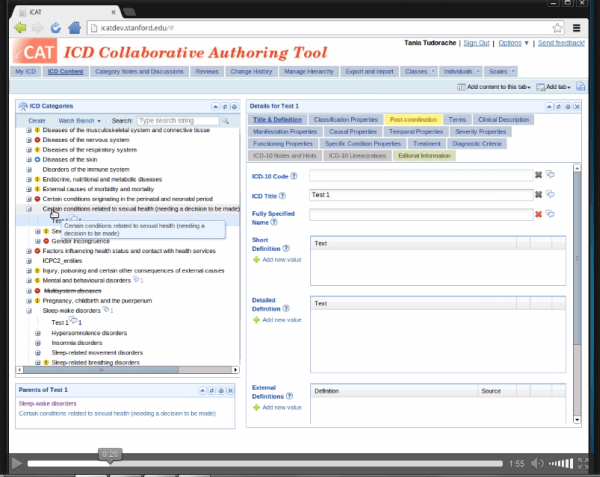
For comparison between the public Beta draft and the iCAT, view this 2 minute iCAT screencast animation (with audio), intended as a demo for ICD Revision editors.

The animation is an .ogv file which should run in recent releases of Firefox but may not load in other browsers. If you don’t have the right program installed to run an .ogv file, the iCAT multi-authoring platform that the TAG editors are using looks like this:

iCAT editing platform 3


In Part Two, I shall be setting out what is currently known about proposals for the classification of Postviral fatigue syndrome, Benign myalgic encephalomyelitis and Chronic fatigue syndrome for ICD-11.

Important caveats: The public Beta platform is not a static document, it is a work in progress, subject to daily editing and revision, to field test evaluation and to approval by the RSG and WHO classification experts. Not all new proposals may survive the ICD-11 field tests. Chapter numbering, codes and “sorting codes” currently assigned to ICD categories are not stable and will change as chapters and parent/child hierarchies are reorganized. The public version of the Beta is incomplete; not all “Content Model” parameters display or are populated; the draft may contain errors and omissions.


Part 2: Status of proposals for the classification of PVFS, BME, and CFS in the public version of the ICD-11 Beta drafting platform published September 30, 2014

Part 3: Status of proposals for the revision of ICD-10’s Somatoform disorders for the core and primary care versions of ICD-11 [to follow]


References for Part 1

1 Committee for the Coordination of Statistical Activities, Twenty-second Session 4-6 September 2013, Items for discussion and decision: Item 8, provisional agenda, pp 8-10: http://unstats.un.org/unsd/accsub/2013docs-22nd/SA-2013-12-Add1-Health-WHO.pdf

2 http://www.who.int/classifications/icd/RSG/en/

3 http://www.who.int/classifications/icd/TAGs/en/

4 http://www.who.int/entity/classifications/TOR_TAGs_WGs.pdf?ua=1

5 Lam TP, Goldberg DP, Dowell AC, Fortes S, Mbatia JK, Minhas FA, Klinkman MS: Proposed new diagnoses of anxious depression and bodily stress syndrome in ICD-11-PHC: an international focus group study. Family Practice (2012) 30 (1): 76-87. Free text: http://fampra.oxfordjournals.org/content/30/1/76.full.pdf+html

6 http://apps.who.int/classifications/icd11/browse/f/en#/

7 http://apps.who.int/classifications/icd11/browse/Help/Get/architecture/en

8 https://dxrevisionwatch.com/wp-content/uploads/2010/10/considerations20on20multisystem_diseases_201008181.doc

9 http://informatics.mayo.edu/WHO/ICD11/collaboratory/attachments/208/19.Multisystem_Diseases_Chapter.v1.2.docx

10 http://www.who.int/classifications/icd/revision/contentmodel/en/

11 http://www.globalclinicalpractice.net/en/

Summary of responses from WHO re: Bodily distress disorder, Bodily stress syndrome, Bodily Distress Syndrome

Post #313 Shortlink: http://wp.me/pKrrB-3YR

+++

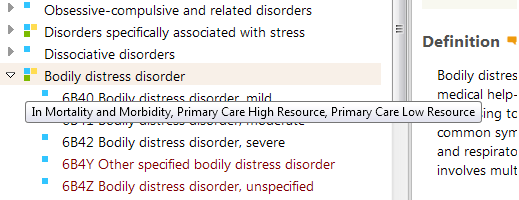
Screenshot: ICD-11 Beta drafting platform, public version, July 31, 2014; Chapter 06 Mental and behavioural disorders: Bodily distress disorder.

+++
BDD310714

Joint Linerarization for Mortality and Morbidity Statistics view selected; “show availability in main linearizations” view selected. Categories designated with three coloured key hover text: “In Mortality and Morbidity, Primary Care High Resource, Primary Care Low Resource. Categories designated with single blue key hover text: “In Mortality and Morbidity.”

+++
Summary of responses from Dr Geoffrey Reed, WHO

On July 23, I submitted an analysis and four questions via the ICD-11 Beta drafting platform for the attention of the Managing Editors for Topic Advisory Group (TAG) Mental Health, the advisory group that is revising ICD-10’s Chapter V.

A copy has been posted in Dx Revision Watch Post #311: Questions raised on ICD-11 Beta draft re: Bodily distress disorder http://wp.me/pKrrB-3Yh

Comments and suggestions submitted by registered users of the ICD-11 Beta drafting platform are screened and forwarded to the appropriate TAG Managing Editors for review.

I also sent a copy of my comments to Dr Geoffrey Reed. Dr Reed is Senior Project Officer overseeing the revision of the ICD Mental and behavioural disorders chapter.

On July 24, I received a response from Dr Reed, via email.

Dr Reed’s responses do not address all the points I had raised via the Beta platform and in my covering email. I am providing a summary of selected of Dr Reed’s responses, below.

I had also drawn Dr Reed’s attention to the absence, since early 2013, of the three G93.3 terms from the public version of the Beta draft and collective concerns for ICD Revision’s failure, to date, to respond to multiple requests to provide an explanation for the continued absence of these terms from the Beta draft and to clarify ICD Revision’s intentions and proposals for the classification of these three ICD-10 terms within ICD-11 [i.e. chapter location(s), parent code(s), hierarchies, Definitions, Synonyms, Inclusion terms etc.].

+++
Dr Reed provided the following information on July 24:

The placement of ME and related conditions within the broader ICD-11 classification is still unresolved.

There has been no proposal and no intention to include ME or other conditions such as fibromyalgia or chronic fatigue syndrome in the classification of mental disorders.
That ME and related conditions be clearly identified as NOT being part of this section of the classification could be made absolutely clear through the use of exclusion terms.

However, Dr Reed will be unable to request that exclusion terms be added to relevant Mental and behavioural disorders categories (e.g., Bodily Distress Disorder) until the conditions that are being excluded exist in the classification. At such time, he would be happy to request exclusion terms.

ICD Revision is currently involved in testing the proposals of the ICD-11 Primary Care Consultation Group* in primary care settings around the world, in part to compare how they work with the proposals of the ICD-11 Expert Working Group on Somatic Distress and Dissociative Disorders**.

Whether the primary care proposal ends up capturing specific groups of patients in primary care who are likely to have underlying medical conditions will certainly be one of the issues for examination and further discussion. Study data would be used as a basis for modifying proposals.

That he considers my analysis is accurate.

That it is not WHO policy to make research protocols for field trial studies that are planned or currently being implemented publicly available for comment.

Details of the study methodology at the time the data are published are expected to be provided, in order that others may examine and critique the methodology, their interpretation of results and their subsequent decisions based on the studies.

Further modifications of the proposals will be based on data evaluation, and justifications made available.

In due course, ICD Revision will make more detailed diagnostic guidelines for all Mental and behavioural disorders available for review and comment before they are finalized, but ICD Revision is not yet ready to do that.

Dr Reed will notify me when that occurs, but anticipates this will be before the end of the year and considers there is plenty of time for review as the approval of ICD-11 is now currently planned for May, 2017.

Dr Reed’s purview does not extend to the section on classification of Diseases of the nervous system or other areas outside the Mental and behavioural disorders chapter, and is therefore unable to provide any information related to how these conditions will be classified in other chapters***.

He is unable to comment about the management of correspondence by other TAG groups**** and signposts to another member of WHO staff [a senior classification expert who had been copied into the joint organizations’ letter to WHO/ICD Revision, in March].

+++
Footnotes:

* Back in 2012, the ICD-11 Primary Care Consultation Group (the PCCG) were proposing a disorder construct that presented a modified version of the Fink et al (2010) Bodily Distress Syndrome (BDS) construct which, at that point, the Primary Care group were proposing to call, “Bodily stress syndrome (BSS).”

The PCCG hasn’t published a progress report since 2012 and the group’s current proposals are not available for scrutiny. If a modified version of BDS is currently being proposed by the PCCG, it isn’t known what changes have been made to the group’s proposals since the Lam et al paper was published in 2012, a paper which is now in the public domain [1].

An editorial co-authored by Prof David Goldberg, in June 2013, implied that Prof Goldberg, at least, was advancing that BDS should be progressed to ICD-11 field testing. It is unclear from Dr Reed’s responses to what extent the PCCG’s most recent proposals correspond to the disorder descriptions and criteria for Fink et al’s, already operationalized, BDS, or whether the group has retained the “BSS” disorder name for the purposes of the field tests and a modified construct/criteria set.

+++
** In 2012, the ICD-11 Expert Working Group on Somatic Distress and Dissociative Disorders (the S3DWG) were proposing an alternative and divergent disorder construct that had good concordance with DSM-5’s Somatic symptom disorder, and poor concordance with Fink et al’s BDS [2].

Perversely, the S3DWG were proposing to call their disorder construct, “Bodily distress disorder (BDD)” – a term already used outside ICD Revision, interchangeably, with Bodily Distress Syndrome [3].

It is the S3DWG’s BDD disorder construct that has been entered into the ICD-11 Beta drafting platform.

The Beta draft entry for BDD has recently had characterizations inserted for three BDD severity specifiers: BDD, Mild; BDD, Moderate; BDD, Severe. This post (which was written before I received responses from Dr Reed) sets out these recent additions to the draft in the context of the two divergent sets of proposals: Definitions for three severities of Bodily distress disorder now inserted in ICD-11 Beta draft, July 19, 2014 http://wp.me/pKrrB-3X9

+++
*** This February 8, 2014 post: http://wp.me/pKrrB-3IX tracks the history of the progression of the three ICD-10 G93.3 categories, PVFS, (B)ME and CFS within the ICD-11 drafting platform, from May 2010 to early 2013.

Under the subheading “So why have these three ICD-10 terms disappeared and why is ICD Revision reluctant to respond?” I have suggested a number of potential reasons for the current absence of these three terms from the Beta draft.

+++
**** On March 17, a joint letter signed by Sonya Chowdhury, CEO, Action for M.E., Annette Brooke MP, Chair, All Party Parliamentary Group on M.E., The Countess of Mar, Chair, Forward M.E. and Dr Charles Shepherd, ME Association, was sent to key Topic Advisory Group for Neurology members and copied to WHO’s Dr Margaret Chan, Dr Geoffrey Reed and Dr Robert Jakob.

The letter had requested, inter alia, clarification for the absence of the three ICD-10 G93.3 terms, Postviral fatigue syndrome, Benign myalgic encephalomyelitis and Chronic fatigue syndrome from the public version of the ICD-11 Beta drafting platform.

Prior to early 2013, in the public version of the Beta draft, Chronic Fatigue Syndrome had been listed in the Beta Foundation Component as an ICD Title entity under the Diseases of the nervous system chapter, with Benign Myalgic encephalomyelitis specified as an Inclusion term to Title term CFS, and Postviral fatigue syndrome listed under Synonyms to Title term, CFS.

The joint letter can be read here:

http://www.actionforme.org.uk/Resources/Action%20for%20ME/Documents/get-informed/who-icd-11-letter-17-3-14-sc.pdf

At the July 1 meeting of the APPG on M.E. it was agreed that in the absence of a response, Annette Brooke MP (Chair) would follow up the correspondence. Minuted here (under 3 Matters arising; d) ICD-11):

http://www.meassociation.org.uk/2014/07/minutes-of-the-appg-on-me-meeting-and-the-agm-held-on-1-july-2014/

I have advised Sonya Chowdhury, Dr Charles Shepherd, Neil Riley and Jane Colby of Dr Reed’s responses and suggested that Annette Brooke MP is updated.

+++
Forthcoming Symposium:

In September, Professor Oye Gureje, who chairs the ICD-11 Expert Working Group on Somatic Distress and Dissociative Disorders, will be presenting on “Proposals and evidence for the ICD-11 classification of Bodily Distress Disorders” as part of series of symposia on the development of the ICD-11 chapter for mental and behavioural disorders, at the World Psychiatric Association XVI World Congress, in Madrid, Spain, 14–18 September 2014.

+++
References:

1. Lam TP, Goldberg DP, Dowell AC, Fortes S, Mbatia JK, Minhas FA, Klinkman MS: Proposed new diagnoses of anxious depression and bodily stress syndrome in ICD-11-PHC: an international focus group study. Family Practice (2013) 30 (1): 76-87. Full free text: http://fampra.oxfordjournals.org/content/30/1/76.long

2. Creed F, Gureje O. Emerging themes in the revision of the classification of somatoform disorders. Int Rev Psychiatry. 2012 Dec;24(6):556-67. http://www.ncbi.nlm.nih.gov/pubmed/23244611 [Full text behind paywall]

3. Fink P, Toft T, Hansen MS, Ornbol E, Olesen F. Symptoms and syndromes of bodily distress: an exploratory study of 978 internal medical, neurological, and primary care patients. Psychosom Med. 2007 Jan;69(1):30-9.

+++
Caveats: The ICD-11 Beta drafting platform is not a static document: it is a work in progress, subject to daily edits and revisions, to field test evaluation and to approval by ICD Revision Steering Group and WHO classification experts. Not all new proposals may survive ICD-11 field testing. Chapter numbering, codes and Sorting codes currently assigned to ICD categories may change as chapters and parent/child hierarchies are reorganized. The public version of the Beta draft is incomplete; not all “Content Model” parameters display or are populated; the draft may contain errors and category omissions.

Call for Expressions of Interest to review the ICD revision process

Post #312 Shortlink: http://wp.me/pKrrB-3Yw

(If the consulting team that secures the ICD Revision interim assessment contract extends their outreach to include analysis of advocate stakeholder views and experience of interacting with the revision process, I shall be happy to discuss key concerns.)

The World Health Organization (WHO) Office of the Assistant Director General, Health Systems and Innovation, has posted a call for expressions of interest from suitable contractors to conduct an interim assessment of the 11th Revision for International Classification of Disease (ICD).

Deadline for expressions of interest is July 31, 2014. Following the selection process, WHO will inform the contracted party by 15 August 2014.

Lead time is four months

Target date for the completed first draft of the deliverable is by 10 October 2014. Due date for the completed final product submitted to WHO will be 15 December 2014 latest.

“WHO keeps the right to publicize the report and its contents as a whole or in parts.”

+++

Call for Expressions of Interest to review the ICD revision process

+++
Terms of Reference:

Review of

WHO’s Revision Process
for the International Classification of Diseases (ICD)

Request for Expressions of Interest

+++
Table of Contents

(…)

1. INTRODUCTION

WHO Office of the Assistant Director General, Health Systems and Innovation, solicits expressions of interest from a suitable Contractor(s) to conduct an interim assessment of the 11th Revision for International Classification of Disease (ICD) to carry out the following work:

1.1 Objective of the Request

WHO Office of the Assistant Director General, Health Systems and Innovation, solicits expressions of interest from a suitable Contractor(s) to carry out the following work:

1. Conduct an interim assessment of the 11th Revision for International Classification of Disease (ICD) in terms of:

Progress towards the goals of the Revisions
• Process and mechanisms put in place for the ICD revision
Project resources (financial & human) in relation to the proposed outcomes of the revision
• Project Plans and proposed timeline for the completion of ICD 11 for 2017
• Organization for maintenance and updates of ICD beyond 2017

2. Analyze the relevance and effectiveness of the planned features of ICD 11 in meeting the needs of the key stakeholders in WHO Member States including its:

a. Use in Mortality statistics – e.g. Cause of Death statistics, Verbal Autopsy, others…
b. Use in Morbidity statistics – e.g. Discharge summaries, Case-mix groupings, others…
c. Use in Primary Care – in low and intermediate resource settings…
d. Use in Clinical Care – for diagnosis, guidance, quality and safety indicators
e. Use in Scientific Research for epidemiology, genetic studies and other

3. Compile an assessment report summarizing the findings and making recommendations for improvement.

Potential contractors are requested to state the reason why they consider themselves suitable for this work and explain how they will respond to the requirements stated in this request with (a) a proposed draft work plan; (b) timeline; (c) budget with annotation.

1.2 Deadline for Expressions of Interest

Expressions of interest must be submitted on or before July 31, 2014 in order to be considered. The description of the contracting agency and curriculum vitae of the proposed team members, and proposed methods for assessment and timeline should be attached to the expressions of interest (see also 2.3). A point of contact for inquiries should be identified. WHO may contact the parties for further clarification. WHO will inform the contracted party following the selection process by 15 August 2014.

(…)

+++
Full document here:

http://www.who.int/classifications/icd/revision/en/

or open PDF on Dx Revision Watch here:

Click link for PDF document  Call for Expressions of Interest to review the ICD revision process


Annex I to this document (Page 12) contains a Summary of the ICD Revision Process

“This document summarizes the ICD Revision Process, in particular, in terms of the timelines for the finalization date and submission to WHO Governing Bodies. Following various consultations with the WHO Member States and relevant international stakeholders, it was decided decided to postpone the submission to WHA to 2017 May in various consultations with the WHO Member States and relevant international stakeholders taking into account [sic]*: the developmental stage of ICD 2013 Beta, and allowing for reasonable time to complete the remaining tasks: reviews; additional proposals; field trials; translations; and the transition preparations.”

Section 2 (Page 23) sets out ICD Revision Process: Tasks for Beta Phase and Finalization 2013-2017

Annex II contains The Detailed List of Multiple Stakeholders to be contacted

*I guess no-one at WHO reviewed and edited this document before posting it?