Update: 12 Point Skinny on ICD-11

Post #297 Shortlink: http://wp.me/pKrrB-3Mk

There has been considerable confusion, recently, around the various ICD-11 Beta draft proposals for the revision of ICD-10’s Somatoform disorders.

Confusion, also around the current status of the ICD-10 G93.3 terms, Postviral fatigue syndrome, Benign myalgic encephalomyelitis and Chronic fatigue syndrome within the ICD-11 Beta drafting platform.

This post is an update to Post #291, January 29, 2014, titled:

Between a Rock and a Hard Place: ICD-11 Beta draft: Definition added for “Bodily distress disorder”

and Post #293, February 8, 2014, titled:

Update on classification of the ICD-10 G93.3 categories within the ICD-11 Beta draft

+++
On February 12, an unnamed WHO Twitter admin posted this reply to a member of the public:

WHO ‏@WHO 

@secretspartacus Fibromyalgia, ME/CFS are not included as Mental & Behavioural Disorders in ICD-10, there is no proposal to do so for ICD-11

+++

This 12 Point Skinny is also on TwitLonger:

http://www.twitlonger.com/show/n_1s0o6a6

Here’s a brief summary of how things stand in the Beta drafting platform at February 24, 2014. If reposting, please repost unedited and with source URL:

http://wp.me/pKrrB-3Mk  

Dx Revision Watch’s 12 Point Skinny on ICD-11:

+++
1. The ICD-10 terms, PVFS, BME, CFS, are not currently listed in the public version of the Beta drafting platform, under any chapter, either as ICD Title terms, or as Inclusion terms to an ICD Title term, or under Synonyms to an ICD Title term.

2. On Feb 12, 2014, an unnamed @WHO Twitter admin replied to a member of the public, stating: “Fibromyalgia, ME/CFS are not included as Mental & Behavioural Disorders in ICD-10, there is no proposal to do so for ICD-11”.

3. But WHO/ICD Revision has yet to clarify intentions for classification of PVFS, BME, CFS within ICD-11, in terms of chapter locations, parent classes, hierarchies, definitions etc.

4. WHO/ICD Revision has been asked to explain the reason for the current absence of these terms and to issue a statement of clarification.

5. Two separate working groups are charged with advising on the revision of the Somatoform disorders section.

6. In 2012, two sets of emerging proposals were published – one for Bodily distress disorder (BDD) and one for Bodily stress syndrome (BSS).

7. In 2012, emerging proposals by the S3DWG (Gureje, Creed’s sub working group) for Bodily distress disorder (BDD were for an SSD-like psychobehavioural responses construct/criteria [1].

8. In 2012, emerging proposals by the PCCG (Goldberg’s Primary Care Consultation Group) for Bodily stress syndrome (BSS). drew heavily on a Fink et al BDS-like symptom patterns from body systems construct/criteria, but with some SSD-like psychobehavioural responses tacked on (a mash-up between two divergent constructs) [2].

9. The Definition for Bodily distress disorder (BDD) [3] recently inserted into the Beta drafting platform is based on disorder description wording from the 2012 Gureje, Creed BDD paper [1].

10. BDD had a child category, Severe bodily distress disorder. This is now removed from the draft. ICD-10’s Somatization disorder has been restored to the draft as a child category to parent, Bodily distress disorder. Additionally, ICD-10’s F48.0 Neurasthenia has been restored to the draft.

F48.0 Neurasthenia plus seven ICD-10 Somatoform disorder categories (F45.0 – F45.9) were previously proposed to be subsumed by a single new disorder construct, BDD [1].

11. Without full disorder description, criteria, inclusions, exclusions, differential diagnoses etc, there is currently insufficient information in the Beta draft to determine the nature of whatever construct and criteria is being progressed to field tests.

12. ICD-11 Beta is a work in progress, updated daily, not finalized, subject to field test evaluation, not approved by ICD Revision or WHO.

+++
References for 12 Point Skinny on ICD-11:

1. Creed F, Gureje O. Emerging themes in the revision of the classification of somatoform disorders. Int Rev Psychiatry. 2012 Dec;24(6):556-67. http://www.ncbi.nlm.nih.gov/pubmed/23244611 [Full text behind paywall]

2. Lam TP, Goldberg DP, Dowell AC, Fortes S, Mbatia JK, Minhas FA, Klinkman MS: Proposed new diagnoses of anxious depression and bodily stress syndrome in ICD-11-PHC: an international focus group study. Fam Pract Feb 2013 [Epub ahead of print July 2012]. http://www.ncbi.nlm.nih.gov/pubmed/22843638. Full free text: http://fampra.oxfordjournals.org/content/30/1/76.long

3. ICD-11 Beta drafting platform public version: Bodily distress disorder: http://apps.who.int/classifications/icd11/browse/f/en#/http%3a%2f%2fid.who.int%2ficd%2fentity%2f767044268

Caveat: The ICD-11 Beta drafting platform is not a static document: it is a work in progress, subject to daily edits and revisions, to field test evaluation and to approval by Topic Advisory Group Managing Editors, the ICD Revision Steering Group and WHO classification experts.

Final post on Dx Revision Watch

Post #294 Shortlink: http://wp.me/pKrrB-3L2

This will be the final post on Dx Revision Watch.

As from today, I am stepping back from advocacy work and from monitoring and reporting via this site.

Dx Revision Watch will remain online for the foreseeable future as a resource. Other than updating some existing posts, no new postings or reports will be added.

Before using this site or republishing content please read the Disclaimer Notes

Suzy Chapman
Dx Revision Watch

“He that reads and grows no wiser seldom suspects his own deficiency, but complains of hard words and obscure sentences, and asks why books are written which cannot be understood.”  Samuel Johnson

+++

Update on classification of the ICD-10 G93.3 categories within the ICD-11 Beta draft

Post #293 Shortlink: http://wp.me/pKrrB-3IX

Update on February 25, 2014:

See updates on this post for Annette Brooke MP’s Parliamentary Oral Question concerning ICD-11 and ME, CFS on February 25, and the Oral Response from The Parliamentary Under-Secretary of State for Health (Jane Ellison).

Update on February 12, 2014:

Following some confusion in the media, WHO posted this disclaimer via @WHO on Twitter on February 12:

WHO ‏@WHO 

ME/CFS are not included as Mental & Behavioural Disorders in ICD-10, there is no proposal to do so for ICD-11

Towards the end of January, ICD Revision confirmed a decision to postpone presentation of ICD-11 for World Health Assembly approval by a further two years, from May 2015 to May 2017, to allow more time for development and field studies.

Caveats: The ICD-11 Beta draft is not a static document. As a work in progress, the Beta draft is subject to daily revisions and additions of textual content, to field test evaluation, and to approval by the International Advisory Group for the Revision of ICD-10 Mental and Behavioural Disorders, ICD-11 Revision Steering Group, and WHO classification experts.

Black Hole Milkyway

In an earlier post (Between a Rock and a Hard Place: ICD-11 Beta draft: Definition added for “Bodily distress disorder”) I reported on what is publicly known about the current status of proposals for the revision of ICD-10’s Somatoform disorders for ICD-11.

PVFS, BME, CFS

This post updates on the status of the three ICD-10 G93.3 categories, Postviral fatigue syndrome, Benign myalgic encephalomyelitis and Chronic fatigue syndrome within the ICD-11 Beta drafting platform.

Information in this report is derived entirely from the public versions of the iCAT > Alpha > Beta drafting platforms, not the collaborative editing platforms used by ICD Revision, to which the public has no access.

Within ICD-10, the three terms are coded or indexed to the Diseases of the nervous system chapter.

In ICD-10, the Mental and behavioural disorders chapter (codes F00-F99) is numbered Chapter V.
The Diseases of the nervous system chapter (codes G00-G99) is numbered Chapter VI.

For ICD-11 Beta draft, the order and numbering of chapters has undergone some reorganization, currently:

Mental and behavioural disorders chapter remains numbered as Chapter 05;
A Sleep-wake disorders chapter has been inserted at Chapter 06;
Diseases of the nervous system chapter has been renumbered to Chapter 07.

Chapter 07 can be viewed in the ICD-11 Beta drafting platform Foundation Component View, here:

http://apps.who.int/classifications/icd11/browse/f/en#/http://id.who.int/icd/entity/1296093776

and in the Joint Linearization for Mortality and Morbidity Statistics View, here:

http://apps.who.int/classifications/icd11/browse/l-m/en#/http://id.who.int/icd/entity/1296093776

(Clicking on the small grey arrows at the beginning of category terms will open drop down parent, child and grandchildren hierarchies.)

+++
Timeline charting progression of the three ICD-10 G93.3 categories, Postviral fatigue syndrome, Benign myalgic encephalomyelitis, and Chronic fatigue syndrome (ICD-10 Index only) within the public version of the ICD-11 drafting platform:

[Click on links for my archived screenshots from the iCAT, Alpha draft and Beta draft.]

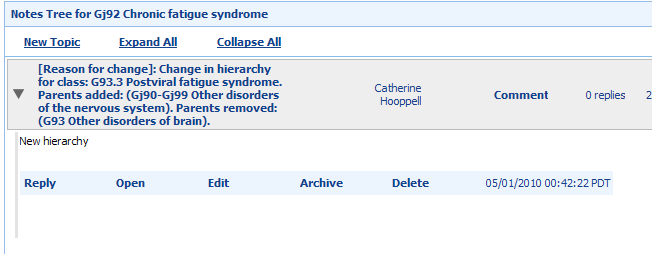
May 2010: iCAT preliminary drafting platform: For the chapter Diseases of the nervous system, this iCAT Discussion Note records a change in hierarchy for class: G93.3 Postviral fatigue syndrome. Its parent: G93 Other disorders of brain is being removed. New parent added: Other disorders of the nervous system.

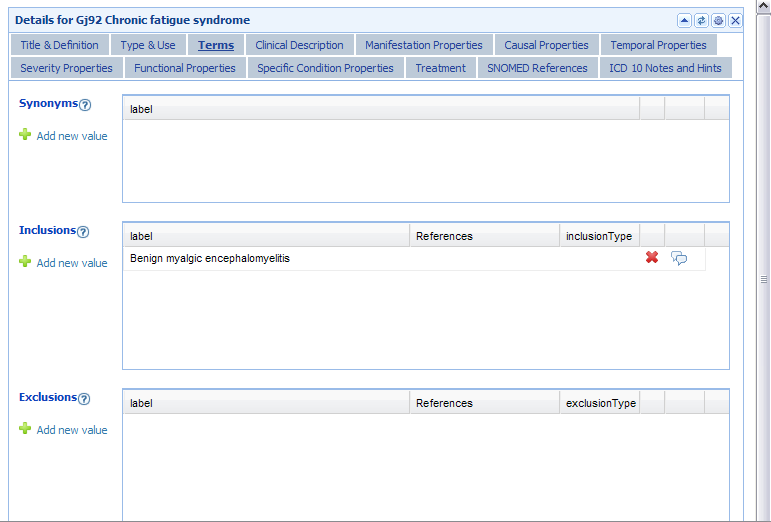
Additionally, this Change History note records that ICD Title term: Postviral fatigue syndrome is being replaced by new ICD Title term: Chronic fatigue syndrome.

A Definition is inserted for new ICD Title: Chronic fatigue syndrome.

Benign myalgic encephalomyelitis is listed as an Inclusion term to new ICD Title: Chronic fatigue syndrome.

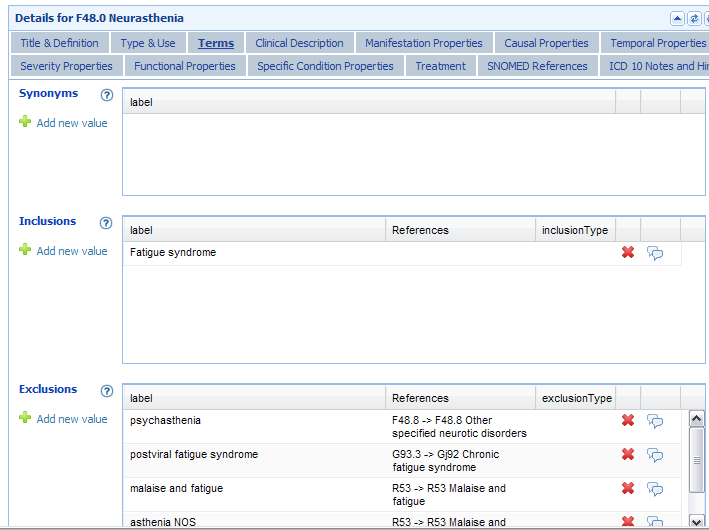
At this point, there is no listing of Postviral fatigue syndrome under Synonyms or Inclusions to ICD Title: Chronic fatigue syndrome, nor elsewhere within the iCAT draft, other than remaining listed as an Exclusion term to F48.0 Neurasthenia and R53 Malaise and fatigue.

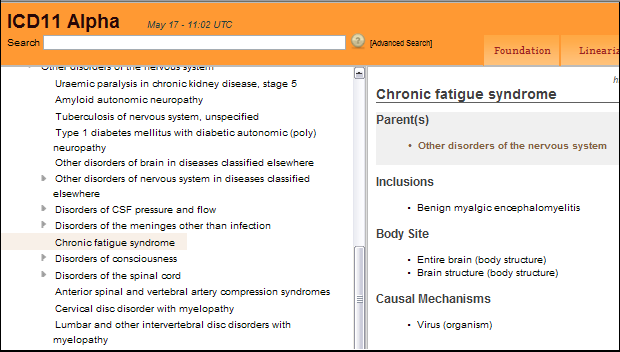
May 2011: Alpha drafting platform launches: New ICD Title: Chronic fatigue syndrome remains coded under parent class Other disorders of the nervous system. “Virus (organism)” is listed under the Content Model parameter for “Causal Mechanisms.”

Benign myalgic encephalomyelitis remains listed as an Inclusion term to ICD Title: Chronic fatigue syndrome.

The term Postviral fatigue syndrome remains unaccounted for.

May 2012: Beta drafting platform launches

July 2012: Beta draft: ICD Title: Chronic fatigue syndrome can no longer be found as a child category directly under parent class: Other disorders of the nervous system.

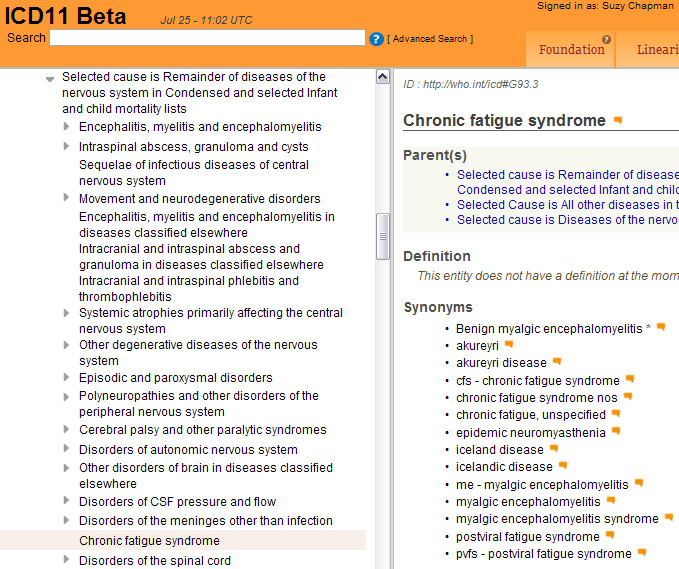
If searched for, the term displays instead under a new “Selected Cause” section, which displays as a kind of subset or sub linearization within the Foundation Component View. It displays with three parents:

Selected cause is Remainder of diseases of the nervous system in Condensed and selected Infant and child mortality lists
Selected Cause is All other diseases in the Selected General mortality list
Selected cause is Diseases of the nervous system

as here, in this July 25, 2012 screenshot.

A large number of terms from other chapters are now also grouped under this “Selected Cause” subset within the Foundation Component. There is no explanation in the public version of the Beta draft what the purpose of the “Selected Cause” subset is or how the categories now listed under it relate to the parent classes under which they were previously coded as child categories. (These “Selected Cause” listings are later dispensed with, at least in the public version of the Beta draft, or are possibly disabled from being generated.)

Other changes: The Definition field for Chronic fatigue syndrome is now blanked.

Benign myalgic encephalomyelitis is listed under Synonyms and specified as an Inclusion term in the linearizations.

13 additional terms are now listed under Synonyms, including Postviral fatigue syndrome, and two terms imported from ICD-10-CM (the ICD-10-CM Chapter 18 R codes: chronic fatigue syndrome nos and chronic fatigue, unspecified).

November 2012: Beta draft: As above, but a brief, revised Definition for Chronic fatigue syndrome has now been inserted by ICD-11 Revision. It reads as follows:

Chronic fatigue syndrome is characterized by extreme chronic fatigue of an indeterminate cause, which is disabling andt [sic] does not improve with rest and that is exacerbated by physical or mental activity.

I have sourced this Definition to this ICD Revision Rare Diseases internal document titled: “Import_RD_definitions” (the Definition text is listed in this .txt file at “1983|Chronic fatigue syndrome|http://who.int/icd#G93.3…”).

Spring 2013: Beta draft:

Since early 2013, no listing can be found in any chapter of the public version of the ICD-11 Beta draft, under any linearization, for any of the terms, Postviral fatigue syndrome, Benign myalgic encephalomyelitis or Chronic fatigue syndrome, as discrete ICD Title terms, or as Inclusion terms or under Synonyms to Title terms, or in the ICD-11 Beta Index.

However, Postviral fatigue syndrome remains listed in the Beta draft as an Exclusion term to Chapter 19: Fatigue and Benign myalgic encephalomyelitis remains listed as an Exclusion term to Chapter 01: Encephalitis, myelitis and encephalomyelitis.*

*In ICD-10, the Title term, G93.3 Postviral fatigue syndrome is also an Exclusion term to F48.0 Neurasthenia. But for ICD-11 and ICD-11-PHC (the primary health care version), the proposal is to eliminate F48.0 Neurasthenia or subsume it under a new, single, “Bodily stress syndrome” (BSS) or “Bodily distress disorder” (BDD) category, in Chapter 05, which is proposed to replace a number of existing ICD-10 Somatoform disorders.

+++

A Beta draft black hole?

June 2013–February 2014: During this period I have contacted several key ICD-11 Revision personnel and the Chair of the Topic Advisory Group for Neurology, directly, with polite requests for clarification of ICD-11 Revision’s current intentions for the chapter classification, coding and hierarchical relationship for these three ICD-10 G93.3 entities.

I have also submitted, via the public version of the Beta drafting platform, a number of requests for clarification and an explanation for their current absence from the draft. At the time of publishing, I have received no clarification from any quarter, either directly, or via the Beta platform.

If the (now 12 month long) absence of these three terms is due to administrative error or oversight, then ICD Revision has had around a dozen opportunities, since last June, to respond to me with an explanation or to restore these three terms to the Beta draft.

It appears this is an issue that no-one involved in the development of the Beta draft is prepared to be accountable for.

I have asked for clarification for the following:

(…) Currently, no entry for any of the terms, Chronic Fatigue Syndrome; Benign Myalgic encephalomyelitis; or Postviral fatigue syndrome, under any hierarchy, can be found within any chapter of ICD-11 Beta, in either the Foundation or Morbidity Linearization views, the PDF print version, or the PDF of the Index.

1. Under which chapter and parent categories are the three ICD-10 G93.3 entities

Chronic Fatigue Syndrome;
Benign Myalgic encephalomyelitis;
Postviral fatigue syndrome

currently proposed to be classified within ICD-11?

2. What is the current proposed hierarchy or relationship within ICD-11 between these three entities, in terms of Title term, Inclusion term, Synonym, and which of these three terms are proposed to be assigned a Definition and other “Content Model” parameters?

3. What is the reason for these three terms not currently displaying in the public version of the Beta drafting platform?

+++
So why have these three ICD-10 terms disappeared and why is ICD Revision reluctant to respond?

The reports on this site are evidence based: in the absence of clarifications directly from ICD Revision, or documentary evidence from reliable sources, I prefer, in general, not to speculate but here are some speculative reasons which might account for the current absence of these three terms from the public version of the Beta draft:

There has been no significant change to proposals in the last 12 months, but the terms have been removed from the draft in order to mitigate controversy over the proposed change of hierarchy (i.e. whether a term is included as a Title term, coded for and assigned a Definition and other Content Model descriptions, or specified as an Inclusion Term to a coded term, or listed under Synonyms to a coded term) and/or over the wording of any proposed Definition or other Content Model descriptive text.

 Topic Advisory Group (TAG) for Neurology intends to retain these three terms under Chapter 07, under an existing parent class that is still undergoing reorganization, and has taken these three terms out of the linearizations in the meantime.

TAG Neurology intends to locate the terms under a new Chapter 07 parent class which does not currently display in the linearizations in the public version of the Beta, or which does display but for which child categories have yet to be populated.

TAG Neurology intends to locate one or more of these terms under a parent class within a subset or sub linearization that cannot currently be generated within the public version of the Beta, for technical reasons.

Unlike ICD-10, multiple parents are allowable under ICD-11: TAG Neurology may intend to assign one or more or these terms to multiple parents within the same chapter, or to code to parents located under more than one chapter, for example, under parent classes, Symptoms, signs and clinical findings involving the nervous and musculoskeletal system or Functional disorders of the nervous system (located under both Chapter 07 and Chapter 19), and has removed the terms in the meantime in order to avoid controversy.

Many categories within ICD-11 are already coded under multiple parents where a disease overlaps two chapters, with the term in black text under the primary parent location and in grey text for the secondary or tertiary location(s), e.g. a skin tumor is both a skin disease and a neoplasm; diseases of the eye as a result of diabetes, or as a result of developmental anomalies.

At one point, ICD Revision was discussing a proposal for a Multisystem Diseases Chapter. This has been rejected in favour of potentially assigning diseases that affect multiple body systems to multiple parents across overlapping chapters, or creating a specific linearization for multisystem diseases as a virtual chapter within the electronic version of ICD-11.

TAG Neurology proposes to retire one or more of these three terms (despite earlier assurances by senior WHO classification experts):

TAG Neurology and TAG Mental Health may be under pressure from the Primary Care Consultation Group to adopt a proposed replacement for the ICD-10 Somatoform disorders that draws heavily on the Per Fink et al construct, “Bodily Distress Syndrome” (BDS). BDS is a single, unifying diagnosis that is inclusive of the somatoform disorders, and the so-called “functional somatic syndromes,” FM, CFS and IBS (which are currently discretely coded or indexed, within ICD-10, in chapters outside the mental and behavioural disorders chapter).

If consensus has not yet been reached about whether the proposed replacement for ICD-10’s Somatoform disorders will more closely mirror DSM-5’s “Somatic symptom disorder” or will incorporate elements of Fink et al’s “Bodily Distress Syndrome,” the three terms, Chronic Fatigue Syndrome, Benign Myalgic encephalomyelitis and Postviral fatigue syndrome may have been removed from the public version of the Beta draft in order to avoid controversy. (It is not yet known which of the two advisory groups’ proposals will be progressing to field testing, this year.)

TAG Neurology may have removed these terms from the public version of the Beta draft in order to avoid controversies surrounding the development of CFS and ME case definitions, for example, the issue of the HHS contract with U.S. Institute of Medicine (IOM) to develop “evidence-based clinical diagnostic criteria for ME/CFS” and to “recommend whether new terminology for ME/CFS should be adopted.”

Whatever the reason, ICD Revision has repeatedly dodged accountability and transparency for its actions.

Having “disappeared” these three ICD terms from the Beta draft, with no explanation, WHO and the ICD Revision Steering Group are disenfranchising professional and advocacy stakeholders from scrutiny of, and participation in the revision process.

Compiled by Suzy Chapman | Dx Revision Watch
Image | Wikimedia Commons courtesy Ute Kraus, Physics education group Kraus, Universität Hildesheim, Space Time Travel, (background image of the milky way: Axel Mellinger)


Media coverage: Karina Hansen now detained six months against her will in Hammel Neurocenter, Denmark

Post #273 Shortlink: http://wp.me/pKrrB-3kV

Update at September 9: According to reports linked to by ME Forenginen, Danmark, on Facebook:

The Hansen parents had a court hearing on September 5, 2013, to challenge the legality of Karina’s guardianship. Karina’s removal from her home by the authorities and her continued detention at Hammel Neurocenter was not scheduled to be covered during the court proceedings.

The Danish Aktion Karina/Term group that has been protesting outside Hammel Neurocenter and the Aarhus Research Clinic for Functional Disorders (the clinic that is advising Hammel Neurocenter on Ms Hansen’s treatment), are planning a new demonstration in front of the Ministry of Health. The event is scheduled for September 26, in Copenhagen.

For more information on this event: https://www.facebook.com/events/536076826466062/

Update at August 30: It is understood that a meeting between the Hansen parents and physicians at Hammel Neurocenter took place on Tuesday, August 28; that Dr Gerdes and lawyer, Mr Tørnes, were not permitted to attend this meeting and that the parents were denied access to visit their daughter.* I will post further information if and when an official update is released.

*Source: https://www.facebook.com/meforeningen.dk

There have been further protests staged, this week, at Hammel Neurocenter:

Aktion Karina – Myalgisk Encephalomyelitis (ME) Aktion 2, Dag 1:

http://www.youtube.com/watch?v=lFfilet_upo

Update: According to ME Forenginen, Danmark, on Facebook, the Hansen parents have been called to a meeting in the next couple of weeks with Merete Stubkjær Christensen, chief physician, Regionshospitalet, Hammel Neurocenter. Doctor Stig Gerdes and lawyer, Paul Tørnes, have sent a further letter to the Aarhus Research Clinic for Functional Disorders (that is advising Hammel Neurocenter on Ms Hansen’s treatment), following a telephone conversation with the Clinic. It is understood that Dr Gerdes and Mr Tørnes were hoping to attend this anticipated meeting with Merete Stubkjær Christensen to support the parents.

Update: YouTube: Danish Aktion Karina/Term group protest (Day 5):
http://www.youtube.com/watch?v=0tAAJvJmhH4

Update: YouTube: Danish Aktion Karina/Term group protest Hammel Neurocenter (Day 4): http://www.youtube.com/watch?v=OqDUJworpaY

Update: New article, August 14: Dagbladet Holstebro (Subscription required for access)

http://dagbladet-holstebro-struer.dk/holstebro/beskyldte-mor-for-alvorlige-svigt-af-syg-datter

Beskyldte mor for alvorlige svigt af syg datter (Accused mother of serious failure of sick daughter)

Update: YouTubes: Danish Aktion Karina/Term group protests about Karina Hansen’s treatment (Days 1 to 5):

Aktion Karina Day 1: http://www.youtube.com/watch?v=zDBhlnw6DMo

Aktion Karina Day 2: http://www.youtube.com/watch?v=yAf2fH8qhuQ

Aktion Karina Day 3: http://www.youtube.com/watch?v=vpCd9ZGAEY8

Aktion Karina Day 4: http://www.youtube.com/watch?v=OqDUJworpaY

Aktion Karina Day 5: http://www.youtube.com/watch?v=0tAAJvJmhH4

“Karina er en 24 årig ME-syg kvinde, som er blevet tvangsindlagt på Hammel Sygehus, underkastet regler for psykiatrien og hun er under psykiaterne på Forskning klinikken for de såkaldte funktionelle lidelsers bestemmelser og fulde kontrol.

“Karinas telefon er gået død, og er ikke mere i brug. Karina har ikke adgang til en PC. Familiens advokat har fået at vide, at han ikke er Karinas advokat. Karina må ikke modtage besøg.

“Karinas retssikkerhed er alvorligt truet. Karina udsættes for fysisk træning, hvilket ofte skader Me-patienter. Karina har ikke set sine forældre siden indlæggelsen for over 100 dage siden. Psykiaterne på Forskningsklinikken for de såkaldte funktionelle lidelser har fået ansvaret for ME-syge i DK, selvom udenlandske og indlandske eksperter mener, at ME er en neurologisk eller en immunologisk sygdom og ikke en psykiatrisk sygdom. Psykiaterne har voldsomt brug for en succeshistorie, da de har fået ansvaret for et helt nyt ME-videns-center, som fremover skal have ansvaret for ME-syge i DK. Psykiaterne på Forskningsklinikken vil ikke samarbejde med specialister i ME, men kun med andre psykiatere.”

Aktion Karina/Term site – https://www.facebook.com/events/214896588665066/

Update: New article, August 14: Ekstra Bladet

http://ekstrabladet.dk/nationen/article2066198.ece

Voldsomt: 5 betjente tvangsindlægger 24-årig  (Violently: 5 cops forced hospitalization of 24-year-old)

Lige nu demonstrerer ca. 20 borgere mod tvangsindlæggelsen af 24-årige karina, der blev fjernet fra hjemmet – uden forældrenes accept Af: Thomas Harder

(Right now, around 20 citizens demonstrate against forced admission of 24 year old Karina, who was removed from home – without parental consent By Thomas Harder)

“De har taget hende og har gjort hende til en psykiarisk sygdom – men hun er fysisk syg, og vi er meget bekymrede for hende”

(“They have taken her and assigned her a psychiatric illness – but she is physically ill, and we are very concerned for her”)

As previously posted on August 14

+++

“…They have not seen their adult daughter for almost six months, after she was forcibly hospitalized in Hammel Neurocenter. Against her parents’ wishes. Against her own wishes. Not even their daughter’s lawyer can get an explanation…”

+++

KHBW2On 12 February, 24 year old Karina Hansen of Holstebro, Denmark, was removed from her home by five policemen, two doctors, two social workers and a locksmith, who threatened to break down the door to the family home.

She was taken, against her will, to Hammel Neurocenter. For six months, now, Karina has remained in hospital and is denied visits from her parents, Per and Ketty Hansen.

Karina is unable to access her legal representative because the hospital and health authorities refuse to acknowledge the lawyer whom she engaged to represent her, in 2012.

The authorities have appointed a guardian over the heads of Karina and her parents, who held power of attorney for their daughter, pictured on the left.

Rebecca Hansen, chairman, ME Foreningen, Danmark (ME Association, Denmark), who is not a relative, has been acting as lay advocate to the Hansen family. The most recent update on Karina’s situation was published here on Dx Revision Watch, in June.

For links to translations of Update 2: Human Rights denied: Something rotten in the state of Denmark: Karina Hansen’s story in Danish, German and Dutch go here.

Professor Per Fink, Aarhus Research Clinic for Functional Disorders is advising Hammel Neurocenter on Karina’s treatment – a treatment regime she has made plain she does not wish to receive, in a setting she does not wish to be detained in.

Her rights, as a patient, to determine where and by what means and for how long she is treated, to receive documentation and a treatment plan and access to her family and her lawyer, are being denied by Danish Health authorities.

For information on Aarhus Research Clinic and Per Fink et al’s construct of Bodily Distress Syndrome, see Part Two of Dx Revision Watch Post: ICD-11 Beta draft and Bodily Distress Disorders; Per Fink and Bodily Distress Syndrome

+++

National media coverage of the case

On August 10, four reports were published by the newspaper, BT, Danmark (a Danish national tabloid):

http://www.bt.dk/danmark/foraeldre-naegtet-at-se-syg-datter-mor-hvordan-skal-jeg-komme-vaek-herfra

Forældre nægtet at se syg datter: ’Mor, hvordan skal jeg komme væk herfra?’

(Parents are refused [visits] to see sick daughter: ‘Mom, how do I get out of here?’)

by Morten Eggert

also

http://www.bt.dk/danmark/derfor-blev-24-aarige-k-fjernet-fra-sine-foraeldre

Derfor blev 24-årige K fjernet fra sine forældre

(Why was 24 year old K removed from her parents?)

also

http://www.bt.dk/danmark/24-aarig-patient-i-slaar-mig-ihjel

24-årig patient: I slår mig ihjel

(24 year old patient: “You are killing me”)

(As I don’t speak Danish and since this is a very sensitive case, I prefer not to provide imperfect and potentially inaccurate auto translations or summaries; the gist of these reports can be roughly auto translated via Google, Bing or other translators.)

also

[Image] http://xa.yimg.com/kq/groups/86982676/219750998/name/BT

Politiker: De må ikke tvangsindlægge

(Politician: They don’t forcibly hospitalize)

“Liselott Blixt, health spokesperson for Dansk Folkeparti (The Danish People’s Party) and Chairman of the Folketing § 71-supervision, which keeps an eye on the use of coercion, has now prompted a statement from Region Midtjylland on this deeply unhappy case…”

+++

Local media coverage

A local paper (Dagbladet Holstebro-Struer) also reported on the case, last week, on 10 August, with a four page interview with Per and Ketty Hansen. Subscribers can read the interview with Karina’s parents, in Danish, online, here:

http://dagbladet-holstebro-struer.dk/holstebro/de-tog-vores-datter

They took our daughter

+++
From ME Forenginen, Danmark’s Facebook page: https://www.facebook.com/meforeningen.dk

On August 13, BT published an interview with ME Forenginen, Danmark’s, Vice-Chair, Cathrine Engsig, about the treatment of Karina Hansen and her parents:

[Image] https://fbcdn-sphotos-b-a.akamaihd.net/hphotos-ak-frc3/p480x480/995990_412997052143731_905956157_n.jpg

+++

Demonstrations

According to ME Forenginen, Danmark’s, Facebook page, a non-affiliated Danish group has started a 5 day demonstration in Aarhus and Hammel to raise awareness of Karina’s plight.

A series of demonstrations started on Monday, 12 August, and ends on Friday, 16 August, in the afternoon.

More information here: https://www.facebook.com/events/214896588665066

+++

Initiatives

According to ME Forenginen, Denmark’s Facebook page, doctor Stig Gerdes and lawyer Stig Tornaes have contacted psychiatrist, Professor Per Fink, Aarhus Research Clinic for Functional Disorders, who is advising Hammel Neurocenter on Karina’s treatment. A copy of their letter can be read, in Danish, on ME Forenginen, Danmark’s, Facebook page, here:

https://www.facebook.com/meforeningen.dk

I will update when further official updates or media coverage become available.

Clarification
Reports and updates on Dx Revision Watch site on the Hansen family’s situation are being published as provided by, and in consultation with, Rebecca Hansen, Chairman, ME Foreningen, Danmark (ME Association, Denmark), or edited from reports as provided. Dx Revision Watch site has no connection with any petitions or initiatives, or with any websites, social media platforms or other platforms set up to promote petitions or initiatives, or to otherwise raise awareness of the Hansen family’s situation. All enquiries in relation to any petitions or other initiatives, or platforms associated with them should be addressed directly to the organizers, sponsors or owners responsible for them.

+++

Previous posts

Something rotten in the state of Denmark: Karina Hansen’s story: http://wp.me/pKrrB-2Xc

Human Rights denied: Something rotten in the state of Denmark: Karina Hansen’s story: Update 1: http://wp.me/pKrrB-35o

Update 2: Human Rights denied: Something rotten in the state of Denmark: Karina Hansen’s story: http://wp.me/pKrrB-390

+++

Links

Website for ME Foreningen, Danmark www.me-foreningen.dk

Official petition launched and sponsored by the ME Association of Denmark, and approved by the Hansen family: http://www.ipetitions.com/petition/postcardtokarina/
For more information on the ME Association of Denmark’s postcard campaign go here on Facebook
For information on Bodily Distress Syndrome see Part Two of Dx Revision Watch Post: ICD-11 Beta draft and BDD, Per Fink and Bodily Distress Syndrome
Opdater 2: Menneskerettighederne nægtet: Noget råddent i staten Danmark: Karina Hansen: http://wp.me/pKrrB-390
Update 2: Human Rights denied: Something rotten in the state of Denmark: Karina Hansen’s story: http://wp.me/pKrrB-390
Update 2: Ontkenning van mensenrechten: Iets verrot in de staat van Denemarken: Het verhaal van Karina Hansen: http://wp.me/pKrrB-390
Update 2: Menschenrechtsverstoß: Etwas ist faul in Dänemark: Karina Hansens Geschichte: http://wp.me/pKrrB-390
Update 2: Droits de l’Homme: Il y a quelque chose de pourri au royaume du Danemark: l’histoire de Karina Hansen: http://wp.me/pKrrB-390

Translations for Update 2: Human Rights denied: Something rotten in the state of Denmark: Karina Hansen’s story

Post #269 Shortlink: http://wp.me/pKrrB-3hQ

Translations of June 19, 2013 report by Rebecca Hansen, chairman, ME Foreningen, Danmark (ME Association, Denmark).

KHBW2

Karina Hansen has now been detained in Hammel Neurocenter against her will for 6 months

If there is a Norwegian translation or other languages other than those below, I’d be pleased to have links to add to this page. You can contact me via the Contact form.


English: http://wp.me/pKrrB-390 Update 2: Human Rights denied: Something rotten in the state of Denmark: Karina Hansen’s story

You are killing me.” Experimental treatment forced on a severely ill ME patient


Dansk: http://wp.me/pKrrB-3gj Opdater 2: Menneskerettighederne nægtet: Noget råddent i staten Danmark: Karina Hansen

”I slår mig ihjel.” Svært ME syg patient tvinges til eksperimentel behandling


Deutsch  | UFOCOMES-blog

Ihr bringt mich um.” Schwer an ME erkrankte Patientin wird zu experimenteller Behandlung gezwungen


Nederlandse  |  ME|cvs Vereniging   |  PDF Nederlandse vertaling

“Jullie vermoorden mij.” Ernstig zieke ME-patiënte gedwongen tot een experimentele behandeling


For earlier posts:

May 11, 2013: Something rotten in the state of Denmark: Karina Hansen’s story: http://wp.me/pKrrB-2Xc

May 25, 2013: Human Rights denied: Something rotten in the state of Denmark: Karina Hansen’s story: Update 1: http://wp.me/pKrrB-35o

May 25, 2013: Menneskerettighederne nægtet: Noget råddent i staten Danmark: Karina Hansen: Opdater 1: http://wp.me/pKrrB-36e

Information on ME Foreningen postcard campaign and petition on Facebook or here: www.me-foreningen.dk

For information on Bodily Distress Syndrome see Part Two Dx Revision Watch Post: ICD-11 Beta draft and BDD, Per Fink and Bodily Distress Syndrome

Opdater 2: Menneskerettighederne nægtet: Noget råddent i staten Danmark: Karina Hansen

Post #267 Shortlink: http://wp.me/pKrrB-3gj

+++

”I slår mig ihjel.”

+++
KH5

Rebecca Hansen, lay advocate to the Hansen family, has issued a further update on Karina’s situation.

Dansk udgave

Svært ME syg patient tvinges til eksperimentel behandling

Af Rebecca Hansen, formand for ME Foreningen

”I slår mig ihjel” gentager svært ME-syge Karina Hansen til sygeplejerskerne, når hun tvinges til kontroversiel og udokumenteret behandling, som kaldes GET (gradvist øget træning).

Karina, 24 år, har Myalgisk Encephalomyelitis (ME), en neuro-immun sygdom, som siden 1969 har haft World Health Organization koden G93.3.

ME-eksperterne savner stadig svar på mange aspekter af sygdommen, men der er bred enighed om, at ME-patienter lider af en dysfunktion i evnen til at producere energi og genvinde kræfter efter motion og enhver form for anstrengelse. Dette kaldes post-exertional malaise – eller PEM. Forskning har vist, at GET forværrer tilstanden hos størstedelen af let ramte ME-patienter [1] [2] [3].

I Belgien behandlede statsfinancierede referencecentre let angrebne ME-patienter med GET, men en evaluering af disse centre viste, at GET ikke var effektiv, og at patienterne faktisk kunne arbejde MINDRE efter de havde fået behandlingen [4] [5].

Read more of this post