Bodily Distress Syndrome: Coming soon to a GP Management Pilot near you…

Post #264 Shortlink: http://wp.me/pKrrB-3dG

NHS England: Pilot of Enhanced GP Management of Patients with Medically Unexplained Symptoms

NHS Barnet Clinical Commissioning Group

Pilot of Enhanced GP Management of Patients with Medically Unexplained Symptoms
Open full size PDF:

Click link for PDF document  Pilot of Enhanced GP Management of Patients with MUS

or download here:

http://tinyurl.com/k44xg7d

Note the use of the term “Bodily Distress Syndrome (BDS)” despite the lack of a body of evidence to support the validity, reliability, safety and clinical utility of the application of the BSD construct* in primary care.

Note also, the list of illnesses under the definition of “MUS”: Chronic Pain, Fibromyalgia, Somatic Anxiety/Depression, Irritable Bowel Syndrome (IBS), Chronic Fatigue Syndrome (CFS), Myalgic Encephalomyelitis (ME), Post-viral Fatigue Syndrome.

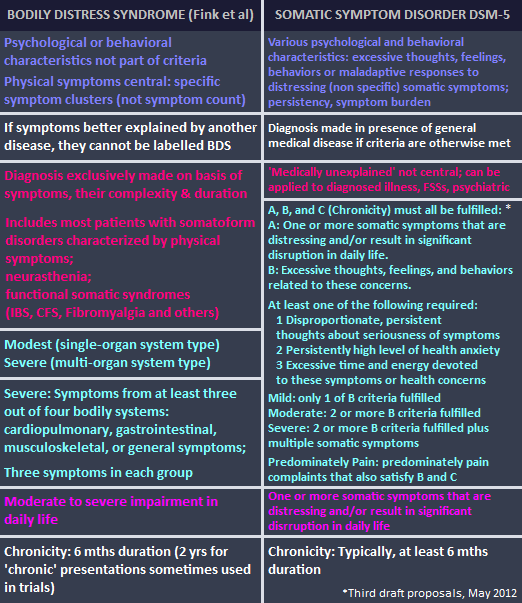
*For information on the Fink et al concept of “Bodily Distress Syndrome” see Part Two of Dx Revision Watch Post: ICD-11 Beta draft and BDD, Per Fink and Bodily Distress Syndrome


Extracts:

22 May 2013

NHS England

PILOT OF ENHANCED GP MANAGEMENT OF PATIENTS WITH MEDICALLY UNEXPLAINED SYMPTOMS

NHS Barnet Clinical Commissioning Group

Background

Medically Unexplained Symptoms

Definition

The term ‘medically unexplained symptoms (MUS)’ are physical symptoms that cannot be explained by organic pathology, which distress or impair the functioning of the patient. Patients often present with physical symptoms that cannot be explained even after thorough investigation. Other terms used to describe this patient group include: Functional Somatic Syndrome (FSS), Illness Distress Symptoms (IDS), Idiopathic Physical Symptoms (IPS), Bodily Distress Syndrome (BDS) and Medically Unexplained Physical Symptoms (MUPS).

Symptoms and Diagnosis

Symptoms

Headache
Shortness of Breath, palpitations
Fatigue, weakness, dizziness
Pain in the back, muscles, joints, extremity pain, chest pain, numbness
Stomach problems, loose bowels, gas/bloating, constipation, abdominal pain
Sleep disturbance, difficulty concentrating, restlessness, slow thoughts
Loss of appetite, nausea, lump in throat
Weight change

Diagnosis

Chronic Pain
Fibromyalgia
Somatic Anxiety/Depression
Irritable Bowel Syndrome
Chronic Fatigue Syndrome
Myalgic Encephalomyelitis
Post-viral Fatigue Syndrome

PROJECT AIMS AND OBJECTIVES

• To pilot a commissioner initiated, enhanced GP management service for patients with MUS in primary care. Refer to Figure 1 for details.

• The pilot will be carried out at selected Barnet GP practices (approximately 15) managing a minimum of 10 patients with MUS over 12 months.

• To identify patients with MUS using an electronic risk stratification tool the ‘Nottingham Tool’ with a review of the generated list at a multidisciplinary (MDT) GP practice meeting for the final patient selection.

• To enhance post-graduate GP training by providing education and training workshops and focused work group meetings on the management of MUS.

• The project will also test the assertion that identification and management of MUS would result in savings to commissioning budgets.

PROJECT OUTCOMES AND BENEFITS

There are several benefits that could be realised from implementing this project. These are as follows:-

• Improved outcomes for patients with MUS, better patient experience

• Improved quality of life

• Improved GP-Patient relationship

• Reduced GP secondary and tertiary referrals

• Reduced unnecessary GP and hospital investigations and prescribing of medicines

• Reduced GP appointments and out of hours appointments to A&E or GP

CONCLUSIONS

There is a high prevalence of patients with medically unexplained symptoms presenting to primary and secondary care services. Patients with MUS are high healthcare service users having a major impact to our local health economy and health outcomes. GPs are well placed to manage MUS patients as this patient group are 50% more likely to attend primary care. We believe that our proposed enhanced management of care by the GP will result in both market and non-market benefits. This proposal has gained approval from the NHS Barnet CCG Primary Care Strategy and Implementation Board, QIPP Board and the NCL Programme Board for the 2013/14 financial year…

etc.

Related material

+++
IAPT NHS Long Term Conditions and Medically Unexplained Symptoms

IAPT NHS Medically Unexplained Symptoms

PHQ-15

The “Nottingham Tool”

Click link for PDF document   Medically Unexplained Symptoms (MUS): A Whole Systems Approach in Plymouth

In partnership with:

Plymouth Hospitals NHS Trust, Sentinel Healthcare Southwest CIC, Southwest Development Centre, September 2009

+++

Click link for PDF document   Medically Unexplained Symptoms (MUS) A whole systems approach
NHS Commissioning Support for London
July 2009 – December 2010

+++

Karina Hansen initiatives: A clarification

Post #260 Shortlink: http://wp.me/pKrrB-38n

Karina Hansen initiatives: Clarification notice

I have now published three posts on my site in relation to the Hansen family’s situation:

Something rotten in the state of Denmark: Karina Hansen’s story: http://wp.me/pKrrB-2Xc

(In English)

Human Rights denied: Something rotten in the state of Denmark: Karina Hansen’s story: Update 1: http://wp.me/pKrrB-35o

(Update in English)

Menneskerettighederne nægtet: Noget råddent i staten Danmark: Karina Hansen: Opdater 1: http://wp.me/pKrrB-36e

(Update in English and Danish)

Clarification

Reports and updates on Dx Revision Watch site on the Hansen family’s situation are being published as provided by, and in consultation with, Rebecca Hansen, Chairman, ME Foreningen, Danmark (ME Association, Denmark), or edited from reports as provided.

Dx Revision Watch site has no connection with any petitions or initiatives, or with any social media platforms or other platforms set up to promote petitions or initiatives, or to otherwise raise awareness of the Hansen family’s situation.

All enquiries in relation to any petitions or other initiatives, or social media platforms, or any other platforms associated with them should be addressed directly to the organizers, sponsors or owners responsible for them.

+++
The official petition launched and sponsored by ME Foreningen, Danmark and approved by the Hansen family can be found here: http://www.ipetitions.com/petition/postcardtokarina/

For more information on the ME Foreningen, Danmark petition go here on Facebook

Website:

ME Foreningen, Danmark
www.me-foreningen.dk

For first report (in English) see: Something rotten in the state of Denmark: Karina Hansen’s story: http://wp.me/pKrrB-2Xc

For more information on the ME Association of Denmark’s postcard campaign go here on Facebook
For information on Bodily Distress Syndrome see Part Two of Dx Revision Watch Post: ICD-11 Beta draft and BDD, Per Fink and Bodily Distress Syndrome
Menneskerettighederne nægtet: Noget råddent i staten Danmark: Karina Hansen: Opdater 1: http://wp.me/pKrrB-36e
Human Rights denied: Something rotten in the state of Denmark: Karina Hansen’s story: Update 1: http://wp.me/pKrrB-35o
Ontkenning van mensenrechten: Iets verrot in de staat van Denemarken: Het verhaal van Karina Hansen: Update 1: http://wp.me/pKrrB-35o
Menschenrechtsverstoß: Etwas ist faul in Dänemark: Karina Hansens Geschichte: Update 1: http://wp.me/pKrrB-35o
Droits de l’Homme: Il y a quelque chose de pourri au royaume du Danemark: l’histoire de Karina Hansen: Update 1: http://wp.me/pKrrB-35o

New Danish and German guidelines for “Bodily distress” and functional disorders published

Post #259 Shortlink: http://wp.me/pKrrB-36F

New Danish and German guidelines for “Bodily distress” and “functional disorders”

Update:

Slide presentation [23 slides in PDF format]

http://www.regionsyddanmark.dk/dwn225587

Or open on Dx Revision Watch site:

Session 4 – Medicinsk uforklarede symptomer – Marianne Rosendal

Medicinsk uforklarede symptomer og funktionelle lidelser

“Medically unexplained symptoms and functional disorders”

Marianne Rosendal, Research Unit for General Practice, Institute of Public Health, Aarhus University

+++
Related information:

Trygfonden invites applications for funding for research on functional disorders
http://www.kronisktraethedssyndrom.dk/Diverse/Trygfonden.pdf
Trygfonden has allocated 48 million for research on functional disorders. The application deadline for the last 28 million kroner is 6 April 2010.
Lene Toscano får 3,3 mio. kr. til formidling af viden om funktionelle lidelser
Lene Toscano gets 3.3 million kr. for dissemination of knowledge about functional disorders
Specialist in General Medicine Lene Toscano, Aarhus University Hospital, has received 3,336,458 kr. from TrygFonden to examine how best to communicate and share knowledge about functional disorders.

+++
As previously posted:

In February, I published information on the status of current proposals for revision of ICD-10 “Somatoform Disorders” for the ICD-11 core version, as displayed in the ICD-11 Beta drafting platform, and on proposals for ICD-11-PHC, the abridged primary care version of ICD.

In Part Two of that post, I compiled information on “Bodily Distress Syndrome,” a disorder construct developed by Per Fink and colleagues initially for research studies, now used in clinical practice at The Research Clinic for Functional Disorders and Psychosomatics, Aarhus.

See post #222 ICD-11 Beta draft and Bodily Distress Disorders; Per Fink and Bodily Distress Syndrome Parts One and Two

+++

Today, I have three new “Bodily Distress Disorders” related items to bring to your attention:

1. The World Psychiatric Association (WPA) is holding its 2013 International Congress in October, in Vienna. Four topics relating to “Bodily Distress Disorders” are being presented:

Bodily Distress Disorders and the new classifications

Bodily Distress Disorders at the work place: prevention and treatment

A stepped care approach for bodily distress disorders: the new interdisciplinary German guideline

Raising the awareness for the health political relevance of Bodily Distress Disorders – a European agenda

Symposia presenters include:

Francis Creed (member of the DSM-5 Somatic Symptom Disorders Work; member of the WHO Working Group on Somatic Distress and Dissociative Disorders, reporting to the International Advisory Group for the Revision of ICD-10 Mental and Behavioural Disorders; co-author book [1], paper [2]).

Per Fink (The Research Clinic for Functional Disorders and Psychosomatics, Aarhus, Denmark, co-author book [1], paper [3]).

Peter Henningsen (Co-author book [1]).


2] A new German guideline has been published, with summary texts in German and English language:

Neue Leitlinien zu funktionellen und somatoformen Störungen

CLINICAL PRACTICE GUIDELINE Non-Specific, Functional, and Somatoform Bodily Complaints

Rainer Schaefert, Constanze Hausteiner-Wiehle, Winfried Häuser, Joram Ronel, Markus Herrmann, Peter Henningsen. Dtsch Arztebl Int 2012; 109(47): 803−13 [PMID 23341111]

Abstract [in English] here:

New guidelines on functional and somatoform disorders

The S3 guideline “Dealing with patients with non-specific, functional and somatoform bodily symptoms” emphasizes the similarities in the management of the manifold manifestations of so called “medically unexplained symptoms” and gives recommendations for a stepped and collaborative diagnostic and therapeutic approach in all subspecialties and all levels of health care. It has a special focus on recommendations regarding attitude, physician-patient-relationship, communication, the parallelization of somatic and psychosocial diagnostics and a stepped therapeutic approach. The “Evidence-based guideline psychotherapy in somatoform disorders and associated syndromes” provides a differentiated analysis of the current evidence regarding the effectiveness of various psychotherapeutic interventions for the most relevant manifestations of functional and somatoform disorders. In combination, both guidelines pose important advances for treatment quality in Germany, but also illustrate remarkable structural and research deficits.

Abstract [in German] here:

Neue Leitlinien zu funktionellen und somatoformen Störungen

Official summary version texts:

English language version:
S3 Clinical Practice Guideline: Non-specific, Functional, and Somatoform Bodily Complaints” (NFS)
or open PDF on Dx Revision Watch:
S3 Non-specific, Functional and Somatoform Bodily Complaints 2013-01

+++
German language version:

http://www.aerzteblatt.de/archiv/132847
MEDIZIN: Klinische Leitlinie Nicht-spezifische, funktionelle und somatoforme Körperbeschwerden
Clinical Practice Guideline: Non-specific, functional and somatoform bodily complaints
Dtsch Arztebl Int 2012; 109(47): 803-13; DOI: 10.3238/arztebl.2012.0803
or open PDF on Dx Revision Watch:
Nicht-spezifische, funktionelle und somatoforme Körperbeschwerden

Correspondence in response to summary version:

Letter: Iatrogenic Chronification as a Result of Pseudo Diagnosis
Dr. med. Rainer Hakimi, Stuttgart
In Reply:
Dr. med. Rainer Schaefert
Klinik für Allgemeine Innere Medizin und Psychosomatik, Universitätsklinikum Heidelberg

3] New Danish Association for General Practitioners (DSMA) guide for general practice on functional disorders:

Funktionelle lidelser for Almen Praksis

Ny vejledning sætter fokus på funktionelle lidelser Practicus | April 2013

“New guide focuses on functional disorders”

[Article in Danish]

This article introduces the new Danish Association for General Practitioners (DSMA) guide for general practitioners, published this May. The Working Group for the guide, which included Per Fink, was chaired by Marianne Rosendal.

Access document here in PDF [in Danish]:

Funktionelle lidelser Dansk Selskab for Almen Medicin 2013

or open PDF on Dx Revision Watch: Funktionelle lidelser 2013

Related information:
Lene Toscano får 3,3 mio. kr. til formidling af viden om funktionelle lidelser
Lene Toscano gets 3.3 million kr. for dissemination of knowledge about functional disorders
Specialist in General Medicine Lene Toscano, Aarhus University Hospital, has received 3,336,458 kr. from TrygFonden to examine how best to communicate and share knowledge about functional disorders.

Notes:

ICD-11 Beta drafting platform Bodily Distress Disorder: Mild; Moderate; Severe

“Bodily distress disorder” (BDD) is being proposed as a new category for ICD-11 to replace a number of existing ICD-10 “Somatoform Disorders.”

An alternative construct, called Bodily stress syndrome (BSS), has been put out for international primary care focus group evaluation by the working group for the revision of ICD-10-PHC (the abridged primary care version of ICD-10), and will be undergoing ICD-11 field testing and analysis. There is no public domain information available on where BSS will be field tested or on field trial study design, patient selection, criteria etc.

Although ICD-11 is at the Beta drafting stage and scheduled for WHA approval in 2015, the public version of the Beta drafting platform has yet to define this proposed new BDD category, characterize its three, proposed severities: Mild; Moderate; Severe, or populate any of its “Content Model” parameters.

It has sat there since February 2012, a tabula rasa.

At the time of writing, it remains unspecified which disorders BDD is proposed to capture.

It isn’t clear whether its criteria are proposed to be based on unspecified somatic symptoms, symptom counts or specific constellations of symptoms (eg gastrointestinal, musculoskeletal); whether psychological or behavioural responses are central to its definition; whether it is intended to be inclusive of selected of the so-called “functional somatic syndromes”; whether, like DSM-5’s SSD, its reach would be extended to include patients with somatic symptoms in association with diagnosed diseases, such as cancer or diabetes.

It is not possible to determine from what little information displays in the public version of the drafting platform whether ICD-11 proposes that BDD would mirror or incorporate Per Fink’s construct of “Bodily Distress Syndrome” for definition, criteria, severity specifiers, inclusions, exclusions etc; or whether it intends BDD to also incorporate DSM-5’s “Somatic Symptom Disorder” (and if so, how might this be achieved, since BDS and SSD lack congruency); or whether a unique definition for BDD is being developed and tested specifically for ICD-11.

Until ICD-11 defines BDD, it presents barriers to professional and lay stakeholders inputting meaningful comment on this proposal, which has remained undefined for over a year.

If the working groups advising ICD-11 Revision are putting forward a Per Fink “BDS” model for BDD, or an adaptation of Per Fink’s model, it is not known how WHO classification experts view any proposal that might seek to shift several, discrete, ICD-10 categories with long-standing classification locations outside the Mental and behavioural disorders chapter of ICD, into Chapter 5, and subsume them under a new disorder construct, for which there is no body of evidence for its validity as a construct and safety of application outside research settings.

Note that the ICD-11 Beta draft is a work in progress: proposals for new disorders for ICD-11 are subject to field trial evaluation and approval by Topic Advisory Group Managing Editors, the ICD-11 Revision Steering Group and WHO classification experts.

These two papers and a book chapter discuss emerging proposals for ICD-11 and ICD-11-PHC:

Lam TP, Goldberg DP, Dowell AC, Fortes S, Mbatia JK, Minhas FA, Klinkman MS. Proposed new diagnoses of anxious depression and bodily stress syndrome in ICD-11-PHC: an international focus group study. Fam Pract 2012 [PMID: 22843638]*
Creed F, Gureje O. Emerging themes in the revision of the classification of somatoform disorders. Int Rev Psychiatry 2012;24:556-67. [PMID: 23244611]
Goldberg DP. Comparison Between ICD and DSM Diagnostic Systems for Mental Disorders. In: Sorel E, (Ed.) 21st Century Global Mental Health. Jones & Bartlett Learning, 2012: 37-53 [Free PDF, Sample Chapter Two: http://samples.jbpub.com/9781449627874/Chapter2.pdf]
*SHORT REPORT Kuruvilla, A, Jacob KS. Perceptions about anxiety, depression and somatization in general medical settings: A qualitative study. National Medical Journal of India, vol. 25, no. 6, pp. 332–335, 2012

+++

What is “Bodily Distress Syndrome”?

The Per Fink et al construct of BDS is a unifying diagnosis that encompasses a group of what are considered to be closely related conditions such as somatization disorder, fibromyalgia, chronic pain disorder, irritable bowel syndrome, chronic fatigue syndrome and ME, multiple chemical sensitivity (MCS) and whiplash associated disorder. On some BDS presentation slides, “Stress and burn out…and many more…” are added to the list.

From the Aarhus Research Clinic website:

“…recent research suggests that the different diagnoses are all subcategories of one single illness, namely BDS…

“…BDS is a new research diagnosis and therefore unfamiliar to many doctors. Most doctors do know the different diagnoses mentioned in the above box, but they are unaware that they can be viewed as one single illness…”

In May 2010, Per Fink and Andreas Schröder, PhD, MD, Aarhus Universitetshospital, Denmark, published the paper, “One single diagnosis, bodily distress syndrome, succeeded to capture 10 diagnostic categories of functional somatic syndromes and somatoform disorders.” [Abstract: PMID: 20403500].

According to the authors of this 2012 EACLPP Conference Abstract: Bodily Distress Syndrome: A new diagnosis for functional disorders in primary care, the concept of “Bodily Distress Syndrome”

is expected to be integrated into the upcoming versions of classification systems.

This 2010 Danish journal article sets out proposals by Fink et al for a new classification:

Journal article: Fink P, Rosendal, M et al. Ny fælles diagnose for de funktionelle sygdomme. [PDF, in Danish]

Note: This proposal by Fink, Rosendal et al has three hitherto discrete ICD-10 classifications, Fibromyalgia (M79.7), IBS (K58) and Chronic Fatigue Syndrome (indexed to G93.3 in ICD-10; classified in ICD-11 Beta draft as an ICD Title term within ICD-11 Chapter 6: Diseases of the nervous system) proposed to be relocated under the ICD-11 mental and behavioural disorders chapter (Chapter 5) and subsumed under a single new disorder classification, “Bodily Distress Syndrome,” along with Neurasthenia (F48.0), Hypochondriasis and some other ICD-10/DSM-IV Somatoform Disorders.

Page 1837

Proposed new classification on left;  Current classifications on right:
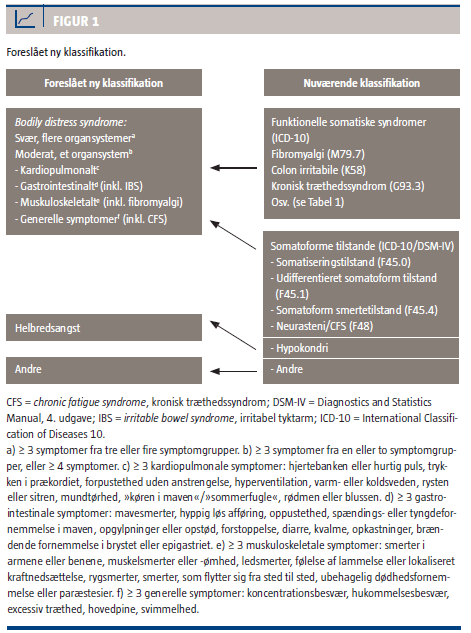
Danish Journal paper Fink P

Here, the same proposal set out in English, from a Danish presentation:

(Note: MS type = Musculoskeletal)

Slide Presentation Two [PDF, in Danish; some slides in English]

Bodily Distress Syndrome (BDS), og helbredsangst  Udvikling af diagnoserne, assessment og forskning på området, Oplæg ved Sundhedspsykologisk, Årsmøde 2011

Slide #11 of 97
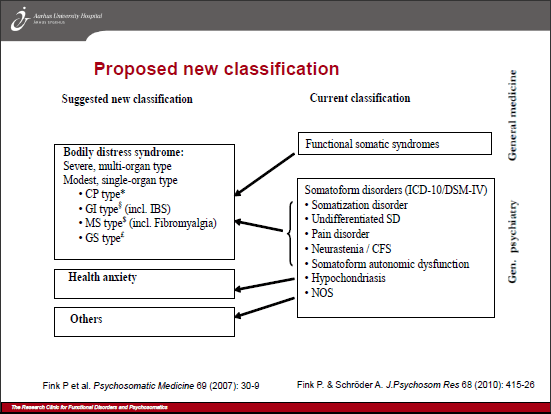
Fink: Proposed New Classification

For further information on proposals for “Bodily Distress Disorder” for ICD-11 and on Per Fink’s “Bodily Distress Syndrome” see Dx Revision Watch post #222: ICD-11 Beta draft and Bodily Distress Disorders; Per Fink and Bodily Distress Syndrome Parts One and Two

References

1. Medically Unexplained Symptoms, Somatisation and Bodily Distress: Developing Better Clinical Services. Creed, Francis; Henningsen, Peter; Fink, Per, Cambridge University Press, 2011. Sample pages on Google Books
2. Creed F, Gureje O. Emerging themes in the revision of the classification of somatoform disorders. Int Rev Psychiatry 2012;24:556-67. [Abstract: PMID: 23244611]
3. Fink P, Schröder A. One single diagnosis, bodily distress syndrome, succeeded to capture 10 diagnostic categories of functional somatic syndromes and somatoform disorders. J Psychosom Res. 2010 May;68(5):415-26. [Abstract: PMID: 20403500]
4. ICD-11 Beta drafting platform: Bodily Distress Disorder: Mild; Moderate; Severe. Proposed revision to ICD-10 Somatoform Disorders

Menneskerettighederne nægtet: Noget råddent i staten Danmark: Karina Hansen: Opdater 1

Post #258 Shortlink: http://wp.me/pKrrB-36e

Clarification

Reports and updates on Dx Revision Watch site on the Hansen family’s situation are being published as provided by, and in consultation with, Rebecca Hansen, Chairman, ME Foreningen, Danmark (ME Association, Denmark), or edited from reports as provided by Ms Hansen.
Dx Revision Watch site has no connection with any petitions or initiatives, or with any social media platforms or other platforms set up to promote petitions or initiatives, or to otherwise raise awareness of the Hansen family’s situation. The use of any links to content on Dx Revision Watch does not imply endorsement of, or association with any initiatives other than the ME Foreningen, Danmark (ME Association, Denmark) Postcard to Karina Campaign.
All enquiries in relation to petitions or other initiatives, social media platforms, or any other platforms associated with them should be addressed directly to the organizers, sponsors or owners responsible for them.

+++

”Har ME-patienter ikke ret til at vælge, hvilken behandling vi ønsker at modtage? Har vi ikke ret til besøgende, når vi er på hospitalet?”

+++
Karina HansenOpdater 1: Menneskerettighederne nægtet

On May 11, on the eve of ME Awareness week, I published an account, of the plight of the Hansen family, in Denmark.

Karina Hansen is 24. She has been bedridden with severe ME since 2009.

In February, this year, Karina was forcibly removed from her bedroom and committed to Hammel Neurocenter.

Her parents have not seen Karina for over three months.

The Hansen family and their lawyer are still waiting for legal documentation and answers to their questions:

Which authority gave the order to remove Karina from her home against her will and by whom was it authorized?

What legislation was used to detain her as an involuntary patient in a hospital?

Why are the parents being denied visits?

Two updates on the case have been released, this week. These are being published, as provided, and with permission of the Hansen family and their lawyer.

+++
Første rapport:
Noget råddent i staten Danmark: Karina Hansen: http://wp.me/pKrrB-2Xc

Verdenserklæringen om Menneskerettighederne: http://www.unric.org/da/information-om-fn/15

Status på Karinas sag – 24.5.13

Af Rebecca Hansen

Følgende tekst er godkendt af familien.

Karina er forsat indlagt på Hammel Neurocenter. Lægen Jens Gyring har givet mundtlig besked til familien om, at indlæggelsen vil forsætte i lang tid – måske et år. Vi har ikke set noget bevis for, at Karina har fået det bedre.

Karinas forældre har en fuldmagt, som giver dem ret til at træffe beslutninger for Karina, også omkring hendes behandling. Denne fuldmagt ignoreres.

Fuldmagten blev oprettet i maj 2012. Karinas praktiserende læge erklærede hende psykisk rask 2 gange i maj 2012.

Sundhedsstyrelsen (SST) påstår, at Karinas advokat ikke er hendes advokat, da de nu mener, at hun ikke var habil, da hun antog advokaten i maj 2012. Advokaten har repræsenteret Karina siden maj 2012 og fik aktindsigt i Karinas sag på dette grundlag. Dernæst oplyser SST, at advokaten havde fuldmagt i 2012 ved første mislykkede forsøg på at få Karina tvangsindlagt (03.05.12) men at fuldmagten ikke er gældende for episoden med hendes endelige tvangsfjernelse og indlæggelse i februar 2013.

Psykiater Nils Balle Christensen skriver, at Karina er voksen og myndig til at træffe ”her og nu beslutninger”, og at de på Hammel Neurocenter ikke gør noget imod hendes vilje. Men samtidig, mener Holstebro Kommune at Karina har brug for en værge og Statsforfatningen Midtjylland har fået til opgave at udpege en værge til hende og hermed umyndiggøre hende.

ME Foreningen kontaktede Patientkontoret den 29. april 2013 for at få navn på Karinas patientrådgiver, idet Foreningen ønsker at bidrage med viden om sygdommen og vil herudover forsøge at skaffe en udenlandsk ME ekspert til landet, der kan tilse Karina. Svaret var at ”sagen er overgivet til Juridisk kontor i Region Midtjylland.”

Karinas forældre og jeg prøvede at besøge Karina den 12. maj, men blev nægtet adgang. Du kan læse om dette på ME Foreningens facebook under noter.

Nils Balle Christensen skriver, at der ikke er besøgsforbud, men Karinas forældre må alligevel fortsat ikke besøge hende. Der gives en mundlig besked til forældrene, at ”juristerne” vil oprette et ”dokument” omkring ”besøgsrestriktionerne”. Denne kan Karinas forældre forvente at få fremsendt i løbet af 7-14 dage.

Vi har ringet til Karinas mobil som hun har med på hospitalet mange gange, men den går direkte på voicemail.

+++

Et besøg hos Karina – et spørgsmål om menneskerettigheder

Af Rebecca Hansen
ME-patient
icerebel62@hotmail.com

Den 12. maj besluttede Karinas forældre og jeg igen at prøve at besøge Karina på Hammel Neurocenter. Karina er en alvorligt syg dansk ME-patient, som er blevet tilbageholdt på Hammel Neurocenter siden den 12. februar 2013, og i denne periode har hendes forældre ikke fået lov til at besøge eller tale med hende.

Karinas advokat har for nylig fået en meget begrænset adgang til nogle af dokumenterne i Karinas sag ved hjælp af offentlig aktindsigt. Af dette materiale fremgik det, at det faktisk ikke er tilladt i Danmark at forhindre pårørende i at besøge deres familie på hospitalet, og at menneskerettighederne har høj prioritet.

Karina forældre var blevet fortalt, at de skulle mødes med Nils Balle Christensen (NBC), en psykiater fra Forskningsklinikken for Funktionelle Lidelser, for at tale om betingelserne for besøg, før de kunne se deres datter. Da Karinas søster, Janni, besøgte Karina i april, fik Janni instruktioner om, hvad hun måtte sige og ikke sige til Karina. Forældrene fik slet ikke lov at komme ind, fordi de fik at vide, at de først skulle mødes med NBC for at afgøre betingelserne for besøg.

Men nu vidste vi, at det ikke er legalt at have sådanne restriktioner på besøg, så vi besluttede at prøve at se Karina søndag den 12. maj – på Mors Dag og den internationale mærkedag for ME.

Før jeg fortæller om besøget, vil jeg fortælle om den kontakt, som NBC har haft med Karina og hendes familie.

Nils Balle Christensen blev involveret i Karinas sag i maj 2012, efter Karinas advokat havde forhindret hendes fjernelse efter psykiatrisk lovgivning. Han blev præsenteret for familien, og hans opgave var at udarbejde en behandlingsplan til Karina. I løbet af sommeren 2012 besøgte NBC Karinas forældre adskillige gange med henblik på at etablere en behandlingsplan. I denne periode ønskede NBC ikke at samarbejde med Karinas advokat, og NBC leverede ikke en skriftlig behandlingsplan. Karinas forældre har aldrig modtaget nogen skriftlige instrukser for Karinas pleje og der var ingen kritik af den pleje, de gav Karina. Jeg var til et møde med NBC og Karinas forældre i 2012, hvor NBC fortalte moderen, at hun gjorde et godt stykke arbejde. NBC kom med et tilbud om at indlægge Karina, men ikke med en plan om hvad der ville ske, når hun blev indlagt. De fik heller ikke nogen forklaring på, hvorfor man ikke kunne behandle Karina i hjemmet. Karinas forældre turde ikke acceptere en ukendt behandling fra en læge, der aldrig før har behandlet (eller set) en alvorlig syg ME-patient. Af mange årsager stolede Karinas forældre ikke på NBC, og kontakten med NBC blev afbrudt i starten af efteråret 2012. Karinas forældre valgte at betale for en privat læge og en diætist til at hjælpe Karina.

Karinas forældre troede, at NBCs involvering med Karina nu var afsluttet. Men den begrænsede adgang, som Karinas advokat nu har opnået ved offentlig aktindsigt afslører, at NBCs engagement langt fra var overstået.

Dokumenterne viser, at der var aktivitet i Karinas sag imellem Sundhedsstyrelsen og henholdsvis Holstebro Kommune, Holstebro politi samt til NBC, efter at hans kontakt til forældrene var stoppet.

Desuden afslører disse papirer, at der var en forespørgsel til Ministeriet for Sundhed og Forebyggelse om retten til at forhindre pårørende i at besøge familiemedlemmer på et hospital. Den 21. december 2012 sendte ministersekretæren for Ministeriet for Sundhed og Forebyggelse et 5-siders svar, der forklarer, at menneskerettighederne har høj prioritet (vejer meget tungt).

Men i NBCs skrivelse af 12. februar 2013 til Karinas forældre står der:

”Det er besluttet, at Karina, pga. sin tilstand, ikke må have besøg de første 14 dage. Det vil herefter blive vurderet, om hun er i stand til at modtage besøg.”

Med disse nye oplysninger om menneskerettighederne i hånden, besluttede Karinas forældre og jeg os den 12. maj for at se, om der stadig var et forbud imod eller begrænsninger på at besøge Karina på Hammel Neurocenter.

Vi ønskede ikke, at personalet skulle føle sig truet af os på nogen måde, så vi havde på forhånd aftalt, at hvis vi fik at vide, vi ikke kunne besøge Karina, ville vi respektere dette, men vi ville stille en masse spørgsmål om, hvorfor dette forbud / denne begrænsning var oprettet.

På Hammel præsenterede Karinas forældre sig for personalet og bad om tilladelse til at se deres datter. Der blev svaret ”nej”, og at det skulle have været aftalt telefonisk med lægen. Jeg spurgte, om der var et besøgsforbud. Det blev der svaret ”nej” til. Så spurgte jeg, om der var restriktioner, men det blev ikke besvaret. I stedet svarede medarbejderen, at hun ville ringe til Jens Gyring, som er overlægen på stedet. De bad os om at vente. Medarbejderne på Hammel Neurocenter var høflige og venlige, men det var tydeligt, at de var beklemte ved vores tilstedeværelse.

Et øjeblik senere vendte sygeplejersken tilbage med svar fra Jens Gyring, at forældrene først skulle have et møde med NBC, inden de kunne se deres datter. Vi diskuterede denne begrænsning, og Karinas forældre bad om en skriftlig forklaring på, hvorfor de skulle have et møde med NBC, før de kunne se deres datter, og hvad hensigten med mødet ville være.

Jeg understregede, at det ikke er lovligt at forhindre forældre i at besøge sit barn og prøvede at vise dem udtalelsen fra Ministeriet for Sundhed og Forebyggelse. En anden medarbejder brød ind og sagde, at denne diskussion skulle tages med lægerne og ikke med dem.

I mellemtiden var Jens Gyring blevet kontaktet igen og havde sagt, at man skulle spørge Karina om hun vil have besøg. En ny sygeplejerske deltog i vores diskussion og sagde: ”Jeg har lige været inde ved Karina og fortalt, at I er her og spurgt om hun vil have besøg, og hun rystede bare på hovedet.”

Meget interessant, at der pludselig ikke var noget besøgsforbud, men at det nu var op til Karina…

Til det svarede jeg, at vi gerne ville have en hel sætning fra Karina for at sikre, at hun forstod spørgsmålet. Vi ønskede at høre hende sige, at hun ikke ville se sin mor og far. Vi kunne ikke rigtig vide, om hun forstod spørgsmålet, eller om hun virkelig troede på, at de var her efter 3 måneder. Desuden bærer Karina normalt ørepropper, så måske hørte hun ikke engang spørgsmålet.

Karinas mor sagde, at hun gerne vil høre ordene fra Karinas egen mund. At hun gerne ville se Karina og høre hendes svar. Og hvis Karina bad hende om at gå, ville hun straks gå igen.

Personalet insisterede på, at Karina havde svaret.

Her skal man huske på, at det sidste Karina sagde til sin mor den 13. februar var, da hun ringede til sin mor og sagde: ”Hvordan kommer jeg ud herfra. Jeg kan ikke klare det.” – Hvad er der sket de sidste 3 måneder? Ønsker Karina virkelig ikke at se sine forældre? Hvis dette er tilfældet, hvad er så årsagen? Hvilken begrundelse har lægerne givet Karina for, at forældrene ikke besøger hende? Vi er overladt til at gætte svarene på disse spørgsmål.

Det var tydeligt, at forældrene ikke ville få lov til at se Karina og selv høre, at Karina ikke ønskede et besøg. Men vi fik de ansatte til at love at få NBC til at sende forældrene en skriftlig erklæring om, hvorfor de skulle have et møde med ham, før de kunne se deres datter, og hvad mødet ville handle om. De lovede også at oplade Karinas mobiltelefon og give den til hende. Så forlod vi Neurocenteret. Karinas mor havde tårer i øjnene og sagde: ”Jeg troede virkelig, at jeg ville få hende at se i dag.”

Efter hjemkomsten skrev Karinas forældre en mail til Nils Balle Christensen og bad igen om på skrift at få at vide, hvorfor de ikke må se Karina, og hvad dagsordenen er for det møde, han kræver, før de kan se hende.

Til dette svarede NBC, at der ikke er besøgsforbud. Og siden Karinas forældre ikke ønsker at mødes med NBC, kan de i stedet mødes med overlæge Jens Gyring: ”hvor der kan laves skriftlige aftaler om fremtidige besøg og telefonkontakt med mere”.

Er det ikke stadig et besøgsforbud, indtil deres betingelser er opfyldt? Hvordan er det forskelligt fra et besøgsforbud, indtil forældrene mødes med NBC? Hvilken ret har de til at stille disse betingelser?

Få dage senere fik Karinas forældre at vide af Jens Gyring, at det ville være op til advokaterne at lave en skriftlig aftale om besøg. Dette kunne tage 2 uger.

I mellemtiden kan vi tænke over, hvad denne situation betyder for andre ME-patienter og deres pårørende i Danmark. En alvorligt syg ME-patient får tilkendt en psykiater, som aldrig før har behandlet en alvorligt syg ME-patient. Psykiateren kommer fra en klinik, der har fravalgt at samarbejde med internationale ME eksperter (brev fra september 2012 og referat fra mødet den 8. oktober 2012). Psykiateren ønsker ikke at samarbejde med patientens advokat eller oplyse noget på skrift om den behandling, han vil give.

Når ME-patienten og de pårørende beslutter, at de ikke ønsker den behandling, som denne psykiater tilbyder, så samarbejder de danske myndigheder for at fjerne ME-patienten fra hjemmet – tydeligt imod hendes vilje – og isolere hende fra hendes pårørende og advokat.

Psykiateren, der har ansvaret for Karina, er også ansvarlig for alle ME-patienter i Danmark – så er det fremtiden for alle ME-patienter og deres familier i Danmark?

Har ME-patienter ikke ret til at vælge, hvilken behandling vi ønsker at modtage? Har vi ikke ret til besøgende, når vi er på hospitalet?

Ja, der er virkelig noget råddent i Danmarks rige.

Hvis jeg har misforstået noget i denne historie, så vil jeg være glad for at høre en forklaring fra de involverede parter.

Rebecca Hansen
ME-patient
Icerebel62@hotmail.com

+++
For first report (in English) see:

Something rotten in the state of Denmark: Karina Hansen’s story: http://wp.me/pKrrB-2Xc

For more information on the ME Association of Denmark’s postcard campaign go here on Facebook
For information on Bodily Distress Syndrome see Part Two of Dx Revision Watch Post: ICD-11 Beta draft and BDD, Per Fink and Bodily Distress Syndrome
Menneskerettighederne nægtet: Noget råddent i staten Danmark: Karina Hansen: Opdater 1: http://wp.me/pKrrB-36e
Human Rights denied: Something rotten in the state of Denmark: Karina Hansen’s story: Update 1: http://wp.me/pKrrB-35o
Ontkenning van mensenrechten: Iets verrot in de staat van Denemarken: Het verhaal van Karina Hansen: Update 1: http://wp.me/pKrrB-35o
Menschenrechtsverstoß: Etwas ist faul in Dänemark: Karina Hansens Geschichte: Update 1: http://wp.me/pKrrB-35o
Droits de l’Homme: Il y a quelque chose de pourri au royaume du Danemark: l’histoire de Karina Hansen: Update 1: http://wp.me/pKrrB-35o

Human Rights denied: Something rotten in the state of Denmark: Update 1

Post #257 Shortlink: http://wp.me/pKrrB-35o
Clarification notice
Reports and updates on Dx Revision Watch site on the Hansen family’s situation are being published as provided by, and in consultation with, Rebecca Hansen, Chairman, ME Foreningen, Danmark (ME Association, Denmark), or edited from reports as provided by Ms Hansen.
Dx Revision Watch site has no connection with any petitions or initiatives, or with any social media platforms or other platforms set up to promote petitions or initiatives, or to otherwise raise awareness of the Hansen family’s situation. The use of any links to content on Dx Revision Watch does not imply endorsement of, or association with any initiatives other than the ME Foreningen, Danmark (ME Association, Denmark) Postcard to Karina Campaign.
All enquiries in relation to petitions or other initiatives, social media platforms, or any other platforms associated with them should be addressed directly to the organizers, sponsors or owners responsible for them.

+++

“…Do ME patients in Denmark not have the right to choose which treatment we want to receive? Do we not have the right to visitors when we are in the hospital?”

+++
Karina Hansen

Update 1: Human Rights denied

On May 11, on the eve of ME Awareness week, I published an account of the plight of the Hansen family, in Denmark. Karina Hansen is 24. She has been bedridden with severe ME since 2009.

In February, this year, Karina was forcibly removed from her bedroom and committed to Hammel Neurocenter.

Her parents have not seen Karina for over three months.

The Hansen family and their lawyer are still waiting for legal documentation and answers to their questions:

Which authority gave the order to remove Karina from her home against her will and by whom was it authorized?

What legislation was used to detain her as an involuntary patient in a hospital?

Why are the parents being denied visits?

Two updates on the case have been released, this week. These are being published, as provided, and with permission of the Hansen family and their lawyer.

+++
For the first report see:

Something rotten in the state of Denmark: Karina Hansen’s story: http://wp.me/pKrrB-2Xc

For reports in Danish see:

Menneskerettighederne nægtet: Noget råddent i staten Danmark: Karina Hansen: Opdater 1: http://wp.me/pKrrB-36e

The Universal Declaration of Human Rights: https://www.un.org/en/documents/udhr/

Status on Karina’s Case – May 24th, 2013

By Rebecca Hansen
Chairman, ME Foreningen, Danmark (ME Association, Denmark)

The following text has been approved by the family.

Karina is still hospitalized at Hammel Neurocenter. Dr. Jens Gyring gave a verbal message to the family that this could continue for a long time, perhaps a year. We have not seen any evidence that Karina is getting better.

Karina’s parents have a power of attorney that gives them the right to make decisions for Karina, also about her treatment. But this is ignored.

The power of attorney was made in May 2012. Karina’s general practitioner declared her psychologically healthy twice, in May 2012.

The Danish Board of Health claims that Karina’s lawyer is not her lawyer, as they now state that Karina was not competent when she hired her lawyer in May 2012. The lawyer has represented Karina since May 2012 and received access to Karina’s case at that time on the basis that he had authority as her lawyer. Then, The Danish Board of Health informed her lawyer, that it is true that he had authority at the time of the first failed attempt to section Karina (May 3, 2012), but that the power of attorney does not apply to the incident in February 2013, when Karina was forcibly removed and hospitalized.

The psychiatrist, Nils Balle Christensen, writes that Karina is an adult and has the ability to make “here and now decisions” [“her og nu beslutninger”] and that Hammel Neurocenter is doing nothing against her will. But at the same time, Holstebro Kommune believes that Karina needs a guardian and Statsforfatningen Midtjylland has been asked to appoint one for her. This will disempower Karina completely and leave all decisions up to her guardian.

The ME Association, Denmark, contacted the Patient Office on April 19, 2013 to ask for the name of Karina’s patient advisor. We wished to inform the advisor about Karina’s illness and to offer to bring an ME expert to Denmark to examine Karina. The answer from the Patient Office was that “the case is handed over to the Legal Office in Region Midtjylland.”

Karina’s parents and I tried to visit Karina on May 12, 2013, but we were denied access to her. You can read more about our attempt on the ME Association’s Facebook page under Noter.

Nils Balle Christensen writes that there is not a ban on visits, but Karina’s parents are still not allowed to visit her. A verbal message was given to Karina’s parents that  “the laywers” will create a “document” about the “visit restrictions.” Karina’s parents expect to get that in the next 7-14 days.

Karina has her mobile phone at the hospital and we have tried to call it many times, but it always goes directly to voice mail.

+++

A Visit to Karina – a Question of Human Rights

Rebecca Hansen
ME patient
Icerebel62@hotmail.com

On May 12, Karina’s parents and I decided once again try to visit Karina at Hammel Neurocenter. Karina is a severely ill Danish ME patient being held at Hammel Neurocenter since February 12, 2013, during which time her parents have not been allowed to visit or talk to her.

Karina’s lawyer has recently received a very limited access to some of the paperwork in Karina’s case by using the Public Records Act. This revealed that it is actually not permitted in Denmark to prevent relatives from visiting their family members in the hospital and that human rights have priority.

Karina’s parents had been told that they must meet with Nils Balle Christensen (NBC), a psychiatrist from the Research Center for Functional Disorders and Psychosomatics [Aarhus], to talk about the conditions of visitation before they could see their daughter. When Karina’s sister, Janni, visited Karina in April, Janni was given instructions about what she could and could not say to Karina. The parents were not allowed in at all because they were told they first needed to meet with NBC to decide the conditions of visitation.

But now we knew that it is not legal to have this restriction on visits, so we decided to try to see Karina on Sunday May 12 – Mother’s Day and International ME Awareness Day.

Before I tell about the visit, I will tell about the contact NBC has had with Karina and her family.

Nils Balle Christensen became involved with Karina’s case in May 2012 after Karina’s lawyer prevented her removal under a psychiatric law. He was introduced to the family and his job was to help make a treatment plan for Karina. During the summer of 2012, NBC visited the family several times with the purpose of making a treatment plan for Karina. During this time, NBC did not want to cooperate with Karina’s lawyer and NBC did not deliver a written treatment plan. Karina’s parents never received any written instructions for Karina’s care and there was no criticism of the care they were giving Karina.

I was at a meeting with NBC and Karina’s parents in August 2012 where NBC told the mother that she was doing a good job. NBC came with an offer to hospitalize Karina, but not a plan about what would happen when she was hospitalized. They also did not receive an explanation as to why they could not treat Karina at home. Karina’s parents did not dare to agree to an unknown treatment from a doctor who has never before treated (or even seen) a severely ill ME patient. For many reasons, Karina’s parents did not trust NBC and contact with NBC was stopped in the early fall of 2012. Karina’s parents chose to pay for a private doctor and a dietician to help Karina.

Karina’s parents believed that NBC’s involvement with Karina was now over. But the limited access that Karina’s lawyer has now obtained under the Public Records Act reveals that NBC’s involvement was far from over.

The paperwork shows that there was activity in Karina’s case between from the Board of Health to Holstebro county and the Holstebro police, as well as to NBC after his contact with her parents had stopped.

Furthermore, these papers reveal that there was an inquiry to the Ministry for Health and Prevention [Ministeriet for Sundhed og Forebyggelse] about the right to prevent relatives from visiting family members at a hospital. On December 21, 2012, the Minister secretary sent a 5-page answer that explains that human rights have priority (weigh very heavily).

But in NBC’s letter to Karina’s parents on Februay 12, 2013, it says:

“It has been decided that because of Karina’s condition, she may not have visitors the first 14 days. After that, it will be evaluated if she is able to have visits.”

With this new information about human rights in hand, Karina’s parents and I decided on May 12 to see if there was still a ban or restrictions on visitation to Karina at Hammel Neurocenter.

We did not want the staff to feel threatened by us in any way, so we had agreed ahead of time that if we were told we could not visit Karina, we would respect this, but would ask a lot of questions about why this ban/restriction was being made.

At Hammel, Karina’s parents introduced themselves to the staff and asked for permission to see their daughter. The answer was No and we were told that they should have made an appointment with the doctor before coming. I asked if there was a ban on visits and they answered No, not a ban. Then I asked if there were restrictions, but did not receive an answer. Instead, a staff member said that she would call Jens Gyring, the head doctor at the center. They asked us to wait. The staff at Hammel Neurocenter were polite and friendly, but it was obvious that they were not comfortable with us being there.

A few minutes later, the nurse returned and said that Jens Gyring’s answer was that the parents must first have a meeting with NBC before they could see their daughter. We discussed this restriction and Karina’s parents asked for a written explanation as to why they had to have a meeting with NBC before they could see their daughter and what the intent of the meeting would be.

I pointed out that it was not legal to prevent parents from seeing their child and tried to show them the statement from the Ministry of Health and Prevention [Ministeriet for Sundhed og Forebyggelse]. A second staff member broke in to say that this discussion must be taken up with the doctors and not them.

In the meantime, Jens Gyring was contacted again and said that Karina should be asked if she wanted to have a visit. A new nurse joined our discussion and said: “I have just been in with Karina and said you were here and asked if she wanted a visit and she just shook her head.”

Very interesting that suddenly there was no ban, but now it was up to Karina…

To that I said that we would like to have a whole sentence from Karina to make sure she understood the question. We wanted to hear her say that she didn’t want to see her mom and dad. We couldn’t really know if she understood the question or if she really believed they were there after three months. Also, Karina usually wears earplugs, so maybe she did not even hear the question.

Karina’s mom said that she would like to hear the words from Karina’s own mouth. That she would like to see Karina and hear Karina’s answer. And if Karina told her to leave, she would go away immediately.

The staff insisted that Karina has answered.

Remember, the last thing Karina said to her mother was on February 13, when Karina called her mother and said: “How do I get out of here? I can’t take this.” – What has happened in the last three months? Does Karina really not want to see her parents? And if so, why not? What have the doctors told Karina about why her parents are not visiting? We can only guess the answers to these questions.

It was clear that her parents would not be allowed to see Karina and hear for themselves that she didn’t want a visit. But we did get the staff to promise to have NBC send them a written statement about why they had to have a meeting with him before they could see their daughter and what the meeting would be about. They also promised to charge up Karina’s cell phone and give it to her. Then we left the [Hammel] Neurocenter. Her mom had tears in her eyes and said, “I really thought I was going to see her today.”

When her parents got home, they wrote a mail to NBC and once again asked for a written explanation as to why they may not see Karina and what the agenda would be for the meeting that he requires before they can see her.

NBC answered that there is no ban on visits. And since Karina’s parents don’t want to meet with NBC, then they can meet with the head doctor Jens Gyring instead: “where there can be made written agreements about future visits, telephone contact and more.”

Isn’t this still a ban until their conditions are met? How is this any different from a ban on visits until the parents meet with NBC? What right do they have to make this condition?

A few days later, Karina’s parents were told by the doctor Jens Gyring that it would be up to the lawyers to make a written agreement about visitation. This could take two weeks.

In the meantime, we can think about what this situation means for other ME patients and their families in Denmark. A severely ill ME patient is assigned a psychiatrist that has never treated a severely ill ME patient before. The psychiatrist comes from a clinic that has chosen not to work with international ME experts (letter from September 2012 and minutes from our meeting in October 2012).

The psychiatrist does not wish to work with the patient’s lawyer or give any written information about the treatment he will give. When the ME patient and the family decide they do not want the treatment offered by this psychiatrist, then the Danish authorities work together to remove the patient from her home – quite obviously against her will – and isolate her for her family and her lawyer.

The psychiatrists in charge of Karina are also in charge of all ME patients in Denmark – so is this the future for all ME patients and their families in Denmark?

Do ME patients in Denmark not have the right to choose which treatment we want to receive? Do we not have the right to visitors when we are in the hospital?

Yes, something is very rotten in the state of Denmark.

If I have misunderstood something in this story, then I will be happy to hear an explanation from the involved parties.

Rebecca Hansen
ME patient
Icerebel62@hotmail.com

+++
For the first report see:

Something rotten in the state of Denmark: Karina Hansen’s story: http://wp.me/pKrrB-2Xc

For more information on the ME Association of Denmark’s postcard campaign go here on Facebook
For information on Bodily Distress Syndrome see Part Two of Dx Revision Watch Post: ICD-11 Beta draft and BDD, Per Fink and Bodily Distress Syndrome
Human Rights denied: Something rotten in the state of Denmark: Karina Hansen’s story: Update 1: http://wp.me/pKrrB-35o
Menneskerettighederne nægtet: Noget råddent i staten Danmark: Karina Hansen: Opdater 1: http://wp.me/pKrrB-35o
Ontkenning van mensenrechten: Iets verrot in de staat van Denemarken: Het verhaal van Karina Hansen: Update 1: http://wp.me/pKrrB-35o
Menschenrechtsverstoß: Etwas ist faul in Dänemark: Karina Hansens Geschichte: Update 1: http://wp.me/pKrrB-35o
Droits de l’Homme: Il y a quelque chose de pourri au royaume du Danemark: l’histoire de Karina Hansen: Update 1: http://wp.me/pKrrB-35o

Something rotten in the state of Denmark: Karina Hansen’s story

Clarification notice
Reports and updates on Dx Revision Watch site on the Hansen family’s situation are being published as provided by, and in consultation with, Rebecca Hansen, Chairman, ME Foreningen, Danmark (ME Association, Denmark), or edited from reports as provided by Ms Hansen.
Dx Revision Watch site has no connection with any petitions or initiatives, or with any social media platforms or other platforms set up to promote petitions or initiatives, or to otherwise raise awareness of the Hansen family’s situation. The use of any links to content on Dx Revision Watch does not imply endorsement of, or association with any initiatives other than the ME Foreningen, Danmark (ME Association, Denmark) Postcard to Karina Campaign.
All enquiries in relation to petitions or other initiatives, social media platforms, or any other platforms associated with them should be addressed directly to the organizers, sponsors or owners responsible for them.

+++
For update to this post see:

Human Rights denied: Something rotten in the state of Denmark: Karina Hansen’s story: Update 1: http://wp.me/pKrrB-35o

Menneskerettighederne nægtet: Noget råddent i staten Danmark: Karina Hansen: Opdater 1: http://wp.me/pKrrB-36e  (Update reports in English and Danish)
+++

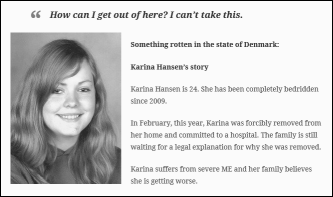
“How can I get out of here? I can’t take this.”

+++
KH5

+++
Something rotten in the state of Denmark:

Karina Hansen’s story

Karina Hansen is 24. She has been completely bedridden since 2009.

In February, this year, Karina was forcibly removed from her home and committed to a hospital. The family is still waiting for a legal explanation for why she was removed.

Karina suffers from severe ME and her family believes she is getting worse.

Karina removed from home

On February 12, 2013, five policemen from Holstebro county, Denmark, arrived at Karina’s house and forcibly removed her from her bedroom.

Two doctors, a locksmith and two social workers were also present.

Karina called for her mother’s help, but her mother was blocked by the police from aiding her. Karina used her mobile phone for the first time in years to call her mother, her father, her cousin and her sister, Janni. Karina is so ill that she can usually only speak in one or two word sentences, but during her removal she managed to call her father and say: Help Dad, in my room, and to her sister: Help, Janni I don’t know where they are taking me.

Karina’s mother could not answer her phone because she was surrounded by policemen.

Karina was driven off to a hospital in an ambulance. Her parents were not told where she was being taken or why they were taking her away. They were given no paperwork.

Later that day, her parents received a phone call. They were told that Karina was at Hammel Neurocenter and that someone would call them every day at 10am to tell them how Karina was doing and that no one would be allowed to visit their daughter for 14 days.

On the morning of February 13, Karina managed to call her mother from her mobile phone. She said: How can I get out of here? I can’t take this. (Hvordan kan jeg komme væk herfra? Jeg kan ikke klare det.) Then the connection was cut.

A few days later, Karina’s parents received a letter from a psychiatrist, Nils Balle Christensen, which said that he would be in charge of Karina’s treatment at Hammel Neurocenter. He also wrote that because “of her condition,” Karina was not allowed visitors for two weeks. That ban on visitors was later extended to three weeks because Dr Christensen was on vacation.

Nils Balle Christensen works at the Aarhus Research Clinic for Functional Disorders and Psychosomatics. He and his boss, Per Fink, believe that ME is a functional disorder. The treatments the clinic recommends are graded exercise therapy (GET), cognitive behavioural therapy (CBT), “mindfulness therapy,” and in some cases, antidepressants. In Denmark, a functional disorder is understood to be a psychosomatic illness.

The psychiatrists at this clinic are considered to have no experience with severely ill ME patients and the Hansen family and ME Foreningen, Danmark fear that if Karina is being treated incorrectly this may lead to a severe and permanent worsening of her condition.

Karina’s parents have not been permitted to see their daughter for three months

The family visited the Neurocenter on April 1 to try to visit Karina, but the parents were not allowed to see her. Karina’s sister, Janni, who is a nurse, was allowed to see Karina for a few minutes. A staff member followed Janni into the room. Janni said that Karina was extremely pale, was unable to talk, and did not show signs that she recognized her sister.

In Janni’s opinion, Karina’s condition is worse now than before she was hospitalized.

Why was Karina forcibly removed?

Karina’s parents and lawyer have yet to receive any official paperwork from any government body or clinician about the reason for her removal. They have received no treatment plan or copies of Karina’s medical reports.

No charges have been made against Karina’s parents. The case has never been heard by a court.

Karina’s parents do not know if or when they will be allowed to see their daughter or if or when she will be allowed to come home. Her parents and her lawyer have obtained power of attorney for Karina, but this is being ignored.

The regional state administrations for Mid-Jutland (Statsforvaltningen Midtjylland) are trying to appoint someone as guardian for Karina.

The only information the family receives comes from Jens Gyring, senior doctor at Hammel Neurocenter. He now calls Karina’s father twice a week and tells him how Karina is.

But the parents are finding it difficult to trust what they are told because they are being given conflicting information. Dr Christensen says Karina is improving every day, but Jens Gyring says there is no change.

Karina’s sister, Janni, thinks her sister is deteriorating.

Jens Grying says he is taking instructions about Karina’s care from Dr Christensen and that the treatment given is a rehabilitation programme.

+++
There are many unanswered questions

Karina’s mother was paid by the county to take care of her daughter and there was never any report of neglect. After Karina was taken away, her mother was fired from her job on the grounds that the caregiver duties were no longer needed.

Which authority gave the order to remove Karina and by whom was it authorized?
What legislation was used to remove and detain her as an involuntary patient in a hospital?
Why are the parents and their lawyer not permitted to see paperwork about the case?
Why have the parents not been allowed to visit?
Are there any charges levelled against the parents?
What is the treatment plan for Karina? The hospital requires that a treatment plan be made on admission.
Why all the secrecy?

+++
Meeting with Liselott Blixt

On April 4, Karina’s parents and two representatives from ME Foreningen, Danmark met with parliament member, Liselott Blixt, who agreed to help to get answers to the many questions in this case.

ME Foreningen, Danmark had been waiting to publish information about Karina’s case until her parents and lawyer had received the official documents. But it is now obvious that these documents will not be released unless pressure is placed on the officials.

+++

ME Foreningen, Danmark campaign

A campaign was launched by ME Foreningen, Danmark for May 12th ME Awareness Week for sending postcards to Karina and also signing a petition in support of the Hansen family’s situation:

http://www.ipetitions.com/petition/postcardtokarina/

For information on where to send your postcard go to ME Foreningen, Danmark on Facebook

If you have a blog or a website, please link to this post or contact ME Foreningen, Danmark for a copy of the account and publish your own blog post. Post a link to this post on Facebook, Twitter, Listservs and forums.

Timeline

Karina Hansen was born in November 1988. She is now 24.

2004/5: Karina contracts mononucleosis, after which she succumbs to countless infections, including sinus infections, as well as severe gastritis. She received many courses of antibiotics. Her activity became very limited because of post exertional malaise. In 2006, Karina had a serious sinus infection and never fully recovered.

2008: Karina receives a diagnosis of Myalgic Encephalomyelitis/ME (ICD-10 G93.3) while at a Danish arthritis hospital, where she was admitted for rehabilitation: exercise and cognitive behavioural therapy (CBT). She was there for 17 days and could never do more than one hour of activity a day.

During the course of her illness, Karina was examined several times by psychiatrists who found no evidence of mental illness. One psychiatrist wrote that her symptoms were most likely caused by the mononucleosis.

Autumn 2009: Karina has an influenza vaccine after which she becomes completely bedridden. In March 2010, Karina’s mother took leave from work to take care of her daughter.

May 2010: Karina’s GP pressured her parents into admitting her to hospital for rehabilitation. By this time, Karina was so ill that she cried from the headaches when they talked to her. There appears to have been an attempt to detain her at the hospital by declaring her mentally unfit. But the medical officer wrote that the “psychiatry law enforcement provisions cannot be used.” She was allowed to go home after three days. Karina’s condition deteriorated after this hospitalization.

May 2010: Karina is seen for the first time by Dr Isager, who confirms the diagnosis of ME. Dr Isager is a Danish doctor who has seen hundreds of ME patients in his long career and has made home visits to many severely ill patients. In 2001, the Danish Ministry of Health wrote that Dr Isager was the Danish doctor with the most experience of ME and had about 250 patients at that time.

March 2011: Karina is seen by another doctor with experience in severe ME. This doctor reconfirmed the ME diagnosis. Karina’s parents worked with her new GP, with Dr Isager, and a nutritionist to try to give Karina the best treatment possible at home. Gut function tests were sent to the USA to try to find a treatment for Karina. There is no hospital in Denmark equipped to take care of severely ill ME patients.

A request was made to have a saline IV started in the home but the county did not cooperate. Karina received a special protein powder and a high iron diet to ensure her nutritional needs were met. Many ME patients do not tolerate iron supplements in pill form.

June 2011: Karina’s mother is hired by the county to be Karina’s caregiver.

May 2012: Sundhedssytrelsen (Danish National Board of Health) contacts two psychiatrists, Per Fink and Jens Nørbæk, about Karina. Karina’s case was presented to them over the phone and Jens Nørbæk stated that Karina must be in an insane-like state: “sindsyglignende tilstand.” These two psychiatrists are considered to have no knowledge of severe ME.

Based on these conversations, the Danish Board of Health put pressure on Karina’s GP to declare Karina psychologically ill and to sign commitment papers. Karina’s GP refused because Karina was not mentally ill. Karina’s GP then resigned as her doctor.

The Danish National Board of Health contacted Per Fink, lead clinician at The Research Clinic for Functional Disorders and Psychosomatics, and asked him to take charge of Karina’s case. The case was then given to another psychiatrist from the clinic, Nils Balle Christensen.

Karina and her parents did not want Dr Christensen as Karina’s doctor. They knew about the research clinic and did not feel the doctors had sufficient knowledge about ME to undertake Karina’s medical care. Karina and her parents said many times they did not want the psychiatric treatment that Dr Christensen was offering. They hired a private doctor to assist Dr Isager in Karina’s care. (Dr Isager is retired.)

February 12, 2013: Karina is forcibly removed from her home and put in the hospital under Dr Christensen’s care. She is now forced to receive the “treatment” she does not want.

May 12, 2013: For three months, Karina’s parents have been denied visits to see their daughter; denied documentation; denied answers to their questions.

+++

The Research Clinic for Functional Disorders and Psychosomatics, Aarhus, Denmark

According to a report by ME Foreningen, Danmark:

The Danish government has put this clinic in charge of taking care of all ME patients in Denmark. The doctors employed here are primarily psychiatrists or psychologists. The centre has spent millions of dollars working to create a new diagnosis, Bodily Distress Syndrome (BDS).

For information on Bodily Distress Syndrome see Part Two of Dx Revision Watch Post:
ICD-11 Beta draft and BDD, Per Fink and Bodily Distress Syndrome

They want to place ME and other illnesses like Fibromyalgia, IBS, chronic pelvic pains and PMS under their new diagnosis. Read about BDS, here, in English:

http://funktionellelidelser.dk/en/for-specialists-researchers/doctors/

Per Fink and his colleagues have been lobbying for their BDS concept to be included in revisions of classification systems.

According to ME Foreningen, Danmark, all treatment at this clinic is on a research basis and all patients receive the same treatment: cognitive behavioural therapy (CBT), graded exercise therapy (GET) and antidepressants. ME Foreningen, Danmark says it has contact with many patients who have ME, Fibromyalgia, IBS, etc but when they are referred to this clinic by their GP, their previous diagnosis is ignored and they are given a psychiatric diagnosis.

ME Foreningen, Danmark states it has many examples of patients who have been pressured by their doctors and case workers to go to this clinic. Patients have reported that their doctors or caseworkers believe this clinic has a proven treatment for ME, Fibromyalgia, IBS etc, so benefits will be denied unless this research treatment is tried. In the 14 years for which the clinic has been open, they only have documentation that they have seen 74 patients with chronic fatigue syndrome. Karina is the first severely ill ME patient that the clinic has had contact with.

+++

Report edited from an account provided by ME Foreningen, Danmark, with permission of the Hansen family.
For more information on the ME Association of Denmark’s postcard campaign go here on Facebook
For information on Bodily Distress Syndrome see Part Two of Dx Revision Watch Post:
ICD-11 Beta draft and BDD, Per Fink and Bodily Distress Syndrome
Something rotten in the state of Denmark: Karina Hansen’s story: http://wp.me/pKrrB-2Xc
Noget råddent i staten Danmark: Karina Hansen: http://wp.me/pKrrB-2Xc
Etwas ist faul in Dänemark: Karina Hansens Geschichte: http://wp.me/pKrrB-2Xc
Il y a quelque chose de pourri au royaume du Danemark: l’histoire de Karina Hansen: http://wp.me/pKrrB-2Xc