Allen Frances: “Follow the Money”

Allen Frances writing on Huffington Post: “Follow the Money”

Post #177 Shortlink: http://wp.me/pKrrB-2e3

Allen Frances, who had oversight of the development of DSM-IV, responds to DSM-5 Inaccuracies: Setting the Record Straight by James H Skully, CEO and Medical Director to the American Psychiatric Association.

Huffington Post Blogs | Allen Frances

Follow the Money

Allen Frances MD | June 9, 2012

…The APA budget depends heavily on the huge publishing profits generated by its DSM monopoly. APA needs the money badly. It is losing paying members; other sources of funding are also on a downward trend; and its budget projections require a big May 2013 injection of DSM-5 cash…

…APA treats DSM-5 like a valuable publishing property, not as a public trust that importantly impacts on people’s lives and public policy. It is excellent at protecting its “intellectual property” with confidentiality agreements and at protecting its trademark and copyright with bullying threats of law suits. But APA has been sadly incompetent and wildly profligate in the day-to-day work of actually producing a safe and scientifically sound DSM-5.

Dr Scully is asking us to believe ten very unbelievable things. My view – if you want to understand why an unreliable and unsafe DSM-5 is being rushed prematurely to market – is to “follow the money…”

Read full commentary on Huff Po

DSM-5 round-up: Lane on “DSM-5 Facts” site, Frances on DSM-5, Kupfer on Frances

DSM-5 round-up: Lane on new “DSM-5 Facts” site, Frances on DSM-5, Kupfer on Frances

Post #176 Shortlink: http://wp.me/pKrrB-2cQ

What we were waiting for were the “full results” of the reliability data from the DSM-5 field trials.

What we got was a public relations sticking plaster.

Christopher Lane reported in Side Effects on the American Psychiatric Association’s new platform DSM-5 Facts – a website launched, last week, to “correct the record, highlight key omissions – and provide essential perspective so that the public has a complete and accurate view…

Side Effects

Christopher Lane, Ph.D. | June 4, 2012

The APA’s PR Problem
Why is the American Psychiatric Association hiring a PR company to market DSM-5?

As the news tumbled out last week that the American Psychiatric Association had hired GYMR, an expensive PR company, to help the organization “execute strategies that include image and alliance building, public education campaigns or media relations to harness the formidable forces of Washington and produce successful results for clients” (services that GYMR brags about in its mission statement), it became clearer than ever that the APA has more than an image-problem with DSM-5

Read on

In a long interview with Allen Frances, Stephen M. Strakowski asks: What’s wrong with DSM-5 and what needs to be done to put it right?

Medscape Psychiatry

What’s Wrong With DSM-5?

Stephen M. Strakowski, MD; Allen J. Frances, MD | June 1, 2012

Addressing Prescription Drug Abuse: Introduction
The Biggest Problems With DSM-5?
What Would Dr. Frances Do?
A Safe, Credible DSM-5 by 2013?

…The reliability-test results for stage 1 show that DSM-5 badly flunked and that stage 2 is desperately needed. The leadership lowered expectations with statements indicating that they are willing to accept diagnostic agreements far below historical levels and include proposals achieving diagnostic agreements that are little better than chance. This is simply not acceptable and should not be accepted…

…it is discouraging that DSM-5 has not accepted the need for external review, is going forward with poorly written and unreliable criteria sets, and still contains so many unsafe and scientifically unsound proposals. It remains to be seen whether DSM-5 will be responsive to what is certain to be increasing external pressure to trim its sails and improve its quality. If it attempts to hang tough, I think DSM-5 will no longer be used much (if at all) overseas and will also lose much of its following in the United States…

Task Force Chair, David J. Kupfer, MD, responds:

Medscape Psychiatry

Dr. Kupfer Defends DSM-5

David J. Kupfer, MD | June 1, 2012

Editor’s Note:
In a recent Medscape interview with Dr. Stephen Strakowski, DSM-IV Task Force Chair Dr. Allen J. Frances expressed serious concerns about a number of proposals being considered for inclusion in the fifth edition of the Diagnostic and Statistical Manual of Mental Disorders (DSM-5), scheduled for release in May 2013. Below, DSM-5 Task Force Chair Dr. David Kupfer defends the proposed revision.

A DSM-5 Defense
Will DSM-5 Inflate Prevalence?

A third Medscape report from the APA’s Annual Conference by Nassir Ghaemi, MD:

Medscape Psychiatry

DSM-5: Finding a Middle Ground

Nassir Ghaemi, MD | June 1, 2012

Professor of Psychiatry, Tufts University School of Medicine; Director, Mood Disorders Program, Psychiatry Department, Tufts Medical Center, Boston, Massachusetts

DSM-5: Validity vs Reliability
But DSM-IV Has Limitations, Too

Two more commentaries from 1 Boring Old Man on DSM-5 process and field trial Kappa results:

the APA Trustees must intervene in the DSM-5…

1 Boring Old Man | June 4, 2012

and will…

1 Boring Old Man | June 3, 2012

Welcome to DSM-5 Facts (The APA’s new PR site)

Welcome to DSM-5 Facts (The APA’s new PR site)

Post #175 Shortlink: http://wp.me/pKrrB-2cm

There’s just a couple of weeks left until the deadline for receipt of stakeholder comments in the third and final review of DSM-5 proposals but still no sign of the promised “full results of the field trials” from the Task Force.

In the meantime, something else from the APA, or rather its PR firm. A spanking new DSM-5 Facts site launched this week “to correct the record” and provide the public with “a complete and accurate view of this important issue.”

http://dsmfacts.org/

Welcome to DSM-5 Facts

The American Psychiatric Association believes strongly in the work that is being done to revise the Diagnostic and Statistical Manual of Mental Disorders (DSM). In preparation for the release of DSM-5, experts from psychiatry, psychology, social work, neuroscience, pediatrics and other fields have committed much of the last five years to reviewing scientific research and clinical data, analyzing the findings of extensive field trials and reviewing thousand of comments from the public.

We welcome scrutiny, not only of this process but of its results.

Regrettably, news reports and commentators alike are filling the discourse with inaccurate, biased or misinformed criticism of DSM-5. Such information undermines the important changes that are being made to the manual, and provokes unwarranted confusion and fear among the individuals and families who stand to benefit most from essential care based on the strongest available diagnostic criteria.

The APA has created this forum to ensure observers of the DSM-5 development process have the facts.

Posted below are recent news stories, articles and opinion pieces, along with our responses, to correct the record, highlight key omissions — and provide essential perspective so that the public has a complete and accurate view of this important issue….


On the DSM-5 Facts Issue Accuracy page you’ll find responses to recent articles and Op-Eds by Allen Frances, Paula Caplan, NYT journalist, Benedict Carey, and Cosgrove and Krimsky.

In a counterpoint to Frances’ May 12, New York Times Op-Ed piece, APA responds:

APA Responds to Allen Frances New York Times Op-Ed

There are actually relatively few substantial changes to draft disorder criteria. Those that have been recommended are based on the scientific and clinical evidence amassed over the past 20 years and then are subject to multiple review processes within the APA.

Unfortunately there is no comment facility on this DSM-5 Fact site.

One section for which substantial changes to disorder criteria are being proposed is the Somatoform Disorders.

The Somatic Symptom Disorder Work Group proposes radical changes to this category: to rename the Somatoform Disorders section to “Somatic Symptom Disorders”; eliminate four existing DSM-IV categories: somatization disorder, hypochondriasis, pain disorder, and undifferentiated somatoform disorder; replace these discrete categories and their criteria with a single new category – “[Complex] Somatic Symptom Disorder” and apply new criteria.

“…To receive a diagnosis of complex somatic symptom disorder, patients must complain of at least one somatic symptom that is distressing and/or disruptive of their daily lives. Also, patients must have at least two [Ed: now reduced to “at least one from the B type criteria” since evaluation of the CSSD field trials] of the following emotional/cognitive/behavioral disturbances: high levels of health anxiety, disproportionate and persistent concerns about the medical seriousness of the symptom(s), and an excessive amount of time and energy devoted to the symptoms and health concerns. Finally, the symptoms and related concerns must have lasted for at least six months.

“Future research will examine the epidemiology, clinical characteristics, or treatment of complex somatic symptom disorder as there is no published research on this diagnostic category.”

“…Just as for complex somatic symptom disorder, there is no published research on the epidemiology, clinical characteristics, or treatment of simple somatic symptom disorder.”

Source: Woolfolk RL, Allen LA. Cognitive Behavioral Therapy for Somatoform Disorders. Standard and Innovative Strategies in Cognitive Behavior Therapy.

And from the SSD Work Group  Rationale/Validity Document  (as published on May 4, 2011 for the second public review of draft proposals but not revised or reissued for the third review):

“…The presence of CSSD complicates management of all disorders and must be addressed in the treatment plan.

“It is unclear how these changes would affect the base rate of disorders now recognized as somatoform disorders. One might conclude that the rate of diagnosis of CSSD would fall, particularly if some disorders previously diagnosed as somatoform were now diagnosed elsewhere (such as adjustment disorder). On the other hand, there are also considerable data to suggest that physicians actively avoid using the older 6 diagnoses because they find them confusing or pejorative. So, with the CSSD classification, there may be an increase in diagnosis.

“The B-type criteria are crucial for a diagnosis of CSSD. These criteria in essence reflect disturbance in thoughts, feelings, and/or behaviors in conjunction with long standing distressing somatic symptoms. Whilst an exact threshold is perhaps arbitrary, considerable work suggests that the degree of functional impairment is associated with the number of such criteria. Using a threshold of 2 or more such criteria results in prevalence estimates of XXXX in the general population, XXXX in patients with known medical illnesses, and XXXX in patients who may previously have been considered to suffer from a somatoform illness. {text in development concerning impact of different thresholds for criteria B- from Francis [Creed]}…”

No data on prevalence estimates available for the second review and no data on impact of different thresholds for the B type criteria and prevalence estimates available for the third review.

I will update if a report on the field trials is released.

Commentary from Allen Frances on the launch of this new DSM-5 Fact site.

Huffington Post Blogs | Allen Frances

Public Relations Fictions Trying to Hide DSM 5 Facts

Allen Frances MD | May 31, 2012

Recently APA recruited a public relations guy from the Department of Defense to respond to my concerns that DSM 5 is way off track. He immediately went on the offensive and (in an interview for Time magazine) made the obvious PR mistake of calling me “a dangerous man.” This provided me the opportunity to pose yet again the troubling questions about DSM 5 that APA repeatedly refuses to answer. The DOD guy hasn’t surfaced since.

Instead, APA has adopted a much smoother, soft sell approach. It has hired GYMR — an expensive PR firm. GYMR actually brags in its mission statement that it can “execute strategies that include image and alliance building, public education campaigns or media relations to harness the formidable forces of Washington and produce successful results for clients.”

We now have the first fruits of GYMR’s “image building” misinformation campaign. It has launched a PR website with the claim it will provide “the facts on DSM-5 development process. Read recent news stories & opinion pieces, along with our responses, to correct the record, highlight key omissions — and provide essential perspective, so that the public has a complete and accurate view of this important issue.”

Unfortunately, the site is very short on accurate facts, very long on misleading (or just plain wrong) “image building” fiction. It is all pure PR fluff — a way to avoid answering the substantive questions that need addressing before DSM 5 is prematurely rushed to press. Let’s compare GYMR fiction versus DSM 5 fact:

GYMR Fiction: “We have extensive data from the field trials that on average there is a slight decrease in the overall rates of DSM-5 in comparison to DSM-IV disorders.”

DSM 5 Fact: This is simply wrong — APA has no such data. Except for autism, all of the DSM 5 changes will dramatically raise the rates of mental disorder and mislabel normal people as psychiatrically sick. The field trial provided no data on this crucial question because it made an unforgivable error — not including head to head prevalence comparisons between DSM IV and DSM 5. This makes it impossible to estimate how explosive will be the DSM 5 rate jumps. Moreover, false epidemics are often nurtured in the primary care settings that were untested in the DSM 5 field trials.

GYMR Fiction: The PR claim is that DSM 5 has provided a transparent process.

DSM 5 Fact: DSM 5 has been peculiarly and self-destructively secretive from its early confidentiality agreements (meant to protect intellectual property) to its current failure to make public any of the results of its ‘scientific’ reviews. Real science can never be confidential. None of this secrecy makes any sense.

GYMR Fiction: “APA takes very seriously its responsibility in developing and maintaining DSM and has devoted $25 million to the DSM-5 update process thus far.”

DSM 5 Fact: The $25 million has been a colossal waste of poorly spent money. We did DSM IV for one-fifth the price and never missed a deadline or stirred much controversy. The difference in expenditure and outcome has nothing to do with us being especially competent. It has everything to do with DSM 5 being poorly conceived and organized and spending lavishly on silly things like public relations.

GYMR Fiction: “There are several proposals in DSM-5 that aim to more accurately describe the symptoms and behaviors of disorders that typically present in children.”

DSM 5 Fact: The epidemics of excessive diagnosis in children will be muddled further by DSM 5. The threshold for ADHD is being lowered despite the tripling of rates. Temper Dyregulation (AKA DMDD) is being suggested based on just a few years of work by just one research group — despite the risk it will exacerbate the already inappropriate and dangerous use of antipsychotic drugs in kids. And DSM 5 somehow persists in not understanding how its suggestions will necessarily have a profound impact on rates of autism.

GYMR Fiction: “There are actually relatively few substantial changes to draft disorder criteria.”

DSM 5 Fact: Dead wrong — how did GYMR ever come up with this one? My guess is that the DSM 5 changes would affect the diagnosis of tens of millions of people. APA has no way of refuting this estimate since it unaccountably failed to ask the crucial prevalence question in its $3 million field trial.

GYMR Fiction: “Those that have been recommended are based on the scientific and clinical evidence amassed over the past 20 years and then are subject to multiple review processes within the APA.”

DSM 5 Fact: Most of the reviews are poorly done and none of the suggestions would stand up to the kind of impartial, independent scientific review demanded by a petition supported by 51 mental health associations. The APA internal review lacks any credibility because it is done in secret and has somehow found a way to approve DMDD and the removal of the bereavement exclusion — both of which have little or no scientific support. To be credible, APA must both make public its own scientific reviews and also contract for external and independent reviews on all the most controversial topics.

GYMR Fiction: “The APA governance attention to this is far greater than anything that ever occurred with DSM III or DSM-IV.”

DSM 5 Fact: Absurd on the face of it. If there had ever been anything resembling proper internal supervision, DSM 5 would not be in this deep mess and would not require expensive PR fig leaves to try to cover it up.

There is more, but you get the idea. DSM 5 is in a paradoxical position. Publishing profits pressure it toward premature publication, but its close to final draft is the object of almost universal opposition. On one side we have APA and its new hired gun GYMR — on the other side we have 51 professional organizations, the Lancet, the New England Journal of Medicine, the international media and outraged segments of the public. It is far too late for any superficial “image building,” however clever, to restore DSM 5 credibility. Saving DSM 5 requires radically reforming its mistakes, not covering them up with a PR smokescreen of misinformation.

The last and only hope for a safe and credible DSM 5 now resides in the new APA leadership — it is within its power to thoroughly reform DSM 5 before it is too late.

The stakes are high. A DSM 5 at war with its users will wind up losing many of them. Disillusioned members (each of whom has involuntarily sunk almost $1,000 in this lavish but misdirected DSM 5 effort) will speed up the already rapid exodus of APA members. APA will eventually lose its monopoly on psychiatric diagnosis. Psychiatry will be unfairly discredited. And, worst of all, the patients who need our help will suffer.

DSM 5 is in such public trouble now because it heedlessly missed every prior private opportunity to self-correct. The solution is not the production of more public relations pablum. Instead, DSM 5 needs to regroup, solve its problems, and avoid racing over a cliff.

American Psychiatric Association (APA) Assembly Notes and Full Treasurer’s Report

American Psychiatric Association (APA) Assembly Notes and Full Treasurer’s Report

Post #174 Shortlink: http://wp.me/pKrrB-2bX

Update @ June 1, 2012

James H. Scully, Jr., M.D., CEO and Medical Director of the American Psychiatric Association, has published a response to Allen Frances’ Huff Po blog of May 30:

DSM-5 Inaccuracies: Setting the Record Straight

Update @ May 30, 2012

1 Boring Old Man

reform, or accept your fate…

1 Boring Old Man | May, 30 2012

Huffington Post Blogs Allen Frances, MD

DSM-5 Costs $25 Million, Putting APA in a Financial Hole

Allen Frances | May 30, 2012

The American Psychiatric Association just reported a surprisingly large yearly deficit of $350,000. This was caused by reduced publishing profits, poor attendance at its annual meeting, rapidly declining membership, and wasteful spending on DSM-5. APA reserves are now below “the recommended amount for a non-profit (reserves equal to a year’s operating expenses).”

APA has already spent an astounding $25 million on DSM-5. I can’t imagine where all that money went. As I recall it, DSM-IV cost about $5 million, and more than half of this came from outside research grants. Even if the DSM-5 product were made of gold instead of lead, $25 million would be wildly out of proportion. The rampant disorganization of DSM-5 must have caused colossal waste. One obvious example is the $3 million spent on the useless DSM-5 field trial, with its irrelevant question, poorly conceived design, and embarrassing results…

Full commentary

On May 8, in an article for Medscape Medical News, Deborah Brauser reported:

     …Members of the task force said they hope to publish the full results [of the DSM-5 field trials] “within a month.” However, the third and final public comment period for the manual opened last week and ends on June 15. Although the entire period is 6 weeks long, the public may only have 2 weeks to comment after the publication of the field trials’ findings. DSM-5 Field Trials Generate Mixed Results

With less than three weeks to go before the stakeholder and public comment period closes, there is still no sign of a report on the DSM-5 field trials.

If the Task Force does not get a report out soon, stakeholders will be obliged to submit feedback without the benefit of data from the trials to inform their comments. Once again, this third and final stakeholder review smacks of a purely tokenistic exercise.

For the two previous draft reviews, some disorders were accompanied by PDF documents expanding on new and revised disorder descriptions and work group rationales.

For the Somatic Symptom Disorders, no updated “Disorder Descriptions” or “Rationale/Validity” documents have been published that reflect substantial revisions made to proposals and criteria between the second and third drafts. The documents as published for the second review have been taken down from the DSM-5 Development site but have not been revised and reissued.

I have twice contacted APA Media and Communications for clarification of whether the Work Group intends to publish revised documents before the end of the comment period. Evidently APA Media and Communications don’t wish to provide me with a response.


I will update if and when a report on the field trials emerges from the Task Force.

In the meantime, here are two public domain documents that may be of interest to APA watchers:

APA Assembly Notes Spring 2012

or download here:

http://alabamapsych.org/wp-content/uploads/2012/02/apa_assembly_notes_may_2012.pdf

APA Treasurer’s Report May 2012  [.ppt compatible PowerPoint reader required]

or view here:

https://docs.google.com/file/d/0BzWdENl1wkVSYk5aXzRZelFYUjA/edit?pli=1

Call to action – DSM-5 comments needed by June 15, 2012

Call to action – DSM-5 comments needed by June 15, 2012

Post #173 Shortlink: http://wp.me/pKrrB-2bO

The stakeholder comment period for the third and final review of draft proposals for DSM-5 categories and criteria closes on June 15. Patients, patient organizations and professional stakeholders have three weeks left in which to submit comments.

US advocate, Mary Dimmock, has prepared a “Call to action”

Call to action – DSM-5 comments needed by June 15, 2012

The Diagnostic and Statistical Manual of Mental Disorders (DSM) is used in the U.S. to categorize mental disorders for patient diagnosis, treatment and insurance. The new version, DSM-5, includes a proposal for Somatic Symptom Disorder (SSD) that will have profound implications for ME/CFS patients. Your input is needed by June 15, 2012 to ensure that the DSM-5 authors understand your concerns…

…SSD can be applied to patients regardless of whether the symptoms are considered to be medically unexplainable or not. Severity is rated by the count and frequency of somatic symptoms. The “Justification for Criteria – Somatic Symptoms”, issued in May 2011, states that CBT, focused on “the identification and modification of dysfunctional and maladaptive beliefs”, is one of the most promising treatments.

Why this matters to ME/CFS patients
A diagnosis of SSD can be “bolted” onto any patient’s diagnosis. All that is required is for the medical practitioner to decide that the patient is excessively concerned with their somatic symptoms and their health. This is done using highly subjective and difficult to measure criteria for which very few independent reliability studies have been undertaken.

For patients with diseases that are poorly understood and misdiagnosed by the medical community, like ME/CFS, this will be disastrous. Once diagnosed inappropriately with SSD, the implications for diagnosis, treatment, disability and insurance will be profound…

Download Mary’s Call to action document here:

Word .docx format DSM-5 Response 2012

Word .doc format DSM-5 Response 2012 (MS 2004)

Somatic Symptom Disorder could capture millions more under mental health diagnosis

Somatic Symptom Disorder could capture millions more under mental health diagnosis

Post #172 Shortlink: http://wp.me/pKrrB-29B

By Suzy Chapman | Dx Revision Watch

Update: My submission to the Somatic Symptom Disorder Work Group in response to the third DSM-5 draft and stakeholder review can be read here: Chapman Response to Third Draft DSM-5 SSD Proposals

May 26, 2012

While media and professional attention has been focused on the implications for introducing new disorders into the DSM and lowering diagnostic thresholds for existing categories, the Somatic Symptom Disorders (SSD) Work Group has been quietly redefining DSM’s Somatoform Disorders with radical proposals that could bring millions more patients under a mental health diagnosis.

The SSD Work Group is proposing to rename the Somatoform Disorders section of DSM-IV to “Somatic Symptom Disorders,” eliminate four existing  DSM-IV categories: somatization disorder [300.81], hypochondriasis [300.7], pain disorder*, and undifferentiated somatoform disorder [300.82] and replace them with a single new category – “Somatic Symptom Disorder.”

*In DSM-IV: Pain Disorder associated with a general medical condition (only): Psychological factors, if present, are judged to play no more than a minimal role. This is not considered a mental disorder so it is coded on Axis III with general medical conditions.See http://behavenet.com/pain-disorder for definitions and criteria for other DSM-IV presentations of Pain disorder.  For DSM-5, it appears that all presentations of Pain disorder will be subsumed under the new SSD category.

If approved, these proposals will license the application of a mental health diagnosis for all illnesses – whether “established general medical conditions or disorders” like diabetes, heart disease and cancer or conditions presenting with “somatic symptoms of unclear etiology” – if the clinician considers the patient is devoting too much time to their symptoms and that their life has become “subsumed” by health concerns and preoccupations, or their response to distressing somatic symptoms is “excessive” or “disproportionate,” or their coping strategies “maladaptive.”

Somatoform Disorders – disliked and dysfunctional

The SSD Work Group, under Chair, Joel E. Dimsdale, MD, says current terminology for the Somatoform Disorders is confusing and flawed; that no-one likes these disorders and they are rarely used in clinical psychiatric practice. Primary Care physicians don’t understand the terms and patients find them demeaning and offensive [1,2].

The group says the terms foster mind/body dualism; that the concept of “medically unexplained” is unreliable, especially in the presence of medical illness, and cites high prevalence of presentation with “medically unexplained somatic symptoms” (MUS) in general medical settings – 20% in Primary Care, 40% in Specialist Care, 33-61% in Neurology; that basing a diagnosis of psychiatric disorder on MUS alone is too sensitive.

The Work Group might have considered dispensing altogether with a clutch of disliked, dysfunctional categories. Instead, the group proposes to rebrand these disorders and assign new criteria that will capture patients with diverse illnesses, expanding application of psychiatric services, antidepressants and behavioural therapies like CBT, for the “modification of dysfunctional and maladaptive beliefs about symptoms and disease, and behavioral techniques to alter illness and sick role behaviors.”

Focus shifts from “medically unexplained” to “excessive thoughts, behaviors and feelings”

The Work Group’s proposal is to deemphasize “medically unexplained” as the central defining feature of this disorder group.

For DSM-5, focus shifts to the patient’s cognitions – “excessive thoughts, behaviors and feelings” about the seriousness of distressing and persistent somatic (bodily) symptoms – which may or may not accompany diagnosed general medical conditions – and the extent to which “illness preoccupation” is perceived to “dominate” or “subsume” the patient’s life.

“[The SSD Work Group’s] framework will allow a diagnosis of somatic symptom disorder in addition to a general medical condition, whether the latter is a well-recognized organic disease or a functional somatic syndrome such as irritable bowel syndrome or chronic fatigue syndrome…” [3]

“…These disorders typically present first in non-psychiatric settings and somatic symptom disorders can accompany diverse general medical as well as psychiatric diagnoses. Having somatic symptoms of unclear etiology is not in itself sufficient to make this diagnosis. Some patients, for instance with irritable bowel syndrome or fibromyalgia would not necessarily qualify for a somatic symptom disorder diagnosis. Conversely, having somatic symptoms of an established disorder (e.g. diabetes) does not exclude these diagnoses if the criteria are otherwise met…” [4]

To meet requirements for Somatization Disorder (300.81) in DSM-IV, a considerably more rigorous criteria set needed to be fulfilled: a history of many medically unexplained symptoms before the age of thirty, resulting in treatment sought or psychosocial impairment. The diagnostic threshold was set high – a total of eight or more medically unexplained symptoms from four, specified symptom groups, with at least four pain and two gastrointestinal symptoms.

In DSM-5, the requirement for eight symptoms is dropped to just one.

One distressing symptom for at least six months duration and one “B type” cognition is all that is required to tick the box for a bolt-on diagnosis of a mental health disorder – cancer + SSD; angina + SSD; diabetes + SSD; IBS + SSD…

The most recent proposals for new category “J 00 Somatic Symptom Disorder.”

Note that the requirement for “at least two from the B type criteria” for the second draft has been reduced to “at least one from the B type criteria” for the third iteration of draft proposals. This lowering of the threshold is presumably in order to accommodate the merging of the previously proposed “Simple Somatic Symptom Disorder” category into the “Complex Somatic Symptom Disorder” category, a conflation now proposed to be renamed to “Somatic Symptom Disorder.” No revised “Disorder Description” and “Rationale/Validity” documents reflecting the changes made between draft two and draft three were issued for the third and final draft.

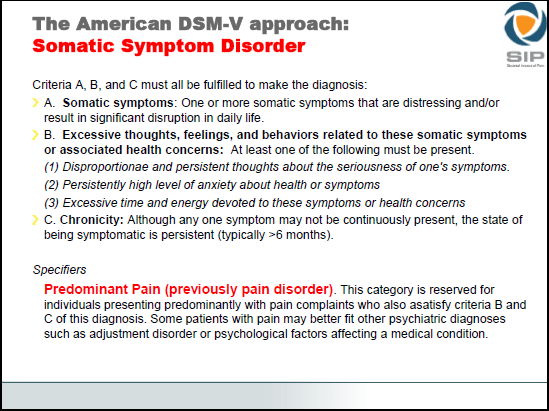
Ed: Update: Following closure of the third stakeholder review on June 15, 2012, proposals, criteria and rationales were frozen and the DSM-5 Development website was not updated to reflect any subsequent revisions. Proposals, criteria and rationales, as posted for the third draft in May 2012, were removed from the DSM-5 Development website on November 15, 2012 and placed behind a non public log in. Consequently, criteria as they had stood for “Somatic Symptom Disorder” at the point at which the third draft was issued can no longer be accessed but are set out on Slide 9 in this presentation, which note, does not include three, optional Severity Specifiers that were included with the third draft criteria. Since any changes to the drafts are embargoed in preparation for publication of DSM-5, in May 2013, I cannot confirm whether any changes have been made to the draft subsequent to June 15, 2012.

IASP and the Classification of Pain in ICD-11  Prof. Dr. Winfried Rief, University of Marburg, Germany

Slide 9

Rief Presentation ICD-11 Pain

How are highly subjective and difficult to measure constructs like “Disproportionate and persistent thoughts about the seriousness of one’s symptoms” and “Excessive time and energy devoted to these symptoms or health concerns” to be operationalized?

By what means would a practitioner determine how much of a patient’s day spent “searching the internet looking for data” (to quote an example of the SSD Work Group Chair) might be considered a reasonable response to chronic health concerns and what should be coded as “excessive preoccupation” or indicate that this patient’s life has become “subsumed” or “overwhelmed” by concerns about illness and symptoms? One hour day? Two hours? Three?

At the APA’s Annual Conference earlier this month, SSD Work Group Chair, Joel E. Dimsdale, presented an update on his group’s deliberations. During the Q & A session, an academic professional in the field expressed concern that practitioners who are not psychiatric professionals or clinicians might have some difficulty interpreting the wording of the B type criteria to differentiate between negative and positive coping strategies.

Dr Dimsdale was asked to expand on how the B type criteria would be defined and by what means patients with chronic medical conditions who devote time and energy to health care strategies to try to improve their symptoms and level of functioning would be evaluated in the field by the very wide range of DSM users; how would these patients be differentiated from patients considered to be spending “excessive time and energy devoted to symptoms or health concerns” or perceived as having become “absorbed” by their illness?

I am not persuaded by Dr Dimsdale’s reassurances that his Work Group will try to make this “crystal clear” in the five to six pages of manual text in the process of being drafted for this disorder chapter. Nor am I reassured that these B (1), (2) and (3) criteria can be safely applied outside the optimal conditions of field trials, in settings where practitioners may not necessarily have the time for, nor instruction in administration of diagnostic assessment tools, and where decisions to code or not to code may hang on arbitrary and subjective perceptions of DSM end-users lacking clinical training in the use of the manual text and application of criteria.

Implications for a diagnosis of SSD for all patient populations

Incautious, inept application of criteria resulting in a “bolt-on” psychiatric diagnosis of a “Somatic Symptom Disorder” could have far-reaching implications for all patient populations:

Application of highly subjective and difficult to measure criteria could potentially result in misdiagnosis with a mental health disorder, misapplication of an additional diagnosis of a mental health disorder or missed diagnoses through dismissal and failure to investigate new or worsening somatic symptoms.

Patients with cancer and life threatening diseases may be reluctant to report new symptoms that might be early indicators of local recurrence, metastasis or secondary disease, for fear of attracting a diagnosis of “SSD” or of being labelled as “catastrophisers.”

Application of an additional diagnosis of Somatic Symptom Disorder may have implications for the types of medical investigations, tests and treatments that clinicians are prepared to consider and which insurers prepared to fund.

Application of an additional diagnosis of Somatic Symptom Disorder may impact payment of employment, medical and disability insurance and the length of time for which insurers are prepared to pay out. It may negatively influence the perceptions of agencies involved with the assessment and provision of social care, disability adaptations, education and workplace accommodations.

Patients prescribed psychotropic drugs for perceived unreasonable levels of “illness worry” or “excessive preoccupation with symptoms” may be placed at risk of iatrogenic disease or subjected to inappropriate behavioural therapies.

For multi-system diseases like Multiple Sclerosis, Behçet’s syndrome or Systemic lupus it can take several years before a diagnosis is arrived at. In the meantime, patients with chronic, multiple somatic symptoms who are still waiting for a diagnosis would be vulnerable.

The burden of the DSM-5 changes will fall particularly heavily upon women who are more likely to be casually dismissed when presenting with physical symptoms and more likely to receive inappropriate antidepressants and anti-anxiety medications for them.

Proposals allow for the application of a diagnosis of Somatic Symptom Disorder where a parent is considered excessively concerned with a child’s symptoms [3]. Families caring for children with any chronic illness may be placed at increased risk of wrongful accusation of “over-involvement” with a child’s symptomatology.

Where a parent is perceived as encouraging maintenance of “sick role behaviour” in a child, this may provoke social services investigation or court intervention for removal of a sick child out of the home environment and into foster care or for enforced in-patient “rehabilitation.” This is already happening in families with a child or young person with chronic illness, notably with Chronic fatigue syndrome or ME. It may happen more frequently with a diagnosis of a chronic childhood illness + SSD.

Dustbin diagnosis?

Although the Work Group is not proposing to classify Chronic fatigue syndrome, IBS and fibromyalgia, per se, within the Somatic Symptom Disorders, patients with CFS – “almost a poster child for medically unexplained symptoms as a diagnosis,” according to Dr Dimsdale’s presentation – or with fibromyalgia, irritable bowel syndrome, chronic Lyme disease, Gulf War illness, chemical injury and chemical sensitivity may be particularly vulnerable to misapplication or misdiagnosis with a mental health disorder under these SSD criteria.

There is considerable concern that this new Somatic Symptom Disorder category will provide a “dustbin diagnosis” in which to shovel the so-called “functional somatic syndromes.”

15% of “diagnosed illness” and 26% of “functional somatic” captured by SSD criteria

For testing reliability of CSSD criteria, three groups were studied for the field trials:

488 healthy patients; a “diagnosed illness” group of 205 patients with cancer and malignancy (some in this group were said to have severe coronary disease) and a “functional somatic” group comprising 94 people with irritable bowel and “chronic widespread pain” (a term used synonymously with fibromyalgia).

Patients in the study were required to meet one to three cognitions: Do you often worry about the possibility that you have a serious illness? Do you have the feeling that people are not taking your illness seriously enough? Is it hard for you to forget about yourself and think about all sorts of other things?

Dr Dimsdale reports that if the response was “Yes – a lot.” then [CSSD] was coded.

15% of the cancer and malignancy group met SSD criteria when “one of the B type criteria” was required; if the threshold was increased to “two B type criteria” about 10% met criteria for dual-diagnosis of diagnosed illness + Somatic Symptom Disorder.

For the 94 irritable bowel and “chronic widespread pain” study group, about 26% were coded when one cognition was required; 13% coded with two cognitions required.

Has the SSD Work Group produced projections for prevalence estimates and potential increase in mental health diagnoses across the entire disease landscape?

Did the Work Group seek opinion on the medico-legal implications of missed diagnoses?

Has the group factored for the clinical and economic burden of providing CBT for modifying perceived “dysfunctional and maladaptive beliefs about symptoms and disease, and behavioral techniques to alter illness and sick role behaviors” in patients for whom an additional diagnosis of Somatic Symptom Disorder has been coded?

Where’s the science?

Dr Dimsdale admits his committee has struggled from the outset with these B type criteria but feels its proposals are “a step in the right direction.”

The group reports that preliminary analysis of field trial results shows “good reliability between clinicians and good agreement between clinician rated and patient rated severity.” In the trials, CSSD achieved Kappa values of .60 (.41-.78 Confidence Interval).

Kappa reliability reflects agreement in rating by two different clinicians corrected for chance agreement – it does not mean that what they have agreed upon are valid constructs.

Radical change to the status quo needs grounding in scientifically validated constructs and a body of rigorous studies not on pet theories and papers (in some cases unpublished papers) generated by Dr Dimsdale’s work group colleagues.

Where is the substantial body of independent research evidence to support the group’s proposals?

“...To receive a diagnosis of complex somatic symptom disorder, patients must complain of at least one somatic symptom that is distressing and/or disruptive of their daily lives. Also, patients must have at least two [Ed: now reduced to at least one since evaluation of the CSSD field trials] of the following emotional/cognitive/behavioral disturbances: high levels of health anxiety, disproportionate and persistent concerns about the medical seriousness of the symptom(s), and an excessive amount of time and energy devoted to the symptoms and health concerns. Finally, the symptoms and related concerns must have lasted for at least six months.”

“Future research will examine the epidemiology, clinical characteristics, or treatment of complex somatic symptom disorder as there is no published research on this diagnostic category.”

“…Just as for complex somatic symptom disorder, there is no published research on the epidemiology, clinical characteristics, or treatment of simple somatic symptom disorder.”

Source: Woolfolk RL, Allen LA. Cognitive Behavioral Therapy for Somatoform Disorders. Standard and Innovative Strategies in Cognitive Behavior Therapy.

Where are the professionals?

During the second public review, the Somatic Symptom Disorders proposals attracted more responses than almost any other category. The SSD Work Group is aware that patients, caregivers and patient advocacy organizations have considerable concerns. But are medical and allied health professionals scrutinizing these proposals?

This is the last opportunity to submit feedback. Psychiatric and non psychiatric clinicians, primary care practitioners and specialists, allied health professionals, psychologists, counselors, social workers, lawyers, patient advocacy organizations – please look very hard at these proposals, consider their safety and the implications for an additional diagnosis of an SSD for all patient illness groups and weigh in with your comments by June 15.

Criteria and rationales for the third iteration of proposals for the DSM-5 Somatic Symptom Disorders categories can be found here on the DSM-5 Development site. [Update: Proposals were removed from the DSM-5 Development website on November 15, 2012.]

References

1 Levenson JL. The Somatoform Disorders: 6 Characters in Search of an Author. Psychiatr Clin North Am. 2011 Sep;34(3):515-24.

2 Dimsdale JE. Medically Unexplained Symptoms: A Treacherous Foundation for Somatoform Disorders? Psychiatr Clin North Am. 2011 Sep;34(3):511-3.

3 Dimsdale J, Creed F. DSM-V Workgroup on Somatic Symptom Disorders: the proposed diagnosis of somatic symptom disorders in DSM-V to replace somatoform disorders in DSM-IV – a preliminary report. J Psychosom Res 2009;66:473–6.

4 DSM-5 Somatic Symptom Disorders Work Group Disorder Descriptions and Justification of Criteria-Somatic Symptoms documents, published May 4, 2011 for the second DSM-5 stakeholder review.

(Caveat: for background to the SSD Work Group’s rationales only; proposals and criteria as set out in these documents have not been revised to reflect changes to revisions or reissued for the third review.)

    Disorder Descriptions   May 4, 2011

    Rationale/Validity Document   May 4, 2011

© Copyright 2015 Suzy Chapman