Human Rights denied: Something rotten in the state of Denmark: Update 1

Post #257 Shortlink: http://wp.me/pKrrB-35o
Clarification notice
Reports and updates on Dx Revision Watch site on the Hansen family’s situation are being published as provided by, and in consultation with, Rebecca Hansen, Chairman, ME Foreningen, Danmark (ME Association, Denmark), or edited from reports as provided by Ms Hansen.
Dx Revision Watch site has no connection with any petitions or initiatives, or with any social media platforms or other platforms set up to promote petitions or initiatives, or to otherwise raise awareness of the Hansen family’s situation. The use of any links to content on Dx Revision Watch does not imply endorsement of, or association with any initiatives other than the ME Foreningen, Danmark (ME Association, Denmark) Postcard to Karina Campaign.
All enquiries in relation to petitions or other initiatives, social media platforms, or any other platforms associated with them should be addressed directly to the organizers, sponsors or owners responsible for them.

+++

“…Do ME patients in Denmark not have the right to choose which treatment we want to receive? Do we not have the right to visitors when we are in the hospital?”
+++
Karina Hansen

Update 1: Human Rights denied

On May 11, on the eve of ME Awareness week, I published an account of the plight of the Hansen family, in Denmark. Karina Hansen is 24. She has been bedridden with severe ME since 2009.

In February, this year, Karina was forcibly removed from her bedroom and committed to Hammel Neurocenter.

Her parents have not seen Karina for over three months.

The Hansen family and their lawyer are still waiting for legal documentation and answers to their questions:

Which authority gave the order to remove Karina from her home against her will and by whom was it authorized?

What legislation was used to detain her as an involuntary patient in a hospital?

Why are the parents being denied visits?

Two updates on the case have been released, this week. These are being published, as provided, and with permission of the Hansen family and their lawyer.

+++
For the first report see:

Something rotten in the state of Denmark: Karina Hansen’s story: http://wp.me/pKrrB-2Xc

For reports in Danish see:

Menneskerettighederne nægtet: Noget råddent i staten Danmark: Karina Hansen: Opdater 1: http://wp.me/pKrrB-36e

The Universal Declaration of Human Rights: https://www.un.org/en/documents/udhr/

Status on Karina’s Case – May 24th, 2013

By Rebecca Hansen
Chairman, ME Foreningen, Danmark (ME Association, Denmark)

The following text has been approved by the family.

Karina is still hospitalized at Hammel Neurocenter. Dr. Jens Gyring gave a verbal message to the family that this could continue for a long time, perhaps a year. We have not seen any evidence that Karina is getting better.

Karina’s parents have a power of attorney that gives them the right to make decisions for Karina, also about her treatment. But this is ignored.

The power of attorney was made in May 2012. Karina’s general practitioner declared her psychologically healthy twice, in May 2012.

The Danish Board of Health claims that Karina’s lawyer is not her lawyer, as they now state that Karina was not competent when she hired her lawyer in May 2012. The lawyer has represented Karina since May 2012 and received access to Karina’s case at that time on the basis that he had authority as her lawyer. Then, The Danish Board of Health informed her lawyer, that it is true that he had authority at the time of the first failed attempt to section Karina (May 3, 2012), but that the power of attorney does not apply to the incident in February 2013, when Karina was forcibly removed and hospitalized.

The psychiatrist, Nils Balle Christensen, writes that Karina is an adult and has the ability to make “here and now decisions” [“her og nu beslutninger”] and that Hammel Neurocenter is doing nothing against her will. But at the same time, Holstebro Kommune believes that Karina needs a guardian and Statsforfatningen Midtjylland has been asked to appoint one for her. This will disempower Karina completely and leave all decisions up to her guardian.

The ME Association, Denmark, contacted the Patient Office on April 19, 2013 to ask for the name of Karina’s patient advisor. We wished to inform the advisor about Karina’s illness and to offer to bring an ME expert to Denmark to examine Karina. The answer from the Patient Office was that “the case is handed over to the Legal Office in Region Midtjylland.”

Karina’s parents and I tried to visit Karina on May 12, 2013, but we were denied access to her. You can read more about our attempt on the ME Association’s Facebook page under Noter.

Nils Balle Christensen writes that there is not a ban on visits, but Karina’s parents are still not allowed to visit her. A verbal message was given to Karina’s parents that  “the laywers” will create a “document” about the “visit restrictions.” Karina’s parents expect to get that in the next 7-14 days.

Karina has her mobile phone at the hospital and we have tried to call it many times, but it always goes directly to voice mail.

+++

A Visit to Karina – a Question of Human Rights

Rebecca Hansen
ME patient
Icerebel62@hotmail.com

On May 12, Karina’s parents and I decided once again try to visit Karina at Hammel Neurocenter. Karina is a severely ill Danish ME patient being held at Hammel Neurocenter since February 12, 2013, during which time her parents have not been allowed to visit or talk to her.

Karina’s lawyer has recently received a very limited access to some of the paperwork in Karina’s case by using the Public Records Act. This revealed that it is actually not permitted in Denmark to prevent relatives from visiting their family members in the hospital and that human rights have priority.

Karina’s parents had been told that they must meet with Nils Balle Christensen (NBC), a psychiatrist from the Research Center for Functional Disorders and Psychosomatics [Aarhus], to talk about the conditions of visitation before they could see their daughter. When Karina’s sister, Janni, visited Karina in April, Janni was given instructions about what she could and could not say to Karina. The parents were not allowed in at all because they were told they first needed to meet with NBC to decide the conditions of visitation.

But now we knew that it is not legal to have this restriction on visits, so we decided to try to see Karina on Sunday May 12 – Mother’s Day and International ME Awareness Day.

Before I tell about the visit, I will tell about the contact NBC has had with Karina and her family.

Nils Balle Christensen became involved with Karina’s case in May 2012 after Karina’s lawyer prevented her removal under a psychiatric law. He was introduced to the family and his job was to help make a treatment plan for Karina. During the summer of 2012, NBC visited the family several times with the purpose of making a treatment plan for Karina. During this time, NBC did not want to cooperate with Karina’s lawyer and NBC did not deliver a written treatment plan. Karina’s parents never received any written instructions for Karina’s care and there was no criticism of the care they were giving Karina.

I was at a meeting with NBC and Karina’s parents in August 2012 where NBC told the mother that she was doing a good job. NBC came with an offer to hospitalize Karina, but not a plan about what would happen when she was hospitalized. They also did not receive an explanation as to why they could not treat Karina at home. Karina’s parents did not dare to agree to an unknown treatment from a doctor who has never before treated (or even seen) a severely ill ME patient. For many reasons, Karina’s parents did not trust NBC and contact with NBC was stopped in the early fall of 2012. Karina’s parents chose to pay for a private doctor and a dietician to help Karina.

Karina’s parents believed that NBC’s involvement with Karina was now over. But the limited access that Karina’s lawyer has now obtained under the Public Records Act reveals that NBC’s involvement was far from over.

The paperwork shows that there was activity in Karina’s case between from the Board of Health to Holstebro county and the Holstebro police, as well as to NBC after his contact with her parents had stopped.

Furthermore, these papers reveal that there was an inquiry to the Ministry for Health and Prevention [Ministeriet for Sundhed og Forebyggelse] about the right to prevent relatives from visiting family members at a hospital. On December 21, 2012, the Minister secretary sent a 5-page answer that explains that human rights have priority (weigh very heavily).

But in NBC’s letter to Karina’s parents on Februay 12, 2013, it says:

“It has been decided that because of Karina’s condition, she may not have visitors the first 14 days. After that, it will be evaluated if she is able to have visits.”

With this new information about human rights in hand, Karina’s parents and I decided on May 12 to see if there was still a ban or restrictions on visitation to Karina at Hammel Neurocenter.

We did not want the staff to feel threatened by us in any way, so we had agreed ahead of time that if we were told we could not visit Karina, we would respect this, but would ask a lot of questions about why this ban/restriction was being made.

At Hammel, Karina’s parents introduced themselves to the staff and asked for permission to see their daughter. The answer was No and we were told that they should have made an appointment with the doctor before coming. I asked if there was a ban on visits and they answered No, not a ban. Then I asked if there were restrictions, but did not receive an answer. Instead, a staff member said that she would call Jens Gyring, the head doctor at the center. They asked us to wait. The staff at Hammel Neurocenter were polite and friendly, but it was obvious that they were not comfortable with us being there.

A few minutes later, the nurse returned and said that Jens Gyring’s answer was that the parents must first have a meeting with NBC before they could see their daughter. We discussed this restriction and Karina’s parents asked for a written explanation as to why they had to have a meeting with NBC before they could see their daughter and what the intent of the meeting would be.

I pointed out that it was not legal to prevent parents from seeing their child and tried to show them the statement from the Ministry of Health and Prevention [Ministeriet for Sundhed og Forebyggelse]. A second staff member broke in to say that this discussion must be taken up with the doctors and not them.

In the meantime, Jens Gyring was contacted again and said that Karina should be asked if she wanted to have a visit. A new nurse joined our discussion and said: “I have just been in with Karina and said you were here and asked if she wanted a visit and she just shook her head.”

Very interesting that suddenly there was no ban, but now it was up to Karina…

To that I said that we would like to have a whole sentence from Karina to make sure she understood the question. We wanted to hear her say that she didn’t want to see her mom and dad. We couldn’t really know if she understood the question or if she really believed they were there after three months. Also, Karina usually wears earplugs, so maybe she did not even hear the question.

Karina’s mom said that she would like to hear the words from Karina’s own mouth. That she would like to see Karina and hear Karina’s answer. And if Karina told her to leave, she would go away immediately.

The staff insisted that Karina has answered.

Remember, the last thing Karina said to her mother was on February 13, when Karina called her mother and said: “How do I get out of here? I can’t take this.” – What has happened in the last three months? Does Karina really not want to see her parents? And if so, why not? What have the doctors told Karina about why her parents are not visiting? We can only guess the answers to these questions.

It was clear that her parents would not be allowed to see Karina and hear for themselves that she didn’t want a visit. But we did get the staff to promise to have NBC send them a written statement about why they had to have a meeting with him before they could see their daughter and what the meeting would be about. They also promised to charge up Karina’s cell phone and give it to her. Then we left the [Hammel] Neurocenter. Her mom had tears in her eyes and said, “I really thought I was going to see her today.”

When her parents got home, they wrote a mail to NBC and once again asked for a written explanation as to why they may not see Karina and what the agenda would be for the meeting that he requires before they can see her.

NBC answered that there is no ban on visits. And since Karina’s parents don’t want to meet with NBC, then they can meet with the head doctor Jens Gyring instead: “where there can be made written agreements about future visits, telephone contact and more.”

Isn’t this still a ban until their conditions are met? How is this any different from a ban on visits until the parents meet with NBC? What right do they have to make this condition?

A few days later, Karina’s parents were told by the doctor Jens Gyring that it would be up to the lawyers to make a written agreement about visitation. This could take two weeks.

In the meantime, we can think about what this situation means for other ME patients and their families in Denmark. A severely ill ME patient is assigned a psychiatrist that has never treated a severely ill ME patient before. The psychiatrist comes from a clinic that has chosen not to work with international ME experts (letter from September 2012 and minutes from our meeting in October 2012).

The psychiatrist does not wish to work with the patient’s lawyer or give any written information about the treatment he will give. When the ME patient and the family decide they do not want the treatment offered by this psychiatrist, then the Danish authorities work together to remove the patient from her home – quite obviously against her will – and isolate her for her family and her lawyer.

The psychiatrists in charge of Karina are also in charge of all ME patients in Denmark – so is this the future for all ME patients and their families in Denmark?

Do ME patients in Denmark not have the right to choose which treatment we want to receive? Do we not have the right to visitors when we are in the hospital?

Yes, something is very rotten in the state of Denmark.

If I have misunderstood something in this story, then I will be happy to hear an explanation from the involved parties.

Rebecca Hansen
ME patient
Icerebel62@hotmail.com

+++
For the first report see:

Something rotten in the state of Denmark: Karina Hansen’s story: http://wp.me/pKrrB-2Xc

For more information on the ME Association of Denmark’s postcard campaign go here on Facebook
For information on Bodily Distress Syndrome see Part Two of Dx Revision Watch Post: ICD-11 Beta draft and BDD, Per Fink and Bodily Distress Syndrome
Human Rights denied: Something rotten in the state of Denmark: Karina Hansen’s story: Update 1: http://wp.me/pKrrB-35o
Menneskerettighederne nægtet: Noget råddent i staten Danmark: Karina Hansen: Opdater 1: http://wp.me/pKrrB-35o
Ontkenning van mensenrechten: Iets verrot in de staat van Denemarken: Het verhaal van Karina Hansen: Update 1: http://wp.me/pKrrB-35o
Menschenrechtsverstoß: Etwas ist faul in Dänemark: Karina Hansens Geschichte: Update 1: http://wp.me/pKrrB-35o
Droits de l’Homme: Il y a quelque chose de pourri au royaume du Danemark: l’histoire de Karina Hansen: Update 1: http://wp.me/pKrrB-35o

APA to release DSM-5 at Annual Meeting (May 18-22): What next?

Post #249 Shortlink: http://wp.me/pKrrB-313

Media coverage following release of DSM-5 is compiled in Posts #251 and #252


Update: APA issued this press release today

Click link for PDF document   APA Press Release No. 13-31 May 17, 2013

American Psychiatric Association Releases DSM-5, Publication of diagnostic manual culminates 14-year development process


Purpleblue1DSM-5 is scheduled for release at the 2013 American Psychiatric Association Annual Meeting (May 18-22), in San Francisco. The official APA publication date is May 22.

Amazon US had been quoting a release and shipping date of May 22, but the site currently gives May 27 for both hardback and paperback editions. Amazon UK currently gives the release and shipping date for both hardback and paperback as May 31.

APA is anticipated to release DSM-5 on Saturday, May 18, with an early morning press briefing.

No heads-up yet from UK Science Media Centre, but SMC New Zealand has already put out press briefing materials here.

Australian SMC DSM-5 background briefing materials and presentation here:
BACKGROUND BRIEFING: DSM 5 – Psychiatric bible or fatally flawed?

DSM-5 will launch; a lot of stuff will be written about it.

What next?

On Monday, May 13, the Division of Clinical Psychology, a division of the British Psychological Society, published a “Position Statement on the Classification of Behaviour and Experience in Relation to Functional Psychiatric Diagnoses, Time for a Paradigm Shift.”

You can download a copy of this document here: Position Statement on Diagnosis.

Two new platforms for discussion launched this week:

The first, Dx Summit website. Article on Mad in America here DxSummit Officially Launches, by Jonathan Raskin, May 15.

http://dxsummit.org/

DxSummit Officially Launches

by Diagnostic Summit Committee

DSM-5 Is Widely Criticized, and Pursuit Of Alternatives in Mental Health Care Is Underway

For Immediate Release:

The latest edition of the Diagnostic and Statistical Manual (DSM-5) of the American Psychiatric Association is being released on May 22, 2013. It is the fifth revision of this widely influential manual for diagnosing mental distress and illness, and has been the subject of national and international criticism for the quality of its science, its criteria for defining disorders and categories, its rationale for inclusion or exclusion of particular symptoms or features, and the considerable inflation in its number of diagnosable disorders since the original DSM was published in the 1950s. Over the past several decades, there has been sharp criticism of the various DSM revisions, but in the case of DSM-5, a critical mass of scholarly opposition has reached a tipping point, including an unprecedented rebuke by the U.S. government’s National Institute of Mental Health, which has stated it will be reorienting away from research that involves the DSM-5. For many mental health professionals it seems clear that fresh thinking–about ways to possibly improve the DSM, prospects for developing possible alternatives to it, and what those prospects might look like–are called for. Regardless of where one stands on these issues, it is clear that new approaches to diagnosis are sorely needed, as both a national and global health concern.

To that end, a new website (dxsummit.org) has been launched to help create an on-line, on-going global forum for scholarly and professional dialogue of humane approaches to mental health diagnosis. Sponsored by the Diagnostic Summit Committee (DSC), a national committee of concerned psychologists, this collaborative effort provides an opportunity for the widest possible input and deliberation of mental health diagnosis from the ground-up. Offering blogs, discussion posts, and psychiatric and psychological articles by stakeholders and leaders in the field, dxsummit.org will open up the discussion of diagnosis to its full range of possibilities, from brain science to cultural variations to the examination of normal human responses to difficult life challenges. The website, underwritten by the efforts of the Society for Humanistic Psychology (SHP) will be a platform for international debate and consensus of comprehensive and valid approaches to mental health diagnosis.

Media inquiries should be directed to Dr. Frank Farley, co-chair of the DSC, and former President of the American Psychological Association and the SHP, at frank.farley@comcast.net or (215) 668-7581; or Dr. Donna Rockwell.

+++
The second new platform is Tom Nickel’s DSMOOC, introduced by Allen Frances, MD, in a May 16 blog at Huffington Post:

DSM-5: Where Do We Go From Here? 

Dr Frances writes:

“That’s why I am so pleased that Thomas Nickel Ph.D., Head of Continuing Education at Alliant International University, has set up a new interactive DSMOOC web site that will undoubtedly become the focal point for diagnostic discussion and remediation. Check it out.

Dr. Nickel writes:

“Now that DSM-5 is about to be released, it is time to determine how best to reduce, if not entirely eliminate, the risk that people will be misdiagnosed and improperly treated.”

“Solutions will not come from one group or one project. As one of what will hopefully be many initiatives, we have developed a MOOC (Massive Open Online Conversation) to bring together concerned clinicians and the public in order to give voice to the many different perspectives about psychiatric diagnosis.”

“Our intention is to stimulate conversations that will lead to useful products. People will find each other and work together to produce materials that can empower patients and influence practitioners. Suggestions for guidelines, practice standards, public policy, and research will hopefully emerge. Certainly, we will make every effort to facilitate this.”

“Previous MOOCs have resembled traditional university courses with lectures and quizzes on technical topics like artificial intelligence or mechanical engineering. Until now, MOOCs have not been closely linked to events happening in the world, nor have they been a channel for real world action. In this regard, a MOOC focused on DSM-5 may be pioneering.”

“Our MOOC will consist of about 15 channels, each one dedicated to one area of significant change or controversy in DSM-5. Each will provide background information; videotaped discussions by leading experts and consumer advocates; references; links; vivid portrayals of psychiatric diagnosis in films and fiction; and an opportunity for discussion. There are even Google Hangouts all set up for study groups to use.”

“Our DSMOOC should be equally interesting for professionals and consumers- and will provide a uniquely open forum for interaction between them.”

“We hope that you will roll up your virtual sleeves, join us at: http://discuss.thementalhealthmanual.com

Follow DSMOOC on Twitter @RethinkingDSM

+++

DSM-5 Development site

The APA’s DSM-5 Development site will remain online.

On May 15, the Home Page text was revised and the site’s content is being reorganized. As everything on the site is nailed down with Licensing and Permissions clauses, you will need to visit the site to read what new text has gone up so far. No doubt APA would like to register the trademark rights to hex #260859, too.

See: UNDER CONSTRUCTION: DSM-5 Implementation and Support

According to what little text is currently displaying, the site will be reorganized to serve as a resource for stakeholders: providers, payers, researchers and patients.

New content is planned to include FAQs, information on implementation of the manual and a mechanism for submitting questions and feedback. Professional users will be able to provide feedback on online assessment measures; there will be links to educational webinars and training courses for US and other countries. The site will list DSM-5 corrections.

+++
Additional media coverage from this week

Too much to include this week, so just a few links:

Concern for the implications of DSM-5‘s new Somatic Symptom Disorder was highlighted by Allen Frances in a Diane Rehm radio broadcast, on May 14. The programme also included an interview with DSM-5 Task Force Chair, David J Kupfer, MD, on the understanding that he would not be engaging with Dr Frances.

The Diane Rehm Show May 14, 2013: http://tinyurl.com/byxupm6

Transcript

Listen again: http://thedianerehmshow.org/audio-player?nid=17729  [51.40 mins including listener phone in]

The site page includes an excerpt from the book “Saving Normal: An Insider’s Revolt Against Out-of-Control Psychiatric Diagnosis, DSM-5, Big Pharma, and the Medicalization of Ordinary Life” by Allen Frances. Published by William Morrow. Copyright © 2013 by Allen Frances. Reprinted with permission.


Somatic Symptom Disorder also featured in a Susan Donaldson James’ article, for ABC News Health, on May 14:

Brain Science Upstages DSM-V, So-Called Mental Health ‘Bible’


Christopher Lane, Ph.D., published The Distortion of Grief on May 14, which has been widely syndicated.


DSM-5: Mental Health Professionals, Critics Face Off Over Upcoming Psychiatric Manual by Lindsey Tanner at Huffington Post, May 15:

“The psychiatric industry, allied with Big Pharma, have massively misled the public,” the Occupy Psychiatry group contends. Organizers include Alaska lawyer Jim Gottstein, who has long fought against overuse of psychiatric drugs.

“The new manual “will drastically expand psychiatric diagnosis, mislabel millions of people as mentally ill, and cause unnecessary treatment with medication,” says the website for the Committee to Boycott the DSM-5, organized by New York social worker Jack Carney.”


More on Occupy APA from Jack Carney, DSW, for Mad in America, May 17:
Occupy APA in San Francisco: Joined in Spirit

Division of Clinical Psychology (DCP) calls for paradigm shift away from ‘disease model’

British Division of Clinical Psychology (DCP) calls for paradigm shift away from ‘disease model’

Post #247 Shortlink: http://wp.me/pKrrB-2Zj

Update: Prof Richard Bentall on BBC Radio 4 Start the Week, Monday, May 13, 2013

http://www.bbc.co.uk/programmes/b01sd3jq

Lucy Johnstone on BBC Radio 4 Today programme, Monday, May 13, 2013 | 2 hours 50 mins in from start

http://www.bbc.co.uk/programmes/b01sd3jn

Lucy Johnstone article at Mad in America, May 13, 2013:

UK Clinical Psychologists Call for the Abandonment of Psychiatric Diagnosis and the ‘Disease’ Model

Lucy Johnstone World Service interview  | MP3 file | 8.2 MB at Dropbox (no Dropbox account required)

+++

Update: Statement released: May 13, 2013

Division of Clinical Psychology

Position Statement on the Classification of Behaviour and Experience in Relation to Functional Psychiatric Diagnoses

Time for a Paradigm Shift

Click link for PDF document   Position Statement on Diagnosis

+++

Today’s Observer reports on the release, tomorrow, of a Position Statement by the British Division of Clinical Psychology (DCP), a sub-division of the British Psychological Society, calling for the abandonment of diagnosis and the ‘illness/disease’ model.

Observer

Psychiatrists under fire in mental health battle
(British) Psychological Society to launch attack on rival profession, casting doubt on biomedical model of mental illness

Jamie Doward | May 12, 2013

“…In a groundbreaking move that has already prompted a fierce backlash from psychiatrists, the British Psychological Society’s division of clinical psychology (DCP) will on Monday issue a statement declaring that, given the lack of evidence, it is time for a “paradigm shift” in how the issues of mental health are understood. The statement effectively casts doubt on psychiatry’s predominantly biomedical model of mental distress – the idea that people are suffering from illnesses that are treatable by doctors using drugs. The DCP said its decision to speak out “reflects fundamental concerns about the development, personal impact and core assumptions of the (diagnosis) systems”, used by psychiatry…”

Also in today’s Observer, opposing positions from Oliver James and Professor Sir Simon Wessely, a member of the Royal College of Psychiatrists and chair of psychological medicine at King’s College London, in which he defends the need to create classification systems for mental disorder and downplays the influence of the DSM:

Do we need to change the way we are thinking about mental illness?
Experts on both sides of the debate over the classification of mental disorders make their case

The Observer | Oliver James | Prof Sir Simon Wessely | Sunday 12 May 2013

Comment from Allen Frances, MD, on Huffington Post, on today’s Observer report:

[Note the position statement is issued by the Division of Clinical Psychology (DCP), a sub-division of the British Psychological Society (BPS) and is not the official position of the BPS.]

 The Inmates Seem to Have Taken Over the Asylum

“…Then the NIMH recklessly renounced all syndromal DSM diagnosis as invalid. But NIMH has nothing to offer now in its place except an oversold and undeliverable promise of some future strictly biological model of mental illness that will take decades to deliver — assuming it can ever be delivered at all…

“…Now the British Psychological Society has produced its own brand of extremist posturing, offering its own quixotic paradigm shift..”


Further mainstream media coverage of the DSM debate

An Editorial and an Opinion piece in the New York Times:

Editorial

Shortcomings of a Psychiatric Bible

The Editorial Board | May 11, 2013

Opinion

Why the Fuss Over the D.S.M.-5?

Sally Satel | May 11, 2013


Nature | News

Psychiatry framework seeks to reform diagnostic doctrine

Critics say clinical manual unfit for mental-health research.

Heidi Ledford | May 10, 2013

Quotes from NIMH’s director, Thomas Insel; epidemiologist, Jane Costello, who resigned from the DSM-5 Work Group for Child and Adolescent Disorders in 2009, and Steven Hyman, a former NIMH director and a former DSM-5 Task Force member, who has chaired the APA-WHO International Advisory Group for the Revision of ICD-10 Mental and Behavioural Disorders [Members].


New Scientist Print edition

Feature article This Week

How a scientific DSM will transform psychiatry

Peter Aldhous, Andy Coghlan and Sara Reardon | May 8, 2013

This article appears in the print edition under the headline “A revolution in mental health, Patients deserve better than an unscientific manual, says leading health institute.”

Also in this week’s New Scientist print edition:

Editorial Opinion

Don’t count on this manual, The future of psychiatric research lies in simpler questions

Allen Frances, MD | May 8, 2013

A longer version of this Allen Frances opinion piece appeared online, earlier in the week, here

Something rotten in the state of Denmark: Karina Hansen’s story

Clarification notice
Reports and updates on Dx Revision Watch site on the Hansen family’s situation are being published as provided by, and in consultation with, Rebecca Hansen, Chairman, ME Foreningen, Danmark (ME Association, Denmark), or edited from reports as provided by Ms Hansen.
Dx Revision Watch site has no connection with any petitions or initiatives, or with any social media platforms or other platforms set up to promote petitions or initiatives, or to otherwise raise awareness of the Hansen family’s situation. The use of any links to content on Dx Revision Watch does not imply endorsement of, or association with any initiatives other than the ME Foreningen, Danmark (ME Association, Denmark) Postcard to Karina Campaign.
All enquiries in relation to petitions or other initiatives, social media platforms, or any other platforms associated with them should be addressed directly to the organizers, sponsors or owners responsible for them.

+++
For update to this post see:

Human Rights denied: Something rotten in the state of Denmark: Karina Hansen’s story: Update 1: http://wp.me/pKrrB-35o

Menneskerettighederne nægtet: Noget råddent i staten Danmark: Karina Hansen: Opdater 1: http://wp.me/pKrrB-36e  (Update reports in English and Danish)
+++

“How can I get out of here? I can’t take this.”

+++
KH5

+++
Something rotten in the state of Denmark:

Karina Hansen’s story

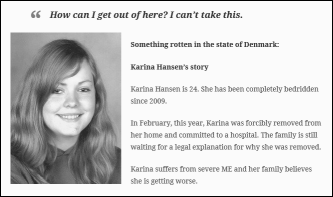
Karina Hansen is 24. She has been completely bedridden since 2009.

In February, this year, Karina was forcibly removed from her home and committed to a hospital. The family is still waiting for a legal explanation for why she was removed.

Karina suffers from severe ME and her family believes she is getting worse.

Karina removed from home

On February 12, 2013, five policemen from Holstebro county, Denmark, arrived at Karina’s house and forcibly removed her from her bedroom.

Two doctors, a locksmith and two social workers were also present.

Karina called for her mother’s help, but her mother was blocked by the police from aiding her. Karina used her mobile phone for the first time in years to call her mother, her father, her cousin and her sister, Janni. Karina is so ill that she can usually only speak in one or two word sentences, but during her removal she managed to call her father and say: Help Dad, in my room, and to her sister: Help, Janni I don’t know where they are taking me.

Karina’s mother could not answer her phone because she was surrounded by policemen.

Karina was driven off to a hospital in an ambulance. Her parents were not told where she was being taken or why they were taking her away. They were given no paperwork.

Later that day, her parents received a phone call. They were told that Karina was at Hammel Neurocenter and that someone would call them every day at 10am to tell them how Karina was doing and that no one would be allowed to visit their daughter for 14 days.

On the morning of February 13, Karina managed to call her mother from her mobile phone. She said: How can I get out of here? I can’t take this. (Hvordan kan jeg komme væk herfra? Jeg kan ikke klare det.) Then the connection was cut.

A few days later, Karina’s parents received a letter from a psychiatrist, Nils Balle Christensen, which said that he would be in charge of Karina’s treatment at Hammel Neurocenter. He also wrote that because “of her condition,” Karina was not allowed visitors for two weeks. That ban on visitors was later extended to three weeks because Dr Christensen was on vacation.

Nils Balle Christensen works at the Aarhus Research Clinic for Functional Disorders and Psychosomatics. He and his boss, Per Fink, believe that ME is a functional disorder. The treatments the clinic recommends are graded exercise therapy (GET), cognitive behavioural therapy (CBT), “mindfulness therapy,” and in some cases, antidepressants. In Denmark, a functional disorder is understood to be a psychosomatic illness.

The psychiatrists at this clinic are considered to have no experience with severely ill ME patients and the Hansen family and ME Foreningen, Danmark fear that if Karina is being treated incorrectly this may lead to a severe and permanent worsening of her condition.

Karina’s parents have not been permitted to see their daughter for three months

The family visited the Neurocenter on April 1 to try to visit Karina, but the parents were not allowed to see her. Karina’s sister, Janni, who is a nurse, was allowed to see Karina for a few minutes. A staff member followed Janni into the room. Janni said that Karina was extremely pale, was unable to talk, and did not show signs that she recognized her sister.

In Janni’s opinion, Karina’s condition is worse now than before she was hospitalized.

Why was Karina forcibly removed?

Karina’s parents and lawyer have yet to receive any official paperwork from any government body or clinician about the reason for her removal. They have received no treatment plan or copies of Karina’s medical reports.

No charges have been made against Karina’s parents. The case has never been heard by a court.

Karina’s parents do not know if or when they will be allowed to see their daughter or if or when she will be allowed to come home. Her parents and her lawyer have obtained power of attorney for Karina, but this is being ignored.

The regional state administrations for Mid-Jutland (Statsforvaltningen Midtjylland) are trying to appoint someone as guardian for Karina.

The only information the family receives comes from Jens Gyring, senior doctor at Hammel Neurocenter. He now calls Karina’s father twice a week and tells him how Karina is.

But the parents are finding it difficult to trust what they are told because they are being given conflicting information. Dr Christensen says Karina is improving every day, but Jens Gyring says there is no change.

Karina’s sister, Janni, thinks her sister is deteriorating.

Jens Grying says he is taking instructions about Karina’s care from Dr Christensen and that the treatment given is a rehabilitation programme.

+++
There are many unanswered questions

Karina’s mother was paid by the county to take care of her daughter and there was never any report of neglect. After Karina was taken away, her mother was fired from her job on the grounds that the caregiver duties were no longer needed.

Which authority gave the order to remove Karina and by whom was it authorized?
What legislation was used to remove and detain her as an involuntary patient in a hospital?
Why are the parents and their lawyer not permitted to see paperwork about the case?
Why have the parents not been allowed to visit?
Are there any charges levelled against the parents?
What is the treatment plan for Karina? The hospital requires that a treatment plan be made on admission.
Why all the secrecy?

+++
Meeting with Liselott Blixt

On April 4, Karina’s parents and two representatives from ME Foreningen, Danmark met with parliament member, Liselott Blixt, who agreed to help to get answers to the many questions in this case.

ME Foreningen, Danmark had been waiting to publish information about Karina’s case until her parents and lawyer had received the official documents. But it is now obvious that these documents will not be released unless pressure is placed on the officials.

+++

ME Foreningen, Danmark campaign

A campaign was launched by ME Foreningen, Danmark for May 12th ME Awareness Week for sending postcards to Karina and also signing a petition in support of the Hansen family’s situation:

http://www.ipetitions.com/petition/postcardtokarina/

For information on where to send your postcard go to ME Foreningen, Danmark on Facebook

If you have a blog or a website, please link to this post or contact ME Foreningen, Danmark for a copy of the account and publish your own blog post. Post a link to this post on Facebook, Twitter, Listservs and forums.

Timeline

Karina Hansen was born in November 1988. She is now 24.

2004/5: Karina contracts mononucleosis, after which she succumbs to countless infections, including sinus infections, as well as severe gastritis. She received many courses of antibiotics. Her activity became very limited because of post exertional malaise. In 2006, Karina had a serious sinus infection and never fully recovered.

2008: Karina receives a diagnosis of Myalgic Encephalomyelitis/ME (ICD-10 G93.3) while at a Danish arthritis hospital, where she was admitted for rehabilitation: exercise and cognitive behavioural therapy (CBT). She was there for 17 days and could never do more than one hour of activity a day.

During the course of her illness, Karina was examined several times by psychiatrists who found no evidence of mental illness. One psychiatrist wrote that her symptoms were most likely caused by the mononucleosis.

Autumn 2009: Karina has an influenza vaccine after which she becomes completely bedridden. In March 2010, Karina’s mother took leave from work to take care of her daughter.

May 2010: Karina’s GP pressured her parents into admitting her to hospital for rehabilitation. By this time, Karina was so ill that she cried from the headaches when they talked to her. There appears to have been an attempt to detain her at the hospital by declaring her mentally unfit. But the medical officer wrote that the “psychiatry law enforcement provisions cannot be used.” She was allowed to go home after three days. Karina’s condition deteriorated after this hospitalization.

May 2010: Karina is seen for the first time by Dr Isager, who confirms the diagnosis of ME. Dr Isager is a Danish doctor who has seen hundreds of ME patients in his long career and has made home visits to many severely ill patients. In 2001, the Danish Ministry of Health wrote that Dr Isager was the Danish doctor with the most experience of ME and had about 250 patients at that time.

March 2011: Karina is seen by another doctor with experience in severe ME. This doctor reconfirmed the ME diagnosis. Karina’s parents worked with her new GP, with Dr Isager, and a nutritionist to try to give Karina the best treatment possible at home. Gut function tests were sent to the USA to try to find a treatment for Karina. There is no hospital in Denmark equipped to take care of severely ill ME patients.

A request was made to have a saline IV started in the home but the county did not cooperate. Karina received a special protein powder and a high iron diet to ensure her nutritional needs were met. Many ME patients do not tolerate iron supplements in pill form.

June 2011: Karina’s mother is hired by the county to be Karina’s caregiver.

May 2012: Sundhedssytrelsen (Danish National Board of Health) contacts two psychiatrists, Per Fink and Jens Nørbæk, about Karina. Karina’s case was presented to them over the phone and Jens Nørbæk stated that Karina must be in an insane-like state: “sindsyglignende tilstand.” These two psychiatrists are considered to have no knowledge of severe ME.

Based on these conversations, the Danish Board of Health put pressure on Karina’s GP to declare Karina psychologically ill and to sign commitment papers. Karina’s GP refused because Karina was not mentally ill. Karina’s GP then resigned as her doctor.

The Danish National Board of Health contacted Per Fink, lead clinician at The Research Clinic for Functional Disorders and Psychosomatics, and asked him to take charge of Karina’s case. The case was then given to another psychiatrist from the clinic, Nils Balle Christensen.

Karina and her parents did not want Dr Christensen as Karina’s doctor. They knew about the research clinic and did not feel the doctors had sufficient knowledge about ME to undertake Karina’s medical care. Karina and her parents said many times they did not want the psychiatric treatment that Dr Christensen was offering. They hired a private doctor to assist Dr Isager in Karina’s care. (Dr Isager is retired.)

February 12, 2013: Karina is forcibly removed from her home and put in the hospital under Dr Christensen’s care. She is now forced to receive the “treatment” she does not want.

May 12, 2013: For three months, Karina’s parents have been denied visits to see their daughter; denied documentation; denied answers to their questions.

+++

The Research Clinic for Functional Disorders and Psychosomatics, Aarhus, Denmark

According to a report by ME Foreningen, Danmark:

The Danish government has put this clinic in charge of taking care of all ME patients in Denmark. The doctors employed here are primarily psychiatrists or psychologists. The centre has spent millions of dollars working to create a new diagnosis, Bodily Distress Syndrome (BDS).

For information on Bodily Distress Syndrome see Part Two of Dx Revision Watch Post:
ICD-11 Beta draft and BDD, Per Fink and Bodily Distress Syndrome

They want to place ME and other illnesses like Fibromyalgia, IBS, chronic pelvic pains and PMS under their new diagnosis. Read about BDS, here, in English:

http://funktionellelidelser.dk/en/for-specialists-researchers/doctors/

Per Fink and his colleagues have been lobbying for their BDS concept to be included in revisions of classification systems.

According to ME Foreningen, Danmark, all treatment at this clinic is on a research basis and all patients receive the same treatment: cognitive behavioural therapy (CBT), graded exercise therapy (GET) and antidepressants. ME Foreningen, Danmark says it has contact with many patients who have ME, Fibromyalgia, IBS, etc but when they are referred to this clinic by their GP, their previous diagnosis is ignored and they are given a psychiatric diagnosis.

ME Foreningen, Danmark states it has many examples of patients who have been pressured by their doctors and case workers to go to this clinic. Patients have reported that their doctors or caseworkers believe this clinic has a proven treatment for ME, Fibromyalgia, IBS etc, so benefits will be denied unless this research treatment is tried. In the 14 years for which the clinic has been open, they only have documentation that they have seen 74 patients with chronic fatigue syndrome. Karina is the first severely ill ME patient that the clinic has had contact with.

+++

Report edited from an account provided by ME Foreningen, Danmark, with permission of the Hansen family.
For more information on the ME Association of Denmark’s postcard campaign go here on Facebook
For information on Bodily Distress Syndrome see Part Two of Dx Revision Watch Post:
ICD-11 Beta draft and BDD, Per Fink and Bodily Distress Syndrome
Something rotten in the state of Denmark: Karina Hansen’s story: http://wp.me/pKrrB-2Xc
Noget råddent i staten Danmark: Karina Hansen: http://wp.me/pKrrB-2Xc
Etwas ist faul in Dänemark: Karina Hansens Geschichte: http://wp.me/pKrrB-2Xc
Il y a quelque chose de pourri au royaume du Danemark: l’histoire de Karina Hansen: http://wp.me/pKrrB-2Xc

Somatic Symptom Disorder paper in Australian & New Zealand Journal of Psychiatry

Somatic Symptom Disorder paper (Frances and Chapman) published in May edition of Australian & New Zealand Journal of Psychiatry

Post #244 Shortlink: http://wp.me/pKrrB-2Wi

ANZJP is a subscription journal.

Commentary by Frances and Chapman discussing the over-inclusive DSM-5 Somatic Symptom Disorder criteria and potential implications for diverse patient groups. The paper concludes by advising clinicians not to use the new SSD diagnosis.

http://anp.sagepub.com/content/current

Commentaries

DSM-5 somatic symptom disorder mislabels medical illness as mental disorder

Aust N Z J Psychiatry May 2013 47: 483-484, doi:10.1177/0004867413484525

Allen Frances¹, Suzy Chapman²

1 Department of Psychiatry, Duke University
2 DxRevisionWatch.com

http://anp.sagepub.com/content/47/5/483.full
http://anp.sagepub.com/content/47/5/483.full.pdf+html

A further commentary on the Somatic Symptom Disorder criteria by Allen Frances, MD, who had chaired the Task Force for DSM-IV, is in press for the June 2013 edition of The Journal of Nervous and Mental Disease.

+++
A second paper, Catatonia from Kahlbaum to DSM-5, by David Healy, is also published in this month’s edition of ANZJP:

May 2013; 47 (5)

Perspectives

Viewpoint

David Healy

Catatonia from Kahlbaum to DSM-5

Aust N Z J Psychiatry May 2013 47: 412-416, doi:10.1177/0004867413486584

+++
Further reading

APA Somatic Symptom Disorder Fact Sheet

Somatic Chapter Drops Centrality Of Unexplained Medical Symptoms Psychiatric News, Mark Moran, March 1, 2013

Somatic Symptoms Criteria in DSM-5 Improve Diagnosis, Care David J Kupfer, MD, Chair, DSM-5 Task Force, defends the SSD construct, Huffington Post, February 8, 2013

The new somatic symptom disorder in DSM-5 risks mislabeling many people as mentally ill Allen Frances, MD, BMJ 2013;346:f1580 BMJ Press Release

Somatic Symptom Disorder could capture millions more under mental health diagnosis Suzy Chapman, May 26, 2012

Mislabeling Medical Illness As Mental Disorder Allen Frances, MD, Psychology Today, DSM 5 in Distress, December 8, 2012

Why Did DSM 5 Botch Somatic Symptom Disorder? Allen Frances, MD, Psychology Today, Saving Normal, February 6, 2013

New Psych Disorder Could Mislabel Sick as Mentally Ill Susan Donaldson James, ABC News, February 27, 2013

Dimsdale JE. Medically unexplained symptoms: a treacherous foundation for somatoform disorders? Psychiatr Clin North Am 2011;34:511-3. [PMID: 21889675]

ICD-11 Round up: April #1

ICD-11 Round up: April #1

Post #239 Shortlink: http://wp.me/pKrrB-2Qy

[PMID 23583019]

The Lancet, Early Online Publication, 11 April 2013
doi:10.1016/S0140-6736(12)62191-6

Proposals for mental disorders specifically associated with stress in the International Classification of Diseases-11

Maercker A, Brewin CR, Bryant RA, Cloitre M, Reed GM, Ommeren MV, Humayun A, Jones LM, Kagee SA, Llosa AE, Rousseau C, Somasundaram DJ, Souza R, Suzuki Y, Weissbecker I, Wessely SC, First MB, Saxena S.

Mental disorders specifically associated with stress are exceptional in needing external events to have caused psychiatric symptoms for a diagnosis to be made. The specialty of stress-associated disorders is characterised by lively debates, including about the extent to which human suffering should be medicalised, 1 and the purported overuse of the diagnosis of post-traumatic stress disorder (PTSD). 2 Most common mental disorders are potentiated or exacerbated by stress and childhood adversity…

Contributors
AM, CRB, RAB, MC, GMR, MvO, SW, MBF, and SS were the core writing group. AH, LJ, SAK, AEL, CR, DS, RS, YS, and IW discussed the text and gave feedback to the core writing group.
Conflicts of interest
AM, CRB, RAB, MC, AH, LJ, SAK, CR, DS, SCW, and YS are members of the WHO ICD-11 Working Group on the Classification of Disorders Specifically Associated with Stress, reporting to the WHO International Advisory Group for the Revision of ICD-10 Mental and Behavioural Disorders. GMR, MvO, and SS are members of the WHO Secretariat, Department of Mental Health and Substance Abuse. AEL, RS, IW, and MBF are special invitees to Working Group meetings. However, the views expressed in this article are those of the authors and, except as specifically noted, do not represent the official policies or positions of the International Advisory Group or WHO.
[Subscription required for full paper. A PDF may be available on authors’ personal websites or academic websites.]

+++

According to CDC’s, Donna Picket, as reported by AHIMA (American Health Information Management Association), “ICD-11 would likely not be ready for implementation in the US until after 2020.”

AHIMA

Update: ICD-11 on Track For 2015

Melanie Endicott | AHIMA & ICD-10 & ICD-10/CAC Summit | April 23, 2013

While the United States is preparing to implement ICD-10-CM/PCS on October 1, 2014, the World Health Organization (WHO) is anticipating a 2015 release of ICD-11. Taking into account the need to then clinically modify the WHO version, ICD-11 would likely not be ready for implementation in the US until after 2020. Donna Pickett, MPH, RHIA, medical systems administrator at Centers for Disease Control and Prevention/National Center for Health Statistics, delivered an update on the progress of ICD-11 development in Monday’s presentation “ICD-11 Update” at the 2013 AHIMA ICD-10-CM/PCS and Computer-Assisted Coding Summit, taking place in Baltimore, MD this week...  Read on

+++

Go here to view ICD-11 Beta drafting platform public version

http://www.who.int/classifications/icd/revision/betaexpectations/en/

ICD-11 Beta: Expectations, Concerns and Known Issues

Information for Beta Participants

ICD-11 Beta Phase started on 14 May 2012. The objective is to have a final ICD-11 version by 2015. This announcement clarifies that ICD-11 Beta version is not final, and will be enhanced by input from multiple stakeholders during the beta phase, which will last 3 years.

Caveats
Problems and Issues
Concerns and Criticisms etc

http://www.who.int/classifications/icd/revision/en/index.html

Revision

Participate in ICD Revision
Video invitation to participate
Frequently Asked Questions About ICD-11
ICD Information Sheet
ICD Revision Information Notes
Register to become involved
Timelines
Content Model
Definitions etc

+++

Presentation | T Bedirhan Üstün

ICD Revision Summary presentation: Quality and Safety Topic Advisory Group meeting, New York, April 2-3, 2013.

ICD11 Quality and Safety TAG 2013 Presentation | Slideshare

According to this presentation, by WHO’s Bedirhan Üstün, all ICD-11 Topic Advisory Groups (TAGs) have finished their editing of the structure. A good deal of work remains for the population of content, in accordance with the ICD-11 Content Model, across all chapters and on compatibility of linearizations across primary care, specialty and detailed research versions.

+++

Presentation [PDF Format, no PP viewer required]

Revising the ICD Definition of Intellectual Disability: Implications and Recommendations | March 19, 2013

Intellectual Disability’s Long Journey: George Jesien, Ph.D., Executive Director, Association for University Centers on Disabilities (AUCD)
Intellectual Disability and the Revision of ICD-10 Mental and Behavioural Disorders: Geoffrey M. Reed, Department of Mental Health and Substance Abuse, WHO
AAIDD Proposed Recommendations for ICD-11: Marc J. Tassé, Nisonger Center – UCEDD, The Ohio State University, Webinar

On Slides 17 and 18, Classification System Most Used and Classification Most Used by Country, graphics for data from WPA-WHO Survey of Practicing Psychiatrists* on global use of ICD-10, ICD-8/9, DSM-IV and Other diagnostic system(s).

*World Psychiatry. 2011 Jun;10(2):118-31.

The WPA-WHO Global Survey of Psychiatrists’ Attitudes Towards Mental Disorders Classification.

Reed GM, Mendonça Correia J, Esparza P, Saxena S, Maj M.

Abstract

Full free paper

+++

Medscape

Schizophrenia Bulletin

Schizophr Bull.2012;38(5):895-898.

Status of Psychotic Disorders in ICD-11

Wolfgang Gaebel

Abstract and full report

+++