Which new DSM-5 disorders proposed for inserting into ICD-10-CM are already added to the ICD-11 Beta draft?
November 6, 2013
Post #280 Shortlink: http://wp.me/pKrrB-3vs
Update to ICD-11 Beta draft at February 3, 2014:
Since my update on January 3, in the ICD-11 Beta draft, Hypochondriasis (illness anxiety disorder) has since been reverted to Hypochondriasis with illness anxiety disorder listed, instead, as an Inclusion term to Hypochondriasis.
Hypochondriasis was subsequently assigned to three parents:
Bodily distress disorders, and psychological and behavioural factors associated with disorders or diseases classified elsewhere; Obsessive-compulsive and related disorders;
Anxiety and fear-related disorders;
At February 3, Hypochondriasis has been removed from parent Bodily distress disorders and is currently assigned dual parentage under:
Obsessive-compulsive and related disorders;
Anxiety and fear-related disorders
Foundation View:
hppt://apps.who.int/classifications/icd11/browse/f/en#/http%3a%2f%2fid.who.int%2ficd%2fentity%2f675329566
Joint Linearization for Mortality and Morbidity Statistics View:
The Definition for Hypochondriasis currently displaying in the Beta draft appears to be the legacy Definition, unrevised from ICD-10.
Update to ICD-11 Beta draft at January 3, 2014:
Revision to ICD-11 Beta draft: In the report below, I stated:
ICD-11 public version Beta draft: Illness anxiety disorder is proposed to be dual coded as Hypochondriasis (illness anxiety disorder) under primary parent, Obsessive-compulsive and related disorders and also coded under Bodily distress disorders, and psychological and behavioural factors associated with disorders or diseases classified elsewhere and assigned a unique code.
As the ICD-11 Beta drafting platform now stands, at January 3, 2014, the DSM-5 term “(illness anxiety disorder)” has been removed from the “Hypochondriasis (illness anxiety disorder)” disorder name and the term reverted to Hypochondriasis.
The term “illness anxiety disorder” is now displaying as listed under “Synonyms” to Hypochondriasis in the ICD-11 Beta Foundation View, and listed under “All Index Terms” in the Morbidity Linearization View.
As previously posted on November 6, 2013:
In the previous four posts, I have documented the September 18-19, 2013 meeting of the ICD-9-CM Coordination and Maintenance Committee and reported on American Psychiatric Association (APA) proposals for inserting a number of new DSM-5 terms into the forthcoming US specific ICD-10-CM.
I also set out how public and professional stakeholders can submit comment or objections on any of the proposals requested at this meeting before the November 15 deadline.
At the September meeting, Darrel Regier, MD, APA Director of Research, presented six diagnoses that are new to DSM-5 for inclusion within ICD-10-CM, with proposals for assigning unique new codes to these disorders for October 2015 [1].
Some of the DSM-5 disorders, below, presented for consideration for inclusion in ICD-10-CM are already entered into the ICD-11 Beta drafting platform and in some cases, entered into the draft over a year or more ago.*
*Caveat: The ICD-11 Beta draft is not approved by WHO or WHA. The Beta draft is a work in progress over the next two to three years. The Beta draft is updated on a daily basis: parent terms, category terms, sorting codes and descriptive content are subject to change as chapter reorganization progresses. This post reflects the Beta draft as it stood on November 6, 2013. ICD-11 Beta Draft Caveats
Binge eating disorder (BED)
(Rationale: Page 32, Diagnosis Agenda: Page 6, Diagnosis Presentations Summary)
Proposal for ICD-10-CM for October 1, 2014: add Binge eating disorder (BED) as an inclusion term to F50.8 Other eating disorders.
Proposal for ICD-10-CM for October 1, 2015: that a unique new code is created for F50.81 Binge eating disorder.
ICD-11 public version Beta draft: Binge eating disorder currently proposed to be coded under Feeding and eating disorders and assigned a unique ICD-11 code. No ICD-11 Definition or other “Content Model” descriptive parameters have yet been populated for Binge eating disorder.
——————————
Gender Identity Disorder in Adolescence and Adulthood
(Rationale: Page 34, Page 6, Diagnosis Presentations Summary)
Proposal for ICD-10-CM for October 1, 2014: that ICD-10-CM change the code for Gender identity disorder in adolescents and adulthood to F64.0 and that “gender dysphoria in adolescents and adults” is added as an inclusion term for this entry.

Source: September 2013 Diagnosis Agenda, Page 34
[See Page 34 of Diagnosis Agenda for discussion of proposed coding changes.]
——————————
Disruptive mood dysregulation disorder (DMDD)
(Rationale: Page 35, Diagnosis Agenda; Page 6, Diagnosis Presentations Summary)
Proposal for ICD-10-CM for October 1, 2014: add Disruptive mood dysregulation disorder (DMDD) as an inclusion term under F34.8: Other persistent mood [affective] disorders.
Proposal for ICD-10-CM for October 1, 2015: that unique new codes are created at F34.81 Disruptive mood dysregulation disorder and F34.89 Other specified persistent mood disorders.
ICD-11 public version Beta draft: Disruptive mood dysregulation disorder (DMDD) is not currently listed.
——————————
Social (Pragmatic) Communication Disorder
(Rationale: Page 37, Diagnosis Agenda; Page 6, Diagnosis Presentations Summary)
Proposal for ICD-10-CM for October 1, 2014: add Social (Pragmatic) Communication Disorder as an inclusion term under F80.89 Other developmental disorders of speech and language.
Proposal for ICD-10-CM for October 1, 2015: that a unique new code is created at F80.82 Social pragmatic communication disorder.
Excludes1: Asperger’s syndrome (F84.5)
Autistic disorder (F84.0)
ICD-11 public version Beta draft: Social (Pragmatic) Communication Disorder is not currently listed.
——————————
Hoarding disorder
(Rationale: Page 39, Diagnosis Agenda; Page 7, Diagnosis Presentations Summary)
Proposal for ICD-10-CM for October 1, 2014: add Hoarding disorder as an inclusion term to F42 Obsessive Compulsive Disorder.
Proposal for ICD-10-CM for October 1, 2015: that a unique new code is created at F42 for F42.2 for Obsessive Compulsive Disorder and F42.3 for Hoarding Disorder in future revisions. (Ms. Pickett stated that new code proposal starting at F42.2 is due to F42.0 and F42.1 deactivation by WHO.)
F42 Obsessive compulsive disorder
New code F42.2 Mixed obsessional thoughts and acts
New code F42.3 Hoarding disorder
New code F42.8 Other obsessive compulsive disorder
New code F42.9 Obsessive-compulsive disorder, unspecified
ICD-11 public version Beta draft: Hoarding disorder currently proposed to be coded under parent Obsessive-compulsive and related disorders and assigned a unique code. No ICD-11 Definition or other “Content Model” descriptive parameters have yet been populated for Hoarding disorder.
——————————
Excoriation (skin picking) disorder
(APA Rationale: Page 41, Diagnosis Agenda, Page 7, Diagnosis Presentations Summary)
Proposal for ICD-10-CM for October 1, 2014: add Excoriation (skin-picking) disorder as an inclusion term to L98.1 Factitial dermatitis (Dermatology section).
Proposal for ICD-10-CM for October 1, 2015: that a unique new code is created at F42 for F42.4 Excoriation (skin-picking) disorder.
Excludes1: Factitial dermatitis (L98.1)
Other specified behavioral and emotional disorders with onset usually occurring in early childhood and adolescence (F98.8)
ICD-11 public version Beta draft: Excoriation disorder (skin-picking disorder) currently proposed to be coded under Obsessive-compulsive and related disorders under parent Body-focused repetitive behaviour disorders and assigned a unique code. No ICD-11 Definition or other “Content Model” descriptive parameters have yet been populated for Excoriation (skin-picking) disorder.
——————————
Premenstrual dysphoric disorder (PMDD)
(APA Rationale: Page 43, Diagnosis Agenda; Page 7, Diagnosis Presentations Summary)
APA considers that placing PMDD outside the recurrent depressive disorder category is less than optimal for differentiating it from ICD-10-CM N94.3 Premenstrual Tension Syndrome, which is generally less severe than PMDD, and does not require psychiatric treatment. If an alternative code in the F32 series is possible, APA would prefer to modify the code in that section in future revisions.
Proposal for ICD-10-CM for October 1, 2014: add Premenstrual dysphoric disorder as an inclusion term to N94.3 Premenstrual tension syndrome (Chapter 15 Diseases of the genitourinary system).
Proposal for ICD-10-CM for October 1, 2015: that a unique new code is created under Chapter 5 F32.8 Other depressive episodes.
New code F32.81 Premenstrual dysphoric disorder
Excludes1: premenstrual tension syndrome (N94.3)
ICD-11 public version Beta draft: Premenstrual dysphoric disorder (PMDD) currently proposed to be dual coded under Chapter 15 Diseases of the genitourinary system > Premenstrual tension syndrome and also coded under Chapter 5 Depressive disorders and assigned a unique code. A draft ICD-11 Definition has been populated for PMDD but no other ICD-11 “Content Model” descriptive parameters have been populated.
——————————
Somatic symptom disorder and Illness anxiety disorder
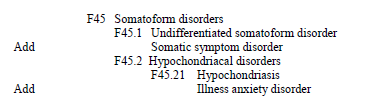
Source: September 2013 Diagnosis Agenda, Page 45
Somatic symptom disorder:
(No rationale provided: Page 45, Diagnosis Agenda) Requester unspecified
Proposal for ICD-10-CM: add Somatic symptom disorder under F45 Somatoform Disorders as inclusion term to F45.1 Undifferentiated somatoform disorder.
ICD-11 public version Beta draft: There is no Somatic symptom disorder in the ICD-11 Beta draft either as a unique new ICD-11 entity code or as an inclusion term or Synonym to an existing ICD-11 code.
For ICD-11 Core version: the current proposal for the F45 Somatoform disorders is for a proposed new construct, Bodily distress disorder, to replace a number of existing ICD-10 categories under Bodily distress disorders, and psychological and behavioural factors associated with disorders or diseases classified elsewhere. Two specifiers: Bodily distress disorder and Severe Bodily distress disorder have yet to be defined or characterized within the Beta draft and no “Content Model” parameters have yet been populated. ICD-11 plans to field test this proposed new ICD-11 construct.
The Definition for Bodily distress disorders, and psychological and behavioural factors associated with disorders or diseases classified elsewhere currently displaying in the Beta draft appears to be the legacy Somatoform disorders Definition imported from ICD-10 and does not reflect any proposed structural reorganization or construct revision for the ICD Somatoform disorders categories.
——————————
Illness anxiety disorder
(No rationale provided: Page 45, Diagnosis Agenda) Requester unspecified
Proposal for ICD-10-CM: add Illness anxiety disorder under F45 Somatoform disorders as inclusion term to F45.21 Hypochondriasis.
ICD-11 public version Beta draft: Illness anxiety disorder is proposed to be dual coded as Hypochondriasis (illness anxiety disorder) under primary parent, Obsessive-compulsive and related disorders and also coded under Bodily distress disorders, and psychological and behavioural factors associated with disorders or diseases classified elsewhere and assigned a unique code.
The Definition for Hypochondriasis (illness anxiety disorder) currently displaying in the Beta draft appears to be the legacy Definition imported from ICD-10 and does not reflect any proposed structural reorganization or construct revision for the ICD Somatoform disorders categories.
Submitting comments
If you have comments or objections to any of the proposals requested at the September ICD-9-CM C & M Committee meeting, the deadline for submissions is November 15, by email, to Donna Pickett: nchsicd9CM@cdc.gov
References for key documents:
1. Article: ICD Codes for Some DSM-5 Diagnoses Updated, Mark Moran, Psychiatric News, October 07, 2013:
http://psychnews.psychiatryonline.org/newsarticle.aspx?articleID=1750103
2. ICD-9-CM/PCS Coordination and Maintenance Committee Meeting September 18-19, 2013:
http://www.cdc.gov/nchs/icd/icd9cm_maintenance.htm#public_meetings
September meeting Proposals [PDF – 342 KB]
http://www.cdc.gov/nchs/data/icd/icd_topic_packet_sept_181913.pdf
September meeting Summary of Diagnosis Presentations PDF file [PDF – 347 KB]:
http://www.cdc.gov/nchs/data/icd/icd_summary_sept_181913.pdf
3. ICD-9-CM/PCS Coordination and Maintenance Committee Meeting Sept 18-19, 2013 meeting materials and four YouTubes of proceedings:
http://www.cms.gov/Medicare/Coding/ICD9ProviderDiagnosticCodes/ICD-9-CM-C-and-M-Meeting-Materials-Items/2013-09-18-MeetingMaterials.html
4. September 19, 2013 Meeting Day Two: ICD-9-CM Coordination and Maintenance Committee Meeting Part 4 videocast:
http://www.youtube.com/watch?v=G-pYdKyr_NE
5. ICD-11 Beta drafting platform (public version):
http://apps.who.int/classifications/icd11/browse/f/en

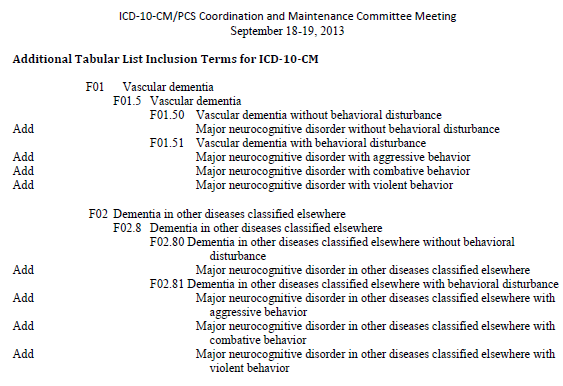
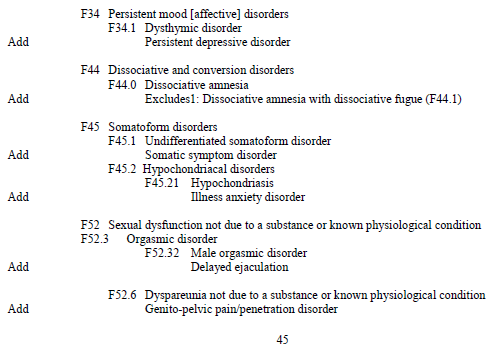
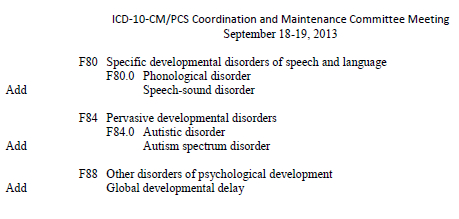

 dx revision watch
Submission: Objection to proposal to insert DSM-5’s Somatic symptom disorder into ICD-10-CM
November 11, 2013 by admindxrw
Post #281 Shortlink: http://wp.me/pKrrB-3×1
There
are just five daysis just one day left in which to submit objections to NCHS to the proposal to insert DSM-5’s Somatic symptom disorder into ICD-10-CM.Submit objections via email by November 15 to Donna Pickett, CDC: nchsicd9CM@cdc.gov
Further information here: Keep SSD out of ICD-10-CM – November 15 deadline for objections
Please let me know if you or your organization or professional body has submitted comment or objections, with a link if your submission is being placed in the public domain.
We need to keep SSD out of ICD-10-CM
Please consider submitting an objection before the November 15 deadline.
If you submitted comment during any of the three DSM-5 public review periods or you are an advocate or clinician signatory to the Institute of Medicine (IOM) definition issue letters campaign please also consider submitting an objection to NCHS.
I have submitted the following:
PDF: Submission NCHS
Text:
To: Ms Donna Pickett, CDC
Re: Comment on proposals, September 18-19, 2013 meeting of the ICD-9-CM Coordination and Maintenance Committee
Diagnostic Agenda, Page 45: Additional Tabular List Inclusion Terms for ICD-10-CM
Add Somatic symptom disorder to ICD-10-CM Tabular List under F45 Somatoform Disorders as inclusion term to F45.1 Undifferentiated somatoform disorder.
Add Somatic symptom disorder to ICD-10-CM Alphabetical Index.
Requestor for proposal: Unspecified
——————————————————–
I am writing to object to the proposed insertion of Somatic symptom disorder into the ICD-10-CM Tabular List and Alphabetical Index.
Somatic symptom disorder is a new construct created by the American Psychiatric Association (APA) for DSM-5.
For DSM-5, the Somatoform Disorders have been dismantled. Four DSM-IV categories: somatization disorder [300.81], some presentations of hypochondriasis [300.7], pain disorder, and undifferentiated somatoform disorder [300.82] are eliminated and replaced with a single new construct, Somatic Symptom Disorder (SSD), cross-walked in DSM-5 to ICD 300.82 (F45.1).
The Somatic Symptom Disorder construct de-emphasizes “medically unexplained” as the central defining feature of this disorder group. The diagnosis does not require that the somatic symptoms are medically unexplained, instead, the focus shifts away from somatic symptoms to emotional, cognitive and behavioral disturbances and “maladaptive” responses: high levels of health anxiety; disproportionate and persistent concerns about the medical seriousness of the symptom(s); or an excessive amount of time and energy devoted to symptoms and health concerns.
Symptoms may or may not be associated with another medical condition: SSD allows for the application of a mental health diagnosis in patients with “established general medical conditions or disorders” like diabetes, heart disease and cancer or presenting with “somatic symptoms of unclear etiology” if the clinician considers the patient otherwise meets the new criteria.
To meet the requirements for DSM-IV Somatization Disorder, a rigorous criteria set needed to be fulfilled: a history of many medically unexplained symptoms before the age of thirty, resulting in treatment sought or psychosocial impairment. And a high diagnostic threshold: a total of eight or more medically unexplained symptoms from four, specified symptom groups, with at least four pain, two gastrointestinal, one psychosexual and one pseudoneurological symptom.
In DSM-5, the requirement for eight symptoms has been dropped to just one or more persistent, non specific, distressing somatic symptoms and the clinician’s perception of “excessive” or “maladaptive” response to the symptom or symptoms.
• These changes for DSM-5 represent a radical restructuring of the DSM-IV Somatoform Disorder categories and a new construct for which much remains to be determined.
On Day Two of the September ICD-9-CM Coordination and Maintenance Committee meeting, Dr Darrel Regier presented and discussed rationales, coding proposals and timings for six new DSM-5 disorders that the APA has proposed for insertion into ICD-10-CM. But the proposal to add the new DSM-5 Somatic symptom disorder and Illness anxiety disorder category terms to ICD-10-CM did not form part of Dr Regier’s presentation on behalf of the APA.
As it is unspecified within the Diagnosis Agenda and during the meeting presentations, it is unclear whether these two proposals are being requested by the APA, by NCHS/CMS, or by other parties or individuals.
• My first concern is that no description of Somatic symptom disorder, no rationale for why this ICD-10-CM change is needed (including clinical relevancy) and no supporting clinical and literature references for the validity of Somatic symptom disorder as a new disorder term were published in the Diagnosis Agenda.
At the public meeting, no presentation had been made on behalf of APA, or by representatives of NCHS or CMS, or by anyone else for the specific proposal to add Somatic symptom disorder as an inclusion term under the ICD-10-CM Somatoform disorders and there was no discussion of this proposal during the course of the meeting [1][2].
There is an expectation that the committees overseeing the development and revision of the draft for the ICD-10-CM will give due consideration to the applicability, clinical utility and reliability of any proposal for the inclusion of a new disorder construct before granting approval for addition to the Tabular List and Index, and that the comments and objections received during the public response period will also be considered.
The lack of rationales and references for supportive evidence provided by the requestors hinders public participation in the response process.
• The absence from both the Diagnosis Agenda document and the meeting presentations of rationales, clinical relevancy and supporting clinical and literature references to enable public scrutiny, consideration and informed responses to this proposal should disqualify SSD from consideration for implementation during a partial code freeze or for consideration for implementation in October 2015.
The burden of proof before introducing any new diagnosis into a classification system is that it has a favourable risk to benefit ratio. This new construct created by the APA for its DSM-5 merits the same level of scrutiny and risk to benefit evaluation as would be expected to be applied to any proposed new disorder/disease under consideration for inclusion in any chapter of ICD, whether this is for the updating of the ICD-10-CM draft, the international ICD-10, the several clinical modifications of ICD-10 or the drafting of ICD-11.
A number of papers have remarked on the paucity of rigorous evidence for the validity, reliability, acceptability, safety and utility of the SSD construct applied to adults and children in diverse clinical settings and across a spectrum of health and allied professionals.
There is no significant body of published research on the epidemiology, clinical characteristics or treatment of the Somatic symptom disorder construct [3][4][5].
In a paper published in the Journal of Psychosomatic Research, September 2013, the SSD work group concedes the lack of clinical evidence for its new construct and acknowledges the “small amount of validity data concerning SSD”; “that much remains to be determined” about the utility and reliability of the specific SSD criteria and its thresholds when applied in busy, general clinical practice, and there are “vital questions that must be answered” as they go forward [6].
• As an under researched, poorly validated disorder construct, Somatic symptom disorder does not meet NCHS/CMS criteria for “new diseases/new technology procedures, and any minor revisions to correct reported errors in these classifications” and should be rejected for consideration for implementation during a partial code freeze but also rejected for consideration for implementation in October 2015.
Concerns for the looseness of the SSD definition and the ease with which these new criteria can be met have been discussed in a number of published papers and commentaries [7][8][9].
The over-inclusiveness of the SSD diagnosis is borne out by the results of the DSM-5 field trial study reported by the chair of the Somatic symptom disorder work group at the 2012 annual meeting of the American Psychiatric Association.
15% of the ‘diagnosed illness’ study group, comprising patients with cancer or coronary disease, were caught by SSD and would meet the criteria for application of an additional mental disorder diagnosis.
26% of the ‘functional somatic’ study group, patients with irritable bowel syndrome or chronic widespread pain, met the SSD criteria.
SSD has a high false positive rate – capturing 7% of the ‘healthy’ field trial control group.
It is also disturbing that the SSD work group (which included no primary care physicians) appears not to have undertaken any field trials into the safety of application of the SSD criteria in children and adolescents.
NCHS/CMS provides no references for data for the application of SSD in children within the Diagnosis Agenda, although the DSM-5 text clearly indicates APA’s intention that SSD is a diagnosis that may also be applied to children with persistent, distressing somatic symptoms.
Potential implications for the application of a diagnosis of SSD:
I am not persuaded that the new SSD construct and criteria can be safely applied outside the optimal conditions of field trials, in settings where practitioners may not necessarily have adequate time for, or instruction in the administration of diagnostic assessment tools, and where decisions to code or not to code may hang on the arbitrary and subjective perceptions of a wide range of end-users who may lack clinical training in the application of mental disorder criteria.
Misapplication of highly subjective and loose, easily met criteria, especially in busy primary care practice, may result in inappropriate diagnoses of mental disorder and inappropriate medical decision making [10], with considerable implications for patients (see Appendix).
A mental disorder diagnosis of SSD can be applied as a “bolt-on” to any chronic medical diagnosis, eg patients with diabetes, angina, cancer, MS, cardiovascular disease, ME and CFS, IBS, chronic widespread pain (aka fibromyalgia) or to patients with a chronic pain condition or with persistent symptoms of unclear etiology.
Patients with chronic, multiple bodily symptoms due to rare diseases, difficult to diagnoses diseases, or multi-system diseases like Behçet’s disease, which can take several years to arrive at a diagnosis, may be especially vulnerable to missed diagnosis or to misdiagnosis with a mental disorder, which may impede access to further testing, investigations, interventions and effective treatments (and result in increased claims against practitioners for medical negligence).
Patients with chronic fatigue syndrome (CFS), “almost a poster child for medically unexplained symptoms as a diagnosis,” according to SSD work group chair, Joel E Dimsdale, or chronic Lyme disease, Gulf War illness, chemical injury and chemical sensitivity; women with potential symptoms of gynecological disease, like ovarian cancer, already often late-diagnosed, endometriosis or interstitial cystitis, or patients with vague neurological symptoms may be particularly vulnerable to misapplication or misdiagnosis with a mental health disorder under the SSD criteria.
There has been considerable opposition to the introduction of this new, poorly tested construct into the DSM-5 amongst patients, carers, advocates, consumer organizations, mental health practitioners and clinicians and considerable concern for the implications for diverse patient populations that the Somatic Symptom Disorder category will provide a “dustbin diagnosis” for the so-called “functional somatic syndromes,” for those living with chronic pain and for patients with persistent, but as yet undiagnosed, symptoms of disease.
• NCHS/CMS has published no independent field trial data and provided no rationales or clinical and literature references to inform public responses. Given the lack of published evidence for the validity and safety of SSD as a construct in adults and children, there is insufficient basis for the approval of SSD for inclusion within ICD-10-CM and it would be scientifically unsafe, premature and against the public interest to include this new construct within ICD.
The proposal for addition to the ICD-10-CM as an inclusion term during a partial code freeze should be rejected. There should be no implementation in October 2015 as an inclusion term to F45.1 or to any other existing code, or with a unique code created.
Appendix:
Incautious, inept application of criteria resulting in a “bolt-on” psychiatric diagnosis of Somatic symptom disorder could have far-reaching implications for diverse patient populations:
• Application of highly subjective and difficult to measure criteria could potentially result in misdiagnosis with a mental disorder, misapplication of an additional diagnosis of a mental disorder or missed diagnoses through dismissal and failure to investigate new or worsening somatic symptoms.
• Patients with cancer and life threatening diseases may be reluctant to report new symptoms that might be early indicators of recurrence, metastasis or secondary disease for fear of attracting a diagnosis of SSD or of being labelled as “catastrophisers.”
• Application of an additional diagnosis of SSD may have implications for the types of medical investigations, tests and treatments that clinicians are prepared to consider and which insurers are prepared to fund.
• Application of an additional diagnosis of SSD may impact payment of employment, medical and disability insurance and the length of time for which insurers are prepared to pay out. It may negatively influence the perceptions of agencies involved with the assessment and provision of social care, disability adaptations, education and workplace accommodations, and the perceptions of medical staff during hospital admissions and accident and emergency admissions.
• Patients prescribed psychotropic drugs for perceived unreasonable levels of “illness worry” or “excessive preoccupation with symptoms” may be placed at risk of iatrogenic disease or subjected to inappropriate and costly behavioural therapies.
• For multi-system diseases like Multiple Sclerosis, Behçet’s disease or Systemic lupus it can take several years before a diagnosis is arrived at. In the meantime, patients with chronic, multiple somatic symptoms who are still waiting for a diagnosis would be vulnerable.
• The burden of the DSM-5 changes to Somatoform Disorders will fall particularly heavily upon women who are more likely to be casually dismissed when presenting with physical symptoms and more likely to be prescribed inappropriate antidepressants and anti-anxiety medications for them.
• Proposals allow for the application of a diagnosis of SSD to children and where a parent is considered excessively concerned with a child’s symptoms. Families caring for children with any chronic illness may be placed at increased risk of wrongful accusation of “over-involvement” with a child’s symptomatology.
Where a parent is perceived as encouraging maintenance of “sick role behavior” in a child, this may provoke social services investigation or court intervention for removal of a sick child out of the home environment and into foster care or enforced in-patient rehabilitation. This is already happening in families in the U.S. and Europe with a child or young adult with chronic illness, notably with Chronic fatigue syndrome or ME. It may happen more frequently with a diagnosis of a chronic childhood illness + SSD.
Thank you for your consideration.
References:
1. September 18-19, 2013 meeting of the ICD-9-CM Coordination and Maintenance Committee Diagnosis Agenda.
2. September 18-19, 2013 meeting of the ICD-9-CM Coordination and Maintenance Committee Summary of Diagnosis Presentations.
3. DSM-5 Somatic Symptom Disorders Work Group Disorder Descriptions and Justification of Criteria – Somatic Symptoms, pub. May 2011, for second DSM-5 stakeholder review.
4. Robert L. Woolfolk and Lesley A. Allen (2012). Cognitive Behavioral Therapy for Somatoform Disorders, Standard and Innovative Strategies in Cognitive Behavior Therapy, Dr. Irismar Reis De Oliveira (Ed.), ISBN: 978-953-51-0312-7
5. Ghanizadeh A, Firoozabadi A. A review of somatoform disorders in DSM-IV and somatic symptom disorders in proposed DSM-V. Psychiatr Danub. 2012 Dec;24(4):353-8.
6. Dimsdale JE, Creed F, Escobar J, Sharpe M, Wulsin L, Barsky A, Lee S, Irwin MR, Levenson J. Somatic Symptom Disorder: An important change in DSM. J Psychosom Res. 2013 Sep;75(3):223-8. Epub 2013 Jul 25.
7. Frances A. The new somatic symptom disorder in DSM-5 risks mislabeling many people as mentally ill. BMJ. 2013 Mar 18;346:f1580. doi: 10.1136/bmj.f1580.
8. Frances A. DSM-5 Somatic Symptom Disorder. J Nerv Ment Dis. 2013 Jun;201(6):530-1. doi: 10.1097/NMD.0b013e318294827c.
9. Frances A, Chapman S. DSM-5 somatic symptom disorder mislabels medical illness as mental disorder. Aust N Z J Psychiatry. 2013 May;47(5):483-4. doi: 10.1177/0004867413484525.
10. Dimsdale JE. Medically unexplained symptoms: a treacherous foundation for somatoform disorders? Psychiatr Clin North Am 2011;34:511-3.
Interest:
Carer/advocate for young adult with long-term medical condition. Owner of website Dx Revision Watch, Monitoring the revision of DSM-5 and ICD-11. Co-author, journal papers and commentaries on the SSD construct (with Professor Allen Frances).
[End of submission]
Share this:
Filed under Allen Frances, Darrel Regier, DSM-5, Functional Somatic Syndrome (FSS), ICD-10-CM, ICD-11, MUS, Myalgic encephalomyelitis, Somatic Symptom Disorder, Somatoform Disorders Tagged with american psychiatric association, dsm-5, functional somatic syndrome, icd-10-cm, icd-11, institute of psychiatry, NCHS, public comment, somatic symptom disorder, somatoform disorders