PVFS, ME, CFS: the ICD-11 Alpha Draft and iCAT Collaborative Authoring Platform

PVFS, ME, CFS: the ICD-11 Alpha Draft and iCAT Collaborative Authoring Platform

Post #46 Shortlink: http://wp.me/pKrrB-KK

The information in this report relates solely to proposals for ICD-11. It does not apply to ICD-10-CM, the forthcoming US “Clinical Modification” of ICD-10. For information on ICD-10-CM see Post #45.

Update @ 6 February 2011

Note that in early November, the iCAT was taken out of the public domain and you will not now be able to view the screenshots below, in situ.

Update @ 30 July 2010

The ICD Revision iCamp2 meeting which was scheduled for April and for which a copy of the Agenda is still available was evidently postponed. ICD-11 Revision Google site gives the revised meeting date as:

27 September – 1 October 2010

According to sources, a print version of the ICD-11 Alpha Draft is now expected to made available around the time that iCamp2 takes place. No Agenda is available yet for this September meeting. The ICD-11 Beta Draft is timetabled for May 2011.


Whither the ICD-11 Alpha Draft?

According to documents published by the ICD Revision Steering Group (RSG) and the Agenda for the iCAMP2 and Revision Steering Group meeting on 19-23 April 2010, it was projected that an alpha draft for ICD-11 would be ready by 10 May 2010 [Key document 1a].

The RSG meeting Agenda proposed that the alpha draft should be presented to the World Health Assembly (WHA) between 17-25 May. A proposal for a press launch was also tabled for discussion.

It is understood that the ICD-11 alpha draft is being created for internal users, was not expected to be complete by May 2010, but released as a “work in progress” towards the beta stage. The Beta Draft for ICD-11, scheduled for May 2011, will be subjected to systematic field trials. It remains unclear at what point in the timeline the Beta would be made available for public comment.

As the Minutes of the April RSG meeting are not yet available, it remains unclear how on target the alpha draft is or whether the goals for 2010 have had to be revised. (See Page 7, ICD-11 Revision Project Plan – Draft 2.0 for Project milestones and budget, and organizational overview.)

When the RSG does release information on the status of the alpha draft and the operational status of the iCAT, I will post an update.

In the meantime, I have asked for information about the availability of Topic Advisory Group proposal forms for stakeholder input, up to what stage in the development process timeline these might be used, and which stakeholders are going to be permitted to make use of proposal forms.


iCAT production server

In the posting ICD-11 Alpha Draft scheduled to launch between 10 and 17 May, 6 May, I reported that it is already possible to view a “Demo and Training iCAT Platform” and also access the iCAT production server.

I cautioned that until an official ICD-11 Alpha Draft is released, it cannot be determined how far the various Topic Advisory Groups have progressed with revising classifications and populating textual content according to a common “Content Model” for the ICD Chapters and categories of interest to us [Key document 1b].

I noted that the Demo and Training iCAT Platform, at that point, was sparsely populated for content and that the classifications and codings listed within the various chapters appeared to have been imported from ICD-10, with little discernable change – presumably as the starting point for the drafting process.

A revised Demo and Training iCAT Platform is now accessible, the content of which is also viewable on the iCAT production server and it is to these proposed revisions that I want to draw your attention.

Note that anyone can view the Demo and Training iCAT Platform and iCAT production server but only WHO, ICD Revision and IT personnel and the Managers and members of the various Topic Advisory Groups (TAGS will have editorial access. External reviewers recruited by TAG Managers will also use the iCAT to upload reviews and comment on proposals and content.

I have compiled a series of screenshots and very brief notes on what is viewable at the moment for the chapters and categories of interest to us.

Note: Screenshots are taken from the Demo and Training iCAT Platform and iCAT production server as they stood at 24 May 2010.  Alpha drafting is an ongoing process and what currently appears may be subject to revision, refinement and additions. Not all the classification and content work currently being undertaken may have been entered into the iCAT.

Note also that when viewing the iCAT in your browser, the left hand side of the screen displays the ICD Categories listings with the category Definition, Term, Clinical Description, Diagnostic Criteria etc displaying on the right of the screen. Because this view is too wide to display on my website template, the screenshots have had to be split in two. On your screen, the iCAT would look like this:


All screenshots as they stood at 24 May 2010.

A wiki-like Collaborative Authoring Tool (known as the iCAT) is being used for the initial authoring of the alpha draft.

The iCAT production server and Demo and Training iCAT Platform can be accessed here:

https://sites.google.com/site/icd11revision/home/icat

iCAT production server at: http://icat.stanford.edu/

Demo and Training iCAT Platform at: http://icatdemo.stanford.edu/

Load either (they may take a minute or more to load and appear less inclined to hang in Firefox).

One loaded, you will be presented with an Entry Page – this is the My ICD Tab

Welcome to iCAT – the Initial ICD 11 Collaborative Authoring Tool!
 

Select the ICD Content Tab and ICD Categories by chapter will populate down the left side of the screen.

Scroll down and open up the + next to 06 VI Diseases of the nervous system

ICD Categories:
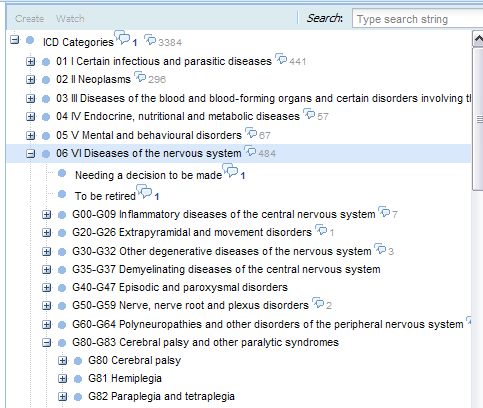
 

Scroll down and note that ICD-10 codings between G83.9 and G99.8 are being reorganised and have been assigned the labels GA thru GN (some of which, like GN, are parent categories with child and grandchildren categories).

Open up the + next to GN Other disorders of the nervous system

which is a parent to category Gj92 Chronic fatigue syndrome

(Note: Gj92 is known as a “Sorting label”. A Sorting label is a string that can be used to sort the children of a category. This is not the ICD code.)

Note that Postviral fatigue syndrome and Benign myalgic encephalomyelitis are not currently accounted for in the ICD Categories List as children of the parent category GN Other disorders of the nervous system. Only Chronic fatigue syndrome is listed and assigned the Sorting Label “Gj92”. [See Glossary: Inclusions]
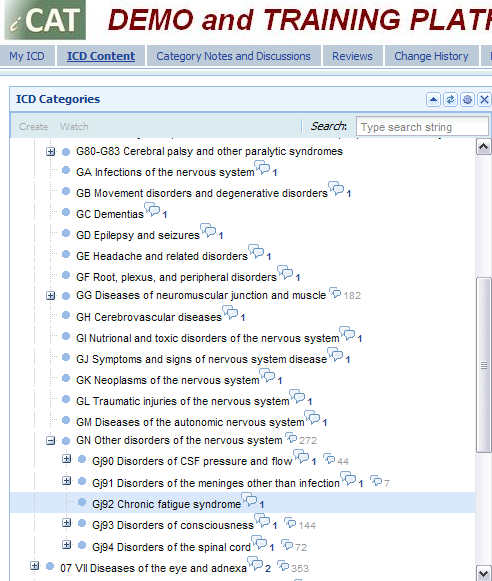


Click on the double speech bubble icon next to Gj92 Chronic fatigue syndrome which will display 1 Category Discussion Note (Click Expand to display the full note. Discussion Notes can also be accessed via the Category Notes and Discussions Tab, from which the screenshot below, orginates).

Discussion Note for Gj92 Chronic fatigue syndrome:
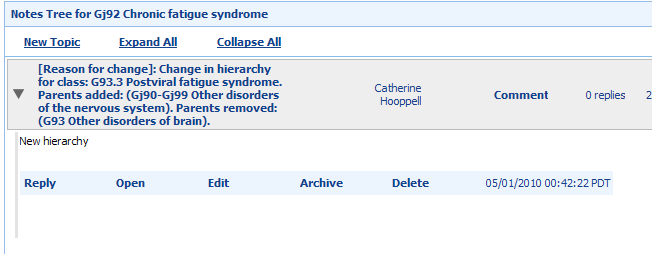
This Discussion Note records a Change in hierarchy for class: G93.3 Postviral fatigue syndrome because its parent category (G93 Other disorders of brain) is removed.

Note that the removal of the parent G93 Other disorders of brain will affect other categories also classified under G93 in ICD-10, not just G93.3. Open up the double speech bubble icons next to other category listings and you can view the Discussion Notes on proposed restructuring for other G8x and G9x categories.

This is the “Change history” for Gj92 Chronic fatigue syndrome:

 
Next, with the ICD Content Tab selected, click on Gj92 Chronic fatigue syndrome and the Details for Gj92 Chronic fatigue syndrome will display on the right side of the screen. Allow a few moments for the text in the boxes to load.

With the Title & Definition Tab selected (the Tab may read Definition only, depending on whether you are viewing the iCAT production server or the Demo iCAT), you can view the

          Details for Gj92 Chronic fatigue syndrome 

To view a Glossary of Terms page, which defines the terms in the Tabs click on the blue question mark icons which will load the iCAT Glossary.

Content for Gj92 Chronic fatigue syndrome:

[See Glossary: Definition] The full text of External Definitions (imported from affiliate classification publications) which is partly hidden in the screenshot, is appended at end of this post.  According to discussion on the iCAT Users Google Group, it is proposed that External Definitions might be given less prominence when displaying in the iCAT.


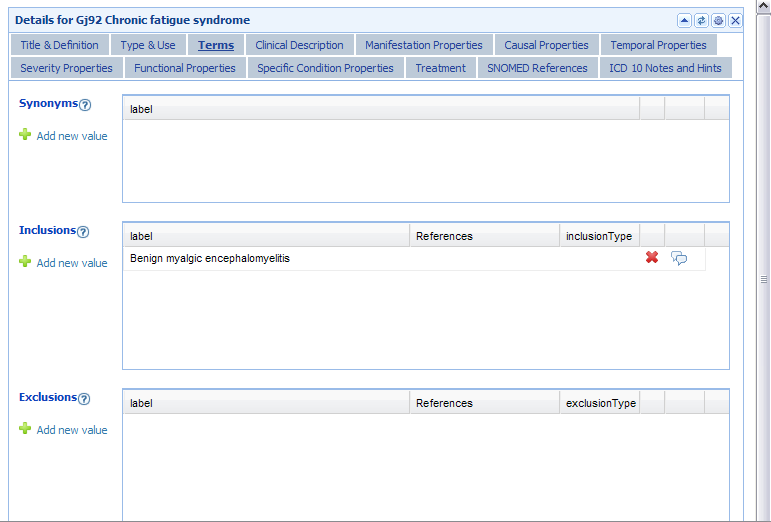
Now click on the Terms Tab.

Terms for Gj92 Chronic fatigue syndrome:

Benign myalgic encephalomyelitis currently appears listed under Inclusions to Gj92 Chronic fatigue syndrome.

Note that Postviral fatigue syndrome is not listed under Inclusions and that Synonyms and Exclusions for Gj92 Chronic fatigue syndrome have yet to be populated. [See Glossary: SynonymsInclusions, Exclusions]

Very few of the other Content Tabs have been populated but it is envisaged that they will be in due course.
 
I provide no screenshots for Benign myalgic encephalomyelitis or Postviral fatigue syndrome because these are not listed in the iCAT Linearized ICD Categories List. [See Glossary: ICD TitleSynonymsInclusions, Exclusions]

Extract from the iCAT Glossary

6. Inclusions

Short definition: Inclusion terms are either synonyms of the category titles or subclasses which are not represented in the classification hierarchy.

Details: Inclusion terms appear in the tabular list of the traditional print version and show users that entities are included in the relevant concept.  All of the ICD-10 inclusion terms have been imported and accessible in the iCat.  These are either synonyms of the category titles or subclasses which are not represented in the classification hierarchy. Since we have synonyms as a separate entity in our ICD-11 content model, the new synonyms suggested by the users should go into the synonyms section.  In the future, iCat will provide a mechanism to identify whether an inclusion is a synonym or a subclass.

7. Exclusions

Short definition: Exclusion terms help users eliminate entities that should be assigned to a different ICD category because of differences in meaning or terminology.

Details: Exclusion terms help users eliminate entities that should be assigned to a different ICD category because of differences in meaning or terminology.


I am including some screenshots of other Chapters which will be of interest.

Chapter 5 (V) Somatoform Disorders at F45 (currently same as or near ICD-10). 

(It is understood from ICD documentation that the child categories F45.40 and  F45.41 are new entities for ICD-11. Note these categories do not mirror the proposals of the DSM-5 “Somatic Symptom Disorder” Work Group.)


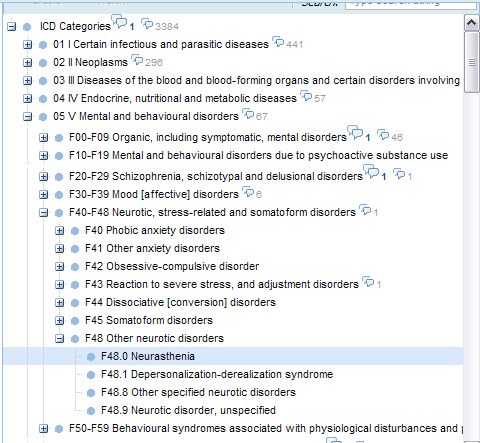
Neurasthenia remains in Chapter 5 (V) at F48.0:
 

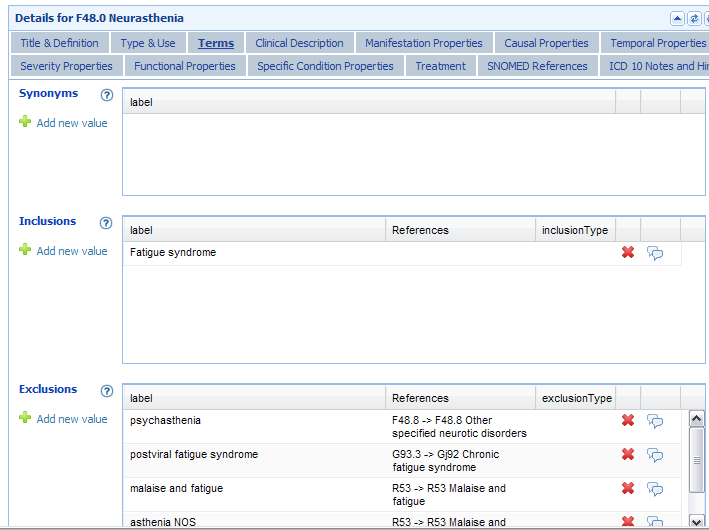
Inclusions and Exclusions for Neurasthenia:
 

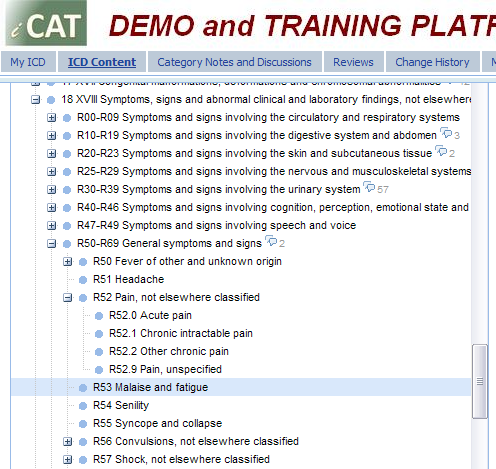
Chapter 18 (XVIII) displaying R53 Malaise and fatigue (this is the Chapter under which the US Clinical Modification, ICD-10-CM, proposes classifying Chronic fatigue syndrome, at R53.82):
 

Inclusions and Exclusions for R53 Malaise and fatigue:


Here are the two Category discussion Notes that appear directly beneath 06 VI Diseases of the nervous system (no ICD10 concepts from Chapter 06 VI are currently moved into either of these “holding pens”).

1 Discussion Note for: Needing a decision to be made


1 Discussion Note for: To be retired

________________________________________________________________________


External Definitions: (Imported from affiliate classification publications, these remain the same as my 6 May posting.)

External Definitions for Gj92 Chronic fatigue syndrome

A syndrome of unknown etiology. Chronic fatigue syndrome (CFS) is a clinical diagnosis characterized by an unexplained persistent or relapsing chronic fatigue that is of at least six months duration, is not the result of ongoing exertion, is not substantially alleviated by rest, and results in substantial reduction of previous levels of occupational, educational, social or personal activities. Common concurrent symptoms of at least six months duration include impairment of memory or concentration, diffuse pain, sore throat, tender lymph nodes,headaches of a new type, pattern, or severity, and nonrestorative sleep. The etiology of CFS may be viral or immunologic. Neurasthenia and fibromyalgia may represent related disorders. Also known as myalgic encephalomyeltis.

Ontology ID UMLS/NC12007_05
E

distinctive syndrome characterized by chronic fatigue, mild fever, lymphadenopathy, headache, myalgia, arthralgia, depression, and memory loss: candidate eitiological agents include Epstein-Barr and other herpesviruses.

Ontology ID UMLS/CSP2006

A syndrome characterized by persistent or recurrent fatigue, diffuse musculoskeletal pain, sleep disturbances, and subjective cognitive impairment of 6 months duration or longer. Symptoms are not caused by ongoing exertion; are not relieved by rest; and result in a substantial reduction of previous levels of occupational, educational, social or personal activities. Minor alterations of immune, neuroendocrine, and automatic function may be associated with this syndrome. There is also considerable overlap between this condition and FIBROMYALGIA.
(From Semin Neurol 1998;18(2):237-42: Ann Intern Med 1994 Dec 15;121(12):953-9)

Ontology ID UMLS/MSH2008_2
008_02_04


Based only on the information visible in the iCAT as it stood at 24 May 2010, it appears that instead of:

ICD-10 (version for 2007) Tabular List

http://apps.who.int/classifications/apps/icd/icd10online/?gg90.htm+g933

Chapter VI (6)

Diseases of the nervous system
(G00-G99)

[…]

Other disorders of the nervous system
(G90-99)

[…]

G93 Other disorders of brain

[…]

G93.3 Postviral fatigue syndrome
           Benign myalgic encephalomyelitis

(with Chronic fatigue syndrome indexed to G93.3 in Volume 3: The Alphabetical Index)

that what may be being proposed at this point is:

that     G83.9-G99.8 codes in ICD-10 Chapter VI: Diseases of the nervous system are being restuctured;

that     G93 Other disorders of brain is removed as a parent category for G93.x codings;

that     GN Other disorders of the nervous system

is now the parent to a large number of categories previously classified between G83.9 and G99.8

that     GN Other disorders of the nervous system is the parent to

            Gj92 (Sorting label) Chronic fatigue syndrome

that     Gj92 Chronic fatigue syndrome is included in ICD-11 Chapter 06 VI Diseases of the nervous system (Neurology chapter) in the ICD Categories list as an ICD Title term; 

that there is currently displaying no Gj9x Sorting label (or any other Sorting label) listing for Postviral fatigue syndrome or Benign myalgic encephalomyelitis in ICD Categories list or any Category Details for either term;

(Whether this is because Inclusion terms appear in the tabular list of the traditional print version but not in the iCAT version, or because of proposed hierarchy changes to the relationship between these three terms or because text remains to be entered into the iCAT for these two terms, cannot be determined from the information available at 10 June – please refer to Glossary of Terms which sets out the relationships between an ICD Title and its inclusion in the iCAT Categories list and between an ICD Title and its Synonyms, Inclusions and Exclusions.)

that    Gj92 Chronic fatigue syndrome is an ICD Title term with a Details page, a Definition and an Inclusion term (but with no Synonyms or Exclusions or other fields yet populated);

that    Benign myalgic encephalomyelitis is listed as an Inclusion to Gj92 Chronic fatigue syndrome

that in    Chapter 5 (V) Details for F48.0 Neurasthenia
            “postviral fatigue syndrome” is specified as an Exclusion to F48.0 with the Reference

             G93.3 -> Gj92 Chronic fatigue syndrome

that in    Chapter 18 (XVIII) Details for R53 Malaise and Fatigue 

            “fatigue syndrome postviral” [sic] is specified as an Exclusion with the References

            F48.0 -> F48.0 Neurasthenia, [which is also an Exclusion to R53 Malaise and Fatigue]
            G93.3 -> Gj92 Chronic fatigue syndrome

but that in the absence of further information, it is currently unclear what the proposed hierarchical status of Postviral fatigue syndrome and Benign myalgic encephalomyelitis will be in relation to Chronic fatigue syndrome, and in relation to each other.  (A request for clarification was made in late June 2010 to Dr Raad Shakir, Chair, Topic Advisory Group for Neurology, but a response is still awaited at March 2011.)


[1] Key documents:

a) ICD-11 Revision Project Plan – Draft 2.0 (v March 10) [PDF format]
Describes the ICD revision process as an overall project plan in terms of goals, key streams of work, activities, products, and key participants.

b) Content Model Specifications and User Guide  (v April 10)
Identifies the basic properties needed to define any ICD concept (unit, entity or category) through the use of multiple parameters.

A more recent version of the Content Model document was uploaded to the ICD Revision site on 22 February 2011.

It can be accessed here on the ICD Revision site:

View Word document

Download Word document

Or opened here on DSM-5 and ICD-11 Watch site: Content Model Reference Guide v January 2011

c) Alpha Drafting Workflow (v 06.10.09)
Sets out lines of responsibility between the various contributors for the alpha drafting phase.

US “Clinical Modification” ICD-10-CM

US “Clinical Modification” ICD-10-CM

Post #45 Shortlink: http://wp.me/pKrrB-Ka

This post is intended to clarify any confusion between ICD-10, ICD-11 and the forthcoming US Clinical Modification of ICD-10, ICD-10-CM.

The WHO published ICD-10 in 1992. The current version of ICD-10 (Version for 2007) is used in the UK and in many countries throughout the world.

ICD-10 is under revision and the development of the structure and content of ICD-11 has been underway since 2007. ICD-11 is scheduled for completion in 2014.

 
Clinical Modifications

Several countries are permitted to publish adaptations of the ICD called “Clinical Modifications” (sometimes known as “national modifications”).

Countries using Clinical Modifications of ICD-10 include Canada (ICD-10-CA), Australia (ICD-10-AM) and Germany (ICD-10-GM).

The United States currently uses an adaptation of the WHO’s now retired ICD-9, called ICD-9-CM, and has been slow to move onto ICD-10.

Rather than skip ICD-10 and move straight onto ICD-11 in 2014+, the US CDC has been developing a modification of ICD 10 called ICD-10-CM which will replace ICD-9-CM.

ICD-10-CM is US specific and is due for implementation in October 2013.

According to one report, the US should not expect to move on to ICD-11 (or a modification of ICD-11) until well after 2020, assuming that ICD-11 is published around the 2014-2015 projection:

Why move to ICD-10, if ICD-11 is on the horizon?
http://www.healthcarefinancenews.com/news/why-move-icd-10-if-icd-11-horizon
 

What are the proposed classifications and codings for PVFS, (Benign) ME and Chronic fatigue syndrome for ICD-10-CM?

In March 2001, the document:

“A Summary of Chronic Fatigue Syndrome and Its Classification in the International Classification of Diseases Prepared by the Centers for Disease Control and Prevention, National Center for Health Statistics, Office of the Center Director, Data Policy and Standards”

provided a concise “summary of the classification of Chronic Fatigue Syndrome in the International Classification of Diseases (ICD), ninth and tenth revisions, and their clinical modifications.”

That document is archived here: http://www.co-cure.org/ICD_code.pdf

In 2001, the proposal had been:

“In keeping with the placement in the ICD-10, chronic fatigue syndrome (and its synonymous terms) will remain at G93.3 in ICD-10-CM.”

So at that point, it was being proposed for the forthcoming US ICD-10-CM that PVFS, (Benign) ME and Chronic fatigue syndrome would be coded at G93.3, which would have placed all three terms in Chapter VI: Diseases of the nervous system (the Neurological chapter).

But the current proposals for ICD-10-CM propose classifying Chronic fatigue syndrome in Chapter 18, under R53 Malaise and fatigue, at R53.82.

The “R” codes are classified under

CHAPTER 18 (XVIII)
Symptoms, signs and abnormal clinical and laboratory findings, not elsewhere classified (R00-R99)

This chapter includes symptoms, signs, abnormal results of clinical or other investigative procedures, and ill defined conditions regarding which no diagnosis classifiable elsewhere is recorded…

Note: this is not the ICD-10-CM Mental and Behavioural chapter, which is:

CHAPTER 5 (V)
Mental and behavioral disorders (F01-F99)
Includes: disorders of psychological development
Excludes2: symptoms, signs and abnormal clinical laboratory findings, not elsewhere classified (R00-R99)

which specifically excludes the R00-R99 codes.

So the current proposal for ICD-10-CM separates CFS and Postviral fatigue syndrome into mutually exclusive categories:

“Chronic fatigue, unspecified” and “Chronic fatigue syndrome not otherwise specified” appear in Chapter 18, under R53 Malaise and fatigue, at R53.82.

Whilst “Postviral fatigue syndrome” and “benign myalgic encephalomyelitis” appear in Chapter 6, under G93 Other disorders of brain, at G93.3.

At some point before October 2013, ICD-10-CM revision will be “frozen” for Centers for Medicare and Medicaid Services (CMS) and insurance companies to prepare for the October 1, 2013 implementation.

See Tom Sullivan at ICD10 Watch.com (no connection with my site) here:

CMS, CDC call for ICD-9 and ICD-10 code freeze
http://icd10watch.com/headline/cms-cdc-call-icd-9-and-icd-10-code-freeze

“CMS, the Centers for Medicare and Medicaid Services, along with CDC, the Centers for Disease Control and Prevention, proposed that both ICD-9-CM and ICD-10-CM/PCS code sets be frozen two years before the compliance deadline.

“What that means: As of October 1, 2011, only limited updates would be instituted into the code sets so that providers, payers, clearinghouses, and health IT vendors, will not have to simultaneously keep pace with code updates while also reconfiguring their existing systems for ICD-10-CM/PCS.” ICD10 Watch.com

During the last ten minutes of the CFSAC meeting on Monday, 10 May, Dr Lenny Jason raised his concerns with the committee that the placement of CFS in ICD-10-CM in the Chapter 18 “R” codes could be problematic.

Videocast of full CFSAC meeting here:
http://videocast.nih.gov/Summary.asp?File=15884

In August 2005, CFSAC had submitted the following recommendation to the Secretary:

http://www.hhs.gov/advcomcfs/recommendations/082005.html

“Recommendation 10: We would encourage the classification of CFS as a ‘Nervous System Disease,’ as worded in the ICD-10 G93.3.”

I suggest that US advocates with concerns about current proposals for the placement of CFS within ICD-10-CM keep a close eye on decisions about the date by which ICD-10-CM is to be frozen.

For the most recent ICD-10-CM proposals see:

http://www.cdc.gov/nchs/icd/icd10cm.htm

The 2010 update of ICD-10-CM is now available and replaces the July 2009 version.

The file for the Tabular List is in a Zipped file which is not that easy to locate on the site. A non Zipped PDF can be downloaded from this site:

http://www.cms.gov/ICD10/12_2010_ICD_10_CM.asp#TopOfPage
http://www.cms.gov/ICD10/Downloads/6_I10tab2010.pdf

or open the PDF on my DSM-5 and ICD-11 Watch site, here
https://dxrevisionwatch.com/wp-content/uploads/2009/12/i10tab2010.pdf

ICD-10-CM CHAPTER 18

Tabular List of Diseases and Injuries Page 1165 (Update for 2010)

      R53 Malaise and fatigue

      […]

      R53.8 Other malaise and fatigue

          Excludes1: combat exhaustion and fatigue (F43.0)
          congenital debility (P96.9)
          exhaustion and fatigue due to:
          depressive episode (F32.-)
          excessive exertion (T73.3)
          exposure (T73.2)
          heat (T67.-)
          pregnancy (O26.8-)
          recurrent depressive episode (F33)
          senile debility (R54)

      R53.81 Other malaise

          Chronic debility
          Debility NOS
          General physical deterioration
          Malaise NOS
          Nervous debility
          Excludes1: age-related physical debility (R54)

     R53.82 Chronic fatigue, unspecified

          Chronic fatigue syndrome NOS
          Excludes1: postviral fatigue syndrome (G93.3)

      R53.83 Other fatigue

          Fatigue NOS
          Lack of energy
          Lethargy
          Tiredness


ICD-10-CM CHAPTER 6 Page 325 (Update for 2010)

Diseases of the nervous system (G00-G99)

Excludes2:

[…]
symptoms, signs and abnormal clinical and laboratory findings, not elsewhere classified (R00-R94)

     […]

     G93 Other disorders of brain

      […]

      G93.3 Postviral fatigue syndrome

          Benign myalgic encephalomyelitis
          Excludes1: chronic fatigue syndrome NOS (R53.82)

For comparison:

German Modification ICD-10-GM
http://www.dimdi.de/static/de/klassi/diagnosen/icd10/htmlgm2010/block-g90-g99.htm

ICD-10-GM Version 2010

Kapitel VI
Krankheiten des Nervensystems
(G00-G99)

G93.- Sonstige Krankheiten des Gehirns

[…]

G93.3 Chronisches Müdigkeitssyndrom

Benigne myalgische Enzephalomyelitis
Chronisches Müdigkeitssyndrom bei Immundysfunktion
Postvirales Müdigkeitssyndrom

For comparison:

Canadian Modification ICD-10-CA

(Version 2009 of ICD-10-CA/CCI replaces version 2006)

http://secure.cihi.ca/cihiweb/dispPage.jsp?cw_page=codingclass_e

Version 2009 ICD-10-CA Tabular List, Volume 1 PDF (4.9MB)
http://secure.cihi.ca/cihiweb/en/downloads/ICD-10-CA_Vol1_2009.pdf

Version 2009 ICD-10-CA Alphabetical Index, Volume 2 PDF (4.3MB)
http://secure.cihi.ca/cihiweb/en/downloads/ICD-10-CA_Vol2_2009.pdf

Chapter VI

Diseases of the nervous system
(G00-G99)

Other disorders of the nervous system
(G90-99)

[…]

G93 Other disorders of brain

[…]

G93.3 Postviral fatigue syndrome

Includes: Benign myalgic encephalomyelitis
Chronic fatigue syndrome

Excludes: fatigue syndrome NOS (F48.0)

For comparison with WHO ICD-10:

Current ICD-10 codings for the three terms are set out on my site, here, together with extracts from Chapter V (the “F” codes) and Chapter XVIII (the “R” codes):

https://dxrevisionwatch.wordpress.com/icd-11-me-cfs/

or go here for the full ICD-10 Volume 1: Tabular List

http://apps.who.int/classifications/apps/icd/icd10online/

ICD-10 Version for 2007 online
http://apps.who.int/classifications/apps/icd/icd10online/?gg90.htm+g933

Chapter VI

Diseases of the nervous system
(G00-G99)

Other disorders of the nervous system
(G90-99)

[…]

G93 Other disorders of brain

[…]

G93.3 Postviral fatigue syndrome
           Benign myalgic encephalomyelitis

Note that in ICD-10, Chronic fatigue syndrome is not included in Volume 1: The Tabular List, Chapter VI under the parent term:

             G93 Other Disorders of brain

but “Chronic fatigue syndrome” does appear in Volume 3: The Alphabetical Index, where it is indexed to G93.3.

In a forthcoming post, I shall be publishing important information about proposals for parent terms, classifications and codings in the ICD-11 Alpha Draft.


Related material:

ICD-9-CM

For information on the current codings in ICD-9-CM (US Clinical Modification) see the NAME U.S. page:  WHO ICD Codes section

American Psychiatric Association on DSM-5

In a 10 December Press Release, the American Psychiatric Association said:

“Extending the timeline [for DSM-5] will allow more time for public review, field trials and revisions”

and

“The extension will also permit the DSM-5 to better link with the U.S. implementation of the ICD-10-CM codes for all Medicare/Medicaid claims reporting, scheduled for October 1, 2013. Although ICD-10 was published by the WHO in 1990, the “Clinical Modification” version (ICD- 10-CM) authorized by the U.S. Centers for Medicare and Medicaid Services (CMS) and the Centers for Disease Control (CDC) is not being implemented in the U.S. until 23 years later.

“The ICD-10-CM includes disorder names, logical groupings of disorders and code numbers but not explicit diagnostic criteria. The APA has already worked with CMS and CDC to develop a common  structure for the currently in-use DSM-IV and the mental disorders section of the ICD- 10-CM.

“The International Classification of Diseases (ICD) is published by the WHO for all member countries to classify diseases and medical conditions for international health care, public health, and statistical use. The WHO plans to release its next version of the ICD, the ICD-11, in 2014.

“APA will continue to work with the WHO to harmonize the DSM-5 with the mental and behavioral disorders section of the ICD-11. Given the timing of the release of both DSM-5 and ICD-11 in relation to the ICD-10-CM, the APA will also work with the CDC and CMS to propose a structure for the U.S. ICD-10 CM that is reflective of the DSM-5 and ICD-11 harmonization efforts. This will be done prior to the time when the ICD-10-CM revisions are “frozen” for CMS and insurance companies to prepare for the October 1, 2013, adoption.”

New WHO YouTube videos: ICD-11 and ICTM

New WHO YouTube videos: ICD-11 and ICTM

Post #44 Shortlink: http://wp.me/pKrrB-IP

ICD-11 Alpha Draft

It was anticipated that an Alpha Draft for ICD-11 would be ready by 10 May. ICD Revision Steering Group has issued no news release around a launch but I will update as soon as information becomes available.

My previous report “ICD-11 Alpha Draft scheduled to launch between 10 and 17 May” can be read here on DSM-5 and ICD-11 Watch.


ICD on YouTube

Two new videos have been added to the WHOICD11 YouTube channel.

WHOICD11 Channel YouTube:

http://www.youtube.com/user/WHOICD11

ICD-11 Alpha Draft 11 May 2010 [3.46 mins]

Brief introduction to the development of ICD-11.

ICD-11 ICTM March 2010 [10.40 mins]

International Classification of Traditional Medicine consulation

This three day WHO consultation on traditional medicine was held in Geneva, in March. The meeting discussed a proposal for an International Classification of Traditional Medicine (ICTM) to parallel the ICD.

The ICTM is projected for 2014 as a new member of the WHO Family of International Classifications (WHO FIC). The vision for ICTM is to produce an international, standardised classification system of terminology, definitions, safety and treatment properties for traditional, complementary and alternative medicine according to a common content model.

All 13 ICD YouTube videos are collated on this page on this DSM-5 and ICD-11 Watch site sub page:

ICD-11 YouTubes: http://wp.me/PKrrB-eV

Revision of DSM-5 and ICD-10-CM raised at 10 May CFSAC meeting

Revision of DSM-5 and ICD-10-CM raised at 10 May CFSAC meeting

Post #43 Shortlink: http://wp.me/pKrrB-HA

A one day public meeting of the US Chronic Fatigue Syndrome Advisory Committee (CFSAC) was held on Monday, 10 May. Minutes of the previous two day meeting and a Videocast of the proceedings of both days (with subtitles) can be accessed here and here.

The Chronic Fatigue Syndrome Advisory Committee (CFSAC) provides advice and recommendations to the Secretary of Health and Human Services via the Assistant Secretary for Health of the U.S. Department of Health and Human Services on issues related to chronic fatigue syndrome (CFS). More information here [PDF].

Towards the end of Monday’s meeting, Dr Leonard Jason, PhD, raised concerns in response to current proposals for the placement of CFS within the forthcoming US “Clinical Modification”, ICD-10-CM, due to be implemented in October 2013. (See this Dx Revision Watch page for current ICD-10-CM proposals.)

Agenda for this Spring 2010 meeting here

CFSAC Agenda – May 10, 2010
Chronic Fatigue Syndrome Advisory Committee
US Department of Health and Human Services

Meeting was webcast live at http://videocast.nih.gov 

Webcast of entire meeting with subtitles is now available to view here

Chronic Fatigue Syndrome Advisory Committee
Monday, May 10, 2010
HHS Office on Women’s Health (OWH)
Total Running Time: 05:47:57

More information here: http://videocast.nih.gov/Summary.asp?File=15884

Presentations, Public Testimonies and Written Testimonies here

Transcripts are being compiled on a dedicated Facebook site here

YouTubes videos here:


New Hillary Johnson blog post – “Sif-Sac, again.” here

Cort Johnson’s blog

A very different looking federal advisory committee on CFS (CFSAC) discussed its charter, its recommendations, XMRV and the blood supply, what the CDC program will look and more. Asst Secretary of Health Dr. Koh, Annette Whittemore and Kim McCleary spoke. Check out the goings on at the CFSAC meeting in

‘The CFSAC on Itself, XMRV, the CDC and More’ from the Bringing the Heat blog:

http://blog.aboutmecfs.org/?p=1540

Phoenix Rising forum thread here

CFSAC Agenda – May 10, 2010

May 10, 2010

9:00 am
Call to Order
Opening Remarks

Roll Call, Housekeeping
Dr. Christopher Snell
Chair, CFSAC

Dr. Wanda Jones
Designated Federal Official

9:15 am
Welcome Statement from the Assistant Secretary for Health

New Members Statement on CFSAC Interests/Goals
Dr. Howard K. Koh

CFSAC New Members

10:00 am
Remarks from Dr. Elizabeth Unger
Dr. Elizabeth Unger

10:30 am
Blood Safety Update on XMRV
Dr. Jerry Holmberg

11:00 am
Review/Update of past CFSAC recommendations
Committee Members

12:30 pm
Subcommittee Lunch
Subcommittee Members

1:30 pm
Public Comment
(on CFSAC charter)
Public

2:00 pm
Review and Discussion of CFSAC Charter and ByLaws
Committee Members

4:00 pm
Adjourn

ICD-11 Alpha Draft scheduled to launch between 10 and 17 May

ICD-11 Alpha Draft scheduled to launch between 10 and 17 May

Post #42 Shortlink: http://wp.me/pKrrB-GT

NOTE: The post below is superceded by Post # 46:

PVFS, ME, CFS: the ICD-11 Alpha Draft and iCAT Collaborative Authoring Platform

Shortlink Post #46: http://wp.me/pKrrB-KK

Note that until the ICD-11 Alpha Draft is released, it cannot be determined how far the various Topic Advisory Groups have progressed with proposals for revising ICD-10 classifications or with populating definitions and other content according to the ICD Content Model. Proposals for revision of classifications and textual content may differ from the examples on the Demo and Training iCAT platform as it appeared on the date this posting was compiled (accessed 06.05.10).

Also note that information in this report applies to the revision of ICD-10 towards ICD-11. Countries using a “Clinical Modification” of ICD, for example, Canada (ICD-10-CA), the USA (implementing ICD-10-CM, in October 2013), Australia (ICD-10 AM) and Germany (ICD-10-GM) should refer to their specific national modification of ICD.

Information on the launch of ICD-11 Alpha Draft

The revision of ICD-10 is overseen by a Revision Steering Group (RSG) and being undertaken by a number of Topic Advisory Groups (TAGs) via a collaborative authoring platform called the iCAT (Initial ICD-11 Collaborative Authoring Tool) using wiki-like software.

Topic Advisory Groups have responsibility for revision of the various chapters, formulating definitions and diagnostic criteria for the relevant categories and suggesting changes to the classification structure.

Since 2007, anyone has been able to submit proposals to the various Topic Advisory Groups for changes or additions to ICD-10 via the ICD Update and Revision Platform. This is not the iCAT, but an extranet where any registered user has been able to submit proposals backed up with citations.

You can register for access, here:
https://extranet.who.int/icdrevision/nr/login.aspx?ReturnUrl=%2ficdrevision%2fdefault.aspx

The WHO has scheduled a press launch of the ICD-11 Alpha Draft and the iCAT electronic authoring platform between 10 – 17 May.

You can see how the iCAT operates in this series of ICD Revision YouTubes: http://wp.me/PKrrB-eV

Once launched, the iCAT will be viewable to anyone who registers for access. But there will be varying levels of editing authority which will initially be restricted to WHO Classification Experts, WHO Secretariat, ICD-11 Revision Steering Group, the Managing Editors and members of Topic Advisory Groups and working groups and the reviewers and expert advisers recruited by the TAG Managing Editors to assist with the reviewing of content.

There is also an iCAT User Group for which anyone can register for membership.

It is anticipated that the public will not be able to interact with the iCAT, for example, to add comment on proposals, until after the Beta Draft has been released for public review and consultation in 2011. But following the launch of the Alpha Draft, it should be possible, to monitor the progress and population of content.

I have requested clarification of whether the names of external reviewers recruited by TAG Managers will be identified within the iCAT and whether the public will be able to track reviewers’ input and comments as content proposals are progressed through the Alpha Drafting Workflow.

ICD Revision maintains a Google website here: https://sites.google.com/site/icd11revision/home

The site publishes agendas and minutes for ICD Revision meetings and also PowerPoint presentations and revision documents. Some of these documents are works in progress and revised versions are uploaded from time to time on this page and on the Face-to Face Meetings pages:
https://sites.google.com/site/icd11revision/home/face-to-face-meetings/icamp/documents
https://sites.google.com/site/icd11revision/home/face-to-face-meetings

There are links for several key documents in Footnotes [1].

The WHO publishes only ICD-10 Volume 1: The Tabular List and ICD-10 Volume 2: The Instruction Manual, online. Summaries of WHO meetings in 2007 and presentations in 2008, proposed that all three volumes of ICD-11 should be freely accessible via the internet. When ICD-11 is disseminated (2014+), all volumes, including Volume 3: The Alphabetical Index, will be electronically published and accessible online.

In ICD-10 Volume 1: The Tabular List, “Postviral fatigue syndrome” is classified in Chapter VI (6) Diseases of the nervous system under G93 Other disorders of brain, coded G93.3.

“Benign myalgic encephalomyeltis” is also coded at G93.3.

http://apps.who.int/classifications/apps/icd/icd10online/?gg90.htm+g933
https://dxrevisionwatch.wordpress.com/icd-11-me-cfs/

In ICD-10, “Chronic fatigue syndrome” is listed in Volume 3: The Alphabetical Index, only, where it is indexed to G93.3.

To date, ICD Revision has been silent around the inclusion (or not) of “Chronic fatigue syndrome” in Volume 1: The Tabular List, in ICD-11.

Nor has ICD Revision published any intention that it proposes to revise the existing Index code for “Chronic fatigue syndrome” for ICD-11 or that “Chronic fatigue syndrome” should be placed in a chapter other than Chapter VI (6), to which it is currently indexed, if it were the case that ICD Revision is considering the inclusion of “Chronic fatigue syndrome” in Volume 1: The Tabular List.

My websites and reports make no assumptions about what proposals might be made by any of the Topic Advisory Groups for the potential inclusion of “Chronic fatigue syndrome” in Volume 1, in ICD-11. But since all three volumes of ICD-11 will be integrable, it is reasonable to anticipate that “Chronic fatigue syndrome” might be included in Volume 1 in this forthcoming edition. (See Footnote [2])

ICD-11 will drop the use of Roman numerals for chapter numbering, so we shall be monitoring, for example, the development of Chapter 5: Mental and behavioural disorders (TAGMH) and Chapter 6: Diseases of the nervous system (TAG Neurology).

The “Start-up List”

The starting point for the Alpha Draft is the “Start-Up List” of categories that has been drafted by WHO to initiate the editing process. This list includes current ICD-10 content, input from ICD national modifications, primary care versions and speciality adaptations, textual definitions imported from affiliate classification publications, proposals received to revise the existing ICD via the Update and Revision Platform and other channels.

During alpha drafting, detailed structured definitions will be added to these ICD categories according to a common template – the “Content Model”.

The “Content Model”

According to ICD Revision, the most important difference between ICD-10 and ICD-11 will be the “Content Model”.

The Content Model is designed to support detailed descriptions of the clinical characteristics of each category and clear relationships to other terminologies and classifications. It identifies the basic characteristics needed to define any ICD category through use of multiple parameters (eg Body Systems, Body Parts, Signs and Symptoms, Diagnostic Findings, Causal Agents, Mechanisms, Temporal Patterns, Severity, Functional Impact, Treatment interventions, Diagnostic Rules).

So there is the potential for considerably more content to be included for diseases, disorders and syndromes for any given entity in ICD-11 than currently appears in ICD-10.

There are examples of several disease entities populated in accordance with the Content Model on the ICD Revision website. The most recent version of the Content Model can be downloaded from this page:
https://sites.google.com/site/icd11revision/home/face-to-face-meetings/icamp2-2010/documents

or open the file here:

Word Document: Doc2b
Content Model Specifications and User Guide

http://tinyurl.com/ICD11ContentModelApril10

See also this paper:

“A Content Model for the ICD-11 Revision”
http://bmir.stanford.edu/file_asset/index.php/1522/BMIR-2010-1405.pdf

How advanced will the Alpha Draft be when it is launched?

According to this late 2009 document: http://tinyurl.com/SummaryiCAMPSept09

It was projected that

“Volume I of ICD-11 Alpha Draft will be published with full Morbidity Linearization ( like ICD-10 fourth edition ) including definitions for at least 80% of the categories. 20% of the entries should have content model parameters completed.

“Volume II of ICD-11 Alpha Draft will be published as a prototype with guidelines and rules to the use of the classification for mortality and morbidity use cases.

“Volume III Index: will be presented both a Digital Search Tool and possible paper version”

The most recent iCamp2 (2010) and Revision Steering Group Meetings took place on 19-23 April, in Geneva. The agenda is available here: http://tinyurl.com/AgendaiCAMP2April10

Revising ICD via the iCAT platform towards a publication comprising three integrable volumes capable of continuous revision in response to new scientific evidence is an ambitious and technically complex operation. ICD-11 is being authored collaboratively by Topic Advisory Group Managers, members and reviewers who are scattered all over the world and who are undertaking these roles in addition to their professional commitments. At present, 136 scientists from 36 countries and all WHO regions are contributing to the work.

The Minutes of the April RSG meeting are not yet available and it’s not clear how on target the Alpha Draft remains or whether the goals for May 2010 have had to be revised.

To view the iCAT Demo and training platform:

Go to the ICD-11 Revision site:

https://sites.google.com/site/icd11revision/home/

then to this page:

iCAT – Initial ICD-11 Collaborative Authoring Tool
https://sites.google.com/site/icd11revision/home/icat

and click on this link:

The demo and training iCAT platform: http://icatdemo.stanford.edu/

this will link to the server hosting the iCAT Demo and Training Platform where you can see how the iCAT will function. (Give it a little time to load.)

Once you are into the iCAT demo, you can poke about:

Click on the “ICD Content” Tab (second Tab on left)

Open the + next to ICD Categories, if the drop down list is not already displaying

Open the + next to 06 VI Diseases of the nervous system

Open the + next to G90-G99 Other disorders of the nervous system

Open the + next to G93 Other disorders of brain

Click on G93.3 Postviral fatigue syndrome

On the Right of your screen:

Click on the “Definition Tab” if it is not already selected

You should see the following:

ICD Code* G93.3

ICD Title Postviral fatigue syndrome

Definition (Text currently unpopulated)

*For a Glossary of Terms click on the ? next to the Field Titles which link to a general page setting out the terms and template for content population within ICD-11.

(URL for this Glossary page is: http://apps.who.int/classifications/apps/icd/icatfiles/iCAT_Glossary.html#definition  )

There are no Definitions populated in this demo for the entry for “Postviral fatigue syndrome”.

Note that until the actual ICD-11 Alpha Draft is released, it cannot be determined how far the various Topic Advisory Groups have progressed with populating content according to the ICD Content Model for the categories of interest to us.

Some “External definitions” have been entered into the demo.

Note these have been imported from other classification systems, either as part of the initial “Start-up List” used to kick start the revision process, or are being used as examples of a populated field.

Again, we need to wait until the draft comes out to see how many fields have been populated so far, their textual content, and the editing status of their content.

External definitions:

Three definitions are currently displaying. (These three definitions are collated on this site along with their sources):
http://www.fpnotebook.com/Rheum/Sx/ChrncFtgSyndrm.htm

iCAT field: External definitions:

A syndrome of unknown etiology. Chronic fatigue syndrome
(CFS) is a clinical diagnosis characterized by an unexplained
persistent or relapsing chronic fatigue that is of at least six
months duration, is not the result of ongoing exertion, is not
substantially alleviated by rest, and results in substantial reduction
of previous levels of occupational, educational, social
or personal activities. Common concurrent symptoms of at least
six months duration include impairment of memory or concentration,
diffuse pain, sore throat, tender lymph nodes,headaches of a new
type, pattern, or severity, and nonrestorative sleep.
The etiology of CFS may be viral or immunologic. Neurasthenia
and fibromyalgia may represent related disorders. Also known as
myalgic encephalomyeltis.

Ontology ID UMLS/NC12007_05
E

distinctive syndrome characterized by chronic fatigue, mild fever,
lymphadenopathy, headache, myalgia, arthralgia, depression, and
memory loss: candidate eitiological agents include Epstein-Barr and
other herpesviruses.

Ontology ID UMLS/CSP2006

A syndrome characterized by persistent or recurrent fatigue,
diffuse musculoskeletal pain, sleep disturbances, and subjective
cognitive impairment of 6 months duration or longer. Symptoms
are not caused by ongoing exertion; are not relieved by rest; and
result in a substantial reduction of previous levels of occupational,
educational, social or personal activities. Minor alterations of
immune, neuroendocrine, and automatic function may be
associated with this syndrome. There is also considerable
overlap between this condition and FIBROMYALGIA. (From Semin
Neurol 1998;18(2):237-42: Ann Intern Med 1994 Dec 15;121(12):
953-9)

Ontology ID UMLS/MSH2008_2
008_02_04

Very few Tabs have been populated in this demo version of the iCAT:

Terms

Synomyms: Not yet populated

Inclusions: Benign myalgic encephalomyeltis

Exclusions: Not yet populated

Clinical Description; Body System; Body Part not yet populated

Entire brain (body structure) Term ID 258335003
Brain structure (body structure) Term ID 12738006

Diagnostic Criteria; Causal Mechanism and Risk Factors not yet populated

Causal Mechanism Virus (organism) Term ID 49872002

Risk Factors; Genomic Linkages; Etiology Type; Causal Mechanism; Functional Impact; SNOMED References not yet populated etc.

Go back to the ICD Content Tab list and open the page for Chapter 5 (V) Mental and behavioural disorders.

Then open the + for F40-F48 Neurotic, stress-related and somatoform disorders

Then open “F45 Somatoform disorders”

where the existing categories in ICD-10 Chapter V: Somatoform disorders are listed.

Note they are listed as they currently appear in ICD-10, as set out in this Comparison Table and are not congruent with any current proposals by the DSM-5 Work Group for Somatic Symptoms Disorders for the proposed major restructuring of the “Somatoform Disorders” categories, as published in the DSM-5 draft
proposals
for diagostic criteria, on 10 February:

Comparison Table: https://dxrevisionwatch.com/wp-content/uploads/2010/01/dsm-icd-equiv3.png

“Harmonization” and integration of ICD-11 with DSM-5

There is already a degree of correspondence between DSM-IV and Chapter V of ICD-10. For the next editions, the APA and the WHO have committed as far as  possible: “To facilitate the achievement of the highest possible extent of uniformity and harmonization between ICD-11 mental and behavioural disorders and DSM-V disorders and their diagnostic criteria” with the objective that “The WHO and APA should make all attempts to ensure that in their core versions, the category names, glossary descriptions and criteria are identical for ICD and DSM.”

It should be evident from the iCAT demo that there is the potential for considerably more content to be included in ICD-11 than there is in ICD-10 and that the progress of the population of content for the categories of interest to us is going to need continuous monitoring as the Topic Advisory Groups and their reviewers work towards the Beta Draft.

I shall update as more information on the launch of the alpha and iCAT becomes available over the next couple of weeks.

————————-

Footnotes:

[1] Key documents:

Content Model Specifications and User Guide (v April 10)
Identifies the basic properties needed to define any ICD concept (unit, entity or category) through the use of multiple parameters.
http://tinyurl.com/ICD11ContentModelApril10

ICD-11 Revision Project Plan – Draft 2.0 (v March 10)
Describes the ICD revision process as an overall project plan in terms of goals, key streams of work, activities, products, and key participants.
http://www.who.int/classifications/icd/ICDRevisionProjectPlan_March2010.pdf

Alpha Drafting Workflow (v 06.10.09)
Sets out lines of responsibility between the various contributors for the alpha drafting phase.
https://dxrevisionwatch.com/wp-content/uploads/2010/01/alpha-drafting-workflow-27-01-10.doc

Further documents eg Style Guide, ICD-11 Conventions:
https://sites.google.com/site/icd11revision/home/face-to-face-meetings/icamp/documents

[2] The Introduction to ICD-10 Volume 3: The Alphabetical Index lists several possible relationships between a term included in the Alphabetical Index and a term included in the Tabular List to which it is indexed:

“The terms included in the category of the Tabular List are not exhaustive; they serve as examples of the content of the category or as indicators of its extent and limits. The Index, on the other hand, is intended to include most of the diagnostic terms currently in use. Nevertheless, reference should always be made back to the Tabular List and its notes, as well as the guidelines provided in Volume 2, to ensure that the code given by the Index fits with the information provided by a particular record.

“Because of its exhaustive nature, the Index inevitably includes many imprecise and undesirable terms. Since these terms are still occasionally encountered on medical records, coders need an indication of their assignment in the classification, even if this is to a rubric for residual or ill-defined conditions. The presence of a term in this volume, therefore, should not be taken as implying approval of its usage.”

and, according to a February 2009 response from WHO HQ Classifications, Terminology and Standards Team, terms that are listed in the Index may be:

a synonym to the label (title) of a category of ICD;
a sub-entity to the disease in the title of a category;
or a “best coding guess”.

In indexing “Chronic fatigue syndrome” to G93.3, ICD-10 does not specify how it views the term in relation to “Postviral fatigue syndrome” or in relation to “Benign myalgic encephalomyelitis”. Nor does ICD-10 specify how it views the relationship between “Postviral fatigue syndrome” and “Benign  myalgic encephalomyelitis”.

New papers: Journal of Psychosomatic Research March 10 edition and In Press

New papers: Journal of Psychosomatic Research March 10 edition and In Press

Post #27 Shortlink: http://wp.me/pKrrB-Dv

At the time of writing, the co-editor of Journal of Psychosomatic Research is Francis Creed.  Professor Creed is a member of the APA’s DSM-5 Somatic Symptom Disorder Work Group and had been a member of the Conceptual Issues in Somatoform and Similar Disorders (CISSD) Project. (See Footnotes [1] and [2])

There are currently a number of new papers and In Press papers on the website of Journal of Psychosomatic Research on “Chronic fatigue syndrome” and the so-called “functional somatic syndromes (FSS)”; fibromyalgia (which is referred to in the paper as “chronic widespread pain”); irritable bowel syndrome; so-called “medically unexplained somatic symptoms”; somatoform disorders; the proposed new DSM-5 category Complex Somatic Symptom Disorder and the Conceptual Issues in Somatoform and Similar Disorders (CISSD) example criteria (Table 2).

Image Source: Academy of Psychosomatic Medicine, Nevada, November ‘09 Annual Meeting slide presentation, Francis Creed, MD, FRCP: Can We Now Explain Medically Unexplained Symptoms? See this posting for slide presentation

There is a new MUS paper by Hilbert, Rief et al published in the March ’10 edition.

There are also In Press papers by White (CFS: One discrete syndrome or many? FSSs); Knoop, Prins, Moss-Morris, Bleijenberg (Central role of cognitive processes in the perpetuation of chronic fatigue syndrome); Voigt, Löwe et al (Systematic review of somatoform disorder diagnoses and suggestions for future classification, DSM-5 and proposed new category CSSD, CISSD Project: Kroenke, Sharpe, Sykes: example criteria); Escobar et al (3 or more concurrent somatic symptoms predict psychopathology and service use); Ladwig, Henningsen, Creed et al (Screening for multiple somatic complaints); Cella and Chalder (Measuring fatigue) .

Journal of Psychosomatic Research
Volume 68, Issue 3, Pages 219-316 (March 2010)

http://www.jpsychores.com/home

March 2010 issue

Patients with medically unexplained symptoms and their significant others: Illness attributions and behaviors as predictors of patient functioning over time, 10 December 2009
Anja Hilbert, Alexandra Martin, Thomas Zech, Elisabeth Rauh, Winfried Rief
pages 253-262
Abstract | Full Text | Full-Text PDF (161 KB)

http://www.jpsychores.com/article/S0022-3999(09)00375-4/abstract

———————-

Articles in Press
http://www.jpsychores.com/inpress

Chronic fatigue syndrome: Is it one discrete syndrome or many? Implications for the “one vs. many” functional somatic syndromes debate
In Press Corrected Proof, Available online 18 March 2010
Peter D. White
Journal of Psychosomatic Research
DOI: 10.1016/j.jpsychores.2010.01.008
Abstract | Full Text | Full-Text PDF (110 KB)

http://www.jpsychores.com/article/S0022-3999(10)00013-9/abstract

Chronic fatigue syndrome: Is it one discrete syndrome or many? Implications for the “one vs. many” functional somatic syndromes debate
Peter D. White

Received 10 November 2009; received in revised form 12 January 2010; accepted 14 January 2010. published online 18 March 2010.
Corrected Proof

Abstract
There is a current debate as to whether “functional somatic syndromes” (FSSs) are more similar to or different from each other. While at the same time, there is evidence of heterogeneity within single syndromes. So, it could be that these syndromes are all part of one big process/illness, are discrete in their own right, or that they are heterogeneous collections of different illnesses lumped together by common symptoms but separated by uncommon pathophysiologies. The example of chronic fatigue syndrome (CFS) is instructive. There is evidence to support all three models of understanding. Three recent large studies have suggested that FSSs are both similar and dissimilar at the same time. The solution to the debate is that we need to both “lump” and “split.” We need to study both the similarities between syndromes and their dissimilarities to better understand what we currently call the FSSs.

Keywords: Functional somatic syndromes, Chronic fatigue syndrome, heterogeneity, homogeneity, risk markers

Wolfson Institute of Preventive Health, Barts and The London School of Medicine and Dentistry, Queen Mary University of London, London, UK Department of Psychological Medicine, St Bartholomew’s Hospital, London,
EC1A 7BE, UK. Tel.: +44 207 601 8108; fax: +44 207 601 7097.
PII: S0022-3999(10)00013-9
doi:10.1016/j.jpsychores.2010.01.008

———————-

Articles in Press
http://www.jpsychores.com/inpress

The central role of cognitive processes in the perpetuation of chronic fatigue syndrome
In Press Corrected Proof , Available online 17 March 2010
Hans Knoop, Judith B. Prins, Rona Moss-Morris, Gijs Bleijenberg
Journal of Psychosomatic Research
DOI: 10.1016/j.jpsychores.2010.01.022
Abstract | Full Text | Full-Text PDF (122 KB)

http://www.jpsychores.com/article/S0022-3999(10)00063-2/abstract

The central role of cognitive processes in the perpetuation of chronic fatigue syndrome
Hans Knoop a, Judith B. Prins b, Rona Moss-Morris c, Gijs Bleijenberg d

Received 8 November 2009; received in revised form 26 January 2010; accepted 26 January 2010. published online 17 March 2010.
Corrected Proof

Abstract

Objective
Chronic fatigue syndrome (CFS) is considered to be one of the functional somatic syndromes (FSS). Cognitions and behavior are thought to perpetuate the symptoms of CFS. Behavioral interventions based on the existing models of perpetuating factors are quite successful in reducing fatigue and disabilities. The evidence is reviewed that cognitive processes, particularly those that determine the perception of fatigue and its effect on behavior, play a central role in the maintenance of symptoms.

Method
Narrative review.

Results
Findings from treatment studies suggest that cognitive factors mediate the positive effect of behavioral interventions on fatigue. Increased fitness or increased physical activity does not seem to mediate the treatment response. Additional evidence for the role of cognitive processes is found in studies comparing the subjective beliefs patients have of their functioning with their actual performance and in neurobiological research.

Conclusion
Three different cognitive processes may play a role in the perpetuation of CFS symptoms. The first is a general cognitive representation in which fatigue is perceived as something negative and aversive and CFS is seen as an illness that is difficult to influence. The second process involved is the focusing on fatigue. The third element is formed by specific dysfunctional beliefs about activity and fatigue.

Keywords: Chronic fatigue syndrome, Functional somatic syndromes, Perpetuating factors, Treatment studies, Cognitive processes, Perception

a Expert Centre Chronic Fatigue, Radboud University Nijmegen Medical Centre, Nijmegen, The Netherlands
b Department of Medical Psychology, Radboud University Nijmegen Medical Centre, Nijmegen, The Netherlands
c School of Psychology, University of Southampton, Southampton, United Kingdom
d Expert Centre Chronic Fatigue, Radboud University Nijmegen Medical Centre, Nijmegen, The Netherlands

Corresponding author. Expert Centre Chronic Fatigue, Radboud University Nijmegen Medical Centre, Postbox 9011 , 6500 HB Nijmegen, The Netherlands.
Tel.: +31 24 3610042; fax: +31 24 3610041.

This article was written while the first author was a visiting staff member of the School of Psychology at the University of Southampton. The working visit was made possible by a grant of the Dutch MSresearch fund (Stichting MSresearch).

PII: S0022-3999(10)00063-2
doi:10.1016/j.jpsychores.2010.01.022

———————-

Articles in Press
http://www.jpsychores.com/inpress

Towards positive diagnostic criteria: A systematic review of somatoform disorder diagnoses and suggestions for future classification
In Press Corrected Proof , Available online 15 March 2010
Katharina Voigt, Annabel Nagel, Björn Meyer, Gernot Langs, Christoph Braukhaus, Bernd Löwe
Journal of Psychosomatic Research
DOI: 10.1016/j.jpsychores.2010.01.015
Abstract | Full Text | Full-Text PDF (183 KB)

Abstract
http://www.jpsychores.com/article/S0022-3999(10)00020-6/abstract

Towards positive diagnostic criteria: A systematic review of somatoform disorder diagnoses and suggestions for future classification
Katharina Voigta 1, Annabel Nagel a1, Björn Meyer a, Gernot Langs b, Christoph Braukhaus b, Bernd Löwe a
Received 1 November 2009; received in revised form 12 January 2010; accepted 14 January 2010. published online 15 March 2010.
Corrected Proof

Abstract

Objectives
The classification of somatoform disorders is currently being revised in order to improve its validity for the DSM-V and ICD-11. In this article, we compare the validity and clinical utility of current and several new diagnostic proposals of those somatoform disorders that focus on medically unexplained somatic symptoms.

Methods
We searched the Medline, PsycInfo, and Cochrane databases, as well as relevant reference lists. We included review papers and original articles on the subject of somatoform classification in general, subtypes of validity of the diagnoses, or single diagnostic criteria.

Results
Of all diagnostic proposals, only complex somatic symptom disorder and the Conceptual Issues in Somatoform and Similar Disorders (CISSD) example criteria reflect all dimensions of current biopsychosocial models of somatization (construct validity) and go beyond somatic symptom counts by including psychological and behavioral symptoms that are specific to somatization (descriptive validity). Predictive validity of most of the diagnostic proposals has not yet been investigated. However, the number of somatic symptoms has been found to be a strong predictor of disability. Some evidence indicates that psychological symptoms can predict disease course and treatment outcome (e.g., therapeutic modification of catastrophizing is associated with positive outcome). Lengthy symptom lists, the requirement of lifetime symptom report (as in abridged somatization), complicated symptom patterns (as in current somatization disorder), and imprecise definitions of diagnostic procedures (e.g., missing symptom threshold in complex somatic symptom disorder) reduce clinical utility.

Conclusion
Results from the reviewed studies suggest that, of all current and new diagnostic suggestions, complex somatic symptom disorder and the CISSD definition appear to have advantages regarding validity and clinical utility. The integration of psychological and behavioral criteria could enhance construct and descriptive validity, and confers prospectively relevant treatment implications. The incorporation of a dimensional approach that reflects both somatic and psychological symptom severity also has the potential to improve predictive validity and clinical utility.

Keywords: Classification, Diagnosis, Diagnostic and Statistical Manual of Mental Disorders, International Classification of Diseases, Somatoform disorders, Validation studies as topic

a Department of Psychosomatic Medicine and Psychotherapy, University Medical Center Hamburg-Eppendorf and Schön Klinik Hamburg-Eilbek, Hamburg, Germany
b Medical and Psychosomatic Hospital Bad Bramstedt, Bad Bramstedt, Germany
Corresponding author. Department of Psychosomatic Medicine and Psychotherapy, University Medical Center Hamburg-Eppendorf, Martinistr. 52, 20246 Hamburg, Germany. Tel.: +49 40 7410 59733; fax: +49 40 7410 54975.
1 Both authors contributed equally to this paper.
PII: S0022-3999(10)00020-6
doi:10.1016/j.jpsychores.2010.01.015
———————-

Articles in Press
http://www.jpsychores.com/inpress

Whether medically unexplained or not, three or more concurrent somatic symptoms predict psychopathology and service use in community populations
In Press Corrected Proof , Available online 17 February 2010
Javier I. Escobar, Benjamin Cook, Chi-Nan Chen, Michael A. Gara, Margarita Alegría, Alejandro Interian, Esperanza Diaz
Journal of Psychosomatic Research
DOI: 10.1016/j.jpsychores.2010.01.001
Abstract | Full Text | Full-Text PDF (129 KB)

http://www.jpsychores.com/article/S0022-3999(10)00006-1/abstract

Whether medically unexplained or not, three or more concurrent somatic symptoms predict psychopathology and service use in community populations

Javier I. Escobar, MD ab, Benjamin Cook, PhD c, Chi-Nan Chen, PhD c, Michael A. Gara, PhD abd, Margarita Alegría, PhD c, Alejandro Interian, PhD ab, Esperanza Diaz, MD e

Received 6 May 2009; received in revised form 20 December 2009; accepted 5 January 2010. published online 17 February 2010.
Corrected Proof

Abstract

Objectives
To examine the frequency of somatic symptoms in a community population of various ethnic backgrounds and to identify correlates of these symptoms such as psychopathology, use of services, and personal distress.

Methods
Using a 14-symptom inventory with interviewer probes for somatic symptoms, we determined the presence of general physical symptoms (GPS) in a sample of 4864 white, Latino, and Asian US community respondents. Medically “edited” verbatim interview responses were used to decide whether or not physical symptoms would qualify as medically unexplained physical symptoms (MUPS). We then assessed the association between GPS and MUPS and psychiatric disorders, psychological distress, and use of services, in both unadjusted and multivariate regression analyses.

Results
One-third (33.6%) of the respondents reported at least one GPS and 11.1% reported at least one MUPS within the last year. 10.7% of respondents had three or more GPS and 1.5% had three or more MUPS. Three or more GPS and MUPS were positively associated with depressive, anxiety, and substance use disorders; service use; and psychological distress in unadjusted comparisons. In multivariate regressions, GPS persisted as a significant predictor, but there was no significant independent effect of MUPS, after controlling for GPS and other covariates.

Conclusions
Regardless of the presence or absence of medical explanations, physical symptoms are an important component of common mental disorders such as depression and anxiety and predict service use in community populations. These results suggest that three or more current GPS can be used to designate a “case” and that detailed probes and procedures aimed at determining whether or not physical symptoms are medically unexplained may not be necessary for classification purposes.

Keywords: Somatoform disorders, Epidemiology

a Department of Psychiatry, UMDNJ-Robert Wood Johnson Medical School, New Brunswick, NJ, USA

b Department of Family Medicine, UMDNJ-Robert Wood Johnson Medical School, New Brunswick, NJ, USA

c Center for Multicultural Health Research, Cambridge Health Alliance-Harvard Medical School, Somerville, MA, USA

d UMDNJ-University Behavioral Health Care (UBHC) Piscataway, NJ, USA

e Department of Psychiatry, Yale University School of Medicine, New Haven CT, USA

Corresponding author.
PII: S0022-3999(10)00006-1
doi:10.1016/j.jpsychores.2010.01.001

———————-

Articles in Press
http://www.jpsychores.com/inpress

Screening for multiple somatic complaints in a population-based survey: Does excessive symptom reporting capture the concept of somatic symptom disorders? Findings from the MONICA-KORA Cohort Study
In Press Corrected Proof , Available online 02 March 2010
Karl Heinz Ladwig, Birgitt Marten-Mittag, Maria Elena Lacruz, Peter
Henningsen, Francis Creed, for the MONICA KORA Investigators
Journal of Psychosomatic Research
DOI: 10.1016/j.jpsychores.2010.01.009
Abstract | Full Text | Full-Text PDF (544 KB)

http://www.jpsychores.com/article/S0022-3999(10)00014-0/abstract

———————-

Articles in Press
http://www.jpsychores.com/inpress

Measuring fatigue in clinical and community settings
In Press Corrected Proof , Available online 11 December 2009
Matteo Cella, Trudie Chalder
Journal of Psychosomatic Research
DOI: 10.1016/j.jpsychores.2009.10.007
Abstract | Full Text | Full-Text PDF (135 KB)

http://www.jpsychores.com/article/S0022-3999(09)00417-6/abstract

Footnotes:

[1] The DSM-5 Somatic Symptom Disorders Work Group proposal is that Somatoform Disorders, Psychological Factors Affecting Medical Condition (PFAMC), and Factitious Disorders should be combined under a common rubric entitled “Somatic Symptom Disorders” and for a new classification “Complex Somatic Symptom Disorder (CSSD).”

The DSM-5 public review period runs from 10 February to 20 April 2010. Members of the public, patient representation organisations, professionals and other end users can submit responses, online.

Please take this opportunity to comment and to alert and encourage professionals and international patient organisations to participate. If the proposals of the “Somatic Symptom Disorders” Work Group were to be approved there may be medical, social and economic implications to the detriment of all patient populations – especially those bundled by many psychiatrists under the so-called “Functional Somatic Syndromes” (FSS) and “Medically Unexplained Syndromes” (MUS) umbrella, under which some include CFS, ME, FM, IBS, CI, CS, chronic Lyme disease, GWS and others.

Proposed Draft Revisions to DSM Disorders and Criteria are published here on the APA’s relaunched DSM5.org website: http://www.dsm5.org/Pages/Default.aspx

Somatic Symptom Disorders

Proposed new DSM-5 category: Complex Somatic Symptom Disorder

Two key PDF documents are associated with these proposals:

      Somatic Symptom Disorders Introduction  DRAFT January 29, 2010

      Justification of Criteria – Somatic Symptoms  DRAFT January 29, 2010

[2] Review paper: CISSD Project leads Kroenke K, Sharpe M, Sykes R: Revising the Classification of Somatoform Disorders: Key Questions and Preliminary Recommendations. Psychosomatics 2007 Jul-Aug;48(4):277-85. FREE Full Text: http://psy.psychiatryonline.org/cgi/content/full/48/4/277

18 Proposals submitted by Dr Richard Sykes to WHO ICD Update and Revision Platform, Topical Advisory Group – Mental Health (TAGMH) https://extranet.who.int/icdrevision/GroupPage.aspx?gcode=104

The paper: Kroenke K: Somatoform disorders and recent diagnostic controversies. Psychiatr Clin North Am 2007 Dec;30(4):593-619:  http://www.ncbi.nlm.nih.gov/pubmed/17938036  contains the following caveat:

“Although the CISSD is an ad hoc group that includes many international experts on somatoform disorders, it was neither appointed nor sanctioned by the APA or WHO, the organizations authorized to approve revisions of DSM and ICD, respectively. As such, the CISSD recommendations should be considered advisory rather than official. Also, there were some suggestions for which the CISSD achieved near consensus but other issues where opinions diverged considerably.”