Forward-ME Group backs proposal for G93.3 legacy terms for ICD-11

Post #333 Shortlink: http://wp.me/pKrrB-4gv

Forward-ME is a group of UK charities and voluntary organisations convened by the Countess of Mar, in order to promote effective joint working by M.E. and CFS organisations.

The organisations are ME Association, ME Research UK, Action for M.E., Tymes Trust, reMEmber CFS, Blue Ribbon Awareness of ME (BRAME), ME Trust, the 25% ME Group, and Invest in ME.


From the News pages of the ME Association

Forward-ME Group | ‘Vital that the new WHO classification continues to provide a bulwark against medical mismanagement of M.E.’ | 21 April 2017

The Forward-ME Group has responded to the latest proposals to update the classification of M.E. and CFS in the World Health Organisation’s next version of the International Classification of Diseases (ICD-11). Implicit in their comments below is recognition of the huge amount of work put into this project by ME/CFS advocates Suzy Chapman and Mary Dimmock.


THE FORWARD-ME GROUP STATEMENT BEGINS HERE

Forward-ME is a group of UK charities and voluntary organisations convened by the Countess of Mar, in order to promote effective joint working by M.E. and CFS organisations.

The organisations are ME Association, ME Research UK, Action for M.E., Tymes Trust, reMEmber CFS, Blue Ribbon Awareness of ME (BRAME), ME Trust, the 25% ME Group, and Invest in ME.

We are in agreement that, as proposed here, it is particularly important for Myalgic encephalomyelitis (M.E.) and Postviral fatigue syndrome – presently classified in the Chapter on Diseases of the nervous system [at G93.3] – to be retained in that chapter of the forthcoming ICD-11.

Along with commending the proposal’s intention to highlight and reinforce the severe and devastating impact of M.E., we would like to draw attention to the body of scientific material referred to in the rationale for the proposal [Rationale point 1: Scientific evidence that exists for neurological dysfunction; Rationale point 2: Recent federal agency reviews and scientific evidence].

This reflects growing evidence of neurological, immunological and endocrinological dysfunction and related biomarkers. However, we agree that current scientific evidence of neurological impairment and WHO/ICD Revision’s position on precedence [i.e. “legacy should trump with regard to the question of moving certain conditions to new chapters”] supports retention of chronic fatigue syndrome and myalgic encephalomyelitis in Diseases of the nervous system.

We support the proposal to move Postviral fatigue syndrome to a synonym under the Concept Title ‘Myalgic encephalomyelitis’. This recognises that not all instances of M.E. may result from a viral infection. We also agree with the proposed removal of the word ‘benign’ from the M.E. title, in keeping with the considerable medical complexity of this condition and its severe and lasting impact on patients.

The position in respect of ‘Chronic fatigue syndrome’ (CFS) is more complex:

  • CFS is listed in the WHO ICD-10 index only.
  • It is indexed to G93.3. Yet in practice the label ‘CFS’ is applied variably – both in research (with a multiplicity of definitions in use) and clinically.

Given the placement of ‘Fatigue syndrome’ in the WHO ICD-10 Mental and behavioural chapter [as a synonym under ‘Neurasthenia’ at F48.0], it was all but inevitable that the introduction of the term ‘Chronic fatigue syndrome’ to apply to a physical illness would cause confusion.

The confusion has a considerable impact on patients. For example, we are aware that some patients are being referred to services for ‘medically unexplained symptoms’, under the mistaken assumption that M.E. is a ‘functional somatic syndrome’. Indeed, the Joint Commissioning Panel for Mental Health (England) has recently published guidance stating that ‘Chronic Fatigue Syndrome/Myalgic Encephalomyelitis’ is a ‘functional somatic syndrome’ [Guidance for commissioners of services for people with medically unexplained symptoms 2017].

As the evidence gathered by this proposal so clearly demonstrates, this illness is a “serious, chronic, complex, and multisystem disease” that causes significant impairment – including neurological, cognitive, immunological, autonomic and energy metabolism disorder. We consider that it is vital that the WHO ICD continues to provide a bulwark against medical mismanagement of M.E. patients.

In this regard securing appropriate exclusions is vital, and we endorse the proposal’s recommendations, as set out at Note 4. In particular, we note that the ICD revision intends that the F48.0 Neurasthenia category [where ‘Fatigue syndrome’ presently appears], together with almost all of the present F45 somatoform disorder categories, be subsumed in a single new category – currently suggested name ‘Bodily distress disorder’. We agree that there needs to be reciprocal exclusions for M.E. and for CFS for the ‘Bodily distress disorder’ category.

We also agree that reciprocal exclusions for M.E. and for CFS for the category ‘Fatigue’ [previously ‘Malaise and fatigue’] are essential.

[Ends]


Click here for a PDF of the text of the Foward-ME response with key links.

Viewing our proposal

We’re inviting international patient and advocacy organizations and other stakeholders to review and comment on our proposal.

In order to view our proposal in the “Proposal Mechanism” you will first need to register with the Beta platform (you can register, if you wish, using an existing social media, Yahoo, Google or MS account).


Register for access here: http://bit.ly/ICD11Registrationpage

There is a short tutorial video on how to register, here: http://bit.ly/ICD11regtutorial

Once you are registered and logged in, go straight to this page to view and comment on our proposal: http://bit.ly/commentICD11

For ease of access, we’ve put a copy of our Proposal and Rationale into a PDF, which you can download here:

Suzy Chapman, Mary Dimmock Proposal for ICD-11

If you are commenting on behalf of an organization, please state the organization’s name and in what capacity.

If you agree with our proposal, the “Agree” button is located directly under the blue Reference links.

If you would like to leave a comment on our proposal, the Comment box is located right at the bottom of the web page, under the most recent comment.

Here is a Q & A addressing some of the questions raised in relation to our proposal:

Q & A version 1, April 2017

Proposal for the ICD-10 G93.3 legacy terms for ICD-11, submitted by Suzy Chapman and Mary Dimmock on March 27, 2017

PDF: http://bit.ly/Proposal111QA


For a summary of our proposal see: A proposal for the ICD-10 G93.3 legacy terms for ICD-11: Part Two
For background to Part Two see: A proposal for the ICD-10 G93.3 legacy terms for ICD-11: Part One

Q and A for Proposal for the ICD-10 G93.3 legacy terms for ICD-11

Post #332 Shortlink: http://wp.me/pKrrB-4g2

To ensure that the ICD-10 G93.3 legacy categories are present and appropriately classified in ICD-11, U.S. advocate Mary Dimmock and I submitted a formal and fully referenced proposal on March 27, 2017.

Here is a Q & A addressing some of the questions raised in relation to our proposal:

Q & A version 1, April 2017

Proposal for the ICD-10 G93.3 legacy terms for ICD-11, submitted by Suzy Chapman and Mary Dimmock on March 27, 2017

PDF: http://bit.ly/Proposal111QA


Q & A version 1 covers:

Q1: Your proposal for ICD-11 does not recommend retiring CFS. Why is that?
Q2: Are PVFS, (Benign) ME and CFS classified the same across all versions of ICD-10?
Q3: How is ICD Revision proposing to classify the G93.3 legacy terms?
Q4: Is there any proposal to classify the terms under Mental or behavioural disorders?
Q5: Will ICD-11 look and function differently to ICD-10?
Q6: What is the implementation date for ICD-11?
Q7: Is ICD-11’s “Bodily distress disorder” the same as Fink’s “Bodily distress syndrome”?
Q8: Where can I view the Beta draft and comment on your proposal?


Our proposal recommends:

  • that the terms should be retained in the neurological chapter (Chapter 08: Diseases of the nervous system);
  • that the terms should be retained under the parent class: Other disorders of the nervous system;
  • that ME and CFS should each be assigned separate codes;
  • that PVFS is not an appropriate title term for ME to sit under (not all cases of ME are preceded by a virus).

We’ve also recommended:

  • reciprocal exclusions for “Bodily distress disorder” and for general Fatigue;
  • that the designation “Benign” should be dropped for ICD-11.

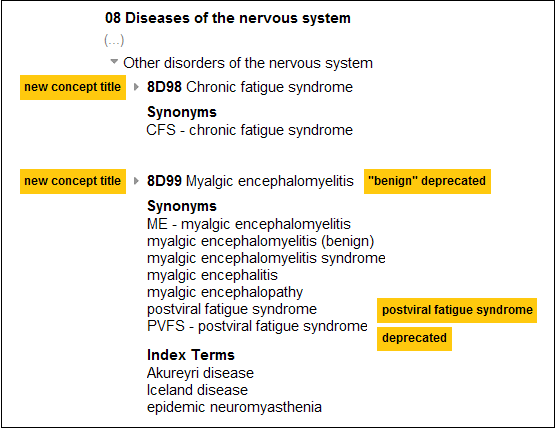
Our proposed restructure for ICD-11 looks like this:

Viewing our proposal

In order to view our Proposal in the Beta “Proposal Mechanism” you will first need to register with the Beta platform (this only takes a minute or two and you can register, if you wish, using an existing social media, Yahoo, Google or MS account).

Register for access here: http://bit.ly/ICD11Registrationpage

There is a WHO tutorial video on how to register, here: http://bit.ly/ICD11regtutorial

Once you are registered and logged in, go straight to this page to view and comment on our Proposal: http://bit.ly/commentICD11

For ease of access, we’ve put a copy of our Proposal and Rationale into a PDF, which you can download here:

Suzy Chapman, Mary Dimmock Proposal for ICD-11

We’re inviting patient and advocacy organizations and other stakeholders to review and comment on our Proposal.

Comments will only be accepted via the Beta “Proposal Mechanism” – so don’t send comments directly to ICD Revision.

If you are commenting on behalf of an organization, please state the organization’s name and in what capacity.

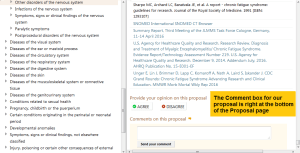
The Comment box for our proposal is located right at the bottom of the web page:

Click here for larger version

You won’t be able to edit or delete your comment once it’s been submitted ‒ so you may want to prepare a draft, first. You can include references to papers, reports etc in support of your comments but you won’t be able to upload files ‒ and it’s a plain text field only.

At the moment, it’s not clear what date comments on proposals will need to be received by in order to be taken into consideration for the version of ICD-11 that is scheduled for release in 2018. But we are recommending that comments are submitted within the next couple of weeks.

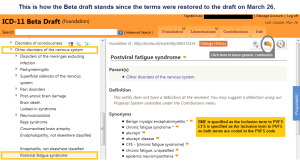
As well as commenting on our proposal, now that ICD Revision has restored the three terms to the draft, you may also comment on how the draft currently stands, here: http://bit.ly/2o8lhMA

Click here for larger version

If you have an queries please contact Suzy Chapman via the Contact Form.

Here’s the PDF again Suzy Chapman, Mary Dimmock Proposal for ICD-11

And here’s the URL again for our proposal on the Beta draft Proposal Mechanism

For a good overview of ICD-11’s structure and functionality by NHS Digital click here

Save

April 4, 2017 Frozen Release of ICD-11 Beta draft for centres undertaking field testing

Post #331 Shortlink:  http://wp.me/pKrrB-4fc

As scheduled, ICD Revision posted a Frozen Release of the ICD-11 Beta draft today, April 4, 2017.

This is a stable version of the draft for use by the centres that are signed up for field testing the Beta draft for utility.

This PDF document sets out information of the field trial process:

ICD-11 Field Trials, Information and Terms of Engagement, 17 March 2017

The Frozen Release can be accessed here (Registration required for access):

http://apps.who.int/classifications/icd11/browse/frozenreleases

http://apps.who.int/classifications/icd11/frozen-2017-04-02/l-m/en#/http%3a%2f%2fid.who.int%2ficd%2fentity%2f569175314


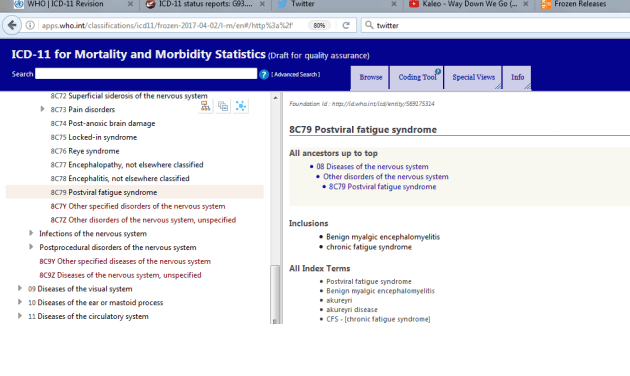
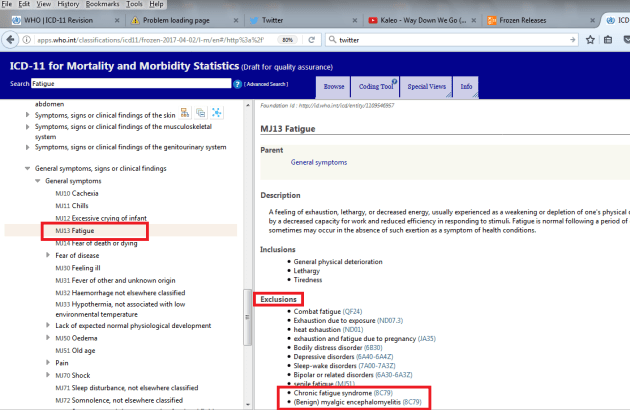
Here are screenshots from the April 4, 2017 Frozen Release for the ICD-10 G93.3 legacy terms, “postviral fatigue syndrome,” “benign myalgic encephalomyelitis,” and “chronic fatigue syndrome.”

There is no change to these terms in the Frozen Release compared with how they had stood on March 26, when the three terms were finally restored to the Beta draft.

Frozen Release: April 4, 2017: Postviral fatigue syndrome

Fatigue, below, displaying exclusions for BME and CFS. Two of the longstanding proposals that I had submitted on December 30, 2014, were approved and marked as “Implemented” on March 26, when the G93.3 legacy terms were finally returned to the draft with this caveat:

“While the optimal place in the classification is still being identified, the entity has been put back to its original place in ICD.” Team WHO 2017-Mar-26 – 12:46 UTC

NB: My proposal of December 30, 2014 for an exclusion for the concept title “Postviral fatigue syndrome” was not approved and implemented on March 26, when PVFS’s two inclusion terms were approved. I have queried the rationale for this apparent anomaly with “Team WHO” but have yet to receive any response.

Frozen Release: April 4, 2017: Fatigue

For a good overview of ICD-11’s structure and functionality by NHS Digital click here

Save

Save

Save

A proposal for the ICD-10 G93.3 legacy terms for ICD-11: Part Two

Post #330 Shortlink: http://wp.me/pKrrB-4eH or http://bit.ly/ICD11proposal
For background to Part Two see: A proposal for the ICD-10 G93.3 legacy terms for ICD-11: Part One

Update: A PDF Q & A for our proposals can be downloaded here


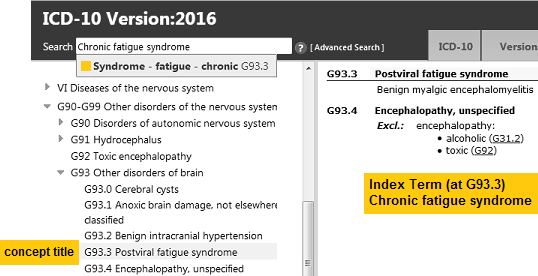
In the World Health Organization’s ICD-10, the terms, “postviral fatigue syndrome,” “benign myalgic encephalomyelitis,” and “chronic fatigue syndrome,” are all classified to G93.3, in the neurological chapter, as below:

Image source: ICD-10 Version: 2016

The next edition of ICD (ICD-11) is scheduled for release at some point in 2018, following presentation at the World Health Assembly (WHA), in May 2018.

The WHO work group with responsibility for the G93.3 legacy categories removed the terms from the publicly accessible version of the ICD-11 Beta draft, in early 2013, while they deliberated over how these categories should be represented in ICD-11.

On March 26, after a four year absence from the draft, “Team WHO” finally restored the G93.3 terms to the Beta platform.

Two long standing proposals for inserting exclusions under Fatigue for Benign myalgic encephalomyelitis and Chronic fatigue syndrome were also approved on March 26.

The three G93.3 legacy terms were returned to their 2009 Beta location with this caveat:

“While the optimal place in the classification is still being identified, the entity has been put back to its original place in ICD.”

This suggests that we should view this as a “placeholder” and that the Topic Advisory Group for Neurology may release revised proposals later this year.

WHO has confirmed there is no intention to classify the terms under the Mental or behavioural disorders chapter or under the Symptoms, signs chapter.


How does the draft currently stand?

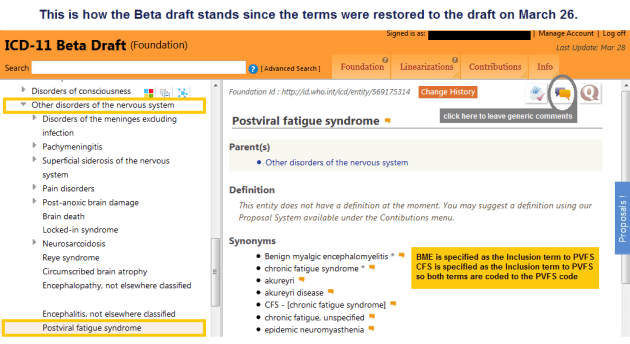
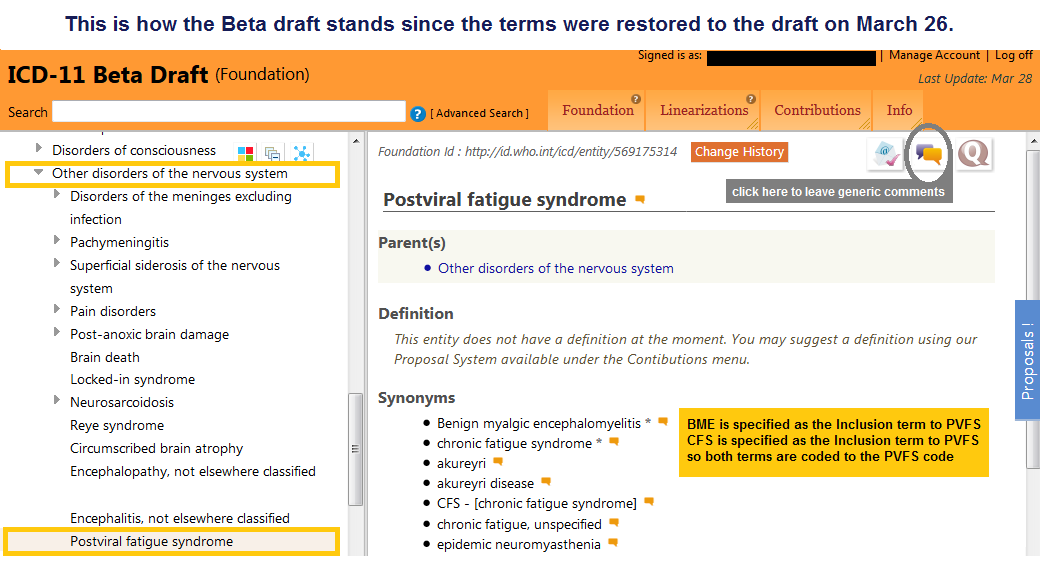
All three terms are currently back under the Neurology chapter, under parent: Other disorders of the nervous system, with PVFS as the lead (or concept title) term. BME and CFS are specified as inclusion terms (so they are coded to the same code as PVFS). All other content on the listing is much as it had stood in the Beta, in 2009.

(This is almost the same hierarchy as in ICD-10, except CFS is now included in the ICD-11 equivalent of the Tabular List, whereas in ICD-10, CFS is included only in the Index. Canada, Germany and the U.S. already have all three terms in their Tabular Lists.)

This is how the terms currently appear in the Beta draft:

https://icd.who.int/dev11/f/en#/http://id.who.int/icd/entity/569175314

In view of the caveat, it remains unclear what Topic Advisory Group for Neurology might still be considering for these terms, when they will reach consensus, or whether alternative proposals might be released at some point.

There was a proposals deadline on Thursday, March 30. Proposals received after this date may have to wait until after the ICD-11 is tested and released to be considered for inclusion in the first annual update of ICD-11, in 2019.


A proposal for ICD-11

To ensure that these terms are present and appropriately classified in ICD-11, U.S. advocate Mary Dimmock and I have collaborated on the preparation of a proposal for the restructure of the ICD-10 G93.3 category terms: Postviral fatigue syndrome; Benign myalgic encephalomyelitis; and Chronic fatigue syndrome.

We submitted a formal and fully referenced proposal on March 27.

Our proposal recommends:

  • that the terms should be retained in the neurological chapter (Chapter 08: Diseases of the nervous system);
  • that the terms should be retained under the parent class: Other disorders of the nervous system;
  • that ME and CFS should each be assigned separate codes;
  • that PVFS is not an appropriate title term for ME to sit under (not all cases of ME are preceded by a virus).

We’ve also recommended:

  • reciprocal exclusions for “Bodily distress disorder” and for general Fatigue;
  • that the designation “Benign” should be dropped for ICD-11.

Our proposed restructure for ICD-11 looks like this:

Viewing our proposal

In order to view our Proposal in the Beta “Proposal Mechanism” you will first need to register with the Beta platform (this only takes a minute or two and you can register, if you wish, using an existing social media, Yahoo, Google or MS account).

Register for access here:

https://icd.who.int/dev11/Account/Register?returnUrl=%2Fdev11%2Fl-m%2Fen

There is a WHO tutorial video on how to register, here:

http://apps.who.int/classifications/icd11/trainingvideos/

Once you are registered and logged in, go straight to this page to view and comment on our Proposal:

https://icd.who.int/dev11/proposals/f/en#/http://id.who.int/icd/entity/988657115?readOnly=true&action=ComplexHierarchicalChangesProposal&stableProposalGroupId=4b26ab6a-393f-4a39-9051-4ac1d4b1a55a

For ease of access, we’ve put a copy of our Proposal and Rationale into a PDF, which you can download here:

Suzy Chapman, Mary Dimmock Proposal for ICD-11

We’re inviting patient and advocacy organizations and other stakeholders to review and comment on our Proposal.

Comments will only be accepted via the Beta “Proposal Mechanism” – so don’t send comments directly to ICD Revision.

If you are commenting on behalf of an organization, please state the organization’s name and in what capacity.

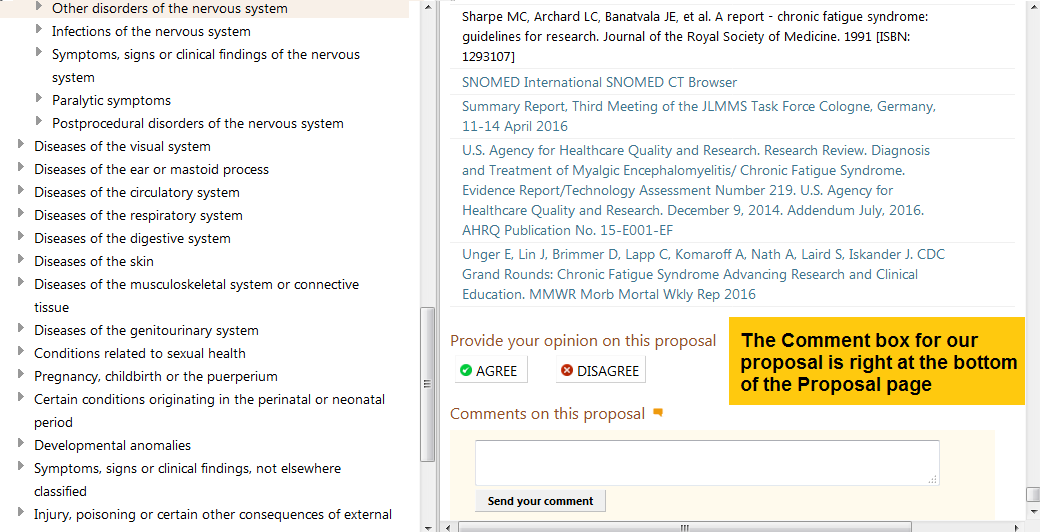
The Comment box for our proposal is located right at the bottom of the web page:

Click here for larger version

You won’t be able to edit or delete your comment once it’s been submitted ‒ so you may want to prepare a draft, first. You can include references to papers, reports etc in support of your comments but you won’t be able to upload files ‒ and it’s a plain text field only.

At the moment, it’s not clear what date comments on proposals will need to be received by in order to be taken into consideration for the version of ICD-11 that is scheduled for release in 2018. But we are recommending that comments are submitted within the next couple of weeks.

As well as commenting on our proposal, now that ICD Revision has restored the three terms to the draft, you may also comment on how the draft currently stands, here:

https://icd.who.int/dev11/l-m/en#/http%3a%2f%2fid.who.int%2ficd%2fentity%2f569175314

Click here for larger version

If you have an queries please contact Suzy Chapman via the Contact Form.

Here’s the PDF again Suzy Chapman, Mary Dimmock Proposal for ICD-11

And here’s the URL again for our proposal on the Beta draft Proposal Mechanism

For a good overview of ICD-11’s structure and functionality by NHS Digital click here

Save

Save

Save

Save

Save

A proposal for the ICD-10 G93.3 legacy terms for ICD-11: Part One

Post #329 Shortlink: http://wp.me/pKrrB-4dV

Our Proposal and Rationale is set out in Part Two:

A proposal for the ICD-10 G93.3 legacy terms for ICD-11: Part Two

A version of ICD-11 in 2018

It’s been a long time coming and it ain’t finished yet…

The World Health Organization (WHO) has been revising ICD-10 since 2007.

After several shifts in the timeline, WHO plans to present a version of the next edition (ICD-11 MMS) at the World Health Assembly (WHA), in May 2018.

WHO won’t be seeking endorsement of the ICD-11 product in May 2018 because it won’t be ready to implement. Endorsement will be sought at some point in the future. In the meantime, a version of ICD-11 is scheduled for release later in 2018, after the May assembly. The release date has yet to be announced.

https://hscic.kahootz.com/connect.ti/t_c_home/view?objectId=297939

“…The World Health Organization (WHO) is currently developing the 11th revision of ICD. Once endorsed by the World Health Assembly (WHA), WHO Nomenclature regulations stipulate that Member States must use the most current revision for mortality and morbidity purposes. For this reason and to allow member countries to adopt the new revision when they are ready, WHO will brief the WHA on ICD-11 in May 2018 but will not seek endorsement at this time.”

Member states will transition from ICD-10 to the new edition at their own pace. It’s going to be several years before countries have evaluated the ICD-11 product for utility and prepared their health systems to make the transition.

At some point, data using codes from the new edition will be accepted alongside data compiled using ICD-10. WHO will continue to support ICD-10 until the majority of member states have adopted and implemented the new edition.

It will take even longer for countries like the U.S. and Canada, who use a country specific adaptation of ICD, to implement as they will need to modify the new edition to suit their countries’ health systems. The earliest Canada can implement is currently projected as 2023 [1]. The U.S.’s CDC estimate it will take at least 6 years after the codes have been ratified to prepare, field test and implement an ICD-11-CM/PCS.


Proposal deadlines

Some important deadlines for proposals for the ICD-11 Beta draft:

The deadline in order for proposals to be considered for a frozen version in March/April 2017 was 30 December 2016.

In order for proposals to be considered for inclusion in the version of ICD-11 that is scheduled for release in 2018, they needed to be submitted by March 30, 2017. So those two deadlines have been reached.

Comments by member states and improvements arising as a part of the Quality Assurance mechanism will be included with deadlines later in 2017.

According to Slide #12 in this November 2016 WHO presentation, the deadline for member state comments is May 31, 2017; the deadline for Field Testing and Quality Assurance is June 30, 2017 [2]. But these dates are unconfirmed and may have been revised since November, last year.

Proposals received after the end of May will be considered in the context of ICD-11 maintenance after 2018, when the new version will be subject to an annual update and maintenance schedule [3]. The first annual update is anticipated in 2019.

The Joint Task Force is considering naming each year’s iteration in the format: ICD 2018; ICD 2019; ICD 2020 and so on. There may never be a need for an ICD-12, since an electronic system is better able to evolve “gracefully” – as Dr Christopher Chute (Joint Task Force; Chair, Revision Steering Group) puts it – in response to advances in scientific knowledge and classificatory changes.


Deadlines for submitting comments

I have asked Dr Jakob and the Joint Task Force to clarify by what date comments on proposals that met the March 30 deadline will need to be submitted by in order to be considered in the context of the earliest release of ICD-11, in 2018.

No clarification has been forthcoming; so if you are a stakeholder considering submitting a comment on existing proposals in the Beta draft or on outstanding proposals queued in the “Proposals Mechanism” which are still going through the review process, then I would advise that you put this in hand over the next couple of weeks. If any deadline is announced, I will update at the top of this report.


Frozen release

On April 4, ICD Revision is scheduled to release a frozen version of ICD-11 MMS for field testing*. If there are any changes in this April 2017 Frozen Release that are relevant to stakeholders in the G93.3 terms, I will post an update at the top of this report.

*ICD-11 Field Trials, Information and Terms of Engagement, March 17, 2017 https://hscic.kahootz.com/gf2.ti/af/762498/122441/PDF/-/ICD11_FT_Information_and_ToE.pdf


Current status of the ICD-10 G93.3 legacy categories

The ICD-10 G93.3 legacy categories: Postviral fatigue syndrome; Benign myalgic encephalomyelitis and Chronic fatigue syndrome were taken out of the public version of the Beta draft in early 2013, with no explanation for their absence.

ICD Revision has maintained a cephalopodic grip on its intentions for these terms.

Advocates and patient organization stakeholders have been attempting to obtain transparency from ICD Revision around the Topic Advisory Group for Neurology’s proposals for these terms for over four years. During this period, stakeholders have been disenfranchised from participation in the revision process.


Questions raised in the English Parliament

15 international stakeholder organizations wrote to the ICD-11 MMS Joint Task Force, in February, in support of my call that the Joint Task Force place the matter of the continued absence of proposals for these terms on the Agenda of their February 20–22 meeting, in Cologne.

There were asked to expedite the release of proposals for public scrutiny and comment before the March 30 deadline.

This initiative was met with a disturbing level of obfuscation on the part of WHO and the Joint Task Force, especially given that ICD Revision has been promoted as an open, transparent process, inclusive of stakeholder participation.

The Countess of Mar, a long standing advocate for patients with ME and CFS, tabled two Written Questions in the House of Lords. The first is here (February 27), which received a response that raised more questions than it answered and a follow up question, here (March 16), which received an equally opaque reply.

But on March 26, the three terms were finally restored to the Beta draft – but with this caveat:

“While the optimal place in the classification is still being identified, the entity has been put back to its original place in ICD.”

Team WHO 2017-Mar-26 – 12:46 UTC

This suggests that we should view the restoration of the terms as a “placeholder” and that the work group may release revised proposals later this year.


What do we know?

WHO has confirmed that there is no intention to classify the ICD-10 G93.3 legacy terms under the Mental or behavioural disorders chapter or under the Symptoms, signs chapter.

“Team WHO” has also approved some long standing proposals for exclusions for two of these terms under Fatigue (but not yet approved an exclusion for Postviral fatigue syndrome and I have asked “Team WHO” for the rationale for this apparent anomaly, since one would anticipate that if the inclusion terms are excluded under Fatigue, the ICD concept title entity would also be excluded). Possibly, TAG Neurology has other plans for the classification of PVFS in ICD-11.

So, nearly 10 years into the revision process, it’s still unclear what the work group might be considering for these terms, when they will reach consensus, or whether alternative proposals might be released on April 4, when a frozen version of ICD-11 is scheduled for release for field testing.


How do the terms currently stand in ICD-10?

This is how the G93.3 legacy terms were represented in ICD-10:

For ICD-10, Postviral fatigue syndrome (PVFS) is the lead (or concept title) term. Benign myalgic encephalomyelitis is the inclusion term under PVFS and takes the G93.3 code. Chronic fatigue syndrome is listed only in the Index, and coded to G93.3.


How do the terms stand in ICD-11 Beta draft, now they have been restored?

Since March 26, 2017, for ICD-11 Beta draft, all three terms are currently back under the Neurology chapter, under parent: Other disorders of the nervous system. PVFS is the lead (or concept title) term. BME and CFS are both specified as inclusion terms to PVFS, in the ICD-11 equivalent of the Tabular List. The terms listed under synonyms and all other “Content Model” descriptive content appear much as the Beta had stood in 2009.

But given the caveat, it is still unknown what the work group might be considering for these terms or whether or when they might release further proposals.

Note that the recommendations of the various external work groups are advisory only. WHO classification experts and the Joint Task Joint can, and sometimes do, overrule work group decisions.

If the Topic Advisory Group for Neurology, that has responsibility for these terms, were to reach consensus and release an alternative set of proposals before 2018, these will not necessarily obtain the approval of WHO/Joint Task Joint.


Suzy Chapman and Mary Dimmock have submitted a proposal

To address this situation, U.S. advocate, Mary Dimmock, and I have collaborated on the preparation of a formal and fully referenced proposal which we submitted on March 27. Our proposal (in the PDF below) recommends that these terms should be retained in the neurological chapter, using separate codes for ME and CFS, and also makes other recommendations.

PDF: Suzy Chapman, Mary Dimmock Proposal for ICD-11


Our Proposal and Rationale is set out in Part Two:

A proposal for the ICD-10 G93.3 legacy terms for ICD-11: Part Two

For a good overview of ICD-11’s structure and functionality by NHS Digital click here

References:

1 International Statistical Classification of Diseases and Related Health Problems, 11th Revision, Canada, Canadian Institute for Health Information (CIHI). https://www.cihi.ca/en/submit-data-and-view-standards/codes-and-classifications/icd-11

2 Presentation, Dr Robert Jakob, WHO/ICD Revision, November 2016. https://t.co/VvtZXVHZoF

3 ICD Revision Quarterly Newsletter, ICD-11 Update: January 2017. http://www.who.int/entity/classifications/ICD11January2017Newsletter.pdf

Save

ICD-11 Beta draft: Rationale for Proposal for Deletion of proposed new category: Bodily distress disorder

Post #328 Shortlink: http://wp.me/pKrrB-4dc

View on ICD-11 Proposal Mechanism: https://tinyurl.com/submissionDeleteBDD

(Registration with the Beta draft required in order to view proposals via the Beta draft Proposal Mechanism.)

PDF: ICD-11 Bodily distress disorder submission

Proposal submitted by Suzy Chapman (Dx Revision Watch) via ICD-11 Beta draft Proposal Mechanism

Submitted: March 1, 2017 (Remains unprocessed)

The author has no affiliations or conflicts of interest to declare.

Rationale for Proposal for Deletion of the Entity: Bodily distress disorder

1: The acronym “BDD” is already in use to indicate Body Dysmorphic Disorder [1].

2: With limited field studies, there is currently no substantial body of evidence for the validity, reliability, utility, prevalence, safety and acceptability of the S3DWG’s proposed disorder construct. However, the focus of this rationale is the proposed nomenclature.

The Somatic Distress and Dissociative Disorders Working Group (S3DWG) proposes to name its construct, “bodily distress disorder (BDD)” – a term that is already used by researchers and in the field interchangeably with the disorder term, “bodily distress syndrome (BDS).”

“Bodily distress syndrome” is a conceptually divergent disorder construct: differently defined and characterized, with different criteria that are already operationalized in Denmark and beyond, in research and clinical settings, and which potentially include a different patient set to that described in the S3DWG’s proposal [2].

As defined for the ICD-11 core version, the S3DWG’s “bodily distress disorder” construct has stronger conceptual and characterization alignment with DSM-5 “somatic symptom disorder (SSD)” than with Fink et al. (2010) “bodily distress syndrome” [3][4].

It is noted that “Somatic symptom disorder” is listed under Synonyms for the BDD entry in the ICD-11 Beta draft.

The defining feature of both the S3DWG’s “bodily distress disorder” and DSM-5 “somatic symptom disorder” is the removal of the distinction between “medically explained” and “medically unexplained” somatic complaints. Rather than define the disorder on the basis of the absence of a known medical cause, instead, specific psychological features are required in order to fulfill the criteria.

The S3DWG’s BDD is characterized by “the presence of bodily symptoms that are distressing to the individual and excessive attention directed toward the symptoms which may be manifest by repeated contact with health care providers.”

“Excessive attention is not alleviated by appropriate clinical examination and investigations and appropriate reassurance.”

“If a medical condition is causing or contributing to the symptoms, the degree of attention is clearly excessive in relation to its nature and progression.”

“Bodily symptoms and associated distress are persistent, being present on most days for at least several months and are associated with significant impairment in personal, family, social, educational, occupational or other important areas of functioning.”

The S3DWG’s “bodily distress disorder” may involve a single unspecified somatic symptom or multiple unspecified symptoms that may vary over time, in association with the disorder’s other defining features.

For DSM-5 “somatic symptom disorder,” the centrality of medically unexplained symptoms in order to meet the criteria is similarly de-emphasized and replaced by psychological responses to distressing, persistent symptoms: “excessive thoughts, behaviours and feelings” or “excessive preoccupation” with the bodily symptom or associated health concerns [5].

As with BDD, for SSD, the symptoms may or may not be associated with another medical condition. Some patients with general medical diagnoses, such as cancer, cardiovascular disease or diabetes, or patients diagnosed with the so-called “functional somatic syndromes” may qualify for a diagnosis of SSD if they are perceived as experiencing disproportionate and excessive thoughts and feelings or using maladaptive coping strategies in response to their illness, despite the reassurance of their clinicians [6].

As with the S3DWG’s defining of BDD, for SSD, there is no requirement for a specific number of complaints from among specified symptom groups to meet the criteria: so no symptoms counts or symptom clusters from body systems required for either.

To meet the SSD criteria: at least one symptom of at least six months duration and at least one of three psychological criteria are required: disproportionate thoughts about the seriousness of the symptom(s); or a high level of health anxiety; or devoting excessive time and energy to symptoms or health concerns; and for the symptoms to be significantly distressing or disruptive to daily life.

Though they differ somewhat in the characterization of their severity specifiers, the S3DWG’s defining of BDD and DSM-5 SSD may be considered essentially similar in conceptualization: no distinction between “medically explained” and “medically unexplained”; a much simplified criteria set to those defining the somatoform disorders, based on “excessive” or “disproportionate” psychological responses to persistent distressing symptoms, and with significant impairment or disruption to functioning.

Whereas, for the Fink et al. (2010) “bodily distress syndrome (BDS),” psychological or behavioural characteristics are not part of the criteria: symptom patterns or clusters from organ/body systems (cardiopulmonary; gastrointestinal; musculoskeletal or general symptoms) are central [2]. The diagnosis is exclusively made on the basis of the somatic symptoms, their complexity and duration, with moderate to severe impairment of daily life. There is a “Moderate: single organ” type and a “Severe: multi-organ” type.

The Fink et al. (2010) BDS construct is considered by its authors to have the ability to capture the somatoform disorders, neurasthenia, “functional symptoms” and the so-called “functional somatic syndromes” under a single, unifying disorder construct which subsumes CFS, ME, fibromyalgia and IBS (which are discretely classified within other chapters of ICD-10), noncardiac chest pain, chronic pain disorder, MCS and some others [7][8][9].

(The various so-called specialty “functional somatic syndromes” are considered by the authors to be an artifact of medical specialization and manifestations of a similar, underlying disorder with a common, hypothesized aetiology.)

Contrast this with the S3DWG’s BDD construct, which makes no assumptions about aetiology and does not exclude symptoms associated with general medical conditions; whereas, for Fink et al. BDS, “If the symptoms are better explained by another disease, they cannot be labelled BDS.”

That DSM-5 SSD and Fink et al. (2010) BDS are differently conceptualized, with different criteria sets, potentially capturing different patient populations has been acknowledged by SSD work group chair, Joel E Dimsdale, and by Fink, Henningsen and Creed [10][11]. In the literature, however, one observes frequent instances where the term “bodily distress disorder” has been used when what is actually being discussed within the paper or editorial is the Fink et al. (2010) “bodily distress syndrome (BDS)” disorder construct.

For example, “bodily distress disorder” is used interchangeably with “bodily distress syndrome” in the editorial (Creed et al. 2010): Is there a better term than “medically unexplained symptoms”? [1].

In this (Rief and Isaac 2014) editorial: The future of somatoform disorders: somatic symptom disorder, bodily distress disorder or functional syndromes? the authors are using the term, “bodily distress disorder” while clearly discussing the Fink et al. (2010) BDS construct [12].

The S3DWG’s proposed term is seen, here, as “Bodily distress disorder (Fink and Schroder 2010)” in Slide #3 of the symposium presentation: An introduction to “medically unexplained” persistent physical symptoms. (Professor Trudie Chalder, Department of Psychological Medicine, King’s Health Partners, 2014) [13].

This recent paper: Medium- and long-term prognostic validity of competing classification proposals for the former somatoform disorders (Schumacher et al. 2017) compares prognostic validity of DSM-5 “somatic symptom disorder (SSD)” with “bodily distress disorder (BDD)” and “polysymptomatic distress disorder (PSDD)” and discusses their potential as alternatives to SSD for the replacement of the somatoform disorders for the forthcoming ICD-11 [14].

The authors state, “the current draft of the WHO group is based on the BDD proposal.” But the authors have confirmed that for their study, they had operationalized “Bodily distress disorder based on Fink et al. 2007” [15].

In the (Fink et al. 2007) paper: Symptoms and syndromes of bodily distress: an exploratory study of 978 internal medical, neurological, and primary care patients, the authors conclude: “We identified a general, distinct, bodily distress syndrome or disorder that seems to encompass the various functional syndromes advanced by different medical specialties as well as somatization disorder and related diagnoses of the psychiatric classification.”

There are other examples in the literature and in the field. But these suffice to demonstrate that the term, “bodily distress disorder” is already used synonymously with disorder term “bodily distress syndrome (BDS)” and that researchers/clinicians, including Fink et al., do not differentiate between the two.

If researchers/clinicians do not differentiate between “bodily distress syndrome” and “bodily distress disorder” (and in some cases, one observes the conflations, “bodily distress syndrome or disorder” and “bodily distress syndrome/disorder”), has the S3DWG considered the difficulties and implications for maintaining the discrete identity of its proposed disorder, once ICD-11 is in the hands of its end users – clinicians, allied health professionals and coders; or considered the implications for patients and the particular vulnerability of those diagnosed with one of the so-called, “functional somatic syndromes”; or the implications for data reporting and analysis?

The S3DWG presented its emerging proposals for subsuming most of the ICD-10 somatoform disorder categories between F45.0 – F45.9, and F48.0 Neurasthenia, under a new single category which it proposes to call “bodily distress disorder (BDD)” in 2012 [3] and again in 2016 [4].

Thus far, the S3DWG has published no rationale for its recommendation to repurpose a disorder term already strongly associated with the Fink et al. (2010) disorder construct.

Neither has the group discussed nor acknowledged within its papers the implications for confusion and conflation between its own SSD- like “BDD” construct and the Fink et al. “bodily distress syndrome (BDS).”

Nor has the group’s output discussed the potential difficulties and implications for maintaining construct integrity within and beyond ICD-11.

There is no justification for introducing a new disorder category into ICD-11 that has greater conceptual alignment with the DSM-5 SSD construct but is proposed to be assigned a disorder name that is closely associated with a divergent (and operationalized) construct/criteria set, that is already in use in research and clinical settings.

This is unsafe and unsound classificatory practice.

This proposed disorder name should be rejected by the Project Lead for the revision of the Mental or behavioural disorders chapter and by the Joint Task Force that is overseeing the finalization of ICD-11 MMS.

If the S3DWG is unprepared or unwilling to reconsider and recommend an alternative disorder name then I submit that the current proposal to replace the somatoform disorders with a single “bodily distress disorder” category should be abandoned.

ICD-11 should proceed with the ICD-10 status quo, or retire or deprecate the somatoform disorder categories for the next edition.

It is perhaps germane that in 2010, three years prior to the finalization of DSM-5, Creed et al. had advanced: “Somatic symptom disorder is not a term that is likely to be embraced enthusiastically by doctors or patients; it has an uncertain core concept, dubious wide acceptability across cultures and does not promote multidisciplinary treatment. In our discussion, the terms which fit most closely the criteria we have set out above were the following: bodily distress (or stress) syndrome/ disorder, psychosomatic or psychophysical disorder, functional (somatic) syndrome or disorder.” [1]

The authors conclude that “bodily distress disorder” best fitted their “Criteria to judge the value of alternative terms for ‘medically unexplained symptoms.'”

It would appear that the term “bodily distress disorder” can mean anything anyone chooses it to mean – which might be admissible for Humpty Dumpty but unsound classificatory practice for ICD-11 [16].

References:

1 Creed F, Guthrie E, Fink P, Henningsen P, Rief W, Sharpe M, White P. Is there a better term than “medically unexplained symptoms”? J Psychosom Res. 2010 Jan;68(1):5-8. doi:10.1016/j.jpsychores.2009.09.004. [PMID: 20004295]

2 Fink P, Schröder A. One single diagnosis, bodily distress syndrome, succeeded to capture 10 diagnostic categories of functional somatic syndromes and somatoform disorders. J Psychosom Res. 2010 May;68(5):415-26. [PMID: 20403500]

3 Creed F, Gureje O. Emerging themes in the revision of the classification of somatoform disorders. Int Rev Psychiatry. 2012 Dec;24(6):556-67. doi: 10.3109/09540261.2012.741063. [PMID: 23244611]

4 Gureje O, Reed GM. Bodily distress disorder in ICD-11: problems and prospects. World Psychiatry. 2016 Oct;15(3):291-292. doi: 10.1002/wps.20353. [PMID: 27717252]

5 American Psychiatric Association. (2013). Somatic Symptom and Related Disorders. In Diagnostic and statistical manual of mental disorders (5th ed.). Washington, DC: Author.

6 Frances A, Chapman S. DSM-5 somatic symptom disorder mislabels medical illness as mental disorder. Aust N Z J Psychiatry. 2013 May;47(5):483-4. [PMID: 23653063]

7 Lam TP, Goldberg DP, Dowell AC, Fortes S, Mbatia JK, Minhas FA, Klinkman MS. Proposed new diagnoses of anxious depression and bodily stress syndrome in ICD-11-PHC: an international focus group study. Fam Pract. 2013 Feb;30(1):76-87. doi: 10.1093/fampra/cms037. Epub 2012 Jul 28. [PMID: 22843638]

8 Ivbijaro G, Goldberg D. Bodily distress syndrome (BDS): the evolution from medically unexplained symptoms (MUS). Ment Health Fam Med. 2013 Jun;10(2):63-4. [PMID: 24427171]

9 Goldberg DP, Reed GM, Robles R, Bobes J, Iglesias C, Fortes S, de Jesus Mari J, Lam TP, Minhas F, Razzaque B et al. Multiple somatic symptoms in primary care: A field study for ICD-11 PHC, WHO’s revised classification of mental disorders in primary care settings. J Psychosom Res. 2016 Dec;91:48-54. doi:10.1016/j.jpsychores.2016.10.002. Epub 2016 Oct 4. [PMID: 27894462]

10 Medically Unexplained Symptoms, Somatisation and Bodily Distress: Developing Better Clinical Services, Francis Creed, Peter Henningsen, Per Fink (Eds), Cambridge University Press, 2011.

11 Frances Creed and Per Fink. Presentations, Research Clinic for Functional Disorders Symposium, Aarhus University Hospital, May 15, 2014.

12 Rief W, Isaac M. The future of somatoform disorders: somatic symptom disorder, bodily distress disorder or functional syndromes? Curr Opin Psychiatry September 2014 – Volume 27 – Issue 5 – p315–319. [PMID: 25023885]

13 Chalder, T. An introduction to “medically unexplained” persistent physical symptoms. Presentation, Department of Psychological Medicine, King’s Health Partners, 2014. [Accessed 27 February 2017]

14 Schumacher S, Rief W, Klaus K, Brähler E, Mewes R. Medium- and long-term prognostic validity of competing classification proposals for the former somatoform disorders. Psychol Med. 2017 Feb 9:1-14. doi: 10.1017/S0033291717000149. [PMID: 28179046]

15 Fink P, Toft T, Hansen MS, Ornbol E, Olesen F. Symptoms and syndromes of bodily distress: an exploratory study of 978 internal medical, neurological, and primary care patients. Psychosom Med. 2007 Jan;69(1):30-9. [PMID: 17244846]

16 Carroll L. Alice’s Adventures in Wonderland. 1885. Macmillan.