What’s new in the ICD-11 Alpha drafting platform? (CFS, PVFS, ME)

What’s new in the ICD-11 Alpha drafting platform? (CFS, PVFS, ME)

Post #157 Shortlink: http://wp.me/pKrrB-22h


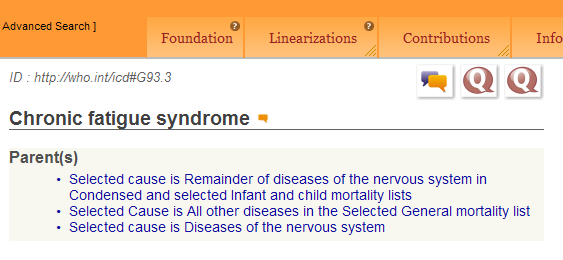
Screenshot: ICD-11 Alpha Browser Foundation view selected, logged in at April 10, 2012:

Chapter 6: Diseases of the nervous system

http://apps.who.int/classifications/icd11/browse/f/en#/http%3a%2f%2fwho.int%2ficd%23G93.3

Apr 09 – 11:02 UTC


ICD-11 Beta drafting platform to launch in May?

As reported in previous posts, according to the timeline, the ICD-11 Beta drafting platform is supposed to be launching this May.

ICD-11 Revision Steering Group has yet to announce whether the Beta platform remains on target for a May release and if so, on what date it will be launched – so I cannot give you a date yet.

Like the Alpha Drafting Browser, the Beta drafting platform will be a work in progress – not a final Beta draft. The final Beta isn’t scheduled until 2014, after the ICD-11 field trials have been undertaken.

When it does launch, the Beta platform is intended to be accessible to professionals and the public for viewing.

Registered or logged in users will have greater access to content and will be able to interact with the platform to read comments, comment on proposals and make suggestions, as part of the ongoing drafting process.  

In the meantime, the publicly viewable version of the Alpha drafting platform (known as the ICD-11 Alpha Browser) can still be accessed here:

http://apps.who.int/classifications/icd11/browse/f/en

The various ICD-11 Revision Topic Advisory Groups are carrying out their draft preparation work on a separate, more complex multi-author drafting platform that is accessible only to WHO and ICD Revision personnel.


Alpha drafting platform

As before, the publicly viewable version of the Alpha Browser should be viewed with the following caveats in mind:

the Alpha draft is a work in progress; it is incomplete; it may contain errors and omissions; it is in a state of flux and updated daily; textual content, codes and “Sorting labels” are subject to change as chapters are reorganized and content populated; the content has not been approved by Topic Advisory Groups, Revision Steering Group or WHO.

It is possible to register, or sign into the platform using existing accounts with several third party account providers such as Google, Yahoo and myOpenID, for increased access and functionality. Once signed in, Comments and Questions can be read and PDFs of the drafts of the top level linearizations can be downloaded from the Linearization tab.

See the Alpha Browser User Guide for information on how the Alpha Browser functions:

http://apps.who.int/classifications/icd11/browse/Help/en


The ICD-11 “Content Model”

ICD-11 will be available in both print and online versions and unlike most chapters of ICD-10, will include descriptive content for ICD terms.

For the online version of ICD-11, all ICD entities will include a definition and a number of additional key descriptive fields – between 7 and 13 pre-defined parameters, populated according to a common “Content Model” (Content Model Reference Guide January 2011).

For example, ICD entity Title, Definition, Synonyms, Narrower Terms, Exclusions, Body Site, Body System, Signs and Symptoms, Causal Mechanisms, and possibly Diagnostic Criteria for some entities.*

*According to the iCAT User Google Group message board, these fields may have been revised since the January 2011 Content Model Reference Guide was published; Content Model parameters in the Beta draft may therefore differ from those currently displaying in the public Alpha drafting platform.

The print version will use a concise version of Definition due to space constraints.

In the Alpha Browser, not all these Content Model parameters display in the Foundation and Linearization views and not all of the parameters that have been listed for individual entities have had their draft text added yet, as some chapters are more advanced for the population of proposed content than others.

So the Alpha draft is still very patchy and many entities have no Definition and little or no other proposed content filled in.

With no “Category Discussion Notes” or “Change history” pop-up windows visible in the public version of the Alpha, the viewer cannot determine the rationales behind the reorganization of terms and hierarchies within the various chapters.


Chapter location and hierarchy for CFS, PVFS and (Benign) ME in ICD-11

I have been reporting since June 2010 that the proposals for ICD-11 Alpha Draft, as far as one could determine, appeared to be:

1] That a change of hierarchy had been recorded in a “Category Discussion Note”, dated May 1, 2010, between ICD-10 Title term “Postviral fatigue syndrome” and “Chronic fatigue syndrome”. (“Category Discussion Notes” and “Change History” pop-ups did display in the earlier iCAT version of the Alpha drafting platform.)

You can view a screenshot from June 2010 of that “Change history” record here:

https://dxrevisionwatch.com/wp-content/uploads/2010/06/change-history-gj92-cfs.png

The Definition field on the “Chronic fatigue syndrome” description panel in the current Alpha Browser is currently blank but in June 2010, the Definition had stood as in this contemporaneous screenshot:

https://dxrevisionwatch.com/wp-content/uploads/2010/05/2icatgj92cfsdef.png

2] That “Chronic fatigue syndrome” had been designated as an ICD-11 Title term within ICD-11 Chapter 6: Diseases of the nervous system, with the capacity for a Definition and up to 10 additional descriptive parameters.

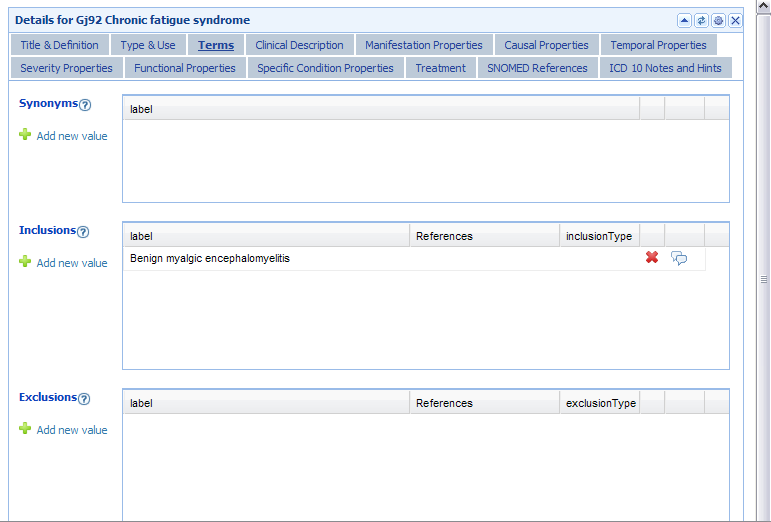
3] That “Benign myalgic encephalomyelitis” had been specified as an Inclusion term to ICD-11 Title term “Chronic fatigue syndrome” but that the relationships between the three terms, PVFS, (B) ME and CFS had yet to be specified, as in this screenshot from June 2010:

https://dxrevisionwatch.com/wp-content/uploads/2010/05/2icatgj92cfsterms.png


What is currently showing in the Chapter 6 Foundation Component?

It isn’t possible to bring up a discrete ICD Title listing for either “Benign myalgic encephalomyelitis” or “Postviral fatigue syndrome” in either the Foundation Component or the Linearization.

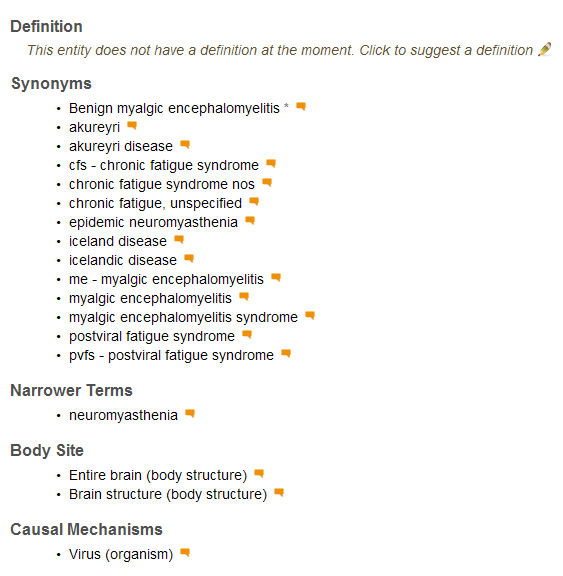
In the Foundation view only, for Chapter 6: Diseases of the nervous system, “Chronic fatigue syndrome” is listed as a Title term with the ICD-10 legacy ID “ID:http://who.int/icd#G93.3”;

the Definition field is currently blank;

a list of terms has recently been added under “Synonyms”;

one term has recently been added under “Narrower Terms”.

(Note: there is a small asterisk at the end of term “Benign myalgic encephalomyelitis” which is listed at the top of the “Synonyms” list. The asterisk “Hover text” reads “This term is an inclusion term in the linearizations.”)

If you want to view the listing directly on the Browser site (note the “Comment” and “Questions” icons which open up pop-up windows next to terms for reading/commenting won’t display unless you have already registered and logged in) go here:

ICD-11 Alpha Browser Foundation view:

http://apps.who.int/classifications/icd11/browse/f/en#/http%3a%2f%2fwho.int%2ficd%23G93.3

ID:http://who.int/icd#G93.3

Chronic fatigue syndrome

Parent(s)

Selected cause is Remainder of diseases of the nervous system in Condensed and selected Infant and child mortality lists
Selected Cause is All other diseases in the Selected General mortality list
Selected cause is Diseases of the nervous system

Definition

This entity does not have a definition at the moment.

Synonyms

Benign myalgic encephalomyelitis *  [Ed: Hover text over asterisk reads: “This term is an inclusion term in the linearizations.”]
akureyri
akureyri disease
cfs – chronic fatigue syndrome
chronic fatigue syndrome nos   [Ed: from current proposals for ICD-10-CM, Chapter 18, R53.82]
chronic fatigue, unspecified   [Ed: from current proposals for ICD-10-CM, Chapter 18, R53.82]
epidemic neuromyasthenia
iceland disease
icelandic disease
me – myalgic encephalomyelitis
myalgic encephalomyelitis
myalgic encephalomyelitis syndrome
postviral fatigue syndrome
pvfs – postviral fatigue syndrome

Narrower Terms

neuromyasthenia

Body Site

Entire brain (body structure)
Brain structure (body structure)

Causal Mechanisms

Virus (organism)


What’s new in Chapter 5: Mental and behavioural disorders?

As reported in Dx Revision Watch post: http://wp.me/pKrrB-1Vx,  the category “Somatoform Disorders” in Chapter 5, Mental and behavioural disorders is currently renamed to “BODILY DISTRESS DISORDERS”, under which currently sit three new child categories:

5M0 Mild bodily distress disorder
5M1 Moderate bodily distress disorder
5M2 Severe bodily distress disorder.

Chapter 5 Linearization view:

http://apps.who.int/classifications/icd11/browse/l-m/en#/http%3a%2f%2fwho.int%2ficd%23F45

Chapter 5 Foundation view:

http://apps.who.int/classifications/icd11/browse/f/en#/http%3a%2f%2fwho.int%2ficd%23F45

(Click on the little grey arrows to display the child categories):

Child categories to parent “BODILY DISTRESS DISORDERS”:

http://apps.who.int/classifications/icd11/browse/f/en#/http%3a%2f%2fwho.int%2ficd%231905_dd0250d2_e8cd_4c48_a93f_7997cc1c8b07

BODILY DISTRESS DISORDERS

5M0 Mild bodily distress disorder
5M1 Moderate bodily distress disorder
5M2 Severe bodily distress disorder
5M3 Somatization disorder
5M4 Undifferentiated somatoform disorder
5M5 Somatoform autonomic dysfunction
5M6 Persistent somatoform pain disorder
      > 5M6.0 Persistent somatoform pain disorder
      > 5M6.1 Chronic pain disorder with somatic and psycological [sic] factors
5M7 Other somatoform disorders
5M8 Somatoform disorder, unspecified

None of these three new (proposed) categories have had any Definitions or other textual content added to the description panels on the right hand side of the Alpha Browser page since I first reported this change in February.

It is still not possible to determine what disorders ICD-11 intends might be captured by these three new (proposed) terms, should ICD-11 Revision Steering Group and WHO classification experts consider these terms to be valid constructs and approve their progression through to the Beta draft.

Because no “Change Notes” or “Change history” pop-up windows display in this version of the Alpha Drafting browser, it is not possible to determine:

whether ICD-11 is proposing to introduce three new terms – 5M0 Mild bodily distress disorder; 5M1 Moderate bodily distress disorder; 5M2 Severe bodily distress disorder, in addition to retaining existing ICD-10 terms, 5M3 thru 5M8;

how ICD Revision intends to define these (proposed) new terms at 5M0, 5M1, 5M2;

how these three (proposed) new terms would relate to the existing ICD-10 “Somatoform Disorders” categories which remain listed as child categories to “BODILY DISTRESS DISORDERS” (apart from “Hypochondriacal disorder” [ICD-10: F45.2], which is now listed as “5H0.5 Illness Anxiety Disorder” in the ICD-11 Alpha Draft).

(See Page 1 and 2 of my report: “Bodily Distress Disorders” to replace “Somatoform Disorders” for ICD-11?: http://wp.me/pKrrB-1Vx  )


References:

ICD-11 Revision: http://www.who.int/classifications/icd/revision/en/

ICD-11 Alpha Browser User Guide: http://www.who.int/classifications/icd/revision/caveat/en/index.html
Alpha Browser Foundation view: http://apps.who.int/classifications/icd11/browse/f/en#
Alpha Browser Linearization view: http://apps.who.int/classifications/icd11/browse/l-m/en#
“Bodily Distress Disorders” to replace “Somatoform Disorders” for ICD-11?: http://wp.me/pKrrB-1Vx

HHS proposes one year delay for ICD-10-CM compliance

HHS proposes one year delay for ICD-10-CM compliance

Post #156 Shortlink: http://wp.me/pKrrB-22q

Yesterday, April 9, the US Department of Health and Human Services issued a proposed rule calling for a one year delay in the ICD-10-CM/PCS compliance deadline.

According to a Centers for Medicare and Medicaid Services (CMS) press release, the proposed rule would postpone the compliance date by which providers and industry have to adopt ICD-10-CM by one year, from October 1, 2013 to October 1, 2014. 

Official publication of the proposed rule is expected to be published in the Federal Register on April 17, followed by a 30 day period during which CMS will take comments.

Full proposal document (pre-publication PDF version)

      http://www.ofr.gov/OFRUpload/OFRData/2012-08718_PI.pdf

or at:

https://s3.amazonaws.com/public-inspection.federalregister.gov/2012-08718.pdf

This document is scheduled to be published in the
Federal Register on 04/17/2012 and available online at
http://federalregister.gov/a/2012-08718 , and on FDsys.gov

Press release issued April 9, 2012:

http://www.hhs.gov/news/press/2012pres/04/20120409a.html

Details for: NEW HEALTH CARE LAW PROVISIONS CUT RED TAPE, SAVE UP TO $4.6 BILLION

For Immediate Release: Monday, April 09, 2012
Contact: CMS Office of Public Affairs
202-690-6145

NEW HEALTH CARE LAW PROVISIONS CUT RED TAPE, SAVE UP TO $4.6 BILLION

Department of Health and Human Services (HHS) Secretary Kathleen Sebelius today announced a proposed rule that would establish a unique health plan identifier under the Health Insurance Portability and Accountability Act of 1996 (HIPAA). The proposed rule would implement several administrative simplification provisions of the Affordable Care Act.

The proposed changes would save health care providers and health plans up to $4.6 billion over the next ten years, according to estimates released by the HHS today. The estimates were included in a proposed rule that cuts red tape and simplifies administrative processes for doctors, hospitals and health insurance plans.

“The new health care law is cutting red tape, making our health care system more efficient and saving money,” Secretary Sebelius said. “These important simplifications will mean doctors can spend less time filling out forms and more time seeing patients.”

Currently, when health plans and entities like third party administrators bill providers, they are identified using a wide range of different identifiers that do not have a standard length or format. As a result, health care providers run into a number of time-consuming problems, such as misrouting of transactions, rejection of transactions due to insurance identification errors, and difficulty determining patient eligibility.

The rule simplifies the administrative process for providers by proposing that health plans have a unique identifier of a standard length and format to facilitate routine use in computer systems. This will allow provider offices to automate and simplify their processes, particularly when processing bills and other transactions.

The proposed rule also delays required compliance by one year– from Oct. 1, 2013, to Oct. 1, 2014– for new codes used to classify diseases and health problems. These codes, known as the International Classification of Diseases, 10th Edition diagnosis and procedure codes, or ICD-10, will include new procedures and diagnoses and improve the quality of information available for quality improvement and payment purposes.

Many provider groups have expressed serious concerns about their ability to meet the Oct. 1, 2013, compliance date. The proposed change in the compliance date for ICD-10 would give providers and other covered entities more time to prepare and fully test their systems to ensure a smooth and coordinated transition to these new code sets.

The proposed rule announced today is the third in a series of administrative simplification rules in the new health care law. HHS released the first in July of 2011 and the second in January of 2012, and plans to announce more in the coming months.

More information on the proposed rule is available on fact sheets at

http://www.cms.gov/apps/media/fact_sheets.asp

The proposed rule may be viewed at www.ofr.gov/inspection.aspx . Comments are due 30 days after publication in the Federal Register.

Media coverage:

MedPage Today

HHS Announces ICD-10 Delay

Joyce Frieden, News Editor, MedPage Today | April 09, 2012


ICD10 Watch

Breaking News: HHS proposes 1-year delay in ICD-10 implementation deadline

Carl Natale | April 09, 2012


Healthcare Finance News

HHS proposes one-year ICD-10 delay

Tom Sullivan, Government Health IT | April 10, 2012

Update on timelines: DSM-5, ICD-11, ICD-10-CM

Update on timelines: DSM-5, ICD-11, ICD-10-CM

Post #155 Shortlink: http://wp.me/pKrrB-21N

Update @ April 10, 2012: CMS issues press release – proposes one year delay for ICD-10-CM compliance

See: http://wp.me/pKrrB-22q for press release and full Proposal document

I will update as more information becomes available.

DSM-5

The DSM-5 clinical settings field trials, scheduled to complete by December, last year, but extended in order that more participants might be recruited, were expected to conclude this March. (Source: DSM-5 Disorganization, Disarray, and Delays, Dr Dayle Jones, American Counseling Association, January 3, 2012)

In November, DSM-5 Task Force Vice-chair, Darrel Regier, MD, predicted the pushing back of the final public review and comment period for revised draft diagnostic criteria from January-February to “no later than May 2012,” in response to DSM-5 timeline slippage and delays in completion of the field trials. (Source: APA Answers DSM-5 Critics, Deborah Brauser, November 9, 2011)

The timeline on the DSM-5 Development site was updated to reflect a “Spring” posting of draft diagnostic criteria but thus far, APA has released no firm date for a final public review and feedback exercise in May.

The second release of draft proposals was posted on May 4, last year, with no prior announcement or news release by APA and caught professional bodies, patient organizations and advocates unprepared.

It is hoped that APA will give reasonable notice before releasing their third and final draft – though how much influence professional and public feedback might have at this late stage in the DSM-5 development process is moot.

DSM-5 is slated for publication in May 2013.

Extract from revised Timeline

Spring 2012: Revised draft diagnostic criteria will be posted on http://www.dsm5.org and open to a third public feedback period for 2 months. Feedback will be shared directly with work group members, and further edits to proposals will be made as needed.

The full DSM-5 Timeline (as it stands at April 8, 2012) can be found here.


ICD-11

The current timeline schedules presentation of the ICD-11 to the World Health Assembly in May 2015 – a year later than the 2009 timeline.

According to a paper published by Christopher Chute, MD, (Chair, ICD-11 Revision Steering Group) et al, implementation of ICD-11 is now expected around 2016. (Source: Chute CG, Huff SM, Ferguson JA, Walker JM, Halamka JD. There Are Important Reasons For Delaying Implementation Of The New ICD-10 Coding System. Health Aff March 2012 DOI: 10.1377/hlthaff.2011.1258) 

The ICD-11 Beta drafting platform is scheduled to be launched and open to the public this May for comment and interaction. It will be a work in progress – not a final Beta draft. The final Beta draft isn’t scheduled until 2014.

No announcement that the Beta platform remains on target for a May release has been issued by WHO or ICD-11 Revision Steering Group and no date is given on the ICD Revision website for the launch.

The publicly viewable version of the Alpha drafting platform (the ICD-11 Alpha Browser) can be accessed here. The various ICD-11 Revision Topic Advisory Groups work on a separate, more layered multi-author drafting platform.

NB: The Alpha drafting platform is a work in progress. It is incomplete, in a state of flux, updated daily and subject to WHO Caveats.

ICD-11 Alpha Browser User Guide here.

Foundation view here.

Linearization view here.

PDFs of Draft Print versions of the Linearization are available from the Linearization tab to logged in users.

The ICD-11 timeline (as it stands at April 8, 2012) can be found on the WHO website here.


ICD-10-CM

Note: ICD-10-CM is the forthcoming US specific “Clinical Modification” of the WHO’s ICD-10. Following implementation of ICD-10-CM, the US is not anticipated to move on to ICD-11, or a Clinical Modification of ICD-11, for a number of years after global transition to ICD-11.

On February 16, Health and Human Services Secretary, Kathleen G. Sebelius, announced HHS’s intent to initiate a process to postpone the date by which certain health care entities have to comply with ICD-10-CM diagnosis and procedure codes. (Source: CMS Public Affairs/HHS Press Release, February 16, 2012)

The final rule adopting ICD-10-CM as a standard was published in January 2009, when a compliance date of October 1, 2013 had been set – a delay of two years from the compliance date initially specified in the 2008 proposed rule.

CMS plans to announce a new ICD-10 implementation date sometime this April, according to CMS Regional Office, Boston. (Source: Healthcare News: CMS targets April for release of new ICD-10-CM/PCS implementation date, March 20, 2012)

It is anticipated that CMS will make an announcement in the Federal Register, take public comment for 60 days, consider feedback on its proposed ruling, then issue a final rule.

For developments on the new ICD-10-CM compliance date, watch the CMS site or sign up for CMS email alerts: http://www.cms.hhs.gov/Medicare/Coding/ICD10/Latest_News.html


Related information:

DSM-5 Development

ICD-11 Revision

ICD10 Watch

Federal Register

CMS Latest News

DHHS Newsroom

ICD-10-CM CDC Site

Conflicts of interest and DSM-5: the media reaction; APA Rebuts Study on Autism and Christopher Lane On What’s Wrong With Modern Psychiatry

Conflicts of interest and DSM-5: the media reaction; APA Rebuts Study on Autism and Christopher Lane On What’s Wrong With Modern Psychiatry

Post #154 Shortlink: http://wp.me/pKrrB-20T

Links for full text, PDF and further coverage following publication of the PloS Essay by Cosgrove and Krimsky:

March 17, 2012: DSM-5 controversies, Cosgrove and Krimsky on potential COIs, counter statement from APA’s John Oldham and APA May Annual Meeting preliminary program

March 14, 2012: Cosgrove, Sheldon: 69% of DSM-5 task force members report pharmaceutical industry ties – review identifies potential COIs

PLoS Blogs

Speaking of Medicine

Conflicts of interest and DSM-5: the media reaction

Clare Weaver | March 26, 2012

…Last week PLoS Medicine published an analysis by Lisa Cosgrove and Sheldon Krimsky, who examined the disclosure policy and the panel members’ conflicts of interest, and call for the APA to make changes to increase transparency before the manual’s publication.

Within three days of publication the paper had been viewed over 4000 times, and several major media outlets reported on the authors’ findings and the wider issues they relate to…

Read full post

Psychiatric Times

American Psychiatric Association Press Release No. 12-15: March 27, 2012

      Commentary Takes Issue with Criticism of New Autism Definition

APA Rebuts Study on Autism

DSM-5 Experts Call Study Flawed

Laurie Martin, Web Editor | 30 March 2012

In a recent commentary, the DSM-5 Neurodevelopmental Disorders Work Group responded to a study that challenges the proposed DSM-5 diagnostic criteria on autism spectrum disorder (ASD).1 The commentary, published in the April issue of the Journal of the American Academy of Child & Adolescent Psychiatry (JAACAP), takes issue with the study by James McPartland and colleagues,2 and addresses what it deems “serious methodological flaws.”

The Work Group refutes the authors’ conclusions that the “Proposed DSM-5 criteria could substantially alter the composition of the autism spectrum. Revised criteria improve specificity but exclude a substantial portion of cognitively.” Dr McPartland and colleagues’ research study, titled Sensitivity and Specificity of Proposed DSM-5 Diagnostic Criteria for Autism Spectrum Disorder, also states, “a more stringent diagnostic rubric holds significant public health ramifications regarding service eligibility and compatibility of historical and future research.” The study in question is also published in the April issue of JAACAP…

Read full article by Laurie Martin, Web Editor

Related material: American Psychiatric Association Press Release No. 12-03

      DSM-5 Proposed Criteria for Autism Spectrum Disorder Designed to Provide More Accurate Diagnosis and Treatment  January 20, 2012

The Sun Interview

March 2012

Side Effects May Include

Christopher Lane On What’s Wrong With Modern Psychiatry

by Arnie Cooper
The complete text of this selection is available in our print edition.

Six years ago Lane began to hear from his students at Northwestern University in Evanston, Illinois, that many of them were on psychiatric drugs. They would come to his office to ask for extensions on their assignments, explaining that they were suffering from anxiety or depression but were on medication for it. He had just published Hatred and Civility: The Antisocial Life in Victorian England, for which he had studied the transition from Victorian psychiatry, out of which psychoanalysis was born, to contemporary psychiatry, with its intense focus on biomedicine and pharmacology. He was already skeptical about the emergence in 1980 of dozens of new mental disorders in the DSM-III, the third edition of the manual. Among these new ailments were the curious-sounding “social phobia” and “avoidant personality disorder.” Lane wanted to know how and why those new disorders had been approved for inclusion and whether they were really bona fide illnesses…

Read Arnie Cooper interview with Christopher Lane

CMS expected to announce proposal for new ICD-10 implementation date sometime in April

CMS expected to announce proposal for new ICD-10 implementation date sometime in April

Post #153 Shortlink: http://wp.me/pKrrB-218

In a press release on February 16, Health and Human Services Secretary, Kathleen G. Sebelius, announced HHS’s intent to initiate a process to postpone the date by which certain health care entities have to comply with ICD-10-CM diagnosis and procedure codes.

The final rule adopting ICD-10-CM as a standard was published in January 2009, when a compliance date of October 1, 2013 had been set – a delay of two years from the compliance date initially specified in the 2008 proposed rule.

Several sites covering CMS’s intention to delay implementation are citing April as the month in which a new timeline for ICD-10-CM is expected to be announced:

HC Pro

New ICD-10 implementation date expected in April

ICD-10 Trainer | March 21, 2012

CMS plans to announce a new ICD-10 implementation date sometime in April, according to representatives of CMS and MassHealth, a public health insurance program for low and medium-income residents in Massachusetts.

Renee Washington, director of customer system integration at MassHealth, revealed the time frame for the much anticipated announcement during the Massachusetts Health Data Consortium’s March 9 conference call. Renee Richard from the CMS Regional Office in Boston confirmed this information during the call…

HC Pro Just Coding

Healthcare News: CMS targets April for release of new ICD-10-CM/PCS implementation date

March 20, 2012

CMS expects to release a new ICD-10-CM/PCS implementation date sometime in April. That date will be the same for payers and providers. (Excerpt from a member only article.)

ICD-10 Watch (no connection with this site which was formerly known as “DSM-5 and ICD-11 Watch”)

It’s about time for an ICD-10 delay announcement

Carl Natale | March 30, 2012

It looks like next week is when the Centers for Medicare and Medicaid (CMS) will announce their proposals for a new ICD-10 timeline.

Which should mean they will publish it in the Federal Register and take public comment for 60 days. Then they will consider the feedback and issue a final rule. Who knows when that will be…

Read full round up by Carl Natale


Christopher Chute, MD, (Chair, ICD-11 Revision Steering Group) et al set out the case for delaying implementation, in this paper published at Health Affairs:

Health Affairs

At the Intersection of Health, Health Care, and Policy

There Are Important Reasons For Delaying Implementation Of The New ICD-10 Coding System

Abstract: http://content.healthaffairs.org/content/early/2012/03/21/hlthaff.2011.1258.abstract

Full free text: http://content.healthaffairs.org/content/early/2012/03/21/hlthaff.2011.1258.full

PDF: http://content.healthaffairs.org/content/early/2012/03/21/hlthaff.2011.1258.full.pdf+html

Published online before print March 2012, doi: Health Aff March 2012 10.1377/hlthaff.2011.1258

There Are Important Reasons For Delaying Implementation Of The New ICD-10 Coding System

Christopher G. Chute 1,*, Stanley M. Huff 2, James A. Ferguson 3, James M. Walker 4 and John D. Halamka 5

Author Affiliations

1 Christopher G. Chute (chute@mayo.edu) is a professor of biomedical informatics at Mayo Clinic, in Rochester, Minnesota.
2 Stanley M. Huff is a professor of biomedical informatics at the University of Utah, in [please provide city], and chief medical informatics officer at Intermountain Healthcare, in Murray, Utah.
3 James A. Ferguson is a fellow at the Kaiser Permanente Institute for Health Policy and vice president of health information technology strategy and policy for Kaiser Permanente, in Oakland, California.
4 James M. Walker is chief health information officer of Geisinger Health System, in Danville, Pennsylvania.
5 John D. Halamka is a professor of medicine at Harvard Medical School, chief information officer at Beth Israel Deaconess Medical Center, and chief information officer at Harvard Medical School, in Boston, Massachusetts.
*Corresponding author

Abstract

Federal authorities have recently signaled that they would consider delaying some aspects of implementation of the newest version of the International Classification of Diseases, known as ICD-10-CM, a coding system used to define health care charges and diagnoses. Some industry groups have reacted with dismay, and many providers with relief. We are concerned that adopting this new classification system for reimbursement will be disruptive and costly and will offer no material improvement over the current system. Because the health care community is also working to integrate health information technology and federal meaningful-use specifications that require the adoption of other complex coding standardization systems (such as the system called SNOMED CT), we recommend that the Centers for Medicare and Medicaid Services consider delaying the adoption of ICD-10-CM. Policy makers should also begin planning now for ways to make the coming transition to ICD-11 as tolerable as possible for the health care and payment community.

Full free text

Tom Sullivan, for Health Care IT News, asks Chute, “Why not just skip right to ICD-11?”

Why not just skip right to ICD-11?

Tom Sullivan, Government Health IT| March 13, 2012

…While industry associations battle over the code set’s future, and HHS figures out when the new compliance deadline will be, the World Health Organization (WHO) is already moving toward ICD-11, promising a beta in 2014 to be followed by the final version in 2015. Should that slip until 2016, U.S. health entities will still be settling into ICD-10 when ICD-11 arrives – meaning that shortly thereafter, we will be right back where we are now: Behind the times, on the previous ICD incarnation.

Are we repeating our own faulty history?

“That almost assuredly will be the case,” said Chris Chute, MD, DrPH, who spearheads the Mayo Clinic’s bioinformatics division and chairs the WHO’s ICD-11 Revision Steering Group…

Read full article by Tom Sullivan

Rhonda Butler argues why US health care providers and industry can’t just ditch ICD-10-CM and wait for ICD-11 in 2015/16:

3M Health Information

We Can’t Skip ICD-10 and Go Straight to ICD-11

Rhonda Butler | March 26, 2012

Since the recent announcement by CMS that ICD-10 implementation will be delayed for certain healthcare entities, some industry pundits have argued, “Let’s just skip ICD-10 and go straight to ICD-11.”

Skipping ICD-10 assumes that we haven’t started implementing ICD-10. Well, the U.S. did start—19 years ago.

What have we been doing for the last 19 years…

Read full article

Letter from Justine M. Carr, MD, Chairperson, National Committee on Vital and Health Statistics to The Honorable Kathleen Sebelius, Secretary, Department of Health and Human Services, March 2, 2012

Contains ICD-10-CM timeline

    Re: Possible Delay of Deadline for Implementation of ICD-10 Code Sets

James Phillips asks Michael First (Editor of DSM-IV-TR, Consultant to WHO ICD-11 Revision) how DSM-5 relates to ICD:

Psychiatric Times

DSM-5 In the Homestretch—1. Integrating the Coding Systems

James Phillips, MD | 07 March 2012

With DSM-5 scheduled for publication a little more than a year from now, we may safely assume that, barring unannounced surprises from, say, the APA Scientific Review Committee, what we will see on the DSM-5 Web site is what we will get. With that in mind it’s time to review what we will indeed get. But before moving to significant changes in the major disorder categories, we should remind ourselves where DSM-5 fits into the larger picture of coding mental illnesses.

There are, in case you have forgotten, two classificatory systems of mental disorders—the International Classification of Diseases (ICD), produced by the World Health Organization (WHO), and the Diagnostic and Statistical Manual (DSM), produced by the American Psychiatric Association. How are they related? It is a question that has confused me, and I assume, some of my psychiatric colleagues as well as others—other mental health professionals, and still others. For an answer to this question I asked Michael First, MD, Editor of DSM-IV-TR, Consultant on the WHO ICD-11 revision…

Read full commentary


Related posts:

HHS Secretary Sebelius announces intent to delay ICD-10-CM compliance date  February 16, 2012

AHIMA: Ten Reasons to Not Delay ICD-10 (ICD-10-CM)  February 23, 2012

DSM-5 controversies, Cosgrove-Krimsky on potential COIs, counter statement from APA’s John Oldham and APA May Annual Meeting preliminary program

DSM-5 controversies, Cosgrove and Krimsky on potential COIs, counter statement from APA’s John Oldham and APA May Annual Meeting preliminary program

Post #152 Shortlink: http://wp.me/pKrrB-20e

Update @ March 20, 2012

Medscape Medical News > Psychiatry

APA Criticized Over DSM-5 Panel Members’ Industry Ties

Megan Brooks | March 20, 2012

March 20, 2012 — Two researchers have raised concerns that the upcoming Diagnostic and Statistical Manual of Mental Disorders, 5th Edition (DSM-5) has been unduly influenced by the pharmaceutical industry, owing to financial conflicts of interest (FCOI) among DSM-5 panel members.

In an essay published in the March issue of PLoS Medicine, Lisa Cosgrove, PhD, from the Edmond J. Safra Center for Ethics, Harvard University, Cambridge, Massachusetts, and Sheldon Krimsky, PhD, from the Department of Public Health and Community Medicine, Tufts University, Boston, say the FCOI disclosure policy does not go far enough and has not been accompanied by a reduction in the conflicts of interest of DSM-5 panel members.

However, John M. Oldham, MD, President of the American Psychiatric Association (APA), “strongly” disagrees.

Read on

At DSM5 in Distress, Allen Frances, MD, who had chaired the task force for DSM-IV, writes:

According to this week’s Time magazine, the American Psychiatric Association has just recruited a new public relations spokesman  who previously worked at the Department of Defense. This is an appropriate choice for an association that substitutes a fortress mentality and  warrior bluster for substantive discussion. The article quotes him as saying: “Frances is a ‘dangerous’ man trying to undermine an earnest academic endeavor.”

Frances asks:

Am I A Dangerous Man?

No, but I do raise twelve dangerous questions

Allen Frances, M.D. | March 16, 2012

published in response to:

TIME Magazine

What Counts As Crazy?

John Cloud | Online March 14, 2012

Print edition | March 19, 2012

…The mind, in our modern conception, is an array of circuits we can manipulate with chemicals to ease, if not cure, depression, anxiety and other disorders. Drugs like Prozac have transformed how we respond to mental illness. But while this revolution has reshaped treatments, it hasn’t done much to help us diagnose what’s wrong to begin with. Instead of ordering lab tests, psychiatrists usually have to size up people using subjective descriptions of the healthy vs. the afflicted.

…Which is why the revision of a single book is roiling the world of mental health, pitting psychiatrists against one another in bitter…

Full article available to subscribers

Pharmalot

Should APA Purge DSM Panels With Pharma Ties?

Ed Silverman | March 15, 2012

As publication of the next version of the Diagnostic and Statistical Manual of Mental Disorders, also known as DSM-5, approaches in May 2013, the so-called bible of psychiatrists is generating increasing scrutiny. The reason, of course, is that classification of various illnesses can help psychiatrists determine how to pursue treatment, which can involve prescribing medications that can ring registers for drugmakers…

Read on

Statement from John M. Oldham, M.D.

Mr Silverman’s report quotes from a statement issued on March 15 by John M. Oldham, M.D., President of the American Psychiatric Association (APA), in response to the Cosgrove and Krimsky PLoS Medicine Essay, “A Comparison of DSM-IV and DSM-5 Panel Members’ Financial Associations with Industry: A Pernicious Problem Persists.”

Read Dr Oldham’s statement here in PDF format:

    PDF statement John M Oldham, M.D., March 15, 2012

or full text below:

March 15, 2012

Statement for John M. Oldham, M.D., President of the American Psychiatric Association:

In their article, “A Comparison of DSM-IV and DSM-5 Panel Members’ Financial Associations with Industry: A Pernicious Problem Persists,” which appeared in the March issue of the journal Public Library of Science, and which ABC and other news outlets quoted, Cosgrove and Krimsky question the work of DSM-5’s volunteer Task Force and Work Group members because of publicly disclosed relationships with the pharmaceutical industry. Although we appreciate that Cosgrove and Krimsky acknowledge the commitment the American Psychiatric Association (APA) has already made to reducing potential financial conflicts of interest, we strongly disagree with their analysis and presentation of APA’s publicly available disclosure documents. Specifically, the Cosgrove-Krimsky article does not take into account the level to which DSM-5 Task Force and Work Group members have minimized or divested themselves from relationships with the pharmaceutical industry.

In 2012, 72 percent of the 153 members report no relationships with the pharmaceutical industry during the previous year. The scope of the relationships reported by the other 28 percent of member varies:

• 12 percent reported grant support only, including funding or receipt of medications for clinical trial research;

• 10 percent reported consultations including advice on the development of new compounds to improve treatments; and

• 7 percent reported receiving honoraria.

Additionally, since there were no disclosure requirements for journals, symposia or the DSM-IV Task Force at the time of the 1994 release of DSM-IV, Cosgrove and Krimsky’s comparison of DSM-IV and DSM-5 Task Force and Work Group members is not valid. In assembling the DSM-5’s Task Force and Work Groups, the APA’s Board of Trustees developed an extensive process of written disclosure of potential conflicts of interest. These disclosures are required of all professionals who participate in the development of DSM-5. An independent APA committee reviews these disclosure documents, which are updated annually or whenever a member’s financial interests change. Individuals are only permitted to serve on a work group or the Task Force if they are judged to have no significant financial interests.

The Board of Trustees’ guiding principles and disclosure policies for DSM panel members require annual disclosure of any competing interests or potentially conflicting relationships with entities that have an interest in psychiatric diagnoses and treatments. In addition, all Task Force and Work Group members agreed that, starting in 2007 and continuing for the duration of their work on DSM-5, each member’s total annual income derived from industry sources would not exceed $10,000 in any calendar year. This standard is more stringent than requirements for employees at the National Institutes of Health and for members of advisory committees for the Food and Drug Administration. And since their participation in DSM-5 began, many Task Force members have gone to greater lengths by terminating many of their industry relationships.

Potential financial conflicts of interest are serious concerns that merit careful, ongoing monitoring. The APA remains committed to reducing potential bias and conflicts of interest through our stringent guidelines.

A number of stories followed the publication of the Cosgrove and Krimsky PLoS Medicine Essay. Links for selected reports in this March 14 Dx Revision Watch post:

Cosgrove, Sheldon: 69% of DSM-5 task force members report pharmaceutical industry ties – review identifies potential COIs

Full text of Essay available here on PLoS site under “Open-access”:

A Comparison of DSM-IV and DSM-5 Panel Members’ Financial Associations with Industry: A Pernicious Problem Persists

Or open     PDF here

Long article from Sandra G. Boodman for Washington Post

Antipsychotic drugs grow more popular for patients without mental illness

Sandra G. Boodman | March 12, 2012

Adriane Fugh-Berman was stunned by the question: Two graduate students who had no symptoms of mental illness wondered if she thought they should take a powerful schizophrenia drug each had been prescribed to treat insomnia.

“It’s a total outrage,” said Fugh-Berman, a physician who is an associate professor of pharmacology at Georgetown University. “These kids needed some basic sleep [advice], like reducing their intake of caffeine and alcohol, not a highly sedating drug.”

Those Georgetown students exemplify a trend that alarms medical experts, policymakers and patient advocates: the skyrocketing increase in the off-label use of an expensive class of drugs called atypical antipsychotics. Until the past decade these 11 drugs, most approved in the 1990s, had been reserved for the approximately 3 percent of Americans with the most disabling mental illnesses, chiefly schizophrenia and bipolar disorder; more recently a few have been approved to treat severe depression.

But these days atypical antipsychotics — the most popular are Seroquel, Zyprexa and Abilify — are being prescribed by psychiatrists and primary-care doctors to treat a panoply of conditions for which they have not been approved, including anxiety, attention-deficit disorder, sleep difficulties, behavioral problems in toddlers and dementia. These new drugs account for more than 90 percent of the market and have eclipsed an older generation of antipsychotics. Two recent reports have found that youths in foster care, some less than a year old, are taking more psychotropic drugs than other children, including those with the severest forms of mental illness…

Read on

Financial Times

New autism diagnostic criteria may encourage symptomatic approach to drug use

Anusha Kambhampaty in New York, Abigail Moss in London | March 15, 2012

MedPage Today

DSM-5 Critics Pump Up the Volume

John Gever, Senior Editor | February 29, 2012

…In a conversation with MedPage Today, APA President John Oldham, MD, and DSM-5 task force chairman David Kupfer, MD, defended their handling of the revision and argued that many of the criticisms were off-base.

For starters, Kupfer said, the proposed revisions were still open to change or abandonment. The DSM-5 will assume its near-final form in June or July, he said – meaning that the APA’s annual meeting in May would provide another forum to debate the changes.

“[The proposals] are still open to revision,” he said. “The door is still very much open…”

[Ed: A third and final stakeholder review and comment period is anticipated in “May at the latest.”  Benedict Carey reported for New York Times, January 19, “The revisions are about 90 percent complete and will be final by December, according to Dr. David J. Kupfer…chairman of the task force making the revisions.”]

Read full Medpage Today article

Psychiatric News Volume 47, Number 4, February 17, 2012 publishes the preliminary schedule for the APA’s May annual meeting:

    PDF

APA’S 165TH ANNUAL MEETING, PHILADELPHIA, MAY 5-9, 2012
Preliminary Schedule