Between a Rock and a Hard Place: ICD-11 Beta draft: Definition added for “Bodily distress disorder”

Post #291 Shortlink: http://wp.me/pKrrB-3Gl

Update on February 2, 2014:

Since publishing my report, below, the Chapter 5 parent class:

“Bodily distress disorders, and psychological and behavioural factors associated with disorders or diseases classified elsewhere”

has been reverted by ICD-11 Revision to read, “Bodily distress disorders”.

The category, 5C70 Psychological and behavioural factors associated with disorders or diseases classified elsewhere [F54 in ICD-10], which had been, and remains listed as an Exclusion to class “Bodily distress disorders”, is now coded towards the end of the list of Chapter 5 Mental and behavioural disorders categories, rather than listed as a hierarchical child category under:

“Bodily distress disorders, and psychological and behavioural factors associated with disorders or diseases classified elsewhere”.

Note that the Definition and Inclusions for “5C70 Psychological and behavioural factors associated with disorders or diseases classified elsewhere” are legacy text carried over from ICD-10. The Fxx codes listed under “Exclusions” for this category have not yet been updated to reflect the new ICD-11 coding structure.

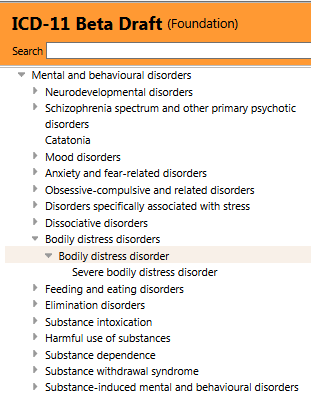
This section of Chapter 5 now displays as in this screenshot, immediately below, when viewed in the ICD-11 Beta drafting platform Foundation View, at February, 2, 2014:
http://apps.who.int/classifications/icd11/browse/f/en#/http%3a%2f%2fid.who.int%2ficd%2fentity%2f1472866636

BDD at 02.02.14

A change also for Hypochondriasis – which has also been removed from under parent class, Bodily distress disorders, and is currently assigned dual parentage under: Obsessive-compulsive and related disorders; and Anxiety and fear-related disorders.

This means that the only categories currently coded under parent term “Bodily distress disorders” (previously, “Bodily distress disorders, and psychological and behavioural factors associated with disorders or diseases classified elsewhere”) are “Bodily distress disorder” and “Severe bodily distress disorder

Update on February 1, 2014:

In June 2013, Prof David Goldberg co-authored a paper: Bodily distress syndrome (BDS): the evolution from medically unexplained symptoms (MUS) in Mental Health in Family Medicine. Co-author, Gabriel Ivbijaro, is Editor in Chief, Mental Health in Family Medicine and a past Chair of the Wonca Working Party on Mental Health. Mental Health in Family Medicine is the official journal of The World Organization of Family Doctors (Wonca) Working Party on Mental Health. I don’t have access to this paper, which is currently embargoed, but it should be free in PMC on June 1, 2014 [5].
+++
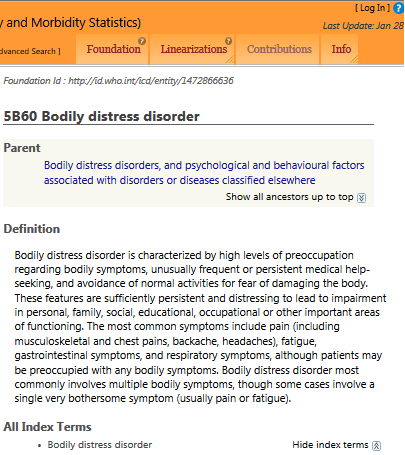
BDDJan_28_14

Screenshot: Chapter 5, ICD-11 Beta drafting platform, public version: January 29, 2014

+++

Between a Rock and a Hard Place

A definition for “Bodily distress disorder” has very recently been entered into the public version of the ICD-11 Beta drafting platform by ICD-11 Revision.

You can view the definition text, as it stands at January 29, in the public version of the Beta drafting platform, here:

Joint Linearization for Mortality and Morbidity Statistics view

Bodily distress disorder

Parent(s)

Bodily distress disorders, and psychological and behavioural factors associated with disorders or diseases classified elsewhere

Definition

Bodily distress disorder is characterized by high levels of preoccupation regarding bodily symptoms, unusually frequent or persistent medical help-seeking, and avoidance of normal activities for fear of damaging the body. These features are sufficiently persistent and distressing to lead to impairment in personal, family, social, educational, occupational or other important areas of functioning. The most common symptoms include pain (including musculoskeletal and chest pains, backache, headaches), fatigue, gastrointestinal symptoms, and respiratory symptoms, although patients may be preoccupied with any bodily symptoms. Bodily distress disorder most commonly involves multiple bodily symptoms, though some cases involve a single very bothersome symptom (usually pain or fatigue).

All Index Terms

  • Bodily distress disorder

Or here, in the Beta Foundation view

—————-

Only the ICD-11 Short (100 word) Definition for this proposed new ICD category has been inserted. At this point, no Inclusion Terms, Exclusions, Synonyms, Narrower Terms, Diagnostic Criteria or other potential Content Model descriptors have been populated.

No Definition or severity characteristics have yet been assigned to Severe bodily distress disorder to differentiate between the two coded severities: “Bodily distress disorder” and “Severe bodily distress disorder.” (Unique codes for a “Mild bodily distress disorder” and a “Moderate bodily distress disorder” were dropped in mid 2013.)

In order to place this development into context here are some notes:

It’s important to understand that there are two working groups reporting to the International Advisory Group for the Revision of ICD-10 Mental and Behavioural Disorders that are charged with making recommendations on the revision of the Somatoform Disorders for the primary care version and core version of ICD-11:

The 12 member Primary Care Consultation Group (PCCG) leads the development and field testing of the revision of all 28 mental and behavioural disorders for inclusion in the next ICD primary care classification (ICD-11-PHC), an abridged version of the core ICD classification. The PCCG is chaired by Prof Sir David Goldberg. Per Fink’s colleague, Marianne Rosendal, is a member of this group.

The 17 member Expert Working Group on Somatic Distress and Dissociative Disorders (S3DWG) is advising on the revision of ICD-10’s Somatoform Disorders. The S3DWG is chaired by Prof Oye Gureje. DSM-5 Somatic Symptom Disorder work group member, Prof Francis Creed, is a member of this group.

In 2011, the Primary Care Consultation Group’s proposals for a replacement for the “Unexplained somatic symptoms/medically unexplained symptoms” category were put out for review and evaluation in primary care settings to nine  international focus groups* in seven countries [1].

*Austria, Brazil, Hong Kong, New Zealand, Pakistan, Tanzania and United Kingdom.

The PCCG anticipated refining their recommendations in the light of focus group responses before progressing to field testing the new disorder.

New disorders that survive the primary care field tests must have an equivalent disorder in the main ICD-11 classification.

Since any new primary care disorder concept will need to integrate into the ICD-11 core version, one might expect some cross-group collaboration between these two advisory committees.

But in their respective 2012 journal papers, the groups presented divergent constructs and neither group refers to the work being undertaken by the other group, or sets out how the two groups relate to each other, or how the primary care group relates to the overall revision process for the Somatoform Disorders.

The specific tasks of the S3DWG include, among others:

“3. To provide drafts of the content (e.g. definitions, descriptions, diagnostic guidelines) for somatic distress and dissociative disorder categories in line with the overall ICD revision requirements.

“4. To propose entities and descriptions that are needed for classification of somatic distress and dissociative disorders in different types of primary care settings, particularly in low- and middle-income countries.”

It is unclear how ICD-11 Revision is co-ordinating the input from the two groups, that is, will it be the PCCG’s revised recommendations that progress to field testing, this year, and if so, how would a divergent set of proposals, developed in parallel by the S3DWG group, relate to the field testing and to the overall revision of the SDs?

Or, will ICD-11 Revision require the PCCG group and the S3DWG group to agree on what to call any proposed, single disorder replacement for six or seven SD categories and to reach consensus over what construct, definition, characteristics and criteria will go forward to ICD-11 field testing, and if so, has consensus now been reached?

Field tests are expected to start this year. Currently, there is no publicly available information on the finalized characteristics, diagnostic guidelines, criteria, inclusions, exclusions, differential diagnoses etc. that are planned to be used for the field tests which would provide the level of detail lacking in this Beta draft definition.

It has been crafted with sufficient elasticity to allow either group’s construct to be shoehorned into it.

ICD-11 Revision is possibly hedging its bets depending on the outcome of its field tests. But the devil’s in the detail and without the detail, it isn’t clear whether this definition describes the construct favoured by the S3DWG in late 2012, or by the PCCG in mid 2012, or a more recent revision by one of the groups, or a compromise between the two.

The definition wording is based – in some places verbatim – on the construct descriptions presented in the Gureje, Creed (S3DWG) “Emerging themes…” paper, published in late 2012 [2].

Extract, Creed F, Gureje O. Emerging themes in the revision of the classification of somatoform disorders. Int Rev Psychiatry. 2012:

“…At the time of preparing this review, a major highlight of the proposals of the S3DWG for the revision of the ICD-10 somatoform disorders is that of subsuming all of the ICD-10 categories of F45.0 – F45.9 and F48.0 under a single category with a new name of ‘bodily distress disorder’ (BDD).

“In the proposal, BDD is defined as ‘A disorder characterized by high levels of preoccupation related to bodily symptoms or fear of having a physical illness with associated distress and impairment. The features include preoccupation with bothersome bodily symptoms and their significance, persistent fears of having or developing a serious illness or unreasonable conviction of having an undetected physical illness, unusually frequent or persistent medical help-seeking and avoidance of normal activities for fear of damaging the body. These features are sufficiently persistent and distressing to lead to impairment of functioning or frequent seeking of reassurance.'”

This 2012 paper goes on to say that the S3DWG’s emerging proposals specify a much simplified set of criteria for a diagnosis of Bodily distress disorder (BDD) that requires the presence of: 1. High levels of preoccupation with a persistent and bothersome bodily symptom or symptoms; or unreasonable fear, or conviction, of having an undetected physical illness; plus 2. The bodily symptom(s) or fears about illness are distressing and are associated with impairment of functioning.

And that in doing away with the “unreliable assumption of its causality” the diagnosis of BDD does not exclude the presence of depression or anxiety, or of a co-occurring physical health condition.

Which is a disorder construct into which DSM-5’s “Somatic Symptom Disorder” (SSD) could be integrated, thus facilitating harmonization between ICD-11 and DSM-5.

But without clarification from ICD-11 Revision (or further published papers, reports or sight of the field test protocol) I do not think one can safely extrapolate that it is the current proposals of the S3DWG group that are going forward to field testing, this year, in preference to a construct and criteria favoured by the PCCG group.

With the caveat that proposals by both groups are likely to have been modified since publication of their respective 2012 papers, or may have since converged into a consensus concept, to recap briefly:

In mid 2012, the Goldberg led PCCG primary care group was proposing a new term called “Bodily stress syndrome (BSS),” to replace ICD’s primary care category, “F45 Unexplained somatic symptoms.” This single BSS category would also absorb F48 Neurasthenia, which is proposed to be eliminated for ICD-11-PHC.

In late 2012, the S3DWG group was proposing to subsume the six ICD-10 categories F45.0 – F45.9, plus F48.0 Neurasthenia, under a single disorder category, but under the disorder name, “Bodily distress disorder” (BDD).

So at that point, the two groups differed on what term should be used for this new disorder.

The two group’s proposed constructs, criteria and exclusions also diverged, with the PCCG group incorporating characteristics of Fink et al’s “Bodily Distress Syndrome” [3] construct, and based on the “autonomic arousal” (or “over-arousal”) illness model, with symptom clusters or symptom patterns from one or more body systems, but also requiring some SSD-like psychobehavioural responses to meet the diagnosis. But, “If the symptoms are accounted for by a known physical disease this is not BSS.”

While the emerging proposals of the S3DWG group leaned more towards a “pure” DSM-5 SSD-like construct that could be diagnosed in patients with persistent “excessive” psychobehavioural responses to bodily symptoms in the presence of any diagnosed disease, patients with so-called “functional somatic syndromes” and patients with somatic symptoms of unclear etiology, but with no evident requirement for specific symptom counts, or for symptom clusters from one or more body systems or for the symptoms to be “medically unexplained.” [4]

What wasn’t explicitly set out in the PCCG’s 2012 paper was whether the group intended to mirror the Fink et al BDS construct to the extent of extending the diagnosis to be inclusive of the so-called “functional somatic syndromes,” FM, CFS and IBS (which are currently discretely coded or indexed within ICD-10 in chapters outside the mental and behavioural disorders chapter).

This 2013 paper, below, interprets that it is the intention of the Primary Care Consultation Group to capture FM, CFS and IBS:

http://www.ncbi.nlm.nih.gov/pubmed/24295235

Free PDF: http://www.uam.es/becarios/jbarrada/papers/hads.pdf

Psychol Assess. 2013 Dec 2. [Epub ahead of print] Bifactor Analysis and Construct Validity of the HADS: A Cross-Sectional and Longitudinal Study in Fibromyalgia Patients. Luciano JV, Barrada JR, Aguado J, Osma J, García-Campayo J.

“[…] In the upcoming primary healthcare version of the ICD-11 (ICD-11-PHC), FM will be classified as part of bodily stress syndrome (BSS; Lam et al., 2013). This new diagnosis will group patients who might have previously been considered different (e.g., those with FM, chronic fatigue syndrome, irritable bowel syndrome, and so on). Frontline clinicians (e.g., GPs) will need reliable tools to identify possible/probable clinical cases of anxiety (i.e., cognitive over-arousal) among patients with BSS who are characterised by elevated somatic over-arousal…”

Prof Tony Dowell, New Zealand, is a member of the PPCG. In this slide presentation Prof Dowell lists IBS, Fibromylagia and CFS under “Bodily Stress Syndromes.” Prof Dowell is already promoting the use of the BSS construct, in New Zealand, despite its current lack of validation:

Slide presentation

Slide 29

Bodily Stress Syndromes

• Gastroenterology – IBS, Non ulcer dyspepsia
• Rheumatology – Fibromyalgia
• Cardiology – Non cardiac chest pain
• Respiratory – hyperventilation
• Dental – TMJ syndrome
• Neurology – ‘headache’
• Gynaecology – chronic pelvic pain
• Psychiatry – somatiform [sic] disorders
• Chronic fatigue Syndrome

Reading the responses of the focus groups, as reported in the Lam et al paper [1], it is evident that some focus group participants understood the proposed BSS construct as a diagnosis under which IBS, Fibromylagia and CFS patients could potentially be assigned; though one of the New Zealand focus groups noted there was quite a strong feeling that CFS did not fit the paradigm as well as other [FSS] disorders, particularly when there was a good history of preceding viral infection.

Whilst a number of diseases are listed in the PCCG criteria, as proposed in 2012, under “Differential diagnoses,” including multiple sclerosis, hyperparathyroidism, systemic lupus erythematosus and Lyme disease – IBS, Fibromylagia, CFS and ME are omitted from the list of “Differential diagnoses” examples.

In June 2013, Prof David Goldberg co-authored a paper: Bodily distress syndrome (BDS): the evolution from medically unexplained symptoms (MUS) in Mental Health in Family Medicine. Co-author, Gabriel Ivbijaro, is Editor in Chief, Mental Health in Family Medicine and a past Chair of the Wonca Working Party on Mental Health. Mental Health in Family Medicine is the official journal of The World Organization of Family Doctors (Wonca) Working Party on Mental Health.

I don’t have access to this paper, which is currently embargoed, but it should be free in PMC on June 1, 2014 [5].

—————-

When viewing the Beta drafting platform, note that the descriptive text for the ICD-11 Beta draft parent term, “Bodily distress disorders, and psychological and behavioural factors associated with disorders or diseases classified elsewhere,” which can be viewed here: ICD-11 Beta drafting platform Foundation view is the legacy text from the beginning of the ICD-10 Somatoform Disorders section (compare in ICD-10 here):

This F45 section introduction text has not yet been revised to reflect the proposed dismantling and reorganization of the ICD-10 Somatoform Disorders section for ICD-11.

Caveat: The ICD-11 Beta draft is not a static document – it is a work in progress, subject to daily revisions and refinements and to approval by the International Advisory Group for the Revision of ICD-10 Mental and Behavioural Disorders, the ICD-11 Revision Steering Group, and WHO classification experts. Proposals for some new or revised disorders may be subject to re-evaluation and revision following ICD-11 field testing.

References:

1. Lam TP, Goldberg DP, Dowell AC, Fortes S, Mbatia JK, Minhas FA, Klinkman MS: Proposed new diagnoses of anxious depression and bodily stress syndrome in ICD-11-PHC: an international focus group study. Fam Pract Feb 2013 [Epub ahead of print July 2012]. http://www.ncbi.nlm.nih.gov/pubmed/22843638 [Full text behind paywall]

2. Creed F, Gureje O. Emerging themes in the revision of the classification of somatoform disorders. Int Rev Psychiatry. 2012 Dec;24(6):556-67. http://www.ncbi.nlm.nih.gov/pubmed/23244611 [Full text behind paywall]

3. Fink et al’s Bodily Distress Syndrome

Per Fink and colleagues are lobbying for their “Bodily Distress Syndrome” (BDS) construct to be integrated into forthcoming classification systems and adopted as a diagnosis by primary care practitioners. They propose the reclassification of the somatoform disorders, pain disorder, neurasthenia and the so-called functional somatic syndromes, including fibromyalgia (FM), irritable bowel syndrome (IBS) and chronic fatigue syndrome (CFS), under a single, unifying diagnosis, “Bodily Distress Syndrome,” already in use in clinical and research settings in Denmark.

4. BDS, BDDs, BSS, BDD unscrambled

5. Ivbijaro G, Goldberg D. Bodily distress syndrome (BDS): the evolution from medically unexplained symptoms (MUS). Ment Health Fam Med. 2013 Jun;10(2):63-4. No abstract available. [PMID: 24427171] Currently embargoed: Free in PMC on June 1, 2014. PMC Archives

G Ivbijaro is Editor in Chief, Mental Health in Family Medicine and a past Chair of the Wonca Working Party on Mental Health. D Goldberg chairs the Primary Care Consultation Group (PCCG) leading the development and field testing of the next ICD primary care classification (ICD-11-PHC).

6. General information on ICD-11 Field Tests:

2012 Annual Report of the International Union of Psychological Science to the American Psychological Association Revision of World Health Organization’s ICD-10 Mental and Behavioural Disorders, Pierre L.-J. Ritchie, Ph.D, January, 2013, Pages 8-11

Click to access icd-report-2012.pdf

WHO ICD Revision Information Note: Field Trials, 23 January 2013
Click to access 15.Field_Trials.pdf

BDS, BDDs, BSS, BDD unscrambled

Post #268 Shortlink: http://wp.me/pKrrB-3fA

BDS, BDDs, BSS, BDD and ICD-11, unscrambled

There are two WHO convened working groups charged with making recommendations for the revision of ICD-10’s Somatoform Disorders: the Primary Care Consultation Group (known as the PCCG) and the Expert Working Group on Somatic Distress and Dissociative Disorders (known as the S3DWG).

The revision of ICD-11 is being promoted as an open and transparent process. But to date, neither working group has published progress reports for stakeholder consumption and neither group has published its emerging proposals in public access journals.

Content populated in the public version of the ICD-11 Beta drafting platform sheds little light on proposals.

Consequently, there is considerable confusion around what is being recommended for the revision of ICD-10’s Somatoform Disorders, whether consensus between the two working groups has been reached, and what proposals will progress to field testing during the next two years.

ICD-11 Revision has been asked to clarify when it intends to define and characterize its current proposals within the Beta drafting platform.

The notes below set out some of what is known about the two working groups’ emerging proposals, how they diverge and how they compare with DSM-5’s Somatic Symptom Disorder and with Fink et al’s Bodily Distress Syndrome.

Caveat: the proposals of the two ICD-11 working groups may have undergone revision and refinement since emerging proposals were published, in July and December, last year; the two groups may or may not have reached consensus over how this proposed new ICD construct should be defined and characterized, its inclusions, exclusions and differential diagnoses, or what name it should be given.

What is Bodily Distress Syndrome (BDS)?

+++

Bodily Distress Syndrome is the name given to a disorder construct developed by Per Fink and colleagues, Aarhus University, that is already in use in Danish research studies and in clinical settings [1].

BDS is described by its authors as “a unifying diagnosis that encompasses a group of closely related conditions such as somatization disorder, fibromyalgia, irritable bowel syndrome and chronic fatigue syndrome.”

Per Fink and colleagues are lobbying for BDS to be integrated into forthcoming classification systems and adopted as a diagnosis by primary care practitioners.

Their proposal is for reclassifying somatoform disorders, pain disorder, neurasthenia and the so-called functional somatic syndromes, including fibromyalgia, irritable bowel syndrome and chronic fatigue syndrome, under a new classification, Bodily Distress Syndrome.

They consider these should be treated and managed as subtypes of the same disorder with CBT, GET, “mindfulness therapy” and in some cases, antidepressants.

The PDF format slide presentation in reference [2] will give an overview of BDS and there is more information and links in an earlier post, in reference [3].

Is Fink et al’s Bodily Distress Syndrome construct the same as DSM-5’s SSD?

+++

No, Bodily Distress Syndrome is a different construct to DSM-5’s Somatic Symptom Disorder.

Psychological or behavioural characteristics, central for the diagnosis of SSD, do not form part of the BDS criteria.

For BDS, physical symptoms are central to the diagnosis, which is based on identification of symptom patterns (not symptom count) from four body systems:

Cardiopulmonary/autonomic arousal; Gastrointestinal arousal; Musculoskeletal tension; General symptoms.

There is a “Modest” BDS (single-organ type) and a “Severe” BDS (multi-organ type).

If the symptoms are better explained by another disease, they cannot be labelled BDS.

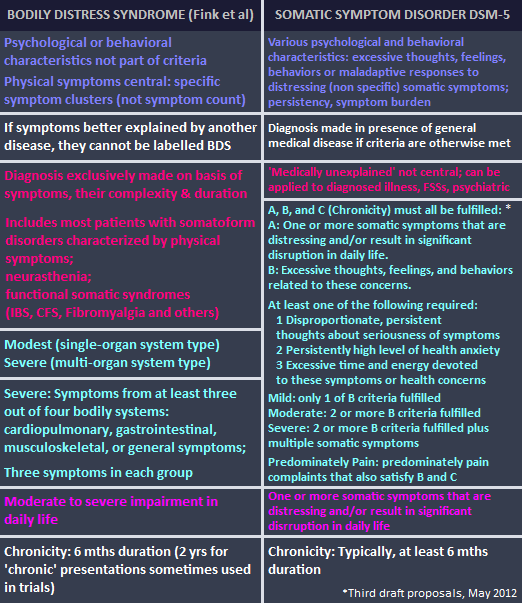
The graphic below compares mutli-organ Bodily Distress Syndrome with Somatic Symptom Disorder, as the DSM-5 draft criteria had stood, in May 2012.

Note the defining characteristics of the DSM-5 SSD construct: the SSD definition calls for positive psychobehavioural characteristics (excessive or maladaptive responses or associated health concerns) in response to persistent distressing somatic symptoms; the requirement that the symptoms are “medically unexplained” is not central to the diagnosis and the symptoms may or may not be associated with a well-recognised medical condition.

The SSD diagnosis can be made in the presence of one or more unspecified, somatic symptoms associated with general medical conditions and diagnosed disease, like multiple sclerosis, cancer, diabetes or angina, or in the so-called “functional somatic syndromes” (for example, IBS, CFS or fibromyalgia) or in complaints with unclear etiology.

Compare Fink et al’s BDS with DSM-5’s SSD, in the table, below:

Depending on screen size/resolution, graphic may not display in full. Click on the image and the image file will load. Graphic: Suzy Chapman

Bodily Distress Syndrome comparison with Somtatic Symptom Disorder

Continued on Page 2

Update on ICD-11 Beta drafting: Bodily Distress Disorder: emerging proposals: Part One

Post #265 Shortlink: http://wp.me/pKrrB-3cr

Update on ICD-11 Beta drafting: Bodily Distress Disorder: emerging proposals: Part One

This report should be read in conjunction with the caveats at the end of the post, on Page 3.

Part One

The technical work associated with the preparation of ICD-11, the field testing and trials evaluation will need to be completed next year if WHO is going to meet its target of presenting ICD-11 for World Health Assembly approval in May 2015, with pilot implementation by 2016.

Three distinct versions of the ICD-11 classification of Mental and Behavioural Disorders are under development: an abridged version for use in primary care, a detailed version for use in specialty settings and a version for use in research.

The ICD-10 Somatoform Disorders are under revision for all three versions and the primary care and speciality versions are being developed simultaneously.

ICD10-PC, the abridged version of ICD, is used in developed and developing countries and in the training of medical officers, nurses and multi-purpose health workers. Globally, more than 90% of patients with mental health problems are managed by practitioners or health workers in general medical or primary care settings – not by psychiatrists.

Over 400 mental disorders are classified in the speciality version of ICD-10 Chapter V. These are condensed to 26 mental disorders for the primary care version – a list can be found on Page 49 of this book chapter, in Table 2.4.

Each disorder in ICD10-PC provides information on patient presentation, clinical descriptions, differential diagnoses, treatments, indications for referrals and information sheets for patients and families.

A revised list of disorders proposed for inclusion in the forthcoming ICD-11-PHC can be viewed on Page 51, in Table 2.5 [1].

For new and revised disorders included in the primary care version there will need to be an equivalent disorder in the core ICD-11 classification.

Existing Somatoform Disorders in the core ICD-10 version can be viewed here: ICD-10 Version: 2010 browser: Somatoform Disorders or from Page 129 in The ICD-10 Classification of Mental and Behavioural Disorders, Clinical descriptions and diagnostic guidelines.

A chart showing the grouping of the detailed core version categories and the 26 corresponding disorders in ICD10-PC can be found here, see Page 8, for F45 Unexplained somatic complaints and F45  Somatoform disorders (ICD-10): Connections between ICD-10 PC and ICD-10 Chapter V.

Where reports of emerging proposals for ICD-11 have been published by ICD revision working group members, the recommendations within them may be subject to refinement or revision following analysis of focus group studies, external review and multicentre field trials to assess the validity and clinical utility of proposals for application in developed and developing countries, in high and low resource settings and across general, speciality and research settings [2].

Not all proposals for new or revised disorders are expected to survive the field trials.

Two working groups are making recommendations for the revision of ICD-10’s Somatoform Disorders:

A WHO Primary Care Consultation Group (known as the PCCG) has been appointed to lead the development of the revision of ICD10-PC, the abridged classification of mental and behavioural disorders for use in primary care settings. The PCCG is charged with developing and field testing the full set of disorders for inclusion in ICD-11-PHC, for which 28 mental disorders are currently proposed.

The PCCG members are SWC Chan, AC Dowell, S Fortes, L Gask, KS Jacob, M Klinkman (Vice Chair), TP Lam, JK Mbatia, FA Minhas, G Reed, and M Rosendal. The PCCG is chaired by Prof, Sir David Goldberg.

A WHO Expert Working Group on Somatic Distress and Dissociative Disorders (known as the S3DWG) was constituted in 2011 to review the scientific evidence for, and clinical utility of the ICD-10 somatoform and dissociative disorders; to review proposals for the DSM-5 somatic symptom disorders and dissociative disorders categories and to consider their suitability or not for global applications; to review proposals and provide draft content for the somatic distress and dissociative disorder categories in line with the overall ICD revision requirements; to propose entities and descriptions for the classification of somatic distress and dissociative disorders for use in diverse global and primary care settings. External reviewers are also consulted on proposals and content.

The full S3DWG membership list is not publicly available but the group is understood to comprise 17 international behavioural health professionals, of which Prof Francis Creed is a member. The S3DWG is Chaired by Prof Oye Gureje.

Responsibilities of ICD-11 working groups are set out on Page 3 (1.1.) of document [3] in the References. Document [3] also includes information on the ICD-11 field trials, from Page 8 (4.).


1. Goldberg DP. Comparison Between ICD and DSM Diagnostic Systems for Mental Disorders. In: Sorel E, (Ed.) 21st Century Global Mental Health. Jones & Bartlett Learning, 2012: 37-53. Free PDF, Sample Chapter Two: http://samples.jbpub.com/9781449627874/Chapter2.pdf
2. PDF WHO ICD Revision Information Note, Field Testing, June 2012
3. Responsibilities of ICD-11 working groups set out on Page 3 of 2012 Annual Report of the International Union of Psychological Science to the American Psychological Association, Revision of World Health Organization’s ICD-10 Mental and Behavioural Disorders, Pierre L.-J. Ritchie, Ph.D., Main Representative to the World Health Organization, International Union of Psychological Science, January, 2013

Continued on Page 2

Bodily Distress Syndrome: Coming soon to a GP Management Pilot near you…

Post #264 Shortlink: http://wp.me/pKrrB-3dG

NHS England: Pilot of Enhanced GP Management of Patients with Medically Unexplained Symptoms

NHS Barnet Clinical Commissioning Group

Pilot of Enhanced GP Management of Patients with Medically Unexplained Symptoms
Open full size PDF:

Click link for PDF document  Pilot of Enhanced GP Management of Patients with MUS

or download here:

http://tinyurl.com/k44xg7d

Note the use of the term “Bodily Distress Syndrome (BDS)” despite the lack of a body of evidence to support the validity, reliability, safety and clinical utility of the application of the BSD construct* in primary care.

Note also, the list of illnesses under the definition of “MUS”: Chronic Pain, Fibromyalgia, Somatic Anxiety/Depression, Irritable Bowel Syndrome (IBS), Chronic Fatigue Syndrome (CFS), Myalgic Encephalomyelitis (ME), Post-viral Fatigue Syndrome.

*For information on the Fink et al concept of “Bodily Distress Syndrome” see Part Two of Dx Revision Watch Post: ICD-11 Beta draft and BDD, Per Fink and Bodily Distress Syndrome


Extracts:

22 May 2013

NHS England

PILOT OF ENHANCED GP MANAGEMENT OF PATIENTS WITH MEDICALLY UNEXPLAINED SYMPTOMS

NHS Barnet Clinical Commissioning Group

Background

Medically Unexplained Symptoms

Definition

The term ‘medically unexplained symptoms (MUS)’ are physical symptoms that cannot be explained by organic pathology, which distress or impair the functioning of the patient. Patients often present with physical symptoms that cannot be explained even after thorough investigation. Other terms used to describe this patient group include: Functional Somatic Syndrome (FSS), Illness Distress Symptoms (IDS), Idiopathic Physical Symptoms (IPS), Bodily Distress Syndrome (BDS) and Medically Unexplained Physical Symptoms (MUPS).

Symptoms and Diagnosis

Symptoms

Headache
Shortness of Breath, palpitations
Fatigue, weakness, dizziness
Pain in the back, muscles, joints, extremity pain, chest pain, numbness
Stomach problems, loose bowels, gas/bloating, constipation, abdominal pain
Sleep disturbance, difficulty concentrating, restlessness, slow thoughts
Loss of appetite, nausea, lump in throat
Weight change

Diagnosis

Chronic Pain
Fibromyalgia
Somatic Anxiety/Depression
Irritable Bowel Syndrome
Chronic Fatigue Syndrome
Myalgic Encephalomyelitis
Post-viral Fatigue Syndrome

PROJECT AIMS AND OBJECTIVES

• To pilot a commissioner initiated, enhanced GP management service for patients with MUS in primary care. Refer to Figure 1 for details.

• The pilot will be carried out at selected Barnet GP practices (approximately 15) managing a minimum of 10 patients with MUS over 12 months.

• To identify patients with MUS using an electronic risk stratification tool the ‘Nottingham Tool’ with a review of the generated list at a multidisciplinary (MDT) GP practice meeting for the final patient selection.

• To enhance post-graduate GP training by providing education and training workshops and focused work group meetings on the management of MUS.

• The project will also test the assertion that identification and management of MUS would result in savings to commissioning budgets.

PROJECT OUTCOMES AND BENEFITS

There are several benefits that could be realised from implementing this project. These are as follows:-

• Improved outcomes for patients with MUS, better patient experience

• Improved quality of life

• Improved GP-Patient relationship

• Reduced GP secondary and tertiary referrals

• Reduced unnecessary GP and hospital investigations and prescribing of medicines

• Reduced GP appointments and out of hours appointments to A&E or GP

CONCLUSIONS

There is a high prevalence of patients with medically unexplained symptoms presenting to primary and secondary care services. Patients with MUS are high healthcare service users having a major impact to our local health economy and health outcomes. GPs are well placed to manage MUS patients as this patient group are 50% more likely to attend primary care. We believe that our proposed enhanced management of care by the GP will result in both market and non-market benefits. This proposal has gained approval from the NHS Barnet CCG Primary Care Strategy and Implementation Board, QIPP Board and the NCL Programme Board for the 2013/14 financial year…

etc.

Related material

+++
IAPT NHS Long Term Conditions and Medically Unexplained Symptoms

IAPT NHS Medically Unexplained Symptoms

PHQ-15

The “Nottingham Tool”

Click link for PDF document   Medically Unexplained Symptoms (MUS): A Whole Systems Approach in Plymouth

In partnership with:

Plymouth Hospitals NHS Trust, Sentinel Healthcare Southwest CIC, Southwest Development Centre, September 2009

+++

Click link for PDF document   Medically Unexplained Symptoms (MUS) A whole systems approach
NHS Commissioning Support for London
July 2009 – December 2010

+++

DSM-5 goes to press with ‘Somatic Symptom Disorder’ amid widespread professional and consumer concern

DSM-5 goes to press with ‘Somatic Symptom Disorder’ amid widespread professional and consumer concern

Post #224 Shortlink: http://wp.me/pKrrB-2EV

Update: On February 8, David J. Kupfer, MD, Chair, DSM-5 Task Force, published in defence of the ‘Somatic Symptom Disorder’ category on Huffington Post:

Somatic Symptoms Criteria in DSM-5 Improve Diagnosis, Care

Last week, the American Psychiatric Association sent the next edition of its Diagnostic and Statistical Manual of Mental Disorders to the publishers.

When DSM-5 is released in May, it will introduce a new ‘catch-all’ diagnosis that could capture many thousands more patients under a mental disorder label.

Today, on Saving Normal at Psychology Today, Allen Frances, MD, who chaired the DSM-IV Task Force, publishes the third in a series of commentaries voicing considerable concern for all illness groups for the implications of an additional diagnosis of ‘Somatic Symptom Disorder.’

Why Did DSM 5 Botch Somatic Symptom Disorder?

Allen Frances writes:

“Once it is an official DSM 5 mental disorder, SSD is likely to be widely misapplied – to 1 in 6 people with cancer and heart disease and to 1 in 4 with irritable bowel syndrome and fibromyalgia…The definition of SSD is so loose it will capture 7% of healthy people (14 million in the US alone) suddenly making this pseudo diagnosis one of the most common of all ‘mental disorders’ in the general population.”

Suzy Chapman writes:

“These highly subjective, difficult to assess criteria have the potential for widespread misapplication, particularly in busy primary care settings – causing stigma to the medically ill and potentially resulting in poor medical workups, inappropriate treatment regimes and medico-legal claims against clinicians for missed diagnoses.

“Why has the Task Force and APA Board of Trustees been prepared to sign off on a definition and criteria set that lacks a body of rigorous evidence for its validity, safety and prevalence, thereby potentially putting the public at risk? And why is APA prepared to abrogate its duty of care as a professional body and expose its membership, physicians and the allied health professional end-users of its manual to the risk of potential law suits?”

From May, an additional mental health diagnosis of ‘Somatic Symptom Disorder’ (SSD) can be applied whether patients have diagnosed medical diseases like diabetes, angina, cancer or multiple sclerosis, chronic illnesses like IBS, fibromyalgia, chronic fatigue syndrome or chronic pain disorders, or unexplained conditions that have so far presented with bodily symptoms of unclear etiology.

A person will meet the criteria for ‘Somatic Symptom Disorder’ by reporting just one or more bodily symptoms that are distressing or disruptive to daily life, that have persisted for at least six months, and having just one of the following three responses:

1) disproportionate, persistent thoughts about the seriousness of their symptoms;
2) persistently high level of anxiety about their health or symptoms;
3) devoting excessive time and energy to symptoms or health concerns.

In the DSM-5 field trials, 15% of the ‘diagnosed illness’ study group (the trials looked at patients with either cancer or coronary heart disease) met the criteria for an additional mental health diagnosis of SSD.

26% of patients who comprised the irritable bowel syndrome or fibromyalgia study group were coded for SSD.

A disturbingly high 7% of the ‘healthy’ control group were also caught by these overly-inclusive criteria.

+++

Psychiatric creep

As the criteria stand, this new disorder will potentially result in a ‘bolt-on’ mental health diagnosis being applied to all chronic illnesses and medical conditions if the clinician decides the patient’s response to distressing symptoms is ‘excessive’ or their coping strategies are ‘maladaptive,’ or that they are ‘catastrophising’ or displaying ‘fear avoidance.’ Or if the practitioner feels the patient is spending too much time on the internet researching data, symptoms and treatments, or that their lives have become ‘dominated’ by ‘illness worries,’ they may be vulnerable to an additional diagnosis of SSD.

Patients with chronic, multiple bodily symptoms due to rare conditions or multi-system diseases like Behçet’s syndrome or Systemic lupus, which may take several years to diagnose, will also be vulnerable to misdiagnosis with a mental disorder.

There is no substantial body of research to support the validity, reliability or safety of the ‘Somatic Symptom Disorder’ diagnosis.

During the second public review of draft criteria for DSM-5, the ‘Somatic Symptom Disorder’ section received more submissions from advocacy organizations, patients, and professionals than almost any other disorder category. But rather than tighten up the criteria or subject the entire disorder section to independent scientific review, the SSD Work Group’s response has been to lower the threshold even further – potentially pulling even more patients under a mental disorder label.

The ‘Somatic Symptom Disorder’ Work Group has rejected eleventh hour calls from professionals and patients to review its criteria before going to print.

APA says there will be opportunities to reassess and revise DSM-5‘s new disorders, post publication, and that it intends to start work on a ‘DSM-5.1’ release. But patient groups, advocates and professionals are not reassured by a ‘publish first – patch later’ approach to science.

Read Parts One and Two, here:

Part One: Mislabeling Medical Illness As Mental Disorder | Allen Frances, December 8, 2012

Part Two: Bad News DSM-5 Refuses To Correct Somatic Symptom Disorder | Allen Frances, January 16, 2013

+++
Notes for media, websites, bloggers:

1. The next edition of the Diagnostic and Statistical Manual of Mental Disorders (DSM) will be published by American Psychiatric Publishing Inc. in May 2013. It will be known as ‘DSM-5 ‘ and has been under development since 1999.
http://www.dsm5.org/Pages/Default.aspx
http://www.dsm5.org/Documents/DSM%205%20development%20factsheet%201-16-13.pdf

2. The American Psychiatric Association (APA) has spent $25 million on the development of DSM-5.

3. The Diagnostic and Statistical Manual of Mental Disorders is used by mental health and medical professionals for diagnosing and coding mental disorders. It is used by psychiatrists, psychologists, therapists, counselors, primary health care physicians, nurses, social workers, occupational and rehabilitation therapists and allied health professionals.

The DSM is also used for reimbursement and informs government, public health policy, courts and legal specialists, education, forensic science, prisons, drug regulation agencies, pharmaceutical companies and researchers. Diagnostic criteria defined within DSM determine what is considered a mental disorder and what is not, which treatments and therapies health insurers will authorise funding for, and for how long.

4. Four existing disorder categories in the DSM-IV ‘Somatoform Disorders’ section: somatization disorder [300.81], hypochondriasis [300.7], pain disorder, and undifferentiated somatoform disorder [300.82] will be eliminated and replaced with a single new category – ‘Somatic Symptom Disorder’ for DSM-5.

5. APA has held three stakeholder comment periods during which professional and public stakeholders have been invited to submit comment on the proposals for the revision of DSM-IV categories and criteria (in February-April 2010; May-June 2011; May-June 2012).

6. DSM-5 is slated for release at the American Psychiatric Association’s 166th Annual Meeting, San Francisco (May 18-22, 2013). The new manual is available for pre-order and will cost $199: http://www.psychiatry.org/dsm5

7. Allen Frances, MD, was chair of the DSM-IV Task Force and of the Department of Psychiatry at Duke University School of Medicine, Durham, NC; Dr Frances is currently professor emeritus, Duke.

8. Dr Frances blogs at DSM 5 in Distress, and Saving Normal at Psychology Today.

Mislabeling Medical Illness As Mental Disorder was published on December 8, 2012

Bad News DSM-5 Refuses To Correct Somatic Symptom Disorder was published on January 16, 2013

For additional information on ‘Somatic Symptom Disorder’:

Somatic Symptom Disorder could capture millions more under mental health diagnosis by Suzy Chapman for Dx Revision Watch, May 26, 2012

Suzy Chapman

Update on ICD-11 Beta draft: Bodily Distress Disorder

Updates on ICD-11 Beta draft: Bodily Distress Disorder (proposed for ICD-11 Chapter 5: Mental and behavioural disorders); Chronic fatigue syndrome; Postviral fatigue syndrome; Benign myalgic encephalomyelitis (Chapter 6: Diseases of the nervous system)

Post #218 Shortlink: http://wp.me/pKrrB-2Bg

Dr Elena Garralda presentation slides:

http://www.rcpsych.ac.uk/pdf/Garralda%20E.pdf

or open here: Click link for PDF document    Garralda presentation Somatization in Childhood

Slide 1

Somatization in childhood

The child psychiatrist’s concern?

Elena Garralda

CAP Faculty Meeting, RCPsych Manchester, September 2012

Slide 11

New ICD-11 and DSM-V classifications

. Somatoform disorders >>>
– Bodily distress syndrome (ICD-11)
– Complex Somatic symptom disorder (DSM-V)

[Preceded by downward pointing arrow]

“Unexplained” or “functional” medical symptoms (CFS, fibromyalgia, irritable bowel syndrome)

[Preceded by upward pointing arrow]

Physical complaint (s)
with subjective distress/preoccupation ++,
illness beliefs impairment
health help seeking

+++

Notes on ICD-11 Beta drafting platform and DSM-5 draft by Suzy Chapman for Dx Revision Watch:

These notes may be reposted, if reposted in full, source credited, link provided, and date of publication included.

January 6, 2013

1] The publicly viewable version of the ICD-11 Beta drafting platform can be accessed here:
Foundation view: http://apps.who.int/classifications/icd11/browse/f/en
Linearization view: http://apps.who.int/classifications/icd11/browse/l-m/en

2] The various ICD-11 Revision Topic Advisory Groups are developing the Beta draft on a separate, more complex platform accessible only to ICD-11 Revision.

3] The ICD-11 Beta draft is a work in progress and not scheduled for completion until 2015/16. When viewing the public version of the Beta draft please note the ICD-11 Revision Caveats. Note also that not all proposals may be retained following analysis of the field trials for ICD-11 and ICD-11-PCH, the abridged Primary Care version of ICD-11:
http://apps.who.int/classifications/icd11/browse/Help/Get/caveat/en

4] The Bodily Distress Disorders section of the ICD-11 Beta draft Chapter 5 can be found here:
http://apps.who.int/classifications/icd11/browse/f/en#/http%3a%2f%2fwho.int%2ficd%23F45
http://apps.who.int/classifications/icd11/browse/l-m/en#/http%3a%2f%2fwho.int%2ficd%23F45

According to the public version of the ICD-11 Beta drafting platform, the existing ICD-10 Somatoform Disorders are currently proposed to be replaced with Bodily Distress Disorders, and Psychological and behavioural factors associated with disorders or diseases classified elsewhere, not with Bodily distress syndrome as Dr Garralda has in her slide presentation.

The following proposed ICD-11 categories are listed as child categories under parent, Bodily Distress Disorders, and Psychological and behavioural factors associated with disorders or diseases classified elsewhere:

EC5 Mild bodily distress disorder
EC6 Moderate bodily distress disorder
EC7 Severe bodily distress disorder
EC8 Psychological and behavioural factors associated with disorders or diseases classified elsewhere

There are no Definitions nor any other descriptors populated for the proposed, new ICD categories EC5 thru EC7.

EC8 is a legacy category from ICD-10 and has some populated content imported from ICD-10.

+++
These earlier ICD-11 Beta draft Somatoform Disorders categories appear proposed to be eliminated and replaced with the four new categories EC5 thru EC8, listed above:

Somatization disorder [F45.0 in ICD-10]
Undifferentiated somatoform disorder [F45.1 in ICD-10]
Somatoform autonomic dysfunction [F45.3 in ICD-10]
Persistent somatoform pain disorder [F45.4 in ICD-10]
    > Persistent somatoform pain disorder
    > Chronic pain disorder with somatic and psychological factors [Not in ICD-10]
Other somatoform disorders [F45.8 in ICD-10]
Somatoform disorder, unspecified [F45.9 in ICD-10]

5] The existing ICD-10 Chapter V category Neurasthenia [ICD-10: F48.0] is no longer accounted for in the public version of the ICD-11 Beta draft. I have previously reported that for ICD-11-PHC, the Primary Care version of ICD-11, the proposal is to eliminate the term Neurasthenia.

(I cannot confirm whether the currently omission of Neurasthenia from the Beta draft is due to oversight or because ICD-11 Revision’s intention is that Neurasthenia is also eliminated from the main ICD-11 classification.)

+++
6] I have previously reported that for ICD-11-PHC, the abridged, Primary Care version of ICD-11, the proposal, last year, was for a disorder section called Bodily distress disorders, under which would sit Bodily stress syndrome [sic].

This category is proposed for ICD-11 Primary Care version to include “milder somatic symptom disorders” as well as “DSM-5’s Complex somatic symptom disorder” and would replace “medically unexplained somatic symptoms.”

7] Dr Garralda lists Complex Somatic symptom disorder (DSM-V) on Slide 11 of her presentation.

The manual texts for the next edition of DSM are in the process of being finalized for a projected release date of May 2013. The next edition of DSM will be published under the title DSM-5 not DSM-V . The intention is that once published, updates and revisions to DSM-5 will be styled: DSM-5.1, DSM-5.2 etc.

When the third draft of DSM-5 was released in May 2012, the proposal was to merge Complex Somatic Symptom Disorder with Simple Somatic Symptom Disorder and to call this hybrid category Somatic Symptom Disorder.

This would mean that this new disorder has the same name as the overall disorder section it sits under, which replaces DSM-IV’s Somatoform Disorders.

As any subsequent changes to draft criteria sets following closure of the third stakeholder review are embargoed, I cannot confirm whether the SSD Work Group has decided to rename this category to Somatic symptom Disorder or retain the original term, Complex Somatic Symptom Disorder, the term used by Dr Garralda in her presentation.

+++
8] Turning from ICD-11 Beta draft Chapter 5 Mental and behavioural disorders to Chapter 6 Diseases of the nervous system:

As previously reported, Chronic fatigue syndrome is listed under Diseases of the nervous system in the Foundation View. There is no listing for Chronic fatigue syndrome in the Linearization View nor is the term listed in the PDF for Chapter 6, that is available to those who are registered with ICD-11 Beta draft for access to additional content:

http://apps.who.int/classifications/icd11/browse/f/en#http%3a%2f%2fwho.int%2ficd%23G93.3

Documentation from the ICD-11 iCAT Alpha draft dating from May 2010, implies that the intention for ICD-11 is a change of hierarchy for the existing ICD-10 Title term Postviral fatigue syndrome.

In the ICD-11 Beta draft, Chronic fatigue syndrome (which was listed only within the Index volume of ICD-10 and not listed in Volume 2: The Tabular List) appears to be elevated to ICD Title term status, with potentially up to 12 descriptive parameters yet to be completed and populated in accordance with the ICD-11 “Content Model”.

But the current proposed hierarchical relationship between PVFS and CFS for ICD-11 remains unconfirmed.

See image for documentation from the iCAT Alpha drafting platform, from May 2010:

https://dxrevisionwatch.com/wp-content/uploads/2010/06/change-history-gj92-cfs.png

There is no discrete ICD Title term displaying for Postviral fatigue syndrome in either the ICD-11 Beta Foundation View or Linearization View.

Neither is there any discrete ICD Title term displaying for Benign myalgic encephalomyelitis in either the Foundation View or Linearization View.

Benign myalgic encephalomyelitis appears at the top of a list of terms under “Synonyms” in the CFS description. [The hover text over the asterisk at the end of “Benign myalgic encephalomyelitis” reads, “This term is an inclusion term in the linearizations.”]

Postviral fatigue syndrome is also listed under “Synonyms” along with a number of other terms imported from other classification systems.

Included in this list under “Synonyms” are “chronic fatigue syndrome nos” and “chronic fatigue, unspecified,” both of which appear to have been sourced from the as yet to be implemented, US specific, ICD-10-CM.

+++
At some recent, unspecified date, a Definition has been inserted for ICD-11 Title term Chronic fatigue syndrome into the previously empty Definition field. An earlier Definition was removed when the Alpha draft was replaced with the Beta draft but can be seen in this screenshot, here, from June 2010:

https://dxrevisionwatch.com/wp-content/uploads/2010/05/2icatgj92cfsdef.png

The current Definition reads (and be mindful of the ICD-11 Caveats):

“Chronic fatigue syndrome is characterized by extreme chronic fatigue of an indeterminate cause, which is disabling andt [sic] does not improve with rest and that is exacerbated by physical or mental activity.”

There are no Definition fields for Benign myalgic encephalomyelitis or Postviral fatigue syndrome as these terms are listed under “Synonyms” to ICD-11 Title term, Chronic fatigue syndrome.

+++
Since one needs to be mindful of the ICD-11 Caveats and as the Chair of Topic Advisory Group for Neurology has failed to respond to a request for clarification of the intention for these three terms and the proposed ICD relationships between them, I am not prepared to draw any conclusions from what can currently be seen in the Beta drafting platform.

I shall continue to monitor the Beta draft and report on any significant changes.

For definitions of “Synonyms,” “Inclusions,” “Exclusions” and other ICD-11 terminology see the iCAT Glossary:
http://apps.who.int/classifications/apps/icd/icatfiles/iCAT_Glossary.html

+++
Related material:

http://www.rcpsych.ac.uk/pdf/8%20Ash%20IC2012.pdf

Presentation slides: Medically Unexplained Symptoms pages

Dr Graham Ash, Lancashire Care NHS Foundation Trust

Website pages featured in the slide presentation:

Medically Unexplained Symptoms

http://www.rcpsych.ac.uk/expertadvice/improvingphysicalandmh/aboutthissite.aspx

Dx Revision Watch Post, June 26, 2012: ICD-11 Beta drafting platform: Update (2): Neurasthenia, Postviral fatigue syndrome (PVFS), Benign myalgic encephalomyelitis (ME), Chronic fatigue syndrome (CFS), Fibromyalgia (FM), Irritable bowel syndrome (IBS): http://wp.me/pKrrB-2mC