Translations for Update 2: Human Rights denied: Something rotten in the state of Denmark: Karina Hansen’s story

Post #269 Shortlink: http://wp.me/pKrrB-3hQ

Translations of June 19, 2013 report by Rebecca Hansen, chairman, ME Foreningen, Danmark (ME Association, Denmark).

KHBW2

Karina Hansen has now been detained in Hammel Neurocenter against her will for 6 months

If there is a Norwegian translation or other languages other than those below, I’d be pleased to have links to add to this page. You can contact me via the Contact form.


English: http://wp.me/pKrrB-390 Update 2: Human Rights denied: Something rotten in the state of Denmark: Karina Hansen’s story

You are killing me.” Experimental treatment forced on a severely ill ME patient


Dansk: http://wp.me/pKrrB-3gj Opdater 2: Menneskerettighederne nægtet: Noget råddent i staten Danmark: Karina Hansen

”I slår mig ihjel.” Svært ME syg patient tvinges til eksperimentel behandling


Deutsch  | UFOCOMES-blog

Ihr bringt mich um.” Schwer an ME erkrankte Patientin wird zu experimenteller Behandlung gezwungen


Nederlandse  |  ME|cvs Vereniging   |  PDF Nederlandse vertaling

“Jullie vermoorden mij.” Ernstig zieke ME-patiënte gedwongen tot een experimentele behandeling


For earlier posts:

May 11, 2013: Something rotten in the state of Denmark: Karina Hansen’s story: http://wp.me/pKrrB-2Xc

May 25, 2013: Human Rights denied: Something rotten in the state of Denmark: Karina Hansen’s story: Update 1: http://wp.me/pKrrB-35o

May 25, 2013: Menneskerettighederne nægtet: Noget råddent i staten Danmark: Karina Hansen: Opdater 1: http://wp.me/pKrrB-36e

Information on ME Foreningen postcard campaign and petition on Facebook or here: www.me-foreningen.dk

For information on Bodily Distress Syndrome see Part Two Dx Revision Watch Post: ICD-11 Beta draft and BDD, Per Fink and Bodily Distress Syndrome

BDS, BDDs, BSS, BDD unscrambled

Post #268 Shortlink: http://wp.me/pKrrB-3fA

BDS, BDDs, BSS, BDD and ICD-11, unscrambled

There are two WHO convened working groups charged with making recommendations for the revision of ICD-10’s Somatoform Disorders: the Primary Care Consultation Group (known as the PCCG) and the Expert Working Group on Somatic Distress and Dissociative Disorders (known as the S3DWG).

The revision of ICD-11 is being promoted as an open and transparent process. But to date, neither working group has published progress reports for stakeholder consumption and neither group has published its emerging proposals in public access journals.

Content populated in the public version of the ICD-11 Beta drafting platform sheds little light on proposals.

Consequently, there is considerable confusion around what is being recommended for the revision of ICD-10’s Somatoform Disorders, whether consensus between the two working groups has been reached, and what proposals will progress to field testing during the next two years.

ICD-11 Revision has been asked to clarify when it intends to define and characterize its current proposals within the Beta drafting platform.

The notes below set out some of what is known about the two working groups’ emerging proposals, how they diverge and how they compare with DSM-5’s Somatic Symptom Disorder and with Fink et al’s Bodily Distress Syndrome.

Caveat: the proposals of the two ICD-11 working groups may have undergone revision and refinement since emerging proposals were published, in July and December, last year; the two groups may or may not have reached consensus over how this proposed new ICD construct should be defined and characterized, its inclusions, exclusions and differential diagnoses, or what name it should be given.

What is Bodily Distress Syndrome (BDS)?

+++

Bodily Distress Syndrome is the name given to a disorder construct developed by Per Fink and colleagues, Aarhus University, that is already in use in Danish research studies and in clinical settings [1].

BDS is described by its authors as “a unifying diagnosis that encompasses a group of closely related conditions such as somatization disorder, fibromyalgia, irritable bowel syndrome and chronic fatigue syndrome.”

Per Fink and colleagues are lobbying for BDS to be integrated into forthcoming classification systems and adopted as a diagnosis by primary care practitioners.

Their proposal is for reclassifying somatoform disorders, pain disorder, neurasthenia and the so-called functional somatic syndromes, including fibromyalgia, irritable bowel syndrome and chronic fatigue syndrome, under a new classification, Bodily Distress Syndrome.

They consider these should be treated and managed as subtypes of the same disorder with CBT, GET, “mindfulness therapy” and in some cases, antidepressants.

The PDF format slide presentation in reference [2] will give an overview of BDS and there is more information and links in an earlier post, in reference [3].

Is Fink et al’s Bodily Distress Syndrome construct the same as DSM-5’s SSD?

+++

No, Bodily Distress Syndrome is a different construct to DSM-5’s Somatic Symptom Disorder.

Psychological or behavioural characteristics, central for the diagnosis of SSD, do not form part of the BDS criteria.

For BDS, physical symptoms are central to the diagnosis, which is based on identification of symptom patterns (not symptom count) from four body systems:

Cardiopulmonary/autonomic arousal; Gastrointestinal arousal; Musculoskeletal tension; General symptoms.

There is a “Modest” BDS (single-organ type) and a “Severe” BDS (multi-organ type).

If the symptoms are better explained by another disease, they cannot be labelled BDS.

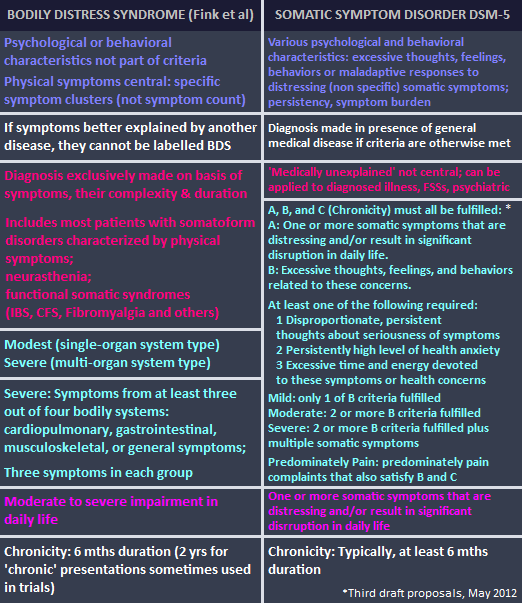
The graphic below compares mutli-organ Bodily Distress Syndrome with Somatic Symptom Disorder, as the DSM-5 draft criteria had stood, in May 2012.

Note the defining characteristics of the DSM-5 SSD construct: the SSD definition calls for positive psychobehavioural characteristics (excessive or maladaptive responses or associated health concerns) in response to persistent distressing somatic symptoms; the requirement that the symptoms are “medically unexplained” is not central to the diagnosis and the symptoms may or may not be associated with a well-recognised medical condition.

The SSD diagnosis can be made in the presence of one or more unspecified, somatic symptoms associated with general medical conditions and diagnosed disease, like multiple sclerosis, cancer, diabetes or angina, or in the so-called “functional somatic syndromes” (for example, IBS, CFS or fibromyalgia) or in complaints with unclear etiology.

Compare Fink et al’s BDS with DSM-5’s SSD, in the table, below:

Depending on screen size/resolution, graphic may not display in full. Click on the image and the image file will load. Graphic: Suzy Chapman

Bodily Distress Syndrome comparison with Somtatic Symptom Disorder

Continued on Page 2

Opdater 2: Menneskerettighederne nægtet: Noget råddent i staten Danmark: Karina Hansen

Post #267 Shortlink: http://wp.me/pKrrB-3gj

+++

”I slår mig ihjel.”

+++
KH5

Rebecca Hansen, lay advocate to the Hansen family, has issued a further update on Karina’s situation.

Dansk udgave

Svært ME syg patient tvinges til eksperimentel behandling

Af Rebecca Hansen, formand for ME Foreningen

”I slår mig ihjel” gentager svært ME-syge Karina Hansen til sygeplejerskerne, når hun tvinges til kontroversiel og udokumenteret behandling, som kaldes GET (gradvist øget træning).

Karina, 24 år, har Myalgisk Encephalomyelitis (ME), en neuro-immun sygdom, som siden 1969 har haft World Health Organization koden G93.3.

ME-eksperterne savner stadig svar på mange aspekter af sygdommen, men der er bred enighed om, at ME-patienter lider af en dysfunktion i evnen til at producere energi og genvinde kræfter efter motion og enhver form for anstrengelse. Dette kaldes post-exertional malaise – eller PEM. Forskning har vist, at GET forværrer tilstanden hos størstedelen af let ramte ME-patienter [1] [2] [3].

I Belgien behandlede statsfinancierede referencecentre let angrebne ME-patienter med GET, men en evaluering af disse centre viste, at GET ikke var effektiv, og at patienterne faktisk kunne arbejde MINDRE efter de havde fået behandlingen [4] [5].

Read more of this post

Update 2: Human Rights denied: Something rotten in the state of Denmark: Karina Hansen’s story

Post #266 Shortlink: http://wp.me/pKrrB-390

Update: Mental Health Act and related documents added at end of report.

+++

She tells the nurses, “You are killing me.” 

+++

KH6

Rebecca Hansen, lay advocate to the Hansen family, has issued a further update on Karina’s situation.

Experimental treatment forced on a severely ill ME patient

By Rebecca Hansen, chairman ME Association, Denmark

“You are killing me” is what severely ill Danish ME patient, Karina Hansen, has repeatedly said to her nurses while she is being forced to receive a controversial and unproven treatment known as Graded Exercise Therapy.

Karina, 24, has Myalgic Encephalomyelitis (ME) which is a neuro-immune illness and has had a World Health Organisation code of G93.3 since 1969.

Much is still unknown about ME, but ME experts agree that ME patients have a dysfunction in their ability to produce energy and to recover from exercise or any type of exertion.

This is called post-exertional malaise or PEM. Studies have shown that GET makes the vast majority of mildly affected ME patients worse [1] [2] [3].

In Belgium, state-funded Reference Centers treated mildly affected ME-patients with GET, but an evaluation of these centers showed that GET was not effective and patients could actually work LESS after getting the treatment [4] [5]. The Belgian Minister of Health officially declared that GET should not be regarded as a curative therapy for ME [6].

Karina has severe ME and no studies of GET have been done on this patient group. Therefore treating severely ill ME patients with GET can only be seen as experimental.

It is illegal to force experimental treatment on patients in Denmark.

The doctors who have ordered this treatment are psychiatrists Nils Balle Christensen and Per Fink from The Research Clinic for Functional Disorders and Psychosomatics (RFD). It is completely unacceptable that Danish authorities are allowing the psychiatrists to treat Karina in this way.

Karina has been held against her will since February 12, 2013, and is forced to undergo GET every day. In 2011, Karina made it clear to the Medical Officer that she did not want GET. She cried when she told him that she wanted to get better, and had tried GET before, but it always made her worse.

The Medical Officer accepted that Karina was mentally healthy and capable of making her own decisions about her treatment. It was agreed she would not be forced to have any unwanted treatment. But this agreement has been broken when Karina was committed. She is now forced to endure GET every day.

Karina is so ill that she usually only has the energy to speak one word at a time. She does best with yes/no questions and questions that do not require complex thought. When her nurses push her too much, she gets angry and cries. Sometimes she summons the energy to say “You are killing me.” But the treatment goes on. If she says nothing, they assume she is cooperating.

I received this information on May 31, 2013, when I attended a meeting with Karina’s parents, her sister, an occupational therapist who treats Karina and a doctor from Hammel Neurocenter, where Karina is being held. The goal of the meeting was to discuss the list of restrictions about visits that Nils Balle Christensen (NBC) had sent to Karina’s parents. NBC is in charge of Karina’s care and Per Fink (PF) is his boss.

Karina’s parents were told they had to have this meeting is they wanted to see Karina. They had not been allowed to see her since she was committed.

Below are the major points from that meeting.

• Karina’s mother (parents) followed the recommendations of ME experts when caring for Karina at home. NBC and PF are ignoring those recommendations.

• At home Karina was allowed to decide her own treatment, but NBC and PF do not allow her to choose her treatment.

• When Karina was committed, all medication was stopped. The staff did not know what medicine she had been taking before she has committed. At home she took cortisol and supplements that were recommended by a doctor.

• Karina refuses to take any supplements or medicine of any kind at the hospital.

• Nils Balle Christensen and Per Fink do not believe that Karina has ME. The doctor we met on May 31 receives his information about Karina and ME from NBC and PF. This doctor said that ME is a “figment of the imagination” and doctors who believe in ME are “imbeciles.” (NBC and PF are officially in charge of all ME patients in Denmark.)

• Karina has been diagnosed with ME four times: twice by ME specialists, once by a rheumatology hospital and once by a psychiatrist.

• NBC and PF are not interested in working with ME specialists or anyone from outside their facility. I offered to have an ME expert come and examine Karina, but that was turned down.

• NBC and PF believe that Karina has a mental illness and probably had it for some time before she became bedbound. The doctor we spoke with said that treating Karina after the recommendations of ME specialists was malpractice and had made her worse. He would not tell the family the name of the illness they think Karina has, or what they think started it, but they were sure that the treatment for this mysterious mental illness was GET. Remember, there is NO evidence that Karina is or ever was mentally ill, as she was always declared mentally healthy.

• The written restrictions about visitations stated that Karina’s parents would only be allowed to see her if they would appear to support the treatment (GET) that Karina is being forced to have. They had not been allowed to visit before, because there was a suspicion that they would say something negative about the treatment. A nurse must be with them at all times to make sure Karina was not “affected in an inappropriate direction.”

• Karina was extremely ill the first week or so after she was committed to Hammel Neurocenter. Stress and overexertion make ME worse and Karina used a lot of energy trying to get help when they committed her. She repeatedly told them she did not want to be there and she made 26 phones calls for help, including one to the police, before her phone died. She has improved in comparison to that first week, but there is no significant improvement from when she was at home. She still cannot walk and she is still very anemic.

• When asked if Karina could speak in complete sentences, the doctor told us: She says and has always said, “You are killing me.” That is a whole sentence.

• They had recently put her on suicide watch because she had been crying a lot. This was never a concern when she was at home.

• The State Administration for Central Jutland (Statsforvaltningen Midtjylland) has appointed a legal guardian for Karina so it is now it is up to him to decide what is best for Karina.

After the meeting, I wrote to Karina’s guardian, telling him about ME and some of Karina’s history. I hope he will take his job seriously by reading all the material in the case and do what is best for Karina. I don’t know if I will receive information about Karina in the future.

Nils Balle Christensen, Per Fink and The Research Clinic for Functional Disorders and Psychosomatics are ordering the forced, experimental treatment of GET on Karina Hansen.

Their unfounded theory that ME can be cured by GET is behind this misguided “research.” And their actions are supported by the Danish government. These are the parties that should be held responsible for the actions taken against Karina and her family.

But the staff at Hammel Neurocenter are not completely innocent. They are blindly following the orders given by NBC and PF. When I first heard Karina would be at Hammel Neurocenter I had hope, because I thought they might be open to learning about ME and that maybe they could help her. I had hoped that they would do the testing that is recommended in the International Consensus Criteria for ME [7]. I thought they might find some things they could treat her for – such as hormone imbalances, immune dysfunction, low blood volume, chronic infections, etc.

Many imbalances are found in ME patients and when those things are treated, quality of life can improve. I had hoped that the staff would be open to learning about the disease that Karina has and do some critical thinking into what ME is. But after my visit to the hospital on May 31, 2013, these hopes are completely crushed.

All orders about Karina’s care come from NBC and PF and the staff is uncritically following them. I hope the staff at Hammel will think hard about what is being done to Karina and decide if they want to be a part of it.

Karina needs is to be in a place that understands ME and respects the special needs of severely ill ME patients. The Research Clinic for Functional Disorders and Psychosomatics clearly has no understanding of ME and is not interesting in learning anything that goes against their theory that ME is “a figment of the imagination.” They should not be in charge of ANY ME patient. And as long Nils Balle Christensen and Per Fink are giving the orders, Hammel Neurocenter is an unfit place for Karina.

Karina’s lawyer, the ME Association, Denmark, and thousands of people who are aware of Karina’s situation continue to fight for her rights.

1 http://www.me-foreningen.dk/filer/Forskning_viser_CBT_og_GET_ikke_helbreder_ME.pdf
2 http://www.iacfsme.org/LinkClick.aspx?fileticket=Rd2tIJ0oHqk%3D&tabid=501
3 http://www.pugilator.com/awareness/is-this-the-end-for-the-belgian-cfs-reference-centers/
4 http://www.me-foreningen.dk/images/stories/me-cfs/pdf/cbt-%20get%20reivew%20twisk-maes.pdf
5 http://me-foreningen.com/meforeningen/innhold/div/2012/09/CFS-la-b%C3%AAte-noire-of-the-Belgian-Health-Care-System-Maes-Twisk.pdf
6 http://www.biomedcentral.com/1741-7015/8/35
7 http://www.me-foreningen.dk/images/stories/me-cfs/pdf/ic%20primer%20-denne%20anbef.%20kopi%203.pdf

Rebecca Hansen, chairman, ME Association, Denmark

Related documents

With the caveat that this document relates to English Law:
http://www.pbs.plymouth.ac.uk/PLR/vol3/Perrin.pdf
Plymouth Law Review (2010)
CHALLENGING COMPULSORY ADMISSION TO HOSPITAL UNDER THE MENTAL HEALTH ACT 1983:
DOES THE LAW ADEQUATELY PROTECT THE RIGHT TO LIBERTY?
Harry Perrin
—————
Danish Mental Health Act
http://www.netpsykiater.dk/htmsgd/psykiatriloven.htm
—————
Mental health law in Denmark (From Page 86)
Mette Brandt-Christensen MD PhD
http://www.rcpsych.ac.uk/pdf/IPv9n4.pdf
—————
Compulsory Admission and Involuntary Treatment of Mentally Ill Patients – Legislation and Practice in EU-Member States
Final Report, Mannheim, Germany, May 15, 2002, Hans Joachim
http://ec.europa.eu/health/ph_projects/2000/promotion/fp_promotion_2000_frep_08_en.pdf
Denmark: From Page 60
—————
CommDH/IssuePaper (2012) 2
WHO GETS TO DECIDE?
Right to legal capacity for persons with intellectual and psychosocial disabilities, Strasbourg, 20 February 2012
https://wcd.coe.int/ViewDoc.jsp?id=1908555
(Information on guardianship)

+++

Clarification

Reports and updates on Dx Revision Watch site on the Hansen family’s situation are being published as provided by, and in consultation with, Rebecca Hansen, Chairman, ME Foreningen, Danmark (ME Association, Denmark), or edited from reports as provided.
Dx Revision Watch site has no connection with any petitions or initiatives, or with any social media platforms or other platforms set up to promote petitions or initiatives, or to otherwise raise awareness of the Hansen family’s situation.
All enquiries in relation to any petitions or other initiatives, or social media platforms, or any other platforms associated with them should be addressed directly to the organizers, sponsors or owners responsible for them.

+++

Previous posts

Something rotten in the state of Denmark: Karina Hansen’s story: http://wp.me/pKrrB-2Xc

Human Rights denied: Something rotten in the state of Denmark: Karina Hansen’s story: Update 1: http://wp.me/pKrrB-35o

Menneskerettighederne nægtet: Noget råddent i staten Danmark: Karina Hansen: Opdater 1: http://wp.me/pKrrB-36e

(Update in English and Danish)

Karina Hansen initiatives: A clarification: http://wp.me/pKrrB-38n

+++

Links

Website for the ME Association, Denmark, ME Foreningen, Danmark www.me-foreningen.dk

Official petition launched and sponsored by the ME Association of Denmark, and approved by the Hansen family: http://www.ipetitions.com/petition/postcardtokarina/
For more information on the ME Association of Denmark’s postcard campaign go here on Facebook
For information on Bodily Distress Syndrome see Part Two of Dx Revision Watch Post: ICD-11 Beta draft and BDD, Per Fink and Bodily Distress Syndrome
Opdater 2: Menneskerettighederne nægtet: Noget råddent i staten Danmark: Karina Hansen: http://wp.me/pKrrB-390
Update 2: Human Rights denied: Something rotten in the state of Denmark: Karina Hansen’s story: http://wp.me/pKrrB-390
Update 2: Ontkenning van mensenrechten: Iets verrot in de staat van Denemarken: Het verhaal van Karina Hansen: http://wp.me/pKrrB-390
Update 2: Menschenrechtsverstoß: Etwas ist faul in Dänemark: Karina Hansens Geschichte: http://wp.me/pKrrB-390
Update 2: Droits de l’Homme: Il y a quelque chose de pourri au royaume du Danemark: l’histoire de Karina Hansen: http://wp.me/pKrrB-390

Update on ICD-11 Beta drafting: Bodily Distress Disorder: emerging proposals: Part One

Post #265 Shortlink: http://wp.me/pKrrB-3cr

Update on ICD-11 Beta drafting: Bodily Distress Disorder: emerging proposals: Part One

This report should be read in conjunction with the caveats at the end of the post, on Page 3.

Part One

The technical work associated with the preparation of ICD-11, the field testing and trials evaluation will need to be completed next year if WHO is going to meet its target of presenting ICD-11 for World Health Assembly approval in May 2015, with pilot implementation by 2016.

Three distinct versions of the ICD-11 classification of Mental and Behavioural Disorders are under development: an abridged version for use in primary care, a detailed version for use in specialty settings and a version for use in research.

The ICD-10 Somatoform Disorders are under revision for all three versions and the primary care and speciality versions are being developed simultaneously.

ICD10-PC, the abridged version of ICD, is used in developed and developing countries and in the training of medical officers, nurses and multi-purpose health workers. Globally, more than 90% of patients with mental health problems are managed by practitioners or health workers in general medical or primary care settings – not by psychiatrists.

Over 400 mental disorders are classified in the speciality version of ICD-10 Chapter V. These are condensed to 26 mental disorders for the primary care version – a list can be found on Page 49 of this book chapter, in Table 2.4.

Each disorder in ICD10-PC provides information on patient presentation, clinical descriptions, differential diagnoses, treatments, indications for referrals and information sheets for patients and families.

A revised list of disorders proposed for inclusion in the forthcoming ICD-11-PHC can be viewed on Page 51, in Table 2.5 [1].

For new and revised disorders included in the primary care version there will need to be an equivalent disorder in the core ICD-11 classification.

Existing Somatoform Disorders in the core ICD-10 version can be viewed here: ICD-10 Version: 2010 browser: Somatoform Disorders or from Page 129 in The ICD-10 Classification of Mental and Behavioural Disorders, Clinical descriptions and diagnostic guidelines.

A chart showing the grouping of the detailed core version categories and the 26 corresponding disorders in ICD10-PC can be found here, see Page 8, for F45 Unexplained somatic complaints and F45  Somatoform disorders (ICD-10): Connections between ICD-10 PC and ICD-10 Chapter V.

Where reports of emerging proposals for ICD-11 have been published by ICD revision working group members, the recommendations within them may be subject to refinement or revision following analysis of focus group studies, external review and multicentre field trials to assess the validity and clinical utility of proposals for application in developed and developing countries, in high and low resource settings and across general, speciality and research settings [2].

Not all proposals for new or revised disorders are expected to survive the field trials.

Two working groups are making recommendations for the revision of ICD-10’s Somatoform Disorders:

A WHO Primary Care Consultation Group (known as the PCCG) has been appointed to lead the development of the revision of ICD10-PC, the abridged classification of mental and behavioural disorders for use in primary care settings. The PCCG is charged with developing and field testing the full set of disorders for inclusion in ICD-11-PHC, for which 28 mental disorders are currently proposed.

The PCCG members are SWC Chan, AC Dowell, S Fortes, L Gask, KS Jacob, M Klinkman (Vice Chair), TP Lam, JK Mbatia, FA Minhas, G Reed, and M Rosendal. The PCCG is chaired by Prof, Sir David Goldberg.

A WHO Expert Working Group on Somatic Distress and Dissociative Disorders (known as the S3DWG) was constituted in 2011 to review the scientific evidence for, and clinical utility of the ICD-10 somatoform and dissociative disorders; to review proposals for the DSM-5 somatic symptom disorders and dissociative disorders categories and to consider their suitability or not for global applications; to review proposals and provide draft content for the somatic distress and dissociative disorder categories in line with the overall ICD revision requirements; to propose entities and descriptions for the classification of somatic distress and dissociative disorders for use in diverse global and primary care settings. External reviewers are also consulted on proposals and content.

The full S3DWG membership list is not publicly available but the group is understood to comprise 17 international behavioural health professionals, of which Prof Francis Creed is a member. The S3DWG is Chaired by Prof Oye Gureje.

Responsibilities of ICD-11 working groups are set out on Page 3 (1.1.) of document [3] in the References. Document [3] also includes information on the ICD-11 field trials, from Page 8 (4.).


1. Goldberg DP. Comparison Between ICD and DSM Diagnostic Systems for Mental Disorders. In: Sorel E, (Ed.) 21st Century Global Mental Health. Jones & Bartlett Learning, 2012: 37-53. Free PDF, Sample Chapter Two: http://samples.jbpub.com/9781449627874/Chapter2.pdf
2. PDF WHO ICD Revision Information Note, Field Testing, June 2012
3. Responsibilities of ICD-11 working groups set out on Page 3 of 2012 Annual Report of the International Union of Psychological Science to the American Psychological Association, Revision of World Health Organization’s ICD-10 Mental and Behavioural Disorders, Pierre L.-J. Ritchie, Ph.D., Main Representative to the World Health Organization, International Union of Psychological Science, January, 2013

Continued on Page 2

Bodily Distress Syndrome: Coming soon to a GP Management Pilot near you…

Post #264 Shortlink: http://wp.me/pKrrB-3dG

NHS England: Pilot of Enhanced GP Management of Patients with Medically Unexplained Symptoms

NHS Barnet Clinical Commissioning Group

Pilot of Enhanced GP Management of Patients with Medically Unexplained Symptoms
Open full size PDF:

Click link for PDF document  Pilot of Enhanced GP Management of Patients with MUS

or download here:

http://tinyurl.com/k44xg7d

Note the use of the term “Bodily Distress Syndrome (BDS)” despite the lack of a body of evidence to support the validity, reliability, safety and clinical utility of the application of the BSD construct* in primary care.

Note also, the list of illnesses under the definition of “MUS”: Chronic Pain, Fibromyalgia, Somatic Anxiety/Depression, Irritable Bowel Syndrome (IBS), Chronic Fatigue Syndrome (CFS), Myalgic Encephalomyelitis (ME), Post-viral Fatigue Syndrome.

*For information on the Fink et al concept of “Bodily Distress Syndrome” see Part Two of Dx Revision Watch Post: ICD-11 Beta draft and BDD, Per Fink and Bodily Distress Syndrome


Extracts:

22 May 2013

NHS England

PILOT OF ENHANCED GP MANAGEMENT OF PATIENTS WITH MEDICALLY UNEXPLAINED SYMPTOMS

NHS Barnet Clinical Commissioning Group

Background

Medically Unexplained Symptoms

Definition

The term ‘medically unexplained symptoms (MUS)’ are physical symptoms that cannot be explained by organic pathology, which distress or impair the functioning of the patient. Patients often present with physical symptoms that cannot be explained even after thorough investigation. Other terms used to describe this patient group include: Functional Somatic Syndrome (FSS), Illness Distress Symptoms (IDS), Idiopathic Physical Symptoms (IPS), Bodily Distress Syndrome (BDS) and Medically Unexplained Physical Symptoms (MUPS).

Symptoms and Diagnosis

Symptoms

Headache
Shortness of Breath, palpitations
Fatigue, weakness, dizziness
Pain in the back, muscles, joints, extremity pain, chest pain, numbness
Stomach problems, loose bowels, gas/bloating, constipation, abdominal pain
Sleep disturbance, difficulty concentrating, restlessness, slow thoughts
Loss of appetite, nausea, lump in throat
Weight change

Diagnosis

Chronic Pain
Fibromyalgia
Somatic Anxiety/Depression
Irritable Bowel Syndrome
Chronic Fatigue Syndrome
Myalgic Encephalomyelitis
Post-viral Fatigue Syndrome

PROJECT AIMS AND OBJECTIVES

• To pilot a commissioner initiated, enhanced GP management service for patients with MUS in primary care. Refer to Figure 1 for details.

• The pilot will be carried out at selected Barnet GP practices (approximately 15) managing a minimum of 10 patients with MUS over 12 months.

• To identify patients with MUS using an electronic risk stratification tool the ‘Nottingham Tool’ with a review of the generated list at a multidisciplinary (MDT) GP practice meeting for the final patient selection.

• To enhance post-graduate GP training by providing education and training workshops and focused work group meetings on the management of MUS.

• The project will also test the assertion that identification and management of MUS would result in savings to commissioning budgets.

PROJECT OUTCOMES AND BENEFITS

There are several benefits that could be realised from implementing this project. These are as follows:-

• Improved outcomes for patients with MUS, better patient experience

• Improved quality of life

• Improved GP-Patient relationship

• Reduced GP secondary and tertiary referrals

• Reduced unnecessary GP and hospital investigations and prescribing of medicines

• Reduced GP appointments and out of hours appointments to A&E or GP

CONCLUSIONS

There is a high prevalence of patients with medically unexplained symptoms presenting to primary and secondary care services. Patients with MUS are high healthcare service users having a major impact to our local health economy and health outcomes. GPs are well placed to manage MUS patients as this patient group are 50% more likely to attend primary care. We believe that our proposed enhanced management of care by the GP will result in both market and non-market benefits. This proposal has gained approval from the NHS Barnet CCG Primary Care Strategy and Implementation Board, QIPP Board and the NCL Programme Board for the 2013/14 financial year…

etc.

Related material

+++
IAPT NHS Long Term Conditions and Medically Unexplained Symptoms

IAPT NHS Medically Unexplained Symptoms

PHQ-15

The “Nottingham Tool”

Click link for PDF document   Medically Unexplained Symptoms (MUS): A Whole Systems Approach in Plymouth

In partnership with:

Plymouth Hospitals NHS Trust, Sentinel Healthcare Southwest CIC, Southwest Development Centre, September 2009

+++

Click link for PDF document   Medically Unexplained Symptoms (MUS) A whole systems approach
NHS Commissioning Support for London
July 2009 – December 2010

+++