Update: 12 Point Skinny on ICD-11

Post #297 Shortlink: http://wp.me/pKrrB-3Mk

There has been considerable confusion, recently, around the various ICD-11 Beta draft proposals for the revision of ICD-10’s Somatoform disorders.

Confusion, also around the current status of the ICD-10 G93.3 terms, Postviral fatigue syndrome, Benign myalgic encephalomyelitis and Chronic fatigue syndrome within the ICD-11 Beta drafting platform.

This post is an update to Post #291, January 29, 2014, titled:

Between a Rock and a Hard Place: ICD-11 Beta draft: Definition added for “Bodily distress disorder”

and Post #293, February 8, 2014, titled:

Update on classification of the ICD-10 G93.3 categories within the ICD-11 Beta draft

+++
On February 12, an unnamed WHO Twitter admin posted this reply to a member of the public:

WHO ‏@WHO 

@secretspartacus Fibromyalgia, ME/CFS are not included as Mental & Behavioural Disorders in ICD-10, there is no proposal to do so for ICD-11

+++

This 12 Point Skinny is also on TwitLonger:

http://www.twitlonger.com/show/n_1s0o6a6

Here’s a brief summary of how things stand in the Beta drafting platform at February 24, 2014. If reposting, please repost unedited and with source URL:

http://wp.me/pKrrB-3Mk  

Dx Revision Watch’s 12 Point Skinny on ICD-11:

+++
1. The ICD-10 terms, PVFS, BME, CFS, are not currently listed in the public version of the Beta drafting platform, under any chapter, either as ICD Title terms, or as Inclusion terms to an ICD Title term, or under Synonyms to an ICD Title term.

2. On Feb 12, 2014, an unnamed @WHO Twitter admin replied to a member of the public, stating: “Fibromyalgia, ME/CFS are not included as Mental & Behavioural Disorders in ICD-10, there is no proposal to do so for ICD-11”.

3. But WHO/ICD Revision has yet to clarify intentions for classification of PVFS, BME, CFS within ICD-11, in terms of chapter locations, parent classes, hierarchies, definitions etc.

4. WHO/ICD Revision has been asked to explain the reason for the current absence of these terms and to issue a statement of clarification.

5. Two separate working groups are charged with advising on the revision of the Somatoform disorders section.

6. In 2012, two sets of emerging proposals were published – one for Bodily distress disorder (BDD) and one for Bodily stress syndrome (BSS).

7. In 2012, emerging proposals by the S3DWG (Gureje, Creed’s sub working group) for Bodily distress disorder (BDD were for an SSD-like psychobehavioural responses construct/criteria [1].

8. In 2012, emerging proposals by the PCCG (Goldberg’s Primary Care Consultation Group) for Bodily stress syndrome (BSS). drew heavily on a Fink et al BDS-like symptom patterns from body systems construct/criteria, but with some SSD-like psychobehavioural responses tacked on (a mash-up between two divergent constructs) [2].

9. The Definition for Bodily distress disorder (BDD) [3] recently inserted into the Beta drafting platform is based on disorder description wording from the 2012 Gureje, Creed BDD paper [1].

10. BDD had a child category, Severe bodily distress disorder. This is now removed from the draft. ICD-10’s Somatization disorder has been restored to the draft as a child category to parent, Bodily distress disorder. Additionally, ICD-10’s F48.0 Neurasthenia has been restored to the draft.

F48.0 Neurasthenia plus seven ICD-10 Somatoform disorder categories (F45.0 – F45.9) were previously proposed to be subsumed by a single new disorder construct, BDD [1].

11. Without full disorder description, criteria, inclusions, exclusions, differential diagnoses etc, there is currently insufficient information in the Beta draft to determine the nature of whatever construct and criteria is being progressed to field tests.

12. ICD-11 Beta is a work in progress, updated daily, not finalized, subject to field test evaluation, not approved by ICD Revision or WHO.

+++
References for 12 Point Skinny on ICD-11:

1. Creed F, Gureje O. Emerging themes in the revision of the classification of somatoform disorders. Int Rev Psychiatry. 2012 Dec;24(6):556-67. http://www.ncbi.nlm.nih.gov/pubmed/23244611 [Full text behind paywall]

2. Lam TP, Goldberg DP, Dowell AC, Fortes S, Mbatia JK, Minhas FA, Klinkman MS: Proposed new diagnoses of anxious depression and bodily stress syndrome in ICD-11-PHC: an international focus group study. Fam Pract Feb 2013 [Epub ahead of print July 2012]. http://www.ncbi.nlm.nih.gov/pubmed/22843638. Full free text: http://fampra.oxfordjournals.org/content/30/1/76.long

3. ICD-11 Beta drafting platform public version: Bodily distress disorder: http://apps.who.int/classifications/icd11/browse/f/en#/http%3a%2f%2fid.who.int%2ficd%2fentity%2f767044268

Caveat: The ICD-11 Beta drafting platform is not a static document: it is a work in progress, subject to daily edits and revisions, to field test evaluation and to approval by Topic Advisory Group Managing Editors, the ICD Revision Steering Group and WHO classification experts.

Update on classification of the ICD-10 G93.3 categories within the ICD-11 Beta draft

Post #293 Shortlink: http://wp.me/pKrrB-3IX

Update on February 25, 2014:

See updates on this post for Annette Brooke MP’s Parliamentary Oral Question concerning ICD-11 and ME, CFS on February 25, and the Oral Response from The Parliamentary Under-Secretary of State for Health (Jane Ellison).

Update on February 12, 2014:

Following some confusion in the media, WHO posted this disclaimer via @WHO on Twitter on February 12:

WHO ‏@WHO 

ME/CFS are not included as Mental & Behavioural Disorders in ICD-10, there is no proposal to do so for ICD-11

Towards the end of January, ICD Revision confirmed a decision to postpone presentation of ICD-11 for World Health Assembly approval by a further two years, from May 2015 to May 2017, to allow more time for development and field studies.

Caveats: The ICD-11 Beta draft is not a static document. As a work in progress, the Beta draft is subject to daily revisions and additions of textual content, to field test evaluation, and to approval by the International Advisory Group for the Revision of ICD-10 Mental and Behavioural Disorders, ICD-11 Revision Steering Group, and WHO classification experts.

Black Hole Milkyway

In an earlier post (Between a Rock and a Hard Place: ICD-11 Beta draft: Definition added for “Bodily distress disorder”) I reported on what is publicly known about the current status of proposals for the revision of ICD-10’s Somatoform disorders for ICD-11.

PVFS, BME, CFS

This post updates on the status of the three ICD-10 G93.3 categories, Postviral fatigue syndrome, Benign myalgic encephalomyelitis and Chronic fatigue syndrome within the ICD-11 Beta drafting platform.

Information in this report is derived entirely from the public versions of the iCAT > Alpha > Beta drafting platforms, not the collaborative editing platforms used by ICD Revision, to which the public has no access.

Within ICD-10, the three terms are coded or indexed to the Diseases of the nervous system chapter.

In ICD-10, the Mental and behavioural disorders chapter (codes F00-F99) is numbered Chapter V.
The Diseases of the nervous system chapter (codes G00-G99) is numbered Chapter VI.

For ICD-11 Beta draft, the order and numbering of chapters has undergone some reorganization, currently:

Mental and behavioural disorders chapter remains numbered as Chapter 05;
A Sleep-wake disorders chapter has been inserted at Chapter 06;
Diseases of the nervous system chapter has been renumbered to Chapter 07.

Chapter 07 can be viewed in the ICD-11 Beta drafting platform Foundation Component View, here:

http://apps.who.int/classifications/icd11/browse/f/en#/http://id.who.int/icd/entity/1296093776

and in the Joint Linearization for Mortality and Morbidity Statistics View, here:

http://apps.who.int/classifications/icd11/browse/l-m/en#/http://id.who.int/icd/entity/1296093776

(Clicking on the small grey arrows at the beginning of category terms will open drop down parent, child and grandchildren hierarchies.)

+++
Timeline charting progression of the three ICD-10 G93.3 categories, Postviral fatigue syndrome, Benign myalgic encephalomyelitis, and Chronic fatigue syndrome (ICD-10 Index only) within the public version of the ICD-11 drafting platform:

[Click on links for my archived screenshots from the iCAT, Alpha draft and Beta draft.]

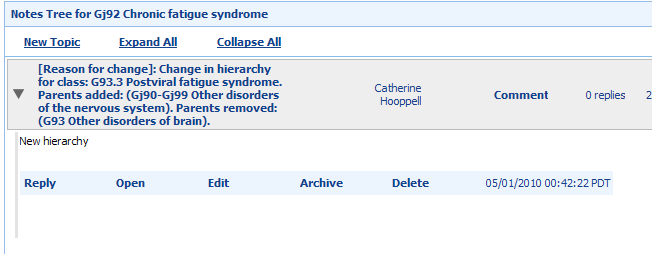
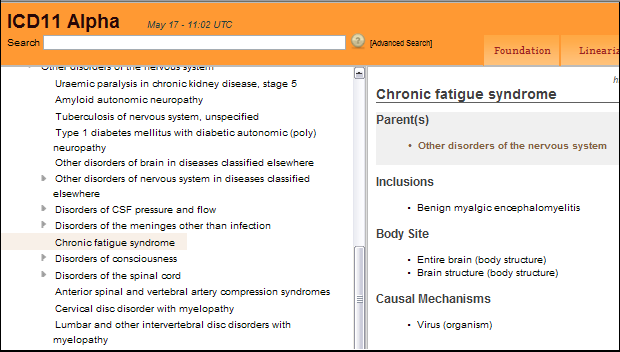
May 2010: iCAT preliminary drafting platform: For the chapter Diseases of the nervous system, this iCAT Discussion Note records a change in hierarchy for class: G93.3 Postviral fatigue syndrome. Its parent: G93 Other disorders of brain is being removed. New parent added: Other disorders of the nervous system.

Additionally, this Change History note records that ICD Title term: Postviral fatigue syndrome is being replaced by new ICD Title term: Chronic fatigue syndrome.

A Definition is inserted for new ICD Title: Chronic fatigue syndrome.

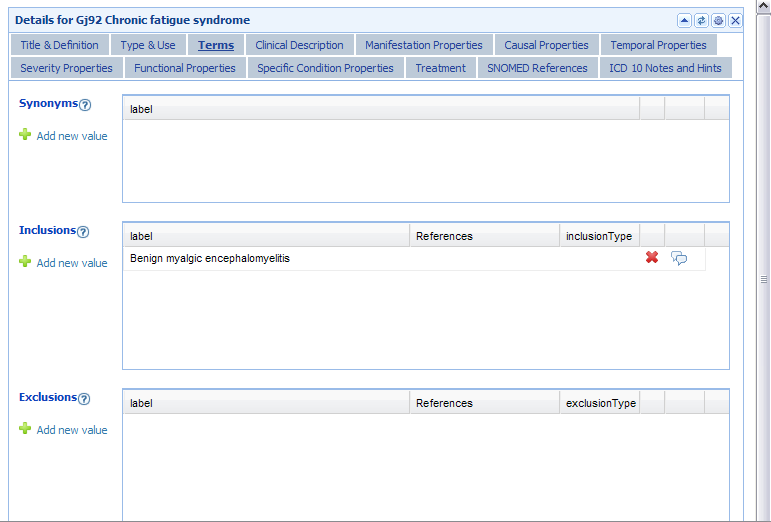
Benign myalgic encephalomyelitis is listed as an Inclusion term to new ICD Title: Chronic fatigue syndrome.

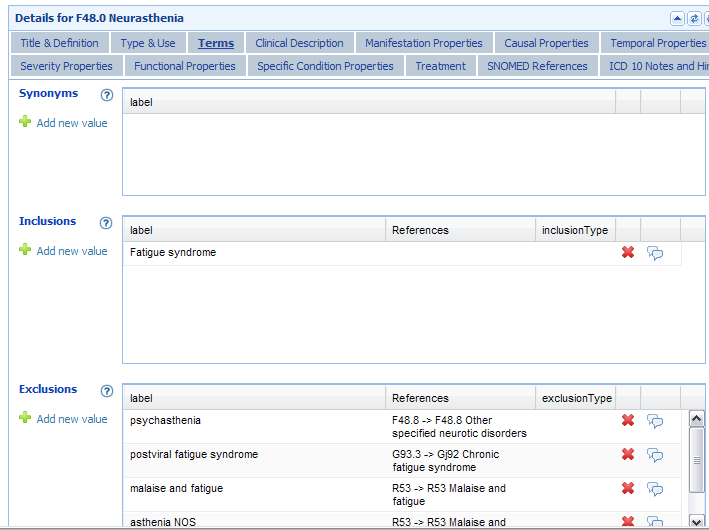
At this point, there is no listing of Postviral fatigue syndrome under Synonyms or Inclusions to ICD Title: Chronic fatigue syndrome, nor elsewhere within the iCAT draft, other than remaining listed as an Exclusion term to F48.0 Neurasthenia and R53 Malaise and fatigue.

May 2011: Alpha drafting platform launches: New ICD Title: Chronic fatigue syndrome remains coded under parent class Other disorders of the nervous system. “Virus (organism)” is listed under the Content Model parameter for “Causal Mechanisms.”

Benign myalgic encephalomyelitis remains listed as an Inclusion term to ICD Title: Chronic fatigue syndrome.

The term Postviral fatigue syndrome remains unaccounted for.

May 2012: Beta drafting platform launches

July 2012: Beta draft: ICD Title: Chronic fatigue syndrome can no longer be found as a child category directly under parent class: Other disorders of the nervous system.

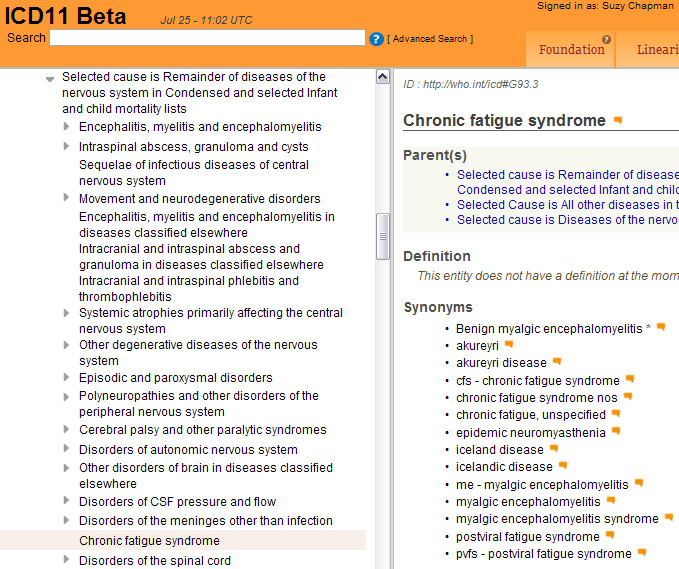
If searched for, the term displays instead under a new “Selected Cause” section, which displays as a kind of subset or sub linearization within the Foundation Component View. It displays with three parents:

Selected cause is Remainder of diseases of the nervous system in Condensed and selected Infant and child mortality lists
Selected Cause is All other diseases in the Selected General mortality list
Selected cause is Diseases of the nervous system

as here, in this July 25, 2012 screenshot.

A large number of terms from other chapters are now also grouped under this “Selected Cause” subset within the Foundation Component. There is no explanation in the public version of the Beta draft what the purpose of the “Selected Cause” subset is or how the categories now listed under it relate to the parent classes under which they were previously coded as child categories. (These “Selected Cause” listings are later dispensed with, at least in the public version of the Beta draft, or are possibly disabled from being generated.)

Other changes: The Definition field for Chronic fatigue syndrome is now blanked.

Benign myalgic encephalomyelitis is listed under Synonyms and specified as an Inclusion term in the linearizations.

13 additional terms are now listed under Synonyms, including Postviral fatigue syndrome, and two terms imported from ICD-10-CM (the ICD-10-CM Chapter 18 R codes: chronic fatigue syndrome nos and chronic fatigue, unspecified).

November 2012: Beta draft: As above, but a brief, revised Definition for Chronic fatigue syndrome has now been inserted by ICD-11 Revision. It reads as follows:

Chronic fatigue syndrome is characterized by extreme chronic fatigue of an indeterminate cause, which is disabling andt [sic] does not improve with rest and that is exacerbated by physical or mental activity.

I have sourced this Definition to this ICD Revision Rare Diseases internal document titled: “Import_RD_definitions” (the Definition text is listed in this .txt file at “1983|Chronic fatigue syndrome|http://who.int/icd#G93.3…”).

Spring 2013: Beta draft:

Since early 2013, no listing can be found in any chapter of the public version of the ICD-11 Beta draft, under any linearization, for any of the terms, Postviral fatigue syndrome, Benign myalgic encephalomyelitis or Chronic fatigue syndrome, as discrete ICD Title terms, or as Inclusion terms or under Synonyms to Title terms, or in the ICD-11 Beta Index.

However, Postviral fatigue syndrome remains listed in the Beta draft as an Exclusion term to Chapter 19: Fatigue and Benign myalgic encephalomyelitis remains listed as an Exclusion term to Chapter 01: Encephalitis, myelitis and encephalomyelitis.*

*In ICD-10, the Title term, G93.3 Postviral fatigue syndrome is also an Exclusion term to F48.0 Neurasthenia. But for ICD-11 and ICD-11-PHC (the primary health care version), the proposal is to eliminate F48.0 Neurasthenia or subsume it under a new, single, “Bodily stress syndrome” (BSS) or “Bodily distress disorder” (BDD) category, in Chapter 05, which is proposed to replace a number of existing ICD-10 Somatoform disorders.

+++

A Beta draft black hole?

June 2013–February 2014: During this period I have contacted several key ICD-11 Revision personnel and the Chair of the Topic Advisory Group for Neurology, directly, with polite requests for clarification of ICD-11 Revision’s current intentions for the chapter classification, coding and hierarchical relationship for these three ICD-10 G93.3 entities.

I have also submitted, via the public version of the Beta drafting platform, a number of requests for clarification and an explanation for their current absence from the draft. At the time of publishing, I have received no clarification from any quarter, either directly, or via the Beta platform.

If the (now 12 month long) absence of these three terms is due to administrative error or oversight, then ICD Revision has had around a dozen opportunities, since last June, to respond to me with an explanation or to restore these three terms to the Beta draft.

It appears this is an issue that no-one involved in the development of the Beta draft is prepared to be accountable for.

I have asked for clarification for the following:

(…) Currently, no entry for any of the terms, Chronic Fatigue Syndrome; Benign Myalgic encephalomyelitis; or Postviral fatigue syndrome, under any hierarchy, can be found within any chapter of ICD-11 Beta, in either the Foundation or Morbidity Linearization views, the PDF print version, or the PDF of the Index.

1. Under which chapter and parent categories are the three ICD-10 G93.3 entities

Chronic Fatigue Syndrome;
Benign Myalgic encephalomyelitis;
Postviral fatigue syndrome

currently proposed to be classified within ICD-11?

2. What is the current proposed hierarchy or relationship within ICD-11 between these three entities, in terms of Title term, Inclusion term, Synonym, and which of these three terms are proposed to be assigned a Definition and other “Content Model” parameters?

3. What is the reason for these three terms not currently displaying in the public version of the Beta drafting platform?

+++
So why have these three ICD-10 terms disappeared and why is ICD Revision reluctant to respond?

The reports on this site are evidence based: in the absence of clarifications directly from ICD Revision, or documentary evidence from reliable sources, I prefer, in general, not to speculate but here are some speculative reasons which might account for the current absence of these three terms from the public version of the Beta draft:

There has been no significant change to proposals in the last 12 months, but the terms have been removed from the draft in order to mitigate controversy over the proposed change of hierarchy (i.e. whether a term is included as a Title term, coded for and assigned a Definition and other Content Model descriptions, or specified as an Inclusion Term to a coded term, or listed under Synonyms to a coded term) and/or over the wording of any proposed Definition or other Content Model descriptive text.

 Topic Advisory Group (TAG) for Neurology intends to retain these three terms under Chapter 07, under an existing parent class that is still undergoing reorganization, and has taken these three terms out of the linearizations in the meantime.

TAG Neurology intends to locate the terms under a new Chapter 07 parent class which does not currently display in the linearizations in the public version of the Beta, or which does display but for which child categories have yet to be populated.

TAG Neurology intends to locate one or more of these terms under a parent class within a subset or sub linearization that cannot currently be generated within the public version of the Beta, for technical reasons.

Unlike ICD-10, multiple parents are allowable under ICD-11: TAG Neurology may intend to assign one or more or these terms to multiple parents within the same chapter, or to code to parents located under more than one chapter, for example, under parent classes, Symptoms, signs and clinical findings involving the nervous and musculoskeletal system or Functional disorders of the nervous system (located under both Chapter 07 and Chapter 19), and has removed the terms in the meantime in order to avoid controversy.

Many categories within ICD-11 are already coded under multiple parents where a disease overlaps two chapters, with the term in black text under the primary parent location and in grey text for the secondary or tertiary location(s), e.g. a skin tumor is both a skin disease and a neoplasm; diseases of the eye as a result of diabetes, or as a result of developmental anomalies.

At one point, ICD Revision was discussing a proposal for a Multisystem Diseases Chapter. This has been rejected in favour of potentially assigning diseases that affect multiple body systems to multiple parents across overlapping chapters, or creating a specific linearization for multisystem diseases as a virtual chapter within the electronic version of ICD-11.

TAG Neurology proposes to retire one or more of these three terms (despite earlier assurances by senior WHO classification experts):

TAG Neurology and TAG Mental Health may be under pressure from the Primary Care Consultation Group to adopt a proposed replacement for the ICD-10 Somatoform disorders that draws heavily on the Per Fink et al construct, “Bodily Distress Syndrome” (BDS). BDS is a single, unifying diagnosis that is inclusive of the somatoform disorders, and the so-called “functional somatic syndromes,” FM, CFS and IBS (which are currently discretely coded or indexed, within ICD-10, in chapters outside the mental and behavioural disorders chapter).

If consensus has not yet been reached about whether the proposed replacement for ICD-10’s Somatoform disorders will more closely mirror DSM-5’s “Somatic symptom disorder” or will incorporate elements of Fink et al’s “Bodily Distress Syndrome,” the three terms, Chronic Fatigue Syndrome, Benign Myalgic encephalomyelitis and Postviral fatigue syndrome may have been removed from the public version of the Beta draft in order to avoid controversy. (It is not yet known which of the two advisory groups’ proposals will be progressing to field testing, this year.)

TAG Neurology may have removed these terms from the public version of the Beta draft in order to avoid controversies surrounding the development of CFS and ME case definitions, for example, the issue of the HHS contract with U.S. Institute of Medicine (IOM) to develop “evidence-based clinical diagnostic criteria for ME/CFS” and to “recommend whether new terminology for ME/CFS should be adopted.”

Whatever the reason, ICD Revision has repeatedly dodged accountability and transparency for its actions.

Having “disappeared” these three ICD terms from the Beta draft, with no explanation, WHO and the ICD Revision Steering Group are disenfranchising professional and advocacy stakeholders from scrutiny of, and participation in the revision process.

Compiled by Suzy Chapman | Dx Revision Watch
Image | Wikimedia Commons courtesy Ute Kraus, Physics education group Kraus, Universität Hildesheim, Space Time Travel, (background image of the milky way: Axel Mellinger)

Update on ICD-11 Beta draft: Bodily Distress Disorder

Updates on ICD-11 Beta draft: Bodily Distress Disorder (proposed for ICD-11 Chapter 5: Mental and behavioural disorders); Chronic fatigue syndrome; Postviral fatigue syndrome; Benign myalgic encephalomyelitis (Chapter 6: Diseases of the nervous system)

Post #218 Shortlink: http://wp.me/pKrrB-2Bg

Dr Elena Garralda presentation slides:

http://www.rcpsych.ac.uk/pdf/Garralda%20E.pdf

or open here: Click link for PDF document    Garralda presentation Somatization in Childhood

Slide 1

Somatization in childhood

The child psychiatrist’s concern?

Elena Garralda

CAP Faculty Meeting, RCPsych Manchester, September 2012

Slide 11

New ICD-11 and DSM-V classifications

. Somatoform disorders >>>
– Bodily distress syndrome (ICD-11)
– Complex Somatic symptom disorder (DSM-V)

[Preceded by downward pointing arrow]

“Unexplained” or “functional” medical symptoms (CFS, fibromyalgia, irritable bowel syndrome)

[Preceded by upward pointing arrow]

Physical complaint (s)
with subjective distress/preoccupation ++,
illness beliefs impairment
health help seeking

+++

Notes on ICD-11 Beta drafting platform and DSM-5 draft by Suzy Chapman for Dx Revision Watch:

These notes may be reposted, if reposted in full, source credited, link provided, and date of publication included.

January 6, 2013

1] The publicly viewable version of the ICD-11 Beta drafting platform can be accessed here:
Foundation view: http://apps.who.int/classifications/icd11/browse/f/en
Linearization view: http://apps.who.int/classifications/icd11/browse/l-m/en

2] The various ICD-11 Revision Topic Advisory Groups are developing the Beta draft on a separate, more complex platform accessible only to ICD-11 Revision.

3] The ICD-11 Beta draft is a work in progress and not scheduled for completion until 2015/16. When viewing the public version of the Beta draft please note the ICD-11 Revision Caveats. Note also that not all proposals may be retained following analysis of the field trials for ICD-11 and ICD-11-PCH, the abridged Primary Care version of ICD-11:
http://apps.who.int/classifications/icd11/browse/Help/Get/caveat/en

4] The Bodily Distress Disorders section of the ICD-11 Beta draft Chapter 5 can be found here:
http://apps.who.int/classifications/icd11/browse/f/en#/http%3a%2f%2fwho.int%2ficd%23F45
http://apps.who.int/classifications/icd11/browse/l-m/en#/http%3a%2f%2fwho.int%2ficd%23F45

According to the public version of the ICD-11 Beta drafting platform, the existing ICD-10 Somatoform Disorders are currently proposed to be replaced with Bodily Distress Disorders, and Psychological and behavioural factors associated with disorders or diseases classified elsewhere, not with Bodily distress syndrome as Dr Garralda has in her slide presentation.

The following proposed ICD-11 categories are listed as child categories under parent, Bodily Distress Disorders, and Psychological and behavioural factors associated with disorders or diseases classified elsewhere:

EC5 Mild bodily distress disorder
EC6 Moderate bodily distress disorder
EC7 Severe bodily distress disorder
EC8 Psychological and behavioural factors associated with disorders or diseases classified elsewhere

There are no Definitions nor any other descriptors populated for the proposed, new ICD categories EC5 thru EC7.

EC8 is a legacy category from ICD-10 and has some populated content imported from ICD-10.

+++
These earlier ICD-11 Beta draft Somatoform Disorders categories appear proposed to be eliminated and replaced with the four new categories EC5 thru EC8, listed above:

Somatization disorder [F45.0 in ICD-10]
Undifferentiated somatoform disorder [F45.1 in ICD-10]
Somatoform autonomic dysfunction [F45.3 in ICD-10]
Persistent somatoform pain disorder [F45.4 in ICD-10]
    > Persistent somatoform pain disorder
    > Chronic pain disorder with somatic and psychological factors [Not in ICD-10]
Other somatoform disorders [F45.8 in ICD-10]
Somatoform disorder, unspecified [F45.9 in ICD-10]

5] The existing ICD-10 Chapter V category Neurasthenia [ICD-10: F48.0] is no longer accounted for in the public version of the ICD-11 Beta draft. I have previously reported that for ICD-11-PHC, the Primary Care version of ICD-11, the proposal is to eliminate the term Neurasthenia.

(I cannot confirm whether the currently omission of Neurasthenia from the Beta draft is due to oversight or because ICD-11 Revision’s intention is that Neurasthenia is also eliminated from the main ICD-11 classification.)

+++
6] I have previously reported that for ICD-11-PHC, the abridged, Primary Care version of ICD-11, the proposal, last year, was for a disorder section called Bodily distress disorders, under which would sit Bodily stress syndrome [sic].

This category is proposed for ICD-11 Primary Care version to include “milder somatic symptom disorders” as well as “DSM-5’s Complex somatic symptom disorder” and would replace “medically unexplained somatic symptoms.”

7] Dr Garralda lists Complex Somatic symptom disorder (DSM-V) on Slide 11 of her presentation.

The manual texts for the next edition of DSM are in the process of being finalized for a projected release date of May 2013. The next edition of DSM will be published under the title DSM-5 not DSM-V . The intention is that once published, updates and revisions to DSM-5 will be styled: DSM-5.1, DSM-5.2 etc.

When the third draft of DSM-5 was released in May 2012, the proposal was to merge Complex Somatic Symptom Disorder with Simple Somatic Symptom Disorder and to call this hybrid category Somatic Symptom Disorder.

This would mean that this new disorder has the same name as the overall disorder section it sits under, which replaces DSM-IV’s Somatoform Disorders.

As any subsequent changes to draft criteria sets following closure of the third stakeholder review are embargoed, I cannot confirm whether the SSD Work Group has decided to rename this category to Somatic symptom Disorder or retain the original term, Complex Somatic Symptom Disorder, the term used by Dr Garralda in her presentation.

+++
8] Turning from ICD-11 Beta draft Chapter 5 Mental and behavioural disorders to Chapter 6 Diseases of the nervous system:

As previously reported, Chronic fatigue syndrome is listed under Diseases of the nervous system in the Foundation View. There is no listing for Chronic fatigue syndrome in the Linearization View nor is the term listed in the PDF for Chapter 6, that is available to those who are registered with ICD-11 Beta draft for access to additional content:

http://apps.who.int/classifications/icd11/browse/f/en#http%3a%2f%2fwho.int%2ficd%23G93.3

Documentation from the ICD-11 iCAT Alpha draft dating from May 2010, implies that the intention for ICD-11 is a change of hierarchy for the existing ICD-10 Title term Postviral fatigue syndrome.

In the ICD-11 Beta draft, Chronic fatigue syndrome (which was listed only within the Index volume of ICD-10 and not listed in Volume 2: The Tabular List) appears to be elevated to ICD Title term status, with potentially up to 12 descriptive parameters yet to be completed and populated in accordance with the ICD-11 “Content Model”.

But the current proposed hierarchical relationship between PVFS and CFS for ICD-11 remains unconfirmed.

See image for documentation from the iCAT Alpha drafting platform, from May 2010:

https://dxrevisionwatch.com/wp-content/uploads/2010/06/change-history-gj92-cfs.png

There is no discrete ICD Title term displaying for Postviral fatigue syndrome in either the ICD-11 Beta Foundation View or Linearization View.

Neither is there any discrete ICD Title term displaying for Benign myalgic encephalomyelitis in either the Foundation View or Linearization View.

Benign myalgic encephalomyelitis appears at the top of a list of terms under “Synonyms” in the CFS description. [The hover text over the asterisk at the end of “Benign myalgic encephalomyelitis” reads, “This term is an inclusion term in the linearizations.”]

Postviral fatigue syndrome is also listed under “Synonyms” along with a number of other terms imported from other classification systems.

Included in this list under “Synonyms” are “chronic fatigue syndrome nos” and “chronic fatigue, unspecified,” both of which appear to have been sourced from the as yet to be implemented, US specific, ICD-10-CM.

+++
At some recent, unspecified date, a Definition has been inserted for ICD-11 Title term Chronic fatigue syndrome into the previously empty Definition field. An earlier Definition was removed when the Alpha draft was replaced with the Beta draft but can be seen in this screenshot, here, from June 2010:

https://dxrevisionwatch.com/wp-content/uploads/2010/05/2icatgj92cfsdef.png

The current Definition reads (and be mindful of the ICD-11 Caveats):

“Chronic fatigue syndrome is characterized by extreme chronic fatigue of an indeterminate cause, which is disabling andt [sic] does not improve with rest and that is exacerbated by physical or mental activity.”

There are no Definition fields for Benign myalgic encephalomyelitis or Postviral fatigue syndrome as these terms are listed under “Synonyms” to ICD-11 Title term, Chronic fatigue syndrome.

+++
Since one needs to be mindful of the ICD-11 Caveats and as the Chair of Topic Advisory Group for Neurology has failed to respond to a request for clarification of the intention for these three terms and the proposed ICD relationships between them, I am not prepared to draw any conclusions from what can currently be seen in the Beta drafting platform.

I shall continue to monitor the Beta draft and report on any significant changes.

For definitions of “Synonyms,” “Inclusions,” “Exclusions” and other ICD-11 terminology see the iCAT Glossary:
http://apps.who.int/classifications/apps/icd/icatfiles/iCAT_Glossary.html

+++
Related material:

http://www.rcpsych.ac.uk/pdf/8%20Ash%20IC2012.pdf

Presentation slides: Medically Unexplained Symptoms pages

Dr Graham Ash, Lancashire Care NHS Foundation Trust

Website pages featured in the slide presentation:

Medically Unexplained Symptoms

http://www.rcpsych.ac.uk/expertadvice/improvingphysicalandmh/aboutthissite.aspx

Dx Revision Watch Post, June 26, 2012: ICD-11 Beta drafting platform: Update (2): Neurasthenia, Postviral fatigue syndrome (PVFS), Benign myalgic encephalomyelitis (ME), Chronic fatigue syndrome (CFS), Fibromyalgia (FM), Irritable bowel syndrome (IBS): http://wp.me/pKrrB-2mC

ICD-11 Beta drafting platform: Update (2)

ICD-11 Beta drafting platform: Update (2): Neurasthenia, Postviral fatigue syndrome (PVFS), Benign myalgic encephalomyelitis (ME), Chronic fatigue syndrome (CFS), Fibromyalgia (FM), Irritable bowel syndrome (IBS)

Post #193 Shortlink: http://wp.me/pKrrB-2mC

The information in this report relates to proposals for the World Health Organization’s forthcoming ICD-11, currently scheduled for pilot dissemination in 2015+; it does not apply to the existing ICD-10 or to the forthcoming US specific “clinical modification” of ICD-10, known as ICD-10-CM.

Caveat: The ICD-11 Beta drafting process is a work in progress over the next two to three years. The Beta draft is updated on a daily basis. Parent terms, category terms and sorting codes assigned to categories are subject to change as chapter reorganization progresses. Images and text in this posting may not reflect the most recently assigned categories and codes. This post reflects the Beta draft as it stood at July 25, 2012. Please also read the ICD-11 Beta Draft Caveats.

Post #190 Changes to ICD-11 Beta drafting platform: Bodily Distress Disorders (1) reported on proposals for including three Bodily distress disorder categories in the Somatoform Disorders section of the ICD-11 Beta drafting platform which appear potentially to replace or subsume a number of existing ICD-10 Somatoform Disorder categories.

That post has been revised to reflect clarifications from Professor, Sir David Goldberg, M.D., around the Primary care version of ICD-11 and to include additional material.

The report in this post updates on current proposals for the ICD-11 Beta drafting platform for revision of the following ICD-10 categories: Neurasthenia, Postviral fatigue syndrome (PVFS), Benign myalgic encephalomyelitis (ME), Chronic fatigue syndrome (CFS), Fibromyalgia (FM) and Irritable bowel syndrome (IBS) for the full version of ICD-11.

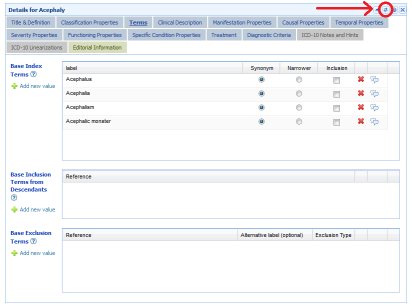
ICD Revision Steering Group and the various Topic Advisory Groups are developing the ICD-11 Beta draft on a non public access collaborative authoring platform where change histories can be tracked, which looks similar to this:

The publicly viewable version of the Beta drafting platform looks like this:

and displays less information. It can be accessed here:

Beta draft Foundation Component (FC) view:

http://apps.who.int/classifications/icd11/browse/f/en

Beta draft Linearization Morbity (LM) view:

http://apps.who.int/classifications/icd11/browse/l-m/en

Increased access to content and interaction with the drafting process can be obtained by registering.
+++
+++
Neurasthenia:

Neurasthenia is not classified in DSM-IV and is not proposed to be classified in DSM-5.

In ICD-10, Neurasthenia is classified in Chapter V Mental and behavioural disorders under parents:

F40-F48 Neurotic, stress-related and somatoform disorders

    F48 Other neurotic disorders
        ›  F48.0 Neurasthenia

+++
For ICD-11 Beta, up until July 3, Neurasthenia was also classified under:

Neurotic, stress-related and somatoform disorders

    9S1 Other neurotic disorders
        ›  9S1.1 Neurasthenia

Inclusions: Fatigue syndrome

Exclusions: psychasthenia
postviral fatigue syndrome
malaise and fatigue
asthenia NOS
burn-out

    9S1.2 Other specified neurotic disorders

Inclusions: Dhat syndrome
Occupational neurosis, including writer’s cramp
Psychasthenia
Psychasthenic neurosis
Psychogenic syncope

     9S1.3 Neurotic disorder, unspecified

Neurosis NOS

+++

On July 4, all child categories classified under parent class, 9S1 Other neurotic disorders, including Neurasthenia and its Inclusion, Fatigue syndrome, were removed from both the FC and LM view and from the PDF for the Chapter 5 Print version and there is currently no listing for any of these categories and child categories under any parent.

As no “Change history” records display in the public version of the Beta draft, it cannot be determined from what information is available whether these categories are temporarily omitted while this section of Chapter 5 is being reorganized, or whether all or selected of these ICD-10 categories are proposed to be retired for ICD-11 or are destined to be subsumed under the proposed Bodily distress disorders categories that ICD Revision has yet to define.

According to the Goldberg February 2011 report, terms included in the ICD11-PHC version of ICD-11 must have an equivalent disorder in the main classification. In February 2011, it was proposed not to include Neurasthenia in the ICD11-PHC version but to subsume under 13 Distress disorder. (It isn’t clear under which disorder group or subcategory Neurasthenia is proposed to be subsumed for the most recently published iteration for ICD11-PHC.)

Neurasthenia remains listed as an Exclusion to Chapter 5 Generalized anxiety disorder and Chapter 18 Malaise and fatigue but these Exclusions may be awaiting attention, if the intention is to retire a number of ICD-10 terms.

I will update when it becomes apparent what the intention is for these currently missing categories.

+++
ICD-11 Chapter 06: Diseases of the nervous system

Postviral fatigue syndrome, Benign myalgic encephalomyelitis, Chronic fatigue syndrome:

In ICD-10, Postviral fatigue syndrome is classified as a Title term within Volume 1: The Tabular List in Chapter VI: Diseases of the nervous system under G00-G99 Other disorders of the nervous system > G93 Other disorders of brain, and coded at G93.3. See: http://apps.who.int/classifications/icd10/browse/2010/en#/G93.3

Benign myalgic encephalomyelitis is also coded in the Tabular List to G93.3 Postviral fatigue syndrome.

Chronic fatigue syndrome is not classified within the Tabular List but is indexed to G93.3 in Volume 3: The Alphabetical Index.

An unauthorised copy of Volume 3: The Alphabetical Index Version for 2006 can be accessed here: (See Page 528)
http://www.scribd.com/doc/7350978/ICD10-2006-Alphabetical-Index-Volume-3 

In indexing Chronic fatigue syndrome to G93.3, ICD-10 does not specify whether it views the term as a synonym, subclass or “best coding guess” to Title term, Postviral fatigue syndrome or to Benign myalgic encephalomyelitis.

Nor does ICD-10 specify the relationship between Postviral fatigue syndrome and Benign myalgic encephalomyelitis.

(For ICD-11, a mechanism will be provided to identify whether an inclusion term is a synonym or a subclass.)

In June 2010, I reported that in May 2010, a change of hierarchy had been recorded in the ICD-11 iCAT Alpha drafting platform “Change History” and “Category Discussion Notes” for class: G93.3 Postviral fatigue syndrome.

See these two screenshots from the original iCAT Alpha drafting platform:

Image 1:

Image 2:

+++
From current information in the Beta draft, it would appear that for ICD-11, the proposal is for a change of hierarchy between Postviral fatigue syndrome and Chronic fatigue syndrome with Chronic fatigue syndrome elevated to an ICD-11 Title term, with a Definition (not currently populated) and with potentially up to 12 other descriptive parameters, populated in accordance with the ICD-11 “Content Model.”

There are a number of terms listed under Synonyms to Title term Chronic fatigue syndrome including Benign myalgic encephalomyelitis and Postviral fatigue syndrome.

Mouse hover over the asterisk at the end of Benign myalgic encephalomyelitis and the following hover text displays, “This term is an inclusion term in the linearizations.”

Also listed under “Synonyms” are “chronic fatigue syndrome nos” and “chronic fatigue, unspecified” (both imported from current proposals for locating Chronic fatigue syndrome in Chapter 18: Symptoms and Signs in the forthcoming US specific, ICD-10-CM).

See this Beta drafting platform page:

http://apps.who.int/classifications/icd11/browse/f/en#/http%3a%2f%2fwho.int%2ficd%23G93


There is currently no discrete ICD Title term listed for Postviral fatigue syndrome in either the Foundation Component or Linearization Morbidity view and no discrete ICD Title term for Benign myalgic encephalomyelitis.

It remains unconfirmed, but from the Beta draft as it currently stands, it suggests that for ICD-11:

  • Chronic fatigue syndrome is proposed to become the Chapter 06 Title term
  • Benign myalgic encephalomyelitis is specified as an Inclusion term to CFS under “Synonyms”
  • Postviral fatigue syndrome and a number of other terms are listed under “Synonyms” to CFS

ICD-11 terminology:

For definitions of Synonyms, Inclusions, Exclusions and other ICD-11 terminology see the iCAT Glossary:

http://apps.who.int/classifications/apps/icd/icatfiles/iCAT_Glossary.html

+++
Fibromyalgia (FM):

In ICD-10, Fibromyalgia is classified under:

Chapter XIII: Diseases of the musculoskeletal system and connective tissue > M79 Other soft tissue disorders > M79 Other soft tissue disorders, not elsewhere classified > M79.7 Fibromyalgia 

ICD-10 Version: 2010: http://apps.who.int/classifications/icd10/browse/2010/en#/M79.7

For ICD-11 Beta draft, Fibromyalgia is currently classified under:

Chapter 13: Diseases of the musculoskeletal system and connective tissue > Soft tissue disorders > Other soft tissue disorders > QG6 Other soft tissue disorders, not elsewhere classified > QG6.7 Fibromyalgia

FC: http://apps.who.int/classifications/icd11/browse/f/en#/http%3a%2f%2fwho.int%2ficd%23M79.7
LM: http://apps.who.int/classifications/icd11/browse/l-m/en#/http%3a%2f%2fwho.int%2ficd%23M79.7

+++
Irritable bowel syndrome (IBS):

In ICD-10, Irritable bowel syndrome is classified under:

Chapter XI: Diseases of the digestive system > K55-K63 Other diseases of intestines > K58.0 Irritable bowel syndrome with diarrhoea > K58.9 Irritable bowel syndrome without diarrhoea > Irritable bowel syndrome NOS

ICD-10 Version: 2010: http://apps.who.int/classifications/icd10/browse/2010/en#/K58

For ICD-11 Beta draft, Irritable bowel syndrome is currently classified under:

Chapter 11: Diseases of the digestive system > Functional gastrointestinal disorders > FS6 Irritable bowel syndrome and other functional bowel disorders > FS6.1 Irritable bowel syndrome 

FC: http://apps.who.int/classifications/icd11/browse/f/en#/http%3a%2f%2fwho.int%2ficd%23K58
LM: http://apps.who.int/classifications/icd11/browse/l-m/en#/http%3a%2f%2fwho.int%2ficd%23K58

+++
I shall continue to monitor the Beta drafting process and update on any significant developments for both ICD-11 Chapter 5 and Chapter 6 and for ICD11-PHC for the categories that are the focus of this post and post #190.
+++
+++
References and related material:

1] ICD-10 Version: 2010 Volume 1 Tabular List online:
http://apps.who.int/classifications/icd10/browse/2010/en

2] ICD-11 Beta drafting platform:
http://apps.who.int/classifications/icd11/browse/f/en

3] Goldberg, D. Guest editorial. A revised mental health classification for use in general medical settings: the ICD11–PHC 1. International Psychiatry, Page 1, February 2011.
http://www.rcpsych.ac.uk/pdf/IPv8n1.pdf

4] 21st Century Global Mental Health by Dr Eliot Sorel, Professor, George Washington University, Washington D.C.
Publication date: August, 2012: http://www.jblearning.com/catalog/9781449627874/
Page 51, Sample Chapter 2: http://samples.jbpub.com/9781449627874/Chapter2.pdf