BDS, BDDs, BSS, BDD unscrambled

Post #268 Shortlink: http://wp.me/pKrrB-3fA

BDS, BDDs, BSS, BDD and ICD-11, unscrambled

There are two WHO convened working groups charged with making recommendations for the revision of ICD-10’s Somatoform Disorders: the Primary Care Consultation Group (known as the PCCG) and the Expert Working Group on Somatic Distress and Dissociative Disorders (known as the S3DWG).

The revision of ICD-11 is being promoted as an open and transparent process. But to date, neither working group has published progress reports for stakeholder consumption and neither group has published its emerging proposals in public access journals.

Content populated in the public version of the ICD-11 Beta drafting platform sheds little light on proposals.

Consequently, there is considerable confusion around what is being recommended for the revision of ICD-10’s Somatoform Disorders, whether consensus between the two working groups has been reached, and what proposals will progress to field testing during the next two years.

ICD-11 Revision has been asked to clarify when it intends to define and characterize its current proposals within the Beta drafting platform.

The notes below set out some of what is known about the two working groups’ emerging proposals, how they diverge and how they compare with DSM-5’s Somatic Symptom Disorder and with Fink et al’s Bodily Distress Syndrome.

Caveat: the proposals of the two ICD-11 working groups may have undergone revision and refinement since emerging proposals were published, in July and December, last year; the two groups may or may not have reached consensus over how this proposed new ICD construct should be defined and characterized, its inclusions, exclusions and differential diagnoses, or what name it should be given.

What is Bodily Distress Syndrome (BDS)?

+++

Bodily Distress Syndrome is the name given to a disorder construct developed by Per Fink and colleagues, Aarhus University, that is already in use in Danish research studies and in clinical settings [1].

BDS is described by its authors as “a unifying diagnosis that encompasses a group of closely related conditions such as somatization disorder, fibromyalgia, irritable bowel syndrome and chronic fatigue syndrome.”

Per Fink and colleagues are lobbying for BDS to be integrated into forthcoming classification systems and adopted as a diagnosis by primary care practitioners.

Their proposal is for reclassifying somatoform disorders, pain disorder, neurasthenia and the so-called functional somatic syndromes, including fibromyalgia, irritable bowel syndrome and chronic fatigue syndrome, under a new classification, Bodily Distress Syndrome.

They consider these should be treated and managed as subtypes of the same disorder with CBT, GET, “mindfulness therapy” and in some cases, antidepressants.

The PDF format slide presentation in reference [2] will give an overview of BDS and there is more information and links in an earlier post, in reference [3].

Is Fink et al’s Bodily Distress Syndrome construct the same as DSM-5’s SSD?

+++

No, Bodily Distress Syndrome is a different construct to DSM-5’s Somatic Symptom Disorder.

Psychological or behavioural characteristics, central for the diagnosis of SSD, do not form part of the BDS criteria.

For BDS, physical symptoms are central to the diagnosis, which is based on identification of symptom patterns (not symptom count) from four body systems:

Cardiopulmonary/autonomic arousal; Gastrointestinal arousal; Musculoskeletal tension; General symptoms.

There is a “Modest” BDS (single-organ type) and a “Severe” BDS (multi-organ type).

If the symptoms are better explained by another disease, they cannot be labelled BDS.

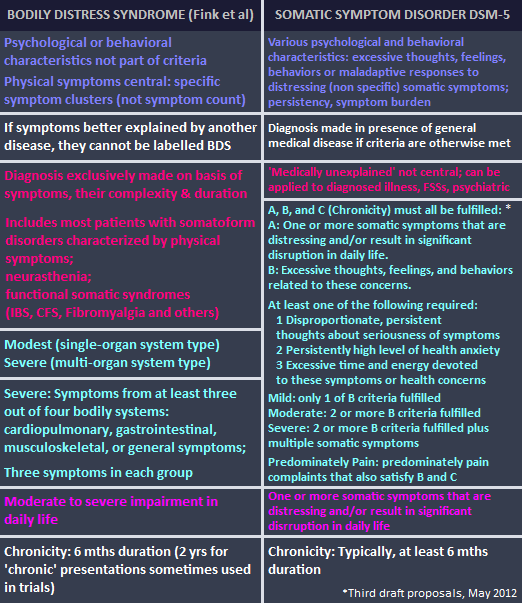
The graphic below compares mutli-organ Bodily Distress Syndrome with Somatic Symptom Disorder, as the DSM-5 draft criteria had stood, in May 2012.

Note the defining characteristics of the DSM-5 SSD construct: the SSD definition calls for positive psychobehavioural characteristics (excessive or maladaptive responses or associated health concerns) in response to persistent distressing somatic symptoms; the requirement that the symptoms are “medically unexplained” is not central to the diagnosis and the symptoms may or may not be associated with a well-recognised medical condition.

The SSD diagnosis can be made in the presence of one or more unspecified, somatic symptoms associated with general medical conditions and diagnosed disease, like multiple sclerosis, cancer, diabetes or angina, or in the so-called “functional somatic syndromes” (for example, IBS, CFS or fibromyalgia) or in complaints with unclear etiology.

Compare Fink et al’s BDS with DSM-5’s SSD, in the table, below:

Depending on screen size/resolution, graphic may not display in full. Click on the image and the image file will load. Graphic: Suzy Chapman

Bodily Distress Syndrome comparison with Somtatic Symptom Disorder

Continued on Page 2

Update on ICD-11 Beta drafting: Bodily Distress Disorder: emerging proposals: Part One

Post #265 Shortlink: http://wp.me/pKrrB-3cr

Update on ICD-11 Beta drafting: Bodily Distress Disorder: emerging proposals: Part One

This report should be read in conjunction with the caveats at the end of the post, on Page 3.

Part One

The technical work associated with the preparation of ICD-11, the field testing and trials evaluation will need to be completed next year if WHO is going to meet its target of presenting ICD-11 for World Health Assembly approval in May 2015, with pilot implementation by 2016.

Three distinct versions of the ICD-11 classification of Mental and Behavioural Disorders are under development: an abridged version for use in primary care, a detailed version for use in specialty settings and a version for use in research.

The ICD-10 Somatoform Disorders are under revision for all three versions and the primary care and speciality versions are being developed simultaneously.

ICD10-PC, the abridged version of ICD, is used in developed and developing countries and in the training of medical officers, nurses and multi-purpose health workers. Globally, more than 90% of patients with mental health problems are managed by practitioners or health workers in general medical or primary care settings – not by psychiatrists.

Over 400 mental disorders are classified in the speciality version of ICD-10 Chapter V. These are condensed to 26 mental disorders for the primary care version – a list can be found on Page 49 of this book chapter, in Table 2.4.

Each disorder in ICD10-PC provides information on patient presentation, clinical descriptions, differential diagnoses, treatments, indications for referrals and information sheets for patients and families.

A revised list of disorders proposed for inclusion in the forthcoming ICD-11-PHC can be viewed on Page 51, in Table 2.5 [1].

For new and revised disorders included in the primary care version there will need to be an equivalent disorder in the core ICD-11 classification.

Existing Somatoform Disorders in the core ICD-10 version can be viewed here: ICD-10 Version: 2010 browser: Somatoform Disorders or from Page 129 in The ICD-10 Classification of Mental and Behavioural Disorders, Clinical descriptions and diagnostic guidelines.

A chart showing the grouping of the detailed core version categories and the 26 corresponding disorders in ICD10-PC can be found here, see Page 8, for F45 Unexplained somatic complaints and F45  Somatoform disorders (ICD-10): Connections between ICD-10 PC and ICD-10 Chapter V.

Where reports of emerging proposals for ICD-11 have been published by ICD revision working group members, the recommendations within them may be subject to refinement or revision following analysis of focus group studies, external review and multicentre field trials to assess the validity and clinical utility of proposals for application in developed and developing countries, in high and low resource settings and across general, speciality and research settings [2].

Not all proposals for new or revised disorders are expected to survive the field trials.

Two working groups are making recommendations for the revision of ICD-10’s Somatoform Disorders:

A WHO Primary Care Consultation Group (known as the PCCG) has been appointed to lead the development of the revision of ICD10-PC, the abridged classification of mental and behavioural disorders for use in primary care settings. The PCCG is charged with developing and field testing the full set of disorders for inclusion in ICD-11-PHC, for which 28 mental disorders are currently proposed.

The PCCG members are SWC Chan, AC Dowell, S Fortes, L Gask, KS Jacob, M Klinkman (Vice Chair), TP Lam, JK Mbatia, FA Minhas, G Reed, and M Rosendal. The PCCG is chaired by Prof, Sir David Goldberg.

A WHO Expert Working Group on Somatic Distress and Dissociative Disorders (known as the S3DWG) was constituted in 2011 to review the scientific evidence for, and clinical utility of the ICD-10 somatoform and dissociative disorders; to review proposals for the DSM-5 somatic symptom disorders and dissociative disorders categories and to consider their suitability or not for global applications; to review proposals and provide draft content for the somatic distress and dissociative disorder categories in line with the overall ICD revision requirements; to propose entities and descriptions for the classification of somatic distress and dissociative disorders for use in diverse global and primary care settings. External reviewers are also consulted on proposals and content.

The full S3DWG membership list is not publicly available but the group is understood to comprise 17 international behavioural health professionals, of which Prof Francis Creed is a member. The S3DWG is Chaired by Prof Oye Gureje.

Responsibilities of ICD-11 working groups are set out on Page 3 (1.1.) of document [3] in the References. Document [3] also includes information on the ICD-11 field trials, from Page 8 (4.).


1. Goldberg DP. Comparison Between ICD and DSM Diagnostic Systems for Mental Disorders. In: Sorel E, (Ed.) 21st Century Global Mental Health. Jones & Bartlett Learning, 2012: 37-53. Free PDF, Sample Chapter Two: http://samples.jbpub.com/9781449627874/Chapter2.pdf
2. PDF WHO ICD Revision Information Note, Field Testing, June 2012
3. Responsibilities of ICD-11 working groups set out on Page 3 of 2012 Annual Report of the International Union of Psychological Science to the American Psychological Association, Revision of World Health Organization’s ICD-10 Mental and Behavioural Disorders, Pierre L.-J. Ritchie, Ph.D., Main Representative to the World Health Organization, International Union of Psychological Science, January, 2013

Continued on Page 2

Somatic Symptom Disorder in recent journal papers

Post #261 Shortlink: http://wp.me/pKrrB-3ah

Somatic Symptom Disorder in recent journal papers

Somatic Symptom Disorder is also included in Saving Normal: An Insider’s Revolt Against Out-Of-Control Psychiatric Diagnosis, Dsm-5, Big Pharma, and the Medicalization of Ordinary Life (pp. 193-6): Allen Frances, William Morrow & Company (20 May 2013).

Also in Essentials of Psychiatric Diagnosis: Responding to the Challenge of DSM-5 (Chapter 16): Allen Frances, Guilford Press (14 June 2013).

In the June edition of Journal of Nervous and Mental Disorders, Allen Frances, MD, who chaired the Task Force for DSM-IV, discusses his concerns for the loosely defined DSM-5 category, Somatic Symptom Disorder, sets out his suggestions for revising the criteria prior to finalization, as presented to the SSD Work Group chair, in December, and advises clinicians against using the new SSD diagnosis.

http://www.ncbi.nlm.nih.gov/pubmed/23719325

DSM-5 Somatic Symptom Disorder.

Frances A.

Department of Psychiatry, Duke University, Durham, NC.

J Nerv Ment Dis. 2013 Jun;201(6):530-1. doi: 10.1097/NMD.0b013e318294827c. No abstract available.

PMID: 23719325

[PubMed – in process]

+++

Commentary by Allen Frances, MD, and Suzy Chapman in the May issue of Australian and New Zealand Journal of Psychiatry. The paper discusses the over-inclusive DSM-5 Somatic Symptom Disorder criteria and the potential implications for diverse patient groups. The paper concludes by advising clinicians not to use the new SSD diagnosis.

http://www.ncbi.nlm.nih.gov/pubmed/23653063

DSM-5 somatic symptom disorder mislabels medical illness as mental disorder.

Allen Frances¹, Suzy Chapman²

1 Department of Psychiatry, Duke University 2 DxRevisionWatch.com

Aust N Z J Psychiatry. 2013 May;47(5):483-4. doi: 10.1177/0004867413484525. No abstract available.

PMID: 23653063

[PubMed – in process]

+++

The April 22 edition of Current Biology published a feature article on DSM-5 by science writer, Michael Gross, Ph.D. The article includes quotes from Allen Frances, MD, and Suzy Chapman on the implications for patients for the application of the new DSM-5 Somatic Symptom Disorder. The article includes concerns for the influence of Somatic Symptom Disorder on proposals for a new ICD category – Bodily Distress Disorder – being field tested for ICD-11 and ICD-11-PHC.

Current Biology 22 April, 2013 Volume 23, Issue 8

Copyright 2013 All rights reserved. Current Biology, Volume  23, Issue  8, R295-R298, 22 April 2013

doi:10.1016/j.cub.2013.04.009

Feature

Has the manual gone mental?

Michael Gross

Full text: http://www.cell.com/current-biology/fulltext/S0960-9822(13)00417-X

PDF: http://download.cell.com/current-biology/pdf/PIIS096098221300417X.pdf

+++

In this opinion piece, published in the BMJ, March 18, Allen Frances, MD, strongly opposes the new Somatic Symptom Disorder, discusses its lack of specificity, data from the field trials and advises clinicians to ignore this new category.

http://www.ncbi.nlm.nih.gov/pubmed/23511949

The new somatic symptom disorder in DSM-5 risks mislabeling many people as mentally ill.

Frances A.

Allen Frances, chair of the DSM-IV task force

BMJ. 2013 Mar 18;346:f1580. doi: 10.1136/bmj.f1580. No abstract available.

PMID: 23511949

[PubMed – indexed for MEDLINE]

+++

Further reading

APA Somatic Symptom Disorder Fact Sheet APA DSM-5 Resources

Somatic Chapter Drops Centrality Of Unexplained Medical Symptoms Psychiatric News, Mark Moran, March 1, 2013

Somatic Symptoms Criteria in DSM-5 Improve Diagnosis, Care David J Kupfer, MD, Chair, DSM-5 Task Force, defends the SSD construct, Huffington Post, February 8, 2013

The new somatic symptom disorder in DSM-5 risks mislabeling many people as mentally ill Allen Frances, MD, BMJ 2013;346:f1580 BMJ Press Release

Somatic Symptom Disorder could capture millions more under mental health diagnosis Suzy Chapman, May 26, 2012

Mislabeling Medical Illness As Mental Disorder Allen Frances, MD, Psychology Today, DSM 5 in Distress, December 8, 2012

Why Did DSM 5 Botch Somatic Symptom Disorder? Allen Frances, MD, Psychology Today, Saving Normal, February 6, 2013

New Psych Disorder Could Mislabel Sick as Mentally Ill Susan Donaldson James, ABC News, February 27, 2013

Dimsdale JE. Medically unexplained symptoms: a treacherous foundation for somatoform disorders? Psychiatr Clin North Am 2011;34:511-3. [PMID: 21889675]

Something rotten in the state of Denmark: Karina Hansen’s story

Clarification notice
Reports and updates on Dx Revision Watch site on the Hansen family’s situation are being published as provided by, and in consultation with, Rebecca Hansen, Chairman, ME Foreningen, Danmark (ME Association, Denmark), or edited from reports as provided by Ms Hansen.
Dx Revision Watch site has no connection with any petitions or initiatives, or with any social media platforms or other platforms set up to promote petitions or initiatives, or to otherwise raise awareness of the Hansen family’s situation. The use of any links to content on Dx Revision Watch does not imply endorsement of, or association with any initiatives other than the ME Foreningen, Danmark (ME Association, Denmark) Postcard to Karina Campaign.
All enquiries in relation to petitions or other initiatives, social media platforms, or any other platforms associated with them should be addressed directly to the organizers, sponsors or owners responsible for them.

+++
For update to this post see:

Human Rights denied: Something rotten in the state of Denmark: Karina Hansen’s story: Update 1: http://wp.me/pKrrB-35o

Menneskerettighederne nægtet: Noget råddent i staten Danmark: Karina Hansen: Opdater 1: http://wp.me/pKrrB-36e  (Update reports in English and Danish)
+++

“How can I get out of here? I can’t take this.”

+++

KH5

+++
Something rotten in the state of Denmark:

Karina Hansen’s story

Karina Hansen is 24. She has been completely bedridden since 2009.

In February, this year, Karina was forcibly removed from her home and committed to a hospital. The family is still waiting for a legal explanation for why she was removed.

Karina suffers from severe ME and her family believes she is getting worse.

Karina removed from home

On February 12, 2013, five policemen from Holstebro county, Denmark, arrived at Karina’s house and forcibly removed her from her bedroom.

Two doctors, a locksmith and two social workers were also present.

Karina called for her mother’s help, but her mother was blocked by the police from aiding her. Karina used her mobile phone for the first time in years to call her mother, her father, her cousin and her sister, Janni. Karina is so ill that she can usually only speak in one or two word sentences, but during her removal she managed to call her father and say: Help Dad, in my room, and to her sister: Help, Janni I don’t know where they are taking me.

Karina’s mother could not answer her phone because she was surrounded by policemen.

Karina was driven off to a hospital in an ambulance. Her parents were not told where she was being taken or why they were taking her away. They were given no paperwork.

Later that day, her parents received a phone call. They were told that Karina was at Hammel Neurocenter and that someone would call them every day at 10am to tell them how Karina was doing and that no one would be allowed to visit their daughter for 14 days.

On the morning of February 13, Karina managed to call her mother from her mobile phone. She said: How can I get out of here? I can’t take this. (Hvordan kan jeg komme væk herfra? Jeg kan ikke klare det.) Then the connection was cut.

A few days later, Karina’s parents received a letter from a psychiatrist, Nils Balle Christensen, which said that he would be in charge of Karina’s treatment at Hammel Neurocenter. He also wrote that because “of her condition,” Karina was not allowed visitors for two weeks. That ban on visitors was later extended to three weeks because Dr Christensen was on vacation.

Nils Balle Christensen works at the Aarhus Research Clinic for Functional Disorders and Psychosomatics. He and his boss, Per Fink, believe that ME is a functional disorder. The treatments the clinic recommends are graded exercise therapy (GET), cognitive behavioural therapy (CBT), “mindfulness therapy,” and in some cases, antidepressants. In Denmark, a functional disorder is understood to be a psychosomatic illness.

The psychiatrists at this clinic are considered to have no experience with severely ill ME patients and the Hansen family and ME Foreningen, Danmark fear that if Karina is being treated incorrectly this may lead to a severe and permanent worsening of her condition.

Karina’s parents have not been permitted to see their daughter for three months

The family visited the Neurocenter on April 1 to try to visit Karina, but the parents were not allowed to see her. Karina’s sister, Janni, who is a nurse, was allowed to see Karina for a few minutes. A staff member followed Janni into the room. Janni said that Karina was extremely pale, was unable to talk, and did not show signs that she recognized her sister.

In Janni’s opinion, Karina’s condition is worse now than before she was hospitalized.

Why was Karina forcibly removed?

Karina’s parents and lawyer have yet to receive any official paperwork from any government body or clinician about the reason for her removal. They have received no treatment plan or copies of Karina’s medical reports.

No charges have been made against Karina’s parents. The case has never been heard by a court.

Karina’s parents do not know if or when they will be allowed to see their daughter or if or when she will be allowed to come home. Her parents and her lawyer have obtained power of attorney for Karina, but this is being ignored.

The regional state administrations for Mid-Jutland (Statsforvaltningen Midtjylland) are trying to appoint someone as guardian for Karina.

The only information the family receives comes from Jens Gyring, senior doctor at Hammel Neurocenter. He now calls Karina’s father twice a week and tells him how Karina is.

But the parents are finding it difficult to trust what they are told because they are being given conflicting information. Dr Christensen says Karina is improving every day, but Jens Gyring says there is no change.

Karina’s sister, Janni, thinks her sister is deteriorating.

Jens Grying says he is taking instructions about Karina’s care from Dr Christensen and that the treatment given is a rehabilitation programme.

+++
There are many unanswered questions

Karina’s mother was paid by the county to take care of her daughter and there was never any report of neglect. After Karina was taken away, her mother was fired from her job on the grounds that the caregiver duties were no longer needed.

Which authority gave the order to remove Karina and by whom was it authorized?
What legislation was used to remove and detain her as an involuntary patient in a hospital?
Why are the parents and their lawyer not permitted to see paperwork about the case?
Why have the parents not been allowed to visit?
Are there any charges levelled against the parents?
What is the treatment plan for Karina? The hospital requires that a treatment plan be made on admission.
Why all the secrecy?

+++
Meeting with Liselott Blixt

On April 4, Karina’s parents and two representatives from ME Foreningen, Danmark met with parliament member, Liselott Blixt, who agreed to help to get answers to the many questions in this case.

ME Foreningen, Danmark had been waiting to publish information about Karina’s case until her parents and lawyer had received the official documents. But it is now obvious that these documents will not be released unless pressure is placed on the officials.

+++

ME Foreningen, Danmark campaign

A campaign was launched by ME Foreningen, Danmark for May 12th ME Awareness Week for sending postcards to Karina and also signing a petition in support of the Hansen family’s situation:

http://www.ipetitions.com/petition/postcardtokarina/

For information on where to send your postcard go to ME Foreningen, Danmark on Facebook

If you have a blog or a website, please link to this post or contact ME Foreningen, Danmark for a copy of the account and publish your own blog post. Post a link to this post on Facebook, Twitter, Listservs and forums.

Timeline

Karina Hansen was born in November 1988. She is now 24.

2004/5: Karina contracts mononucleosis, after which she succumbs to countless infections, including sinus infections, as well as severe gastritis. She received many courses of antibiotics. Her activity became very limited because of post exertional malaise. In 2006, Karina had a serious sinus infection and never fully recovered.

2008: Karina receives a diagnosis of Myalgic Encephalomyelitis/ME (ICD-10 G93.3) while at a Danish arthritis hospital, where she was admitted for rehabilitation: exercise and cognitive behavioural therapy (CBT). She was there for 17 days and could never do more than one hour of activity a day.

During the course of her illness, Karina was examined several times by psychiatrists who found no evidence of mental illness. One psychiatrist wrote that her symptoms were most likely caused by the mononucleosis.

Autumn 2009: Karina has an influenza vaccine after which she becomes completely bedridden. In March 2010, Karina’s mother took leave from work to take care of her daughter.

May 2010: Karina’s GP pressured her parents into admitting her to hospital for rehabilitation. By this time, Karina was so ill that she cried from the headaches when they talked to her. There appears to have been an attempt to detain her at the hospital by declaring her mentally unfit. But the medical officer wrote that the “psychiatry law enforcement provisions cannot be used.” She was allowed to go home after three days. Karina’s condition deteriorated after this hospitalization.

May 2010: Karina is seen for the first time by Dr Isager, who confirms the diagnosis of ME. Dr Isager is a Danish doctor who has seen hundreds of ME patients in his long career and has made home visits to many severely ill patients. In 2001, the Danish Ministry of Health wrote that Dr Isager was the Danish doctor with the most experience of ME and had about 250 patients at that time.

March 2011: Karina is seen by another doctor with experience in severe ME. This doctor reconfirmed the ME diagnosis. Karina’s parents worked with her new GP, with Dr Isager, and a nutritionist to try to give Karina the best treatment possible at home. Gut function tests were sent to the USA to try to find a treatment for Karina. There is no hospital in Denmark equipped to take care of severely ill ME patients.

A request was made to have a saline IV started in the home but the county did not cooperate. Karina received a special protein powder and a high iron diet to ensure her nutritional needs were met. Many ME patients do not tolerate iron supplements in pill form.

June 2011: Karina’s mother is hired by the county to be Karina’s caregiver.

May 2012: Sundhedssytrelsen (Danish National Board of Health) contacts two psychiatrists, Per Fink and Jens Nørbæk, about Karina. Karina’s case was presented to them over the phone and Jens Nørbæk stated that Karina must be in an insane-like state: “sindsyglignende tilstand.” These two psychiatrists are considered to have no knowledge of severe ME.

Based on these conversations, the Danish Board of Health put pressure on Karina’s GP to declare Karina psychologically ill and to sign commitment papers. Karina’s GP refused because Karina was not mentally ill. Karina’s GP then resigned as her doctor.

The Danish National Board of Health contacted Per Fink, lead clinician at The Research Clinic for Functional Disorders and Psychosomatics, and asked him to take charge of Karina’s case. The case was then given to another psychiatrist from the clinic, Nils Balle Christensen.

Karina and her parents did not want Dr Christensen as Karina’s doctor. They knew about the research clinic and did not feel the doctors had sufficient knowledge about ME to undertake Karina’s medical care. Karina and her parents said many times they did not want the psychiatric treatment that Dr Christensen was offering. They hired a private doctor to assist Dr Isager in Karina’s care. (Dr Isager is retired.)

February 12, 2013: Karina is forcibly removed from her home and put in the hospital under Dr Christensen’s care. She is now forced to receive the “treatment” she does not want.

May 12, 2013: For three months, Karina’s parents have been denied visits to see their daughter; denied documentation; denied answers to their questions.

+++

The Research Clinic for Functional Disorders and Psychosomatics, Aarhus, Denmark

According to a report by ME Foreningen, Danmark:

The Danish government has put this clinic in charge of taking care of all ME patients in Denmark. The doctors employed here are primarily psychiatrists or psychologists. The centre has spent millions of dollars working to create a new diagnosis, Bodily Distress Syndrome (BDS).

For information on Bodily Distress Syndrome see Part Two of Dx Revision Watch Post:
ICD-11 Beta draft and BDD, Per Fink and Bodily Distress Syndrome

They want to place ME and other illnesses like Fibromyalgia, IBS, chronic pelvic pains and PMS under their new diagnosis. Read about BDS, here, in English:

http://funktionellelidelser.dk/en/for-specialists-researchers/doctors/

Per Fink and his colleagues have been lobbying for their BDS concept to be included in revisions of classification systems.

According to ME Foreningen, Danmark, all treatment at this clinic is on a research basis and all patients receive the same treatment: cognitive behavioural therapy (CBT), graded exercise therapy (GET) and antidepressants. ME Foreningen, Danmark says it has contact with many patients who have ME, Fibromyalgia, IBS, etc but when they are referred to this clinic by their GP, their previous diagnosis is ignored and they are given a psychiatric diagnosis.

ME Foreningen, Danmark states it has many examples of patients who have been pressured by their doctors and case workers to go to this clinic. Patients have reported that their doctors or caseworkers believe this clinic has a proven treatment for ME, Fibromyalgia, IBS etc, so benefits will be denied unless this research treatment is tried. In the 14 years for which the clinic has been open, they only have documentation that they have seen 74 patients with chronic fatigue syndrome. Karina is the first severely ill ME patient that the clinic has had contact with.

+++

Report edited from an account provided by ME Foreningen, Danmark, with permission of the Hansen family.
For more information on the ME Association of Denmark’s postcard campaign go here on Facebook
For information on Bodily Distress Syndrome see Part Two of Dx Revision Watch Post:
ICD-11 Beta draft and BDD, Per Fink and Bodily Distress Syndrome
Something rotten in the state of Denmark: Karina Hansen’s story: http://wp.me/pKrrB-2Xc
Noget råddent i staten Danmark: Karina Hansen: http://wp.me/pKrrB-2Xc
Etwas ist faul in Dänemark: Karina Hansens Geschichte: http://wp.me/pKrrB-2Xc
Il y a quelque chose de pourri au royaume du Danemark: l’histoire de Karina Hansen: http://wp.me/pKrrB-2Xc
Somatic Symptom Disorder paper in Australian & New Zealand Journal of Psychiatry

Somatic Symptom Disorder paper (Frances and Chapman) published in May edition of Australian & New Zealand Journal of Psychiatry

Post #244 Shortlink: http://wp.me/pKrrB-2Wi

ANZJP is a subscription journal.

Commentary by Frances and Chapman discussing the over-inclusive DSM-5 Somatic Symptom Disorder criteria and potential implications for diverse patient groups. The paper concludes by advising clinicians not to use the new SSD diagnosis.

http://anp.sagepub.com/content/current

Commentaries

DSM-5 somatic symptom disorder mislabels medical illness as mental disorder

Aust N Z J Psychiatry May 2013 47: 483-484, doi:10.1177/0004867413484525

Allen Frances¹, Suzy Chapman²

1 Department of Psychiatry, Duke University
2 DxRevisionWatch.com

http://anp.sagepub.com/content/47/5/483.full
http://anp.sagepub.com/content/47/5/483.full.pdf+html

A further commentary on the Somatic Symptom Disorder criteria by Allen Frances, MD, who had chaired the Task Force for DSM-IV, is in press for the June 2013 edition of The Journal of Nervous and Mental Disease.

+++
A second paper, Catatonia from Kahlbaum to DSM-5, by David Healy, is also published in this month’s edition of ANZJP:

May 2013; 47 (5)

Perspectives

Viewpoint

David Healy

Catatonia from Kahlbaum to DSM-5

Aust N Z J Psychiatry May 2013 47: 412-416, doi:10.1177/0004867413486584

+++
Further reading

APA Somatic Symptom Disorder Fact Sheet

Somatic Chapter Drops Centrality Of Unexplained Medical Symptoms Psychiatric News, Mark Moran, March 1, 2013

Somatic Symptoms Criteria in DSM-5 Improve Diagnosis, Care David J Kupfer, MD, Chair, DSM-5 Task Force, defends the SSD construct, Huffington Post, February 8, 2013

The new somatic symptom disorder in DSM-5 risks mislabeling many people as mentally ill Allen Frances, MD, BMJ 2013;346:f1580 BMJ Press Release

Somatic Symptom Disorder could capture millions more under mental health diagnosis Suzy Chapman, May 26, 2012

Mislabeling Medical Illness As Mental Disorder Allen Frances, MD, Psychology Today, DSM 5 in Distress, December 8, 2012

Why Did DSM 5 Botch Somatic Symptom Disorder? Allen Frances, MD, Psychology Today, Saving Normal, February 6, 2013

New Psych Disorder Could Mislabel Sick as Mentally Ill Susan Donaldson James, ABC News, February 27, 2013

Dimsdale JE. Medically unexplained symptoms: a treacherous foundation for somatoform disorders? Psychiatr Clin North Am 2011;34:511-3. [PMID: 21889675]

DSM-5 Round up: April #3

Post #240 Shortlink: http://wp.me/pKrrB-2T2

“…Psychiatry has already reached far into our daily lives, and it’s not by virtue of the particulars of any given D.S.M. It’s because the A.P.A., a private guild, one with extensive ties to the drug industry, owns the naming rights to our pain. That so significant a public trust is in private hands, and on such questionable grounds, is what we ought to worry about.”
           The New Yorker, April 9, 2013

The Book of Woe

Gary Greenberg is a Connecticut psychotherapist, author of four books and cultivator of an impressive braid.

Greenberg’s new book The Book of Woe: The DSM and the Unmaking of Psychiatry on the politics and controversies surrounding the making of DSM is published by Blue Rider Press on May 2. Read an excerpt here.

Extracts from “Manufacturing Depression” (Harpers, May 2007), essays, articles and other writings can be read here. Media interviews and podcasts here.

Gary Greenberg blogs here.

Interview with Gary Greenberg:

The Atlantic

The Real Problems With Psychiatry

A psychotherapist contends that the DSM, psychiatry’s “bible” that defines all mental illness, is not scientific but a product of unscrupulous politics and bureaucracy.

“…take the damn thing away from them.”

Hope Reese | May 2, 2013

+++
DSM-5 Media Round up: April #3

Nature | News Feature

Nature Volume: 496, Pages: 416–418 Date published: (25 April 2013) DOI:doi:10.1038/496416a

Mental health: On the spectrum

Research suggests that mental illnesses lie along a spectrum — but the field’s latest diagnostic manual still splits them apart.

David Adam | April 24, 2013

p. 397 Editorial

+++

Globe and Mail (Canada)

When did life itself become a treatable mental disorder?

Patricia Pearson | Special to The Globe and Mail | April 27, 2013

+++

+++

Plos Open Access

Perspective doi:10.1371/journal.pbio.1001544

Subgrouping the Autism “Spectrum”: Reflections on DSM-5

Meng-Chuan Lai, Michael V. Lombardo, Bhismadev Chakrabarti, Simon Baron-Cohen

+++

Monitor on Psychology (Organ of the American Psychological Association)

The Next DSM

A look at the major revisions of the Diagnostic and Statistical Manual of Mental Disorders, due out next month.

Rebecca A Clay | April 2013

+++

Psychology Today

Saving Normal

The International Reaction to DSM-5

Allen Frances, MD | April 23, 2013

For WPA/WHO survey of global usage of ICD-10 v DSM-5 see Presentation slides: Slides 17 and 18:
Revising the ICD Definition of Intellectual Disability: Implications and Recommendations March 19, 2013
Data from World Psychiatry. 2011 Jun;10(2):118-31.
The WPA-WHO Global Survey of Psychiatrists’ Attitudes Towards Mental Disorders Classification.
Reed GM, Mendonça Correia J, Esparza P, Saxena S, Maj M. Free full paper

+++

Huffington Post Allen Frances MD
Allen Frances MD, Professor Emeritus, Duke University | April 21, 2013

+++

Slide presentation David J Kupfer

Psychiatry Update – American College of Physicians | March 2, 2013

www.acponline.org/about_acp/chapters/va/13mtg/kupfer_psychiatryupdate.pptx

File Format: Microsoft Powerpoint .pptx

(Emerging options for DSM-5 Primary Care Version from Slide 18)

++

Psychiatric News | April 19, 2013
Volume 48 Number 8 page 5-5
10.1176/appi.pn.2013.4b14
American Psychiatric Association

Professional News

Gambling Disorder to Be Included in Addictions Chapter

Mark Moran | April 19, 2013

+++

Full paper PDF:

www.luc.edu/law/media/law/students/publications/llj/pdfs/hass.pdf

Could the American Psychiatric Association Cause You Headaches? The Dangerous Interaction between the DSM-5 and Employment Law

Douglas A. Hass | March 9, 2013

+++

Scientific American

New DSM-5 Ignores Biology of Mental Illness

The latest edition of psychiatry’s standard guidebook neglects the biology of mental illness. New research may change that

Ferris Jabr | April 2013

+++

UK Times

First, the good news: you’re not having a nervous breakdown

John Naish | April 16, 2013

Behind a paywall

+++

+++