ICD-11 December Round up #1

Post #286 Shortlink: http://wp.me/pKrrB-3AJ

“The current ICD Revision Process timeline foresees that the ICD is submitted to the WHA in 2015 May and could then be implemented…experience obtained thus far, however, suggests that this timeframe will be extremely tight for paying due diligence to the work especially in terms of: appropriate consultations with expert groups; communication and dissemination with stakeholders; and sufficient time for field testing in multiple countries and settings, and carrying out the resulting edits.”   B Üstün, September 2013

In this September posting, I reported that a further extension to the ICD-11 timeline is under consideration.

This document and this slide presentation (Slides 29 thru 35) indicate that ICD-11 Revision is failing to meet development targets.

In a review of progress made, current status and timelines (document Pages 5 thru 10), Dr Bedirhan Üstün, Coordinator, Classification, Terminology and Standards, World Health Organization, sets out the options for postponement and discusses whether submission of ICD-11 for World Health Assembly approval should be delayed until 2016, or possibly 2017.

I will update as further information on any decision to extend the timeline emerges.

+++
Round up of ICD-11 related materials:

Slide presentation: PDF format, mostly in German

58. GMDS-Jahrestagung, Lübeck, 1.-5.9.2013: Symposium, Medizinische, Klassificationen und Termiologien Vortrag Üstün und Jakob, 5.9.2013

ICD-11 Übersicht Üstün und Jakob

Slide presentation: Slideshare format, in English

Regional Conference of the International Society for Adolescent Psychiatry and Psychology (ISAPP)

Diagnostic Classifications in the 21st Century: how can we capture developmental details Bedirhan Üstün, Coordinator, World Health Organization, November 24, 2013

Multisystem diseases and terms with multiple parents:

In 2010, ICD-11 Revision posted this Discussion Document: Multisystem Disorders, Aymé, Chalmers, Chute, Jakob.

The text sets out the feasibility, rationale for and possible scope of a new multisystem disorders chapter for ICD-11 for diseases that might belong to or affect multiple body systems.

A more recent working document (WHO ICD Revision Information Note, R Chalmers, MS docx editing format, dated 29 January 2013) updates the discussion and concludes that a majority of ICD Revision Topic Advisory Groups and experts did not agree with the recommendation to create a new Multisystem Disease Chapter for ICD-11 and that other options for accommodating diseases which straddle multiple chapters were being considered.

According to ICD-11 Beta drafting platform, the ICD-11 Foundation Component will allow for a single concept to be represented in a Multisystem Disease linearization and appear in more than one logically appropriate location. In the linearizations (e.g. Morbidity), a single concept has a single preferred location and references [to the term] from elsewhere [within the same chapter or within a different chapter] are greyed out but link to the preferred location.

For example, skin tumour is both a skin disease and a neoplasm and for ICD-11 is located under two chapters. Other diseases that are proposed to be assigned multiple parents include some eye diseases resulting from diabetes; tuberculosis meningitis (as both an infectious and a nervous system disease) and Premenstrual dysphoric disorder (PMDD), currently proposed to be dual coded under Chapter 15 Diseases of the genitourinary system under parent term, Premenstrual tension syndrome but also listed under Chapter 5 Mental and behavioural disorders under Depressive disorders.

While previous versions of ICD did not support multiple inheritance, there are already over 450 terms with multiple parents within ICD-11.

Editorial commentary, ICD-11 Neurological disorders:

J Neurol Neurosurg Psychiatry doi:10.1136/jnnp-2013-307093

The classification of neurological disorders in the 11th revision of the International Classification of Diseases (ICD-11)

Sanjeev Rajakulendran¹, Tarun Dua², Melissa Harper², Raad Shakir¹

1 Imperial College NHS Healthcare Trust, Charing Cross Hospital, London, UK; 2 Department of Mental Health and Substance Abuse, World Health Organization, Geneva, Switzerland

Published Online First 18 November 2013 [Full text behind paywall]

Abstract: http://www.ncbi.nlm.nih.gov/pubmed/24249782

Single page extract as image: http://jnnp.bmj.com/content/early/2013/11/18/jnnp-2013-307093.extract

(If a single page text file fails to load at the above link, try pasting the editorial title into a search engine and access the page from the search engine link.)

Primary Care version of ICD-11 (ICD-11-PHC):

The ICD-10-PHC is an abridged version of the ICD-10 core classification for use in primary care and low resource settings. A new edition (ICD-11-PHC) is being developed simultaneously with the core ICD-11.

For all new and revised disorders included in the ICD-11 Primary Care version there will need to be an equivalent disorder in the ICD-11 core classification.

The Mental and behavioural disorders section of ICD-11-PHC is expected to list 28 mental and behavioural disorders most commonly managed within primary care settings, as opposed to over 400 disorders in Chapter 5 of the core version.

The following ICD-10-PHC disorders are proposed to be dropped for ICD-11-PHC:

F40 Phobic disorders; F42.2 Mixed anxiety and depression; F43 Adjustment disorder;
F45 Unexplained somatic symptoms; F48 Neurasthenia; Z63 Bereavement, Source [4].

A list of the 28 proposed disorders for ICD-11-PHC, as they stood in 2012*, can be found on Page 51 of Source [5].

*This list may have undergone revision since the source published.

A new disorder term “Anxious depression” is proposed to be field tested for inclusion in ICD-11-PHC and is discussed in this recent paper by Prof, Sir David Goldberg, who chairs the Primary Care Consultation Group (PCCG) charged with the development of the primary care classification of mental and behavioural disorders for ICD-11:

Abstract: http://onlinelibrary.wiley.com/doi/10.1002/da.22206/abstract

Depression and Anxiety

DOI: 10.1002/da.22206

Review ANXIOUS FORMS OF DEPRESSION

David P. Goldberg

Article first published online: 27 NOV 2013 [Full text behind paywall]

There are further commentaries on the proposed new diagnoses of “anxious depression” and “bodily stress syndrome” in this 2012 paper:

Lam TP, Goldberg DP, Dowell AC, Fortes S, Mbatia JK, Minhas FA, Klinkman MS: Proposed new diagnoses of anxious depression and bodily stress syndrome in ICD-11-PHC: an international focus group study. Fam Pract 2012 Jul 28. http://www.ncbi.nlm.nih.gov/pubmed/22843638 [Full text behind paywall]

According to this earlier paper, the Primary Care Consultation Group (PCCG) was still refining a construct and criteria for its proposed new disorder category, which the group had tentatively named as “Bodily stress syndrome” (BSS).

BSS would replace ICD-10-PHC’s Unexplained somatic symptoms and Neurasthenia categories and would be located under a new disorder group section heading called “Body distress disorders,” under which would sit three other discrete disorders. See Page 51 of Source [5].

The characteristics of new disorder 15: Bodily stress syndrome (as they appeared in the paper) might be described as a mash-up between selected of the psychobehavioural characteristics that define DSM-5’s new Somatic symptom disorder (SSD) and selected of the characteristics and criteria for Fink et al’s Bodily Distress Syndrome – rather than a mirror or near mirror of one or the other.

In order to facilitate harmonization between ICD-11 and DSM-5 mental and behavioural disorders, we might envisage pressure on the group to align with or accommodate DSM-5’s new Somatic symptom disorder within any framework proposed to replace the existing ICD Somatoform disorders.

But DSM-5’s SSD and Fink et al’s BDS are acknowledged by Creed, Henningsen and Fink as divergent constructs, so this presents the groups advising ICD Revision with a dilemma if they are also being influenced to recommend a BDS-like construct.

You can compare how these two constructs differ and appreciate why it may be proving difficult to convince ICD Revision of the utility of the PCCG’s BSS construct (and the potential for confusion where different constructs bear very similar names) in my table at the end of Page 1 of this Dx Revision Watch post:

BDS, BDDs, BSS, BDD and ICD-11, unscrambled

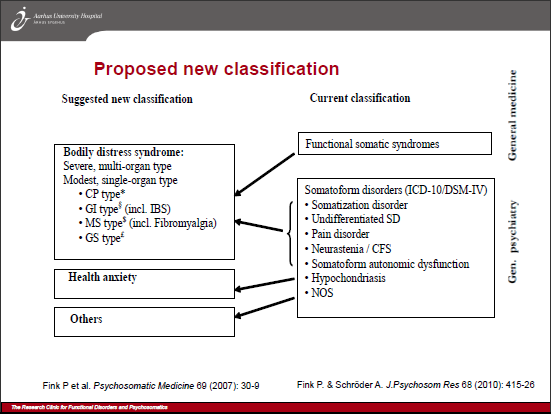
Marianne Rosendal (member of the ICD-11 Primary Care Consultation Group; member of WONCA International Classification Committee), Fink and colleagues are eager to see their Bodily distress syndrome construct adopted by primary care clinicians and incorporated into management guidelines and revisions of European classification systems to replace ICD-10’s F45 somatoform disorders, pain disorder, neurasthenia (ICD-10 F48), and the so-called “functional somatic syndromes,”  Fibromyalgia (ICD-10 M79.7), IBS (ICD-10 K58) and CFS (indexed to ICD-10 G93.3). See graphics at end of post.

While Fink et al’s BDS construct seeks to capture somatoform disorders, pain disorder, neurasthenia and the so-called functional somatic syndromes under a single, unifying diagnosis, it is unclear from the 2012 Lam et al paper whether and how the so-called functional somatic syndromes are intended to fit into the Primary Care Consultation Group’s proposed ICD-11 framework.

While the paper does list some exclusions and differential diagnoses, it lists no specific exclusions or differential diagnoses for FM, IBS or CFS and it is silent on the matter of which of the so-called functional somatic syndromes the group’s proposed new BSS diagnosis might be intended to be inclusive of, or might intentionally or unintentionally capture.

Nor is it discussed within the paper what the implications would be for the future classification and chapter location of several currently discretely coded ICD-10 entities, if Bodily stress syndrome (or whatever new term might eventually be agreed upon) were intended to capture all or selected of FM, IBS, CFS and (B)ME – the sensitivities associated with any such proposal would not be lost on Prof Goldberg which possibly accounts for the lacunae in this paper.

Lack of consensus between the two groups advising ICD-11:

The second working group advising ICD-11 on the revision of ICD-10’s Somatoform disorders is the WHO Expert Working Group on Somatic Distress and Dissociative Disorders (S3DWG).

In late 2012, their emerging construct (also published behind a paywall) had considerably more in common with DSM-5’s SSD construct than with Fink et al’s BDS (see: BDS, BDDs, BSS, BDD and ICD-11, unscrambled).

But the S3DWG’s construct Bodily distress disorder (BDD) and Severe bodily distress disorder are yet to be defined and characterised in the public version of the ICD-11 Beta draft.

It remains unknown whether the two groups making recommendations for the revision of ICD-10’s Somatoform disorders have reached consensus over what definition and criteria WHO intends to field trial over the next year or two and what this proposed new diagnosis should be called; whether their proposed BDD/BSS/WHATEVER construct will have greater congruency with DSM-5’s SSD or with Fink et al’s BDS, or what patient populations this new ICD construct is intended to include and exclude.

The absence of information on proposals within the Beta draft, itself, and the lack of working group progress reports placed in the public domain presents considerable barriers for stakeholder comment on the intentions of these two groups and renders threadbare ICD-11’s claims to be an “open” and “transparent” and “inclusive” collaborative process.

Two further papers relating to “Medically unexplained symptoms,” “Bodily distress syndrome” and “Somatoform disorders”:

http://www.sciencedirect.com/science/article/pii/S0163834313002533

General Hospital Psychiatry

Psychiatric–Medical Comorbidity

Is physical disease missed in patients with medically unexplained symptoms? A long-term follow-up of 120 patients diagnosed with bodily distress syndrome

Elisabeth Lundsgaard Skovenborg, B.Sc., Andreas Schröder, M.D., Ph.D.

The Research Clinic for Functional Disorders and Psychosomatics, Aarhus University Hospital, Denmark

Available online 22 October 2013 In Press, Corrected Proof [Full text behind paywall]

http://www.systematicreviewsjournal.com/content/2/1/99

Systematic Reviews 2013, 2:99 doi:10.1186/2046-4053-2-99

Barriers to the diagnosis of somatoform disorders in primary care: protocol for a systematic review of the current status

Alexandra M Murray¹²*, Anne Toussaint¹², Astrid Althaus¹² and Bernd Löwe¹²

1 Department of Psychosomatic Medicine and Psychotherapy, University Medical Center Hamburg-Eppendorf, Hamburg, Germany

2 University Hospital of Psychosomatic Medicine and Psychotherapy, Schön Clinic Hamburg-Eilbek, Hamburg, Germany

Published: 8 November 2013

[Open access article distributed under the terms of the Creative Commons Attribution License]

Finally, brief summaries of selected of the workshops held at the European Association for Consultation-Liaison Psychiatry and Psychosomatics (EACLPP) 2012 Conference, including workshops on “functional disorders and syndromes” and “Bodily distress,” one of which included:

http://www.eaclpp-ecpr2012.dk/Home/DownloadWorkshop

“…brief presentations which describe the present state of the proposed changes to Primary care classifications (ICPC and ICD for primary care) (MR) and DSM-V and ICD-11 (FC).”

where presenter “MR” is Marianne Rosendal; “FC” is Francis Creed, member of the ICD-11 Expert Working Group on Somatic Distress and Dissociative Disorders (S3DWG).

Note: ICPC-2 used in primary care is also under revision.

Foreslået ny klassifikation (Suggested new classification, Fink et al): 

Source Figur 1: http://www.ugeskriftet.dk/LF/UFL/2010/24/pdf/VP02100057.pdf
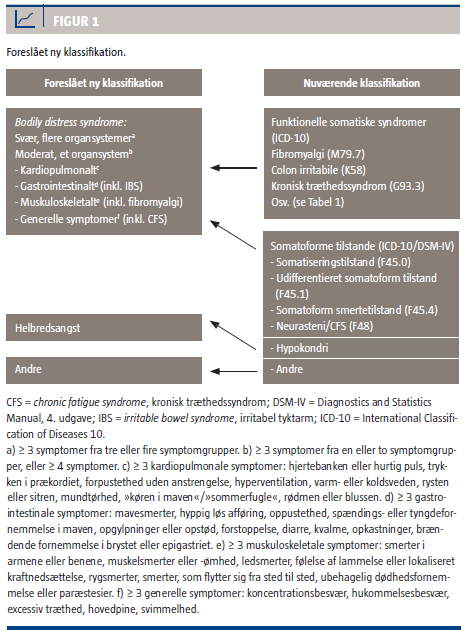
Danish Journal paper Fink P

Fink: Proposed New Classification

+++
References

1. WHO considers further extension to ICD-11 development timeline

2. Committee for the Coordination of Statistical Activities, Twenty-second Session 4-6 September 2013, Items for discussion and decision: Item 8 of the provisional agenda, 3 September 2013 Full document in PDF format

3. Slide presentation: ICD Revision: Where are we? What remains to be done? Shall we have ICD WHA submission in 2015 or later? Bedirhan Ustun, World Health Organization Classifications, Terminologies, Standards, ICD Revision: Quality Safety Meeting 2013, September 9-10, 2013 http://www.slideshare.net/ustunb/icd-2013-qs-tag-26027668

4. Goldberg, D. Guest editorial. A revised mental health classification for use in general medical settings: the ICD11–PHC 1. International Psychiatry, Page 1, February 2011. http://www.rcpsych.ac.uk/pdf/IPv8n1.pdf

5. Goldberg DP. Comparison Between ICD and DSM Diagnostic Systems for Mental Disorders. In: Sorel E, (Ed.) 21st Century Global Mental Health. Jones & Bartlett Learning, 2012: 37-53. Free PDF, Sample Chapter Two: http://samples.jbpub.com/9781449627874/Chapter2.pdf

Compiled by Suzy Chapman for Dx Revision Watch

DSM-5 November Round up #1

Post #285 Shortlink: http://wp.me/pKrrB-3zQ

Recent documents issued by the American Psychiatric Association at DSM-5 Development

Coding Changes Update: Important Coding and Criteria Updates: UPDATED 11/22/13

APA Statement issued 10.31.13: Statement on DSM-5 Text Error Pedophilic disorder text error to be corrected

Text Corrections: DSM-5 Paraphilic Disorders 10/31/13

Criteria Update: Updates to DSM-5 Adjustment Disorders: 10/15/13

Coding Changes Update: Neurocognitive Disorders Coding Updates: UPDATED 10/18/13

Psychiatric News Article: ICD Codes for Some DSM-5 Diagnoses Updated, Mark Moran, 10/7/13

+++
Commentary, Dx Summit

Attenuated Psychosis Syndrome Was Not Actually Removed from DSM-5

by Sarah Kamens

Note from Dx Revision Watch: Here is another codable diagnosis slipped in by APA before going to press. Between closure of the third DSM-5 draft review and publication of the final code sets a “Brief somatic symptom disorder,” where duration of symptoms is less than 6 months, was added under new category, “Other specified Somatic Symptom and Related Disorder” cross-walked to ICD 300.89 (F45.8) [DSM-5, Page 327]. This “Other specified” category can be used for symptom presentations that do not meet the full criteria for any of the disorders in the Somatic symptom and related disorders diagnostic class.
This means that as little as a single, distressing physical symptom + just one psychobehavioural symptom from the Somatic symptom disorder “B type” criteria, with less than 6 months chronicity would meet criteria for a codable mental disorder. A “Brief illness anxiety disorder” diagnosis of less than 6 months duration has also been inserted under this code – neither of which were in the third draft.

+++
Commentary from Christopher Lane, Ph.D., at Side Effects, Psychology Today:

The OECD Warns on Antidepressant Overprescribing Antidepressant consumption not matched by an increase in global diagnoses

Christopher Lane | November 22, 2013

+++
Commentary by Athena Bryan for Brown Political Review:

A Tale of Two Codices: the DSM, ICD and Definition of Mental Illness in America

Athena Bryan | November 21, 2013

Note from Dx Revision Watch: I have added a comment to this article, noting that APA has proposed the following new DSM-5 disorders for inclusion in the forthcoming U.S. specific ICD-10-CM via the September 18-19, 2013 meeting of the ICD-9-CM Coordination and Maintenance Committee: Binge eating disorder (BED); Disruptive mood dysregulation disorder (DMDD); Social (pragmatic) communication disorder; Hoarding disorder; Excoriation (skin picking) disorder; Premenstrual dysphoric disorder (PMDD); that DSM-5′s new constructs, Somatic symptom disorder (SSD) and Illness anxiety disorder were also proposed for insertion into the ICD-10-CM Tabular List and Index; that the ICD-10-CM is a “clinical modification” of WHO’s ICD-10 and is scheduled for U.S. implementation in October 2014; that its development from the ICD-10 has been the responsibility of NCHS.

+++
Three DSM-5 Somatic symptom disorder related items:

+++
Editorial British Journal of Psychiatry:

Editorial: Michael Sharpe, DSM-5 Somatic symptom disorder Work Group member BJP November 2013 203:320-321; doi: 10.1192/bjp.bp.112.122523:

Editorial: Somatic symptoms: beyond ‘medically unexplained’

Abstract:

Somatic symptoms may be classified as either ‘medically explained’ or ‘medically unexplained’ – the former being considered medical and the latter psychiatric. In healthcare systems focused on disease, this distinction has pragmatic value. However, new scientific evidence and psychiatric classification urge a more integrated approach with important implications for psychiatry.

Note from Dx Revision Watch: Unless NCHS rejects the proposal submitted at the September 18-19, 2013 meeting of the ICD-9-CM Coordination and Maintenance Committee, Somatic symptom disorder is destined for insertion into the ICD-10-CM Tabular List under F45 Somatoform Disorders as an inclusion term to F45.1 Undifferentiated somatoform disorder and for adding to the Alphabetic Index. See http://wp.me/pKrrB-3×1.

+++
Slide presentation: Francis Creed, University of Manchester, UK:

Can we now explain medically unexplained symptoms?

Francis Creed | Exeter, June 13, 2013 | PDF format

or open PDF [1.5MB] here Creed June 2013 slide presentation

+++
Book chapter: Polypharmacy in Psychiatry Practice, Volume I: Multiple Medication Use Strategies:

Polypharmacy in Psychiatry Practice, Volume I: Multiple Medication Use Strategies, Ritsner, Michael S (Ed.) 2013, XVII, 287 p ISBN: 978-94-007-5804-9 (Print) 978-94-007-5805-6 (Online)

Chapter 11: Multiple Medication Use in Somatic Symptom Disorders: From Augmentation to Diminution Strategies  

Most of Chapter 11, Pages 243-254 (pp 247-249 omitted) can be previewed on Google Books here

Correspondence In Press in response to Dimsdale et al paper: Somatic Symptom Disorder: An important change in DSM

Post #284 Shortlink: http://wp.me/pKrrB-3yQ

Update: The four letters, below, published In Press in Journal of Psychosomatic Research are now published in the December 2013 issue:

Issue: Vol 75 | No. 6 | December 2013 | Pages 497-588

Update: Editorial by Michael Sharpe, DSM-5 Somatic symptom disorder Work Group member

http://bjp.rcpsych.org/content/203/5/320.abstract
http://bjp.rcpsych.org/content/203/5/320.full.pdf+html

Editorial: Somatic symptoms: beyond ‘medically unexplained’

BJP November 2013 203:320-321; doi: 10.1192/bjp.bp.112.122523

Michael Sharpe FRCPsych, Department of Psychiatry, University of Oxford, Warneford Hospital, Oxford OX3 7JX, UK.

Abstract

Somatic symptoms may be classified as either ‘medically explained’ or ‘medically unexplained’ – the former being considered medical and the latter psychiatric. In healthcare systems focused on disease, this distinction has pragmatic value. However, new scientific evidence and psychiatric classification urge a more integrated approach with important implications for psychiatry.

A paper by DSM-5 Work Group members, Dimsdale JE, Creed F, Escobar J, Sharpe M, Wulsin L, Barsky A, Lee S, Irwin MR, Levenson J, titled Somatic Symptom Disorder: An important change in DSM, was published in the September issue of Journal of Psychosomatic Research.

There are four responses to this paper currently In Press. Subscription or payment is required to access the full text of these responses but the Dimsdale et al paper is now available free of charge:

http://www.jpsychores.com/inpress

http://www.jpsychores.com/article/S0022-3999(13)00345-0/fulltext

Correspondence

The somatic symptom disorder in DSM 5 risks mislabelling people with major medical diseases as mentally ill

DOI: 10.1016/j.jpsychores.2013.09.005

Winfried Häuser

Department of Internal Medicine I, Klinikum Saarbrücken, Saarbrücken, Germany
Department of Psychosomatic Medicine, Technische Universität München, München, Germany

Frederick Wolfe

National Data Bank for Rheumatic Diseases, Wichita, USA

In Press Corrected Proof Received 2 September 2013; accepted 25 September 2013. published online 28 October 2013.

Dimsdale and co-authors present data on the reliability, validity, and prevalence of the new DSM 5 category “Somatic Symptom disorder” (SSD) defined by persistent somatic symptoms in conjunction with…

http://www.jpsychores.com/inpress

http://www.jpsychores.com/article/S0022-3999(13)00349-8/fulltext

Correspondence

Diagnosis of somatic symptom disorder requires clinical judgment

DOI: 10.1016/j.jpsychores.2013.09.009

Joel E. Dimsdale

Department of Psychiatry, University of California, San Diego, United States
[Ed: DSM-5 SSD Work Group Chair]

James Levenson

Department of Psychiatry, Virginia Commonwealth University, United States
[Ed: DSM-5 SSD Work Group Member]

In Press Corrected Proof Received 27 September 2013; accepted 27 September 2013. published online 01 November 2013.

The diagnosis of somatic symptom disorder (SSD) rests on the presence of 3 factors—1. distressing and impairing somatic symptoms, 2. that are persistent at least 6 months, and 3. that are associated…

http://www.jpsychores.com/inpress

http://www.jpsychores.com/article/S0022-3999(13)00378-4/fulltext

Correspondence

A commentary on: Somatic symptom disorder: An important change in DSM

DOI:10.1016/j.jpsychores.2013.10.012

Winfried Rief

Clinical Psychology and Psychotherapy, University of Marburg, Marburg, Germany

Available online 1 November 2013

The songs of praise about DSM-5 and its innovations are disseminated through the media, and consequently, a positive evaluation of the new category of somatic symptom and associated disorders was published…

http://www.jpsychores.com/inpress

http://www.jpsychores.com/article/S0022-3999(13)00393-0/fulltext

Correspondence

Tradeoffs between validity and utility in the diagnosis of Somatic Symptom Disorder

DOI:10.1016/j.jpsychores.2013.10.015

Joel E. Dimsdale

Department of Psychiatry, University of California, San Diego, United States
[Ed: DSM-5 SSD Work Group Chair]

James Levenson

Department of Psychiatry, Virginia Commonwealth University, United States
[Ed: DSM-5 SSD Work Group Member]

Available online 31 October 2013

We appreciate the opportunity of responding to Professor Rief’s thoughtful letter concerning the thinking that guided our workgroup’s proposals for Somatic Symptom Disorder (SSD). When we started out…

in response to paper:

http://tinyurl.com/SSDPDFresearchgate [Download Free PDF from link on right of webpage.]

http://www.ncbi.nlm.nih.gov/pubmed/23972410

Somatic Symptom Disorder: An important change in DSM.

Dimsdale JE, Creed F, Escobar J, Sharpe M, Wulsin L, Barsky A, Lee S, Irwin MR, Levenson J.

J Psychosom Res. 2013 Sep;75(3):223-8. Epub 2013 Jul 25.

Abstract: http://www.jpsychores.com/article/S0022-3999(13)00265-1/abstract [Free]

Full text: http://www.jpsychores.com/article/S0022-3999(13)00265-1/fulltext

References: http://www.jpsychores.com/article/PIIS0022399913002651/references


+++
Commentaries on Somatic Symptom Disorder published in 2013 journal papers

In the June 2013 edition of Journal of Nervous and Mental Disorders, Allen Frances, MD, who chaired the Task Force for DSM-IV, discusses his concerns for the loosely defined DSM-5 category, Somatic Symptom Disorder, sets out his suggestions for revising the criteria prior to finalization, as presented to the SSD Work Group chair, in December 2012, and advises clinicians against using the new SSD diagnosis.

http://www.ncbi.nlm.nih.gov/pubmed/23719325

DSM-5 Somatic Symptom Disorder.

Frances A.

Department of Psychiatry, Duke University, Durham, NC.

J Nerv Ment Dis. 2013 Jun;201(6):530-1. doi: 10.1097/NMD.0b013e318294827c. No abstract available.

PMID: 23719325

+++

Commentary by Allen Frances, MD, and Suzy Chapman in the May 2012 issue of Australian and New Zealand Journal of Psychiatry. The paper discusses the over-inclusive DSM-5 Somatic Symptom Disorder criteria and the potential implications for diverse patient groups. The paper concludes by advising clinicians not to use the new SSD diagnosis.

http://www.ncbi.nlm.nih.gov/pubmed/23653063

DSM-5 somatic symptom disorder mislabels medical illness as mental disorder.

Allen Frances¹, Suzy Chapman²

1 Department of Psychiatry, Duke University 2 DxRevisionWatch.com

Aust N Z J Psychiatry. 2013 May;47(5):483-4. doi: 10.1177/0004867413484525. No abstract available.

PMID: 23653063

+++

The April 22, 2013 edition of Current Biology published a feature article on DSM-5 by science writer, Michael Gross, Ph.D. The article includes quotes from Allen Frances, MD, and Suzy Chapman on potential implications for patients for the application of the new DSM-5 Somatic Symptom Disorder. The article includes concerns for the influence of Somatic Symptom Disorder on proposals for a new ICD category – Bodily Distress Disorder – being field tested for ICD-11.

Current Biology 22 April, 2013 Volume 23, Issue 8

Copyright 2013 All rights reserved. Current Biology, Volume  23, Issue  8, R295-R298, 22 April 2013

doi:10.1016/j.cub.2013.04.009

Feature

Has the manual gone mental?

Michael Gross

Full text: http://www.cell.com/current-biology/fulltext/S0960-9822(13)00417-X

PDF: http://download.cell.com/current-biology/pdf/PIIS096098221300417X.pdf

+++

In a BMJ opinion piece, published March 2013, Allen Frances, MD, opposes the new Somatic Symptom Disorder, discusses lack of specificity, data from the field trials, and advises clinicians to ignore this new category.

PDF for full text

http://www.ncbi.nlm.nih.gov/pubmed/23511949

The new somatic symptom disorder in DSM-5 risks mislabeling many people as mentally ill.

Frances A.

Allen Frances, chair of the DSM-IV task force

BMJ. 2013 Mar 18;346:f1580. doi: 10.1136/bmj.f1580. No abstract available.

PMID: 23511949

[PubMed – indexed for MEDLINE]

+++
Somatic Symptom Disorder is also included in Saving Normal: An Insider’s Revolt Against Out-Of-Control Psychiatric Diagnosis, DSM-5, Big Pharma, and the Medicalization of Ordinary Life (pp. 193-6): Allen Frances, William Morrow & Company (May 2013).

Also Essentials of Psychiatric Diagnosis: Responding to the Challenge of DSM-5 (Chapter 16): Allen Frances, Guilford Press (June 2013).

+++

Further reading

Objection to proposal to insert DSM-5′s Somatic symptom disorder into ICD-10-CM Suzy Chapman, Public submission, ICD-9-CM/PCS Coordination and Maintenance Committee Meeting September 18-19, 2013

APA Somatic Symptom Disorder Fact Sheet APA DSM-5 Resources

Somatic Chapter Drops Centrality Of Unexplained Medical Symptoms Psychiatric News, Mark Moran, March 1, 2013

Somatic Symptoms Criteria in DSM-5 Improve Diagnosis, Care David J Kupfer, MD, Chair, DSM-5 Task Force, defends the SSD construct, Huffington Post, February 8, 2013

The new somatic symptom disorder in DSM-5 risks mislabeling many people as mentally ill Allen Frances, MD, BMJ 2013;346:f1580 BMJ Press Release PDF for full text

Somatic Symptom Disorder could capture millions more under mental health diagnosis Suzy Chapman, May 26, 2012

Mislabeling Medical Illness As Mental Disorder Allen Frances, MD, Psychology Today, DSM 5 in Distress, December 8, 2012

Why Did DSM 5 Botch Somatic Symptom Disorder? Allen Frances, MD, Psychology Today, Saving Normal, February 6, 2013

New Psych Disorder Could Mislabel Sick as Mentally Ill Susan Donaldson James, ABC News, February 27, 2013

Dimsdale JE. Medically unexplained symptoms: a treacherous foundation for somatoform disorders? Psychiatr Clin North Am 2011;34:511-3. [PMID: 21889675]

Objectors to insertion of DSM-5’s Somatic symptom disorder into ICD-10-CM

Post #283 Shortlink: http://wp.me/pKrrB-3y8

Michael Munoz, Executive Director, Rocky Mountain CFS/ME & FM Association has organized a joint letter of objection signed by 13 U.S. patient organizations and advocates for submission to NCHS. It can be read here:

http://www.rmcfa.org/index.html > http://www.rm-cfs-fms.citymaker.com/f/NCHS.pdf

or download PDF here: Joint response to NCHS 11.15.13

This joint submission had been signed by the following organizations and advocates:

Michael Munoz, Executive Director, Rocky Mountain CFS/ME & FM Association
Lori Chapo-Kroger, RN, President & CEO, PANDORA Org
Charmian Proskauer, President, Massachusetts CFIDS/ME & FM Association
Tamara Staples, President & Co-Founder, Fibromyalgia – ME/CFS Support Center, Inc.
Donna Pearson, Vice President, Massachusetts CFIDS/ME & FM Association
Jean Harrison, President and Founder, MAME – Mothers Against Myalgic Encephalomyelitis
Denise Lopez-Majano, Founder, Speak Up About ME
Rik Carlson, President, Immunedysfunction.org
Jennifer M. Spotila, JD., Occupy CFS blog, Patient Advocate
Billie Moore, Patient Advocate
Charlotte von Salis, JD, Patient Advocate
Mary Schweitzer, Ph.D., Patient Advocate
Mary Dimmock, Patient Advocate

I’d like to thank all those who have submitted objections to NCHS in opposition to the September 2013 C & M Committee meeting proposal to insert Somatic symptom disorder as an inclusion term in ICD-10-CM.

My submission can be read here PDF: Submission NCHS

Some additional organizations and individuals have advised me of their own submissions. If you have submitted a response on behalf of your organization or as a patient, advocate or professional and you would like your name or your organization’s name added to the list of responders below please shoot me an email or contact me via the Contact form with a link to your submission (if it has been placed in the public domain) and a couple of lines of credentials or stakeholder interest, if desired.

Bridget Mildon, Patient advocate and Founder of FND Hope, Inc. FND Hope is the only state registered non profit patient advocacy organization specifically for those assigned a diagnosed of Functional Neurological Disorder. Bridget was misdiagnosed with FND and continues to advocate for those with a FND diagnosis to receive appropriate patient care fndhope.org Submission
Mark Thompson, patient. Submission
Diane O’Leary, Ph.D. is a philosopher focused on the rights of medical patients denied medical care because of mistaken somatoform diagnoses. She is author of the book, Patient, Executive Director of the Sneddon’s Foundation, and author of numerous web and print entries on Sneddon’s Syndrome, a highly threatening cerebrovascular disease generally mistaken for somatoform disorders. Dr. O’Leary is author of “Peculiar Silence: The Problem of Error in Diagnosis of SSD” (a reply piece at BMJ). Dr O’Leary has coauthored several blogs, published and forthcoming, with Prof. Allen Frances at Huffington Post, Psychology Today and Psychiatric Times. New work is forthcoming for the National Organization for Rare Disorders and Ben’s Friends. An audio interview with Dr. O’Leary is available here. PDF Submission also Submission [On LinkedIn]
Suzy Chapman, DipAD, UK carer/advocate for young adult with long-term illness. Owner of website Dx Revision Watch, Monitoring the revision of DSM-5 and ICD-11. Co-author of journal papers and commentaries on the Somatic symptom disorder construct (with Professor Allen Frances). PDF Submission
Richard A. Lawhern, Ph.D. is an 18-year patient advocate. He writes content and moderates for “Living With TN,” a social networking site that supports nearly 5,000 chronic face pain patients in 117 countries – many of whom have been substantively harmed by mis-application of psychosomatic diagnoses. Submission
Angela Kennedy, M.A. (also retired R.G.N.), social science lecturer and researcher. Author of the book Authors of our own misfortune?: The problems with psychogenic explanations for physical illnesses (2012) Village Digital Press. Carer and parent of disabled woman who became ill at 12 years of age.
Gail Kansky, President, National CFIDS Foundation, Inc. Needham, MA http://www.ncf-net.org Submission
Jack Carney, Ph.D., DSW, Brooklyn, NY, Committee to Boycott the DSM-5, contributor to Mad in America. A social worker, Dr Carney writes on the contradictions and hypocrisies of the public mental health system and promotes and applauds acts of resistance to it.
Jennifer Brauer, BA, Women’s Studies, University of Massachusetts. Former certified paramedic, Emergency Medical Technician BLS, Bureau of The Emergency Medical Services, NY City Fire Dept. (1996-2005).
Samuel Wales, author, The Kafka Pandemic

Next meeting of ICD-10-CM Coordination and Maintenance Committee is March 19-20, 2014

Post #282 Shortlink: http://wp.me/pKrrB-3xE

The deadline for receipt of public submissions in response to proposals for updates and changes to ICD-10-CM diagnosis and procedure codes presented at the September 18-19, 2013 meeting of the ICD-9-CM Coordination and Maintenance Committee has now closed.

In 2014, this advisory Committee, which is co-chaired by NCHS and CMS, will be known as the ICD-10-CM Coordination and Maintenance Committee, as there will be no further updates of ICD-9-CM.

A done deal?

Proposals submitted on behalf of the American Psychiatric Association (APA) and presented at the meeting by APA’s Research Director, Darrel Regier, MD, can be found from Page 32 of the Diagnosis Agenda. Additional proposals for inclusion of new DSM-5 disorder terms within ICD-10-CM Chapter 5 Mental and behavioral disorders can be found on Pages 45-46.

The Summary of the September meeting diagnosis presentations can be found here. Links for the four videocasts of the meeting’s two day proceedings are listed in this Dx Revision Watch post and the Meeting Materials are here.

The Timeline for ICD-9-CM (for the remainder of its life) and for ICD-10-CM is set out from Page 3 of the Diagnosis Agenda.

Some diagnosis proposals at the September 18-19, 2013 meeting were requested for October 2014 implementation and some for 2015 implementation. I shall update this site when the outcomes of the various proposals are published, next year.

There is a lack of clarity over which body has requested the addition of Somatic symptom disorder (SSD) and Illness anxiety disorder as inclusion terms to existing ICD-10-CM codes. It isn’t clear whether these two additional DSM-5 constructs have been proposed for inclusion in ICD-10-CM by the APA or by the NCHS/CMS Committee – if the latter, should we assume these two proposals already have the support of NCHS?

Given APA’s determination to achieve harmonization between the two systems, the outcome of its proposals to insert a handful of new DSM-5 disorders into ICD-10-CM may already be a done deal between APA and NCHS: the Director of NCHS may not need much persuasion to ratify their retrofitting into ICD-10-CM.

Loss of public trust and confidence

If NCHS is planning to rubber stamp insertion into ICD-10-CM of DSM-5’s poorly validated Somatic symptom disorder in response to APA diktat, having conducted no field testing and in the absence of a body of supportive evidence for SSD’s clinical relevance, safety and utility, and with disregard for a high level of public concern, what confidence can the public have that this federal agency is meeting its duty of care towards patient populations and towards the clinicians and allied health professionals who may deploy this proposed new ICD term, in its ethics, integrity and methods and for upholding standards of scientific rigour?

APA may re-present proposals next year

If APA is unsuccessful with any of the additions requested via the September meeting, it is possible that the organization may re-present proposals or modified proposals at the next C & M Committee meeting, scheduled for March 19-20, 2014. There are also other new DSM-5 disorders or changes that APA might potentially propose for incorporation into ICD-10-CM at the March 2014 or the September 2014 meeting, or at some later point.

Only a brief public submission period for March 2014 meeting

March 19-20, 2014 meeting

The deadline for Requestors to submit proposals for consideration for the March meeting agenda is January 17, 2014.

The draft agenda will be posted in February 2014.

Registration is required for those wishing to attend the meeting. Register online between on February 14 – March 14.

The two day meeting is scheduled for March 19 – 20.

Note: the deadline for receipt of comments on the March 19-20, 2014 meeting proposals for both procedure and diagnosis codes and changes is given as April 18. So instead of a couple of months for stakeholder responses, it appears there will only be four weeks or so in which to prepare and submit comments or objections.

I will post the Diagnosis Agenda for the March 2014 meeting as soon as it becomes available and links for the videocasts of the proceedings after the meeting has taken place. (Videocasts now substitute for written transcripts of meeting proceedings.)

Extracts from the Timeline that relate to the publication of additions and changes for ICD-10-CM:

April 2014 Notice of Proposed Rulemaking to be published in the Federal Register as mandated by Public Law 99-509. This notice will include references to the complete and finalized FY 2015 ICD-10-CM diagnosis and ICD-10-PCS procedure codes. It will also include proposed revisions to the MS-DRG system based on ICD-10-CM/PCS codes on which the public may comment. The proposed rule can be accessed here.

June 2014 Final addendum posted on web pages as follows:

Diagnosis addendum – http://www.cdc.gov/nchs/icd/icd10cm.htm
Procedure addendum – http://cms.hhs.gov/Medicare/Coding/ICD10/index.html

October 1, 2014 New and revised ICD-10-CM and ICD-10-PCS codes go into effect along with DRG changes. Final addendum posted on web pages as follows:

Diagnosis addendum – http://www.cdc.gov/nchs/icd/icd9cm_addenda_guidelines.htm
Procedure addendum – http://www.cms.gov/Medicare/Coding/ICD9ProviderDiagnosticCodes/addendum.html

November 2014 Any new ICD-10 codes required to capture new technology that will be implemented on the following April 1 will be announced. Information on any new codes to be implemented April 1, 2015 will be posted on the following websites:

http://www.cms.gov/Medicare/Coding/ICD9ProviderDiagnosticCodes/addendum.html

http://www.cdc.gov/nchs/icd/icd9cm_addenda_guidelines.htm

Submission: Objection to proposal to insert DSM-5’s Somatic symptom disorder into ICD-10-CM

Post #281 Shortlink: http://wp.me/pKrrB-3×1

Information in this post relates to proposals submitted via the September ICD-9-CM Coordination and Maintenance Committee meeting for inclusion of additional codes and changes to the forthcoming US specific ICD-10-CM/PCS.

There are just five days is just one day left in which to submit objections to NCHS to the proposal to insert DSM-5’s Somatic symptom disorder into ICD-10-CM.

Submit objections via email by November 15 to Donna Pickett, CDC: nchsicd9CM@cdc.gov

Further information here: Keep SSD out of ICD-10-CM – November 15 deadline for objections

Please let me know if you or your organization or professional body has submitted comment or objections, with a link if your submission is being placed in the public domain.

We need to keep SSD out of ICD-10-CM

Please consider submitting an objection before the November 15 deadline.

If you submitted comment during any of the three DSM-5 public review periods or you are an advocate or clinician signatory to the Institute of Medicine (IOM) definition issue letters campaign please also consider submitting an objection to NCHS.

I have submitted the following:

PDF: Submission NCHS

Text:

To: Ms Donna Pickett, CDC

Re: Comment on proposals, September 18-19, 2013 meeting of the ICD-9-CM Coordination and Maintenance Committee

Diagnostic Agenda, Page 45: Additional Tabular List Inclusion Terms for ICD-10-CM

Add Somatic symptom disorder to ICD-10-CM Tabular List under F45 Somatoform Disorders as inclusion term to F45.1 Undifferentiated somatoform disorder.

Add Somatic symptom disorder to ICD-10-CM Alphabetical Index.

Requestor for proposal: Unspecified

——————————————————–

I am writing to object to the proposed insertion of Somatic symptom disorder into the ICD-10-CM Tabular List and Alphabetical Index.

Somatic symptom disorder is a new construct created by the American Psychiatric Association (APA) for DSM-5.

For DSM-5, the Somatoform Disorders have been dismantled. Four DSM-IV categories: somatization disorder [300.81], some presentations of hypochondriasis [300.7], pain disorder, and undifferentiated somatoform disorder [300.82] are eliminated and replaced with a single new construct, Somatic Symptom Disorder (SSD), cross-walked in DSM-5 to ICD 300.82 (F45.1).

The Somatic Symptom Disorder construct de-emphasizes “medically unexplained” as the central defining feature of this disorder group. The diagnosis does not require that the somatic symptoms are medically unexplained, instead, the focus shifts away from somatic symptoms to emotional, cognitive and behavioral disturbances and “maladaptive” responses: high levels of health anxiety; disproportionate and persistent concerns about the medical seriousness of the symptom(s); or an excessive amount of time and energy devoted to symptoms and health concerns.

Symptoms may or may not be associated with another medical condition: SSD allows for the application of a mental health diagnosis in patients with “established general medical conditions or disorders” like diabetes, heart disease and cancer or presenting with “somatic symptoms of unclear etiology” if the clinician considers the patient otherwise meets the new criteria.

To meet the requirements for DSM-IV Somatization Disorder, a rigorous criteria set needed to be fulfilled: a history of many medically unexplained symptoms before the age of thirty, resulting in treatment sought or psychosocial impairment. And a high diagnostic threshold: a total of eight or more medically unexplained symptoms from four, specified symptom groups, with at least four pain, two gastrointestinal, one psychosexual and one pseudoneurological symptom.

In DSM-5, the requirement for eight symptoms has been dropped to just one or more persistent, non specific, distressing somatic symptoms and the clinician’s perception of “excessive” or “maladaptive” response to the symptom or symptoms.

• These changes for DSM-5 represent a radical restructuring of the DSM-IV Somatoform Disorder categories and a new construct for which much remains to be determined.

On Day Two of the September ICD-9-CM Coordination and Maintenance Committee meeting, Dr Darrel Regier presented and discussed rationales, coding proposals and timings for six new DSM-5 disorders that the APA has proposed for insertion into ICD-10-CM. But the proposal to add the new DSM-5 Somatic symptom disorder and Illness anxiety disorder category terms to ICD-10-CM did not form part of Dr Regier’s presentation on behalf of the APA.

As it is unspecified within the Diagnosis Agenda and during the meeting presentations, it is unclear whether these two proposals are being requested by the APA, by NCHS/CMS, or by other parties or individuals.

• My first concern is that no description of Somatic symptom disorder, no rationale for why this ICD-10-CM change is needed (including clinical relevancy) and no supporting clinical and literature references for the validity of Somatic symptom disorder as a new disorder term were published in the Diagnosis Agenda.

At the public meeting, no presentation had been made on behalf of APA, or by representatives of NCHS or CMS, or by anyone else for the specific proposal to add Somatic symptom disorder as an inclusion term under the ICD-10-CM Somatoform disorders and there was no discussion of this proposal during the course of the meeting [1][2].

There is an expectation that the committees overseeing the development and revision of the draft for the ICD-10-CM will give due consideration to the applicability, clinical utility and reliability of any proposal for the inclusion of a new disorder construct before granting approval for addition to the Tabular List and Index, and that the comments and objections received during the public response period will also be considered.

The lack of rationales and references for supportive evidence provided by the requestors hinders public participation in the response process.

• The absence from both the Diagnosis Agenda document and the meeting presentations of rationales, clinical relevancy and supporting clinical and literature references to enable public scrutiny, consideration and informed responses to this proposal should disqualify SSD from consideration for implementation during a partial code freeze or for consideration for implementation in October 2015.

The burden of proof before introducing any new diagnosis into a classification system is that it has a favourable risk to benefit ratio. This new construct created by the APA for its DSM-5 merits the same level of scrutiny and risk to benefit evaluation as would be expected to be applied to any proposed new disorder/disease under consideration for inclusion in any chapter of ICD, whether this is for the updating of the ICD-10-CM draft, the international ICD-10, the several clinical modifications of ICD-10 or the drafting of ICD-11.

A number of papers have remarked on the paucity of rigorous evidence for the validity, reliability, acceptability, safety and utility of the SSD construct applied to adults and children in diverse clinical settings and across a spectrum of health and allied professionals.

There is no significant body of published research on the epidemiology, clinical characteristics or treatment of the Somatic symptom disorder construct [3][4][5].

In a paper published in the Journal of Psychosomatic Research, September 2013, the SSD work group concedes the lack of clinical evidence for its new construct and acknowledges the “small amount of validity data concerning SSD”; “that much remains to be determined” about the utility and reliability of the specific SSD criteria and its thresholds when applied in busy, general clinical practice, and there are “vital questions that must be answered” as they go forward [6].

• As an under researched, poorly validated disorder construct, Somatic symptom disorder does not meet NCHS/CMS criteria for “new diseases/new technology procedures, and any minor revisions to correct reported errors in these classifications” and should be rejected for consideration for implementation during a partial code freeze but also rejected for consideration for implementation in October 2015.

Concerns for the looseness of the SSD definition and the ease with which these new criteria can be met have been discussed in a number of published papers and commentaries [7][8][9].

The over-inclusiveness of the SSD diagnosis is borne out by the results of the DSM-5 field trial study reported by the chair of the Somatic symptom disorder work group at the 2012 annual meeting of the American Psychiatric Association.

15% of the ‘diagnosed illness’ study group, comprising patients with cancer or coronary disease, were caught by SSD and would meet the criteria for application of an additional mental disorder diagnosis.

26% of the ‘functional somatic’ study group, patients with irritable bowel syndrome or chronic widespread pain, met the SSD criteria.

SSD has a high false positive rate – capturing 7% of the ‘healthy’ field trial control group.

It is also disturbing that the SSD work group (which included no primary care physicians) appears not to have undertaken any field trials into the safety of application of the SSD criteria in children and adolescents.

NCHS/CMS provides no references for data for the application of SSD in children within the Diagnosis Agenda, although the DSM-5 text clearly indicates APA’s intention that SSD is a diagnosis that may also be applied to children with persistent, distressing somatic symptoms.

Potential implications for the application of a diagnosis of SSD:

I am not persuaded that the new SSD construct and criteria can be safely applied outside the optimal conditions of field trials, in settings where practitioners may not necessarily have adequate time for, or instruction in the administration of diagnostic assessment tools, and where decisions to code or not to code may hang on the arbitrary and subjective perceptions of a wide range of end-users who may lack clinical training in the application of mental disorder criteria.

Misapplication of highly subjective and loose, easily met criteria, especially in busy primary care practice, may result in inappropriate diagnoses of mental disorder and inappropriate medical decision making [10], with considerable implications for patients (see Appendix).

A mental disorder diagnosis of SSD can be applied as a “bolt-on” to any chronic medical diagnosis, eg patients with diabetes, angina, cancer, MS, cardiovascular disease, ME and CFS, IBS, chronic widespread pain (aka fibromyalgia) or to patients with a chronic pain condition or with persistent symptoms of unclear etiology.

Patients with chronic, multiple bodily symptoms due to rare diseases, difficult to diagnoses diseases, or multi-system diseases like Behçet’s disease, which can take several years to arrive at a diagnosis, may be especially vulnerable to missed diagnosis or to misdiagnosis with a mental disorder, which may impede access to further testing, investigations, interventions and effective treatments (and result in increased claims against practitioners for medical negligence).

Patients with chronic fatigue syndrome (CFS), “almost a poster child for medically unexplained symptoms as a diagnosis,” according to SSD work group chair, Joel E Dimsdale, or chronic Lyme disease, Gulf War illness, chemical injury and chemical sensitivity; women with potential symptoms of gynecological disease, like ovarian cancer, already often late-diagnosed, endometriosis or interstitial cystitis, or patients with vague neurological symptoms may be particularly vulnerable to misapplication or misdiagnosis with a mental health disorder under the SSD criteria.

There has been considerable opposition to the introduction of this new, poorly tested construct into the DSM-5 amongst patients, carers, advocates, consumer organizations, mental health practitioners and clinicians and considerable concern for the implications for diverse patient populations that the Somatic Symptom Disorder category will provide a “dustbin diagnosis” for the so-called “functional somatic syndromes,” for those living with chronic pain and for patients with persistent, but as yet undiagnosed, symptoms of disease.

• NCHS/CMS has published no independent field trial data and provided no rationales or clinical and literature references to inform public responses. Given the lack of published evidence for the validity and safety of SSD as a construct in adults and children, there is insufficient basis for the approval of SSD for inclusion within ICD-10-CM and it would be scientifically unsafe, premature and against the public interest to include this new construct within ICD.

The proposal for addition to the ICD-10-CM as an inclusion term during a partial code freeze should be rejected. There should be no implementation in October 2015 as an inclusion term to F45.1 or to any other existing code, or with a unique code created.

Appendix:

Incautious, inept application of criteria resulting in a “bolt-on” psychiatric diagnosis of Somatic symptom disorder could have far-reaching implications for diverse patient populations:

• Application of highly subjective and difficult to measure criteria could potentially result in misdiagnosis with a mental disorder, misapplication of an additional diagnosis of a mental disorder or missed diagnoses through dismissal and failure to investigate new or worsening somatic symptoms.

• Patients with cancer and life threatening diseases may be reluctant to report new symptoms that might be early indicators of recurrence, metastasis or secondary disease for fear of attracting a diagnosis of SSD or of being labelled as “catastrophisers.”

• Application of an additional diagnosis of SSD may have implications for the types of medical investigations, tests and treatments that clinicians are prepared to consider and which insurers are prepared to fund.

• Application of an additional diagnosis of SSD may impact payment of employment, medical and disability insurance and the length of time for which insurers are prepared to pay out. It may negatively influence the perceptions of agencies involved with the assessment and provision of social care, disability adaptations, education and workplace accommodations, and the perceptions of medical staff during hospital admissions and accident and emergency admissions.

• Patients prescribed psychotropic drugs for perceived unreasonable levels of “illness worry” or “excessive preoccupation with symptoms” may be placed at risk of iatrogenic disease or subjected to inappropriate and costly behavioural therapies.

• For multi-system diseases like Multiple Sclerosis, Behçet’s disease or Systemic lupus it can take several years before a diagnosis is arrived at. In the meantime, patients with chronic, multiple somatic symptoms who are still waiting for a diagnosis would be vulnerable.

• The burden of the DSM-5 changes to Somatoform Disorders will fall particularly heavily upon women who are more likely to be casually dismissed when presenting with physical symptoms and more likely to be prescribed inappropriate antidepressants and anti-anxiety medications for them.

• Proposals allow for the application of a diagnosis of SSD to children and where a parent is considered excessively concerned with a child’s symptoms. Families caring for children with any chronic illness may be placed at increased risk of wrongful accusation of “over-involvement” with a child’s symptomatology.

Where a parent is perceived as encouraging maintenance of “sick role behavior” in a child, this may provoke social services investigation or court intervention for removal of a sick child out of the home environment and into foster care or enforced in-patient rehabilitation. This is already happening in families in the U.S. and Europe with a child or young adult with chronic illness, notably with Chronic fatigue syndrome or ME. It may happen more frequently with a diagnosis of a chronic childhood illness + SSD.

Thank you for your consideration.

References:

1. September 18-19, 2013 meeting of the ICD-9-CM Coordination and Maintenance Committee Diagnosis Agenda.

2. September 18-19, 2013 meeting of the ICD-9-CM Coordination and Maintenance Committee Summary of Diagnosis Presentations.

3. DSM-5 Somatic Symptom Disorders Work Group Disorder Descriptions and Justification of Criteria – Somatic Symptoms, pub. May 2011, for second DSM-5 stakeholder review.

4. Robert L. Woolfolk and Lesley A. Allen (2012). Cognitive Behavioral Therapy for Somatoform Disorders, Standard and Innovative Strategies in Cognitive Behavior Therapy, Dr. Irismar Reis De Oliveira (Ed.), ISBN: 978-953-51-0312-7

5. Ghanizadeh A, Firoozabadi A. A review of somatoform disorders in DSM-IV and somatic symptom disorders in proposed DSM-V. Psychiatr Danub. 2012 Dec;24(4):353-8.

6. Dimsdale JE, Creed F, Escobar J, Sharpe M, Wulsin L, Barsky A, Lee S, Irwin MR, Levenson J. Somatic Symptom Disorder: An important change in DSM. J Psychosom Res. 2013 Sep;75(3):223-8. Epub 2013 Jul 25.

7. Frances A. The new somatic symptom disorder in DSM-5 risks mislabeling many people as mentally ill. BMJ. 2013 Mar 18;346:f1580. doi: 10.1136/bmj.f1580.

8. Frances A. DSM-5 Somatic Symptom Disorder. J Nerv Ment Dis. 2013 Jun;201(6):530-1. doi: 10.1097/NMD.0b013e318294827c.

9. Frances A, Chapman S. DSM-5 somatic symptom disorder mislabels medical illness as mental disorder. Aust N Z J Psychiatry. 2013 May;47(5):483-4. doi: 10.1177/0004867413484525.

10. Dimsdale JE. Medically unexplained symptoms: a treacherous foundation for somatoform disorders? Psychiatr Clin North Am 2011;34:511-3.

Interest:

Carer/advocate for young adult with long-term medical condition. Owner of website Dx Revision Watch, Monitoring the revision of DSM-5 and ICD-11. Co-author, journal papers and commentaries on the SSD construct (with Professor Allen Frances).

[End of submission]