CMS posts ICD-10-CM Release for 2015; confirms Partial Code Freeze extension; reminder, SSD proposals

Post #306 Shortlink: http://wp.me/pKrrB-3SJ

This report updates on the revised implementation date for ICD-10-CM, the revised Partial Code Freeze timeline, the ICD-10-CM Release for 2015 files, and a reminder of the deadline for objections to the insertion of DSM-5’s Somatic symptom disorder into ICD-10-CM.

[For reminder of deadline for objections to proposed insertion of Somatic symptom disorder into ICD-10-CM, skip to red subheading.]

On April 1, 2014, Bill H.R. 4302, known as the PAM Act (Protecting Access to Medicare Act), was signed into law by President Obama.

As a result of a quietly inserted clause piggybacking on this Bill, implementation of ICD-10-CM was delayed by a further year. Centers for Medicare & Medicaid Services (CMS) has confirmed that the effective implementation date for ICD-10-CM is now October 1, 2015.

Until that time, the codes in ICD-10-CM (the U.S. specific adaptation of the WHO’s ICD-10) are not valid for any purpose or use.

+++

Partial Code Freeze

CMS has announced that the partial code freeze on updates to the ICD-9-CM and ICD-10-CM diagnosis and procedure codes will continue until October 1, 2015.

Between October 1, 2011 and October 1, 2016 revisions to ICD-10-CM/PCS will be for new diseases/new technology procedures, and any minor revisions to correct reported errors in these classifications. Regular (at least annual) updates to ICD-10-CM/PCS will resume on October 1, 2016.

The Partial Code Freeze document has been updated to reflect the revised Timeline and can be accessed here in PDF format Partial Code Freeze for ICD-9-CM and ICD-10

or text, below:

Partial Code Freeze for ICD-9-CM and ICD-10

The ICD-10 Coordination and Maintenance Committee (formerly the ICD-9-CM Coordination and Maintenance Committee) implemented a partial freeze of the ICD-9-CM and ICD-10 (ICD-10-CM and ICD-10-PCS) codes prior to the implementation of ICD-10 which would end one year after the implementation of ICD-10. There was considerable support for this partial freeze. On April 1, 2014, the Protecting Access to Medicare Act of 2014 (PAMA) (Pub. L. No. 113-93) was enacted, which said that the Secretary may not adopt ICD-10 prior to October 1, 2015. Accordingly, the U.S. Department of Health and Human Services expects to release an interim final rule in the near future that will include a new compliance date that would require the use of ICD-10 beginning October 1, 2015. The rule will also require HIPAA covered entities to continue to use ICD-9-CM through September 30, 2015. When published, links will be provided to this interim final rule at http://www.cms.gov/Medicare/Coding/ICD10/Statute_Regulations.html

The partial freeze will be implemented as follows:

• The last regular, annual updates to both ICD-9-CM and ICD-10 code sets were made on October 1, 2011.

• On October 1, 2012, October 1, 2013, and October 1, 2014 there will be only limited code updates to both the ICD-9-CM and ICD-10 code sets to capture new technologies and diseases as required by section 503(a) of Pub. L. 108-173.

• On October 1, 2015, there will be only limited code updates to ICD-10 code sets to capture new technologies and diagnoses as required by section 503(a) of Pub. L. 108-173. There will be no updates to ICD-9-CM, as it will no longer be used for reporting.

• On October 1, 2016 (one year after implementation of ICD-10), regular updates to ICD-10 will begin.

The ICD-10 Coordination and Maintenance Committee will continue to meet twice a year during the partial freeze. At these meetings, the public will be asked to comment on whether or not requests for new diagnosis or procedure codes should be created based on the criteria of the need to capture a new technology or disease. Any code requests that do not meet the criteria will be evaluated for implementation within ICD-10 on and after October 1, 2016 once the partial freeze has ended.

CDC has not yet updated its webpages to reflect the ICD-10-CM implementation delay or the revised Partial Code Freeze timeline.

+++

SSD and ICD-10-CM/PCS Coordination and Maintenance Committee proposals

At the September 2013 and March 2014 Coordination and Maintenance Committee meetings, the American Psychiatric Association (APA) submitted numerous requests for addenda changes for new index entries and tabular inclusion terms for evaluation for implementation on October 1, 2015.

It is unclear whether requests for modifications submitted by APA and other requestors via these September and March meetings will be rolled forward for evaluation for implementation on and after the revised date of October 1, 2016 or whether these proposals will now need to be resubmitted at future C & M Committee meetings. (The next public meeting takes place September 23–24, 2014.)

I have approached NCHS for clarification.

+++
If the proposals from these two meetings do require resubmitting, this would provide another opportunity to comment on the proposal to add the DSM-5’s new disorder term, Somatic symptom disorder, to the ICD-10-CM.

See earlier post: Update on proposal to add DSM-5′s Somatic symptom disorder to ICD-10-CM

+++
At the public Coordination and Maintenance Committee meeting on September 18–19, 2013, a proposal had been submitted to add Somatic symptom disorder (SSD) as an inclusion term to existing ICD-10-CM code F45.1 Undifferentiated somatoform disorder in the Tabular List Addendum (this also included addition to the Index).

Note: Proposal is not to create a unique code for SSD or to replace any of the existing ICD-10-CM somatoform disorders with SSD, but to add SSD as an inclusion term under an existing ICD-10-CM code, F45.1.

September 18–19, 2013 meeting Agenda, Page 45: PDF Agenda
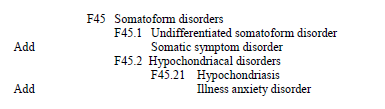
ICD10CM 4

+++
The proposal to add somatic symptom disorder to the Index (under Disorder), was resubmitted at the public meeting on March 19–20, (reason unclear but a number of proposals for modifications to both the Tabular List and the Index from the September 2013 meeting were also duplicated at the March 2014 meeting).

March 19–20, 2014 meeting Agenda, Page 89: PDF Agenda
March14 ICD-10-CM Cand M SSD to Index

+++
Any decisions made on the considerable number of proposals requested at last year’s September meeting are yet to be posted and possibly won’t be evident until the relevant Addendum is released.

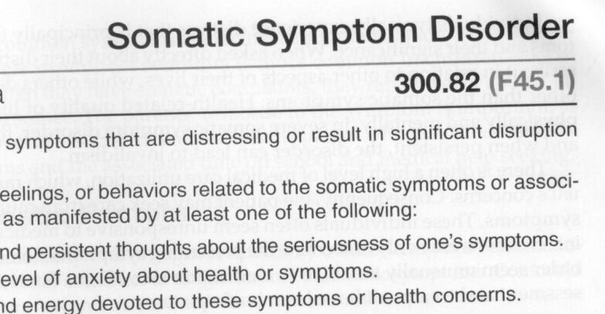
In the DSM-5, Somatic symptom disorder is already cross-walked to ICD-9 code 300.82 (ICD-10-CM F45.1):

+++
DSM-5 (Page 311)

SSDcrosswalk

+++
Given that APA worked with CDC on the cross-walk between the new DSM-5 disorder terms and ICD-9/ICD-10-CM equivalent codes, NCHS’s Director will likely rubber stamp the APA’s proposals for insertion of SSD and a number of other new DSM-5 categories.

Nevertheless, I shall be putting in another objection before the June 20 deadline and I hope all stakeholders with concerns will strongly oppose the incorporation of this controversial new disorder construct into ICD-10-CM.

The deadline for comments on proposals requested at the March meeting is June 20th.

Send comments, by email, to NCHS to nchsicd9CM@cdc.gov

+++
Not a small thing

Between 2010 and 2012, the SSD Work Group attracted considerable opposition across three stakeholder reviews to its radical proposals for a replacement for the somatoform disorders.

In late 2012 and early 2013, we saw a good deal of “outrage” in comments to articles by Allen Frances and myself here and here at Psychology Today and here in the BMJ, in response to the cavalier decision by the Task Force to barrel through with the SSD Work Group’s poorly validated disorder construct.

But I see little evidence of sustained opposition from U.S. professionals and patients over the September and March NCHS/CMS update and revision meeting proposals to insinuate SSD into ICD-10-CM.

At the moment, the proposal is for inserting SSD as an inclusion term under an existing category – not to create a unique code for SSD and not to replace the existing framework with SSD. At the September meeting, CDC’s Donna Pickett said:

“…And just to complete the package, there are other Tabular List proposals that appear on Page 45 and 46 that we would also invite your comments on. And again, with some of the terminology changes that Dr Regier has described the intent here is to make sure that if those terms are being used, that they do have a home somewhere within ICD-10-CM to facilitate people looking these up. So we invite comments…”

Sounds almost cosy. But if NCHS does rubber stamp the addition of Somatic symptom disorder to ICD-10-CM, it could leverage future replacement of the existing Somatoform disorders categories with this new, single diagnostic construct, bringing ICD-10-CM’s framework in line with DSM-5.

There are implications for ICD-11, too.

Once SSD is inserted into ICD-10-CM, the presence of this term within the U.S. modification of ICD-10 may make it easier for ICD-11 Revision Steering Group to justify approving proposals to replace the existing ICD-10 Somatoform disorders categories with a single, new disorder construct that would mirror SSD’s defining characteristics – its positive psychobehavioural features, its simplified criteria, its de-emphasis on “medically unexplained” and facilitate harmonization between ICD-11 and DSM-5 disorder terms.

Christopher Chute, Mayo, chairs the ICD-11 Revision Steering Group. Chute has suggested that following implementation, ICD-10-CM might be brought gradually in line with ICD-11 through a series of annual updates, for smoother transition to ICD-11-CM.

Inserting the SSD term into ICD-10-CM paves the way for disorder construct congruency between DSM-5, ICD-10-CM, ICD-11, and eventually, the ICD-11-CM modification.

Send comments, by email, by June 20, to NCHS at nchsicd9CM@cdc.gov


CMS posts files for ICD-10-CM Release for 2015

On May 15, CMS posted the ICD-10 Procedure Coding System (ICD-10-PCS) files for 2015, download files here:

On May 19, CMS posted the ICD-10-CM and GEMs files for 2015:

These files (some of which are large ZIP files) include:

2015 Code Descriptions in Tabular Order

2015 Code Tables and Index – Updated 5/22/14 (includes Tabular List, and Index in PDF format)

2015 ICD-10-CM Duplicate Code Numbers

2015 Addendum

2015 General Equivalence Mappings (GEMs) – Diagnosis Codes and Guide

2015 Reimbursement Mappings – Diagnosis Codes and Guide

According to the Addendum, “There were no changes to the 2014 ICD-10-CM, therefore there are no 2015 ICD-10-CM Addenda.”

These ICD-10-CM Release for 2015 files are not yet available on the CDC site but when they are posted, they should be accessible from this page: http://www.cdc.gov/nchs/icd/icd10cm.htm


Further reading
Justina Pelletier: The Case Continues Phil Hickey, April 4, 2014
Objection to proposal to insert DSM-5′s Somatic symptom disorder into ICD-10-CM Suzy Chapman, Public submission, ICD-9-CM/PCS Coordination and Maintenance Committee Meeting September 18-19, 2013
Somatic Chapter Drops Centrality Of Unexplained Medical Symptoms Psychiatric News, Mark Moran, March 1, 2013
Somatic Symptoms Criteria in DSM-5 Improve Diagnosis, Care David J Kupfer, MD, Chair, DSM-5 Task Force, defends the SSD construct, Huffington Post, February 8, 2013
The new somatic symptom disorder in DSM-5 risks mislabeling many people as mentally ill Allen Frances, MD, BMJ 2013;346:f1580 BMJ Press Release PDF for full text
Somatic Symptom Disorder could capture millions more under mental health diagnosis Suzy Chapman, May 26, 2012
Mislabeling Medical Illness As Mental Disorder Allen Frances, MD, Psychology Today, DSM 5 in Distress, December 8, 2012
Why Did DSM 5 Botch Somatic Symptom Disorder? Allen Frances, MD, Psychology Today, Saving Normal, February 6, 2013
New Psych Disorder Could Mislabel Sick as Mentally Ill Susan Donaldson James, ABC News, February 27, 2013

12 Point Skinny on ICD-11

Post #305 Shortlink: http://wp.me/pKrrB-3Rm

Update at May 15, 2014: Somatization disorder, listed as a uniquely coded child category under parent, Bodily distress disorder, has been removed from the Beta draft Linearizations since publishing the update on May 9. Instead, the ICD-10 legacy terms, somatoform disorders and Somatization disorder are both now listed under Synonyms to Bodily distress disorder and also listed as Index Terms. The three severity specifiers for BDD, (Mild, Moderate, Severe) remain.

Neurasthenia, listed as a child category under parent, Mental and behavioural disorders, has been removed from the Linearizations and is not listed in the PDF for the print version of the Alphabetical Index.

Update at May 9, 2014: Three uniquely coded severity specifiers (Mild, Moderate, Severe) have now been added back as child categories to Bodily distress disorder but Somatization disorder remains as a uniquely coded child category to BDD.

As no new posts will be added to the site from April, I leave you with my 12 Point Skinny on ICD-11 first published in February.

The version below has been updated to reflect changes since February.

A brief summary of how things stand in the Beta drafting platform at March 31, 2014.

If reposting, please repost unedited, with the publication date and source URL:

12 Point Skinny on ICD-11

Dx Revision Watch’s 12 Point Skinny on ICD-11:

1. The ICD-10 terms, PVFS, BME, and CFS, are not currently displaying in the public version of the Beta drafting platform under any chapters, either as ICD Title terms, or as Inclusion terms to ICD Title terms, or under Synonyms to ICD Title terms.

2. On Feb 12, 2014, @WHO Twitter admin stated: “Fibromyalgia, ME/CFS are not included as Mental & Behavioural Disorders in ICD-10, there is no proposal to do so for ICD-11”. This position was additionally confirmed by Mr Gregory Härtl, Head of Public Relations/Social Media, WHO.

3. Other than this position, WHO/ICD Revision has yet to clarify how it does propose to classify PVFS, BME, and CFS within ICD-11, in terms of intentions for specific chapter locations, parent classes (including any proposals to assign any of these terms to multiple parentage), hierarchies, Definitions text and other “Content Model” descriptive parameters.

4. Since June 2013, multiple requests have been made to WHO/ICD Revision to account for the current absence of these terms from the public version of the Beta draft and to issue a statement clarifying intent. On March 18, 2014, a joint letter was sent to key WHO/ICD Revision personnel [1].

5. Two separate working groups have been appointed by WHO/ICD Revision that are advising on the revision of the Somatoform disorders categories.

6. In 2012, two sets of emerging proposals were published – one for a tentative construct called Bodily distress disorder (BDD), and one for a divergent construct, tentatively called Bodily stress syndrome (BSS).

7. In 2012, the emerging proposals by the ICD-11 Expert Working Group on Somatic Distress and Dissociative Disorders (the Gureje led S3DWG sub working group) for its Bodily distress disorder (BDD) concept had described an SSD-like construct with criteria based on psychobehavioural responses [2].

8. In 2012, the emerging proposals by the PCCG (the Goldberg led ICD-11 Primary Care Consultation Group) presented an alternative Bodily stress syndrome (BSS) construct [3].

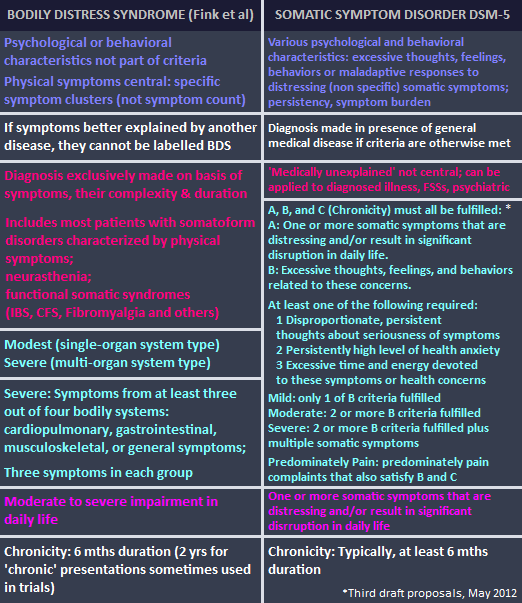
This proposal drew heavily on Fink et al’s Bodily Distress Syndrome (BDS) disorder model, requiring symptom patterns from body systems to meet the criteria. But the PCCG proposed to incorporate some SSD-like psychobehavioural responses, which do not form part of Fink’s BDS criteria – attempting a mash-up between two divergent constructs or disorder models [4].

9. The Definition for Bodily distress disorder (BDD) that is inserted into the Beta drafting platform [5] is based on the disorder description wording in the 2012 Gureje, Creed BDD paper, which had described an SSD-like construct [3].

10. BDD had a child category, Severe bodily distress disorder. This is now removed from the public Beta draft. Instead, ICD-10’s Somatization disorder has been restored to the draft linearizations as the child category to parent, Bodily distress disorder. Additionally, ICD-10’s F48.0 Neurasthenia has been restored to the draft, under parent, Mental and behavioural disorders.

Update at May 9, 2014: Three uniquely coded severity specifiers (Mild, Moderate, Severe) have now been added back as child categories to Bodily distress disorder but Somatization disorder remains as a uniquely coded child category to BDD.

In the ICD-11 Beta, it had previously been proposed that seven ICD-10 Somatoform disorders categories (F45.0 – F45.9) plus F48.0 Neurasthenia would be replaced by this single new disorder construct, Bodily distress disorder (BDD) [2].

But how these two (now apparently proposed to be restored) ICD-10 legacy categories, Somatization disorder and Neurasthenia, are currently envisaged to function within a new disorder framework to replace the Somatoform disorders categories remains unclarified.

Update at May 15, 2014: Somatization disorder, listed as a uniquely coded child category under parent, Bodily distress disorder, has been removed from the Beta draft Linearizations since publishing the update on May 9. Instead, the ICD-10 legacy terms, somatoform disorders and Somatization disorder are both now listed under Synonyms to Bodily distress disorder and also listed as Index Terms. The three severity specifiers for BDD, (Mild, Moderate, Severe) remain.

Neurasthenia, listed as a child category under parent, Mental and behavioural disorders, has now been removed from the Linearizations and is not listed in the PDF for the print version of the Alphabetical Index.

11. Without full disorder descriptions, criteria, inclusions, exclusions, differential diagnoses etc. or field test protocol, there is insufficient information in the public version of the Beta draft to determine the characteristics and criteria for whatever construct is being progressed to field tests; or to determine whether the initial field testing protocol represents the construct favoured by the Revision Steering Group (RSG); or to determine whether the two advisory groups and the RSG have reached consensus over the revision of the Somatoform disorders categories.

12. ICD-11 Beta is a work in progress, updated daily, and not finalized. Proposals for new categories are subject to ongoing revision and refinement, to field test evaluation, may not survive field testing, and are not approved by ICD Revision or WHO.

+++
References for 12 Point Skinny on ICD-11:

1. Joint letter signed by Annette Brooke MP, Chair, All Party Parliamentary Group on M.E., Countess of Mar, Chair, House of Lords-led group Forward ME, Dr Charles Shepherd, Medical Adviser of the ME Association, Sonya Chawdhury, Chief Executive, Action for M.E.
http://www.actionforme.org.uk/Resources/Action%20for%20ME/Documents/get-informed/who-icd-11-letter-17-3-14-sc.pdf

2. Creed F, Gureje O. Emerging themes in the revision of the classification of somatoform disorders. Int Rev Psychiatry. 2012 Dec;24(6):556-67. http://www.ncbi.nlm.nih.gov/pubmed/23244611 [Full text behind paywall]

3. Lam TP, Goldberg DP, Dowell AC, Fortes S, Mbatia JK, Minhas FA, Klinkman MS: Proposed new diagnoses of anxious depression and bodily stress syndrome in ICD-11-PHC: an international focus group study. Fam Pract Feb 2013 [Epub ahead of print July 2012]. http://www.ncbi.nlm.nih.gov/pubmed/22843638. Full free text: http://fampra.oxfordjournals.org/content/30/1/76.long

4. Graphic comparing Fink et al’s BDS criteria with DSM-5’s SSD

5. ICD-11 Beta drafting platform public version: Bodily distress disorder: http://apps.who.int/classifications/icd11/browse/f/en#/http%3a%2f%2fid.who.int%2ficd%2fentity%2f767044268

Caveats: The ICD-11 Beta drafting platform is not a static document: it is a work in progress, subject to daily edits and revisions, to field test evaluation and to approval by Topic Advisory Group Managing Editors, the ICD Revision Steering Group and WHO classification experts.


Moving on

Post #304 Shortlink: http://wp.me/pKrrB-3QY

I am still seeing considerable confusion, misunderstanding and misreporting around what can and what cannot be determined from the public version of the ICD-11 Beta drafting platform on emerging proposals for revision of ICD-10′s Somatoform disorders.

If writing about complex classificatory revision processes, I suggest you first familiarize yourselves with how the several ICD-11 Beta drafting platform linearizations function and interrelate; that you inform yourselves about the proposals of both of the ICD-11 working groups charged with making recommendations for potential revision of the ICD-10 Somatoform disorders, including obtaining and scrutinizing key journal papers, reports and presentations on emerging proposals published by members of both working groups; and that for comparison, you have an understanding of the existing F45 Somatoform disorders framework and the disorder descriptions and criteria for the categories located under this section of ICD-10, and that you are also familiar with the construct and criteria for DSM-5’s Somatic symptom disorder, in order that you can provide evidence based, accurate and up to date information and analysis, within the limitations of what information is public domain.

Reiteration of misinformation and inaccurate reporting on blogs, websites and social media platforms helps no-one. It devalues patient and carer concerns; it undermines the work of advocates committed to providing accurate, referenced and timely information; it panics patients and provokes knee jerk “activism” and “slacktivism.”

It has become clear to me, down the years, that the majority of ME patients are not interested in evidence based reporting.

I am wasting my time.

For those who have listened, thank you. The site will remain online as a resource.

Suzy Chapman for Dx Revision Watch

“He that reads and grows no wiser seldom suspects his own deficiency, but complains of hard words and obscure sentences, and asks why books are written which cannot be understood.”  Samuel Johnson

Global creep of DSM-5’s Somatic symptom disorder

Post #303 Shortlink: http://wp.me/pKrrB-3Qq

Update at April 14, 2014:

Written response (April 10, 2014) from Independent Hospital Pricing Authority (IHPA) to request for clarification regarding the term ‘Somatic symptom disorder’ and Australia’s clinical modification of ICD-10, ICD-10-AM:

PDF: IHPA response re SSD and ICD-10-AM


As previously posted:

In the previous posting Update on proposal to add DSM-5′s Somatic symptom disorder to ICD-10-CM I reported that NCHS is preparing to rubber stamp proposals to insert Somatic symptom disorder into the U.S.’s forthcoming clinical modification of ICD-10.

Comments/objections to Diagnosis Agenda proposals submitted at the March meeting need to be sent by email to NCHS at nchsicd9CM@cdc.gov by June 20th.

1] According to this Australian legislative document:

http://www.comlaw.gov.au/Details/F2014L00304

Australian Government, Statement of Principles concerning somatic symptom disorder No. 24 of 2014

for the purposes of the Veterans’ Entitlements Act 1986 and Military Rehabilitation and Compensation Act 2004

“Somatic symptom disorder attracts ICD-10-AM code F45.1.”

For the purposes of the Statement of Principles:

“ICD-10-AM code” means a number assigned to a particular kind of injury or disease in The International Statistical Classification of Diseases and Related Health Problems, 10th Revision, Australian Modification (ICD-10-AM), Eighth Edition, effective date of 1 July 2013, copyrighted by the Independent Hospital Pricing Authority, and having ISBN 978-1-74128-213-9;”

The Australian ICD-10-CM, Eighth Edition, July 2013 is not in the public domain. As I do not have access to a copy, I have contacted the relevant body for clarifications.

I have asked whether Somatic symptom disorder has been added to the Eighth Edition of ICD-10-AM as an Inclusion term to F45.1 Undifferentiated somatoform disorder in the Tabular List and Alphabetical Index.

Or, whether this legislative document relies on the ICD cross-walk codes as published in the DSM-5 in May 2013 for the cross-walk between DSM-5 disorders and the disorders in the U.S.’s ICD-9-CM and forthcoming ICD-10-CM.

Or, whether the legislative document relies on a cross-walk between DSM-5 disorders and ICD-10-AM codes developed specifically in relation to the ICD-10-AM Eighth Edition, July 2013.

I will update this post when I have received clarification.

According to this page: http://nccc.uow.edu.au/icd10am-achi-acs/overview/icd10am/index.html

“[Australia’s] ICD-10-AM has also enjoyed more widespread use, having been assessed, found suitable and adopted by many other countries, including: New Zealand, Ireland, Singapore, Slovenia.”

I am unable to confirm how many countries that have adopted ICD-10-AM have migrated from earlier editions to the July 2013 edition or are preparing to migrate to the most recent edition.

Other clinical modifications (CMs) of ICD-10:

Canada (ICD-10-CA): The most recent edition of ICD-10-CA is the 2009 edition Volume One: Tabular List 2009. Canada is anticipated to adopt a CM of ICD-11 before the U.S. does, but in meantime, an updated edition of ICD-10-CA might be anticipated, especially given the recent extension to the ICD-11 development timeline. Canadians will need to be alert to the potential for addition of SSD as an inclusion term to the next edition of ICD-10-CA.

Germany (ICD-10-GM): There is an ICD-10-GM version for 2014. There is no SSD under F45.x or under any other code, but watch for any updated versions released prior to transition to a CM of ICD-11.

Thailand (ICD-10-TM): There does not appear to be a more recent version of the Thai clinical modification than the online version for 2007, but watch for SSD in any updated versions prior to potential transition to a CM of ICD-11. ICD-10-TM Online version for 2007.

ICD-11 Beta drafting platform:

There is no documentary evidence of a proposal to add SSD, per se, to ICD-11. However, the wording for the Definition for Bodily distress disorder, as it currently stands in the Beta drafting platform, is drawn from the Gureje, Creed 2012 paper on the S3DWG sub working group’s emerging proposals for ICD-11 [1].

The paper described a simplified disorder framework – a construct into which DSM-5′s Somatic Symptom Disorder could be comfortably integrated, thus facilitating harmonization between the respective ICD-11 and DSM-5 disorder construct and criteria replacements for the Somatoform disorders classifications.

As with DSM-5′s SSD, for the emerging proposals for BDD, the focus was not on symptoms counts, or on strict symptom patterns or clusters from one or more body systems, or on whether symptoms were determined as being “medically explained” or “medically unexplained,” but on the perception of disproportionate or maladaptive psychobehavioural responses to, or excessive preoccupation with any troublesome chronic bodily symptom(s). And that in doing away with the “unreliable assumption of its causality” the diagnosis of BDD would not exclude the presence of a co-occurring physical health condition – which is very close to SSD’s defining characteristics.

1. Creed F, Gureje O. Emerging themes in the revision of the classification of somatoform disorders. Int Rev Psychiatry. 2012 Dec;24(6):556-67. http://www.ncbi.nlm.nih.gov/pubmed/23244611 [Abstract. Full text behind paywall]

2] On the Patient.co.uk site, a peer reviewed article on Somatic symptom disorder:

http://www.patient.co.uk/doctor/somatic-symptom-disorder

This article is not a recommendation and it draws heavily on the DSM-IV and current ICD-10 Somatoform disorders framework, criteria and literature. Though it does highlight that DSM-5 has a new, simplified framework and reformulated criteria that rely less on strict patterns of somatic symptoms and more on the degree to which a patient’s thoughts, feelings and behaviours about their symptoms are considered disproportionate or excessive; that for DSM-5, “medically unexplained” is de-emphasized – symptoms may or may not be associated with another medical condition and patients with organic comorbidities such as heart disease, osteoarthritis or cancer, who would have previously been excluded under DSM-IV, can now be included in the diagnosis of SSD.

There is little published research examining the reliability, utility, epidemiology, clinical characteristics or treatment of Somatic symptom disorder as a diagnostic construct and none of the article’s references are for papers specifically using the new Somatic symptom disorder criteria.

3] Somatic symptom disorder in a BMJ Rapid Response:

Rapid Response to: Clinical Review, Fibromyalgia by Anisur Rahman, Martin Underwood, Dawn Carnes [Full text for Clinical Review behind paywall]

http://www.bmj.com/content/348/bmj.g1224/rr/689294

Rapid Response: Fibromyalgia: an unhelpful diagnosis for both patients and doctors [Full text for Rapid Response accessible]

Christopher Bass, consultant in liaison psychiatry, John Radcliffe Hospital , Oxford OX3 9DU

Dr Max Henderson, senior lecturer in Epidemiology and Occupational psychiatry, Inststitute of psychiatry, Kings College London 

According to the authors, fibromyalgia ( coded in ICD-10 under Chapter XXIII Diseases of the musculoskeletal system and connective tissue, at M79.7 ) is more appropriately described in terms of “polysymptomatic distress”; “polysymptomatic distress has been recognised as a somatoform disorder, specifically as a somatic symptom disorder or SSD,” and that since “FM overlaps with other disorders with medically unexplained symptoms such as irritable bowel syndrome and chronic fatigue syndrome” it is more appropriate to treat them with multidisciplinary teams within the same specialised service in the general hospital.

4] This commentary by infectious disease specialist, Judy Stone, MD, at Scientific American blogs, mentions concerns around SSD:

Have Pain? Are You Crazy? Rare Diseases Pt. 2

By Judy Stone | February 18, 2014

“It’s all in your head,” patients with unexplained pain or unexpected symptoms often hear…

5] Halifax Somatic Symptoms Disorder Trial

http://clinicaltrials.gov/show/NCT02076867

ClinicalTrials.gov Identifier: NCT02076867

Sponsor: Capital District Health Authority, Canada

The purpose of this study is to compare the effectiveness of Intensive Short-Term Dynamic Psychotherapy (ISTDP) plus Medical Care As Usual (MCAU) compared to MCAU for Somatic Symptom and Related Disorders (SSRD). Consenting patients presenting to the emergency department with suspected SSRD will be randomly allocated to receive either 8 weekly individual sessions of ISTDP or to an 8-week wait list followed by ISTDP. MCAU including emergency department and/or family doctor consultation is available throughout trial participation. The primary outcome measure is participant self-reported somatic symptoms at week 8.


Update on proposal to add DSM-5’s Somatic symptom disorder to ICD-10-CM

Post #302 Shortlink: http://wp.me/pKrrB-3PE

Update at April 5, 2014: Implementation of the U.S.’s forthcoming adaptation of ICD-10, ICD-10-CM, has been kicked further down the road to no earlier than October 1, 2015.

Bill H.R. 4302, known as the PAM Act (Protecting Access to Medicare Act), was signed into law by President Obama on April 1, 2014. This means that the U.S. cannot now transition from ICD-9-CM to ICD-10-CM on October 1, 2014. CMS has yet to issue a full statement, update its webpages and issue guidelines for a new implementation date. No statement has yet been made concerning the impact of this legislation on the timeline for the ICD-10-CM update process during a partial code freeze.

Update at April 5, 2014: The Summary of the March 19–20, 2014 meeting of the ICD-10-CM/PCS Coordination and Maintenance Committee meeting has now been posted

Lots of “outrage” over SSD and DSM-5 but I see little evidence of sustained “outrage” over proposals to add SSD as an Inclusion term to the U.S.’s ICD-10-CM.

If NCHS rubber stamps the addition of Somatic Symptom Disorder to ICD-10-CM it could leverage the future replacement of the existing Somatoform disorders categories with this new, poorly validated single SSD diagnostic construct, bringing ICD-10-CM in line with DSM-5.

There are implications for ICD-11, too.

Once SSD is inserted into ICD-10-CM, the presence of this term within the U.S. adaptation of ICD-10 may make it easier for ICD-11 Revision Steering Group to justify proposals to replace the existing ICD-10 Somatoform disorders categories with a single, new ICD construct contrived to incorporate SSD-like characteristics and facilitate harmonization between ICD-11 and DSM-5 disorder terms and diagnostic criteria.

+++
This post updates on proposals at the March meeting of the ICD-10-CM/PCS Coordination and Maintenance Committee to add DSM-5’s controversial new Somatic symptom disorder as an Inclusion term to ICD-10-CM.

But first, a necessary recap of the September 2013 meeting:

ICD-10-CM/PCS Coordination and Maintenance Committee meetings provide a public forum to discuss proposed changes to the U.S.’s forthcoming ICD-10-CM and ICD-10-PCS, scheduled for implementation on October 1, 2014 to be confirmed.

The public meetings, which are co-chaired by representatives for CMS and NCHS, take place in March and September and are followed by public comment periods.

The fall meeting of the ICD-10-CM/PCS Coordination and Maintenance Committee was held on September 18–19, 2013.

On Day Two of the September meeting, American Psychiatric Association’s Darrel Regier, MD, had proposed six new DSM-5 disorders for inclusion in ICD-10-CM.

On Page 45 and 46 of the Diagnosis Agenda, under Additional Tabular List Inclusion Terms for ICD-10-CM, a number of other changes to specific Chapter 5 F codes had also been proposed. These were introduced en masse, by CDC’s Donna Picket. (Reached on Day Two, at 1:22:21 in from the start of Videocast Four.)

This section of the Diagnosis Agenda included the proposals to add the new DSM-5 disorders: Somatic symptom disorder (proposed to Add as an Inclusion term to F45.1 Undifferentiated somatoform disorder) and Illness anxiety disorder (proposed to Add as Inclusion term to F45.21 Hypochondriasis) to ICD-10-CM’s Chapter 5 codes.

(F45.1 and F45.21 are the ICD-10-CM codes to which these two new APA disorders are already cross-walked in the DSM-5.)

ICD10CM 4

Source: Page 45, Diagnosis Agenda (Topic Packet), September 18–19, 2013 ICD-10-CM/PCS Coordination and Maintenance Committee Meeting

+++
Videocasts of the entire September 2013 meeting proceedings, Diagnosis Agenda (Topic Packet), Procedural Agenda, Meeting materials etc can be found in Dx Revision Watch Post #277.

Note: there was no proposal at the September 2013 meeting to create a unique code for either Somatic symptom disorder (SSD) or Illness anxiety disorder, for either 2014 or October 1, 2015 implementation, and no proposal that Somatic symptom disorder should replace or subsume any of the existing ICD-10-CM F45.x Somatoform disorders. Note also, these proposals are specific to the forthcoming U.S. clinical modification of ICD-10.

In relation to the section of the Agenda on Pages 45 and 46, CDC’s, Donna Picket, had stated:

1:22:21 in: Diagnosis Agenda: “Additional Tabular List Inclusion Terms for ICD-10-CM”
Donna Pickett (CDC): “…And just to complete the package, there are other Tabular List proposals that appear on Page 45 and 46 that we would also invite your comments on. And again, with some of the terminology changes that Dr Regier has described the intent here is to make sure that if those terms are being used, that they do have a home somewhere within ICD-10-CM to facilitate people looking these up. So we invite comments. We’re showing the Tabular List proposed changes; however, there obviously would be associated Alphabetic Index changes with that which we didn’t show just to keep the package a little bit smaller…”
Source: [Unofficial transcription from Video Four, September 2013 ICD-9-CM C & M Committee meeting.]

There were no questions or comments from the floor or by phone link on any of the proposals listed on Pages 45 and 46 under “Additional Tabular List Inclusion Terms for ICD-10-CM” and no discussion or queries on any of the individual proposals listed under under this section of the Agenda between the meeting co-chairs and APA’s, Dr Regier.

NCHS’s decision on proposals to add Somatic symptom disorder (SSD) and Illness anxiety disorder as Inclusion terms to ICD-10-CM Tabular List Chapter 5, and to also add to the Index, isn’t known and may not be evident until the next ICD-10-CM Addenda is released, later this year, or until the Final Addenda released.

Some of the objections that were submitted last year to the proposal to add Somatic symptom disorder (SSD) as an Inclusion term in ICD-10-CM at the September 2013 meeting are collated on Dx Revision Watch here.

+++

March 2014 meeting of the ICD-10-CM/PCS Coordination and Maintenance Committee

This meeting took place on March 19–20, 2014. I was unable to attend as I live in the UK.

The ICD-9-CM and ICD-10-CM Timeline and Diagnosis and Procedure Codes Agenda (Topic Packet) can be found here, on the CDC website:

Proposals (Topic Packet) March 19-20, 2014

Procedure Agenda, Meeting Materials and Handouts can be downloaded from Zip files here, on the CMS website:

Meeting Materials March 19-20, 2014

A Summary Report of the Diagnosis part of the meeting is scheduled to be posted on the NCHS website, in June.

A Summary Report of the Procedure part of the meeting is scheduled to be posted on the CMS website, in June.

April 17, 2014: Deadline for receipt of public comments on proposed procedure code revisions discussed at the March 19, 2014 ICD-10 Coordination and Maintenance Committee meeting for implementation on October 1, 2014.

June 20, 2014: Deadline for receipt of public comments on proposed code revisions discussed at the March 19–20 meeting for implementation on October 1, 2015.

ICD-10-CM is currently subject to a partial code freeze. During the freeze, the public will be asked to comment on whether or not a proposal should be approved, and if not, why; and whether requests for new diagnosis or procedure codes should be created based on the criteria of the need to capture a new technology or disease. Any code requests that do not meet the criteria will be evaluated for implementation within ICD-10-CM on and after October 1, 2015 to be confirmed once the partial freeze has lifted.

Comments on the diagnosis proposals presented at the ICD Coordination and Maintenance Committee meeting should be sent, preferably by email, to the following address by June 20th deadline: nchsicd9CM@cdc.gov

+++

The Two Day proceedings were streamed live and can be watched on YouTube:

Video One: Day One: Morning Session: Procedural Codes: 2014 Mar 19th, FY 2014 ICD-10 Coordination and Maintenance Committee

+++
Video Two: Day One: Afternoon Session: Procedural Codes: 2014 Mar 19th, FY 2014 ICD-10 Coordination and Maintenance Committee

+++
Video Three: Day Two: Diagnosis Codes: 2014 Mar 20th, FY 2014 ICD-10 Coordination and Maintenance Committee

+++
Page 64, Topic Packet: http://www.cdc.gov/nchs/data/icd/Topic_packet_3_19_2014.pdf

[Extract]

Chapter 5 Addenda

The American Psychiatric Association (APA) proposes the following addenda changes to the ICD-10-CM Tabular and Index, specifically to Chapter 5, Mental, Behavioral and Neurodevelopmental disorders (F01-F99).

The APA indicates that these revisions are necessary because DSM-5 contains several new diagnoses, as well as new disorder titles, that do not map well to any existing ICD-10-CM codes.

Because of this, they are proposing numerous new index entries and tabular inclusion terms to ensure that coders can correctly identify the codes to use. The APA proposes that these changes will also ensure that new DSM-5 disorder titles correspond to a valid ICD-10-CM code.

Many of the changes in the proposed addenda relate to the reconceptualization of the substance use disorders from having separate disorder names and codes for substance abuse and dependence. However, extensive scientific evidence was assembled to show that, rather than existing as two separate disorders, these conditions exist on a spectrum that the APA has now conceptualized as ranging from mild to moderate to severe. In order to make the closest approximations with existing ICD-10-CM codes, it is noted that codes for mild substance use disorders correspond to the abuse codes and codes for moderate and severe substance use disorders correspond to dependence codes. The APA may recommend changes in the structure and names of ICD-10-CM substance related disorders, in the future, however at the present time they are only recommending the addition of the new terminology as inclusion terms.

The following addenda are proposed for implementation on October 1, 2015

[…]

1:12:12 in from start of YouTube Three: Chapter 5 Addenda Proposed Tabular Modifications.

1:12:12 Beth Fisher (CMS): Introduces proposals for [Tabular] modifications from APA for Chapter 5. These are all Addenda type changes because [ICD-10-CM is] in code freeze mode, we didn’t have the opportunity to do new codes just yet. Hands podium to Darrel Regier, MD.

1:13:01 Darrel Regier (APA): Mapping DSM-5 to ICD-10-CM codes; Major change to rename Dementias group to Major Neurocognitive Disorders, because including in this group some neurocognitive deficit conditions such as Traumatic brain injury and other neurocognitive disorders that are not inherently some of the neurodegenerative diseases, such as Alzheimer’s, Picks Disease. (Page 64 Diagnosis Agenda)

1:14:02 Darrel Regier (APA): We’ve also introduced [in DSM-5] a Mild neurocognitive disorder that reflects the Mild cognitive impairment, MCI, that is currently in ICD-9, ICD-10…

1:15:06 Darrel Regier (APA): A lot of significant changes to substance abuse disorder area which will require some notes and guidelines…

1:15:27 Darrel Regier (APA): [APA has] a number of new disorders…15 new disorders that are in the DSM-5, but there were 50 disorders that were actually subsumed into a spectrum of conditions that dropped the total number of disorders by something like 28; so you had 50 disorders that collapsed into 22 disorders. Among those, some of the most prominent – Aspergers, Autism, Pervasive developmental disorder NOS, into a single Autism spectrum disorder…assessed on two domains…assessed in terms of level of severity instead of categorical distinctions…

1:17:04 Darrel Regier (APA): Eliminating distinction between abuse and dependence so that on a continuum of Mild, Moderate, Severe…no strict separation between abuse category and dependence…

1:21:00: Question from floor re Alcohol abuse, Alcohol dependence.

1:31:15 Beth Fisher (CDC): Some of these Inclusion terms may have been proposed at September 2013 meeting. (But does not explain the reason for their being resubmitted at the March meeting.)

1:31:34 Beth Fisher (CDC): Begins running through all Addenda Additions.

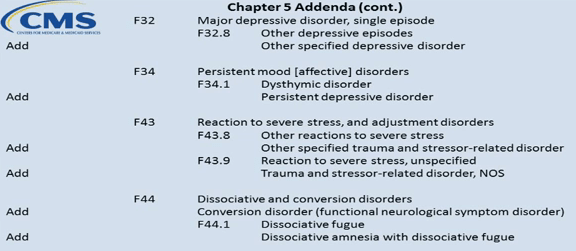
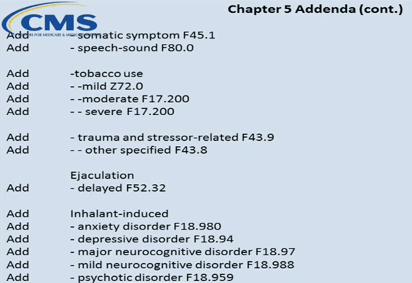
1:31:42 Beth Fisher (CDC): At F44 Dissociative and conversion disorders, Add Conversion disorder, in parenthesis, functional neurological symptom disorder as Inclusion term.

March 2014 C and M meeting Conversion disorder (FNSD)

Source: ICD-10-CM C & M Committee meeting, March 20, 2014, Screenshot Video Three

Note, there was no proposal under these Proposed Tabular Modifications to Add Somatic symptom disorder as Inclusion term to F45.1 Undifferentiated somatoform disorder to the Tabular List. But the proposal to Add Somatic symptom disorder as an Inclusion term to F45.1 Undifferentiated somatoform disorder to the Tabular List and to the Alphabetical Index had been proposed at the September 2013 meeting.

Also, no proposal to Add Illness anxiety disorder to the Tabular List, but again, this had been proposed at the September 2013 meeting (under F45.21), for both the Tabular List and the Index. (Decisions on all four of these September 2013 meeting proposals are unknown.)

1:34:06 Beth Fisher (CMS): Concludes proposed Addenda Additions to Chapter 5 Tabular List.

1:34:12 Beth Fisher (CMS) Moves onto Proposed Index Modifications from Page 82, Topic Packet.

1:42:36 Beth Fisher (CMS) Page 89: [Under main Index term “Disorder”] And then Somatic symptom disorder to F45.1.

Page 89, Diagnosis Agenda Add Somatic symptom disorder

March14 ICD-10-CM Cand M SSD to Index

Source: ICD-10-CM C & M Committee meeting, March 20, 2014, Screenshot Video Three

(No comments from floor regarding proposal to Add SSD to Index, or queries in respect of outcome of September meeting proposals. It was not feasible for me to participate in this meeting via phone link from UK to query.)

Note, there was no proposal under Proposed Index Modifications to add Illness anxiety disorder to the Index, but this proposal had been included in the September 2013 Topic Packet. Why SSD has been resubmitted for consideration for addition to the Index at the March 2014 meeting is unclear, and as I say, the outcome of proposals for the September meeting for both SSD and IAD to be added to both Tabular List and to Index is unknown.

1:44:25 Beth Fisher (CMS): Concludes proposed Addenda Additions to Chapter 5 Alphabetical Index. Invites comments.

1:44:26: Questions from floor regarding Alcohol; Cannabis; Cocaine use; Implications for legal differences between states for use of cannabis. Question regarding Neurodegeneration due to alcohol.

1:50.02 Beth Fisher (CMS): Other Addenda (Ed: presumably Tab and Index Addenda on pp 91–93 and 93–97) were reached on Day One, as there was time, so not being presenting on Day Two. Invites further comments.

1:50.27 Donna Picket (CDC): Adjourns meeting. Reminds floor (and participants via phone link/videocasts and non attendees), to submit comments on Diagnosis proposals by June 20 deadline.

1:51:07 Question from floor: Process question: if these proposals are all approved, when will they be approved and when will they be effective, because we want to notify our members of what codes to use?

1:51:32: Donna Pickett (CDC): All of these being presented were for consideration for implementation in October 1, 2015. Within 2015, we have a huge body of work that has been accumulating during partial code freeze and we’ve encouraged comments to come in about the timing for making the Final Addenda available. The typical time frame we have used in the past is posting [Addenda] in June and proposals to become effective October 1, of that same year. However, issues have arisen because there is a huge body of work and it was mentioned, yesterday, [during Meeting Day One] that the industry may want to have an Addenda released earlier and we invited comment on that, because of the amount of work that would need to go into incorporating the changes into the relevant systems and programs etc. If we were to stay with the traditional process, the Addenda would be made available in June. Meeting concluded.

Comments on the diagnosis proposals presented at the ICD-10-CM Coordination and Maintenance Committee meeting should be sent, preferably by email, to the following address by June 20th deadline: nchsicd9CM@cdc.gov

Joint Open letter to WHO/ICD Revision over classification of absent G93.3 terms for ICD-11 Beta draft

Post #301 Shortlink: http://wp.me/pKrrB-3Pp

Today, Sonya Chowdhury, CEO, Action for M.E., has released an Open Letter to Dr Ra’ad Shakir, Chair, ICD-11 Revision Topic Advisory Group for Neurology.

The Open Letter has been copied to Tarun Dua, Managing Editor, Neurology Topic Advisory Group, WHO; Christopher Chute, Chair, ICD Revision Steering Group, WHO; Dr Geoffrey Reed, Senior Project Officer, International Advisory Group for the Revision of ICD-10 Mental and Behavioural Disorders, ICD-11, WHO; Dr Margaret Chan, Director General, WHO; Dr Robert Jakob, MD, Medical Adviser, WHO.

In the interests of transparency, I have acted in an advisory capacity in the preparation of this joint letter in respect of existing ICD-10 coding, proposals for the G93.3 terms for ICD-11, as they had stood in January 2013, and around Beta drafting platform technicalities.

http://www.actionforme.org.uk/get-informed/news/policy-and-campaigns/open-letter-to-who-over-classification

Open letter to WHO over classification

18 March, 2014

Action for M.E.

Chief Executive Sonya Chowdhury has written an open letter to Dr Ra’ad Shakir, Chair of the World Health Organisation neurology topic advisory group, regarding concerns over the classification of M.E./CFS in the WHO ICD-11.

There has been concern within the M.E. community that the three ICD-10 G93.3 terms, PVFS (Postviral Fatigue Syndrome), BME (Benign Myalgic Encephalomyelitis) and CFS (Chronic Fatigue Syndrome) have been missing from the public version of ICD-11 Beta draft since early 2013.

The letter which has been produced collectively, is also signed by Annette Brooke MP, Chair of the All Party Parliamentary Group on M.E., the Countess of Mar, Chair of the House of Lords-led group Forward ME, and Dr Charles Shepherd, Medical Adviser of the ME Association who, like Sonya, is a member of the APPG secretariat.

The PDF of the joint letter can be read here:

Click to access who-icd-11-letter-17-3-14-sc.pdf

Open PDF here:  Click link for PDF document   Joint Open Letter to WHO/ICD 03.18.14

Text

OPEN LETTER

Dr Ra’’ad Shakir
Chair, WHO Neurology Topic Advisory Group
Chief of Neurology
Imperial College NHS Trust
Charing Cross Hospital
London

17th March 2014

Dear Dr Shakir

Re: WHO ICD-11 Beta draft classification

We are writing, collectively, on behalf of the estimated 250,000 people with M.E./CFS. in the UK.

As you may be aware, there has been considerable discussion and concern expressed within the M.E./CFS community regarding the WHO ICD-11 classification.

As both individuals and organisations, we have received a number of questions and concerns from people affected by M.E./CFS and are therefore writing to seek clarification to enable us to respond accordingly.

We are keen to work collaboratively with others to help empower and support people affected by M.E. and as such, would be very happy to discuss this further with you directly or welcome you to a meeting of either the All Party Parliamentary Group on M.E. or Forward M.E. (a House of Lords-led collaboration).

A summary of our current understanding

The three ICD-10 G93.3 terms, PVFS (Postviral fatigue syndrome), BME (Benign myalgic encephalomyelitis) and CFS (Chronic fatigue syndrome) have been missing from the public version of ICD-11 Beta draft since early 2013.

Prior to early 2013, in the public version of the ICD-11 Beta drafting platform, Chronic Fatigue Syndrome had been listed in the Foundation Component as an ICD Title entity under Diseases of the nervous system, with Benign Myalgic encephalomyelitis specified as an Inclusion term and Postviral fatigue syndrome listed under Synonyms to the Chronic Fatigue Syndrome Title entity. Therefore, all three terms were accounted for within the Beta draft; the terms were then removed from the public version of the Beta draft.

Currently, no entry for any of the terms, CFS, BME or PVFS, under any hierarchy, can be found within any chapter of ICD-11 Beta in the Foundation or the Morbidity and Mortality linearization, the top level category list, the PDF print version or the PDF Alphabetical Index.

The replies that WHO Twitter admin gave to members of the public who enquired about this, stated that there was no proposal to include ME, CFS or Fybromyalgia as Mental and behavioural disorders in ICD-11. They did not say (as Parliamentary Under-Secretary of State for Health, Jane Ellison MP stated in response to a question from Annette Brooke MP) “no proposal to reclassify ME/CFS in ICD-11 ”(¹ Hansard, House of Commons, Oral Answers to Questions, Tuesday, February 25, 2014).

A member of the public also asked on Twitter if there is a proposal to reclassify ME, CFS and Fybromyalgia as “Bodily Distress Disorders” in ICD-11, but no reply was forthcoming from WHO Twitter Admin. Also, they did not confirm a proposal to ‘retain’ in Chapter 07, only not to include in Chapter 05.

Points of clarification requested

1. Under which chapters and parent categories are the following three ICD-10 G93.3 entities currently proposed to be classified within ICD-11:

Chronic Fatigue Syndrome;
Benign Myalgic encephalomyelitis;
Postviral fatigue syndrome?

2. What is the current proposed hierarchy or relationship within ICD-11 between these three entities, in terms of Title term, Inclusion term, Synonym, and which of these three terms are proposed to be assigned a Definition and other “Content Model” parameters?

3. What is the reason for these three terms not currently displaying in the public version of the Beta drafting platform?

4. When does ICD-11 Revision intend to restore these three terms to the public version of the Beta drafting platform?

We very much appreciate you taking the time to respond to our request and look forward to hearing from you.

Yours sincerely

Sonya Chowdhury, CEO, Action for M.E.; Secretariat, All Party Parliamentary Group on M.E.
Annette Brook MP; Chair, All Party Parliamentary Group on M.E.
Countess of Mar; Forward M.E., House of Lords
Dr Charles Shepherd, Medical Adviser, ME Association; Secretariat, All Party Parliamentary Group on M.E.

c.c.Tarun Dua, Managing Editor, Neurology Topic Advisory Group, WHO
Christopher Chute, Chair, ICD Revision Steering Group, WHO
Dr Geoffrey Rees [sic], Project Manager, Mental & Behavioural Chapter, ICD-11, WHO
Dr Margaret Chan, Director General, WHO
Dr Robert Jakob, MD, Medical Adviser, WHO

Action for M.E.
PO Box 2778
Bristol BS1 9DJ