Next meeting of ICD-10-CM Coordination and Maintenance Committee is March 19-20, 2014

Post #282 Shortlink: http://wp.me/pKrrB-3xE

The deadline for receipt of public submissions in response to proposals for updates and changes to ICD-10-CM diagnosis and procedure codes presented at the September 18-19, 2013 meeting of the ICD-9-CM Coordination and Maintenance Committee has now closed.

In 2014, this advisory Committee, which is co-chaired by NCHS and CMS, will be known as the ICD-10-CM Coordination and Maintenance Committee, as there will be no further updates of ICD-9-CM.

A done deal?

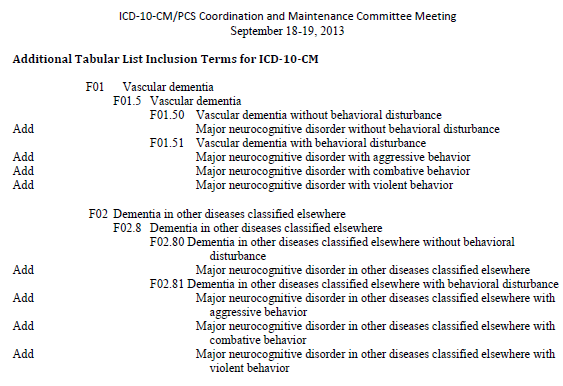
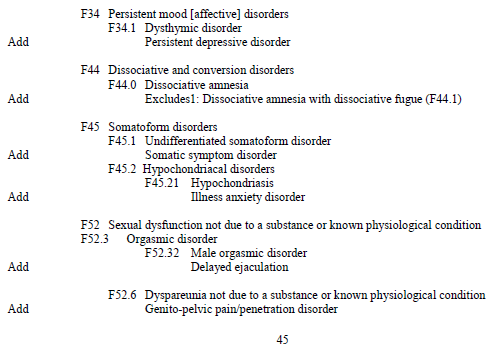
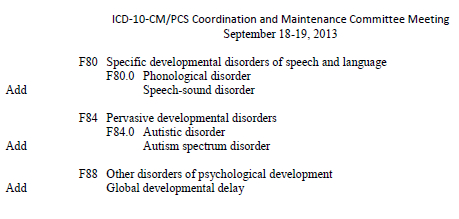
Proposals submitted on behalf of the American Psychiatric Association (APA) and presented at the meeting by APA’s Research Director, Darrel Regier, MD, can be found from Page 32 of the Diagnosis Agenda. Additional proposals for inclusion of new DSM-5 disorder terms within ICD-10-CM Chapter 5 Mental and behavioral disorders can be found on Pages 45-46.

The Summary of the September meeting diagnosis presentations can be found here. Links for the four videocasts of the meeting’s two day proceedings are listed in this Dx Revision Watch post and the Meeting Materials are here.

The Timeline for ICD-9-CM (for the remainder of its life) and for ICD-10-CM is set out from Page 3 of the Diagnosis Agenda.

Some diagnosis proposals at the September 18-19, 2013 meeting were requested for October 2014 implementation and some for 2015 implementation. I shall update this site when the outcomes of the various proposals are published, next year.

There is a lack of clarity over which body has requested the addition of Somatic symptom disorder (SSD) and Illness anxiety disorder as inclusion terms to existing ICD-10-CM codes. It isn’t clear whether these two additional DSM-5 constructs have been proposed for inclusion in ICD-10-CM by the APA or by the NCHS/CMS Committee – if the latter, should we assume these two proposals already have the support of NCHS?

Given APA’s determination to achieve harmonization between the two systems, the outcome of its proposals to insert a handful of new DSM-5 disorders into ICD-10-CM may already be a done deal between APA and NCHS: the Director of NCHS may not need much persuasion to ratify their retrofitting into ICD-10-CM.

Loss of public trust and confidence

If NCHS is planning to rubber stamp insertion into ICD-10-CM of DSM-5’s poorly validated Somatic symptom disorder in response to APA diktat, having conducted no field testing and in the absence of a body of supportive evidence for SSD’s clinical relevance, safety and utility, and with disregard for a high level of public concern, what confidence can the public have that this federal agency is meeting its duty of care towards patient populations and towards the clinicians and allied health professionals who may deploy this proposed new ICD term, in its ethics, integrity and methods and for upholding standards of scientific rigour?

APA may re-present proposals next year

If APA is unsuccessful with any of the additions requested via the September meeting, it is possible that the organization may re-present proposals or modified proposals at the next C & M Committee meeting, scheduled for March 19-20, 2014. There are also other new DSM-5 disorders or changes that APA might potentially propose for incorporation into ICD-10-CM at the March 2014 or the September 2014 meeting, or at some later point.

Only a brief public submission period for March 2014 meeting

March 19-20, 2014 meeting

The deadline for Requestors to submit proposals for consideration for the March meeting agenda is January 17, 2014.

The draft agenda will be posted in February 2014.

Registration is required for those wishing to attend the meeting. Register online between on February 14 – March 14.

The two day meeting is scheduled for March 19 – 20.

Note: the deadline for receipt of comments on the March 19-20, 2014 meeting proposals for both procedure and diagnosis codes and changes is given as April 18. So instead of a couple of months for stakeholder responses, it appears there will only be four weeks or so in which to prepare and submit comments or objections.

I will post the Diagnosis Agenda for the March 2014 meeting as soon as it becomes available and links for the videocasts of the proceedings after the meeting has taken place. (Videocasts now substitute for written transcripts of meeting proceedings.)

Extracts from the Timeline that relate to the publication of additions and changes for ICD-10-CM:

April 2014 Notice of Proposed Rulemaking to be published in the Federal Register as mandated by Public Law 99-509. This notice will include references to the complete and finalized FY 2015 ICD-10-CM diagnosis and ICD-10-PCS procedure codes. It will also include proposed revisions to the MS-DRG system based on ICD-10-CM/PCS codes on which the public may comment. The proposed rule can be accessed here.

June 2014 Final addendum posted on web pages as follows:

Diagnosis addendum – http://www.cdc.gov/nchs/icd/icd10cm.htm
Procedure addendum – http://cms.hhs.gov/Medicare/Coding/ICD10/index.html

October 1, 2014 New and revised ICD-10-CM and ICD-10-PCS codes go into effect along with DRG changes. Final addendum posted on web pages as follows:

Diagnosis addendum – http://www.cdc.gov/nchs/icd/icd9cm_addenda_guidelines.htm
Procedure addendum – http://www.cms.gov/Medicare/Coding/ICD9ProviderDiagnosticCodes/addendum.html

November 2014 Any new ICD-10 codes required to capture new technology that will be implemented on the following April 1 will be announced. Information on any new codes to be implemented April 1, 2015 will be posted on the following websites:

http://www.cms.gov/Medicare/Coding/ICD9ProviderDiagnosticCodes/addendum.html

http://www.cdc.gov/nchs/icd/icd9cm_addenda_guidelines.htm

Which new DSM-5 disorders proposed for inserting into ICD-10-CM are already added to the ICD-11 Beta draft?

Post #280 Shortlink: http://wp.me/pKrrB-3vs

Update to ICD-11 Beta draft at February 3, 2014:

Since my update on January 3, in the ICD-11 Beta draft, Hypochondriasis (illness anxiety disorder) has since been reverted to Hypochondriasis with illness anxiety disorder listed, instead, as an Inclusion term to Hypochondriasis.

Hypochondriasis was subsequently assigned to three parents:

Bodily distress disorders, and psychological and behavioural factors associated with disorders or diseases classified elsewhere; Obsessive-compulsive and related disorders;
Anxiety and fear-related disorders;

At February 3, Hypochondriasis has been removed from parent Bodily distress disorders and is currently assigned dual parentage under:

Obsessive-compulsive and related disorders;
Anxiety and fear-related disorders

Foundation View:

hppt://apps.who.int/classifications/icd11/browse/f/en#/http%3a%2f%2fid.who.int%2ficd%2fentity%2f675329566

Joint Linearization for Mortality and Morbidity Statistics View:

http://apps.who.int/classifications/icd11/browse/l-m/en#/http%3a%2f%2fid.who.int%2ficd%2fentity%2f675329566

The Definition for Hypochondriasis currently displaying in the Beta draft appears to be the legacy Definition, unrevised from ICD-10.

Update to ICD-11 Beta draft at January 3, 2014:

Revision to ICD-11 Beta draft: In the report below, I stated:

ICD-11 public version Beta draft: Illness anxiety disorder is proposed to be dual coded as Hypochondriasis (illness anxiety disorder) under primary parent, Obsessive-compulsive and related disorders and also coded under Bodily distress disorders, and psychological and behavioural factors associated with disorders or diseases classified elsewhere and assigned a unique code.

As the ICD-11 Beta drafting platform now stands, at January 3, 2014, the DSM-5 term “(illness anxiety disorder)” has been removed from the “Hypochondriasis (illness anxiety disorder)” disorder name and the term reverted to Hypochondriasis.

The term “illness anxiety disorder” is now displaying as listed under “Synonyms” to Hypochondriasis in the ICD-11 Beta Foundation View, and listed under “All Index Terms” in the Morbidity Linearization View.

As previously posted on November 6, 2013:

In the previous four posts, I have documented the September 18-19, 2013 meeting of the ICD-9-CM Coordination and Maintenance Committee and reported on American Psychiatric Association (APA) proposals for inserting a number of new DSM-5 terms into the forthcoming US specific ICD-10-CM.

I also set out how public and professional stakeholders can submit comment or objections on any of the proposals requested at this meeting before the November 15 deadline.

At the September meeting, Darrel Regier, MD, APA Director of Research, presented six diagnoses that are new to DSM-5 for inclusion within ICD-10-CM, with proposals for assigning unique new codes to these disorders for October 2015 [1].

Some of the DSM-5 disorders, below, presented for consideration for inclusion in ICD-10-CM are already entered into the ICD-11 Beta drafting platform and in some cases, entered into the draft over a year or more ago.*

*Caveat: The ICD-11 Beta draft is not approved by WHO or WHA. The Beta draft is a work in progress over the next two to three years. The Beta draft is updated on a daily basis: parent terms, category terms, sorting codes and descriptive content are subject to change as chapter reorganization progresses. This post reflects the Beta draft as it stood on November 6, 2013. ICD-11 Beta Draft Caveats

Binge eating disorder (BED)

(Rationale: Page 32, Diagnosis Agenda: Page 6, Diagnosis Presentations Summary)

Proposal for ICD-10-CM for October 1, 2014: add Binge eating disorder (BED) as an inclusion term to F50.8 Other eating disorders.

Proposal for ICD-10-CM for October 1, 2015: that a unique new code is created for F50.81 Binge eating disorder.

ICD-11 public version Beta draft: Binge eating disorder currently proposed to be coded under Feeding and eating disorders and assigned a unique ICD-11 code. No ICD-11 Definition or other “Content Model” descriptive parameters have yet been populated for Binge eating disorder.

——————————

Gender Identity Disorder in Adolescence and Adulthood

(Rationale: Page 34, Page 6, Diagnosis Presentations Summary)

Proposal for ICD-10-CM for October 1, 2014: that ICD-10-CM change the code for Gender identity disorder in adolescents and adulthood to F64.0 and that “gender dysphoria in adolescents and adults” is added as an inclusion term for this entry.

ICD10CM5

Source: September 2013 Diagnosis Agenda, Page 34

[See Page 34 of Diagnosis Agenda for discussion of proposed coding changes.]

——————————

Disruptive mood dysregulation disorder (DMDD)

(Rationale: Page 35, Diagnosis Agenda; Page 6, Diagnosis Presentations Summary)

Proposal for ICD-10-CM for October 1, 2014: add Disruptive mood dysregulation disorder (DMDD) as an inclusion term under F34.8: Other persistent mood [affective] disorders.

Proposal for ICD-10-CM for October 1, 2015: that unique new codes are created at F34.81 Disruptive mood dysregulation disorder and F34.89 Other specified persistent mood disorders.

ICD-11 public version Beta draft: Disruptive mood dysregulation disorder (DMDD) is not currently listed.

——————————

Social (Pragmatic) Communication Disorder

(Rationale: Page 37, Diagnosis Agenda; Page 6, Diagnosis Presentations Summary)

Proposal for ICD-10-CM for October 1, 2014: add Social (Pragmatic) Communication Disorder as an inclusion term under F80.89 Other developmental disorders of speech and language.

Proposal for ICD-10-CM for October 1, 2015: that a unique new code is created at F80.82 Social pragmatic communication disorder.

Excludes1: Asperger’s syndrome (F84.5)

Autistic disorder (F84.0)

ICD-11 public version Beta draft: Social (Pragmatic) Communication Disorder is not currently listed.

——————————

Hoarding disorder

(Rationale: Page 39, Diagnosis Agenda; Page 7, Diagnosis Presentations Summary)

Proposal for ICD-10-CM for October 1, 2014: add Hoarding disorder as an inclusion term to F42 Obsessive Compulsive Disorder.

Proposal for ICD-10-CM for October 1, 2015: that a unique new code is created at F42 for F42.2 for Obsessive Compulsive Disorder and F42.3 for Hoarding Disorder in future revisions. (Ms. Pickett stated that new code proposal starting at F42.2 is due to F42.0 and F42.1 deactivation by WHO.)

F42 Obsessive compulsive disorder

New code F42.2 Mixed obsessional thoughts and acts
New code F42.3 Hoarding disorder
New code F42.8 Other obsessive compulsive disorder
New code F42.9 Obsessive-compulsive disorder, unspecified

ICD-11 public version Beta draft: Hoarding disorder currently proposed to be coded under parent Obsessive-compulsive and related disorders and assigned a unique code. No ICD-11 Definition or other “Content Model” descriptive parameters have yet been populated for Hoarding disorder.

——————————

Excoriation (skin picking) disorder

(APA Rationale: Page 41, Diagnosis Agenda, Page 7, Diagnosis Presentations Summary)

Proposal for ICD-10-CM for October 1, 2014: add Excoriation (skin-picking) disorder as an inclusion term to L98.1 Factitial dermatitis (Dermatology section).

Proposal for ICD-10-CM for October 1, 2015: that a unique new code is created at F42 for F42.4 Excoriation (skin-picking) disorder.

Excludes1: Factitial dermatitis (L98.1)

Other specified behavioral and emotional disorders with onset usually occurring in early childhood and adolescence (F98.8)

ICD-11 public version Beta draft: Excoriation disorder (skin-picking disorder) currently proposed to be coded under Obsessive-compulsive and related disorders under parent Body-focused repetitive behaviour disorders and assigned a unique code. No ICD-11 Definition or other “Content Model” descriptive parameters have yet been populated for Excoriation (skin-picking) disorder.

——————————

Premenstrual dysphoric disorder (PMDD)

(APA Rationale: Page 43, Diagnosis Agenda; Page 7, Diagnosis Presentations Summary)

APA considers that placing PMDD outside the recurrent depressive disorder category is less than optimal for differentiating it from ICD-10-CM N94.3 Premenstrual Tension Syndrome, which is generally less severe than PMDD, and does not require psychiatric treatment. If an alternative code in the F32 series is possible, APA would prefer to modify the code in that section in future revisions.

Proposal for ICD-10-CM for October 1, 2014: add Premenstrual dysphoric disorder as an inclusion term to N94.3 Premenstrual tension syndrome (Chapter 15 Diseases of the genitourinary system).

Proposal for ICD-10-CM for October 1, 2015: that a unique new code is created under Chapter 5 F32.8 Other depressive episodes.

New code F32.81 Premenstrual dysphoric disorder

Excludes1: premenstrual tension syndrome (N94.3)

ICD-11 public version Beta draft: Premenstrual dysphoric disorder (PMDD) currently proposed to be dual coded under Chapter 15 Diseases of the genitourinary system > Premenstrual tension syndrome and also coded under Chapter 5 Depressive disorders and assigned a unique code. A draft ICD-11 Definition has been populated for PMDD but no other ICD-11 “Content Model” descriptive parameters have been populated.

——————————

Somatic symptom disorder and Illness anxiety disorder
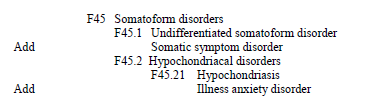
ICD10CM 4

Source: September 2013 Diagnosis Agenda, Page 45

Somatic symptom disorder:

(No rationale provided: Page 45, Diagnosis Agenda) Requester unspecified

Proposal for ICD-10-CM: add Somatic symptom disorder under F45 Somatoform Disorders as inclusion term to F45.1 Undifferentiated somatoform disorder.

ICD-11 public version Beta draft: There is no Somatic symptom disorder in the ICD-11 Beta draft either as a unique new ICD-11 entity code or as an inclusion term or Synonym to an existing ICD-11 code.

For ICD-11 Core version: the current proposal for the F45 Somatoform disorders is for a proposed new construct, Bodily distress disorder, to replace a number of existing ICD-10 categories under Bodily distress disorders, and psychological and behavioural factors associated with disorders or diseases classified elsewhere. Two specifiers: Bodily distress disorder and Severe Bodily distress disorder have yet to be defined or characterized within the Beta draft and no “Content Model” parameters have yet been populated. ICD-11 plans to field test this proposed new ICD-11 construct.

The Definition for Bodily distress disorders, and psychological and behavioural factors associated with disorders or diseases classified elsewhere currently displaying in the Beta draft appears to be the legacy Somatoform disorders Definition imported from ICD-10 and does not reflect any proposed structural reorganization or construct revision for the ICD Somatoform disorders categories.

——————————

Illness anxiety disorder

(No rationale provided: Page 45, Diagnosis Agenda) Requester unspecified

Proposal for ICD-10-CM: add Illness anxiety disorder under F45 Somatoform disorders as inclusion term to F45.21 Hypochondriasis.

ICD-11 public version Beta draft: Illness anxiety disorder is proposed to be dual coded as Hypochondriasis (illness anxiety disorder) under primary parent, Obsessive-compulsive and related disorders and also coded under Bodily distress disorders, and psychological and behavioural factors associated with disorders or diseases classified elsewhere and assigned a unique code.

The Definition for Hypochondriasis (illness anxiety disorder) currently displaying in the Beta draft appears to be the legacy Definition imported from ICD-10 and does not reflect any proposed structural reorganization or construct revision for the ICD Somatoform disorders categories.

Submitting comments

If you have comments or objections to any of the proposals requested at the September ICD-9-CM C & M Committee meeting, the deadline for submissions is November 15, by email, to Donna Pickett: nchsicd9CM@cdc.gov

+++

References for key documents:

1. Article: ICD Codes for Some DSM-5 Diagnoses Updated, Mark Moran, Psychiatric News, October 07, 2013:
http://psychnews.psychiatryonline.org/newsarticle.aspx?articleID=1750103

2. ICD-9-CM/PCS Coordination and Maintenance Committee Meeting September 18-19, 2013:
http://www.cdc.gov/nchs/icd/icd9cm_maintenance.htm#public_meetings

September meeting Proposals [PDF – 342 KB]
http://www.cdc.gov/nchs/data/icd/icd_topic_packet_sept_181913.pdf

September meeting Summary of Diagnosis Presentations PDF file [PDF – 347 KB]:
http://www.cdc.gov/nchs/data/icd/icd_summary_sept_181913.pdf

3. ICD-9-CM/PCS Coordination and Maintenance Committee Meeting Sept 18-19, 2013 meeting materials and four YouTubes of proceedings:
http://www.cms.gov/Medicare/Coding/ICD9ProviderDiagnosticCodes/ICD-9-CM-C-and-M-Meeting-Materials-Items/2013-09-18-MeetingMaterials.html

4. September 19, 2013 Meeting Day Two: ICD-9-CM Coordination and Maintenance Committee Meeting Part 4 videocast:
http://www.youtube.com/watch?v=G-pYdKyr_NE

5. ICD-11 Beta drafting platform (public version):
http://apps.who.int/classifications/icd11/browse/f/en

September ’13 meeting Summary document posted: ICD-9-CM Coordination and Maintenance Committee

Post #279 Shortlink: http://wp.me/pKrrB-3w6

The Summary of Diagnosis Presentations for the September 2013 meeting of the ICD-9-CM Coordination and Maintenance Committee has now been posted on the CDC website.

Deadline for receipt of public comments: November 15, 2013

Comments on the proposals presented at the September meeting should be sent to this email address: nchsicd9CM@cdc.gov

The Summary document and Diagnosis Agenda document can be downloaded here:

http://www.cdc.gov/nchs/icd/icd9cm_maintenance.htm

Summary and Proposals

September 18-19, 2013

Summary Adobe PDF file [PDF – 93 KB] Click link for PDF document   Summary Sept 18-19 2013

http://www.cdc.gov/nchs/data/icd/icd_summary_sept_181913.pdf

Proposals Adobe PDF file [PDF – 347 KB] Click link for PDF document   Topic packet Sept 18-19 2013

http://www.cdc.gov/nchs/data/icd/icd_topic_packet_sept_181913.pdf

According to the instructions for requesters, proposals for a new code should include:

• Description of the code(s)/change(s) being requested

• Rationale for why the new code/change is needed (including clinical relevancy)

• Supporting clinical references and literature should also be submitted.

Proposals should be consistent with the structure and conventions of the classification.

For the proposals to insert Somatic symptom disorder (SSD) and Illness anxiety disorder into ICD-10-CM as inclusion terms under existing F45 Somatoform disorders codes (as listed on Page 45 of the Diagnostic Agenda/Proposals document), no descriptions, no rationales and no supporting clinical references and literature were set out in the Diagnostic Agenda/Proposals document nor presented at the September meeting.

The requesters for each of these additional 17 insertions/changes listed under “Additional Tabular List Inclusion Terms for ICD-10-CM” remain unclear.

If you have comments or objections to the proposed insertion of Somatic symptom disorder (SSD) or in relation to any of the proposals requested via the September ICD-9-CM C & M Committee meeting, please have your submissions in, via email, to Donna Pickett nchsicd9CM@cdc.gov by November 15.

+++

Related posts:

Keep SSD out of ICD-10-CM – November 15 deadline for objections: http://wp.me/pKrrB-3vK

Videos and meeting materials: September 18–19 ICD-9-CM Coordination and Maintenance Committee meeting: http://wp.me/pKrrB-3tV

APA petitions CMS for additions to ICD-10-CM: Deadline for public comment and objections November 15: http://wp.me/pKrrB-3tq

+++

References for key documents and screenshots:

1. Article: ICD Codes for Some DSM-5 Diagnoses Updated, Mark Moran, Psychiatric News, October 07, 2013:
http://psychnews.psychiatryonline.org/newsarticle.aspx?articleID=1757346

2. ICD-9-CM/PCS Coordination and Maintenance Committee Meeting September 18-19, 2013:
http://www.cdc.gov/nchs/icd/icd9cm_maintenance.htm

September meeting Proposals document [PDF – 342 KB]:
http://www.cdc.gov/nchs/data/icd/icd_topic_packet_sept_181913.pdf

3. ICD-9-CM/PCS Coordination and Maintenance Committee Meeting Sept 18-19, 2013 meeting materials and four YouTubes of proceedings:
http://www.cms.gov/Medicare/Coding/ICD9ProviderDiagnosticCodes/ICD-9-CM-C-and-M-Meeting-Materials-Items/2013-09-18-MeetingMaterials.html

4. YouTube Videos from September 18, 2013 Meeting Day One

ICD-9-CM Coordination and Maintenance Committee Meeting (Morning Session) Part 1
http://www.youtube.com/watch?v=Ut3DmV88Dmc

ICD-9-CM Coordination and Maintenance Committee Meeting (Morning Session) Part 2
http://www.youtube.com/watch?v=CAE190sM5AQ

ICD-9-CM Coordination and Maintenance Committee Meeting (Afternoon Session) Part 3
http://www.youtube.com/watch?v=QQOFadq2x6U

September 19, 2013 Meeting Day Two

ICD-9-CM Coordination and Maintenance Committee Meeting Part 4
http://www.youtube.com/watch?v=G-pYdKyr_NE

Keep SSD out of ICD-10-CM – November 15 deadline for objections

Post #278 Shortlink: http://wp.me/pKrrB-3vK

Update: My submission on behalf of Dx Revision Watch can be read here.

The American Psychiatric Association (APA) has proposed the following DSM-5 disorders for inclusion in the forthcoming ICD-10-CM (Pages 32-44, September 2013 Diagnosis Agenda):

Binge eating disorder (BED);
Disruptive mood dysregulation disorder (DMDD);
Social (pragmatic) communication disorder;
Hoarding disorder;
Excoriation (skin picking) disorder;
Premenstrual dysphoric disorder (PMDD)

Additionally, APA has petitioned for revisions to the ICD-10-CM listing for gender dysphoria in adolescents and adults, which is not a new disorder.

On Page 45 and 46 of the Agenda, under Additional Tabular List Inclusion Terms for ICD-10-CM a number of other additions and changes to specific Chapter 5 F codes are being proposed, including the insertion of Somatic symptom disorder (SSD) and Illness anxiety disorder.

+++
A final reminder of the deadline for comments and objections in relation to Somatic symptom disorder

Q: When do objections need to be in by and where should they be sent?

A: Submit objections via email by November 15 to Donna Pickett, CDC: nchsicd9CM@cdc.gov

Q: Can anyone submit objections?

A: Yes. And from as many patient, professional and advocacy groups as possible, particularly from the U.S. but also international objections. Although this concerns potential changes to the draft of the U.S. specific ICD-10-CM there may be implications for ICD-11.

Q: What is being proposed?

A: The American Psychiatric Association has requested 6 new DSM-5 disorders for consideration for inclusion in the forthcoming ICD-10-CM via the September 18-19, 2013 ICD-9-CM Coordination and Maintenance Committee meeting.

APA’s rationales for these requested additions, the coding proposals and timings are set out on Pages 32 thru 44 of the September meeting Diagnosis Agenda.

But on Pages 45-46, under “Additional Tabular List Inclusion Terms for ICD-10-CM”, a further 17 proposals and changes are listed for consideration for addition to the Mental and behavioral disorders F codes.

These include the addition of the new DSM-5 categories, Somatic symptom disorder (SSD) and Illness anxiety disorder, as inclusion terms, under the ICD-10-CM Somatoform disorders section, thus:

ICD10CM 4

Source: September 2013 Diagnosis Agenda, Page 45

The Diagnosis Agenda can be downloaded here: http://www.cdc.gov/nchs/data/icd/icd_topic_packet_sept_181913.pdf

Q: Is “Somatic symptom disorder” being proposed to replace several existing ICD-10-CM Somatoform disorders categories and is a unique new code proposed to be assigned to SSD?

A: No, not in the proposal as it stands in the Diagnosis Agenda document.

The proposal is to add SSD as an inclusion term under F45.1 Undifferentiated somatoform disorder. This is the ICD-10-CM code to which SSD is cross-walked in the DSM-5.

Illness anxiety disorder is being proposed as an inclusion term under F45.21 Hypochondriasis. This is the ICD-10-CM code to which Illness anxiety disorder is cross-walked in the DSM-5.

Q: What should I include in my objection?

A: Responders are being asked by NCHS/CMS to consider the following: Whether you agree with a proposal, disagree (and why), or have an alternative proposal to suggest.

Responders are also being asked to comment on the timing of those proposals that are being requested for approval for October 2014: Does a specific proposal for a new or changed Index entry and Tabular List entry meet the criteria for consideration for implementation during a partial code freeze [6] or should consideration for approval be deferred to October 2015?

And separately, and where applicable, comment on the creation of a specific new code for the condition effective from October 1, 2015. (This is not applicable in the case of SSD or Illness anxiety disorder.)

• Since no timing has been specified for the proposed insertion of the requests on Pages 45-46, I suggest stating that as a poorly validated disorder construct, SSD does not meet NCHS/CMS criteria for “new diseases/new technology procedures, and any minor revisions to correct reported errors in these classifications” and should not be considered for approval during a partial code freeze.

+++
On Day Two of the meeting, APA’s Darrel Regier presented 7 proposals for additions or changes, discussed APA’s rationales for each of these requests, in turn, and fielded any resulting questions or comments from the floor or from the meeting chairpersons.

Rationales, references, specific coding proposals for addition as inclusion terms in October 2014 (and subsequent code modifications in those cases where a unique new ICD code is proposed to be created for the term effective from October 2015) are also set out in the Agenda document (from Page 32).

But there was no presentation on behalf of APA, or by representatives of NCHS or CMS, or by anyone else for the specific proposal to add Somatic symptom disorder (SSD) and Illness anxiety disorder as inclusion terms under the ICD-10-CM Somatoform disorders.

No rationales for their inclusion or references to scientific evidence to support the validity of these new DSM-5 constructs have been published in the Diagnosis Agenda and there was no discussion of these two proposals during the course of the meeting.

The requesters of the proposals set out on Pages 45-46 are not identified, so it is unclear whether these “Additional Tabular List Inclusion Terms” are being proposed by APA or by NCHS/CMS.

• I suggest you comment in submissions on the absence from both the Agenda document and the meeting presentations of rationales and references to enable proper public scrutiny, consideration and informed responses to the proposed inclusion of these two terms.

All that was said about the list of proposals on Pages 45-46 was the following, after Dr Regier had wrapped up his own presentation and handed the podium back to the Co-Chair:

[Unofficial transcription from videocast] Donna Pickett (CDC):

“…And just to complete the package, there are other Tabular List proposals that appear on Page 45 and 46 that we would also invite your comments on. And again, with some of the terminology changes that Dr Regier has described the intent here is to make sure that if those terms are being used, that they do have a home somewhere within ICD-10-CM to facilitate people looking these up. So we invite comments. We’re showing the Tabular List proposed changes; however, there obviously would be associated Alphabetic Index changes with that which we didn’t show just to keep the package a little bit smaller.”

• You might also consider quoting the APA’s disturbing DSM-5 field trial data (see March 2013 BMJ commentary by Prof Allen Frances for data).

• Or quote the SSD work group’s recognition of the shaky foundations and lack of scientific robustness for its new DSM-5 construct:

In its recent paper: Somatic Symptom Disorder: An important change in DSM, the SSD work group acknowledges the “small amount of validity data concerning SSD” and that much “remains to be determined” about the utility and reliability of the specific SSD criteria and its thresholds when applied in busy, general clinical practice, and there are “vital questions that must be answered.” [7]

• There is no body of published research on the epidemiology, clinical characteristics or treatment of the APA’s Somatic symptom disorder construct.

• There is a paucity of rigorous evidence for the validity, safety, reliability, acceptability and utility of the SSD construct when applied to adults and children in diverse clinical settings and across a spectrum of health and allied professionals.

• NCHS/CMS has insufficient scientific basis for the approval of SSD as a valid new disorder construct for inclusion within ICD; has published no independent field trial data and provided no rationale to inform public responses.

+++
Why is it important to submit objections?

If SSD is inserted as an inclusion term to an existing code in ICD-10-CM this may leverage the future replacement of several existing ICD-10-CM Somatoform disorders categories with the SSD construct, to more closely mirror DSM-5.

Inserting SSD as an inclusion term into ICD-10-CM may make it easier for ICD-11 to justify its proposal for a Bodily distress disorder to replace several existing ICD-10 Somatoform disorders categories. Though BDD may not mirror SSD exactly, it is anticipated to incorporate SSD’s characteristics and thereby facilitate harmonization between ICD-11 and DSM-5 disorder terminology.

As set out many times during the three DSM-5 stakeholder reviews and in several papers published earlier this year with Prof Allen Frances, DSM-5 SSD has highly subjective and loose, easily met criteria.

A mental health diagnosis of SSD can be applied as a “bolt-on” to any chronic medical diagnosis – to patients with cancer, diabetes, heart disease, MS, angina, ME and CFS, IBS, FM, chronic pain conditions. It can be applied to adults and children (or to the caregivers of children with chronic illnesses).

SSD may become the dustbin diagnosis into which those with persistent, “medically unexplained” somatic (bodily) symptoms will be shovelled. Patients with rare or hard to diagnose illnesses may find themselves mislabelled with SSD.

Implications for the potential impact on patients for an additional diagnosis of SSD are set out (about half way down the page) in my report Somatic Symptom Disorder could capture millions more under mental health diagnosis and in copies of submissions to the three DSM-5 stakeholder review periods, collated on this site.

Also in Mary Dimmock’s 2012 SSD Call to Action materials.

There is a now a copy of the 20 March, 2013 BMJ commentary “The new somatic symptom disorder in DSM-5 risks mislabeling many people as mentally ill” by Prof Allen Frances (with Suzy Chapman) on the NAPPS Skills (Northern Association for Persistent Physical Symptoms) site (Vincent Deary’s group) in this PDF.

If you’ve not already done so, please get an objection in before November 15.

And please alert all contacts, advocates, patient groups and professionals to the November 15 deadline and the need for input and objections.

Further information:

1 Crazy Like Us: How the U.S. Exports Its Models of Illness – DSM-5 is Americanizing the world’s understanding of the mind Christopher Lane, Ph.D. in Side Effects, October 9, 2013

2. Dx Revision Watch: APA petitions CMS for additions to ICD-10-CM: Deadline for public comment and objections November 15: http://wp.me/pKrrB-3tq

3. Dx Revision Watch: Videos and meeting materials: September 18- 19 ICD-9-CM Coordination and Maintenance Committee meeting: http://wp.me/pKrrB-3tV

4. Article: ICD Codes for Some DSM-5 Diagnoses Updated, Mark Moran, Psychiatric News, October 07, 2013:

http://psychnews.psychiatryonline.org/newsarticle.aspx?articleID=1757346

5. ICD-9-CM/PCS Coordination and Maintenance Committee Meeting September 18-19, 2013

September C & M meeting Diagnosis Agenda Proposals PDF document [PDF – 342 KB]

http://www.cdc.gov/nchs/data/icd/icd_topic_packet_sept_181913.pdf

6. Partial Freeze of Revisions to ICD-9-CM and ICD-10-CM/PCS

7. Somatic Symptom Disorder: An important change in DSM. Dimsdale JE, Creed F, Escobar J, Sharpe M, Wulsin L, Barsky A, Lee S, Irwin MR, Levenson J. J Psychosom Res. 2013 Sep;75(3):223-8. Epub 2013 Jul 25.

Videos and meeting materials: September 18–19 ICD-9-CM Coordination and Maintenance Committee meeting

Post #277 Shortlink: http://wp.me/pKrrB-3tV

Update: Crazy Like Us: How the U.S. Exports Its Models of Illness – DSM-5 is Americanizing the world’s understanding of the mind by Christopher Lane, Ph.D. in Side Effects, October 9, 2013

This report relates to proposals submitted via the September ICD-9-CM/PCS Coordination and Maintenance Committee meeting for the inclusion of additional codes to the forthcoming US specific ICD-10-CM.

The twice yearly ICD-9-CM Coordination and Maintenance Committee meetings provide a public forum to discuss proposed code changes to ICD-9-CM and the ICD-10-CM/PCS. Next year, the committee, which is co-chaired by CMS and CDC, will be renamed to the ICD-10-CM Coordination and Maintenance Committee.

ICD-10-CM/PCS is scheduled for implementation in October 2014 and currently subject to partial code freeze.

The meeting scheduled on September 18, 2013 was devoted to both diagnosis and procedure code topics. The second day of the meeting, September 19, continued discussions related to diagnosis code topics.

Below are links for key meeting materials, four videocasts, and agenda item listings for the diagnosis proposals presented on Day Two (videocast Part 4). This includes the presentation of proposals by American Psychiatric Association (APA) Director of Research, Darrel Regier, MD, for insertion of new DSM-5 diagnoses into the ICD-10-CM.

Meeting materials:

From CDC website: ICD-9-CM Coordination and Maintenance Committee webpage:

http://www.cdc.gov/nchs/icd/icd9cm_maintenance.htm

September 18-19, 2013 meeting Proposals (Timeline, Agenda for Diagnosis Proposals) [PDF – 342 KB]

From CMS.gov website:

September 18-19, 2013 meeting materials page

September 18, 2013 Agenda (Timeline, Agenda for ICD-10-PCS Topics, Procedure presentations) [PDF, 326KB]

September 18, 2013 Meeting Materials [ZIP, 4MB]

Download Zip file from CMS.gov meeting materials page | 4MB Zip file unpacks to:

PDF Presenter Slides: Cerapedics ICD-9 9 18 2013 FINAL [712KB]

PDF Presenter Slides: Respicardia ICD-9 Sept 18 FINAL [670KB]

PDF CMS/CDC Meeting Slides: September-ICD9CM-slides [3033KB]

PDF Text version of CMS/CDC Meeting slides: 508-Compliant-Version-of-September-ICD9CM-slides [282KB]

+++

Videocasts for September 18, 2013 | Day One

Pat Brooks (CMS) Co-Chairperson
9:00 AM – 12:30 PM ICD-10-PCS Procedure presentations with public comment
12:30 PM – 1:30 PM Lunch break
1:30 PM – 5:00 PM Diagnosis presentations with public comment

Part 1 1:43 hours duration

Procedure presentations with public comment


+++
Part 2 1:27 hours duration

Procedure presentations with public comment


+++
Part 3 59 minutes duration

Diagnosis presentations with public comment

+++
Videocast for September 19, 2013 | Day Two

Donna Pickett (CDC) Co-Chairperson
+++
Part 4 1:42 hours duration

Diagnosis presentations with public comment

+++
Diagnosis proposals

4:58 mins in: Presenter Lizabeth (Beth) Fisher (CDC) [on behalf of requestor: The American Society of Anesthesiologists]

Page 47 Diagnosis Agenda: Unintended awareness under general anesthesia

Comment from floor: Robert Adams reads out written statement.

13:56 mins in: DSM-5 and ICD-10-CM Discussions on mental health conditions and harmonization with ICD-10-CM.

Presenter: Darrel Regier, MD (Director of Research, APA; served as DSM-5 Task Force Vice-Chair)

Preamble about DSM and DSM-5.

Page 32 Diagnosis Agenda: Binge eating disorder

No questions or comments from the floor or by phone link.

29 mins in: Page 34 Diagnosis Agenda: Gender identity disorder in adolescence and adulthood

No questions or comments from the floor or by phone link.

37 mins in: Page 35 Diagnosis Agenda: Disruptive mood dysregulation disorder (DMDD)

No questions or comments from the floor or by phone link.

45 mins in: Page 37 Diagnosis Agenda: Social (pragmatic) communication disorder

No questions or comments from the floor or by phone link.

54 mins in: Page 39 Diagnosis Agenda: Hoarding disorder

No questions or comments from the floor or by phone link.

1hr:1 min in: Page 41 Diagnosis Agenda: Excoriation (skin picking) disorder

Some questions raised by DP on behalf of other and comment from the floor.

1hr:14 mins in: Page 43 Diagnosis Agenda: Premenstrual dysphoric disorder (PMDD)

Question raised by DP regarding PMDD and Excludes.
No questions or comments from the floor or by phone link.

Dr Regier concludes his presentation and hands podium back to Donna Pickett (CDC).

1hr:22 mins in: Page 45-46 Diagnosis Agenda: Additional Tabular List Inclusion Terms for ICD-10-CM

See screenshots at end of Post #276 for Diagnosis Agenda Pages 45-46.

[Unofficial transcription from videocast]

Donna Pickett (CDC): “…And just to complete the package, there are other Tabular List proposals that appear on Page 45 and 46 that we would also invite your comments on. And again, with some of the terminology changes that Dr Regier has described the intent here is to make sure that if those terms are being used, that they do have a home somewhere within ICD-10-CM to facilitate people looking these up. So we invite comments. We’re showing the Tabular List proposed changes; however, there obviously would be associated Alphabetic Index changes with that which we didn’t show just to keep the package a little bit smaller…”

No questions or comments from the floor or by phone link on any of the proposed inclusion terms listed on Pages 45 and 46 under “Additional Tabular List Inclusion Terms for ICD-10-CM”.

Donna Picket moves on to next set of proposals and turns podium over to Beth Fisher (CDC).

1hr:23 mins in: Page 49 Diagnosis Agenda: Intracranial injury (TBI)

Comment from floor at 1hr:32 mins: Luana Ciccarelli from the American Academy of Neurology. Comment from Sue Bowman read out by Beth Fisher.

1hr:34 mins in: Page 53 Diagnosis Agenda: Placenta Previa vs Low Lying Placenta

Presenter Lizabeth (Beth) Fisher (CDC) on behalf of requestor: The American Congress of Obstetricians and Gynecologists (ACOG).

No questions or comments from the floor or by phone link.

This concluded the diagnosis portion of the presentations.

Note that Agenda items from Page 53 onwards were tabled for presentation and discussion in earlier in the meeting proceedings.

1hr:40 mins in: Donna Pickett (CDC) brings meeting to a close.

[Unofficial transcription from videocast]

Donna Pickett (CDC): “…November 15…is in the Topic Package for receipt of comments on all of the proposals. That is the deadline, but we’d love to have them sooner as this does have implications in terms of what does become part of an addenda or not, and that would be specific to the inclusion terms in the Tabular List and Alphabetical Index because, again, unless the proposal meets the criteria established for the partial freeze, no new codes are being entertained except for the ones that were requested. We invite your comments on that as well…”

Submitting public comment:

The deadline for receipt of public and professional stakeholder comment on any of the proposed ICD-10-CM/PCS code revisions discussed at the September 18-19, 2013 ICD-9-CM Coordination and Maintenance Committee meeting is November 15.

Comments should be sent to the following dedicated NCHS/CMS email addresses:

Procedure comments by email to Pat Brooks, CMS: patricia.brooks2@cms.hss.gov

Diagnosis comments by email to Donna Pickett, CDC: nchsicd9CM@cdc.gov

(Full contact details for submission of written comments/objections to NCHS/CMS on Page 8 of the Proposals/Diagnosis Agenda PDF. Electronic submissions are much preferred in order to ensure timely receipt.)

APA petitions CMS for additions to ICD-10-CM: Deadline for public comment and objections November 15

Post #276 Shortlink: http://wp.me/pKrrB-3tq

Information in this report relates to American Psychiatric Association (APA) proposals, submitted via the September ICD-9-CM/PCS Coordination and Maintenance Committee Meeting, for the inclusion of a number of additions to the forthcoming US specific ICD-10-CM.

ICD-9-CM is the official system of assigning codes to medical diagnoses in the United States. Next year, ICD-9-CM will be replaced by ICD-10-CM, scheduled for implementation on October 1, 2014.

The DSM is widely used by CMS contractors, federal and state agencies and medical insurers to indicate eligibility for provision of services.

Since the official codes required in the United States for records and reimbursement purposes are ICD-CM codes, DSM diagnoses are cross-walked to the closest approximation of ICD-CM codes to classify diagnoses for insurance claims, research, data capture and other public health purposes.

APA petitions ICD-9-CM Coordination and Maintenance Committee:

The ICD-9-CM and ICD-10-CM coding systems are subject to annual revisions by NCHS and CMS via public review meetings held twice a year (in March and September), followed by brief public comment periods.

October 1, 2011 saw the last major update of ICD-10-CM/PCS until October 1, 2015. Between October 1, 2011 and October 1, 2015 revisions to ICD-10-CM/PCS will be for new diseases/new technology procedures, and any minor revisions to correct reported errors in these classifications. Regular (at least annual) updates to ICD-10-CM/PCS will resume on October 1, 2015.

The ICD-9-CM Coordination and Maintenance Committee will continue to meet twice a year during this partial code freeze. At these meetings, the public will be asked to comment on whether or not requests for new diagnosis or procedure codes should be created based on the criteria of the need to capture a new technology or disease. Any code requests that do not meet the criteria will be evaluated for implementation within ICD-10-CM on and after October 1, 2015 once the partial code freeze has ended.

At last month’s Coordination and Maintenance Committee meeting, APA presented seven diagnoses that are new to DSM-5, along with proposals for new codes for addition to the ICD-10-CM [1]. APA states that the new codes, if approved [by NCHS/CMS], would probably not be added to ICD-10-CM until 2015.

Yesterday, APA published an article in Psychiatric News (the PR organ of the APA), listing the additions and changes proposed by APA via the September meeting (about two thirds into the article):

ICD Codes for Some DSM-5 Diagnoses Updated, Mark Moran, Psychiatric News, October 07, 2013 DOI: 10.1176/appi.pn.2013.10b30

The following disorders were proposed by APA for inclusion in ICD-10-CM (Pages 32-44, Diagnosis Agenda).

Dr Regier’s presentation starts on Day Two of the meeting, video Part 4, 13:50 mins in from start and concludes after PMDD.

Binge eating disorder (BED);
Disruptive mood dysregulation disorder (DMDD);
Social (pragmatic) communication disorder;
Hoarding disorder;
Excoriation (skin picking) disorder;
Premenstrual dysphoric disorder (PMDD)

Additionally, the APA has petitioned for revisions to the ICD-10-CM listing for gender dysphoria in adolescents and adults, which is not a new disorder. Dr Regier’s presentation concluded with recommendations for PMDD.

Edit: On Page 45 and 46 of the Agenda, under Additional Tabular List Inclusion Terms for ICD-10-CM a number of other changes to specific Chapter 5 F codes are proposed, including the addition to the ICD-10-CM Chapter 5 codes of the new DSM disorders:

Somatic symptom disorder (proposed as Inclusion term to F45.1 Undifferentiated somatoform disorder)

Illness anxiety disorder (proposed as Inclusion term to F45.21 Hypochondriasis)

None of these 16 proposed additional inclusion terms to the ICD-10-CM Mental and behavioural disorders (Chapter 5) F codes, as listed on Pages 45-46, were presented or discussed by Dr Regier on behalf of the APA but presented briefly and en masse by Donna Pickett.

I have pasted screenshots from the Agenda at the end of this report [Ref 5].

Ms Pickett introduced this section of the Agenda on Day Two, video Part 4, 1 hour 22 mins in from start.

Diagnosis Agenda Item Page 45-46: “Additional Tabular List Inclusion Terms for ICD-10-CM”

Co-Chair Donna Pickett: “…And just to complete the package, there are other Tabular List proposals that appear on Page 45 and 46 that we would also invite your comments on. And again, as with some of the terminology changes that Dr Regier has described the intent here is to make sure that if those terms are being used, that they do have a home somewhere within ICD-10-CM to facilitate people looking these up. So we invite comments. We’re showing the Tabular List proposed changes. However, there obviously would be associated Alphabetic Index changes with that which we didn’t show [in the Agenda] just to keep the package a little bit smaller.”

With no discussion taking place on rationales for individual proposals and no comments or questions being received from the floor or by phone link, Ms Pickett moved swiftly forward to introduce the next Agenda item.

Since these proposals are unattributed in the Agenda, the provenance of these additional 16 code change requests is unclear (that is, whether the requestors are CMS/CDC, Collaborating Centre for the WHO-FIC in North America, WHO ICD-10 Update Committee, WHO ICD-11 Revision, APA or other petitioners).

If the addition of new DSM-5 disorders Somatic symptom disorder and Illness anxiety disorder had been proposed by the APA, it is unclear why these were not included within Dr Regier’s presentation for discussion.

Blink and you might have missed the proposal to incorporate Somatic symptom disorder and Illness anxiety disorder into ICD-10-CM – so little time and attention being devoted to this section of the Agenda.

Note that Hypochondriasis (Illness anxiety disorder) is proposed to be included in the ICD-11 Beta draft under dual parents Obsessive-compulsive and related disorders and Bodily distress disorders, and psychological and behavioural factors associated with disorders or diseases classified elsewhere.

Full proposals from APA and other petitioners can be read in the ICD-9-CM/PCS Coordination and Maintenance Committee Meeting Sept 18–19, 2013: Proposals document at:

http://www.cdc.gov/nchs/icd/icd9cm_maintenance.htm

(Diagnosis Agenda) Proposals document [PDF – 342 KB]:

http://www.cdc.gov/nchs/data/icd/icd_topic_packet_sept_181913.pdf

A Summary report of the Procedure part of the September 18–19, 2013 ICD-9-CM Coordination and Maintenance Committee meeting is not yet available. This is expected to be posted on the CMS webpage in October, at:

http://www.cms.gov/Medicare/Coding/ICD9ProviderDiagnosticCodes/ICD-9-CM-C-and-M-Meeting-Materials.html

and also on the CDC’s website page for the meetings.

Other Meeting materials (Agenda, Proposals and four YouTubes of the two-day September meeting proceedings) are now available from this page [3]:

http://www.cms.gov/Medicare/Coding/ICD9ProviderDiagnosticCodes/ICD-9-CM-C-and-M-Meeting-Materials-Items/2013-09-18-MeetingMaterials.html

There is an ICD-9-CM and ICD-10-CM/PCS revisions Timeline set out on pages 3 thru 7 of the Proposals PDF [2].

Submitting public comment:

The deadline for receipt of public and professional stakeholder comment on any of the proposed ICD-10-CM/PCS code revisions discussed at the September 18-19, 2013 ICD-9-CM Coordination and Maintenance Committee meeting is November 15, 2013.

Comments should be sent to the following NCHS email addresses:

Procedure comments by email to Pat Brooks, CMS: patricia.brooks2@cms.hss.gov

Diagnosis comments by email to Donna Pickett, CDC: nchsicd9CM@cdc.gov

Full contact details for submission of comments/objections to NCHS/CMS are on page 8 of the Proposals PDF. The meeting co-chairs state that electronic submissions are greatly preferred over snail mail in order to ensure timely receipt.

Responders are asked to consider the following:

Whether you agree with a proposal, disagree (and why), or have an alternative proposal to suggest.

But also to comment on the timing of those proposals that are being requested for approval for October 2014.

Does a proposal for a new or changed Index entry and Tabular List entry meet the criteria for implementation in Oct 2014 during a partial code freeze or should consideration for inclusion be deferred to Oct 2015 implementation? And separately, comment on the creation of a specific new code for the condition effective from October 1, 2015.

I shall post reminders before the November 15, 2013 deadline date and also a copy of the September meeting Summary document, once this is available. (Posting of the Summary document may be delayed due to the government shut-down and you may prefer to review the YouTubes of the meeting proceedings rather than wait for the Summary document to appear.)

+++

References for key documents and screenshots:

1. Article: ICD Codes for Some DSM-5 Diagnoses Updated, Mark Moran, Psychiatric News, October 07, 2013:
http://psychnews.psychiatryonline.org/newsarticle.aspx?articleID=1757346

2. ICD-9-CM/PCS Coordination and Maintenance Committee Meeting September 18-19, 2013:
http://www.cdc.gov/nchs/icd/icd9cm_maintenance.htm

September meeting Proposals document [PDF – 342 KB]:
http://www.cdc.gov/nchs/data/icd9/icd9cm_proposals_91819.pdf

3. ICD-9-CM/PCS Coordination and Maintenance Committee Meeting Sept 18-19, 2013 meeting materials and four YouTubes of proceedings:
http://www.cms.gov/Medicare/Coding/ICD9ProviderDiagnosticCodes/ICD-9-CM-C-and-M-Meeting-Materials-Items/2013-09-18-MeetingMaterials.html

4. YouTube Videos from September 18, 2013 Meeting Day One

ICD-9-CM Coordination and Maintenance Committee Meeting (Morning Session) Part 1
http://www.youtube.com/watch?v=Ut3DmV88Dmc

ICD-9-CM Coordination and Maintenance Committee Meeting (Morning Session) Part 2
http://www.youtube.com/watch?v=CAE190sM5AQ

ICD-9-CM Coordination and Maintenance Committee Meeting (Afternoon Session) Part 3
http://www.youtube.com/watch?v=QQOFadq2x6U

September 19, 2013 Meeting Day Two

ICD-9-CM Coordination and Maintenance Committee Meeting Part 4
http://www.youtube.com/watch?v=G-pYdKyr_NE

5. Pages 45-46, Diagnosis Agenda:

ICD10CM 1

ICD10CM 2

ICD10CM 3