Practice Central on ICD-10-CM transition; APA Monitor and WHO Reed on ICD-11

Two articles on forthcoming classification systems: the first on ICD-10-CM from Practice Central; the second on ICD-11 from the February 2012 edition of the American Psychological Association’s “Monitor on Psychology”

Post #140 Shortlink: http://wp.me/pKrrB-1Tt

Update: Medicare could delay burdensome rules on doctors | Julian Pecquet, for The Hill, February 14, 2012

“The acting head of the Medicare agency said Tuesday that she is considering giving the nation’s doctors more time to switch to a new insurance coding system that critics say would cost millions of dollars for little gain to patients.

“Marilyn Tavenner, the acting administrator of the Centers for Medicare and Medicaid Services, told a conference of the American Medical Association (AMA) that her agency could delay adoption of the so-called ICD-10 system. Current law calls for physicians to adopt the new codes next year…

“…Speaking to reporters after her prepared remarks, Tavenner said her office would formally announce its intention to craft new regulations “within the next few days.”

ICD-10 Deadline Review Update | Andrea Kraynak, for HealthLeaders Media, February 15, 2012

“Big news regarding the ICD-10-CM/PCS implementation timeline came Tuesday morning during the American Medical Association (AMA) National Advocacy Conference in Washington, DC.”

“Per CMS acting administrator Marilyn Tavenner, CMS plans to revisit the current implementation deadline of October 1, 2013. Tavenner said CMS wants to reexamine the pace of implementing ICD-10 and reduce physicians’ administrative burden, according to an AMA tweet…”

Practice Central: Resources for Practicing Psychologists

Practice Central, a service of the APA Practice Organization (APAPO), supports practicing psychologists in all settings and at all stages of their career. APAPO is a companion organization to the American Psychological Association. Our mission is to advance and protect your ability to practice psychology.

http://www.apapracticecentral.org/update/2012/02-09/transition.aspx

Practice Update | February 2012

Transition to the ICD-10-CM: What does it mean for psychologists?

Psychologists should be aware of and prepare for the mandatory shift to ICD-10-CM diagnosis codes in October 2013

By Practice Research and Policy staff

February 9, 2012—Beginning October 1, 2013 all entities, including health care providers, covered by the Health Insurance Portability and Accountability Act (HIPAA) must convert to using the ICD-10-CM diagnosis code sets. The mandate represents a fundamental shift for many psychologists and other mental health professionals who are far more attuned to the American Psychiatric Association’s Diagnostic and Statistical Manual of Mental Disorders (DSM).

Most psychologists were trained using some version of DSM. For other health care providers, the World Health Organization’s International Classification of Diseases and Related Health Problems (ICD) – which contains a chapter on mental disorders – is the classification standard.

Over the years, efforts to harmonize these two classifications have resulted in systems with similar (often identical) codes and diagnostic names. In fact, even if psychologists record DSM diagnostic codes for billing purposes, payers recognize the codes as ICD-9-CM – the official version of ICD currently used in the United States. Since 2003, the ICD-9-CM diagnostic codes have been mandated for third-party billing and reporting by HIPAA for all…

Read full article here


Dr Geoffrey M. Reed, PhD, Senior Project Officer, WHO Department of Mental Health and Substance Abuse, is seconded to WHO through IUPsyS (International Union for Psychological Science). Dr Reed co-ordinates the International Advisory Group for the Revision of ICD-10 Mental and Behavioural Disorders.

Meetings of the International Advisory Group are chaired by Steven Hyman, MD, Harvard University, Cambridge, MA, a former Director of the National Institute of Mental Health (NIMH) and DSM-5 Task Force Member.

The Department of Mental Health and Substance Abuse will also be managing the technical part of the revision of Diseases of the Nervous System (currently Chapter VI), as it is doing for Chapter V.

February 2012 edition of the American Psychological Association’s “Monitor on Psychology”:

http://www.apa.org/monitor/2012/02/disorder-classification.aspx

Feature

Improving disorder classification, worldwide

With the help of psychologists, the next version of the International Classification of Diseases will have a more behavioral perspective.

By Rebecca A. Clay

February 2012, Vol 43, No. 2

Print version: page 40

What’s the world’s most widely used classification system for mental disorders? If you guessed the Diagnostic and Statistical Manual of Mental Disorders (DSM), you would be wrong.

According to a study of nearly 5,000 psychiatrists in 44 countries sponsored by the World Health Organization (WHO) and the World Psychiatric Association, more than 70 percent of the world’s psychiatrists use WHO’s International Classification of Diseases (ICD) most in day-to-day practice while just 23 percent turn to the DSM. The same pattern is found among psychologists globally, according to preliminary results from a similar survey of international psychologists conducted by WHO and the International Union of Psychological Science.

“The ICD is the global standard for health information,” says psychologist Geoffrey M. Reed, PhD, senior project officer in WHO’s Department of Mental Health and Substance Abuse. “It’s developed as a tool for the public good; it’s not the property of a particular profession or particular professional organization.”

Now WHO is revising the ICD, with the ICD-11 due to be approved in 2015. With unprecedented input from psychologists, the revised version’s section on mental and behavioral disorders is expected to be more psychologist-friendly than ever—something that’s especially welcome given concerns being raised about the DSM’s own ongoing revision process. (See “Protesting proposed changes to the DSM” .) And coming changes in the United States will mean that psychologists will soon need to get as familiar with the ICD as their colleagues around the world…

Read full article here

For more information about the ICD revision, visit the World Health Organization.

Rebecca A. Clay is a writer in Washington, D.C

ICD-11 Beta drafting platform for release in May 2012

ICD-11 Beta drafting platform for release in May 2012

Post #139 Shortlink: http://wp.me/pKrrB-1SE

ICD-11 Beta drafting platform

ICD Revision on Facebook has announced that a ‎4th Face to Face meeting of the ICD Revision Topic Advisory Group for Internal Medicine (TAG IM) was held recently, in Tokyo.

No agenda, meeting materials or documents have been posted on the ICD-11 Revision Google site but a PowerPoint presentation prepared by WHO’s, Dr Bedirhan Üstün, is viewable here on the “Slideshare” platform.

Dr Bedirhan Üstün is Coordinator, Classifications, Terminology and Standards, Department of Health Statistics and Information, WHO, Geneva.

You won’t need a PowerPoint .pptx format viewer to view this presentation on the Slideshare site, but you will need a .pptx viewer if you want to download and view the file. (A free .pptx viewer can be downloaded for free from the Microsoft site.)

In order to download the file, you will first need to register with Slideshare or use a Facebook membership as Sign in. If you do agree to download through a Facebook membership, please read and digest the T & C before you agree to Slideshare accessing your Facebook profile data.

View the presentation here:

http://www.slideshare.net/ustunb/tokyo-2012-ustun-show

Tokyo 2012 ustun (show) by Bedirhan Ustun on Feb 10, 2012

for which it states:

“WHO is revising the ICD to be completed by 2015. It is going to enter into a Beta phase by 2012 May during which all stakeholders could see and comment on the ICD as well as propose changes, test in practice.”

Slide #7 states:

2011  : Alpha version (ICD 11 alpha draft)

– + 1 YR  : Commentaries and consultations

2012  : Beta version & Field Trials Version

– + 2 YR Field Trials

2014   : Final version for public viewing

– 2015  : WHA Approval

2015+  implementation

Slides #11 and #12, set out the thirteen parameters of the ICD-11 “Content Model”.


The “Content Model”

ICD Revision says that the most important difference between ICD-10 and ICD-11 will be the Content Model.

Content in ICD-11 will be populated in accordance with the ICD-11 Content Model Reference Guide. There is the potential for considerably more content to be included for diseases, disorders and syndromes in ICD-11 than appears in ICD-10, across all chapters:

“Population of the Content Model and the subsequent review process will serve as the foundation for the creation of the ICD-11. The Content Model identifies the basic characteristics needed to define any ICD category through use of multiple parameters (e.g. Body Systems, Body Parts, Signs and Symptoms, Diagnostic Findings, Causal Agents, Mechanisms, Temporal Patterns, Severity, Functional Impact, Treatment interventions, Diagnostic Rules).”

This is the most recent available version of the Content Model Reference Guide January 2011

This iCAT Glossary page gives an overview of the 13 Content Model parameters.

See also Post #62: ICD-11 Content Model Reference Guide: version for December 2010


New Beta drafting browser

In May 2011, a publicly viewable ICD-11 Alpha Browser platform was launched.

In July 2011, this platform was opened up to professionals and other interested stakeholders who can register via the site for fuller access and for reading and submitting comments. See the ICD-11 Alpha Browser User Guide for information on how the Browser functions and how to register for increased access. (This is the Alpha/Beta “hybrid” referred to in the WHO-FIC Council conference call report, February 16, 2011: Page 6: PDF for Report)

ICD-11 Revision and Topic Advisory Groups are continuing to use a separate platform for drafting purposes.

Stakeholder participation at the Beta stage

In preparation for the Beta drafting stage, another publicly viewable platform is being developed. According to ICD Revision presentations, this platform will invite and support a higher level of professional and public interaction with the drafting process, with various levels of input and editing authority for interested stakeholders who register for participation. According to editing status, registered stakeholders would be permitted to:

Make comments
Make proposals to change ICD categories
Participate in field trials
Assist in translating

See presentation slides in Dx Revision Watch Posts #70 and #71:

ICD Revision Process Alpha Evaluation Meeting 11 – 14 April 2011: The Way Forward?

ICD Revision Process Alpha Evaluation Meeting documents and PowerPoint slide presentations


Slides #15 and #16 of Dr Üstün’s presentation show the methods via which interested stakeholders will be able to register for interaction with the platform.

I will update when more information becomes available on the launch of the Beta platform.

New: Online ICD-10 Version for 2010

New: Online ICD-10 Version for 2010

Post #106 Shortlink: http://wp.me/pKrrB-1jm

The information in this report refers only to the existing international WHO ICD-10 and not to the forthcoming ICD-11 or to any country specific, clinical modification of ICD-10.

New: Online ICD-10 Version for 2010

I reported some months ago that according to documentation from WHO-FIC meeting materials, it was understood that a version of ICD-10 for 2010 was planned to be published online by WHO, Geneva, earlier this year.

This would replace the ICD-10 online version for 2007 and incorporate all the annual updates to ICD-10 from 2007 to 2010.

This is now up online.

A searchable version of ICD-10 for 2010 is available at this URL:

http://apps.who.int/classifications/icd10/browse/2010/en

International Statistical Classification of Diseases and Related Health Problems 10th Revision

It is presented on a platform similar to the platform being used for the ICD-11 Alpha Draft, that is, a list of ICD-10 Chapters on the left side of the screen, arranged with hierarchical parent > child categories, with the category codings set out on the right side of the screen.

This is the URL for ICD Title term G93.3 Postviral fatigue syndrome:

http://apps.who.int/classifications/icd10/browse/2010/en#/G93.3

If “Chronic fatigue syndrome” is entered into the Search box, a drop down reads:

“Syndrome – fatigue – chronic – G93.3”

(Which is the way it is set out in Volume 3 The Alphabetical Index.)

Mouse hover over the orange square on the left of the dark blue drop down and the “Alt text” reads:

“Found in Index”

There is a User Guide for ICD-10 Version: 2010 but the platform is not difficult to navigate, just select a chapter and click on the little grey arrows to display parent class and Title term categories and their child categories – you can’t break anything:

http://apps.who.int/classifications/icd10/browse/Help

Those of us with websites that have URLs pointing to specific ICD-10 version for 2007 categories will need to adjust URLs for the new platform, as code specific URLs are pointing only to the ICD-10 Version: 2010 opening page, for example:

what displayed in ICD-10 version for 2007 at this path:

http://apps.who.int/classifications/apps/icd/icd10online/?gg90.htm+g933

would need updating to:

http://apps.who.int/classifications/icd10/browse/2010/en#/G93.3

and the Chapter V entry for the F40-48 categories:

http://www.who.int/classifications/apps/icd/icd10online/?gf40.htm+f480

would need updating to:

http://apps.who.int/classifications/icd10/browse/2010/en#/F40-F48

or

http://apps.who.int/classifications/icd10/browse/2010/en#/F45.0

to point to F45 Somatoform Disorders

or

http://apps.who.int/classifications/icd10/browse/2010/en#/F48.0

to point to F48.0 Neurasthenia.

Compiled by Suzy Chapman


Update on ICD-11 development: July 3, 2011

Update on ICD-11 development: July 3, 2011

Post #96 Shortlink: http://wp.me/pKrrB-1eb

The information in this mailing relates only to ICD-11, the forthcoming revision of ICD-10 that is scheduled for pilot implementation in 2015. It does not apply to the forthcoming US specific Clinical Modification of ICD-10, known as “ICD-10-CM”, scheduled for implementation in October 2013, or to Clinical Modifications of ICD-10 already in use.

Caveat (updated 18 September 2011): The screenshots below were a “snapshot” of the ICD-11 Alpha Browser as it had stood on May 17 and 19, 2011. The ICD-11 Alpha Browser is a work in progress and is updated by ICD Revision personnel on a daily basis. Information visible in the Alpha Browser is incomplete, will have changed since May 17, may be in a state of flux and may contain errors and omissions; the codes and temporary “Sorting labels” assigned to ICD parent classes and categories are subject to change as work on the draft progresses and as chapters are reorganized. Note that the screenshots below no longer reflect what can be seen in the draft, as it currently stands in September 2011.

Not all ICD-11 category terms and the data associated with them (which is in the process of being populated according to 13 common ICD-11 Content Model fields, that include Definitions, Inclusions, Exclusions, Causal Mechanisms and other parameters that will be used to describe ICD-11 entities) display in this version of the Alpha Browser platform. A separate, more layered electronic drafting platform is being used by the various ICD Revision Topic Advisory Group (TAG) managers and their workgroup members, accessible only to ICD Revision TAG personnel via a password protected log in. The multi author electronic platform which the Revision TAGs are working on displays Content Model fields that are not currently viewable by the public, though for some ICD categories, Definitions are now displaying in the public version, as the development of some chapters of the ICD-11 Alpha Browser is more advanced than others.

In the next month or two, ICD-11 Revision is planning to release a new drafting platform which will be accessible by the public and for which professionals and the public will be able to register online to submit comment. This new platform was originally scheduled for mid May, then July, but ICD Revision is slipping its targets. When the new platform is released, there will be an official channel of communication but the commenting process will not be like that of the DSM stakeholder review. For an idea of what is being planned for stakeholder involvement during the alpha and beta development stages, see the presentation slides in these two Dx Revision Watch posts from April 19, 2011:

ICD Revision Process Alpha Evaluation Meeting 11 – 14 April 2011: The Way Forward?

Shortlink Post #70: http://wp.me/pKrrB-ZN

ICD Revision Process Alpha Evaluation Meeting documents and PowerPoint slide presentations

Shortlink Post #71: http://wp.me/pKrrB-10i

In the meantime, the version of the Alpha Draft currently visible to the public comes with WHO caveats and should not be relied upon and it does not reflect the screenshots below, as they had stood in May, this year. As soon as the new public platform is released, I will update, at the moment there is insufficient information to reliably determine proposals and I am seeing misreporting and outdated information being discussed on some forums.

For example, in June to November 2010, the iCAT Alpha Draft recorded a change in hierarchy for PVFS because its parent class “G93 Other disorders of brain” is removed, with ICD Title “Gj92 Chronic fatigue syndrome” listed as a child category of parent class, “GN Other disorders of the nervous system” (see this post for screenshots as they stood at that date).

But by May 2011, the “Sorting labels” had been revised and the public version of the alpha draft displayed “06L Other disorders of the nervous system” > “06L00 Chronic fatigue syndrome”. However, the 06L00 code has subsequently been reassigned to parent class “Disorders of autonomic nervous system”, and parent class, “[G93] Other disorders of brain” (an ICD-10 legacy parent class which had previously been proposed to be removed or retired) has since reappeared as a parent class at “06L02”.

“Chronic fatigue syndrome” is currently listed not at, or under “06L00”, or under parent class “06L02” [formerly parent class G93, under which had sat PVFS and (B)ME and a number of other child classes to G93], but is currently assigned the Sorting label “23A113.00” under:

23 Special tabulation lists for mortality and morbidity
  > 23A Tabulation list for mortality
     >> 23A113 Selected cause is Remainder of the nervous system in Condensed and selected Infant and  child mortality lists
         >>> 23A113.00 Chronic fatigue syndrome

(for which no rationale or “Discussion Note” is evident in the public version), together with a long list of other Chapter 6 categories listed under Special tabulation lists for mortality and morbidity.

I would advise against attempting to determine ICD-11 proposals based on the status of the information as it currently displays, the ambiguities, the lack of visible “Discussion Notes” which explain changes (which had been visible in the iCAT platform, last year) and given that input and organization of data on the multi editor platform is subject to daily revision by numerous ICD Revision personnel, is therefore in a state of flux and may contain technical errors and omissions due to software glitches and human error in data entry and operation of a complex electronic platform.

I wrote to WHO’s Sarah Cottler in September 2011 requesting clarifications. No response was received.

Click here for ICD Caveats


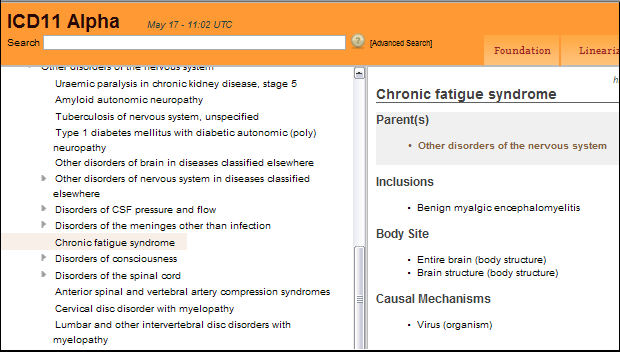
Screenshot from ICD11 Alpha  retrieved May 17 – 11.02 UTC    Chapter 6 Diseases of the nervous system: Foundation Tab selected

ICD11 Alpha Chapter 6

    »  http://apps.who.int/classifications/icd11/browse/f/en#/@_@who_3_int_1_icd_2_G93_3_3
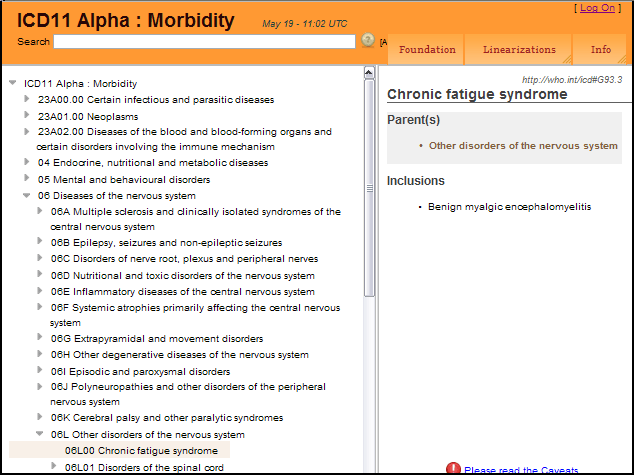
Screenshot from ICD11 Alpha  retrieved May 19 – 11.02 UTC    Chapter 6: Linearizations Tab > Morbidity selected

    »  http://apps.who.int/classifications/icd11/browse/l-m/en#/@_@who_3_int_1_icd_2_G93_3_3
 

Slipping Timeline

In May, I reported that the revision of ICD-10 and development of ICD-11 is running about a year behind targets for the population of content and software development and that the ICD-11 Timeline for Alpha and Beta drafting has been adjusted [1]. In order to meet its revised schedule, the technical work on ICD-11 will need to be completed by 2013, the year the APA’s DSM-5 is slated for publication. 

Drafting platforms

In November 2010, the iCAT platform through which ICD-11 was being drafted was taken out of the public domain. In May, this year, an ICD-11 Alpha browser was released for public viewing [2], with a number of caveats [3].

This most recently published Alpha platform does not include many of the “Content Model” parameters, for example, no draft “Definitions” are included and neither are the  “Discussion Notes” and “Change Histories” that had been viewable in the iCAT, as it stood last June to November. You can see screenshots of the June to November 2010 version of the iCAT in this post [4].

For screenshots from the most recent Alpha Browser for:

Chapter 6: Diseases of the nervous system > 06L Other disorders of the nervous system > 06L00 Chronic fatigue syndrome

see this post [5] or pull up the Alpha Browser pages, here [6].

As you’ll see, ICD-10 Chapter VI (6) is undergoing reorganization and the parent class “G93 Other disorders of brain” under which “Postviral fatigue syndrome”, “Benign myalgic encephalomyelitis” and many other ICD-10 categories had sat is proposed to be removed. A change of hierarchy between “Postviral fatigue syndrome” and “Chronic fatigue sydrome” is recorded in a “Change History” note.

Reorganization of Chapter 6 Diseases of the nervous system

Chapter 6 categories for ICD-11 are currently assigned the codes 06A thru 06L02. It is not known what codes will eventually be assigned to the categories within ICD-11 Chapter 6. As you’ll see from the screenshots, “06L00 Chronic fatigue syndrome” is proposed to be classified under “06L Other disorders of the nervous system”, with “Benign myalgic encephalomyelitis” specified as an Inclusion term to “06L00 Chronic fatigue syndrome”.

Relationships between Inclusion terms are not specified within ICD-10, but they will be specified within ICD-11.

Go here for ICD-11 Chapter 5 “Neurotic, stress-related and somatoform disorders” > Somatoform Disorders and Neurasthenia:

http://apps.who.int/classifications/icd11/browse/f/en#/@_@who_3_int_1_icd_2_F45

http://apps.who.int/classifications/icd11/browse/f/en#/@_@who_3_int_1_icd_2_F48_3_0

Go here for ICD-11 Chapter 18 “Symptoms, signs and abnormal clinical and laboratory findings, not elsewhere classified” > Malaise and fatigue:

http://apps.who.int/classifications/icd11/browse/l-m/en#/@_@who_3_int_1_icd_2_R53


The Revision Steering Group (RSG) and the various ICD Revision Topic Advisory Groups (TAGs) and their external reviewers for content and proposals are using a more layered version of the platform on which they are undertaking the ongoing drafting process; their platform is currently accessible only to WHO, ICD Revision and IT technicians.

The public version of the ICD-11 Alpha Browser, which is being updated daily, is currently open for public viewing only – not for commenting on. But in July, ICD Revision is planning to open up the Alpha Browser for one year for public commenting and consultations.

Extracts from: http://www.who.int/classifications/icd/revision/en/index.html

ICD-11 Timeline

Compiled from the most recent Timelines [1] [7]:

May 2011: Alpha Browser opened up for public viewing [Reached]

July 2011: Alpha Browser opened up for public commenting

+1 year for Commentaries and consultations

May 2012: Beta version opened up to public and Field Trials Version

+2 years for Field trials

2014: Final version for public viewing

May 2015: Presentation of the final version for World Health Assembly (WHA) Approval

Stakeholder participation

The WHO will be engaging with stakeholders who express an interest in participating in the ICD revision process.

Individuals may register to:

Make comments

Make proposals to change ICD categories

Participate in field trials

Assist in translating

The drafting browsers will be open all year round, subject to continuous daily updates and open to all interested stakeholders – Health Care Providers, Information Managers etc. Proposals and feedback will be subject to structured peer review by the Topic Advisory Groups.

For more information on how stakeholder participation is being projected see presentation slides in these reports on my site [8] [9].

Registering for participation

It’s currently unclear which classes of stakeholder might be called upon to participate, and to what extent, during the Alpha drafting stage.

The Stakeholder Registration Form [10] currently appears geared for participation by medical and allied health professionals and administrators. Irrespective of whether the “Yes” or “No” field for the question “Are you a health care professional?” is selected, one is presented with the same options:

Register to become involved

http://www.who.int/classifications/icd/revision/en/index.html

WHO wants to know if you are interested in being involved in the ICD Revision. We will contact you as certain features are opened to the public.

What is your clinical profession?

Medicine

Psychology

Nursing

Counselling

Social Work

Health Information Manager

Coder

Which of the following describes your highest educational attainment? Pre-University; University Degree; Non-doctoral post graduate degree (e.g. Master’s;) Doctoral degree (PhD, post bachelor’s MD, or similar)

Are you interested in participating in:

Making proposals

Peer-reviewing

Field trials

I will check the form again, once the Alpha draft has been opened up for public comment, currently scheduled for July. It is anticipated that an Alpha browser using different software from that currently in use may be released in July. I will update when the browser is opened up for public comment.

The ICD-11 “Content Model”

The WHO’s, Dr Bedhiran Üstün, describes ICD-10 as a “laundry list”. One of the most significant differences between ICD-10 and the forthcoming ICD-11 will be the “Content Model”.

Content Model

http://www.who.int/classifications/icd/revision/contentmodel/en/index.html

The content model is a structured framework that captures the knowledge that underpins the definition of an ICD entity.

Represents ICD entities in a standard way

Allows computerization

Each ICD entity can be seen from different dimensions or “parameters”. E.g. there are currently 13 defined main parameters in the content model to describe a category in ICD (see below).

A parameter is expressed using standard terminologies known as “value sets”

Content Model Parameters

ICD Entity Title

Classification Properties

Textual Definitions

Terms

Body System/Structure Description

Temporal Properties

Severity of Subtypes Properties

Manifestation Properties

Causal Properties

Functioning Properties

Specific Condition Properties

Treatment Properties

Diagnostic Criteria

For more information on the application of the “Content Model” see document [11].

Definitions

There are no definitions inlcuded in any volume of ICD-10 for  “Postviral fatigue syndrome”, “Benign myalgic encephalomyelitis” or “Chronic fatigue syndrome”. WHO has never set out what it understands by these terms nor has it specified what ICD-10 understands the relationships between these three terms to be (see page: https://dxrevisionwatch.wordpress.com/icd-11-me-cfs/) but there will be definitions in ICD-11 and the relationships between Inclusion terms will be specified.

Definitions

http://www.who.int/classifications/icd/revision/def/en/index.html

All ICD entities will have definitions: key descriptions of the meaning of the category in human readable terms – to guide users

Limited definition in Print Version – 100 words

Detailed definitions ONLINE

Definitions will be compatible with:

– the Content Model

– Diagnostic Criteria

– across the whole classification and the versions

Versions of ICD-11 are planned for multiple settings:

Primary Care

Clinical Services

Research

Specialty Adaptations of ICD-11 are being planned for:

Children and Youth

Oncology

Mental Health

Neurology

Musculoskeletal

Dermatology

Dentistry

————————————–

Sources, references and further reading:

ICD-11 Revision on main WHO website

http://www.who.int/classifications/icd/revision/en/

1] ICD-11 Revised Timeline

http://www.who.int/classifications/icd/revision/timeline/en/index.html

2] ICD-11 Alpha Browser Platform

http://apps.who.int/classifications/icd11/browse/f/en

3] ICD-11 Alpha Browser Caveats

http://www.who.int/classifications/icd/revision/caveat/en/index.html

4] Article: iCAT collaborative authoring platform, June to November 2010, screenshots and notes

https://dxrevisionwatch.wordpress.com/2010/06/07/pvfs-me-cfs-and-the-icd-11-alpha-draft-and-icat-collaborative-authoring-platform/

5] Article: ICD-11 Alpha Browser Platform, screenshots and notes for Chapter 6: Diseases of the nervous system > 06L Other disorders of the nervous system > 06L00 Chronic fatigue syndrome

https://dxrevisionwatch.wordpress.com/2011/05/19/icd-11-alpha-drafting-platform-launched-17-may-public-version/

6] ICD-11 Alpha Browser Platform: ICD-11 entity “06L00 Chronic fatigue syndrome”

Foundation:

http://apps.who.int/classifications/icd11/browse/f/en#/@_@who_3_int_1_icd_2_G93_3_3

Linearizations Morbidity:

http://apps.who.int/classifications/icd11/browse/l-m/en#/@_@who_3_int_1_icd_2_G93_3_3

7] ICD-11 Timeline: PowerPoint presentation (in PDF format)

http://unstats.un.org/unsd/class/intercop/expertgroup/2011/AC234-P32.PDF

8] Article: ICD Revision Process Alpha Evaluation Meeting documents and PowerPoint slide presentations

https://dxrevisionwatch.wordpress.com/2011/04/19/icd-revision-process-alpha-evaluation-meeting-presentations/

9] Article: ICD-11 Revision Steering Group struggling to meet targets for release of Beta Draft platform in May

https://dxrevisionwatch.wordpress.com/2011/04/11/icd-11-struggling-to-meet-targets-for-release-of-beta-draft-in-may/

10] Register for participation in ICD-11 Alpha drafting process

http://www.who.int/classifications/icd/revision/en/

Stakeholder Registration form

https://spreadsheets.google.com/spreadsheet/viewform?formkey=dDVabnF1RFpTQkVnVEN2TXhVRm55MGc6MQ

[11] ICD-11 Content Model Reference Guide version January 2011

http://sites.google.com/site/icd11revision/home/documents

https://dxrevisionwatch.com/wp-content/uploads/2011/02/content20model20reference20guide20january2020111.doc

ICD-11 Alpha Drafting platform launched 17 May (public version)

ICD-11 Alpha Drafting platform launched 17 May (public version)

Post #81 Shortlink: http://wp.me/pKrrB-16N

This information does not apply to the forthcoming US specific “Clinical Modification” of ICD-10, called ICD-10-CM, scheduled for implementation in October 2013.

Changes to Alpha Draft since May 17, 2011:

May 19 – 11:02 UTC : Code/sorting label assigned to Parent class “Other disorders of the nervous system” changed from 06N to 06L.

Screenshot from ICD11 Alpha  May 17 – 11.02 UTC    Chapter 6 Diseases of the nervous system: Foundation Tab selected

ICD11 Alpha Chapter 6

    »  http://apps.who.int/classifications/icd11/browse/f/en#/@_@who_3_int_1_icd_2_G93_3_3

Screenshot from ICD11 Alpha  May 19 – 11.02 UTC    Chapter 6: Linearizations Tab > Morbidity selected

    »  http://apps.who.int/classifications/icd11/browse/l-m/en#/@_@who_3_int_1_icd_2_G93_3_3


Four new pages were published on the WHO’s main website on 17 May – the revised Timeline for ICD-11, the announcement of an Alpha Draft browser, a Registration form and a Caveat. Yesterday, I posted the revised ICD-11 Revision Timeline.

What can be seen for PVFS, (B)ME and CFS in the public Alpha Draft?

For the Alpha browser, go to this page:

http://www.who.int/classifications/icd/revision/en/index.html

Here it states:

The International Classification of Diseases 11th Revision is due by 2015

ICD is the international standard to measure health & health services

• Mortality statistics
• Morbidity statistics
• Health care costs
• Progress towards the Millenium Development Goals
• Research

– Alpha draft is updated daily as the work progresses
– It is intended to show the new features to stakeholders early
– Commenting will be available in July 2011

The link for the alpha browser is:

http://apps.who.int/classifications/icd11/browse/f/en

This is the link to a page for “Caveats”

“Read more on what to expect in the ICD-11 Alpha Draft”

ICD-11 Alpha Draft Caveats

ICD-11 alpha draft is:

• Incomplete
• May contain errors, omissions or imperfections
• The work in different chapters are at different stages
• The alpha drafting work is going on by the WHO, Revision Steering Group and Topic Advisory Groups
• The alpha draft is going to be updated on a daily basis
• The alpha draft is NOT TO BE USED for CODING at this stage
• The alpha draft has not yet been approved by the Topic Advisory Groups, Revision Steering Group or WHO

Click here to access the public Alpha Draft browser

Poke around and open the Parent and Child categories and the Tabs – you cannot edit or break anything.

This new interface is not as detailed or as easy to navigate as the software version of the iCAT collaborative drafting platform that was in the public domain up until November, last year. Less information is visible, for example, some of the paramenter tabs, including “Definitions”. (Compare with what could be seen in this iCAT screenshot from last June.)

This is a public draft and another platform is being used by ICD Revision for ongoing drafting. The public draft will be updated as the work of the various Topic Advisory Groups and working groups progresses. ICD Revision has not reached its targets for the generation of content and population of “Content Model” fields across all chapters and this draft is not as far forward as ICD Revision had projected for a May 2011 release.

Though viewable now, the Alpha drafting browser is not planned to be open for public comment until July, this year. It’s not yet clear which classes of public stakeholder will be able to participate in the drafting process, come July, or to what extent.

If you are interested in the proposed public comment, interaction and input processes for the Alpha and Beta drafting stages, see this DSM-5 and ICD-11 Watch post for meeting presentation slides.

Summary

First a caveat: It had been anticipated that a Beta drafting platform would be released in May, this year. WHO has cited lack of content and underdeveloped software for delaying the launch of a Beta drafting platform.

This public version of an Alpha drafting platform is a “work in progress”; not all disease and disorder categories may have been entered into the draft and proposed textual content is in the process of being authored and reviewed by the various Topic Advisory Groups, ICD Revision Steering Group and external peer reviewers.

From what can be seen, today, 19 May:

06L00 Chronic fatigue syndrome

is proposed to be coded within Chapter 6 Diseases of the nervous system (the Neurology chapter), as an ICD Title category, under the Parent class, 06L Other disorders of the nervous system.

Benign myalgic encephalomyelitis is specified as an Inclusion to 06L00 Chronic fatigue syndrome.

“Causal mechanisms” for 06L00 Chronic fatigue syndrome are cited as “Virus (organism)”.

The relationship between ICD Title category 06L00 Chronic fatigue syndrome and Inclusion term Benign myalgic encephalomyelitis is not yet specified, ie whether for ICD-11, “Benign myalgic encephalomyelitis” is proposed to be specified as a Synonym , Subclass or other relationship to “06L00 Chronic fatigue syndrome”.

Many categories within the draft are waiting for their Inclusion terms to be specified, not just the three terms of interest to us.

For explanation of Inclusions and other “Content Model” parameter terms, see: iCAT Glossary or the key ICD-11 Content Model document.

6 Inclusions

Details: Inclusion terms appear in the tabular list [Ed: ICD Volume 1] of the traditional print version and show users that entities are included in the relevant concept. All of the ICD-10 inclusion terms have been imported and accessible in the iCat. These are either synonyms of the category titles or subclasses which are not represented in the classification hierarchy. Since we have synonyms as a separate entity in our ICD-11 content model, the new synonyms suggested by the users should go into the synonyms section. In the future, iCat will provide a mechanism to identify whether an inclusion is a synonym or a subclass.”


What is the proposed relationship between PVFS and CFS?

Postviral fatigue syndrome is not accounted for in the “Foundations” or “Linearizations > Morbidity” listings.

In ICD-10, Postviral fatigue syndrome is an ICD Title category under G93 Other disorders of brain. I cannot confirm, but it may be that due to the hierarchy  change, “Postviral fatigue syndrome” is proposed to be subsumed under “06L00 Chronic fatigue syndrome” with “06L00 Chronic fatigue syndrome” becoming the ICD Title category, because “G93.3 Postviral fatigue syndrome” has lost its ICD-10 Parent category.

At the moment, there is not sufficient information displaying to determine what the intention is. Last June, I requested a clarification from Dr Raad Shakir, chair of Topic Advisory Group for Neurology, but no clarification has been forthcoming.

In the iCAT initial drafting platform, last November, where “Postviral fatigue syndrome” was referenced within a “Category Note” and specified as an Exclusion to Chapter 5 and Chapter 18,  it was referenced as:

“G93.3 Postviral fatigue syndrome -> Gj92 Chronic fatigue syndrome”

[“Note: Gj92” is a “Sorting label” assigned for the initial Alpha drafting process, not an eventual ICD-11 code.]


“Change history” note from May 2010

In ICD-10, “Postviral fatigue syndrome” is a Title code at G93.3 under Parent category “G93 Other disorders of brain”. “Benign myalgic encephalomyelitis” sits under “G93.3 Postviral fatigue syndrome” (relationship unspecified).

As previously reported, an iCAT “Change history” note, dated 1 May 2010, records a “Change in hierarchy for class: G93.3 Postviral fatigue syndrome because its parent category (G93 Other disorders of brain) is removed.”

This would leaves the existing ICD-10 G93.3 Title category, “Postviral fatigue syndrome” and “Benign myalgic encephalomyelitis” that sits beneath it, and also the G93.3 index entry for Chronic fatigue syndrome with no parent category.

Note that the removal of the parent “G93 Other disorders of brain” affects many other categories also classified under G93 in ICD-10 which have also been assigned new parents under the reorganization of Chapter 6 (VI).

Screenshot of “Change history” Note from May 2010


Exclusions

No Exclusions have been specified yet for “06L00 Chronic fatigue syndrome”.

“Postviral fatigue syndrome” is specified as an Exclusion to the following ICD-11 chapters:

Chapter 5 “05E06 Other neurotic disorders > 05E06.00 Neurasthenia”
Chapter 18 “18GF General symptoms and signs > 18F03 Malaise and fatigue.”

(Chapter 18 is the “R code” chapter of ICD-10; ICD-10-CM proposes to retain CFS under R53 Malaise and fatigue at R53.82 Chronic fatigue, unspecified, as “Chronic fatigue syndrome NOS”, with the Exclusion: Postviral fatigue syndrome G93.3.)

Go here for ICD-11 Chapter 5 “Neurotic, stress-related and somatoform disorders” > Somatoform Disorders:

http://apps.who.int/classifications/icd11/browse/f/en#/@_@who_3_int_1_icd_2_F40-F48

Go here for ICD-11 Chapter 18 “Symptoms, signs and abnormal clinical and laboratory findings, not elsewhere classified”:

http://apps.who.int/classifications/icd11/browse/l-m/en#/@_@who_3_int_1_icd_2_XVIII


Congruency with DSM-5 proposals for revision of DSM-IV “Somatoform Disorders”

There is no obvious mirroring of the radical proposals currently being put forward by the DSM-5 Somatic Symptom Disorders Work Group to rename “Somatoform Disorders” to “Somatic Symptom Disorders” and combine a number of existing somatoform categories under a new rubric, “Complex Somatic Symptom Disorder”.


Registering for involvement

There is a Registration form here

This form appears to be aimed at recruiting medical health professionals for putting their names down to be contacted at some point to “Make comments; Make proposals to change ICD categories; Participate in field trials; Assist in translating“. It’s not clear whether or at what point in the Alpha/Beta drafting processes involvement might be extended to non professional stakeholders.

Register to become involved

ICD-11 Registration

“WHO wants to know if you are interested in being involved in the ICD Revision. We will contact you as certain features are opened to the public.”

[Fields are: Family name*; First name*; Email address*; Organization or Company*; LinkedIn ID; Are you a health care professional?* Yes/No. Continue…]   *Required fields


Related information

1] ICD11 Alpha browser

2] ICD Revision Process Alpha Evaluation Meeting documents and PowerPoint slide presentations

3] Key document: ICD Revision Project Plan version 2.1 9 July 2010

4] Key document: Content Model Reference Guide version January 2011

ICD Revision: WHO announces revised Timeline for ICD-11

ICD Revision: WHO announces revised Timeline for ICD-11

Post #79 Shortlink: http://wp.me/pKrrB-16e

The information in this report relates only to ICD-11, the forthcoming revision of ICD-10 that is scheduled for completion and pilot implementation in 2014/15. It does not apply to the forthcoming US specific Clinical Modification of ICD-10, known as ICD-10-CM.

The following has been published on the WHO’s website in the last couple of days. Note that the original timeline had scheduled presentation to the WHA (World Health Assembly) in May 2014, for pilot implementation of ICD-11 in 2014. This most recent timeline for ICD-11 Revision suggests that implementation is being postponed until 2015+.

A WHO news release (if issued) and details on how to access the drafting platform, will be posted as more information becomes available.

http://www.who.int/classifications/icd/revision/timeline/en/

ICD Revision Timelines

May 2011

Open ICD-11 Alpha Browser to the public for viewing

July 2011

Open ICD-11 Alpha Browser to the public for commenting

May 2012

Open ICD-11 Beta to the public

ICD-11 Beta Information
WHO will engage with individuals from an outside community to participate in the ICD revision process.

Individuals will be allowed to:

Make comments
Make proposals to change ICD categories
Participate in field trials
• Assist in translating

May 2015
Present the ICD-11 to the World Health Assembly 

Related information:

Alpha and Beta drafting process:

ICD Revision Process Alpha Evaluation Meeting documents and PowerPoint slide presentations, April 19, 2011: http://wp.me/pKrrB-10i

ICD Revision Process Alpha Evaluation Meeting 11 – 14 April 2011: The Way Forward? April 19: 2011: http://wp.me/pKrrB-ZN


Key documents and references:

1] Key document: ICD Revision Project Plan version 2.1 9 July 2010

2] Key document: Content Model Reference Guide version January 2011