Proposed new diagnoses of anxious depression and bodily stress syndrome in ICD-11-PHC: an international focus group study

Proposed new diagnoses of anxious depression and bodily stress syndrome in ICD-11-PHC: an international focus group study. [JOURNAL ARTICLE]

Post #196 Shortlink: http://wp.me/pKrrB-2pp

This paper, published on July 28, discusses field testing of two proposed new categories for the forthcoming ICD-11 PHC, “anxious depression” and “bodily stress syndrome (BSS)”.

“Bodily stress syndrome (BSS)” is currently proposed to replace ICD-10 PHC’s “F45 Unexplained somatic complaints” which is the equivalent to ICD-10’s “F45 Somatoform Disorders” section.

For ICD-11 PHC, it is proposed not to include the discrete category “Neurasthenia.”

+++
Full text, subscription required:

Family Practice (2012) doi: 10.1093/fampra/cms037

First published online: July 28, 2012

http://fampra.oxfordjournals.org/content/early/2012/07/20/fampra.cms037.long

http://fampra.oxfordjournals.org/content/early/2012/07/20/fampra.cms037.full.pdf+html

Abstract

http://www.ncbi.nlm.nih.gov/pubmed/22843638

Lam TP, Goldberg DP, Dowell AC, Fortes S, Mbatia JK, Minhas FA, Klinkman MS

Proposed new diagnoses of anxious depression and bodily stress syndrome in ICD-11-PHC: an international focus group study. [JOURNAL ARTICLE]

Fam Pract 2012 Jul 28.

BACKGROUND: The World Health Organization is revising the primary care classification of mental and behavioural disorders for the International Classification of Diseases (ICD-11-Primary Health Care (PHC)) aiming to reduce the disease burden associated with mental disorders among member countries.

OBJECTIVE: To explore the opinions of primary care professionals on proposed new diagnostic entities in draft ICD-11-PHC, namely anxious depression and bodily stress syndrome (BSS).

METHODS: Qualitative study with focus groups of primary health-care workers, using standard interview schedule after draft ICD-11-PHC criteria for each proposed entity was introduced to the participants.

RESULTS: Nine focus groups with 4-15 participants each were held at seven locations: Austria, Brazil, Hong Kong, New Zealand, Pakistan, Tanzania and United Kingdom. There was overwhelming support for the inclusion of anxious depression, which was considered to be very common in primary care settings. However, there were concerns about the 2-week duration of symptoms being too short to make a reliable diagnosis. BSS was considered to be a better term than medically unexplained symptoms but there were disagreements about the diagnostic criteria in the number of symptoms required.

CONCLUSION: Anxious depression is well received by primary care professionals, but BSS requires further modification. International field trials will be held to further test these new diagnoses in draft ICD-11-PHC.

+++

Notes and related posts:

ICD-10 PHC (sometimes written as ICD-10-PHC or ICD10-PHC or ICD-10 PC), is a simplified version of the WHO’s ICD-10 chapter for mental and behavioural disorders for use in general practice and primary health care settings. This system has rough but not exact equivalence to selected of the mental disorders in the core ICD-10 classification.

The ICD-10 PHC includes and describes 26 disorders commonly managed within primary care as opposed to circa 450 classified within Chapter V of ICD-10.

Click here for a chart showing the grouping of categories adapted from the full ICD-10 version for the existing ICD-10 PHC mental health categories

Professor, Sir David Goldberg, M.D., Emeritus Professor, Institute of Psychiatry, King’s College, London, is a member of the DSM-5 Mood Disorders Work Group. Prof Goldberg also chairs the Consultation Group for Classification in Primary Care that is making recommendations for the mental and behavioural disorders for ICD-11 PHC.

Other members of the ICD-11 PHC Consultation Group include Michael Klinkman (GP, United States; Vice Chairman); Sally Chan (nurse, Singapore), Tony Dowell (GP, New Zealand) Sandra Fortes (psychiatrist, Brazil), Linda Gask (psychiatrist, UK), KS Jacob (psychiatrist, India), Tai-Pong Lam (GP, Hong Kong), Joseph Mbatia (psychiatrist, Tanzania), Fareed Minhas (psychiatrist, Pakistan), Marianne Rosendal (GP, Denmark), assisted by WHO Secretariat Geoffrey Reed and Shekhar Saxena.

The majority of patients with mental health problems are diagnosed and managed by general practitioners in primary care – not by psychiatrists and mental health specialists. ICD-10 PHC is used in developed and developing countries in general medical settings and also used in the training of medical officers, nurses and multi purpose health workers.

See also Page 3 of this report:

Changes to ICD-11 Beta drafting platform: Bodily Distress Disorders (1)

Page 3, including Update at July 9: Second list of proposals for ICD-11 PHC

Further information on ICD-10 PHC and proposals for the 28 mental health disorders proposed to be included in ICD-11 PHC can be found in these two documents:

1] Goldberg, D. Guest editorial. A revised mental health classification for use in general medical settings: the ICD11–PHC 1. International Psychiatry, Page 1, February 2011.

http://www.rcpsych.ac.uk/pdf/IPv8n1.pdf

Note: The list of proposed categories in the editorial above has been superseded by the list in Chapter 2 of this book, below. (Source: Prof D Goldberg, who stresses these are draft proposals and subject to revision in the light of field trial results).

2] 21st Century Global Mental Health by Dr Eliot Sorel, Professor, George Washington University, Washington D.C.

Publication date: August, 2012: http://www.jblearning.com/catalog/9781449627874/

Page 51, Sample Chapter 2: http://samples.jbpub.com/9781449627874/Chapter2.pdf

Changes to ICD-11 Beta drafting platform: Bodily Distress Disorders (1)

Changes to ICD-11 Beta drafting platform: Bodily Distress Disorders (1)

Post #190 Shortlink: http://wp.me/pKrrB-2jB


+++

This four page post is a revised version of content first published on July 2, 2012.

Information in this report relates to proposals for the World Health Organization’s forthcoming ICD-11, currently scheduled for pilot dissemination in 2015+; it does not relate to the existing ICD-10 or to the forthcoming US specific “clinical modification” of ICD-10, known as ICD-10-CM.

Caveat: The ICD-11 Beta drafting process is a work in progress over the next two to three years. The Beta draft is updated on a daily basis. Parent terms, category terms and sorting codes assigned to categories are subject to change as work on chapter reorganization progresses. Images and text in this posting may not reflect the most recently assigned categories and codes. This post reflects the Beta draft as it stood at July 24, 2012. Please also read the ICD-11 Beta Draft Caveats.

This report updates on recent changes to the Somatoform Disorders section of the ICD-11 Beta drafting platform. The Beta drafting platform can be accessed here:

Beta draft Foundation view:

http://apps.who.int/classifications/icd11/browse/f/en

Beta draft Linearization view:

http://apps.who.int/classifications/icd11/browse/l-m/en
+++

How do the Somatoform Disorders categories currently stand in ICD-10?

ICD-10 Tabular List Version: 2010 can be accessed here: http://apps.who.int/classifications/icd10/browse/2010/en

ICD-10 Chapter V “Somatoform Disorders”

This is the section of ICD-10 that corresponds with the Somatoform Disorders section in DSM-IV. There is a degree of correspondence between current categories for this section of ICD-10 and for DSM-IV, as set out in the (simplified) table, below.

For clinical descriptions and diagnostic guidelines for ICD-10 Somatoform Disorders see Page 129 of the “Blue book”:

ICD-10 Classification of Mental and Behavioural Disorders: Clinical descriptions and diagnostic guidelines: http://www.who.int/classifications/icd/en/bluebook.pdf

Current DSM-IV Codes and Categories for Somatoform Disorders and ICD-10 Chapter V Equivalents

[Ed: Neurasthenia is not categorized within DSM-IV.]

Source: Mayou R, Kirmayer LJ, Simon G, Kroenke K, Sharpe M: Somatoform disorders: time for a new approach in DSM-V. Am J Psychiat. 2005;162:847–855.
+++
+++
This screenshot shows how the ICD-11 Beta draft had stood at June 24, 2012:

ICD-11 Beta Draft: Morbidity Linearization view


+++

For ICD-11 Beta draft, the proposal in June 2012 had been to rename ICD-10’s F45 Somatoform Disorders parent category to Bodily Distress Disorders.

Three new proposed terms: 9R0 Mild bodily distress disorder; 9R1 Moderate bodily distress disorder; 9R2 Severe bodily distress disorder were inserted above the 9R3 thru 9R8 legacy categories imported from ICD-10.

ID : http://who.int/icd#F45

05 Mental and behavioural disorders [Chapter V in ICD-10]

[…]

BODILY DISTRESS DISORDERS  [F45 Somatoform Disorders > F40-F48 Neurotic, stress-related and somatoform disorders in ICD-10]

9R0 Mild bodily distress disorder  [New term to ICD]
9R1 Moderate bodily distress disorder   [New term to ICD]
9R2 Severe bodily distress disorder  [New term to ICD]
9R3 Somatization disorder  [F45.0 in ICD-10]
9R4 Undifferentiated somatoform disorder  [F45.1 in ICD-10]
9R5 Somatoform autonomic dysfunction   [F45.3 in ICD-10]
9R6 Persistent somatoform pain disorder  [F45.4 in ICD-10] 
    ›  9R6.1 Persistent somatoform pain disorder
      9R6.2 Chronic pain disorder with somatic and psychological factors  [Not in ICD-10]
9R7 Other somatoform disorders  [F45.8 in ICD-10]
9R8 Somatoform disorder, unspecified  [F45.9 in ICD-10]

+++

Hypochondriacal disorder, coded at F45.2 in ICD-10, is currently renamed to Illness Anxiety Disorder for ICD-11 Beta draft and relocated under ANXIETY AND FEAR-RELATED DISORDERS:

http://apps.who.int/classifications/icd11/browse/l-m/en#/http%3a%2f%2fwho.int%2ficd%23F45.2

ID : http://who.int/icd#F45.2

9C5  ANXIETY AND FEAR-RELATED DISORDERS

      ›  9C5.6 Illness Anxiety Disorder

Continued on Page Two

What’s new in the ICD-11 Alpha drafting platform? (CFS, PVFS, ME)

What’s new in the ICD-11 Alpha drafting platform? (CFS, PVFS, ME)

Post #157 Shortlink: http://wp.me/pKrrB-22h


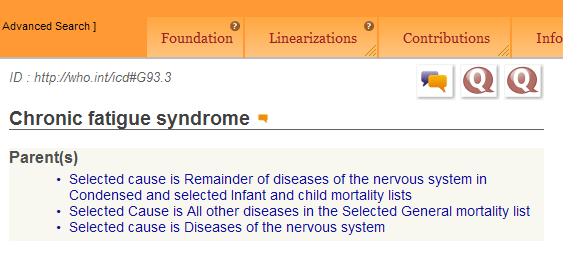
Screenshot: ICD-11 Alpha Browser Foundation view selected, logged in at April 10, 2012:

Chapter 6: Diseases of the nervous system

http://apps.who.int/classifications/icd11/browse/f/en#/http%3a%2f%2fwho.int%2ficd%23G93.3

Apr 09 – 11:02 UTC


ICD-11 Beta drafting platform to launch in May?

As reported in previous posts, according to the timeline, the ICD-11 Beta drafting platform is supposed to be launching this May.

ICD-11 Revision Steering Group has yet to announce whether the Beta platform remains on target for a May release and if so, on what date it will be launched – so I cannot give you a date yet.

Like the Alpha Drafting Browser, the Beta drafting platform will be a work in progress – not a final Beta draft. The final Beta isn’t scheduled until 2014, after the ICD-11 field trials have been undertaken.

When it does launch, the Beta platform is intended to be accessible to professionals and the public for viewing.

Registered or logged in users will have greater access to content and will be able to interact with the platform to read comments, comment on proposals and make suggestions, as part of the ongoing drafting process.  

In the meantime, the publicly viewable version of the Alpha drafting platform (known as the ICD-11 Alpha Browser) can still be accessed here:

http://apps.who.int/classifications/icd11/browse/f/en

The various ICD-11 Revision Topic Advisory Groups are carrying out their draft preparation work on a separate, more complex multi-author drafting platform that is accessible only to WHO and ICD Revision personnel.


Alpha drafting platform

As before, the publicly viewable version of the Alpha Browser should be viewed with the following caveats in mind:

the Alpha draft is a work in progress; it is incomplete; it may contain errors and omissions; it is in a state of flux and updated daily; textual content, codes and “Sorting labels” are subject to change as chapters are reorganized and content populated; the content has not been approved by Topic Advisory Groups, Revision Steering Group or WHO.

It is possible to register, or sign into the platform using existing accounts with several third party account providers such as Google, Yahoo and myOpenID, for increased access and functionality. Once signed in, Comments and Questions can be read and PDFs of the drafts of the top level linearizations can be downloaded from the Linearization tab.

See the Alpha Browser User Guide for information on how the Alpha Browser functions:

http://apps.who.int/classifications/icd11/browse/Help/en


The ICD-11 “Content Model”

ICD-11 will be available in both print and online versions and unlike most chapters of ICD-10, will include descriptive content for ICD terms.

For the online version of ICD-11, all ICD entities will include a definition and a number of additional key descriptive fields – between 7 and 13 pre-defined parameters, populated according to a common “Content Model” (Content Model Reference Guide January 2011).

For example, ICD entity Title, Definition, Synonyms, Narrower Terms, Exclusions, Body Site, Body System, Signs and Symptoms, Causal Mechanisms, and possibly Diagnostic Criteria for some entities.*

*According to the iCAT User Google Group message board, these fields may have been revised since the January 2011 Content Model Reference Guide was published; Content Model parameters in the Beta draft may therefore differ from those currently displaying in the public Alpha drafting platform.

The print version will use a concise version of Definition due to space constraints.

In the Alpha Browser, not all these Content Model parameters display in the Foundation and Linearization views and not all of the parameters that have been listed for individual entities have had their draft text added yet, as some chapters are more advanced for the population of proposed content than others.

So the Alpha draft is still very patchy and many entities have no Definition and little or no other proposed content filled in.

With no “Category Discussion Notes” or “Change history” pop-up windows visible in the public version of the Alpha, the viewer cannot determine the rationales behind the reorganization of terms and hierarchies within the various chapters.


Chapter location and hierarchy for CFS, PVFS and (Benign) ME in ICD-11

I have been reporting since June 2010 that the proposals for ICD-11 Alpha Draft, as far as one could determine, appeared to be:

1] That a change of hierarchy had been recorded in a “Category Discussion Note”, dated May 1, 2010, between ICD-10 Title term “Postviral fatigue syndrome” and “Chronic fatigue syndrome”. (“Category Discussion Notes” and “Change History” pop-ups did display in the earlier iCAT version of the Alpha drafting platform.)

You can view a screenshot from June 2010 of that “Change history” record here:

https://dxrevisionwatch.com/wp-content/uploads/2010/06/change-history-gj92-cfs.png

The Definition field on the “Chronic fatigue syndrome” description panel in the current Alpha Browser is currently blank but in June 2010, the Definition had stood as in this contemporaneous screenshot:

https://dxrevisionwatch.com/wp-content/uploads/2010/05/2icatgj92cfsdef.png

2] That “Chronic fatigue syndrome” had been designated as an ICD-11 Title term within ICD-11 Chapter 6: Diseases of the nervous system, with the capacity for a Definition and up to 10 additional descriptive parameters.

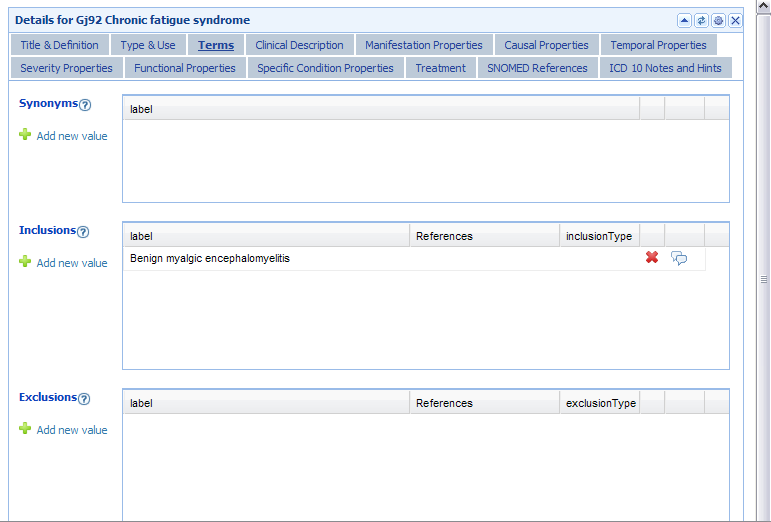
3] That “Benign myalgic encephalomyelitis” had been specified as an Inclusion term to ICD-11 Title term “Chronic fatigue syndrome” but that the relationships between the three terms, PVFS, (B) ME and CFS had yet to be specified, as in this screenshot from June 2010:

https://dxrevisionwatch.com/wp-content/uploads/2010/05/2icatgj92cfsterms.png


What is currently showing in the Chapter 6 Foundation Component?

It isn’t possible to bring up a discrete ICD Title listing for either “Benign myalgic encephalomyelitis” or “Postviral fatigue syndrome” in either the Foundation Component or the Linearization.

In the Foundation view only, for Chapter 6: Diseases of the nervous system, “Chronic fatigue syndrome” is listed as a Title term with the ICD-10 legacy ID “ID:http://who.int/icd#G93.3”;

the Definition field is currently blank;

a list of terms has recently been added under “Synonyms”;

one term has recently been added under “Narrower Terms”.

(Note: there is a small asterisk at the end of term “Benign myalgic encephalomyelitis” which is listed at the top of the “Synonyms” list. The asterisk “Hover text” reads “This term is an inclusion term in the linearizations.”)

If you want to view the listing directly on the Browser site (note the “Comment” and “Questions” icons which open up pop-up windows next to terms for reading/commenting won’t display unless you have already registered and logged in) go here:

ICD-11 Alpha Browser Foundation view:

http://apps.who.int/classifications/icd11/browse/f/en#/http%3a%2f%2fwho.int%2ficd%23G93.3

ID:http://who.int/icd#G93.3

Chronic fatigue syndrome

Parent(s)

Selected cause is Remainder of diseases of the nervous system in Condensed and selected Infant and child mortality lists
Selected Cause is All other diseases in the Selected General mortality list
Selected cause is Diseases of the nervous system

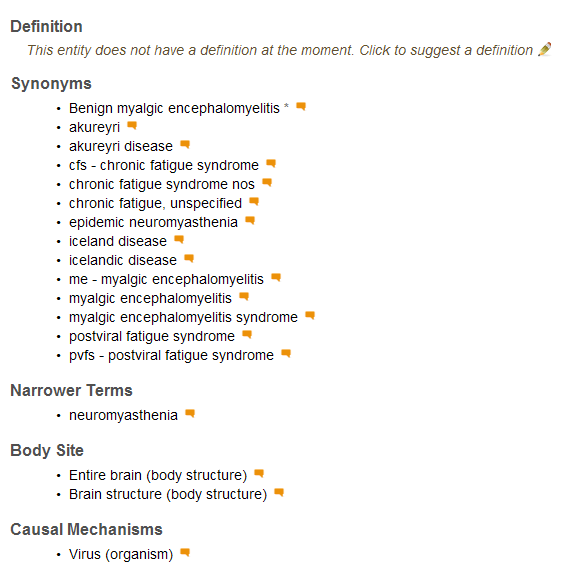
Definition

This entity does not have a definition at the moment.

Synonyms

Benign myalgic encephalomyelitis *  [Ed: Hover text over asterisk reads: “This term is an inclusion term in the linearizations.”]
akureyri
akureyri disease
cfs – chronic fatigue syndrome
chronic fatigue syndrome nos   [Ed: from current proposals for ICD-10-CM, Chapter 18, R53.82]
chronic fatigue, unspecified   [Ed: from current proposals for ICD-10-CM, Chapter 18, R53.82]
epidemic neuromyasthenia
iceland disease
icelandic disease
me – myalgic encephalomyelitis
myalgic encephalomyelitis
myalgic encephalomyelitis syndrome
postviral fatigue syndrome
pvfs – postviral fatigue syndrome

Narrower Terms

neuromyasthenia

Body Site

Entire brain (body structure)
Brain structure (body structure)

Causal Mechanisms

Virus (organism)


What’s new in Chapter 5: Mental and behavioural disorders?

As reported in Dx Revision Watch post: http://wp.me/pKrrB-1Vx,  the category “Somatoform Disorders” in Chapter 5, Mental and behavioural disorders is currently renamed to “BODILY DISTRESS DISORDERS”, under which currently sit three new child categories:

5M0 Mild bodily distress disorder
5M1 Moderate bodily distress disorder
5M2 Severe bodily distress disorder.

Chapter 5 Linearization view:

http://apps.who.int/classifications/icd11/browse/l-m/en#/http%3a%2f%2fwho.int%2ficd%23F45

Chapter 5 Foundation view:

http://apps.who.int/classifications/icd11/browse/f/en#/http%3a%2f%2fwho.int%2ficd%23F45

(Click on the little grey arrows to display the child categories):

Child categories to parent “BODILY DISTRESS DISORDERS”:

http://apps.who.int/classifications/icd11/browse/f/en#/http%3a%2f%2fwho.int%2ficd%231905_dd0250d2_e8cd_4c48_a93f_7997cc1c8b07

BODILY DISTRESS DISORDERS

5M0 Mild bodily distress disorder
5M1 Moderate bodily distress disorder
5M2 Severe bodily distress disorder
5M3 Somatization disorder
5M4 Undifferentiated somatoform disorder
5M5 Somatoform autonomic dysfunction
5M6 Persistent somatoform pain disorder
      > 5M6.0 Persistent somatoform pain disorder
      > 5M6.1 Chronic pain disorder with somatic and psycological [sic] factors
5M7 Other somatoform disorders
5M8 Somatoform disorder, unspecified

None of these three new (proposed) categories have had any Definitions or other textual content added to the description panels on the right hand side of the Alpha Browser page since I first reported this change in February.

It is still not possible to determine what disorders ICD-11 intends might be captured by these three new (proposed) terms, should ICD-11 Revision Steering Group and WHO classification experts consider these terms to be valid constructs and approve their progression through to the Beta draft.

Because no “Change Notes” or “Change history” pop-up windows display in this version of the Alpha Drafting browser, it is not possible to determine:

whether ICD-11 is proposing to introduce three new terms – 5M0 Mild bodily distress disorder; 5M1 Moderate bodily distress disorder; 5M2 Severe bodily distress disorder, in addition to retaining existing ICD-10 terms, 5M3 thru 5M8;

how ICD Revision intends to define these (proposed) new terms at 5M0, 5M1, 5M2;

how these three (proposed) new terms would relate to the existing ICD-10 “Somatoform Disorders” categories which remain listed as child categories to “BODILY DISTRESS DISORDERS” (apart from “Hypochondriacal disorder” [ICD-10: F45.2], which is now listed as “5H0.5 Illness Anxiety Disorder” in the ICD-11 Alpha Draft).

(See Page 1 and 2 of my report: “Bodily Distress Disorders” to replace “Somatoform Disorders” for ICD-11?: http://wp.me/pKrrB-1Vx  )


References:

ICD-11 Revision: http://www.who.int/classifications/icd/revision/en/

ICD-11 Alpha Browser User Guide: http://www.who.int/classifications/icd/revision/caveat/en/index.html
Alpha Browser Foundation view: http://apps.who.int/classifications/icd11/browse/f/en#
Alpha Browser Linearization view: http://apps.who.int/classifications/icd11/browse/l-m/en#
“Bodily Distress Disorders” to replace “Somatoform Disorders” for ICD-11?: http://wp.me/pKrrB-1Vx

“Bodily Distress Disorders” to replace “Somatoform Disorders” for ICD-11?

“Bodily Distress Disorders” to replace “Somatoform Disorders” for ICD-11?

Post #145 Shortlink: http://wp.me/pKrrB-1Vx

The information in this report relates only to proposals for the WHO’s forthcoming ICD-11; it does not relate to ICD-10 or to the forthcoming US specific “clinical modification” of ICD-10, known as ICD-10-CM.

Codes assigned to ICD-11 Beta draft categories are subject to change as chapter reorganization progresses. Images and text in this posting may not reflect the most recently assigned codes. This post has been updated to reflect the launch of the Beta drafting platform and revisions to codes assigned during the drafting process as they stand at June 24, 2012.

Part One


This report contains an important update on proposals for ICD-11 Chapter 5: Mental and behavioural disorders.

In a February 16, 2012 report by Tom Sullivan for Health Care Finance News, Christopher Chute, MD, who chairs the ICD Revision Steering Group, warned of a possible delay for completion of ICD-11 from 2015 to 2016.

The ICD-11 Beta drafting platform was launched in May 2012.

The Beta drafting platform is a publicly viewable browser similar to the Alpha drafting platform that had been in the public domain since May, 2011.

You can view the Beta Drafting Browser here:

Foundation Component view:

http://apps.who.int/classifications/icd11/browse/f/en

Morbidity Linearization view:

http://apps.who.int/classifications/icd11/browse/l-m/en

The Morbidity Linearization is the view that includes (what may be temporarily assigned) sorting codes. These codes are likely to change as chapter organization progresses. Click on the small grey arrows next to the chapters and categories to display parent > child > grandchildren hierarchies. Click on individual terms to display descriptive content in the right hand frame of the Beta Browser.

Textual content for ICD-11 is in the process of being drafted and the population of content for some chapters is more advanced than others. Content for some of the “ICD-11 Content Model” parameters may display: ID legacy code from ICD-10 (where applicable); Parent(s); Definition; Synonyms; Inclusions; Narrower Terms; Exclusions; Body Site; Causal Mechanism; Signs and Symptoms.

(For ICD-11, entities will be defined across all chapters through up to 13 “Content Model” parameters – considerably more descriptive content than in ICD-10 and a significant workload for the Topic Advisory Group members and managers who are generating the content for ICD-11.)

The Beta Browser User Guide is here:

http://apps.who.int/classifications/icd11/browse/Help/en

This page of the User Guide sets out differences between Foundation view and Morbidity Linearization view.

The various ICD Revision Topic Advisory Groups (TAGs) are carrying out their work on a separate, more complex, multi-author drafting platform. On their platform, editing histories and “Category and Discussion Notes” are recorded so the progress of proposals and reorganization of ICD entities can be tracked, as the draft evolves.

For the Beta drafting platform, interested stakeholders may register for increased access and interaction with the drafting process by submitting comments and suggestions on draft content and proposals.

For those registered for increased access, it is possible to download PDFs of drafts for the “Print Versions for the ICD-11 Beta Morbidity Linearization” for all 25 chapters of ICD-11. These are obtainable, once registered and logged in, from the Linearization > Print Versions tab.

Caveats

I’m going to reiterate the ICD-11 Alpha Browser Caveats because it’s important to understand that the ICD-11 Beta draft is a work in progress – not a static document – and is subject to change.

The draft is updated on a (usually) daily basis; when you view the Beta Browser, you are viewing a “snapshot” of how the publicly viewable draft stood at the end of the previous day; not all chapters are as advanced as others for reorganization or population of content; the draft is incomplete and may contain errors and omissions.

The codes and “sorting labels” assigned to ICD parent classes, child and grandchildren terms are subject to change as reorganization of the chapters progresses. The Beta draft has not yet been approved by the Topic Advisory Groups, Revision Steering Group or WHO and proposals for, and content in the draft may not progress to the Beta drafting stage; field trials have not yet been completed – so be mindful of the fact that the draft is in a state of flux.

As it currently stands, the Beta draft lacks clarity; not all textual content will have been generated and uploaded for terms imported from ICD-10 and there may be no definitions or other textual content displaying for proposed new terms.

Two chapters that are a focus of this site are Chapter 5: Mental and behavioural disorders and Chapter 6: Disorders of the nervous system (the Neurology chapter). (ICD-11 is dropping the use of Roman numerals.)

I won’t be reporting on specific categories in Chapter 6 in this post but will do a follow up post for Chapter 6 in a forthcoming post; again, there is a lack of clarity for Chapter 6 and requests for specific clarifications, last year, from the chair of Topic Advisory Group Neurology and the lead WHO Secretariat for TAG Neurology have met with no response.

Continued on Page 2: Somatoform Disorders in ICD-10; Somatoform Disorders to Bodily Distress Disorders for ICD-11?