Call to action – DSM-5 comments needed by June 15, 2012

Call to action – DSM-5 comments needed by June 15, 2012

Post #173 Shortlink: http://wp.me/pKrrB-2bO

The stakeholder comment period for the third and final review of draft proposals for DSM-5 categories and criteria closes on June 15. Patients, patient organizations and professional stakeholders have three weeks left in which to submit comments.

US advocate, Mary Dimmock, has prepared a “Call to action”

Call to action – DSM-5 comments needed by June 15, 2012

The Diagnostic and Statistical Manual of Mental Disorders (DSM) is used in the U.S. to categorize mental disorders for patient diagnosis, treatment and insurance. The new version, DSM-5, includes a proposal for Somatic Symptom Disorder (SSD) that will have profound implications for ME/CFS patients. Your input is needed by June 15, 2012 to ensure that the DSM-5 authors understand your concerns…

…SSD can be applied to patients regardless of whether the symptoms are considered to be medically unexplainable or not. Severity is rated by the count and frequency of somatic symptoms. The “Justification for Criteria – Somatic Symptoms”, issued in May 2011, states that CBT, focused on “the identification and modification of dysfunctional and maladaptive beliefs”, is one of the most promising treatments.

Why this matters to ME/CFS patients
A diagnosis of SSD can be “bolted” onto any patient’s diagnosis. All that is required is for the medical practitioner to decide that the patient is excessively concerned with their somatic symptoms and their health. This is done using highly subjective and difficult to measure criteria for which very few independent reliability studies have been undertaken.

For patients with diseases that are poorly understood and misdiagnosed by the medical community, like ME/CFS, this will be disastrous. Once diagnosed inappropriately with SSD, the implications for diagnosis, treatment, disability and insurance will be profound…

Download Mary’s Call to action document here:

Word .docx format DSM-5 Response 2012

Word .doc format DSM-5 Response 2012 (MS 2004)

Somatic Symptom Disorder could capture millions more under mental health diagnosis

Somatic Symptom Disorder could capture millions more under mental health diagnosis

Post #172 Shortlink: http://wp.me/pKrrB-29B

By Suzy Chapman | Dx Revision Watch

Update: My submission to the Somatic Symptom Disorder Work Group in response to the third DSM-5 draft and stakeholder review can be read here: Chapman Response to Third Draft DSM-5 SSD Proposals

May 26, 2012

While media and professional attention has been focused on the implications for introducing new disorders into the DSM and lowering diagnostic thresholds for existing categories, the Somatic Symptom Disorders (SSD) Work Group has been quietly redefining DSM’s Somatoform Disorders with radical proposals that could bring millions more patients under a mental health diagnosis.

The SSD Work Group is proposing to rename the Somatoform Disorders section of DSM-IV to “Somatic Symptom Disorders,” eliminate four existing  DSM-IV categories: somatization disorder [300.81], hypochondriasis [300.7], pain disorder*, and undifferentiated somatoform disorder [300.82] and replace them with a single new category – “Somatic Symptom Disorder.”

*In DSM-IV: Pain Disorder associated with a general medical condition (only): Psychological factors, if present, are judged to play no more than a minimal role. This is not considered a mental disorder so it is coded on Axis III with general medical conditions.See http://behavenet.com/pain-disorder for definitions and criteria for other DSM-IV presentations of Pain disorder.  For DSM-5, it appears that all presentations of Pain disorder will be subsumed under the new SSD category.

If approved, these proposals will license the application of a mental health diagnosis for all illnesses – whether “established general medical conditions or disorders” like diabetes, heart disease and cancer or conditions presenting with “somatic symptoms of unclear etiology” – if the clinician considers the patient is devoting too much time to their symptoms and that their life has become “subsumed” by health concerns and preoccupations, or their response to distressing somatic symptoms is “excessive” or “disproportionate,” or their coping strategies “maladaptive.”

Somatoform Disorders – disliked and dysfunctional

The SSD Work Group, under Chair, Joel E. Dimsdale, MD, says current terminology for the Somatoform Disorders is confusing and flawed; that no-one likes these disorders and they are rarely used in clinical psychiatric practice. Primary Care physicians don’t understand the terms and patients find them demeaning and offensive [1,2].

The group says the terms foster mind/body dualism; that the concept of “medically unexplained” is unreliable, especially in the presence of medical illness, and cites high prevalence of presentation with “medically unexplained somatic symptoms” (MUS) in general medical settings – 20% in Primary Care, 40% in Specialist Care, 33-61% in Neurology; that basing a diagnosis of psychiatric disorder on MUS alone is too sensitive.

The Work Group might have considered dispensing altogether with a clutch of disliked, dysfunctional categories. Instead, the group proposes to rebrand these disorders and assign new criteria that will capture patients with diverse illnesses, expanding application of psychiatric services, antidepressants and behavioural therapies like CBT, for the “modification of dysfunctional and maladaptive beliefs about symptoms and disease, and behavioral techniques to alter illness and sick role behaviors.”

Focus shifts from “medically unexplained” to “excessive thoughts, behaviors and feelings”

The Work Group’s proposal is to deemphasize “medically unexplained” as the central defining feature of this disorder group.

For DSM-5, focus shifts to the patient’s cognitions – “excessive thoughts, behaviors and feelings” about the seriousness of distressing and persistent somatic (bodily) symptoms – which may or may not accompany diagnosed general medical conditions – and the extent to which “illness preoccupation” is perceived to “dominate” or “subsume” the patient’s life.

“[The SSD Work Group’s] framework will allow a diagnosis of somatic symptom disorder in addition to a general medical condition, whether the latter is a well-recognized organic disease or a functional somatic syndrome such as irritable bowel syndrome or chronic fatigue syndrome…” [3]

“…These disorders typically present first in non-psychiatric settings and somatic symptom disorders can accompany diverse general medical as well as psychiatric diagnoses. Having somatic symptoms of unclear etiology is not in itself sufficient to make this diagnosis. Some patients, for instance with irritable bowel syndrome or fibromyalgia would not necessarily qualify for a somatic symptom disorder diagnosis. Conversely, having somatic symptoms of an established disorder (e.g. diabetes) does not exclude these diagnoses if the criteria are otherwise met…” [4]

To meet requirements for Somatization Disorder (300.81) in DSM-IV, a considerably more rigorous criteria set needed to be fulfilled: a history of many medically unexplained symptoms before the age of thirty, resulting in treatment sought or psychosocial impairment. The diagnostic threshold was set high – a total of eight or more medically unexplained symptoms from four, specified symptom groups, with at least four pain and two gastrointestinal symptoms.

In DSM-5, the requirement for eight symptoms is dropped to just one.

One distressing symptom for at least six months duration and one “B type” cognition is all that is required to tick the box for a bolt-on diagnosis of a mental health disorder – cancer + SSD; angina + SSD; diabetes + SSD; IBS + SSD…

The most recent proposals for new category “J 00 Somatic Symptom Disorder.”

Note that the requirement for “at least two from the B type criteria” for the second draft has been reduced to “at least one from the B type criteria” for the third iteration of draft proposals. This lowering of the threshold is presumably in order to accommodate the merging of the previously proposed “Simple Somatic Symptom Disorder” category into the “Complex Somatic Symptom Disorder” category, a conflation now proposed to be renamed to “Somatic Symptom Disorder.” No revised “Disorder Description” and “Rationale/Validity” documents reflecting the changes made between draft two and draft three were issued for the third and final draft.

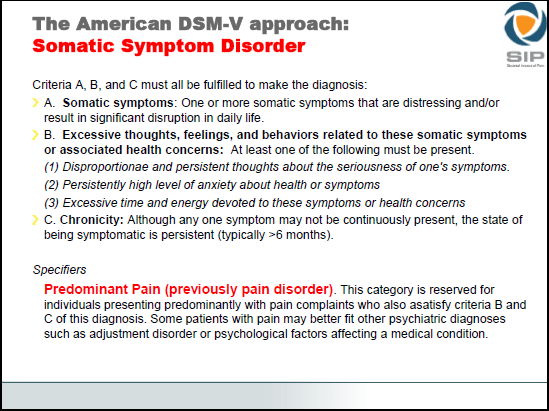
Ed: Update: Following closure of the third stakeholder review on June 15, 2012, proposals, criteria and rationales were frozen and the DSM-5 Development website was not updated to reflect any subsequent revisions. Proposals, criteria and rationales, as posted for the third draft in May 2012, were removed from the DSM-5 Development website on November 15, 2012 and placed behind a non public log in. Consequently, criteria as they had stood for “Somatic Symptom Disorder” at the point at which the third draft was issued can no longer be accessed but are set out on Slide 9 in this presentation, which note, does not include three, optional Severity Specifiers that were included with the third draft criteria. Since any changes to the drafts are embargoed in preparation for publication of DSM-5, in May 2013, I cannot confirm whether any changes have been made to the draft subsequent to June 15, 2012.

IASP and the Classification of Pain in ICD-11  Prof. Dr. Winfried Rief, University of Marburg, Germany

Slide 9

Rief Presentation ICD-11 Pain

How are highly subjective and difficult to measure constructs like “Disproportionate and persistent thoughts about the seriousness of one’s symptoms” and “Excessive time and energy devoted to these symptoms or health concerns” to be operationalized?

By what means would a practitioner determine how much of a patient’s day spent “searching the internet looking for data” (to quote an example of the SSD Work Group Chair) might be considered a reasonable response to chronic health concerns and what should be coded as “excessive preoccupation” or indicate that this patient’s life has become “subsumed” or “overwhelmed” by concerns about illness and symptoms? One hour day? Two hours? Three?

At the APA’s Annual Conference earlier this month, SSD Work Group Chair, Joel E. Dimsdale, presented an update on his group’s deliberations. During the Q & A session, an academic professional in the field expressed concern that practitioners who are not psychiatric professionals or clinicians might have some difficulty interpreting the wording of the B type criteria to differentiate between negative and positive coping strategies.

Dr Dimsdale was asked to expand on how the B type criteria would be defined and by what means patients with chronic medical conditions who devote time and energy to health care strategies to try to improve their symptoms and level of functioning would be evaluated in the field by the very wide range of DSM users; how would these patients be differentiated from patients considered to be spending “excessive time and energy devoted to symptoms or health concerns” or perceived as having become “absorbed” by their illness?

I am not persuaded by Dr Dimsdale’s reassurances that his Work Group will try to make this “crystal clear” in the five to six pages of manual text in the process of being drafted for this disorder chapter. Nor am I reassured that these B (1), (2) and (3) criteria can be safely applied outside the optimal conditions of field trials, in settings where practitioners may not necessarily have the time for, nor instruction in administration of diagnostic assessment tools, and where decisions to code or not to code may hang on arbitrary and subjective perceptions of DSM end-users lacking clinical training in the use of the manual text and application of criteria.

Implications for a diagnosis of SSD for all patient populations

Incautious, inept application of criteria resulting in a “bolt-on” psychiatric diagnosis of a “Somatic Symptom Disorder” could have far-reaching implications for all patient populations:

Application of highly subjective and difficult to measure criteria could potentially result in misdiagnosis with a mental health disorder, misapplication of an additional diagnosis of a mental health disorder or missed diagnoses through dismissal and failure to investigate new or worsening somatic symptoms.

Patients with cancer and life threatening diseases may be reluctant to report new symptoms that might be early indicators of local recurrence, metastasis or secondary disease, for fear of attracting a diagnosis of “SSD” or of being labelled as “catastrophisers.”

Application of an additional diagnosis of Somatic Symptom Disorder may have implications for the types of medical investigations, tests and treatments that clinicians are prepared to consider and which insurers prepared to fund.

Application of an additional diagnosis of Somatic Symptom Disorder may impact payment of employment, medical and disability insurance and the length of time for which insurers are prepared to pay out. It may negatively influence the perceptions of agencies involved with the assessment and provision of social care, disability adaptations, education and workplace accommodations.

Patients prescribed psychotropic drugs for perceived unreasonable levels of “illness worry” or “excessive preoccupation with symptoms” may be placed at risk of iatrogenic disease or subjected to inappropriate behavioural therapies.

For multi-system diseases like Multiple Sclerosis, Behçet’s syndrome or Systemic lupus it can take several years before a diagnosis is arrived at. In the meantime, patients with chronic, multiple somatic symptoms who are still waiting for a diagnosis would be vulnerable.

The burden of the DSM-5 changes will fall particularly heavily upon women who are more likely to be casually dismissed when presenting with physical symptoms and more likely to receive inappropriate antidepressants and anti-anxiety medications for them.

Proposals allow for the application of a diagnosis of Somatic Symptom Disorder where a parent is considered excessively concerned with a child’s symptoms [3]. Families caring for children with any chronic illness may be placed at increased risk of wrongful accusation of “over-involvement” with a child’s symptomatology.

Where a parent is perceived as encouraging maintenance of “sick role behaviour” in a child, this may provoke social services investigation or court intervention for removal of a sick child out of the home environment and into foster care or for enforced in-patient “rehabilitation.” This is already happening in families with a child or young person with chronic illness, notably with Chronic fatigue syndrome or ME. It may happen more frequently with a diagnosis of a chronic childhood illness + SSD.

Dustbin diagnosis?

Although the Work Group is not proposing to classify Chronic fatigue syndrome, IBS and fibromyalgia, per se, within the Somatic Symptom Disorders, patients with CFS – “almost a poster child for medically unexplained symptoms as a diagnosis,” according to Dr Dimsdale’s presentation – or with fibromyalgia, irritable bowel syndrome, chronic Lyme disease, Gulf War illness, chemical injury and chemical sensitivity may be particularly vulnerable to misapplication or misdiagnosis with a mental health disorder under these SSD criteria.

There is considerable concern that this new Somatic Symptom Disorder category will provide a “dustbin diagnosis” in which to shovel the so-called “functional somatic syndromes.”

15% of “diagnosed illness” and 26% of “functional somatic” captured by SSD criteria

For testing reliability of CSSD criteria, three groups were studied for the field trials:

488 healthy patients; a “diagnosed illness” group of 205 patients with cancer and malignancy (some in this group were said to have severe coronary disease) and a “functional somatic” group comprising 94 people with irritable bowel and “chronic widespread pain” (a term used synonymously with fibromyalgia).

Patients in the study were required to meet one to three cognitions: Do you often worry about the possibility that you have a serious illness? Do you have the feeling that people are not taking your illness seriously enough? Is it hard for you to forget about yourself and think about all sorts of other things?

Dr Dimsdale reports that if the response was “Yes – a lot.” then [CSSD] was coded.

15% of the cancer and malignancy group met SSD criteria when “one of the B type criteria” was required; if the threshold was increased to “two B type criteria” about 10% met criteria for dual-diagnosis of diagnosed illness + Somatic Symptom Disorder.

For the 94 irritable bowel and “chronic widespread pain” study group, about 26% were coded when one cognition was required; 13% coded with two cognitions required.

Has the SSD Work Group produced projections for prevalence estimates and potential increase in mental health diagnoses across the entire disease landscape?

Did the Work Group seek opinion on the medico-legal implications of missed diagnoses?

Has the group factored for the clinical and economic burden of providing CBT for modifying perceived “dysfunctional and maladaptive beliefs about symptoms and disease, and behavioral techniques to alter illness and sick role behaviors” in patients for whom an additional diagnosis of Somatic Symptom Disorder has been coded?

Where’s the science?

Dr Dimsdale admits his committee has struggled from the outset with these B type criteria but feels its proposals are “a step in the right direction.”

The group reports that preliminary analysis of field trial results shows “good reliability between clinicians and good agreement between clinician rated and patient rated severity.” In the trials, CSSD achieved Kappa values of .60 (.41-.78 Confidence Interval).

Kappa reliability reflects agreement in rating by two different clinicians corrected for chance agreement – it does not mean that what they have agreed upon are valid constructs.

Radical change to the status quo needs grounding in scientifically validated constructs and a body of rigorous studies not on pet theories and papers (in some cases unpublished papers) generated by Dr Dimsdale’s work group colleagues.

Where is the substantial body of independent research evidence to support the group’s proposals?

“...To receive a diagnosis of complex somatic symptom disorder, patients must complain of at least one somatic symptom that is distressing and/or disruptive of their daily lives. Also, patients must have at least two [Ed: now reduced to at least one since evaluation of the CSSD field trials] of the following emotional/cognitive/behavioral disturbances: high levels of health anxiety, disproportionate and persistent concerns about the medical seriousness of the symptom(s), and an excessive amount of time and energy devoted to the symptoms and health concerns. Finally, the symptoms and related concerns must have lasted for at least six months.”

“Future research will examine the epidemiology, clinical characteristics, or treatment of complex somatic symptom disorder as there is no published research on this diagnostic category.”

“…Just as for complex somatic symptom disorder, there is no published research on the epidemiology, clinical characteristics, or treatment of simple somatic symptom disorder.”

Source: Woolfolk RL, Allen LA. Cognitive Behavioral Therapy for Somatoform Disorders. Standard and Innovative Strategies in Cognitive Behavior Therapy.

Where are the professionals?

During the second public review, the Somatic Symptom Disorders proposals attracted more responses than almost any other category. The SSD Work Group is aware that patients, caregivers and patient advocacy organizations have considerable concerns. But are medical and allied health professionals scrutinizing these proposals?

This is the last opportunity to submit feedback. Psychiatric and non psychiatric clinicians, primary care practitioners and specialists, allied health professionals, psychologists, counselors, social workers, lawyers, patient advocacy organizations – please look very hard at these proposals, consider their safety and the implications for an additional diagnosis of an SSD for all patient illness groups and weigh in with your comments by June 15.

Criteria and rationales for the third iteration of proposals for the DSM-5 Somatic Symptom Disorders categories can be found here on the DSM-5 Development site. [Update: Proposals were removed from the DSM-5 Development website on November 15, 2012.]

References

1 Levenson JL. The Somatoform Disorders: 6 Characters in Search of an Author. Psychiatr Clin North Am. 2011 Sep;34(3):515-24.

2 Dimsdale JE. Medically Unexplained Symptoms: A Treacherous Foundation for Somatoform Disorders? Psychiatr Clin North Am. 2011 Sep;34(3):511-3.

3 Dimsdale J, Creed F. DSM-V Workgroup on Somatic Symptom Disorders: the proposed diagnosis of somatic symptom disorders in DSM-V to replace somatoform disorders in DSM-IV – a preliminary report. J Psychosom Res 2009;66:473–6.

4 DSM-5 Somatic Symptom Disorders Work Group Disorder Descriptions and Justification of Criteria-Somatic Symptoms documents, published May 4, 2011 for the second DSM-5 stakeholder review.

(Caveat: for background to the SSD Work Group’s rationales only; proposals and criteria as set out in these documents have not been revised to reflect changes to revisions or reissued for the third review.)

    Disorder Descriptions   May 4, 2011

    Rationale/Validity Document   May 4, 2011

© Copyright 2015 Suzy Chapman

More Kappa data from DSM-5 field trials

More Kappa data from DSM-5 field trials

Post #167 Shortlink: http://wp.me/pKrrB-27D

Further data from the DSM-5 field trials results have been released in a report by Deborah Brauser for Medscape Medical News.

You can read Ms Brauser’s report from the American Psychiatric Association’s annual conference here, though you may need to register for the site:

Medscape Medical News > Psychiatry

DSM-5 Field Trials Generate Mixed Results

Deborah Brauser | May 8, 2012

…Members of the task force said they hope to publish the full results “within a month.” However, the third and final public comment period for the manual opened last week and ends on June 15. Although the entire period is 6 weeks long, the public may only have 2 weeks to comment after the publication of the field trials’ findings.

“No previous field trial had such a sophisticated design. And it has resulted in more statistically significant data for specific disorders,” said Dr. Regier.

The current DSM-5 field trials, as well as field trials for past manuals, use Kappa score as a statistical measure of criteria reliability. A Kappa score of 1.0 was considered perfect, a score of greater than .8 was considered almost perfect, a score of .6 to .8 was considered good to very good, a score of .4 to .6 was considered moderate, a score of .2 to .4 was considered fair and could be accepted, and a score of less than .2 was considered poor.

 At adult sites, schizophrenia was shown to have a pooled Kappa score of .46. However, that is down from the .76 and .81 Kappa scores found in the DSM-IV and DSM-III, respectively, and it is less than the .79 score found in the International Classification of Diseases, Tenth Revision (ICD-10).

“It’s important to realize in some ways that the Kappa in the current field trial was from a totally different design…,” said Dr. Regier

Full report

This table has some of the results:


Reconstructed from data published by A Frances, DSM 5 in Distress, Psychology Today, 05.06.12


1 Boring Old Man has updated an earlier table here on his blog which incorporates additional data from the Medscape report: 

updated table
1 Boring Old Man | May 9, 2012

There are further, detailed commentaries from 1 boring old man on the DSM-5 field trial results and Kappa values here:

major depressive disorder κ=0.30?…     May 6, 2012

a fork in the road…     May 7, 2012

Village Consumed by Deadly Storm…     May 8, 2012

box scores and kappa…     May 8, 2012

Included in Ms Brauser’s report are data for “Complex somatic disorder”:

The field trials for the new proposed category Complex Somatic Symptom Disorder (CSSD) were held at Mayo. According to one of several tables within Ms Brauser’s report, the following data have been released for “Complex somatic disorder” [sic]:

Extract from DSM-5 Field Trials Generate Mixed Results, Deborah Brauser,  May 8, 2012

Disorder DSM-5 (95% CI) DSM-IV ICD-10 DSM-III
Major neurocognitive disorder .78 (.68 – .87) .66 .91
ASD .69 (.58 – .80) .59 – .85 .77 -.01
PTSD .67 (.59 – .74) .59 .76 .55*
Child ADHD .61 (.51 – .72) .59 .85 .50
Complex somatic disorder .60 (.41 – .78) .45 .42

CI, confidence interval; ASD, autism spectrum disorder; PTSD, posttraumatic stress disorder; ADHD, attention-deficit/hyperactivity disorder

*From the DSM-III-R.

CSSD is a new category for DSM-5 which redefines and replaces some, but not all of the existing DSM-IVSomatoform Disorders categories under a new rubric with a new definition and criteria.

It’s a mashup of the existing categories:

Somatization Disorder
Hypochondriasis
Undifferentiated Somatoform Disorder
Pain Disorder

Following evaluation of the field trials, this new category, Complex Somatic Symptom Disorder is now proposed to drop the “Complex” descriptor, be named Somatic Symptom Disorder and absorb Simple Somatic Symptom Disorder (SSSD) – a separate diagnosis that had been introduced for the second draft, with criteria requiring fewer symptoms than for a diagnosis of CSSD and shorter chronicity.

In order to accommodate SSSD, criteria and Severity Specifiers for CSSD have been modified since the second draft. (More on this in the next post.)

Since CSSS (or SSD, as is now proposed) did not exist as a category in DSM-IV, or in ICD-10 or DSM-III, it’s unclear and unexplained by the table what data for which existing somatoform disorders have been used for Kappa comparison for this new category with data for ICD-10 and DSM-III, and how meaningful comparison between them would be.

You can find out more about how the field trials were conducted on the DSM-5 Development site.


Delay in publication of field trial results and no key documents in support of proposals

Stakeholders may not get to scrutinise a report on the field trials until as late as a couple of weeks before the public comment period closes.

There are no Disorder Descriptions and Rationale/Validity Propositions PDF documents that expand on category descriptions and rationales (at least not for the Somatic Symptom Disorders) and reflect revisions to proposals between the release of the second and third draft.

Yesterday, I contacted APA’s Communications and Media Office to enquire whether the Somatic Symptom Disorders work group intends to publish either a Disorder Descriptions or Rationale/Validity Propositions document, or both, to accompany this latest draft during the life of the stakeholder review period or whether these key documents are being dispensed with for the third draft.

I’ll update if and when APA Media and Communications provides clarification.


Related post:

Make Yourself Heard! says DSM-5’s Kupfer – but are they listening?

Make Yourself Heard! says DSM-5’s Kupfer – but are they listening?

Make Yourself Heard! says DSM-5’s Kupfer – but are they listening?

Post #166: Shortlink: http://wp.me/pKrrB-26L

Four further commentaries from 1 boring old man on DSM-5 field trial results and Kappa values:

major depressive disorder κ=0.30?…

May 6, 2012

a fork in the road…

May 7, 2012

Village Consumed by Deadly Storm…

May 8, 2012

box scores and kappa…

May 8, 2012

MedPage Today

Most DSM-5 Revisions Pass Field Trials

John Gever, Senior Editor | May 07, 2012

“…Darrel Regier, MD, the APA’s research director, explained that the trials were intended primarily to establish reliability – that different clinicians using the diagnostic criteria set forth in the proposed revisions would reach the same diagnosis for a given patient. The key reliability measure used in the academic center trials was the so-called intraclass kappa statistic, based on concordance of the “test-retest” results for each patient. It’s calculated from a complicated formula, but the essence is that a kappa value of 0.6 to 0.8 is considered excellent, 0.4 to 0.6 is good, and 0.2 to o.4 “may be acceptable.” Scores below 0.2 are flatly unacceptable.

Kappa values for the dozens of new and revised diagnoses tested ranged from near zero to 0.78. For most common disorders, kappa values from tests conducted in the academic centers were in the “good” range:

Bipolar disorder type I: 0.54
Schizophrenia: 0.46
Schizoaffective disorder: 0.50
Mild traumatic brain injury: 0.46
Borderline personality disorder: 0.58

In the “excellent” range were autism spectrum disorder [0.69], PTSD [0.67], ADHD [0.61], and the top prizewinner, major neurocognitive disorder [better known as dementia], at 0.78. But some fared less well. Criteria for generalized anxiety disorder, for example, came in with a kappa of 0.20. Major depressive disorder in children had a kappa value of 0.29. A major surprise was the 0.32 kappa value for major depressive disorder. The criteria were virtually unchanged from the version in DSM-IV, the current version, which also underwent field trials before they were published in 1994. The kappa value in those trials was 0.59.

But a comparison is not valid, Regier told MedPage Today…”

Read full report

DSM5 in Distress
The DSM’s impact on mental health practice and research.

Newsflash From APA Meeting: DSM 5 Has Flunked its Reliability Tests
Needs To Be Kept Back For Another Year

Allen J. Frances, M.D. | May 6, 2012

“…The results of the DSM 5 field trials are a disgrace to the field. For context, in previous DSM’s, a diagnosis had to have a kappa reliability of about 0.6 or above to be considered acceptable. A reliability of .2-4 has always been considered completely unacceptable, not much above chance agreement…”

Reconstructed from data published by A Frances, DSM 5 in Distress, Psychology Today, 05.06.12

“…No predetermined publication date justifies business as usual in the face of these terrible Field Trial results (which are even more striking since they were obtained in academic settings with trained and skilled interviewers, highly selected patients, and no time pressure. The results in real world settings would be much lower). Reliability this low for so many diagnoses gravely undermines the credibility of DSM 5 as a basis for administrative coding, treatment selection, and clinical research…”

Read full commentary

Scientific American

Field Tests for Revised Psychiatric Guide Reveal Reliability Problems for Two Major Diagnoses

Ferris Jabr | May 6, 2012

“…The kappa for generalized anxiety disorder was about 0.2 and the kappa for major depressive disorder was about 0.3.

“…These numbers are way too low according to the APA’s own scales—and they are much lower than kappas for the disorders in previous versions of the DSM. Regier and other members of the APA emphasized that field trial methodology for the latest edition is far more rigorous than in the past and that kappas for many diagnoses in earlier editions of the DSM were likely inflated. But that doesn’t change the fact that the APA has a problem on its hands: its own data suggests that some of the updated definitions are so flawed that only a minority of psychiatrists reach the same conclusions when using them on the same patient. And the APA has limited time to do something about it…”

“…Until the APA officially publishes the results of the field trials, nobody outside the association can complete a proper analysis. What I have seen so far has convinced me that the association should anticipate even stronger criticism than it has already weathered. In fairness, the APA has made changes to the drafts of the DSM-5 based on earlier critiques. But the drafts are only open to comment for another six weeks. And so far no one outside the APA has had access to the field trial data, which I have no doubt many researchers will seize and scour. I only hope that the flaws they uncover will make the APA look again—and look closer…”

Read full report

Psychiatric News | May 04, 2012
Volume 47 Number 9 page 1a-28
American Psychiatric Association
Professional News

DSM Field Trials Providing Ample Critical Data

David J. Kupfer, M.D.

This article is part a series of commentaries by the chair of the DSM-5 Task Force, which is overseeing the manual’s development. The series will continue until the release of DSM-5 in May 2013.

As of this month, the 12-month countdown to the release of the fifth edition of the Diagnostic and Statistical Manual of Mental Disorders (DSM-5) officially begins. While the developers of DSM-5 will continue to face several deadlines over the coming year, the progress that has been made since APA’s 2011 annual meeting has been nothing short of remarkable.

One of the most notable and talked-about recent activities of the DSM revision concerns the implementation and conclusion of the DSM-5 Field Trials, which were designed to study proposed changes to the manual…

Read on

From the same article and note that

“After the comment period closes, visitors will no longer be able to submit feedback through the site, and the site will not reflect any further revisions to the draft manual in anticipation of its publication in May 2013. However, the site will remain live and viewable.”

Make Yourself Heard!

The DSM-5 Web site (www.dsm5.org) is open to a third and final round of feedback. For six weeks, patients and their loved ones, members of the profession, and the general public can submit questions and comments via the Web site. All will be read by members of the appropriate DSM-5 work groups.

A summary of changes made to the draft diagnostic criteria since the last comment period (May-July 2011) will help guide readers to important areas for review, but visitors are encouraged to comment on any aspect of DSM-5. After the comment period closes, visitors will no longer be able to submit feedback through the site, and the site will not reflect any further revisions to the draft manual in anticipation of its publication in May 2013. However, the site will remain live and viewable.

Psychiatrists can use this important opportunity to express their opinions about proposed changes and how they may impact patient care. Since http://www.dsm5.org was first launched in February 2010, the work groups have discussed— and in many cases, implemented draft changes in response to—the feedback received from the site. This final comment period presents a historic opportunity for APA members to take part in the DSM-5 revision process and help impact the way in which psychiatric disorders are diagnosed and classified in the future.

David J. Kupfer, M.D., is chair of the DSM-5 Task Force and a professor of psychiatry at the University of Pittsburgh Medical Center and Western Psychiatric Institute and Clinic.

Commentary on Dr Kupfer’s report from 1 boring old man

self-evident…

I boring old man | May 6,  2012

Further commentary from 1 boring old man on DSM-5 controversy

not a good time…

1 boring old man | May 5, 2012

DSM-5 Somatic Symptoms Work Group submissions 2012: Last chance to tell SSD Work Group why it needs to ditch flawed, unsafe and unscientific proposals

DSM-5 Somatic Symptoms Work Group submissions 2012: Last chance to tell SSD Work Group why it needs to ditch unsafe and scientifically flawed proposals

Post #165 Shortlink: http://wp.me/pKrrB-26q

Under the guise of “eliminating stigma” and eradicating “terminology [that] enforces a dualism between psychiatric and medical conditions” the American Psychiatric Association appears hell bent on colonising the entire medical field by licensing the application of a mental health diagnosis to all medical diseases and disorders.


Last chance to tell the SSD Work Group why it needs to ditch its unsafe and scientifically flawed proposals

The third DSM-5 Development public review of proposals for revisions to DSM-IV categories and criteria runs through May 2 – June 15. This will be the last opportunity for stakeholders to submit feedback.

Register on the DSM-5 Development site to submit comment or use your previous user name and log in details if you submitted during the earlier reviews. For information on registration see this post from 2011.

One again, I’m collating copies of submissions to the Somatic Symptom Disorders Work Group on a dedicated page from international patient organizations, medical, allied health and other professional stakeholders, patients, advocates and professional bodies.

Any consumer groups, medical professionals, allied health professionals, social workers, lawyers etc with concerns for the Somatic Symptom Disorders proposals are welcome to forward copies of submissions for publication here.

If you are looking for submissions for the first and second public reviews, you need these pages:

Submissions to first public review (February 10 – April 20, 2010): http://wp.me/PKrrB-AQ

Submissions to second public review (May 4 – July 15, 2011): http://wp.me/PKrrB-19a

This year’s submissions are being collated here as they come to my attention:

DSM-5 SSD Work Group submissions 2012 

Shortlink for submissions page is: http://wp.me/PKrrB-1Ol

Today I am publishing UK patient and advocate, Peter Kemp’s submission to the SSD Work Group:

Submission from Peter Kemp, UK advocate

How people with M.E. and CFS (and other illnesses) could be misdiagnosed as Somatic Symptom Disorder using DSM-5

Misdiagnosis is a common occurrence by all accounts. Therefore medical definitions or criteria should not only assist diagnosis – they should positively aim to prevent or reduce misdiagnosis.

Somatic Symptom Disorder (SSD) as proposed for DSM-5 allows too many possibilities for misdiagnosis. Misdiagnosis that could have disastrous consequences. This is so readily foreseeable that this must be addressed.

Once a physician diagnoses SSD, they have effectively judged the patient incompetent to interpret their own symptoms. If the patient has an unrecognised disease that progresses, or develops a new disease and reports the new symptoms to the doctor, what will the doctor do? The patient is untrustworthy. The doctor is busy and has ‘real’ patients to treat.

It is inevitable that even patients that are correctly diagnosed with SSD will sooner or later present with actual physical disease. The diagnosis of SSD could predictably obstruct investigation and treatment of their disease. This obstruction could be directly attributed to the use of an SSD diagnosis.

SSD should not be included in DSM-5 unless specific guidance to prevent misdiagnosis are included and these have been proven effective.

Imagine a doctor with a patient presenting in the early stages of MS. MS can be difficult to diagnose. When Professor Poser reviewed 366 MS diagnoses made by board certified neurologists, he found that only 65% had been correctly diagnosed (http://www.cfids.org/archives/2000rr/2000-rr4-article03.asp ).

It can take years before the signs, symptoms and tests are clear enough to make a diagnosis (http://ms.about.com/popular.htm ). The symptoms of ‘pre-diagnosis’ MS can be very distressing and the lack of a laboratory test or firm diagnosis may add to a patient’s worries. The patient may try all sorts of strategies to try and find out about, and improve what is happening to them. They may appear to pester their GP, they may appear neurotic and irrational.

Now imagine that in accordance with DSM-5, a doctor gives them a diagnosis of the proposed SSD. The patient has an official diagnosis in their medical records that amounts to ‘hypochondriac’. What effect will that have on the patient’s chances of getting the necessary investigations as the disease progresses? How is it going to help them to cope with their distressing physical symptoms now they have been explained as psychosomatic? The time it will take for them to get a true diagnosis may be further prolonged, and the years spent waiting could be made even more harrowing because of inaccurate psychological labelling.

Therefore sensible doctors will avoid diagnosing SSD. Foolish doctors risk spending their time at professional disciplinary hearings and in court; and this still might not adequately reflect the amount of suffering their diagnosis of SSD could cause.

The rationale for SSD also states: The proposed classification for Somatic Symptom Disorders deemphasizes the central role of medically unexplained symptoms. Instead, it defines disorders on the basis of positive symptoms (distressing somatic symptoms + excessive thoughts, feelings, and behaviors in response to these symptoms).”

I believe it safe to say that ‘positive symptoms’ does not mean ‘good symptoms’ or ‘symptoms with the right attitude’. I imagine it means definite, definable, testable and maybe even measurable. But when terms like ‘distressing’ and ‘excessive’ are used to measure symptoms, the definition is not a definition. It is not even a convincing concept.

The idea is right, to base the definition on signs and symptoms that are actually present, as long as these sufficiently differentiate the condition from other conditions and do not lead to too many misdiagnoses. Unfortunately, they would predictably fail to achieve this because the definition proposed is significantly subjective.

The ‘DSM-5 Proposed Revision’ could certainly misdiagnose M.E. This would be a serious matter as M.E. is classified by the WHO ICD as a neurological illness. A doctor whose diagnosis of SSD was contradicted by a doctor that diagnosed M.E could find themselves in an awkward legal situation. The implications to the proper care of a patient, due to misdiagnosing a serious neurological illness as a neurotic illness hardly bear thinking about. Hindering necessary investigations and treatment might only be a small part of the problems this might create.

The latest proposal states:

Somatic Symptom Disorder

Criteria A, B, and C must all be fulfilled to make the diagnosis:”

“A. Somatic symptoms: One or more somatic symptoms that are distressing and/or result in significant disruption in daily life.”

The Myalgic Encephalomyelitis: International Consensus Criteria – states:
(http://www.meassociation.org.uk/?p=7173)

“A patient will meet the criteria for post-exertional neuroimmune exhaustion (A), at least one symptom from three neurological impairment categories (B), at least one symptom from three immune/gastro-intestinal/genitourinary impairment categories (C), and at least one symptom from energy metabolism/transport impairments (D).”

The Canadian Expert Consensus Panel Clinical Case Definition for ME/CFS states:
(http://www.cfids-cab.org/MESA/ccpccd.pdf)

“A patient with ME/CFS will meet the criteria for fatigue, post-exertional malaise and/or fatigue, sleep dysfunction, and pain; have two or more neurological/cognitive manifestations and one or more symptoms from two of the categories of autonomic, neuroendocrine and immune manifestations; and adhere to item 7.”

Therefore every patient with M.E. or CFS or ME/CFS will present with ample distressing and disruptive symptoms to satisfy DSM-5 Somatic Symptom Disorder Part A.

“B. Excessive thoughts, feelings, and behaviors related to these somatic symptoms or associated health concerns: At least one of the following must be present.

(1) Disproportionate and persistent thoughts about the seriousness of one’s symptoms.
(2) Persistently high level of anxiety about health or symptoms
(3) Excessive time and energy devoted to these symptoms or health concerns”

The NICE Guidelines for CFS/ME state:
(http://www.nice.org.uk/nicemedia/live/11824/36191/36191.pdf )

“People with mild CFS/ME are mobile, can care for themselves and can do light domestic tasks with difficulty. Most are still working or in education, but to do this they have probably stopped all leisure and social pursuits. They often take days off, or use the weekend to cope with the rest of the week.”

Therefore even the mildest form of CFS sees persons who have often greatly reduced or stopped socializing, hobbies, sports etc.; and spend much of the time formerly devoted to these pursuits in resting and recuperating their energy to continue working.

When this level of disruptive illness goes on for more than 6 months, people will naturally and rationally become worried. They will be fearful of what is happening and what is going to happen. They will be anxious about their responsibilities, their job, their family and friend connections – everything. They may quite naturally seek help from their GP. They may be given antidepressants, sleeping medications, pain killers, etc. All these combined with a chronic illness necessitate frequent visits to their GP. They may try alternative therapies (possibly after having found what their GP offered did not help them). They may alter their diet, take nutritional supplements, go for acupuncture, homeopathy or other type of therapy.

And here is the rub; if one does not believe they are actually physically ill, their ‘thoughts, feelings and behaviours’ will certainly appear ‘excessive’. This could apply not just to CFS, but many other high impact and distressing illnesses.

The ‘Rationale’ for SSD states: “Undifferentiated Somatoform Disorder has such a low threshold that it is applicable to a very large proportion of patients attending primary care. The same low threshold issue occurs with Somatoform Disorder NOS.”

The proposed definition does not address this problem. It might actually make it worse. If doctors believe that SSD has a valid definition they may start actually using it – then God help us.

If a person with just ‘mild’ CFS is justified in being worried, justified in resting so they can keep working, justified in searching for something that will improve their health – then anyone with the illnesses mentioned could meet the criteria to satisfy DSM-5 Somatic Symptom Disorder Part B.

The only proviso is that to some extent this could depend on interpretation of the subjective aspects of part B (there may be more detailed explanations elsewhere – this essay is based on what is included here). What is ‘excessive’, ‘persistantly’, ‘disproportionate’, ‘seriousness’?*

The same ‘Rationale’ for SSD remarks on: “The lack of positive psychological features in the definition”. Unfortunately the proposed criteria attempt to define “positive psychological features” based entirely upon a physician’s subjectivity. That is not, in any sense, a definition.

This is why I believe the circular-reasoning trap constructed with SSD makes it risible. They construct a concept for SSD. They construct criteria for the concept. Chicken-egg or egg-chicken, take your pick.

The problem with this approach is that it does not IDENTIFY the psychological condition they are trying to define. SSD cannot exist only by differentiating features, this is true. Yet differentiating is an essential step. SSD must discern from other anxiety or depressive disorders. It must be discern from normal or rational anxiety, whether that anxiety is acute, chronic or fluctuating. It must discern from anxiety or depressive disorders due to neurological illness or injury. It must discern from physical illness that has not yet been diagnosed, or from physical illness for which diagnosis is complex or often delayed. It must discern from new or emerging diseases. If SSD cannot discern from these, then misdiagnosis could be a common and predictable result.

The criteria should define the disorder but they don’t. They attempt to define the criteria. The disorder should inform the criteria, but it doesn’t. The disorder is lost in a confusion of subjective terms, ‘excessive’, ‘persistantly’, ‘disproportionate’, ‘seriousness’.

The only way it can work is if someone (and here’s another trap); someone who believes that SSD exists and is defined by the DSM, decides what ‘excessive’ and ‘disproportionate’ etc., mean. Then all they have to do, is reach exactly the same conclusion that every other physician using the DSM would reach in the same position. Bingo. A diagnosis that does not mean anything other than what the ‘diagnoser’ decides that it means. And they better hope they got it right, otherwise a good lawyer will wipe the floor with them.

“C. Chronicity: Although any one symptom may not be continuously present, the state of being symptomatic is persistent (typically >6 months).”

This is either synchronicity, or they got this direct from the NICE Guidelines for ‘CFS/ME’. The NICE Guidelines ‘Making a diagnosis’ state:

“The range of presenting symptoms is wide, and fatigue and pain may not always be the prominent disabling features at initial presentation.”

“Symptoms tend to vary in intensity and type over a period of weeks or months (and evolve into what is more clearly CFS/ME with time)”

Mild CFS will satisfy DSM-5 Somatic Symptom Disorder Part C. Therefore every person with M.E. or CFS could get a diagnosis of SSD unless they can convince any psychiatrist they encounter that they are not ‘excessive’, ‘persistent’, ‘disproportionate’, or that they don’t believe they are seriously ill.

A serious anomaly might arise with SSD in both M.E. and CFS. These illnesses can start with only fatigue or just a few symptoms. Extreme fatigue and pain might be all that a patient reports. However, if the illness continues over years, some symptoms may improve whilst new ones appear. Problems such as sensory impairments, bladder and bowel problems, immune dysfunction, and a host of neurological symptoms (to name but a few) can develop.

Will the M.E. or CFS patient then be vulnerable to having their previous diagnosis ‘cancelled-out’ by a new diagnosis of SSD, because they developed too many symptoms and are worried about them?

The SSD development group have repeated previous flaws they identified as creating the need for new definitions. They have not defined anything. Yet there may be some positive outcome from their efforts. I imagine that some medical insurance company executives must be rubbing their hands together in glee, but medical negligence lawyers should be turning cartwheels.

Peter Kemp

*Editor: Accompanying the first and second release of draft proposals for the Somatic Symptom Disorders categories, two quite lengthy PDF documents that expanded on the disorder descriptions and validity/rationales were published in conjunction with the webpage Proposed Revision, Rationale and Severity texts.

For this third draft, no PDFs have been published that reflect the Work Group’s revisons since release of the second draft, last May, or set out its rationales in detail. No draft DSM-5 textual content, more comprehensive disorder descriptions or field trial evaluations are available for public scrutiny other than brief, revised Rationale texts:

Criteria for Proposed Revision J00 Somatic Symptom Disorder

Rationale text for category J00 Somatic Symptom Disorder:

Related material:

1] DSM-5 proposals for Somatoform Disorders revised on April 27, 2012

2] DSM-5 Development site

3] Somatic Symptom Disorders proposals

APA Press Release: DSM-5 Draft Criteria Open for Public Comment

APA Press Release: DSM-5 Draft Criteria Open for Public Comment

Post #164 Shortlink: http://wp.me/pKrrB-20I

Commentaries and media, followed by APA Press Release No. 24

(Not specific to DSM-5 third draft: Ethics complaints filed against APA.)

Psychology Today

Science Isn’t Golden
Matters of the mind and heart

Patients Harmed by Diagnosis Find Their Voices
Victims of psychiatric labeling file ethics complaints.

Paula J. Caplan, Ph.D. | April 28, 2012

The American Psychiatric Association’s 2012 Annual Meeting

This coverage is not sanctioned by, nor a part of, the American Psychiatric Association.

From Medscape Medical News > Conference News
DSM-5 Field Trial Results a Hot Topic at APA 2012 Meeting

Deborah Brauser | May 3, 2012

May 3, 2012 — Telepsychiatry, neuromodulation, the role of genetics, and updates for the upcoming Diagnostic and Statistical Manual of Mental Disorders, Fifth Edition (DSM-5) are just some of the hot items on the agenda of this year’s American Psychiatric Association’s 2012 Annual Meeting in Philadelphia…

(Not specific to DSM-5 third draft: Letter, AJP re DSM-5 field trial reliability and kappas.)

American Journal of Psychiatry

Letters to the Editor | May 01, 2012
Standards for DSM-5 Reliability

Am J Psychiatry 2012;169:537-537. 10.1176/appi.ajp.2012.12010083

Robert L. Spitzer, M.D.; Janet B.W. Williams, Ph.D.; Jean Endicott, Ph.D.
Princeton, N.J.
New York City

DSM5 in Distress
The DSM’s impact on mental health practice and research.

DSM 5 Rejects ‘Hebephilia’ Except for the Fine Print

Alan Frances MD | May 3, 2012

Scientific American blogs

APA Announces New Changes to Drafts of the DSM-5, Psychiatry’s New “Bible”

Ferris Jabr | May 3, 2012

Observations

Opinion, arguments & analyses from the editors of Scientific American

“…This year, the APA is holding its annual meeting from May 5 to 9 in Philadelphia, where much of the discussion will focus on the drafts of the DSM-5 and the results of “Field Trials”—dry runs of the new diagnostic criteria in clinical settings. I am attending the conference to learn more and, next week, my colleague Ingrid Wickelgren at Scientific American MIND and I will bring you a series of blogs about the DSM-5 authored by ourselves and some well-known researchers and psychiatrists. For the duration of next week, we will also publish my feature article about DSM-5 in its entirety on our website. After next week, you can still read the feature in the May/June issue of MIND. Stay tuned!”

About the Author: Ferris Jabr is an associate editor focusing on neuroscience and psychology.

1 boring old man

1 boring old man | May 3, 2012

the future of an illusion IV½…

and

the future of an illusion IV

1 boring old man | May 2, 2012

Psychology Today | DSM 5 in Distress

Wonderful News: DSM 5 Finally Begins Its Belated and Necessary Retreat
Perhaps this will be the beginning of real reform.

Alan Frances MD | May 2, 2012

MindFreedom International Newswire

Protesters, Rejecting Mental Illness Labels, Vow to “Occupy” the American Psychiatric Association Convention

MindFreedom International
Last modified: 2012-05-01T16:46:46Z
Published: Tuesday, May. 1, 2012 – 9:46 am

PHILADELPHIA, May 1, 2012 — /PRNewswire-USNewswire/ — On Saturday, May 5, 2012, as thousands of psychiatrists congregate for the American Psychiatric Association (APA) Annual Meeting, individuals with psychiatric labels and others will converge in a global campaign to oppose the APA’s proposed new edition of its “bible,” the Diagnostic and Statistical Manual of Mental Disorders (DSM-5), scheduled for publication in 2013. Occupy the APA will include distinguished speakers from 10 a.m. to noon at Friends Center (1515 Cherry Street, Philadelphia), and a march at approximately 12:15 p.m. to the Pennsylvania Convention Center (12th and Arch Streets), where the group will protest from approximately 1 p.m. while the APA meets inside…

http://www.psychiatry.org/advocacy–newsroom/newsroom/dsm-5-draft-criteria-open-for-public-comment

Wed May 02, 2012

Contact: For Immediate Release                                  
Eve Herold, 703-907- 8640 Release No. 24
press@psych.org
Erin Connors, 703-907-8562
econnors@psych.org

DSM-5 Draft Criteria Open for Public Comment
Mental health diagnostic manual available for final online comment period

ARLINGTON, Va. (May 2, 2012) – For a third and final time, the American Psychiatric Association (APA) invites public comment on the proposed criteria for the upcoming fifth edition of the Diagnostic and Statistical Manual of Mental Disorders (DSM-5). DSM is the handbook used by health care professionals as an authoritative guide to the diagnosis of mental disorders.

The public comment period will last six weeks, beginning May 2 and continuing until June 15. All responses submitted via the DSM-5 website will be considered by the DSM-5 Work Groups, which are charged with assessing the latest scientific evidence and recommending the disorder definitions and criteria to be included in the manual. Nearly 10,800 comments from health care professionals, mental health advocates, families and consumers were submitted in the first two public comment periods in 2010 and 2011.

“The comments we have received over the past two years have helped sharpen our focus, not only on the strongest research and clinical evidence to support DSM-5 criteria but on the real-world implications of these changes,” said APA President John M. Oldham, M.D. “We appreciate the public’s interest and continued participation in the DSM-5 development process.”

In preparation for this final comment period, members of the DSM-5 Task Force and Work Groups have updated their proposals for diagnostic criteria. The revised criteria reflect recently published research, results from DSM-5 field testing of the criteria and public comments received since 2010.

Key changes posted for this round of public review include:

Revised proposals to place Attenuated Psychosis Syndrome and Mixed Anxiety Depressive Disorder in Section III of the manual, covering conditions that require further research before their consideration as formal disorders

 Added language to Major Depressive Disorder criteria to help differentiate between normal bereavement associated with a significant loss and a diagnosis of a mental disorder

Added rationale for changes to Personality Disorders, with field trial data now supporting the reliability of dimensional measures and the categorical diagnosis of Borderline Personality Disorder

Modified diagnostic criteria for Pedophilic Disorder to make the category more consistent with the World Health Organization’s International Classification of Diseases

Condensed diagnoses within Communication Disorders to only include Language Disorders and Speech Disorders

A proposal for a new diagnosis of Suicidal Behavioral Disorder

Modified diagnostic criteria for numerous disorders, including some in the Neurocognitive Disorders and Anxiety Disorders chapters

A proposed Cultural Formulation Interview, which includes specific questions to help clinicians more effectively assess cultural aspects of psychiatric diagnosis

A detailed list of changes made to draft proposals since July 2011 can be found on www.DSM5.org .

Revisions to DSM reflect scientific advances in the field and new knowledge gained since the last manual was published in 1994. Since 1999, more than 500 mental health and medical researchers and clinicians from the United States and abroad have been involved in the planning, review and deliberations for DSM-5. Field trials in both large academic medical centers and routine clinical practices have tested select criteria.

Feedback to the proposed diagnostic criteria can be submitted through www.DSM5.org , which will be available until the comment period ends June 15. After that, the site will remain viewable but will be closed to comments as the Work Groups and Task Force complete revisions and submit criteria for evaluation by the Scientific Review Committee and the Clinical and Public Health Committee. The Task Force will then make final recommendations to the APA Board of Trustees. The final version of DSM-5 is expected to go before the Board of Trustees in December 2012.

“As with every stage in this thorough development process, DSM-5 is benefiting from a depth of research, expertise and diverse opinion that will ultimately strengthen the final document,” noted David J. Kupfer, M.D., chair of the DSM-5 Task Force.

Publication of DSM-5 is expected in May 2013.

The American Psychiatric Association is a national medical specialty society whose physician members specialize in the diagnosis, treatment, prevention and research of mental illnesses, including substance use disorders. Visit the APA at www.psychiatry.org  and www.HealthyMinds.org .