Briefing paper on ICD-11 and PVFS, ME and CFS: Part 1

Post #315 Shortlink: http://wp.me/pKrrB-40E


Part one of a three part report on the status of ICD-11 proposals for the classification of the three ICD-10 entities:

G93.3 Postviral fatigue syndrome (coded under parent class G93 in Tabular List)

Benign myalgic encephalomyelitis (inclusion term to G93.3 in Tabular List)

Chronic fatigue syndrome (indexed to G93.3 in Volume 3: Alphabetical Index)


Part 1: Status of the ICD-11 development process

Part 2: Status of proposals for the classification of PVFS, BME, and CFS in the public version of the ICD-11 Beta drafting platform

Part 3: Status of proposals for the revision of ICD-10’s Somatoform disorders for the core and primary care versions of ICD-11


Part 1: Status of the ICD-11 development process

The revision of ICD-10 and development of the structure for ICD-11 began in April 2007.

ICD-11 was originally planned for completion by 2012, but the timeline was extended to 2015 early in the development process.

In January 2014, WHO/ICD Revision extended the timeline by a further two years to allow more time for generation of content, peer review, field testing and evaluation, translations and transition preparations [1].

The current projected date for approval by the World Health Assembly (WHA) is May 2017 with implementation timelined for 2018+.

In July 2014, WHO issued a call for expressions of interest in a contract for an external interim assessment of the revision process. Due date for the assessment report is December 15, 2014. It is not known whether WHO intends to publish a summary of the external assessment report.

Once ICD-11 is ready for dissemination, WHO Member States will transition to the new edition at their own pace. There is no WHO mandated date by which ICD-11 must be implemented, but WHO has said that it won’t support the annual updating of ICD-10 indefinitely. Developing and low resource countries may take many years before migrating to ICD-11.


Print and electronic versions

The scope of the revision project is ambitious and technically very complex. The project is under-resourced and underfunded and there is no overall project manager. Work groups have complained about the burden of work and poor internal communications.

There will be an ICD-11 print edition and a more expansive computerized version planned to be integrable with the international SNOMED CT terminology system.

The electronic version has a Foundation Component which includes all the ICD-11 diagnostic categories arranged in hierarchical “trees.”

From the Foundation Component, subsets (known as “linearizations”) are derived that contain mutually exclusive lists of terms for different purposes, e.g. for mortality, morbidity or primary care.

There are anticipated to be linearizations for mental and behavioural disorders, low resource and high resource primary care settings, rare diseases and occupational health and speciality classifications, including neurology, paediatrics, ophthalmology and dermatology.

The public version of the Beta drafting platform currently displays only the Foundation Component and a Joint Linearization for Mortality and Morbidity Statistics.

The country specific “Clinical Modifications” of ICD-10, including the U.S.’s forthcoming ICD-10-CM, are expected to be incorporated into ICD-11, as linearizations, as is ICPC-2.

The development process is overseen by a Revision Steering Group (RSG) chaired by biomedical informatics expert, Christopher Chute, MD, Mayo Clinic, Rochester, MN [2].


Primary Care version

ICD-10 PHC (sometimes written as ICD-10-PHC or ICD10-PHC or ICD-10 PC), is a simplified version of the WHO’s ICD-10 chapter for mental and behavioural disorders for use in general practice and primary health care settings. This system has rough but not exact equivalence to mental disorders in the core ICD-10 classification.

The ICD-10 PHC describes 25 disorders commonly managed within primary care as opposed to circa 450 classified within Chapter V of ICD-10.

An revised version, known as ICD-11 PHC, is being developed simultaneously with the core version.

The ICD-11 Primary Care Consultation Group, chaired by Prof Sir David Goldberg, is charged with the revision of the 26 mental and behavioural disorders in ICD-10 PHC. The 28 mental disorders proposed for the new primary care edition (ICD-11 PHC) will require an equivalent category within the core ICD-11 version [5].


Work Groups

Over 20 work groups have been assembled since 2007 reporting to the RSG. These are known as Topic Advisory Groups (TAGs). Professional and scientific organisations also have representatives on the TAGs [3].

TAG Managing Editors may also recruit external reviewers for reviewing proposals and textual content. Terms of Reference for TAGs and work groups can be viewed in reference [4].

Reporting to the TAGs are sub working groups charged with making recommendations for specific chapter sections. TAG membership lists are available from the WHO site but the names of sub working group members and external reviewers are not posted.

The Work Groups with most relevance for the ICD-10 G93.3 categories are:

TAG Neurology (Diseases of the nervous system) Chair: Prof Raad Shakir, Managing editor: Tarun Dua, WHO.

TAG Mental Health (Mental and behavioural disorders) Co-Chairs: Geoffrey Reed, PhD, WHO; Steven Hyman, MD, Harvard University.

ICD-11 Expert Working Group on Somatic Distress and Dissociative Disorders (S3DWG) Chair: Prof Oye Gureje. A sub working group to TAG Mental Health. Prof emeritus, Francis Creed, is a member. This group is said to have 17 members but apart from two others, I have been unable to establish the full membership list.

ICD-11 Primary Care Consultation Group (PCCG) Chair: Prof Sir David Goldberg, Vice-chair: Prof Michael Klinkman (U.S.). Per Fink’s research collaborator, Marianne Rosendal, is a member of the 12 person, PCCG. The full member list has been published in a journal paper [5] but is not posted on the WHO website.


Differences between ICD-10 and ICD-11

There are significant differences between the structure of ICD-10 and ICD-11: more chapters (currently 26 against ICD-10’s 22); reordering of chapters; restructuring of disease classes and parent/child hierarchies within chapters; renaming of some terms; relocation of some terms to other existing chapters or to new chapters; multiple linearizations; more descriptive content; a new system of code numbers.

Disease terms with an equivalent ICD-10 term are back referenced to their legacy terms and codes in the electronic platform for ICD-10 Version: 2010 [6].


Multiple parents and multisystem diseases

For ICD-10 Tabular List, an ICD entity (a parent class, title term or inclusion term) can appear in only one place within the classification.

For ICD-11, multiple parentage is permissible. In the Foundation Component, disorder or disease terms can appear under more than one hierarchical parent [7].

Diseases that straddle two chapters, like malignant neoplasms of the skin, can now be viewed under Diseases of the skin as well as cross-linking to the Neoplasms chapter. Premenstrual Dysphoric Disorder (PMDD), proposed for inclusion in ICD-11, is listed under both Depressive disorders, in the Mental and behavioural disorders chapter, and also under Premenstrual tension syndrome under new chapter, Conditions related to sexual health.

So the ICD-10 concept of discrete chapter location is being dispensed with for ICD-11.

In 2010, the Revision Steering Group posted a discussion paper on the potential for incorporating a new chapter into ICD-11 for Multisystem diseases, but this proposal has been rejected [8].

In 2013, consideration was being given, instead, for generating a multisystem diseases linearization – as a virtual chapter – compiled from the Foundation Component that lists all ICD disorders and diseases, but there would be no separate Multisystem diseases chapter within the print version [9].

It isn’t known whether a decision has been reached but there is currently no ability to generate a multisystem diseases linearization from the Foundation Component, at least not within the public version of the Beta drafting platform.

How to represent multisystem diseases within ICD-11 (and the potential for an ICD category term to be assigned to multiple parents) could have implications for classification of one or more of the three ICD-10 G93.3 terms.


The Content Model

Another major difference between ICD-10 and ICD-11 is the Content Model. For ICD-11, all uniquely coded ICD Title terms (but not their Inclusion terms or Synonyms) are intended to have Definitions and in some cases, other descriptive content populated [10]. Whereas category terms located in ICD-10 chapters other than Chapter V: Mental and behavioural disorders were listed, to quote WHO’s, Bedirhan Üstün, like a laundry list, with no descriptive content.


Outside of the WHO classification experts, the RSG, the working groups, sub working groups and their external advisers who else is inputting into the development process?

In 2009, ICD Revision Steering Group began inviting professional bodies and Royal Colleges to submit proposals for revisions to the ICD structure and content for ICD-11.

WHO has also set up a Global Clinical Practice Network (GCPN), an international network of over 11,000 mental health and primary care professionals [11].

Calls have gone out for various classes of professional stakeholder to register with the public version of the Beta draft to participate in the revision process:

Medicine; Nursing; Midwifery; Dentistry; Pharmacy; Health information management (coding, medical records); Environmental and occupational health and hygiene; Physiotherapy or Physical therapy; Nutrition; Social Sciences; Psychology; Social work and counseling; Epidemiology; Health Policy; Traditional and complementary medicine.

A pre-final draft for ICD-11 is expected to be released for public comment at some point in 2015/16, but no firm date for this has been announced.


How can stakeholders participate?

Professional stakeholders and others who register an interest are able to interact with the Beta drafting platform and access additional content, e.g. PDFs of the print versions and Index.

The public version of the Beta drafting platform can be viewed without registration but comments submitted by registered stakeholders are not visible to non registered viewers.

Comments and suggestions are screened and forwarded to the appropriate TAG Managing editors for review. Occasionally, a TAG Managing editor or one of the ICD Revision staff will respond to a proposal or a request for correction via the comments facility.

Registered stakeholders are permitted to:

• Add comments on and read other stakeholder comments on concepts; title terms; synonyms; inclusion terms; exclusions and other Content Model parameter terms;
• Comment on whether a category is in the right place;
• Comment on whether the category is useful for Primary Care; Research; Clinical;
• Suggest definitions (with sources) for a disease or disorder and comment on already populated draft definitions;
• Make proposals to change ICD categories, supported with references;
• Offer to participate in field trials (for professionals only);
• Offer to assist in translating ICD into other languages

Stakeholders can register for participation here: http://www.who.int/classifications/icd/revision/en/

Video inviting professional and stakeholder participation here: http://www.who.int/classifications/icd/revision/video/en/

The Beta platform is intended for considered and collegiate input – not as a platform for campaigning or activism.

Some patient advocacy organisations, for example, gender and trans* groups, have been holding face to face meetings with ICD Revision personnel at conferences or other venues to inform the revision process and represent their constituencies’ interests.

A new Proposals mechanism was launched on the public Beta draft in July 2014. This is a more sophisticated system through which registered users can submit proposals, supported with rationales and references, for changes/additions/deletions to proposed ICD-11 entities.

Proposals guide: http://apps.who.int/classifications/icd11/browse/Help/Get/proposal_main/en


Where to view the Beta drafting platform

ICD Revision and TAG Managing editors are developing the Beta draft on a separate electronic multi-authoring platform, known as the iCAT, on a server which is not accessible to the public.

The iCAT Beta platform is more layered than the Beta version which the public sees: it displays a larger number of “Content Model” parameters; there are tabs for tracking “Change Histories” and “Category Notes and Discussions” for comparing earlier iterations of a specific chapter section with the most recent edits. There are sub lists for terms that are proposed to be retired or for which decisions are needing to be made.

The public version of the Beta has no means through which changes to the draft (and rationales for changes) can be tracked, or for comparing, for example, an earlier edit of a specific chapter section with the most recent content.

The inability to monitor editing histories in the public Beta draft and the absence of progress reports from the work groups adds to confusion around interpretation of the Beta content. The draft is updated daily, so it needs checking every day for relevant changes.

You can view the public version of the Beta drafting platform here:
http://apps.who.int/classifications/icd11/browse/f/en

Foundation Component (the entire ICD universe):
http://apps.who.int/classifications/icd11/browse/f/en#/

Joint Linearization for Mortality and Morbidity Statistics:
http://apps.who.int/classifications/icd11/browse/l-m/en#/

User Guide: http://apps.who.int/classifications/icd11/browse/Help/en


Click on the small grey arrows next to the Beta draft categories to display their parent, child and grandchildren categories, as drop down hierarchies.

Linearization display button1Select this coloured button to display symbols and hover text indicating which linearization(s) a selected term is listed under.

The display panel on the right contains the “Content Model” text: Short and Long Definitions, Inclusion terms, Synonyms, Exclusions, Index terms etc. for the selected ICD Title term. Many terms are still awaiting population of Short Definitions (for print version) and Long Definitions (for electronic version), and other descriptive content.

For comparison between the public Beta draft and the iCAT, view this 2 minute iCAT screencast animation (with audio), intended as a demo for ICD Revision editors.

The animation is an .ogv file which should run in recent releases of Firefox but may not load in other browsers. If you don’t have the right program installed to run an .ogv file, the iCAT multi-authoring platform that the TAG editors are using looks like this:
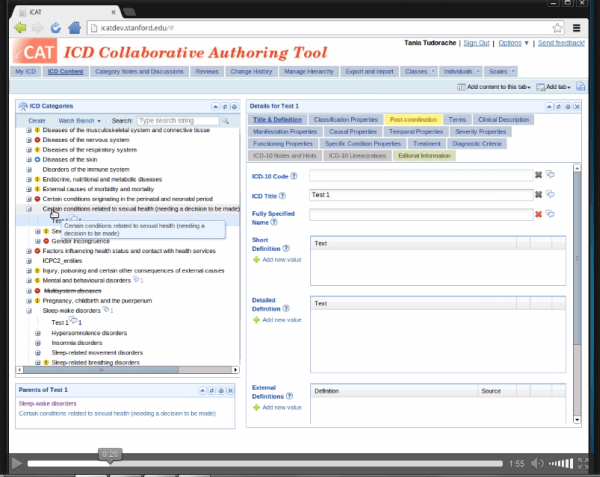
iCAT editing platform 3


In Part Two, I shall be setting out what is currently known about proposals for the classification of Postviral fatigue syndrome, Benign myalgic encephalomyelitis and Chronic fatigue syndrome for ICD-11.

Important caveats: The public Beta platform is not a static document, it is a work in progress, subject to daily editing and revision, to field test evaluation and to approval by the RSG and WHO classification experts. Not all new proposals may survive the ICD-11 field tests. Chapter numbering, codes and “sorting codes” currently assigned to ICD categories are not stable and will change as chapters and parent/child hierarchies are reorganized. The public version of the Beta is incomplete; not all “Content Model” parameters display or are populated; the draft may contain errors and omissions.


Part 2: Status of proposals for the classification of PVFS, BME, and CFS in the public version of the ICD-11 Beta drafting platform published September 30, 2014

Part 3: Status of proposals for the revision of ICD-10’s Somatoform disorders for the core and primary care versions of ICD-11 [to follow]


References for Part 1

1 Committee for the Coordination of Statistical Activities, Twenty-second Session 4-6 September 2013, Items for discussion and decision: Item 8, provisional agenda, pp 8-10: http://unstats.un.org/unsd/accsub/2013docs-22nd/SA-2013-12-Add1-Health-WHO.pdf

2 http://www.who.int/classifications/icd/RSG/en/

3 http://www.who.int/classifications/icd/TAGs/en/

4 http://www.who.int/entity/classifications/TOR_TAGs_WGs.pdf?ua=1

5 Lam TP, Goldberg DP, Dowell AC, Fortes S, Mbatia JK, Minhas FA, Klinkman MS: Proposed new diagnoses of anxious depression and bodily stress syndrome in ICD-11-PHC: an international focus group study. Family Practice (2012) 30 (1): 76-87. Free text: http://fampra.oxfordjournals.org/content/30/1/76.full.pdf+html

6 http://apps.who.int/classifications/icd11/browse/f/en#/

7 http://apps.who.int/classifications/icd11/browse/Help/Get/architecture/en

8 https://dxrevisionwatch.com/wp-content/uploads/2010/10/considerations20on20multisystem_diseases_201008181.doc

9 http://informatics.mayo.edu/WHO/ICD11/collaboratory/attachments/208/19.Multisystem_Diseases_Chapter.v1.2.docx

10 http://www.who.int/classifications/icd/revision/contentmodel/en/

11 http://www.globalclinicalpractice.net/en/

Bodily Distress Syndrome: Coming soon to a GP Management Pilot near you…

Post #264 Shortlink: http://wp.me/pKrrB-3dG

NHS England: Pilot of Enhanced GP Management of Patients with Medically Unexplained Symptoms

NHS Barnet Clinical Commissioning Group

Pilot of Enhanced GP Management of Patients with Medically Unexplained Symptoms
Open full size PDF:

Click link for PDF document  Pilot of Enhanced GP Management of Patients with MUS

or download here:

http://tinyurl.com/k44xg7d

Note the use of the term “Bodily Distress Syndrome (BDS)” despite the lack of a body of evidence to support the validity, reliability, safety and clinical utility of the application of the BSD construct* in primary care.

Note also, the list of illnesses under the definition of “MUS”: Chronic Pain, Fibromyalgia, Somatic Anxiety/Depression, Irritable Bowel Syndrome (IBS), Chronic Fatigue Syndrome (CFS), Myalgic Encephalomyelitis (ME), Post-viral Fatigue Syndrome.

*For information on the Fink et al concept of “Bodily Distress Syndrome” see Part Two of Dx Revision Watch Post: ICD-11 Beta draft and BDD, Per Fink and Bodily Distress Syndrome


Extracts:

22 May 2013

NHS England

PILOT OF ENHANCED GP MANAGEMENT OF PATIENTS WITH MEDICALLY UNEXPLAINED SYMPTOMS

NHS Barnet Clinical Commissioning Group

Background

Medically Unexplained Symptoms

Definition

The term ‘medically unexplained symptoms (MUS)’ are physical symptoms that cannot be explained by organic pathology, which distress or impair the functioning of the patient. Patients often present with physical symptoms that cannot be explained even after thorough investigation. Other terms used to describe this patient group include: Functional Somatic Syndrome (FSS), Illness Distress Symptoms (IDS), Idiopathic Physical Symptoms (IPS), Bodily Distress Syndrome (BDS) and Medically Unexplained Physical Symptoms (MUPS).

Symptoms and Diagnosis

Symptoms

Headache
Shortness of Breath, palpitations
Fatigue, weakness, dizziness
Pain in the back, muscles, joints, extremity pain, chest pain, numbness
Stomach problems, loose bowels, gas/bloating, constipation, abdominal pain
Sleep disturbance, difficulty concentrating, restlessness, slow thoughts
Loss of appetite, nausea, lump in throat
Weight change

Diagnosis

Chronic Pain
Fibromyalgia
Somatic Anxiety/Depression
Irritable Bowel Syndrome
Chronic Fatigue Syndrome
Myalgic Encephalomyelitis
Post-viral Fatigue Syndrome

PROJECT AIMS AND OBJECTIVES

• To pilot a commissioner initiated, enhanced GP management service for patients with MUS in primary care. Refer to Figure 1 for details.

• The pilot will be carried out at selected Barnet GP practices (approximately 15) managing a minimum of 10 patients with MUS over 12 months.

• To identify patients with MUS using an electronic risk stratification tool the ‘Nottingham Tool’ with a review of the generated list at a multidisciplinary (MDT) GP practice meeting for the final patient selection.

• To enhance post-graduate GP training by providing education and training workshops and focused work group meetings on the management of MUS.

• The project will also test the assertion that identification and management of MUS would result in savings to commissioning budgets.

PROJECT OUTCOMES AND BENEFITS

There are several benefits that could be realised from implementing this project. These are as follows:-

• Improved outcomes for patients with MUS, better patient experience

• Improved quality of life

• Improved GP-Patient relationship

• Reduced GP secondary and tertiary referrals

• Reduced unnecessary GP and hospital investigations and prescribing of medicines

• Reduced GP appointments and out of hours appointments to A&E or GP

CONCLUSIONS

There is a high prevalence of patients with medically unexplained symptoms presenting to primary and secondary care services. Patients with MUS are high healthcare service users having a major impact to our local health economy and health outcomes. GPs are well placed to manage MUS patients as this patient group are 50% more likely to attend primary care. We believe that our proposed enhanced management of care by the GP will result in both market and non-market benefits. This proposal has gained approval from the NHS Barnet CCG Primary Care Strategy and Implementation Board, QIPP Board and the NCL Programme Board for the 2013/14 financial year…

etc.

Related material

+++
IAPT NHS Long Term Conditions and Medically Unexplained Symptoms

IAPT NHS Medically Unexplained Symptoms

PHQ-15

The “Nottingham Tool”

Click link for PDF document   Medically Unexplained Symptoms (MUS): A Whole Systems Approach in Plymouth

In partnership with:

Plymouth Hospitals NHS Trust, Sentinel Healthcare Southwest CIC, Southwest Development Centre, September 2009

+++

Click link for PDF document   Medically Unexplained Symptoms (MUS) A whole systems approach
NHS Commissioning Support for London
July 2009 – December 2010

+++

Update on ICD-11 Beta draft: Bodily Distress Disorder

Updates on ICD-11 Beta draft: Bodily Distress Disorder (proposed for ICD-11 Chapter 5: Mental and behavioural disorders); Chronic fatigue syndrome; Postviral fatigue syndrome; Benign myalgic encephalomyelitis (Chapter 6: Diseases of the nervous system)

Post #218 Shortlink: http://wp.me/pKrrB-2Bg

Dr Elena Garralda presentation slides:

http://www.rcpsych.ac.uk/pdf/Garralda%20E.pdf

or open here: Click link for PDF document    Garralda presentation Somatization in Childhood

Slide 1

Somatization in childhood

The child psychiatrist’s concern?

Elena Garralda

CAP Faculty Meeting, RCPsych Manchester, September 2012

Slide 11

New ICD-11 and DSM-V classifications

. Somatoform disorders >>>
– Bodily distress syndrome (ICD-11)
– Complex Somatic symptom disorder (DSM-V)

[Preceded by downward pointing arrow]

“Unexplained” or “functional” medical symptoms (CFS, fibromyalgia, irritable bowel syndrome)

[Preceded by upward pointing arrow]

Physical complaint (s)
with subjective distress/preoccupation ++,
illness beliefs impairment
health help seeking

+++

Notes on ICD-11 Beta drafting platform and DSM-5 draft by Suzy Chapman for Dx Revision Watch:

These notes may be reposted, if reposted in full, source credited, link provided, and date of publication included.

January 6, 2013

1] The publicly viewable version of the ICD-11 Beta drafting platform can be accessed here:
Foundation view: http://apps.who.int/classifications/icd11/browse/f/en
Linearization view: http://apps.who.int/classifications/icd11/browse/l-m/en

2] The various ICD-11 Revision Topic Advisory Groups are developing the Beta draft on a separate, more complex platform accessible only to ICD-11 Revision.

3] The ICD-11 Beta draft is a work in progress and not scheduled for completion until 2015/16. When viewing the public version of the Beta draft please note the ICD-11 Revision Caveats. Note also that not all proposals may be retained following analysis of the field trials for ICD-11 and ICD-11-PCH, the abridged Primary Care version of ICD-11:
http://apps.who.int/classifications/icd11/browse/Help/Get/caveat/en

4] The Bodily Distress Disorders section of the ICD-11 Beta draft Chapter 5 can be found here:
http://apps.who.int/classifications/icd11/browse/f/en#/http%3a%2f%2fwho.int%2ficd%23F45
http://apps.who.int/classifications/icd11/browse/l-m/en#/http%3a%2f%2fwho.int%2ficd%23F45

According to the public version of the ICD-11 Beta drafting platform, the existing ICD-10 Somatoform Disorders are currently proposed to be replaced with Bodily Distress Disorders, and Psychological and behavioural factors associated with disorders or diseases classified elsewhere, not with Bodily distress syndrome as Dr Garralda has in her slide presentation.

The following proposed ICD-11 categories are listed as child categories under parent, Bodily Distress Disorders, and Psychological and behavioural factors associated with disorders or diseases classified elsewhere:

EC5 Mild bodily distress disorder
EC6 Moderate bodily distress disorder
EC7 Severe bodily distress disorder
EC8 Psychological and behavioural factors associated with disorders or diseases classified elsewhere

There are no Definitions nor any other descriptors populated for the proposed, new ICD categories EC5 thru EC7.

EC8 is a legacy category from ICD-10 and has some populated content imported from ICD-10.

+++
These earlier ICD-11 Beta draft Somatoform Disorders categories appear proposed to be eliminated and replaced with the four new categories EC5 thru EC8, listed above:

Somatization disorder [F45.0 in ICD-10]
Undifferentiated somatoform disorder [F45.1 in ICD-10]
Somatoform autonomic dysfunction [F45.3 in ICD-10]
Persistent somatoform pain disorder [F45.4 in ICD-10]
    > Persistent somatoform pain disorder
    > Chronic pain disorder with somatic and psychological factors [Not in ICD-10]
Other somatoform disorders [F45.8 in ICD-10]
Somatoform disorder, unspecified [F45.9 in ICD-10]

5] The existing ICD-10 Chapter V category Neurasthenia [ICD-10: F48.0] is no longer accounted for in the public version of the ICD-11 Beta draft. I have previously reported that for ICD-11-PHC, the Primary Care version of ICD-11, the proposal is to eliminate the term Neurasthenia.

(I cannot confirm whether the currently omission of Neurasthenia from the Beta draft is due to oversight or because ICD-11 Revision’s intention is that Neurasthenia is also eliminated from the main ICD-11 classification.)

+++
6] I have previously reported that for ICD-11-PHC, the abridged, Primary Care version of ICD-11, the proposal, last year, was for a disorder section called Bodily distress disorders, under which would sit Bodily stress syndrome [sic].

This category is proposed for ICD-11 Primary Care version to include “milder somatic symptom disorders” as well as “DSM-5’s Complex somatic symptom disorder” and would replace “medically unexplained somatic symptoms.”

7] Dr Garralda lists Complex Somatic symptom disorder (DSM-V) on Slide 11 of her presentation.

The manual texts for the next edition of DSM are in the process of being finalized for a projected release date of May 2013. The next edition of DSM will be published under the title DSM-5 not DSM-V . The intention is that once published, updates and revisions to DSM-5 will be styled: DSM-5.1, DSM-5.2 etc.

When the third draft of DSM-5 was released in May 2012, the proposal was to merge Complex Somatic Symptom Disorder with Simple Somatic Symptom Disorder and to call this hybrid category Somatic Symptom Disorder.

This would mean that this new disorder has the same name as the overall disorder section it sits under, which replaces DSM-IV’s Somatoform Disorders.

As any subsequent changes to draft criteria sets following closure of the third stakeholder review are embargoed, I cannot confirm whether the SSD Work Group has decided to rename this category to Somatic symptom Disorder or retain the original term, Complex Somatic Symptom Disorder, the term used by Dr Garralda in her presentation.

+++
8] Turning from ICD-11 Beta draft Chapter 5 Mental and behavioural disorders to Chapter 6 Diseases of the nervous system:

As previously reported, Chronic fatigue syndrome is listed under Diseases of the nervous system in the Foundation View. There is no listing for Chronic fatigue syndrome in the Linearization View nor is the term listed in the PDF for Chapter 6, that is available to those who are registered with ICD-11 Beta draft for access to additional content:

http://apps.who.int/classifications/icd11/browse/f/en#http%3a%2f%2fwho.int%2ficd%23G93.3

Documentation from the ICD-11 iCAT Alpha draft dating from May 2010, implies that the intention for ICD-11 is a change of hierarchy for the existing ICD-10 Title term Postviral fatigue syndrome.

In the ICD-11 Beta draft, Chronic fatigue syndrome (which was listed only within the Index volume of ICD-10 and not listed in Volume 2: The Tabular List) appears to be elevated to ICD Title term status, with potentially up to 12 descriptive parameters yet to be completed and populated in accordance with the ICD-11 “Content Model”.

But the current proposed hierarchical relationship between PVFS and CFS for ICD-11 remains unconfirmed.

See image for documentation from the iCAT Alpha drafting platform, from May 2010:

https://dxrevisionwatch.com/wp-content/uploads/2010/06/change-history-gj92-cfs.png

There is no discrete ICD Title term displaying for Postviral fatigue syndrome in either the ICD-11 Beta Foundation View or Linearization View.

Neither is there any discrete ICD Title term displaying for Benign myalgic encephalomyelitis in either the Foundation View or Linearization View.

Benign myalgic encephalomyelitis appears at the top of a list of terms under “Synonyms” in the CFS description. [The hover text over the asterisk at the end of “Benign myalgic encephalomyelitis” reads, “This term is an inclusion term in the linearizations.”]

Postviral fatigue syndrome is also listed under “Synonyms” along with a number of other terms imported from other classification systems.

Included in this list under “Synonyms” are “chronic fatigue syndrome nos” and “chronic fatigue, unspecified,” both of which appear to have been sourced from the as yet to be implemented, US specific, ICD-10-CM.

+++
At some recent, unspecified date, a Definition has been inserted for ICD-11 Title term Chronic fatigue syndrome into the previously empty Definition field. An earlier Definition was removed when the Alpha draft was replaced with the Beta draft but can be seen in this screenshot, here, from June 2010:

https://dxrevisionwatch.com/wp-content/uploads/2010/05/2icatgj92cfsdef.png

The current Definition reads (and be mindful of the ICD-11 Caveats):

“Chronic fatigue syndrome is characterized by extreme chronic fatigue of an indeterminate cause, which is disabling andt [sic] does not improve with rest and that is exacerbated by physical or mental activity.”

There are no Definition fields for Benign myalgic encephalomyelitis or Postviral fatigue syndrome as these terms are listed under “Synonyms” to ICD-11 Title term, Chronic fatigue syndrome.

+++
Since one needs to be mindful of the ICD-11 Caveats and as the Chair of Topic Advisory Group for Neurology has failed to respond to a request for clarification of the intention for these three terms and the proposed ICD relationships between them, I am not prepared to draw any conclusions from what can currently be seen in the Beta drafting platform.

I shall continue to monitor the Beta draft and report on any significant changes.

For definitions of “Synonyms,” “Inclusions,” “Exclusions” and other ICD-11 terminology see the iCAT Glossary:
http://apps.who.int/classifications/apps/icd/icatfiles/iCAT_Glossary.html

+++
Related material:

http://www.rcpsych.ac.uk/pdf/8%20Ash%20IC2012.pdf

Presentation slides: Medically Unexplained Symptoms pages

Dr Graham Ash, Lancashire Care NHS Foundation Trust

Website pages featured in the slide presentation:

Medically Unexplained Symptoms

http://www.rcpsych.ac.uk/expertadvice/improvingphysicalandmh/aboutthissite.aspx

Dx Revision Watch Post, June 26, 2012: ICD-11 Beta drafting platform: Update (2): Neurasthenia, Postviral fatigue syndrome (PVFS), Benign myalgic encephalomyelitis (ME), Chronic fatigue syndrome (CFS), Fibromyalgia (FM), Irritable bowel syndrome (IBS): http://wp.me/pKrrB-2mC

Summary: September 19 ICD-9-CM Coordination and Maintenance Committee Meeting

Summary: September 19 ICD-9-CM Coordination and Maintenance Committee Meeting

Post #205 Shortlink: http://wp.me/pKrrB-2vc  

The September meeting of the ICD-9-CM Coordination and Maintenance Committee, jointly chaired by CMS and CDC, took place on September 19, 2012.

For further information on this public process see the CDC website page:

http://www.cdc.gov/nchs/icd/icd9cm_maintenance.htm

+++

Meeting Summary document

The meeting Summary document has now been published.  The audio is not yet available.

The Summary document can be downloaded here:

September 19, 2012

Summary (10 pages) [PDF – 59 KB]

http://www.cdc.gov/nchs/data/icd9/2012_September_Summary.pdf

or opened in PDF format here:     Summary September 19 2012

+++

The Proposals and Agenda document can be downloaded here:

http://www.cdc.gov/nchs/icd/icd9cm_maintenance.htm#meeting_materials

ICD-9-CM Coordination and Maintenance Committee Meeting

September 19, 2012

Proposals (74 pages) [PDF – 730 KB]

http://www.cdc.gov/nchs/data/icd9/Topic_packet_for_September_19_2012.pdf

or opened in PDF format here:     Topic packet for September 19 2012

According to the Summary document, the deadline for receipt of public comments on proposals submitted at this meeting is November 16, 2012. If there is any change to this date, I will update.

Comments on proposals presented at the ICD-9-CM Coordination and Maintenance Committee meeting should be sent to the following email address: nchsicd9CM@cdc.gov. See Page One of the Summary document for important information on submission of public comment.

Extract, Summary document

Chronic fatigue syndrome

Andreas Kogelnik, MD, representing the Coalition 4 ME/CFS, was available via telephone to address questions and clinical concerns.

Lori Chapo-Kroger, representing the Coalition 4 ME/CFS, expressed that many nations, and the World Health Organization, put CFS at G93 in ICD-10, and that this would include everyone but the U.S.

Mary Dimmock, representing the Coalition 4 ME/CFS, questioned why the change must wait until after 2014 when they feel that this is an error in the classification right now (and has been since 2001).

Dr. Kogelnik indicated that the term myalgic encephalomyelitis is used in Europe while the U.S. continues to use the term chronic fatigue syndrome, and that the Coalition 4 ME/CFS considers these two conditions (CFS and ME) to be the same. That is why they want both terms included in the same code.

Nelly Leon-Chisen, AHA, noted support for a need for a code for chronic fatigue syndrome distinct from chronic fatigue, unspecified. She indicated also that with the cause being unknown it is better that the classification not be locked into placing CFS as a viral code. Also, if there is no consensus for ME and CFS being the same then it makes sense to keep them as two separate codes. If research later develops that says they are the same then the data can be aggregated together. However, if the research does not show this, then you don’t have them lumped into one code that does not allow you to separate out one from the other.

Sue Bowman, AHIMA, questioned counting all CFS as following a virus infection. She expressed a need for clinical consensus on this condition. Also, she stated that she did not see a rationale for an early change (before 2014).

+++

Note: Dx Revision Watch has no connection with the Coalition 4 ME/CFS or with the development of any proposals submitted by this organization. The views and opinions expressed in Coalition 4 ME/CFS submissions to ICD-9-CM  Coordination and Maintenance Committee meetings represent the views of the Coalition 4 ME/CFS and its representatives and not the views of Dx Revision Watch.

All enquiries about proposals submitted to CMS/CDC on behalf of the Coalition 4 ME/CFS should be addressed directly to the Coalition 4 ME/CFS.

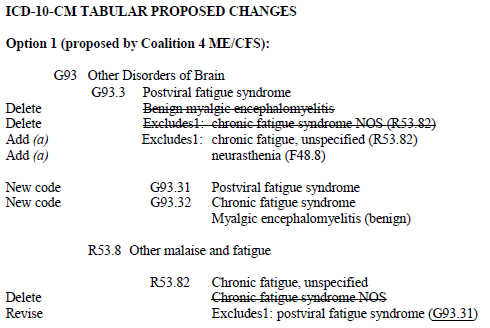
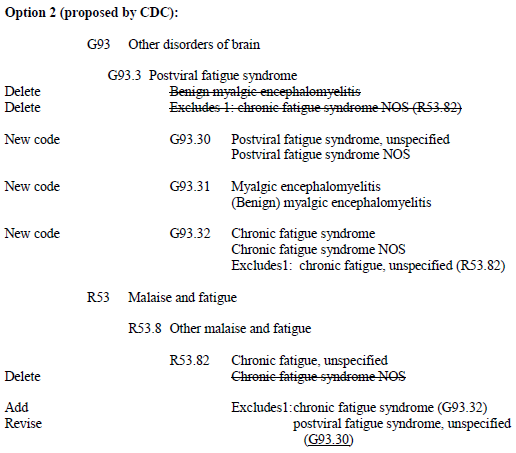
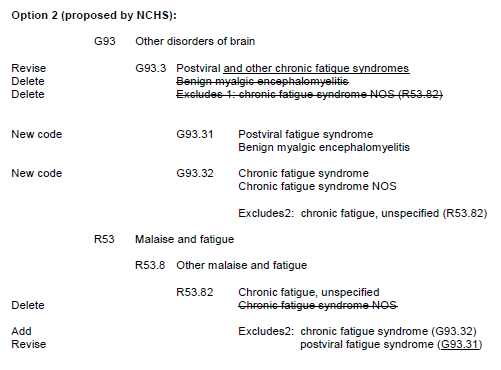
Note also that the proposal from the Coalition 4 ME/CFS (Option 1) and the alternative proposal presented by CMS/CDC (Option 2) at the September meeting are set out in accordance with the requirements of the ICD-9-CM Coordination and Maintenance Committee for the submission of proposals. 

For Options 1 and Option 2 see post Proposals: September 19 ICD-9-CM Coordination and Maintenance Committee Meeting or Proposals document Topic packet for September 19 2012

+++

Related posts:

Proposals: September 19 ICD-9-CM Coordination and Maintenance Committee Meeting

Coding CFS in ICD-10-CM: CFSAC and the Coalition4ME/CFS initiative

Extracts: ICD-9-CM Coordination and Maintenance Committee Meeting Summary document (CFS coding)

Extracts: ICD-9-CM Coordination and Maintenance Committee Meeting September 14, 2011 (Coding of CFS in ICD-10-CM)

Proposals: September 19 ICD-9-CM Coordination and Maintenance Committee Meeting

Proposals: September 19 ICD-9-CM Coordination and Maintenance Committee Meeting

Post #204 Shortlink: http://wp.me/pKrrB-2uL

The next meeting of the ICD-9-CM Coordination and Maintenance Committee, which is jointly chaired by CMS and CDC, takes place on September 19, 2012. 

There is a very full agenda for this meeting. The meeting materials Proposals document has now been published.

For further information on this public process see the CDC website page:

http://www.cdc.gov/nchs/icd/icd9cm_maintenance.htm

+++

The Proposals and Agenda document can be downloaded here:

http://www.cdc.gov/nchs/icd/icd9cm_maintenance.htm#meeting_materials

ICD-9-CM Coordination and Maintenance Committee Meeting

September 19, 2012

Proposals (74 pgs) [PDF – 730 KB]

http://www.cdc.gov/nchs/data/icd9/Topic_packet_for_September_19_2012.pdf

or opened in PDF format here:      Topic packet for September 19 2012

Note: I have no connection with the Coalition 4 ME/CFS or with the development of any proposals submitted by this organization. All enquiries about the proposal submitted to CMS/CDC on behalf of the Coalition 4 ME/CFS should be addressed directly to the Coalition 4 ME/CFS.

Note also that the proposal from the Coalition 4 ME/CFS and the alternative proposal from CMS/CDC are set out in accordance with the requirements of the ICD-9-CM C & M Committee for the submission of proposals.

+++

Coding of CFS in the forthcoming US specific ICD-10-CM

At the ICD-9-CM Coordination and Maintenance Committee’s September 14, 2011 meeting, a presentation had been made on behalf of the Coalition 4 ME/CFS in relation to the formal submission of a proposal.

The proposal requested that consideration be given to moving the classification of Chronic fatigue syndrome from its current proposed location within the ICD-10-CM R code chapter (Chapter 18: Symptoms and signs) to the G code chapter (Chapter 6: Diseases of the nervous system).

This would bring the chapter location of Chronic fatigue syndrome in ICD-10-CM in line with the international version of ICD-10, the Canadian ICD-10-CA and proposals for the forthcoming ICD-11.

No NCHS decision reached in response to the September 2011 proposals and the public comments received in respect of these proposals was conveyed following closure of the public comment period, last November.

However, further discussion of Chronic fatigue syndrome and two additional proposals are tabled on the agenda for discussion at the September 19, meeting, tomorrow.

I am appending the relevant extract from the Diagnosis Agenda and Proposals document which was published on the CDC  website overnight. An official audio and a Summary of the meeting should be available in due course on the CDC website. I will update with these when available.

+++

Extract Topic packet for September 19 2012 (Page 46)

[…]

Chronic fatigue syndrome

Andreas Kogelnik, M.D., Coalition 4 ME/CFS

Chronic fatigue syndrome

A proposal, submitted by the Coalition 4 ME/CFS, to modify codes for chronic fatigue syndrome (CFS) was presented and discussed at the September 2011 ICD Coordination and Maintenance Committee meeting. The National Center for Health Statistics also presented an alternative proposal, Option 2. There were many comments from the audience, and there was general support for the NCHS-proposed Option 2, moving CFS from Chapter 18, Symptoms, signs and abnormal clinical findings, not elsewhere classified, to Chapter 6, Diseases of the Nervous System but retaining separate codes for CFS and myalgic encephalomyelitis (ME). The rationale for retaining separate codes included agreement on the importance of being able to extract data on the two conditions separately or combine, as needed. It was also noted that term ME is not seen in medical record documentation. Written comments received on this issue were inconclusive. There was not agreement that the two conditions are the same. While some comments were from private citizens, others were from advocacy organizations and associations that represent health care providers and other large constituencies that use the classification. The public comment period following the meeting is not meant as a poll or survey. Analysis of public comment focused on the substance of the comments; whether there was a clear scientific consensus regarding the etiology and manifestations of the condition; and an understanding of the classification, its structure and conventions, and its uses by the health care industry.

As noted in the information from the September 2011 presentation, the cause or causes of CFS remain unknown, despite a vigorous search. While a single cause for CFS may yet be identified, another possibility is that CFS represents a spectrum of illnesses resulting from multiple possible pathways. Conditions that have been proposed to trigger the development of CFS include infections, trauma, immune dysfunction, stress, and exposure to toxins. Research in this area is ongoing.

There are several case definitions currently in use, some separating CFS from ME, and others merging the two conditions. The most widely used are the 1994 case definition (http://www.cdc.gov/cfs/case-definition/index.html ), the Canadian and the Oxford definitions. A new case definition for ME was published in the 2011 international consensus criteria that emphasized recent research and clinical experience that strongly point to widespread inflammation and multisystem symptoms and neuropathology. This new definition, which considers ME and CFS as synonymous terms, however, has not been widely vetted by the health care community at large. While there is no consensus on one case definition, there is consensus that this is a serious and complex syndrome, and it is likely that there are multiple subgroups. It has been noted that some providers use the terms interchangeably while others consider one condition a subgroup of the other. There is also some overlap with fibromyalgia and CFS/ME could be considered one of the multiple chronic overlapping pain conditions.

References

1. Fukuda et al. Ann Intern Med (1994) 121:953-959
(http://www.cdc.gov/cfs/case-definition/1994.html )
2. Holmes et al. Ann Intern Med (1988) 108:387-389.
3. Sharpe et al. J Roy Soc Med (1991) 84:118-121
4. Carruthers et al. J CFS (2003) 11:7-97
5. Carruthers et al.. J Intern Med (2011) 270: 327-38.

The Coalition 4 ME/CFS has stated that they do not support Option 2 proposed in September 2011 and have submitted a revised proposal. A revised Option 2 is also being proposed, consistent with comments received supporting Option 2 as noted above. The Coalition is also requesting that their proposal be considered for implementation prior to October 1, 2014 even though the condition is not a new disease and therefore does not meet the criteria for implementation during the partial freeze.

Based on the above, the following proposals for consideration are:

+++

+++
For comparison, the proposal that had been presented by CDC at the September 2011 meeting in counterpoint to an earlier proposal presented by the Coalition 4 ME/CFS at that same meeting was this:


Instead of Title term G93.3 Postviral and other chronic fatigue syndromes (CDC Option 2, September 2011)

CDC suggests retaining the Title term G93.3 Postviral fatigue syndrome (CDC Option 2, September 2012).

+++
Instead of Child category G93.31 Postviral fatigue syndrome, Benign myalgic encephalomyelitis

CDC is now suggesting two categories for Postviral fatigue syndrome, thus:

G93.30 Postviral fatigue syndrome, unspecified, Postviral fatigue syndrome NOS (not otherwise specified)

with a discrete Child category G93.31 Myalgic encephalomyelitis, Benign myalgic encephalomyelitis.

+++
No suggested change to the September 2011 CDC Option 2 suggestion for Child categories:

G93.32 Chronic fatigue syndrome, Chronic fatigue syndrome NOS.

The+++

Related posts:

Coding CFS in ICD-10-CM: CFSAC and the Coalition4ME/CFS initiative

Extracts: ICD-9-CM Coordination and Maintenance Committee Meeting Summary document (CFS coding)

Extracts: ICD-9-CM Coordination and Maintenance Committee Meeting September 14, 2011 (Coding of CFS in ICD-10-CM)

Notice of Meeting of the ICD-9-CM Coordination and Maintenance Committee

Notice of Meeting of the ICD-9-CM Coordination and Maintenance Committee

Post #201 Shortlink: http://wp.me/pKrrB-2tv

Update at August 18:

CMS meeting to address more ICD-10 issues  Round up from Carl Natale for ICD10 Watch

September ICD-9-CM C & M meeting announced

The next meeting of the ICD-9-CM Coordination and Maintenance Committee has been announced for September 19, 2012 and a tentative agenda published.

For further information on this public process see the CDC website page:

The 2013 release of ICD-10-CM is available to download from the CDC site: International Classification of Diseases, Tenth Revision, Clinical Modification (ICD-10-CM)

ICD-9-CM Coordination and Maintenance Committee

Upcoming meeting: September 19, 2012

    Tentative Agenda

Html: Federal Register Notice of Meeting of ICD-9-CM Coordination and Maintenance Committee

A Notice by the Centers for Disease Control and Prevention

Notice of Meeting of the ICD-9-CM Coordination and Maintenance Committee

The National Center for Health Statistics (NCHS), Classifications and Public Health Data Standards Staff announces the following meeting:

Name: ICD-9-CM Coordination and Maintenance (C&M) Committee meeting.

Time and Date: 9 a.m.-5 p.m., September 19, 2012.

Place: Centers for Medicare and Medicaid Services (CMS) Auditorium, 7500 Security Boulevard, Baltimore, Maryland 21244.

Status: Open to the public, limited only by the space available. The meeting room accommodates approximately 240 people.

Security Considerations: Due to increased security requirements CMS has instituted stringent procedures for entrance into the building by non-government employees. Attendees will need to present valid government-issued picture identification, and sign-in at the security desk upon entering the building. Attendees who wish to attend a specific ICD-9-CM C&M meeting on September 19, 2012, must submit their name and organization by September 10, 2012, for inclusion on the visitor list. This visitor list will be maintained at the front desk of the CMS building and used by the guards to admit visitors to the meeting.

Participants who attended previous ICD-9-CM C&M meetings will no longer be automatically added to the visitor list. You must request inclusion of your name prior to each meeting you attend.

Please register to attend the meeting on-line at: http://www.cms.hhs.gov/apps/events/.Show citation box

Please contact Mady Hue (410-786-4510 or Marilu.hue@cms.hhs.gov ), for questions about the registration process.

Matters To Be Discussed: Tentative agenda items include: September 19, 2012.

ICD-10 Topics:
ICD-10 Implementation Announcements
Expansion of Thoracic Aorta Body Part Under Heart and Great Vessels System
Addendum Issues (Temporary Therapeutic Endovascular Occlusion of Vessel, changing body part from thoracic aorta to abdominal aorta)
ICD-10MS-DRGs
ICD-10HAC Translations
ICD-10MCE Translations

ICD-10-CM Diagnosis Topics:
Age related macular degeneration
Bilateral mononeuropathy
Bilateral option for cerebrovascular codes
Chronic Fatigue Syndrome
Complications of urinary devices
Diabetic macular edema
Food Protein Induced Enterocolitis Syndrome (FPIES)
Maternal care for previous Cesarean section/previous uterine incision
Metatarsus varus (congenital metatarsus adductus)
Microscopic colitis
Mid-cervical region and coding of spinal cord injuries
Multifocal motor neuropathy
Parity to supervision of pregnancy codes
Proliferative diabetic retinopathy
Retinal vascular occlusions
Salter Harris fractures
Sesamoiditis
Shin splints
Spontaneous rupture/disruption of tendon

Agenda items are subject to change as priorities dictate.

Note:

CMS and NCHS will no longer provide paper copies of handouts for the meeting. Electronic copies of all meeting materials will be posted on the CMS and NCHS Web sites prior to the meeting at http://www.cms.hhs.gov/ICD9ProviderDiagnosticCodes/03_meetings.asp#  and http://www.cdc.gov/nchs/icd/icd9cm_maintenance.htm

Contact Persons for Additional Information: Donna Pickett, Medical Systems Administrator, Classifications and Public Health Data Standards Staff, NCHS, 3311 Toledo Road, Room 2337, Hyattsville, Maryland 20782, email dfp4@cdc.gov :, telephone 301-458-4434 (diagnosis); Mady Hue, Health Insurance Specialist, Division of Acute Care, CMS, 7500 Security Boulevard, Baltimore, Maryland 21244, email marilu.hue@cms.hhs.gov , telephone 410-786-4510 (procedures).

The Director, Management Analysis and Services Office, has been delegated the authority to sign Federal Register notices pertaining to announcements of meetings and other committee management activities, for both the Centers for Disease Control and Prevention, and the Agency for Toxic Substances and Disease Registry.

Dated: August 9, 2012.

Catherine Ramadei,

Acting Director, Management Analysis and Services Office, Centers for Disease Control and Prevention.

[FR Doc. 2012-20019 Filed 8-14-12; 8:45 am]

BILLING CODE 4160-18-P

(c) 2012 US Federal Register

+++
Related posts:

At the ICD-9-CM Coordination and Maintenance Committee’s September 14, 2011 meeting, a presentation was made on behalf of the Coalition 4 ME/CFS in relation to the formal submission of a proposal that consideration be given to moving the classification of Chronic fatigue syndrome from its current proposed location within the ICD-10-CM R code chapter (Chapter 18: Symptoms and signs) to the G code chapter (Chapter 6: Diseases of the nervous system).

This would bring chapter location and parent class coding of Chronic fatigue syndrome in line with the international version of ICD-10, published in 1990, the Canadian ICD-10-CA and proposals for the forthcoming ICD-11.

No decision in response to the proposal, meeting discussions and public comment received has been conveyed following closure of the public comment period. Further discussion of Chronic fatigue syndrome has been tabled on the tentative agenda for the September 19, 2012 meeting.

I will post Summary documents and other relevant meeting materials as these become available. There are three posts on Dx Revision Watch that relate to and report on the presentation at the September 14, 2011 meeting:

Coding CFS in ICD-10-CM: CFSAC and the Coalition4ME/CFS initiative

Extracts: ICD-9-CM Coordination and Maintenance Committee Meeting Summary document (CFS coding)

Extracts: ICD-9-CM Coordination and Maintenance Committee Meeting September 14, 2011 (Coding of CFS in ICD-10-CM)